



Abstract
The widespread globalisation, democratisation and decentralisation process that took place in developing nations in the early 1990s created unique opportunities for subnational governments to play an important role in delivering developmental outcomes. Revitalising regional and local economies is one important mandate that emerged with the decentralisation process as a key function for local governments. However, the local government sphere in South Africa faces failures in driving regional and local economic development due to various institutional and market-related challenges. Against the failure of decentralised entities to drive regional and local economic development in South Africa, this article considers the utilisation of deconcentration through dedicating national administrative powers and resources to the regional level to revitalise the prospects of local economies. The article argues that there are better prospects for regional and local economic development through deconcentration due to the expertise, resources and capacities found within the national and provincial governments, as they receive a significant share of the national division of revenues. The article further demonstrates how deconcentration can be implemented through the state deconcentrating and managing its economic development functions at the regional level to municipal-owned district economic development entities tasked with stimulating regional economic development.
Keywords
Introduction
Decentralisation and democratisation processes have led to a structural shift in the role of the state in emerging and developing nations. While decentralisation led to the devolution of state power from central governments to subnational governments, democratisation resulted in the mass inclusion of citizens in decision-making and in electing their local authorities (Faguet, 2014; Grindle, 2007; United Cities and Local Government, 2013). The decentralisation theory holds that the proximity of the local government to local communities yields better service delivery and improved governance (Faguet, 2014; Hart and Welham, 2016). This assumption follows the argument that centralised governments are too far removed from the citizens and are unable to efficiently deliver public goods or understand the needs of the citizens (Monkam, 2014). Despite the decentralisation theory’s promises of improved services and accountability, decentralisation has yet to yield the necessary impact in many developing nations due to incapacities by local governments to deliver essential services and developmental outcomes (UCLG, 2013).
In South Africa, decentralisation emerged with the dawn of the democratic dispensation, which also saw the abandonment of the statist and welfarist Reconstruction Development Programme (RDP) as the main macroeconomic policy for a market-centred approach in the Growth Employment and Redistribution (GEAR) programme in 1996 (Khambule and Gerwel-Proches, 2019; Nash, 2002). Whereas the RDP emphasised the central role of the state in determining economic direction, GEAR emphasised the need to delink the state through deregulation, liberalisation and privatisation (Bond, 2000). Market decentralisation as a vital component of the decentralisation process promotes a strong role for the private sector in delivering public goods, thereby privatising the role of the state. GEAR and decentralisation policies came at the expense of the RDP’s social welfare posture, marginalised people’s developmental needs by undermining redistribution, and contributed to rising poverty and inequality across all levels in South Africa (Bond, 2000). These adverse developmental challenges have been aggravated by the inefficiencies and inabilities of the local government sphere to deliver social and economic developmental outcomes.
While central states coordinate economic development at the national level, decentralisation emphasises the important role of local governments in coordinating and planning for regional and local economic development (RLED). As such, RLED emerged as a vital component of the globalisation and decentralisation process, with a critical focus on local governments using their competitive advantages to tap into their economic potential and create job opportunities (Rodríguez-Pose and Wilkie, 2017). However, many subnational governments in South Africa and other developing nations continue to struggle to make RLED work due to an inability to plan for development, a lack of capacity, a poor understanding of local economies, as well as a lack of coordination between the central state and local state (Meyer, 2014; Nel and Rogerson, 2016). The failure to plan and make RLED work undermines the ability of the country to respond to the ongoing economic challenges. These failures reveal the pitfalls of decentralisation, as local governments in developing regions are mostly unprepared and lack the necessary institutional capacity found within central states to coordinate economic development.
Against the persistent failure of decentralised entities to deliver social and economic development outcomes in developing nations, this article aims to assess the possible utilisation of deconcentration as a model for improving RLED prospects to address South Africa’s adverse socio-economic conditions. The country faces an economic crisis with a 29% unemployment rate and a 55% poverty rate, which are exacerbated by slow economic growth (Statistics South Africa, 2019). This crisis requires the immediate intervention of the central state in supporting the revitalisation of regional and local economies, to ensure that the billions of investments secured by President Ramaphosa meet a local state capable of coordinating economic development. As such, deconcentration is modelled in support of the country’s new District Development Model, launched by the President in 2019, which aims to improve the impact and coherence of the local government sphere in delivering social and economic developmental services through the district and metropolitan municipalities (Department of Planning, Monitoring and Evaluation, 2019).
Methodologically, the assessment is tested upon existing literature on uneven capacities in the national, provincial and local government spheres in South Africa. It is further supplemented by literature on the successful utilisation of deconcentration in Indonesia to mitigate subnational incapacities. This development model is different from the fully decentralised service delivery model through local municipalities as the forefront of RLED, which has invariably failed to deliver developmental outcomes. A primary focus of this article is therefore on how the deconcentration of economic development functions to regions (districts) might improve RLED outcomes with the support of the national capacity and resources to respond to economic development challenges. This kind of deconcentration is envisaged through Local municipal-owned regional economic development entities (Local Economic Development Agencies) as appropriate vehicles due to their status as regional (district) economic development drivers.
An overview of decentralisation
The decentralisation of state power remains highly contested in the political and development space because of its origins. Decentralisation refers to the transfer of political, administrative and fiscal powers from central governments to regional and local governments (Faguet, 2014). Decentralisation is often not a result of the political will of the political leadership, but is rather due to complex political reasons (Hart and Welham, 2016). The foremost reason behind decentralisation is international macro-economic pressure from global financial institutions such as the World Bank and the International Monetary Fund (Baccaro and Papadakis, 2009). This pressure was evident in the imposition of the Washington Consensus, which forced developing nations to ‘delink, to reduce themselves, to stabilise the economy, to privatise the economy, to engage in “good governance”, to democratise themselves and society, to create an “enabling environment” for the private sector, etc.’ (Mkandawire, 2001: 293). Contrary to the idea of ‘consensus’, these policies were implemented grudgingly and undermined the structural challenges that faced many African countries (Kahn, 2004).
For decentralisation proponents, the foremost reasons to decentralise are to improve governance, participation and accountability, as well as to bring better services to the citizens (Faguet, 2014; Monkam, 2014). Countries such as Bolivia, Peru and Kenya decentralised as a means of responding to political and economic crises and pressure, while South Africa, Brazil and Mexico decentralised to create inclusive and democratic societies in response to previous central and authoritarian regimes that were not close enough to constituents (Faguet, 2014; Grindle, 2007; Hart and Welham, 2016). For some of these countries, decentralisation was recommended by the IMF and the World Bank to institutionalise democracy through local governments and ensure efficiency in delivering vital developmental services. Central to this mandate is the argument that subnational governments have an essential role to play in addressing the socio-economic challenges facing developing nations (World Bank, 2014). This argument is promoted by the view that local authorities are found deep within the social, political and economic structures of communities and can generate better responses to their socio-economic challenges. For proponents of the decentralisation theory, the proximity of subnational governments to the citizens improves accountability, responsiveness and service delivery (Grindle, 2007).
Decentralisation is underpinned by three interrelated components in accordance with the mandate of improving service delivery and accountability. These three components are political, administrative and fiscal decentralisation (Gadenne and Singhal, 2014; Hart and Welham, 2016). Political decentralisation is the transfer of political power through the provision of a locally elected subnational government that has its own authority within its territory or jurisdiction (Faguet, 2014; Grindle, 2007). At the heart of political decentralisation is the criticism that centralised governments lack accountability as they are far removed from the citizens. The proximity between local authorities and citizens is argued to promote accountability, efficiency, effectiveness and transparency. Despite these assumptions, accountability in developing nations has regressed due to local authorities failing to be accountable to citizens. Countries such as Mexico and South Africa are experiencing a rise in political interference and competition for the management of resources. This competition often results in political assassinations among local authorities competing for the control of local resources (Calderón, 2018; De Haas, 2016). Factors such as corruption, inefficiencies, maladministration, mismanagement and local government incapacities undermine the ability of local governments to fulfil their developmental mandate.
Administrative decentralisation is the second component of the decentralisation theory, which refers to the ‘hierarchical and functional distribution of powers and functions between central and non-central units’ (Cohen and Peterson, 1999: 2). Administrative decentralisation involves functional assignment, which refers to central government deciding which functions to decentralise to subnational governments. The leading argument for administrative decentralisation is that subnational governments will improve service delivery by being responsive and proactive to the needs of citizens (Hart and Welham, 2016). Some authors (Bahl and Martinez-Vazquez, 2013; World Bank, 2014) argue that subnational governments are rooted in local active citizenship and are therefore better informed about the needs of the citizens as compared to centralised states. Decentralisation has yielded mixed results, with developed nations recording positive results, and developing and underdeveloped countries yielding negative outcomes (Channa and Faguet, 2016; Gadenne and Singhal, 2014). The results have also been mixed in terms of urban and rural settings, with urban areas recording improvements in service delivery, while rural regions record poor performance (Monkam, 2014; The Presidency, 2015). The institutional capacity of local governments to deliver on their functions remains the determinant factor with regard to whether decentralisation succeeds or fails. These observations explain why developing and underdeveloped nations that have capacity deficits tend to have weak and underperforming subnational governments.
The third component, fiscal decentralisation, refers to the delegation of financial powers, such as expenditure, local tax and revenue collection, to subnational governments. Fiscal decentralisation ‘emphasises the devolution of expenditure responsibilities and revenue powers’ to subnational governments (Monkam, 2014: 275). It is essential that local governments be assigned with functions that are allocated necessary financial resources to optimise service delivery (Hart and Welham, 2016). This is because subnational revenues play an important role in determining the ability and efficiency of subnational governments to deliver on their developmental outcomes. A key barrier to fiscal decentralisation has been the limited revenue bases for subnational governments, as most decentralised governments depend on government transfers (Gadenne and Singhal, 2014; The Presidency, 2015). In the South African context, fiscal decentralisation has not yielded the expected results because municipalities are struggling to generate revenues because of limited revenue streams (Monkam, 2014). In a review of whether fiscal decentralisation improves service delivery and reduces poverty in Côte d’Ivoire, Sanogo (2019) found that while increased local revenues positively affect access to public services, fiscal decentralisation has more effect on access to public services than on reducing poverty. Further to this, developing countries are less likely to have decentralised revenues than developed countries, due to capacity issues (Gadenne and Singhal, 2014).
Decentralisation and regional and local economic development in South Africa
Decentralisation in South Africa has been entrenched through various legislative pieces, such as the Constitution (1996), the White Paper on Local Government, the Municipal Systems Act of 2000 (MSA), the Municipal Finance Management Act of 2003 (MFMA) and the Municipal Structures Act (MSA) of 1999. In relation to social and economic development matters, the South African Constitution (1996) stipulates the direct involvement of the government in economic development to improve socio-economic standards. Section 152 of the Constitution instructs municipalities to ‘promote social and economic development, structure and manage its administration, budgeting and planning processes to give priority to the basic needs of the community and to promote the social and economic development’ (RSA, 1996: 87). Further to this, the Constitution prioritises all the components of decentralisation: political, administrative and financial. This is notable in that fiscal decentralisation is promoted through the Constitution (1996) by instructing municipalities to manage their budgeting and planning processes to prioritise the needs of citizens. Social and economic development in the South African local government sphere is promoted through RLED as an approach that ensures local participation in the making of local economies.
The White Paper instructed local governments to become developmental by committing to work with citizens and social groups to create suitable and sustainable mechanisms of meeting the social, political and economic needs of their people, and subsequently improving their livelihoods (Department of Provincial and Local Government (DPLG), 1998). This mandate is interlinked with local economic development (referred to as RLED throughout the paper), which is defined as a participatory process whereby the public sector, private sector, businesses and the non-governmental sector collaborate, with the aim of creating a conducive environment for economic development and job creation (World Bank, 2005). The primary objective of RLED is to enhance the economic prosperity of citizens in their respective local territories (particularly in economically lagging regions), and subsequently improving their socio-economic conditions (Canzanelli, 2011). To ensure RLED is participatory, the White Paper (DPLG, 1998) mandates local governments to maximise social development and economic growth through integrating and coordinating development planning, promoting democratic development, and building social capital to enable local solutions to development challenges. Participation is enhanced through citizen participation and consultation, which are compulsory in the Integrated Development Plans (IDPs) and RLED strategies undertaken by local governments.
Local government in South Africa has the important task of ensuring that RLED addresses the plight of the millions of South Africans languishing in poverty and unemployment. The decentralisation of economic development functions means that economic development strategies are no longer only crafted at the macro level through centralised planning, as they have shifted to designing economic development strategies at the micro level through a participatory approach. This shift was enacted due to evidence that centralised states lack the necessary information to design effective economic development policies for the micro level (Grindle, 2007). Studies show that development policies and projects are likely to fail when local stakeholders are not involved in decision-making (Hart and Welham, 2016). The decentralisation of economic development functions through the LED approach is important because it puts citizens at the centre of planning for local economies. The argument put forward by the decentralisation theory is that local authorities are better placed to understand and design economic development strategies that relate to the needs of the local sphere (Faguet, 2014). This is contrary to centralised state-led development, wherein the state has a close relationship with the markets or businesses with a limited role for citizens in informing economic decisions, particularly the central state’s lack of in-depth knowledge of local territories.
South Africa is regarded as one of the most successful case studies of decentralisation (Canzanelli, 2011), yet this success is limited to enhanced democratisation as the developmental outcomes reflect significant failures. RLED in South Africa has largely failed because of the many institutional-related challenges that face local governments. As such, the failure of decentralisation in South Africa should not be seen from the reductionist view that limits it to the inability of the local government to deliver basic services and governance challenges; it should also be seen in connection with the failure of local government to improve the prospects of regional and local economies. The first major failure of RLED is concerned with the capacity deficits caused by a lack of qualified and competent LED staff within municipalities (Meyer, 2014; Nel and Rogerson, 2016). This is due to the lack of professionalisation of economic development functions, while other functions such as town planning are highly professionalised. The absence of RLED knowledge consequently leads to challenges in understanding and planning for RLED. Against this challenge, the Municipal Demarcation Board (2019) has emphasised the need to improve local governments’ capacity to plan and deliver developmental outcomes, as well as maintain developmental infrastructure.
In a 20-year review of local government in South Africa, The Presidency (2015) noted that 78% of municipalities fail to perform all 12 of their constitutional functions, while 50% perform less than half of their constitutional duties. Most municipalities do not prioritise RLED because it is not regarded as a critical function of the local government sphere, as it falls outside of traditional local government functions of providing electricity, housing, water and sanitation, as well as refuse removal (Rogerson, 2010). For this reason, questions should be asked about why a government that cannot provide basic services is entrusted with executing the economic development mandate. RLED capacity deficits are not unique to the South African context, as Schoburgh (2014) noted that local governments in Jamaica are also facing failures in driving LED due to institutional capacity issues. These failures undermine the role of local governments in promoting human development and attaining sustainable development goals for many developing nations.
The lack of political will to support RLED in South Africa has also led to RLED emerging as an unfunded mandate (Khambule, 2020). During the decentralisation period as the country moved towards the establishment of a new local government structure, the White Paper (DPLG, 1998) cautioned that unfunded mandates constrain the already limited resources of local governments and undermine service delivery. The decentralisation theory views an unfunded mandate as a way of avoiding responsibility for service provision or of undermining local governments. Central government might want to offload policy responsibility for a function but not pay for it, and/or may even want local government to fail in certain areas so that central government can reclaim those powers. (Hart and Welham, 2016: 10)
This understanding of an unfunded mandate is true insofar as there is incomplete fiscal decentralisation – where the central government instructs local governments on where to spend their budgets. In the South African context, the local government has its own fiscal discretion regarding how it spends and distributes revenues. RLED as an unfunded mandate is not only due to the central government not supporting RLED, but is also due to local governments not viewing RLED as a key priority. This is evident in that municipal RLED units receive the least funding/budget and human resources of all municipal functions, while billions of unused transfers are sent back to the national fiscus (Khambule, 2020).
Local government in South Africa is additionally criticised for its failure to implement LED projects (Meyer, 2014). This failure is linked to three key factors: a lack of capacitated LED staff, an incapacity to plan for development and an inability to understand LED outside of projects (Rogerson and Rogerson, 2012). The complexity surrounding the failure to implement RLED projects is due to weak capacity and the pursuit of unsustainable RLED projects with no economic merits. This has led to LED being reduced to project implementation, fostering the negation of key activities such as SMME development as well as business retention and expansion (Khambule, 2020). The incapacity to plan for local development is also attributed to a lack of an organised structure that has the necessary mandate to plan for development and bring different resources together for LED (Gasser et al., 2013). These failures suggest that effective decentralisation takes more than meeting legislative and policy requirements, but needs political willingness and strong leadership to ensure the existence of a capable bureaucracy in office.
Deconcentration
Although the devolution of state power from the national sphere to the local sphere mainly occurs through the decentralisation approach, it can also be undertaken through a deconcentration approach. According to Hart and Welham (2016: 7), ‘deconcentration refers to how responsibilities and staffing are managed within central government ministry structures’. Deconcentration is the transfer of the duties, administrative powers and resources of the central government to local and regional offices overseen by the central government (PEFA Secretariat, 2013). Deconcentration is a form of administrative decentralisation, along with delegation and devolution. Delegation is ‘perceived as a more extensive form of decentralization, while devolution represents administrative decentralization that underlies most political decentralization’ (Utomo, 2009: 2). Deconcentration fundamentally refers to how national responsibilities and competencies are delegated to regional structures or agents to accelerate national interests. Deconcentration is not widely used by many developing nations because it is viewed as weakening decentralisation; because it does not involve the transfer of power to subnational governments as power rests within the central state (Utomo, 2009).
Whereas decentralisation leads to the autonomy of subnational institutions to dictate their priorities and ensures that municipal leaders are accountable to their communities, deconcentration requires the central state to create subnational structures or institutions to delegate to the regional sphere while remaining with authority. This is opposed to central governments transferring their powers to local state institutions such as local or regional governments through decentralisation. The deconcentration approach is criticised for failing to give local governments their political, administrative and fiscal autonomy, as it only leads to partial decentralisation (Hart and Welham, 2016). In relation to economic development functions and the provision of services, deconcentration argues for the state to be at the epicentre of coordinating economic development policies because of the incapacities of the local state. Contrary to deconcentration, the decentralisation approach argues that economic development and service delivery should be coordinated by local actors due to their intimate knowledge of the local situation (Bahl and Martinez-Vazquez, 2013).
Utomo (2009) presented three distinct models of deconcentration. The first model proposes that deconcentration precede decentralisation, with the hope of turning the deconcentrated regional bodies into fully autonomous decentralised subnational governments once necessary capacity has been built. The second model proposes that deconcentration be effected along with decentralisation, with the central state having the autonomy to implement key projects without the involvement of local authorities. The third model proposes that deconcentration plays a specific role based on government-determined objectives in line with national priorities. Deconcentration models one and three are ideal for the South African landscape as an institutional set up to bolster economic development capacity, while also ensuring that full decentralisation is met as soon as capacity is created. The second approach is useful because it guarantees capacity building for incapacitated local government functions and forces coordination between the various spheres of government. This is as opposed to the first model, which seeks to bypass local authorities. The third model is useful because it can promote coordination and facilitate knowledge-sharing platforms between RLED units and the regional economic development agencies or structures.
The main reason for central governments opting for deconcentration over decentralisation is the inability of decentralised entities to meet their developmental outcomes due to various issues, i.e. the lack of capacity within local governments to meet their responsibilities. The capacity deficit is addressed through deconcentration by using the inherent capacity within national governments to improve the delivery of developmental outcomes. Hart and Welham (2016: 17) criticised this approach by arguing that a ‘lack of local government capacity should not be used as an excuse to delay decentralisation but should be seen as a challenge to be managed during the decentralisation process’. The argument from decentralisation proponents is that if decentralisation is not permitted due to a risk of a lack of capacity at the local government level, then local governments will never develop the necessary capacity required for effective decentralisation (Bahl and Martinez-Vazquez, 2013; Faguet, 2012). This argument fails to consider the immediate attention that is often required to address developmental challenges, particularly in a developing country like South Africa that is facing an economic crisis.
Peterson (2006), using the example of financial management information systems (FMIS), argued that not all functions can be decentralised or are appropriate for local governments due to various reasons such as a lack of capacity. Alluding to Peterson’s (2006) observation, Hart and Welham (2016: 18) noted that fiscal decentralisation may face various challenges at the local government level, such as that ‘central government may perceive that the quantity and quality of local government staff, including financial management staff, leaves public resources exposed to unacceptable risk’. In the South African context, fiscal decentralisation has been met by many challenges in terms of understanding the MFMA, which often leads to unauthorised and irregular expenditure as well as corruption. The 2017–2018 audit outcomes revealed that the financial management of 63 municipalities out of 257 regressed (Auditor General, 2018). In addition to these challenges, a recent audit by the National Treasury revealed that more than 50% of Chief Financial Officers (CFOs) do not meet the requirements to be CFOs in municipalities (Auditor General, 2018; National Treasury, 2019). The deconcentration of fiscal responsibilities over decentralisation has yielded positive results in countries such as Indonesia and France due to the fiscal capacity of their central governments.
A successful example of effective deconcentration can be seen in the case of Indonesia, which remains one of the fastest-growing developing economies (Aritonang, 2016). Deconcentration in Indonesia was employed dominantly when the regime of Law No. 5/1974 was implemented by emphasising uniformity, integrality, hierarchy, and dual roles for local government leaders. It had brought so many impacts, especially related to the local capacity and initiative to decide the best for the local community. (Aritonang, 2016: 84–85)
Figure 1 depicts the case study of deconcentration in Indonesia. This policy ensured that the country emerged as one of the East Asian economies that experienced unprecedented economic development under the developmental state model.
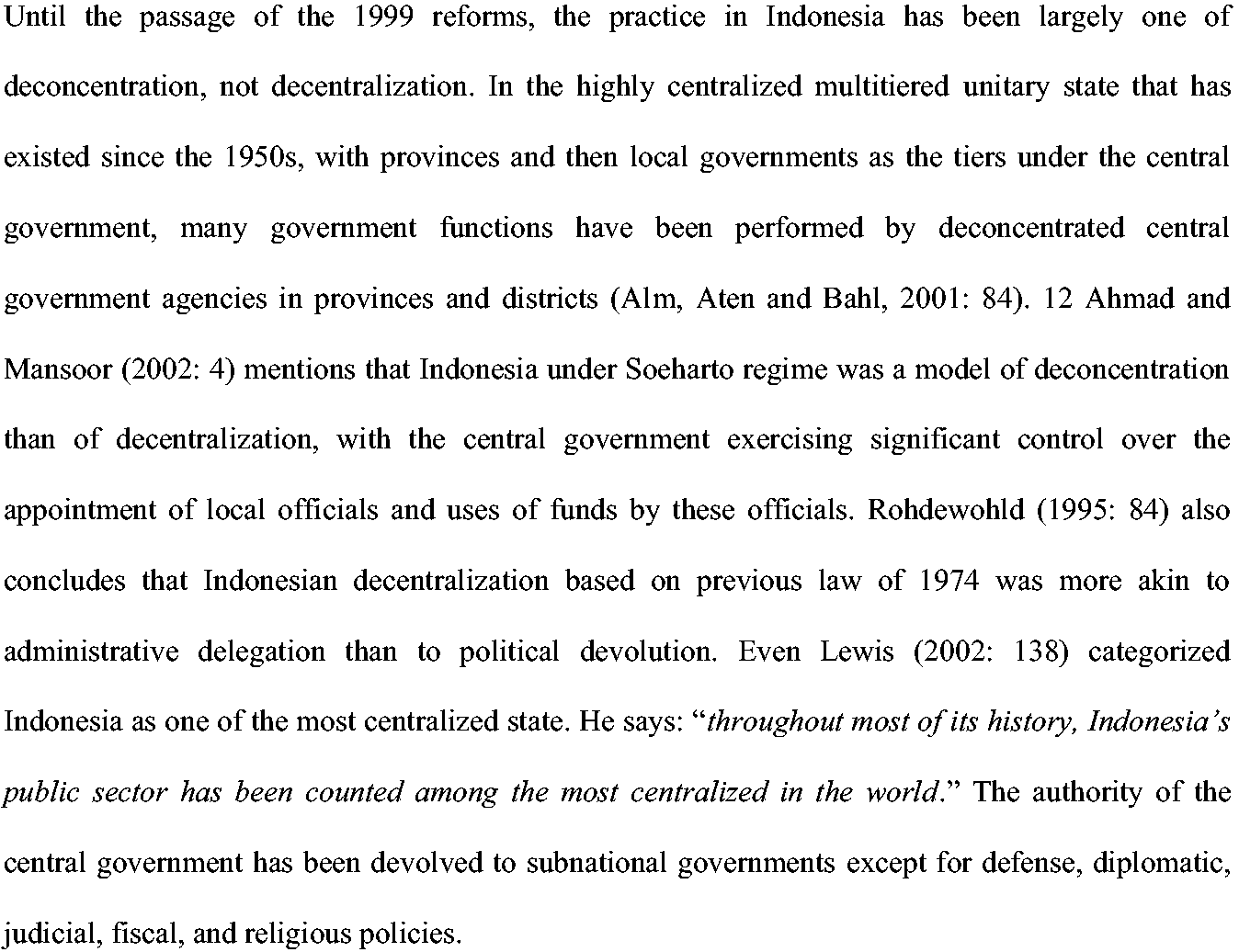
Deconcentration in Indonesia. Source: Utomo (2009: 16–17).
The success of the Indonesian model of deconcentration is evident in that the country moved from being a poor country to an emerging market economy, with the largest economy in South East Asia. The strong role of the central state in hiring local officials ensured that capacity is prioritised within the local developmental state. The deconcentration of essential functions such as fiscal duties was instrumental in promoting fiscal capacity and coordination with national priorities and spending (Aritonang, 2016). The success story of deconcentration in Indonesia is connected to how deconcentration was used to support decentralisation and the balance between the various levels of government (Aritonang, 2016; Utomo, 2015). The Indonesian deconcentration model is linked to Utomo’s third model of deconcentration, i.e. using the national capacity to design and implement specific policies and projects based on government-determined objectives. Deconcentration has also been widely implemented in Francophone West Africa due to the nature of unitary states, particularly in promoting territorial justice and the redistribution of wealth by fostering enhanced equilibrium between the central state and subnational institutions (Pinto, 2004). For South Africa, deconcentration could be instrumental in supporting equitable economic growth, while also ensuring the redistribution of economic activities to address the high levels of economic inequality.
Deconcentration and regional and local economic development
In recognition of the various capacity deficits that face the South African local government sphere in delivering the developmental mandate, it is essential to assess the merits of utilising deconcentration in economic development functions to improve the prospects of RLED. Deconcentration has been defined as the delegation of state power, resources and administrative capacities from national government departments to regional structures as means of promoting national interests. This is in contrast to full decentralisation, which advocates for the delegation of power to local governments to have autonomy in determining their developmental agendas. The ongoing decentralisation failures impede on the ability of local government to create a conducive environment for economic development and attract domestic investment, while corruption undermines the private–public partnerships needed in the development landscape. These factors result in market failures, such as financial risk aversion at the local government level. Local governments in developing nations fail to deliver social and economic services due to the unpreparedness of decentralised institutions (UCLG, 2013). These failures undermine the role and ability of the state to respond to social and economic development challenges.
Responding to the immediate developmental challenges (slow economic growth, a 29% unemployment rate and a 55% poverty rate) that South Africa is facing requires that the state play an active role, particularly the national government, through deconcentration due to notable incapacities of the local state. The South African Constitution (1996) stipulates that while the spheres of government are distinctive, they are also interdependent and interrelated, thereby arguing for strong coordination between the different spheres. As such, the national government could use its powers to ensure enhanced coordination and capacity through the deconcentration of economic development personnel. The national government has the power, administrative capacities and resources that are absent within local government to deliver developmental outcomes through Ministries such as Economic Development, the National Treasury and entities such as the Industrial Development Corporation (IDC). These capacities and financial resources are evident in that the local government sphere received 9% of the budget from 2011 to 2018, while provincial governments received 43% and the national government received 48% (National Treasury, 2019). Based on these institutional capabilities of the national and provincial governments, the deconcentration of national capacities and resources to drive RLED in underperforming rural and small town regions could be in line with the NDP’s mandate of ensuring a capable developmental state to address the country’s developmental challenges.
Introducing the deconcentration of economic development to various regions and districts to spearhead RLED might assist in two ways. First, it could potentially address the ongoing RLED failures that are underpinned by institutional failures related to capacity deficits and planning challenges through the depth of capacity and resources within national and provincial departments. For example, Lephalale Municipality in Limpopo has been identified as a nodal point for the country’s economy, but the lack of LED capacity undermines the prospects of the regional economy (Chokoe, 2018). Deconcentrating capacitated staff from national departments might bring expertise, resources and capacities to exploit the competitive advantage of the Lephalale Municipality. In this context, the state intervenes through its inherent and dedicated capacity to revitalise regional and local economies, strengthen institutional arrangements for effective RLED, and improve the country’s response to unemployment, poverty and inequality. The coordination of economic development could be undertaken through a deconcentration model that caters for a consultative process between the local political leadership and the central government to ensure support from local authorities and residents. Given the nature of South Africa’s participatory approach to development, the second and third models of deconcentration are the most appropriate in promoting the cooperative governance of economic development.
The second component of RLED failures that can be addressed through deconcentration is the lack of funding for RLED. It is widely accepted that RLED remains an unfunded mandate in South Africa due to a lack of prioritisation by local government (Rogerson and Rogerson, 2012). This lack of funding is due to functions being decentralised without ensuring appropriate financial resources, which undermines the delivery of economic development outcomes. The intervention of the national government through deconcentration might be key in ensuring the availability of funding for development programmes that are currently an unfunded mandate. This is in line with the structural component of the development state as it emphasises the need for the state to utilise its administrative power and resources to accelerate economic development. This is possible based on the fact that the national and provincial governments hold a significant share of the budget (National Treasury, 2019). Further to this, government ministries already fund the majority of RLED projects as municipalities fail to source development finance outside government ministries (Lawrence and Rogerson, 2019). Given that the government already dominates the development finance aspect of RLED, the deconcentration of economic development functions could ensure that the central state plays a key role in facilitating high-impact economic development initiatives that will stimulate growth and attract further investment.
Addressing the RLED funding challenge needs to be closely linked to addressing the incapacities to plan for development at the local government level. Existing RLED planning challenges undermine local development and investment. Gasser et al. (2013) blamed the economic development planning challenges in developing economies on the lack of institutionalised planning structures within decentralised institutions. This is evident in the South African context, where there is a lack of proper planning for RLED strategies in local governments. This is due to the perceived disconnect between RLED planning and business development (Rogerson and Rogerson, 2012). Further to this, consultants do the majority of RLED strategies, which reveals the incapacity to plan for development in the South African local government sphere. As a response to these challenges, the national economic development planning function can be deconcentrated to spearhead the planning for local economies. This task can be championed with the assistance of the National Planning Commission (NPC), the IDC and the Department of Cooperative Governance and Traditional Affairs (COGTA). This approach could be done in conjunction with the ongoing efforts by COGTA and South African Local Government Association (SALGA) to build LED capacity, with access to the skills of personnel from the national and provincial governments.
Deconcentration through local economic development agencies
The South African National Development Plan envisages a capable developmental state being the only solution to the ongoing triple challenges of unemployment, poverty and inequality (NPC, 2012). The developmental state aspiration requires strong and capable state institutions across all spheres of government to ensure efficiency in delivering developmental outcomes. Evidence from successful developmental states such as Japan, China, South Korea and Singapore points to the existence of capable bureaucracy selected through meritocracy (Von Holt, 2010). However, similar to other decentralised states in developing nations, South Africa is mired in institutional incapacities that render it unable to replicate the success of the East Asian developmental states. Smoke (2015) attributed these incapacities to the lack of financial resources within subnational institutions to attract skilled officials. These problems can also be linked to the uneven capacity distribution between the national, provincial, metropolitan and local municipalities. The uneven distribution of capacities is heavily impacted by the distribution of revenues favouring the national and provincial governments, whereas local government sphere requires more revenues, as it is at the forefront of service delivery.
Within the economic development landscape, the absence of capacity to drive RLED was to be addressed through the establishment of Local Economic Development Agencies (LEDAs). These LEDAs were established to be an impetus for RLED by bringing in expertise, capacity and resources at the regional level (IDC, 2006; Khambule, 2020; Lawrence and Rogerson, 2019). The establishment of LEDAs can be interpreted as a method of deconcentration (although autonomous from the national government) to promote efficiency, as is evident in that the NDP directs municipalities to develop regional or district institutions to deliver services where municipalities fail (NPC, 2012). LEDAs can also be linked with the government’s current commitment to reprioritise the delivery of social and economic development services through the new District Development Model, which intends to improve the coordination and implementation capacity of the local government sphere (DPME, 2019). Both the new District Development Model and the deconcentration model emphasise the use of regional (district) structures at the forefront of driving social and economic development services to address the country’s high unemployment rate.
Given the lack of capacity by local governments to drive RLED, the establishment of LEDAs needs to be linked to the creation of a capable local state through a deconcentrated approach. This is evident in that LEDAs were first established by the IDC in various regions to promote regional economic growth and development (IDC, 2006). The legislative documents on the establishing guidelines of LEDAs (see Table 1) point out that LEDAs were introduced in various regions to revitalise regional and local economies based on a five-year grant from the IDC, with guaranteed institutional support during the pre-establishment phase between 2006 and 2012. This model is linked to Utomo’s (2009) second and third models of deconcentration, which emphasise that deconcentration should complement decentralisation. The IDC-supported LEDAs were very successful in revitalising local economies and implemented various large-scale and high-impact economic development projects (Khambule, 2020; Lawrence, 2013). However, unintended consequences emerged as a result of changes in local government legislation (Municipal Finance Management Act, 2003). These legislative changes had an inverse impact on the institutional and operational structures of LEDAs when they fully entrenched decentralisation and gave municipalities all the administrative and financial burden of LEDAs.
Premises and roles of local economic development agencies in South Africa.
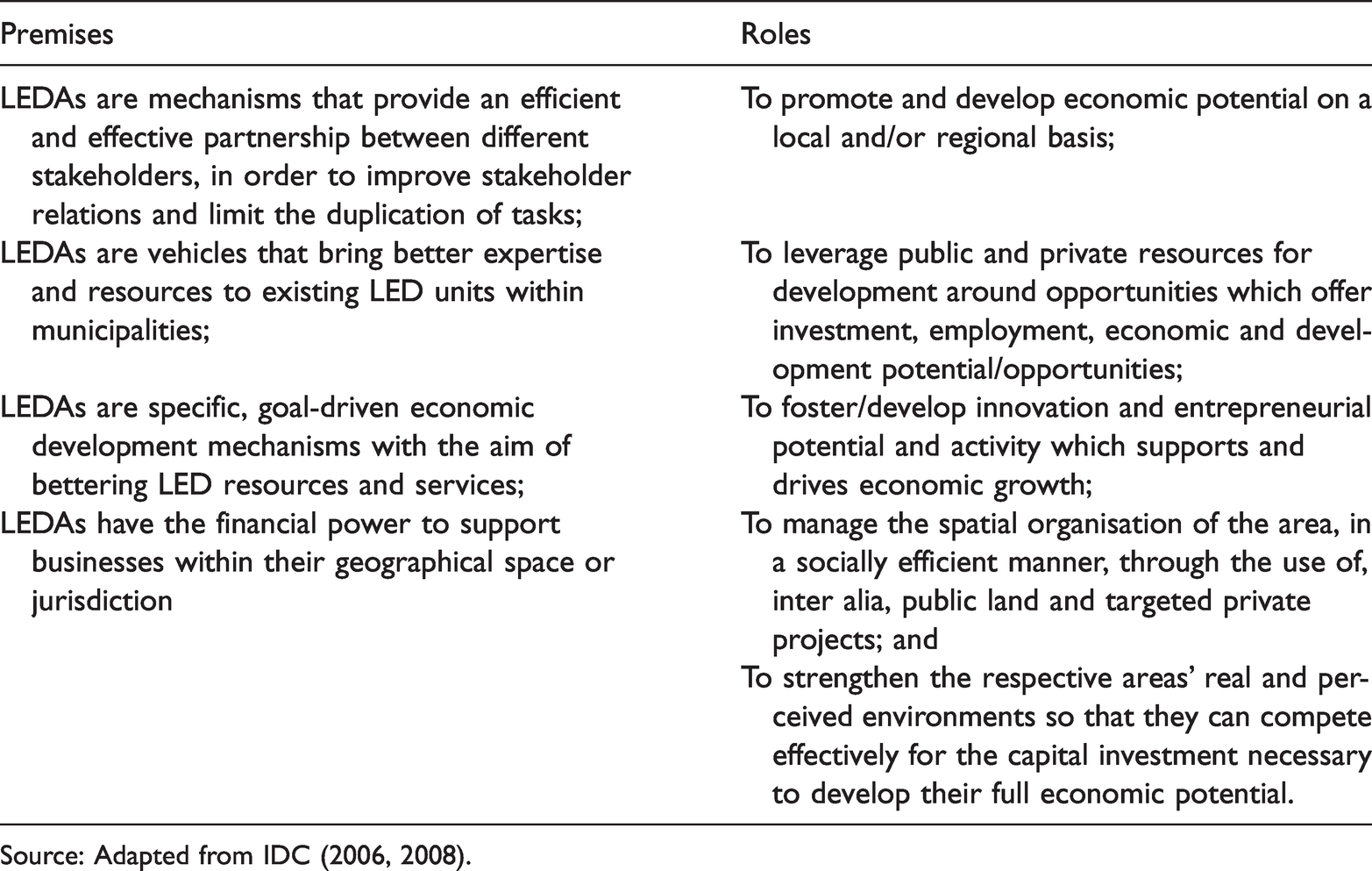
Based on the above, it is evident that LEDAs were established as economic development vehicles mandated to create a local state capable of driving RLED. As per Table 1, one of the most important functions is the role of LEDAs in strengthening ‘the respective areas’ real and perceived environments so that they can compete effectively for the capital investment necessary to develop their full economic potential’ (IDC, 2006: 5). Equally important is the role of LEDAs in promoting and exploiting the potential of local and regional economies. While these important measures exist, LEDAs are also facing certain institutional challenges that undermine their effectiveness as they struggle to effectively revitalise local economies due to financial constraints, capacity issues, high staff turnover, and limited and constrained roles (IDC, 2012; Khambule, 2020). These challenges can be addressed by ensuring that LEDAs become the deconcentration harbour where all capacities (national, provincial and local) are dedicated towards revitalising the lagging economies of small-town and rural areas. Although not utilising LEDAs, the revitalisation of local economies in Indonesia followed a strong state capacity that promoted local endowment and resources. Further to this, Indonesia’s deconcentration promoted an effective economic development system through ‘industrial clusters and national and regional innovation systems’ in ensuring accelerated economic growth and development (Aritenang, 2013: 175). This approach can be replicated in South Africa through ensuring that the deconcentrated model of economic development coordinates with existing special economic zones to promote industrial development within regions.
Since deconcentration allows the national government to delegate its resources and capacities to the subnational level for efficiency purposes, this approach can also be adopted through LEDAs. This is because LEDAs are strategically positioned for this role as they are established at a district (regional) level, and can be used as means of improving the efficiency of RLED through dedicating state power and resources to revitalise local and regional economies. A similar approach was administered through the IDC-led LEDAs, where the IDC dedicated its capacity and resources in a deconcentrated approach to support RLED by funding the operational- and project-related costs of LEDAs. There were notable successes as the deconcentrated IDC approach guaranteed funding and capacity for LEDAs, as opposed to the current fully decentralised approach that fails to capacitate and resource LEDAs. Lawrence (2013) observed that the IDC-funded LEDAs made a significant impact by revitalising regional and local economies, as they emphasised economic development and increased the capacity of local governments to respond to service delivery and infrastructure backlogs. This evidence supports the argument that a deconcentrated approach is somewhat better than a fully decentralised approach as an immediate response to adverse socio-economic conditions.
A significant additional benefit of deconcentration is that the national government can delegate its financial resources to LEDAs and effectively support local development. Government is already the primary funder of economic development projects undertaken by LEDAs (Khambule, 2020; Lawrence and Rogerson, 2019). As noted in the first wave, the five-year grant from the IDC ensured that the LEDAs had readily available funding for development, thereby strengthening local economies through the capacity and resources of the IDC (Lawrence, 2013). Notably, the end of the IDC donor-funded period led to major financial challenges for LEDAs, to the extent that some LEDAs were disestablished. The deconcentrated approach worked because the IDC used its expertise to ensure appropriate institutional arrangements for LED. As such, there are grounds for the national government to deconcentrate economic development duties and use its resources to ensure LEDAs are capable of driving and revitalising local economies. The national government can use its immediate resources to design programmes that can generate employment and attract further investment to the country. This will ensure strategic coordination between the decentralised and deconcentrated economic development functions to design and implement policies and special projects to revitalise local economies. The immediate benefit of such an approach is that it can strengthen the coordination between the different spheres of government while also creating a local state capable of delivering developmental outcomes.
In the bid to improve the country’s economic development outcomes through a deconcentrated approach, the following recommendations are made: LEDAs should be approached using a deconcentrated approach rather than a decentralised approach to ensure that capacity and institutional arrangements are coordinated at the regional level to support local development. The government needs to conduct a feasibility study on whether to use the second or third model of deconcentration. This should be done to ensure that the adopted model fits the South African context. The national government should delegate some of its Economic Development Department’s powers and resources, as well as those of the National Planning Commission (NPC), COGTA and the IDC, to spearhead LEDAs. This could accelerate the government’s response to the ongoing economic crisis by ensuring enhanced capacity and resources in RLED planning and implementation. Local governments should view this as a learning curve and prepare for an effective decentralisation that prioritises capacity in economic development planning. Local government functions should be professionalised, particularly economic development functions. This might ensure that RLED is not limited to project implementation, but is extended to business development, business retention and expansion, promoting local value chains and local clustering. The IDC should work hand in hand with the reconfigured LEDAs and commit to funding projects that have the potential to make a significant economic impact. The IDC, Small Business Development Agency (SEDA) and the Department of Small Business Development should emphasise the importance of an entrepreneurial approach to RLED through SMME development and avail necessary funding to businesses that have the potential to create sustainable and decent job opportunities. The competitive advantages of all regions should be explored to the limit to ensure that the economic development potential of South Africa is maximised. Linkages between the new District Development Model and deconcentration should be developed in order to bolster the capacity of lagging regions.
Based on the adoption of the abovementioned recommendations, LEDAs can play an important role in coordinating RLED and revitalising local economies. The success of LEDAs will depend on the ability of the state to ensure strategic intergovernmental relations and coordination between municipal local economic development units, the deconcentrated LEDAs and the national government. Ensuring appropriate coordination might enhance institutional arrangements for RLED by integrating the different capacities and competencies of national structures that will be deconcentrated through LEDAs. For example, coordinating efforts between the IDC, Small Enterprise Development Agency and the Department of Small Businesses Development might enhance SMME development by addressing regulatory burdens and availing funding for SMMEs, with the potential to reap economies of scale. The effectiveness of this task can only be enabled by deconcentrating the national economic development capacity based on the second or third model of deconcentration. This deconcentrated approach could potentially address the current incapacities that undermine the ability of the state to respond to the ongoing developmental challenges and assist in creating a capable state.
While deconcentration is proposed as an ideal solution to addressing the capacity deficits that undermine the state’s ability to respond to developmental challenges, it is important to guard against the suppression of fully decentralised entities. This means that deconcentration should be understood as a step towards full decentralisation, rather than as a means of ensuring greater control by the central government. This understanding of deconcentration is key in ensuring that the LEDAs, under the tutelage of the IDC and other national ministries, promote an economic development driven by local solutions and prioritise the meeting of national developmental objectives. As such, LEDAs could strategically identify, design and implement economic development projects and policies that can accelerate the government’s response to the triple challenges of unemployment, poverty and inequality. Deconcentrated capacity can also be driven by the promotion of innovation, business hubs, new industrial policies, business retention and expansion as a means of revitalising regional and local economies. This arrangement could promote reciprocal recognition between the state and the business sector in the development space, thereby creating the mass investment seen in the success of the East Asian Tigers.
Conclusion
Decentralisation promised better service delivery, good governance and accountability, yet local governments in South Africa and many other developing nations have delivered quite the opposite as they are mired in inefficiencies, corruption and a lack of responsiveness to the plight of their communities. This has led to a loss of trust in the local government system, which finds itself facing increasingly violent service delivery protests. When it comes to the mandate of local governments to drive RLED, this has failed due to institutional capacity issues such as planning incapacities, a lack of understanding RLED, funding challenges and so on. Market-related challenges such as a lack of market information cause financial risk aversion, resulting in RLED being an unfunded mandate. Based on these notable failures, this article assessed the utilisation of deconcentration as a response to the country’s developmental challenges, which are exacerbated by capacity deficits at the local government level. The assessment revealed that the uneven distribution of national revenue negatively impacts the uneven capacity of the national, provincial and local spheres of government.
The proposed deconcentration of economic development functions will occur through LEDAs under the tutelage of the IDC, the Economic Development Department, COGTA and the NPC, as Indonesia has done with fiscal control. This deconcentration is based on the state using its administrative power, capacities and resources through designing and implementing economic development strategies and programmes that are capable of unearthing and revitalising regional and local economies. This model of deconcentration is in line with the structural component of the developmental state, which emphasises the utilisation of state capacity to deliver developmental outcomes in line with deconcentration models two and three. The transition to deconcentrated LEDAs, however, needs to be done in consultation with local governments to ensure enhanced coordination between the various spheres of government. Further to this, the consultation of local authorities is important in ensuring the success of deconcentration as oversight authorities of these regional development agencies. Working on the basis that local governments have failed to deliver on their developmental mandate, this task can be carried out through LEDAs as they already exist at the regional (district) level.
Given that deconcentration has better prospects of driving RLED due to the existence of skilled and capacitated personnel at the national and provincial levels (and other government entities), the national government should deconcentrate its economic development functions through the Economic Development Department and the IDC to spearhead LEDAs. If the national government adopts a deconcentrated approach to LEDAs, it can bring provide the necessary human capital to enable LEDAs to develop economic development programmes that are capable of revitalising local economies. The merits of the deconcentrated approach were witnessed during the successes recorded under the IDC-led LEDAs period, as well as in the Indonesian context where national capacity was used to pursue national developmental interests. In the South African context, the institutional and financial capacity of the IDC steered LEDAs in the right direction, whereas the subsequent withdrawal of the IDC after the five-year grant led to local governments failing to make LEDAs and RLED work. As argued in the case of Lephalale Municipality, strategic national intervention is needed to ensure that the economic potential of the area is fully exploited as it has been identified as a nodal economic point.
Footnotes
Declaration of Conflicting Interests
The author(s) declared no potential conflicts of interest with respect to the research, authorship, and/or publication of this article.
Funding
The author(s) received no financial support for the research, authorship, and/or publication of this article.
