




Abstract
Local governance encompasses the involvement of local governments and other community-based organizations in participatory decision-making for efficient delivery of public services. In the developing world, however, the weakness of the local government and local governance has inhibited the efficient and effective delivery of these services. Relying on water and sanitation data and interviews of relevant officials, this study analyses the structure of governance of water supply and sanitation (WSS) at the community levels in selected medium-sized urban centres in Nigeria. Results showed that majority of the city dwellers lacked access to safe water and sanitation, an indication of convoluted, poorly regulated provision regimes and the waning capacity of local governments to galvanize local actions towards the efficient provision and management of these services at community levels. Multiple provision regimes, weak coordinating and regulatory frameworks characterize WSS governance. Further, the sub-national authorities’ encroachment on local government funds which deprived these tiers of government the resources they could have used in providing these essential services presents a major setback. Local governments require financial and constitutional autonomy to provide basic services to the people and supervise and coordinate the activities of other governmental and non-governmental actors involved in service provision.
Keywords
Introduction
The importance of safe water and sanitation to health, welfare and realization of day-to-day livelihood aspirations of the people as well as the overall socio-economic development and environmental sustainability of nations occupies the front burner in policy and academic discourses (Akpabio and Udofia, 2017: 2; Balogun et al., 2017: 2; England et al., 2017: 3; WHO/UNICEF, 2017). Despite the realization of the significant contributions of safe water and sanitation to human well-being, access to safe water and sanitation has remained a serious problem, particularly in developing countries with Africa at the centre of this access deficit (Akpabio and Udofia, 2017). This has been blamed on political factors such as lack of coherent water supply and sanitation (WSS) policies, ad hoc WSS programmes, the multiplicity of agencies, actors and functions, weak institutional and legal frameworks and poor governance of the WSS especially at the local level; and environmental factors like galloping urbanization, climate change, rapid economic and population growth compound the water situation, thereby causing overexploitation of both surface and underground water resources with the attendant stress on rural and urban water supply systems (Akpabio, 2012: 19; Federal Ministry of Water Resources, 2016a: 1).
With the implementation of the Millennium Development Goals (MDGs) and its successor programme, the Sustainable Development Goals (SDGs), however, some improvement in access to safe water and sanitation has been recorded (WHO/UNICEF, 2017). Recent UNICEF data indicate that the number of people that used safely managed water services increased from 4.2 billion in 1991 to 5.2 billion people in 2015 while another 1.3 billion have access to ‘basic’ improved water sources within 30 min per round trip to collect water (WHO/UNICEF, 2017). Despite this significant progress towards achieving the Goal 6 of the SDGs which provides for universal access to safe water and sanitation, an estimated 660 million and 2.4 billion people still do not have access to improved drinking-water sources and sanitation, respectively, as of 2016 (World Health Organization, 2017), with more than 90% of this number residing in developing countries.
In Nigeria, the proportions of urban and semi-urban populations that have access to reliable water supply increased from 50% to 69% in 2015 while household access to safe sanitation hovers around 29%, with 25% still practising open defecation (Federal Ministry of Water Resources, 2016b: 2). However, the proportion of the population that lacks access to improved water and sanitation remains unacceptably high (Federal Ministry of Water Resources, 2016b: 7). While water supply is poor in rural areas, the proportion of the urban population connected to piped water has fallen from 32% in 1990 to 3% in 2015 (GSMA, 2016). As reported in the Brief by the Federal Ministry of Water Resources in 2017, access to basic water and sanitation services is significantly lower in poorer communities and among vulnerable groups such as those in Internally Displaced Persons Camps (Federal Ministry of Water Resources, 2017). Expectedly, there are marked variations in access to these services across geographical (urban–rural, geopolitical zones and states) socio-economic (high–low income) and cultural domains (ethnic groups). Despite the presence of water supply agencies in all the States in Nigeria, a vast proportion of urban dwellers, concentrated mostly in small and medium cities, still derive their water from non-piped sources (GSMA, 2016). Although most of these point sources are regarded as safe, many human and non-human intervening factors in the supply chain may interact to reduce the quality of the water.
The large proportion of households that lacks access to improved water sources and sanitation poses a serious threat to the country’s goal of achieving the Goal 6 of the SDGs as well as overall national development. Apart from the fact that inadequate access to water and sanitation could cause Nigeria 1.3% of her GDP (UNICEF, 2018: 1), it is capable of increasing the disease burden, infant and childhood mortalities; reducing the quality and standard of living and impacting negatively on ecosystem preservation and poverty alleviation efforts (Akpabio, 2012; Akpabio and Udofia, 2017; Allen et al., 2006; Chen et al., 2006; Federal Republic of Nigeria, 2000; Dominguez Torres, Carolina, 2012). The UNICEF has estimated that 124,000 children of less than 5 years die annually of diarrhoea which is closely linked to unsafe water and sanitation practices (UNICEF, 2018: 1).
Water and sanitation provision in Nigeria is characterized by a multiplicity of providers with the preponderance of informal providers while the three tiers of government play important roles (Federal Republic of Nigeria, 2000; Macheve et al., 2015). The institutional and legislative frameworks for the provision of water and sanitation remain poorly defined, and the effective coordination of the different actors in the water and sanitation value chain seems to be lacking. Consequently, roles, functions, interventions and projects of different tiers of government and their agencies often overlap, resulting in redundancy, resource wastage and, sometimes, unhealthy rivalry, while responses to WSS problems are often ad hoc in their conception and implementation. Akpabio (2007) noted an overconcentration of water supply facilities in communities with significant representation in government to the detriment of needy communities with low representation in government. The newly crafted water policy operational from 2016 is designed to address the problems that remained unsolved by the previous policies, anticipate new problems and make adequate provision for solving them (Federal Ministry of Water Resources, 2016a).
Even though local governments are only responsible for water and sanitation provision in the rural areas under the various policies, they remain important water and sanitation providers in small and medium-sized cities due to the failure of the State Water Agencies (SWAs) to that provide services in these areas. Nonetheless, lack of capacity, diminished revenue allocation, institutional weakness, lack of autonomy and other factors have combined to reduce the capacity of local governments in providing and managing water and sanitation services in their respective jurisdictions. Akpabio and Udofia (2017) attributed the poor state of water and sanitation provision in Nigeria to lack of effective governance of water and sanitation services at different levels of governance, with the problem being more pronounced at the local level.
This article examines the structure of water and sanitation governance in three medium-sized cities of Nigeria to analyse the current state of water and sanitation provision and how governance at the local level has contributed to the unimpressive level of water and sanitation provision in these urban centres. Specifically, the study reviews the water and sanitation provision governance structure in Nigeria; examines the contributions of each actor to water and sanitation provision; locates the place of local governance in the convoluted provision structure and highlights the challenges that prevent local governments from meeting up with the responsibility of providing safe water and sanitation in small and medium-sized urban centres. It is expected that the findings of the study will shed more lights on the whys and wherefores of reduced access to safe water and sanitation in the small and medium-sized urban centres in Nigeria and chart the possible pathways to addressing the nagging problem of access to safe water and sanitation in these and comparable cities across Africa.
Water supply and sanitation provision governance in Nigeria
The responsibilities for WSS provision in Nigeria are shared among the three tiers of government: the federal, state and local governments. The statutory responsibility for policy advice and formulation, data collection, and monitoring and coordination of water resources development lies with the federal government; the States are responsible for the provision of water and sanitation in the urban areas and the local governments are saddled with the responsibility of providing water and sanitation in the rural areas (Macheve et al., 2015). The Federal Ministry of Water Resources is responsible for the formulation of national water policy for the federation while the States, through their relevant ministries and SWAs, make residual water and sanitation policies that regulate water and sanitation provision in their respective jurisdictions. The states’ Houses of Assemblies also enact edicts that guide water production, distribution and consumption in their respective states.
Between 2000 and 2017, the federal government introduced several policies and programmes aimed at improving water and sanitation supply situation in the country. These include the 2000 National Water Supply and Sanitation Policy which seeks to promote an affordable and sustainable provision of safe water and adequate sanitation for all; Water Sanitation Policy prepared in 2005 mainly to address the shortcoming of the Water Supply and Sanitation Policy (2000); National Low Income Household Strategy for Water Supply and Sanitation; and the 2016 Draft National Water and Sanitation Policy. A major lacuna in the past water policies was the apparent neglect of the sanitation aspect. The objectives of the Draft Water Policy of 2016 are, among other things, to increase service coverage for water supply and sanitation to meet the level of socio-economic demand; ensure the right of access to clean water and basic sanitation for Nigerian citizens to meet the basic human needs of present and future generations; ensure the affordability of water supply and sanitation services for Nigerian citizens; separate organizational responsibility for regulation from service provision and establish accountable, independent, effective and financially viable water service providers operating under a regulated policy framework (Federal Ministry of Water Resources, 2016a).
Many national programmes aimed at improving access to water and sanitation have been launched by the federal government. These programmes include Partnership for Expanded Water, Sanitation and Hygiene aimed at achieving the SDGs on universal access to Water, Sanitation and Hygiene in Rural Areas; National Open Defecation Free Roadmap targeted at eliminating open defecation and recently, the National Urban Water Sector Reform Project which is sponsored by the World Bank (Federal Ministry of Water Resources, 2017; World Bank, 2017). The National Water Sector Reform, a scaled intervention project, was designed to improve urban water supply and sanitation by addressing the challenges facing SWAs which include lack of cost recovery, maintenance, reliability and low investment in rehabilitation and expansion (World Bank, 2017). Realizing the role of governance in the sustainable provision of water and sanitation, the European Commission, in 2004, initiated a Water Supply and Sanitation Sector Reform Programme at a total cost of €119.63 million with the donor agency contributing 72.2% while the Federal Government and benefiting States make up the balance (Ahmad et al., 2009). The main thrust of this programme is to improve WSS governance at the federal, state and local government levels.
The State Water Agencies, otherwise called State Water Boards (SWBs) in some States, are statutorily empowered to provide water and sanitation in urban areas while rural water supply and sanitation is used for rural water supply and sanitation (Akpabio, 2012). Most of SWAs were set up as corporations but run largely as government parastatals, a compelling reason for their inefficiency and ineffectiveness. Due to rapid population growth and the concomitant areal expansion of cities, poor staffing, lack of investments, legal and institutional limitations and fiscal constraints (Akpabio and Udofia, 2017; Balogun et al., 2017; Federal Ministry of Water Resources, 2017; Macheve et al., 2015), these SWAs and SWBs have remained acutely incapacitated in discharging their responsibilities of providing safe water and sanitation to urban dwellers across the country.
Although the local governments are not responsible for water provision in the urban centres, the absence of efficient water provision on the part of SWAs has made them major providers, especially in small and medium-sized urban centres. In a country where the majority of the urban dwellers rely on water point sources such as boreholes and deep wells, the local governments not only provide point source water but, in certain cases, also pay the bills for the public standpipes provided by the SWAs. However, the absence of a well-structured, participatory local governance at the grassroots level has hindered the efficient delivery of WSS. Multiple providers of water point facilities in Nigeria include the federal, state and local governments, non-governmental organizations and community-based organizations (NGOs/CBOs), donor agencies, philanthropists and, in certain cases, politicians and political office-holders. Other important actors in the water supply chain are the water vendors who obtain water from different sources and supply to their patrons. Lack of regulation of the activities of these water providers has a significant impact on the sustainability, pricing, quality and overall access to water in urban areas.
Till date, policies and programmes of government appear to have overlooked the roles of local governance and local government in the provision and governance of WSS at the community level. Local governance and devolution of power to the lower level government are essential kernels of democracy and the participation of the local community in matters concerning their well-being is the basis for sustainable development. Local governance has been described as the process by which communities assume the rights and responsibilities for their well-being through elected representatives acting within laid down statutes and procedures that are not necessarily affiliated to the formal government authorities (CLEEN, 2016). Therefore, according to CLEEN, the essential ingredients of local governance are participatory democracy, devolution of power, transparency, openness, legislative, financial and organizational autonomy, accountability and state support and protection. It is trite to note however that though local government remains the institutional building block for local governance, ‘the wider governance sphere comprises a set of state and non-state institutions, mechanisms and processes, through which public goods and services are delivered to citizens and through which citizens can articulate their interests and needs, mediate their differences and exercise their rights and obligations’(Wilde et al., 2009: 5). In many developing countries like Nigeria, however, it is the state institutions that provide governance at the local levels due to the weak organization or sheer non-existence of non-state institutions.
Crucially, the local government remains the most accessible level of engagement with the State for the vast majority of people and, therefore, better positioned to provide basic services and facilitate participatory decision-making (Paul and Ozohu-Suleiman, 2015; UNDP, 2013). Worldwide, this tier of government is, among other things, responsible for water distribution, wastewater and solid waste collection, public transport, street lights, cleaning of streets, markets and public places, public toilets (UCLG, 2014). It is also in the best position to set up a community-based governance structure that can ensure adequate coverage, efficient management and community participation in the governance of WSS at the community levels.
The lingering problem of water and sanitation provision and governance in Nigeria is an indication of the incapacitation of local governance which is best positioned to provide and monitor the delivery of these services at the community level. Furthermore, the erosion of democratic principles in the emergence of the leadership at the local government level has undermined effective governance at the grassroots. The constitution of caretaker committees designed to run the affairs the local councils as a substitute to democratically elected executive councils remains a major challenge undermining effective and representative governance at the lowest tier of government. Members of these caretaker committees are handpicked by the state governors against the provision of the constitution that provides for the emergence of democratically elected executive councils and legislature through elections (Constitution of the Federal Republic of Nigeria, 1999, sec. 7). Consequently, members of the caretaker committees lack security of tenure and full authority to act. The import of these is the emergence of leaders at this tier of government at the behest of the governor, who are neither necessarily competent nor enjoy the legitimacy required to foster participatory governance at the community levels.
As a direct consequence of the funding and governance problems at the local level of governance, the WSS sector in the small and medium-sized urban centres has become poorly regulated, chaotic and inefficient. Apart from the shortage of water and sanitation services supply, the quality of such offerings has become a critical issue in the water and sanitation supply discourse, thereby threatening the target of achieving universal safe water and sanitation coverage by 2030. The recent statistics by the World Health Organization which put diarrhoea deaths due to poor water and sanitation at 80 986 in 2012 (World Health Organization, 2015) attests to the precarious water and sanitation supply situation in Nigeria. The need to understand the convoluted water and sanitation provision regime and the underlying factors form the basis for this study.
Research methodology
This study adopts a mixed-methods research design to investigate the role of local governance in water supply and sanitation provision in medium-sized cities. The research design complements quantitative secondary data derived from archival sources with primary data obtained from interviews to describe the situation of WSS provision and management in the medium-sized cities of Nigeria, using three cities as a case study. The choice of this approach was informed by the nature of the data required to answer the research questions that were asked in this study.
The study context
This study examines the governance of water and sanitation in Oyo Alaafin, Ogbomoso and Iseyin, three medium-sized cities in Oyo State, southwest Nigeria. The three cities have a combined population of over a million people with Iseyin having a projected population of 348 810 in 2019 while Oyo Alaafin has a projected population of 421 393 in 2019. The population of Ogbomoso was projected to be 498, 269 in 2019. These projections were based on the 1991 population census figures and an average national growth rate of 2.58% per annum (World Bank, 2020). These cities are similar in many respects. The occupation of the vast majority of the population is trading while a considerable number engages in trading and local craft. Iseyin is the fourth largest city in Oyo State. The economies of these cities are built around informal activities and local trading while some evidence of modernization is noticeable in the industrial sector and employment structure. Both Ogbomoso and Oyo Alaafin consist of two local governments each within the city space while Iseyin has only one local government. Large-scale commercial agriculture also constitutes an important activity at the urban peripheries.
Each of the three cities has a water scheme that is designed to supply piped water to the cities and their environs. The water schemes in Oyo Alaafin and Ogbomoso were commissioned in 1964 with a capacity of 7700 m3 per day and 16 600 m3 per day to supply water to the cities and their environs. The Iseyin water scheme was built in 1983 and has a capacity of 1200 m3 per day. Due to rapid urbanization and the attendant urban expansion, the population and areal extent of these cities have outgrown the capacities of the respective water schemes, thereby leaving a critical supply gap. The situation is compounded by the obsolescence of the facilities and lack of investment in their maintenance and expansion, a situation that has forced the schemes to stop operation in most cases.
Data collection and analysis
This study relies majorly on secondary data obtained from the World Bank-sponsored Water and Sanitation Facilities Baseline Survey for Oyo State, Nigeria. These data are complemented by an oral interview of local government officials in charge of Water Sanitation Hygiene (WASH) or related department in the local governments of the cities under study. The data captured the state of water and sanitation facilities across Nigeria in 2015. The survey has two parts. The first part captured water supply and the second part captured the sanitation facility inventory of public places in the State. Water supply system survey covered both water pipe facilities and water point facilities. The former applies to large and small-scale waterworks that deliver water through the piping of water to the homes of consumers, while the latter applies to point source water provision from boreholes, wells and other sources. The sanitation facility survey captured the inventory of sanitation facilities in public places such as schools, marketplaces, hospitals and motor parks in the cities. The characteristics of the sanitation facilities relevant to this study include location, type of institution, availability of sanitation facilities, type of toilet facility and responsibility for managing facility. The settlements form the unit of data collection and analysis. For the study area, two of the cities – Oyo Alaafin and Ogbomoso – extend beyond one local government boundaries while the third, Iseyin, is contained in one local government area. Data required for this study were extracted from the database for Oyo State that contained data for the 33 local government areas in the state. However, the data were extracted by filtering out the settlement name to extract the data that apply to the three settlements under study.
The interview schedule that consists of semi-structured questions was drawn to guide the interview with the representatives of the local governments. This method has the advantage of interviewee’s involvement through a focused, but conversational, two-way communication (Cloke et al., 2004; Samuel et al., 2017). Two officials of the local governments in each of the three cities under study were purposively selected for the interview, making six interviewees for the study. The interview schedule elicited information on the existence of special department or unit for managing WSS, the actors involved in WSS provision in the local government area, regulation of these actors, nature and frequency of engagement with the actors and the funding situation for WSS provision and management.
Frequencies and percentages were used to summarize the data extracted from the World Bank-sponsored Water and Sanitation Facilities Baseline Survey for Oyo State, Nigeria. The interviews with the local government water and sanitation officials were content-analysed using topic coding. Using this method, the texts were grouped into various categories that align with the sub-themes of this research (Holsti, 1969: 14). The interview schedule was grouped into four sub-themes: the local structure for the provision and managing WSS, actors involved in WSS and the mode of engagement, regulation of activities in the WSS and the funding for the WSS provision and management.
Results and discussion
Profile of piped water provision in the study area
Water supply characteristics in the study area.

SWA: State Water Agency.
Source: Author’s computation (2019).
However, only the water supply facilities in Oyo and Ogbomoso have transmission pipes of 5 and 15 km, respectively, as indicated in Table 1. This suggests that only the two cities can receive piped water from their water supply facilities while the remaining one cannot receive water supply because there are no transmission pipes in place to convey water from the facilities to the distribution reservoir in the city. This is an indication of a lack of infrastructure that can support water provisions in the area. Even the two cities that have transmission pipes, the lengths of pipes available to carry water to the cities are rather short, given the extent of the areal expansions these cities have witnessed in the last 40 years. The authors did not find any evidence of a major infrastructural expansion since the construction of these facilities.
In terms of management, all the facilities are managed by the State’s Water Agency (Water Corporation of Oyo State). As noted earlier, the State Water Agencies are riddled with the problem of funding, cost recovery, governance and political interference, which has incapacitated them from delivering on their mandates. This is buttressed by the fact that customers only pay for services periodically and not regularly, and hence, the SWA is unlikely to recover the costs of providing water to its customers. This is in line with the findings of the World Bank in its study of State Water Agencies in Nigeria (Macheve et al., 2015). These challenges have put the State Water Agency in limbo with the result that many of its water supply facilities outside the state capital only exist only in name and not in service. The inexorable consequence is that residents of these secondary cities have to rely on water points within or outside their compounds to meet their water needs. In an area with the prevalence of extreme poverty, it is difficult for many households to provide improved water points within their compounds (Akpabio, 2012; Ohwo, 2016). Hence, they rely on publicly provided water points outside their compounds or remain at the mercy of water vendors who provide water of doubtful quality and at a higher premium than publicly provided water (Ohwo, 2016; Osumanu et al., 2010; Wutich et al., 2016).
Promoters of water point supply systems
Promoters of water point facilities.
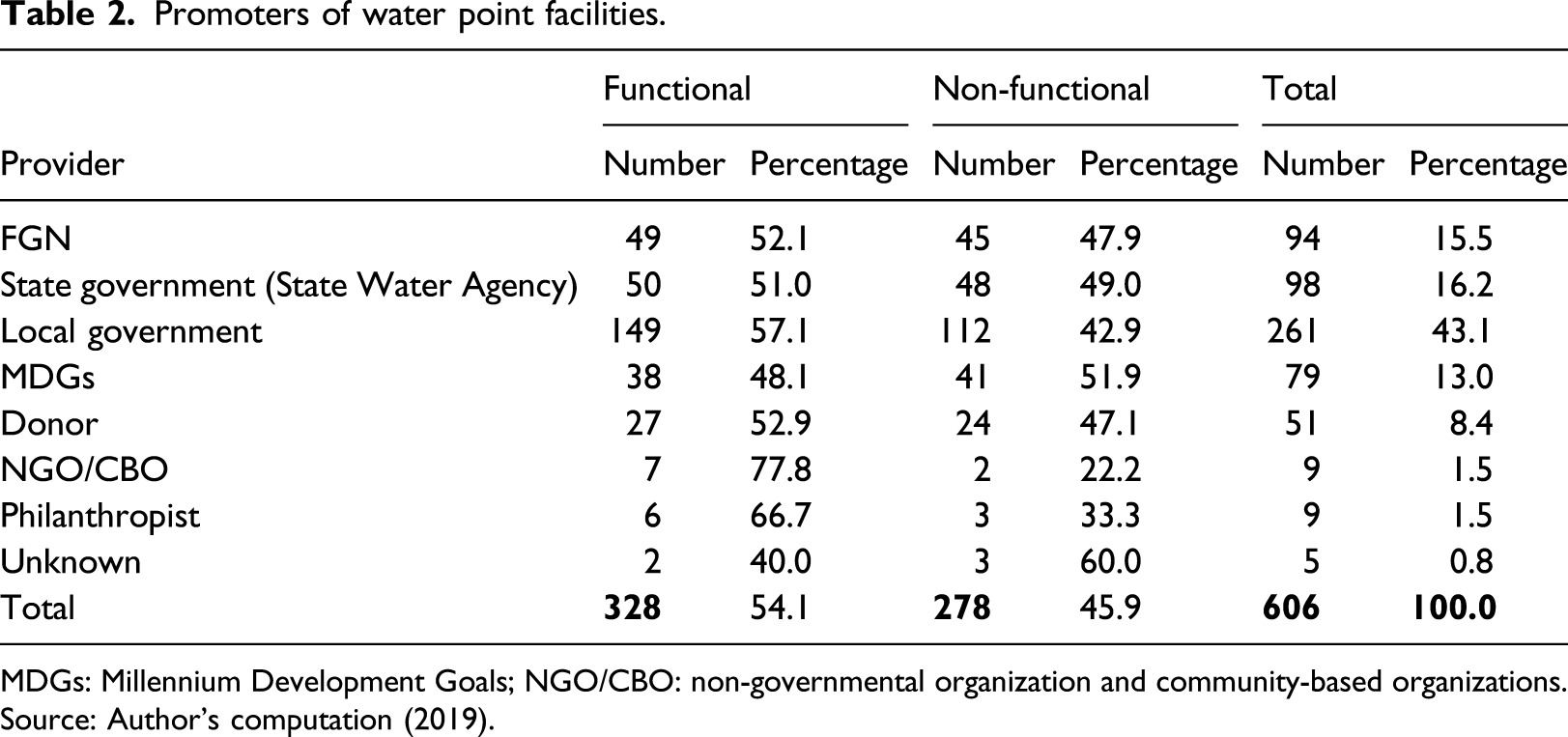
MDGs: Millennium Development Goals; NGO/CBO: non-governmental organization and community-based organizations.
Source: Author’s computation (2019).
The implications of this multiplicity of actors are many and vary from one jurisdiction to another. As each actor has a different standard for measuring water quality (some do not even have), it becomes difficult to maintain a minimum standard in the quality of water obtained from these sources (Wutich et al., 2016). Another implication is that many of these providers are rarely on the ground where they have provided these facilities. Thus, the continued maintenance of these facilities becomes difficult in the absence of a concrete management structure. An attempt to guard against maintenance issues led to the formation of the Water and Sanitation Committee in each local government area to oversee the management of these water point facilities. Findings in Table 1, however, revealed that such committees were not in place in the cities under study. This might explain why a large proportion of the facilities are not functioning as evidence in Table 2 shows that 278 (45.8%) of the 606 water point facilities are non-functional.
A closer look at the ratio of the functional to non-functional facilities reveals that the MDGs have the highest percentage (51.9%) followed by the state (49.0%) and federal (47.9%) governments, respectively. It is instructive to note that even though the NGO/CBO contributes a small fraction of the total water points, it nevertheless has the lowest percentage (22.2%) of non-functional facilities. The reason for this is not far-fetched. Many of these organizations are based or have representatives in the communities where these facilities are provided. This enables them to monitor and maintain these facilities when the need arises. In the same vein, it is clear that among the tiers of governments, the local governments, the closest to the people, also have the least percentage of non-functional facilities, a fact that suggests that their closeness to these facilities may have rubbed off on the promptness in monitoring and maintenance of these facilities. However, the fact that the local government also has a higher ratio of non-functional facilities relative to those of non-governmental organizations also calls to question the capacity of this tier of government to not only provide these facilities but also ensure timely maintenance. As noted in the Water Supply and Sanitation Provision Governance in Nigeria section, local governments in Nigeria lack political and financial autonomies, a situation that has hindered their efficient functioning as the third tier of government as provided for in the constitution of the Federal Republic of Nigeria.
Sanitation situation in the study area
Characteristics of sanitation facilities.

Source: Author’s computation (2019).
Water governance
As noted in The Study Context section, one local government official in the local government office of each of the three cities were interviewed to determine the extent to which local governance exists in the WSS sector. The responses were coded under the five major headings: the existence of WSS department, involvement of private actors, engagement with stakeholders and funding of WSS.
On the existence of a local authority department that oversees WSS matters, the interviewees stated that no department handles WSS matter. Rather, the functions and responsibilities of providing and managing WSS are vested on the department of environmental health services whose mandate spreads over health and environmental issues, in addition to WSS. The implication of these is the inefficiency noticed in the management of local government-promoted water point and sanitation facilities.
Similarly, the interviewees from the three cities also acknowledged the existence of private actors in WSS provision, noting, in particular, the water vendor which they claim exists in two categories. According to them, the first category is essentially small-scale, consisting of the cart pushers and the ‘fetchers’ that carry their water bucket on the shoulder while the second group are considered large scale as they use motorized water tanker (3000–10 000 litre capacity) to convey water to prospective buyers. While the latter is mostly registered with the relevant department in the local government, the former was said to be too amorphous to be tracked down. On the regulation of these water vendors, the interviewees from Iseyin noted that the officials of the local government do visit the operation base of the water tanker to ascertain the quality of water they supply to households in the city. The interviewees from Ogbomoso and Oyo could not say categorically if the local government officials play any regulatory role in the activities of this category of water providers. In the three cities under study, there was no evidence that the cart pushers and ‘fetchers’ are subjected to any form of regulation. When asked if the rate charged by these private actors is regulated, the three interviewees claimed that they were not aware of any regulation, indicating that the water vendors are at liberty to determine the rates.
Another aspect of WSS provision that was asked was the engagement with stakeholders – consumers, providers, CSOs and other interested parties in WSS matters at the community level. Only the interviewee from Ogbomoso claimed that the local government officials do hold meetings with the water providers on the need to ensure the provision of quality water for the consumers. Others said there was no such forum, citing lack of clear identification of who the stakeholders are as the reason. It is apparent that even where the meeting was said to take place (Iseyin), the meeting could not be described as a stakeholders’ meeting as only the providers were usually invited, a testament to the weak stakeholder engagement in the entire study area. There is no evidence to suggest that the consumer of WSS is involved in such stakeholders’ engagements.
As regards funding, the three interviewees lamented the parlous state of funding for local government which has adversely affected effective WSS provision. The interviewee from Ogbomoso said: As you know that is the state that receives the allocation meant for the local governments. The state only pays the salaries of local government workers. Nothing more. You can see our premises overgrown with the weeds. The Chairman cannot even clear the weeds unless the governor provides the fund.
The problem of funding of the third tier of government has become a topical issue in the recent years with the state harnessing the resources meant for the local government, leaving the governance at the grassroots to suffer (Okafor, 2010; Olojede et al., 2019; Rosemary et al., 2016).
From the responses, it is clear that WSS governance at the local level is anything but weak and virtually non-existent. A dramatic step is required to restore governance at the local level as this will form the basis for mobilizing other actors in local governance such as the CBOs, CSOs, FBOs, among others towards the attainment of adequate WSS.
Conclusion
This study examined the water and sanitation provision in three medium-sized cities in Oyo State, southwest Nigeria. The result revealed the inadequacy and the non-functional state of most of these facilities which suggest a lack of effective governance structure for the provision and management of these facilities at the local level. In cities that lack piped water, the provision of which falls under the jurisdiction of the State’s Water Agency, residents usually rely on alternative water supply which is provided by varied providers, among which the local government is a principal actor. The local governments, being the closest to the people, stand out as the largest provider of these alternative water supply facilities in these urban areas, even though this is outside the responsibilities assigned to it in the National Water Policy document, as well as the manager of the largest proportion of sanitation facilities.
The local government appears to be better placed to provide and manage this aspect of urban water supply given its closeness to these urban neighbourhoods. However, evidence from the local government officials interviewed revealed that lack of autonomy and the predatory instincts of the state governments on the local governments’ statutory fund allocation from the central government are seriously undermining the capacity of the local governments to efficiently and effectively provide and manage these facilities. It is, therefore, imperative that the current constitutional status of local government be reviewed to grant them autonomy so that they can render to the people the basic services that they are created to render.
Footnotes
Acknowledgments
Authors are grateful to the National Urban Water Sector Sector Reform Project, Abuja, Nigeria, for providing part of the data used in this study.
Declaration of conflicting interests
The author(s) declared no potential conflicts of interest with respect to the research, authorship, and/or publication of this article.
Funding
The author(s) received no financial support for the research, authorship, and/or publication of this article.
