




Abstract
While the activities of multinational oil corporations contribute significantly to oil pollution and environmental degradation in most oil-producing countries, the extent to which illegal artisanal refineries contribute to the environmental problems in Niger Delta remains unclear. Extant literature attributes this to the expanding activities of the artisans as well as the use of crude technology in illegal oil refining. Given the widespread nature of the artisanal oil-refining economy in the Niger Delta region, we assess its contribution to the growing environmental pollution in the region. By artisanal oil refining, we mean small-scale crude oil processing or subsistent distillation of petroleum that is often outside the boundaries of the state law. This study links the continual failure of the clean-up programme in the Niger Delta to the booming artisanal crude oil-refining economy in the region. Using predominantly qualitative methods of data collection and content analysis, we adopted the enterprise value chain analysis to underscore the underlying local economic interests and external economic opportunities that sustain oil bunkering, oil theft and petro-piracy. We conclude that these illegal refining processes significantly undermine the Ogoniland clean-up project and make the remediation programme unsustainable in Nigeria.
Introduction
Niger Delta has a total land area of 70,000 km2 (Ajibade and Awomuti, 2009, p. 112), about one-third of the land area in wetland and large mangrove swamp forests containing more than 1000 oilfields located in the region (Ajibade and Awomuti, 2009, p. 113). The Ogoniland (one of the ethnic groups in the Niger Delta region) covers 1000 km2 (386 square miles), with a population of about 832,000 and a flow station capacity of 185,000 barrels per day (UNEP, 2011, pp. 22–24). The Ogoniland extends to four local government areas of Eleme, Gokana, Khana and Tai. Most of the communities have several oilfields operated by multinational oil companies such as Shell Petroleum Development Company (Nigeria) Ltd (SPDC), a joint venture between the Nigerian National Petroleum Company (NNPC), Shell International, Elf and Agip. The activities of these oil companies have resulted in oil spills and environmental pollution. In addition to the bulging youth population who face the huge impact of growing unemployment, the majority of the population in the region live in abject poverty despite the huge amount of money the oil in the region generates for the government.
Oil contamination arising from drilling operations and pipeline transportation as well as attendant environmental pollutions have been severally studied and documented in the literature (Leonard, 2016, pp. 1–160; Obi and Rustad, 2011, pp. 1–267; Okonta, 2008, pp. 1–328; UNEP, 2011, 1–262; Watts, 2012, pp. 437–467). For many years in Ogoniland, oil pollution caused by petroleum hydrocarbons is widespread on the land areas, in sediments and swampland. The damage is consequential both on the aquatic and terrestrial wildlife, as well as on human beings. The United Nations Environmental Programme (UNEP) reports that the damage occurs ‘… in a significant number of locations, serious threats to human health from contaminated drinking water to concerns over the viability and productivity of ecosystems’ (UNEP, 2011, p. 6). It is from this sense that Lindén and Pålsson (2013, p. 685) argue that it is often very difficult to clean up without causing further damage to the same environment. Ledum Mittee
1
notes that: There are no engagements with the people who are going to be affected; where are the sites that are going to be cleaned and all that? The community is not made aware of most of the things that are going on, and the cleanup seems to be driven as if it is just a political thing (Mittee, 2019, p. 2).
Importantly, the 2011 report of the UNEP Environmental Assessment of Ogoniland contains measures to improve the control and maintenance of oil facilities in Ogoniland to function sustainably and in a way that benefits the lives and livelihoods of Ogoni communities. This report strongly recommends that individual contaminated land areas within the communities require cleaning up within 5 years while the restoration of heavily impacted mangroves is a long-term project of 30 years. In addition to specific contaminated sites, the UNEP report also advocates an awareness programme for the community to mitigate against further ‘disproportionate environmental footprint of artisanal refining’ (UNEP, 2011, p. 12). It is from this perspective that Ledum Mittee amplifies the alienation of the local interest from the oil production activities as driving the sub-economy of artisanal refining, which continues due to the contradictions in the implementations of the UNEP (2011) report.
The argument has thus shifted from further damage arising from the clean-up to whether the systematic and sustainable clean-up and remediation process are possible considering the continuous activities of artisanal refining in the Ogoniland. Adunbi (2020, p. 41) refers to the artisanal refining group as the ‘captive creeks of oil in the Delta’, that is, groups of youth redefining energy practices to encompass a makeshift oil-refining infrastructure that competes with the multinational oil corporations, such as Shell, Chevron and Exxon Mobile, both in oil exploitation and damage to the environment. In most cases where oil was observed floating on the water, it was impossible to determine whether the source of the contamination was from the multinational companies or from artisanal outfits which are involved in oil refining, as tidal movement carried the contamination in different directions. The scientific UNEP report identified 65 contaminated sites marked for the clean-up, excluding an unidentified large number of contaminated sites arising from the activities of artisanal refining in Ogoniland. This supports the specific warning by UNEP that ‘all sources of ongoing contamination, including the artisanal refining which is currently ongoing in the creeks, must be brought to a swift end before the Clean-Up of the creeks, sediments and mangroves can begin’ (UNEP, 2011, p. 13).
The report emphasized further that the environmental clean-up and restoration activities will be extensive, long-running and expensive, requiring $1,012,488,640 (summarized and popularized as $1billion), out of which $99,452,700 should be spent on the restoration of artisanal refining sites while $10,000,000 should be spent on alternative employment to those in artisanal refining (UNEP, 2011, p. 227). A cursory review of reports on the Federal Government’s Hydrocarbon Pollution Remediation Project (HYPREP) shows that 21 of the 65 remediation sites are expected to be completed by December 2020. This claim by HYPREP has been described as a political gimmick and highly opaque process (Ebiri, 2019), while the Premium Times (Nigeria) doubts the claims because the volatile security situation of Ogoniland does not guarantee any meaningful economic or even contractual activity, and in such atmosphere, it will be difficult to conclude that any contractor is on-site working (Iroanusi, 2020). A few of the clean-up projects are executed in contravention of the UNEP specification because even the Federal Minister of Environment expressed displeasure with the slow pace of the clean-up, expressing concern that some projects fall short of the standard.
Thus, this study seeks to explain the dynamics of artisanal crude oil refining and how it is implicated in the continual failure of the clean-up processes in the Niger Delta. Employing the enterprise value chain analysis, we explain the underlying local economic interests as well as the external economic opportunities that drive and sustain oil bunkering, petro-piracy and illegal artisanal crude oil refining industry in the region, and how these are undermining the Ogoniland clean-up efforts, as well as making the remediation programme unsustainable. Using the documentary method of data collection, we relied on data from secondary sources and applied content analysis for this study. The first section is the introductory and the method adopted for research. This is followed by a thematic review of literature from the perspectives of artisanal refining process, and oil refining economy with their attendant environmental consequences. The next section presents the UNEP clean-up plans for the Ogoniland and the challenges of effective responses due to the continuous small- and large-scale illegal refining where about 80% of the crude oil is wasted and discharged into the environment of the local community. Subsequent sections include an analysis of the UNEP report within the theoretical lens of the value enterprise chain vis-a-vis the criminal networks governing the artisanal refining in the Niger Delta and the conclusion.
Methodology
Generally, the methodology of this study is derived from some related studies carried out in recent years, while the data utilized for descriptive analyses are generated mainly from the UNEP report. We used the UNEP assessment of Ogoniland report to delineate the four cardinal recommendations: Ogoniland restoration authority, environmental restoration fund, coordination of multi-stakeholder efforts, and the institutional and regulatory reforms. For the implementation of the UNEP reports, publications of Nigeria’s Hydrocarbon Pollution Restoration Project (HYPREP) and non-governmental organizations such as Transparency International, Stakeholders Democracy Network, Oxford Poverty and Human Development Initiative, Foundation for Partnership Initiative in the Niger Delta and local newspapers like The Guardian (Nigeria) and Vanguard (Nigeria), were used to assess the implementation of the UNEP recommendations. Published materials in the form of journal articles, textbooks and reports collected from electronic sources, mostly the internet, that focused on the conceptual issues of artisanal refining, categorization of stakeholders and the local economic conditions that sustain oil bunkering, illicit oil theft and artisanal refining were used. The rationale for utilizing a descriptive analysis is rooted in the nature of the data and the keywords/variables employed in the study. The study also incorporated flow charts and diagrams in the descriptive analysis/method to demonstrate the stages/processes or interactions of the enterprise value chain and organized oil crime in the Niger Delta region.
Crude oil resources: The pollution and environmental damage
As stated above, Niger Delta has about 1000 oilfields (Ajibade and Awomuti, 2009, p. 113). The crude oil reserve is estimated at 28.2 billion barrels, while natural gas reserves total about 165 trillion standard cubic feet (scf), including 75.4 trillion scf of non-associated gas (NNPC, 2017). Nigeria’s crude oil production accounts for about 75–80% of revenues with several transmission channels into incomes and economic output (PwC Nigeria, 2016, p. 2). However, the activities of oil companies operating in the Niger Delta has continued to result in oil spills and environmental pollution of varying degrees, as well as devastates the local economy and the livelihoods of the host communities (Gelber, 2015, pp. 40–159).
The term ‘oil pollution’ is often interchanged with oil spills because both terms are interlinked. For the past four decades, oil spills, whether accidental or deliberate, have become a recurrent phenomenon in global waters. The Intelligence Report shows that spills ranging in size from 34 tonnes have occurred in waters of 112 nations since 1960 (Global Marine Oil Pollution Information Gateway, n.d.): the Persian Gulf War oil spill of 1991, the BPs Deepwater Horizon oil spill of 2010, the Ixtoic 1 oil spill of 1979, the Atlantic Empress oil spill of 1997 among others (Kaushik, 2020). These spills are considered enormous due to the accidental nature of their occurrences and the fact that the quantities of oil spilt are known. Unfortunately, spills from non-vessel sources are often neglected, irrespective of their significant contribution to oil pollution. The Gulf of Guinea is a typical example of where incessant oil spills from pipeline leakages, bunkering, and discharges of waste oils, among other non-vessel sources not easily quantifiable, are not adequately recognized.
Whanda et al. (2017, p. 439) observe that the common cause of oil spill is an operational failure (pipeline corrosion, production, poor infrastructure and inadequate maintenance, fault during oil processing steps), third party interference (interdiction, the attempt of theft or intentional vandalism) and unknown factors including accidental third party damage (TPD) of pipelines during excavation usually linked to sabotage and illegal bunkering. The main source of spills in the Niger Delta is the pipelines used for crude transportation, which plays a very significant role in oil spill incidents (Ngada and Bowers, 2018, pp. 501–504). Shell Petroleum Development Company (SPDC), for example, records an average of about 200 oil spill incidents every year since 2005 (Akpomuvie, 2011, p. 201; SPDC, 2014). About 324,000 barrels of crude oil were spilt in 1500 incidents from SPDC’s facilities between 2007 and 2013, with 75% of the spills attributed to sabotage/theft. Rexler (2019, p. 1) notes that Nigeria’s unsecured 5000-km pipeline network has remained vulnerable to vandalism and theft, in which crude oil is illegally tapped in a process colloquially known as ‘bunkering’. These thefts of fuels are thriving due to sustained black market for stolen crude – including a downstream sector of local refineries – valued in 2011 at $4.4 billion annually in lost revenue for the Nigerian government and oil companies. Also, environmental pollution may generate negative spillovers on labour, productivity, human capital accumulation and a variety of economic activities (Garuba, 2010, pp. 18–20; Zabbey et al., 2017, pp. 954–956). Ordinioha and Brisibe (2013, p. 2) report that ‘an average of 240,000 barrels of crude oil is spilt in the Niger Delta every year, in large part due to unknown causes (31.85%), third party activity (20.74%) and mechanical failure (17.04%)’.
The abundance of crude oil in the Niger Delta has undoubtedly attracted countless oil exploration and exploitation activities to the area, which also come with varying adverse effects on the region’s oil reserve and the environment. Consequently, environmental concern has been the major point of contention between the government of Nigeria, the Multinational Oil Companies (MOCs) and the specific communities affected by oil pollution in the region (Elekwachi et al., 2019, pp. 1–7). Different environmental assessments have been carried out in the region, especially the United Nations Environmental Programme (UNEP), with a view to determining the extent of the impacts of oil pollution and possible remediation and clean-up for sustainable livelihoods. Reports of various studies have shown marked environmental degradation occasioned by oil pollution in the region. For instance, a report by Amnesty International reveals how two massive oil spills from downstream petroleum operations led to the leakage of black oil into rivers and creeks in Bodo, which killed fishes and destroyed people’s livelihoods in the fishing town. Moreover, UNEP’s environmental assessment of Ogoniland shows significant oil pollution, which was not readily visible from the ground. The UNEP study utilized information provided by Ogoniland residents about oil contamination in their communities to supplement official oil spill data supplied by the Nigerian government and the SPDC to uncover the environmental impacts on land, groundwater, surface water, air, sediments, vegetation, and the implications of these impacts for public health. However, most of the studies only examined oil pollution from onshore/offshore operations by major MOCs, particularly the SPDC, without considering the contributions of artisanal crude oil refining to the menace.
The proliferation of artisanal refineries in the region has brought untold negative effects on the environment with attendant long-term impacts on the hydrosphere, lithosphere, atmosphere and biosphere. The process of artisanal refining incurs reckless wastage of oil such that two drums of crude oil can translate to only one drum of refined products, with the rest as waste (Obenade and Amangabara, 2014, p. 27). The waste oils are dumped haphazardly on land, rivers and streams, causing severe damage to the environment and public health. Accidents, fires and explosions occur as a result of illicit distillery processes involving open fires fed by crude oil tipped into pits in the ground. Emissions from artisanal oil exploration activities (drilling, bunkering, pipeline vandalism, gas flaring) perpetrated in the mangroves have costly environmental implications for a region that host one of the most bio-diverse ecosystems in the world (Onyena and Sam, 2020, pp. 2–6). This combines with the gas flaring activities of the MOCs to cause air pollution in the region and its attendant global warming and climate change impacts.
Additionally, significant quantities of oil are spilt on land and creeks from broken pipes used by numerous makeshift refineries in the region (Obenade and Amangabara, 2014, p. 26). Artisanal refining, if left unchecked, may degenerate into an irreversible loss of the region’s mangrove habitat (UNEP, 2011, pp. 102–105). Also, arable lands have been lost with resultant negative effects on crop production and food security for the region’s population (Nwilo and Badejo 2005, pp. 567–570). Of particular importance are the impacts of oil pollution on the coastal environment, especially on its species-rich marine ecosystems (wetlands and estuaries). Besides, the effects extend to the underground water table as UNEP scientists found an 8 cm layer of refined oil floating on the groundwater, which serves the wells in the area that is reportedly linked to an oil spill that occurred more than 6 years earlier. This, however, implies that the impact of oil pollution on the environment is yet to be fully ascertained despite the numerous assessments by government and other agencies. In addition, the existing environmental remediation by MOCs in some parts of the region, such as the clean-up of Ogoniland, does not cover spills from artisanal refining activities despite their enormous contribution to oil pollution and environmental degradation in the region. Hence, the UNEP recommends that for the clean-up and remediation projects to be meaningful, the illegal oil refining activities in the creeks should not be allowed to continue unchecked. This draws out two fundamental issue-areas: first, although artisanal refining operates mainly on small scales in the creeks, it has a cumulative impact on the environment; second, artisanal refining operates as a sub-economy outside the regulations of the state, which sustains the local populations. The following sections, therefore, establishes how the local economic interests support illegal oil refining in the region and the different groups engaging in the illegal sub-economic activities.
Structures and dynamics of artisanal crude oil refining: The value chain argument
Artisanal refining process
Artisanal refining of crude oil involves the processing of illegally tapped crude oil in bushes (forests) using local technology, resources and skills. Most of the stolen crude used in illegal refining comes from illegally installed taps (both on drylands and underwater) on approximately 1650 km of crude oil pipelines that crisscross the Niger Delta. Skilled welders, many of whom were formerly contractors for oil companies but now unemployed, typically carry this out at night. A small team of three–six people can set up a tapping point in just a few days. The installation of a tap can be $6200 on average (Stakeholders Democracy Network, 2015).
Operating an installed tap involves using the oil pressure and a rubber hose to siphon crude oil from the tap into a boat built to receive oil. Most of the vessels used (called ‘Cotonou boats’) can load an amount equivalent to between 100 and 600 drums, although most carry around 450 drums. When it arrives by boat from the tapping point, camp workers transfer the cold crude oil to a storage tank using a rubber hose and pump. In some camps, open-air pits are also used for storing stolen crude. These pits are simply large holes dug in the ground, clad with plastic or other synthetic material dense enough to stop oil from leaking out. An average-sized camp employs 12–20 people, although larger camps can employ far more. The refining process uses a simplified version of fractional distillation (locally called ‘cooking’), in which crude oil is heated and condensed into separate petroleum products. Aspects of the illegal refining process were also adapted from traditional gin (kai-kai) and palm wine distillation (ogogoro). Typical materials required for a refining camp include land with river access, a main cooking ‘oven’, storage facilities (GEEPEE tanks), a cooling system, a sequence of drums (typically metal or rubber drums and sometimes jerry cans), galvanized pipes, pumping machines, hoses, bundles of zinc, 12 by 1 board and 1 kg of Omo [laundry powder for washing drums]. The ovens are constructed using 2–3 mm plates. The illegal refining process yields diesel, petrol, kerosene, bitumen and waste products (Anifowose et al., 2012, p. 648; Stakeholders Democracy Network, 2015).
This illegal business has, over the years, grown in leaps and bounds with hundreds of makeshift artisanal refineries across the Niger Delta region, usually hidden in oil-soaked clearings and operated by thousands of jobless youths (Gelber, 2015, pp. 160–230). In 2016, up to 181 illegal artisanal refineries were destroyed, with crude oil and diesel worth 420 billion naira ($1.3 billion) confiscated and 748 operators arrested by the military. In 2017, another 13 artisanal refineries were destroyed by the military (Owolabi, 2017).
Context of artisanal oil refining economy
Illegal mining and refining characterize almost all aspects of natural resources, including the mining of gold, diamond, crude oil et cetera and they are usually executed by a conglomeration of stakeholders with diverse interests (Anifowose et al., 2012, pp. 648–649). The context of artisanal refining is primarily defined by competing interests of economic gain. From the Niger Delta context, the key stakeholders in the illegal crude oil refining enterprises are (a) the local oil-producing communities, (b) formal and informal security personnel and (c) foreign oil merchants. While these group actors have a common interest in the production of oil, their motivations and actions vary in line with their responsibility in the process of production and distribution of oil production rents. Also, each group of actors is constituted by multiple intra-group actors within the illegal production framework.
Local oil-producing communities
The neglect of development in local communities and environmental pollution associated with oil production remains the foundation for anti-state mobilization that manifest in the form of militancy, crude oil theft and artisanal refining. From the value chain and organized crime perspective, a complex network of layers of community actors and interests are involved in the political economy of crude oil refining. There are three possible layers of interests involved in the local but illegal oil refining. The first layer is the hands-on-the wheel youth comprising welders, electricians, carpenters, et cetera engaging in the fabrication of makeshift tankers, drums, cooling spots, pipelines drilling and refining in the creeks. The construction, management and operation of the illegal refining processes are handled by young people. The second layer is community members helping local operators to conceal the construction of the artisanal refining infrastructure projects by monitoring any interference from the state authorities since resource infrastructures are the property of the Nigerian state under the Petroleum Act of 1969 and other subsequent laws, such as the Land Use Act of 1973 (Adunbi, 2020, p. 45). The third layer is defined as the ‘big boss’ or ‘financers’ of the capital-intensive mechanism of illegal crude oil production. Adunbi (2020, p. 45) conceptualize the big bosses as ‘…the near-invisible participants … in most cases the financiers of the projects’. The financers are mostly local community merchants linked to the corridors of state power and/or multinational oil corporations. They own the various local oil artisanal outfits located in the creeks, recruit both the artisans and the youths monitoring the operations and preying against uninvited visitors to the production sites, as well as have a direct connection with foreign collaborators. The three layers – artisans involved in the oil productions, the local community members preying on the uninvited and uncollaborative of security operatives and the near-invisible financers – are intertwined and interconnected in the enterprise of illegal oil refining.
The security personnel and government representatives
It is rare for any bunkering activity to take place in the Niger Delta without the involvement of the military (Ralby, 2017). The Joint Task Force (JTF) officers, comprising personnel from the Nigerian Army, Air Force, Navy and the Police, oftentimes provide security covers for the illicit pipeline tapping and refining, as well as escorting vessels conveying illicit crude or refined products. The police also aid the evasion of some arrested criminals or release them due to political pressure indicating official complicity in the illegal hydrocarbons trade. Several highly placed politicians, oil company staff, the staff of Nigerian National Petroleum Corporation and military officers are actively involved in both the small- and large-scale illegal oil business in the region (Asuni, 2009, p. 1; Katsouris and Sayne, 2013, p. 5; Ralby, 2017). These networks of illegal operators are supported and sustained by highly organized security (formal and informal) architectures.
Foreign intermediaries or merchants
These are international criminal cartels that own foreign ships, buy illicit hydrocarbons, exchange the product with arms and ammunition and handle the money laundering for the international players. International players mainly from Eastern Europe, Russia, Australia, Lebanon, Morocco, Venezuela, the Netherlands and France are involved in financing the process, transporting finished products and laundering the money made therefrom. The market flourishes in these countries and the proceeds are laundered through these merchants in other West African countries, such as from Cote d’Ivoire and Senegal to Lebanon and Syria (Katsouris and Sayne, 2013, p. 14; Ralby, 2017).
The structure and dynamic operations can be explained from the theoretical lens of the enterprise value chain, as this theoretical notion relates to organized crime and artisanal refining. Enterprise value chain relates to a spectrum of business value chain or processes involved in transforming raw materials to finished products, which also incorporates operational mode, sale and delivery of the industry, in this case, artisanal refining (McCormick and Schmitz, 2001, 17–23). The system of activities that creates new values or shows how values are added at each stage of transformation is known as value chain, and when it tends towards income generation, it is termed business or enterprise value chain (Dekker, 2003; Porter, 1985, pp. 26–27). According to Kaplinsky and Morris (2000, pp. 4–8), a value chain is categorized based on the incurred sum of expenditure (total value) and procurement cum margin cost (i.e. production cost less selling price).
The process is broadly grouped into five: oil theft, transportation of the stolen oil, artisanal refining, transportation and sale of the refined products. The five broad categories are individually made up of other components, which is illustrated in Figure 1. Processes of the enterprise value chain and organized crime actors. Source: Authors’ articulation.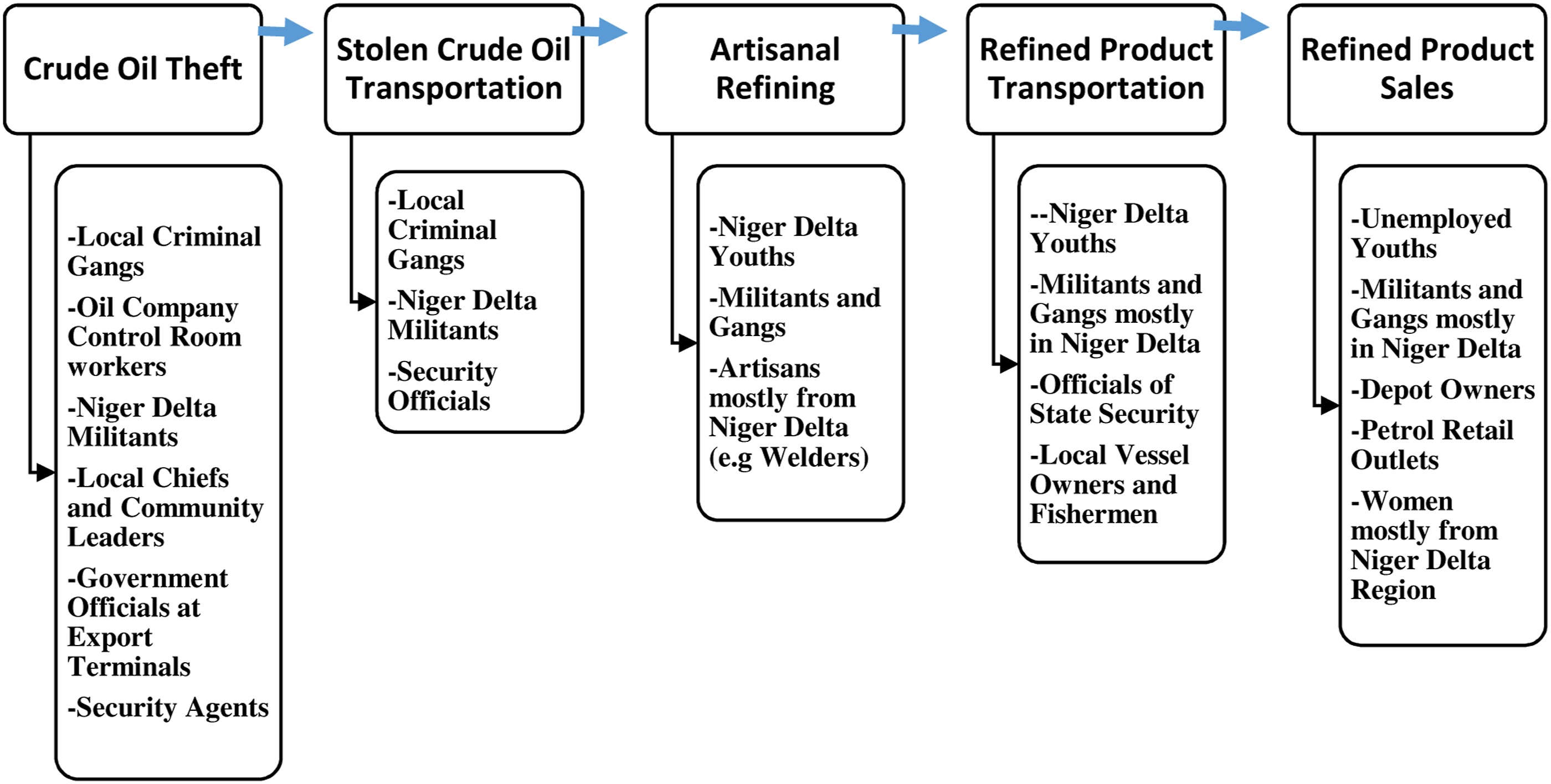
Figure 1 illustrates the processes involved in the enterprise value chain in relation to organized crime vis-à-vis artisanal refining. The Niger Delta region has an enormous deposit of crude oil, which has been one of the major sources of Nigerian export earnings over the past 6 decades. As such, many stakeholders in the underground economy are involved in the 5-stage process mentioned above. This process of organized crime in the Niger Delta region is complex, given that many private and public stakeholders are involved in these clandestine activities, including community leaders, unemployed youth, fishermen, politicians, oil company staff and government security officials.
Current size of the illegal artisanal refining business in the Niger Delta.
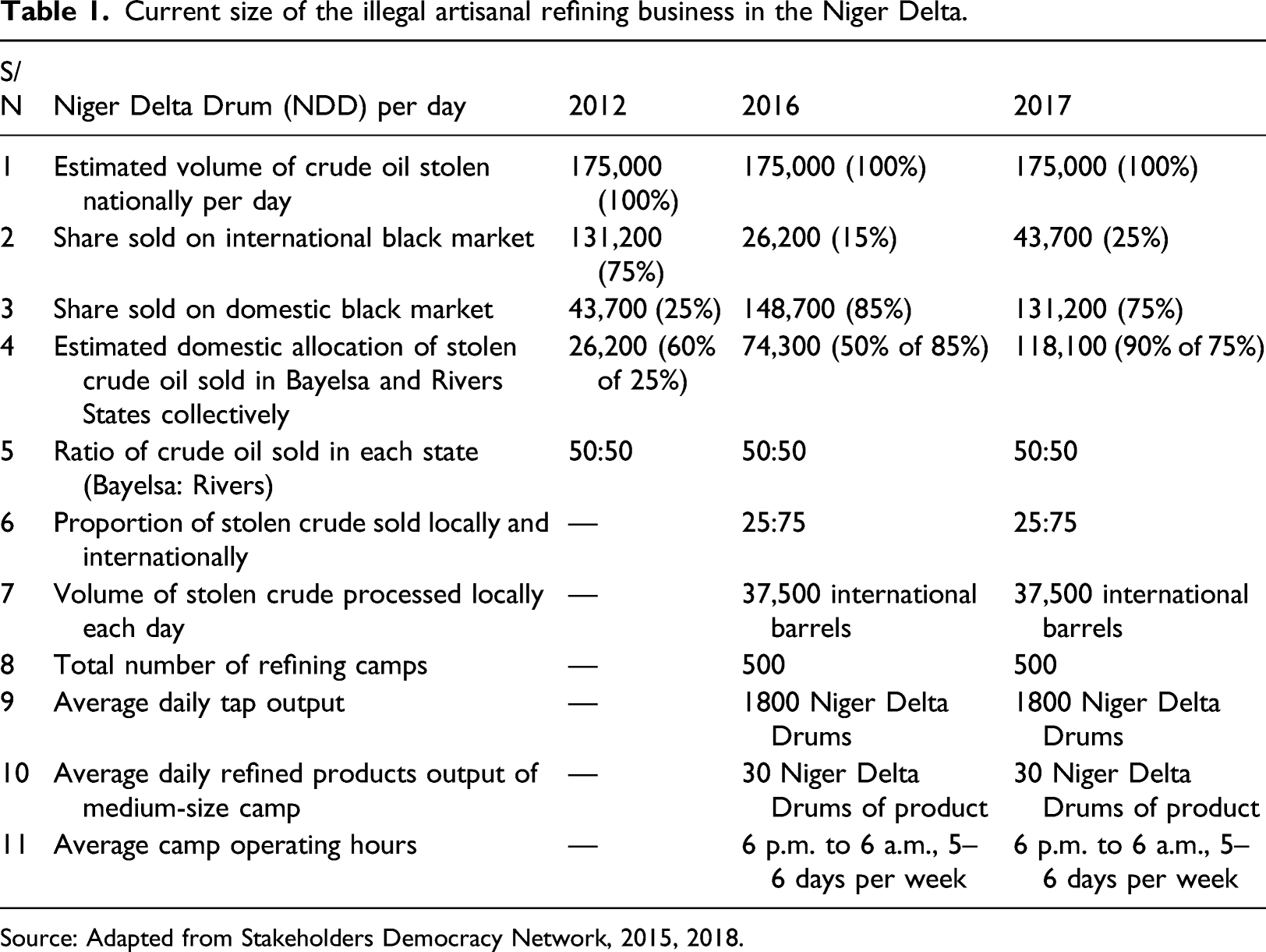
Source: Adapted from Stakeholders Democracy Network, 2015, 2018.
Estimated tap point income and operating costs ($/month).
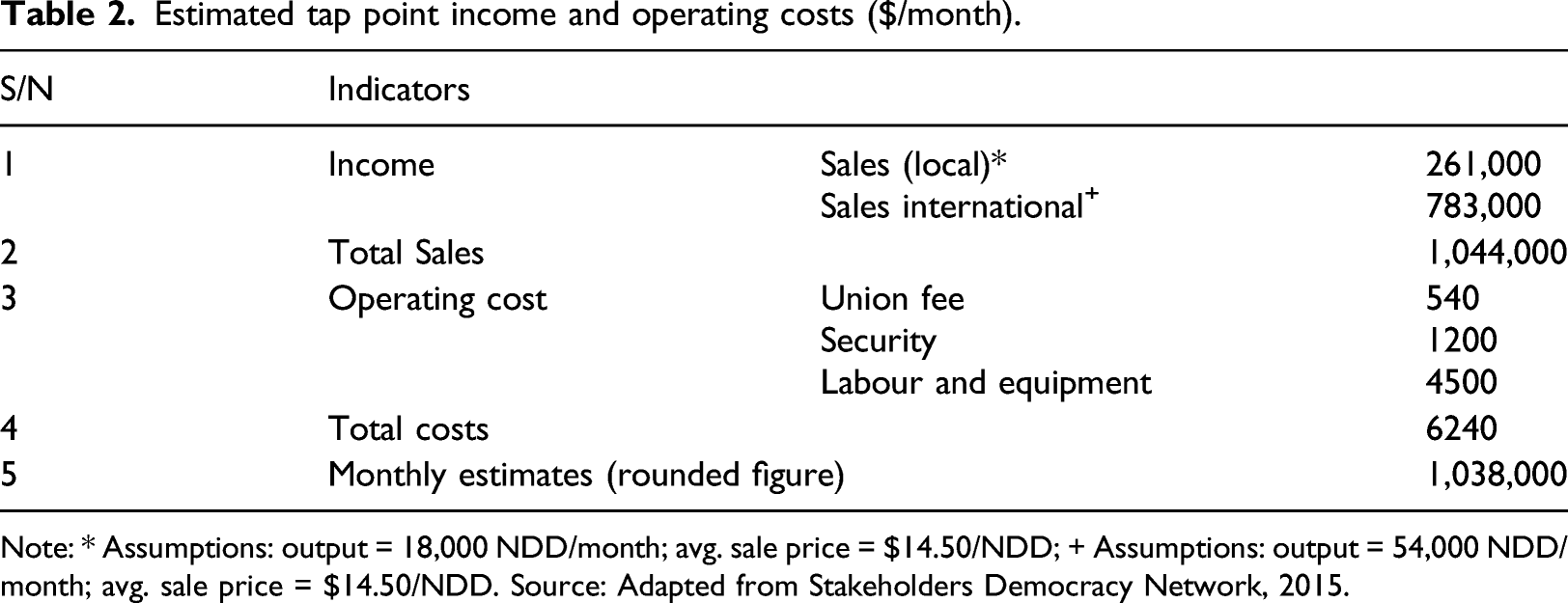
Note: * Assumptions: output = 18,000 NDD/month; avg. sale price = $14.50/NDD; + Assumptions: output = 54,000 NDD/month; avg. sale price = $14.50/NDD. Source: Adapted from Stakeholders Democracy Network, 2015.
Balogun (2018, p. 194) observes that the enterprise value chain in relation to artisanal refining has a positive contribution to the local economy through stimulation of economic activities, job creation, provisions of other social services, and cheaper refined crude oil products such as fuel, cooking gas, kerosene and so on. Unfortunately, these seemingly positive contributions of artisanal refining to the local economy seem to shift the focus away from the avalanche of negative consequences this illegal refining activity has on the local environment and the Nigerian economy at large.
The Ogoniland clean-up and the challenges of artisanal refining
The UNEP report maps the geographical and demographic settings of Ogoniland in Rivers State within the general context of Nigeria’s Niger Delta. It takes account of the impacts of oil exploration and production and its logical connection to the ensuing struggle by the Ogonis. The report also looks at the background to environmental degradation in Ogoniland, bringing out the effects of petroleum hydrocarbon and non-hydrocarbon environmental issues on groundwater, surface water and vegetations of the local communities. The UNEP report also presents a general assessment of the infrastructures of the oil industries in Ogoniland, especially those of the SPDC. The report makes the following findings: • Oil contamination in Ogoniland is widespread and severely impacting many aspects of the environment. • Oil continues to periodically spill from pipeline fractures and the illegal practice of artisanal refining, contaminating creeks and soil, staining and killing vegetation and seeping metres deep into the ground, and polluting water tables. • Smoke from artisanal refining is a daily presence, and fire close to inhabited areas is a constant threat from pools of oil that gather after a spill due to corrosion or bunkering or where artisanal refining of crude oil takes place. • Illegal extraction of oil, locally referred to as bunkering, is also a cause of spills and the ensuing environmental damage. • At the technical level, the report recommends that measures have to be taken to clean up the contamination and restore the environment. • At a more strategic level, the report recommends that action is needed to prevent a repeat of this tragedy in Ogoniland.
In light of these, UNEP came up with a set of recommendations which are divided into two parts: short-term (those that, once implemented, will have an immediate positive impact on Ogoniland) and long-term (those that have longer timelines and which, when implemented, are a path to sustainability that will bring lasting improvements for Ogoniland) (UNEP, 2011, pp. 102–231). Figure 2 presents a graphic summary of the key recommendations to various stakeholders. Graphic summary of the key recommendations. Source: Authors’ articulation.
A common denominator found in both the overall findings of the report and the ‘Emergency Measures’ is the identification and acknowledgement of artisanal refining as one of the enablers of environmental degradation in Ogoniland. The report underscores the scale of environmental damage from artisanal refining thus: ...contaminating creeks and soil, staining and killing vegetation and seeping metres deep into the ground, polluting water tables [while] smoke from artisanal refining is a daily presence and fire close to inhabited areas is a constant threat from pools of oil which gather after a spill due to corrosion or bunkering or where artisanal refining of crude oil takes place (UNEP, 2011, p. 204).
The volume of crude oil stolen and refined illegally remains unknown. Different estimated figures are reported both by the NNPC and other independent sources such as researchers. For instance, Asuni (2009, pp. 5–6) reports the figures at somewhere between 30,000 and 300,000 barrels, or the monetary value approximation of US$ 100 billion between 2003 and 2008, while Katsouris and Sayne (2013, p. 15) reported that ‘…an average of 100,000 barrels per day vanished from facilities on land, in swamps and shallow water in the first quarter of 2013’. A more recent report by Ralby (2017) notes that about 30% of all hydrocarbon products are smuggled from Niger Delta, at the estimated annual cost of $3 to $8 billion. Since the practice is illegal and clandestine, obtaining the total number of operation sites is almost difficult, if not impossible. However, the UNEP reported 12 wells (in water) and a flow station (on land) of artisanal refining in Bodo West alone (UNEP, 2011, p. 161).
The environmental consequences arising from illegal artisanal refining are considered very high both on humans and the ecosystem. A typical artisanal refinery is associated with a large number of accidents. Fires and explosions on refining sites claim dozens of lives every year. In Ogoniland, the UNEP identifies the following impact areas: • huge smoke plumes above the distilleries all day; • contamination of soil and groundwater in the immediate vicinity; • damage to surrounding vegetation from fire and smoke; • contamination of water in the creeks and coastal and mangrove vegetation and • air pollution – those involved in the artisanal refining process are at high risk of exposure to extreme levels of hydrocarbons, which can have both acute and chronic impacts, while the smoke blowing from the area can adversely affect entire communities (UNEP, 2011, pp. 30–40).
Due to the primitive distilling technology and methodology of artisanal refineries, about 80% of the crude oil is wasted in the distillation process and subsequently discharged into the environment (Yabrade and Tanee, 2016, p. 206). Artisanal refining can be carried using two broad methods: small-scale refining using primitive illegal skills, where metal pipe drums welded together are used to boil crude oil, with the fumes collected, cooled and condensed in tanks. The second method, large-scale refining, is done through tapping oil pipelines or wellheads, known as ‘hot tapping’ or ‘pressure tapping’ to steal and refine illegally. It is reported that around 25 percent of the oil in the Niger Delta is kept inland and refined in the countless artisanal refineries, which is also proliferating in Ogoniland (UNEP, 2011, p. 104).
The UNEP report further recommends that: Although the impacts of each illegal refinery are small, the cumulative effect risks an environmental catastrophe, the costs of which would far outweigh the short-term economic benefits derived. Unless artisanal refining of crude oil is brought to a swift end through effective regulatory action, in conjunction with developmental and educational initiatives, it has the capacity to cause further serious damage to the ecosystem and livelihoods of the coastal communities in Ogoniland and beyond. The fact that these operations are ongoing and proliferating in full view of the enforcement agencies is indicative, at best, of a lack of effective preventive measures and, at worst, of collusion (UNEP, 2011, p. 104).
In what seemed to be a ritualistic fulfilment of the recommendations for the creation of Ogoni Restoration Authority, the administration of President Goodluck Jonathan ‘set up some agencies that appeared to be for all the Niger Delta, and headed by non-Ogoni instead of being Ogoni-specific’ without any fund (Chukwu, 2016, para. 5). Prominent among these agencies is the HYPREP, established in 2012. The HYPREP, originally a unit of the Ministry of Petroleum Resources (but currently a unit of the Ministry of Environment following its reformation by the Buhari administration in 2020), was therefore charged with the responsibility of implementing the remediation programme. In response to the UNEP report, the HYPREP has the ‘mission to protect and restore the environmental human rights of all communities affected by hydrocarbon pollution in Nigeria’, especially in Ogoniland and its environs (Templars, 2015, p. 1). Other objectives the HYPREP was set to achieve in Ogoniland and other impacted communities include • determine the scope, means and modalities of the remediation of soil and groundwater contamination in impacted communities as may be recommended by HYPREP’s Governing Council and remedy them; • enhance local capacity for better environmental management and promote awareness of sound environmental management as well as ensure livelihoods and sustainable development; • ensure security and promote peacebuilding efforts in impacted communities and • strengthen governance, transparency and accountability in the region.
For ease of operation, efficiency and transparency, the Federal Government also set up three organs: the Governing Council to formulate policies for the project, the Board of Trustees to manage the fund of the project, and the Project Coordination Office to coordinate the day-to-day affairs of the project, including the needed transparency and financial discipline that the project of that magnitude requires (HYPREP, 2020).
Discussion
Ogoniland has suffered one of the most devastating environmental pollution crises in Nigeria arising from oil exploitation activities, which has led to the destruction of the local economy, endangered public health and created public security risks. Hydrocarbon contamination from millions of barrels of oil spilt day in day out has led to a toxic level concentration of heavy metals like manganese, iron, copper, zinc, lead, nickel, cobalt, cadmium and chromium in the aquatic and terrestrial ecosystem (Enegide and Chukwuma, 2018, p. 3). For example, benzene contamination in drinking water wells shows more than 900 times the UN acceptable level (Lindén and Pålsson, 2013, p. 685). The UNEP environmental assessment findings on the impact of oil pollution on vegetation, aquatic and public health in Ogoniland are damning. The assessment found that oil spills have led to ‘hydro-carbonization’ and bitumen-like covering of mangrove habitats, cash crops and clearing of vegetation by fire outbreaks. Thick layers of floating oils in creeks and water bodies have destroyed the ecosystem in dimensions that have led to the extinction of fish species and rendered fishery unlucrative. Hydrocarbon and benzene contamination of wells and streams is implicated in health complications and the spread of cancer in the region.
The ubiquity of heavy contamination of Ogoniland 10 years after the UNEP report submission (Ibekwe, 2020) shows that pollution issues are still heavily politicized (Nwozor, 2020, pp. 883–900). Unfortunately, restoration projects in Ogoniland have begun only in 11% of the planned sites (Ibekwe, 2020), leaving 89% of the sites still unattended. Artisanal refiners have arguably leveraged and exploited these unattended areas to proliferate and operate. It is therefore unsurprising that artisanal refining has continued to constitute another major contributor to this ongoing pollution and contamination in Ogoniland and its environs. Some oil pollution sites emanating from hidden artisanal oil refining sites, which took the UNEP experts aerial reconnaissance to identify (UNEP, 2011, pp. 102–104), have continued to operate unabatedly with all of its attendant ‘re-pollution’ consequences (Advocacy Centre, 2020; Chukwu, 2019). The economic condition and the exuberance of the population that engage in artisanal refining, coupled with the attendant security risks, have further compromised the audacity of the monitoring group to mount serious checks on this segment of the community. The consequence has been undiminished oil bunkering, theft and illegal refining, all of which have continued to mount heavy pressure on soil, water, air and the entire ecosystem in Ogoniland and its environs.
The Niger Delta is a paradox of affluence and affliction (Ibeanu, 2008, p. 15). Despite minor improvements since the end of military rule in 1999, poverty persists in the region (Foundation for Partnership Initiative in the Niger Delta, 2018). Notwithstanding the extreme wealth of the region, which sustains the entire country, all of the states in the region are caught up at the lower rung of the national poverty average (Oxford Poverty and Human Development Initiative, 2017, pp. 5–7). Poverty and youth unemployment have thus been cited as factors responsible for restiveness and criminality in the region (Awojulugbe, 2020). Ex-militants, the majority of whom have little formal education and conventional skills, find it difficult to survive in the increasingly deteriorating economic condition of the region. Some of them who were educated and trained in skills by the government as part of the amnesty agreement to end the militancy have been reintegrated into a society where there are non-existent jobs (Ebiede et al., 2020, pp. 4–12), forcing them to return to illegal oil bunkering due to its high economic return and the experiences that they already have in oil criminality (Oyefusi, 2014, pp. 531–540). The display of wealth that accrues from the high financial yield of artisanal refining by ex-militants unwittingly makes illegal artisanal oil refiners models to other youths of the region. The bulk of the youthful population of the region, already buffeted by extreme poverty and dire unemployment conditions, turn to the illegal venture for survival.
Local communities and their leaders are complicit in illegal artisanal refining (Ogala, 2013). The dynamics of local politics, power configuration and reconfiguration in the region also factors into the issue of artisanal refining (Aaron, 2015, pp. 171–177). The struggle for the emancipation of the region from economic backwardness is an effort that integrates all the social groups in the region. The armed confrontation dimension to the struggle for resource control and sociopolitical development of the region has led to the formation of various armed groups to challenge the Nigerian state, rival communities and local authorities that disagree with the ideology and strategy of the struggle (Ebiede, 2017, pp. 6–12). Local community members and civilians who are perceived to collude with the Nigerian state against armed groups and their interests have been persecuted and killed. Thus, politicians and local community leaders identify tacitly with the armed groups in the region that control the network of artisanal refinery industry for financial returns and personal security and safety (Briggs, 2007). During elections, these armed groups play a fundamental role through violent activities against political parties, candidates and interest blocs that may constitute a threat to their business (Stakeholders Democracy Network, 2020). Consequently, political leaders associate and participate in the economy of the artisanal refining industry either directly or indirectly (Asuni, 2009). This situation creates a safety net for the network of the illegal businesses, as members of the community do not readily cooperate with state authorities to identify artisanal refiner(ie)s in their communities.
Although the UNEP Environment Assessment report was submitted to the Federal Government in 2011, it took another 4 years (2015) for the government to order the implementation of the report’s recommendations for environmental clean-up and remediation of Ogoniland. The cost of the remediation programme was projected to cost billions of dollars. Although one billion US dollars ($1billion) part funding for the first phase of the clean-up was mapped out, concerns regarding full implementation, the sustainability of the programme, arising from factors such as the overall cost of the project, transparency issues in HYPREP and issues of commitment by successive governments and multinational oil companies remain (Alabi, 2019; Ibekwe, 2020; Templars, 2015). Although $1billion was announced for the clean-up and remediation project, only $360 million has been released to HYPREP so far, specifically to the Board of Trustees, in two tranches of $180 million each in 2018 and 2019 (HYPREP, 2020, para. 4). While a new investigation by some NGOs has criticized HYPREP’s and SPDC’s systemic failure to clean up Ogoniland (Ibekwe, 2020), it is estimated that it may take up to 30 years of remediation efforts at the cost of billions of dollars to reverse the damage and restore the environment (UNEP, 2011, p. 12). Major government agencies regulating the oil industry ‘lack qualified technical experts and resources’ to execute the project (UNEP, 2011, p. 12). The Department of Petroleum Resources (DPR) and the National Oil Spill Detection and Response Agency (NOSDRA), for instance, lack proper understanding and interpretation of Environmental Guidelines and Standards for the Petroleum Industry in Nigeria (EGASPIN) and the capacity to detect oil spills. Despite the touted New Remediation Management System, the UNEP report indicted the SPDC, noting that ‘while the new changes are an improvement, they still do not meet the local regulatory requirements or international best practices’ (UNEP, 2011, p. 12).
In a study on the extent of community participation in the clean-up exercise, Bodo and Ukpong (2018, p. 98) found that HYPREP’s awareness efforts focused more on elite stakeholders while leaving out the majority of the local population in the sensitization campaign. Thus, the majority of the locals and minority communities do not believe that the government is sincere about the clean-up of the polluted environment. The local communities consider the clean-up programme as just an avenue for government officials and local elite groups and stakeholders to advance their personal objectives.
The continuous pollution of the region by artisanal refining has further exposed the low commitment and weak capacity of the government. The government of Nigeria has also not recorded significant success in tracing and dismantling the illegal artisanal refineries scattered across the region in line with its commitment to clean up Ogoniland as artisanal refining activities continue to rise (Mamudu et al., 2019, pp. 5–6). The JTF officers in the region have been accused of either protecting and facilitating the activities of artisanal refiners or running the artisanal refineries themselves. For instance, Transparency International report of 2019 found that: There have been reports of soldiers protecting the ‘tapping points’, where crude oil is retrieved from illegally installed taps on the oil pipelines, of armed forces personnel turning a blind eye to, or indeed protecting, illegal bush refineries, and of soldiers soliciting bribes in return for undisturbed passage for illegal oil transportations (Transparency International, 2019, p. 3).
The findings of the Transparency International study suggest that the military are aware of the locations of most of the illegal artisanal refineries. They, however, allow the illegal activity because they also profiteer from it. In 2019, the governor of Rivers State, Nyesom Wike, alleged that Major-General Jamil Sarham, the General Officer Commanding (GOC) the Nigeria Army’s 6 Division in Port Harcourt, had his syndicate and network of artisanal refineries, run and protected by Nigeria Armed Forces personnel and resources. This allegation has also been echoed by Johnmark Ezon-Ebi, the leader of Reformed Niger Delta Avengers (RNDA) and a coalition of other groups of ex-militants, when he alleged that top government and military personnel partake in the oil bunkering syndicate as well as aid other oil thieves (Amaize, 2019). Petroleum products from artisanal refineries fill the local supply gap. The shortfall of 20 million litres of the premium motor spirit daily consumption need makes illegal artisanal refining a lucrative venture as the demand for oil products exceeds the supply (Adekoya, 2019; Ogala, 2013). The booming international market for stolen and illegally refined Nigerian oil within the Gulf of Guinea region and beyond is a major driver of artisanal refining activities in the Niger Delta. Thus, the daily theft of about 400,000 barrels of crude oil is sustained by local and international black market demands (Murdock, 2012). Illegally refined oil is also sold to the international black market as the oil is transferred onto waiting ships with doctored documents.
Conclusion
An interplay of dynamic factors such as poverty and unemployment, the complicity of local leaders and top government political/security officials and the scarcity of oil products market within Nigeria and the West African region has sustained the lucrative illegal network of artisanal refining in the Niger Delta region. These factors also lead to a deliberate failure in the enforcement of environmental regulations and the containment of illegal artisanal refineries on the part of government officials. This has also translated to increased pollution of freshwater sources, fishing estuaries, vegetations and farmlands. Thus, for the clean-up and remediation efforts in Ogoniland to be successful, the government has to make concerted efforts to gainfully employ youth and divert their attention away from the illicit enterprises. In addition, the government should dismantle illegal oil refinery camps, confiscate and dispose of all illegal crude oil and refined products in the Niger Delta. More importantly, skilled youths engaged in the artisanal refinery business should be formally absorbed by international oil companies operating in the Niger Delta so as to improve their human capacity and contribute to the local content drive in Nigeria. Finally, it is also recommended that the Nigerian government should earmark at least 10% of the national income towards improving the well-being of the oil host communities in the Niger Delta since those communities produce about 95% of the country’s export earnings. This will further dissuade jobless youths from engaging in the illegal artisanal refinery business and encourage community members to assist the government in fighting the menace of artisanal refining.
Footnotes
Declaration of conflicting interests
The author(s) declared no potential conflicts of interest with respect to the research, authorship, and/or publication of this article.
Funding
The author(s) received no financial support for the research, authorship, and/or publication of this article.
