



Abstract
The Levelling Up White Paper (LUWP) is intended to drive local economic growth and development, particularly in left-behind places. It proposes policies and investments in innovation infrastructure and services as an explicit mission and key component of the LU reform agenda. This paper, however, suggests that, without systemic behaviour and culture change in national innovation institutes and their funders, the LUWP will produce few if any results of game-changing significance. Based on a project to explore how a Research Council and one of its core funded institutes should improve local impact and prepare for the LUWP, the paper explores practical changes that need to be considered to make LUWP place-based innovation ambitions a reality. It discusses the structures and processes that national institutes and programmes might need to transition from interventions that have local impacts incidentally by accident of where they are taking place, to purposeful place-based growth and development. It then suggests the capabilities required to deliver this well – which has major implications for innovation funders. The LUWP’s good intentions for more impactful place-based innovation requires new tools and techniques, experimentation and learning-by-doing, and proper resourcing – robustly tested and evaluated by Local Economy research and practitioner communities.
Keywords
Introduction
Local growth strategies founded on knowledge-based, high-tech innovation have become a pervasive orthodoxy in recent decades (Royal Society, 2020). Potential implications of this for social inequality in general, and ‘left-behind places’ in particular, has been recognised (NESTA, 2020), but has tended, if at all, to be addressed through regeneration rather than development programmes.
Government’s adoption of ‘Levelling Up’ (LU) as a primary goal of the Johnson administration (GOV.UK, 2021) has been anticipated in a number of innovation strategies. For instance, the 2020 R&D road map (HMG, 2020), 2021 Innovation Strategy (BEIS, 2021) and Plan for Growth (HMT, 2021) all recognise the importance of the impending Levelling Up White Paper (LUWP). Contextual measures like the revision to the Treasury (HMT) Green Book (HMT, 2020) for public investment appraisal and Government support for ‘Civic University’-type incentives (including an award for the Civic Universities Network [DfE, 2022]) are signifiers of a belief that, among others, public expenditure on research and development (PERD – which includes innovation, so RD&I) can be part of the levelling up equation for target geographies.
The LUWP (DLUHC, 2022) was finally published on 2 February 2022. It locates RD&I as an important contributor to the ‘intangible capital’ places require to build and sustain their success. Intangible capital is one of six capital requirements (alongside physical, human, social, financial and institutional) for places. In the six-capital framework (Figure 1) an example is given. Low investment in RD&I leads to a ‘low wage, low skills economy’. This stimulates ‘emigration of skills and firms’, which in turn reinforces lower capacity and capabilities to receive investment in RDI…in a vicious circle of relative decline. Purposeful/Incidental and Host-HEI/Place dimensions.
To redress this, a specific mission is adopted that ‘By 2030, domestic public investment in R&D outside the Greater South East (GSE) will increase by at least 40%, and over the Spending Review period by at least one third. This additional government funding will seek to leverage at least twice as much private sector investment over the long term to stimulate innovation and productivity growth…This mission is focused on delivering R&D and innovation’.
The mission is accompanied by specific departmental investment proposals; place-based initiatives like three ‘innovation accelerators’ for the Mayoral Combined Authorities (MCAs) of Greater Manchester (GM) and West Midlands (WM), and of Glasgow city-region; and a new corporate goal for UKRI – to ‘Deliver economic, social, and cultural benefits from research and innovation to all of our citizens, including by developing research and innovation strengths across the UK in support of levelling up…and increase consideration of local growth criteria and impact in R&D fund design’.
This Viewpoint considers whether the changes implied in the LUWP are likely in practice to deliver tangible LU in left behind geographies and communities; and what local leadership teams and national innovation institutes might do to increase LU outcomes and impacts in these geographies.
The case study example
The Viewpoint draws heavily on an exercise undertaken by the author and a colleague 1 in late 2021 for one of the Research Councils and a National Innovation Institute to prepare them for anticipated LUWP goals and priorities.
Our work was for EPSRC (the Engineering and Physical Sciences Research Council) and the Henry Royce Institute (the ‘Royce’ which EPSRC core funds) – the national innovation institute for advanced materials RD&I. The Royce has its HQ in Manchester with spokes in six Russell Group Universities (Sheffield, Leeds, Liverpool, Oxford, Cambridge and Imperial), UKAEA and NNL. Our project comprised desk research, extensive consultation and involvement with relevant funders, participants, users and stakeholders, to consider baseline impact in place-based terms and how this impact might be increased in any impending LUWP context.
Our desk research surfaced a relative paucity of material on how national RD&I institutes should engage locally and how their sub-national impact can be optimised.
‘Discovery’ roundtables included place-based Royce leadership teams in both the Manchester hub and the other northern spokes (Leeds, Liverpool, Sheffield), their host university institutions, and local demand side role players – for example, Combined Authority or LEP, business cluster group or intermediary etc. These were followed up with two open workshops for role players on both demand and supply sides in geographies across the North, both where Royce has a physical footprint, but also where it doesn’t (e.g. NorthEast, Pennine East Lancashire etc).
The hub and spokes of the Royce in the North are highly valued role players in local academic and business eco-systems – especially for their facilities, but also for their expertise and as part of the place’s offer and brand where they are located. It has also established some reach into networks beyond their local eco-systems. For instance, there are links to relevant centres in the NorthEast, and links between individual practitioners in their own fields as a gateway to wider local involvement.
Yet there are also local frustrations. Ease of access to facilities and expertise is transactional. There are also more fundamental barriers to place-based and LU agendas. Academic business models, driven by the long-term interest of research communities, are not always well-suited to business problem-solving – typically shorter term, translational or at higher levels of the technology readiness ladder (TRL). In public policy terms, the channels and commissioning frameworks for deploying national RD&I expertise on local problem-solving are not built into the structures and processes of national institutes.
One example we used with the Royce was whether and how the institute could increase granular understanding of and improve intervention effectiveness for the role of advanced materials in GM and North West’s net zero 2038 goals. In theory, that seems a legitimate benefit a city-region might expect from hosting the national RD&I institute for advanced materials. But in practice, it is neither seen as a primary Royce responsibility; nor does GM have the levers to task Royce, short of just commissioning the exercise as they would from any commercial consultancy. Net zero is just an example. One could make the same point with a whole range of other public policy questions where advanced materials have a potential role to play – healthtech, circular economy, reimagining town centres, transport and housing infrastructure, among others.
Following the desk research, discovery sessions, workshops, and bilateral discussions, we were able to design and propose two frameworks which we believe can be used and adapted across public RD&I roleplayers in general, and for national innovation institutes seeking to optimise their place-based and LU impact in particular.
The next section outlines these findings and recommendations in greater detail, prior to concluding comments about the implications of this exercise for LU research and practice more widely.
Findings and recommendations
Our findings recognise that, of course, national innovation undertaken in specific places has local impacts – for instance attracting high skills employment and high-tech businesses, with resultant increases in local expenditure, business spill overs and clustering effects. But incidental impact – almost by definition – cannot be asserted as a place-based model for national innovation policy of a government who have put LU goals at the centre of their purposes.
In these circumstances, national role players need models or frameworks that can illuminate the geographical impact of the choices they are making (even if incidentally) and can thereafter be used as strategic tools to turn incidental into purposeful local and regional goals.
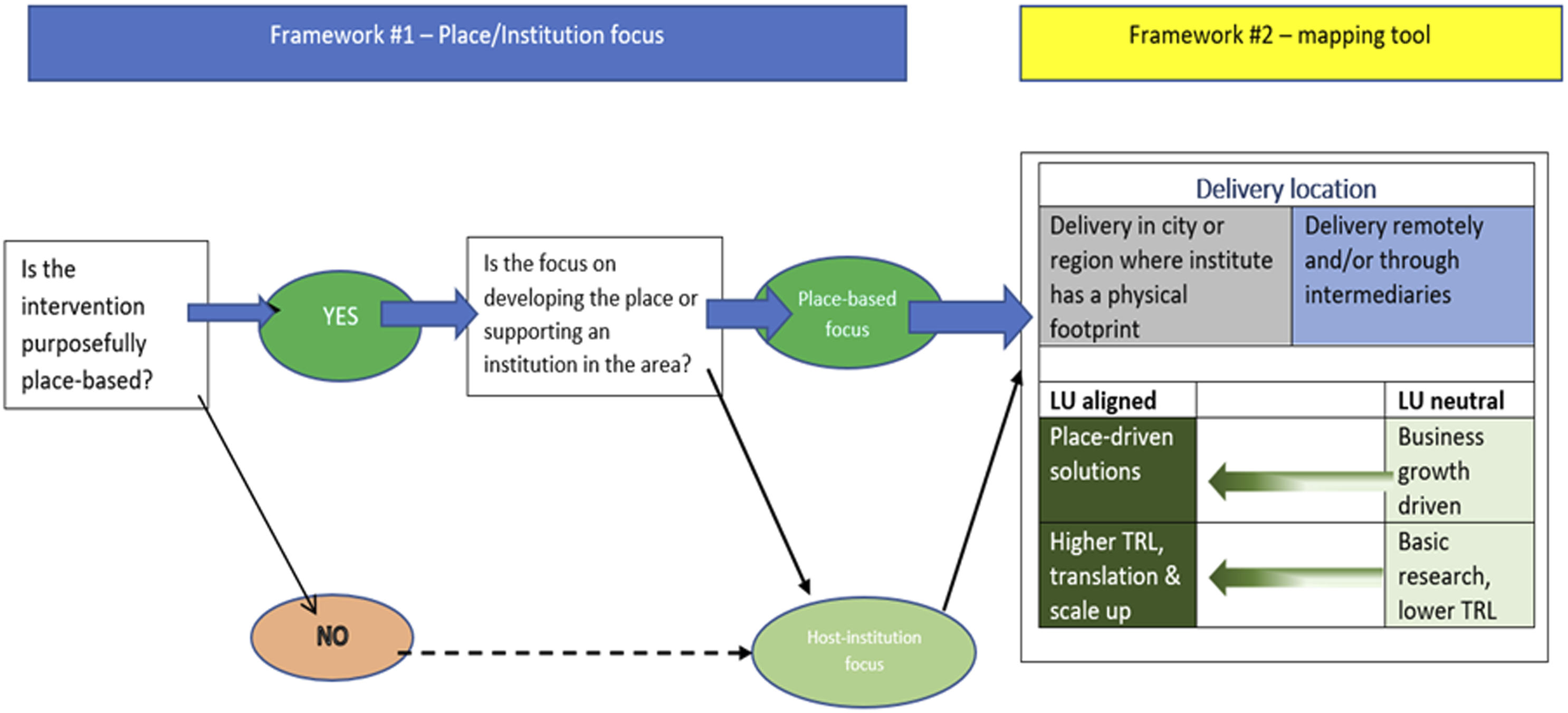
Framework #1 enables national innovation institutes and programmes to map the focus and intended outcomes of their activities. An activity might be driven primarily by the roles and responsibilities of the host institution, or potentially by some sort of place-focused client. Its place-based outcomes might be explicit/purposeful or might be the incidental consequence of some place-blind purpose. This framework implies four generic innovation intervention strategies.
In descriptive mode, the tool can be applied usefully to allocate and measure impact. However, it can also potentially be used as a strategic planning tool.
To the extent that regional benefits maximisation is a priority (or a mediated shared goal of the priorities of an Agency’s primary stakeholders – corporate, funder, host institution), the regional benefits framework should
A strategy which is about a national institute or programme adding value to existing clusters of excellence might focus more on the bottom right quadrant – a rather more transactional ‘investing in success’ strategy. One that is driven by the needs/ambitions of the host of the institute – often a university, but potentially a large business or RTO/PSRE might gravitate towards the top left quadrant. The bottom left is more opportunistic – some ad hoc coalition of role players identifying an opportunity (probably a tranche of government funding) and bidding for it.
These strategic choices are not exclusive. A regional benefits framework might, for instance, seek win-wins in the two purposeful quadrants through an opportunistic funding or programme bid. But where national institutes and programmes proactively seek purposeful impact, there probably needs to be some activity in the upper quadrants – and this is the focus of the second framework proposed.
A second three-tiered framework comprises the following: • Tier One distinguishes between national innovation institutes’ roles in places where they are located and in places where they do not have a physical footprint. In physical nodes, participation in business, skills and wider economic eco-systems can be relatively direct and more easily achieved. But, in LU mode, national institutes and programmes have to address the ‘cold spots’ without physical innovation infrastructure and local services. To return to the Royce local net-zero challenge, just because they have no physical presence in the NorthEast or SouthWest does not mean there is no public demand for advice and support to progress advanced materials contribution to their net zero challenges. • •
Putting the two frameworks together produces a decision flow and mapping figure illustrated below:
Applying these frameworks suggests that mission-driven innovation for LU purposes has to be at least partly about empowering all places to have access to national innovation assets and capabilities to address their priorities and challenges. It has to be about enabling national institutes and programmes both to measure local impact – but also to fundamentally alter its plans and operating styles to be able to respond to place-based agendas.
Figure 2 suggests the LU-priority for national innovation role players will most likely be delivered where in framework one it is a purposeful contribution to place-based development. And framework #2 suggests that, whether it is in the physical location of the national institute or delivered remotely, the most LU-aligned interventions will be driven by the place itself (effectively as the client) and be most impactful where it is higher up the TRL, translation, commercialisation or scale-up ready.
An illustrative strategic framework for LU planning and management of national innovation interventions.
This is not to say that other interventions cannot have significant place-benefits. But an institution with NO LU priority interventions is unlikely to deliver major and optimal LU benefits.
Having outlined a framework, the question of how it should be populated remains outstanding, and will, of course, vary according to local context, character of innovation institution and intervention, and its position in national thinking, policy and resourcing.
The sort of changes national innovation institutes might need to consider in order to deliver at high levels of LU readiness include: • New goals, intervention strategies and measurement systems • Local economic policy capabilities and connections at both Board and executive levels • Some level of specific local and regional programme funding • A responsive problem-solving and solutions team able to mobilise rapidly in response to local demand.
These amount to a major change agenda for leadership and management of hitherto more academic and business-oriented teams. It also requires some core funding for the strategic roles and some programme resources for local interventions.
On the demand side, the LU innovation agenda also requires ‘intelligent clients’ with some level of resources at city-region, district and community levels. Local (LAs) and Combined Authorities (CAs) and their partners need to be able to frame sensible questions national institutes and programmes can answer, and commission them to test and then advise on delivery of solutions. Combined Authorities and LAs need to be able to plan and mobilise local businesses, public bodies, and stakeholders to scale up change on the ground where national innovation investments deliver positive results.
Implications for LU policy and practice
The case study was conducted prior to publication of the LUWP. Now that the White Paper has been published, how far is it likely to drive the sort of change described above?
First, the White Paper is very strong on prescribing local measurement, evidence-informed decision-making and evaluation. ‘Lack of [place-based] evidence, monitoring and evaluation’ (page 144) is one of the five identified shortcomings of past policy attempts to address regional disparities. Government is proposing to establish a new independent body in England focused on data, transparency and robust evidence, a new Spatial Data Unit in Department for Levelling Up Homes and Communities (DLUHC), investing in spatial modelling tools, supporting and working with ONS to make relevant data accessible and readily available, including ONS’s new sub-national data explorer.
One can anticipate this increased emphasis will extend to publicly funded innovation role players and communities. It will require new measurement systems in these bodies, and also understandings of how to use them. It should also deliver new sources of data and evidence for researchers in these areas of policy development and academic inquiry.
Second, the LUWP goes some way towards suggesting a move from incidental impact intervention models to more purposeful strategies. The new corporate goal for UKRI could signal an expectation of adoption of place-based goals for the institutes and programmes that UKRI funds, and perhaps even a more general requirement of government funded RD&I. However, if the UKRI corporate goal is a forerunner of a more general trend, there must be major doubts whether it passes any reasonable tests of specificity (e.g. ‘developing RDI strengths across the UK…[increasing] local growth criteria and impact in R&D design’) or measurability.
Third, the adoption of Mission #2 – ‘By 2030, domestic public investment in R&D outside the GSE will increase by at least 40%, and over the Spending Review period by at least one third…to stimulate innovation and productivity growth’ – clearly signifies the importance of RD&I in levelling up agendas. There are even three place-based ‘innovation accelerators’ centred on GM, WM and Glasgow city-region, commanding £100m (presumably over the spending review period – so an average of around £10mpa each).
However, both the mission, the metrics associated with it, and the accompanying narrative is silent about how this will be achieved – and the amounts involved are a long way short of LU driving the ‘global science and technology superpower’ metric of 2.4% of GVA on RD&I spend by 2027. For instance, the innovation accelerators might amount to around 0.0003% of GVA (i.e 3/10,000ths) for their respective city regions if they receive expected private sector leverage!
The case study at least has the merit of proposing a number of generic intervention strategies for increasing LU RD&I intensity – strategic expertise/knowledge, local programme funding, rapid response teams, in addition to measurement, performance management and evaluation systems. None of these are precluded by the LUWP – but nor are they explicitly recognised, and consideration given as to the resources required to do them well.
Academic considerations
What might the preceding narrative mean for Local Economy research agendas?
As a viewpoint, this piece is presented as a potboiler to stimulate further development thinking.
Local growth policymakers and practitioners recognise ‘place-blindness’ in national RD&I policy and practice has a long pedigree. National policy makers, and organisations with global reach that happen to be located in specific places in the UK, face competing priorities that tend to be more important than considerations of local and regional impact.
The LUWP is government’s attempts to redress this – through relatively light-touch goal and mission-driven policy, together with tweaks in where modest amounts of RD&I public investment is spent.
This seems to be a couple of small steps in the right direction. But research communities have major roles to play if these small steps are to be a springboard for a major leap.
In its own terms, LUWP proposals need changes in measurement and evaluation rooted in robust evidence and analysis of RD&I theories of change, benefits and impact assessment.
However, moving from incidental to purposeful place-based RD&I interventions will require a more granular understanding of local offers national innovation role players need to be considering; the framing of strategic asks local and regional teams should be making or commissioning from them; and the policies and resources Government can put in place to enable this to happen.
Models and frameworks from research areas like devolution, civic universities, or science and technology-led regional innovation are helpful. But this viewpoint, and the case study on which it draws suggests the post-LUWP period will be experimental with a lot of learning by doing.
If the LUWP is to drive national RD&I’s place based and LU impacts out of first gear, relevant research communities should proactively engage nationally and locally on both demand and supply sides, to set the parameters, track and deliver the learning from the coming period of LUWP implementation.
