



Abstract
Although the literature on accelerators, an important and newer model of entrepreneurial support, considers their performance and the definition of the form, little is known about how accelerators populate in a single ecosystem over time. We find accelerators are established by different types of entities such as non-profit organizations, local governments, universities, and even foreign government agencies with different goals. Based on a novel dataset of all 107 accelerator programs that ever operated in New York City, we propose a new way of categorizing accelerators by their founding attributes. We confirm that the emergence of accelerators in New York City started with the entry of non-profit accelerators for the purpose of local economic development. For-profit actors followed. Accelerators began from the periphery of the city’s geographic boundaries, but over time became concentrated in Manhattan. We also observe a shift toward sector specialization. Our contributions are to examine the development of one entrepreneurial support organization over time in one ecosystem, present a method to categorize accelerators based on their sub-niches, and to provide evidence of a catalyzing role of local government in fostering ecosystem emergence.
Keywords
Introduction
Probe any entrepreneurial ecosystem, defined as a geographically defined system of entrepreneurs and institutions (Spigel and Harrison, 2018), and you will likely find an assortment of entrepreneurial support organizations (ESOs). ESOs operate with varied missions, services, and goals to support entrepreneurs as they develop their firms. One of the most popularized forms of ESO in the last decade are accelerators, a type of ESO with a cohort-based model designed to speed up the launch of a businesses by offering fixed-term coaching, networking with investors, and, often, seed funding (Cohen et al., 2019a; Hochberg, 2016). This is due to high-profile national programs such as Y Combinator and Techstars (Drover et al., 2017). Yet this popularized view masks considerable heterogeneity among accelerators and the long incubation of the idea. And while recent studies draw attention to the accelerator phenomenon and its impacts on firm outcomes (Breznitz and Zhang, 2019; Canovas-Saiz et al., 2021; Cohen et al., 2019a; Gonzalez-Uribe and Leatherbee, 2018; Hochberg, 2016; Yu, 2020), we lack understanding of accelerators as organizations and their heterogeneity, including how different categories of accelerators emerge in relation to each other, both temporally and geographically, within an entrepreneurial ecosystem.
Accelerators are launched by a variety of groups including entrepreneurs, governments, venture capital (VC) firms, and large corporations with diverse goals ranging from public good-motivated to philanthropic and for-profit purposes (Chan et al., 2020; Cohen et al., 2019a). Given this, one framework to study the emerging organizational ecology of accelerators is to consider their missions as they relate to the goals and needs of various stakeholders in an entrepreneurial ecosystem. In this paper, we ask how a population of accelerators emerges in an entrepreneurial ecosystem and provide insight into how the goals of diverse stakeholders are formed and realized as organizational sub-niches emerge in an ecosystem through a case study of one metropolitan region. Rather than assuming that the environment is given, our focus is on the endogenous temporal process by which a system develops.
Understanding the organizational ecology of parts of the ecosystem is important for piecing together a coherent picture and narrative of entrepreneurial ecosystem formation. To answer our research question, we draw on organizational ecology’s application of niche theory, which explains how and why different types of organizations emerge within a same broad population (Hannan et al., 2003). This allows us to develop a framework for categorizing accelerators into sub-niches based on their origin and founding. Next, we examine how accelerators populate an entrepreneurial ecosystem based on their origins, as well as if they occupy a specialist versus generalist orientation, and where they locate in an urban area.
We apply our niche framing using a case study approach. Accelerators, as organizations and as a financing model, reflect a temporal process of development. Their development embodies a conscious movement to integrate funding and incubation within a single program by experienced entrepreneurs, investors, and public actors. New York City (NYC) provides an ideal case to examine accelerator emergence. Notably, the city lagged other large US metropolitan regions in the establishment of an entrepreneurial identity and ecosystem, despite being the financial capital of the United States, which should have made it attractive to startups (Arikan, 2008; Endeavour Insight, 2014: 4; Florida, 2014: 36; Rossi and Di Bella, 2017). NYC accelerators were founded by groups with diverse backgrounds including government, non-profits, local entrepreneurs, and investors with a financial motivation. We find that such backgrounds associate with different founding patterns and ultimately demonstrate the utility of having multiple accelerator organizational types within a region.
This paper makes three contributions. First, we contribute to the literature on accelerators and entrepreneurial support organizations by categorizing accelerator sub-niches. We demonstrate the utility of bridging theory on organizational ecology to ESOs (Clayton, 2020). Second, we discern the patterns of accelerator emergence in an ecosystem in terms of accelerator origin, mission, and geography. Finally, we contribute to the understanding of the role of local government in fostering ecosystem emergence. We find that public and non-profit actors play an important role in supporting ecosystems by establishing distinct ESOs. Our findings have implications for the NYC ecosystem builders as well as other communities trying to build entrepreneurial ecosystems.
The emergence of accelerators and heterogenous backgrounds
Accelerators are one of the dominant and most popularized ESOs in current entrepreneurial ecosystem discourse (Isenberg, 2011; Mason and Brown, 2014). Distinguished from VC investments and incubators, whose services are carried out without a clearly defined period of support, accelerators offer formatted services to startups. Some organizations offer accelerator programs, though their mission or operations may be broader, while others function only as accelerators. Our use of the term accelerator refers to individual accelerator programs.
The focus of the accelerator literature has mainly been on outcomes. From the earliest studies, researchers have examined the outcomes of accelerated firms, leveraging a variety of measures such as firm survival and the amount of raised funds (Cohen, 2013; Cohen et al., 2019a; Hallen et al., 2014; Hochberg, 2016). Due to the limitations inherent with outcome measures, the accelerator literature continues to provide new answers to this question (Hallen et al., 2020). Findings consistently suggest that accelerators help startups achieve milestones earlier (Clayton et al., 2018; Yu, 2020). Scholars also measure outcomes at the ecosystem level, highlighting how accelerators improve the entrepreneurial capacity of ecosystems (Fehder and Hochberg, 2014, 2019; Goswami et al., 2018; Xing et al., 2018). More recent studies try to understand the mechanisms by which accelerators support startups (Brown et al., 2019; Lyons and Zhang, 2018; Stevenson et al., 2020). Cohen et al. (2019b) build a novel explanation for how accelerators’ program elements assist startups by mitigating entrepreneurs’ bounded rationality based on several in-depth case studies.
Another theme in the accelerator literature investigates heterogeneity in the backgrounds of the individuals that found accelerators and the organizations that sponsor them. Exploring a variety of accelerator programs world-wide, researchers elucidate that diverse agents establish accelerators and that public actors such as governments and universities take a primary role in their diffusion and expansion (Breznitz and Zhang, 2019; Chan et al., 2020; Gonzalez-Uribe and Leatherbee, 2018; Yu, 2020). Cohen et al. (2019b) find heterogeneity in the backgrounds of founders and sponsors (e.g., governments, universities, foundations) and evidence that this heterogeneity influences the design choices of accelerator programs (e.g., equity investment) and the outcomes of accelerated firms (e.g., fundraising and valuation). Their finding that startups in accelerators sponsored by government have lower growth rates than those sponsored by private investors suggests accelerators with different organizational sponsors may target different startups and lead to different outcomes. These papers do not make the connection between types and temporal and geographic emergence, providing motivation for our paper.
In summary, the accelerator literature indicates that even within one ESO form there exists considerable heterogeneity. Accelerators are established with varied missions and goals by different groups of individuals, investors, businesspeople, and civic leaders (Bliemel et al., 2018; Canovas-Saiz et al., 2021). Heterogeneity of mission translates to heterogeneity of accelerator models, leading to the question of why multiple types exist and how they emerge in relation to each other. Our paper takes a first step toward filling these gaps in our understanding of accelerators and ecosystems. It investigates whether there are patterns in the emergence of accelerator types, and whether multiple types may serve the same diverse, evolving ecosystem. In the next section, we use organizational ecology’s application of niche theory as a frame for theorizing why different types of accelerators emerge, when they emerge, and where they emerge in the spatial geography of a city.
Accelerator sub-niches
Niche theory explains how and why different organizational species emerge (Freeman and Hannan, 1983; Hannan and Freeman, 1977). Under the umbrella of an ESO, which is a fundamental niche according to niche theory, different realized niches will emerge over time due to dynamic and competitive processes guiding resource partitioning and acquisition (Hannan et al., 2003: 320). The underlying logic is that users of a fundamental niche have needs that could be met more efficiently by a realized niche that is more targeted. Like incubators, local venture mentoring organizations, coworking spaces and other entrepreneurial supports, accelerators are a realized ESO niche (Clayton, 2020; Clayton et al., 2018). The accelerator literature (Chan et al., 2020; Cohen et al., 2019b) and available evidence suggests that within the ESO realized niche of an accelerator, there is further partitioning which allows categorization of distinct accelerator sub-niche types. Our focus is on understanding the emergence of these sub-niches.
New organizational types emerge through a dynamic process of competition and adaptation (Hannan et al., 2003; Luksha, 2008). Sub-niches emerge to fulfill perceived unmet needs, occupying different resources spaces (Carroll and Khessina, 2005; Freeman and Hannan, 1983). Bertoni et al. (2019) find different types of VC occupy different niches; we extend this idea to accelerators. We expect that, first, the accelerator landscape is populated by sub-niche accelerators that attempt to fill a broad role. These will be either government entities, non-profit organizations or partnerships that try to develop new capacity that would be attractive to private investment. These organizations are casting a wide net rather than targeting a specific industrial segment or type of founder, for example. There is still much uncertainty in the ecosystem and risk in creating new ESOs. Once the business case is made and these accelerators are functioning, we expect to see greater entry of for-profit or business development accelerators. For private investors, this represents an opportunity for profit. Finally, we expect national and international entities to move in once a local entrepreneurship market has thickened and these groups see merit in placing their startups or accelerator programs in the region. The logic is that the first organizational sub-niches emerge when there is more uncertainty in the local ecosystem and have a broader, more altruistic, economic development purpose. We follow Feldman et al.‘s (2016: 10) definition of economic development, which focuses on expanding the capacities of individuals and firms and relies on innovation to increase prosperity and quality of life through institutions of openness, risk tolerance, and diversity. This is followed by the entry of sub-niches with profit or development motives who are less willing to take on risk. Ecology’s niche theory suggests that the growing diversity of sub-niches creates sustainability (Levine and HilleRisLambers, 2009). There is also potential, from the niche view, for sub-niche decline.
We further exploit niche theory to help distinguish generalist versus specialist accelerators based on the programs’ business models and missions. Following the logic of Carroll and Swaminathan (2000), we expect resource-partitioning occurs among organizations as early generalist accelerators which did not have a specific mission focus begin to specialize or leave open an unmet need for specialist accelerators. After generalists emerge, subsequent accelerators will seek out different types of startups to support, such as specialist sub-niches that target industry sectors or include a social purpose (i.e., women and BIPOC founders). Niche theory also suggests that evolutionary dynamics of adaptation may favor specialist versus generalist sub-niches depending on the source and type of ongoing environmental changes. Generalists may dominate within a niche when a change in the environment is drastic with high uncertainty; specialists may dominate when change is fleeting or incremental (McDonald and Gao, 2019).
Finally, we consider a third dimension in the organizational ecology of accelerators: their location. Research on the geography of innovation finds an integral role for peripheral areas in supporting innovation and entrepreneurship (Eder, 2018; Mayer and Baumgartner, 2014). We carry this logic to considering the geographic emergence of accelerators in a city. Given that resources and support could vary by place, accelerators established by different founders and sponsors are likely to emerge in different neighborhoods within a city (Lomi, 1995). We predict that accelerators will first emerge in neighborhoods where costs are lower—outside the main business district. Maintaining lower costs of operation is crucial in early stages of experimentation with a new organizational form when there is high uncertainty, in the same way there is uncertainty around a new product innovation (Lee and Rodríguez-Pose, 2013). This is especially the case when these new forms may be sponsored by public agents with often limited budget. In contrast, sub-niche entrants that rely on resources different from those that government and not-for-profit accelerators rely on would locate in the city center, perhaps close to their other operations in the case of corporate accelerators. Access to professional service providers in the central business district and a more prestigious address would guide these decisions. We would especially expect such a connection between investor-led accelerators and a location in a financial district. Also, in the case that an accelerator has a social mission we might expect these to locate in areas outside traditional business hubs. We explore these propositions in our analysis.
Research design
We conduct an exploratory case study of the emergence of one ESO type in one city over time: accelerator programs in New York City (NYC) from 2008 to 2019. NYC is an ideal setting because it is a large global city and has worked concertedly across recent mayoral administrations to develop an entrepreneurial ecosystem (Zukin, 2020b, 2020c). The dynamic history of the NYC ecosystem, described in the next section, and the active engagement of various stakeholders provides a testbed to study the dynamics of evolving organizational forms like the accelerator in an emerging entrepreneurial ecosystem. Our first task was to identify and collect data on the population of accelerator programs.
We referred to seven sources to compile the population of NYC accelerator programs that ever operated in the five boroughs of NYC. We set an accelerator program as the unit of analysis, instead of an accelerator organization, for two reasons. First, some accelerator organizations launch several programs by collaborating with other organizations. Such programs are significantly different from the original accelerator in terms of goals, missions, profiles of founders and sponsors, and thus, the way of functioning. Second, accelerators report programs separately on platforms such as Crunchbase, and they recruit startups separately. We refer to accelerators and accelerator programs interchangeably. We merged lists of accelerators from Crunchbase 1 , Google Maps, Seed DB, Startup Opportunity, Accelerator Info, Demoday, and Digital NYC. Additionally, we found accelerators omitted from these sources using web-searches and prior literature. The initial search found 478 potential accelerator programs, including duplicates. We removed duplicates by cross-referencing our data and by conducting a series of web searches to identify when program names had changed.
Our criteria for inclusion were that the program offered an educational or coaching program for a limited cohort with a specific time delineation. We excluded programs that simply offered funding or ad hoc services; did not target entrepreneurs (e.g., accelerating real-estate deals); were backed by another accelerator program already in our database; had no evidence of actual operation; claimed not to be an accelerator; did not operate within NYC boroughs; or, operated only virtually.
We observed several cases where agents established multiple accelerator programs. Those programs’ managers list the programs separately because they were established based on collaborations with external organizations. For example, Techstars launched a series of accelerator programs based on collaboration with various entities including large corporations and public organizations. We consider these programs as distinct from the original. 2 After this data cleaning and sorting process, we identified 107 unique accelerator programs that operated in NYC between the start of 2008 and the end of 2019. We collected data on the organizations who sponsored the accelerator and the individuals who were involved in the founding. We collected information on accelerator missions, operations, and address. We used this information to inductively code accelerator sub-niches and analyze when, where, and how different accelerators emerge. We rely on other secondary data sources and prior literature to piece together an historical narrative of the NYC ecosystem and emergence of accelerators. Our intention is not to compare NYC accelerators to other cities but to focus on the temporal development in this one location.
In the next sections, we outline the history of the NYC ecosystem and present our analyses. We organize our analyses by first delineating accelerator sub-niches and describing our inductive methodology in depth. We then present our analysis exploring why certain organizational sub-niches populate the ecosystem before others, and whether there are discernible specialization and location trends. (Figure 1) Timeline of major events the NYC entrepreneurial ecosystem.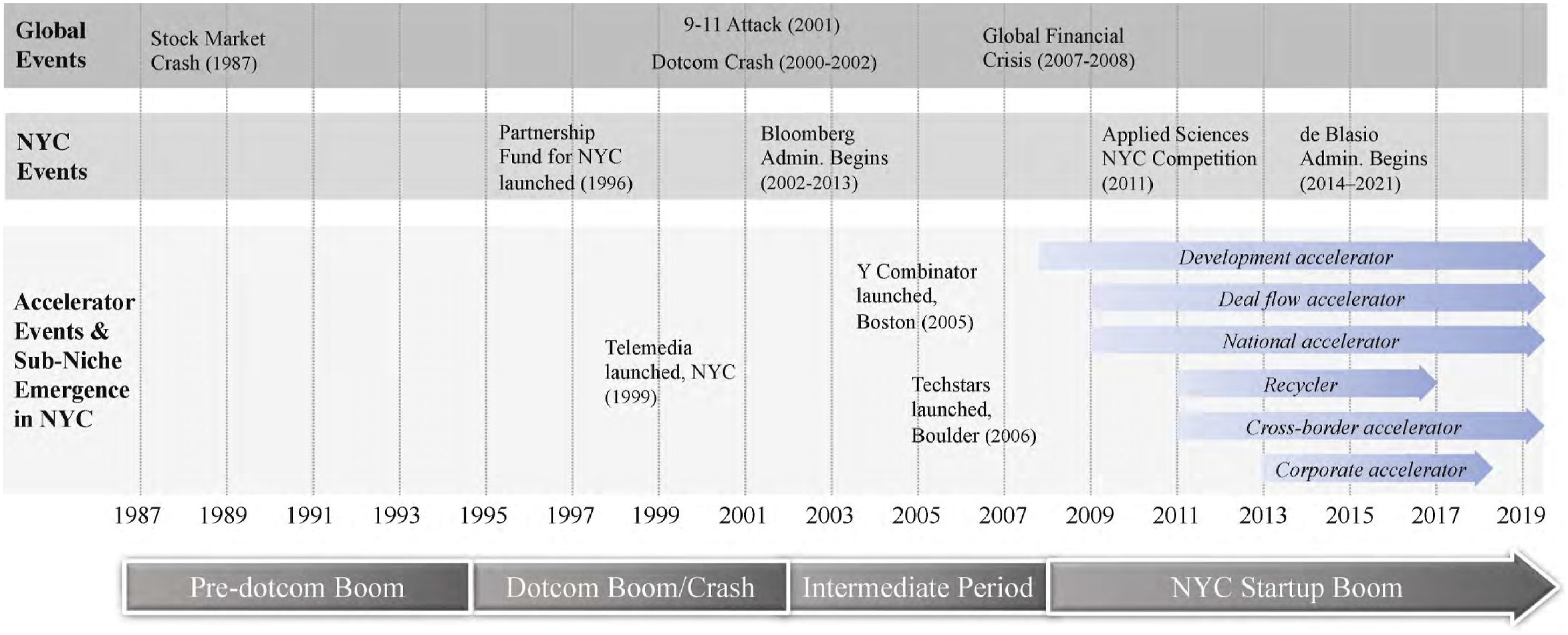
The emerging New York City entrepreneurial ecosystem
Given the importance of both urbanization economies and finance for entrepreneurial firms, it is a paradox that NYC did not share in the early startup activity witnessed in Silicon Valley. NYC was the center of financial industry in the US by the late 1980s. After two entrepreneurship booms due to economic and technical changes, NYC progressed to be one of the largest global entrepreneurial hotspots. Figure 1 outlines the progression of the entrepreneurial ecosystem, starting with the 1987 stock market crash. During the crash a large number of workers were laid off from existing industry, and they began to find new opportunities in entrepreneurship as the crash also lowered startup costs and other employment options in established companies (see Arikan, 2008: 96 and Indergaard, 2004: 6, 43). Meanwhile, the rise of Internet technology opened opportunities to launch new media businesses without massive investments (Zukin, 2020b). These changes led to a concentration of digital startups in NYC known as Silicon Alley (Arikan, 2008). However, poor business models lacking scale-up potential and reckless investments led to the early 2000s dotcom crash (Arikan, 2008; Zukin, 2020a). The agglomeration did not survive and was adversely affected by the 11 September 2001 attacks (Indergaard, 2004).
The NYC entrepreneurial ecosystem was still underdeveloped in the era of the dotcom boom, despite some evidence of private sector ecosystem building activities and public sector support (Arikan, 2008; Cukier et al., 2016; Indergaard, 2004; Zukin, 2020b). The city was not favorable for entrepreneurs in terms of physical space and it lacked entrepreneurial culture (Batra, 2017; Moore, 2018; Wolf-Powers et al., 2017). After the collapse, the city struggled with the leakage of skilled personnel and technologies (Batra, 2017; Moore, 2018).
Michael Bloomberg (mayor from 2002 to 2013), an entrepreneur, began work to revitalize NYC after his inauguration and was a proponent of investing in entrepreneurial initiatives. He fostered new industries by providing risk management support (Batra, 2017; Schrock and Wolf-Powers, 2019). The administration selected eight new sectors including healthcare and food industries, allocated new spaces by rezoning underutilized facilities such as Brooklyn Navy Yards, and forged public-private partnerships for innovation (Batra, 2017).
The 2008 financial crisis was a turning point and NYC was its epicenter. It lowered both the opportunity costs and direct costs associated with starting a firm. There were slack resources available, and entrepreneurship offered a path forward. Talented workers noticed the potential, and dotcom boom veterans, scattered to other industries, flocked to startups (Zukin, 2020a). Local investors’ and landlords’ attitudes became more positive toward startups (Cukier et al., 2016). The city’s efforts after the bubble burst helped achieve entrepreneurial legitimacy through continued investment in local entrepreneurial capacity (Wolf-Powers et al., 2017). NYC attracted a variety of entrepreneurial talents and risk capital, becoming a global hotspot (Zukin, 2020c) with success stories such as Foursquare, Etsy, and Tumblr. In 2011, the Bloomberg administration launched a large competition, “Applied Sciences NYC”, for a technology campus on Roosevelt Island provided by the city government. While NYC was home to prominent universities, none had a strong engineering or technology focus and the goal was to bring this focus (Wolf-Powers et al., 2016). The winning consortium established Cornell Tech in 2017 which became a source of local tech workers for the NYC ecosystem. These activities accelerated local entrepreneurial fever (De Haan et al., 2020).
Behind this transformation of the city’s entrepreneurial ecosystem was an aggressive and collaborative effort of a wide range of stakeholders, including city government, universities, and entrepreneurs involved in public-private partnerships. The city’s investment arm, NYC Economic Development Corporation, partnered with private investors, entrepreneurs, and universities on efforts like Varick Street Incubator, East River Science Park, Audubon Business and Technology Center, and Harlem BioSpace (Batra, 2017; Cohen, 2013; Joseph et al., 2021; Schrock and Wolf-Powers, 2019).
The legacy of public-private partnership continued after the administration change in 2014 as Mayor de Blasio strengthened the focus on racial and gender minorities and the connection with the city’s social issues (Robertson, 2019; Shieber, 2015; Zukin, 2020b). Meanwhile, the ecosystem witnessed the entry of corporate actors. In line with the increasing global attention to urban entrepreneurship, corporations including Google and Amazon launched tech campuses in Manhattan and began to participate in the city’s technology-based economic development projects (Robertson, 2019; Zukin, 2020a, 2020b). The NYC ecosystem’s capacity continued to expand (Nylund and Cohen, 2017). Myriad experts from diverse industries and talents attracted to the city’s lifestyle created a favorable atmosphere for foreign startups (Robertson, 2019; Stephens et al., 2019). ESOs supported by foreign governments also began to appear in the ecosystem during this time, assisting startups from their home country to land and launch in NYC (Stenbom, 2018). As a result, there now exists a vibrant, visible entrepreneurial ecosystem in NYC.
Origin of accelerators in the NYC ecosystem
Y Combinator, started in 2005 in Boston, is regarded as the first seed-accelerator (Cohen et al., 2019b) yet archival sources indicate two accelerator programs in NYC pre-date Y Combinator. Both launched at the end of the venture boom in the 1990s and integrated funding, networking, and educating elements into a single program—the same factors that define accelerators. Telemedia Accelerator was the first organization that called itself an “accelerator”. It was established in 1999 by a partnership between the NYC Investment Fund, Bear Stearns, Psilos Group, and City University of New York. Its objective was to provide stability to NYC’s nascent entrepreneurial ecosystem (Arikan, 2008). The founders were VCs who planned to launch additional branches outside NYC. Their location, though, was next to the World Trade Center and after 9-11 Telemedia closed.
Another early accelerator program, InSITE, started in 1999 by a group of Columbia University and New York University (NYU) students. Organized as a 501(c)3 tax-exempt organization, InSITE’s model provided fellowships to students and paired them with startups. The program began with a 1-year cohort concept, an educational component, and a graduation event that included pitching in front to investors for a grant, which accords with the accelerator form. The program continues to operate. The next section expands on our analysis of the emergence of NYC’s accelerator ecosystem and its sub-niches.
Analysis part 1: Accelerator sub-niche categorization
We approached the task of categorizing accelerator sub-niches inductively, using an iterative process of exploring the data, determining fields that define accelerators’ activities, ownership, programs and founding, and categorizing and recategorizing to achieve a strong fit. From this process, accelerator programs were grouped based on similarity and then category names were defined. Two researchers performed this work separately and compared their categorizations to ensure agreement where conflicting, agreeing on category names together.
Informed by niche theory, we suspected that differences in the backgrounds of individual accelerator founders and of accelerator organizational sponsors lead to a different set of resources being mobilized to support startups (Drover et al., 2017; Flynn, 1993; Hausberg and Korreck, 2020), as well as different goals for the accelerator that may affect startup recruitment. Detailed review of the data confirmed this, indicating clear origin patterns. For example, while some accelerators were sponsored by non-profits, others were founded by VCs or corporations.
Accelerator sub-niche categorization.

The first sub-niche, development accelerator, consists of programs established by either universities and/or local government. Accelerators established by foundations also fall into this category. Their objective is to speed up new company formation and they often have a local economic development focus. Twenty-two accelerators satisfy this criterion. An example is NYC Seed Start, which was established in 2010 through a collaboration between the NYC Economic Development Corporation, Industrial Technology Assistance Corporation, NYC Investment Fund, NY Star, and Polytechnic University.
The second sub-niche includes 20 accelerators established by local entrepreneurs who previously founded successful startups in NYC. Following the literature, we call these recyclers after the individuals who recycle their entrepreneurial talents in a local area (Mason and Harrison, 2006; Spigel and Vinodrai, 2020). For example, Cofound/Harlem, established by three entrepreneurs in 2015, supports Harlem-based startups. Minority Venture Partners was established in 2014 by founders of a consulting firm and offers free services for minority-founded startups. FoodFutureCo and Human Ventures, both launched in 2015 by local entrepreneurs, support ventures resolving grand challenges related to waste, food, and education.
Twenty-seven accelerators fit into a third sub-niche: deal flow accelerators. These are established by organizations with ongoing operations in VC firms, private equity funds, investment banking, and business services. For example, FirstGrowthVC (now Venturecrush FG) was established in 2009 by the law firm Lowenstein Sanders as the first for-profit accelerator in NYC. Morgan Stanley Multicultural Innovation Lab was established by the bank in 2017 with a goal to increase deal flow from founders with diverse backgrounds.
Cross-border accelerators, a fourth sub-niche, focus on startups from foreign countries, with the objective of expanding their US market reach. Among 14 accelerators in this category, three—German Accelerator (2014), Impact USA (2016), and French Tech Tour America (2017)—were established by foreign governments. German Accelerator was established by Germany’s Federal Ministry of Economic Affairs and Energy with a mission to empower German startups to scale globally. Two other cross-border accelerators—ERA Global (2015) and DEV Korea (2014)—have unique business models that offer acceleration services to startups wanting to expand to NYC in exchange for foreign government funding. The other nine accelerators in this category were established by private foreign entities. For example, Ellis Accelerator was launched in 2019 by Christian Jorg, a founding manager of German Accelerator. The program brings international startups (mainly European) to NYC.
Fourteen NYC accelerators were launched by organizations that operate business acceleration programs nationally. We call these national accelerators as their NYC location is a branch. These include Techstars (2011), AngelPad (2013), and Startup Bootcamp (2016). The earliest was Startup Leadership Program, established in Boston in 2006 and then in NYC in 2009. It operates more than 20 chapters globally.
The sixth and final sub-niche, corporate accelerators, consists of programs affiliated with large, established companies. Like corporate VC programs (Gaba and Bhattacharya, 2012; MacMillan et al., 2008), these accelerators are strategic investments that allow corporations to examine possible acquisitions. There are seven accelerators in this category, including eBay (2016), MasterCard (2014), Kaplan (2013), and SAP (2018). AB InBeV, a brewing corporate, has launched three different accelerators: Zxlerator in 2015; Techstars Connection established with Techstars in 2016; and 100+ Accelerator in 2018.
The six sub-niches are not mutually exclusive, but they are exhaustive. All accelerator programs in our data may be categorized into one sub-niche. There are some hybrid cases such as accelerators established by collaboration of for-profit investors and public agents or national accelerators and corporates. Our approach accords with prior studies that find many organizational types and economic systems exist that do not fit clear boundaries (e.g., Hall and Soskice, 2001; Moulick et al., 2020). Nevertheless, we set clear boundaries between categories to discern unambiguous sub-niche dynamics. We were able to set these boundaries by prioritizing identification of the primary goal of each accelerator when considering accelerators founded by only one individual or group. Additionally, we considered the key agent bringing about the accelerator’s launch in the case of programs founded by multiple partners. 3
Analysis part 2: Accelerator sub-niche dynamics
Accelerators over time in the NYC ecosystem
The number of accelerators opening in NYC steadily grew from 2008 to 2019, with a noticeable jump after 2015. As Figure 2 indicates, it was a development accelerator—Startl—that first entered. Startl was created as a collaboration between non-profit foundations interested in local economic development including the Gates and Hewlett Foundations, a few experienced local entrepreneurs eager to help, and for-profit partners seeking investment opportunities including IDEO, Berkeley & Noyes, and DreamIT Ventures. Next, deal flow and national accelerators emerged. The first deal flow accelerator entered NYC in 2009 (FirstGrowthVC). Startup Leadership Program entered the same year as the first national accelerator. Cross-border accelerators and recyclers followed in 2010, consolidating a diverse ecosystem of accelerators. The last sub-niche to enter was corporate accelerators in 2013. Accelerator Sub-Niche activity, 2008–2019. (a) Active accelerators by category, annual count and (b) Active accelerators by category, proportion.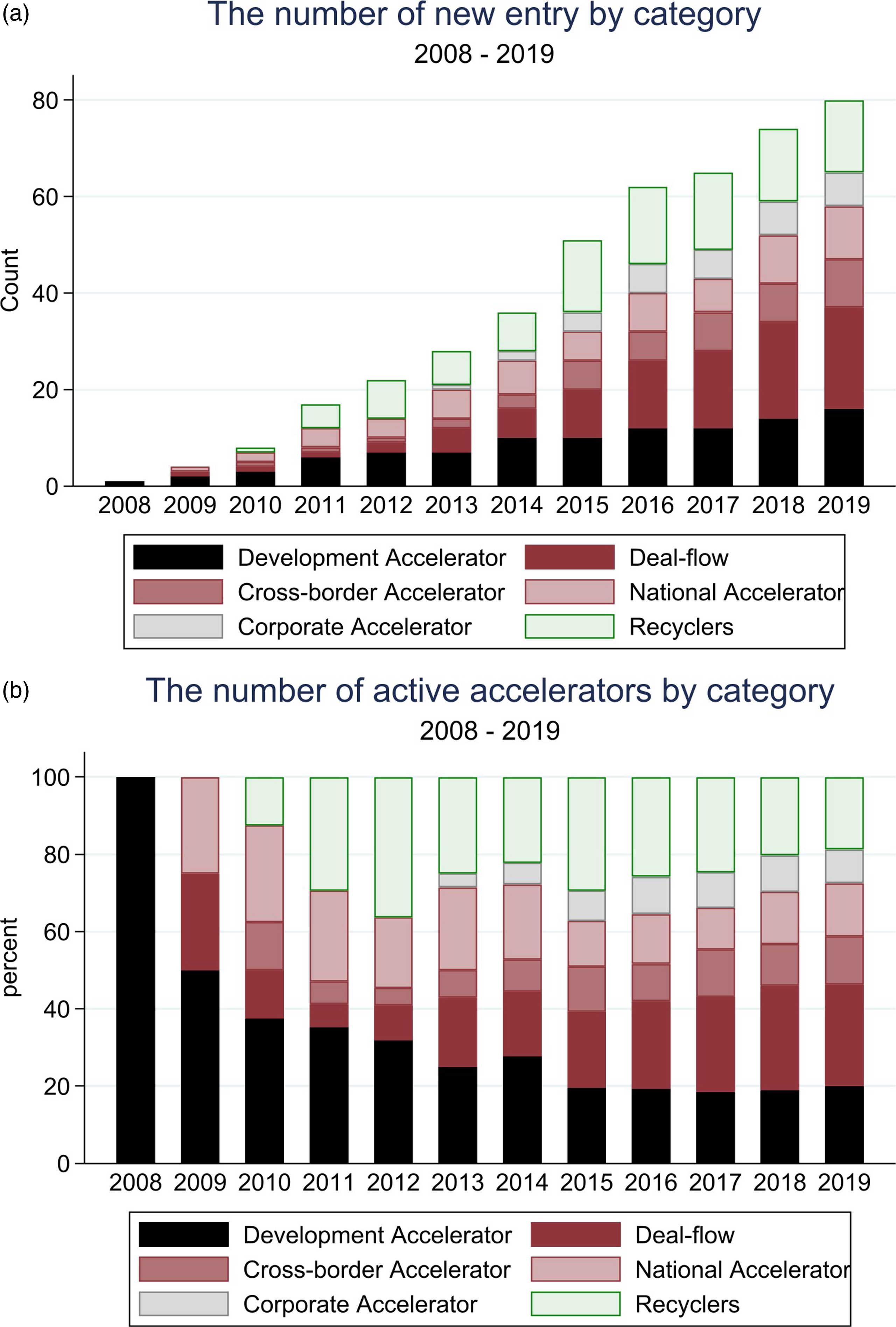
As expected based on niche theory, government and non-profit supported accelerators populated first when there was greater uncertainty about what types of support would be helpful and what types of firms needed support. The first accelerator, Startl, required by-in from multiple partners. This trend also makes sense given the economic timing—in 2008 the financial crisis was in full swing and public good-focused agents were working to develop new ways of spurring economic growth. Development accelerators were an option. At this time, Bloomberg’s administration was also focused on lifting the entrepreneurial profile of the city. This proportion of development accelerators decreased over time, though, as the number of accelerators in other categories increased. After this sub-niche brought attention to the accelerator form, accelerators established by private and for-profit entities followed. In 2010, development accelerators were still the most common type in NYC, but their proportion had dropped below 50%. By 2011, the two most common accelerators sub-niches were development and recyclers. The proportion of active development accelerators held around 20% from 2015 to 2019.
The growth of development accelerators slowed with the rise of deal flow accelerators. Deal flow accelerators emerged in 2009 and their proportion has increased steadily since about 2011, making the category the largest proportion in the city as of 2019. This indicates private entities see accelerators as a lucrative program for attracting startups and filtering those with potential for investment.
Moving on to consider recyclers, their early role suggests entrepreneurs have an enabling role in the initial emergence of a new organizational form and ecosystem. Their strong presence in the ensuing decade also suggests a role in sustaining the ecosystem. Entrepreneurs show a proclivity for engaging in philanthropy (Clayton et al., 2021) and supporting other local startups through mentoring and investing (DeTienne and Robb, 2016). The recycling literature documents a number of cases where successful or serial entrepreneurs voluntarily assist nascent ventures, helping to embed startups in their ecosystems (Mason and Brown, 2014; Mason and Harrison, 2006; Spigel and Vinodrai, 2020). Their role as a distinct accelerator sub-niche is indicative of the important local development role entrepreneurs play after they start or exit their firms.
Finally, cross-border and corporate accelerators appeared later. They grew in number only after 2015 when roughly 40 accelerators had already launched in NYC. This indicates these types are likely not going to be ecosystem emergence enablers and instead follow trends. It also suggests that cross-border and corporate accelerators enter only after an abundance of evidence suggests a profitable or productive organizational form.
By 2019, we find a strong mix of all accelerator sub-niches, suggesting aspiring entrepreneurs have many choices. These proportions have remained relatively stable since 2015, suggesting the ecosystem may have settled on an optimal mix of sub-niches.
Generalist versus specialist sub-niches in NYC
Sector specialist & social purpose accelerator sub-niche entry dynamics.

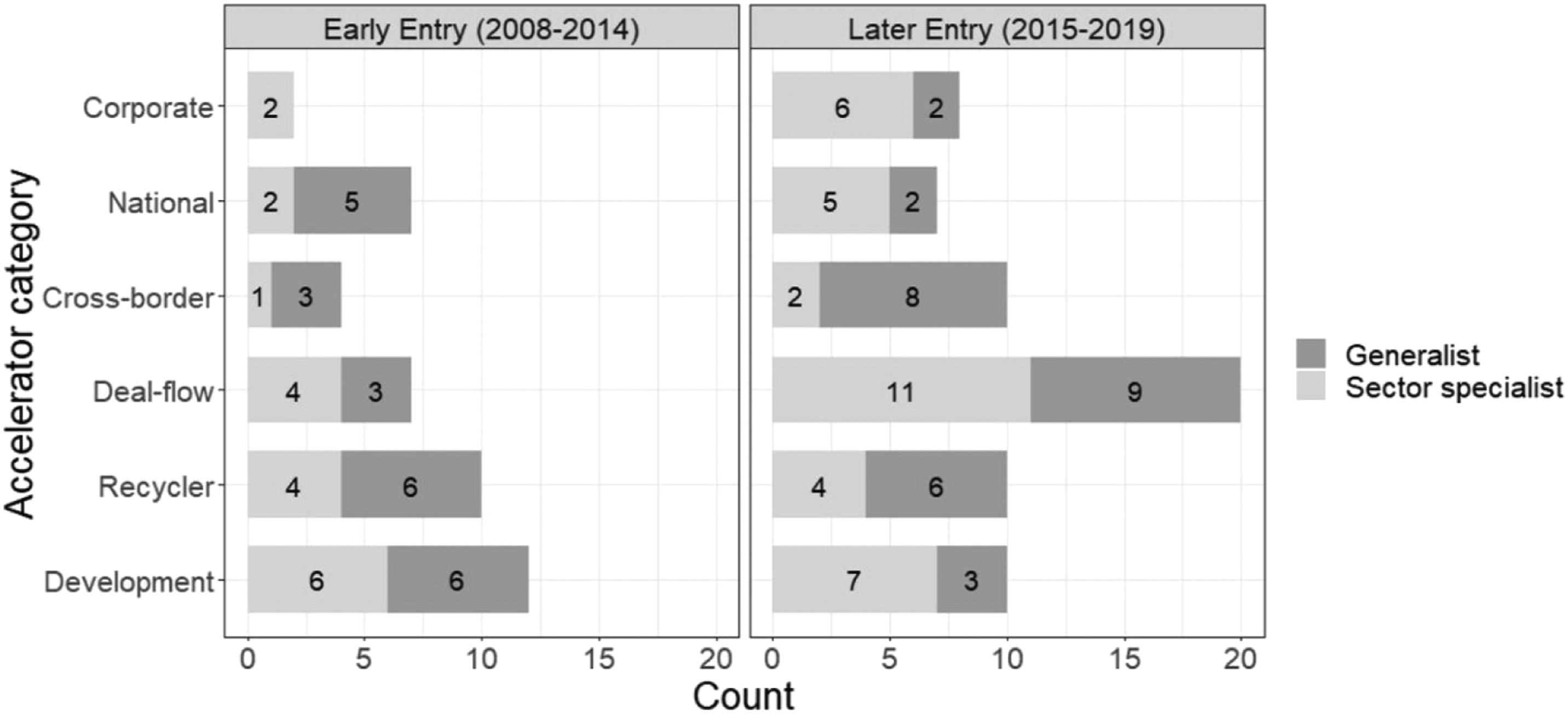
Sector specialist accelerators by Sub-Niche entry dynamics.
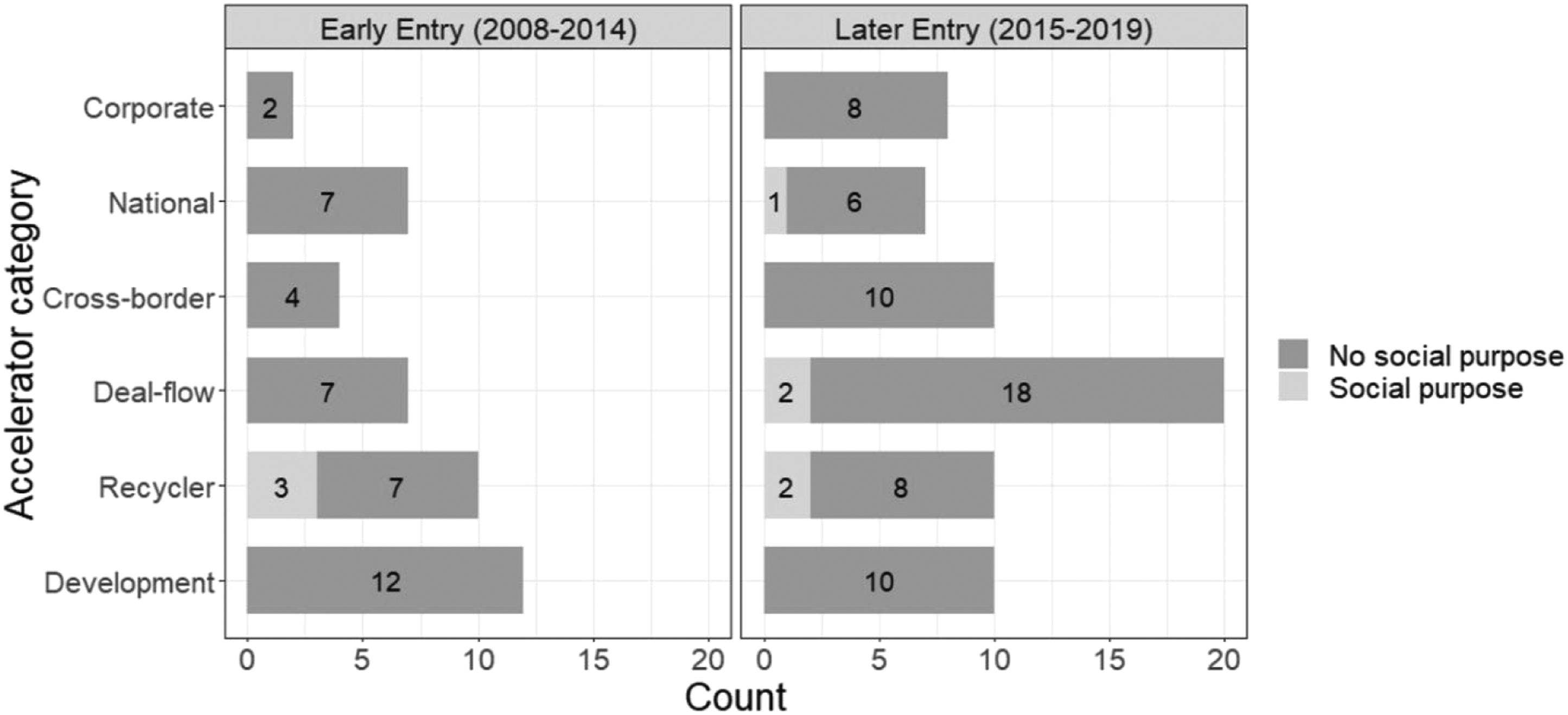
Social purpose accelerators by sub-niche entry dynamics.
Sector specialist accelerators
Almost half of the accelerators are sector specialists (see Table 2). The proportion of sector specialists increases in the later period (45–55%) suggesting temporal movement from generalist to specialist orientations. The degree of specialization is disproportionate across sub-niches, though. The corporate sub-niche is most specialized at 80% sector specific, whereas cross-border accelerators are least specialized 21% sector specific.
Diving into each sub-niche, we find development and national accelerators drive the movement to specialization (Figure 3). The proportion of development sector specialists increases 50%–70% from the early to later period. Looking into the data, we find NYU was at the center of this change. NYU had launched generalist accelerators in the earlier period but launched two specialist accelerators in the later period—AI Nexus Lab (2016) with a focus on artificial intelligence (AI) and H2 Refuel Accelerator (2019) with a focus on hydrogen technology. In addition, NYC Economic Development Corporation launched Rlab (2018) to accelerate virtual reality technology startups and City University of New York launched NYDesigns (2019) to target hardware startups. These findings indicate that later accelerator entrants sought to differentiate their services from those of accelerator incumbents by specializing in specific sectors.
Looking at national accelerators, the proportion of sector specialists experienced a large increase from 29% to 71% over time, also providing evidence of a movement toward specialization. Consider two national accelerators, Techstars and Dreamit Ventures: when these accelerators launched their first programs in 2011 they supported startups from a broad range of sectors. However, starting in 2016 their subsequent accelerator programs targeted startups in specific industries including security and health. Our observations support the expectation of niche theory that greater sub-niche specialization and differentiation will occur over time as organizations react to competitors and find their “fit” in the ecosystem.
Table 2 indicates differing patterns for the remaining sub-niches. Cross-border accelerators show the lowest degree of specialization throughout the whole period and do not grow. Their specialization is not along the sector; rather, it reflects their international focus. For corporate and deal flow accelerators, we find initial sector specialist proportions that are higher than other sub-niches (both two early corporate and four of seven early deal flow). These sub-niches specialized from the start. It makes sense the corporates would be specialists given that they are most qualified to nurture startups that are in their own or an adjacent industrial sector. Investors also usually target specific industries so it makes sense that deal flow accelerators would follow this pattern.
Social purpose accelerators
Figure 4 and the last three columns of Table 2 display specialization in terms of social purpose. The proportion of accelerators with a social purpose is low at 8% with only a small increase in the later period. Furthermore, looking across sub-niches there was only one with a social purpose program in the early period. By the later period, though, half the sub-niches had started to operate a social purpose accelerator. Still, their proportion over time has grown little. An important finding, though, is that social purpose programs are disproportionately concentrated among recyclers. Recyclers appear to be particularly interested in embedding social purpose into their accelerators.
Deal flow and national accelerators with a social purpose appeared in the later period. The emergence of two social purpose deal flow accelerators—UBS Financial Service Project Entrepreneur (2015) and Morgan Stanley Multicultural Innovation Lab (2017)—is suggestive, but not strong evidence for a shift toward social purpose specialization in this sub-niche. UBS Financial Services and Morgan Stanley launched accelerators that serve gender and racial minorities as a corporate social responsibility (CSR) initiative. Bunker Labs (2018), a national accelerator focused on helping veterans launch businesses, also emerged in the later period. Bunker Labs opened an incubator in NYC in 2016 that pivoted to an accelerator model in 2018. This signals the organization saw value in opening a social purpose ESO in NYC and that an accelerator ended up being the preferred model.
There are no social purpose accelerators in these three sub-niches: development, cross-border, and corporate. Though development accelerators do not appear to operate with an underrepresented minority or gender-focused mission, the timing of the emergence of the social purpose accelerators is coincidental with broader policy movements in the city. Robertson (2019) describes the history of NYC’s entrepreneurship support policies and finds the de Blasio administration, which began in 2014, continued the entrepreneurship programs established by Bloomberg and recalibrated them to focus on minority groups and local problems.
In summary, we observe an overall movement in absolute number of accelerators toward specialization in terms of sector, but not as strongly for social purpose. However, there is heterogeneity across sub-niches. Sector specialization increased among development and national accelerators. That fact that recyclers have a higher proportion of social purpose accelerators over time is congruent with the entrepreneurial recycling literature (Mason and Brown, 2014; Mason and Harrison, 2006; Spigel and Vinodrai, 2020). Finally, despite the lower absolute number of accelerators moving toward or opening as a social purpose accelerator, we find evidence that the practice of social purpose accelerators diffused across accelerator sub-niches over time. Future research might extend this analysis to investigate whether certain sub-niches are better positioned to operate social purpose programs.
Geographic distribution of accelerators in NYC
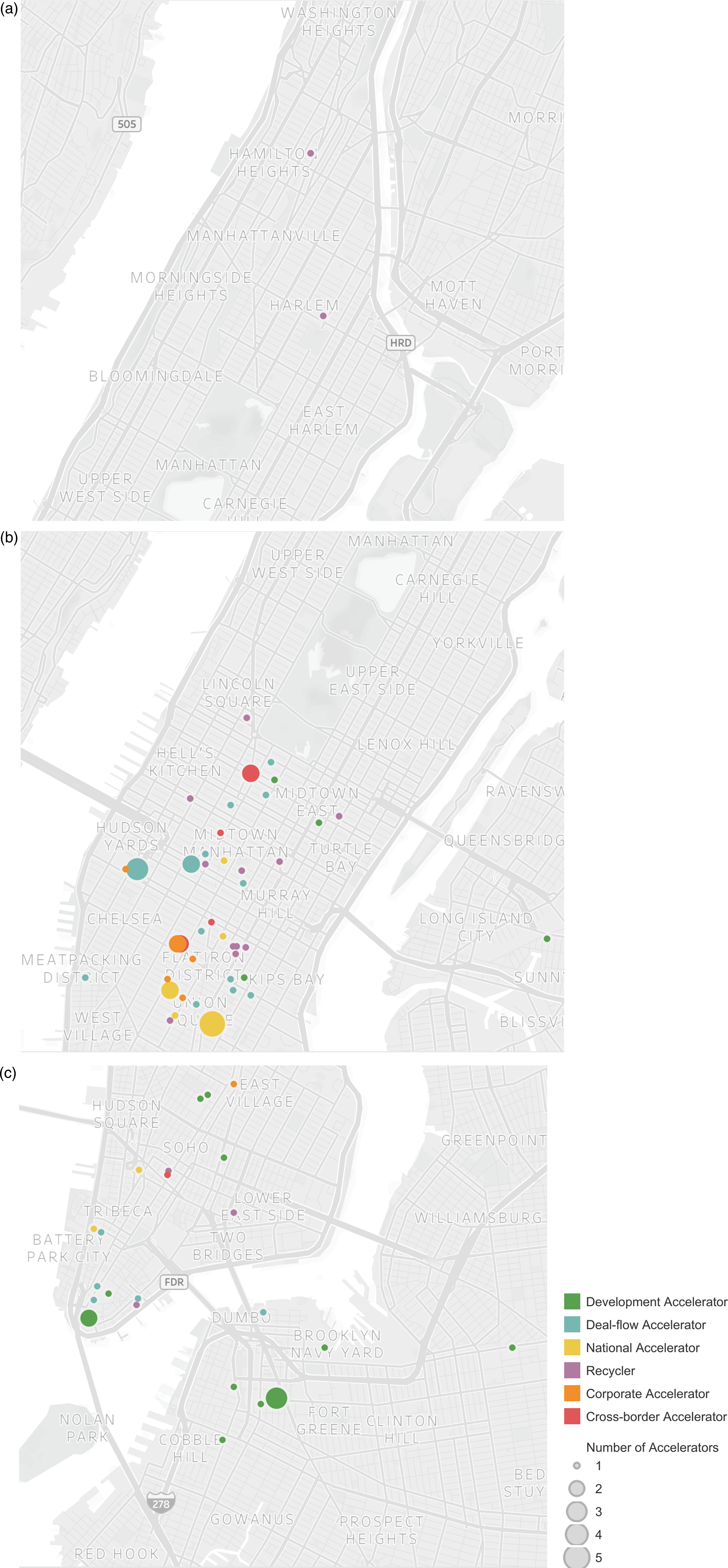
Finally, we examine the question of where accelerators establish their programs geographically in NYC and whether patterns emerge. To examine the geography of accelerators over time, we map the location of accelerators in Figure 5 at three points in time: 2009, 2014, and 2019.
5
Figure 6 magnifies the 2019 image so that roads and neighborhoods are visible. Accelerator geographic distribution over time. (a) 2009, (b) 2014, and (c) 2019. Magnified accelerator geography, 2019. (a) 2019 North, (b) 2019 Central, and (c) 2019 South.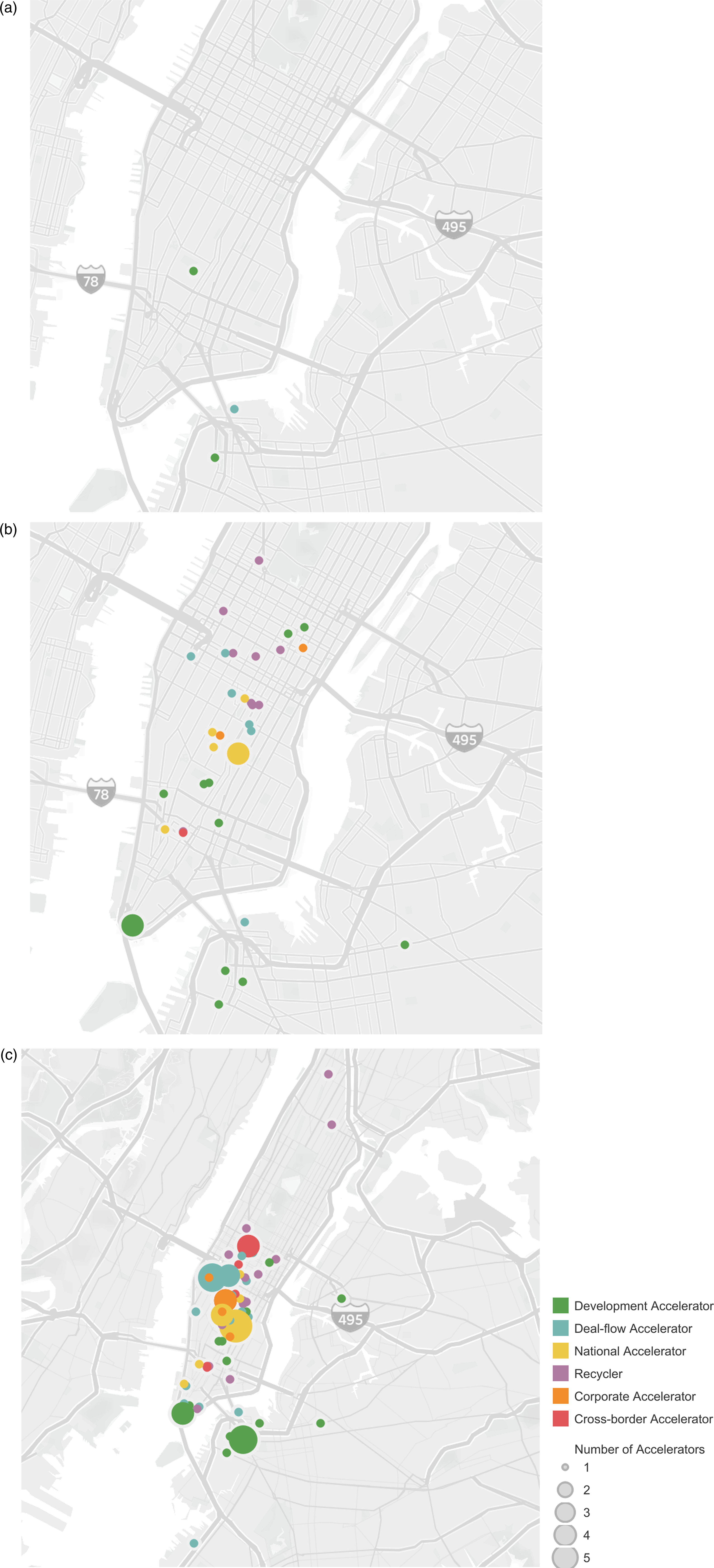
The 2009 map shows that accelerators started in neighborhoods outside but adjacent to the central business and financial district—specifically in Brooklyn—as we expected. Startl (2008) and FirstGrowth VC (2009) both launched in Brooklyn. Berkeley Innovation Labs (2009) next opened at NYU in lower Manhattan. From there, the number of accelerators in Manhattan rapidly increased. Thirty-five of the 38 accelerators that emerged from 2010 to 2014 started in Manhattan between the Soho and Garment District (just south of the Theatre District) neighborhoods (Figure 5(b)). More than two-thirds of these were national accelerators, deal flow accelerators, and recyclers. There were only three accelerators established outside Manhattan during this time (all in Brooklyn): NYC Seed Start (2010), Brooklyn Fashion & Design (2013), and Blue Ridge Labs (2014).
The geographic concentration of accelerators in Manhattan emerges as a major temporal trend when comparing maps. Looking at Figure 6(b), most accelerator programs are located between Union Square and Midtown Manhattan by 2014. By the end of 2019, only 15% of NYC accelerators were located outside Manhattan.
In 2015, the geography of accelerators again changed as some accelerators opened for the first time in other central business district-adjacent neighborhoods including in Harlem (northern end of Manhattan) and in Queens (east of Manhattan). Notably, these were development accelerators and recyclers. Cofound/Harlem opened in central Harlem in 2015 and is a recycler. It does not require a fee or take equity and was established by three local entrepreneurs to contribute to their community after successfully exiting from a previous startup. NYDesigns, a development accelerator, launched in Queens in 2019 but originally formed as an incubator in 2006 by the City University of New York. These locational shifts mark an important change that could have broader implications for urban neighborhoods and spatial structure. For example, it could be that accelerators may be used as a neighborhood revitalization tool; however, there is also potential that these trends are indicative of broader gentrification patterns that could change the character and composition of these neighborhoods in a detrimental way for groups that have lived there historically. Finally, accelerators established in Brooklyn in this later period were mostly created at places owned by NYU or city government.
In summary, accelerators first emerged outside the central business district in an adjacent neighborhood. While the public and non-profit actors launched accelerators on the outskirts, newer for-profit actors launched in the city center. Deal flow, national, and corporate accelerators—the three sub-niche categories of for-profit accelerators—tended to concentrate in the central business district and trendy neighborhoods of Manhattan. This is certainly a function of New York rents, but it also reflects a desire for accelerator organizational sponsors to co-locate with entrepreneurs in their target sector. We lack data on the client firms of the accelerators, but these different locations reflect proximity to different populations. This can be seen in the magnified maps where neighborhood names are shown.
Discussion & policy implications
New York is certainly a unique case, but despite many advantages the city historically lacked an entrepreneurial scene. This has changed recently and NYC has become a recognized entrepreneurial hotspot. We focus on one ESO that was active during the emergence of the city’s entrepreneurial ecosystem. Because of NYC’s size and population density there are a sufficient number of accelerators and more accelerator sub-niches than may be available to study in smaller cities and ecosystems. The study of a large city allows opportunity to peer into the dynamics of a large ecosystem. The progression of niche types and their locations suggests lessons for other places that are attempting to develop entrepreneurial ecosystems.
The fact that accelerator sub-niches exist makes good sense. Niches emerge as their operators perceive unmet demand from entrepreneurs. Their motives may be altruistic or driven by a profit-motive. The fact that specialist accelerator programs appear after generalists follows niche theory as we hypothesized, which predicts the rise of organizations that offer specialized goods and services to a narrow set of customers after the growth of generalists providing a broader range (Carroll and Swaminathan, 2000). The geographic trends in accelerator location further support our argument that sub-niche development is an important consideration for the entrepreneurial ecosystem and local development literatures—we find that the emergence of sub-niches correlates to accelerators’ location in either the central business district or adjacent neighborhoods.
In every city and community, there is likely to be demand from nascent entrepreneurs for support and the compelling question is how to get started. Our results point to the role of public good-motivated accelerators such as development and recyclers. Despite the attention received by national accelerators and the desire of many local officials to attract them, we find they are only one type of organization in the accelerator phenomenon. Moreover, national accelerators may only enter once there is sufficient deal flow that results out of the actions of others. The NYC case demonstrates that attraction of a national program may provide a certification that the ecosystem is robust. Our case suggests investment by local government and recycled entrepreneurs may play a more important role in the beginnings of an entrepreneurial ecosystem.
Our findings point to a role for local government policy to invest in development accelerators through public-private partnerships that help aspiring entrepreneurs launch firms, create deal flow, and help demonstrate that entrepreneurship is a viable option. Through this investment, accelerators established by public actors may ignite the entrepreneurial ecosystem. A region with few startup companies should not begin trying to foster an ecosystem by building accelerators, but when there are a number of startup companies in need of support, partnering with other groups to develop an accelerator program may make sense. The NYC case demonstrates that after observing the successful launch of public accelerators and enthusiastic response from local entrepreneurs, successful entrepreneurs, angels, and service providers may participate in launching accelerators with greater confidence. Because local government was willing to accept a degree of risk and experiment with new models of entrepreneurship support they were able to kickstart the local accelerator phenomenon.
Public good-motivated accelerators are also important because they are consistently launched in more affordable neighborhoods outside the city’s expensive economic center, as our literature review predicted. This contrasts the profit motivated types which concentrate in expensive central business districts that provide accessibility and prestige. Through these location choices, public accelerators can be tools to mitigate accelerator access disparities. If the goal of public investment is to create conditions that will later induce private sector investment, then these patterns may be seen as a success for NYC and goal for others. Based on the igniting and sustaining roles that public accelerators play in the city’s ecosystem, policymakers should continue to attract partners to establish accelerators.
The growing role of profit-motivated accelerator sub-niches has implications for which startups are receiving support and where they are receiving it. Our finding that socially motivated accelerators emerge most often from recyclers, followed by deal flow and national should be of interest to public servants involved with the ecosystem. Social mission and deal flow are terms not often used to describe the same organization, but new social entrepreneurship ventures indicate this movement may be sustainable. Public servants may watch with a skeptical eye and consider whether the startups most in need of the support of a social mission accelerator are receiving it and then step in with a new partnership or development accelerator if needed. Localities with the social purpose goals should consider reaching out to experienced entrepreneurs to act as partners, also, given the growth of recyclers.
Concluding remarks
Our paper makes several contributions. Our accelerator sub-niche typology offers a framework for understanding the emergence of accelerators and other entrepreneurial support organizations in entrepreneurial ecosystems. This is contribution to the literatures on accelerators and entrepreneurial support organizations and shows the utility of adopting an organizational ecology framing for accelerator emergence. We advance these literatures beyond considerations of accelerator participation outcomes (Brown et al., 2019; Cohen, 2013; Cohen et al., 2019b; Hochberg, 2016; Stevenson et al., 2020) to delineating their role in ecosystem development. Our framework uses patterns in organizational origin, mission, and geography to understand the emergence of other organizational types within an entrepreneurial ecosystem. In this way, we also contribute insights into the evolution of entrepreneurial ecosystems, which invites future comparative work. Finally, our results generate several important local policy and strategy implications which are a practical contribution toward understanding how local governments can support ecosystem emergence. We confirm the role of governments in taking a primary role in accelerator diffusion (Breznitz and Zhang, 2019; Chan et al., 2020; Yu, 2020). Our findings have implications for the NYC ecosystem builders as well as for other ecosystems.
The organizational ecology of an entrepreneurial ecosystem depends on regional attributes and historic paths. Our specific findings most strongly generalize to entrepreneurial ecosystems in global economic centers rich in skilled investors and mentors where public agents play active roles like NYC; however, our typology offers a framework for understanding other entrepreneurial ecosystems. For example, Berlin and London’s ecosystems are based on large-scale public startup initiatives such as Startup Berlin and London Tech City. Studying their accelerator ecology over time would provide insightful comparisons. The NYC case also draws a special class of cross-border accelerators, such as the Ellis Accelerator, a port of entry for foreign startups. This opens an avenue of further inquiry about the location and role of cross-border accelerators internationally.
Our investigation was limited by the lack of data on NYC startup firms to examine the population of new firms and accelerator participants. Future research could examine how participation in the different sub-niches affects firm outcomes. This would require development of longitudinal data to trace the growth and survival of startup firms supported by various types of accelerators. The organizational ecology of accelerators is also likely shaped by other social and economic factors not analyzed here. Our review of context considers some of the political and economic conditions that influenced the rise of the NYC ecosystem, but there are likely others. For example, we do not investigate inter-neighborhood political and community development dynamics. The influence of other socio-economic factors such as the patterns of immigration and international trade would be a fruitful venue for future research.
Our paper gives rise to an open-ended research question: how will the organizational ecology of accelerators vary by cities, and how will it be similar? We encourage others to undertake work to examine these patterns in other regions and for other types of ESOs building on our framework. Comparative studies with other cities with different growth trajectories and population sizes can help our understanding of the organizational ecology of entrepreneurial support organizations and their broader ecosystems.
Footnotes
Acknowledgements
We thank Colin Delargy and Elias Massion for research assistance. We thank Sekou Bermiss for his comments on an earlier version of this paper.
Declaration of conflicting interests
The author(s) declared no potential conflicts of interest with respect to the research, authorship, and/or publication of this article.
Funding
The author(s) received no financial support for the research, authorship, and/or publication of this article.
