



Abstract
This article examines Wolf’s hypothesis of modular judgment in the context of rape myths and attribution of blame to rape victims. Modular judgment was operationalized using blame schemata suited to judgment of everyday aggression. Each of 88 female participants, of whom 29 were sexual trauma survivor therapists, 29 were sex offender therapists and 30 were non-therapists, was presented with written descriptions of 16 rapes, which included information regarding the victim’s behaviors before (her prior sexual experience), during (the kind and the degree of the resistance she exhibited) and after the rape (meeting or not meeting with the attacker). Dependent variables were attribution of blame to the survivor, attribution of blame to the attacker and judgments regarding severity of the rape. As expected, the therapists attributed less blame to the survivors and more blame to the attacker, and judged the rapes as slightly more severe than did non-therapist participants. For all participants in this study, the survivor’s behavior after the rape carried the greatest weight regarding attribution of responsibility to her. These results are discussed in terms of the theories of modular judgment and defensive attribution, and the just world theory. We recommend further investigations with regard to the perceived connection between survivors’ behaviors after a rape and blame attribution.
Introduction
Despite the high frequency of rape, many incidents go unreported, often due to survivors’ fears that they will be blamed for their own victimization. While more frequent in the past, it has been shown that many people, unfortunately, still hold victims at least partly responsible for their misfortunes (e.g. Hafer, 2000; Hafer and Bègue, 2005; Vonderhaar and Carmody, 2015). This is a matter of no slight import since research reports suggest that rape survivors may suffer additional trauma from responses to disclosure (Fanflick, 2007; Suarez and Gadalla, 2010).
Studies exploring the factors that increase the likelihood of a woman being blamed for having been raped indicate that the salient factors may, in fact, be irrelevant to the rape itself. These factors include: the victim’s prior sexual experiences (L’Armand and Pepitone, 1982; Schuller and Klippenstine, 2004); alcohol consumption (Baldwin-White and Elias-Lambert, 2016; Sims et al., 2007); provocative behavior or manner of dress (Whatley, 2005; Workman and Orr, 1996); acquaintance with the attacker (Idisis et al., 2007; Schuller and Klippenstine, 2004); emotional reactions and resistance or lack of resistance to the sexual assault (Bongiorno et al., 2016; Gavey and Gow, 2001); and prior history of rape (Anderson et al., 1997; Frese et al., 2004). The belief that the victim’s characteristics and behavior can justify the rape constitutes one aspect of what has been termed ‘rape myths’.
Rape myths are described as ‘prejudicial, stereotyped, or false beliefs about rape, rape victims and rapists’ (Burt, 1980: 217). They are considered to be ‘attitudes and beliefs that are generally false but are widely and persistently held, and that serve to deny and justify male sexual aggression against women’ (Lonsway and Fitzgerald, 1994: 134). Rape myths include widespread beliefs connected with what a typical rape scenario ‘is supposed’ to look like and the characteristics of the rapist and victim (Grubb and Turner, 2012), something that affects the decision-making process and blame attributions on the part of many individuals, including the general public (Bongiorno et al., 2016), students (Vonderhaar and Carmody, 2015), police officers (Hine and Murphy, 2017), jury members (Dinos et al., 2015; Ward, 1995), social work students (Baldwin-White and Elias-Lambert, 2016) and prosecutors (O’Neal et al., 2015). Those who endorse rape myths may believe that victims lie about having been raped or exaggerate when telling what happened. Upholding rape myths may, in fact, determine the degree to which the victim is blamed and whether the rapist is acquitted of charges of rape (Gerger et al., 2007; Ward, 1995) or even whether or not charges are actually filed (O’Neal et al., 2015).
The just world theory (Lerner, 1980; Lerner and Miller, 1978) provides a conceptual framework that may explain the perpetuation of rape myths in spite of society’s growing awareness of their fallacy (Vonderhaar and Carmody, 2015). According to this theory, people have a need to believe in a world in which individuals get what they deserve (Lerner, 1977; Lerner and Simmons, 1966; Parent, 2010), a world in which good things happen to good people and bad things happen to bad people. When confronted with rape victims we are, in fact, confronted with those to whom something happened that they did not deserve, and this violates people’s principles of justice and fairness, especially when the events cannot be changed. Feeling threatened, many people tend to rationalize the event by searching for things that survivors ‘must’ have done to bring about their own victimization (Hafer, 2000; Hafer and Bègue, 2005; Lerner, 1980; Lerner and Simmons, 1966; Vonderhaar and Carmody, 2015) and to minimize the significance of victim suffering. This protects them from anxiety in face of the possibility that a similar fate could befall them.
However, not every survivor is blamed to the same degree, and the degree of blame attributed is a function of differences in external circumstances, or ‘modular judgment’ (Wolf, 2001). Modular judgment can be explained by the theory of ‘defensive attribution’ (Bell et al., 1994). According to this theory, attribution of varying degrees of blame and responsibility for rape are a function of the extent of the observer’s identification with the participants in the assault. People, therefore, are expected to attribute less blame to those with whom they identify and more blame to those perceived as different from themselves. This theory has, in fact, been supported by empirical research (Stel et al., 2012). An Australian study that did not make reference to modular judgment theory showed that cultural similarity with the perpetrator versus cultural dissimilarity affected the blame attributions participants assigned to rape victims and perpetrators (Bongiorno et al., 2016).
A method for operationalizing modular judgment can be derived from the functional theory of cognition (Anderson, 1996), whereby attributing and avoiding blame were found to occur frequently as part of individuals’ everyday life decisions and judgments (Anderson, 2013). The blame attribution scheme is expressed in the equation: Blame = Culpa ⊕ Consequences
In this equation, attribution of blame is a function of information from two sources. The first, culpa, represents the way in which the observer perceives an aggressor’s attempts to avoid causing harm. The second, consequences, represents the perceived degree of harm caused. The symbol ⊕ represents an integration function.
Wolf (2001) demonstrated that perception and moral judgment of aggression change in accordance with situational factors, a phenomenon that shows modular judgment (Wolf et al., 1996). In the blame attribution scheme, the relative weight of different factors in determining blame, such as the molecular components of culpa and consequence, can be ascertained. This relative weight index is known as the moral ratio (MR).
Anderson’s paradigm can be used to understand the process of attributing blame to rape survivors. As explained above, culpa represents the way in which an observer perceives the aggressor’s attempts to avoid causing harm. By using Baron’s (1977) definition of aggression, which incorporates the intention of the victim to avoid being harmed, culpa can be evaluated by focusing on the victim’s rather than on the aggressor’s behavior, so that culpa represents the way in which an observer perceives the victim’s attempts to avoid being harmed. Introducing victim-related variables into the equation affords the aggressor an opportunity to justify his actions and explain why he did not refrain from attacking the victim. Such justifications also afford the observer an opportunity to justify the aggressor’s actions.
This study will examine the effects of four victim-related variables in rape vignettes: the victim’s pre-rape sexual experience (much sexual experience or no experience at all); the kind of resistance she applied (physical or verbal resistance); the degree of victim resistance (strong or weak resistance); and meeting or not meeting with the attacker following the rape. While it may seem surprising to include the last variable, the two parties to the event could be long-term friends, a situation that may mean continued interaction of some kind with the perpetrator is not necessarily implausible and, in some cases, may be unavoidable.
In addition to the variables described above, the present study will examine potential differences in judgment for three different groups of participants: female therapists who work with sexual trauma survivors; female therapists who work with sex offenders; and women in non-therapy professions. If greater willingness to attribute blame to victims of sexual assault has been associated with greater acceptance of rape myths (Burt, 1980; Jenkins and Dambrot, 1987), then those understanding the factors contributing to rape should demonstrate a reduced propensity to blame the victim. The literature on attitude change shows that education (Blumberg and Lester, 1991; Popma, 1996) and experience (Leahy, 1994; Mahoney and Craine, 1991) tend to reduce stereotypes and stereotyped thinking. Since therapists experienced in working with either rape survivors or offenders should possess the knowledge necessary to refute rape myths, therapists and non-therapists are expected to attribute blame differently (e.g. Idisis et al., 2007). To date, there have been no studies examining the differential effects of victim blame tendencies for survivor versus offender therapists. If awareness and understanding of the causes of rape suffice, then these two groups should concur.
Hypotheses
Hence, the three hypotheses are: Survivor blame will be related to each of the variables examined: extent of prior sexual experience, type and degree of resistance, and agreeing or not agreeing to see the rapist again. The combination of much sexual experience, weak verbal resistance and seeing the attacker following the rape is expected to result in the highest level of blame, while the lowest level of blame is expected for a victim who was a virgin, who resisted strongly and physically, and who did not meet with the rapist again. The variables will be tested in three experimental situations that explore blaming the survivor, blaming the attacker and judgment regarding the severity of the event. Levels of blame will differ for therapists versus non-therapists whereby the former will attribute less blame to rape victims than will the latter. Similarly, therapists are expected to attribute greater blame to the attacker than the non-therapists and to judge the event as more severe than the non-therapists.
Method
Participants
A total of 88 women with university degrees participated in this study, of whom 29 were professional therapists who worked with sex trauma survivors, 29 were professional therapists who worked with sex offenders and 30 were non-therapists. The participants ranged in age from 24 to 65; the average age was 38.49 (SD = 11.4). They had completed between 15 and 24 years of education with an average of 17.3 years. The majority were married. Some had never been married and others were divorced or widowed. In all cases there were no significant differences among the groups regarding demographics.
The survivor therapists comprised the staff of a specialized, hospital-based clinic for survivors of sexual assault and experienced survivor therapists from a municipal social services agency. Offender therapists worked with convicted offenders in prison or at a community clinic for released offenders. The sample of non-therapist professional women was attained by snowball sampling beginning with a number of friends of professionals in the sample.
Instruments and procedure
Participants received a hard copy of the questionnaire and completed it in their own time; this usually required 90 minutes. The questionnaires were handed out and collected by a contact person at the therapists’ places of work and the non-therapist participants received their questionnaires from the co-author of this study. All questionnaires were identical; in other words, there was no randomization of vignette order.
Before presenting the experimental scenarios, participants were asked to use a scale of 1 to 20 and to imagine a rape for which they would attribute blame to the victim to the maximum extent possible (20), and a rape for which they would attribute the least blame to the victim (1). These descriptions served as anchoring stimuli for the experiment.
Participants were then presented individually with a series of 16 rape scenarios, each containing information regarding the pre-rape sexual experience of the victim (much sexual experience or no experience at all), the kind of resistance she exhibited (physical or verbal resistance), the degree of victim resistance (strong or weak) and meeting or not meeting with the attacker following the rape. Participants were asked to envision the following scenario (variable alternatives in brackets): Danny and Rinat were friends for quite some time. They met often at each other’s homes, went out together, studied together – their relationship was close. One evening, when at Danny’s home, they sat on the bed, talking, laughing and drinking a bit of alcohol. The conversation covered many topics, among them sex. They talked openly about sex, including things they had never discussed until that day. Both of them were feeling good, and after two or three beers they continued to talk while lying on the bed. Suddenly, Danny forced himself upon Rinat. Rinat, who had had no prior sexual experience [or was very experienced] did all she could to fight Danny off. She hit him with her fists, kicked him, and even scratched him [or she pushed him weakly with her hands or yelled that she did not want this and cried ceaselessly, or she tried to reason with him and convince him to stop and when it did not help she stopped trying]. Danny did not let up and he raped Rinat. After the rape, Rinat never met with Danny again [or she agreed to continue to meet with him as before after he promised he would never again force himself upon her].
Structure of the study
There were three experimental conditions: Experiment 1 – attributing blame for the rape to the survivor; Experiment 2 – attributing blame to the rapist; and Experiment 3 – judging the severity of the rape event.
Data analysis
For each experiment, the data were first analyzed by comparing means and standard deviations for each of the three participant groups regarding the experimental variables hypothesized as related to assignment of blame for the rape. Following this, ANOVA calculations were compared.
MR
A two-way analysis of variance was used to compute the independent significance of the victim’s prior sexual experience, degree of resistance, kind of resistance and victim’s behavior after the rape. An index that facilitates examination of this phenomenon is the MR. MR is an index derived from measures of blame attribution, and represents the relative weights of different factors in determining blame. Participants in the present study attached great importance to the victim’s behavior after the rape (meeting or not meeting with the attacker following the rape), in spite of the fact that it has no relevance at all to the rape itself. The MR of the victim’s behavior after the rape (MRm) was computed using the formula:

where M represents the absolute weight attributed to the victim’s behavior following the rape, D represents the absolute weight attributed to the degree of resistance, K represents the absolute weight attributed to the kind of resistance and S represents the absolute weight attributed to the victim’s prior sexual experience. Absolute weights are determined using data from the participant’s original response sets and computing the differences in the marginal averages of the two variables. The value of MRm varies from 0–1. Using the above equation as a base, the relative weight of the victim’s prior sexual experience (MRs) can be expressed as:

Results
Experiment 1: Blaming the victim
Mean values for the judgments made by the three groups of participants are summarized in Figure 1 (tables on which these means and standard deviations are listed can be requested from the corresponding author). Similar patterns emerged for all three groups with respect to attribution of blame as a function of the variables examined. Greater blame was attributed to the victim: when she was highly sexually experienced compared to not experienced at all (among survivor therapists: 3.83 and 2.76; among offender therapists: 3.72 and 2.72; and among non-therapists: 8.01 and 6.21); when she demonstrated verbal resistance compared to physical resistance (among survivor therapists: 3.72 and 2.88; among offender therapists: 3.72 and 2.73; and among non-therapists: 7.87 and 6.34); when the resistance was weak compared to strong (among survivor therapists: 3.73 and 2.86; among offender therapists: 3.64 and 2.81; and among non-therapists: 8.00 and 6.21); and when she continued to meet with the attacker following the rape compared to not meeting him (among survivor therapists: 4.07 and 2.52; among offender therapists: 4.03 and 2.42; and among non-therapists: 8.95 and 5.27).
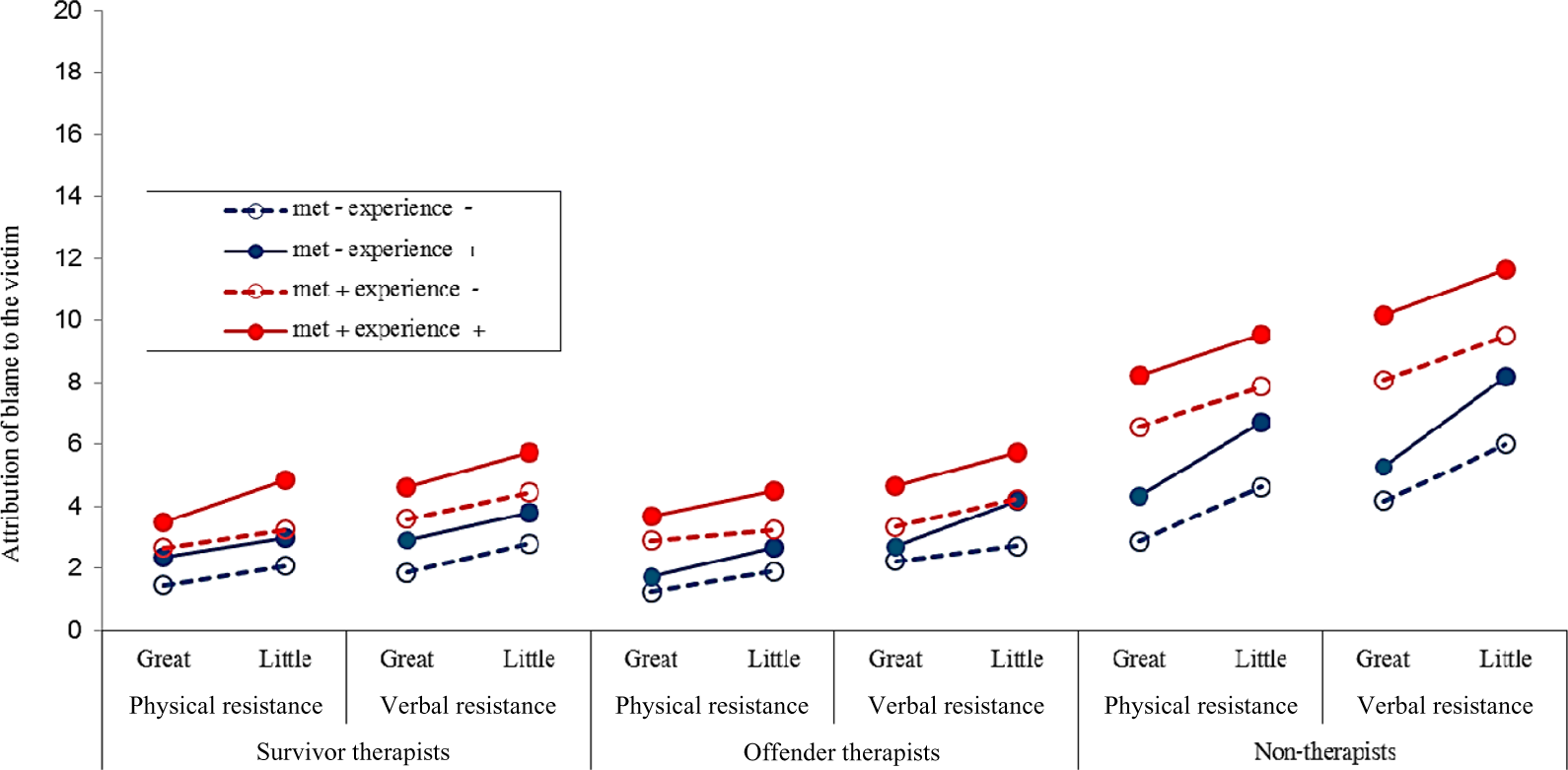
Attribution of blame to the victim as a function of the variables among the three groups of participants.
In spite of the similar trends, the non-therapist group showed a significantly higher willingness to blame the victim compared to both therapist groups (7.11, 3.29, 3.22 for non-therapists, survivor therapists and offender therapists, respectively).
The conclusions derived from the figure are supported by a five-way ANOVA of levels of blame as a function of the four operative variables (sexual experience, type of resistance, degree of resistance, agreeing to meet) serving as within-participant variables while participants’ status served as the between-participant variable.
Interactions between participants’ status and degree of resistance, prior sexual experience and meeting with the attacker following the rape were significant: F(2, 85) = 4.14, p < 0.05. Interactions between participants’ status and degree of resistance, and meeting with the attacker following the rape, were also significant: F(2, 85) = 4.95, p < 0.01.
A two-way ANOVA found the coefficient of the interaction between participants’ status and meeting with the attacker following the rape [F(2, 85) = 19.43, p < 0.001], participants’ status and degree of resistance [F(2, 85) = 11.26, p < 0.001] and participants’ status and prior sexual experience of the victim [F(2, 85) = 5.63, p < 0.01] to be significant. Interactions between prior sexual experience of the victim and degree of resistance, prior sexual experience of the victim and meeting with the attacker, and prior sexual experience of the victim and kind of resistance were also significant: F(1, 85) = 15.95, 8.48, 4.87; p < 0.001, 0.01 and 0.05, respectively. Furthermore, significant main effects were found for: meeting or not meeting with the attacker fallowing the rape [F(1, 85) = 205.07, p < 0.001]; degree of resistance [F(1, 85) = 152.55, p < 0.001]; sexual experience [F(1, 85) = 141.29, p < 0.001]; kind of resistance [F(1, 85) = 78.29, p < 0.001]; and participants’ status [F(2, 85) = 33.25, p < 0.001]. These findings support the research hypotheses.
Table 1 presents the data for the MR: among all three groups, the most significant weight was assigned to the variable of victim behavior after commission of the rape (meeting with the attacker after the rape), followed by the variable connected with a pre-rape characteristic of the victim (her sexual experience or inexperience) and, last, by the variables related to her resistance during the rape act itself (strength and type of resistance).
Relative weights of all the variables for survivor therapists, offender therapists and non-therapists.

A one-way analysis of variance for repeated measurements found significant differences in the relative weight assigned to the four variables among survivor therapists [F(3) = 6.356, p < 0.001]. Comparisons between pairs of variables show that the source of the differences is the relative weight given to meeting after the rape versus the relative weights given to all other variables. For offender therapists, a significant difference was also found [F(3) = 3.010, p < 0.05]. In this case, the source of the differences is the relative weight given to meeting after the rape versus the relative weights given to sexual experience and type of resistance only. A significant difference was found for the non-therapist group as well [F(3) = 10.452, p < 0.001]. Similar to the survivor therapist group, the source of the differences is the relative weight assigned to meeting with the attacker compared with the relative weights assigned to the other three variables. Interestingly, the most significant differences were found for the non-therapist group, followed by the offender therapists and finally the survivor therapists.
The results of Experiment 1 indicate that all participants tended to attribute blame to the survivor for being raped. However, levels of attributed blame were low among the therapist participants and moderate among the non-therapist participants.
Experiment 2: Blaming the attacker
The means for the judgments made by the three groups of participants are summarized in Figure 2 (the table listing the means and standard deviations can be requested from the corresponding author). Similar patterns are shown for all three professional status groups with respect to the attribution of blame to the attacker as a function of the variables examined. Greater blame was attributed to the attacker: when the victim was not sexually experienced rather than when she was highly experienced (among survivor therapists: 18.53 and 17.51; among offender therapists: 18.92 and 18.03; and among non-therapists: 16.87 and 15.31); when the victim demonstrated physical resistance rather than verbal resistance (among survivor therapists: 18.50 and 17.54; among offender therapists: 18.87 and 18.07; and among non-therapists: 16.80 and 15.38); when the victim’s resistance was strong rather than weak (among survivor therapists: 18.41 and 17.62; among offender therapists: 18.80 and 18.14; and among non-therapists: 16.80 and 15.38); and when the victim did not meet with the attacker after the rape compared to if she continued to meet with him following the rape (among survivor therapists: 18.63 and 17.41; among offender therapists: 19.14 and 17.81; and among non-therapist: 17.45 and 14.73).

Attribution of blame to the offender as a function of the variables among the three groups of participants.
As hypothesized, both therapist groups showed a significantly higher willingness to blame the attacker compared to the non-therapist group (18.02, 18.47 and 16.09, respectively).
A five-way ANOVA found significant coefficients for the interaction among: participant status and meeting with the attacker [F(2, 85) = 16.40, p < 0.001]; participant status and degree of resistance [F(2, 85) = 8.22, p < 0.01]; and participant status and prior sexual experience [F(2, 85) = 3.94, p < 0.05]. Interactions between: prior sexual experience of the victim and meeting with the attacker; prior sexual experience of the victim and kind of resistance; and prior sexual experience of the victim and degree of resistance were also significant: [F(1, 85) = 22.06, 19.73, 9.95; p < 0.001, p < 0.001 and p < 0.01, respectively]. In addition, the interactions between kind of resistance and degree of resistance [F(1, 85) = 8. 67, p < 0.01], and between kind of resistance and meeting with the attacker following the rape [F(1, 85) = 6.49, p < 0.05] were found to be significant as well.
Significant main effects were found for: meeting or not meeting with the attacker following the rape [F(1, 85) = 214.07, p < 0.001]; degree of resistance [F(1, 85) = 135.69, p < 0.001]; sexual experience [F(1, 85) = 120.00, p < 0.001]; kind of resistance [F(1, 85) = 69.40, p < 0.001]; and participants’ status [F(2, 85) = 26.44, p < 0.001].
Relative weights of all the variables assigned by the three groups of participants are summarized in Table 2. Among all three groups, the most significant weight was assigned to the variable representing victim behavior after commission of the rape (meeting or not meeting with the attacker) followed by the variable connected with a pre-rape characteristic of the victim (her sexual experience or inexperience) and, finally, by the variables related to her resistance during the rape act itself (type and degree of resistance).
Relative weights of all variables for survivor therapists, offender therapists and non-therapists.

One-way analysis of variance for repeated measurements found significant differences in the relative weight assigned to the four variables among survivor therapists [F(3) = 5.86, p < .01], offender therapists [F(3)= 1.780, p < 0.05] and among the non-therapist group [F(3) = 5.86 p < 0.01].
Comparing pairs of variables showed that the source of the differences between the survivor therapist and non-therapist groups was the relative weight given to meeting after the rape versus that given to all other variables. Among offender therapists the source of the differences was the relative weight given to meeting after the rape and that given to degree of resistance. As in attribution of blame to the victim, the most significant differences were found among the non-therapist group, followed by the offender therapists and finally the survivor therapists.
Experiment 3: Severity of the crime
Figure 3 summarizes the participants’ judgments of severity (tables listing means and standard deviations can be requested from the corresponding author) and shows that all the participant groups rated the rape scenarios as very severe, regardless of the particulars of each scenario, as a function of the variables examined. Greater severity was attributed to the rape: when the victim was sexually inexperienced than when she was highly sexually experienced (among survivor therapists: 16.39 and 14.98; among offender therapists: 18.55 and 17.95; and among non-therapists: 16.39 and 14.98); when the victim demonstrated physical rather than verbal resistance (among survivor therapists: 16.17 and 15.20; among offender therapists: 18.68 and 17.82; and among non-therapists: 16.17 and 15.20); when the resistance was strong rather than weak (among survivor therapists: 16.29 and 15.08; among offender therapists: 18.61 and 17.89; and among non-therapists: 16.29 and 15.08); and when the victim did not meet with the attacker after the rape than when she continued to meet with him following the rape (among survivor therapists: 17.30 and 14.07; among offender therapists: 18.93 and 17.57; and among non-therapists: 17.30 and 14.07). However, there was a consistent trend among therapists to rate all the 16 scenarios as more severe than the non-therapist group did (18.25, 17.59 and 15.68, for offender therapists, survivor therapists and non-therapists, respectively).

The severity of the event as a function of the variables among the three groups of participants.
A five-way ANOVA found significant interactions between the five variables (participants’ status, sexual experience of the victim, the kind of the resistance she exhibited, the degree of victim resistance and meeting or not meeting with the attacker) [F(2, 85) = 3.74, p < 0.05]. This interaction was also reflected in a triple interaction between sexual experience, type of resistance and meeting or not meeting with the attacker [(1, 85) = 5.02, p < 0.05]. A two-way ANOVA found significant interactions between: participant status and meeting with the attacker [F(2, 85) = 14.37, p < 0.001]; participant status and sexual experience [F(2, 85) = 4.98, p < 0.01]; and participant status and degree of resistance [F(2, 85) = 3.77, p < 0.05]. In addition, significant interactions were found between: sexual experience and meeting with the attacker [F(1, 85) = 13.76, p < 0.001]; sexual experience and degree of resistance [F(1, 85) = 6.88, p < 0.05]; and between sexual experience and type of resistance [F(1, 85) = 6.86, p < 0.05]. All main effects were found significant: meeting [F(1, 85) = 156.15, p < 0.001]; degree of resistance [F(1, 85) = 96.73, p < 0.001]; sexual experience [F(1, 85) = 93.90, p < 0.001]; type of resistance [F(1, 85) = 91.97, p < 0.001]; and participant status [F(2, 85) = 21.66, p < 0.001].
As shown in Table 3, in all three groups the most significant weight was assigned to the victim’s behavior after commission of the rape (meeting or not meeting with the attacker).
Relative weights of all the variables for survivor therapists, offender therapists and non-therapists.

One-way analysis of variance for repeated measurements found significant differences in the relative weight assigned to the four variables among survivor therapists [F(3) = 2.74, p < .005] and offender therapists F(3) = 4.71, p = 0.01]. Comparison between pairs of variables shows that the source of the differences among survivor and offender therapist groups was the relative weight given to meeting after the rape and that given to sexual experience and degree of resistance.
Significant differences in the relative weight assigned to the four variables in the non-therapist group were also found [F(3) = 11.18, p < 0.001]. The source of the differences was the relative weight given to meeting after the rape and the relative weights given to all other variables.
As in attribution of blame to the victim and to the attacker, significant differences were also found in the attribution of severity to the rape event among the participating groups. The non-therapist group considered the event to be the most severe, followed by the offender therapists and finally the survivor therapists.
Table 4 presents a summary of the correlations among the study variables. There is a strong positive correlation between the severity of the rape event and the degree of attribution of blame to the attacker and a moderate negative correlation between the attacker’s blame/contribution and the victim’s blame/contribution. A moderate negative correlation was also found between severity of the event and the blame/contribution of the victim.
Correlations among judgments of survivor’s contribution, offender’s contribution and rape severity (n = 88).

Note: **P = 0.01.
Discussion
In general, the current study showed that all non-therapist, offender therapist and survivor therapist participants tended to blame not just the attacker, but also the survivor, to varying degrees, for having been raped, and to attribute different degrees of severity to the rape event. Attributions of blame and rape severity changed as a function of the victim’s behavior before, during and after the rape.
Blaming the survivor versus blaming the rapist
As is consistent with other studies (Geiger et al., 2004; Gotovac and Towson, 2015), participants tended to attribute greater blame and responsibility to the sexually experienced survivor versus the virgin. Accordingly, participants blamed the attacker more when the victim had no previous sexual experience. In view of the media attention that has been devoted in contemporary Israeli society to raising awareness of the fact that it is not correct to assign any weight to whether or not a rape survivor was a virgin, it is perhaps surprising that such a view still holds sway even to a small extent, certainly among the therapist participants in this study.
Verbal rather than physical resistance and weak rather than strong resistance yielded the highest attributions of survivor blame in all three groups. This finding is consistent with studies that found a link between attribution of blame to the survivor and the type of resistance applied at the time of the event (Black and McCloskey, 2013; Dinos et al., 2015; Nevo, 2003), that looked at the very existence or absence of resistance (Cohn et al., 2009; McCaul et al., 1990) or considered the point during the event at which resistance was applied (Hine and Murphy, 2017). It appears that in order to be regarded as an unwilling participant in the sexual interaction, the survivor was required by some participants in this study to have conformed to stereotypical expectations of behaviors and resistance against her attacker, a phenomenon explained by Turner and Stets (2005). There was no allowance here for the freeze response that is now commonly recognized as one of the possible instinctual reactions under survival threat (Baldwin, 2013), something with which at least the therapist participants in the study should have been familiar.
It is important to note that the relative weights assigned to the type and extent of resistance were least important in attribution of blame to the survivor. This finding is interesting, since survivor behavior during the rape would perhaps be expected to carry the highest weight compared to her behavior prior to and following the rape event. At the same time, resisting may not always be in the best interests of the victim in a real-life event as her resistance, whether verbal or physical, may avoid rape completion but may also mean that she is otherwise seriously physically assaulted (Wong and Balemba, 2016). This element was not generally taken into account when judging blame attributions related to victim resistance.
Possibly the most unexpected finding was that post-rape behavior (meeting with the attacker) carried the greatest weight in this study regarding attribution of responsibility to the survivor. This finding is puzzling, given the fact that the survivor’s behavior after the crime has no relevance to the commission of the crime itself.
The influence of this variable can perhaps be explained either by a lack of empathy for the rape survivor’s particular circumstances (Stel et al., 2012) or by the defensive attribution theory (Bell et al., 1994). Participants in this study might believe that if they had been in a similar situation, they would have reacted differently and not have met with the attacker after the rape. Since the most natural response to rape is stereotypically believed to be either rage or extreme fear of the rapist, agreeing to meet with him anywhere except in a court of law may be inconceivable for many (see also Turner and Stets, 2005).
It is possible that the study participants believed the fact that the survivor chose to meet again with the man who attacked her, reflected negatively on her character – rape myths would contend that this is not the kind of behavior expected of a victim. In their opinion, therefore, she was seen as having contributed to some degree to her own rape and they attributed a measure of blame to her. This can, indeed, be explained by the just world theory (Lerner, 1980; Lerner and Miller, 1978). Moreover, attributing blame to the victim because of a variable that has no relevance to the commission of the rape itself shows that stereotypes and rape myths still persist today, even among those who are knowledgeable about the subject, such as the therapists in this study.
It is important to note that, in this particular scenario, the rape perpetrator and the survivor had been close friends for a significant period of time; no allowance was afforded by any of the three groups for the importance of the relationship to the survivor and possible avenues for remorse and forgiveness within that relationship. It would, perhaps, be expected that survivor therapists would be most aware of this kind of complexity in relationships for a one-time rape when the rapist is a personal friend. In fact, both survivor and offender therapists alike endorsed this blame variable similarly, while to a significantly lesser degree than did the non-therapists.
Assessments of severity
Similar to the findings discussed above, the victim’s behavior before, during and after the rape had a significant influence on the severity attributed to the rape event. The vignettes in the current study did not mention any details that have been found to affect the perception of rape severity, such as rapist use of a weapon or the attacker causing serious physical injuries (Chen and Ullman, 2010). The lack of such indicators means that study participants assessed rape severity solely based upon the fact that rape had occurred.
All participants assessed the incident as more severe if the survivor had had no previous sexual experience compared to having had considerable sexual experience. Cynically, perhaps, some people may ascribe more harm to the rape of a virgin versus the rape of a sexually experienced woman.
The combination of physical and strong resistance compared to verbal and weak resistance yielded the highest attributions of event severity, similar to findings reported by Nevo (2003). This is consistent with the argument that people tend to regard events that correspond to stereotypical descriptions aligned with rape myths as more serious (Gavey and Gow, 2001). Finally, as in attribution of blame to the survivor and to the attacker, it was found that her behavior after the rape (meeting with the attacker) carried the greatest weight in all three participant groups when determining severity of the rape event. The positive correlation found in this study between the severity of the event and attribution of blame to the rapist, and the moderate negative correlation between severity of the rape and attribution of blame to the survivor reflect rape minimization as described by Simonson and Subich (1999). Minimization corresponds to a reduction of the attacker’s assigned culpability and responsibility for the attack, the attribution of at least some of the blame and responsibility to the survivor, and even the failure to label the event as one of rape (Ben-David and Schneider, 2005).
Survivor therapists, offender therapists and non-therapists
Despite growing public awareness of the problem of rape, this study shows that rape myths and their impact on attributions of blame to the victim persist to the present day. Even among the current study’s educated participants, assumed to be relatively free of prejudice in view of studies which show that education reduces rape myth adherence (Van der Bruggen and Grubb, 2014; Vonderhaar and Carmody, 2015), there is still a tendency to blame the victim. This trend was moderate, but it does exist.
As expected, survivor blame among the non-therapists was significantly higher than among therapists. Since knowledge reduces stereotypes and prejudices, and since stereotypes and prejudices are associated with blaming the victim (Grubb and Turner, 2012; Hine and Murphy, 2017), it was expected that therapists would be less likely to blame the victims. In fact, Shechory and Idisis (2006) found that therapists were less likely to hold prejudices and adhere to rape myths than students.
Correspondingly, the two therapist groups in the current study attributed higher severity to the rape event than did the non-therapist group .This finding is consistent with that of Idisis et al. (2007). Perhaps offender therapists adopt this more severe stance for social reasons – so as not to be perceived as identifying with the offenders they are treating – and survivor therapists relate to the serious harm they see having been inflicted on their clients regardless of the actual acts performed as part of the rape event.
However, given the professional training in preparing both survivor and offender therapists for work with their respective populations, it is surprising that they endorsed any survivor blame at all. In fact, while therapists assigned less responsibility to the survivor for having been raped than did the non-therapists, they did partly blame her. In the same way, while non-therapists held the rapist somewhat less responsible than did the therapists, the therapists still considered the other variables when deciding on his level of blame.
Given that offender therapists work with convicted sex offenders on correcting their cognitive errors regarding responsibility for their offenses, and hear all the excuses rapists provide, we might expect them to express much clearer rapist blame. Similarly, since survivor therapists seek to help their clients understand that responsibility for the rape lies solely in the rapist’s hands, it is surprising that they were not clearer in their condemnation of the attacker in the experimental vignettes in all their permutations.
In fact, there should have been no doubt in any of the participants’ minds that what happened was a rape. The vignette clearly says: ‘Suddenly, Danny forced himself upon Rinat.’ There is no other way to understand this statement. It should not have mattered what Rinat did or said, whether she was a virgin or not, or whether she agreed to continue their friendship or not; nothing can change the meaning of the statement that he forced himself upon her. The fact that even experienced survivor and offender therapists were distracted by the other details raises questions regarding the adequacy of therapist training with respect to combating rape myths and highlights the need to increase understanding about rape. In fact, in a separate study, a full 30% of the university students participating in a mock jury study did not feel that an event that was clearly stated as coerced sex met the legal definition for sexual assault (Russell et al., 2011). There is clearly still much work ahead in both research and training.
Significance of the current study
Along with the observer’s personal need to blame the victim as a means of enforcing his or her sense of security and control over his or her life (Lerner, 1977; Lerner and Simmons, 1966; Peterson and Muehlenhard, 2004), blaming the victim also serves a social function by downplaying the seriousness of the crime of rape. By deflecting blame away from the rapist and on to the victim, and by placing responsibility firmly on the victim, society can avoid confronting the problem of rape (Lonsway and Fitzgerald, 1994; Ryan, 2011). This also helps the rapist: if he knows society endorses rape myths, he can neutralize and devalue the victim by underscoring her negative personality and behavioral traits, which are then readily accepted as true by many in the environment. It also helps the potential rapist neutralize his own inhibitions before committing a rape by telling himself that what he is about to do does not constitute rape (Ryan, 2011).
Experiencing rape, as well as the belief that something she did or failed to do would result in being blamed for it, can lead to serious psychological and behavioral consequences for the survivor (McGrath, 2011). The impact of the rape itself is exacerbated by negative and unhelpful responses that often greet the disclosure, not only on the part of friends and family members, but also by some police and professionals (Ahrens, 2006). In some cases this can even prevent the survivor from coping with her traumatic experience, leaving her vulnerable to re-victimization (Miller et al., 2011).
Given these dire consequences, we can see the need for intensification of educational and informational programs to facilitate changing preconceived ideas, shattering rape myths and refuting prejudices. This could help reduce rape survivors’ fears of being blamed for their victimization, free them from enduring feelings of guilt and encourage them to report their victimization to the authorities. This, in turn, will increase the chance of rapists being caught, incarcerated and possibly treated, and of victims receiving the therapy and support they need and deserve (Shechory and Idisis, 2006).
Study limitations and suggestions for future research
The current study used a small convenience sample and, in order to claim more robustness for its results, future research should seek to acquire larger random samples. Larger samples would allow examination of the professional populations with respect to age, gender, seniority, training background and perhaps their own personal experiences with sexual assault or sexual assault experiences within their family or social circles.
Effectiveness studies of rape awareness programs seeking to combat rape myths could be conducted. It would be interesting to explore whether there is a difference in the effectiveness of such programs if applied in graduate school training or continuing education after the professional has joined the work force.