




Abstract
In post-apartheid South Africa, insufficient consideration is given to how historical injustices affect current generations and how they could affect future generations. This has implications for issues such as intergenerational justice and equity. Framed within historical trauma theory and the life-course perspective, this paper explores notions of victimhood in post-apartheid Africa. It draws on qualitative interviews conducted with 20 children and grandchildren (10 females and 10 males) of victims of apartheid-era gross human rights violations. The interview data, which were interpretively analysed, yielded a number of salient themes. Participants’ sense of victimhood is anchored in their continuing socio-economic marginalisation deriving from the structural legacy of apartheid, as well as the pervasive racism that continues to bedevil South Africa well into the post-apartheid era. This is compounded by the perceived lack of accountability for historical injustices and the responsibilities that they perceive the government to have towards them. Given this, the paper argues for a reconceptualisation of the notion of victimhood and giving greater consideration to the impact that the structural legacy of apartheid has on the contemporary existential realities of Black South Africans.
Race-based oppression, discrimination and exploitation in South Africa can be traced back to the arrival of the Dutch settlers in 1652, as well as the British colonists who ruled from the 18th century until 1910. These practices were expanded and formalised into a system of legitimised racism called apartheid (an Afrikaans language term meaning ‘separateness’) when the National Party gained power in 1948 (Gibson, 2004). By the time democracy was achieved in 1994, colonialism and apartheid had left in its wake a deeply unequal and fragmented society. It could be argued that apartheid had been an acutely traumatic experience for Black South Africans. Research also suggests that trauma can be transmitted from one generation to the next (Volkan, 1996). According to Terreblanche (2002), apartheid resulted in the entrenchment of poverty for many Black South Africans.
Despite this, it appears that insufficient consideration is given to how injustices perpetrated during apartheid affect current generations, and how they could potentially affect future generations. This has implications for issues such as intergenerational justice and equity, as well as the country’s capacity to forge a socially cohesive society. This paper explores the notion of generational victimhood in contemporary South Africa. Its main aim is to understand how children and grandchildren of victims of apartheid-era gross human rights violations conceptualise victim identity in relation to historical injustices. Within the context of the Truth and Reconciliation Commission (TRC), gross human rights violations were defined as (a) killings, abductions, torture, severe ill treatment of any person; or (b) any attempt, conspiracy, incitement, instigation, command, or procurement to commit an act referred to in (a) (Promotion of National Unity and Reconciliation Act 1995). It is hoped that this will deepen our understanding of the impact that the structural legacy of apartheid has on the contemporary existential realities of Black South Africans, and offer lessons for addressing the legacies of historical injustices in societies emerging from protracted inter-group conflict and repression.
Defining victimhood
Within the context of gross human rights violations, it could be argued that the only people who could legally lay claim to victimhood would be primary victims of gross human rights violations, for example those who have been tortured, killed, injured, etc. Yet, defining who a political victim is can be problematic because it tends to transverse the conventional legal abstract definition of who is a victim and who is not (Huyse, 2002). According to Jacoby (2015), political victims are often identified without asking why these particular victims and not others come to be recognised, by whom, and for what purpose. This ubiquity makes it difficult to make sense of competing claims of victims, especially in disputed political contexts (Jacoby, 2015).
For Montville (1989), victimhood includes: (a) a history of violent trauma, aggression and loss; (b) a belief that the aggression and violence suffered is not justifiable by any standard; (c) a constant fear that the aggressor could strike again at any time; and (d) the perception that the world is indifferent to the victim group’s plight. In addition to this, Bouris (2007) asserts that there is a set of important and relatively constant characteristics inherent in the victim identity. These are innocence, purity, the lack of responsibility, the absence of guilt and moral superiority. The idea of innocence is grounded in the belief that one has not done anything wrong to invite or deserve the victimisation (Bouris, 2007). Indeed, the phrase ‘innocent victim’ is frequently used to highlight the notion that nothing was done to provoke victimisation (Huyse, 2002).
Bouris (2007), however, reminds us that in post-conflict societies, the definition of victim should be embedded in the broader context. It should not only encompass legal considerations, but also socio-political factors, culture and the victim’s own perception of whether he or she is a victim (Huyse, 2002). Bar-Tal et al. (2009) further contend that a sense of personal victimhood is grounded in a set of beliefs, attitudes, emotions and behavioural tendencies. For Aquino and Byron (2002), one is a victim to the extent to which one perceives oneself as having been the target, either momentarily or over time, and exposed to harmful actions emanating from one or more people. Bard and Sangrey (1986), on the other hand, emphasise the psychological impact of being harmed as integral to the development of a sense of victimhood. What all of this then entails is a rejection of a reductionist and essentialist conception of what a victim is, in favour of a more nuanced understanding of the concept. This consideration becomes especially critical in societies such as South Africa that are in the midst of rebuilding in the aftermath of protracted intergroup conflict. In these societies, the structural legacy of the past tends to loom large well into the post-conflict era and thus needs to be addressed.
Conceptual framework
Two interrelated theoretical perspectives provide an overarching conceptual framework for the article. These are the life-course perspective (Bengtson and Allen, 1993) and historical trauma theory (Sotero, 2006). The life-course perspective focuses on the study of individual development: ‘lifelong adaptive processes of acquisition, maintenance, transformation and attrition in psychological structures and functions’ (Baltes et al., 1999: 472). It emphasises the importance of focusing on the interaction of the person and the environment and the importance of time, context, process and meaning in human development and family life (Maddox and Campbell, 1985). In this way, it provides both a developmental and historical framework that enables scholars and policy makers to examine historical circumstances that have affected the lives of members of different generations (Hareven, 1996).
At the same time, George (2003) reminds us that there is no unified life-course perspective, and that the theory can best be used in conjunction with other specific theories. This is especially the case in the context of specific topics where the importance of long-term processes is recognised, which offer theories that can be integrated with life course principles (George, 2007). For this reason, historical trauma theory (Sotero, 2006) is offered as complementary to the life-course perspective. It has been used to explain how the historical context of the Aboriginal peoples in Canada created socio-economic and psychological disadvantage amongst that populace spanning five generations (Aguiar and Halseth, 2015). According to Sotero (2006), historical trauma theory is underpinned by the assumption that mass trauma is deliberately and systematically inflicted upon a target population by a subjugating, dominant population over an extended period of time. The magnitude of the trauma derails the population from its natural, projected historical course resulting in a legacy of physical, social and economic disparities that persists across generations (Sotero, 2006). Similarly, Degruy-Leary (2005) notes that the legacy of subjugation remains in the form of racism, discrimination, and social and economic disadvantage even after overt legitimisation of subjugation has been rescinded.
While primary victims endure significant physical and psychological trauma (Faimon, 2004), secondary and subsequent generations are affected by the original trauma through various means, including, among others, potential impairment of the parenting capacity of primary victims (Danieli, 1998). In addition to this, Sotero (2006) asserts that secondary and subsequent generations can also experience vicarious traumatisation through the collective memory of the population, as well as through first-hand experience of discrimination, injustice, poverty and inequality. From the preceding discussion, the usefulness of the life course perspective in explaining the intergenerational implications of past injustices becomes apparent. It enables us to identify distinct life events over the lifespan and discover how social processes have impacted developmental trajectories (Macmillan, 2001).
Goals of the study
The aim of the study was to explore the notion of generational victimhood amongst children and grandchildren of victims of apartheid-era gross human rights violations. It was guided by the following overarching research question: To what extent do you see yourself as a victim in contemporary South Africa, and how is that sense of victimhood conceptualised?
Method
Research design
To explore how victimhood is constructed amongst descendants of victims of apartheid-era gross human rights violations, this study employed a hermeneutic phenomenological approach. Hermeneutics is a theory of textual interpretation (Ricoeur, 1976). Some of its main underpinnings are the assumption that human behaviour is purposive, active and goal-directed (Schwandt, 1997), and that interpretation takes place in a context delineated by our everyday participatory understanding of people and events (Van Vlaenderen, 1997). Phenomenology, on the other hand, can be defined as a human science since: ‘the subject matter of phenomenological research is always the structures of meaning of the lived human world’ (Van Manen, 1997: 11). For Alvesson and Skoldberg (2000), phenomenology is critical of the natural scientific method for having distanced itself too far from its basis in everyday life. Phenomenology becomes hermeneutic when its focus moves from being descriptive to interpretive. As a philosophical orientation and a methodology, hermeneutic phenomenology focuses on illuminating details and seemingly trivial aspects of experience that may be taken for granted in our lives, in order to create meaning and achieve a sense of understanding (Wilson and Hutchinson, 1991).
Sample
In contrast to quantitative research, qualitative research focuses in depth on relatively small samples (Patton, 1990). Because the investigator examines individuals who can contribute to evolving theory (Creswell, 1998), it is also theory-based (Miles and Huberman, 1994). For this reason, the study used theoretical sampling. Maykut and Morehouse (1994) note that theoretical sampling allows the researcher to build and broaden theoretical insights in the ongoing process of data collection and analysis. In addition to this, Polkinghorne (1989), as well as Van Manen (1997) remind us that participant selection in hermeneutic phenomenological research focuses on participants who have lived experience of the focus of the study, who are willing to talk about their experience, and who are diverse enough from one another to enhance possibilities of rich and unique stories of the particular experience. Thus the study sample consisted of 20 children and grandchildren of Black South African victims of gross human rights violations residing in Johannesburg and Pretoria.
As mentioned previously, the TRC defined victims of gross human rights violations as those who have experienced (a) killings, abductions, torture, severe ill treatment; or (b) any attempt, conspiracy, incitement, instigation, command, or procurement to commit an act referred to in (a). Furthermore, its mandate was limited to gross human rights violations that had been committed between 1 March 1960 and 10 May 1994 because this represents a period during which the worst and most gross human rights violations had been committed (TRC Final Report, Vol. 1, 1998). Ultimately, approximately 21,300 people had filed gross human rights petitions with the Commission. These were mostly primary victims who had personally experienced gross human rights violations during the period in question. There were, however, also secondary victims who testified at the Commission because they were parents, children, or spouses of primary victims who had been killed or had disappeared during apartheid. An equal number of males and females participated in the study. Nine participants were grandchildren, while 11 were children of victims of gross human rights violations. Participants were at least 18 years old and therefore over the legal age of consent, which is 16 years. They were also able to express themselves comfortably in the English language. For a profile of participants, see Table 1.
Profile of interview participants.
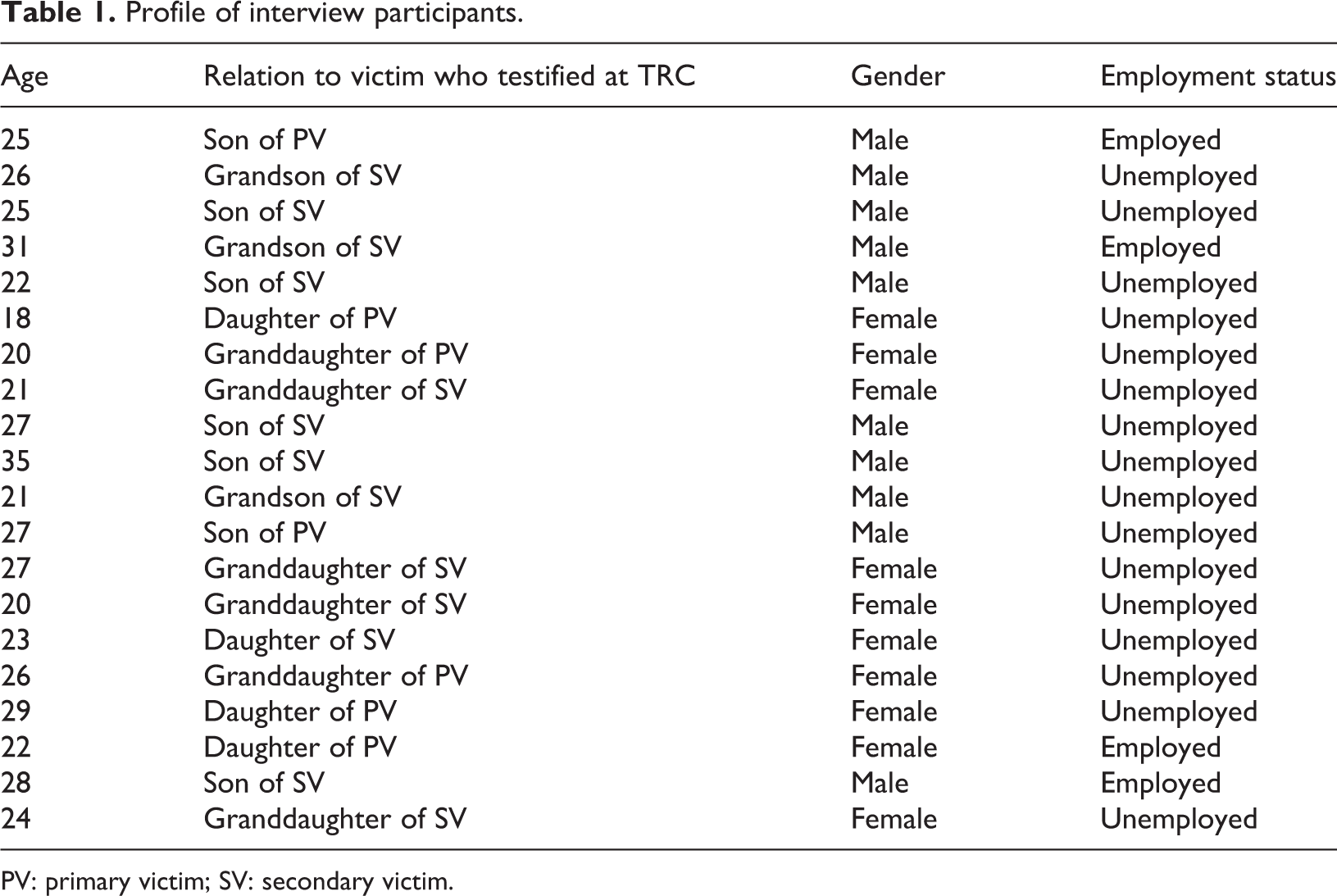
PV: primary victim; SV: secondary victim.
Data collection and procedure
Participants were identified and contacted through the Khulumani Support Group (KSG). The victims of gross human rights violations and their families had established KSG in order to facilitate their engagement with the TRC. Individual meetings were arranged where each potential participant was provided with a detailed description and explanation of the study, and given the opportunity to ask questions for clarification. Arrangements were then made to conduct interviews with those who agreed to participate in the study. An in-depth, semi-structured qualitative interview was conducted in English with each participant on an agreed-upon date. Interviews lasted as long as participants needed to answer the questions, with most interviews lasting between 45 minutes and one hour. Interviews took place either at the residences of participants, the KSG head office, or the Centre for the Study of Violence and Reconciliation (CSVR) head office, both of which are located in Johannesburg.
Those who opted to be interviewed at the latter two places were provided with transport reimbursement of 100 Rands each. In some cases, post-interview telephone calls were made to participants in order to clarify ambiguities contained in the interview data. An interview summary was compiled at the end of the interview. This was geared towards capturing tacit information and was used to aid the interpretation process. With the permission of participants, interviews were digitally recorded and then transcribed verbatim in preparation for analysis.
Data analysis
It is noted that hermeneutic phenomenology is not a prescriptive data analytical approach, but that it rather offers a set of flexible guidelines which researchers can adapt according to their research aims (Smith and Osborn, 2003). A fundamental principle that guides a hermeneutic phenomenological methodology is the desire to understand people’s experiences and their understanding of their personal world. According to Smith et al. (2009), this understanding is gained through a reflexive examination of participants’ accounts, with the researcher being aware of his/her own perspective and attitudes regarding the topic, and how these could impact on the analysis of the data. For these reasons, interpretive phenomenological analysis was deemed as a suitable method of analysis for the current study.
Each transcribed interview was read and re-read in order to become familiar with its content. The central parts as they relate to the focus of the study were then extracted. Following this, salient themes and recurring ideas or language relevant to the study were identified, focussing specifically on eliciting a sense of meaning in the data (Neuman, 1997). In the next phase, the plausibility of understandings previously generated was explored and evaluated. Following Van Vlaenderen (1997), this process involved challenging understandings and searching for negative instances or patterns. These were then incorporated into the larger structure, where appropriate. In the final phase of the interpretive analytical process, general theoretical significance was assigned to the interpretive data by contextualising it within the relevant literature (Neuman, 1997).
Ethical considerations
Because qualitative research is underpinned by the assumption that science can never be value-free (Knapik, 2002), it becomes imperative to give attention to a range of ethical issues relevant to the study. What adds to the importance of addressing ethical issues is because the study was of a sensitive nature; and there was therefore a real possibility of re-traumatising participants. While they were not necessarily primary victims of gross human rights abuses, Pearlman and Saakvitne (1995) remind us that the issue of re-traumatisation also applies to victims of secondary trauma. Thus, the Institutional Review Board (IRB) at Nova Southeastern University provided ethical approval for the study. In addition to this, KSG also granted formal approval for the study.
To obtain informed consent from participants, they were provided in non-technical terms with information about the overall purpose of the investigation and the main features of the research design, as well as any possible risks and benefits that might result from their participation (Kvale, 1996). Following Creswell (1998), they were also informed that their participation was voluntary and that they could terminate participation at any stage during the study. In addition to this, they were also made aware of counselling services where they could get trauma debriefing. A commitment was made that anonymity and confidentiality would be ensured in order to respect their privacy and protect their dignity and autonomy. At the start of the interview and following Briere (1997), I made sure not only to establish rapport, but also to use sensitivity and monitor the participant’s reactions for excessive distress throughout the interview in order to mitigate against possible re-traumatisation.
Results
The interpretive analytical process yielded a number of salient themes in relation to the extent to which descendants of victims of past gross human rights violations regard themselves as victims in contemporary South Africa. In the following section, these themes along with representative quotations are presented.
Continuing socio-economic marginalisation
Many of the participants lamented the continuing socio-economic marginalisation that they were confronted with in the new South Africa. This view is consistent with the literature (see, for example, Niehaus, 2006; Saul, 2006). Thus it has been noted that while Black people have been liberated in the political sense, this liberation has not been extended to the realm of socio-economics. Saul (2006) alludes to this when he asserts that when apartheid was eventually defeated, the outcome was not quite what many people expected, particularly those who had harboured expectations of better lives for them and their families. Kagee (2003), on the other hand, is more forthright when he states that the benefits conferred by the abolition of apartheid are counterbalanced by continuing economic marginalisation of large sectors of the South African population. Similarly, in reflecting on the shortcomings of South Africa’s post-conflict socio-economic transformation, Ali Mazrui described it as a matter of Black people receiving the crown and White people retaining the jewels (in Hendricks and Whiteman, 2004).
Thus one participant asserted that freedom has essentially eluded him and his family despite the significant political advances that occurred since democracy was gained. He thus questioned the extent to which one could claim to be free, despite suffering continued marginalisation. Although he did not state this explicitly, he appeared to refer to socio-economic marginalisation, which he blamed on the enduring structural legacy of apartheid. I am not free in South Africa. How can I be free? I am asking myself each and every day that if I’m really free, why I am suffering. So not much has changed, not at all. Only when you are free from suffering can you say that you are really free. I am a second-year drop-out and struggling because of the consequences of apartheid. I am stuck because of the previous apartheid regime’s circumstances which led me today to be stuck. (25-year-old son)
Embedded in this concept was the notion that this generation and subsequent ones would not be burdened by apartheid’s legacy, and that their life outcomes would be determined, not by structural forces, but by courage, hard work and the willingness to make use of the opportunities that political freedom present. The views of the aforementioned participant, however, dispel the relevance that this conceptualisation of freedom has for many young Black South Africans. Mattes (2011) reminds us that many of the fault lines of apartheid have been replicated within these post-apartheid generations, with many Black youth being confronted with the same if not greater levels of frustrating encounters with unemployment, poverty, inequality and hopelessness as their parents. Another participant, who also complained about the lack of socio-economic change, expressed the belief that there had been little significant transformation of the type that would make a meaningful impact on the lives of those who had previously been disadvantaged. She also implied that Black people were worse off than during apartheid. I haven
For another participant, the notion of continuing socio-economic marginalisation was grounded in issues of unemployment and lack of access to education. He alluded to what could be described as a dialectical relationship between the two. Thus, one cannot get a decent job if one is not educated, and that concomitantly, one needs to work in order to afford a decent education. We are still struggling and things are difficult because you cannot get a job, because you have no learning and you can’t learn if there is no job to pay for it. So what is going to happen to us? (25-year-old son)
Continuing racism
The persistence of racism was another salient theme in the conceptualisation of victimhood. One participant lamented the fact that Black South Africans, in general, continue to suffer racism, particularly at the hands of the South African police. This was traumatic and reminded him of the past. While he felt positive about the challenges that were overcome, he expressed frustration at the unwillingness of many White South Africans to change their views of Black South Africans and treat them as equals. I see White people they still do the same things they did that time. They treat us like nothing. The police, if they catch somebody they choke him and choke him; like the last time I saw other guy they put a blue glove over his head. I feel bad…it reminds me of where we come from. Some White people are alright, but others, they not good to Black people. They still think we are not the same and you can see how they treat us, as if we are not human. (26-year-old grandson)
In response to what he regards as the refusal of White South Africa to show sensitivity and insight for the pain that the past continues to impose on many Black lives, Terreblanche argues that ‘White indignation should be rejected as unwarranted arrogance or disguised racism and the bravado of people who have no sense of history or social responsibility towards those who have been exploited and victimised’ (2002: 5). He implores White South Africans to honestly acknowledge the systematic character of the country’s social and economic problems, and the central role that White political domination and racial capitalism have played in creating these problems and causing such wide-spread social injustices (Terreblanche, 2002).
Another participant was also firm in her belief that White people refuse to change their racist beliefs and practices, and even pass these on to their children. This made her question whether racism will ever end. One can therefore regard all of this as evidence of how deeply racism is ingrained in the hearts and minds of White South Africans, and the challenge that South Africa is confronted with in trying to eradicate racist beliefs and practices. I feel bad because we are not treated as equal to Whites. Apartheid has ended, but attitudes and beliefs did not change. They teach their children those same things. I feel unwelcome in restaurants and shops. I don’t know if it is ever going to change, if people are ever going to change. (23-year-old daughter) I think, apartheid is gone, but others, White people, they still have apartheid. Because when I read the newspaper, you can see that other places still have apartheid, like in the Free State [a province where incidents of racism had been reported frequently]. (35-year-old son) There was racism at this school. I used to see these things all happening and I tell myself, ‘I guess things haven’t changed as much as people claim they have’. You see racism still going around in schools. I expected it, but you always hope that it won’t happen. (21-year-old grandson)
Lack of accountability and social justice
Another salient theme in which conceptions of victimhood were grounded was the perception that there had been a reluctance to hold accountable those who committed past human rights abuses. Lack of accountability was generally conceptualised in retributive terms, involving application of appropriate punishment for crimes committed. According to Van Der Merwe (2009), studies show that victims of gross human rights violations want justice and that many were deeply disappointed by the fact that many perpetrators were able to circumvent justice. One participant noted that there was no justice for victims of gross human rights violations and implied this to be demonstrative of the lack of victim-centeredness that was inherent in South Africa’s transitional justice process. These people should be held accountable, but that has not happened. They must be punished for what they did. That is what is supposed to happen. But there is no justice for victims. They get nothing, no justice, no compensation, but they are asked to forgive and reconcile. (27-year-old granddaughter) You want to fight like all the people of that government, you know. They should be the ones who should be locked in jail. If you did have anything to do with it, to be locked in jail; it is our views and it should have been happening like that. If you were working for the government, then you should be punished…They should not only focus on individual perpetrators. They should also focus on generals and politicians. (27-year-old son) Right now…you can expose…historical incidents that had happened with White people…it’s all in the media that one and two has happened. Like Mr. Frank Chikane, those were White guys that tried to kill him. But immediately you try and find the perpetrator is an ANC, then you are against the ANC. You are anti-ANC and the ANC they are ruling the government. Because one thing for sure, if this thing, the bombing was the Whites who have done that, there would have been justice. (25-year-old son) My father was violated, but nothing happened. He wasn’t helped by anyone, even after apartheid. There was no justice, there needs to be justice, not revenge just justice so that my family’s situation can improve, so that they can take care of their needs, medical needs, education for children. (27-year-old son)
Mamdani (2000) laments the scapegoating of those who carried out orders, while those who gave orders went unpunished. Van Der Merwe (2009) reminds us that in 2002, President Thabo Mbeki granted pardons to 33 ANC and Pan Africanist Congress (PAC) members who were serving jail terms for politically motivated crimes. Of these, 20 had been denied amnesty by the TRC. One could argue that this constitutes proof that perpetrators, especially those belonging to the liberation movements, were able to short-circuit justice. These notions of retributive and reparative forms of justice embody a victim-centred (Robins, 2009) or grassroots approach (Smyth, 2007) to transitional justice. According to Lundy and McGovern (2008), an approach that is not victim-centered is more likely to result in re-victimisation and disempowerment, and in the process, pose threats to peace and stability.
Expectations from and responsibilities of government
Another salient theme in relation to participants’ sense of victimhood was their perception that the government had shirked its responsibility of ensuring that the needs of victim families are met. It is perhaps understandable that participants felt that the government should assist them materially, given the fact that the gross human rights violations further exacerbated the deep-seated poverty that apartheid had created. In addition, it could be argued that poverty and inequality were further entrenched in the post-apartheid era. One participant who exemplified this view insisted that government had a responsibility to consult victims and their families on what their needs were. His view was that they were entitled to be provided with the necessary resources to meet those needs since that was what people had fought for. I deeply feel that the government should come and ask us how we suffered mostly because of being raised by a single parent, especially as a mother of six children. They should find out what our needs are and provide us with those basic needs. We are entitled to education, better housing, health and all these other things that the constitution promises us. This is what people were fighting for in the first place. So there are a lot of things that they should address; that should have been done in the past years, you know like supplying water and giving people electricity where it is needed. (27-year-old son) Government should also listen on a day-to-day basis people’s sufferings you know, like what the people want. They should on daily basis ask people, ‘what do you want’. This will help them understand what is needed, and where it is needed. There is money, but it is either wasted or not spent at all. You always hear of government under spending, yet people are starving. (28-year-old son)
Another participant expressed the belief that government should have confiscated the ill-gotten gains that many perpetrators accrued under apartheid and distributed them among victims and their families who are now suffering as a result of past human rights abuses. The government should’ve at least confiscated the things that they did inherit from those apartheid deeds and then bring the money to us. Money that they got, I think it should be taken from them and it should be given to us because of we are the ones who were suffering because of their deeds. (27-year-old son)
The views outlined above express participants’ concern for their current material realities. They are convinced that the government had a moral and political responsibility to provide victims and their families with assistance in meeting basic needs and other material challenges they face. While many participants blamed the current challenges on the fact that their families suffered gross human rights violations, there was also a view that argued against what can be described as a sense of entitlement to sympathy and benevolence that was based on victim status. The literature supports the notion of entitlement derived from a sense of victimhood. Meads, for example, suggests that where wounds are regarded as an asset, competition over victimhood increases (in Sykes, 1992). Bauman (1998), on the other hand, decries the mushrooming of support groups for children of Holocaust survivors in the United States as a desperate search for scapegoating, rather than taking responsibility for present personal troubles. Thus, one participant implored that although they had been oppressed for a long time, Black South Africans should take responsibility for their own well-being and start doing things for themselves. She argued against subscribing to an ideology of victimhood and rather for the collective empowerment of Black South Africans by making use of the opportunities that democracy bestows. We as Blacks must do our thing. They (Whites) don’t owe anyone anything. I mean they are using their brains to do anything they want so as us we must use our brains. They’ve benefited from the past. They made it work for them. It was apartheid. You could do nothing. But now things have changed and we must make use of the opportunities. We cannot always expect government to do things for us although it is their responsibility, they will not always be able to do it. So we need to empower ourselves. (23-year-old daughter)
Conclusion
This paper has explored the notion of generational victimhood in contemporary South Africa. The results suggest that participants’ sense of victimhood is anchored in their continuing socio-economic marginalisation, as well as the pervasive racism that continues to bedevil South Africa well into the post-apartheid era. This is compounded by the perceived lack of accountability for historical injustices and the responsibilities that they perceive the government to have towards them. The latter emanated largely from the unmet expectations that had been cultivated during the transition from apartheid to democracy.
It could be said that participants, in the first instance, see themselves as generational victims, which stems from the impact that historical injustices had on past generations and how that has shaped the life-trajectories of current generations. It is noted that victims of past atrocities are often poor. Furthermore, one of the most striking features of both poverty and inequality is that it can be reproduced and transmitted across generations (Potter and Roksa, 2013). The same applies to wealth. Thus Seekings and Nattrass (2005) contend that the affluence of White South Africans is largely based on an enduring legacy of past discrimination, especially in public education. They argue that White South Africans are reaping the benefits of the skills and credentials they acquired in the past and that they could pass onto their children even when public education was de-racialized. According to Brooks (2004), on the other hand, economists estimate that up to 80 percent of lifetime wealth accumulation results from gifts from earlier generations. Thus the reproduction of certain socio-economic conditions transforms prior wealth and privilege obtained through racial oppression into current wealth and privilege (Brooks 2004).
Participants’ sense of generational victimhood is compounded by the perceived lack of victim-centeredness of South Africa’s transitional justice process, which has interfered with the ability of victims, and their descendants, to procure an equitable future and reverse their marginalization. Underpinning this lack of victim-centredness was the lack of prominence that reparation was afforded vis-à-vis amnesty and individual accountability. Research suggests that victims are more concerned with issues like reparation that have a bearing on their livelihoods (Fletcher and Weinstein, 2002). At the same time, the fact that the economics of transitional justice should not end with reparation needs to be underscored, particularly in a context where inequality and poverty are endemic. Hence it becomes critical to mainstream broader issues of development as part and parcel of transitional justice practices (Duthie, 2008).
In addition to the lack of victim-centredness of the TRC, participants have to contend with both the intergenerational psychological impact of racism, as well as contemporary racism in South Africa. The pervasive fear, mistrust and anger that are often directed towards the racial ‘other’ is a significant stumbling block in repairing South Africa’s social fabric. Carter (2007) reminds us that racism not only results in a profound and lasting sense of injury for its primary victims, but that it can also be a source of intergenerational stress, trauma and emotional injury. Similarly, Thompson-Miller and Feagin (2007) have highlighted the cumulative and long-term effects of racial discrimination and the fact that this accumulation of pain is passed across several generations of the racially oppressed.
In addition to seeing themselves as generational victims, participants also see themselves as victims of continuing social exclusion and economic marginalization that derives from structural violence in contemporary South Africa. Structural violence is systemic and typically embedded into the societal structure and cultural institutions (Galtung, 1969). According to Freire (1998), it interferes with the individual’s ontological and historical vocation to achieve self-actualization. Indeed, one of the criticisms lodged against the TRC relates to its narrow focus on gross human rights violations at the expense of the structural evils of apartheid (Nattrass, 1999). Mamdani (2000) for example, is critical of the TRC’s omission from its mandate of the approximately 3.5 million people who, between 1960 and 1982, had their families, communities and livelihood shattered by forced removals. Others such as Terreblanche (2002) suggest that the TRC’s work should not have been restricted to only 34 years (1960–1994), especially not in a country where the human rights of Blacks had been grossly violated for almost 350 years. For this reason, Van Der Walt et al. (2003) claim that the Commission, with its restrictive focus only on gross human rights violations from 1960 onwards, contributed towards this process of facilitating a sophisticated amnesia of the greater historical and structural violence of apartheid. Thus, while White South Africans continue to benefit from the structural arrangements put in place under apartheid and that continue to exist, poor South Africans, the overwhelming majority of whom are Black, find it increasingly difficult to break out of cycles of poverty that engulf them.
On the one hand, the life-course perspective highlights the fact that human development takes place in the context of intertwined social relationships and that ‘the shape of one’s life course is influenced by the shape of the life courses of others’ (Thornberry 2016: 271). We are thus able to see how social processes have impacted the developmental trajectories of participants. Through historical trauma theory, on the other hand, we come to see how past injustices can be linked to current economic, social and psychological challenges faced by those who have been historically disadvantaged. According to Kirmayer et al. (2014), this is particularly useful in giving mental health practitioners access to individual stories of suffering, and to locate causes, ascribe responsibility, valorise the person’s struggle, and mobilise more effective responses.
A significant amount of criticism is lodged against the claiming or assigning of victimhood. Sykes (1992: 12), for example, argues that we live in a ‘society of victims’ characterised by a ‘readiness not merely to feel sorry for oneself, but to wield one’s resentment as weapons of social advantage and to regard deficiencies as entitlements to society’s deference’. While this may be true in some instances, it is also a false generalisation that to a large extent serves to undermine efforts at addressing historical injustices and restoring social harmony in previously divided societies such as South Africa. Thus it could not be assumed that to claim or assign victimhood in these contexts is to capitalise on its supposed privileges, which, according to Starman (2006), is associated with the assumption of innocence, entitlement to sympathy and ethical indulgence reserved for those who suffer, eschewal of responsibility and the corollary right to pass the blame to others. Rather, to talk about generational victimhood, as is done in this paper, is to address a fundamental reality. It is to bring attention to the fact that many of the challenges that South Africa currently faces, such as poverty and inequality, and the relation these have to the country’s social problems, can be directly attributed to the injustices of colonialism and apartheid. Laplante (2008) warns that if economic and social inequalities are not addressed and the grievances of the poor are ignored, the possibility of repetition of past injustices increases. Similarly, Montville (2001) asserts that the sense of powerlessness that accompanies the inability of people to secure basic needs makes them extremely vulnerable to political violence and aggression. It is, therefore, unsurprising that the failure of government to meet the socio-economic needs and provide basic services to the poor, has been the background to emergent contemporary conflicts between the poor and the state.