




Abstract
This study examines whether sex differences in level of distress and help-seeking for physical and emotional problems as a result of criminal victimization can be explained by injury, type of crime, and the victim–offender relationship. The study uses data from the National Crime Victimization Survey (NCVS) from 2008–2014. Analyses utilize multivariate logistic regression and interaction terms to address possible differences between males and females. Consistent with the existing literature, females reported elevated distress and were more likely to seek help for emotional and physical problems. However, being a victim of intimate and family violence contributed to heightened distress and increased help-seeking for both males and females. Male distress was elevated when the offender was a friend or acquaintance and when the attack was a robbery. Victims services should address crimes males are more likely to experience, including robbery and victimizations by known, but not necessarily intimate, relationships.
Introduction
It is well established that the consequences of violent victimization are a significant public health issue (Aldrich and Kallivayalil, 2013; McCart et al., 2010; Papachristos and Wildeman, 2014). Victims of violent crime often experience emotional and physical health consequences resulting from interpersonal victimization (Aldrich and Kallivayalil, 2013; McCart et al., 2010). Data indicate that as many as 68% of serious violent crime victims (i.e. victims of robbery, aggravated assault, and sexual assault) experienced socio-emotional problems between 2009 and 2012. However, only 12% of victims who experienced these problems received help from victim service agencies, and a majority of these were women (Langton and Truman, 2014).
While there has been a great deal of research on females’ physical and emotional problems and help-seeking behaviors, scholarship is beginning to examine the consequences for males who are victimized. Significant questions remain regarding the nature of victimization and help-seeking behaviors for male victims and how male and female responses to victimization differ. Therefore, the purpose of this study is to examine (1) sex differences in elevated distress resulting from criminal victimization and (2) factors associated with victim help-seeking for emotional and physical problems. Specifically, we ask whether male help-seeking behaviors can be attributed to sex differences in level of distress, the type of crime, degree of injury, and the relationship between the victim and the perpetrator—or gendered social norms. By examining these differences, health care and criminal justice professionals can more effectively match the needs of crime victims not only to available victim services but also in order to develop new avenues to reach victims who are less visible to social institutions.
Victimization, health consequences, and help-seeking
Research indicates that there are substantial differences between males and females in self-reported physical and emotional problems and help-seeking behavior. Males and females also report experiencing different consequences of victimization that are similar to distinctions observed across other health domains (Barsky et al., 2001; Courtenay, 2000). Physical and emotional problems, particularly heightened levels of distress, are often the aftermath of violent victimization. Physical consequences of interpersonal violence include bodily injury as well as frequent headaches, upset stomach, and suffering from chronic pain (Coker et al., 2000). Emotional and mental health consequences of interpersonal victimization include depression and post-traumatic stress disorder (Angel et al., 2014; Black, 2011; Bouffard and Koeppel, 2014; Breslau et al., 2000; Pimlott-Kubiak and Cortina, 2003; Taylor and Kliewer, 2006). In addition, psychological distress, the state of emotional suffering resulting in symptoms of depression and anxiety, can manifest in physical health problems such as headaches or periods of insomnia (Kleinman, 1991; Kirmayer, 1989; Mirowsky and Ross, 2002). Females are more likely to report experiencing socio-emotional problems relative to males for all types of violent victimization (Arnocky and Vaillancourt, 2014; Langton and Truman, 2014).
Research also indicates that males and females engage in different help-seeking strategies (Adams and Campbell, 2012; Parent et al., 2018). Data indicate that females (15%) are more likely than males (6%) to receive assistance from victim services (Langton, 2011). Research has also demonstrated that male victims perceive being victimized as weak and helpless, which in turn results in difficulties expressing feelings and seeking support. Oftentimes, men are more likely to externalize blame while women, on the other hand, are more apt to internalize blame (Stanko and Hobdell, 1993). Female crime victims are also more likely than male victims to seek help from a mental health professional, particularly for depression (Courtenay, 2000; Kaukinen, 2002, 2004; Mahalik et al., 2003; New and Berliner, 2000). These disparities align with the broader mental health literature and the common underutilization of services by males (Bland et al., 1997; McCart et al., 2010).
Current perspectives on sex differences in distress and help-seeking
Two perspectives in the existing literature may help to explain disparities for both self-reported health problems and for help-seeking behavior. The first argues that sex differences can be explained by the characteristics of incidents. The second perspective argues that sex differences can be explained by gendered social norms; that males may be reluctant to admit their distress or ask for help because they counter the notion of masculinity and signal weakness.
Differences in victimization experiences
Sex differences in distress as a result of victimization may be explained by the types of crimes males and females are more likely to experience. In 2016, there were approximately 5.7 million violent victimizations experienced by US residents aged 12 years or older (Morgan and Keena, 2017). Evidence indicates that although males historically experienced higher rates of violent victimization, this gap has closed in recent years (Truman and Langton, 2014). In a 2014 Bureau of Justice Statistics (BJS) report, research found that, of those aged 12 years or older, 1.2% of all males (1.5 million males) and 1.1% of all females (1.5 million females) experienced one or more violent victimizations (Truman and Langton, 2014). Even in research where risk appears similar, there are notable differences in the type and nature of victimization experienced (Catalano, 2013; Melton and Belknap, 2003; Rennison and Welchans, 2000). In their mixed methods study examining the context of intimate partner violence, Melton and Belknap (2003) found that male defendants were significantly more likely than female defendants to be reported as making threats to the victim or to threaten physical, nonlethal harm to the victim. In instances of physical violence, male defendants were significantly more likely to be reported as shoving or pushing the victim, grabbing or dragging the victim, pulling the victim’s hair, physically restraining the victim, strangling the victim, and preventing the victim from calling 911. On the other hand, female defendants were significantly more likely than male defendants to perpetrate violence in self-defense and reported being injured more often.
Data from the National Crime Victimization Survey indicate that females were more likely to be victimized by an intimate partner and be sexually assaulted (Catalano, 2013; Rennison and Welchans, 2000). Females were also more than twice as likely to be seriously injured (i.e. from sexual violence, gunshot or knife wounds, internal injuries, unconsciousness, or broken bones) as a result of an intimate perpetrator’s actions (Catalano, 2013). Existing literature further supports that women suffer disproportionately from intimate partner violence, including physical and emotional health problems (Caldwell et al., 2012). Caldwell et al. (2012) found that cultural factors that typically ascribe higher status to the male gender, and men’s greater size and strength compared with women (on average) impact the disproportionate impact that women encounter in the context of intimate partner violence.
Intimate partner violence has been associated with heightened socio-emotional problems (Weaver et al., 2014; White and Satyen, 2015). In general, crimes committed by an offender already known to the victim are experienced differently than those where the offender is a stranger (Kang and Lynch, 2014). Literature points to the dependence of victims on the offenders either financially or emotionally as barriers to seeking help for many victims. Victims are less likely to mobilize the law when there is a greater level of emotional intimacy or closeness in the relationship (Adams and Campbell, 2012; Gartner and MacMillan, 1995; Kang and Lynch, 2014). If an individual is reliant on his or her partner for money or shelter, he or she may be reluctant to leave. Reluctance to report may be even more pronounced if there are children involved or if the victim resides in a rural area where there are fewer shelters and resources available to victims (DeKeseredy and Schwartz, 2009).
Help-seeking may also be enhanced by the severity of the crime. The severity of the crime and whether or not a victim was injured are underscored as factors in determining whether a victim experiences elevated distress levels. This is especially true when the injury is serious enough that it alters a victim’s appearance or physically disables the victim (Weaver et al., 2014). Research on intimate partner violence finds a strong relationship between the severity of physical abuse and increased likelihood of help-seeking in women (Duterte et al., 2008). This relationship is particularly pronounced in the context of rape and sexual assault. In a study by Coker et al. (2000), of 556 women and men who experienced intimate partner violence and/or coerced sex and their help-seeking behavior, women were significantly more likely to report physical or sexual intimate partner violence (IPV) (17.8%) than were men (4.9%). These differences in reporting remain despite the fact that, overall, victims of rape or sexual assault experience heightened socio-emotional problems and distress (Langton and Truman, 2014).
From the incident characteristic perspective, we would hypothesize that the most important and substantial factors predicting sex differences would be incident characteristics—the victim–offender relationship, type of crime and injury. These factors would minimize or make sex significance disappear in help-seeking.
Gendered social norms
In contrast to the salience of incident characteristics, sex differences in reported distress and help-seeking may be attributed to gender norms (Burcar, 2013; Finkelhor and Wolak, 2003; Tsui et al., 2010). Health behaviors can be examples of ‘doing gender’; in other words, engaging in socially expected health behaviors are another way of creating or exacerbating perceived differences between men and women (Courtenay, 2000; West and Zimmerman, 1987). Males have been socially constructed as the ‘stronger’ sex, which means that showing sickness or signs of distress can be perceived as a form of weakness (Courtenay, 2000; Tsui et al., 2010). Health-related research has highlighted the ways in which men have been discouraged by fellow family members and peers from admitting symptoms of pain or signs of deteriorating health for fear of being perceived as weak (Courtenay, 2000).
These patterns in help-seeking for victimization mirror socially constructed gender roles learned early in life. For instance, the importance of a physical examination is more heavily stressed among young females as part of ‘being a woman’ while the importance of physical examinations does not hold the same importance for young males and is not reflective of ‘being a man’ or traditional notions of masculinity (Courtenay, 2000). Engaging in formal help-seeking behaviors may be associated with accepting victim status and as a sign of weakness (Burcar, 2013). This association between victimhood and weakness does not align with traditional notions of masculinity (Arnocky and Vaillancourt, 2014; Burcar, 2013). The association between victimhood and weakness can discourage help-seeking and result in underutilization of services for males with physical and mental health problems.
In sum, the ‘gendered social norms’ perspective would suggest that incident characteristics may not entirely explain sex differences. From this perspective, sex will remain significant even when controlling for incident characteristics. More specifically, there are unexplained or immeasurable effects for our analysis and sex itself will remain a significant predictor.
Methods
This study examines two related research questions: (1) Why are there sex differences in distress as a result of being a victim of a violent crime? and (2) For males and females who have moderate to severe distress, why are there sex differences in help-seeking for physical and mental health problems as a result of being a victim of a crime?
Data
To address these questions, in this study we used data from the National Crime Victimization Survey (NCVS) 2008–2014. The NCVS is a national survey of persons aged 12 years or older living in households in the USA. Our analysis did not utilize a particular age cut-off point and included all persons aged 12 or older in our sample. Age was a continuous variable. The survey uses a stratified and multi-stage cluster sampling design in which persons are interviewed about their experiences with victimization. The survey is used to produce national estimates of non-fatal property and violent victimization. The data are available through the Inter-university Consortium for Political and Social Research (ICPSR) for each individual year and as multi-year incident files. Each person is interviewed seven times over the course of a 3-year period. The first interview is conducted in person and subsequent interviews may be conducted either in person or by phone.
The NCVS uses a screening tool that includes demographic information about each person in the household aged 12 years or older and questions about types of victimization that may have occurred. It is important to note that the NCVS collects data on the victim’s biological sex, and as such in the current analysis we refer to ‘sex’ rather than ‘gender.’ However, we address research examining both ‘gender’ and ‘sex’ in the review of the literature. This falls in line with both feminist and intersectional scholarship where sex refers to a biological status and gender refers to how one perceives and expresses oneself (Renzetti, 2013). The screening tool uses a bounded time frame of 6 months to reduce the likelihood of telescoping and issues with memory recall. For each incident that meets the screening criteria, an interviewer asks further information through a detailed incident questionnaire such as the circumstances of the incident, the victim relationship to the offender, and the consequences of victimization and whether the police were informed. Further details are available in the data documentation (US DOJ, 2015).
The year 2008 (quarter 3) was the first data collection wave that asked victims about socio-emotional problems as a result of their victimization. The current study utilized the data collection years 2008 to 2014 (the most recent year available at that time). These data were treated as cross-sectional to maximize the total sample size for analysis. Only victims who had personal contact with the offender were asked about socio-emotional problems. Therefore, the analyses were limited to victims of personal crimes including physical assault, sexual assault, and robbery. Terms and definitions for the NCVS are available on the Bureau of Justice website (https://www.bjs.gov/index.cfm?ty=tdtp&tid=9).
Despite its strengths as a large sample of victims across the USA and detailed indicators about victim and incident characteristics, there are some important weaknesses that should be noted. Although victims were asked about socio-emotional problems, the measures in the NCVS are based on the victim’s self-report rather than a validated and reliable clinical assessment. Further, there are limits to which victims were asked about socio-emotional problems and help-seeking. All victims who had personal contact with offenders were asked about distress, but only those with moderate to severe distress were asked to provide further information about mental and physical health problems. It is possible that victims with low distress could have experienced other problems and may have sought help for them.
Measures
Dependent variables included elevated distress, help-seeking for emotional problems, and help-seeking for physical problems. Elevated distress was measured by the question, ‘How distressing was being a victim of this crime to you? Was it not at all distressing, mildly distressing, moderately distressing, or severely distressing?’ This variable was recoded so that victims who reported moderate or severe distress were coded 1 for ‘elevated distress,’ and victims with mild or no distress were coded 0. Victims who reported moderate or severe distress were also asked follow-up questions about what specific types of physical or mental health problems they experienced and whether help was sought for these problems. Specifically, victims were asked, ‘Did you seek any kind of professional help for the feelings you experienced as a result of being a victim of this crime?’ and ‘Other than any medical care you received for the injury(ies) you suffered did you seek any professional or medical help for the physical problems you experienced as a result of being a victim of this crime?’ Both these variables were coded 1 if the victim sought help and 0 if the victim did not seek help.
The analyses included independent variables for sex (male = 1), whether the victim was injured (injury = 1) and the victim–offender relationship. The victim’s relationship to the offender included incidents in which there was a single offender: intimate partner (spouse, ex-spouse, boyfriend or girlfriend, and ex-boyfriend or ex-girlfriend), non-intimate family member (aunt or uncle, parent, grandparents, and children), friend (or ex-friend), acquaintance (persons known to the victim who did not fit within the other categories), and stranger (someone unknown to the victim). When the victim indicated that there was more than one offender, the relationship was coded as multiple offenders. To account for missing data, a control variable was included for where the relationship was not known. The type of crimes included physical assault, rape or sexual assault, and robbery.
The analyses also controlled for other demographic characteristics including race and ethnicity, household income, age, and marital status. Income is measured by the NCVS on a 14 category ordinal scale, which was recoded into four categories (<US$25,000; US$25,000 to US$49,999; US$50,000+, and unknown income). This is similar to prior treatments of this variable (e.g. Felson and Pare, 2010). Marital status included victims who were married, never married, and other marital status.
Analytic procedures
First, the study analyzed differences in males and females in the sample and the dependent variables. All victims of violence were asked about elevated distress, but only those victims who reported moderate or severe distress were asked about help-seeking. Chi-square tests were used for all categorical variables and t-tests were performed for the continuous variable, age. Three regression models were used to examine elevated distress, help-seeking for mental health problems, and help-seeking for physical health problems. All models utilized logistic regression due to the dichotomous nature of each dependent variable. In consideration of whether the key independent variables had unique effects for men relative to women, subsequent analyses also examined interactions with sex.
Results
Sex differences in levels of distress
Table 1 presents the results of the bivariate analysis using the unweighted data for sex differences. This is consistent with prior treatments of these data when conducting predictive analyses (Gallagher, 2005; Lohr and Liu, 1994). The sample included 7,739 victims (3,874 males and 3,865 females). All variables were significantly different for males and females (p < 0.001) with the exception of age. These results were significant with mainly weak associations (phi < 0.2) with sex differences in elevated distress as the strongest association (phi = −0.246). Substantial differences between males and females were evident in the victim–offender relationship and type of crime. Females were more likely than males to be victimized by an intimate or family member and be victims of sexual assault, consistent with known patterns of victimization.
Sample characteristics.
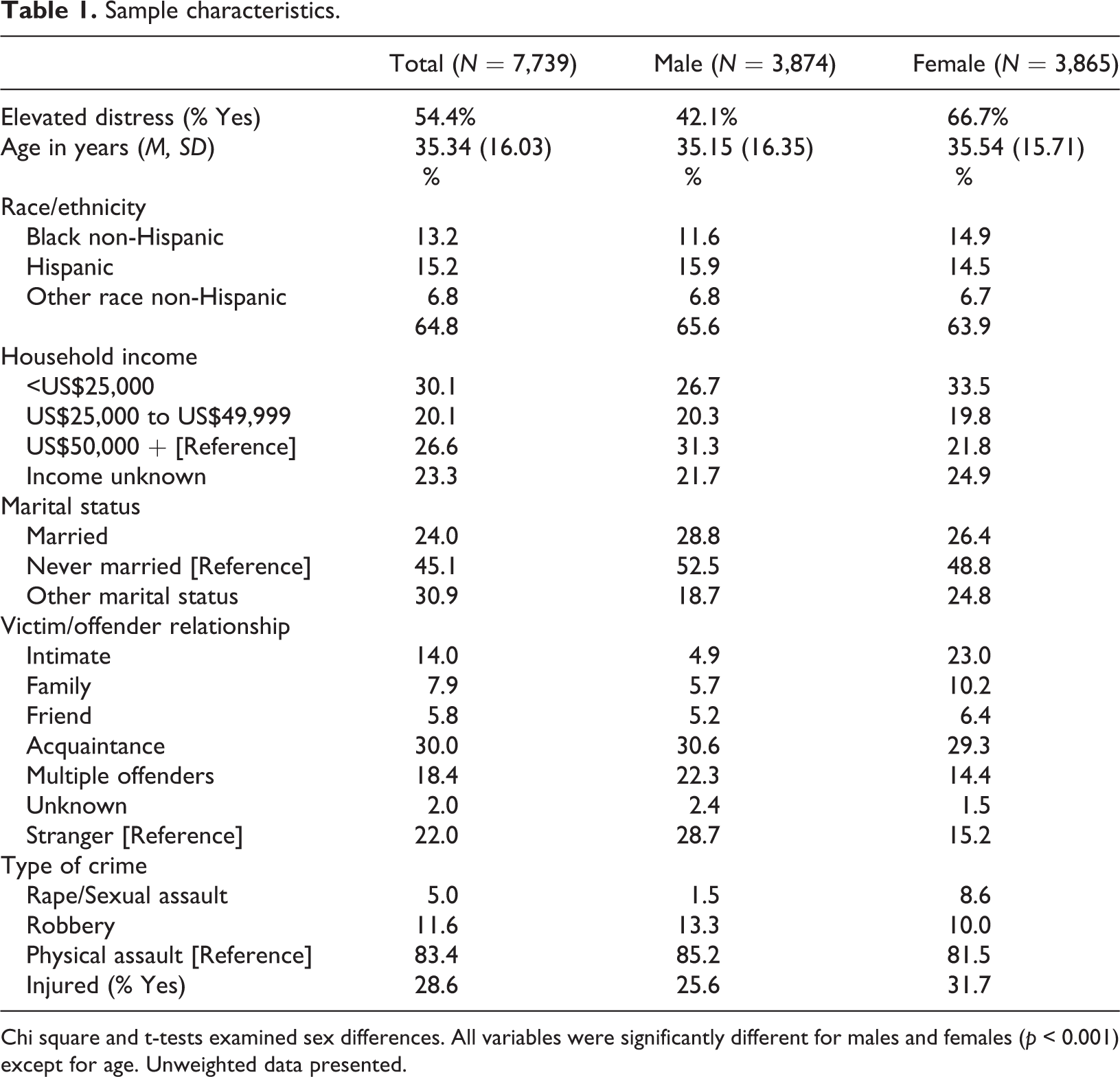
Chi square and t-tests examined sex differences. All variables were significantly different for males and females (p < 0.001) except for age. Unweighted data presented.
Multivariate analyses predicting distress indicated that males were less likely to report feeling elevated distress as a result of being a victim of crime (Table 2). Elevated distress was also associated with intimate and familial offenders, injury, and both rape/sexual assault and robbery, relative to physical assault. Further analyses explored whether the effect of relationship, type of crime, and injury was different for males relative to females, using interaction terms. In these additional analyses, the effects of the interaction between male and friend, acquaintance, unknown relationship and robbery were significant (p < 0.05 and p < 0.01). The addition of interactions slightly improved the Nagelkerke R square of the model, from 0.211 to 0.215.
Logistic regression predicting elevated distress (N = 7,739).
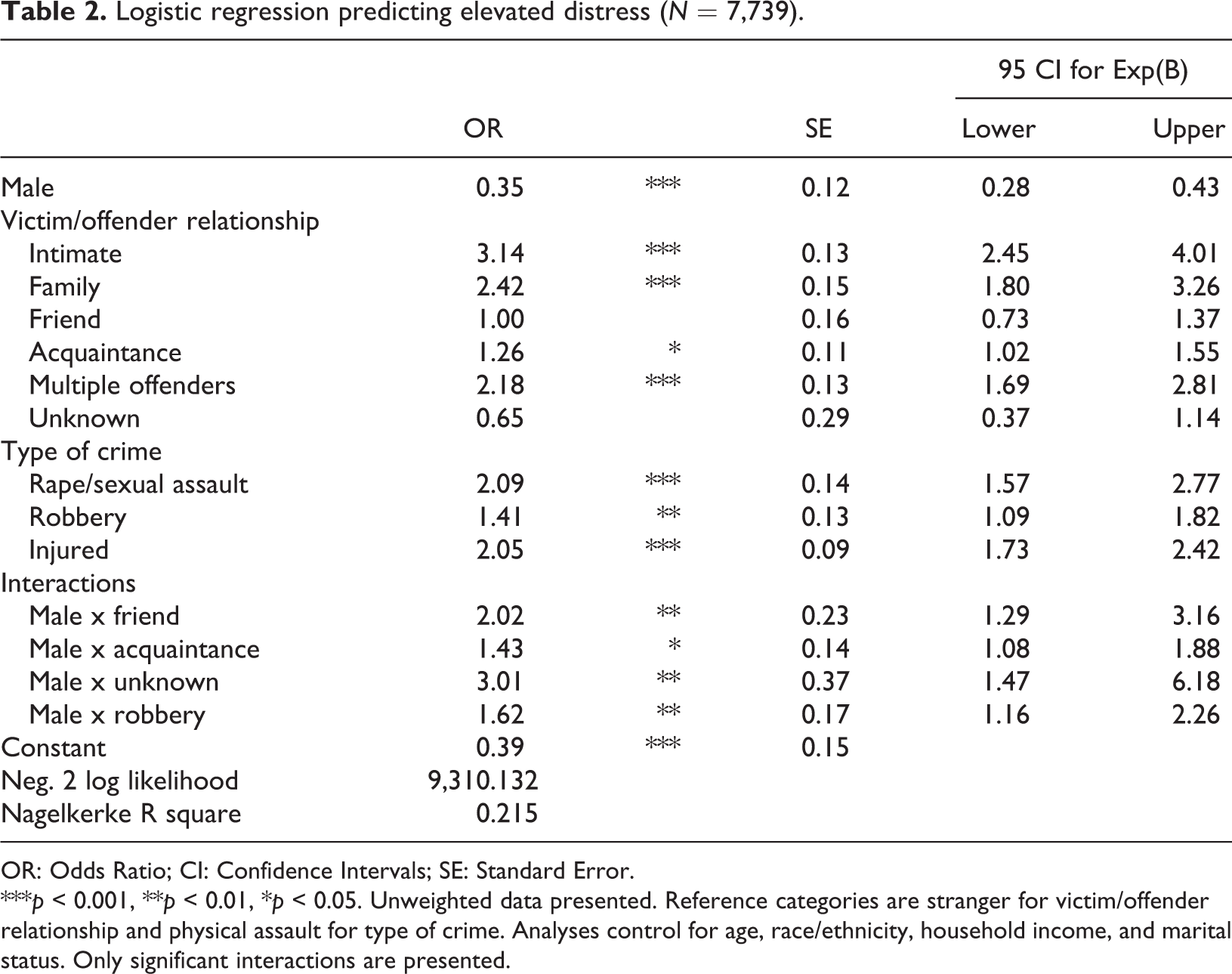
OR: Odds Ratio; CI: Confidence Intervals; SE: Standard Error.
***p < 0.001, **p < 0.01, *p < 0.05. Unweighted data presented. Reference categories are stranger for victim/offender relationship and physical assault for type of crime. Analyses control for age, race/ethnicity, household income, and marital status. Only significant interactions are presented.
Sex differences in physical and emotional help-seeking behaviors
Victims who reported elevated distress (moderate or severe) were asked further questions about physical and mental health problems resulting from their victimization. Among those with elevated distress (n = 4,209), most victims reported at least one mental health problem and about half noted a physical problem. Only victims who reported a specific mental health or physical health problem were asked if they sought help. Victims who were asked about help-seeking but did not provide a valid answer for any problem were excluded (eight victims for emotional problem help-seeking; three for physical problem help-seeking). For victims who had at least one valid answer but fewer than eight invalid answers, these invalid answers were coded as 0 for those questions.
Among the 3835 victims who reported an emotional issue related to their victimization (1,425 males and 2,410 females), 21.6% sought professional help for those problems. Females were significantly more likely to seek help (25.9%) compared with males (14.2%). The most common emotional problems victims reported included anger (79.0%), anxiety (77.3%) and feeling unsafe (72.5%). Only feelings of anger were not significantly different for males and females (p > 0.05).
Fewer victims reported physical problems than emotional problems (n = 2,539; 824 males and 1,715 females). About one in five victims who had a physical problem sought help. Males (17.0%) were significantly less likely to seek help compared with females (22.8%, p < 0.001). The most frequently reported problems included having trouble sleeping (76.0%), fatigue (56.8%), muscle aches (51.8%), and stomach aches (51.6%). All of these were reported more frequently among females (p < 0.01).
Multivariate logistic regression analyses examined predictors of seeking help for emotional problems (Table 3). Although males were less likely than females to seek help, there were no significant interactions between sex and the key independent variables. Closer relational distance to the offender, victim injury, and rape/sexual assault predicted help-seeking for emotional problems. Feeling depressed and anxious were the problems more likely to lead to help-seeking. Sex remained significant when controlling for demographic, incident and health characteristics (p < 0.01).
Logistic regression for emotional problem help-seeking (N = 3,835).

OR: Odds Ratio; CI: Confidence Intervals; SE: Standard Error.
***p < 0.001, **p < 0.01, *p < 0.05. Unweighted analyses presented. Reference categories are stranger for victim/offender relationship and physical assault for type of crime. Analysis control for age, race/ethnicity, household income and marital status.
Analyses of help-seeking for physical problems indicated that significant sex differences disappeared with interactions for victim–offender relationship and type of problem (Table 4). Rape or sexual assault crimes were more likely to lead to help-seeking relative to physical assault (p < 0.05). The type of problem experienced was also significant. In particular the odds of help-seeking were significantly increased for ‘other’ physical problems, Exp(B) = 3.54; p < 0.001. Interactions with sex indicated that these ‘other’ problems were particularly relevant for female victims.
Logistic regression for physical problem help-seeking (N = 2,549).
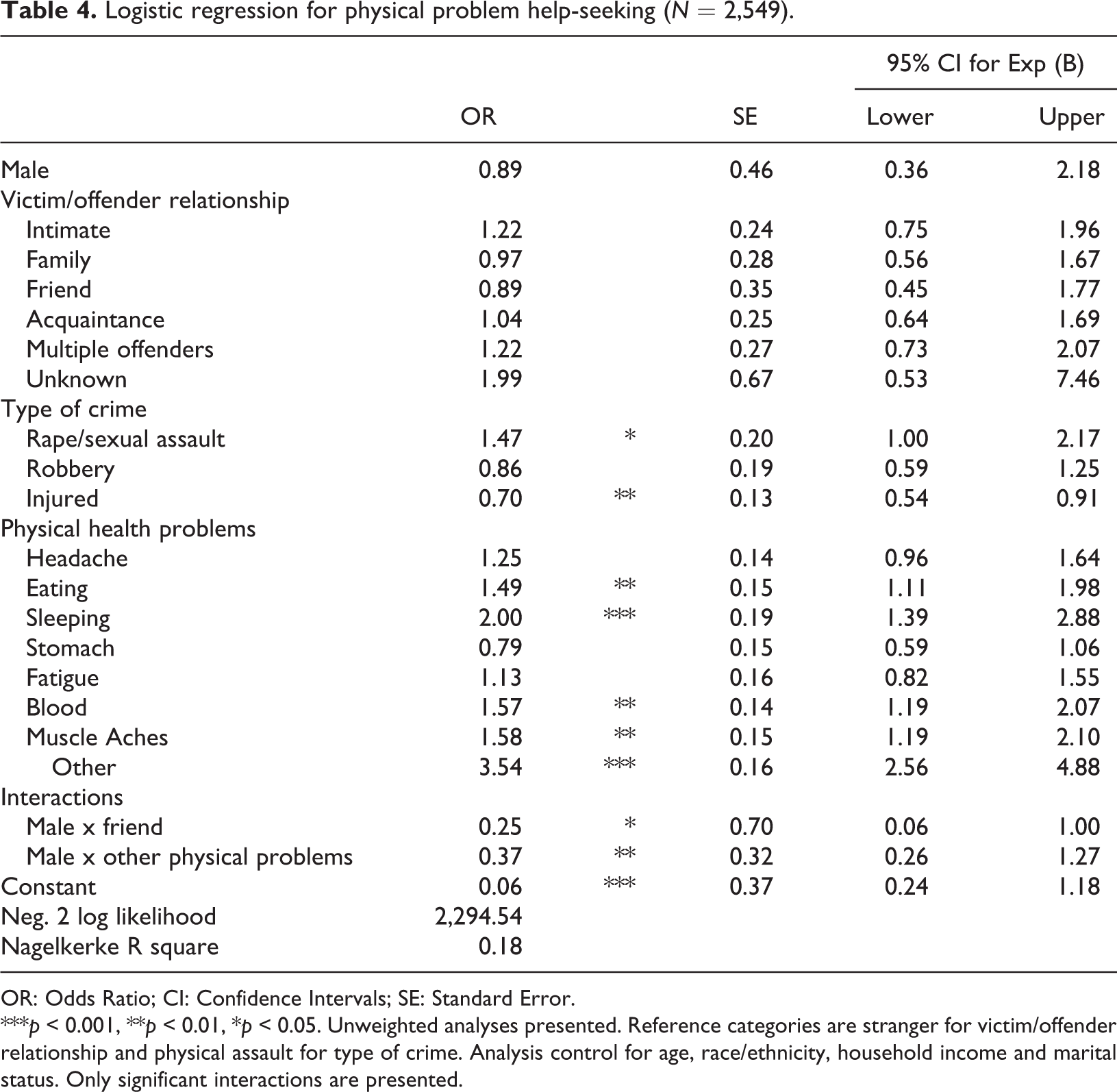
OR: Odds Ratio; CI: Confidence Intervals; SE: Standard Error.
***p < 0.001, **p < 0.01, *p < 0.05. Unweighted analyses presented. Reference categories are stranger for victim/offender relationship and physical assault for type of crime. Analysis control for age, race/ethnicity, household income and marital status. Only significant interactions are presented.
Discussion
Although a great deal of research has examined the consequences of victimization, the majority of this work has focused exclusively on females. Therefore, the purpose of this study was to examine sex differences in feelings of distress and help-seeking outcomes. We were interested in whether these sex differences could be explained by characteristics of the incident—type of crime, victim injury, and victim–offender relationship—or by sex alone. If sex remained significant, we theorized that differences in the consequences of victimization are attributed to gendered social norms.
Consistent with prior work (Courtenay, 2000; Hunt et al., 2011; Kaukinen, 2004), bivariate analyses indicated that males reported lower levels of distress and were less likely to seek help relative to females as a result of being a victim of crime. Analyses then examined whether these differences in experiencing distress and seeking help could be explained by the victim–offender relationship, type of crime, and injury and if sex remained as a significant predictor of elevated distress and help-seeking behavior. The results indicated that incident characteristics were influential in all models, supporting the incident characteristic perspective. Multivariate analyses indicated that victimizations perpetrated by an intimate partner or family member, crimes of sexual assault and incidents resulting in injury elevated feelings of distress and the likelihood of help-seeking. These factors had a similar effect for both males and females. These findings may help explain why males overall report lower distress and seek help less often than females. Females are more likely than males to experience intimate partner violence and sexual assault, while males are more likely to initiate intimate partner violence (Hamberger, 2005).
However, sex remained significant even after interactions were added, for all analyses except for physical problem help-seeking. For both elevated distress and help-seeking for emotional problems, sex remained significant, suggesting that other factors, such as socially constructed gender norms, may be impacting the disclosure of distress and reluctance to seek help (Courtenay, 2000; Good et al., 1989; Sullivan, Camic and Brown, 2015). This may indicate that it may be counter to hegemonic masculinity to disclose feelings of distress or seek help for emotional problems (Brooks, 1998; Good et al., 1989; Pollack and Levant, 1998; Sullivan et al., 2015) but not to acknowledge physical pain. However, the health literature indicates that admitting trouble with both emotional and physical problems is impacted by gendered notions of masculinity (Courtenay, 2000; Evans and Wallace, 2008; Inckle, 2014).
Although incident characteristics had similar effects for males and females, overall, some factors did influence males and females differently. These results further support the ‘gender norms’ perspective that even when the incident is similar, males and females may experience and interpret it in different ways. In terms of variables with different effects for males and females, victimization by friends and acquaintances and robbery victimization were significant when interacted with sex, suggesting that these factors may be more important to males than females in increasing their distress. Another observed difference through interactions included sex and ‘other physical problems’ for help-seeking. The analyses indicated that females reported ‘other’ physical problems and that this was influential in help-seeking. Due to the nature of the questions, it was unclear what physical problems females might be experiencing that were not included in the available choices.
Directions for future research
While this study was comprehensive in its analysis of sex differences in distress and help-seeking behavior, there were limitations to the research. The study was only able to utilize cross-sectional data from 2008–2014 as the NCVS began collecting information on help-seeking and distress levels in 2008. Cases in the analyses were also limited because help-seeking questions were only asked of victims with moderate or severe distress who reported at least one emotional or physical health problem. It is possible that even low levels of distress may be related to specific health problems. Further, the study examined if sex remains a significant predictor controlling for incident characteristics as an indicator of gendered notions of masculinity. Due to the nature of the data, the study was limited in measuring this concept directly.
Despite these limitations, this study lends itself to multiple directions for future research. Results indicated that females report more elevated levels of distress as a result of being a victim of a violent crime. However, more research is needed to determine whether or not males are actually experiencing less distress than females or if males are simply underreporting distress. Furthermore, it is important to understand the salience of socially constructed gender norms in reporting distress and propensity to seek help. Lastly, an analysis of distress and help-seeking is needed using an intersectionality framework (Collins, 2008; Crenshaw, 1991). More specifically, future research should explore how variables such as race, class, and gender may interact and more explicitly explain patterns of distress and help-seeking behaviors (Like-Haislip and Warren, 2011).
Considerations for policy and practice
This analyses of sex differences and help-seeking behavior has important implications for criminal justice practitioners and victim service providers. This study highlights that while, on the surface, the factors that influence both male and female help-seeking behaviors are similar, there are differences that demand policy and practitioner attention. In this study, the type of crime experienced and the victim–offender relationship warrant such increased attention. The victim–offender relationship is important given the results, which highlight that victimization by friends and acquaintances may play a more significant role in males compared with females in increasing distress.
Outreach services in the community, particularly in unconventional settings such as the workplace or through peer support networks, should be implemented to better understand and serve male victims. These less overt avenues for outreach, such as the peer support network or the incorporation of a victim service area in non-traditional spaces such as the workplace, may be a more efficient way of reaching those who either do not want to be perceived or identify as victims.
Service providers should also be aware of the different ways of asking questions related to victimization. In a recent study focused on the service needs of young male victims who were of color, when asked if they had been victimized, most respondents reported not being victimized. However, when they were asked more specific questions such as if they had been robbed, the answers changed drastically (Sered, 2014). Overall, the ability to reach such an underserved population is important, given that that male victims of robbery or those victimized by friends or acquaintances are more likely to experience elevated levels of distress. It is important that service providers are aware of the differences between males and females in experiencing distress by type of crime and victim–offender relationship in order to best address the underlying needs of the population.
Efforts by criminal justice practitioners should reconsider how law enforcement may be best able to recognize victims of robbery and should understand law enforcement’s instrumental role in pointing victims to the most appropriate resources. While the percentage of crime victims who seek help from victims services remains extremely low, reporting to police greatly increases the likelihood of accessing victims services (Zaykowski, 2014). Overall, it will be important to determine how law enforcement, criminal justice practitioners, and health service providers can most efficiently work together to best target underserved victims of violent crime.