




Abstract
This paper describes collaborative research with Wiwa and Arhuaco women concerning local reparations with an intersectional perspective on the Colombian post-conflict agreement. Our central argument is that indigenous women’s processes, experiences, and expectations of reparation reflect a wish to engage in a dialogue with the Special Jurisdiction for Peace (JEP) through its Works, Projects or Activities (TOAR) so that their perspectives on and complex conceptions of harm and reparation, as well as their relationship with social orders, bodies, and territory, can be recognized and considered in managing the risks of the revitalization of patriarchy during the post-accord period.
Introduction
The armed conflict in the Sierra Nevada de Santa Marta (SNSM) has generated multiple types of impact on the rights of Wiwa and Arhuaca indigenous women. These women have been highly affected at the individual and collective levels in terms of their rights as women, spiritual healing processes, sacred sites, rituals, and cultural rights. The communitarian, familial, personal, and territorial orders have likewise been affected. In these two cultures, there is a particular relationship between women and territory. They constitute the symbolic and material representation of Mother Earth, generating a two-way causal effect. Therefore, it is crucial to name and make visible the multiplicity of damages and harms from their perspective, thus deepening the notion of territory as ‘a subject of rights and as a victim of human rights’. We thereby seek to contribute to the maximization and recognition of the transformative potential of the reparation programs of the Special Jurisdiction for Peace (JEP) 1 and the expectations of victims in the Works, Projects or Activities (TOAR) 2 with respect to their reparative or restorative content. TOAR are practical tools for parties to contribute to reparation, guaranteeing that it is a restorative process.
These projects should consult with indigenous women to integrate their expectations for reparations. Doing so is the only way to recognize the profound consequences of the harms suffered by SNSM’s women and their territories during the armed Colombian conflict and the post-conflict era. Our central argument is that indigenous women’s processes, experiences, and expectations of reparation show a wish to engage in a dialogue with the JEP through TOAR so that their perspectives on and complex conceptions of harm and reparation as well as their relationship with social orders, bodies, and territory can be recognized and considered in managing the risks of the revitalization of patriarchy during the post-accord period.
Review of the literature
Kimberly Theidon (2004, 2006) is a scholar working on violence and reproductive justice for indigenous women in the context of armed conflict and post-conflict circumstances in the Andean region. She affirms that Colombia is one of the few countries to recognize indigenous women and children born of sexual violence (SV) as victims and as subjects for reparations. 3 However, such children are given to relatives or close friends despite legislative advances, while others are reared in indigenous communities as metaphors for the unwanted: as bad omens and objects of mockery, gossip, and rejection. Therefore, she posits ‘situated biologies’ embodied in the survivors and their children as a fundamental research concept (Theidon, 2004, 2006). She introduces several tensions and dilemmas apropos the need to explore the characteristics of such violence. She probes the primary and secondary damages associated with losses incurred from the forced disappearance of family members, nudity, prostitution, slavery, abortions, and forced unions related to conflict. She also proposes intercultural methodologies from a gender-sensitive perspective. Furthermore, she accords space to collective interviews and focus groups, incorporating cultural and spiritual dimensions.
Similarly, Theidon (2006) highlights the need to focus on women’s narratives, both in terms of their experience of victimization and in terms of the diverse processes of resistance they developed as this violence was perpetrated. Likewise, she emphasizes specific patterns of SV, such as mass rape by the military, its ritual aspects, the technologies of horror, and the shared guilt that seals a lethal fraternity. Theidon also indicates that Quechua-speaking women in Ayacucho who were survivors of SV rarely explicitly mention their ordeals. Conversely, she heard accounts during her data collection that emphasized expressions like ‘I don’t want anyone to hear us talking about this’ or ‘That man did what he did to me, he abused me’, and community accounts that spoke of the women survivors as ‘they got pregnant’. Encountering silences in the lives of indigenous communities that can sometimes be protective and must be respected is evidence of the feminist dilemma of ‘breaking the silence’ in order to confront SV. These silences sometimes allow the lives of children and survivors to be anchored in hope and the possibility of resuming daily lifestyles.
In the same way, Lykes and Crosby (2014) affirm the tension between individual and collective rights in the reparations of indigenous women and racialized gendered violence in Guatemala. Many psychological theories on the effects of war and state violence locate the problem in individual post-traumatic disorder (Lykes and Mersky, 2006). Lykes and Crosby affirm that reparations’ human rights regimes can often in fact reinforce and contribute to this suffering, pathologizing trauma as an individual and not a social phenomenon embodied in a particular way by each of those marked by it (Martín-Baró, 1994). In the same way, Das et al. (2000) argue that the responses ‘often transform the local idioma of victims into universal professional languages of complaint and restitution—thereby remak[ing] both representations and experiences of suffering being inattentive to how the transformations they induce contribute to the suffering they seek to remedy’.
Feminist participatory action researchers (PARers) have critiqued psychologists’ tendencies to speak over participants’ voices (Boyer and Fine, 1992), to focus exclusively on their experiences of damage rather than on their resistance and resilience, and to reduce complex and intersectional circulations of power that rupture community to intra-individual symptoms and systems as well as circuits of dispossession (Lykes and Mersky, 2006). Feminist PARers instead listen to the experiences of participants, their families, and communities at the intersections of gendered, racialized, classed, and heterosexist violations and facilitate processes through which they can together document those experiences, analyze their root causes, and generate collaborative actions to redress harm and create change (Lykes and Crosby, 2014).
The concept of High Risk Feminism, developed by Julia Zulver in research based in Colombia and El Salvador, provides insight about how to move away from the gendered essentialism that relegates women to the instrumentalizing role of peacebuilders. She proposes a nuanced reading of women as survivors, activists, and fighters in contexts of high risk and of their contributions to transitional justice (TJ). In the same way, she invites us to understand women’s mobilization in terms of the ‘gender of violent pluralism’ (Zulver, 2019: 22). We point to Zulver’s (2019) suggestion to study women’s agency in conflict situations with attention to the intersectional complexity of agency, especially to ‘women as actors for peace’ (p. 23). In this sense, Berry (2017) and Berry and Rana (2019) focus on Bosnia, Rwanda, and Nepal to identify five barriers that prevent women from feeling at peace in their daily lives: spatial dislocation, temporal dislocation, hierarchies of victimhood, competing truths, and economic insecurity. They conclude with pioneering innovations in peacebuilding by outlining ways that women in these countries work to overcome those obstacles. Their work in Rwanda and Bosnia demonstrates how post-conflict institutions have created hierarchies of victimhood that facilitate social divisions and fracture women’s political organizations, and that revitalize patriarchy.
Traditional TJ and peacebuilding narratives have also been critiqued for inadequately incorporating local needs and priorities of women or for categorizing them as victims or peacemakers. Martin (2021) and Björkdahl and Selimovic (2015) introduce in this sense a new critical feminist literature of peacebuilding and TJ, one that prioritizes local approaches and gendered experiences. The authors insist on diverse, creative, and transformative agential modalities to negotiate patriarchal, post-conflict structures and to counter the notion that women are passive actors.
The work of Yoshida and Céspedes-Báez (2021) focuses on the situation in Colombia as an example of taking account of the lessons of environmental peacebuilding studies and of including the environment as part of the women, peace and security agendas. The authors emphasize how SV in conflict eclipses the ecological and environmental violence and harms that impact women’s livelihoods. This omission ignores the fact that the environment has for many women, including indigenous women, an important spiritual relationship and it continues placing women exclusively in the category of vulnerable, that is, requiring protection, rather than as peacebuilders and agents of transformation. The authors affirm that the Katsa Su (large territory) judgment of JEP case 02 4 is a significant jurisprudential step for alternative conceptions of reparations. This case opened up an opportunity to adjudicate on the harms inflicted on the environment and their connection to women’s experiences in conflict, considering ‘the territory as inseparable, and interconnected and interdependent with the Awa people, emphasizing the differential and disproportionate impact of the conflict on indigenous girls and women’ (Auto SRVBIT-079, 2019; JEP 02 case, 2018; Yoshida and Céspedes-Báez, 2021).
Theoretical framework
Content and scope of the right to reparation
International human rights law increasingly recognizes the right to reparation for victims of internationally wrongful acts. However, it has been a challenge to delimit the content of this right. Even so, since 1989 the United Nations Commission on Human Rights and its Sub-Commission on the Promotion and Protection of Human Rights have been debating the Basic Principles and Guidelines on the Right of Victims to Reparations, which were approved in April 2005 (Van Boven, 2009). Mainly, this gave recognition to mechanisms, modalities, procedures, and methods so that, from existing legal obligations, the duty to make reparations by the states could be obtained. They refer to restitution, compensation, rehabilitation, and guarantees of non-repetition as forms of reparation for victims.
These advances are important; however, it has been questioned whether the content of the right to reparation is clear, precisely because it goes beyond the legal sphere and increasingly enters into dialogue with political and social concepts and theories (Rubio-Marín, 2006). In turn, Rubio raises some problems with supporting a notion of reparation that focuses mostly on individual types of reparation aimed at full restitution or compensation to address massive and gross violations of human rights because there reparation should not be merely a means to provide an individual remedy. The author proposes reparation as a creative and rights-affirmative act (Rubio-Marín, 2006). Conceived in this way, instead of seeking to address all the consequences of the violation of a person’s rights and trying to return him or her to the status quo, reparations become measures that promote a minimum degree of both interpersonal and institutional trust. In other words, Rubio proposes that the potential of reparations lies in their contribution to building a democratic state.
Thus, reparations contribute to the construction of a new order, which is why they become an opportunity to transform structural inequalities and, specifically, systematic discrimination against women. It is thus also important to analyze reparations from a gender perspective since it is a useful critical category of historical analysis that takes into account the experiences, experiences, and thoughts of women, which can rethink and transform history (Scott, 2017) and the new order. This category contributes to the definitions of damages, types of violations of rights ought to be prioritized, who should be included in the circle of beneficiaries . . . what types of benefits would be best suited to both recognize and assist victims around which reparation programs, reparation measures, and the policy are articulated. (Rubio-Marín, 2006: 74)
This is a challenge because the answers to what, why, and how reparations should correspond to different women and groups of women, such as those who belong to indigenous peoples, and the challenge is greater when we talk about indigenous women. The answers depend on various factors, such as types of conflict, needs, experiences, the specific forms of violence, and the cultural contextual meanings of damages and losses (Rubio-Marín, 2006). Hence, it is important to take into account the agencies and interpretations that indigenous women make about their own losses, affectations, and damages, and therefore the ways of repairing them.
In the Colombian case, with the Peace Accords, a gender and ethnicity agenda has been introduced, which shows progress in the construction of this peace process and in the construction of the legal–political order through reparations. However, the question of how to develop and apply them places us in the challenge of understanding the epistemology of what reparations imply for women and, of course, for indigenous women.
Restorative justice and TOAR
According to JEP’s methodological guidelines, restorative justice is part of the essential core of the institution, in a transversal way to the Final Agreement (JEP, 2020a). Thus, it manages conflicts through the participation of protagonists in the judicial process, establishing itself as a proposal of justice that guarantees the rights and satisfaction of the needs of the victims. The TOAR allows for a dialogical contribution by the parties to the judicial process and for reparation, transcending the relationship of proportionality between harm and punishment, and understanding reparation as a form of justice. This contributes to the reconstruction of communitarian social ties that were affected by different actors, with public policies and in harmony with the traditions of indigenous peoples.
An intersectional perspective on TOAR has not yet occurred from the perspective of indigenous women. According to the Constitutional Court, the JEP will not order monetary compensation for victims. Likewise, it will not replace the functions of the Land Restitution Unit or the Victims’ Unit, nor the collective reparation processes (Corte Constitucional, 2018: C-080 Constitutional Court).
TOAR constitutes an element of anticipated compliance with sanctions that may occur at different procedural moments. Thus, TOAR constitutes one of the obligations for parties before the Integral System. These parties propose the reparation projects. However, few ethnic TOAR have been developed and implemented. There is, however, a catalog proposed in the Final Agreement and there are some concrete proposals from appellants (Cubillos Lima, 2021). We would like to emphasize that TOAR must guarantee the effective participation of the victims and attend to the effects they have caused, contributing to the reconstruction of social ties and to overcoming the conflict. The findings presented in the following section seek to qualify the evaluation of its reparative–restorative components via consultation with indigenous women.
Reparation from the perspective of indigenous women: harmonization and body–territory
It is crucial to think of a transformative and restorative justice from the perspective of indigenous women. McEvoy and McGregor (2008) present and define the currents of study of TJ through multiple positions, encounters, and trajectories. In this way, they situate these currents as a set of legal–political and socioeconomic strategies that generate post-conflict reconstruction processes. However, TJ must transcend these two dimensions when dealing with indigenous women. The authors warn that it is necessary to go beyond state-centered and Eurocentric conceptions of harm, generating multiple, open, and interrelated reparations. Transformative reparations with indigenous women begin with changes in institutional paradigms, the rehabilitation of their own methodologies, and their state recognition (McEvoy and McGregor, 2008).
Carianil et al. (2020) examine how the body and its relationships are one way to recognize the positions, processes, and methodologies of indigenous women in the framework of a comprehensive reparation from the perspective of their thoughts and lives. The document introduces relevant and necessary concepts to initiate reparation processes with indigenous women. The first concept is harmonization, which affirms that spirituality is a fundamental basis for the thoughts and lives of indigenous peoples. According to the authors, harmonization is a spiritual process that indigenous peoples use to balance the space and generate an environment of healing, repair, and good living. They propose that this concept should be integrated in cases of violence reparation. It is about ‘healing-repairing those pains and evils that disturb precisely that harmony of the individual, the family and the community’ to achieve a consistent, integral, inclusive, and respectful repair (Carianil et al., 2020: 5) with their ways of conceiving their life and social order.
The second concept introduced by the authors is that of the body, which is closely linked to that of territory. As Sefair (in press) states, the body–territory relationship in indigenous women does not constitute a discourse or metaphor. It is a ‘physical/material and spiritual relationship that links one body (the feminine) with another (the territory), for the understanding of leadership and violence’. When an indigenous woman is violated, Mother Earth is affected and violated as well. The author affirms that the body is her only present and possible material reality, whence she exercises the power to regenerate energies, to give life, and to be a cycle. This is a central and long-standing theme: ‘the struggle for the life of indigenous women, a life free of violence is also the struggle and defense and reparation of the land. The two territories are life itself’ (Sefair, in press).
Talking about the effects of the armed conflict on indigenous women and the violence they suffer requires consideration of their spiritual principles in order to achieve comprehensive ethnic and gender reparations. Miriam Liz Andela (2020), a Nasa indigenous woman, affirms that the corporeality of indigenous women must be understood from an integral and extended perspective, starting simultaneously from the territorial and individual rights of women. This approach has been denominated ‘the territory, the family and the woman’ and goes beyond the individual, without disaggregating the territorial and the corporal (Andela, 2020: 9). Indigenous women are representatives of Mother Earth and have bodily characteristics and life cycles associated with the dynamics of the territory. For example, their reproductive organs represent water sources and vice versa (Carianil et al., 2020). The violence generated in the territory cannot be disaggregated from the rights of indigenous women, as it would ignore a vital ontological relationship in terms of reparation.
This type of reparation transcends existing institutional guidelines since it is necessary to have measures that harmonize the territory and the body after bloodshed and other violence suffered. Harmonization encompasses everything: thoughts, weaving, daily actions in the chagra (orchard), the maloka, the hearth and the kitchen, everything is guided by the power of the word in the feminine, in the collective and the circle, in the sacred places (Carianil et al., 2020). Ana Manuela Ochoa, Kankuama indigenous magistrate of the JEP, in terms of a possible case of indigenous women mentions that the action must go beyond the territory. It is about making them owners of the territory, allowing them to continue to perish and to speak their language. Many petitions focus on historical claims of structural inequalities, so it is necessary to allow a movement of agency forces generated by women to emerge from their places of enunciation (Carianil et al., 2020). Therefore, the institution must reorient the restorative forms, actions, and parameters in dialogue with the ontological perspectives of indigenous women. Ochoa (2020) agrees with the importance of collaborative work between institutions and women: ‘more than subjective reparations and compensation, they seek to be free as women’ (p. 7). For example, women in the framework of the JEP ask for houses or healing spaces where they can meet and talk about what happened to them, spaces where they can do rituals, sit, and weave together (Carianil et al., 2020: 10).
Reparative action with an ethnic and gender approach thus implies understanding the meaning of ‘body-territory’ and ‘healing spaces’ or harmonization, transcending subjective reparation and proposing dynamics of being, living, and feeling what it means to be an indigenous woman that allow them to transform and vindicate their rights. These spaces allow them to meet and return to the harmony of their bodies as the first territory and the community as the second territory, strengthening and vindicating their leadership processes.
Indigenous ontology and territory as victim
Izquierdo and Viaene (2018) introduce elements of the ontological conflict between indigenous and non-indigenous visions of harm and reparation in Colombia and Guatemala. From the perspective of indigenous ontologies, Mother Earth, rivers, and stones are victims and subjects of reparations. For Izquierdo and Viaene, this legal figure of territory and life of the river and forests should be protected by the right to life recognized by the Universal Convention on Human Rights. Colombian courts have recognized the Atrato River and the Amazon forests as ‘legal subjects of reparation and protection’. The concept, ‘territory as victim’, has been incorporated in articles 3, 8, 29, and 45 of the Indigenous Peoples Victims Law 4633/2011. Article 3 reads, ‘this law is a political triumph for indigenous peoples’ organizations’, which affirms that they have ‘special and collective links’ with ‘Mother Earth’ and have, according to article 29, the right to ‘harmonious coexistence in the territories’. Article 45 recognizes the territory as a ‘living integrity and sustenance of identity and harmony’ that ‘suffers damage when it is violated or desecrated by the internal armed conflict’. Spiritual healing is part of the integral reparation of the territory, according to article 8 (Decreto Ley de Víctimas No. 4633, 2011). In other words, this recognition means more rights to territory than rights to land. Among the jurisprudential precedents, the Bajo Atrato case (Corte Constitucional, 2016) recognized both the physical and spiritual affectation of indigenous communities by the paramilitary presence in their territories. This concept was also adopted by the civil chamber specializing in land restitution in ruling 007 of 2014, which recognized the Embera Katío indigenous reservation of Alto Andágueda as a subject of special constitutional protection and holder of fundamental rights due to the affectations of the armed groups in the territory. These recognitions were made ‘in consideration of the affectations caused by the armed conflict in a serious, systematic, disproportionate, differentiated and direct manner’, inasmuch as the territory ‘has an identity and dignity that constitutes it as a subject of rights’ (Jurisdicción Especial para la Paz (JEP), 2020b).
The Special Peace Jurisdiction (SJP, 2018), in case 002, has interpreted national norms with the system of norms and cosmo-visions of indigenous peoples, which has allowed the territory to be accredited as a victim since the conflict is not limited to the damage caused to human beings, but its consequences are also inscribed in the eyes of the beings that inhabit their territories and the natural environment itself, and therefore, as their territory is representative and the ownership falls on each people.
Ecofeminism: gender, environment, and ethnicity
Ecofeminism studies are helpful for understanding ‘female bodies-territories’ as related to extractivism and armed conflict. It emphasizes the connection between the exploitation of nature and the oppression of women (Mellor, 2000). Vandana Shiva (2006) makes visible the reality of deprivation suffered by women due to neocolonial economic development projects, which allows the destruction of women, nature, and oppressed cultures. Ecofeminists assert that an alternative globalization based on nonviolence, community autonomy, and the revalorization of women’s knowledge and cultural heritage is urgently needed.
In this sense, the feminine ecology of knowledge, led by Teresa Cunha and inspired by the ecology of knowledge proposed by De Sousa Santos, is crucial. This perspective allows us to approach the knowledge available in the ‘Global South’ to ensure true social justice. These theoretical visions advocate for a justice from the perspective of human and environmental rights and expose how fragile are the schemes dominated by oppressive systems of ‘Western modernity’ founded on capitalism, colonialism, heteropatriarchy, androcentrism, and anthropocentrism (Cunha and Casimiro, 2019) and which affect the struggles and claims of indigenous women’s rights and their relationship with the environment, thus impacting their feminine ontology.
This project seeks to combat oppressive forces of masculine modernity as well as the exacerbated consumerism of industrialized societies that has generated the destruction of ecosystems, the impoverishment and exploitation of the population of the South, especially women, as well as the disappearance of native peoples (Cunha and Casimiro, 2019). In the Colombian case, these extractivist dynamics increased in the context of the armed conflict, affecting the land struggles of peasant and indigenous women. Thus, gender constitutes one of the central factors for understanding these territorial conflicts and proposes solutions that can be materialized through transformative reparation measures in which the agencies of indigenous women are relevant. The authors place the transformative dimension of the defense of territory as victim at the center of the debate, from a decolonial and gender perspective, in order to question the anthropocentric conception of the right to reparation and broaden the spectrum of possibilities for the reparation of indigenous women and Mother Earth.
Research questions and section structure
The following research questions guide this section: in methodological terms, what does the recognition of ancestral territory as a victim and reparation of harms against Wiwa and Arhuaco women imply? What type of activities, projects, and works with reparative content could be articulated in the TOAR with the methodologies and expectations of Arhuaco and Wiwa women, and with the territory as a victim? To answer them, we first introduce the multiple and interconnected affectations between social order, body, and territory for Wiwa and Arhuaco women (Pastor and Santamaria, 2020) and ‘the vital order of Mother Earth’ (Restrepo, in press). These concepts will allow the JEP to understand the relationship between the different individual, interpersonal, collective, anthropocentric, and biocentric dimensions of reparation. Second, we are interested in identifying some of the harms highlighted by participants in our program. Finally, we will shine a light on some elements of reparation in a comparative analysis of the two cases, presenting a possible articulation of and some recommendations for the legal definition of the TOAR.
Context
Violence in the SNSM
The SNSM is the highest coastal mountain system on the planet, isolated from the Andes in northeastern Colombia, and shared by 45,000 people from the Arhuaco, Kogi, Kankuamo, and Wiwa peoples. The Constitutional Court, in its ruling 004 of 2009, declared that the Wiwa and Arhuaco belong to the 35 peoples at risk of being physically and culturally exterminated by armed conflict. According to Acevedo (2013), the SNSM has become a buffer zone and natural corridor between the Caribbean coast and the northeast of the country for various armed groups (FARC, ELN, AUC, and military and police forces).
According to the National Center for Historical Memory (Centro Nacional de Memoria Histórica (CNMH), 2016: 34), the 19th Front was divided into two fronts, the 19th and the 41th or Cacique Upar, which shared territory with the Ejército de Liberación Nacional (National Liberation Army, or ELN) in the Perija, near the border with Venezuela, in 1988. Thus, FARC had been present in the region for almost 40 years (Saab and Taylor, 2009). In the same year, Carlos and Vicente Castaño led 25 members of the AUC into the Sierra to combat the escalation of kidnappings and extortion by the ELN against the nascent mining industry (Löfving, 2004; Ronderos, 2016; Weber, 2016). The ELN’s 6th of December and José Manuel Martínez Quiroz Fronts had been present in the region since 1987. In about a decade, the AUC had become an army of 3,000 called the Northern Bloc that was led by Jorge 40 and José 39 and supported directly or indirectly by local politicians, cattle ranchers, farmers, businessmen, and traders (CNMH, 2016; Tate, 2011: 13). Its arrival in the region was marked by terror strategies such as kidnappings of guerrilla families, massacres, and forced displacement, leaving more than 72,000 victims in the department. In 2003, under Uribe’s policy of democratic security, the Patriot Plan for recovering territories under FARC’s control that were minutes from Jimaín involved the government’s Popa and High Mountain Battalions (Henderson, 2011).
Thus, Wiwa and Arhuaca women have been affected by forced displacement, widowhood, and the loss and recruitment of their sons, fathers, and brothers. Between 1996 and 2016, 65.5% of all cases of forced displacement in the SNSM were indigenous persons (Garavito Rivera, 2017). Constitutional Court Order 092/2008 highlights the following as the main practices of physical and cultural extermination against women in the SNSM: SV, exploitation of domestic work, conditions of vulnerability due to their membership in indigenous organizations, and discrimination. Since 2016, with the signing of the Peace Accords, paramilitary strongholds such as the Autodefensas Gaitanitas de Colombia and the Giraldo Clan, members of the ELN, and other illegal groups has been continuing to dispute the territory of the Wiwa and Arhuaco peoples (Rettberg et al., 2020).
Harms to Wiwa women
Due to the constant confrontations between the AUC and the army, the Wiwa Yugumaiun Bunkuanarrua Tayrona Organization (OWYBT) states that in 2008, 517 families led by widows were displaced to cities like Valledupar and Riohacha or to municipalities like San Juan del Cesar (OWYBT, 2015). Later, the Wiwa territory was occupied by settlers, producing a double victimization: displacement and territorial dispossession (Ministerio de Cultura, 2010). In 2015, following reports of alleged collaboration with the various armed actors, 800 Wiwa people (mostly children and women) were displaced, due to threats, indiscriminate shooting from a helicopter, and the massacre of 50 indigenous male leaders. There were also reports of illicit coca crops, the fumigation and bombing of which affected endemic plants, animals, and people.
We observed the effects of this particularly in the community of La Laguna during the presentation of the social cartography of five young women, who spoke in tears of the particular damage to women in their community as follows: Here where we are gathered, the national army bombed us on 19 April 2003 and destroyed the town, because very close by there were several FARC camps and they were also in combat with the AUC. We had to flee, they destroyed our houses, our crops . . . we had to leave everything behind. (La Laguna, February 2022, conversation with Liliana)
As Liliana affirms, this event was the beginning of crude combat between the army, FARC, and the AUC; the creation of the Wayuu Counterinsurgency Front of the Northern Bloc of the AUC; and attacks against Wiwa women attributed to both the army and AUC, such as the massacre of El Limón (September 2002), Potrerito (December 2002), La Laguna (April 2003), and Marokazo (May 2003). All of this generated a humanitarian crisis of such magnitude that in 2005 the Inter-American Commission on Human Rights issued precautionary measures in favor of the Wiwa people.
In the words of the Sagas (female spiritual authorities), Many of the indigenous women who live in the lower part of the Sierra were and continue to be affected by armed violence. Many children were left fatherless and many households headed by widowed women had to cope with raising six and seven children per family. In addition, many women were raped, and many children were born from these rapes. (Santamaria, 2019: fieldwork notes)
The armed conflict and violence against the territory also meant that feminine sacred sites, (ezwamas) aimed at the harmonization of sexuality, were affected, making the spiritual consultation with Mother Earth fragile and profoundly impacting spiritual security and the balance between the divinities and human beings (Escuela Intercultural de Diplomacia Indígena (EIDI), 2020). One of the iconic cases of violence against both territory and women’s bodies occurred on 7 November 2009. A 13-year-old Wiwa girl was sexually abused by a soldier of the Santa Barbara Battalion Army (X Brigade) during their military occupation on La Peña de Los Indios and the Cerro del Oso. The survivor has been designated a Saga by her community.
The Wiwa Ethnic Safeguard Plan describes in 2015 the main problems as profound violations of Wiwa territorial rights and the rights of Wiwa women, stating that the lack of knowledge and the violation of territorial rights lead to ‘violence against Wiwa women and the violation of their autonomy as a people’. The main role of Wiwa women is focused on the cultural preservation of ancestral knowledge from the woman–territory connection (OWYBT, 2015).
This view was also expressed by several women leaders in a conversation with 50 Wiwa commissioners and the Ombudsman’s Office in December 2021 during the review of two cases of SV: I want to remember the case of the rape of the fifteen-year-old Wiwa girl in La Junta on 13 October 2021, by an outsider of the community and the mobilization of the community against the case. Now only two months later, a five-year-old girl was raped in Riohacha by a family member. When the case was reported to the Wiwa commissioner, the latter, in collusion with the aggressor, mistreated the girl during the interrogation, denying her access to health care to the point that the girl died. We have to stop these behaviors in their entirety. (Edilma, coordinator of the Wiwa women’s process in Cesar, Conversation in San Juan del Cesar, December 2021)
Similar to the Guatemalan case (Lykes and Crosby, 2014), we see in Edilma’s narrative the need to generate collaborative actions to redress harm and create change. For participants in the diploma courses, the SV denounced here is linked to the violence related to the armed conflict in the first decade of the 2000s.
The denouncement of these cases has implied high risks to the security of local Wiwa women leaders. Our ally Edilma Loperena has to travel with security and bodyguards. Similarly, Ena Loperena, coordinator of the women’s process in Guajira, received a threatening package in November 2021, which contained a doll with a bullet embedded in its body (Fieldwork diary, 2021).
Harms to Arhuaco women
The presence of legal and illegal armed groups in the SNSM implied forced recruitment and accusations and had a profound effect on the government and rituals in Arhuaco territory. The AUC, led by the Jorge 40, made incursions into villages by means of torture, SV, massacres, and forced displacement, which took place with greater force between 2001 and 2003. Approximately 500 families were displaced. Some were able to return to their homes once the paramilitary incursions were over, but others decided to remain in Valledupar or even settle in Bogotá (Comisión de Observación de la Crisis Humanitaria en la Sierra Nevada de Santa Marta (COCHSNSM), 2003).
The military and police forces were also heavily affected. They were the authors of accusations and did not protect the Arhuacos in the midst of the armed conflict. On the contrary, they were accomplices in kidnappings, torture, and assassinations of leaders and community members. The most iconic case is the assassination of three leaders of the Board of Directors of the Arhuaco People and the claims for justice by their widows over more than 20 years (EIDI, 2020; Moreno, 1991). The army sought to implement the strategy of ‘asphyxiating the enemy’ by installing strict roadblocks for the mobilization of food and essential medicines, which generated the isolation and confinement of some Arhuaco populations and a serious humanitarian crisis in the short and medium terms (COCHSNSM, 2003).
Arhuacan women lived through such events as SV, massacres, displacement, forced labor, and the recruitment of themselves or their families (parents, children, husbands, brothers, and sisters). These damages affected ‘the essential right of Arhuacan women to be indigenous women, from which other rights and roles are derived: as guardians of the territory, their right to plant, their right to protect and preserve everything that exists, including traditional knowledge’ (EIDI, 2020: 10). This mission and role were affected by the men of the 39 and 40, who strategically controlled the sacred sites, vetoed access to the Arhuaco women, and affected territorial and cultural care (EIDI, 2020). The army and AUC prevented the passage of food and medicine as well as women’s access to the orchards during the shortage and famine caused by the confinement. Children contracted serious diseases, as did pregnant women. The famine caused enormous damage to the spiritual imbalance (EIDI, 2020).
The effect on the vital order of Mother Earth is exemplified in a specific case of SV against an Arhuaco woman. In the words of Digneris Izquiero, Cabilda (political authority) of Pueblo Bello, Erminda, a young Arhuaco (seventeen years old) inhabitant of the Arhuaco territory seriously affected by the armed conflict, went down to Pueblo Bello with her father to get documents. When she arrived at the municipality, she had to go to the bathroom. Since in her community, she went to the bush. On the way back, she met a motorcycle driver who presented himself as a police officer and signaled her to go with him. The young woman, who did not speak Spanish, was kidnapped and missing by the perpetrator who raped her, drugged her and left her abandoned hours later. (Digneris Izquierdo, Pueblo Bello, Converstory December 2021)
Pueblo Bello was the birthplace of the FARC political party in the 1980s and was also under the territorial control of the 40 and 39, two of the fiercest paramilitary groups in the region. Likewise, the militarization of high mountain counter-guerrilla battalions in the region and the violence against both the territory and Arhuaca women exacerbated intra-community and settler SV against women in the communities (Acosta et al., 2018). For the Ati Mamas (spiritual female authorities) and Digneris Izquierdo, the effects on the Arhuaco territory by legal and illegal armed actors have affected the vital order in such a way that the SV against Herminda in Pueblo Bello is interrelated with territorial violence and must be comprehensively repaired.
Table 1 presents some of the damages identified by both groups of women.
Effects and violations to the territory, and to Wiwa and Arhuaca women.
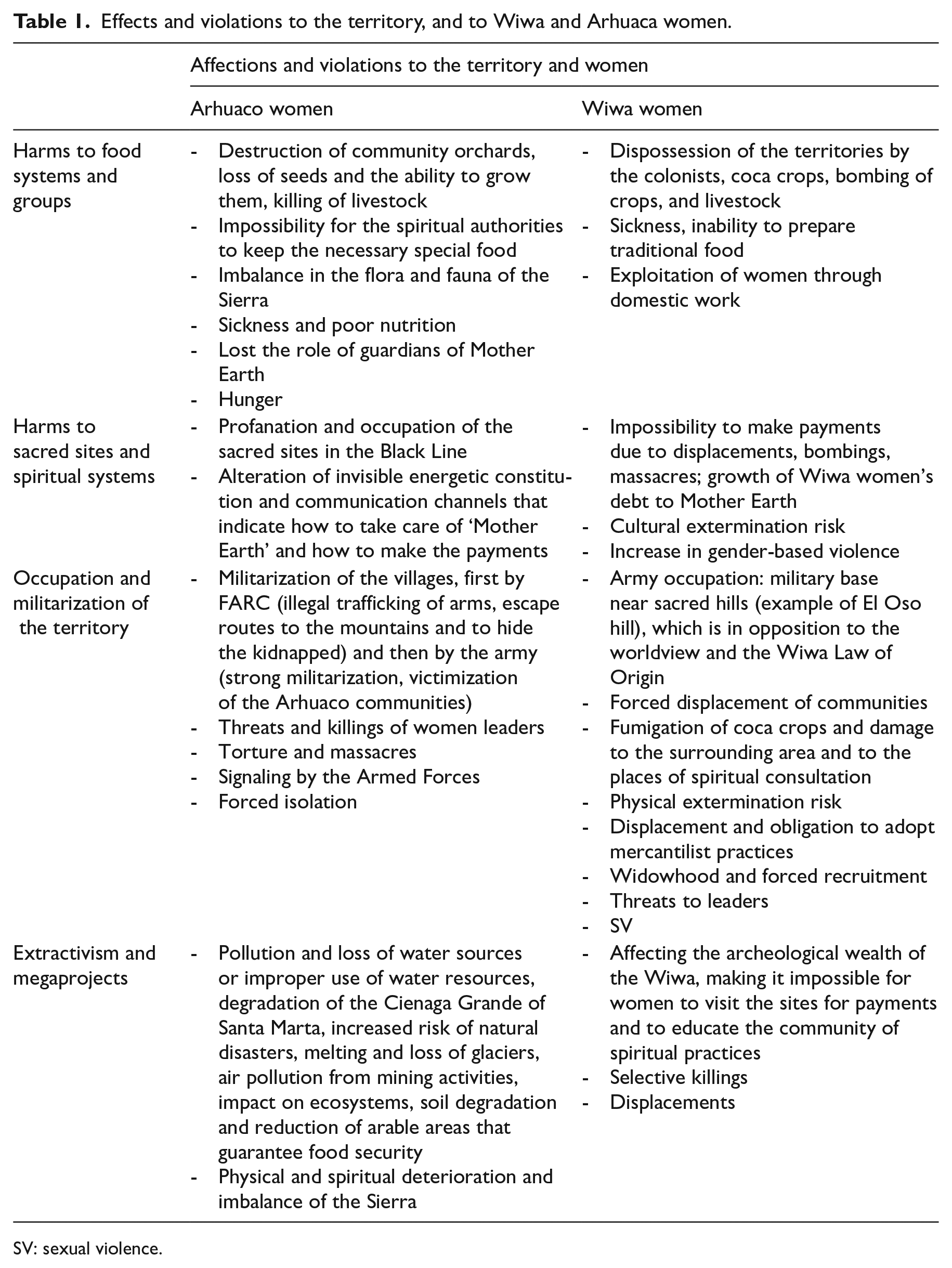
SV: sexual violence.
The victimization of social order–body–territory and the vital order of Mother Earth in the words of the Wiwa and Arhuaco women implies a continuum of affectations. In both cases, there is evidence of violations by all actors in the conflict, mainly illegal armed groups (the guerrillas and AUC in particular) and the army, through legal and illegal territorial control. These differentiated forms of violence impact different dimensions of women’s community life, which place spirituality; the relationship between women, their bodies, territories, and social orders; and the life cycles of Mother Earth in a central place. In this way, complex and interrelated harms are produced. As Martin (2021) affirms for Sierra Leone’s case, TJ and peacebuilding architects prioritize institutional design without including indigenous female priorities. It is necessary to adopt an intersectional perspective that involves gender and ethnicity, and a biocentric perspective that makes possible the reparation of the different orders. Every act of violence inflicted on women and/or territory is part of the continuum between these orders, which duplicates and complicates the consequences of each act and its resulting harm. It also increases the impossibility of carrying out traditional practices of restoration and reparation of harms, which the conflict has exacerbated for decades (Saga, 2019).
Methodology
Based on Tuhiwai Smith (2010), we sought to build a dialogue of knowledge that would bring the interests of the participants together with the members of the team in charge of the data collection process in order to consolidate a research agenda in which we identified common elements. The interest in exploring the territory from participants’ voices was a starting point. For Wiwa and Arhuaca women, the ways to produce knowledge, collect information, and reflect on reparative methodologies imply bringing to the center their ontological and spiritual principles, their perspectives on reparation and knowledge production, and their organizational processes, territorial defense, and rights as women, all in dialogue with the social sciences. From their epistemologies, separation between how to produce knowledge about reparation and how to apply does not exist.
The intercultural diploma program
Inspired by the contributions of popular education (Freire, 1982) and participatory action-research (Armijos Moya et al., 2016), we generated a collaborative knowledge production strategy that prioritized information collection processes co-designed with the participating women and members of the work team of the Intercultural School of Indigenous Diplomacy (EIDI), attached to the Center for Conflict and Peace Studies, and the URINTERCULTURAL Center of the Universidad del Rosario through the intercultural graduates. These are non-formal educational processes of no more than 156 hours focused on strengthening the organizational component of women in local organizations.
The diploma courses were co-constructed between EIDI and the women, creating spaces and activities for learning and teaching. The co-created methodologies and training agendas draw on collaborative languages and representations such as music, dance, and traditional rituals, prioritizing analysis and articulation in the face of the tensions between Wiwa and Arhuaco ontologies, as well as traditional academic research tools. With the Wiwa women, we carried out a regional ritual in September 2019 with the participation of 25 women. This focused on violence against indigenous women and territory, and its own forms of reparation. With the Arhuaco women, we developed a diploma course in October 2019, with the participation of 50 women and 50 men, to strengthen their organizational project. In both cases, we exchanged experiences between the two processes. The second diploma course, developed in 2020, sought to strengthen access to justice for women legal authorities in the Government House in Pueblo Bello (Cesar), in alliance with the Colombian Institute of Family Welfare (ICBF) and the Attorney General’s Office. In this article, the results analyzed are the product of information-gathering activities based on social cartography exercises.
Creating epistemological dialogues: when social cartography transcends the graphic sense
At EIDI, we use social mapping to reconstruct the collective memory of women in relation to their spiritual and territorial defense practices. In this sense, the work of Cabnal (2018) on the defense of territory–body–land in Guatemala, which promotes a communitarian feminism, is crucial for us. Unlike traditional approaches of liberal feminism, which conceive of SV as involving the bodies of women and men, Cabnal shows a continuum between the individual dimension and a collective spectrum of affectation that involves the territorial defense of Mother Earth as a subject of rights and reparation. Similarly, Paredes’ (2010) proposal on the patriarchal intersection in Bolivia of ancestral and colonial patriarchal systems appears as a key concept to understand these practices of violence. The concept of territory–body–earth refers to indigenous women’s bodies as a continuation of Mother Earth. In Cabnal’s (2018) terms, historical and oppressive violences against territories have also materialized in our ‘territory-bodies’. Moreover, community feminism proposes new places, such as the female body, to think and outrage against neocolonial political and economic violence. Thus, our vision, co-created with Wiwa women such as Lejandrina Pastor (a Wiwa political authority) and Digenris Izquierdo (an Arhuaco political authority), agrees with the idea of a continuum of violence against indigenous women that manifests in multiple dimensions in their individual and collective lives.
We use social cartography as a collaborative methodology to reconstruct the collective memory of women in relation to their spiritual and territorial defense practices. The exercise of social cartography is diverse and encompasses multiple interpretations based on the relationship between a social group and the inhabited territory. Following Font-Casaseca (2020), the importance of cartographically enunciating the everyday dimension in which women inhabit the territory transcends an exclusively descriptive perspective. This act is also vital to ‘problematize human life and its study in multiple dimensions and scales’ (Font-Casaseca, 2020: 571). Portraying on paper the sacred sites of women and the ways in which they inhabit the territory allows us to reveal the diverse and complex territorial relationships that women perceive in a differentiated manner.
In the first place, the methodology opened up the possibility of denouncing some phenomena that affect the stability of the territories and the mobility of women in them. During the mapping exercises, two sources of territorial impacts were identified: (1) extractivism and megaprojects and (2) occupation and militarization. The following section of the article delves into each of these elements.
Second, identifying, locating, naming, and recreating the sacred spaces of Arhuaca and Wiwa communities were strategies to come to know the claims of the participants in the face of the aforementioned affectations. Although these claims are different for the Arhuaco and Wiwa people, they have in common the call for spiritual and cultural reparation and the strengthening of women’s organizational processes in the base territories.
The methodology of social cartography incorporating indigenous women’s perspectives became a bridge to make visible the recognition of the ancestral territory as a victim and to identify possible reparation measures. Being an exercise socialized and agreed to with the participating women, its design transcends categorical hierarchical interaction, granting equal legitimacy to indigenous and social science knowledge, and allowing for collective work based on the dialogue of knowledge between indigenous women and the EIDI team.
Findings: the School of Sagas and the process of Arhuaco women
Below we present the results of our long-term research. We show some of the principles of the Wiwa and Arhuaco ontology that we think should be considered in the implementation of TOAR since they enter into tension with some universalist perspectives of reparation. Although women’s participation is numerically lower, it is a historical opening of the justice system and government amid extreme violence. As stated by Berry and Rana (2019), grassroots or parallel power structure emerges during war as open spaces for women’s social and political gains. In the SNSM, from the Arhuaco people there are two women, both Cabildas, and one commissary in charge of the administration of indigenous justice, while in the case of the Wiwa only one active commissioner has been elected and there is one former commissioner. Although positions of ‘women’s coordinators’ have been created within the indigenous social organizations, they do not have a vote in decision-making.
The Sagas
We found during our fieldwork that Wiwa spiritual practices aimed at protecting Mother Earth (land, sacred places, nature, and the universe) and men and women, through traditional female and masculine knowledge, are the bases for truth clarification and reparation. Male and female authorities carry out the work of care and the processes of healing and harmonization of all members of the indigenous peoples. However, for this case we will focus on the care work oriented by women authorities in cases related to sexual and gender-based violence.
According to the Wiwa Law of Origin, two divine beings are the foundation of this relational ontology (De la Cadena, 2015; Escobar, 2015; Ulloa, 2020). For these authors, feminist perspectives introduce new analyses and conceptions of rights opening toward viewing nonhumans (the organic, the non-organic, the supernatural, or spiritual) as political actors. Here a perspective of relational ontology is crucial to understand the relationships between humans and nonhumans in biocentric terms.
As presented by the participants during the diploma courses, in this myth the sun is a male and the moon a female deity. The territory for the Wiwa was created by Ade Serankua (the sun), owner of Mother Earth. Like human beings, Serankua feeds himself because he experiences hunger. In this sense, the Wiwa people are indebted to the sun for using water, trees, food, and natural resources. To ‘pay’ this debt, they make spiritual tributes at the sacred sites designated by their spiritual authorities, following the advice and guidance of the Sagas and the Mamos (male spiritual authorities). This debt has increased and intensified as a result of the armed conflict.
The Wiwa women constitute the organizational process. The School of Sagas is a spiritual sanction and reparation measure imposed on the Colombian government as well as the armed and economic actors to repair the effects of the armed conflict and extractive industries. According to them, it is impossible ‘to clarify the truth’, to repair and to guarantee security without spiritually and materially undoing the harm caused to Mother Earth. For Carianil et al. (2020) and Andela (2020), this reparation is not reduced to economic compensation, but rather goes through the strengthening of spiritual, healing, and harmonizing practices to restore the energy balance between the territory and indigenous women. Like Cabnal (2018), the Sagas highlight the relationship between the spiritual defense of sexual and reproductive rights, and of territorial rights, through the defense of social order–body–territory. In this way, they go beyond Cabnal and introduce the social order, materialized in the Law of Origin according to which the Wiwa are obliged to make payments for the usufruct of everything in their territories. The payments led by the Mamos and Sagas fulfill this responsibility according to strict cultural orientations.
Wiwa women consolidated their organizational process more than a decade ago, during armed conflict. They held their first Assembly with more than 500 participants from the Kogui-Arhuaco-Malayo Reservation. One of its main focuses was to provide advice on traditional payments and work to heal and control SV, associated with the strong militarization of the region and the exploitation of Wiwa territory by economic actors, in order to strengthen Wiwa territorial defense.
The School has the following three objectives to highlight: the strengthening of traditional feminine knowledge (sharing their language, dances, music, rituals, and traditional songs), the acquisition of physical materials for territorial spiritual payments (quartzes, tumas, chimanás and sacred canes) to repair and control violence against social order–body–territory, and the consolidation of the Ushui (feminine sacred temples) Integral Center for Cultural and Spiritual Formation and Strengthening of the Wiwa. According to them, the design, methodologies, and processes of the Integral System, and therefore those of TOAR, are too rigid since they do not sufficiently recognize their expectations, needs, and symbolic and spiritual expectations of truth and reparation. Ochoa (2020) affirms that pagamentos, the Wiwa women’s assemblies, and the women’s traditional knowledge center should be strengthened as the main strategies for reparation from TOAR.
Returning to Izquierdo and Viaene (2018), the role of the Sagas impacts some of the classic principles of reparation. The definition and content of the right to reparation have been built from classic and structural conceptual elements such as the ownership of this right, the condition of victim, the legal concept of damage, and the subject obliged to repair, which integrate the notion and forms of comprehensive legal reparation as well as conventional measures of reparation such as restitution, compensation, rehabilitation, satisfaction, and guarantees of non-repetition as compiled by Zubiría Posada (2019). The Sagas’ questioning of these notions is that they can be restrictive in the face of the needs and requests of indigenous women and their communities’ victims of violence since they are insufficient to achieve a reparation that is transformative and that strengthens their own ways of redressing and healing the damages suffered, as stated by Uprimny and Saffon (2005). One way to illustrate this is the restrictive interpretation of the concept of victim and damage when we refer to the relationship between body–territory affectations, in which both land and female bodies must be repaired in an integral and related manner. In addition, tension arises between the Wiwas’ request that their female authorities be constituted and recognized as self-managers of reparation and truth, inverting the classic model in which these actions are institutionally led, and demanding that reparative strategies, works, and actions be constructed from their ontology and not from external perspectives. We will now analyze some of these methodological proposals.
Social order–body–territory
We found that the Sagas speak of the correspondence between social order–body–territory (Pastor and Santamaria, 2020). This notion is neither rhetorical nor metaphorical and requires real actions of territorial defense and recognition of sexual and reproductive rights. Taking up the terms of Andela (2020), Carianil et al. (2020), and Sefair (in press), the defense of Wiwa women’s rights implies reparative acts of harmonization of the diverse affectations of the continuum of violence against them, classically differentiated between ‘the territory’ and ‘women’. As shown above, both the Wiwa’s territory and their women and girls were sexually violated on a continuum of violence in the first decade of the 2000s. For the Sagas, there is a connection between the affectations to the territory and the SV against women at that time, and contemporary sexual violence. The territory is the depository of the Wiwa sacred codes, consigned in the sacred sites. These, in turn, are the reservoir of the female ancestors, who were women and today rest in these sites as guardians of Mother Earth and the social order within which sexuality enters. Any process of reparation must be registered with these spiritual fathers and mothers because it is a matter of defending not only the individual rights of women, but also the rights of nature. This order is what the Sagas have called ‘social order-body-territory’. Thus, the indiscriminate violence of legal and illegal armed actors during the last 20 years has affected intra- and extra-community practices through sexual crimes against Wiwa girls.
In this sense, after the collaborative work with the participants of the diploma courses and with two intellectuals and indigenous political authorities in particular—Lejandrina Pastor of the Wiwa people, and Digneris Izquierdo and Dunen Muelas of the Arhuaco—for the interpretation of this concept, we can say that there are points of convergence with Cabnal (2018) and Paredes (2010) as well as new avenues for reflection. Like these authors, our interlocutors in the Sierra agree with the existence of a continuum of violence against the bodies of indigenous women, their territories, and Mother Earth as a subject of rights. In addition, they introduce a social and spiritual order both composed of sacred sites (feminine and masculine) rooted in their territories and represented in their individual bodies, which has been affected, damaged, and requires complex reparation processes. Among the multiplicity of existing sacred sites, there are female sites designated for the reparation of SV understood in a broad sense, including SV against Mother Earth. These sites, tended and cared for by the Sagas, bring unpublished reflections on, expectations of, and actions for reparation to be explored that community feminism outlines but does not yet develop. Our work has been to gather these concepts thought and practiced by the women of the Sierra to strengthen the dialogue with national and international TJ.
Territorial rituals for reparation: the ‘altar’ and the sacred site of Shikaka
As Theidon (2004, 2006) states for the Peruvian case, it is crucial to incorporate the spiritual and cultural dimensions in the reparation of violence against indigenous women. A clear example is the Saga’s rituals as procedures of reparation. Through them, the Sagas denounce the violence against the social order–body–territory, harmonizing the sacred sites. These methodologies should be integrated with, for example, Law 1257 of 2008, which is designed to combat violence and discrimination against women in Colombia. For the Sagas, Wiwa women cannot rely solely on external criminal laws for their own right to mitigate domestic violence or SV related to the armed conflict since reparation implies the empowerment of spiritual energy and territorial defense. Recalling Shiva (2006), Cunha and Casimiro (2019), and De Sousa Santos (2014), dialogue between the Sagas and TOAR is crucial for repairing the neocolonial violence exacerbated by the conflict and for recognizing this ecology of feminine knowledge. Thus, the Sagas’ proposal is based on the territorial routes as a strategy of reparation to mitigate the violence against Wiwa women and to strengthen spiritual defense as a central strategy. For this reason, the Sagas have guided the realization of seven territorial tours and payments, focusing on the activation and awakening of women for the defense of the rights of Mother Earth and their territorial, sexual, and reproductive rights as indigenous women. In this way, the rituals and previous spiritual work are one of the pillars that must be considered for the implementation of the TOAR.
During our fieldwork, we participated in one of the most important rituals: the pagamento of Shikaka. For the Wiwa people, this ezwama, located between the Jerez River and the Riohacha port, represents a space from which the defense and spiritual government are exercised, and the Law of Origin legislated and interpreted as a central strategy from the customary law. Each ezwama has a specific jurisdiction and is spiritually related to the others as a node in a network. Sacred mapping by Wiwa spiritual authorities has identified over 37 sacred sites. During the ritual, the participants affirm that for Wiwa women, this site represents a strategic place that must be visited, attended to, and cared for, maintaining the energetic balance of the social order–body–territory. Each site has a specialty, so the spiritual payments and visits are specialized. Mother Earth speaks and ‘charges’ peoples through diseases, natural disasters, and violence rebalancing energetically violent actions. Shikata represents the ezwama for harmonizing anger and pain, roots of gender violence related to armed conflict, which has been embedded for years in the body and spirit of the inhabitants of the region. The Sagas assert during the ritual that the spiritual energy of anger, hatred, and SV of survivors and perpetrators has circulated in the bodies and elements of nature. Only by using situated biologies and corporeal practices, and by respecting protective silences about SV is a real reparation possible (Theidon, 2006). In their words, when you get angry, when you hate, and drink water, and then urinate, or take a shower, all this energy of death, of SV, goes into the river, the sea and the lagoon. Therefore, the whole territory and its elements must be harmonized. (Pastor and Santamaria, 2020)
During the ritual, three of Ulloa’s (2021) expectations for this type of repair were met: first, the collective actions for territorial and bodily defense that made knowledge and emotions visible, implying ‘political positions responding to diverse ontologies around being and feeling with and in the territory’ (Ulloa, 2021), and, second, the Saga’s perspective based on relationality and fluidity between social orders, bodies, and territories. This strategy, in contrast to the body–territory notion proposed by Cabnal and Paredes, involves Wiwa men as central actors for reparation and the fight against SV related to the armed conflict, seeking to harmonize them emotionally and generating reparations from their own ontology. Returning to Cunha and Casimiro (2019) and Izquierdo and Viaene (2018), this situated knowledge subverts one of the beliefs of the ontology of reparation, in which ‘the racialized woman must be saved from the racialized man, conceptualized in the hegemonic model, as the natural perpetrator’ (Pastor and Santamaria, 2020).
The Arhuaco case
The vital order of Mother Earth
The Arhuaco people are governed by the principles of the vital cycle and the order of Mother Earth. From the natural order and the reading of the sacred sites is born the Law of Origin that compiles the system of government, duties, and rules applicable to the beings that inhabit the ancestral territory (EIDI, 2020). Arhuaca women, by symbolizing Mother Earth, also follow a natural cycle represented in the conception, gestation, and birth of the human being (EIDI, 2020). Arhuaco ontology introduces elements into the spiritual and physical plane that must be taken into account in reparation. Therefore, when the territory is exploited or affected, the spirit of women is touched, implying consequences for their physical and spiritual health (EIDI, 2020). Returning to Shiva (2006), the interventions of different actors (the extractive sector, legal and illegal actors, and settlers) in the Arhuaco territory constitute a trigger for the disintegration and imbalance of the vital order of Mother Earth as an expression of bad development promoting the destruction of it, Arhuaco women, and nature. This affects access to land, limits autonomy and territorial government, and unleashes a chain of harms at the environmental, cultural, economic, political, and spiritual levels, impacting women in a differentiated manner. In Restrepo’s (in press) terms, these effects impact the vital order of Mother Earth. For the JEP, the design and execution of TOAR should focus on generating the conditions necessary for Arhuacan women to reestablish the vital order put into imbalance by the armed conflict and extractive industries.
Paying to repair and balance the vital order of Mother Earth
The Arhuaco people have their own system of reparation designed from the guidelines of Mother Earth (Santamaria, fieldwork notes). The reparation is initially spiritual and is carried out through harmonization processes led by the spiritual authorities, developed in energetic spaces called sacred sites (Restrepo, in press). These represent a living organ of the human body and form an ancestral map that indicates the use, handling, and care of Mother Earth. Likewise, they indicate the harms, threats, affectations, illnesses, and what ‘must be paid, cured, repaired in each sacred space and in our own body’ (Seshizha, 2018).
These sites for the Arhuaco women are connected by a spiritual thread that feeds and sustains all living and non-living beings called the Black Line, a multidirectional conception that integrates the geographical, spiritual, and cultural delimitation of the territory. This symbolic and physical map is defined by radial or virtual lines, called ‘black’ or ‘origin’, which fulfill two functions. The first is in charge of protecting the systems of sacred sites, interconnected areas by rivers, mountains, hills, subsoils, maritime currents, stones, and tumas where the ancestral codes of the origin of life rest. Regarding this point, the Mamos and Sagas are in charge of fulfilling the payments, the ancestral consultations, or the collection of traditional materials to guarantee the balance of Mother Earth. The second has to do with recognizing the exercise of free self-determination, autonomy, and self-government spaces known as Eswama, Kadukwe, and Mamanua. From there, the traditional authorities are directed to the representativeness of the internal government, the ancestral territorial order, ethnic survival, and political dialogue with other instances of the State and individuals. In the words of the Wiwa women, ‘we share the ancestral territory of the Black Line, like our house’ (Seshizha, 2018).
This is physically represented in water, referring to the feminine, to the force, and to the possibility of creation, reproduction, and support of Mother Earth (Seshizha, 2018). This perspective is based on the vital order of Mother Earth. Although it shares some elements of Cabnal’s body–territory notion (Cabnal, 2018), it also implies the materialization of this order in the sacred sites of Arhuacan women that symbolize fertility (Aty Serecha), sexuality and balance (Aty Nawowa), and the corrective role (Ñankwa) of women and mothers to whom she does wrong (Izquierdo, 2020). Thus, reparation is mediated by the permission granted by spiritual fathers and mothers (Nuanase) who determine ways to repair the damage done to this order, implying damage to nature, to the subjects, and to the sacred sites affected.
As for the Wiwa, for the Arhuaca compensation constitutes a payment in gratitude to the land (pagamento) or for harm generated (Izquierdo, 2019). Thus, one of the ways Arhuaco women activate their traditional knowledge and care for Mother Earth is through pagamentos. There are payments for abundance, for the rains, to ask forgiveness, for protection, and even as a way of offering healing for the diverse affectations of the territory and the women (Izquierdo, 2020). The compensation of the territory by means of the payments is an alternative of own reparation that allows for sustaining the cultural legacy and to open transformative dimensions for the Arhuaco women (Torres, 2020).
The Cabilda Digneris’ proposal provides concrete elements for reflection on symbolic reparation (kikava, akueka in the Ika language) when there is a practice of SV during our diploma courses. After having accompanied so many cases, she affirms, ‘the wound and pain in SV are unimaginable. When someone rapes, we ask the family to give their best cow. This way the family feels the experience of loss’ (Conversatorio Casa de Gobierno, Pueblo Bello, September 2021). The healing process of victim and aggressor is based on the use of medicinal plants to cleanse the organisms of the parties to the conflict. The trust-building process takes place in the Kaduku (sacred site) through traditional work and fasting rituals. Likewise, a strong spiritual process based on the principle of ‘what happened with you, happened with me’ takes place. For this process of spiritual reestablishment, families and communities are fundamental. One great contribution made by families is to be willing to sit for 1 or 2 months doing spiritual work where the cleansing of generations and lineages of each of the parties is fundamental. Thus, there is a widening of the circle of responsibility since the guilt and the harm lie not only on the individual, as in a classic reflection on reparation in SV, but extend to the families of both victim and aggressor. La Cabilda explains that the aggressor must kneel on two stones, until his body begins to sweat, and he feels shivers so that he can imagine and feel what the victim felt. As we explained above, in this process we look at, analyze and work with the two families, their history and their marunsamas (that of the aggressor and that of the victim, that of the ancestors of each of the lineages). (Conversatorio Casa de Gobierno, Pueblo Bello, September 2021)
This reflection and practice on the reparation of damages to sexuality makes an unprecedented contribution to existing studies. As we have seen, these studies have focused on symbolic reparation, placing the territory as the central subject from an integral, not fragmented, conception and with long-lasting historical repercussions while placing individual or collective reparation in itself in second place.
One of the strategies of reparation for TOAR is the creation of women’s payments and the strengthening of the support services from the perspective of the indigenous right to SV that opens doors to women’s education from an ecology of feminine knowledge and that strengthens the restorative knowledge of neocolonial projects and conflicts for the new generations (Cunha and Casimiro, 2019; Shiva, 2006).
Process of formation and spiritual leadership of Arhuacan women
The experiences of violence lived by the Arhuaco people have been attended to and repaired by Arhuaco women for thousands of years, from the strengthening of their own female education, the defense and revitalization of the territory, the struggle for access to justice to deal with violence against them, and their cultural and organizational strengthening (Santamaria, 2022). They establish a relationship between reparation and the strengthening of their traditional knowledge such as weaving, traditional music, dance and songs, traditional cooking, language transmission, traditional spiritual work, midwifery, child rearing, and care. Thus, we observe diverse, fluid forms of agency in the context in which women are able to act from everyday life (Hume and Wilding, 2019: 253). Likewise, they seek to reaffirm the discipline with which the mandates of the spiritual authorities are carried out, and the consolidation of self-justice (EIDI, 2020).
We want to highlight the role of Arhuacan women recognized as Ati Mamas. They hold the energy of Mother Earth in the company of their husbands and communities, and therefore require special and more rigorous training throughout their lives (EIDI, 2020). During puberty, they are withdrawn from community life, concentrating on the preparation of materials and their preparation for spiritual work. They also have a special diet and do prolonged fasting (Izquierdo, 2019). For the Arhuaco people, strengthening the leadership of the Mamas ensures the survival of the intergenerational reproduction of traditional knowledge and is an obligatory step toward reparation (Santamaria, 2019, fieldwork notes). Arhuaco women have organized and resisted both politically and spiritually through the School of Mamas (EIDI, 2020), an initiative to strengthen the rituals of harmonization and carry out assemblies of women and payments in specialized sacred sites for the mitigation of violence against women, territorial defense, and productive opportunities within the communities (Santamaria, 2022). The School of Mamas also constitutes the basis for the formative processes of leadership of Arhuacan women, consultation processes for the formation of Kuimi girls, and processes of sexual and reproductive health (EIDI, 2020). The strengthening of the leadership from these formative proposals seeks that present and future generations have access to the orientation and spiritual accompaniment for the healing of the intergenerational affectations and harms.
Returning to the terms of Izquierdo and Viaene (2018), the reparative activities are based on the ontology and experience of the Arhuacan women and should be consulted with the Mamas, who in turn contemplate appropriate ways to communicate with the spiritual parents as well as the materials used for the pagamentos, the chosen sacred sites, and the strengthening of the spiritual leadership of the Arhuaco women. Reparation measures for the Arhuaco women seek to safeguard their unity and integrity as women and with the territory, recognizing their ways and spaces to heal and harmonize (Carianil et al., 2020; Ochoa, 2020). We specify that this will be possible with an approach aimed at reestablishing territorial rights and the vital order of Mother Earth. Likewise, the constitutional protection that recognizes the Mamas as true territorial authorities must be effectively guaranteed, integrating land formalization policies that guarantee the protection and restitution of rights of use and enjoyment of collective property. This would allow for the reparation of sacred sites so that Arhuaco women can continue to protect their culture as a form of self-protection and that their territory be governed by female and male spiritual authorities (Mamas and Mamos) for the reestablishment of the equilibrium that was altered during the conflict.
Own methodologies for reparation from the indigenous women of the Sierra
We present in Table 2 the main common elements identified in the reconstruction of the two cases. For this, we chose as main axes the affectations to the territory, our own methodologies, and some proposals of TOAR derived from them.
Methodologies for reparation from indigenous women.
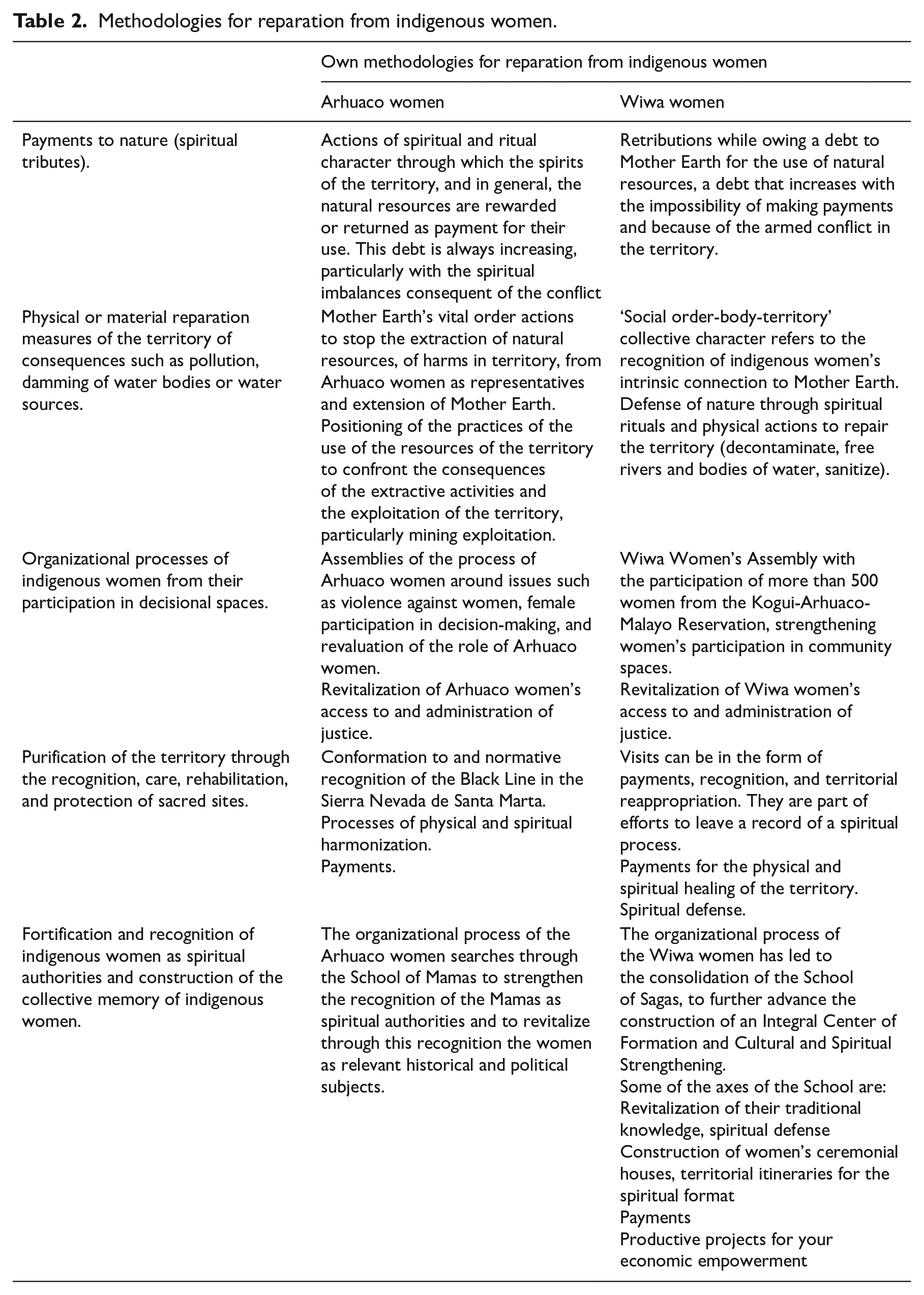
The voices of Wiwa and Arhuaco women regarding what they consider to be and identify as necessary for reparation and of a comprehensive nature have not always been considered. As Zulver (2019) and Berry and Rana (2019) affirm, women know what they want after war and have developed sophisticated and nuanced conceptions and practices of agency and resilience. Nevertheless, their ethnicities, classes, and categories of victimhood are barriers to accessing rights and postwar institutions. As Martin (2021) says, TJ institutions like the JEP need to observe how their activities should reinforce ‘traditional female roles and emphasized communal hierarchies’ (Martin, 2021).
A comparative analysis allows us to highlight three aspects. First, the methodologies involve women’s activities, actions, and knowledge that are not recognized by the JEP, being historically framed in negotiation and relationship with indigenous male leaders. For both Wiwa and Arhuaco women, a necessary condition for individual and collective reparation is the reparation of the territory as a living physical and spiritual reality. Hence, the territory must be understood as a victim and for this reason it is urgent to cleanse, reconstruct, and protect it. In both cases, this territorial dimension implies both physical/material and spiritual actions on it, and actions aligned with the intrinsic principle of connection between women and Mother Earth. In this sense, the methodologies identified require the recognition of women as subjects of healing and as healers of themselves and of the territory, which, once repaired as a victim, would make it possible to ensure conditions for the full sovereignty and self-government of indigenous peoples and women. For the women of both peoples, until the damage directly caused to the territory as well as the damage and crimes that occurred in the territory and against them are repaired, reparation will be insufficient and incomplete.
Second, significant actions are required for women, framed in their own references and meanings for transformative reparation. These are not actions that return them to the previous conditions of violence, but rather that guarantee that the conditions that permitted the initial violence will not be repeated. Actions are also required that provide dignified conditions for their lives, free from violence against their social orders, bodies, cycles, and territories.
Finally, although each people has their own characteristics, history, contexts, and impacts of violence, there are common axes of reparation between them. We would like to highlight (1) the central place of spirituality as part of reparation, (2) the need for reparation of the physical territory and bodies of women, and (3) the strengthening of the organizational processes of women who work from the political-spiritual. The spiritual methodologies proposed in both cases do not constitute secondary reparation measures and actions, but are a central responsibility for the actors involved in the armed conflict and for State institutions.
Conclusion
The comparative analysis of the Wiwa and Arhuaco cases guided the reflection toward a reparation with living–corporate–collective dimensions emerging from their ontologies and practices of harmonization and healing of the multiple aggressions under their orders. Therefore, for the implementation of TOAR it is necessary to prioritize their spaces and methodologies of healing involving actions of reconstruction of memories of dispossession, absence, and pain, thought out from their own scenarios and itineraries: pagamentos, rituals, spiritual journeys, visits to sacred places, kankurwas, and spiritual houses.
It is necessary to recognize the territory as a subject of rights and as a victim and, with it, the affectations caused. It will be fundamental to name the damages inscribed in the conceptions ‘social order-body-territory’ and ‘the vital order of Mother Earth’. It will also be vital to understand their contributions as builders of peace, defenders of life, and builders of memory and collective reparation. However, it seems important to us to emphasize that this recognition should not be made from the perspective of ‘women as nurturing peacebuilders’ since, as we observed for the indigenous women of the Sierra, their mobilization is based on a fierce defense of their organizational processes, territory, and sexual and reproductive rights, and not necessarily ‘in the interest of others’. Thus, this group of women contributes to the feminist project of peacebuilding, from an ethnic approach, short-circuiting the general idea of ‘the greater good of peacebuilding’ (Zulver, 2019). It is also important to short-circuit hierarchies of victimhood as Berry and Rana (2019) affirm. They emphasize that, after atrocities, victim categories interact with ethnicity and gender, creating power differences that affect the possibility of sharing gender or ethnic interests.
Indigenous women and reparations expectations are marginal on the gender perspective and on the ethnic perspective of the JEP. Therefore, since the JEP from the TOARs can recognize the socio-spiritual importance of sacred sites, of the Sagas and Mamas, and of their access to geographical spaces and natural resources to carry out their processes of reparation. These spaces are valid equally for constructing methodologies to collect information and for including their needs for reparation. The consultation of TOAR and direct interjurisdictional dialogue with women, and with the Sagas and Mamas as political–spiritual authorities, is crucial, as they are recognized as political, historical, and decision-making subjects in terms of reparation.
