




Abstract
Despite being the second most prevalent form of human trafficking, human trafficking for labour exploitation remains a victimisation process that has received little scholarly attention. This qualitative study, based on data from in-depth interviews with labour trafficking survivors in Spain, seeks to apprehend how they experienced that situation while giving them a voice and adopting a survivor-centric approach to the phenomenon. To this end, it first analyses from their perspective the process of their enslavement, as well as the feelings it engendered: from recruitment, to transfer, to exploitation, including the objective circumstances and means used. It then analyses the essential aspects of the process leading to their liberation, examining how the situation was ended, the type of assistance received and desired, and the recourse they had to a criminal law response. It concludes with a series of proposals for how labour trafficking should be institutionally addressed in view of the survivors’ suggestions.
Introduction
Trafficking in human beings (THB) for labour exploitation (LE), or labour trafficking (LT), is the process described in international law by the Palermo Protocol (Article 3), the Council of Europe Convention on Action against Trafficking in Human Beings or Warsaw Convention (Article 4), and Directive 2011/36/EU on preventing and combating THB and protecting its victims (Article 2). This process includes the recruitment, transportation, transfer, harbouring, or receipt of persons, by coercive, fraudulent, or abusive means, for the specific purpose of exploiting the victims through forced labour or services, slavery, or practices similar to slavery.
LT is the second most prevalent form of THB, after sex trafficking (ST), if not the first, based on the most recent estimates. The latest statistical reports on THB show that LT ranks second in percentage of victims, accounting for 38% of all victims, according to the United Nations Office on Drugs and Crime (UNODC, 2020), or 22%, according to the European Union (European Commission-Migration and Home Affairs, 2020). However, in its most recent estimate, the International Labour Organization reports that modern slavery has increased globally in recent years and that most of the people subjected to forced labour in the world are subjected to LE (17.3 million) as opposed to sexual exploitation (SE) (6.3 million) (International Labour Organization, 2022). Yet despite its prevalence, to date LT has received less scholarly attention than ST. A 2018 review of empirical studies on LT published between 2000 and 2015 found that the existing literature is limited, fragmented, and underdeveloped; meets minimal academic standards; is highly descriptive; and involves the collection of evidence of little value (Cockbain et al., 2018). Hence, the calls for empirical research to focus on this type of trafficking (Russell, 2018).
Field studies conducted in the United States and, especially, Europe, particularly in the last decade, show LT victimisation processes in several productive sectors characterised by low professional training requirements and high seasonality. These include agriculture and domestic service (Correa da Silva and Cingolani, 2020; Murphy, 2014; Villacampa, 2022a; Villacampa et al., 2023), hospitality (Ollus et al., 2013; Van Meeteren and Hiah, 2020; Van Meeteren and Wiering, 2019), the food industry (Davies, 2019, 2020a, 2020b; Skrivankova, 2014), construction (Skrivankova, 2014; Vandekerckhove et al., 2003), and cleaning services (Davies and Ollus, 2019; Jokinen et al., 2011; Ollus, 2016).
While empirical studies on this form of THB are still scant, studies conducted with data obtained directly from the accounts of people who have actually experienced this type of victimisation are even fewer. The complexity of gaining access to victims (Fernandes et al., 2021a, 2021b) or even the difficulties they exhibit in recognising themselves as such (Van Meeteren and Hiah, 2020) may explain the scarcity of such analyses. However, in a regulatory context in which the international legal instruments created to combat trafficking, especially the Warsaw Convention, adopt a human rights perspective to approach this reality and highlight the need to address it from a victim-centric perspective, giving a voice to THB victims is essential. This is because such a strategy aims to address the phenomenon holistically and eradicate its causes, devising a response to it based on what is known as the ‘3P policy’, that is, prevention, protection, and prosecution, which prioritises protecting victims and their welfare over prosecuting crimes (Obokata, 2006; Villacampa, 2012).
Making this approach effective requires placing victims, and the recognition of their rights, at the centre of the institutional response to THB. Ultimately, it calls for going even further, not only giving a voice to those who have been victimised by such processes to understand what we are facing (Murphy, 2014), but also adopting what has been called a survivor-centric, rather than victim-centric, approach to managing this reality (Nicholson, 2019). This means assuming a model that, far from offering a paternalistic response to human trafficking and exploitation, chooses a cultural and contextual one (Mishra, 2015), an approach to these phenomena and to the institutional responses offered centred on the perspective of survivors, whose voices must become central to setting the anti-trafficking and anti-slavery agenda (Nicholson, 2019).
As noted, to date, few field studies have reported on the process endured by the people subjected to this type of victimisation or how it has been institutionally addressed. On the rare occasion that access has been gained to victims, as is customary in other trafficking-related field studies, the focus has been on ST victims (Murphy, 2014; Russell, 2018). The few existing narratives of survivors of LT or the forced provision of services have focused on giving an account of the trafficking process – from recruitment, to transfer and, ultimately, exploitation – and the means and mechanisms used in each stage to subdue the victims (Correa da Silva and Cingolani, 2020; Fernandes et al., 2021a; Ollus et al., 2013; Van Meeteren and Bannink, 2020; Vandekerckhove et al., 2003; Villacampa and Flórez, 2018; Villacampa and Torres, 2014). They have also made it possible to confirm how the idea of a continuum of exploitation operates in the legal labour market (Skrivankova, 2010), showing how the very dynamic of this market in certain industries favours the escalation of exploitation (Davies, 2019, 2020a, 2020b; Davies and Ollus, 2019; Ollus, 2016), nudging this criminal phenomenon closer to economic crime and supporting the need for a legal response focused not only on criminal but also on social justice. Along with structural reasons related to the labour market in the destination countries that encourage the very existence of LT and LE, qualitative studies conducted with victims have also shown how restrictive immigration policies, victims’ fear of losing their precarious jobs, and the fact that they do not identify as victims are facilitating factors for the persistence of situations of severe LE (Ollus, 2016; Van Meeteren and Hiah, 2020; Van Meeteren and Wiering, 2019).
However, beyond critically analysing the interaction between trafficking victims in general and the institutional approach to the phenomenon in destination countries (Fernandes et al., 2021b; Villacampa and Torres, 2014), to date, very few studies have analysed the perspective of LT and LE survivors in particular regarding both their victimisation process and the process that led them to become survivors, that is, that enabled them to put an end to the situation of exploitation they had been subjected to and move on with their lives. The present qualitative research was thus undertaken with victims of LT and severe LE with precisely this twofold aim: to learn how survivors of these phenomena experienced both the process leading to their effective enslavement and the one by which they were freed. The research was conducted in Spain because it is both a European destination country for THB victims (European Commission-Migration and Home Affairs, 2020) and one of the ones to detect a higher percentage of LT cases in recent years (CITCO, 2022). The results and proposals made based on this study could thus also be useful for all Western European destination countries.
Method
To conduct this research, which was approved by the University of Lleida Ethics Committee, a non-probability snowball sampling system was used, resulting in the selection of seven LT survivors.
Given the challenges involved in gaining access to this population, the process began with an initial sample of 34 victim service professionals who had assisted LT victims. These professionals had previously been contacted and interviewed by members of the research team responsible for the research project in the context of which this study was conducted to gain insight into the challenges they faced in assisting LT victims. Once the interviews with these professionals had concluded, they were asked whether they could facilitate contact with any survivors they had assisted who might be interested in participating in the study. The inclusion criteria for the study were: (1) that the potential interviewee had endured a THB process that had culminated in a situation of LE lasting at least several days; (2) that he or she was of legal age; and (3) that he or she could communicate in English or Spanish.
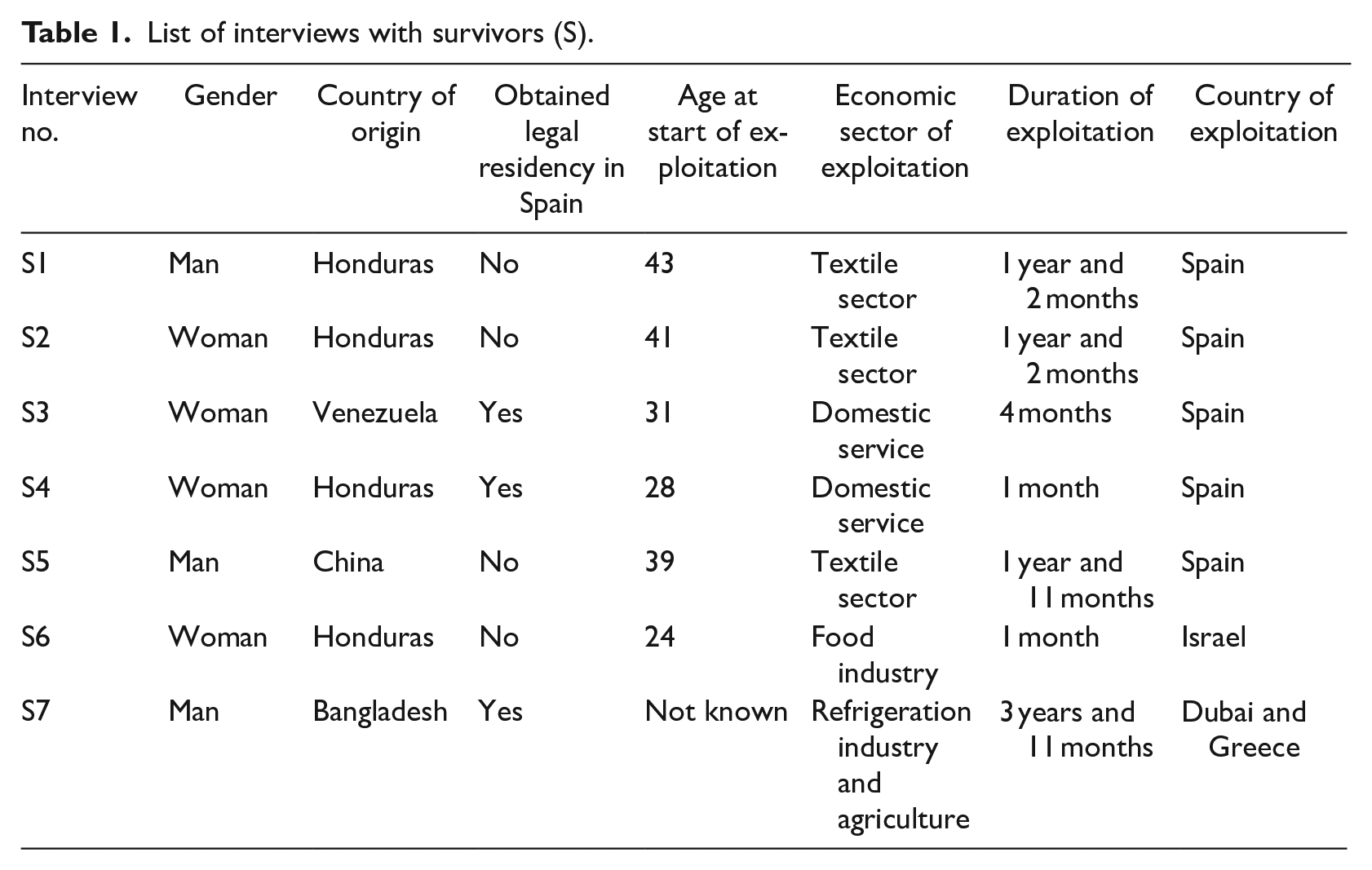
The organisations provided the telephone numbers of 20 survivors, after obtaining their consent to share this information with the researchers. In an initial call, the researchers explained the purpose of the study to the potential interviewees, answering any questions and providing clarifications, indicating that the interview would be anonymous. During this first telephone conversation, once it had been verified that they met the criteria for inclusion in the study, they were asked to provide their oral consent to participate in it. Of the 20 survivors initially contacted, 7 gave their consent and were ultimately interviewed. The interviewees had the sociodemographic characteristics (nationality, gender, current residential status in Spain) shown in Table 1. They were exploited in the economic sectors reflected in that table at the ages shown (M = 34.33 years; SD = 7.06), for the indicated periods (M = 14.85 months; SD = 15.13), and in the stated countries.
List of interviews with survivors (S).
The interview model used to collect the data was based on that used to interview trafficking victims in three earlier qualitative studies: (1) the Finland-led Flex Project (Jokinen et al., 2011); (2) Moens et al. (2003), on case studies of THB victims in three European Union countries (Belgium, Italy and the Netherlands); and (3) two previous qualitative studies with victims of trafficking for criminal exploitation in Spain (Villacampa and Torres, 2014) and Colombia (Villacampa and Flórez, 2018). It addressed the following three main areas: (1) recruitment and transfer to Spain of the trafficked persons; (2) living and working situation in Spain; and (3) end of the situation of exploitation, received and expected help, and initiation of criminal proceedings and passage through the criminal justice system.
The interviews, which lasted between 40 and 120 minutes, were conducted between July 2020 and February 2021 by videoconference using the platforms WhatsApp (4), Zoom (2), and Skype (1). They were recorded with the interviewees’ consent and subsequently fully transcribed.
The data were analysed using the thematic analysis methodology (Guest et al., 2012), following its component steps (Braun and Clarke, 2006), that is, familiarisation with the data, generation of initial codes, search for and review of themes, and definition and naming of themes. QDA Miner Lite software was used for data processing. An initial coding table was created based on the existing literature, mentioned in the introduction, and the two focuses of the research (i.e. survivors’ views of both the process of their enslavement and the process by which they were freed), which was used as a guide for the initial coding. The coding was refined as subsequent codes emerged inductively, which were used to determine the main themes that make up the final coding table.
With respect to this research study limitations, it should be noted that initially it was aimed to analyse a larger number of victim testimonies; however, given the huge difficulty of finding LT and LE survivors who would consent to being interviewed, we were able to access only a small number. Despite this, the testimonies presented in the interviews were considered to be sufficiently representative of the experiences endured by survivors, the effects on them and how they got over their victimisation processes. In addition, although interviewees were located in Spain, their different origin and the diversity of places where their exploitation took place allow us to consider that their accounts might be not very different from those for LT and LE survivors found in other Western European countries. However, the limited number of interviewees leads to caution in generalising the results obtained.
Results
The results are presented according to the dual aims of the research, that is, to learn how survivors of LT and severe LE processes experienced both the process leading to their effective enslavement and the process by which they were freed.
Process leading to enslavement
The international concept of THB defines it as the process leading to the enslavement of persons through the use of fraudulent, coercive, or abusive means when the victims are of legal age. It follows that this process begins with the person’s recruitment, usually followed by his or her transfer, and culminates in his or her actual enslavement or severe exploitation. Although the final stage of the process, that is, the exploitation itself, is not necessary for the elements included in the international legal concept of trafficking to be considered achieved, in a criminological analysis of the phenomenon, it is appropriate to include the end of the process in the analysis as well. Thus, in keeping with the scheme used in previous work analysing trafficking processes explained by victims (Villacampa and Flórez, 2018; Villacampa and Torres, 2014), this paper will report how the victim-survivors experienced the following three stages of the process, along with the means and mechanisms used in each one: (1) recruitment; (2) transfer; and (3) exploitation.
Recruitment of those to be trafficked
Fraudulent mechanisms were used to recruit the seven people who would later be exploited by the recruiter him- or herself or by other people related to the recruiter to varying degrees.
To understand why fraudulent means were the ones most commonly used in the recruitment stage, one must be aware of the challenging circumstances the people being recruited faced in their lives. All interviewees came from precarious economic situations, in some cases because they had dependents (S1, S2, S4), in others because their food and health conditions had deteriorated as a result of an economic crisis in their country of origin (S3). This precarious initial situation was sometimes exacerbated by extortion by violent armed groups in the country of origin (S2, S6, S7).
There is thus a clear abusive component in this type of trafficking process. This component becomes apparent upon closer examination of the victims’ reasons for leaving their countries and embarking on the migration process, which were generally economic: ‘to find a better life’ (S1), due to the ‘distress and desperation we were experiencing there’ (S3), because ‘I wanted my children to be able to study’ (S4), or even in pursuit of the dream of coming to Europe and ‘owning my own business’ (S5). However, in four cases in which the process also stemmed from an attempt to avoid violence by armed groups, other reasons cited for undertaking it included the following: ‘the people who killed my brother could come after me, too’ (S1), ‘the gangs extort money from you’ (S2), or that they had to ‘escape the threat of the gangs’ (S6) or even ‘escape from the mafia or the corrupt police’ in the country of origin (S7). The abuse of the victim’s vulnerable situation in these cases thus stems not so much from his or her precarious economic situation as the threat of suffering violence at the hands of third parties.
Six of the interviewees were recruited in their country of origin by people who then exploited them directly or acted as intermediaries, putting the victim in touch with the exploiter. In one case, however, the victim-survivor was clearly recruited in the destination country, with no apparent connection between the person who organised his journey to Spain and the one who ended up exploiting him there (S5). In this case, the people who arranged the victim’s transportation to Spain told him that, upon reaching the Spanish port to which he was headed, he should go to a specific area of the city – whose name he was given – where he would find many people of his own nationality and that one of them would offer him work, which is ultimately what happened.
When the recruitment takes place in the country of origin, it is sometimes done through people with whom the victim has some sort of relationship of trust or with whom he or she has previously had varying degrees of contact. One interviewee said that it was some Colombians whom she had met during a previous stay in Colombia who had offered to help her come to Spain (S3). Another said she had been recruited through a good friend of her sister’s, whom the whole family knew (S4). In a third case, it was a former friend of the victim herself, who had moved to Israel a few years earlier, who, according to the interviewee, ‘sold me to the Russian mafia’ (S6). This pre-existing relationship of trust, the proximity to the victim that facilitates recruitment, may also explain why the initial recruiters were either people of the same nationality as the victim (S4, S5, S6, S7) or from the same continent (S1, S2, S3), rather than nationals of the destination countries.
Notwithstanding the prior relationships between some victim-survivors and their recruiters, the Internet played an important role in recruitment. In two cases in which the victim and offender already knew each other, contact between them was re-established through social media (S3, S6); in other two in which they were not previously acquainted, the victim accessed the phoney job offer directly online (S1, S2).
In all cases, the means used for the recruitment, in addition to the aforementioned abuse of various situations of vulnerability, was deception, sometimes accompanied by threats, although the latter was more of a motivating or precipitating factor to embark on the journey than a means of recruitment itself, at least in the early stages of the process. The most common practice was, thus, to deceive the victim, at least regarding the conditions under which the work was to be performed, and in some cases also about the nature of the job itself. In all cases, the victim-survivors were told reasonable and more or less advantageous financial conditions and working hours, although they did not always meet Western labour standards. At least in two cases, employers’ acceptance of people whose situation in Spain had not been regularised was in itself a factor enabling the recruiter – and, subsequently, the exploiter – to negotiate clearly disadvantageous payment conditions from the recruitment stage on (S1, S2).
While deception regarding the working conditions was a constant, instances of deception about the type of work to be performed were also found. When the work was to be carried out in the live-in care sector, this circumstance was concealed (S3, S4).
Transfer
As a general rule, the victim’s transfer was the second stage of the trafficking process, following recruitment, although in one case the recruitment took place after the transfer. The transfer from the various countries of origin to Spain, the destination country in all but two cases, varied depending on the place of origin. None of the interviewed victims’ journeys originated in a European country. In all cases, the journeys were long-distance and the means of transport used varied.
The five victims from South America, including both those who arrived at a Spanish airport and those who landed in Israeli territory (S1, S2, S3, S4, S6), made the journey by plane under normal sanitary conditions. The Chinese victim-survivor travelled first to Japan and, from there, to Spain by ship, in a cargo container shared with some 20 people. Finally, the longest journey in terms of duration, which furthermore took place under life-threatening conditions for the people being transferred, was the one described by the Bangladeshi victim-survivor, who initially travelled from Bangladesh to Dubai by plane, but described the second leg of his journey to Europe as a gruelling multi-week voyage made mostly on foot or by road. The victim-survivor recounted making the journey from Dubai to Europe, which he entered via Greece, with an original group of around 20 people, which grew or shrunk as other groups joined and left them along the way. During the journey, they travelled from Dubai to Oman crammed into a lorry, and then continued on foot for several hours once they had crossed the border before boarding a boat to Iran. Once there, they were transported in a cattle truck to a forest, where they remained in appalling conditions, without food or water, for several days. They were eventually led by a new detachment of traffickers, who guided them on foot, walking for around a month, to the border with Turkey. They crossed it at night through the mountains, and took a bus to Istanbul, where they were held in a crowded warehouse. Once there, subject to payment of a fee, they boarded a lorry to cross the Greek border into Europe.
As for the victims’ agency to decide how and when to travel, most of the trips were arranged directly by the exploiters, by intermediaries colluding with them, or by human trafficking groups whose connection with the people who would exploit the victims upon their arrival at the destination country could not be clearly established. The victim-survivors had no choice regarding how or when the journey would be made. The exception to this were two cases in which the victims, after receiving what they thought was an attractive job offer in Spain, sold part of their assets to raise the necessary funds to purchase plane tickets to Madrid (S1, S2), which allowed them to choose the conditions they would travel in.
At least in three cases, it was the final exploiters or intermediaries colluding with them, acting as decoys since the victims knew and trusted them, who bought the plane tickets and sent money to the victims. This money was to be used either to arrange the necessary paperwork for them to travel to Spain from their country of origin or directly to provide them with enough cash to enter Spain or another destination country on a tourist visa (S3, S4, S6). In any case, the payment of the ticket and provision of cash marked the start of the debt the victims would contract with the traffickers. In these cases, it was the exploiters themselves or the intermediaries who picked up the victim-survivors at the airport or gave them instructions on how to get from the airport to the place where the exploitation would take place.
In two other cases, the mode and pace of transit was determined by human trafficking groups, whose relationship with the exploiters or interest or direct involvement in the victims’ ultimate exploitation could not be established. The victim-survivors lacked agency in these journeys, too, which were moreover the ones made under the most dangerous conditions for the life or integrity of the people being moved. In one case, the victim-survivor sailed from a Japanese port to a Spanish one on a cargo ship inside a shipping container shared with 20 other people. In the other, the victim’s account of the trip from Dubai to Greece was rife with references to the overcrowding of people in insanitary conditions in different vehicles and dwellings, human marches to the point of exhaustion, severe physical abuse, and shortages and lack of food and even water, in addition to the traffickers’ constant demands for money from the families of the people being moved to ensure the journey’s continuation.
Albeit to varying degrees, the victim-survivors’ lack of agency with regard to the mode and timing of their transfer entailed a significant restriction on their freedom to act, indicative of the intensification of the means used to continue the trafficking process. In some cases, this limitation on their freedom to act was compounded by restrictions on the victim’s freedom of movement and even episodes of severe physical and psychological abuse. The studied cases, which began as fraudulent and abusive, became more coercive as the process progressed.
Exploitation stage
This section will examine, first, the objective conditions in which the exploitation of the trafficked persons occurred; second, the means used by the exploiters to maintain that situation over time; and, third, the feelings that enduring the trafficking process followed by the exploitation engendered in the people who went through the experience.
Objective conditions of exploitation
The economic sectors in which the analysed LE experiences took place were mainly the textile industry (n = 3), followed by domestic service (n = 2), although examples were also found of exploitation in other types of industries – food and refrigeration – and in agriculture. The victim-survivors were subjected to this situation for a period of time ranging from a minimum of 1 month to a maximum of 3 years and 11 months (M = 14.85 months; SD = 15.12), mostly in Spain, although two victim-survivors (S6, S7) were exploited in Israel and in Dubai and Greece, respectively.
In three of the analysed cases, the exploiters were the recruiters themselves (S1, S2, S3) and, in two others, people acting in collusion with the recruiters (S4, S6). In the two remaining cases (S5, S7), there was no evidence of any relationship between the exploiters and recruiters. Except in one case of domestic service (S4) and in the exploitation occurring in the agricultural sector in Greece (S7), in the rest of the analysed cases, no evidence was found that the exploiters were nationals of the victim-survivor’s destination country, but rather people from geographical areas close to their country of origin who had settled in the destination country. This was the case for S1 and S2 (Honduran victims exploited by Peruvian nationals), S3 (a Venezuelan victim exploited by a Colombian family), and S5 (a Chinese citizen exploited compatriots). There was no proximity in terms of country of origin between the victims (Hondurans) and exploiters (Russians) in the case of S6. However, it remained a constant that the exploiters were people already established in Israel, the country where the exploitation took place, who lured their victims with a compatriot with whom they were more or less acquainted.
As for the formal coverage of the provision of services itself, in general, the victim-survivors did not have a written employment contract. The contract was ‘oral, purely spoken’ (S1), ‘entirely verbal’ (S4), or directly lacking (S3, S5). Only in one case did the victim-survivor believe she had signed a written employment contract (S6). However, she likewise did not know what conditions she was agreeing to, as the document the victims were given to sign as a contract was in Hebrew, and when they asked the employers for a Spanish translation, ‘they got angry and told them they did not trust them’ (S6).
In the absence of an employment contract, the conditions determined for the provision of services, when established in advance, were also agreed orally, if at all. Even when they were agreed, they were regularly breached, as witnessed by the paradigmatic example of remuneration. In those cases in which the pay had been orally agreed, the amount was less than the minimum wage, ranging from a maximum of €1,000 a month to be paid to a live-in domestic worker (S4), to the €600 a month promised to a full-time textile workshop employee (S1), and even €1 an hour in the case of another worker in that field (S5). In other cases, there was not even a record that the pay had been agreed in advance (S3) or the agreement reached was to work solely in exchange for food and lodging (S7).
Regardless of whether the remuneration had been agreed, none of the seven victim-survivors were paid regularly for their services, but rather were not paid at all or received just a token amount from time to time. Multiple reasons were given for not paying them. In some cases, they had to do with the debt previously contracted with the exploiters, which they were told was increasing due to the expenses they incurred while being exploited. In others, it was the boss who acknowledged a growing debt to the workers. In still others, the worker simply stopped being paid without any explanation at all. The following interview excerpts bear witness to this trend: ‘From the third month on, we were not paid at all. The boss accumulated a debt to us’ (S1); ‘When it was time to get paid, he told us that part of what we were owed had gone to electricity and water for us in the workshop’ (S2); ‘Over four months, they gave me 100 euros. So I was able to escape’ (S3); ‘The day we were supposed to get paid, they told us we wouldn’t be paid, because we had to pay for our food and board’ (S6); and ‘I worked for three years and got paid for three months’ (S7).
Nor were the working hours clearly agreed in advance in most cases, and even when they were, they were not ultimately observed. The following interview excerpts illustrate this: ‘In theory, it was a 9-hour workday, plus overtime, but by the third month, we could hardly sleep because we always had to deliver things very quickly’ (S1); ‘At first, the workday was from 7 to 7 on weekdays, but then, since you had to finish the work to get paid, I had to work more and more hours and on weekends’ (S2); ‘I worked from Sunday to Sunday. I got up at 6 in the morning and worked until late at night . . . . I had to be ready at all times for whatever they might ask. No matter what time it was, from the moment I got up: I took care of the children, after cleaning all day and, in the end, sometimes they had friends over’ (S3); ‘I worked around 16 hours a day’ (S5); ‘I would get up at four in the morning and work until twelve at night’ (S6).
With such long hours, the interviewees hardly had any free time. The exploiters considered that they should be working almost all the time. Breaks were few and far between and strictly to keep them productive, as the following excerpts show: ‘Once, they gave us a Sunday off for the Easter holidays; we later found out that there were bank holidays’ (S1); ‘We barely had any time off because we worked every day. If you told the boss it was a bank holiday, we would work normal hours or finish at lunchtime’ (S2). None of the seven reported having done any regular activity in what little leisure time they had, and their freedom of movement to do so during their breaks was highly limited, as evidenced by the following excerpts: ‘The only time I was free was when they went out or told me that they were going to the shopping centre and I went with them; I never had a holiday or met anyone, because I couldn’t go out (S3)’; ‘I would go out occasionally, but only very cautiously and when they couldn’t see me, because I had a lot of work, I was tired, I had no money, and the building was locked’ (S5); ‘We had the Sabbath off, but we were not allowed to leave the flat’ (S6).
Workplace health and safety conditions were deficient in the seven cases. The interviews with those five who worked in textile workshops or other types of industrial facilities revealed that they were dark, often closed places that did not meet minimum ventilation, air conditioning, or lighting standards, and that sometimes the workers were not even allowed to go to the toilet with a minimum of privacy. According to one interviewee (S1), ‘There was no toilet in the workshop, and they didn’t let us go out; they would give us a frying pan, and we had to relieve ourselves there’. Another interviewee said the exploiters even escorted them to the toilet (S6). Just how cramped the quarters that some of them worked in were is reflected in excerpts such as: ‘He had his business in an abandoned market, with no heat, in a place with two rooms. It was like a storage room, all messy, full of work and machinery, and we were locked in’ (S2); ‘We all worked [between 12 and 13 people] in the basement. That’s where the sewing machines, kitchen and toilet were. The windows to the street were covered so you couldn’t see in, and they didn’t open. It was very dirty’ (S5).
Furthermore, what breaks they were given during their long workdays in these places were clearly insufficient. They ate where they worked, usually with little time to do so, and sometimes with clearly paltry rations. As one interviewee (S6) explained,
They gave us one sandwich for the whole day. They barely let us drink water. I lost 25 pounds. We could eat the sandwich sitting down, but then they would take our chairs away so we would go back to work. We only stopped for lunch; breakfast was a biscuit or a piece of bread that they gave us with our coffee.
While the two survivors who were exploited as domestic servants did not mention darkness, poor ventilation, dirtiness, or overcrowding among the adverse working conditions as they lived with the exploiters, they did report other conditions that also posed health hazards. One said that, even though her hands were badly damaged by the cleaning products used, she was never able to see a doctor (S3). The other (S4) reported being sexually harassed by the elderly man she was caring for from the moment she entered the house as a live-in employee. As a result of the employer’s constant sexual advances, she had to push her bed up against her bedroom door at night to prevent him from coming in and ended up not spending the night in the home to avoid those attempts.
As for where they stayed, some of the victim-survivors lived in the same place where they worked, which they sometimes shared with their exploiters. This was the case with the domestic workers (S3, S4), with one of the exploited textile workers (S5), and with the exploited agricultural worker (S7). Even when they spent the night in places other than where they worked, it was at locations in the exploiters’ direct or indirect orbit, accessible to them. Their movements between the places where they spent the night and where they worked were usually controlled by the exploiters, because they lived in a flat owned either by a relative of the exploiters near the workplace (S1, S2) or by someone acting in collusion with them (S4, S6).
Except in the case of the domestic workers, the places whether they spent the night likewise failed to meet the minimum sanitary conditions. One victim-survivor reported sleeping in crowded spaces on a middle floor of a building downstairs from where the exploiters slept, in much more acceptable conditions (S5). Another said that victims were crammed into a two-room flat, which they were not allowed to leave and in which they were guarded by some sort of jailers who seemed to be trusted associates of the exploiters (S6). Finally, still two others reported sleeping on a greenhouse floor (S7) or on an inflatable mattress in the living room of their recruiter’s flat (S4).
Means of coercion
Given that the victim-survivors remained in the described situation of exploitation for around 14 months on average, it is important to know what means the exploiters used to maintain this exploitation over time. As noted, the analysed LT processes began with deception and abuse of the victim’s situation of need and vulnerability, which became more intense and coercive during the transfer stage. In the exploitation stage, the use of fraudulent, abusive and, especially, coercive means to keep the slaves in a situation of exploitation became even more evident.
The exploiters often resorted to deception to ensure that the victims remained in the exploitative situation. As the initial deception could no longer be maintained at this stage of the process, the points on which it originally relied were changed. In two cases, the victim-survivors were told that they would receive their outstanding wages, that the amount owed to them by their employer – who, in theory, could not pay them until his or her economic situation improved – would increase (S1, S2), or even that they would become working partners in a company to which the boss was contributing the capital (S2). In other occasions, the deception consisted of a false promise to fix their irregular status in Spain. Although three members of the sample did ultimately regularise their residence status in the country, at the time they were trafficked and exploited, they were all irregular immigrants; hence, the promise to regularise their status was a major incentive to keep them in the exploitative situation. As one interviewee said, ‘When we got tired, they courted us: they told us they were going to fix our papers’ (S1).
Another important tool of deception and disinformation was the false impression that the exploiters gave the exploited that seeking institutional help outside the workplace could bring them more problems than solutions, making them believe that their status as illegal aliens would prevent them from receiving help. As two of the interviewees noted, ‘When I threatened to go to the police, they told me not to go, that it was a problem because they would fine me instead of doing anything’ (S1); ‘They warned me not to go to the doctor or social services; they said I would get into trouble’ (S2).
Abuse of the victims’ situations of need and vulnerability continued, growing more intense, during the final part of the process, in which the exploiters’ position of superiority was even more evident than that of the traffickers. The victim-survivors were uprooted, irregular, and in some cases, undocumented residents who were barely allowed to maintain contact with their families and did not know anyone in the destination country, placing them even more at the exploiters’ mercy than in earlier stages of the process. At least three interviewees mentioned restrictions on contacting their families back home (S1, S3, S4); in one case, the exploiters even confiscated the interviewee’s phone (S6). Withholding the exploited person’s documentation was another tactic mentioned in one the interviews (S6). This was not a common practice in the analysed cases because some of the migrants were directly undocumented (S5, S7) or were workers who, despite being in possession of their passport – in some cases, because they had hidden it – were illegal aliens (S1, S2, S3, S4).
One important tool of abuse, especially in cases in which the exploiters had borne the costs of bringing the victim to Spain or the place where he or she was exploited, was the debt that the victim had contracted with them. The exploited persons were not informed of how the debt was being repaid, but simply assumed that they had to keep working to pay it off. As one interviewee acknowledged, ‘They didn’t pay me because I owed them for my airfare’ (S3), despite not having been told the amount of the debt or the conditions and term of its repayment.
The most salient aspect of this stage of the process was the intensification of the use of coercive mechanisms to keep the victims in the situation of exploitation. Along with the aforementioned restrictions on contact with their respective families or with professionals who might provide institutional support in the destination country, the most clearly coercive mechanisms observed ranged from implicit or explicit threats to their physical integrity to psychological and even direct physical abuse, including physical confinement of the exploited persons. Examples of threats to integrity can be found in at least the cases of two interviewees who provided different types of services to people who were allegedly members of a criminal organisation whose reaction, should they refuse to work or demand better working conditions, they feared. In addition to the aforementioned examples of physical and psychological abuse during transit, manifestations of such behaviour were also found in the exploitation stage. As an example of psychological abuse, one interviewee explained, ‘If we were working slowly or the boss didn’t like it, he would insult us and threaten to hit us or toss us out on the street without documentation or any place to go’ (S5). Another interviewee mentioned at least one episode of physical abuse: ‘One time, we stopped working for a moment, because we were in pain, and the women who were watching us came over to hit us and pull our hair’ (S6). Finally, the obvious restrictions on the exploited people’s freedom of movement, as a coercive means of perpetuating their situation of exploitation, whether in the workplace or in both the workplace and at home, when they were not the same, was a constant in all the interviews. Every single victim-survivor said that, more or less subtly, the aim was to prevent them from going outside, whether materially doing so albeit without locking them in (S3) or by systematically locking them up to prevent them from escaping or going out to report the situation (S1, S2, S3, S5, S6, S7). Abduction was thus a coercive mechanism used in all the analysed cases.
Feelings engendered in the victims
The victims described the experience as ‘horrible’ (S2), ‘an ordeal’ (S6), and ‘very hard’ (S7). The feeling that most often accompanied the seven of them as a result of the experience was sadness, the feeling of depression. One verbalised it explicitly (S2), while others referred to it implicitly, acknowledging that they had cried a lot when they were going through the situation (S5, S7).
Sadness was linked to a feeling of helplessness (S1), to an inability to change the situation they were going through, to not feeling ‘strong enough to play tough’, but only just enough to endure (S4), to considering themselves ‘a prisoner’ of the situation (S5), ‘locked up’ (S5), ‘imprisoned’ (S2). It also seemed to be related to their objectification, to having been treated like a commodity, as ‘if we were products on a pallet’, as one interviewee said (S7), or to having fallen victim to the deception (S5).
In addition to sadness and helplessness, at least three interviewees also felt fear, whether of ‘losing the job and ending up on the street’ (S1) or for their very physical integrity, depending on each one’s circumstances, since, as one interviewee said, ‘You would get up in the morning and you didn’t know if that day they were going to kill you or do something to you’ (S6). Fear of what could happen to them in these cases led to paralysing situations, where ‘in the end you let them, so they exploit you and everything; at least you have something’ (S1), situations of ‘having no choice but to be there, because what was I going to do on the street, since I didn’t know anyone’ (S3).
In response to their lived experience and the attendant feelings, one victim-survivor reported feeling a deep regret for having left their country and having gone through this situation (S6), while others reported feeling ‘angry’ (S2) or ‘anger and frustration’ (S3). The latter was not only over the situation that others had put them in, but even ‘anger at themselves’ (S3) for having allowed it to happen to them.
Process of liberation
The process by which victims are freed begins with the end of the exploitation. This is followed by the provision of assistance, to help them rebuild their lives, as well as the criminal law response to the trafficking and exploitation process they have gone through and how they experience their journey through the courts, where applicable. This section will address all three of these aspects.
End of the situation of exploitation
In none of the analysed cases did the situation of exploitation end as a result of a course of action undertaken by the authorities or by private initiative to save or free the victim-survivors. In none of them were the victims rescued. Rather, the victims themselves assumed an active role that proved decisive in putting an end to their exploitation.
Two survivors whose freedom of movement was less restricted than that of the other interviewees, as they walked from the workshop to the place where they spent the night, managed to report the situation to the police at some point (S1, S2). The police asked them to go back to work at the place where they were being exploited until a joint inspection by police officers and labour inspectors could be organised to confirm the offences committed by the exploiters. The exploited persons followed these instructions and, after a month-long wait, were the ones to facilitate the inspectors’ entry into the illegal textile workshop.
In the cases in which the exploited people’s freedom of movement was more restricted, the exploitation ended because they literally escaped from the place where it was taking place. In two cases, this was because, when it was time to leave the workspace, they were deemed able to do so, as they had finished their workday and, thus, were no longer locked in (S4, S7). In the rest of the cases, the victim-survivors literally fled from the place of exploitation against their captors’ will. In one case, the flight was triggered when the employer came home drugged and began to physically and psychologically abuse the domestic worker more than usual (S4). She managed to escape from the employers and run out into the street, where a bus driver came to her aid. In the last two cases, the victim-survivors were kept permanently under lock and key. In one case, the survivor managed to get a co-worker to give him the keys to the property and, again, ran out into the street, where he was rescued by a passer-by (S5). In the other, the six victims locked in the flat where they spent the night under the watch of a sort of jailers took advantage of a night when they had managed to recover their passports and the guards were asleep to jump out the window with what they could carry of their belongings (S6). In this latter case, the victim fled the flat at the first chance she had, because ‘even if it meant breaking a leg or an arm . . . I was getting out of there’ (S6).
Assistance
After managing to free themselves from the situation by their own means, three victims received specialised assistance from THB victim assistance providers (S3, S5, and S7), while the other four did not (S1, S2, S4, and S5), although at least the police were aware of the trafficking and exploitation situation they had suffered in all cases except S4.
In some cases, there is no record that the survivors who did not receive specialised assistance requested it, explicitly or otherwise. These individuals undertook the coping process on their own, with occasional support from the police, for example, to fetch their belongings from the place where they were exploited in a way that would not expose the victims (S5), or simply because they found another job in which the exploitative situation was not so obviously repeated (S4). However, other survivors who did not receive assistance had explicitly made it known that they needed it, without receiving an institutional response. Three of them said that filing the complaint had put them in a complex situation (S1, S2, and S5), as they had turned their bosses against them without receiving institutional support, since they had not been referred to a social service that could support them when they were losing not only their jobs, but also their lodging. One said, ‘I have not received any help from organisations. I’ve been to all of them, and I haven’t got anything; the only help I’ve received has been from the city council for food’ (S1). Another said, ‘They didn’t help us in Madrid, they didn’t give us any guidance . . . nothing. Until we went to Cáritas [a charitable organisation] in Saragossa and explained the problem, and the social worker there sent us to UGT [a labour union]’ (S2).
The lack of help received stands in contrast with these people’s wishes. Excerpts such as the ones reproduced below show that they would have liked to have received institutional support that was not forthcoming. In some cases, the response they were asking for was more legal in nature: ‘I would have liked the police and labour inspectors to have investigated more; I would have liked them to have really helped me, for them to at least have had to pay us what they owed us’ (S1); I would like the laws to be a bit stronger for people who abuse people so much. For the new boss to have to assume the obligations of the previous one if the company is sold. Because here it seems like just selling the company is enough’ (S2). In other cases, they would have required more psychological support: ‘I have never sought psychological help, and this is the first time I’ve opened up to someone like this, but from time to time, it is hard for me . . . There are things you carry around inside’ (S4).
The three victim-survivors who had received specialised support received it from different victim service providers. The programme implemented with them covered aspects such as lodging, healthcare, and psychological and legal assistance. In two of the three cases, it was the victims themselves who approached the organisation for help. In one case, the victim said she approached it to seek asylum (S6). In the other, the victim had been detected by someone from a victim service provider while travelling from Spain to Portugal who offered to help him and gave him his telephone number. When he was intercepted by the Spanish police on his return to Spain, he called the person from the nongovernmental organisation (NGO) who had offered him support months earlier (S7). Only in one case was the victim referred to a specialised NGO by the police. She had gone to a police station to ask to be voluntarily returned to her country. Upon seeing the state she was in, the officers feared she was a trafficking victim and contacted the organisation, which enrolled her in its assistance programme (S3).
The victim-survivors’ assessment of the institutional support received depended on their individual experience: it was clearly positive when they had been included in a specialised organisation’s assistance programme and more neutral or even negative when they had not. Remarks such as ‘I am very proud and very grateful to them’ (S3) or ‘They have all been like a mother to me’ (S6), in reference to the staff of these service providers, are indicative of the highly positive assessments of these organisations’ work. They were made by people who had interacted for months with staff from these organisations, staying at their shelter flats and maintaining contact with them after gaining more autonomy, or even collaborating with them to rescue other victims once they had recovered.
Curiously, these victims’ positive assessment of these organisations also extended to the police, even though only in one case was it police officers who referred the victim to the specialised assistance. Even among those people who had not received specialised assistance, the assessment of the police was not entirely negative (S1, S2), despite the survivors’ awareness that they had not given them effective assistance, as the following excerpt shows: ‘The police and labour inspectors treated me very well, but it was just talk; there was no action’ (S1).
As for the victims’ residence status, insofar as it is a necessary precondition to normalise their stay in Spain and consolidate their recovery process, there is no record that any of them were offered the recovery and reflection period provided for under immigration law. In fact, three of them explicitly said that they had not been offered this option and thus did not know they could have availed themselves of it (S3, S6, and S7).
The regularisation of their residence status in Spain, obtaining a residence and work permit, is a key element in the victims’ recovery process and ability to enter the labour market under normal conditions. This is true to such an extent that one victim said he would have liked for ‘the police and labour inspectors to have helped with the papers’ (S1), complaining that it was just empty words, or stating that, having missed the opportunity to prove that she had been working for someone illegally for 2 years, she now ‘has to stay for up to three years and apply for a permit based on “arraigo” [ties to Spain], submitting an employment contract’ (S2). The demanding nature of the procedure for obtaining a residence and work permit in accordance with Spanish immigration law means that only survivors who received assistance from specialised organisations managed to regularise their situation, in one case, even, obtaining only a work permit, without yet having obtained a residence permit. Only one unassisted survivor had managed to regularise her situation, as she had had a child in Spain (S4).
It is also relevant to victims’ recovery process for them to have economic means that allow them to gain financial autonomy. However, with one exception, there is no record that they received any compensation, whether from the exploiter or any public fund. The exploiter was not required to pay the outstanding wages and, although one survivor said she did not want anything from her former employers (S3), others regretted that it could not be proved that they had been working illegally for 2 years for someone who had not paid them and, ultimately, only had to pay them a fortnight’s wages (S1, S2). Nor had the victims received any financial compensation from public funds. Only one survivor reported receiving temporary monthly financial aid from the NGO assisting her, for room and board (S6).
Criminal law response to LT and exploitation
Within the institutional response to the LT and LE process endured by the interviewed survivors, it is relevant to specifically analyse the institutional criminal law response offered by the authorities. This is because the initiation and prosecution of criminal proceedings for the commission of the crimes of trafficking and exploitation is the system’s most forceful legal response for dealing with the reality under analysis here. This research found that, except for one case, no criminal proceedings leading to prosecution of the crimes suffered by the survivors seemed to be underway. In general, the interviewees had hardly any information in this regard, to the extent that they confused the criminal proceedings with the administrative ones leading to the issue of a foreigner identification document (S7). However, in some cases, the criminal proceedings, should they have existed at all, were thought to have been shelved (S1, S5) or were never brought. This is despite the fact that some victims offered to testify for the prosecution if proceedings were initiated (S2) and that one even claimed to have gone in to give a statement to the police twice ‘so they could properly substantiate the case’ (S6).
Finally, only in one case do criminal proceedings seem to be underway, and they have not yet reached the trial stage, as the survivor claims to have testified alone before the judge (S3). She was escorted to give her testimony by police officers, who picked her up at the offices of the NGO assisting her and brought her back after she had given her statement, as well as by the organisation’s psychologist. Hence, this victim reported having felt comfortable and sufficiently protected during her testimony as a witness.
Discussion and conclusion
This research aimed to learn how LT and LE survivors experienced the processes of both their enslavement and liberation. Although the limited sample size makes it advisable to be cautious in drawing conclusions, interviewees’ accounts enable a better understanding of this phenomenon (Murphy, 2014) while providing important information for adopting a survivor-centric (Nicholson, 2019), cultural and contextual (Mishra, 2015) approach to this reality.
With regard to the first of these processes, the research results show that, at first, during recruitment, the main means used was deception, as previous research has shown (Correa da Silva and Cingolani, 2020; Fernandes et al., 2021a; Jokinen et al., 2011; Moens et al., 2003; Ollus et al., 2013; Van Meeteren and Bannink, 2020; Vandekerckhove et al., 2003; Villacampa and Torres, 2014), albeit with a clear abusive component, linked to the victims’ precarious financial situations or the situations of violence or the threat of violence to which they were subjected, which was exacerbated when the migration process undertaken was illegal. The recruitment was usually done by people from the more or less immediate circle of the recruited persons, with whom they had some sort of relationship of trust, confirming the findings of previous studies (Jokinen et al., 2011; Ollus et al., 2013; Vandekerckhove et al., 2003; Villacampa and Torres, 2014). However, regardless of any prior personal relationship, social media were found to be a widely used mechanism at this stage. There were also cases of recruitment in the destination country. Thus, any campaigns to prevent trafficking, whether targeted at the general population or intended to prevent the victimisation of persons at risk due to the aforementioned circumstances, should emphasise preventing recruitment. In this regard, they should encourage people to distrust job offers to perform unskilled labour abroad in suspiciously advantageous conditions – especially if they do not include regularisation as part of the immigration process – when they come from people from the victim’s more or less immediate circle already in the destination country, with special emphasis on contact maintained or resumed through social media. In addition, such campaigns should also target illegal aliens already in the destination country, and not just people still in their countries of origin, as they can be recruited once the migration process is underway and even after it has concluded.
With regard to the transfer stage of the trafficking process, the research results show that the means of commission used intensify as more control is acquired over the victim, as previous research has found (Correa da Silva and Cingolani, 2020; Fernandes et al., 2021a; Villacampa and Flórez, 2018; Villacampa and Torres, 2014). They also show that the journeys undertaken in this kind of trafficking are long distance, as none of the victims were from Europe. The most dangerous journeys were those made by land and sea, as opposed to by plane, especially when they were organised by migrant smuggling networks as opposed to directly by the people who would exploit the victims. These findings confirm the results of earlier research pointing to the close interaction between THB and illegal migration (Ollus, 2016; Van Meeteren and Hiah, 2020; Van Meeteren and Wiering, 2019). However, they also indicate that police intervention strategies in LT should primarily focus on workers from outside Europe, without neglecting the fact that the fight against migrant smuggling can also be a powerful tool for pre-emptively fighting what could end up becoming a trafficking process if combined with a migration policy that is not overly restrictive. The results further indicate that all these journeys are characterised by a lack of agency of the people being transported in terms of choosing the circumstances in which the journey will take place. Future LT prevention plans should thus draw attention to this circumstance to prevent potential victims from undertaking such journeys.
To conclude with the enslavement process, with regard to the exploitation stage, in line with previous research (Villacampa and Flórez, 2018; Villacampa and Torres, 2014), the results show that the means used become more intense and coercive as the process progresses. Physical and psychological abuse, and even detainment were not alien to the analysed cases. In addition, the nature of the deception changed, as it no longer referred to working conditions, but to the payment of outstanding wages or regularisation of the migrant’s residence status. In the perpetuated process of abuse, payment of the debt supposedly contracted with the trafficker and the imposed isolation of the exploited person usually played an important role. In addition, with regard to objective working conditions, the lack of a written employment contract meant that the conditions were, at most, orally agreed and were clearly disadvantageous, in terms of both pay and the sanitary conditions in which the exploited person was to perform the work. Such abusive working conditions, along with inadequate housing, have already been highlighted in earlier studies (Correa da Silva and Cingolani, 2020; Jokinen et al., 2011; Moens et al., 2003; Ollus et al., 2013; Van Meeteren and Bannink, 2020).
This study also found that the situation of exploitation lasted, on average, for more than a year, which is not an exception considering the length of exploitative situations resulting from previous research (Lightowlers et al., 2022). However, it means that these situations of extreme labour abuse went unnoticed by the Spanish authorities for months. This aspect must be taken into account when designing intervention strategies to put an end to such situations, when preventive strategies have failed. Beyond the paralysing fear that prevented the exploited persons from seeking help, and that could have escalated if these situations would have lasted more, the environmental elements most conducive to the perpetuation of exploitative situations were the isolation in which the victims were kept, through the ironclad control exerted over them and the fact that they were illegal aliens, whose employment status in Spain had not been regularised. This shows that the maintenance of restrictive immigration policies that hinder the regularisation of migrants’ residence and employment status in destination countries favours situations of severe LE (Ollus, 2016; Van Meeteren and Hiah, 2020) and that such policies should thus be reviewed to effectively combat these forms of LE. In addition, the fact that these workers were kept isolated both socially and from their families, that they were physically controlled by the exploiters all this time, means this circumstance should be taken into account in the design of labour inspection strategies to detect such situations.
Furthermore, this study has shown that the exploiters were not people of the same nationality as the victim, but from countries in geographical regions close to theirs, and, above all, people already established in the country where the exploitation took place, and that exploitative behaviour can occur in diverse sectors. These findings contradict biases that have been found to persist among Spanish criminal justice system and labour inspection professionals in cases of LT, who consider exploitation to occur primarily in the agricultural and domestic service sectors and the exploiters to be compatriots of the victims, rather than businesspeople based in the destination country (Villacampa, 2022a). That is, the picture of exploitation deduced from this study is close to that of research showing that exploitation occurs in various productive sectors (Davies, 2019; Ollus, 2016; Ollus et al., 2013; Skrivankova, 2014; Van Meeteren and Hiah, 2020; Van Meeteren and Wiering, 2019). Moreover, it reinforces the idea that the structure of the labour market in the destination countries, controlled by Western employers, and not so much the desire of the victims’ compatriots to make a profit, is the main factor favouring exploitation (Davies, 2019, 2020a, 2020b; Davies and Ollus, 2019; Ollus, 2016; Van Meeteren and Wiering, 2019). Therefore, the biases observed among Spanish criminal justice system and labour inspection professionals should be overcome for interventions against these types of trafficking scenarios to be more effective.
Finally, the enslavement process has been shown to engender feelings of sadness, helplessness, and fear in the victims, followed by responses such as anger and regret. The victims’ references to these circumstances should be taken into account, not only to determine the aspects that future victim-centric intervention programmes with people who have gone through this process should stress (Fernandes et al., 2021b), but also, again, to chip away at the biases some professionals responsible for managing these situations have been shown to have, as they tend to think LT is less serious than ST because it has fewer adverse effects (Villacampa, 2022a, 2022b).
As for the second process this research has analysed, the process of the LT and LE survivors’ liberation was shown to begin when the victims themselves assumed an active role to put an end to the situation of exploitation. Contrary to what the LT literature usually reports, that is, that victims tend not to view themselves as such (European Union Agency for Fundamental Rights, 2015; Rijken, 2011; Van Meeteren and Hiah, 2020), in this study, the victims recognised themselves as exploited persons. No course of action was undertaken by public or private organisations to save them by putting an end to the situation. In addition to highlighting the need to undertake institutional actions to detect situations of severe LE in destination countries to more efficiently prevent them, this also shows that empowering the people subjected to such situations is an essential tool not only for preventing them, but also to end them should they occur regardless. This empowerment requires not only conducting information campaigns aimed at groups at risk of severe LE about labour rights and the available possibilities for obtaining assistance from the authorities, but above all providing for a system for regularising migrants’ status that is less restrictive than the current one to prevent persons who might potentially report these situations from fearing deportation.
As for the assistance the survivors received, as an essential element through which to coordinate the process leading to their freedom, the results indicate that fewer than half the victims ultimately received specialised assistance. This is despite the police’s awareness of most of the situations and the fact that those who did not receive it did require it, especially because, in filing a report, they had lost their jobs and, sometimes, their accommodation too. The paucity of victims assisted by skilled trafficking victim service providers versus those who needed it, beyond showing the appropriateness of adopting a more proactive approach to LT and LE by these professionals, calls for a review of the referral system for these victims in Spain and other countries with similar shortcomings (Villacampa, 2022b). A referral system must be established between criminal justice and victim service professionals to ensure that all victims requiring assistance obtain it, especially as the assistance received is positively assessed precisely when it has been specialised. Given the survivors’ explicit demands, the assistance programme implemented with these victims should include psychological assistance to overcome the aforementioned negative emotional effects, social assistance to address the lack of housing they face after reporting the crime, and legal assistance. Specifically, legal assistance should include information and assistance to help these victims regularise their residence and employment status in the destination country, as the research results show that only those assisted by specialised NGOs have achieved this. It should further include the implementation of mechanisms to ensure the victim-survivors receive compensation at least from their employers for any outstanding wages, as it has also been shown that this does not usually happen.
To conclude, with regard to the institutional legal response to these cases, it is clear that hardly any criminal proceedings have been initiated for the commission of an LT crime or crimes against the rights of workers and that the survivors had not been informed of the meaning of the legal or procedural interactions they sometimes referred to (Fernandes et al., 2021b). These results underscore the need to prosecute these crimes more efficiently and to increase the justice administration’s communicative capacity with these types of victims. Finally, the importance that the survivors gave to the regularisation of their immigration status in the destination country and to overcoming the injustice arising from the fact that their time working had not been recognised, nor had the wages owed them been paid, suggests that it would be more consistent with these people’s demands and with the very notion of a continuum of exploitation (Skrivankova, 2010) to approach this reality from a social justice perspective (Davies, 2019, 2020a, 2020b; Davies and Ollus, 2019) rather than a strictly criminal justice one.
