




Abstract
Hate-motivated behavior (HMB) comprises a problem for public health and criminal justice systems. The present study contributes to current science of HMB by examining (1) potential typology replication and extension and (2) demographic and attitudinal correlates of HMB subtypes. The present study was a secondary analysis of an online survey study of discriminatory behavior and well-being. Participants were adults living in the United States (N = 289). Four HMB subtypes emerged: generalized, unmotivated, reactive, and defensive. The generalized subtype was characterized by elevated levels of prejudices, positive views toward hate groups, and the youngest age. The reactive subtype was differentiated from the defensive subtype by modestly higher HMB, racism, and positive views toward racially motivated hate groups. HMB subtypes were largely consistent with prior literature, and therefore can inform public health and criminal justice system responses to acts ranging from minor discrimination to interpersonal violence. Prevention and practice are discussed.
Introduction
Hate-motivated behavior (HMB) is one of society’s detrimental and harmful forms of social inequity spanning across multiple domains of empirical and legal inquiry (Chakraborti, 2015; Cogan, 2002; Cramer et al., 2020). At the core of HMB lies prejudice toward the actual or perceived group membership of the victim and includes hate crimes, hate speech, and microaggressions (e.g. Bell, 2002; Boeckmann and Turpin-Petrosino, 2002; Perry, 2002). Legally, HMB has clear definitions for protected groups (e.g. in the United States, the Hate Crimes Prevention Act, 2009), such that acts motivated at least in part by the offender’s bias against a ‘race, religion, disability, sexual orientation, ethnicity, gender, or gender identity’ are deemed a hate crime (Federal Bureau of Investigation (FBI), n.d.). Hate speech constitutes any form of derogatory language (e.g. insult in memes, symbols, cartoons) aimed at a particular group based on their perceived or actual religion, ethnicity, nationality, race, or identity factors (e.g. gender identity and sexual orientation; Tsesis, 2002). Microaggressions are the more common and subtle bias-motivated behaviors; they tend to be brief, everyday interactions, both verbal and non-verbal, that send demeaning messages to an individual based on their membership in a minoritized social group (e.g. insults, put-downs; Sue et al., 2007).
The need to study causes and correlates of HMB is increasingly self-evident. For instance, while on the surface microaggressions may not seem as detrimental or serious as criminal victimization, several works outline the severe impacts these acts have on the individuals experiencing them, such as psychological distress, negative affect, and negative self-perceptions (Lui and Quezada, 2019; Sue et al., 2007; Wong et al., 2014). Indeed, using the term micro should not be interpreted as minimizing the negative effects of these behaviors, but rather current convention and terminology in this area of research. HMB can also have physical and even lethal consequences. A dense literature (e.g. Burks et al., 2018; Lockwood and Cuevas, 2022) depicts property and interpersonal violent hate crimes causing emotional and physical health problems for victims and larger affected communities. Although still a relatively rare occurrence, extreme forms of HMB, such as fatal mass shootings, are frequently driven by hate or bias based on victim characteristics (Silva, 2021). Collectively, the damage caused by the range of HMB begs for further study to inform public health, criminal justice, and legislative responses.
One area of considerable interest is understanding HMB offender characteristics. As past research classifying HMB offenders has yielded mixed success, the current paper attempts to utilize a recently developed tool, the Hate-Motivated Behavior Checklist (HMBC; Cramer et al., 2021, 2023) to determine if a motivational typology (i.e. classification system) of potential HMB offenders can be derived. Given the novelty of the HMBC, one way of organizing offenders is through the categorization of subtypes (i.e. distinct groups within a typology; Byrne and Roberts, 2007). Thus, the current research aimed to: (1) explore hate-motivated offender subtypes among a community sample and (2) assess variation in characteristics associated with HMB subtypes emerging from the HMBC.
Theoretical backdrop
HMB spans across multiple domains of inquiry, as such, attempts to explain HMB can come from different theoretical lenses. These approaches span from strain theory, social identity, prejudice, and social ecological models, to name the relevant theoretical approaches to the current study. For example, Walters (2011) tied in several prominent theoretical approaches to develop a parsimonious model to describe HMB, including strain theory, Perry’s (2002) approach of ‘difference’, and a general theory of crime to argue that self-control may be the missing link from previous theoretical explanations and becomes a repeated determinant of HMB. One of the most relevant theoretical orientations for our purposes is Tajfel and Turner’s (1979) Social Identity Theory (SIT), which states that individuals have a need to form ties to social groups to help them understand themselves and develop their personal identities. These ties to social groups, or social identities, serve as a positive resource for one’s self-concept by enhancing feelings of self-esteem, belongingness, and trust (Correll and Park, 2005). In normal group interactions, then, SIT only predicts that the individual will show preference for the ingroup, not derogation toward the outgroup (Brewer, 1999). However, research has shown that, under certain circumstances, strong identification with particular social groups can lead to hatred and violence toward outgroup members (Moshman, 2007; Pereira et al., 2010; Tajfel and Turner, 1979).
One factor that has been shown to moderate an individual’s outgroup derogation is the perception of the outgroup as a threat to the ingroup (Tajfel, 2010; Tajfel and Turner, 1979). Consequently, the individual responds with antagonism, and outgroup derogation follows. Intergroup threat can take many different forms. The most obvious form is realistic conflict, in which the ingroup and outgroup are in actual conflict over tangible resources or power (Pereira et al., 2010). However, there are other, more psychological intergroup threats that can affect attitudes toward outgroups, such as threat of the ingroup’s identity itself (Riek et al., 2006). For instance, outgroups can threaten ingroup identity by denying the value of being a member of the group or by doubting the existence of a distinct identity altogether (Voci, 2006).
Intergroup threat has been shown to increase not just negative attitudes, but also behaviors toward outgroups. For example, gay men present a gender threat to heterosexual men (Glick et al., 2007), and this threat has been shown to cause heterosexual men to increase punishment toward gay men (Parrott, 2008, 2009). In addition, dehumanization has been empirically documented in groups with a history of hate crimes (Goff et al., 2008) and sexual minorities (MacInnis and Hodson, 2012).
Since the primary factor behind hate offenses is bigotry (Levin and McDevitt, 1993; McDevitt et al., 2002; Perry, 2002), it is essential to better understand the intergroup attitudes among and between HMB subtypes. For example, level of prejudice toward minority groups is strongly linked to lab-based anti-gay aggression (Parrott et al., 2011; Parrott and Lisco, 2015). In fact, prejudice has been shown to be a primary factor of HMB (Franklin, 2000). However, it has been postulated that the extent to which prejudice contributes to HMB may also depend on the subtype of the offender (Jacobs and Potter, 1997; Messner et al., 2004). Although prejudice may be a fundamental factor of HMB, more empirical evidence is needed to understand the circumstances under which subtypes of prejudice influence different types of HMB.
The main difference, then, is that hate crimes involve individual members of an outgroup as opposed to the whole outgroup. As opposed to diffusing the crime to the group, as with genocide, the perpetrator of HMB directs their violence toward one individual. In her discussion of racially HMB, Perry (2002) suggests that this difference may be spawned by a threat to the perpetrator’s ingroup that is created by a particular outgroup member, as opposed to the entire outgroup. In other words, HMB acts to extinguish an active, present threat to an individual’s social identity. By eliminating this threat, the individual can reestablish the superiority of their extant or preferred social identity, thereby increasing their feelings of self-worth. Thus, an understanding of the processes underlying social identities, specifically those facilitating outgroup derogation, is important when trying to understand the motivations behind hate crimes. Having laid some of the theoretical groundwork, we discuss HMB typologies next.
Hate-motivated offender typologies
Criminologists use typologies to organize the complex and widely various types of offenders into homogeneous categories (Gibbons, 1975). To be most effective, typologies should have utility, clarity and objectivity, and be mutually exclusive, comprehensive, and parsimonious (Gibbons, 1975). The use of typologies in criminology research can be seen for several offense types (e.g. burglary, sex offenses; Pedneault et al., 2012; Vaughn et al., 2008), offense characteristics (i.e. victim characteristics, mode of offending; Vandiver and Kercher, 2004), longitudinal patterns of offending, etiological factors in offending (e.g. trauma history; DeHart, 2018; Wijkman et al., 2010), and intervention strategies (Kaseweter et al., 2016; Robertiello and Terry, 2007). In the case of hate-motivated offenses, typology subtypes serve the purpose of alerting law enforcement to signs of an offense being fueled specifically by the group membership of the victim (McDevitt et al., 2002), although use of the HMBC to identify subtypes also holds promise to serve prevention and intervention design purposes.
Hate-motivated offenses are distinct from non-hate-motivated offenses in several ways, such as often having multiple perpetrators (Levin, 1999; Ruback et al., 2015) and being fueled by feelings of bigotry and supremacy (Franklin, 2000; Levin and McDevitt, 1993). However, the most distinctive aspects of hate-motivated offenses are the psychological and environmental circumstances behind the behavior or act (e.g. motivations and intent; (Cornell et al., 1996; Craig, 2002; Sullaway, 2004). Thus, several scholars have attempted to differentiate hate-motivated offenders into subtypes based on their motivation or expected outcome from the act.
Levin and McDevitt (1993) interviewed law enforcement, offenders, and victims of hate crime offenses and laid the foundation for hate-motivated offender typologies. The authors identified three major subtypes: thrill (i.e. desire for excitement or thrill), defensive (i.e. wanting to protect their territory) and mission (i.e. wanting to rid the world of a minority group). This classification system was later expanded to add an additional subtype of ‘retaliatory’ to capture hate offenders that act in response to a perceived slight toward their social group (McDevitt et al., 2002). Through an inventory of antigay behaviors in college students, Franklin (2000) constructed a different typology of motivations with four main subtypes: peer dynamics (i.e. desire for closeness and approval of peers), antigay ideology (i.e. negative feelings and attitudes toward homosexuality), thrill-seeking (i.e. desire for excitement and thrill), and self-defense (retaliation against perceived homosexual aggression or flirtation). More recently, Walters (2011) added self-control (Gottfredson and Hirschi, 1990) and socioeconomic strain (Agnew, 1992) in hate crime causation to the existing typologies, resulting in three subtypes: (1) thrill-seekers (i.e. looking for trouble from outgroup members), (2) defending turf (i.e. gregarious individuals with low acceptance of others), and (3) poor socialization (i.e. history of unemployment, poor academic performance, criminality). When applying these typologies to hate offenders, thrill-seeking and peer influence are the most prevalent motivations within hate-motivated offenses, with McDevitt et al. (2002) reporting 66% thrill-seeking offenders and Franklin (2000) reporting 35% peer-influenced offenders. The least prevalent is mission-oriented offenders (less than 1%; McDevitt et al., 2002).
While these typologies have laid the foundation for categorizing HMBs, there are other key issues that warrant consideration. First, these typologies do not satisfy the requirements of an effective typology. The current HMB typologies may not be comprehensive, as they have been shown to not account for and explain a majority of HMB subtypes (Phillips, 2009). Further work is required to delineate demographic, attitudinal and other characteristics that may distinguish subtypes. Second, typologies were developed based largely on criminal samples. A public health perspective on HMB necessitates examination of offending among all citizens (Cramer et al., 2020). Third, these typologies were constructed with qualitative response coding and less with established questions and measures (e.g. case files; McDevitt et al., 2002). Thus, the current research rectifies these limitations of prior hate offender typology research.
In addition to identifying motivations of HMB, it may also be relevant to identify demographic differences in HMB subtypes. Some data suggest that certain demographics are more common among those committing HMB, such as younger age, White or Black, and/or male (Cramer et al., 2021; FBI, 2019). However, these demographics are not universally in the majority, as there are different typical demographics depending on the type of offense and the target group. For example, Stacey (2011) found the average age of a sexual orientation hate crime offender is 20 years old. However, another report suggests 43% of violent hate offenders are 30 years or older (Masucci and Langton, 2017). While this information is certainly valuable, there is still much that is unknown about the typical demographic characteristics of HMB offenders, and what we do know is most likely an incomplete picture.
The available literature suggests there are mixed findings regarding the relationships between HMB with demographics, prejudice, social identity identification strength, and attitudes toward hate groups. Thus, the current research aimed to broaden the understanding of who commits HMB as well as further delineate how certain attitudes and ideologies present themselves within different hate-motivated subtypes.
The present study
The current study explored HMB-focused subtypes based on responses to a previously published measure (HMBC; Cramer et al., 2021). We also aimed to describe variation in individual differences across motivational subtypes.
Hypothesis 1 (H1): We expected HMB motivation subtypes such as thrill-seeking, perceived threat, and revenge to emerge. Subtypes were derived from HMBC motivation items.
Research Question 1 (RQ1): We examined whether motivational subtypes varied by individual differences identified in the supporting literature.
Method
Participants and procedure
In total, we recruited 345 adults from Amazon’s Mechanical Turk (MTurk; Litman et al., 2017) to participate in the study. All procedures performed in studies involving human participants were in accordance with the ethical standards of the institutional research committee at the University of North Dakota and with the 1964 Helsinki declaration and its later amendments or comparable ethical standards. After excluding individuals that failed attention checks (n = 49) or did not complete the full study (n = 19), we were left with a final sample of N = 289 participants to use in data analysis (60.2% female; 73% White; Mage = 40.1, SDage = 13.4). The majority of the sample indicated a heterosexual orientation (88.9%), to be US citizens (97.6%) and to be of civilian status (89.6% vs being military service members). MTurk has become a popular platform to gather reliable, diverse, participant data compared with traditional university participant pools (Buhrmester et al., 2011; Gamblin et al., 2017; Gosling et al., 2004). Data were collected online through a Qualtrics survey between December 2017 and January 2018. Participants were taken to the survey after clicking on a link advertised on Mechanical Turk as a survey consisting of several scales. After providing informed consent, participants completed a demographics questionnaire and were then provided with the measures listed below to complete in a randomized order. To ensure participants were paying attention, an item was included prompting participants to not select a response on a Likert-type scale, but instead a specified shape below the Likert-type scale. The study took an average time of 30 minutes to complete, and participants were compensated with $0.75 for participating.
Measures
Hate-Motivated Behavior Checklist
The HMBC is a three-section measure used to assess (1) the prevalence of several types of HMB, (2) the characteristics of persons being targeted by HMB, and (3) the motivations fueling HMB (Cramer et al., 2021). The first section prompts participants to report the frequency of committing 26 HMBs (e.g. spat at a person, made verbal threats) within their lifetime (0 = Never, 4 = Constantly). These are summed for a total score with high reliability (Cramer et al., 2021). The second section prompts participants to report how often they engaged in the behaviors from Section 1 due to 11 different demographic characteristics (e.g. race, sex, national origin) of the target person (0 = Never, 4 = Constantly). The third section prompts participants to report how often they engaged in the behaviors due to 14 different motivations (0 = Never, 4 = Constantly). Participants were asked about each motivation separately. Grounded in social science literature on hate, these items include motivations such as boredom (i.e. ‘You were bored’), thrill-seeking (i.e. ‘You wanted a thrill’), perceived threat (i.e. ‘The person threatened you’), peer influence (i.e. ‘Others in my group were doing it’), and revenge-seeking (i.e. ‘You wanted revenge because someone else from the person’s group did something negative’), among others.
Intergroup attitudes and prejudice
The Attitudes Toward Lesbians and Gay Men-Short Form (ATLG-S, Herek and Capitano, 1996) was used to assess sexual orientation-based prejudice. This 10-item scale consists of five items measuring attitudes toward lesbians (ATL; α = 0.93) and five items measuring attitudes toward gay men (ATG; α = 0.92), with lower scores denoting more positive attitudes (1 = Strongly disagree, 9 = Strongly agree).
The Symbolic Racism Scale (α = 0.88; Henry and Sears, 2002; Sears and Henry, 2005) was used to assess race-based prejudice. This 8-item scale measures the extent to which people adhere to contemporary racist attitudes, with lower scores denoting greater racist attitudes (1 = Strongly agree, 4 = Strongly disagree or 1 = All of it, 4 = Not much at all).
The Modern Sexism Scale (α = 0.91; Swim et al., 1995) was used to assess sex-based prejudice. This 8-item scale measures contemporary sexist attitudes, with lower scores denoting less sexist attitudes (1 = Strongly disagree, 5 = Strongly agree).
Finally, the Negative Attitudes Toward Immigrants Scale (NATIS; α = 0.96; Varela et al., 2013), a 12-item scale with lower scores denoting more positive attitudes (1 = Completely disagree, 5 = Completely agree) was used to measure immigrant-based prejudice.
Social identity
To measure social identity, participants were asked the extent to which they identify with the majority group and the minority group on a 5-point scale (1 = Strongly disagree, 5 = Strongly agree). We defined majority group identity as ‘I am proud to be American’ and minority group identity as ‘I identify as part of my cultural community’ (adopted from past measures, Murphy et al., 2018; Murphy and Mazerolle, 2018). Higher scores indicate a stronger identification with the group in question.
Perceptions of hate groups
We examined perceptions of hate groups (e.g. Ku Klux Klan (KKK), Nation of Islam, Westboro Baptist Church, and Aryan Brotherhood/Neo-Nazis; Southern Poverty Law Center list (SPLC), 2020), as well as several filler organizations (e.g. National Rifle Association, Centers for Disease Control, American Civil Liberties Union, and Department of Justice) using an attitude thermometer rating (range 0–100) with higher scores denoting warmer (i.e. positive) toward the group in question (Glasford and Johnston, 2018; Hoffarth and Hodson, 2018).
Demographics
Participants provided several demographic characteristics. Specifically, we asked participants to report their age (in years), their gender identity (e.g. male, female, male-to-female, female-to-male, queer, other), their racial identity (e.g. American Indian/Alaskan Native, Asian/Pacific Islander, Black/African American, White, Biracial, Multiracial, other), their ethnicity (e.g. Hispanic/Latino(a), White/non-Hispanic, other), and their sexual orientation (e.g. gay, lesbian, straight, bisexual, queer, questioning, pansexual, asexual, prefer no label, other). In addition, participants provided the level of education they have obtained (e.g. less than high school, some high school, high school/GED, associate’s degree, bachelor’s degree, master’s degree, doctoral degree), their political party affiliation (e.g. republican, democratic, libertarian, independent, green party, none, other), and their religious affiliation (e.g. Jewish, Catholic, Protestant, Methodist, Baptist, other Christian denomination, Muslim, Buddhist, Atheist, Agnostic, other). Finally, participants reported the US state they are currently residing in, their approximate annual household income (in dollars), and if they have ever served in the US military.
Data analysis
Latent class analysis (LCA) is a common statistical technique for forming typologies, particularly for aggressive behaviors and corresponding motivations (Kaseweter et al., 2016; Vaughn et al., 2009). Thus, motivational subtypes were explored using LCA (McCutcheon, 1987) based on individual responses across the behavior items, with the optimal classification solution determined from overall model fit (H1). LCA permitted identification of groups based on patterns of self-reported hate motivation. All 14 HMB motivation items were first recoded (scores of 0–2, higher values = higher frequency) to ensure sufficient counts in the higher frequency categories. Estimation involved generalized structural equation models featuring the multinomial logit link, given the item coding. No additional covariates were included. Due to the exploratory nature of the classification, the analysis began with a single-group solution, and progressed by comparison of model fit as classes were added. Finally, RQ1 was examined via analyses of variance (ANOVAs) to explore motivational subtype variation in HMB scores, targeted groups, and individual differences. Bonferroni’s post hoc comparisons were inspected where significant overall tests were found.
Results
H1: motivational subtypes
Four latent classes emerged based on the HMB motivation items. Entropy for the final model was good (0.98), indicating high quality classification probabilities (Ramaswamy et al., 1993). The Vuong–Lo–Mendell–Rubin adjusted likelihood ratio test (Lo et al., 2001) for the five-class solution was non-significant (χ2 (29) = 112.37, p = 0.83), indicating that progression beyond four classes was unwarranted. Additional LCAs were examined up to a seven-class solution, but comparison of each model’s Akaike and Bayesian information criterion in conjunction with the LMR LR tests for each (k − 1) progression supported the conclusion that the four-class solution best represented the data.
Table 1 contains a summary of HMB subtypes resulting from the LCA. HMB motivation item means by subtype are displayed in Figure 1. Based on this sample, the largest class includes those unmotivated toward HMB (n = 143; 49.48%), as reflected in overall low item means for all 14 items (see measures section for all 14 items). On the opposite end of the ideological spectrum is a generalized class (n = 25; 8.65%), characterized by consistently high HMB motivations for all items. The two classes remaining are similar in size but are contrasted in their endorsement of specific HMB motivations. The reactive class (n = 57; 19.72%) has above-average means for almost all HMB motivations, and stands apart from other classes in endorsing Items (‘intruding on you’) as well as Items 9 and 10 (‘impulsive’ and ‘following others in my group’, respectively). The defensive class (n = 64; 22.15%) is similar to the unmotivated class in that their endorsement of HMB motivation items is consistently low, with the exception of Items 4 and 5 (‘intruding on you’ and ‘threatened you’, respectively), suggesting a more passive and fearful view of outgroups. Table 1 elaborates on the literature support and associated characteristics of the four HMB subtype solution.
Hate-motivated behavior latent class typology descriptions.
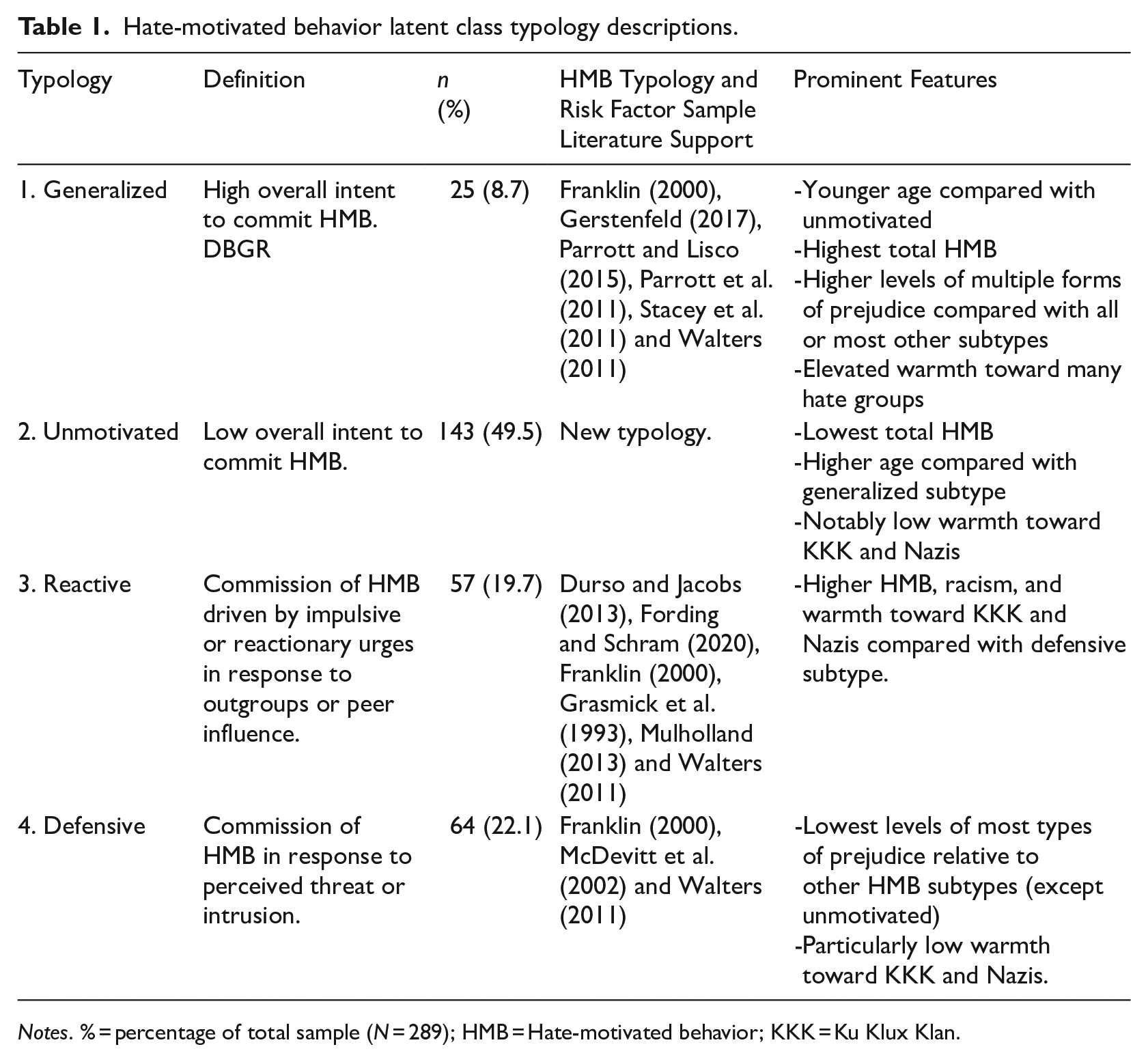
Notes. % = percentage of total sample (N = 289); HMB = Hate-motivated behavior; KKK = Ku Klux Klan.
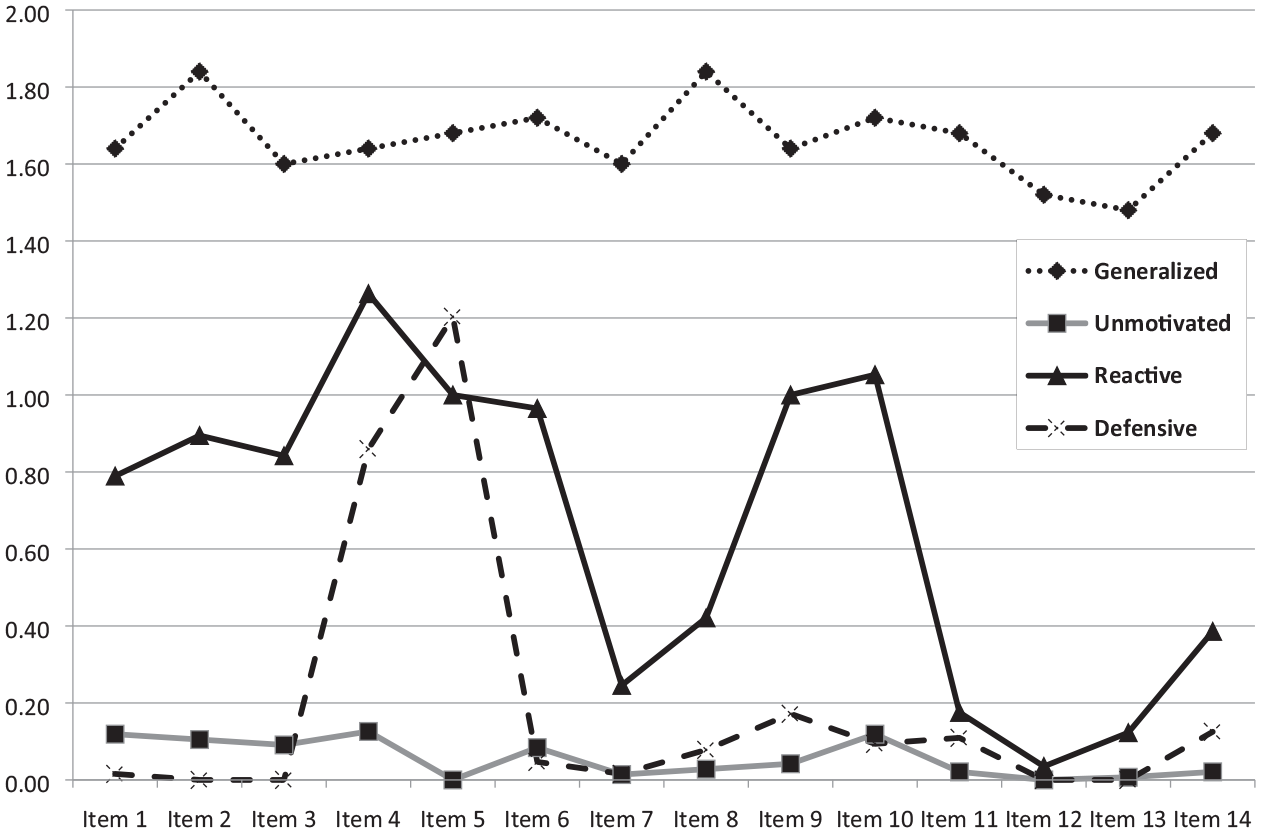
Hate-Motivated Behavior Checklist motivations item means by latent class.
RQ1: motivational subtype variation in individual differences
ANOVA results showed that motivational subtype was significantly associated with HMBC behaviors total score, age, all prejudice domains, and warmth toward the KKK, Westboro Baptist Church and Nazis. Non-significant effects were observed for American identity, minority identity, and warmth toward the Nation of Islam. Table 2 contains test statistics for these analyses. Table 3 contains descriptive statistics and demarcation of significant pairwise comparisons (with effect sizes). The major themes observed in these findings are as follows. First, compared with all other subtypes, the generalized subtype was characterized by higher HMB, anti-gay prejudice, anti-lesbian prejudice, anti-immigrant beliefs, and warmth toward the KKK and Nazis (large effects). The generalized subtype was further differentiated from the defensive subtype by elevated sexism, racism, and warmth toward the Westboro Baptist Church (large effects). The generalized subtype was additionally distinguished from the unmotivated subtype by younger age (large effect). Members of the reactive subtype were higher in HMB (large effect), racism, as well as warmth toward the KKK and Nazis (moderate effects), compared with the unmotivated subtype. The reactive and defensive subtypes were only differentiated by a moderate disparity in HMB, in which reactive persons were higher. Unfortunately, small cell sizes precluded examination of motivational subtypes by categorical demographics like race and gender. Relative to other typologies, the generalized subtype can be described by low age, high prejudice, escalated HMB, and strong affinity for several hate groups. Moreover, the reactive subtype is distinguished from the defensive subtype by higher qualities suggesting a theme of White supremacy or identity centrality (i.e. racism and affinity for the KKK and Nazis).
Analysis of variance model test statistics: motivational subtype by HMBC behaviors, age, social identity, prejudice, and warmth toward hate groups.
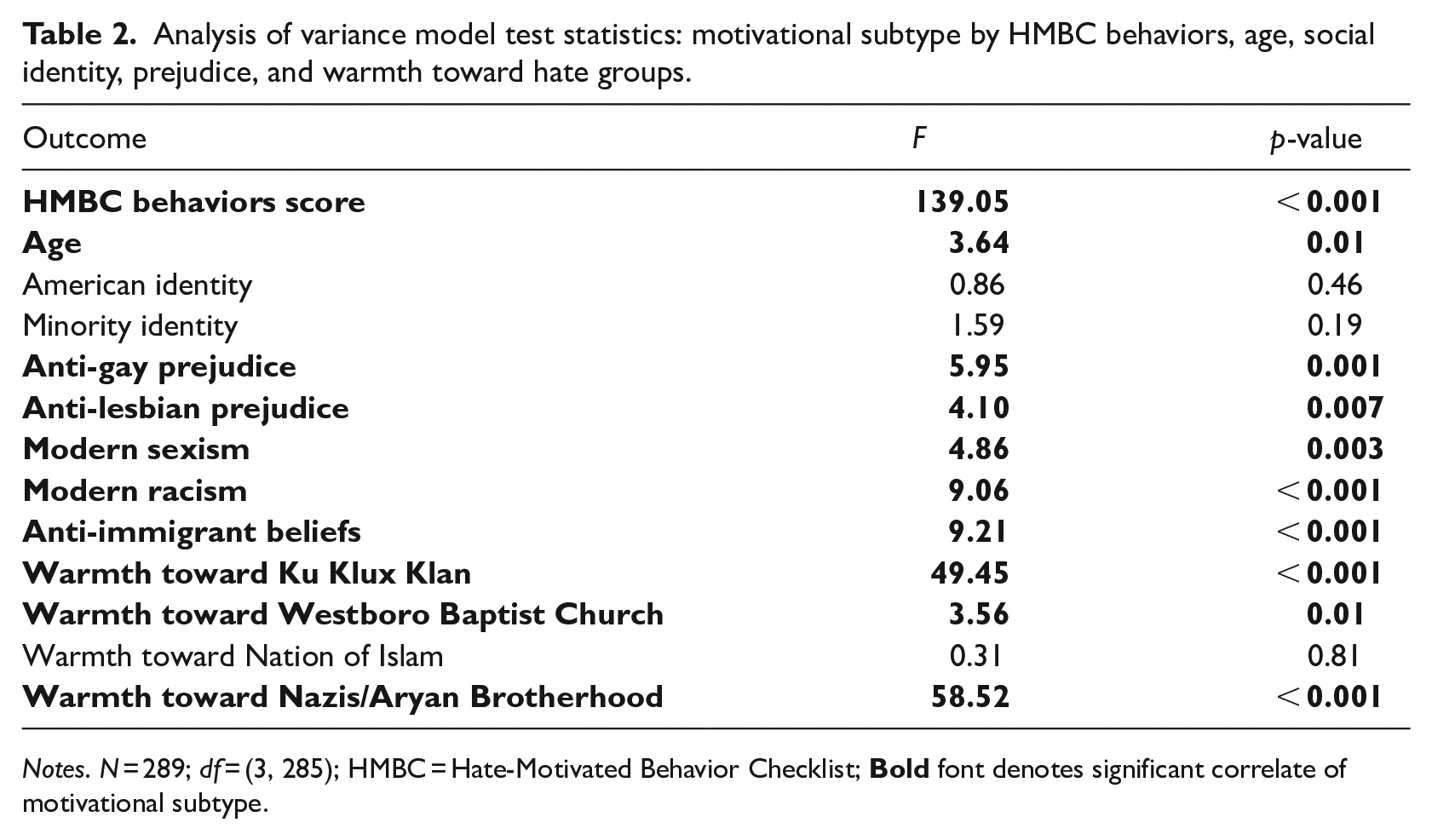
Notes. N = 289; df = (3, 285); HMBC = Hate-Motivated Behavior Checklist;
Motivational subtype post hoc comparisons of hate-motivated behavior, age, prejudice, and warmth toward hate groups.
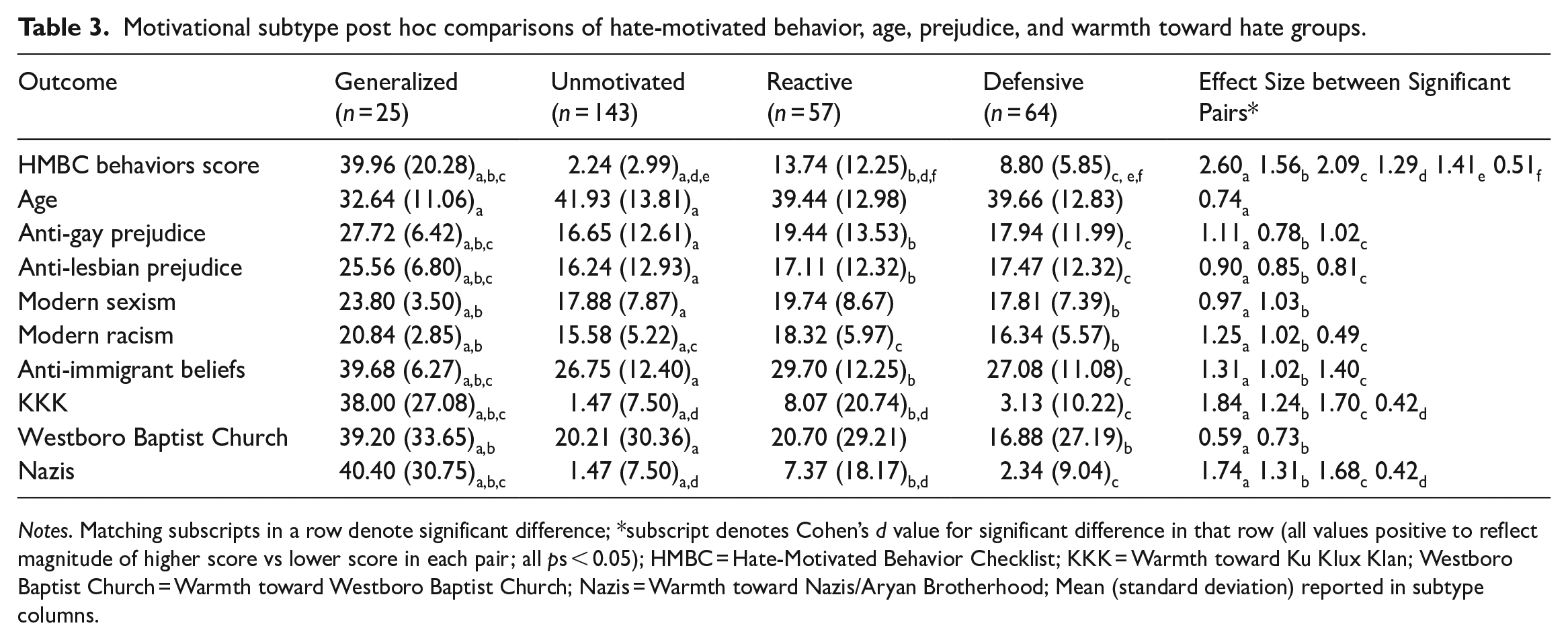
Notes. Matching subscripts in a row denote significant difference; *subscript denotes Cohen’s d value for significant difference in that row (all values positive to reflect magnitude of higher score vs lower score in each pair; all ps < 0.05); HMBC = Hate-Motivated Behavior Checklist; KKK = Warmth toward Ku Klux Klan; Westboro Baptist Church = Warmth toward Westboro Baptist Church; Nazis = Warmth toward Nazis/Aryan Brotherhood; Mean (standard deviation) reported in subtype columns.
Discussion
The primary purpose of our secondary HMBC analysis was to assess motivational subtypes observed through LCA. Four subtypes emerged: generalized, unmotivated, reactive, and defensive. Table 1 contains a summary of the four motivational subtypes. While the current typology does not perfectly match prior typologies identified in hate crime offenders (Levin and McDevitt, 1993; McDevitt et al., 2002), anti-gay behavior (Franklin, 2000), or theory-based criminological (Walters, 2011) literature, most HMB subtypes are supported by previous literature.
The generalized subtype, comprising a small proportion (less than 1 in 11) of the sample of community-dwelling adults, is high on all motivations. Likewise, this subtype self-reported the most HMB, and highest degrees of prejudice and affinity for hate groups. As such, elements of a prejudice-based subtype (Franklin, 2000) are evident, as well as support for prior literature linking young age (Gerstenfeld, 2017) and prejudice (e.g. Parrott et al., 2011; Parrott and Lisco, 2015) to the commission of HMB. Furthermore, Walters’ (2011) poor socialization subtype includes involvement in criminal behavior generally. More work needs to be done to assess correlates of the generalized subtype to test the premise that it may reflect general involvement in poor social, and frequent criminal, behavior.
The reactive subtype, making-up almost 1 in 5 of community-dwelling adults, appears to be driven by impulsive responses to outgroup or peer social influence. As such, elements of several existing typologies are evident such as Franklin’s (2000) peer dynamics, as well as Walters’ (2011) thrill-seeking and defending turf. Walters’ (2011) thrill-seeking subtype is particularly supported because of the role of racial prejudice in differentiating our reactive and defensive subtypes; the reactive subtype is characterized by modestly higher levels of racism, and support for White supremacist hate groups. While we cannot draw causal conclusions concerning the role of White supremacist ideology in HMB from these findings, they do add to a growing interdisciplinary literature highlighting the resurgence of White identity or supremacy in mainstream American society (e.g. Fording and Schram, 2020; Levchak and Levchak, 2020). Furthermore, following supposition in prior literature (e.g. Jacobs and Potter, 1997), the role of prejudice in HMB commission may be particularly strong within the reactive subtype; this supposition warrants further conceptual and empirical inquiry.
The defensive subtype we found, accounting for almost a quarter of adults, is congruent with the defensive subtype reported by McDevitt et al. (2002) and the self-defense type reported by Franklin (2000); all are marked by emphasis on reacting to perceived threat or intrusion. The function of the defensive subtype, responding to threats or intrusion from a foreign outgroup, aligns with intergroup threat literature (e.g. Chang et al., 2016). HMB may serve the purpose of dealing with perceived threats in a variety of ways ranging from demeaning (e.g. through jokes) or intimidating (e.g. making verbal threats) the perceived intruding group, to more violent acts against person or property. Given hateful acts may worsen as one’s ingroup identity strengthens (Costarelli, 2007), it is worth exploring the root and strength of differing identities (e.g. racial, religious) of the hateful actor driving this subtype.
The unmotivated subtype, composed of about half of the adult sample, is new to the literature. HMB is of relatively low frequency for this group. While the individual differences we assessed did not differentiate this subgroup in many meaningful ways, unmotivated individuals did possess notably low warmth toward hate groups. Further replication of this subtype is of particular importance because its very presence suggests a potential positive outcome: a trajectory characterized by low HMB. Additional exploration of individual differences that may describe this subtype would be of value in terms of identifying sources of intervention and prevention for the commission of HMB. Such examination of the unmotivated subtype could inform possible HMB protective factors such as altruism, perspective taking, psychological flexibility, and emotion regulation. In addition, it is important to note that as Chakraborti (2015) outlined, the current conceptualization of HMB may not be as inclusive as it could be. For example, HMB across minority groups or against a majority group continues to be relatively unexplored in the literature (Díaz-Faes and Pereda, 2022). As such, future research should replicate this particular subtype and may even suggest additional subtypes with a more inclusive view of HMB. We find it particularly important to further examine and replicate this subtype when contextualizing the timing of the current study’s data collection. The current sample was collected between December 2017 and January 2018, well before the Covid-19 pandemic took place. Acknowledging an increase, in particular anti-Asian HMB, during this time (Han et al., 2023), this warrants further examination of the developed typology. Another important societal change has been the increase and accessibility to hate speech through the Internet (Castaño-Pulgarín et al., 2021; Costello and Hawdon, 2020). This increase in access to hate speech and hate groups could result in an increase in potential HMBs and further typologies that gain their rise through digital world. As such, we would expect differences in the typologies between the current study and past findings.
Our refined understanding of HMB through typology and individual difference assessment points to several important implications and HMBC next steps. The first implication concerns further development of the HMBC, including typology replication to further ascertain no substantial overlap between the identified typologies. Confirmatory factor analytic work is needed for the HMBC in other community-dwelling (e.g. adult, college student, youth) samples. Furthermore, given the pressing nature of HMB as a public health problem (Cramer et al., 2021, 2023) it is imperative to test the properties of the HMBC as an assessment instrument in groups that may commit HMB with greater frequency and intensity. Future samples of interest include active and former hate group members, criminal offenders and gang members, and law enforcement and military personnel.
Our analyses to date also set the stage for translation of the HMBC into a HMB risk assessment instrument. Violence risk assessment research has benefited from the development of various structured professional judgment (SPJ) instruments in areas such as general interpersonal violence (Hart et al., 2016). We posit that, with additional assessment of HMB risk and protective factors, an SPJ instrument could be developed for HMB. Dunbar (2003) provided an initial step in this direction by articulating a Bias Motivation Profile, a four-item SPJ tool developed based on record review of offenders. This tool, however, lacks sufficient consideration of the various risk factors for the continuum of HMB. As a first step, perceived or evidence-based risk factors for prejudiced attitudes should be investigated to assess whether they apply to behavior and motivations. The HMBC and typology construct validity could be extended through evaluation of static and dynamic factors such as dual process model traits and attitudes (e.g. Sibley and Duckitt, 2008), mental health (e.g. Wallace, 2019), and alcohol use and aggression (e.g. Parrott, 2008). As such, the HMBC would be a starting point to develop a risk assessment tool that could widely be utilized. We call on researchers to further develop and refine the HMBC to expand its utility as a risk assessment tool for adult and potentially juvenile populations. We also urge researchers to further examine the construct validity of the HMBC and to rule out potential false positive rates.
An existing literature has found varying support for psychological, educational and other interventions for prejudiced attitudes (e.g. Berger et al., 2018; Grapin et al., 2019). Few studies have explored prevention efficacy for HMB (e.g. Levy and Levy, 2017). We surmise a starting point for public health and psychological interventions for HMB should begin with targeting common motivational subtypes and their associated characteristics (e.g. Franklin, 2000; McDevitt et al., 2002). For instance, existing evidence-based interventions for impulsive behaviors such as dialectical behavior therapy (Koerner and Dimeff, 2007) may be adapted to intervene with the thrill-seeking HMB, such as seen in the reactive subtype. Moreover, education and training for professionals interfacing with HMB perpetrators, namely case managers, law enforcement, mental health providers and prosecuting attorneys, should include educational content regarding existing evidence for and implications of motivational typology. Providing such training and educational sessions to increase inclusion and acceptance of diverse backgrounds, and holding HMB perpetrators accountable for their actions can result in the empowerment of victims of HMB. Translation of HMBC and broader scientific findings into practical solutions is an imperative next step to solving HMB.
The present study possesses several limitations. First, although HMB does occur frequently among a general sample of adults (Mason, 2005; Ray et al., 2004), our sampling strategy limits generalizability. Although Mturk has been found to be a reliable online data platform, the population from which we drew is generally less politically diverse and more educated than the general US population and may not pay as much attention to each question in comparison to traditional samples (Goodman et al., 2013). We employed several attention check items throughout the study, but we urge the reader to keep this in mind when interpreting our findings. We proffer a recommended next set of samples of interest above to expand on what is known about the HMBC and HMB motivational subtypes. Second, the cross-sectional nature of the data limit causal inference. We cannot, for instance, identify hate group affinity or prejudice as root causes of HMB. Implementing the HMBC as part of a larger study of youth and young adults to derive causal patterns of HMB and typology development may show promise in devising prevention and intervention strategies.
Footnotes
Acknowledgements
This work was supported by the Joyce and Aqueil Ahmad Endowment at the University of North Dakota awarded to the first author.

Data availability statement
The data that support the findings of this study are available from the corresponding author upon reasonable request.