




Abstract
The rapid growth in consumption of bottled water across the globe has drawn attention of policy makers and academicians alike. However, its consumption practices have been examined primarily in the context of industrialized countries. Drawing on studies of Science, Technology and Society, Public Understanding of Science, and institutions, this article explores the nuances of the consumption conundrum of bottled water in India. This mixed method study relies on data collected through surveys and ethnography of consumption practices at selected sites in Delhi. We find reasons for bottled water consumption to vary with the site of consumption. Although the notions of “purity” and “scarcity” drive consumption behavior, these attributes are far from being objective. Rather, they are shaped by a complex mix of sociocultural factors, public understanding of science, and trust on various institutional mechanisms of water provisioning.
Bottled water is one of the fastest growing sectors in the global non-alcoholic beverages market (Doria, 2006; Standage, 2005; Ward et al., 2009). 1 In the past few decades, its consumption has increased tremendously in many developing countries (Arnold, 2006; Doria, 2006; Gleick & Cooley, 2009), especially in Mexico, China, Brazil, and India (Arnold, 2006; Gleick, 2004). 2 The majority of academic studies on bottled water consumption, however, continue to pertain to developed countries (Chapelle, 2005; Dietrich, 2006; George, 1994; Gleick, 2004; Glennon, 2004; Jain, 1994; Mascha 2006; Race, 2012; Wilk, 2006), and studies on developing countries remain few and far between (Ahmad & Bajahlan, 2009; Baba, Erees, Hicsonmez, Cam, & Ozdilek, 2008; Feru, 2004; Jeena, Deepa, Rahiman, Shanthi, & Hatha, 2006). 3 These studies, drawing on diverse disciplinary backgrounds (e.g., anthropology, history, environmental studies, public health, and marketing), shed light on variability of consumption practices across countries and cultures. Our study, taking the case of Delhi, explores the nuances of the consumption conundrum of bottled water in an Indian metropolitan area. Drawing from studies in Science, Technology and Society (STS), Public Understanding of Science (PUS), and institutions, this article examines the importance of perceptions of purity and scarcity of drinking water, trusts on institutions, along with other socioeconomic factors behind bottled water consumption in a developing country context.
The practice of drinking water consumption and institutional (public/private/community owned) arrangements for drinking water provisioning significantly vary across national (developed/developing), geographical (temperate/tropical), and cultural contexts. The consumption practice of drinking water in developed countries can be more aptly termed as liquid consumption, comprising tea, coffee, juice, alcoholic beverages, soft drinks, and different categories of “drinking water”. 4 In tropical developing countries, on the other hand, “raw drinking water” remains a major form of fluid intake. 5 This difference in our view would have bearing on the reasons for consumption of bottled water, not discussed in the literature so far.
The official estimates suggest that rivers and ground water are the two major sources of water in Delhi (Planning Department [PD], 2009). However, both these sources suffer from serious chemical and microbial contamination (Centre for Science and Environment, 2003; Dasgupta, 2004; Lalwani, Dogra, Bhardwaj, Sharma, & Murty, 2006; Maria, 2008), making it a necessity to treat such water to make it drinkable. 6 The government-run Delhi Jal Board (DJB—water utility) is responsible for provisioning of drinking water in Delhi. Over time, scarcity of drinking water has become a major issue in Delhi, where large numbers of people remain outside the formal network (piped water connection) of DJB, who eventually have to rely on “other” institutional mechanisms to fulfil their drinking water needs (Harvey, 2012; Truelove, 2011). Quality of drinking water is often perceived to vary across these provisioning mechanisms. People’s perception of water “quality” and their trust on the “institutional mechanisms” thus plays a significant role in shaping the consumption practices. Moreover, with rapid urbanization and industrialization in developing countries, regulatory governance and environmental discourses are becoming central to everyday life. The discourses on science and science-based regulations are often argued to be embedded in sociocultural contexts (Dodds, Tseëlon, & Weitkamp, 2008). For instance, “value” people ascribe to “scientific claims” associated with technology or regulatory governance mechanisms may shape consumption practices in “modern” societies, “drinking water” in general, and bottled water in particular, being no exception. These “values,” in turn, are determined by a host of institutional factors and socially shaped perceptions. By highlighting the role of these factors in shaping consumption behavior, the article intends to contribute to the emerging set of literature within STS studies (Dodds et al., 2008; Eden, 2011; Foltz, 1999; Michael, 1998; Ormerod & Scott, 2013; Race, 2012), which engages with the multiple dynamics of consumption practices in everyday life. The study is exploratory in nature and employs both quantitative and qualitative techniques. The article is divided into five sections. The first section develops the conceptual framework, which is followed by data, sample description, and methodology in the second section; the third section reports the findings, the fourth and penultimate section discusses the key findings, and the final section presents the concluding remarks.
Bottled Water Consumption in India: A Bird’s Eye View
Unlike the developed Western nations, India has a shorter history of consumption of bottled water as an industrial product. Bisleri was one of the earliest bottled water firms established in India in the late 1960s. 7 The industry was almost dormant for the next 30 years, which registered rapid growth after the liberalization of Indian economy in the early 1990s (Bhushan, 2006). Until 2002, only 215 firms were licensed to manufacture packaged drinking water and 3 for natural mineral water (Government of India, 2001-2002); within few years it reached up to 1,283 firms in the packaged drinking water segment. 8 By 2010, 2,714 firms were manufacturing normal packaged drinking water and 18 natural mineral water (Bureau of Indian Standards, 2010). Currently, the industry is pegged at Indian rupees (INR) 28.4 billion (Eurobarometer, 2009). Despite the rapid growth, which has made it a top bottled water consuming country in the world, the per capita bottled water consumption in India remains less than 5 liters per year, much lower than the global average of 24 liters (Bhushan, 2006). The market structure of Indian bottled water sector is also quite unique. Overall, it is dominated by the big brands, such as Bisleri, Kinley, Aquafina, Kingfisher, and Himalayan (Eurobarometer, 2009), but a sizeable portion of the market is captured by small, local bottled water manufacturers. 9
Reasons for Bottled Water Consumption: Understanding the Notions of “Purity” and “Scarcity”
The Making of “Purity”
Though young as an industry, bottled water has a long history of consumption (Chapelle, 2005; Stickler, 1989). The earliest consumption of bottled water as a commercial product can be traced to Western Europe. During the 19th century, it was consumed as natural mineral water, primarily for healing purposes (George, 1994; Green & Green 1985; Stickler, 1989). Its consumption was confined to the elites and was often consumed to flaunt aristocracy (George, 1994). The earliest bottled water was produced at natural springs; the existing technologies of production and distribution were not convenient for its mass production (Chapelle, 2005). 10 Over time, the technologies for purification, packaging, and distribution of bottled water have evolved that led to an increase in the shelf life of water and it further paved the way for its mass production (Hawkins, 2011).
Studies in developed countries often cite suspicion over quality of tap water as a major reason for consumption of bottled water (Denehy, 2008). In a study conducted by the American Water Works Association Research Foundation, 47% people reported “worries” about safety was the main reason for consuming bottled water (DWRF, 1999 as cited in Doria, 2006). It is to be noted that in the United States, the standards set for tap water quality by the Environmental Protection Agency (EPA) are in many cases more stringent than the standards set for bottled water by the Food and Drug Administration (FDA; Arnold, 2006; Potera, 2002). It suggests that, people’s perception of water quality is not always in conformity with the “objectively defined standards” of quality adopted by regulatory bodies. Rather, “trust” on the “institutions” involved in water provisioning and regulation often acts as an important factor in influencing their choice of water. The perception of risk and suspicion toward drinking water supplied through specific “institutional arrangement” is shaped by the trust on those “institutional set ups” and is often believed to be influenced by socioeconomic and political attributes (Bickerstaff & Walker, 2003; Douglas 1992; Freudenburg & Pastor, 1992; Short, 1984). Ormerod and Scott (2013) argue that the cultural theory of risk maintains that social groups (or cultures) differ in their understanding of risk based on implicit differences in experience and identity; some risks are recognized while others are suppressed, depending on underlying assumptions, moral values, and ideas about order. (p. 354)
The public perception of risk is often influenced by the coverage of such issues in media (Belford, 2008; Marks, Kalaitzandonakes, Wilkins, & Zakharova, 2007) albeit in a nonlinear manner mediated by, once again, multiple socioeconomic parameters (Bhaduri & Sharma, 2012).
Often, subjective preference for taste is offered as a reason for bottled water consumption in North America (Belford, 2008; Doria, 2006; Foltz, 1999; Gleick, 2004). Some studies, however, suggest that people do not express clear preferences over bottled water in “blind testing” (Belford, 2008; Wilk, 2006). On the other hand, another set of studies points out that certain combinations of taste make bottled water more acceptable to consumers (Pomento, 2001). The absence of pungent smell of chlorine in tap water has also been cited as a reason for consumption of bottled water (Lambert, 1993; Pip, 2000). Foltz (1999) states that “there are two reasons for people to buy bottled water: What is in it and what is not in it. Europeans buy it for what is in it, Americans for what is not in it” (p. 302). In other words, Europeans tend to prefer mineral water, because of its mineral contents, whereas Americans tend to buy bottled water as it does not have the tang taste of chlorine in it.
We argue the issue of taste and perception of “quality” is significantly shaped by historical and cultural factors and holds meaning in only specific cultural contexts. For instance, in India, unlike the West European case where consumers pose higher trust on “spring water,” the public perception of water quality varies from place to place. Ground water is considered “best” for consumption by a large section of population in both urban and rural areas in developing countries (e.g., see Bakker, 2007). 11 It is considered as the “purest” form of water by people who trust on the “agency” of nature to provide good drinking water. They generally consume such water without any treatment or filtration. This phenomenon, however, is more visible in small cities and rural areas. Thus, the trust on the “naturalness” and “purity” of groundwater shapes their drinking water practices and also influences trust on specific institutional arrangements (such as private bore wells) for obtaining drinking water. On the other hand, many studies have elucidated that trust on bottled water as a pure and safe alternative to tap water is a crucial factor, which contributed to its growth (Grondin, Levallois, Morel, & Gingras, 1996; Lambert, 1993; Levallois, Grondin, & Gingras, 1999). In the United States, for instance, around 50% of consumers of bottled water believe that bottled water is safer and healthier than tap water (Potera, 2002). Many recent studies, however, challenge this belief, and argue that bottled water is no purer and safer than tap water (Doria, 2006; Wilk, 2006).
It appears that more than any objective facts, trust shapes people’s consumption of bottled water, by shaping their perception of purity and safety of drinking water alternatives. Trust is crucial in situations where individuals think they do not have personal control over the hazards they are exposed to (Glenn et al., 2012). Trust manifests in the form of belief, decision, or action. For example, the increasing reliance on “point of use” water filtration technology or bottled water connotes the “belief” and trust on these technological artifacts. Similarly, the suspicion over the quality of public water supply may imply a lack of trust on these modes of water provisioning. It is often argued that the choice of bottled water or reliance on water filtration technologies is guided by the marketing and advertisement power of the industry (Belford, 2008; Wilk, 2006). This line of argument undermines the importance of extra-market forces and regulatory structures, such as personal experiences, influence of peer groups, trust on science-based technologies, regulatory governance, and trust on various institutions (public/private) involved in supplying drinking water. 12
In the United States, bottled water consumption was also driven up because of its recognition as an alternative to other beverages at meal times (Foltz, 1999; Jain, 1994). Jain argues that (1994, p. 4) “the American big splash did not occur until the early 1980s, when the European way of drinking water; that is, at mealtimes or as a substitute for alcoholic beverages, was established among American consumers.” In a study of why people drink bottled water conducted by the American Water Works Association Research Foundation, 47% of the respondents claimed that they choose bottled water as an alternative to other drinks, particularly soft drinks (Doria, 2006). The soft drinks and other beverages are increasingly conceived as having a negative health impact and thus not suitable for a healthy lifestyle, contrarily bottled water is portrayed as a healthy alternative. This argument is also reiterated by the bottled water industry; one of the big players promotes bottled water as an alternative to other beverages and states that, “with the reality of today’s on-the-go lifestyle, 70% of what we drink comes in a bottle or a can. If you consider all the bottled beverages available for people to drink, it’s good they can simply choose a quality, calorie-free water in a bottle.” 13 Once again, this reiterates the specific cultural context of consumption and how issues of trust on science and technology, health benefits, and risk shape consumption of “pure” drinking water.
Situating Scarcity—Constructed or Real?
Studies on developing countries find the unavailability/scarcity of a public drinking water supply as an important reason (Llorente & Zerah, 2003) for bottled water consumption. Drawing on a small but evolving literature on manufactured scarcity of water (Johnston, 2003; Klink, Moriana, & García, 2000; Mehta, 2003, 2007), we argue that the rather simplistic understanding of scarcity needs to be critically analyzed. In Mehta’s (2001) words “there has been a tendency to direct attention to the lack of supply or availability of water due to natural forces rather than look at human induced practices and socio-political consideration” (p. 2025). The scarcity or unavailability is often created due to political or institutional choices or decisions (Johnston, 2003). In addition, we argue that the public perception of “water unavailability” needs to be understood in the context of site specificity of consumption. There is a common belief that people consume bottled water at those specific sites, where there is “unavailability” or “scarcity” of drinking water. We argue that the perception of “unavailability” is influenced by the socioeconomic background of the respondents and their perception of “safe drinking water.” For instance, availability of normal tap water is also often viewed as scarcity of “safe” drinking water, leading to bottled water consumption by specific groups. Thus, the perceived “scarcity” is very much subjective in nature and does not necessarily have an overlap with physical unavailability.
The Model
To study the consumption behavior, we have constructed three variables (a) reasons for bottled water consumption, (b) frequency of bottled water consumption, and (c) places where most frequently consumed. We have analyzed these reasons based on three sets of factors: (a) socioeconomic variables, (b) place of residence, and (c) people’s perception about water quality. The conceptual model employed in the article is presented through a schematic diagram (Figure 1).
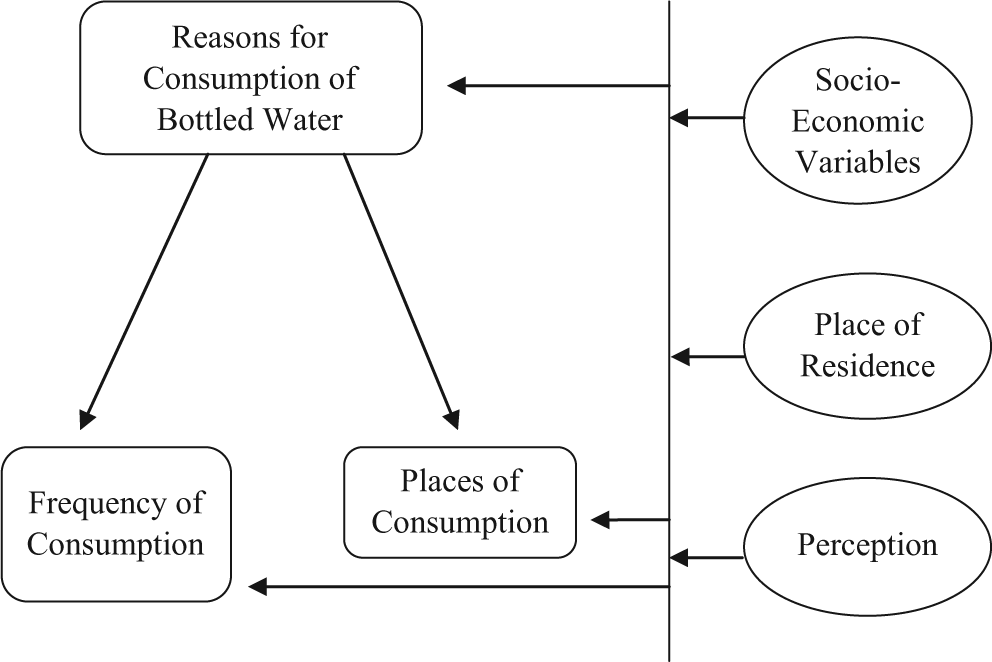
Schematic diagram of analytical model.
The article employed socioeconomic variables, such as, age, gender, educational qualifications, family income, and occupation (Abrahams, Hubbell, & Jordan, 2000; Drinking Water Inspectorate & M.E.L Research, 1996). The second crucial set of variables is related with place of stay. The urban and rural geographic divide has significantly come out in studies dealing with drinking water consumption patterns. In a study in the early 1970s in France, it was found that bottled water consumption was much higher in urban areas (Ferrier, 2001). Similarly, the perception about water quality is a significantly important factor shaping the consumption pattern of bottled water (Grondin et al., 1996; Lambert, 1993; Levallois et al., 1999) and is employed in the present study.
Data, Sample, and Methodology
The study incorporates both quantitative and qualitative methods (see, e.g., Bryman, 2006). For the quantitative analysis, we carried out a survey of 100 individuals in New Delhi, India. Before conducting the final survey, a pilot survey was conducted by interviewing around 30 people in Jawaharlal Nehru University campus, New Delhi. The locations for the interviews were selected keeping in mind places where a mixed group of individuals could be found. Accordingly, we chose one railway station, one market place, one government institute, and one higher education institute for the survey. Three of the responses were incomplete and thus dropped, and we continued with 97 responses (Table 1). To corroborate these findings, we also carried out an ethnographic analysis of this everyday phenomenon (Mintz, 1985) over the past 4 years (2008-2012) years. The study being exploratory in nature, we attempt to analyze the quantitative data in multiple ways. We use simple descriptive statistics and correlation coefficients as primary steps. Next, we attempt multiple regressions. We adopt the procedure of maximum likelihood estimation (MLE) of probit (and ordered probit) specifications. We use the statistical software STATA (Version 11) for our analysis.
Sample Description. a
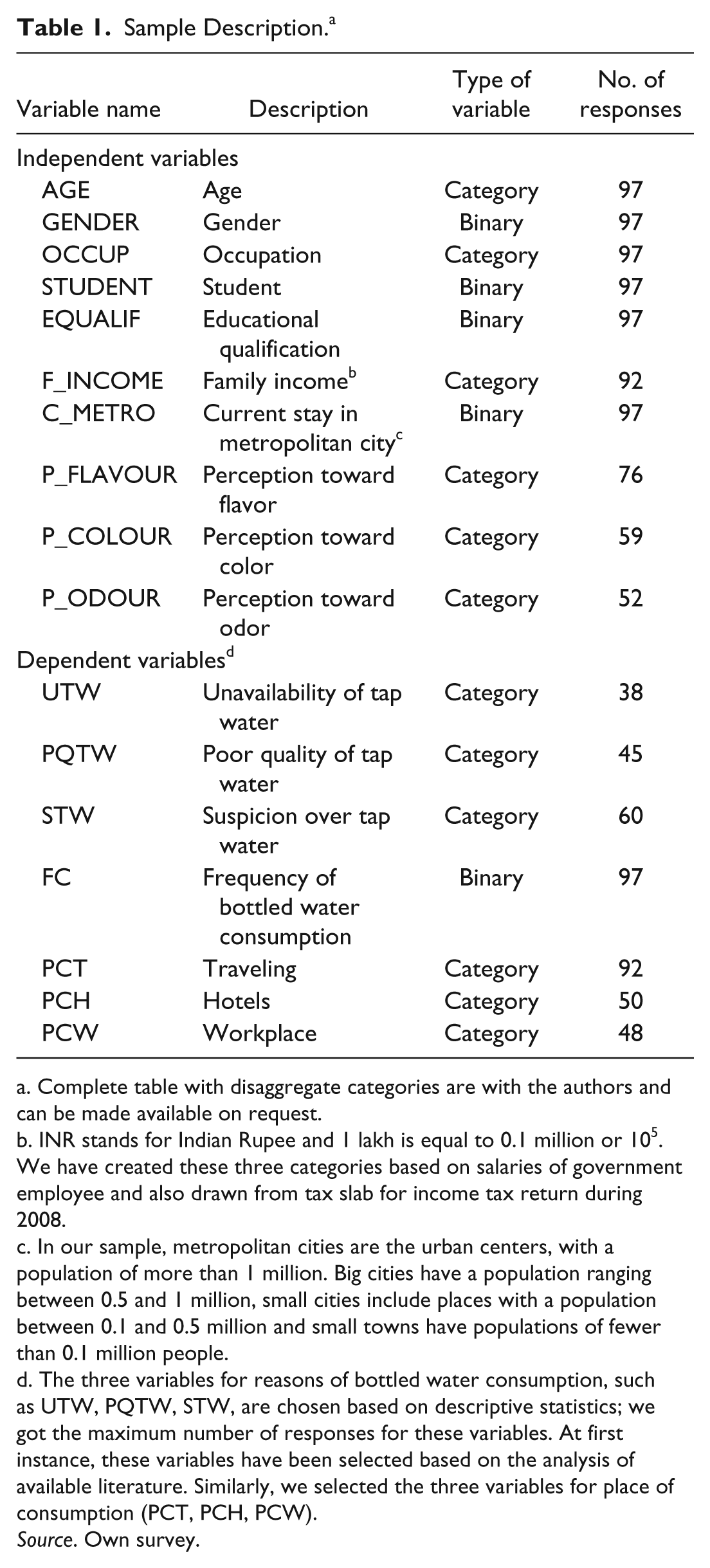
Complete table with disaggregate categories are with the authors and can be made available on request.
INR stands for Indian Rupee and 1 lakh is equal to 0.1 million or 105. We have created these three categories based on salaries of government employee and also drawn from tax slab for income tax return during 2008.
In our sample, metropolitan cities are the urban centers, with a population of more than 1 million. Big cities have a population ranging between 0.5 and 1 million, small cities include places with a population between 0.1 and 0.5 million and small towns have populations of fewer than 0.1 million people.
The three variables for reasons of bottled water consumption, such as UTW, PQTW, STW, are chosen based on descriptive statistics; we got the maximum number of responses for these variables. At first instance, these variables have been selected based on the analysis of available literature. Similarly, we selected the three variables for place of consumption (PCT, PCH, PCW).
Source. Own survey.
Findings
Model 1a shows that people from lower family incomes (F_INCOME), currently staying in nonmetro areas (C_METRO), and educational qualification (EQUALIF) up to graduation claim that unavailability of tap water is the most important reason for bottled water consumption (UTW). The results are significant at the 5%, 1%, and 10% levels, respectively. The Wald chi-square for the overall model is significant at the 5% level.
We also find that students (STUDENT) and people with high family income (F_INCOME) cite poor water quality of tap water (PQTW) as the primary reasons for consumption of bottled water (Model 1b, Table 2). The dummy variable used for place of stay (C_METRO), although insignificant, acts as a control variable. The results are significant at the 5% and 1% levels respectively. The Wald chi-square for the overall model is significant at the 5% level.
Reasons for Consumption of Bottled Water: Estimation of Model 1.

Note. UTW = unavailability of tap water; PQTW = poor quality of tap water; STW = Suspicion over tap water. t values are given in parentheses.
p < 0.10; **p < 0.05. ***p < 0.01.
Model 1c finds that people currently staying in metro areas (C_METRO) and those who give importance to color while analyzing water quality (P_COLOURALL) cite suspicion about quality of tap water (STW) as the major reason for consumption of bottled water. Family incomes (F_INCOME) do not have any significant effect, but act as a control variable. The results are significant at the 5% and 1% levels, respectively. The Wald chi-square for the overall model is significant at the 1% level.
In Model 2, we find that around one fourth (24%) of the respondents regularly consume bottled water. By regular consumption, we mean that their average consumption is above 60 liters per month. The estimation reveals (Model 2, Table 3) that people residing in metro areas (C_METRO), nonstudent (STUDENT), youth (AGE), male (GENDER), and those who cite unavailability of tap water (UTW) are the people who most frequently consume bottled water (FC). Our variable C_METRO is significant at the 5% level, STUDENT is significant at the 1% level, age (AGE) is negative and significant at the 1% level, gender (GENDER) is significant at the 5% level, and the variable capturing unavailability of water (UTW) is significant at the 5% level. The Wald chi-square for the overall model is significant at the 1% level.
Frequency of Consumption (FC) of Bottled Water Consumption: Estimation of Model 2.
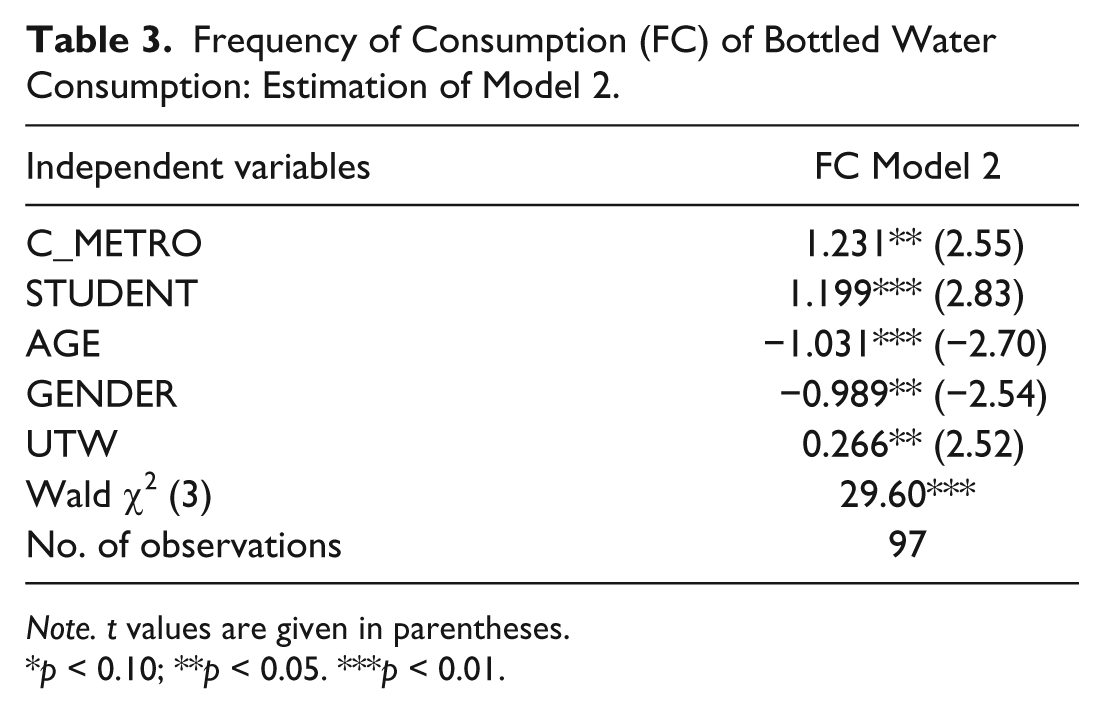
Note. t values are given in parentheses.
p < 0.10; **p < 0.05. ***p < 0.01.
Our survey results show that the three most important sites/occasions of bottled water consumptions are during traveling, at hotels, and at the workplace. Since it is an exploratory study and there is no priori conceptual framework to bank on, we carried out pair wise correlation analysis to explore the possible determinants of consumption behavior in these places.
We find a high correlation between people who consume bottled water because they consider tap water supply as of poor quality and those who consume bottled water because it is packaged and it tastes better. The pair wise correlation coefficients are positive and significant at the 1% and 10% levels. Similarly, people who consume bottled water because it is packaged also consume it because of its taste and convenience. The pair wise correlation coefficients are positive and significant at the 1% and 5% levels. People who consume bottled water because they consider it purer than other sources also consume because of its taste. The pair wise correlation coefficients are positive and significant at the 10% level. We accordingly, specified the models.
Model 3a (Table 4) estimation reveals that nonstudents and those who are suspicious of tap water quality (STW) are the people who consume bottled water mostly during traveling (PCT). People judging water quality by taste (TASTE) or people who think bottled water is pure because it is packaged (PACKAGED) are not the ones who prefer to consume bottled water during traveling. Our variable STUDENT is negative and significant at the 10% level, STW is significant at the 1% level, PACKAGED is significant at the 5% level, and TASTE is significant at the 10% level. The Wald chi-square for the overall model is significant at the 5% level.
Place of Consumption: Estimation of Model 3.

Note. STW = suspicion over tap water; PCH = people who consume bottled water in hotels; PCT = people who consume bottled water mostly during traveling; PCW = people who consume bottled water mostly at workplace; PQTW = poor quality of tap water. t values are given in parentheses.
p < 0.10; **p < 0.05. ***p < 0.01.
We found that people who are suspicious about the water quality of tap water (STW), who consider bottled water as purer than other sources of drinking water (PURERTHANOTHERS) and who consider tap water as of poor quality (PQTW) are the people who consume bottled water in hotels (PCH; Model 3b, Table 4). The results are significant at the 5%, 10%, and 5%, respectively. The Wald chi-square for the overall model is significant at the 5% level.
Model 3c reveals that younger people (AGE) who are currently staying in metro areas (C_METRO) and those who consider bottled water consumption as part of their life style (PARTOFLIFESTYLE) consume bottled water most frequently at the workplace. The results are significant at the 5%, 10%, and 1% levels, respectively. AGE and PARTOFLIFESTYLE have positive effects, whereas place of stay (C_METRO) has a negative effect. STUDENT is insignificant but acts as control variable. The Wald chi-square for the overall model is significant at the 1% level.
Discussion
Our study demonstrates that multiple factors influence bottled water consumption in Delhi (Table 5). Although, prima facie, the oft-quoted factors, such as “scarcity” and “suspicion” over quality of tap water do appear to play an important role, a deeper analysis is perhaps warranted to understand the nuances associated with them.
Correlation Matrix of Reasons for Consumption of Bottled Water.

Note. UTW = unavailability of tap water; PQTW = poor quality of tap water; STW = suspicion over tap water; PTO, purer than other sources of drinking water;
p < 0.10; **p < 0.05. ***p < 0.01.
People citing the unavailability of tap water as the most important reason for bottled water consumption are primarily coming from lower family income groups (annual family income less than INR 1 lakh), who have a low level of education and who mostly live in metro cities. These individuals depend on complementary water-provisioning mechanisms, such as illegal local piped-water network, own or community-owned boring, private and public water tankers, and commercial bottled water (Harvey, 2013). Zerah (2000) argued that bottled water consumption is restricted to the upper strata of society. Our study does not find such income-wise differences in frequency of consumption. Dutta, Chander, and Srivastava (2005) also reported that around 3.9% of households relied on bottled water to supplement the unreliable supply of public water in unplanned settlements of Delhi. 14 Although appearing “natural,” the reasons for this “scarcity” of drinking water in locations inhibited by the lower middle class population lie in “institutional failures.” This failure of the established public sector provisioning mechanisms compels certain sections of people to consume bottled water. To cater to this new “demands” from lower income families, many small, both registered and unregistered firms have popped up. This has been a major reason for the growth of the “bulk water segment” in this industry. Our fieldwork suggests that many of these firms do not often have a properly regulated, or approved, water treatment facility. However, the fact that this water is “treated” seems to be enough for their growing acceptance. Public perception here is not based on any formally communicated or scientifically validated source of knowledge, rather daily experiences seem to shape their perception and consumption behavior.
We found that poor quality of tap water was stated as the most important reason for bottled water consumption by people from higher family income groups and students. Unavailability of public supply is not the case with high income groups in Delhi. All the planned colonies in Delhi are “connected” by piped-water network (PD, 2009). It seems, therefore, that there is a suspicion about the quality of tap water supplied by the public utility. The suspicion over water quality is guided by several factors, such as, one’s prior experience of getting contaminated piped-water supply, role of media, increasing “awareness” about health-related issues, and lack of regulatory governance for ensuring specific “standards” for drinking water. Normally, piped water (from DJB) is supposed to be “safe,” but contamination is often reported due to old and corroded pipes. The mass media in Delhi has been particularly active in reporting such instances of contaminated water supply by public utilities. 15 In comparison, ironically, very few reports (with the exception of Centre for Science and Environment, 2003) have highlighted quality issues of bottled water in the media. There are no mandatory standards for drinking water quality (Lodhia, 2006; Sharma, 2012) and the quality standards followed by the public utility are not well publicized. Contrary to this, there are mandatory standards for bottled drinking water, and these specifications are more visible.
The social groups, which are more exposed to higher education and having higher income, are more suspicious of water quality supplied by the DJB. In general, less information is made available about water purification technologies employed by the public utilities. In contrast, the bottled water manufacturing firms readily publicize their “efficient” and “state of the art” water-purification technologies. One wonders whether this difference in the way public and private water provisioning agents make information, about their technologies, available in the public domain have a bearing in shaping suspicion over quality! Unfortunately, no studies, so far, have analyzed how people understand the various “scientific claims” made by the bottled water firms in India. 16
People currently staying in metropolitan cities and who impart higher value to sensory perceptions while perceiving the quality of tap water stated suspicion over tap water quality as the most important reason for bottled water consumption. The personal experience of getting contaminated supply from a public source acts as a strong factor for pushing bottled water consumption among people living in metropolitan cities. Note that in our study, we also interviewed people living in nonmetro areas. For them, it appears that the reasons for bottled water consumption are more diverse. Along with the poor quality of tap water, people also keep the convenience to carry water and purity of sources unfamiliar to them in mind while consuming bottled water. Our results showed that a sizable portion of our sample consume bottled water during travelling, which perhaps goes well with the fact that people, particularly those who live in smaller towns and villages, do not trust water from unfamiliar sources too much.
Analysis of the reasons for bottled water consumption in relation to amount and frequency of consumption reveals that the most frequent consumers of bottled water are people who are currently residing in metropolitan cities, nonstudent (i.e., working people), young in age and male. One fourth (around 24%) of the respondents claimed that they regularly consume bottled water. They also cite “unavailability” of tap water as an important reason for consumption of bottled water. If we critically analyze this case, we find that the young, working class males find bottled water as an important alternative to cope with the unreliable and intermittent supply from a piped-water network, which is a common phenomenon in Delhi (Truelove, 2011; Zerah, 2000). We argue it as a kind of “induced” scarcity because of the specific nature of water provisioning by the public utility. This category of respondents is ready to purchase water at a higher price for drinking purpose instead of relying on public supply as it fits better with their working life schedule and conforms to their drinking water habits at their workplace. 17 Moreover, interviews with young professionals revealed that many of the new office premises in Delhi provide primarily bottled water. Access to bottled water in offices may influence the decision of these people to consume the same at home.
The study found that the consumption of bottled water is significantly bounded by specific sites of consumption. The frequency of consumption was higher at a few sites and rare at others. The study found that people consume bottled water most frequently either while travelling or in hotels and at workplaces. The maximum numbers of respondents consume it while travelling. Employed people (nonstudents) and those who are suspicious about the tap water quality confirm that they consume bottled water mostly during travelling. However, neither the taste of bottled water nor the convenience of it “being packaged” (i.e., trust because it is packaged and safe from contamination) explain the reason for consumption among this group. But suspicion about the water quality of an alternate (unfamiliar) water source at public places/space outside home seems to be a major driver of consumption of bottled water in India. We found that a substantial number of people consume bottled water when they visit hotels and food joints. People who are suspicious about quality of tap water and consider it as of poor quality consume bottled water in hotels. Some respondents stated that, out of home, they always prefer bottled water. Once again, more than trust on the bottled water, it reflects the distrust in water supplied from public source. In recent years, many public places (e.g., railway stations, universities, major bus terminals, tourist places) in Delhi have installed water purifiers in their premises. This has perhaps strengthened the suspicion over the quality of piped water. 18 The “cultural” influence of preferences toward “raw drinking water” rather than “liquid consumption,” mentioned above, also has bearing on emergence of hotels and travelling as the sites where bottled water is most frequently consumed. Note that other beverages are easily available in these sites. The workplace emerged as the other crucial site of bottled water consumption. Younger people currently staying in metropolitan areas most frequently consume bottled water in their work places and consider it as part of their life style.
Conclusion
The study systematically examines the consumption of bottled water and shows variation in its pattern across sites of consumption. The study also reveals that the diverse institutional mechanisms (water supplied by public utility, informal private or community-based boring water supply, commercial bottled water) through which drinking water is “produced” and distributed shapes the public perception of “purity” of drinking water. We find an interesting interdependence between the notions of “unavailability,” “suspicion,” and “purity.” “Unavailability” of water, though implies physical scarcity, are not “natural” but outcomes of institutional arrangements. For individuals, especially belonging to the upper socioeconomic strata, unavailability also implies “suspicion” over “purity,” even when water is physically available. Perception of “purity,” in turn, is shaped by personal experience, mediated through media coverage, institutional representation of water purification technologies, cultural factors (distrust on unfamiliar water sources), and trust on “institutional mechanisms” involved in water provisioning, besides scientific claims. To conclude, we argue that bottled water consumption in India is shaped by a complex interplay of sociocultural factors, public understanding of science, and trust on institutional mechanisms involved in water provisioning.
Footnotes
Acknowledgements
The models were developed during our research stay at the Centre for Research in Economic Sociology and Innovation, which was supported by the University of Essex and the open-ended, Capacity Build-Up Fund by Jawaharlal Nehru University. An earlier version of this article was presented at the Symposium on Anthropology of Global Issues, held at the University of Delhi, India in April 2012 and at STEPS Summer School, hosted by the University of Sussex, United Kingdom in May 2012. The comments from Mark Harvey on an earlier version helped evolve the article into its current shape. We sincerely acknowledge the comments from Poonam Pandey, Susan Losh, and the anonymous reviewers of the journal.
Declaration of Conflicting Interests
The author(s) declared no potential conflicts of interest with respect to the research, authorship, and/or publication of this article.
Funding
The author(s) received no financial support for the research, authorship, and/or publication of this article.