



Abstract
In the context of technological dissemination sessions aimed at prospective students at the Polytechnic University of Baja California in the city of Mexicali, Baja California, the importance of engineering and its role in scientific and technological progress was stressed, as well as its role in scientific and technological progress as drivers of economic development in the region. A group of 2,154 students from 20 different institutions of public high school education answered a survey designed as an evaluation tool for a career path or technology area of interest. The survey results show that students have a low preference for engineering careers. Moreover, these results were augmented with an additional study on the high attrition of students in engineering schools in the city of Mexicali, Baja California, also conducted by the authors. It raises the importance of teaching science in the early education levels, which aims to prepare scientists and technologists needed for the development of research and innovation as a foundation for economic prosperity and welfare of an emerging economy such as Mexico.
Keywords
“Tell me and I forget, show me and I remember, involve me and I learn.”
Introduction
Disciplinary college training and high school average completion level in Mexico has some special points in epistemological and historical reflection in the basic disciplines: mathematics, science, and technology. They focus on deep technical details, but lack a comprehensive and accurate view of the general concept of science and technology, how they perform in today’s world, their social impact and relationships, or the history of science and technology (Vázquez, Acevedo, & Manassero, 2005). Training in these issues is even more critical when considering that a technologist, specializing in one particular technology, must become professor of the many and different technologies, received in his initial training, which are offered in the high school education curriculum.
Paradoxically, science and technology education has not been developed at the same rate as science and technology. The role that education plays in these two areas has been featured in the “Declaration on Science and the Use of Scientific Knowledge,” adopted at the World Conference on Science held in Budapest in 1999, in these terms: “It is urgent to renew, expand and diversify the basic education for all in the field of science, emphasizing the skills and scientific and technological knowledge to participate meaningfully in the society of the future” (UNESCO, 1999).
In most Latin American countries, the teaching of science and technology is intended to be among the priorities of education programs. Efforts and budgets have been devoted to improve the policies, curricular, teaching methods, and materials related to scientific disciplines as well as the training of specialized teachers, so they are up to date and interested in their professional mission. In this framework, well-educated teachers will have the natural motivation to teach in early education levels. As a consequence of this social environment, students will choose the fields of science and engineering. In recent decades, the scientific community has expressed great concern about the huge decrease in the number of male and female students who enroll in scientific and technological branches.
Science, Technology, and Innovation in Mexico
According to the National Development Plan (NPD) 2013–2018, a lag in the global knowledge market persists in Mexico. Some figures of the situation are revealing: The country’s contribution to global knowledge production is less than 1% of the total; for every 1,000 members of the economically active population, researchers represents about one-tenth of those observed in more advanced countries; and the number of graduated doctors per million of inhabitants (29.9) is insufficient for attaining the future human capital that the nation requires. International experience shows that it is convenient to invest in scientific research and experimental development at a rate greater than or equal to 1% of GDP. In Mexico, this figure reached 0.5% of GDP in 2012, representing the lowest level among the Organization for Economic Cooperation and Development (OECD) countries, and even less than the average for Latin American countries (Plan Nacional de Desarrollo [National Development Plan] 2013–2018) (Figure 1).
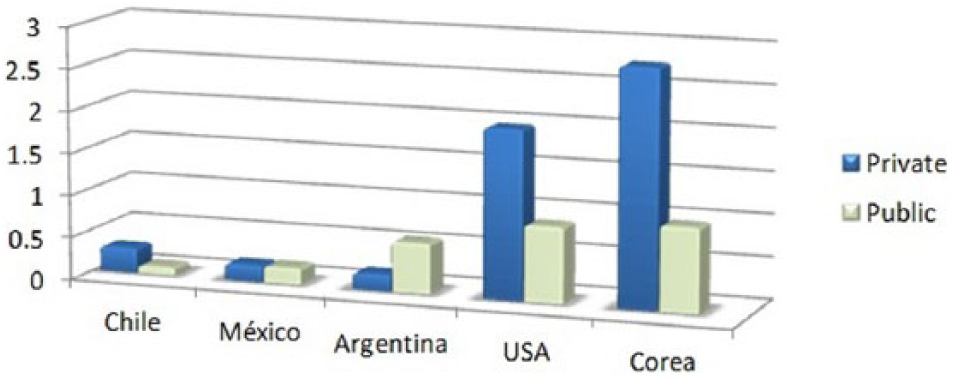
GDP investment in research and development.
The New Labor Paradigm
Unlike other generations, young people have on hand access to a wealth of information. However, they sometimes lack the tools or skills to process effectively and extract what is useful or important. Our young people need a clear path to be inserted into a productive life. Mexicans today must reply to a new paradigm where job opportunities are not only offered but sometimes need to be invented. The dynamics of technological advancement and globalization demand young people to be innovative. At this juncture, education must be closely linked to the research and the productive life of the country.
The nation as a whole must invest in activities and services that create added value in a sustainable way. In this regard, it should increase the level of public and private investment in science and technology as well as its effectiveness. The challenge is to make Mexico a dynamic and strengthened Knowledge Society (Plan Nacional de Desarrollo 2013–2018).
Current Status of Engineering in Mexico
In Mexico, the teaching of engineering suffers from deficiencies arising from underdevelopment itself. There is an emerging technology development and misunderstanding towards scientific research, due to the absence of a tradition of a true culture of engineering.
Education should promote the training of engineers not only to know how to use operations manuals more efficiently. Indeed, the aim is to clarify, within the limitations, which are the most important factors that influence the educational problem.
The level of engineering in Mexico is seen as below that of industrialized countries. There are many schools of engineering, but they suffer, to greater or lesser degree, the lack of resources for development, such as laboratory equipment and highly qualified staff. This is due, in part, to the situation of dependence on technology in our country. Emphasis will be placed on the need to update the plans and study programs in engineering to avoid the lag in the new registered progress (Rivera, 1990).
In the state of Baja California, located on the border with the United States, northwestern Mexico, 2,200 engineers graduate from public and private schools each year, but this does not satisfy the demand of the industrial plants in the region. Only 20% of the college students in the state are enrolled in some type of engineering (ANUIES [National Association of Universities and Institutions of Higher Education] 2011–2012). In Baja California, there are approximately 1,199 assembly plants that require a lot of engineers (Secretaría de desarrollo económico de Baja California 2014). Therefore, the demand is covered by engineers from other parts of the country.
Given the obvious need for engineers, the universities that offer these careers provide financial aid to students in order to supplement their tuition. The low attendance of students is related to the difficulty in learning mathematics that adds to the economic difficulties and student mobility.
The same situation is observed in schools that offer studies but on a technical level, but we must add other variants such as the idiosyncrasies of the parent seeking to have a child with a degree level, according to Unites States Agency for International Development (USAID 2014). In addition to this problem, the Faculties of Engineering are facing a high dropout rate that represents above 50% (ANUIES 2011–2012).
Dropout Basic Assumptions
ANUIES identified, in 2006, a list of problems within the higher education system in Mexico:
disruption of higher education system compared to previous educational levels,
persistence of high dropout rates and low efficiency, and
failure and little impact of policies to promote scientific and technological research.
The dropout at any educational level affects the student that leaves, as well as other members of the system: the student family, the institution (public and private), the economy of the country where this situation occurs, the productive sector, and so forth. Regarding the Mexican economy, the government spends about US$5,200 yearly for each student in college (Plan Nacional de Desarrollo 2007–2012), representing an investment larger than twice of what is invested on a high school student.
The National Development Plan 2007–2012 describes the following information regarding the average schooling at different educational levels. It is estimated that the average years of schooling among people between 15 to 24 years old are 9.7, implying completed basic education both primary and secondary. Unfortunately, students have low performance regarding reading, writing, and mathematics. For those students who study beyond the average level of education, only one in four young people between 18 and 22 years old reach the top level of educational coverage. It is considered that the low enrollment in higher education is due to backlogs and inefficiencies in the previous levels, poverty, and the institution’s own characteristics. On the other hand, 50% of students enroll in areas of social and administrative sciences, in contrast to the exact sciences, where some institutions have decreased enrollments.
However, the completion rate is between 53% and 63%, depending on the type of program. Reaching a higher level does not guarantee that the graduates will join the world of work, reflecting lack of involvement of higher education institutions in the labor market (USAID 2014).
Therefore, it is important to know how the condition in which senior students arrive at college is reflected in their previous academic experience and their personal interest in higher education studies (Plan Nacional de Desarrollo 2013–2018).
Didactics in Teaching Science as a Proposal to Improve Enrollment and Prevent Dropout in Engineering Careers
What is the Science, Technology, and Society (STS) movement? It emerged in the second half of the 20th century due to the convergence of various factors with the objective of a better understanding of the social and organizational dimension of science and technology.
Important factors are as follows:
the need to manage large industrial and military complexes such as the Manhattan Project during World War II and centers of research and development (R&D) associated with big science and high technology that emerged after WWII;
the appearance of a critical awareness of the risks and negative effects of science and technology: nuclear holocaust, environmental disasters, industrial accidents, and so forth;
the need to create institutions and training experts in science and technology and impact assessment of technology policy; and
the creation of research, especially from the perspective of the sociology of knowledge, challenging the traditional image of science and technology as an activity isolated from the social, political and economic context.
The STS in Education
Educational guidance of STS facilitates innovation in the curriculum of science and technology at all levels of education, in accordance with the new goals for science and technology education, and is required for the 21st century. For its effective implementation, it is necessary to change teaching practice, the role of the teacher, and learning strategies. The STS proposal is a field of study and research and, above all, an innovative general education proposal. From the first perspective, it is to understand better the science and technology in its social context, addressing the interrelationship between scientific and technological developments and social processes (Acevedo, 1997). As a general educational proposal, it is a radical new approach to the curriculum at all levels of education, in order to provide training and knowledge, especially in values that promote responsible citizenship and democratic participation in the evaluation and control of the social implications of science and technology.
The Teacher’s Role in Education STS
In STS modality, teachers not only have to communicate the objectives to be achieved, but must personally strive to lead by example. The teacher should also promote communication in the classroom, increasing students’ activity and autonomy (Waks, 1996).
The Curricula for Science, Technology, and Society
In traditional training there is a very large gap between the sciences and the humanities. However, in the new knowledge society in which we live, integrity of the individual’s professional development is essential. Therefore, it is necessary to bring all this expertise into an action that impacts the society.
The common denominator of the STS curriculum is to present science and technology integrated together in a social context. Its explicit objectives aim to overcome the drawbacks of traditional science education, such as the lack of students’ interest in science and technology; their low enrollment in these studies; and the marked inequality affecting different groups in many countries: women, less bright students, ethnic minorities, and so forth.
STS education focuses on students, not learning units, trying to facilitate the understanding of their experiences and phenomena that occur in everyday life, in ways that school learning is applied in technological and social environment, and provide them democratic participation in decision making on social issues related to science and technology. This general objective is focused on others as staff empowerment; development of intellectual skills; preparation for citizenship in local, national, and global levels; to make personal decisions, social and moral formation, and professionally responsible citizens in the community and work; and achieving more and better scientists and engineers.
STS education attempts to balance three types of objectives:
knowledge and learning skills for personal or cultural purposes;
processes of scientific and technological research; and
development of values for professional, public, and political issues, either local or global.
The common objectives of many STS programs are to
increase scientific and technological literacy of citizens;
generate science and technology interest in students;
promote social contextualization of scientific studies through the interactions between STS; and
help students improve critical thinking, logical reasoning, creative problem solving, and decision making.
The contents of STS education are usually selected based on two criteria: one focusing on relevant scientific and technological issues that affect society inspired by the pragmatic American tradition, and another on social and cultural aspects of science and technology, derived from the European academic tradition.
The former allows a better connection between student’s interests and the academy, but can lead to a partial and too specialized education due to its more specific nature. The second approach, more general, could provide students with a more comprehensive and durable structure, but it is far more often seen because it treats STS relations from the perspective of other disciplines such as philosophy, ethics, sociology, history, cultural, and economic aesthetic (Aikenhead & Ogawa, 2007). STS activities may contribute to these changes using the scheme of constructivist teaching-learning process (Figure 2).
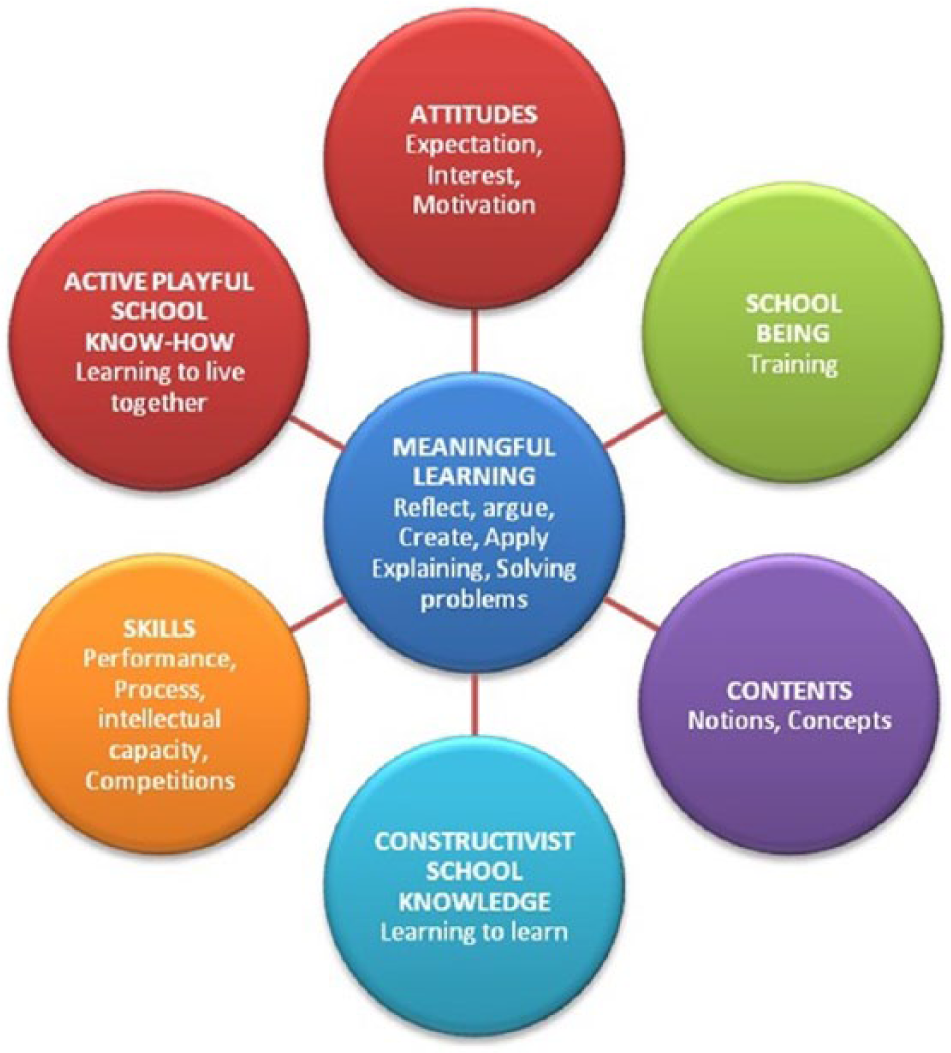
Schematic constructivist teaching-learning process.
Experiential Workshops
It is highly recommended to practice collaboration since this set of activities is important to human development, allowing the integrated formation of students in the STS approach: scientific and technological education, which aims to question the social nature of STS knowledge and its effects on different economic, social, environmental, and cultural fields (OEI, 2006). The recommended strategies to be applied include the use of information technology, allowing generation of a dynamic curriculum of science, such as the use of Moodle platform, educational websites, and so forth. Suggested topics for experiential workshops are
Industrial water pollution
AIDS-2000: AIDS vaccine
The school network
Roads and highways
The management of urban waste
Employment or automation
Method
During January to April 2012, a day of directed technological diffusion was held for students graduating from institutions of higher secondary education. The aim of this event was to show to high school students why they need to pursue a degree in engineering. Personal relations with teachers and other students, with minds open to technical innovations, will ensure success.
Along with this exercise, an exploratory study was conducted in order to understand the perception that students may have about their vocational preferences after graduating from high school. Twenty public high schools were covered and a total of 2,154 students were registered; a talk was given to students on the importance of engineering as a promoter of scientific and technological progress and the economic development of the region. At the end of the conference, a survey on a career preference, gender, or area of interest was handed over. From the population involved in the study, 1,158 students showed no interest in pursuing university studies in any engineering career, while 482 demonstrated interest. That is, only 22% of all registered students showed interest in a career in engineering. In addition, 21% omitted the data of interest and 3% were interested in more than one career (Figure 3).

Academic interest of students in higher secondary education.
On the other hand, women accounted for 53% of all students who registered and who are graduating from upper secondary education (Figure 4). From the group that is not interested in engineering, equivalent to 54% of students, 65% are women (Figure 5). Regarding the 22% of students who are interested in continuing their studies in the area of engineering, 69% are men and only 31% women (Figure 6). In contrast, women as new students arriving at the Polytechnic University of Baja California from 2010 to 2013 represented only 15% to 17%, still a gap.
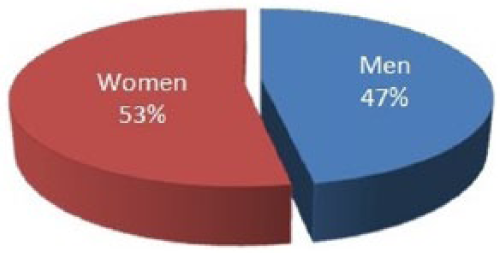
Students by gender.
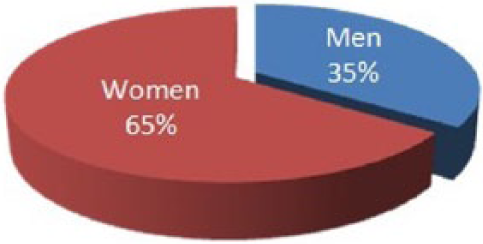
Students by gender not interested in engineering.
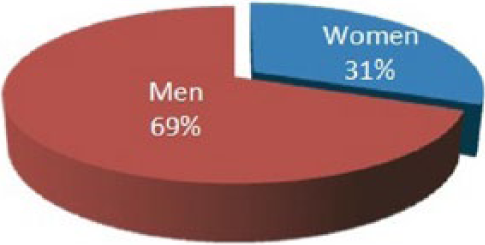
Students by gender interested in engineering.
As a reference, OECD education indicators from 2012 regarding the percentage of 15-year-old boys and girls planning a career in engineering or computing shows Mexico in third place just below Poland and Slovenia, where girls are 7.8% and boys 27.3%. When compared with results from this report, girls are close with 6.8%, but boys appear with a low value of 15.2% (Figure 7).
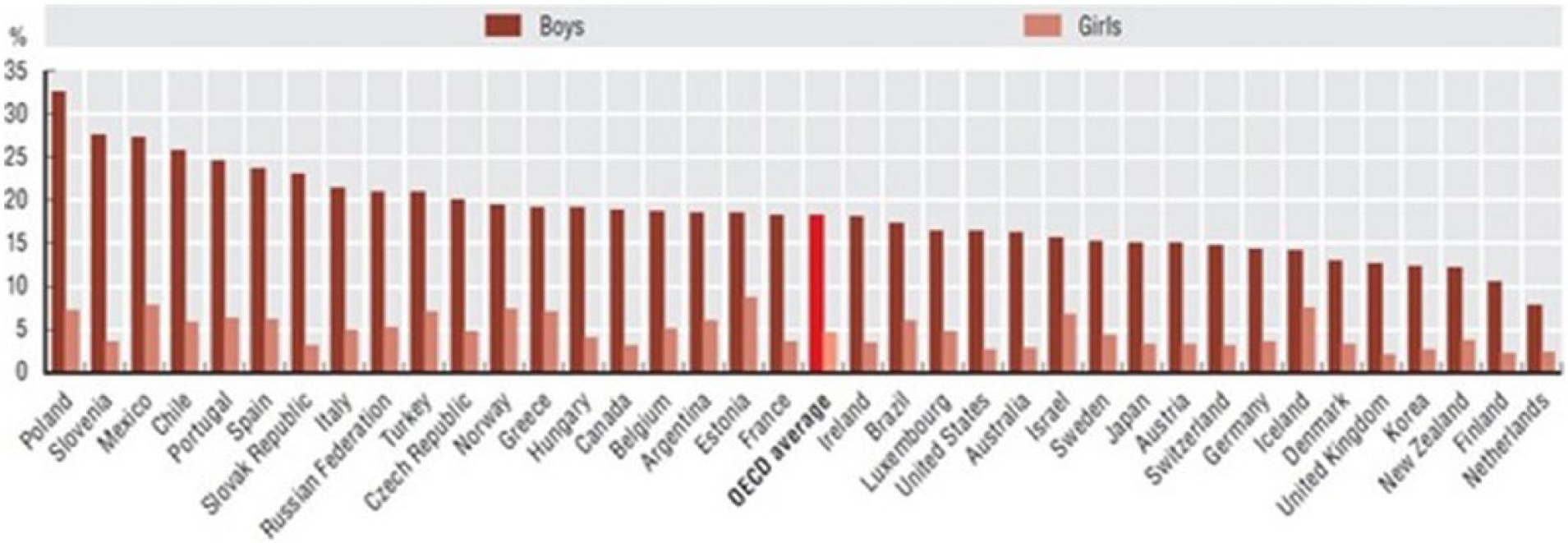
OECD percentage of 15-year-old boy and girls planning a career in engineering or computing.
Conclusions and Recommendations
The results of this exploratory study indicate that there is little interest from the next graduating class of high school students in continuing their studies in the field of engineering. It is necessary to offer them a scenario that allows them to deal with various ethical dilemmas they will have to decide. This experiment was reproduced in a learning environment through experiential workshops. As a result, we observed a stimulation of students’ reflective and critical attitude on various economic, political, social, and environmental issues. We also observed an attitudinal change brought by the dynamics of collaborative work that allowed them to implement values such as respect, tolerance, and solidarity among others.
Furthermore, it became evident that teachers need to be updated in the teaching of science based on STS. Therefore, informational and planning meetings were held among secondary education level and academic staff of the university. Free access information from the University of California, Berkeley (2012) was used and proved to be a good a source of STS training materials, guides, assessments, practice exercises, recommendations.
With regard to gender equity, there has been a greater presence of women in engineering professions than in previous generational cohorts. The percentage of women interested in engineering careers is low, considering that secondary education graduates are about the same amount of men and women (ANUIES 2011–2012).
As shown by other studies, women generally have a better academic performance in high school (Moran, 2012), and at higher education levels, they show greater motivation, discipline, persistence, and a varied use of learning strategies in careers that have traditionally been considered “unfit” for them (Duarte, Sevilla, Gutierrez, & Galaz, 2011).
Even now, in most OECD countries, fewer than 30% of women graduate in the fields of engineering, manufacturing, and construction. Not surprisingly, women are underrepresented in high-technology industries (OECD, 2012).
Hence, the importance of teaching science with an STS model; it is essential to foster of student interest in both genders in matters of science and technology as a priority for economic progress in the region and to promote a better quality of life for citizens.
Finally, we recommend the practice of experiential workshops using information technologies as a strategy for the generating of a dynamic curriculum of science by the discussion of hot topics such as pollution, advances in fighting diseases, infrastructure, genetics, industrial development, nano science, and ethics.
Footnotes
Declaration of Conflicting Interests
The author(s) declared no potential conflicts of interest with respect to the research, authorship, and/or publication of this article.
Funding
The author(s) received no financial support for the research, authorship, and/or publication of this article.