



Abstract
Understanding the intersections of science and publics has led to research on how diverse publics interpret scientific information and form positions on science-related issues. Research demonstrates that attitudes toward science, political and religious orientation, and other social factors affect adult interactions with science, which has implications for how adults influence K-12 STEM (science, technology, engineering, and mathematics) education. Based on a statewide survey of adults in Idaho (n = 407), a politically and religiously conservative western state, we demonstrate how attitudes toward science, measured through a composite measure “orientation toward science,” and other social factors are correlated with support for STEM education. Results show that “orientation toward science,” along with political orientation and respondents’ perceptions of feeling informed about science, predicts behavior intentions to support STEM education. Our findings suggest that a nuanced and localized approach to fostering support for K-12 STEM education would resonate with populations regardless of political orientation, and they illuminate new ways of thinking about how political orientation more generally impacts thinking about science in the context of complicated “socio-scientific relations.” In exploring how people think about science in a politically and religiously conservative state, we provide insights on potential outcomes in other states, should conservative ideology spread. We argue that the publics’ relationship with science and, by extension, support for science education, is more fluid, as many of us suspect, than ideological polemics suggest.
Keywords
Introduction
The complex intersections of science and the public, or “publics” in consideration of the “different sections of the modern public,” are beset with many ongoing challenges (Bauer, 2014, p. 3; Gehrke, 2014; Irwin, 2014). Scholars have pointed to problematic levels of public scientific literacy (Sturgis & Allum, 2004), politicized processes involving scientific research, funding, applications, and policy formation which potentially alienate citizens (Irwin, 2014; Wynne, 2014), and an ongoing legitimacy problem for science in the United States (Bak, 2001; Gauchat, 2010, 2012; Nisbet & Scheufele, 2009). Recent scholarship recognizes that the dissemination of scientific knowledge is a factor in all of these challenges but also that citizens actively seek out, question, and interpret scientific information to which they are exposed. Attitudes toward science, political orientation, and religious orientation are among the variables that affect how people interpret scientific information, how they think about science, and, importantly, how they form positions on science-related issues (Gauchat, 2012; Pardo & Calvo, 2008; Steel, Lach, & Satyal, 2006; Wood & Vedlitz, 2007; Zia & Todd, 2010).
Embedded in those intersections of the publics and science are a variety of state and national initiatives and a wide range of policies and pedagogical innovations implemented to improve outcomes in K-12 STEM (science, technology, engineering, and mathematics) education (Cannady, Greenwald, & Harris, 2014; Johnson, Rochkind, & Ott, 2010; Kaya & Lundeen, 2010; Losh, 2014; Smith, Pasero, & McKenna, 2014). Our research focuses on which variables in the research mentioned above affect citizen support for STEM education opportunities in local schools. A focus on K-12 is particularly important because local citizens, legislators and policy-makers directly shape public education at the district and state levels.
In exploring the intersection of the publics’ relationship with science and K-12 STEM education, we examine responses from a statewide survey of Idaho residents. We demonstrate how attitudes toward science, measured through a composite measure we call Orientation Toward Science, and other social factors are correlated with behavior intentions, measured through an index related to funding, to support K-12 STEM education. We ask,
Does a person’s orientation toward science predict intention to support STEM education policy?
Does orientation toward science improve our understanding of and ability to predict support for STEM education policy over demographic and social factors alone?
This article adds to the understanding of how adult attitudes toward science and political orientation shape thinking about science-related issues and particularly in relationship to K-12 science education. Our findings suggest that a more nuanced and localized approach to fostering support for K-12 STEM education would resonate with populations regardless of political orientation, and they illuminate new ways of thinking about how political orientation more generally affects thinking about science in the context of complicated “socio-scientific relations” (Irwin, 2014, p. 74). In exploring how people think about science in a politically and religiously conservative state, we provide insights on potential outcomes in other states should conservative ideology spread. We find effects similar to other researchers, but our findings also indicate that the publics’ relationship with science and, by extension, support for science education, is more fluid, as many of us suspect, than ideological polemics suggest. This gives both caution and opportunity as various interested coalitions vie in the cultural negotiation of publics–science relations in the United States.
Literature Context
For decades, the publics’ relationship with science has been viewed as the consequence of a gap in knowledge between the general public and the scientific community, that is, the “deficit model.” As the relationship has been more thoroughly problematized, research has turned more generally to the social process of negotiating the integration of science and technology in a democracy. In an anthropological sense, this social process constitutes cultural negotiation, and the politics of using information, of course, remains an ongoing dynamic in the negotiation. Scientists and institutions supporting and applying scientific knowledge have the lion’s share of power to define science-technology issues and direct agendas for research and application, though the agendas often meet personal or public resistance when they do not resonate with the interests of various individuals or publics (Wynne, 1991, 2014).
The emerging challenge is one of how to most effectively cultivate publics–science relations such that, on one hand, various “publics” access and integrate scientific knowledge while adapting to the changes it brings, and, on the other hand, citizens collectively and democratically participate in how knowledge is cultivated and applied. K-12 STEM education plays a key role on many levels in negotiating science-public relations through its broader citizenship aims and in building the expertise necessary for STEM-based roles in research and application. However the negotiations play out, it has become clear that the “‘wicked’ problems of science governance” (Sturgis, 2014, p. 38) involve how the publics think about science—interpretations of scientific knowledge and the process through which it is integrated, or not, into their worldviews and decision-making. Thus, the factors that have been identified as shaping adult interactions with science, such as political orientation and attitudes toward science, need to be better understood for their effects on STEM education. Understanding how publics interpret and integrate science information into their worldview involves multiple considerations. Researchers have explored how people seek, interpret, and use scientific information, how they make sense of science–technology issues, how to best communicate with and involve the publics, and the politicized role of science and political institutions in defining “issues”—with the publics’ often public or personal resistance to those issues (Wynne, 1991, 2014).
Actual levels of scientific knowledge among citizens, their effects on integration of new knowledge, and how knowledge levels affect evaluation of and stances taken toward science-related public issues continue to be a concern (Bauer, Petkova, & Boyadjieva, 2000; Wood & Vedlitz, 2007). However, Jasanoff (2014) points out that people who want information will find it, and they are remarkably adept at processing it when motivated, but, when people are exposed to new information, a wide array of conditions shape how they develop their understanding of scientific information (Groffman et al., 2010; Irwin, 2014; Jasanoff, 2014; Mikulak, 2011; Nisbet & Scheufele, 2009; Sturgis, 2014; Wynne, 2014). Such conditions include that people are cognitive misers (Nisbet & Scheufele, 2009; Pardo & Calvo, 2008), they seek to avoid cognitive dissonance in processing information (Zia & Todd, 2010), they filter information to preserve stability in their worldview (Wood & Vedlitz, 2007), they question information that may be a threat to their way of life (Wynne, 1991), and they are particularly sensitive to certain controversial or polarizing science-technology issues, (Bak, 2001; Binder, Cacciatore, Scheufele, Shaw, & Corley, 2012; Pardo & Calvo, 2008).
Attitudes toward science in particular shape how people interpret information, how they integrate it into their worldview, and how they apply it to understanding controversial scientific topics and science-technology applications and policy. Attitudes and their interaction with social factors have typically been examined to explain changes over time in a population or how attitudes toward science and trust are correlated with people’s interpretation of certain science-technology issues toward the ends of informing educational efforts or improving science communication (e.g., Gauchat, 2012; Groffman et al., 2010; Nisbet & Goidel, 2007; Wiederhold, 2011; Wood & Vedlitz, 2007; Zia & Todd, 2010). For example, Wood and Vedlitz examined how people’s “values, culture, and ideological predispositions affect” how they “define an issue” and form a stance on global warming (2007: 552-53). In exploring “components” or “base factors” of information-processing filters, they found that social and political contexts—including one’s political ideology, religion, and demographic background—affect attitudes toward science, which, in turn, affect judgment about specific science–technology issues.
Similarly, Steel et al. (2006) studied policy actors’ political ideology and its effects on their views of science and scientists and found a relationship between their ideology and perceptions. Zia and Todd (2010) found that political ideology also affects people’s attitudes and how they interpret scientific information related to particular public science–technology issues. In the context of STEM education, Verhey (2005) argues that the research on “effective evolution pedagogy” establishes that “students arrive in classrooms with deeply held (if sometimes erroneous) ideas based on their prior learning about various topics” that they “must ‘unlearn’ before they can learn . . . or the new information is at risk of failing to be incorporated in the student’s worldview” (p. 997, citing Bransford, Brown, & Cocking, 2000). Along these lines, Miller (2004) argues that the level of formal education matters in people’s attitudes toward science (though not all agree that education levels are correlated with attitudes), leading to his recommendation of “at least a year” of college-level science courses (p. 290).
While college education is a key area for the publics to encounter scientific information, most citizens in the United States have their first opportunity to systematically encounter scientific knowledge in K-12 public education. Improving STEM education is a vital aspect of negotiating the publics’ relationship with science, and attitudes toward science on the part of adults is one neglected aspect in understanding how to potentially improve K-12 STEM education. Much work has been done to understand children’s attitudes, with occasional attempts to include measures of adults or parents (e.g., see Archer et al., 2012), but linking publics’ science attitudes to K-12 STEM education is rare. We demonstrate that the publics’ relationship with science and their attitudes toward science affects general support for STEM education and, notably, in the conservative state of Idaho.
The Politics and Educational Context of Idaho
Idaho, a largely rural state with agriculture, forestry, and mining as its economic base, ranks 39th in U.S. population size (1,567,582) and 46th in population density. Idaho is also the most religiously conservative state in the western United States, outside of Utah, based on a number of indicators, including belief in God, importance of religion to their life, religious attendance, frequency of prayer, literal interpretation of scriptures, and interpretation of religious teachings (Pew Forum on Religion & Public Life, 2008, pp. 159-166). The state as a whole is politically conservative, with only 7 of the 35 districts represented by Democratic senators and 13 out of 70 representatives from the Democratic Party. The dominance of the Republican Party in Idaho’s politics places the state at number seven in the United States, and tied with Utah (and just behind Wyoming) in the western region (Gallup, 2012). The broad appeal of the Republican Party to Idahoans lies in their cultural affinity toward individualism, a political belief with deep historical roots that the Party has successfully mobilized (see, e.g., Blank, 1988; Stapilus, 2009). Idaho’s conservative tendencies provide an interesting case study as research demonstrates that in the United States over the past few decades self-identified political and religious conservatives have tended to develop negative attitudes toward science and scientists (Gauchat, 2012).
Similar to states across the nation, K-12 STEM outcomes in Idaho are less than ideal. In 2011, barely a third of Idaho’s eighth graders performed at or above proficiency in math (37%) and science (38%) (National Science Board, 2014). These proficiencies are above the national average for math (34%) and science (31%), but they are lower than other states in the region with similar population densities and levels of rural residents (e.g., Montana, North Dakota, South Dakota though equal to those of Wyoming; National Science Board, 2014). Given the economic challenges of providing K-12 public education in general, improving STEM education specifically will likely require increased funding or trade-offs with other educational aspects.
Like other states across the nation attempting to raise sufficient funding, voters in Idaho have been asked to support school budget referenda options generally through school levies. In Idaho, a simple majority of residents voting in favor is required to approve a supplemental levy. The number of districts using levies increased in 2000 with over two thirds of 115 public school districts relying on them (Ferguson, 2012: 13). In general, Idahoans are willing to tax themselves to fund education in their district, but, in recent examples, approximately a third of Idahoans did not support school levies, and, further, few of the levies were written to raise the ideal amount of funds.
Methods and Results
Survey and Sample Design
The Idaho statewide survey was designed to explore themes such as public support for STEM education and public attitudes and perceptions about science, scientists, and STEM education. Interviews were conducted in the fall of 2011 via telephone, and lasted 22 minutes on average. We sampled the state through random digit dial of phone numbers, both household landlines (900) and wireless phone numbers (1500), with a total of 407 completed phone interviews. 1 The final response rate was 22.5% (407/1806), which was calculated after removing total disconnects (499) and ineligibles (95) from the total number of phone numbers in the sampling frame. The cooperation rate (the proportion of interviews conducted from all eligible units actually contacted) was 59.2%, and the refusal rate was 14.5% (American Association for Public Opinion Research, 2011, p. 46). Data were weighted to account for the unequal probabilities of being sampled due to household type (wireless, landline, or both), and this weighting also helped to balance differences in demographics among household types, such as age. Data analysis described below was conducted using Stata/SE 14.0.
Orientation Toward Science Measure
A number of ways have been developed to measure various facets of attitudes toward science. Some facets relevant to the current study include measuring attitudes toward science in general, for example, expectations and benefits, and attitudes toward specific issues, for example, climate change and GMOs (Bak, 2001; Miller, 2004; Pardo & Calvo, 2008; Roberts, Reid, Schroeder, & Norris, 2013), trust in science including elements of “fair play” and “confidence” (Pardo & Calvo, 2008) and considering individual scientists, the scientific process (Miller, 2004) and the institutions of science (Sturgis & Allum, 2004), and perspectives on the nature of science—or the “process of scientific inquiry” (Stocklmayer & Bryant, 2012: 83; see also Bauer et al., 2000, Steel et al., 2006). Attitudes toward science are typically correlated with a variety of demographic and “worldview” variables.
Differentiating attitudes and trust is complicated. For example, Bauer et al. (2000, p. 47) developed questions for knowledge and attitude measures that both could be seen to capture elements of trust such as “The reward of scientific research is recognition rather than money,” though they argue trust is most closely related to their questions on knowledge about the institution of science. Pardo and Calvo (2008) look to two facets of attitudes toward science, including a “perception of beneficial effects” and of “undesired effects” in their research on how attitudes effect positions on climate change. Like Miller (2004) and Pardo and Calvo (2008), Bak (2001) explores two aspects of attitude: general attitudes toward science and attitude regarding specific, controversial areas. Interested in the relationship between ideology and “orientations toward science and scientists,” Steel et al. (2006, p. 485) use a series of five questions to measure “orientations” in collecting original data from stakeholders in the Pacific Northwest United States involved in environmental and natural resource management. Their questions, in comparison to others’ research, cover measures of the nature of science (“Science provides objective knowledge about the world”), understanding in a particular area of scientific application (natural resource management), and trust, in both senses, for instance, discussed by Pardo and Calvo (2008).
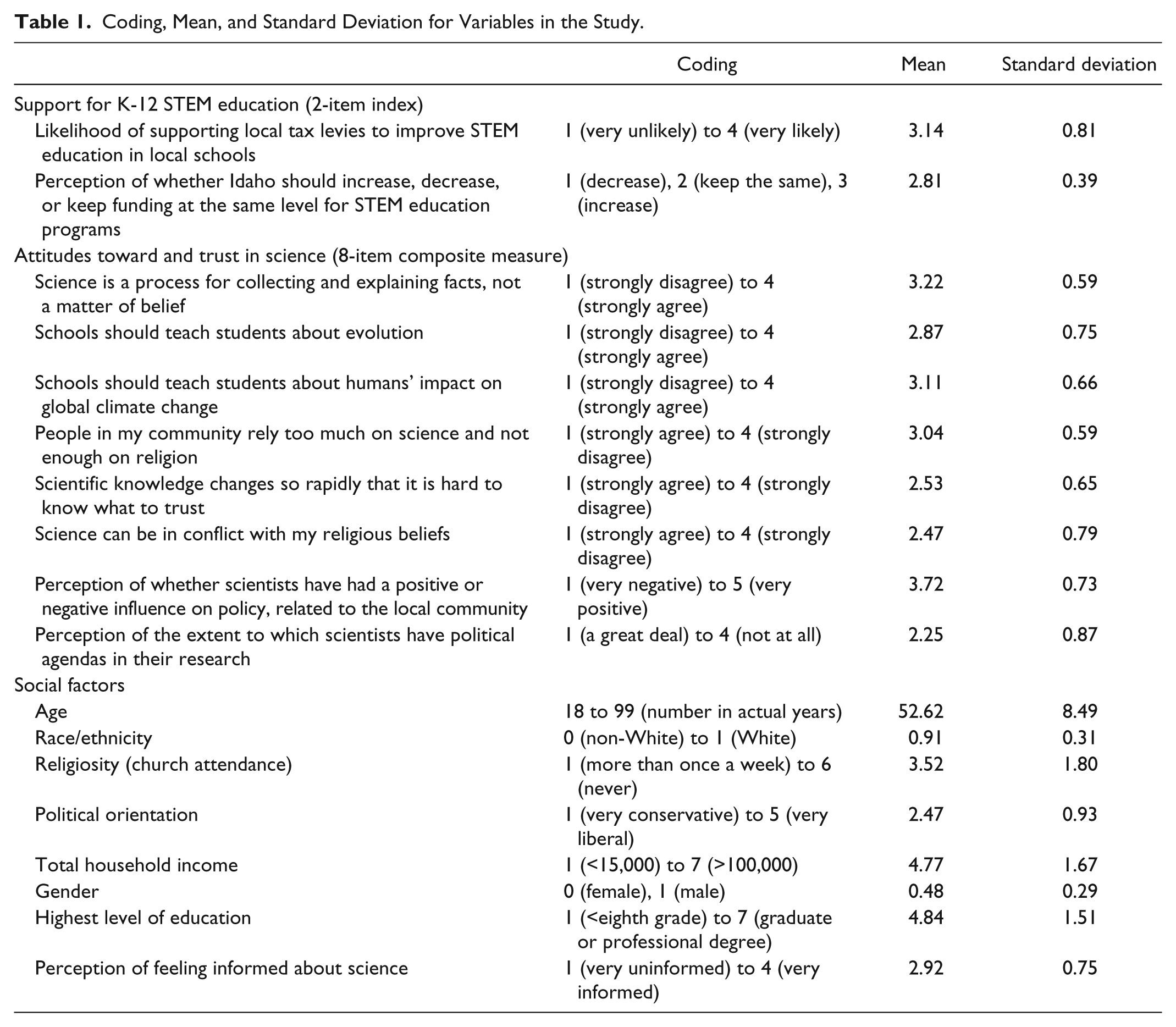
Drawing and adapting questions used in these studies and the Pew General Public Science Survey, we use an enhanced measure Orientation Toward Science. This composite measure includes eight survey items that measure respondents’ endorsement of science as a legitimate way of knowing, trust in science, attitudes toward science and scientists, expectations about how science should function in their schools and communities, and how respondents integrate scientific knowledge into their own worldview (refer to Appendix A for specific wording of the eight questions). Items were reverse coded as necessary so higher scores would indicate a more trusting and pro-science orientation. All items were centered prior to analysis. The standardized Cronbach alpha for this scale was .63. (See Table 1 for coding, mean, and standard deviation for individual items, as well as all other variables used in the study.)
Coding, Mean, and Standard Deviation for Variables in the Study.
Behavioral Intentions to Support K-12 STEM Education Policy
The survey included two items that measured behavioral intentions regarding K-12 STEM education. Specifically, respondents were asked to report their willingness to support a local tax levy to fund STEM education. Participants responded using a 4-point scale indicating agreement (strongly agree” to “strongly disagree”). We also asked whether respondents believed the state should increase, decrease, or keep funding the same for STEM education. These two measures were combined to create an additive index, such that higher numbers indicated more support for funding STEM education policy.
Social Factors
Our survey included a standard range of questions about demographic characteristics, including racial-ethnic background, sex, age, educational attainment and household income. Political orientation relies on categories Very Conservative, Conservative, Moderate, Liberal, Very Liberal. Religiosity is measured through church attendance. In addition, we included a variable measuring how informed respondents felt about science and technology.
Participant Demographics
Participants were predominantly white (91.0%), with 2.9% identifying as American Indian or Alaska Native and 2.4% identifying as Hispanic/Latino; 1.7% indicated they were other or mixed race, and less than 1.0% indicated they were Black/African American or refused to provide this information. Participants ranged in age from 18 to 93 years, with an average age of 52.6 years, with 48% male and 52% female respondents. The majority of the respondents indicated they were parents (80%), and 81% had at least completed high school or had a GED (15% refused to answer). In the following analysis, degrees of freedom vary from sample size due to missing data; a total of 386 participants were included in the regression analyses below.
Predicting Associations Between Orientation Toward Science, Social Factors, and Support for K-12 STEM Education Policy
As mentioned above, we measured participant willingness to support increases in funding for K-12 STEM education through two items. These items were correlated (r = .23, p < .001) and subsequently combined to create a two-item additive index in which higher numbers indicated more support for funding STEM education. Correlational analysis supported the hypothesis that individuals who had more positive attitudes toward science as indicated by our Orientation Toward Science measure were more willing to support increased funding for K-12 STEM education, (r = .47, p < .001).
We conducted a multiple regression procedure using support for K-12 STEM education as the main dependent variable. Using a series of regression models (Table 2, Models 1-3), we tested the effects of orientation toward science and social factors on behavioral intentions to support K-12 STEM education policy. The demographic and social predictor variables in the models included: age, race (dichotomized to White and other), religiosity (church attendance as a behavioral measure), political orientation, highest level of education, total household income, and how informed participants felt they were about science and technology.
Multivariate Ordinary Least Squares Regression Models Predicting Behavioral Intensions to Support K-12 STEM Education (N = 386).
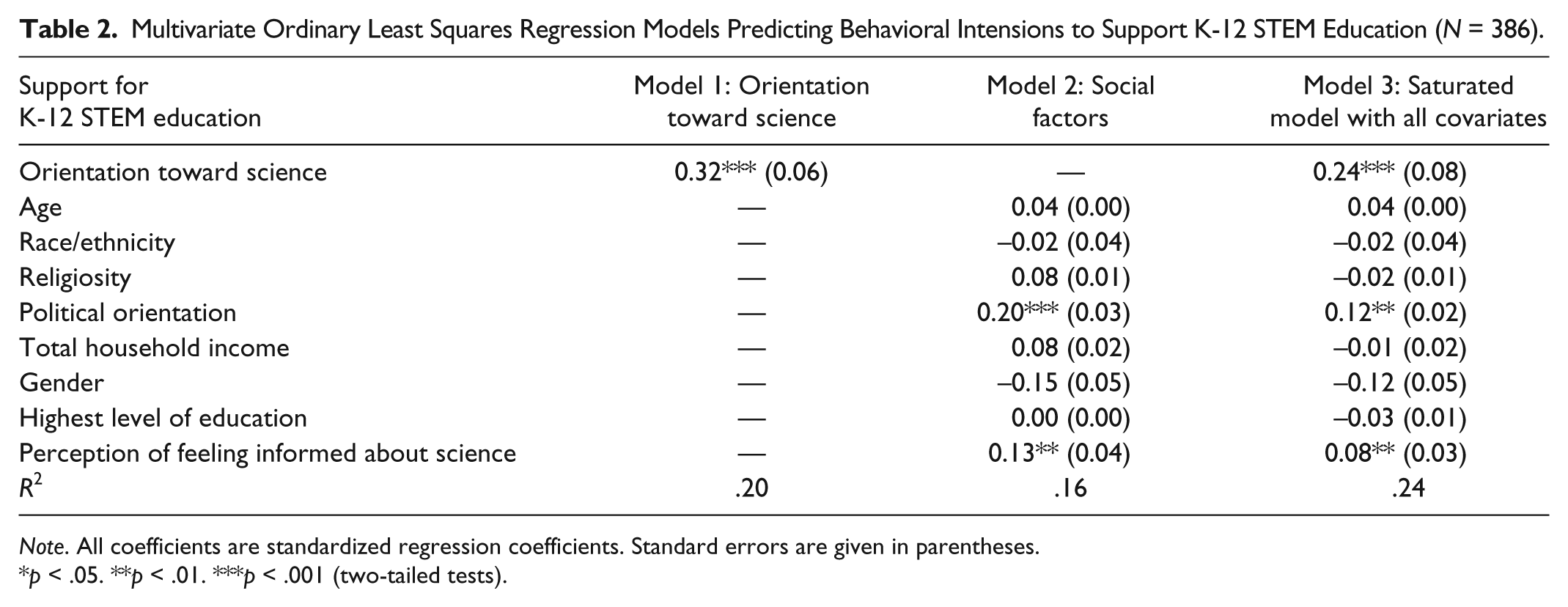
Note. All coefficients are standardized regression coefficients. Standard errors are given in parentheses.
p < .05. **p < .01. ***p < .001 (two-tailed tests).
In Model 1, we entered the composite measure for Orientation Toward Science into the regression equation. As seen by the results, this variable was significantly related to support for K-12 STEM education. Those who have a more positive orientation toward science are more likely to support K-12 STEM education policy (b = 0.32).
In Model 2, we entered several demographic and social factors as predictors of support for K-12 STEM education. Parameter estimates indicate that individuals with a more liberal political orientation (b = 0.20) and individuals who report they are more informed about science and technology (b = 0.13) have higher scores on the support for K-12 STEM education measure. Higher scores indicate more positive attitudes and trust in science.
Model 3 is a saturated model that includes Orientation Toward Science as well as social and demographic factors as predictors of support for K-12 STEM education. This model accounted for an additional 7.9% of variance over Model 2: the change in R2 value is statistically significant (F = 14.38; p < .001). In this model, orientation toward science, political orientation, and feeling informed about science, remain significant. Notably, even when effects of the selected social and demographic predictors are controlled for, Orientation Toward Science remains a significant predictor of intention to support K-12 STEM education policy (b = 0.24; p < .001), affirming our second research question—that orientation toward science improves our understanding of and ability to predict support for K-12 STEM education policy over demographic and social factors alone.
Discussion and Implications
Social factors and attitudes toward science, including trust, have effects on how people integrate scientific information and how they form positions on controversial science–technology issues. We apply this understanding to the realm of K-12 STEM education, showing that Idaho adults’ attitudes toward science, as measured by Orientation Toward Science, have an effect on general support for STEM education. Additionally, we found that social factors such as political orientation and the extent to which Idahoans felt they were informed about science were significant predictors of support for STEM education in the local school district. Individuals with a more liberal political orientation who felt more informed about science and technology reported more support for K-12 STEM education funding. Overall, these results suggest that context matters, that the public attitudes toward, and understanding of, science is related to support for K-12 STEM education, and that oft-cited problems with STEM education should be understood as integral to understanding the public’s relationship with science.
Our Orientation Toward Science measure includes an item asking about science broadly: “Science is a process for collecting and explaining facts, not a matter of belief.” However, there are other distinctions within the broader realm of public trust in science that are also worth consideration. For instance, more detailed measures of knowledge about and trust in the methods of science have been used and could have added to our understanding of attitudes (e.g., Bauer et al., 2000). The important aspects of scientific literacy may be less about trusting scientists, the “agenda” of science, or the ability to recite scientific fact and more about cultivating publics that have a more thorough understanding of the scientific method.
Even though a rural, conservative state, participants in our study expressed support for K-12 STEM education on average, as seen by the perception that Idaho should increase funding for STEM education programs (mean = 2.81 on a 3-point scale). What is telling however, is the significant association between respondents’ political orientation and assessments of feeling informed about science with support for STEM funding. It would be important to understand if other demographically similar states with different economic circumstances would demonstrate similar funding priorities.
Our findings suggest a few avenues for applications in K-12 STEM education. One strategy for increasing support for STEM education is to focus on finding innovative ways to address parental orientation toward science. Clarifying the links between basic science and applied science may provide associations for parents (and community members) that science education has broad implications for real-world problems. For example, a levy that is framed to provide resources for STEM education for students might do well to provide examples of how basic science education is essential to scientific advances that have local benefits (e.g., improved agricultural practice or water conservation; providing cheaper energy sources).
Acknowledging the relative stability of political orientation, attention could be directed toward the variable of feeling informed about science. Although challenged in critiques of the deficit model, the level of scientific knowledge or information is still likely to have an effect on orientation toward science and the likelihood of supporting STEM education (e.g., Gauchat, 2010; Sturgis & Allum, 2004). In directing attention toward adults’ orientation toward science and the degree to which they feel informed about science, one might develop communication methods that mediate and build trust in scientific authority and foster understanding of the positive benefits of the application of science. Respondents overwhelmingly felt their local schools were doing well with STEM education. Thus, communication efforts could partner with local school systems. Outreach and educational efforts directed toward parents originating from the local schools could be framed around local issues and experiences, facilitated by specifically integrating discussions around local-level concerns. Some of this could be carried on local turf through public consultation initiatives (Gehrke, 2014; Haywood & Besley, 2014; MacLean & Burgess, 2009; Walls, Rowe, & Frewer, 2011).
Finally, the scholarship that demonstrates the impact of attitudes toward science on a variety of science-related issues may inform K-12 curriculum development. K-12 education forms the foundation for citizen relationships with science. Citizens’ understanding and integration of science is as much about attitudes and trust as it is about knowledge. The demonstration of the importance of attitudes toward science for how people process scientific information and engage with science as adults might encourage science teachers and educational leaders to continue to attend to how the science curriculum addresses and discusses positive engagement with science along with cultivating science knowledge.
The understanding and application of science information is clearly contested, and, as Losh (2014) states, “at least some contenders view science as a matter of opinion” (p. 59). Our research indicates that, more than “some,” it may be a broader cultural pattern that people take their relationship with science and its applications as a matter in which a good deal of choice is not only possible but necessary. It is their responsibility to choose. One of our survey questions provides further evidence. The question is: “students should choose what to believe and what not to believe from the scientific claims they learn about in school.” Of our respondents, 73.4% “strongly agree” or “agree” with this statement, without a pattern based on political or religious orientation. The pattern of response to our “believe” question is perhaps a consequence of the predominant influence of political orientation in a conservative state, which fosters mistrust of science. Alternatively, this response pattern could be the result of both conservative and liberal-leaning respondents seeing the necessity for caution when approaching scientific claims, though from differing premises (e.g. Svalastog, 2010). Nonetheless, our findings indicate that our respondents, from across the political spectrum, feel that people should choose what to integrate from science knowledge and how to form a position on science-related issues. Among the myriad of influences that shape those decisions, sub-cultural or “group-specific” effects (Gauchat, 2012: 171) resulting from sociocultural divisions along the lines of, for instance, political orientation, certainly have an effect. The degree to which this happens offers caution for the spread of conservative ideologies.
While the effects of some social factors in predicting support for STEM education were significant statistically, the modest size of these effects indicates the complexity of the “wicked” problem of public-science relations. Much is left unexplained. Our findings suggest that individual variation in peoples’ relationship with science—how people think about science, integrate science information and form positions on science–technology issues, is greater than variation easily associated with social factors. Wynne (2014) reminds us that the embrace of scientific claims, or contestation of them or policy appropriating them, is often not about the claim itself or the science directly behind the claim. It is often about other contextual issues, with the claim being only part of the negotiation. Socio-cultural divisions intersect with, and are dependent on, other more idiosyncratic contextual dynamics in affecting people’s relationship with science. How the claim is appropriated may inadequately address or conflicts with personal concerns (e.g., religious questions, economic viability, localized impacts), social concerns (e.g., relations with others or competing purposes), values (e.g., individualism, individual freedom of choice), alternative scientific questions (e.g., alternative ways to increase food quality/production rather than GMOs), or concern with risk, which is often the only concern recognized by policy makers (Wynne, 2008). The public may intuitively understand and respond to the importance of these particular contextual issues—evidenced by the fact that, essentially, our respondents have a contingent view of science. Our results indicate that one’s relationship with science, which we partially operationalize as Orientation Toward Science, is, at least in the United States, subject to individual reflexivity and consideration.
In any case, the negotiation for the publics’ science mind is ongoing. The negotiation could be cause for alarm if seen primarily as an ideological battle. However, it could also be approached as adventurous and open territory for teaching and learning if the openness outweighs the effects of ideology and/or the ideology is secondary to learning about, understanding and integrating science.
The findings in this article further demonstrate that the way adult citizens think about science has likely implications for STEM education. Another implication is that students may have orientations that inhibit engagement in science as trustworthy, true or interesting, or parents of students may have orientations that, in turn, affect their student’s engagement with, and thinking about, science. It remains to be seen if the effects of orientation toward science can be linked to other relevant outcomes in STEM education. In particular, we are interested in testing whether parental attitudes toward science affect outcomes measured in student interest and performance in K-12 science. Moreover, our findings from a sample of Idaho adults suggest further research in conservative-dominant states is necessary in understanding the patterned effects of conservatism on attitudes and support for K-12 STEM education in the United States. Understanding the effects of political conservativism in socio-science relations remains a priority consideration as the call to address national STEM preparedness and other science-related issues, such as climate change, takes place within an ongoing politicized context. The effects on science education in public schools will shape how young people engage as active citizens in a participatory democracy fraught with challenges in the governance of science and technology with paramount human social and environmental challenges hanging in the balance.
Footnotes
Appendix A
Appendix B
Declaration of Conflicting Interests
The author(s) declared no potential conflicts of interest with respect to the research, authorship, and/or publication of this article.
Funding
The author(s) disclosed receipt of the following financial support for the research, authorship, and/or publication of this article: The data collection for this work was supported by the Micron Foundation. However, the analysis, findings and arguments herein are outside the scope of that funded project.