



Abstract
A number of public controversies have emerged around forensic DNA testing backlogs at crime laboratories in the United States. This study provides a first look at public responses to such backlogs, using a controversy in the state of Wisconsin as a case study. First, it builds on research about public understandings of DNA and the “CSI effect” to develop a theoretical framework. Next, it explores news coverage of the Wisconsin backlog. It then uses survey data to show that public understandings of DNA, media use, and demographic factors were related to how closely respondents followed the story about the backlog and/or how much they supported increased spending on DNA testing at the crime lab. Self-reported understanding of DNA predicted following the backlog, whereas perceived reliability of DNA evidence predicted both following the backlog and support. Total television viewing was not related to either following the backlog or support, but watching crime television predicted following the backlog. Reading a newspaper and watching local TV news each predicted following the backlog; reading a newspaper also predicted support. These results suggest a number of theoretical insights into how members of the public may reason about and draw on media messages regarding DNA and DNA testing in responding to forensic DNA testing backlogs.
Forensic DNA testing has become a crucial and widely used tool in criminal investigations and prosecutions across a wide array of nations (Curtis, 2014). For example, as of September 2015, the Combined DNA Index System unit of the U.S. Federal Bureau of Investigation (2015) had used the National DNA Index System to produce more than 296,490 hits assisting in more than 282,175 investigations. As the use of forensic DNA testing has expanded dramatically over the past two decades in the United States, state and local crime laboratories have often struggled to keep pace with the demands placed on them to conduct such testing. Consequently, DNA testing backlogs—defined as cases that remain untested for 30 days after being submitted to a laboratory—have become a substantial and increasing problem in the criminal justice system (Nelson, Chase, & DePalma, 2012). To address these backlogs, the federal government has undertaken a range of efforts, including several grant programs (End the Backlog, 2015).
In some instances, DNA testing backlogs at crime laboratories have emerged as public issues in statewide election campaigns playing out through the mass media. These include the 2006 Illinois gubernatorial campaign (Yates, 2006) and the 2010 Connecticut gubernatorial campaign (Pazniokas, 2011), as well as the 2010 and 2014 campaigns for attorney general of Ohio (Marshall, 2010; Swartsell, 2014). In each case, politicians promised to address DNA testing backlogs by increasing resources for crime laboratories.
Given the importance of DNA testing backlogs in the criminal justice system as well as the emergence of such backlogs as public issues, the present study examines how members of the public responded to one widely publicized controversy about a DNA testing backlog: The backlog at the Wisconsin State Crime Laboratory, which J. B. Van Hollen made a central theme in his successful 2006 campaign for state attorney general (Walters & Forster, 2007). Specifically, it explores how public understandings of DNA, various forms of media use, and background characteristics (demographic and political) were related to how closely members of the public followed the story about the backlog and how much they supported increased spending on DNA testing at the crime lab. To develop a theoretical framework for doing so, the study builds on research investigating public understandings of DNA, as well as on the literature regarding the so-called “CSI effect.” Next, it provides an overview of the Wisconsin backlog and media coverage of it. It then uses survey data from 2007 to analyze how a sample of Wisconsin residents responded to the issue. The results provide what is, to the authors’ knowledge, the first systematic portrait of public responses to a controversy about a forensic DNA testing backlog.
Public Understandings of DNA and Forensic DNA Testing
A growing body of literature examines public understandings of DNA and DNA testing in a range of nations, including New Zealand (Curtis, 2009, 2014), Portugal (Machado & Silva, 2014), the United Kingdom (Levitt & Weldon, 2005; Stackhouse, Anderson, Shaw, & Iredale, 2010; Wilson-Kovacs, Wyatt, & Hauskeller, 2012), and the United States (Bates, 2005; Brewer & Ley, 2010; Dundes, 2001; Miller, 2004). Taken as a whole, this research suggests that public knowledge about DNA and its forensic uses is often limited. It also reveals a complex set of mixed views on the use of DNA databases. Looking at the United States in particular, survey research indicates low but moderately increasing levels of public knowledge (Miller, 2004, 2010) and self-perceived understanding (Brewer & Ley, 2010; National Science Foundation, 2002) regarding DNA. Surveys of the U.S. public have also revealed high levels of confidence in the reliability of DNA evidence and strong support for the use of DNA testing in the criminal justice system, including the use of DNA databases (Brewer & Ley, 2010; Dundes, 2001).
Research to date has paid little specific attention to how members of the public respond to controversies about DNA testing backlogs. However, a theoretical framework premised on heuristic reasoning about science and technology suggests they may use their broader understandings of DNA and DNA testing to guide their responses to such controversies. Previous accounts hold that members of the public are “cognitive misers” who often possess limited information about science and technology and, thus, rely on information shortcuts to make sense of these subjects (Brossard & Nisbet, 2007; Nisbet & Goidel, 2007). In the case of DNA testing backlogs, one’s self-perceived general understanding of DNA could provide a cognitive framework for guiding the extent to which one follows a particular controversy about a DNA testing backlog at a state crime laboratory. Similarly, one’s perceptions regarding the reliability of DNA evidence could provide information shortcuts for judging whether to pay attention to stories about such a backlog and for evaluating government actions about it. By this logic, greater self-perceived understanding of DNA and greater faith in the reliability of DNA evidence may be associated with greater attention to DNA testing backlogs and greater support for increased spending on forensic DNA testing.
The CSI Effect, Media Use, and Forensic DNA Testing
Though public responses to DNA testing backlogs may partly reflect broader understandings of DNA and DNA evidence, they may also reflect media messages about forensic uses of DNA. Indeed, a sizable body of literature discusses the possibility of a CSI effect, whereby portrayals of forensic science on popular entertainment television programs such as CSI: Crime Scene Investigation, shape public understandings (e.g., Cole, 2015; Ley, Jankowski, & Brewer, 2012; Podlas, 2005; Schweitzer & Saks, 2007; Shelton, Barak, & Kim, 2011; Shelton, Kim, & Barak, 2006). Of particular relevance in the case at hand, research raises the possibility that watching crime television programs portraying forensic DNA testing as “routine, swift, useful, and reliable” (Ley et al., 2012, p. 52) will lead viewers to hold greater faith in the reliability of DNA evidence as well as greater expectations that it will be used in the criminal justice system. However, the findings from this literature suggest that, at the very least, the reality is more complicated than portrayed by early, popular accounts of a widespread and powerful CSI effect (e.g., Roane, 2005; Willing, 2004). Furthermore, several studies suggest that a wider range of media—including news, documentary, and fictional sources—can shape public perceptions of DNA and DNA testing (Bates, 2005; Curtis, 2014).
Looking at U.S. survey respondents, Brewer and Ley (2010) found that several different forms of media use were related to public perceptions of DNA and forensic DNA testing. To begin with, they found that overall television viewing was negatively related to self-perceived understanding of DNA. The authors attribute this pattern to the potential for such viewing to displace learning opportunities (see Nisbet et al., 2002). At the same time, Brewer and Ley (2010) found that overall television viewing was positively related to belief in the reliability of DNA evidence and support for a national DNA data bank. The authors attribute this set of relationships to the capacity for television viewing to cultivate viewers’ perceptions of reality (see Dudo et al., 2011). Building on their findings, one could hypothesize a negative relationship between overall television viewing and attention to stories about DNA testing backlogs (reflecting displacement of time that otherwise might be spent following the story), but a positive relationship between such viewing and support for increased spending on DNA testing at crime labs (reflecting cultivation of faith in DNA testing).
Brewer and Ley (2010) also found that crime television viewing was associated with self-perceived understanding of DNA and belief in the reliability of DNA evidence. The authors observe that the first relationship follows from arguments that crime television viewing can produce learning effects about forensic science (see Podlas, 2005; Schweitzer & Saks, 2007; Shelton et al., 2006) and that both relationships follow from arguments that genre-specific television viewing can shape knowledge and beliefs about science and technology (see Nisbet et al., 2002; Nisbet & Goidel, 2007). Extending this logic, one might expect crime television viewing to be positively associated with attention to stories about DNA testing backlogs and support for increased spending on DNA testing at crime labs.
In addition, Brewer and Ley (2010) found that that newspaper reading was linked to self-perceived understanding of DNA and that both newspaper reading and local television news viewing were linked to support for a national DNA data bank. As the authors observe, these findings resonate with broader arguments that news media use can produce learning effects and shape opinion regarding science and technology topics—at least when the news media cover such topics (see Nisbet et al., 2002; Su, Akin, Brossard, Scheufele, & Xenos, 2015). Brewer and Ley’s (2010) results suggest that if the news media cover a controversy about a DNA testing backlog, then news media use may be associated with greater attention to this story. Such a relationship would be consistent with an agenda-setting effect on audience members, whereby news media attention to the topic directs public attention to that same topic (see Iyengar & Kinder, 1987). By presenting a backlog as a serious problem for which the government is responsible, news media could also produce a framing effect on public opinion (see Iyengar, 1991). Thus, specific forms of media use as well as attention to the DNA backlog story, in particular, may be associated with support for increased spending on DNA testing.
Demographic and Political Patterns in Responses to Forensic DNA Uses
Along with public understandings of DNA and media use, demographic and political factors may help explain public responses to forensic DNA testing (Curtis, 2009, 2014). Looking at U.S. survey data, Brewer and Ley (2010) found that African American respondents were less likely than other respondents to believe that DNA evidence is reliable and to support a national DNA data bank. The same study found that conservatives expressed greater support for a national DNA data bank than did liberals. The authors also found that other demographic factors—including gender, education, income, and age—were related to self-perceived understanding of DNA or views on forensic uses of DNA. Thus, the following account examines whether demographic and political factors help explain public responses to DNA testing backlogs.
The DNA Testing Backlog at the Wisconsin State Crime Laboratory
To provide a case for study, the analysis focuses on public responses to the DNA testing backlog at the Wisconsin State Crime Laboratory that emerged as a key issue in the 2006 campaign for state attorney general. The incumbent in this campaign, Peg Lautenschlager, faced a challenge for her party’s nomination from a fellow Democrat, Kathleen Falk. Meanwhile, two Republicans, J. B. Van Hollen and Paul Bucher, competed for their party’s nomination.
An analysis of coverage in the Milwaukee Journal Sentinel, the state’s highest circulation newspaper, was used to track media attention to the backlog issue. The first story about the topic in 2006 was an April 21 article that described how a local television news story had linked DNA testing backlogs at the state crime lab to three unsolved homicides. It also described how all three of Lautenschlager’s rivals had criticized her handling of the backlog. No additional stories on the topic appeared for almost 4 months. However, on August 17, the newspaper ran a story suggesting that a delay in DNA testing at the lab had allowed a rape suspect to remain free and subsequently participate in an attempted robbery during which a Department of Justice agent was murdered. This story prompted renewed criticism of Lautenschlager’s handling of the backlog by her opponents, as well as a wave of additional news stories. The Journal Sentinel ran 10 stories on the backlog between August 17 and the primary election on September 12, in which Falk and Van Hollen won their respective parties’ nominations. During the general election campaign, in which Van Hollen continued to emphasize the backlog issue, the newspaper ran four stories on the topic. Between the November 7 general election, which Van Hollen won, and the end of 2006, the Journal Sentinel ran four more stories about the backlog, for a total of 30 stories in 2006. The newspaper continued to cover the issue in 2007, running six stories on the topic as Van Hollen was inaugurated as attorney general and then worked to address the backlog by hiring additional crime lab specialists.
As a case for study, the Wisconsin backlog controversy is relatively distant in the past and limited to a single state. Thus, one must exercise caution in generalizing from the results here to other cases, particularly more recent ones. On the other hand, the Wisconsin case parallels other public controversies about DNA testing backlogs that have become issues in statewide elections in the past decade, including as recently as 2014 (see above). Furthermore, an existing survey data set, collected in Wisconsin in 2007, includes measures for all of the variables of interest for the present study. Thus, the Wisconsin case provides the best opportunity available to conduct an initial exploration of public responses to a DNA testing backlog.
Method
The data for the study came from a telephone survey of the adult population in the four-county Milwaukee metropolitan area, the largest metropolitan area in the state of Wisconsin (and the one served by the Journal Sentinel, the newspaper discussed above). 1 The 908 respondents were selected through random digit dialing, with a cooperation rate of 33% and a sampling error of ±3.3%. 2 The survey was conducted from October 2 to December 20, 2007, by the Institute for Survey and Policy Research at the University of Wisconsin–Milwaukee. Thus, it took place around 1 year after the 2006 election campaign for the office of Wisconsin Attorney General, during which the Republican nominee, J. B. Van Hollen, made the DNA testing backlog at the state crime laboratory a central issue in his victorious campaign. Furthermore, the survey took place during the first year of Van Hollen’s tenure in the office, as he engaged in efforts to address the backlog that received publicity through the news media.
Two questions measured the study’s key dependent variables. The first asked respondents, how closely they had followed the story about the DNA testing backlog at the Wisconsin crime lab. Responses were coded as 0 for not closely at all (40% of respondents), 1 for not very closely (24%), 2 for somewhat closely (29%), and 3 for very closely (7%). The second asked whether respondents supported or opposed increased spending on DNA testing at the Wisconsin crime lab. Responses to this item were coded as 0 for strongly oppose (3% of respondents), 1 for somewhat oppose (6%), 2 for somewhat support (41%), and 3 for strongly support (50%). On average, respondents tended to say that they had not followed the story very closely (M = 1.03; SD = 0.98) but that they supported increased spending (M = 2.38; SD = 0.73).
Another pair of questions measured self-perceived understanding of DNA and perceptions of DNA evidence as reliable. These questions followed the wordings of items included in a series of National Science Foundation surveys and Gallup Organization surveys, respectively (see Brewer & Ley, 2010). Self-perceived understanding was coded as 0 for those who said they had little understanding of what the term DNA means, 1 for those who said they had a general sense of what it means, and 2 for those who said they had a clear understanding (M = 1.49; SD = 0.61); note that this measure captured self-reported understanding rather than actual knowledge. 3 Perceptions of DNA evidence as reliable were coded as 0 for only somewhat reliable or not reliable at all (fewer than 1% of respondents chose the latter option), 1 for very reliable, and 2 for completely reliable (M = 2.05; SD = 0.68).
Yet another series of items measured various forms of media use. Overall television viewing was measured by a question asking respondents how many hours of television they watched on an average day. Responses were coded as 0 for none, 1 for 1 hour or a fraction thereof, 2 for 2 hours, 3 for 3 hours, and 4 for 4 or more hours (M = 2.58; SD = 1.18). Additional questions asked respondents how often they read a daily newspaper (M = 2.28; SD = 0.92) and watched local TV news (M = 2.47; SD = 0.87); response options here included never (coded as 0), hardly ever (1), sometimes (2), and regularly (3). The measure for crime television viewing was an index (Cronbach’s α = .67; M = 1.36; SD = 1.03) that ranged from 0 to 3 and was created by averaging scores for two questions (which used the same response options as the items for newspaper reading and local television news watching): One asking respondents how often they watched prime-time dramas about criminal investigations such as CSI, CSI: Miami, and CSI: New York (M = 1.51; SD = 1.23) and another asking them how often they watched TV shows about real-life criminal investigations such as Forensic Files (M = 1.21; SD = 1.13).
The survey also included measures of demographic and political variables. Specifically, it included a 7-category measure of education (coded to range from 0 to 6; M = 3.88; SD = 1.53), a 10-category measure of income (recoded as two dichotomous variables, one for >$49,000 and one for missing data, with ≤$49,000 as the baseline; 41%, 13%, and 45%, respectively), a 7-category measure of political ideology (coded to range from 0 for extremely liberal to 6 for extremely conservative; M = 3.12; SD = 1.41), and age in years (median = 52), as well as dichotomous measures of sex (coded as 0 if male and 1 if female; 38% and 62%, respectively), self-identification as African American (coded as 0 if no and 1 if yes; 82% and 18%, respectively), and self-identification as Hispanic (coded as 0 if no and 1 if yes; 95% and 5%, respectively). 4
Results
Two ordinary least squares regression models—one for each dependent variable—were used to explore how public understandings of DNA, media use, and background factors were related to how closely respondents followed the story about the DNA testing backlog at the Wisconsin crime lab and how much they supported increased spending on DNA testing at the crime lab. The model for support also included attention to the backlog story as a predictor. Table 1 presents the results for each model. First, consider the results for public understandings of DNA. Self-reported understanding of DNA was positively related to following the story about the backlog (p < .05; β = .08) but not significantly related to support for increased spending. Thus, respondents who said they understood what DNA means were more likely to pay attention to the backlog story, compared with those who said they had little understanding, but did not differ discernibly in their opinions about spending. In contrast, perceived reliability of DNA evidence was positively related to both following the story about the backlog (p < .05; β = .07) and support for increased spending (p < .01; β = .24). In other words, respondents who perceived DNA testing as reliable were more attentive to the backlog story and considerably more supportive of increased spending, compared with those who perceived it as less reliable.
Predicting How Closely Respondents Followed the Wisconsin Crime Lab DNA Testing Backlog and How Much They Supported Increasing Spending on DNA Testing at the Crime Lab.
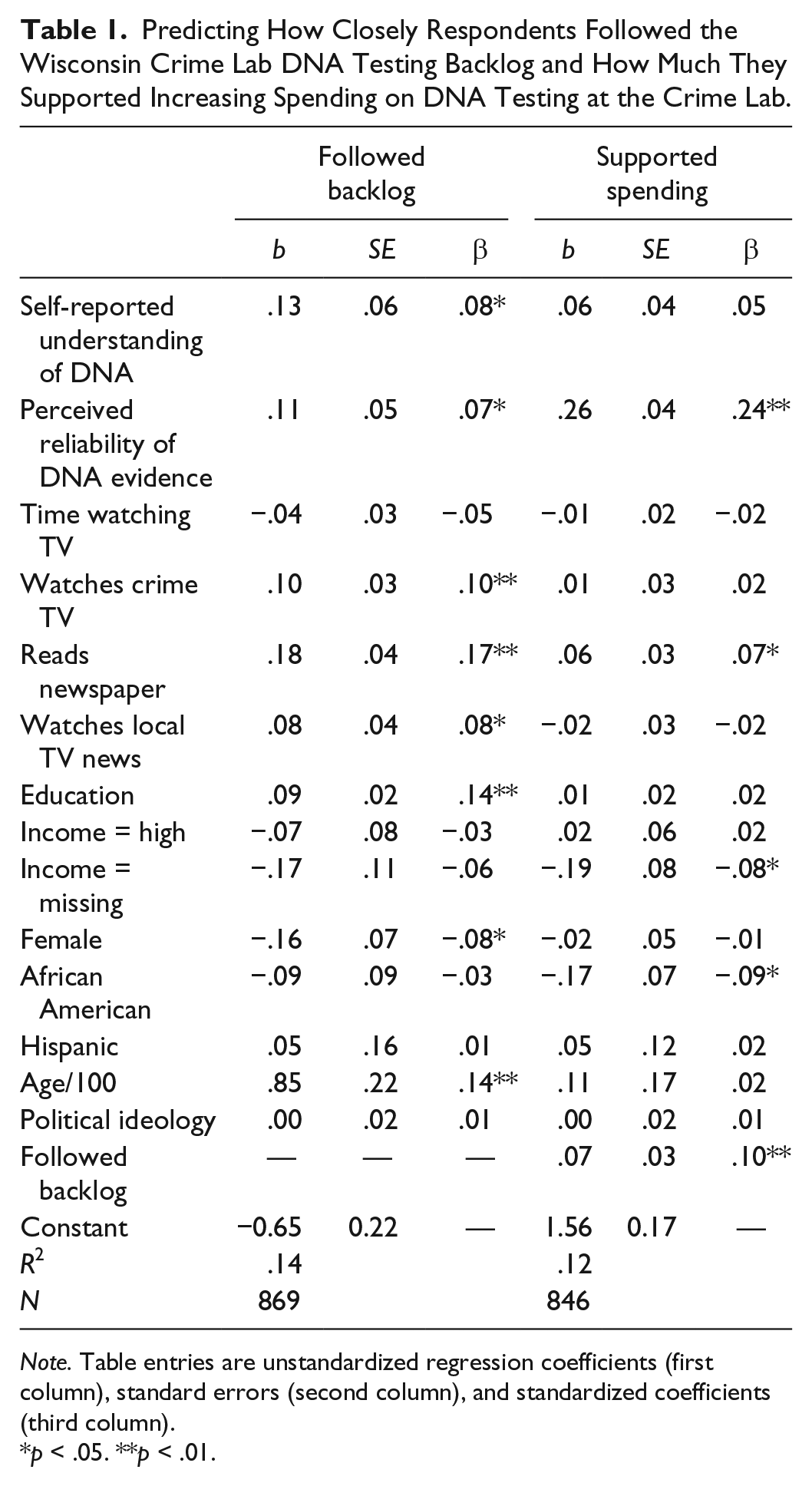
Note. Table entries are unstandardized regression coefficients (first column), standard errors (second column), and standardized coefficients (third column).
p < .05. **p < .01.
Turning to the media use variables, overall time spent watching television was not significantly related to following the story about the backlog or support for increased spending. On the other hand, watching crime television was positively related to following the backlog story (p < .01; β = .10): compared with nonviewers, respondents who regularly viewed crime dramas, such as CSI, and “true crime” programs, such as Forensic Files, were more likely to report paying attention to this story. Meanwhile, such viewing was not significantly related to support for increased spending. Newspaper reading was positively related to both dependent variables, so that regular newspaper readers were more likely than nonreaders to follow the backlog story (p < .01; β = .17) and support increased spending (p < .05; β = .07). Watching local television news was positively related to following the backlog story (p < .05; β = .08), but not significantly related to support for increased spending. Following the backlog story, in turn, was positively related to support for increased spending (p < .01; β = .10).
As for the demographic and political variables, greater education and age were positively related to following the backlog story (p < .01; β = .14 for each). In addition, women were less likely than men to pay attention to this story (p < .05; β = −.08). Compared with other respondents, African American respondents (p < .05; β = −.09) and those who did not report their income (p < .05; β = −.08) were less supportive of increased spending. No other significant relationships emerged between demographic factors and either of the dependent variables. Nor was ideology related to either dependent variable.
Conclusion
The results of this study show that relatively few Milwaukee-area residents paid close attention to the story about the DNA testing backlog at the Wisconsin crime laboratory. At the same time, most of those surveyed supported increased spending for DNA testing at the crime lab. The results also illuminate patterns in who followed the story and who supported increased spending. With regard to public understandings of DNA, the findings resonate with a theoretical account of heuristic reasoning about science and technology in general (Brossard & Nisbet, 2007; Nisbet & Goidel, 2007) and forensic DNA testing in particular (Brewer & Ley, 2010). Self-perceived understanding of DNA was associated with following the story, suggesting that such understanding can provide a cognitive framework for guiding attention to the topic. Self-perceived understanding of DNA did not translate into greater support for spending, which could reflect the potential for understanding to promote critical as well as supportive perspectives on uses of DNA testing (see also Bates, 2005). At the same time, perceived reliability of DNA evidence was linked to both following the backlog story and support for increased spending. Thus, members of the public may use their perceptions regarding the reliability of DNA evidence as information shortcuts in deciding whether to pay attention to DNA testing backlogs and evaluating whether the government should devote more resources to forensic DNA testing.
A number of relationships emerged between different forms of media use and public responses to the DNA testing backlog. Overall television viewing was not related to following the backlog story; thus, there was no evidence that the former displaced the latter. Nor did the analysis yield evidence that overall television viewing cultivated support for increased spending on DNA testing—a result that could reflect the nature and/or quantity (and perhaps relative dearth) of general television portrayals regarding the topic. Crime television viewing was positively related to following the backlog story, a result that could indicate a CSI effect on attention to forensic DNA testing in real life (paralleling the apparent effect on self-perceived understanding of DNA; Brewer & Ley, 2010). 5 On the other hand, such viewing was not related to greater support for public spending on DNA testing. At first glance, this result seems inconsistent with crime television’s portrayal of forensic DNA testing as an essential tool in criminal justice. One possible explanation for the absence of a relationship here is the tendency of crime television programs to portray forensic DNA testing as routine and swift, rather than subject to backlogs (Ley et al., 2012). Thus, such programs may not suggest to viewers that real-life crime laboratories confront limited resources.
Public responses to the DNA testing backlog may have reflected news media use, as well. Compared with nonreaders and nonviewers, respectively, those who regularly read a daily newspaper and watched local television news paid more attention to the backlog story. These relationships suggest agenda-setting effects of the news media on following the story. Compared with nonreaders, newspaper readers also expressed greater support for increased spending—a finding that suggests a framing effect. The contrast between the relatively clear and strong relationships to attention and support for newspaper reading and the weaker or nonsignificant relationships for local television news use may reflect the tendency of newspapers to cover public issues more extensively than do local television news broadcasts (e.g., Druckman, 2005). In the case at hand, the leading local newspaper, the Milwaukee Journal Sentinel, covered the backlog controversy in considerable depth. No data on local television news coverage of the story are available; however, it seems reasonable to assume that Milwaukee television news did not cover the topic as extensively as did the Journal Sentinel.
Finally, a variety of demographic patterns emerged in public responses to the DNA testing backlog. Attention to the story was associated with both greater education and greater age; these results may reflect broader patterns in interest about public affairs topics (and, for education, interest in science, and technology topics; National Science Foundation, 2014). Moreover, a gender gap emerged here, with men following the story more closely than women did. This difference, though modest, is somewhat surprising given previous findings that women are more likely than men to support a DNA data bank (Brewer & Ley, 2010), follow crime news (Pew Research Center, 2008), and pursue forensic science as a profession (Houck, 2009); one possibility is that the gap reflects a broader pattern of greater interest in news about government and politics among men than among women (Pew Research Center, 2008). In contrast, no gender gap emerged on support for increased spending. Attention to the story did not differ across race or ethnicity, but African American respondents expressed less support for increased spending than did other respondents. This pattern may reflect broader racial divides in public views about the use of DNA evidence in the criminal justice system (Brewer & Ley, 2010; Duster, 2006). In contrast to previous findings of ideological differences in views about forensic DNA testing (Brewer & Ley, 2010; Curtis, 2014), no differences across political ideology emerged for either attention to the story or support for increased spending—despite the role of the backlog issue in a partisan election campaign. Then again, any partisan division on the topic may have been blunted by the defeat of the incumbent Democratic attorney general (Lautenschlager) by an intraparty rival (Falk) who, like the Republican nominee (Van Hollen), campaigned on a platform of addressing the backlog. Alternatively (or additionally), any ideological divisions on the issue may have faded by 2007, when the survey took place.
In drawing conclusions from the study’s results, one should bear in mind several potential limitations. First, the analysis used cross-sectional survey data; thus, it only demonstrates correlations, rather than causal relationships, among the variables. Second, the analysis relied on self-reports with subjective response categories for several key variables, including understanding of DNA and the different forms of media use. Third, the models explained relatively low proportions of variance in the dependent variables (14% for following the backlog story and 12% for support), though this is not unusual in analyses of public attention and attitudes. Fourth, the generalizability of the study’s findings must be considered in the context of the case selected for study: The 2006 to 2007 controversy surrounding the Wisconsin state backlog. Even within the context of this case, different—and, in the case of the news media relationships, stronger—results could have emerged in 2006 (when the election campaign took place, and when coverage in the Journal Sentinel peaked) compared with 2007 (when the survey took place). Looking at a broader time frame, changes in the landscapes of criminal justice, public understandings of DNA, and/or the mass media (such as the 2015 cancelation of CSI) could alter the relationships found here. Most important, perhaps, one might find different relationships depending on the presence of a public controversy covered by the news media (as in Wisconsin, when the study took place) or the absence of such a controversy.
To address these limitations, future research could build on the analysis presented here by using different data sets (including panel, experimental, or qualitative data), different measures (including direct knowledge measures), and different cases (including more recent cases from other locations in the United States or from other nations, as well as from contexts where there was no public controversy about a backlog). Future research could also explore what factors, if any, mediate or moderate the relationships observed here. Doing so may shed new light on the relationships among public understandings of science, media use, and public responses to forensic DNA testing backlogs. Given the extent of existing backlogs, it seems likely that public controversies surrounding them will continue to emerge for some time to come.
Footnotes
Acknowledgements
The authors thank Linda Hawkins and the Institute for Survey and Policy Research at the University of Wisconsin–Milwaukee for access to the survey data used in this study.
Declaration of Conflicting Interests
The author(s) declared no potential conflicts of interest with respect to the research, authorship, and/or publication of this article.
Funding
The author(s) received no financial support for the research, authorship, and/or publication of this article.