



Abstract
The purpose of the current article is to identify the frequently used terms for the field of study that deals with the information and communication technology usage in the government and explore the difference and relationship, if any, between these terms. This field of study is inundated with old and new terminologies that lack clarity of usage leading to opportunistic usage, confusion, and impacting accumulation of knowledge. A three-stage search was followed to: (1) identify key terms used to refer to the field of study; (2) identify top ranked journals across social science, computer, and business management that publish in this field; and (3) identify the most frequently used terms in these select journals. The seven terms thus identified are smart government, e-government, e-governance, digital government, open government, e-democracy, and e-participation. The origin, definitions, and models of these terms is further explored, and their relationship is illustrated in diagrams of concentric and overlapping circles. The current study is a step toward developing a stable and dependable vocabulary that may benefit scholars in operationalizing the terms and practitioners in policy implementation and assessing policy effectiveness.
1. Introduction
The field of study that deals with the application of information and communication technology (ICT) in government is inundated with terminologies leading to a “ . . . deficit/surplus of words to describe the ‘field’” (Peixoto, 2013). Several terms are in use such as, digital government, e-government, and e-governance. In addition, new terminologies continue to surface from previous ones such as, Web 2.0 to government 2.0 (or gov 2.0) to society 2.0 (Tumin & Fung, 2010), where Web 2.0 generally refers to websites offering interoperability and user generated content signifying a participatory culture, and has now increasingly become synonymous with social media platform (O’Reilly, 2005). Moreover, the usage of the terms varies between studies; for example, some consider e-government and e-governance as interchangeable (Gronlund & Horan, 2005), while others argue that e-governance has a broader perspective than e-government (Calista & Melitski, 2007). The superfluity of terminologies and the inconsistency of their usage is problematic because it hampers accumulation of learning under a topic and deters focus and long-term success of a program (Peixoto, 2013). Furthermore, inconsistent definitions lead to opportunistic usage of the terms to fit a need; for example, open government may be used to mean accountability or service delivery or both (Peixoto, 2013).
The purpose of the current article is to identify the frequently used terms that refer to the field of study dealing with the ICT usage in the government and explore the difference and relationship, if any, between these terms. Studies have differentiated some of these terms (e.g., Calista & Melitski, 2007; Garson, 2006; Glybovets & Alhawawsha, 2017; Sheridan & Riley, 2010). However, dealing with distinct pair of terms is not effective in building a comprehensive comparative image of how various terminologies differ or relate with each other. Unclear definitions and relationships between these terms create a problem for scholars in operationalizing the terms and the multiple terms may perplex the practitioners in policy implementation and assessing effectiveness of policy programs.
The current study aims to initiate the development of a stable and dependable vocabulary that scholars and practitioners in this field can refer to and benefit from. The next section defines the methodology adopted for identifying the frequently used terminologies in the field. It is followed by reporting of the findings from the literature of the identified terms with a conceptual model of the relationships between these terminologies, and a conclusion.
2. Methodology
First, a combination of commonly known terms, such as “IT” AND “Government,” “ICT” AND “Government,” “e-gov,” “smart-gov,” and “online-gov,” were used as keywords for search in Google Scholar to identify the terminologies that are in use in the literature at the intersection of ICT usage and government. A quick read of title and abstract was done to identify key terms that are used to refer this field. In addition, some ICT glossaries were also searched; for example, the Everyday ICT terms for Policymakers and Government Officers (United Nations [UN], 2011). Twelve such terminologies were identified for the current study.
Second, top journals that publish work on IT and ICT usage in the government were selected. Such publications are spread across more than one discipline, and this article focused on particularly social sciences, computer science, and business management journals. A combination of search in Google Scholar and Scimago to identify common outlets for such publications and comparing the Scimago journal ranking helped identify the top ranked journals in the three disciplines. Note that all the Institute of Electrical and Electronics Engineers (IEEE) outlets were included under one search term of “IEEE” because of a large number of its publications in its multiple outlets in the field of interest.
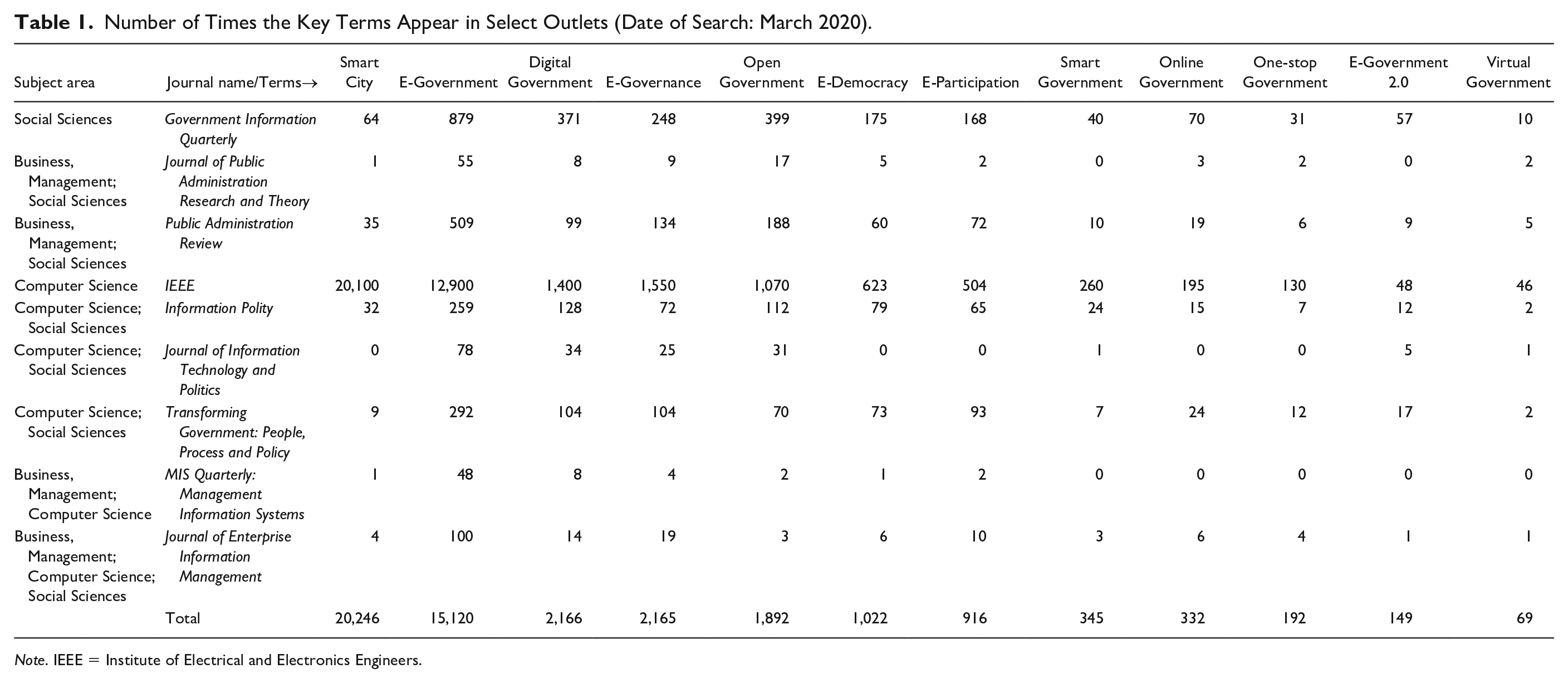
Third, the 12 key terms were searched in each of these journals and the results for number of publications were recorded and arranged in descending order a snapshot of which is presented in Table 1. Google Scholar’s advanced search function was used to find articles with exact phrase of the search terminology for each journal. Based on this list, the key terms that had about 1,000 publications or more are further explored in this article. As listed in Table 1, the terms that stood out as most used terms amongst the list, and are prevalent in all the three disciplines are: smart city, e-government, digital government, e-governance, open government, e-democracy, and e-participation. Some journals (e.g., European Journal of Information Systems) as well as terms (e.g., m-gov, t-government, and u-government), other than the ones in Table 1, were also searched. The results did not change the order of the terms and did not make other terms more significant than the seven terms selected for discussion in the current study.
Number of Times the Key Terms Appear in Select Outlets (Date of Search: March 2020).
Note. IEEE = Institute of Electrical and Electronics Engineers.
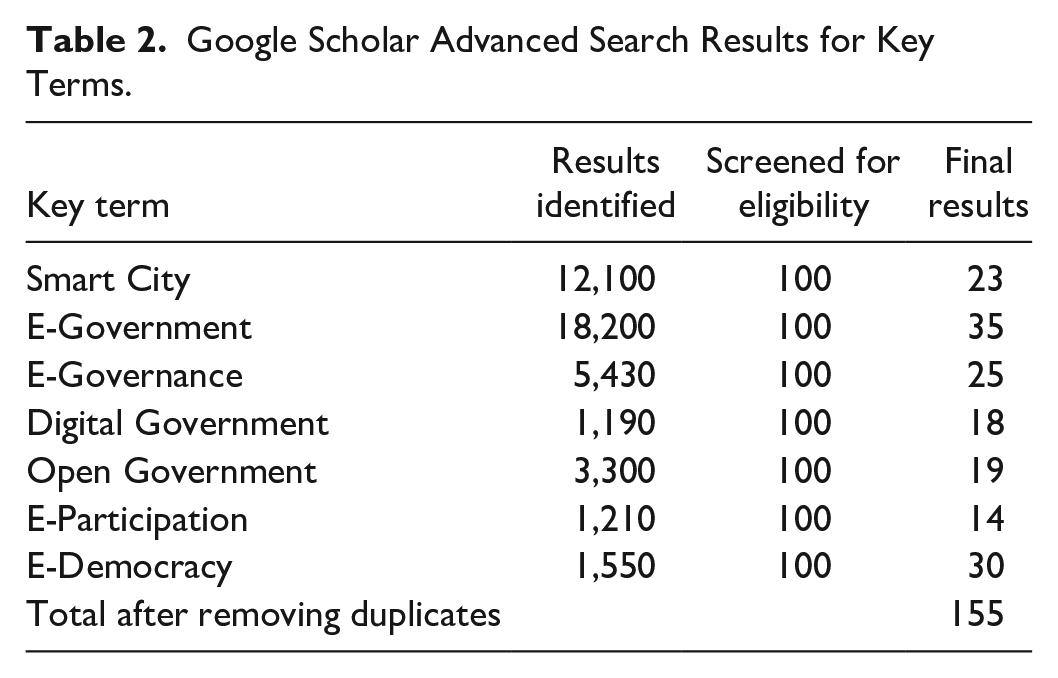
Finally, these seven terms were used as keywords for search in Google Scholar to identify the literature for the systematic review in the current study. Due to the large number of publications in these fields, search filters were used to limit the search in the title of the work published in the recent two decades. The idea was to identify the publications that were exclusively focused on one or more of the terms and that would help define and differentiate these concepts. The advanced search function of Google Scholar was used to search for the exact phrase of each keyword in the title of the article dated between 2000 and 2020. The results were sorted by relevance and the title and abstract of the first hundred results for each of the seven keywords were reviewed to identify publications for inclusion in the current review. The publications were included if they focused on defining the concept, presenting a framework or model of the concept, comparing two or more terms such as, e-government and e-governance or e-government and digital government or those that included a combination of terms of interest in their title example, terms of participation, e-government, and open government. Studies on the implementation, adoption, utilization, or effectiveness of these concepts were excluded. Such articles were only included if obtained through citation in the selected work, for their potential to make a point in the current study. In accordance to the guidelines provided by Moher et al. (2009) for preferred reporting items in systematic reviews, a summary of number of items at different stages of search is provided in Table 2. It shows the number of items that resulted in identification, were screened for eligibility, and were finally included in the review; for example, the advanced search for the exact phrase “smart city” in the title of the publication dated between 2000 and 2020 identified 12,100 results. These were sorted by relevance and the title and abstract of the first 100 items were reviewed for their eligibility for inclusion. This resulted in a total of 23 articles that were considered fit to be included in the systematic review. Same process was followed for other key terms. Some articles got repeated in the results between the searches. These were removed later resulting in a final list of 155 publications.
Google Scholar Advanced Search Results for Key Terms.
Google Scholar search results were augmented with search in Web of Science and ProQuest databases. An advanced search using the search operator OR to separate the keywords was performed in the title and abstract for English Language documents during the time span of 2000-2020. The type of documents included were article, book, book chapter, conference paper, dissertation/thesis, government & official document, and report. Same criteria of inclusion and exclusion were applied in reviewing the search results, as used in Google Scholar. These searches added 13 new articles from Web of Science and 12 from ProQuest, to the list of 155 items from Google Scholar bringing the total to 180. Majority of the articles added from Web of Science and ProQuest were in the realm of smart city. Apart from these, reports published on the websites of UN for e-government and e-participation and Organization for Economic Co-operation and Development (OECD) for open government were included in the review as these organizations conduct regular surveys and rank their member countries on these parameters and are thus, a good resource to obtain latest developments in these fields.
Google Scholar is increasingly used as a bibliometric tool that competes with databases such as, Web of Science and Scopus (Moed et al., 2016) and is used in the current study because it suits the objective of the current study very well. Google Scholar includes different types of sources such as, conference proceedings, articles, books, open access journals, and reports across various disciplines or subject areas that may not be included in a given research library like Web of Science. The current study deals with interdisciplinary concepts. Depending on the subject field, the final version of a scholarly research may not always be journal articles in peer reviewed outlets but can also be (peer reviewed) books or conference proceedings (Moed et al., 2016) and the growth in the number of open-access journals and institutional repositories increases the number of articles readily available via Google Scholar (Degraff et al., 2013). Google Scholar is also used in the current study because it allows easy access to citation information and, when sorting results by relevance, it uses author and publication information as well as how often and how recently an item has been cited in other scholarly literature. This is very helpful in finding relevant work when dealing with a large volume of publications as in the current study. Moed et al. (2016) compared Google Scholar search results with Scopus and their findings reveal that both databases cover a set of core sources and in fact, the citations are reflected faster in Google Scholar than in Scopus. “The finding that citation counts at the article level in GS and Scopus show a strong (linear) statistical correlation suggests that the two databases are to some extent interchangeable, at least as far as citation counts are concerned of targets indexed in both” (Moed et al., 2016, p. 547). Finally, in the current study, the findings of Google Scholar were supported and strengthened through the use of other sources; for example, Scimago, Web of Science, and Proquest. The literature on the seven select terms is discussed next for definitions, origins, and models with a focus on clarifying how these terms relate with each other.
3. Findings
3.1. E-Government
Table 1 shows that the term is well in use across all three disciplines of social science (particularly public administration), business management, and computer science. Although the use of computers in the government was prevalent from as early as 1950s, the term e-government came into use around the 1990s after the invention of internet and World Wide Web, and with the rise of e-commerce and e-business (Gronlund & Horan, 2005). E-government started as a practitioner field; for example, in the United States the first signs can be traced back to Vice President Al Gore’s National Performance Review wherein he strongly emphasized the use of e-government (Gronlund & Horan, 2005).
There is much consensus in the various definitions of e-government, in terms of viewing e-government as a means for providing information and services using ICT (Weerakkody & Reddick, 2012; Gottschalk, 2009; S. Lee et al., 2005; Norris et al., 2001). UN defines e-government as “ . . . the use of information and communication technology (ICT) for the provision of information and public services to the people” (UN, 2014, p. 61). Most of the definitions also consider government-citizen interactions as part of service and others include democracy as one of the deliverable of e-government: E-government is the “ . . . public sector use of the internet and other digital devices to deliver services, information, and democracy itself” (West, 2005, p. 1).
An old definition by the UN and the American Society for Public Administration, lays down the ICT tools used in e-government: “Broadly defined, e-government includes the use of all information and communication technologies, from fax machines to wireless palm pilots, to facilitate the daily administration of government. However, like e-commerce, the popular interpretation of e-government is one that defines it exclusively as an Internet driven activity . . . to which it may be added “that improves citizen access to government information, services and expertise to ensure citizen participation in, and satisfaction with the government process. . .” (as cited in Moon, 2002, p. 425).
The e-government maturity models typically start with a stage comprising of cataloguing and creating online forms for online information sharing, and then move on to higher stages of providing transactional services, followed by vertical and finally horizontal integration (Layne & Lee, 2001; Silcock, 2001). The vertical integration means linking the organizations’ system within similar functionalities and connecting local systems to central systems, while horizontal integration is connecting systems across different functions to provide a one-stop shop for services to citizens (Layne & Lee, 2001) meaning a fully integrated point of service delivery. Some models add a fifth stage of political participation to their e-government maturity model (e.g., Hiller & Bélanger, 2001; Marchionini et al., 2003; West, 2005). Almuftah et al. (2016) contrast and compare 17 different e-government maturity models and conclude that majority of the models have four or five stages and the content in the stages is very similar. Models have a last stage of integration of services, while most now go beyond that to include participatory and democratic usage of e-government infrastructure, such as e-voting (Almuftah et al., 2016).)
E-government is shown at the core in Figure 1. This is based on the early origins and usage of the term in the literature, and because the models of e-government start with a stage for cataloguing, a necessary activity for a government taking its functions online on which other functions can be further built upon.

The concentric circles based on the scope of the usage of ICT.
3.2. E-Democracy and E-Participation
E-participation is defined as “the process of engaging citizens through ICTs in policy and decision-making in order to make public administration participatory, inclusive, collaborative and deliberative for intrinsic and instrumental ends” (UN, 2014, p. 61). E-participation encompasses government’s interaction with public such as informing public of government activities, government’s consultation with public on policy making, and empowering them for decision making (UN, 2014). The initial models of e-government maturity were associated with the new public management aimed at reinventing government to work better and cost less, and treated citizens as customers (Kettl, 2015; Kim & Robinson, 2014). However, Denhardt and Denhardt (2000) proposed principles of new public service as an improvement upon the new public management, focusing on democratic governance where there are opportunities for citizens to define policy problems, and develop and implement solutions (Denhardt & Denhardt, 2000). This encouraged an e-government approach that includes citizens as an essential part of policy design and implementation (e.g., Kim & Robinson, 2014; Nabatchi & Mergel, 2010). The later models of e-government based on new public service approach include public participation, often as an advanced stage of e-government (Kim & Robinson, 2014). The new information technology and particularly social media applications are acknowledged as enabling tools for bottom-up approach that enhance public participation (Kim & Robinson, 2014).
The UN assesses its member countries on e-participation biennially and their survey uses a three-level model of e-participation consisting of “e-information” for providing citizens with public information, “e-consultation” for engaging people in deliberation on public policies and “e-decision-making” for empowering people through codesign of policy. The first e-information stage in e-participation resembles the first stage of cataloguing in e-government, although, the intention for information sharing may differ. The e-information is intended for enabling citizens participation in policy making, while in e-government models, the focus is on service delivery. The measures of e-participation are evolving: earlier, the expectation of participation stage was related to filing complaints online (Hiller & Bélanger, 2001), but after the advent of Web 2.0 tools, scholars include use of social media as an important measure of e-participation (UN, 2014).
Though some studies have used e-democracy in a manner that conveys it as a broader concept than e-participation (e.g., Spirakis et al., 2010), other scholars have used e-participation and e-democracy interchangeably (e.g., Macintosh, 2008; Norris, 2007). E-democracy is defined as the use of ICT in political debates and decision-making processes (Päivärinta & Sæbø, 2006). This definition essentially is the same as that of e-participation. Bellamy’s (2000) models of e-democracy include a consumer model where the role of citizens is as consumers of public services (similar to e-government), and a neo-republican democracy that expects active citizen’s participation and involvement, especially at the local level. E-participation has sometimes been equated with a more continuous involvement in shaping policies and public service delivery than one time voting (UN, 2014). However, it will perhaps be hard to argue that e-voting is only democratic and not participatory or e-forums are participatory but not democratic. The models and mechanisms of e-democracy are similar to those of e-participation; for example, e-democracy initiatives include mechanisms of representation (e.g., e-voting), participatory forms of citizenship through consultation (e.g., e-panels, e-consultation), deliberative mechanisms (e.g., online forums), and initiatives of citizen action (e.g., e-petitioning), over and above access to information, and two-way communication and dialogue involving ICT (Norris, 2007).
Thus, the current study considers e-participation and e-democracy as interchangeable. This is reflected in Figure 1 by having a single circle represent both meaning that the two terms are fully overlapping. E-government models argue that the end state of e-government includes widespread citizen participation, including voting, increased trust in government, and generally more citizen centric government, that is, e-government “morphs into e-democracy” (Norris, 2007, p. 147). Both e-government and e-participation models begin with a common information sharing platform but diverge in purpose in the later stages with the former inclining toward service delivery and latter focusing on public participation in policy making. The Figure 1 shows this by overlapping e-government within e-democracy/e-participation circle.
3.3. E-Governance
Governance includes formal and informal processes and institutions in public as well as private and nongovernmental organizations to guide collective activities of a group (Keohane & Nye, 2000) and e-governance is the performance of this governance via the electronic medium for an efficient, speedy and transparent information dissemination to the public, and other agencies, and for performing government administration activities (UNESCO, 2005). Torres et al. (2006), argue that “e-governance includes e-government plus key issues of governance such as online engagement of stakeholders in the process of shaping, debating, and implementing public policies” (p. 277).
One line of thought is that e-government should be replaced with the term e-governance because most e-government definitions are about governance rather than government (Gronlund & Horan, 2005). Gronlund and Horan (2005) point out that the usage varies by field of study; political scientists use the term e-governance while IS researchers use e-government, although this is not corroborated in Table 1 of this study. They also believe that the two terms have become so intertwined in use and the term e-government has become so well-established, that everyone will have to live with the confusion; they themselves prefer to use e-gov to cover all (Gronlund & Horan, 2005). Fountain (2001) explains that public in e-government stands for citizens, businesses, as well as other governments. Fountain (2001) mentions 25 U.S. e-government projects that include government to government (G2G), government to businesses (G2B) and government to citizens (G2C) services. In addition, digitization programs internal to organization such as to improve efficiency and effectiveness in payroll, travel, and training are also included in this list of e-government initiatives (government to employee [G2E] services). There are other studies that endorse that e-government serves actors other than citizens, such as to facilitate government agencies to work together and serve businesses (e.g., S. Lee et al., 2005).
A contrary line of thought, however, is that e-governance has a broader scope as compared with e-government (Finger & Pécoud, 2003; Harrison et al., 2012; UNESCO, 2005). Cullen (2010) has differentiated between e-government and e-governance defining latter as a program to engage citizens in the policy processes of oversight using online technologies such as, email or social networking applications (as cited in Harrison et al., 2012). While e-government is the delivery of services to citizens (G2C), government (G2G), and businesses (G2B) using information technology (Norris, 2010), e-governance is the management of technology initiatives to be implemented successfully as well as the transformation of democratic interactions and relationship between the government and its citizens in an information society (Calista & Melitski, 2007; D’Agostino et al., 2011; Guida & Crow, 2009; Marche & McNiven, 2003). Norris (2010) roots for a clear distinction between e-government and online citizen engagement activities and argues that e-government is not e-governance or e-democracy now and neither is it going to become so ever. Delivery of services is a function of government while the decision to whether provide the service is a matter of governance (Marche & McNiven, 2003). Some define e-governance as a series of steps for government agencies in order to develop and administer successful implementation of e-government (Sheridan & Riley, 2010). E-governance is considered a broader topic than e-government that deals with the whole spectrum of the relationship and networks within government regarding the usage and application of ICTs (Sheridan & Riley, 2010). While e-government refers to what is happening within government organizations particularly those that provide services to citizens or companies, e- governance is a broader term that refers to the whole system engaged in managing a society including activities of government, private, and voluntary organizations, and citizens, as well as the processes and flows required to do so (Atkinson, 2003; Gronlund & Horan, 2005). Thus, the focus in e-governance expands to include other stakeholders in the society, such as businesses and nonprofits. E-governance is seen as use of information technology and systems in a dynamic and continuous process for enhancement of interactions between various actors including citizens, government, nonprofits, private sector, different levels of government (e.g., local, national, global), as well as between various functions such as, legislation and regulation (Finger & Pécoud, 2003). Figure 1 encompasses e-government and e-participation within e-governance to reflect that e-governance includes both. At the same time, while e-government and e-participation is citizen centric, e-governance is a broader concept in usage with multiple partners and processes.
3.4. Digital Government
Some scholars argue that the three terms of digital government, e-government, and e-governance have become synonymous with the use of ICT in government organizations and they themselves use e-government and digital government interchangeably in their work (Marchionini et al., 2003). West’s (2005) influential work on Digital Government starts the discussion with the term e-government (despite the book’s title) by which it appears that West (2005) considers digital government synonymous with e-government, although he offers no direct clarification for the interchangeable use of the terms. Several other studies also use digital government and e-government interchangeably (e.g., Chen, 2003; Gamper & Augsten, 2003; Pavlichev et al., 2004). Chen (2003), however, enlists different activities under the two: digital government comprises of information sharing and knowledge management, citizen access to government data, designing communication networks, and ensuring security of confidential data; e-government comprises of online public service delivery, e-politics, e-democracy, e-voting, transactions and security related to those transactions, and business and political issues that are relevant for e-government. Chen’s (2003) categorizes information sharing in digital government, but it is included in e-government definitions of others.
OECD (2014) called for a move from e-government to digital government with a view to opening, innovating and modernizing public sectors. As per this report, e-government is the use of ICTs by the governments as a tool to achieve better government, while digital government is governments’ modernization strategies using digital technologies to create public value where digital technology includes, . . . ICTs, including the Internet, mobile technologies and devices, as well as data analytics used to improve the generation, collection, exchange, aggregation, combination, analysis, access, searchability and presentation of digital content, including for the development of services and apps. (OECD, 2014, p. 6)
OECD’s definition of digital government is larger in scope, in relation to e-government and e-governance, and includes components over and above e-governance such as, the emphasis on a data driven culture, knowledge management, and data security. Marchionini et al. (2003) argue that, “The application of IT to government service is often termed ‘e-government’ and the larger concept of government that depends upon IT to achieve basic missions is termed “digital government” (p. 25). Digital government comprises of the reform in public management including service delivery and democratic process improvements and the creation of economic activity (Asgarkhani, 2007). Garson (2006) uses digital government as an “umbrella term that comprises all uses of information and telecommunications technologies in the public sector” (p. 18), e-governance as a “vision of changing the nature of the state in which networks blur the lines separating governmental, non-profit, and private sectors” and e-government as “the provision of governmental services by electronic means, usually over the Internet” (p. 19). As per these distinct definitions of the three concepts, and the discussion of e-governance versus e-government, Figure 1 shows digital government encompassing e-governance, which further contains e-government.
3.5. Smart City
Over 99.3% of the total smart city search results are in IEEE as shown in Table 1, suggesting that smart city is a terminology that is overwhelmingly more in usage by the technology scholars as compared with those in social science or management. The concept of smart city is prevalent since the early times of internet (i.e., 1990s) and web 2.0 (a term coined in 2004; Kaplan & Haenlein, 2010; O’Reilly, 2005), as researchers studied ICT application to urban life in search of high tech solutions for urban problems (Dameri, 2013).
The smart city concept further builds on the concept of e-government to foster innovation by collecting, processing, integrating, and using data on a larger scale for better decision making and quality of services (Mechant & Walravens, 2018). The data are considered far more important in smarter forms of government (Mechant & Walravens, 2018). The emphasis on data is also prevalent in the digital government definition. Although e-government and smart city terms have become increasingly intertwined, smart city requires complex partnerships with far more diverse stakeholders such as, businesses, civil society, academia, and citizens (Mechant & Walravens, 2018). Here, the smart city definition, imitates the multiple stakeholder aspect present in the e-governance definition that was discussed earlier in this article and was also the differentiating point between e-government and e-governance.
Table 3 enlists the differentiating and overlapping points between smart city and e-government. One point of difference between smart city and e-government is, and scholars are in general consensus on this, that smart city usually focuses on local-urban scale (Chourabi et al., 2012; Dameri, 2013). Some argue that, even though, smart city has city as the geographical unit in which to develop the smart government, its boundaries may extend beyond a city to a region or city network, a nation, and also up to a global scale as ICT and the internet are not bound by the physical boundaries and may create virtual global scale smart cities and communities (Dameri, 2013). Unlike smart cities, the focus of e-government, and other concepts discussed so far, is not limited to the local or urban boundaries and is studied at all levels of government.
Comparing E-Government, Smart City, and Open Government.
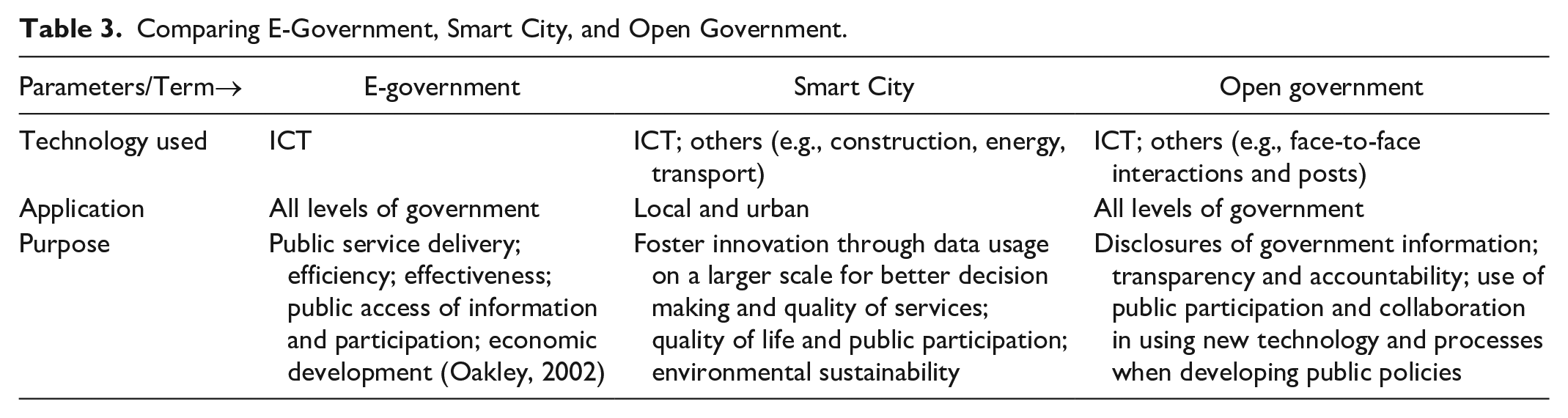
The second difference is that the smart cities concept is not dependent on ICT alone and its objectives incorporate more than the use of ICT for efficient public service delivery and public participation as in e-government and e-participation. Smart city vision incorporates an “urban center of the future, made safe, secure, environmentally green, and efficient . . . ” (Hall et al., 2000). Nam and Pardo (2011) identify the three dimensions of a smart city: a digital technology dimension, a creative city dimension with a focus on people, education, learning, and knowledge for intellectual capital and social capital, and an institutional dimension that includes the political, administrative, legal, and regulatory elements and their relationship with nongovernment parties. Europe’s smart city initiative enlists measures on buildings, local energy networks (heating and cooling) and transport as the main components of the initiative (Strategic Energy Technologies Information System, 2020). The goals of smart city vary from improving environmental sustainability, resilience, quality of life and well-being, to public participation, and intellectual capital (Dameri, 2013). Objectives of innovation, sustainability, livability, and climate friendliness have increasingly gained importance in smart city definitions and there scope ranges across all aspects of infrastructure design, construction, maintenance, as well as waste handling (Hall et al., 2000; Mircea et al., 2017). These objectives and scope help distinguish smart city from other concepts discussed in this article. Though, the selective focus of researchers and practitioners has been mainly on the information technology aspect of the smart city, the scope of the term smart city draws concepts from urban design, architecture, and information technology to public policy and social sciences (Ramaprasad et al., 2017). Smart city frameworks include not just information technology, governance, and policy, but ecosystems of people and communities interacting with their environment that includes, economy, the natural environment, natural resources like water and energy, built infrastructure including transport and mobility, buildings, facilities, services, planning and management, architecture, and data (Anthopoulos et al., 2016; Chourabi et al., 2012). Thus, in Figure 2, the smart city concept is shown as a partially overlapping circle with e-government.

The overlapping circles of e-government, open government, and smart city.
3.6. Open Government
The usage of this term started in the 1950s leading up to the passage of the Freedom of Information Act (FOIA; Yu & Robinson, 2012). Initially, it was used to refer to politically sensitive disclosures of government information but lately it has altered to mean the release of government data through technology and even stretched to apply to any public sector use of technologies (Yu & Robinson, 2012). Discussions of open government often include President Obama’s Presidential Memorandum on Transparency and Open Government in 2009 (e.g., McDermott, 2010) emphasizing social media usage in open government. The Memorandum mandated U.S. Federal agencies to be transparent, use public participation, and be collaborative in using new technology and processes when developing public policies. OECD’s definition of open government encompasses transparency of government actions, the accessibility of government services and information and the responsiveness of government to new ideas, demands and needs (OECD, n.d.). These definitions do not consider e-government as a prerequisite for open government, although e-government may facilitate open government.
Some consider open government within the larger academic field of e-government; for example, Harrison et al. (2012) situate open government within the academic field of e-government and e-democracy. Open government maturity models share similarities with the e-government models (e.g., G. Lee & Kwak, 2012). Level 1 has government agencies working on cataloguing followed by Level 2 where publishing of relevant data online increases transparency (G. Lee & Kwak, 2012). Level 3 involves public feedback and participation activities; Level 4 has interagency and public collaboration; and finally, Level 5 is increased transparency, participation and collaboration through ubiquitous and continuous public engagement (G. Lee & Kwak, 2012).
However, others argue that there is an essential difference between e-government and open government. A government cannot be called more open just by building the right kind of website (Yu & Robinson, 2012). On the contrary, open government objectives, such as of well-maintained and searchable archives of documents, often get sidelined due to other digital government objectives such as, of service delivery (Clarke, 2019). Table 3 provides a comparison of open government to smart city and e-government. E-government gravitates to efficient service delivery while open government toward increased transparency by making government information available to the public. Although information sharing is often the first stage in e-government models and public participation and collaboration the ultimate goals, e-government cannot be construed the same as open government. Digital technology may be used for routine and other government activities not meant to be shared with public at large, such as a country’s defense data. There is a tangible difference in the technologies involved or considered important for open government. The origin of the term open government is related to FOIA and predates e-government. While e-government essentially rides on ICT, open government can use offline tools as well; for example, communications under FOIA can be done through physical mail, and government information can be shared in face-to-face forums. At the same time, digital technology such as Web 2.0 (Chun et al., 2010) tools are considered important for access of information and collaboration required for open government objectives.
The three concepts facilitate and overlap with each other but also have distinct components, as Table 3 and Figure 2 illustrate. E-government provides the necessary infrastructure for open government (Bertot et al., 2014). Open government may facilitate e-government objectives of efficiency and effectiveness in public services delivery (Harrison et al., 2012) and smart city objectives of participation, and data collection and use. However, open government, just like smart government, is not dependent on digital technology alone. Figure 2 shows this by open government only partially overlapping with e-government and smart government.
E-government does not enclose either smart city or open government because the latter two concepts involve other dimensions and are not dependent mandatorily on ICT as is the case in E-government. At the same time, open government does not enclose e-government because e-government has objectives such as, efficiency, quality, and cost-effectiveness in the provision of public services and routine administration (Harrison et al., 2012) that are not open government objectives. Open government aims at data and service accessibility to public in the name of transparency and openness (Bertot et al. 2014). Open government is only one of the several public values that may be attained through e-government (Twizeyimana & Andersson, 2019) and at the same time, open government may not rely solely on e-government infrastructure. Similarly, smart government is distinct in its use of technologies other than ICT, its focus on local city level, and its objectives that focus, not just on public service delivery and public participation, but also on sustainability and improving overall quality of life of residents through innovation.
4. Discussion and Conclusion
The forgoing discussion explores the origins and definitions and models of various terminologies frequently used in the field of ICT usage in government, and establishes a relationship between these, as illustrated in Figures 1 and 2. The digital government concept is an umbrella term that encompasses all activities of the government that are dependent on information technology including e-governance, e-participation, and e-government. E-governance is the next subset that is seen as processes and outcomes with a focus on supporting e-government implementation and transformation of citizen-government interaction and involving a variety of stakeholders. It encompasses e-democracy/e-participation (used interchangeably) and e-government which sits at the core. Open government and smart city have the ethos of e-governance but their definitions do not exclusively focus on the utilization of information technology. Smart city is an extension of e-government, albeit in reference to local urban governments. Table 3 facilitates easy inference of scope and technology; for example, that open government uses technology other than ICT in e-government.
However, the article also clarifies that all these terms are used interchangeably in the literature, and rightly so in some cases; for example e-participation and e-government, in light of the contemporary definitions and models of e-government that do not limit e-government to service delivery activities. Current e-government definitions and stages include democratic activities such as citizen engagement or public participation as an important application of e-government (UN, 2014; West, 2005) and e-participation is one of the advanced stages of e-government. Apart from these, e-government stages include activities of cataloguing, vertical, and horizontal integration of government activities (Layne & Lee, 2001), and all G2B, G2C, G2G, and G2E activities using a range of information technology (Fountain, 2001; Moon, 2002) that overlaps with e-governance and digital government definitions. Even Torres et al. (2006) argue that “e-government has become an umbrella term covering almost all information and communication technology (ICT) applications” (p. 277). Gronlund and Horan (2005) also refer to e-government, e-governance, and digital government as synonyms.
The aim of the current study was to initiate the development of a stable and dependable vocabulary that scholars and practitioners in this field can refer to and benefit from. The discussion of the origin, definitions, models, and interlinkages of these select terminologies in the current study is a step toward settling the ambiguity and vagueness in the usage of these terms. The scholars and practitioners can avoid inconsistency in interpretation by understanding the characteristics of each terminology. In scholarly work, inconsistent interpretation may lead to variation in application of concepts across studies and hinder the accumulation of knowledge in a field of study. This study attempts to clarify some of the concepts so that those studying for example, e-government, e-participation, or smart city are able to use the right terminology for their study and do not feel the need to come up with a new terminology, which will help in accumulation of learning under a field of study; for example, future scholars of smart city will be able to conduct search using smart city as the key terminology and be confident about the search results without the concern of missing important work under e-government or any other terminology. When various scholars in multiple disciplines use the correct terminology that, in the longer run, will facilitate the assessment of the state of the knowledge in a particular field.
Vagueness or ambiguity of terms may perplex practitioners and lead to inappropriate implementation and evaluation of policies. For example, someone unclear about the difference between open government and e-government may focus on efficiency of public service delivery instead of transparency of government information and services when implementing or evaluating an open government policy. Similarly, vague understanding of e-government and e-participation may mean that the officials are content with using ICT infrastructure for public service delivery and may not effectively utilize it for public participation activities. Implemented policies are evaluated for their impact and a knowledge of defined boundaries of the concepts or their multiple interpretation is important in defining the measures for a concept; for example, the UN evaluates its member countries on both e-government and e-participation and scores them separately which is not possible unless there is clear boundaries for these concepts and a knowledge of how they differ because that will determine the measures for each concept.
The interlinkages between the various terminologies are illustrated in Figures 1 and 2 in the form of a mesh of concentric and overlapping circles. The circles in Figure 1 can merge or split, depending on how a concept is defined relative to the other; for example, if e-democracy is considered as a broader concept than e-participation, then another circle can be introduced between e-participation and e-governance for e-democracy. This illustration is a starting point and future researchers are encouraged to reconfigure and bring in other terminologies into this picture to create a vocabulary that scholars and practitioners can easily refer to and benefit from.
Footnotes
Declaration of Conflicting Interests
The author declared no potential conflicts of interest with respect to the research, authorship, and/or publication of this article.
Funding
The author received no financial support for the research, authorship, and/or publication of this article.
