



Abstract
This article attempts to descriptively characterize the impact of the sharing economy, using Uber as an example, on the social welfare of those people working via the app. For this purpose, the author proposes a theoretical concept of a technologically networked economy, which is a component of a broader heuristic model of a technologically networked reality. Furthermore, a critical review of the different approaches to the sharing economy and the diverse practices within it have been carried out. The results of the theoretical exploration of this increasingly popular phenomenon revealed parallels with the problems of nondigital labor markets in the field of the workforce. The clear separation of grassroots sharing practices from those in name only like Uber suggest that the latter do not realize social welfare more broadly than ordinary capitalist enterprises.
Introduction
Until recently, the considerations about technological progress in the broad sense, and digital or Information and Communication Technology (ICT) in particular, have been characterized by the domination of optimistic scenarios (e.g., Bell, 1973; Castells, 1999; McLuhan, 1994; Tapscott & Williams, 2008) over a factual analysis of the phenomenon of what we call the network society (Castells, 2004; Van Dijk, 2020). Some researchers use other terms (J. Martin, 1978; Masuda, 1981; Terranova, 2004) and point out that, while we live today in a society permeated by the digital, where our actions are frequently mediated by digital tools, and the objects we encounter are frequently shaped by digital intervention [ . . . ] it would be wrong to think that we live in “The Digital Society.” (A. Martin, 2008, p. 151)
Although the potential impact of network (digital) technologies on the world of work have also been discussed, as in James Beniger’s (1986) The Control Revolution, Frank Levy and Richard Murnane’s (2004) The New Division of Labor, Vasilis Kostakis and Michel Bauwens’s (2014) Network Society and Future Scenarios for a Collaborative Economy, or recently, Shoshana Zuboff’s (2019) The Age of Surveillance Capitalism, the emancipatory vision of the “wealth of networks” (cf. Benkler, 2006) is a definite leader. Researchers have paid attention to the solutions that the new network technologies (also known as “new digital technologies”; Prodnik, 2015, p. 286) offered or were soon to offer to individuals or businesses (Coyle, 2017; Montgomery & Baglioni, 2020; Nurvala, 2015). However, they have rarely considered the issue of social welfare in the context of a rapidly changing reality. The exceptions were deliberations on political participation impregnated with new technologies, which saw a real transformation of the democratic system and the public sphere.
The analysis of the foundations of the network (digital) economy on the example of the widely discussed “sharing economy” should consider the impact of this social and economic phenomenon, including innovative organizational and distribution solutions, on existing economic practices and social relations, which are not indifferent to the “production” of social welfare (Baranowski, 2019a; Margaris et al., 2017). This is all more important because the network, or “the convergence of computing, media and telecommunications into the Net was a new social system” (Barbrook, 2007, p. 175), expected to lead to “deep changes in the structure and modus operandi of the corporation and our economy, based on new competitive principles such as openness, peering, sharing, and acting globally” (Tapscott & Williams, 2008, p. 3). Taking this into account, the question about the possibility of satisfying the material and nonmaterial needs of society in a technologically networked economy (TNE) seems justified—that is, generating social welfare within the phenomenon of the “new economy,” also called the digital economy or digital capitalism (cf. Fuchs & Mosco, 2016; Grimshaw, 2017). The latter two are used interchangeably (cf. Hicks, 2020; Peters, 2020; Sadowski, 2020), but it is worth being aware that the (digital) economy itself is a broader concept in scope.
The main research question addressed in this article is whether the sharing economy (with Uber as an example) provides social welfare to the participants in this form of economic activity in a way that differs from the “traditional” model based on the exploitation of subcontractors. This is an even more important issue because many researchers see a real added value in TNE; following Kostakis and Bauwens (2014, p. 7), this can be described as “the ICT revolution’s wealth-generating potential.” The main research question was framed based on the literature review and hence is descriptive in nature.
The article is structured as follows: In the next section, I offer a conceptual proposal of technologically networked spheres of social life (with particular emphasis on the economy), which allows looking at social welfare from a digital perspective. I then describe the sharing economy phenomenon against the background of less precise approaches. Following this, I distinguish between sharing economy sensu stricto and sensu largo, after which I move on to outline the Uber company’s characteristics. The issue of social welfare from the perspective of the profit-oriented sharing economy model constitutes the next section. I then conclude the article.
Technologically Networked Economy
The problem of social welfare is addressed in this article only within the framework of a technologically networked reality (TNR; Diagram 1), which is narrowed down, first, to a technologically networked society (TNS), and second, to a TNE. The latter two dimensions, in particular, serve as a reference point for the issue of social welfare in a changing (from the perspective not only of the most developed countries), increasingly networked reality. It is indisputable that the TNR and its implicit parts do not constitute the totality of the complex dynamic structure of reality as such. In the submitted article, we limit the field of denotation to this fragment of reality because it constitutes an increasingly important sphere of functioning in today’s world (Edward, 2020).
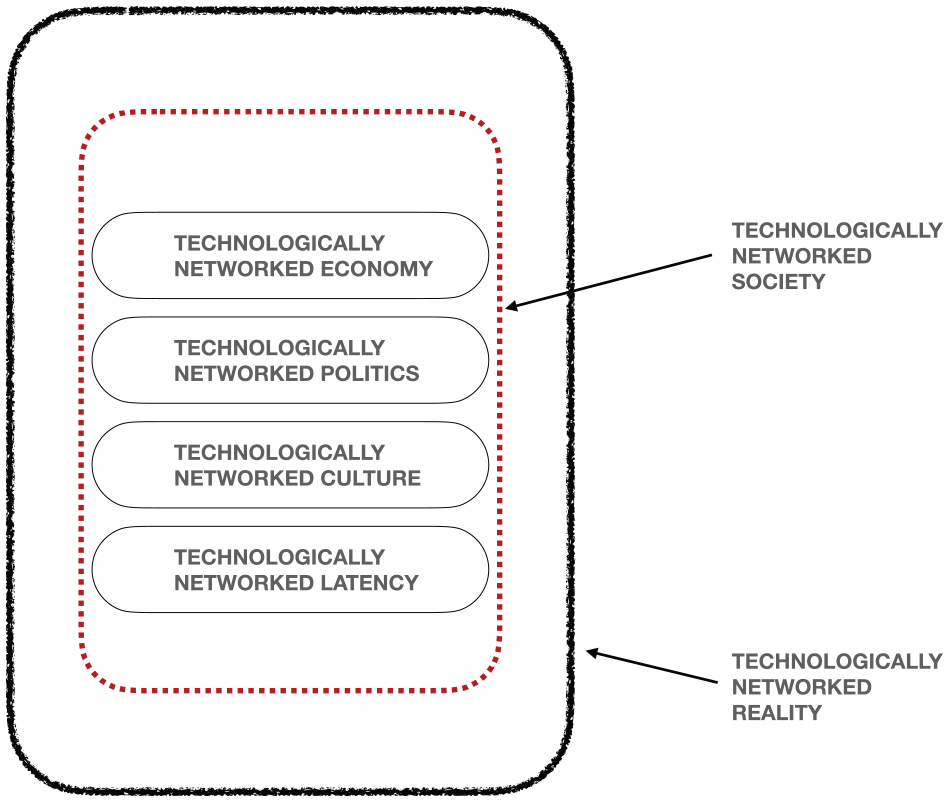
Technologically networked reality with subsystems.
As presented here, the TNR is a component of a more comprehensive, multilevel, dynamic and emergent system of relations among ideas, ideologies, phenomena and processes, as well as objects and entities situated in a historically structured dimension (Cerqueti et al., 2019). In essence, it is about context, that is, a reference field for identifying and deciphering social relationships that manifest in their full glory at the level of society. In the term “TNR,” the emphasis is on the new information and communication technologies that define the “global communication network” (Castells, 2002), considerably narrowing the notion of the social reality in the broad sense (although, dialectically speaking, it may go beyond it). The ontological status of TNR is directly related to social reality as such for the following reasons: (a) technologically cross-linked structures are superstructured over nontechnological networks, and (b) even if they generate “virtual” nodes based on automated algorithms—that is, going beyond the extensiveness of what is social in a hard sense—they affect a reality beyond the pretechnological (Baranowski & Mroczkowska, 2021; Thomas et al., 2018). The specific social “avatars” (independent simulacra) are of theoretical conception, but for the sake of accuracy, they are still at most future references.
The TNS is a concretization of the TNR (TNS ⊂ TNR). However, its attitude toward society as such can also be described through a subset relationship within a wider field (TNS ⊂ Society). Since TNS is a category referring to the specific and most important (although, in this case, “technologically mediated”) concept of sociology, one can be tempted to analyze its components by analogy with the original dimensions. Therefore, let us consider the elements of the structure of social differentiation that, alongside culture, determine the substrate of society.
The permanent components of social differentiation relationships characterizing society include status, roles, groups, institutions, and territorial communities. Social status—that is, the position of an individual in the structure of social relations, which determines the person’s respect or disrespect in a given community—is closely reflected in the TNS. Although “technological mediation” forces the introduction of several mechanisms to compensate for the lack of face-to-face relations that occur in communities understood as primary groups, the ICT infrastructure offers such possibilities. The social role, which is the behavior of an individual with a certain status, has its correlates also in a network (digital) society (Resende et al., 2020). It is an instruction that is an effect of the dominant status of an entity (agent), which in turn, is determined based on its professional position, or more aptly, for example, “recognition” in social networking sites (social media).
Social groups, understood as network configurations (or groups within a network), are characterized by a sense of their identity (Simmel’s “We”), which defines others as “strangers.” The equivalent of a territorial community in the TNS is the virtual community described by Howard Rheingold (2000) in The Virtual Community. However, some researchers have reservations about this assumption (cf. Koh et al., 2003). To refer to Talcott Parsons (1964, p. 99), group cohesion in the digital dimension is ensured through a latency mechanism; in this case, this mechanism is technologically networked and sustained by the ICT infrastructure.
The social institutions, defined by Émil Durkheim (1982, p. 45) as “all the beliefs and modes of behavior instituted by the collectivity,” seem to play a unique role in social cohesion. First, they are responsible for resolving the difficulties and ills of the community. The problems concern the various dimensions of the functioning of society; hence, specific institutions have been established to ensure the order and integrity of an organized form of collective life, such as political, economic, educational, social, or religious institutions. Each institution has several specific functions with the overriding goal of ensuring the cohesion and sustainability of the social organism, as well as social welfare. In this case, unlike in terms of status, role or group, the TNS does not strictly fulfil the tasks of individual institutions in the broad sense. Selected individual functions aimed at maintaining social ties can be performed in an ICT dimension by analogy to the nondigital community. Nevertheless, patterns of socialization and acculturation within TNS take on a specific character for two reasons. First, it is the network communication dynamics of its own (cf. Castells, 2009), and second, the fact that these patterns are also subject to change in a nonnetwork dimension. As for the latter, McLuhan (1994) drew attention to it in the context of learning, saying that “our education has long ago acquired the fragmentary and piecemeal character of mechanism” (p. 357), which implies the absence of homogeneous patterns of consistency maintenance. Political institutions in the TNS still have some potential for implementation, which is sporadic in specific national contexts (e-voting in Estonia or algorithmic decisions on whether to grant social benefits in Sweden; see Nowacka-Isaksson, 2018).
The most interesting institution in terms of the issue at hand is the economy (cf. Grimshaw, 2017; Huws, 2014), which can also be explained from the perspective of a networked society (TNE ⊂ TNS) and individual companies’ desire to gain a competitive advantage over their adversaries (for Silicon Valley companies, see “Why startups are leaving,” 2018). The economy plays a significant role in society as it organizes mechanisms responsible for meeting the needs of a given population. It is also influential for other components of a society with a system of statuses, roles or other institutions, such as educational (Baranowski, 2020) and political elements. This is particularly evident in the contemporary capitalist social and economic system, which it takes many shapes but has some standard features (the so-called platform economy, including the system described below).
A New Model of Sharing Economics or Sharing Economy Practices
The term sharing economy, introduced by Marcus Felson and Joe Spaeth (1978), has been mistakenly translated as “sharing economics” (Bozdoganoglu, 2017, p. 121; see also Courcoubetis & Weber, 2018) or “economics of sharing” (Munkøe, 2017, p. 38), suggesting that there is a social science of sharing. Even in the report of PricewaterhouseCoopers (2016, p. 1), we can read about the “sharing economics trend” or the “sharing economics model.” Some people speak of a “socio-economic system built around the division of human and material resources” (Jablonski, 2020, p. 135). The very concept of sharing economy is about the “economy” of sharing, or more precisely, shared or collaborative business practices, although the meanings of these terms in specific business ventures may be misleading (e.g., Uber or Airbnb). Idealized versions of sharing economy emphasize the aspect of trading without markets and sharing of goods according to principles: “why own property when you can use it,” “share, don’t buy,” “the more you share – the more you have,” “don’t debt to own” or “access is more important than ownership.” (Zysk, 2016, p. 40)
The aforementioned researcher does not make it clear in what sense we are talking about “omitting the market,” but one can suggest that it is a market in its full potential. In the above principles, there are subtle socioeconomic differences between ownership and possession (Baranowski, 2011), which could become the basis for nontrivial analyses of the phenomenon of the sharing economy (cf. Ossewaarde & Reijers, 2017). However, the author has limited the discussion to nonempirical and wishful thinking, emphasizing that “the economy of sharing is another, after fair trade, Corporate Social Responsibility, responsible tourism, and responsible investment, movement in the service industry” (Zysk, 2016, p. 46). This idealized approach has a purely formal character far from the paradigm adopted in this article of examining social reality as it is (positive aspect) and not as it should be (normative aspect).
For some (nonsociological) researchers, the corporate social responsibility codes and their theoretical normative principles are more important than companies’ and corporations’ real activities (Gholami, 2011; Green & Peloza, 2011). I would like to point out that Volkswagen AG also had this “noble” corporate social responsibility document, which contains guidelines for the liability of the German manufacturer (see Kopp & Richter, 2007), while fraudulently programming TDI engines (the Dieselgate scandal).
As Koen Frenken and Juliet Schor (2017) noted, the word sharing in the context of sharing economy phenomenon should be replaced by renting because most of the examples included in the sharing business practices are rentals offered for money (i.e., they involve financial compensation (financial remuneration). The profit-oriented approach contradicts the idea of sharing, which is identified with the social practice of “free” sharing (which should be closer to Marcel Mauss’ vision described in The Gift, 2002). The sociological and anthropological meaning of sharing refers to social practices aimed at building and strengthening social relationships and group identity, linked to norms of reciprocity (Polanyi, 1957) that cement the community (rather than generating profit). There is no consensus on whether sharing economies can bring financial benefits, because for some researchers, sharing is contrary to making a profit, and for others, it is secondary to the effective use of funds that have not been used to their full extent before (cf. Arcidiacono et al., 2018; Hill, 2015; Ravenelle, 2017). In the latter case, it is also about promoting sustainable development (Daunoriene et al., 2015) and strengthening forms of cooperation (hence, the term collaborative economy). The thread of generating profit, and thus, the emergence of money as a means of exchange, is not indifferent to social relations and relationships, as David Graeber (2014) pointed out in a well-documented anthropological work titled Debt. The first 5000 years. This argument must be considered when deciding whether “sharing” may involve an intentional act of making money. A positive answer to this question brings to mind the axiom of money neutrality, characteristic of the subjective-marginalist school of economics (cf. Hornborg, 2019), which takes a demand-driven approach but has little to say about sharing. Other scientists emphasize that “what many often call ‘sharing economy’ is neither sharing nor just about the economy” (Jemielniak & Przegalinska, 2020, pp. 21-22). An exciting approach is presented by Vasilis Kostakis and Michel Bauwens (2014, p. 15) in their typology, based on which, sharing economy companies are classified under “netarchical capitalism.” The latter, however diverse, have a common feature that [ . . . ] while their front-ends (whether the platform’s infrastructure, see Facebook or Airbnb, or a P2P practice that the company may follow, see IBM) might be distributed, they are based on certain technological regimes of centralized back-ends while having a for-profit orientation with exclusionary financialization. (p. 26)
The gig economy, a term often used interchangeably with sharing economy, refers to labor market participation, that is, the scheme of contracted temporary work in which income is obtained through gigs (i.e., individual projects or tasks; Rinne, 2017). On this account, “what the gig economy has come to symbolise for some is an opportunity for flexibility, to earn additional income through short-term opportunities and thus yields tangible benefits” (Montgomery & Baglioni, 2020, p. 2). For others, “the gig economy has simply meant a decline in the quality of employment in terms of pay and conditions” (Montgomery & Baglioni, 2020, p. 2). Here, let us take the example of Amazon, which invented “an extraordinary name for its stock of precarious temporary jobs: ‘Mechanical Turk’ (MTurk) (see Lazuly, 2006). When a task cannot be completed by computer, it is entrusted to an army of reservists, who are paid a penny” (Frank, 2016, p. 23; see also Thomas & Clifford, 2017). In the eyes of the online sales giant, the issue is not about replacing monotonous and/or dangerous work done by people using computer-controlled machines (which would have a positive impact on the social welfare and well-being of hired workers in specific positions) but about generating profit (Husson, 2019). This is why Thomas Frank (2016) said that it is hard to imagine a better initiation in the sphere of the sharing economy, the “sharing economy”—that is what it is called because an employee uses his own car, his own apartment, or his own computer—for the great benefit of the employer. (p. 23)
Sharing Economy and Access Economy
In one article, Giana M. Eckhardt and Fleura Bardhi (2015) proposed the concept of access economy instead of the misleading term sharing economy. However, it is worth remembering that the term “access” was used much earlier by Jeremy Rifkin (2000). Following the point of view presented in this article, the authors determined that the term sharing economy has nothing to do with real sharing practices. The previously raised problem of deriving financial benefits from the sharing of resources has not been solved by the distinction made by the aforementioned researchers from London’s universities. However, it has made it possible to articulate certain discrepancies and make an initial division of companies according to specific criteria (Table 1). Therefore, the sharing economy in the strict sense mainly concerns shared consumption based on individual agreements, that is, with a small role of intermediaries (sometimes limited to technological infrastructure). An important role in the sharing economy in the strict sense is played by the trust between the participants in the exchange.
Sharing Economy Versus Access Economy.

Source. Malinowski (2016).
Consumption is an integral part of the “sharing” economy. However, some use the term collaborative consumption (Felson & Spaeth, 1978) to emphasize aspects of “community” and “cooperation,” which—as I have suggested—are not entirely compatible with empirical examples (cf. Jarvis, 2017; Kostakis & Bauwens, 2014). This proves that there is no shortage of the optimistic visions promoted by David Bollier and Pat Conaty (2014) and Nan Lin (2004), which emphasize “good” practices of the new culture of common goods or so-called social capital. Some academics note that the debate over the commons has emerged from “an increasing awareness of ecological destruction due to limitless privatization of resources and the destructive externalities of capitalist production and consumption” (Ossewaarde & Reijers 2017, pp. 611-612).
The access economy is distinguished by the direct participation of an intermediary, which is the primary beneficiary of the so-called sharing, and of ordinary trade, in which contractors or subcontractors are deprived of social security and other social rights. If such practices are called “sharing,” commonly understood words must be redefined. In addition to “better” ways of exploiting the workforce of hired workers, with the use of mobile applications, such companies as Uber naturally contribute to the commodification of newer and newer areas of social life (Ziółkowski et al., 2020a, 2020b), and it must be remembered that “commodification is inextricably intertwined with the production and reproduction of capital” (Tittenbrun, 2017, p. 222). As Evgeny Morozov (2015, p. 6) noted, “it is difficult to preserve values such as solidarity in a technological environment built on personalised, individualised and unique experiences.” Moreover, the introduction of novelty in a TNE has a more significant impact on other spheres of reality than is commonly assumed. In Le Mirage numérique. Pour une politique du Big Data, Morozov (2015) put it this way: Silicon Valley does not lie: our everyday life is being transformed; but this is happening through forces much more dangerous than digitalisation or access to the web. The fetish of innovation should not serve as an excuse to burden us with the costs of current economic or political problems. (Morozov, 2015, p. 6)
These problems—as described in detail and systematically by Mazzucato (2015)—include public funding of basic research, which private corporations then use to generate “private” profits. Politically, the practices of socialization of private losses (the recent financial crisis) and appropriation of public profits (the iPhone technologies described by Mazzucato, 2015) are legitimized. Michel Husson (2001) described the ridiculous relationship in a TNE, pointing out that “the share prices of companies operating in the ‘net economy’ sphere and listed on such specialised markets as Nasdaq in the U.S. have broken completely out of the tether and have no relation to the performance of [these] companies.” This in turn shows that speculative bubbles related to new technologies are not a thing of the past, as they still involve potentially large profits.
Within the access economy, “innovation” is pushed along different paths (Klementewicz, 2020, p. 184), sometimes through open conflict with local or state authorities, and sometimes in the privacy of bureaucrats’ offices. An example of the first strategy is the actions of the Uber company (whose scale of operation is shown in Figure 1), which fights opponents in the form of cities, such as Boston, in various ways (including sophisticated ones, discussed below). The second strategy is represented by, for example, an agreement signed by MasterCard with the Nigerian government “for the release of an identity card that is also a credit card” (Morozov, 2015, p. 6). All these practices must be seen in the broader context of a specific “evolution”: from web-tracking programs to surveillance systems; from web content and relationship management systems to population surveillance technologies; from control and disciplining gazes to the dispersal of awareness of who is looking, where and when. Power on the Web is also an apparent absence and inaccessibility to others, a location that even the prominent may not know (see I.P. disguise, call and email encryption, physical server location, redirection system). (Baranowski, 2019b)
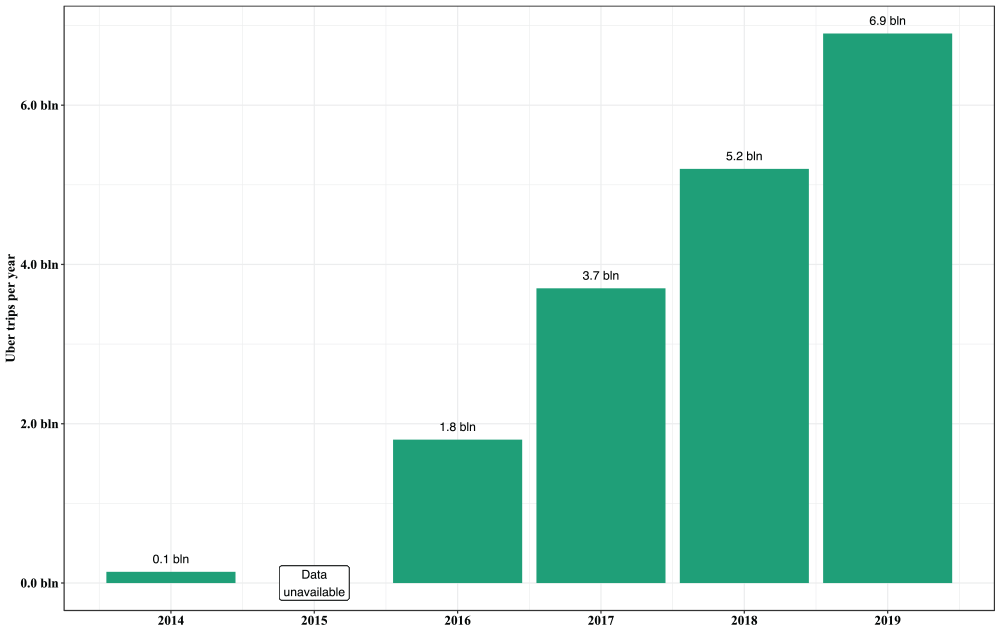
Uber trips by year (in billions).
The sharing economy is no exception in this respect, although digital tools have the potential for more emancipatory and egalitarian use.
A study on Uber in Portugal shows that the regulatory framework did not put a stop to the increase in profit margins. Furthermore, the crystallization of the chain of command along the axis digital platform > partner company > driver has led to the spread of [ . . . ] the “soft corporation,” marked by the entrenchment of atypical working conditions within the platform economy and of a multiple exploitation of drivers who do not own a company: first by the app, then by the entrepreneur TVDE. (Leonardi & Pirina, 2020, p. 60)
The sharing economy practices exemplified by Uber show that innovative technologies do not necessarily lead to the crystallization of qualitatively different working conditions from those we know from nontechnologically networked solutions. The Portuguese example does not mean that Uber’s business model lacks advantages; because of the advantages it has, followers are willing to use it. However, it does provide empirical evidence that the “process of platformization of work” (Leonardi & Pirina, 2020, p. 47) suffers from the ills afflicting salaried workers in nondigital professions, as well as the so-called self-employed (Behling & Harvey, 2015).
The Precarious Workforce and Uber
Researchers have long drawn attention to the potential dangers associated with computerization of workflow management functions. In Imaginary Futures, Richard Barbrook (2007) recalled the “founding father of cybernetics,” Norbert Wiener, who echoing Marx [ . . . ] had warned that the role of new technology under capitalism was to intensify the exploitation of workers. Instead of creating more leisure time and improving living standards, the computerisation of the economy under Fordism would increase unemployment and cut wages. (p. 60)
Even earlier, Graham Murdock and Peter Golding (2001, p. 114) drew attention to the marketization process in Digital Possibilities, Market Realities, which was characterized by four fundamental dynamics—privatization, liberalization, reorientation of regulation, and corporatization of the public sector. The above points also apply to the TNE, which puts the “wealth of networks” in a completely different light from that preferred by cyber-enthusiasts. Besides, as technology companies have taken possession of some of today’s most valuable resources—data; they have also gained control over city authorities deprived of as much money as imagination, and can play the role of good-hearted saviours of helpless bureaucrats filling administration buildings. (Morozov, 2015, p. 7)
Uber’s business model is an excellent example. Karolina Mikołajewska-Zając noted that this profitable company has a lot of power over the driver. It can, e.g., deactivate his profile at any time because, for example, he was misjudged by the customer. And yet, the reason for the negative assessment could have been many factors independent of the driver, such as the fact that he was in traffic jams. (PAP, 2018)
The above purely technical details should be developed, and it should be stated very clearly that Uber [ . . . ] wants to exert tight control over laborers and users rather than provide ways to empower them. In China, Uber monitors its workforce to see who participates in protests, whereas in countries everywhere it uses algorithms to determine if drivers work for the competition. At the same time, companies who host sharing platforms desperately avoid state regulations by insisting that they are technology (not service) providers–intermediating platforms, they say, rather than running an accommodation rental service (in the case of Airbnb) or a taxi company (Uber). (Jemielniak & Przegalinska, 2020, p. 25)
There is massive asymmetry in the relationship between “employees” and Uber. The California-based giant has total control over the drivers, who use their personal cars to provide transportation services. For the sake of accuracy, so-called Uber drivers are often subcontractors of companies that own fleets of cars and sub-employ them (i.e., they don’t officially work for Uber). This is particularly relevant in light of the study of the social welfare (including psychological well-being) of these subcontractors. Uber has introduced a “Partner Protection” service in Poland, among other countries; this is a form of accident insurance for partner drivers (but does not include those who are subemployed by intermediate companies). However, this development does not change Uber’s dominance over people “employed” in precarious conditions. Even more important seems to be the way of repelling attacks from critics, which is an effective strategy for eliminating barriers to the development of this profit-oriented company. Let us view the following case: [ . . . ] the cab drivers raised a protest. When the regulatory authorities from India to France went to Uber, the California company suddenly changed its strategy. Its owners, until now deaf to any criticism and rational arguments, are now demanding regulation of the sector. They seem to understand why their company has become an easy target: its practices are too unfair. Last winter, under the fire of criticism, Uber resigned from imposing higher rush hour fares. Nevertheless, that is not all. In a brilliant advertising move, the company also offered one of his most declared opponents, the city of Boston, access to the treasure trove of the (anonymous) car-registered routes in order to help reduce traffic jams and facilitate city management. (Morozov, 2015, pp. 6-7)
This time, the strategy contributed to Uber’s success in Massachusetts, but several concerns about having clients’ data available for the company’s ongoing business remain. The case concerns the terms and conditions of employment at Uber, and this information should be publicized so that application users and potential customers have an insight into the real “innovative” solutions of the transport giant (Scholz, 2016). These practices are extremely momentous and bring to mind—using Luc Boltanski and Ève Chiapello’s (2007, p. xiv) words—new mechanisms of exploitation. They are “new” because, on the one hand, they are mediated by platform technologies, and on the other, relate to a more flexible and precarious work organization. Flexibility and precarity offer great marketing opportunities that emphasize the possibility of work and its intensity depending on the driver’s will. In fact, referring to the concept mentioned earlier, it is worth being aware that “in netarchical models, such as that of Uber [ . . . ] there is no community nor the creation of commons; rather individual workers compete for their own livelihood” (Bauwens et al., 2019, p. 37).
Social Welfare and (Neoliberal) Political Economy of Sharing
Discussions about the “new” reality, the “new” society and the “new” network economy have a long history and have appeared in thick volumes of monographs and scientific journals. One of the most frequently cited epigones of the “new” describes this phenomenon as follows: The new economy of our time is certainly capitalist, but of a new brand of capitalism: it depends on innovation as the source of productivity growth; on computer-networked global financial markets, whose criteria for valuation are influenced by information turbulences; on the networking of production and management, both internally and externally, locally and globally; and on labor that is flexible and adaptable. (Castells, 2009, p. 33)
Here, even flexible employment is an attribute, as if against the conclusions of economists and sociologists studying this phenomenon (cf. Standing, 2011, 2014). However, the reality—even this networked one—looks much less optimistic when we look at it from the point of view of social welfare. It must be remembered that a TNE, however prosocial and progressive, functions primarily in neoliberal capitalism (C. J. Martin, 2016). This means that a large part of the network dimension is commercialized, privatized, and commodified, while corporations “only support ‘sharing’ if they can make money from it” (Bollier, 2014). Social welfare is not a priority objective for profit-oriented network enterprises, although this does not immediately mean that we are facing adversity. The social needs at various levels can be met by commercial platforms or businesses, but this is not the form of “exclusive” welfare we mean when we use the term “sharing.” The emancipatory perspective of the network society, perhaps too naively, involves liberation from the power of the market—that is, profit and exploitation—and brings to mind the expansion of “common goods,” decommodified social relations or social welfare in its broadest sense (see Dolšak & Ostrom, 2003; Baranowski, 2019a). Describing the allegedly “new” economy and the associated increase in labor productivity in the United States, Michel Husson (2005) soberly stated that this increase is intended to [ . . . ] put an end to the “Solov paradox” of saying that the computerisation that is being pushed through does not bring about productivity gains. This direct relationship must be challenged: the increase in labour productivity does not only depend on technological innovation but also on a very classical factor, namely, the degree of labour exploitation.
Moreover, the growth understood in this way does not translate into increased social welfare for employees, who constitute the great majority of every society.
Advanced technologies can effectively extend social welfare by providing knowledge (Baranowski, 2019b; Jakubowska, 2019), information, access to specialists of all kinds, health monitoring applications or ICT infrastructure that enables self-organization of society (e.g., in the political dimension, support groups for people in need of help or even the realization of not only unique interests). However, there is a considerable difference between, for example, Airbnb (a service that allows the user to find paid accommodation for private individuals) and CouchSurfing or BeWelcome, platforms that allow users to offer free accommodation or guided tours of the city (for the differences between the two, see Ossewaarde & Reijers, 2017). The former is profit-driven, while the latter offer free, off-market goods. Both satisfy a specific need, but only the latter eschews commodification, although CouchSurfing “reformed itself form ‘a commons into a commodity’ by attracting investments from venture capitalist in 2011” (Ossewaarde & Reijers, 2017, p. 616). This example vividly shows that the logic of capitalist accumulation creatively exploits the emancipatory potential of digital communing to commodify and commercialize it.
The TNS mainly fits into the scenario sketched by Barbrook (2007, p. 75), in which “the modern phenomenon of commodity fetishism had been transformed into [a] universal principle of technological fetishism,” although it should be added that this occurred with several exceptions (cf. Jemielniak & Przegalinska, 2020, p. 41). In contrast, contrary to network enthusiasts, our expectations of new ICT are perhaps too high given that the Internet is nothing more than “a super-fast and globally accessible combination of library, post office, and mail order catalogue,” as sarcastically noted by David Graeber (2015, p. 132). A rational point of view was proposed by Anthony Atkinson (2015); considering the directions of technological change, he stated, “[W]e have to consider who receives capital income, and the case for fairer shares of wealth” (p. 116), which should be an essential criterion for the assessment of a TNE.
When considering the issue of social welfare in the context of a sharing economy as we know it, it is impossible to disregard the consumption component, if only because a consumption-oriented economy actively promotes disaffection, saps confidence and deepens the sentiment of insecurity, becoming itself a source of the ambient fear it promises to cure or disperse—the fear that saturates liquid modern life and the principal cause of the liquid modern variety of unhappiness. (Bauman, 2007, p. 46)
From this point of view, a TNE oriented towards consumption not only fails to deliver social welfare, but through a series of mechanisms that “discipline” the flawed—to paraphrase Bauman—user-customers, it also contributes to the permanent state of tension associated with “not possessing,” “not being visible” or “not using” technological innovations (cf. Ettlinger, 2014).
Conclusion
In Understanding Media, Marshall McLuhan (1994) commented, “[T]he social and educational patterns latent in automation are those of self-employment and artistic autonomy,” perhaps overly optimistically adding that “panic about automation as a threat of uniformity on a world scale is the projection into the future of mechanical standardisation and specialism, which are now past” (p. 359). However, so far—and almost a quarter of a century has passed since these words were written—standardization and specialization are not a thing of the past. Modern societies, especially the most developed ones, are characterized by a high degree of accessibility and use of digital network technologies. At the same time, their impact on the production of social welfare should be considered at least marginal (Zuboff, 2015, 2019). I do not deny the potential of new technological solutions, because the free software movement, the ability to share cultural resources, the availability of knowledge and freedom of speech, for example, are undeniable assets of network reality (for more on resilient communities and global commons, see Kostakis & Bauwens, 2014).
However, in the real-world view of a TNE, often referred to as innovative, we are dealing with one of the most damaging and asymmetric models of labour exploitation invented in recent decades. In the case of Uber, the costs and risks associated with this business—the obligation to sign an insurance contract, own a vehicle, take out sick leave or secure a pension—are borne by the employee, while the Californian “innovator” who invented the software takes the lion’s share of the profits generated this way. (Frank, 2016, p. 23)
Social welfare, viewed from the perspective of the sharing economy, is not the primary purpose of sharing “economics”—first, because it is not any economics, but a fragment of economic reality, and second, because there is no sharing for the dominant companies of the “new” economy. It is mainly about making profit through the intentional exploitation of the labor force and real technological innovations, and the label of “creative industry,” which serves the great and positive transformation of society, concerns at most the PR tricks of producing “imaginary worlds.” In these imaginary worlds, the emancipatory potential to change commodified reality becomes even more difficult because—as in the example of CouchSurfing described above—those involved in communal practices feel cheated and objectified. However, if one looks closely at this broad socioeconomic panorama, the real disadvantages of large corporations, such as Google, Facebook, Airbnb, Uber, Amazon and Apple (as far as the latter is concerned, see Mazzucato, 2015) outweigh the potential advantages of sharing practices according to the principle that “[t]here is no innovation without monopoly; challenging even the smallest of its powers will force it to close factories” (Frank, 2016, p. 23) or exemption of casual partners. These consequences do not contribute to the subjective well-being of the individual or the social welfare of the whole community. Although there is a different scenario to imagine (Morozov, 2019), in which new technologies work to meet the needs of society in the broadest sense and contribute—as Bauman (2017) noted—to the “gradual elimination of particularly ‘bad jobs,’” nowadays, this is still a potential and future challenge.
Footnotes
Declaration of Conflicting Interests
The author declared no potential conflicts of interest with respect to the research, authorship, and/or publication of this article.
Funding
The author received no financial support for the research, authorship, and/or publication of this article.
