



Abstract
In the twenty-first century, the focus of science and technology (S&T) on the human interests and the accessible interests of society, and so the rise of some questions concerning the impact of S&T on social norms, has led to embedding ethical debates in S&T policy-making. The ethics of S&T policy-making, as a representation of the relationship between ethics and S&T policy-making, is a relatively new area of applied and professional ethics that addresses the dilemmas and ethical challenges of the S&T policy-making process. Understanding and recognizing the ethical components of S&T policy-making, one can develop a normative framework to assist policymakers in designing and analyzing ethical policies in the S&T field. The design and development of such a framework is the main purpose of the present study. In this study, the components of the proposed framework for ethical policy-making in S&T, their ethical and policy approaches, as well as their fundamental ethical and policy principles have been identified through studying sources and texts related to meta-ethics, normative ethics, and S&T ethics. Then, these components have been categorized in the form of steps for ethical policy-making using the thematic analysis method. Based on the results of this study, the ethical policy-making steps in S&T include problem identification, information gathering and feeding of the policy process, policy advice and policy formulation, policy implementation, and policy evaluation, which follow 9 ethical principles and 13 policy principles.
Introduction
Today, science and technology (S&T) do play a major role in developing innovative solutions to meet social needs. The impacts that these innovative solutions have on our mental performance, behavior, and lifestyle are unprecedented. Recently, as S&T has grown and developed, we have seen a significant increase in ethical debates on S&T so that, besides experts, more non-experts express their views and concerns in this regard. People are afraid of the negative consequences of S&T and want to protect social values from the influence of new values that have emerged through the development of S&T and seem to show less respect and attention to living beings (Bovenkerk, 2012). So ethical questions about S&T advances are urgent and crucial. Questions like how should we pay attention to new technologies? How should we control their effects? What should we base our thoughts and decisions about S&T on? Who should we trust for advice? (Van Est et al., 2014). These and many other questions explain why ethics is (and should be) important for S&T policy-making. Today, in many journals, ethical S&T policy-making is discussed, and ethical issues that are directly related to S&T policy-making (including privacy, intellectual property rights, access, equality, etc.) are thought through by many scholars (Fishkin, 1979, 55–76; Ladikas et al., 2015). Ethics in S&T policy-making is associated with concepts such as good and bad, right and wrong, obligatory or non-obligatory, and seeks to span cross-cultural and individual borders of norms and values (Ladikas et al., 2015).
It should be noted that the practical fusion of ethics and policy-making does not occur in isolation and automatically; Rather, it is influenced by various factors such as culture, values, government policy-making institutions, informal structures, ethical practices in decision-making situations, insight toward and awareness of the effects and consequences of S&T, etc., all of which influence the expression and orientation of ethical issues (Brom et al., 2015; Burgess, 2014). It is in this light that recognizing these components is essential to ethical policy-making. On the other hand, with the incorporation of morality into policy-making, ethics experts and policymakers need to know that they cannot enter the formal policy-making process with the same kind of general principles that prevail in public debate. Because these principles are far simple in terms of value to deal with the real complexities of policy-making such as multiple actors, public debates, challenges of the rapid technological change, etc., it is necessary to combine different types of principles with new and more complex methods, concepts and theories, or even to introduce new principles (Fishkin, 1979, 55–76). So the main questions this study seeks to answer are: (i) what are the ethical components of ethical policy-making in S&T? (ii) What are the principles governing ethical policy-making in S&T? Answering these questions, the present study seeks to develop a normative framework for ethical policy-making in S&T.
Theoretical Foundations
The three main ethical theories, in normative ethics, for guiding ethical decisions are utilitarianism, deontology, and virtue ethics. Utilitarianism theory focuses on the consequences of an action for all/most of those who are directly or indirectly affected by it. In general, according to this theory, moral behavior is an action that benefits the maximum number of people who are affected by it (Mill, 1982). The deontological theory revolves around ethical duties and determines ethical responsibilities. According to this theory, developed originally by Immanuel Kant, moral action is the one that the agent does according to his/her duties, whatever the results of the action are. The duties are derived categorically from the categorical imperative and due to the correlation between duties and responsibilities, identifying the latter is straightforward (Kant, 1996, 56). Virtue ethics concentrates on the agent's character rather than the actions or consequences. According to this theory, moral action is one that a virtuous person does in morally significant situations (Russell, 2013, 9). Using moral virtue theory, moral actions moral actions should be practiced by agents, including professionals, to be institutionalized as virtues in them over time.
Since these ethical theories focus on different ethical aspects (consequences/duties/characters), in many decision-making situations the conclusions reached through one theory may be different from the conclusions derived with the help of other theories. Since all those aspects are important to consider in the process of reaching good moral decisions, then policymakers exploiting an integrated approach need to embrace the combined merits and strengths of all three ethical theories. But it should be noted that the integrated approach cannot deal with ethical issues arising from the complexities of S&T policy-making, including multiple actors, public debates, challenges of the rapid technological change, etc., with simple principles. Instead, the integrated approach requires different types of principles need to be combined with new and more complex methods, concepts and theories, or even new principles. For this reason, in the next section, an attempt has been made to introduce a set of methods, concepts, and theories that, in combination with these principles and ethical theories, lead to a proposed ethical policy-making framework in the field of S&T.
Democracy Approach
In simple terms, democratic policy-making translates to public participation in policy-making. For democratic policy-making, it is not enough to simply reflect public opinion or provide a platform for verbal competition between interest groups, but democratic representatives are needed to integrate and embed the scientific, moral, and political concerns of the general public into the policy-making process and meet the interests of the people in the best way possible (Brown, 2006; Fukuyama, 2003, 212–215). This definition accentuates and reinforces principles such as participation (Carothers & Brechenmacher, 2014), non-maleficence and beneficence (Ross, 1939), fallibility (Sah, 1991; Stelzer, 2016), learning (Sanderson, 2009), justice (Ross, 1939), respect (Gillon, 1994; Landau & Osmo, 2003), equality (Landau & Osmo, 2003), inclusion (Carothers & Brechenmacher, 2014), openness (Aven & Renn, 2018; Pohjola & Tuomisto, 2011; Sanderson, 2009). One of the political ideologies that emphasizes the role of democracy is liberal democratic. In this ideology, democracy works under the principles of liberalism. The main characteristics of liberal democratic are a market economy with private ownership and equal protection of human rights, civil rights, and civil liberties and political freedoms for all people (Hardin, 2003). Liberal democratic ideology, since the seventeenth century, has emphasized the role of technical expertise and professional ethics expertise in creating effective policies and as a means to meet the best interests of citizens (Evans, 2002). The prevailing view, then, was that ethics advisory committees followed principles such as accountability (Argyrous, 2012; Aven & Renn, 2018; Carothers & Brechenmacher, 2014), fidelity (Brown, 2006; Meslin & Shapiro, 2002; Ross, 1939; Welfel & Kitchener, 1992), transparency (Argyrous, 2012; Aven & Renn, 2018; Carothers & Brechenmacher, 2014), consultation (Sanderson, 2009) and incorporating a wider range of professional and non-technical perspectives into the S&T policy agenda resulting in more effective and democratic representation.
So, ethics advisory committees facilitate policy-making and increase its legitimacy (Evans, 2002). The first ethics advisory committees were formed with the advent of the new bioethics profession (Evans, 2012). Bioethicists, who wanted to be taken seriously by policymakers, adapted their approach, from the outset, to the needs of government advisory committees. This kind of ethical committee that promotes the ‘principled’ approach focuses on a limited set of middle-level ethical principles that provide basic guidance for policy-making while being consistent with a variety of philosophical foundations (Beauchamp and Childress, 2001; Evans, 2002). So, ethics advisory agencies are formal structures created specifically to consciously reflect on ethical issues in the policy-making system. The informal form of ethics, on the other hand, is more about morality that revolves around the ethical issues/values presented by non-experts in a social context. Lay morality is an integral part of ethics in policy-making and such membership is commonly found on many professional state boards of licensure in the Unite States. It should be noted that ethics, both formal and informal, originates from the dominant values of the society that are rooted in the cultural and historical, or even biological backgrounds (Ladikas et al., 2015). Policymakers’ attention to values and cultural context in policy-making reflects their political morality (Sládeček, 2018). Furthermore, the concerns of the private sector and civil society organizations, which influence the direction of decisions, should not be overlooked. Using ethical arguments and conducting information campaigns, private sector and civil society organizations influence ethical debates (Ladikas et al., 2015).
Evidence-Based Policy-Making
Contrary to opinion-based policy-making which is based on beliefs and ideas derived from the untested views of individuals or groups, ideological views, prejudices, or speculation, evidence-based policy-making (Arcos, 2016; Muir Gray, 1997) reinforces the principle of objectivity in policy-making (Leir & Parkhurst, 2016), and helps to make informed decisions about policies, programs, and projects by supplying the best evidence to policy development and implementation (Davies, 2004). Evidence from systematic research is one of the information sources of evidence-based policy-making (Muir Gray, 1997). In addition, policy evaluation by measuring, describing, and analyzing various policy dimensions provides the knowledge needed for effective policy-making (Department for Business, Innovation, and Skills, 2010). The tendency of policymakers to analyze and evaluate policies resonates with the principles of transparency and reparation (Plante, 2007). Policy evaluation requires consensus-based indicators. There is a great variety of policy evaluation indicators, and the type of indicators used in policy evaluation depends on the framework and approach that evaluators and analysts choose depending on the goals and conditions of the policy (Arnold, 2004).
Analysts who act ethically should strive to promote results that are good for society (Mintrom, 2010). The five most important ethical principles that can enhance the effective performance of policy analysts are integrity, competence, responsibility, respect, and concern (Plante, 2007). ‘Ethical debate’ is a debate about the values of a society based on people's perception of right and wrong, and influenced by cultural norms (Ladikas et al., 2015), is another important source of information for evidence-based policy-making. One of the most important things to do at the beginning of an ethical discussion on a morally-related issue is to find as many specific ethical aspects of the issue as possible. Sometimes what appears to be a moral disagreement is a difference in facts or concepts (Bonde et al., 2013; Van de Poel & Royakkers, 2011). For this reason, public perception study is an integral part of the ethical debate over any S&T development. Public opinion polls about S&T are important sources of feedback and information (Chaturvedi et al., 2015). Local, indigenous, and traditional knowledge is still another source of information for evidence-based policy-making. Today, the combination of the two concerns of profit-risk assessment and cultural vulnerability has led the international community to make decisions that value the local, indigenous and traditional knowledge and preserve the rights of indigenous and local peoples (COMEST, 2015).
In addition, evidence-based policy-making today is linked to the concept of strategic policy intelligence thereby reinforcing the methodicality principle in policy-making (Hafner-Zimmermann, 2007; Tübke et al., 2001). Strategic policy intelligence is a continuous process of gathering legal and ethical information and careful analysis, and therefore supplies a controlled injection of intelligence to policymakers at the operational level (Tübke et al., 2001).
Strategic policy intelligence can provide three capabilities for policy-making: (a) understanding path dependency, diverse motivations, as well as priorities and capacities in policy-making situations; (b) understanding incompatible, destructive, innovative, and possible wild cards in these situations; (c) understanding alternative strategies and perspectives for managing key factors in policy situations (Kuosa, 2014). The three most important tools of strategic intelligence in S&T policy-making are technology assessment, technology forecasting, and technology foresight.
Technology assessment is ‘the process of purposeful examination of the consequences of technological change (Van Est & Brom, 2012). This process involves examining the short-term benefits of technology to economics, but generally goes beyond that, identifying the affected parties and unintended consequences of technology extensively and in the long run; It examines both the pleasant and the unpleasant consequences of technology because of the loss of a golden opportunity is as detrimental to society as confronting an unforeseen danger (Hetman, 1973). Technology assessment emphasizes the better connection between technology assessment and technology policy and helps to formulate a comprehensive and ethical technology policy (Hennen, 1999). In general, the role of ethical evaluation is to help policymakers observe at-risk values more clearly, as well as to enable them to develop policies that are more evidence-based and less intuitive. Therefore, integrating ethical evaluation into technology assessment should clarify what is at stake, rather than endorsing a political approach. Technology assessment in the modern sense has a more participatory nature than its predecessors. Participatory technology assessment means practicing a kind of democracy for technology development. Stakeholders who are affected by technology should be involved in decisions about technology development and enhancement. Participatory technology assessment reduces inequality and injustice by taking into account the plurality of views and values in society and incorporating them into policies (Hennen, 1999). One of the important issues in technology assessment is to examine the implications of S&T for social values and fundamental rights. In general, the main purpose of assessments and analyses of the social effects of science, technology, and innovation should be policy reform (Finsterbusch, 1975). Technology forecasting uses the generalization of past trends and to some extent creativity to explore and uncover the future, thereby reducing risk and uncertainty about upcoming events. Furthermore, it helps to identify the features of future and local technology innovations against which we need to take a stand. Technology foresight, as a participatory process, is also a valuable tool to help policymakers (Martin, 2001; Martin & Johnston, 1999). The knowledge resulting from foresight is practical and considers the elements influencing the future, long-term trends, developments, and dynamics (Van der Steen & Van Twist, 2013).
From what has been said, it can be inferred that stakeholder participation is recognized as a key factor in improving policy evidence. In general, the legitimacy of evidence is greater in cases where the conflicting views, beliefs, values, and interests of stakeholders and policymakers are taken into account to formulate policy advice. The role of the participatory approach in strengthening the legitimacy of evidence can be explained in several ways. First, the participatory approach bridges the gap between the problems defined by scientific examinations and the experiences, values, and actions of the actors who are the key to solving those problems. Second, participation helps to identify differences, divergences, views, and interests related to the problems. Third, participation facilitates problem definition. Fourth, participation enhances participants’ learning, thereby helping to improve the quality of decision-making (Evans, 2012).
Responsible Innovation
Responsible innovation, as a new approach to innovation policy-making used in the EU Horizon 2020 program, addresses controlling the negative effects of innovations and directing them towards positive social and environmental effects. The responsible innovation approach explores the responsibilities of the various actors and stakeholders involved in the innovation process as well as the products, effects, and consequences of innovation (Chesbrough, 2003). In the responsible innovation approach, stakeholders and actors share the responsibility for the results, effects, and consequences of innovation (Hartley et al., 2017; Schomberg, 2013). So, responsible innovation is seen as a change in the moral work division. In general, responsible innovation attempts to responsibly manage innovations and pay attention to the ethical and social dimensions of innovation along with their economic aspect (Owen et al., 2013). Doing so, by forecasting the social and ethical effects of technology, responsible innovation has a preemptive and active approach (Ribeiro et al., 2017). Attention to ethical values and social acceptance criteria is so another requirement of responsible innovation that should be considered at the beginning of innovation formation otherwise the innovation, likely, will face failure (Ladikas et al., 2015). Providing a platform for getting feedback on developed policies to revise them is another requirement for responsible innovation implementation. Owen et al. (2013) refer to this as reflexivity. In addition, a code of ethics distributes the duties and responsibilities of the innovation process among stakeholders, and so stakeholders (should) feel responsible for the ethical principles of innovation (COMEST, 2015).
These codes of conduct can influence political orientation in specific areas of S&T. Inclusion principle, as another requirement of responsible innovation, requires the widespread use of perspectives in the processes of dialogue, collective discussion, and consultation. This principle identifies potentially controversial areas (Stilgoe et al., 2020). This principle is also enshrined in Article 27 (1) of the Universal Declaration of Human Rights (1948). This clause is distributive and so directly affects issues of social justice. Not recognizing the right to participate in science and technology, based on fair opportunities, to enjoy the benefits of S&T, and also to assess their risks, is an obvious injustice (COMEST, 2015). Furthermore, among the features of emerging innovations and technologies, ambiguity and uncertainty are especially important, and these features make ethical studies of these technologies more difficult and complicated (Brey, 2012). If the dangerous and harmful effects of innovation are known and predictable, then, based on the prevention principle, preventive actions are taken to mitigate the effects. But if such effects are uncertain and unpredictable, precautionary actions should be taken to prevent them, according to the precautionary principle (Parrott, 2017; Martuzzi, 2007). According to the precautionary principle, to mitigate a possible risk, we should take regulatory actions so that the possibility of the risk is minimized (Schomberg, 2014).
In addition, issues related to ‘dissemination’ are very important in responsible innovation, and the current debate on open access requires careful ethical consideration. In the face of the growing volume of information, open access will become a key issue in the long run and its ethical aspects need to be considered (COMEST, 2015). Also, public awareness and ethics training are a constructive, rather than a mere coincidence, element in responsible innovation that helps to avoid deliberate misuses of S&T and is undoubtedly an important ethical issue. In this regard, attention should also be paid to gaps in providing education and training with a special focus on international coordination and cooperation, and capacity-building in developing countries (COMEST, 2015). In addition, a strong system of policies and laws to protect intellectual property rights is essential (UNESCO, 1971). Data protection and privacy are other requirements of responsible innovation (Besnoy, 2013). There are international guidelines in this area. For example, fair action on information is a set of internationally accepted principles and practices of the OECD (1980) that define how the information society should work fairly with information, its storage, and dissemination, and so maintains privacy and security (Rotenberg, 2001). Many of these practices follow the principle of confidentiality (Duncan et al., 2011).
Sustainable Development
Due to the increasing and uncontrolled growth of resource consumption, the emergence of harmful environmental as well as socio-economic impacts have endangered the future of the planet. This has led countries to engage in global participation in mitigating these effects and has brought about the idea of sustainable development as one of the achievements of the UN Environment Summit. In addition to development, sustainable development emphasizes economic efficiency and social welfare, maintaining environmental sustainability and resource recovery (Trinder, 2008).
Many experts today believe that human values, as another fundamental dimension, which can be in various cultural, political, religious, and moral forms, should be added to the three dimensions of sustainability, that is, environmental, economic, and social aspects. Sustainable development is recognized as a way to liberate people from various bondages, increase environmental protection and development, and promote an equitable world order. The ethics of sustainable development encourages the empowerment of communities and individuals to take responsibility for their own lives and to be closely involved in deciding on all the problems that determine their present and desired future reality. From this perspective, the concept of development is considered beyond economic growth and includes political, social, technological, moral, intellectual, and other aspects of the whole culture (Meadows, 1998). Ethical considerations of sustainable development have interdependent dimensions and the role of S&T is especially important in emerging areas of convergent technologies. These considerations are embedded in the governance of science, and the relationship between science and society. They bring into play complex configurations of political environments, business pressures, and social expectations that are value-laden and potentially value-transforming, and are so inherently moral (COMEST, 2015).
Design Science
Design science is an interdisciplinary research approach that seeks to design and present artifacts (method, model, structure, technique) that help solve problems in the real world. This research approach discusses what the designed artifact should look like if it wants to achieve the supposed aims. Design science seeks to generate new knowledge and theory for desirable and efficient change through the construction and evaluation of artifacts (March & Smith, 1995). so, practicality is one of the main characteristics of design science because it tries to create products that serve human purposes (Simon, 2019). Today, design science is used in various fields, and some researchers see it as a suitable approach to design methods that help managers and policymakers to make decisions in complex situations (March & Storey, 2008). In design science, the methodology and stages of conducting research and creating artifacts must be stated accurately and clearly (Hevner, 2007). So far, various methodological frameworks for conducting research in design science have been proposed by researchers, among which we can refer to the framework of Peffers et al. (2007). This framework includes the following steps:
Problem identification: The problem is a difficulty or a need. In this step, we must define the problem and show its importance and necessity. This step may involve proposing one or more solutions. Defining the goals of the solution: a solution is selected from the existing solutions and the choice is justified. In this step, the advantages of the selected solution over the existing solutions should be stated clearly. Design and development: an artifact is designed to achieve the goals of the selected solution. Implementation: we show how the designed artifact can solve the problem using it in practice. Evaluation: In this step, the success rate of the artifact in solving the problem is evaluated. Dissemination (feedback): the artifact, its benefits, and its effectiveness should be communicated to other relevant audiences (Peffers et al., 2007).
Research Methodology
The main purpose of this study is to develop an ethical framework for S&T policy-making. In this regard, an attempt has been made, in the first step, to identify and derive the ethical components of S&T policy-making from related sources and documents using the qualitative method of documentary study. The documentary study method means the analysis of those documents that contain information about the subject of the study (Bailey, 1994). Understanding the purposes and motives of documents and texts, the researcher, through this method, extracts and cites concepts related to the subject of his/her research (Mogalakwe, 2006). In the second step, to categorize the ethical components of S&T policy, identify the relationships between them, and formulate an ethical policy framework, the thematic analysis method, inspired by the 7-Step Approach, has been used (Noblit et al., 1988). Using this qualitative and interpretive method, the collected data are analyzed and a framework for understanding the situation under study is derived inductively from the data (Charmaz, 2008, 155). The thematic analysis steps of the ethical policy components in S&T are as follows:
Findings
Based on the policy approaches described and explained in section 2 of the study, 29 ethical components for S&T policy-making have been identified. Each of these 29 components originates from the principles. These principles in the present study are divided into two categories: policy principles and ethical principles. The policy principles may have moral aspect, but are not fundamental in the sense that they derive from other (ethical) principles. However, they have explicit policy denotations. On the other hand, the ethical principles that are related to moral theories and intuitions are fundamental in the sense that they do not derive from other principles. The ethical and policy principles are found in Figure 1.
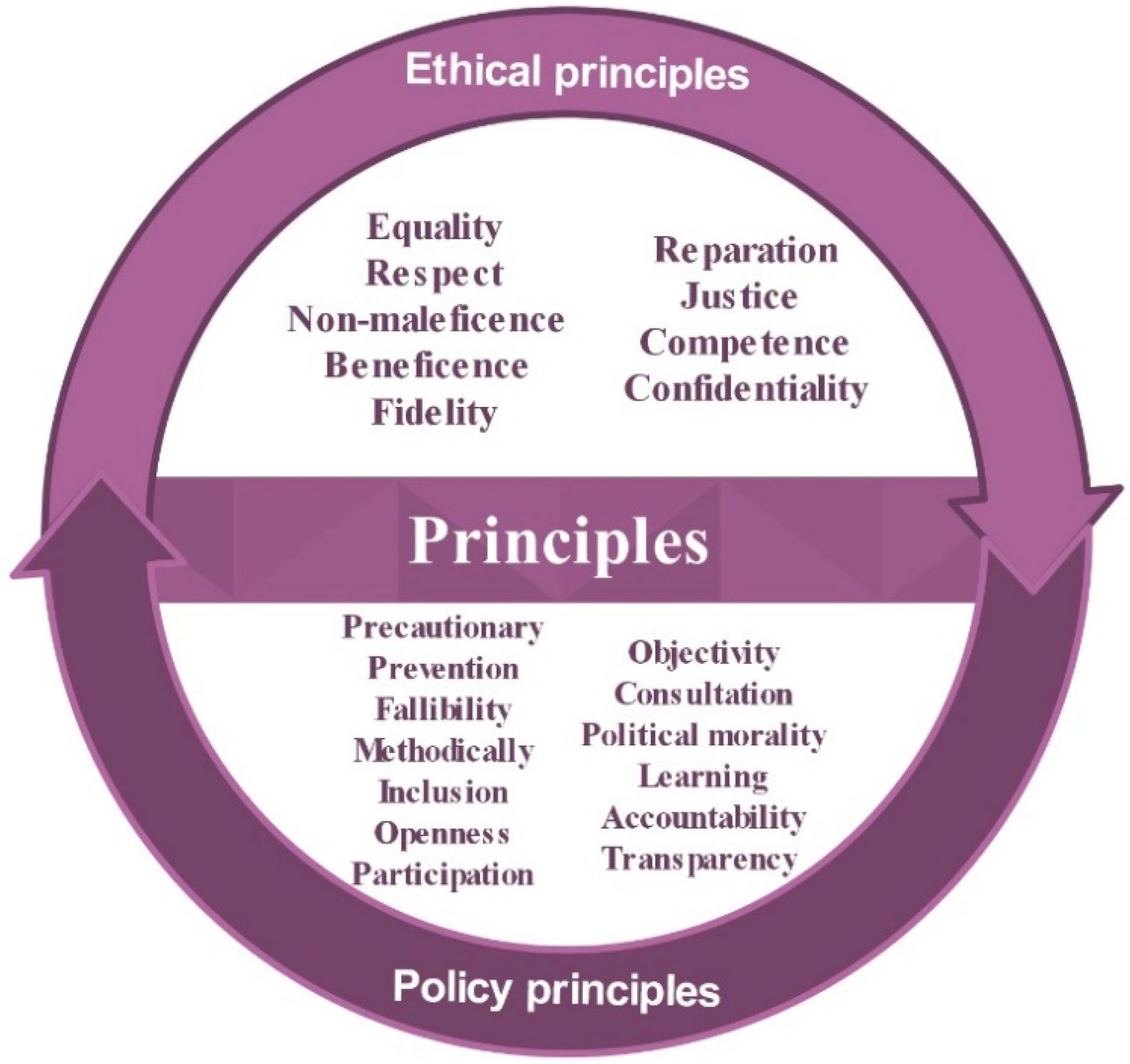
Principles of ethical policy-making in S&T.
Also, the 29 components along with their policy approaches as well as their policy and ethical principles are shown in Table 1.
The Components onf Ethical Policy-Making in S&T.

Based on the interpretation of the components of ethical policy-making, they are classified into appropriate categories. For example, components (C9) and (C19), each of which somehow refers to the knowledge required for ethical policy-making, are in the same category, or (C6), (C11), (C2), (C28), and (C13), which refer to the tools and methods that feed the S&T ethical policy-making process with information, are likewise in the same category. A name is then chosen for each category, which, while incorporating the concepts implicit in each of the relevant components, explains a sub-step in the ethical policy-making process in S&T. After explaining the ethical policy sub-steps in S&T, the related sub-steps are categorized into related categories. For example, information source identification and methodological analysis of information sources that refer to the identification and analysis of information sources are in the same category. A name is then chosen for each category, which, while incorporating the implicit concepts in each of the relevant sub-steps, explains a main step in the S&T ethical policy-making process. Finally, the main and sub-steps are combined and the ethical policy framework in the S&T area is developed as described in Table 2.
Combining the Main and sub-Steps of Policy-Making and Framework Development.
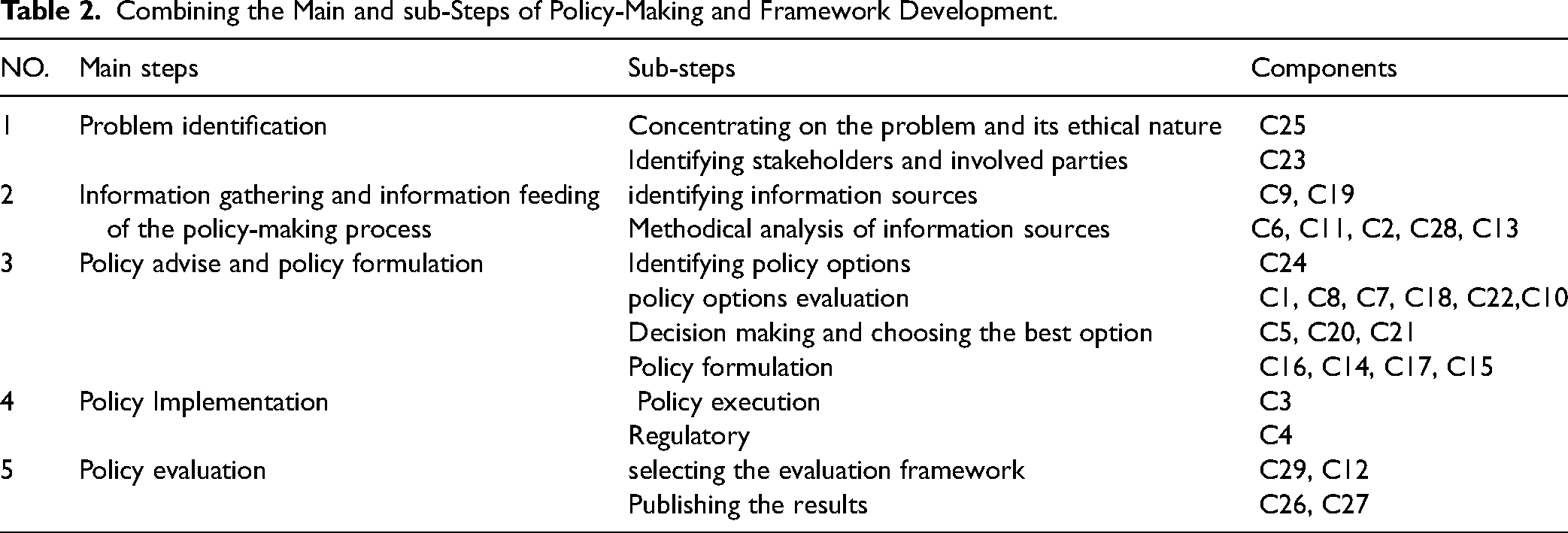
The ethical principles of the components are combined in Table 2, thereby the status of ethical principles in each of the main ethical policy-making steps in S&T has been explained. Table 3 shows the frequency of each ethical principle in each policy-making step.
Frequency of Ethical Principles in Steps of the Ethical S&T Policy-Making.
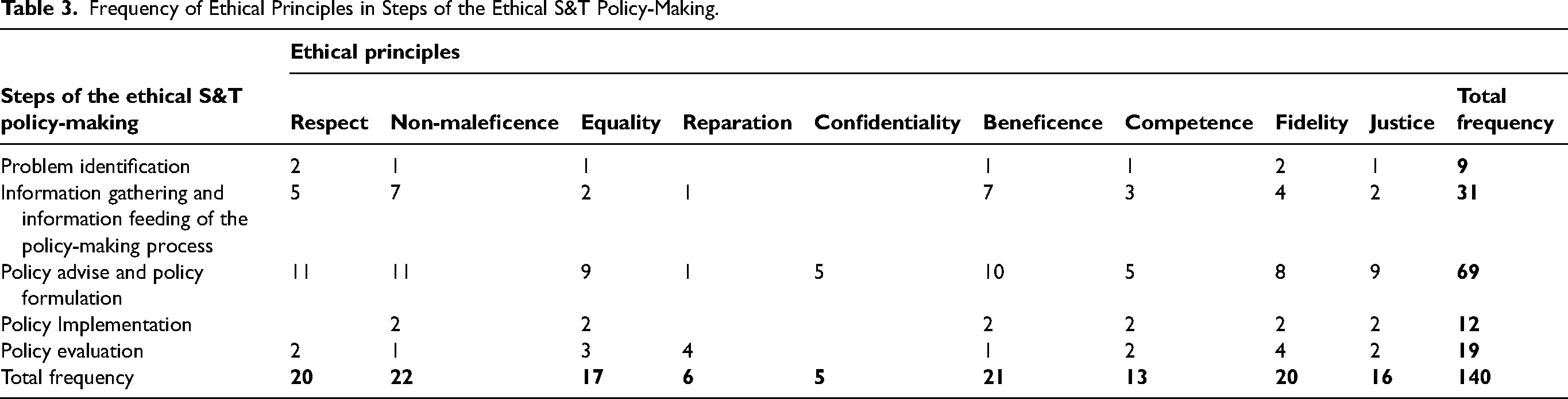
As Table 3 shows, the ‘principle of ‘non-maleficence’ and the ‘principle of beneficence’ have the highest frequency in the main policy-making steps, and the principles of ‘fidelity, ‘respect’, and ‘equality’ are in the next ranks, respectively. Also, in the step of policy advice and formulation, all ethical principles are applied and the principles play a major role in this policy-making step. Furthermore, the following results have been obtained regarding the importance of each ethical principle in the main policy-making steps:
In the process of identifying and recognizing the problem, the principles of respect, fidelity, and accountability have the highest frequency. In the step of information gathering and feeding of the policy-making process, the principles of non-maleficence and beneficence have the highest frequency. In the step of policy advice and formulation, the principles of respect and non-maleficence are in the first rank and the principles of equality and justice are in the next rank, respectively. In the policy implementation step, the principles of non-maleficence, fidelity, beneficence, competence, justice, and equality have the highest frequencies. In the policy evaluation step, the principle of reparation and the principle of fidelity comes first.
Also, the policy principles of the components are combined with the information in Table 2; thereby the status of policy principles in each of the main ethical policy-making steps in S&T has been explained. Table 4 shows the status of policy principles in each policy-making step in S&T. The numbers indicate the frequency of each policy principle in each policy-making step.
Frequency of Policy Principles in Steps of the Ethical S&T Policy-Making.

As Table 4 shows, the principles of inclusion and transparency have the highest frequency in the main policy-making steps, and the principles of ‘objectivity’, ‘learning’, ‘openness’, ‘political morality’, and ‘participation’ are in the next ranks, respectively. Also, all policy principles apply in the policy advice and formulation step. In addition, the following results have been obtained regarding the importance of each policy principle in the main policy-making steps:
In the step of problem identification and recognition, the principles of inclusion and participation have the highest frequency. In the step of information gathering and feeding of the policy-making process, the principles of inclusion, objectivity, and methodicality have the highest frequency, and the principle of fallibility is in the next rank. In the policy advice and formulation step, the principle of political morality is in the first rank, followed by the principles of learning, transparency, and inclusion respectively. In the policy implementation step, the principles of Precautionary, objectivity, and transparency are in the first rank. In the policy evaluation step, the principles of transparency, learning, openness, and accountability are in the first rank.
Discussion and Conclusion
In general, the normative framework of ethical policy-making in S&T can be shown in Figure 2. The innermost layer of this framework reflects the ethical policy-making process in S&T. Nine ethical principles and 13 morally-related policy principles govern this process. All components of this process are supported by five policy approaches evidence-based policy-making, design science, responsible innovation, sustainable development, and democracy. This normative framework also advises policymakers to take an integrated approach to decision-making situations and to take advantage of all three virtue, consequential, and deontological ethics theories. In this framework, the more we move from the innermost layer to the outermost layer, the more abstract and theoretical the framework becomes.

Normative ethical policy-making framework in S&T.
The first step in ethical policy-making in S&T is ‘problem identification and recognition’, in which specific problem concerning the fundamental and effective issues of society is addressed and prioritized by policymakers. In this step, the moral nature of the problem is identified and explained in detail concentrating on its ingredients, scope, and implications. Recognizing and solving the moral problem(s) helps to find the best moral action or at least the acceptable moral action in the situation. In addition, the step must identify individuals and groups who may be affected in some way by policies, and identify the benefits and values associated with them. Based on the results of this study, the most important ethical principles governing this step are respect, fidelity, competence, non-maleficence, justice, equality, and beneficence, respectively. The most important policy principles governing this step are inclusion, Consultation, participation, objectivity, accountability, and openness respectively.
The second step in ethical policy-making in S&T is ‘information gathering and feeding of the policy-making process in which the accurate information needed for policy interventions is gathered from all available information sources. In general, sources of information include formal statistics (censuses, survey sampling, and registration statistics) and informal statistics, academic research results, expert opinions, survey results, attitudes, values, and findings based on program monitoring and evaluations. Local, indigenous, and traditional knowledge, on the other hand, play an important role in understanding the world in which people live - perceptions that do not conflict with science but operate at different levels and may become threatening when power relations are mediated by techno-scientific worldviews are very instrumental and unequal. In addition, it is necessary to use some tools and methods to analyze information resources and turn the resulting knowledge into definable policy options for policymakers. Participatory technology assessments, S&T foresight, technology forecasting, the social impact analysis of science, technology, and innovation for policy reforms, and public opinion polls on S&T are some of the most important ones. Based on the results of this study, the most important ethical principles governing this step are non-maleficence, beneficence, respect, fidelity, competence, justice, equality, and reparation, respectively. Likewise, the most important policy principles governing this step are inclusion, objectivity, methodicality, fallibility, transparency, participation, prevention, precautionary, openness, learning, political morality, and accountability, respectively.
The third ethical policy-making step in S&T is ‘policy advice and formulation’ in which the knowledge gained from the previous steps is turned into different policy options and scenarios. In real life, options are not often already existent and need to be analyzed and invented. The initiative of policymakers to build solutions is crucial. After the identification of policy options/solutions, they are also evaluated ethically in this step. Various sources can be used in the ethical evaluation of these solutions, including using the views, questions, and ethical debates of different social groups, using ethical counseling structures, using ethical charters and codes of conduct, paying attention to moral values and social acceptance criteria, paying attention to cultural norms and values. Benefiting from these resources, the possible outcomes and consequences of each policy solution should be forecasted and evaluated. After evaluating the options, an attempt is made to reach a rational choice among the various policy options, a choice that can be discussed and argued about different ethical frameworks. On the other hand, in this choice, the concerns of the private sector and civil society should also be taken into account. The result is a policy draft. The policy draft should be reviewed by experts in the form of roundtables and formal meetings. In the policy-making literature, this stage is known as the policy discourse (Hajer, 2002). During this discourse, a team of subject-matter experts should be consulted to make the draft more accurate and consistent. Some of the most important areas where subject-matter experts can help to formulate an ethical policy are Ethics training among professional scientists, technicians, and S&T activists, data protection and privacy, free access to scientific and technological information, and intellectual property rights laws and regulations. Based on the findings of this study, the most important ethical principles governing this step are non-maleficence, respect, beneficence, justice, equality, fidelity, confidentiality, competence, and reparation. In addition, the most important policy principles governing this step are political morality, transparency, learning, inclusion, openness, participation, accountability, Consultation, objectivity, prevention, methodicality, respectively.
The fourth ethical policy-making step in S&T, ‘policy implementation’, refers to establishing procedures, writing guidelines, or issuing grants to start the actualization of the policies formulated in the previous step. In this step, policy activities can be adapted to different policy bodies as well as other organizations and companies. In addition, policy-makers should monitor policy-related inputs, outputs, and achievements as soon as policy implementation begins. Careful monitoring of policies prevents deviations. It should be noted that S&T carries several risks. Sometimes policymakers are aware of some potential risks in which case they should, even are morally obliged, to take regulatory action. One of the regulatory actions of policymakers based on the principle of Precautionary is to issue temporary licenses to technological and innovative products. This regulatory action allows policymakers to minimize potential risks.
Based on the findings of this study, the most important ethical principles governing this step are competence, justice, fidelity, equality, non-maleficence, and beneficence, respectively. Likewise, the most important policy principles governing this step are accountability, transparency, precautionary, objectivity, political morality, prevention, and fallibility, respectively.
The fifth ethical policy-making step in S&T is to evaluate policy design, implementation, and results. In this step, to acquire knowledge and information to improve the policy-making process or future policy actions, policies and the process of their formulation are evaluated. This step involves policy learning, and the outputs of this step should provide new input for formulating future visions and priorities. This step requires an analytical and descriptive review of policies and attempts to explain them. The definition of the evaluation indicators is very important for policy evaluation. Existing policies can be evaluated from different aspects by defining appropriate indicators. Some of the most important aspects of policy assessment are implementation rate, impacts, ethical considerations, policy-making process, efficiency, effectiveness, etc. Choosing these aspects depends on the framework that is chosen for evaluation. In this step, while presenting the results of the policy analysis to the stakeholders, the ground should be provided for their feedback. This action demonstrates policy transparency and Policy makers’ flexibility for policy reform. Based on the findings of this study, the most important ethical principles governing this step are fidelity, reparation, equality, respect, competence, justice, non-maleficence, and beneficence. Likewise, the most important policy principles governing this step are objectivity, fallibility, methodicality, inclusion, and participation.
Finally, it should be stated that although there have been good studies on the importance of ethics in policy making, few studies are found that have integrated ethical components in S&T policy making. So, the lack of literature on the topic is the most important limitation of this study. This theoretical vacuum shows the importance of further development in this field of the study.
The proposed framework in this study is developed based on five policy approaches including evidence-based policy making, sustainable development, design science, responsible innovation and democracy. Other policy approaches that can complete and develop the proposed framework of this paper should be studied in future research endeavors. In addition, it is suggested that interested researchers use the proposed framework for ethical evaluation of existing policy documents or formulation of ethical policies in their future studies.
Footnotes
Declaration of Conflicting Interests
The author(s) declared no potential conflicts of interest with respect to the research, authorship, and/or publication of this article.
Funding
The author(s) received no financial support for the research, authorship, and/or publication of this article
