




Abstract
Quality literacy instruction in preschool can be critical to the future academic success for all children, but may be even more so for children with disabilities. The purpose of this study was to examine progress in emergent literacy skills of young children with disabilities, compared with their typical peers, in an inclusive preschool setting. Participants in this study included 77 prekindergarteners with disabilities and 77 children with no identified disabilities who were matched based on age, teacher, and school. Children were enrolled in inclusive Early Reading First prekindergarten classrooms. Results suggest that although children with disabilities made significant gains mirroring the progress of their typical peers, as a group, they did not catch up to the achievement of their typical peers. Children with disabilities showed the greatest progress in Print Awareness and Recognizing Uppercase Letters. Implications for future instruction and research are outlined.
Learning to read is one of the most important skills for children in our society. Preschoolers who exhibit well-developed emergent literacy skills typically have better success inall academic areas from elementary through high school (Lonigan, Burgess, & Anthony, 2009). Conversely, researchers have found that children who lack appropriate early literacy skills are more likely to have difficulty acquiring reading skills, read less, and receive less practice than proficient readers (Allington, 1984; Snow, Burns, & Griffin, 1998). Subsequently, children with difficulties in emergent literacy skills may fall even further behind their peers as they progress in school (Allington, 1984; Snow et al., 1998). While receiving quality literacy instruction in preschool is critical to the future academic success for all children, it is especially so for children who enter school developmentally behind their peers. With estimations that more than one in three children experience difficulty learning to read (Adams, 1990; Shaywitz, Escobar, Shaywitz, Fletcher, & Makuch, 1992), it is important that emergent literacy skills be specifically taught in the preschool classroom.
Many children with disabilities struggle to acquire emergent literacy skills that are associated with later literacy achievement such as oral vocabulary, phonological awareness, and print and alphabet knowledge (Sulzby & Teale, 1991; Teale & Sulzby, 1986; Whitehurst & Lonigan, 1998). Fortunately, researchers have found that emergent literacy skills can be taught to and learned by young children with disabilities (e.g., Adams, Foorman, Lundberg, & Beeler, 1998; Blachman, Ball, Black, & Tangle, 2000; Wagner, Torgesen, & Rashotte, 1994). Furthermore, additional studies show that preschool children with disabilities demonstrate growth in emergent literacy skills when they are given a structured literacy-rich environment (Katims, 1994). The current investigation focuses on the language and literacy outcomes of children with disabilities in such an environment: Early Reading First (ERF) classrooms.
As part of the No Child Left Behind Act of 2001, ERF programs focus on enhancing children’s early language and literacy skills through curriculum adoption and/or enhancement, classroom modification, and teacher professional development (e.g., coaching, workshops, and classroom support). The purpose of ERF was to prevent later reading difficulties by providing young children, particularly from lower socioeconomic backgrounds, with high-quality language and literacy-rich environments to prepare them for school success.
Critical Emergent Language and Literacy Skills and Instruction
Emergent literacy skills are predictive of later reading success and therefore should be emphasized in preschool instruction (Chatterji, 2006; National Early Literacy Panel [NELP], 2008; Scarborough, 2001). In a recent meta-analysis of studies on emergent literacy skills and instruction, NELP (2008) found that the skills with the strongest predictive relationship with later literacy outcomes included alphabet knowledge (letter names and sounds), phonological awareness (ability to think about and manipulate sounds in words), print concepts (knowledge of forms and use of print), and oral language (ability to use and comprehend language in communicative contexts). Moreover, the panel found that specific instructional strategies and approaches can promote the development of these skills, including code-focused interventions (designed to teach skills related to understanding the alphabetic principle) and language-enhancement interventions (designed to improve expressive and receptive oral language skills) in preschool and kindergarten programs. Specifically, phonological awareness instruction had the most significant and largest effect size (0.82) of all code-focused interventions to later literacy skills, supporting the importance of phonological awareness in the early childhood setting. Overall, the findings from the NELP report highlight not only the critical early language and literacy skills that are likely to support future reading success but also the wide variety of instructional approaches that can be taken during the preschool years to promote growth in young children with and without disabilities.
Instructional strategies for early childhood classrooms can be discussed in terms of Response to Intervention (RTI). RTI is a multitiered prevention pyramid model designed to detect, prevent, and address academic challenges of children. The primary or universal tier of RTI supports the academic needs of all children in the classroom. Instruction in the universal tier may also be referred to as evidence-based reading instruction (Vaughn & Fuchs, 2006) or high-quality reading instruction (Division for Learning Disabilities, 2007). In early primary years, universal strategies may include whole-class instruction with the critical emergent literacy skills (i.e., phonological awareness, alphabet knowledge, print concepts, and oral language), as well as differentiated early literacy instruction such as varying the time, content, level of support, and scaffolding (Connor et al., 2009). Within the RTI model, Tier 2 interventions are designed for students who exhibit challenges or weak progress with regular classroom instruction. Evidence-based Tier 2 strategies include intense, explicit, and systematic instruction in homogeneous small groups (Gersten et al., 2008; Gunn, Biglan, Smolkowski, & Ary, 2000; Jenkins, Peyton, Sanders, & Vadasy, 2004; Vadasy, Sanders, & Peyton, 2005; Vaughn et al., 2006), as well as progress monitoring of emergent literacy skills at least one time per month (Mathes et al., 2005; McMaster, Fuchs, Fuchs, & Compton, 2005; Vaughn et al., 2006). Students who do not make adequate progress in Tiers 1 or 2 may require more intensive, individualized daily instruction, as found in Tier 3 interventions (Gillon, 2000; McMaster et al., 2005). The movement between tiers is based on academic progress throughout the school year. The children receiving instruction in Tiers 2 or 3 may or may not have an individualized education plan (IEP; Greenwood et al., 2011).
High-quality emergent literacy instruction is of importance to young children in the prevention of later eligibility of special education, as little or no exposure to early literacy experiences places children at risk of later challenges in language and literacy (Chard & Kameenui, 2000; Shonkoff & Phillips, 2000; Zill & Resnick, 2006). Furthermore, children who attend preschool are placed at less risk of later special education identification (Belfield, 2005), as well as for learning disabilities (Conyers, Reynolds, & Ou, 2003) than those who do not attend preschool. Yet, with the expansion of inclusive placements within early childhood settings (Odom et al., 2004), it is important to examine how these placements effect the academic skills of children with disabilities and their typically developing peers.
Early Literacy Achievement Among Preschoolers With Disabilities in Inclusive Settings
Many children with a variety of disabilities may experience challenges with learning emergent literacy skills. Children with language impairments, particularly those with delays in vocabulary, comprehension, syntax, and phonological awareness, are more likely to experience difficulty with conventional (e.g., decoding, oral reading fluency, reading comprehension, writing, and spelling) and emergent literacy skills (e.g., oral language, print and letter knowledge, and phonological processing; Bishop & Adams, 1990; Catts, 1997; NELP, 2008; Scarborough, 1990; Wagner & Torgesen, 1987; Whitehurst & Lonigan, 1998). Children with cognitive delays (e.g., Down syndrome), autism, and other developmental disabilities often have language impairments that are characteristic of their disability. For instance, children with autism may have difficulty with spontaneous language, pragmatics, delayed grammar usage, oral language skills, and vocabulary development skills (American Psychiatric Association, 2000; V. Smith, Mirenda, & Zaidman-Zait, 2007; Wilkinson, 1998). Children with Down syndrome typically have stronger expressive language skills than receptive skills, and have particular challenges with phonology (e.g., phonological processes and poorer speech intelligibility) and syntax (e.g., delays in morphology and complex utterances; Martin, Klusek, Estigarribia, & Roberts, 2009).
Inclusion within early childhood settings is a primary placement for many children with a variety of disabilities (Odom, Buysse, & Soukakou, 2011). Inclusion not only refers to the placement of children with disabilities in the same class as typically developing peers but also includes the socialization and shared learning environments with typically developing peers (Division for Early Childhood/National Association for the Education of Young Children, 2009). Within an inclusive environment, children with disabilities should be provided with the supports and services as necessary (Rafferty, Piscitelli, & Boettcher, 2003; Winter, 1999), as well as equal opportunities within the same classroom (Odom et al., 1996; Peck, Odom, & Bricker, 1993).
Several studies have shown that children with and without disabilities benefit socially in inclusive settings (e.g., Buysse & Bailey, 1993; Buysse, Goldman, & Skinner, 2002; Cross, Traub, Hutter-Pishgahi, & Shelton, 2004; Gallagher & Lambert, 2006; Guralnick & Groom, 1988; Jenkins, Speltz, & Odom, 1985). However, fewer studies have explored how children with disabilities progress in specific emergent literacy skills within inclusive preschool settings. In a study examining language development and social competence in inclusive and segregated settings of children with disabilities, Rafferty et al. (2003) found no differential impact on the effect sizes on language and social competences between inclusive and segregated settings for preschoolers with mild to moderate disabilities. Holahan and Costenbader (2000) found that preschoolers functioning at a higher level of social and emotional skills performed better on developmental outcomes in inclusive settings as opposed to segregated settings. In an examination of changes in language development for preschoolers with autism and typically developing peers in segregated and integrated settings, Harris, Handleman, Kristoff, Bass, and Gordon (1990) found that all children, typically developing and those with autism, benefitted from a quality language enriched inclusive preschool in the area of language development. The instructional approaches consisted of whole group, small group, and individualized instruction in the inclusive environment.
Purpose of Study
One reason many children with disabilities may be placed in inclusive preschool classrooms is to improve their academic outcomes. Therefore, it is important to not only examine whether children with disabilities show significant progress in social skills but also to examine early academic areas, as well. There is a paucity of research regarding emergent literacy progress in children with disabilities and typically developing peers within inclusive settings. This study will add to the literature base by examining progress in emergent literacy skills for all children in inclusive preschool classrooms and to help determine whether a high-quality language and literacy-based classroom can assist in reducing the achievement gap between children with disabilities and their typically developing peers. The purpose of this study was to examine progress in emergent literacy skills of young children with disabilities, compared with their typically developing peers, in an inclusive ERF preschool setting. The following research questions were posed: Research Question 1: How much progress did children with disabilities experience in oral vocabulary, phonological awareness, and alphabet and print knowledge during the prekindergarten year, compared with their typically developing peers? Research Question 2: Did the achievement gap between children with disabilities and typical peers narrow in oral vocabulary, phonological awareness, and alphabet and print knowledge over the course of the prekindergarten year?
Method
Participants
The sample was pooled from a larger evaluation database of 652 children who participated in ERF classrooms. The data were collected over 2 academic year periods. Of these 652 children, 77 had IEPs, spoke English as their first language (M age = 50 months, SD = 6.14), and exhibited adequate speech and language skills to perform the assessment tasks without adaptations. This is the population we chose to study. These 77 children with disabilities were matched to 77 children with no identified disabilities who also spoke English as their first language (M age = 51 months, SD = 5.1). The sample consisted of 37% female and 63% male participants. All children in the sample attended the ERF prekindergarten program 1 entire school year. Children were matched based on the school or child care site they attended, then the classroom, next their age in months, and finally their gender. There were no instances where matches were not able to be narrowed using this hierarchy.
All children were enrolled in inclusive prekindergarten classrooms that were participating in ERF. The 38 classrooms were located in public elementary schools and private child care sites in a large, urban area in the southeastern United States. Inclusionary criteria for classrooms included an ELLCO Pre-K (M. W. Smith & Dickinson, 2002) Literacy Environment Checklist average score of “basic” (M = 3) for the Language and Literacy Environment items. Because these participating sites received ERF funding, all sites served children who lived in poverty, as indicated by the percentage of children participating in federal free and reduced lunch programs.
The children with disabilities were receiving special education services for a variety of disabilities commonly diagnosed by the preschool years, including developmental delays, autism, pervasive developmental disorders–not otherwise specified, speech and language impairments, cognitive impairments, and Down syndrome. Although each disability presents specific challenges, children in this sample were all functioning at social, cognitive, behavioral, and linguistic levels to the extent their IEP teams had recommended they participate in language and literacy instruction in the general education classroom with typical peers. In addition, only data from children who were able to complete the tasks according to standardized administrative format were included in the analyses.
Measures
Oral receptive vocabulary
Vocabulary was assessed using the Peabody Picture Vocabulary Test–Third Edition (PPVT-3; Dunn & Dunn, 1997). The PPVT-3 is a nationally normed assessment and is appropriate for ages 2 through adulthood. On this assessment, children are presented with an array of four pictures of common objects and actions. Children are asked to identify a target picture by pointing (e.g., “point to a faucet”). Internal reliability on the PPVT-3 is .92 to .98 (median = .95; PPVT-3; Dunn & Dunn, 1997).
Emergent literacy achievement
A variety of early literacy skills were measured with the Phonological Awareness Literacy Screening Prekindergarten (PALS-PreK; Invernizzi, Sullivan, Meier, & Swank, 2004). This battery of assessments was chosen because it can be administered individually, and because many of the emergent literacy skills can be assessed quickly and reliably. This study included the following subtests of the PALS-PreK: (a) Alphabet Knowledge—Children are asked to name uppercase letters, children who name 16 or more correctly are asked to name the lowercase letters, and children who name nine or more lowercase letters are asked to say the sounds that the letters make; (b) Beginning Sound Awareness—Children are presented with pictures and are asked to produce the first sound for the words that begin with /s/, /m/, and /b/; (c) Print and Word Awareness—Children are asked to identify various text components while the examiner reads a nursery rhyme printed in a book; and (d) Rhyme Awareness—Children are presented with four pictures and are asked to identify the two pictures that rhyme. Reliability ranges from .75 to .93 for the four subtests (Invernizzi et al., 2004).
Procedures
Importantly, all of the children in this study attended ERF classrooms during their prekindergarten year. Classroom teachers who participated in ERF were provided with professional development to enhance children’s language, literacy, and cognitive skills. The teachers in this ERF program participated in approximately 50 hr of professional development on teaching language and literacy skills in the preschool classroom. They also had coaches and weekly on-site support in their school.
The PPVT-3 was given to all children in the fall and spring of their prekindergarten school year, per regulations of the ERF program. In addition, although not required, some participating classrooms used the PALS-PreK to capture additional information regarding the children’s early language and literacy skills. When this information was available, it was used in the analyses for this study. Assessments were administered at the child’s school in standardized format according to test manuals by trained examiners. Data were analyzed to determine progress in the language and literacy skills of both groups of children.
Results
To answer the research questions, two types of primary analyses were performed. First, pre–post repeated measures ANOVAs were conducted to examine progress within the groups and differences between the two groups on the PPVT-3 and PALS-PreK, as well as any interaction effects. The PPVT-3 and each of the PALS-PreK subtests were analyzed separately. Gain scores were computed on all measures to examine how scores changed over the prekindergarten year and to determine whether the achievement gap between children with disabilities and typically developing peers was changed between the groups (see Table 1).
Mean Group Performance and Gain Scores.
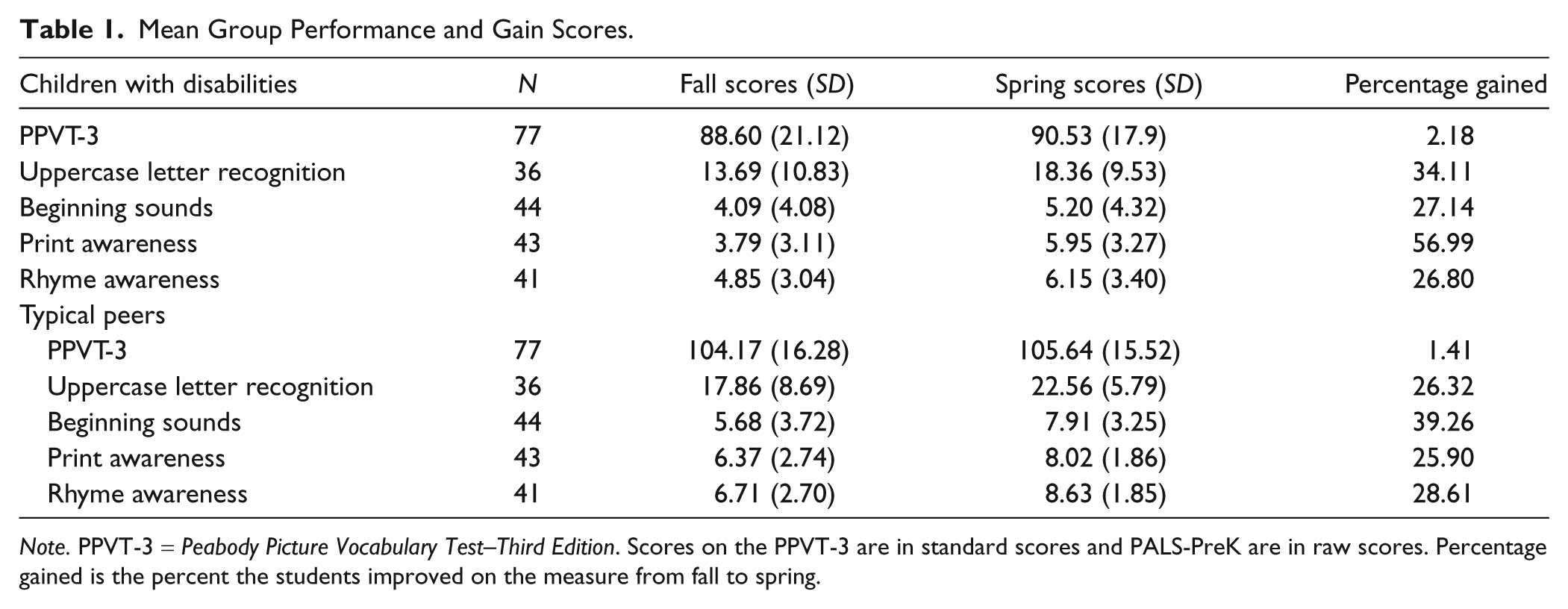
Note. PPVT-3 = Peabody Picture Vocabulary Test–Third Edition. Scores on the PPVT-3 are in standard scores and PALS-PreK are in raw scores. Percentage gained is the percent the students improved on the measure from fall to spring.
Progress in Early Languageand Literacy Skills
Between-group results
Using repeated measures ANOVAs, the data were analyzed to determine the differences in progress on language and literacy skills from fall to spring between the typically developing peers and children with disabilities. As expected, all children exhibited progress during the prekindergarten year. Furthermore, typically developing children performed significantly better than children with disabilities on the PPVT-3, η2 = .177,F(1, 142) = 30.483, p < .001, as well as on all subtests of the PALS-PreK: Uppercase Letter Recognition, η2 = .060,F(1, 70) = 4.47, p < .05, Print Awareness, η2 = .171, F(1, 84) = 17.269, p < .001, Beginning Sounds, η2 = .086, F(1, 86) = 8.092, p < .05, and Rhyme Awareness, η2 = .167,F(1, 80) = 16.089, p < .001.
Within-group results
The data were also analyzed to examine how each group progressed on the language and literacy tasks from fall to spring. On the PPVT-3, neither group showed significant progress in standard scores from fall to spring. However, unlike the PPVT-3, significant within-group differences were observed for both groups of children on several subtests of the PALS-PreK. All children performed significantly better from fall to spring on Uppercase Letter Recognition, η2 = .387, F(1, 70) = 44.278,p < .001, Print Awareness, η2 = .456, F(1, 84) = 70.312,p < .001, Beginning Sounds, η2 = .232, F(1, 86) = 25.938,p < .001, and Rhyme Awareness, η2 = .262, F(1, 80) = 28.366, p < .001. Although both groups showed progress on all assessments, the effect sizes between pre- and post-assessments were considered small (Cohen, 1988).
Achievement gap between children with disabilities and typically developing peers
Given that children from both groups showed significant progress on specific language and literacy tasks from fall to spring, we next computed gain scores to see how the children’s skills changed over 1 academic school year, and whether the achievement gap between the groups changed as well. There were no interactive effects; thus, there were no significant achievement gap changes for any measure for either group nor were there any significant effects on within-subjects. On the PPVT-3, children in both groups gained slightly less than two standard score points by the spring (see Figure 1). Although significant within-group differences were not found in mean standard scores, there was a slight change from fall to spring narrowing the performance gap between the groups by .46 points.
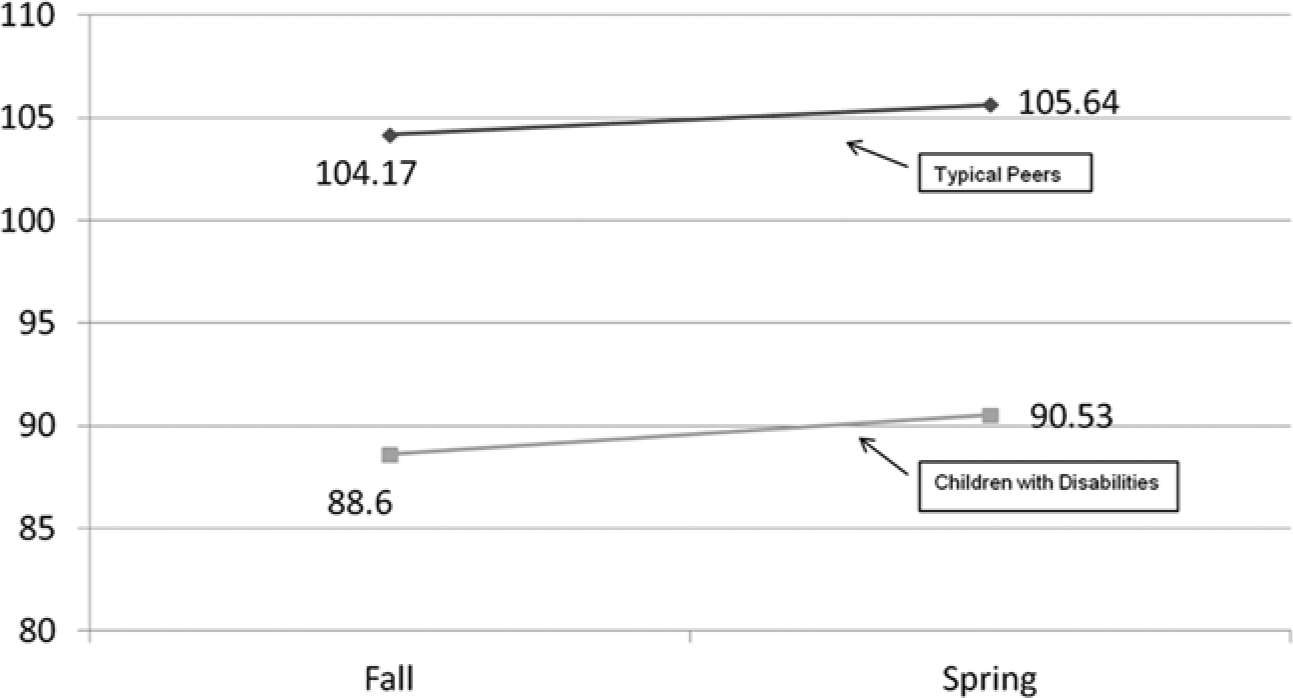
Mean growth in standard scores on the PPVT-3 from fall to spring by group.
Interestingly, a different pattern was found on the PALS-PreK. Although children in both groups made progress from fall to spring on each subtest, the performance gap between typically developing children and children with disabilities narrowed on the Print Awareness subtest, specifically by .51 raw score points (see Figure 2). The gap widened on the Uppercase Letter Recognition, Rhyme Awareness, and Beginning Sounds subtests by .03, .62, and 1.12 raw score points, respectively (see Table 1; see Figures 3–5).
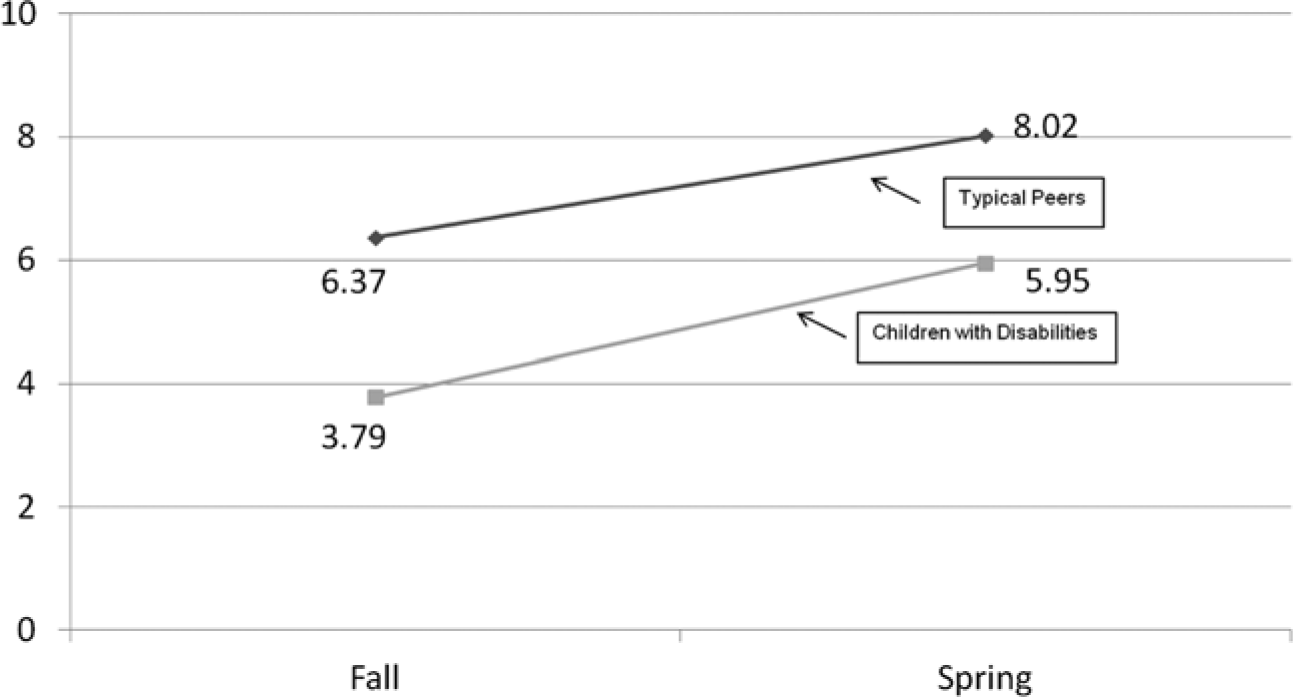
Mean Growth in PALS-PreK Print and Word Awareness subtest from fall to spring.

Mean growth in PALS-PreK uppercase alphabet recognition subtest from fall to spring.
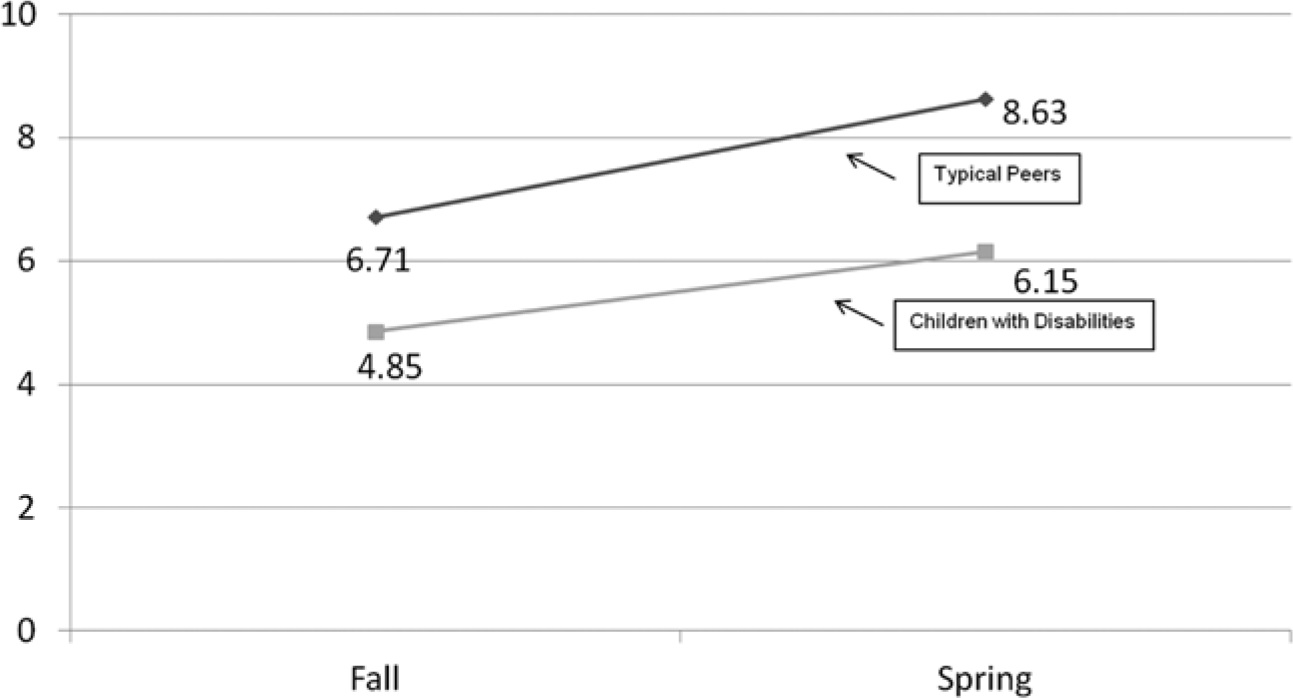
Mean growth in PALS-PreK Rhyme Awareness subtest from fall to spring.
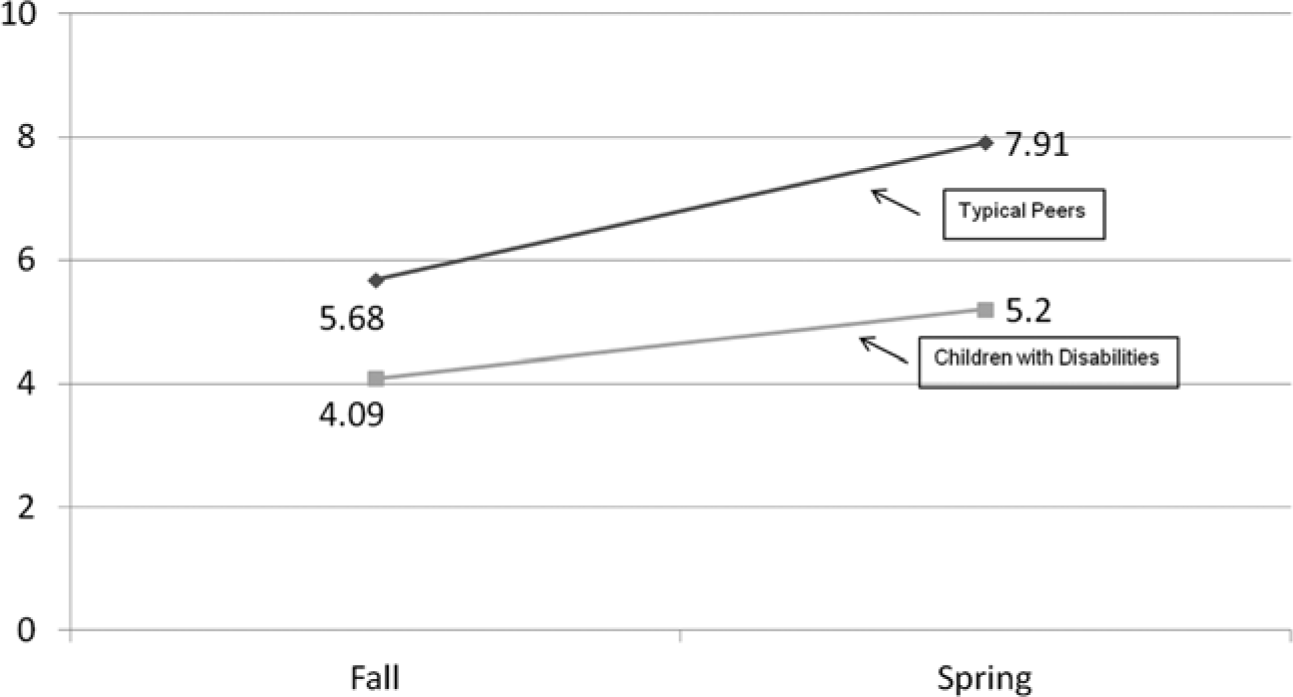
Mean growth in PALS-PreK beginning sounds subtest from fall to spring.
Discussion
This study had two goals. First, we examined progress in emergent literacy skills in children with disabilities in inclusive language and literacy-enriched prekindergarten classrooms as compared with their typically developing classmates. Second, we explored whether the achievement gap was narrowed between the children with disabilities and children without identified disabilities. Overall, the results suggested that children with disabilities made significant progress in emergent literacy skills, mirroring the gains of their typically developing peers. Yet as a group, the children with disabilities did not catch up with their typically developing peers on any language and literacy task. Importantly, the typically developing peers and the group of children with disabilities varied in their individual scores. Some participants with disabilities had higher pretest scores than did the typically developing peers. Furthermore, some children with disabilities exhibited higher posttest scores than their matched peers. However, as a group, the children with disabilities started further behind, and the progress patterns did not allow them to catch up to the achievement of their typically developing peers.
Not surprisingly, typically developing children outperformed the children with disabilities throughout the prekindergarten year. However, children with disabilities made similar gains in receptive vocabulary as the typically developing peers. Given the nature of standard scores, it is difficult to show progress on this measure over 1 school year. Nevertheless, it is encouraging to find that children with disabilities not only maintained their vocabulary skills but also showed some progress over the prekindergarten year while participating in whole-classroom language and literacy instruction.
On the PALS-PreK, children with disabilities made the least amount of progress on the phonological awareness tasks, as opposed to their typically developing peers. The children with disabilities never caught up with typical peers on these tasks. Children with disabilities experienced the most amount of gain with the print awareness and recognizing uppercase letters tasks. For the typically developing peers, the least amount of gain was in print awareness; however, even on this task, the gains made by children with disabilities did not allow them to surpass or match the posttest score of their typical peers.
With regard to the achievement gap between the children with disabilities at the beginning of the prekindergarten year, there were no significant changes for any of the tasks, as indicated by the lack of interaction effects within the analysis of groups and measures. This finding was qualified by an examination of the means. Children with disabilities progressed from the instruction they received, but only narrowed the achievement gap in oral expressive language and print awareness, and the gap actually widened on the phonological awareness measures.
These findings can be interpreted as support that children with disabilities may experience significant gains in orthographic skills (e.g., alphabet recognition and print concepts) in inclusive settings. Meanwhile, phonological awareness instruction may require more explicit instruction. Certainly, there is empirical evidence that suggests that young children who struggle with phonological awareness can benefit from explicit, small group, intensive instruction during the preschool years (Elbaum, Vaughn, Hughes, & Moody, 1999; Phillips, Clancy-Menchetti, & Lonigan, 2008; Pullen & Justice, 2003). Explicit instruction includes the teaching of the most efficient and effective method possible (Carnine, Silbert, Kame’enui, & Tarver, 2004). Within this instructional approach, the teacher leads the instruction, determines the instructional goals and pace, chooses the appropriate materials, and provides immediate corrective feedback to the student. Tasks may be broken down into smaller skills and are sequenced to allow for student mastery of prerequisite skills before moving on to more challenging skills (Joyce, Weil, & Calhoon, 2000).
As with other research on this topic (e.g., Cross et al., 2004; Harris et al., 1990; Holahan & Costenbader, 2000; Rafferty et al., 2003), the findings from this study suggest that children with disabilities benefit in language and emergent literacy skills from participating in high-quality language and literacy instruction in inclusive prekindergarten classrooms. The NELP (2008) report stated that alphabet knowledge, phonological awareness, print concepts, and oral language have a strong predictive relationship with later literacy outcomes. As children with disabilities experience difficulties when learning these emergent literacy skills (Sulzby & Teale, 1991; Teale & Sulzby, 1986; Whitehurst & Lonigan, 1998), and given the increase of inclusive environments (Odom et al., 2011), this study adds to the research on academic benefits of children with disabilities in inclusive literacy-rich environments.
Although positive, the results should be viewed with caution. There are limitations to this study. Because this study involved analyses from a much larger data set, information was missing regarding the exact nature of special education services the children with disabilities received, the specific special education eligibility category of each individual child and information on individual ethnicities, and socioeconomic levels. This is a limitation that limits the interpretation and generalization of the results. Another limitation is that not all of the children in this study were given the PALS-PreK assessment, as noted in Table 1. Information regarding the missing pieces of descriptive data would be beneficial for future research. Nevertheless, this study is an important step in characterizing how children with disabilities fare in language and literacy inclusive classrooms. It is also important to acknowledge that the children in this study were participating in ERF classrooms, where they were exposed to high-quality language and literacy instruction and resources from trained teachers and coaches who supported that instruction. Certainly, this is not the case in all prekindergarten classrooms. It is not clear whether such positive results would have been found in classrooms without these kinds of supports in place.
Implications for the classroom from this study include the need to explicitly address phonological awareness skills to children with disabilities. These findings may be interpreted in terms of RTI. For example, the results indicated that children with disabilities benefited from participating in high-quality language and literacy instruction in inclusive environments, such as would be seen in a Tier 1 or universal instruction. Yet, some students, such as the lower achieving students may require additional instruction in phonological awareness skills possibly in small group settings, such as a Tier 2 intervention. It is possible that had the lower achieving students received explicit, small group, or individualized instruction commonly found in Tiers 2 or 3 of RTI, the achievement gap between typically developing peers and children with disabilities may have narrowed. Examples of current RTI frameworks and resources for prekindergarten include Center for Response to Intervention in Early Childhood (CRTIEC, 2012; www.crtiec.org/), Recognition and Response (Coleman, Buysse, & Neitzel, 2006), and Exemplary Model of Early Reading Growth and Excellence (EMERGE; Gettinger & Stoiber, 2008).
It is also important to note that the skills the children with disabilities had the most challenge with auditory-based and more abstract concepts (e.g., beginning sounds and rhyming awareness). The skills they performed best in were orthographic and more concrete concepts (e.g., print and word awareness and letter recognition). Being aware of this information, teachers may need to have a greater instructional focus on teaching phoneme and rhyming awareness tasks. Implications for future research areas include the increased need to study emergent literacy skills in children with disabilities, particularly in inclusive environments, and examine what types of Tier 2 and 3 interventions might affect the academic gap for children with disabilities.
In sum, the findings in this study guide us toward future research that examines the academic implications of inclusive environments for young children with disabilities. Children with disabilities are increasingly placed in inclusive prekindergarten environments. Furthermore, many researchers have suggested that inclusion is socially beneficial for children with and without disabilities (Buysse & Bailey, 1993; Buysse et al., 2002; Cross et al., 2004; Gallagher & Lambert, 2006; Guralnick & Groom, 1988; Jenkins et al., 1985). However, there is a paucity of literature on the academic progress of children with disabilities in inclusive environments. This investigation adds to the literature on academic skills of typical children and children with disabilities on inclusive literacy-rich environments. This study was an attempt to answer questions about how all prekindergarten children progress when participating in literacy-enriched environments, and indeed they did show progress. However, their growth is not without complexity, as some skills may be best approached in other instructional contexts, specifically those related to phonological awareness instruction, as the achievement gap between children with and without disabilities widened for these skills. Overall, we view these findings as supportive of inclusive language and literacy instruction during the prekindergarten year, and as a positive step toward understanding the conditions under which children with disabilities can benefit academically from participating in these classrooms.
Footnotes
Acknowledgements
We would like to thank the Smart Start/Education staff at United Way Greater Atlanta, particularly Katrina D. Mitchell, for their assistance with this project. We especially thank the children and families who participated in this project, without whom this research would not have been possible.
Authors’ Note
The opinions expressed in this article are authors’ and do not represent views of the funding agencies.
Declaration of Conflicting Interests
The author(s) declared no potential conflicts of interest with respect to the research, authorship, and/or publication of this article.
Funding
The author(s) disclosed receipt of the following financial support for the research, authorship, and/or publication of this article: This study was supported in part by the Developing Readers Early and Mightily (DREAM) and Reinforce, Educate, and Develop Early Readers Successfully (READERS). Early Reading First Program grants were awarded to the United Way of Greater Atlanta (Grant Nos. S359BO50040 and S359BO60041).