



Abstract
The purpose of the current study was to characterize and compare the emergent-literacy skills, print interest, and home-literacy environment of children with autism spectrum disorder (ASD) to their peers, as well as to examine the association between children’s emergent-literacy skills and their home-literacy environment. Results indicated that children with ASD had significantly higher alphabet knowledge and significantly lower print-concept knowledge when controlling for language ability compared with their peers. Children with ASD also had significantly lower print interest than their typical peers. Moreover, print interest and frequency of storybook reading were related to children’s alphabet knowledge. Clinical implications and areas for future research are discussed.
In recent years, a number of well-funded and well-informed national and international initiatives have helped us to better understand how young children with autism spectrum disorder (ASD) learn (e.g., Lord et al., 2005; National Autism Center, 2009). Because of these endeavors, the ASD field has seen dramatic growth in the characterization of children with ASD (e.g., Gotham, Pickles, & Lord, 2009; Luyster, Qiu, Lopez, & Lord, 2007), as well as the formulation of new, potent interventions (Kasari, Gulsrud, Freeman, Paparella, & Hellemann, 2012). However, despite this influx of novel information, significant gaps in our knowledge remain in the ASD field. Of particular concern is that we have little empirical understanding of how to best prepare young children with ASD for academic success, particularly in the area of reading achievement. Research consistently shows that children with ASD exhibit a “discrepancy” between their academic achievement in areas such as reading and their intellectual functioning (Estes, Rivera, Bryan, Cali, & Dawson, 2011); that is, the actual academic outcomes are lower than would be expected.
The extant literature has provided ample evidence to support provision of early intervention for children with ASD, although this has seldom focused explicitly on improvement of emergent-literacy (i.e., reading precursors) skills. A first step in identifying effective interventions in this area is to examine areas of need for children with ASD concerning their emergent-literacy skills. Itis also important to identify characteristics of the home-literacy environment for children with ASD because the home-literacy environment plays a powerful role in helping children acquire literacy skills. Therefore, the current study aims to examine the differences in emergent-literacy skills and the home-literacy environments of children with ASD in comparison with children with typically developing language, as well as how these two constructs may be related.
Emergent-Literacy Skills of Children With ASD
Previous research has postulated that individuals with ASD are likely to perform lower than their peers who are typically developing on measures of reading ability and they are more likely to display an irregular, maladaptive reading profile (e.g., Jones et al., 2009). Furthermore, like children who are typically developing or developmentally delayed, the long-term academic outcomes of children with ASD are suggested to be better if they achieve grade-level reading benchmarks (Whalon, Al Otaiba, & Delano, 2009).
The development of emergent-literacy skills is of central importance to young children with ASD, given the relation between emergent-literacy skills and future reading achievement. Emergent-literacy skills include the necessary precursor skills children develop before becoming formal readers (Whitehurst & Lonigan, 1998). The current study focused on the emergent-literacy skills of alphabet knowledge, print-concept knowledge, definitional vocabulary, and phonological awareness. Alphabet knowledge refers to children’s ability to identify the letters of the alphabet, print-concept knowledge refers to children’s knowledge about book and print organization, definitional vocabulary refers to children’s understanding of word meanings, and phonological awareness refers to children’s understanding of the sounds in words. These constructs were chosen based on research suggesting that these early literacy skills are predictive of later reading ability (Hammill, 2004; National Early Literacy Panel [NELP], 2008; Schatschneider, Fletcher, Francis, Carlson, & Foorman, 2004), and are highly related to children’s oral language abilities (Storch & Whitehurst, 2002).
An emerging body of literature is illuminating the reading profiles of young children with ASD. In the first study of its kind, Lanter, Watson, Erickson, and Freeman (2012) assessed the emergent-reading profiles of 41 children aged 4 to 8 with ASD. These researchers investigated children with ASD who were younger than those in prior studies, and reported that children with ASD possessed relative strengths in discrete skills (e.g., letter identification), relative weaknesses in global reading skills (e.g., print function), and that children’s language skills were strongly associated with their literacy skills. However, this study lacked a comparison group of children who are typically developing; this means it was not possible to ascertain whether and the extent to which these patterns were unique to children with ASD in comparison with typical peers.
Studies directly comparing the reading abilities of children with ASD with children who are typically developing tell a more complicated story. Some studies, specifically those focused on adolescents, do not report group differences in reading comprehension, whereas other studies report that children with ASD exhibit superior comprehension skills to those who are typically developing (Brown, Oram-Cardy, & Johnson, 2013). In addition, there are little data regarding when during development any possible ASD comprehension impairments might emerge (Davidson & Weismer, 2014). Furthermore, some research suggests that simply possessing an ASD diagnosis is not the best predictor of later reading skills (Brown et al., 2013), but that language level and social communication could be an even more potent predictor of reading ability (Ricketts, Jones, Happé, & Charman, 2013).
Children with ASD also show a unique reading pattern when it comes to their interest in print. Children’s print interest, or their motivation to engage with print, appears related to later reading achievement (Frijters, Barron, & Brunello, 2000). Print interest is often conceptualized as the “earliest metalinguistic milestone” (Justice & Ezell, 2004, p. 186) because it symbolizes that children are interested in viewing print as an object that represents something of interest. Previous research also suggests children with ASD may possess high print interest (Lanter et al., 2012; Nation, Clarke, Wright, & Williams, 2006).
Home-Literacy Environment of Children With Developmental Disabilities
The home-literacy environment exerts significant influence on the literacy development of children, including those who are typically developing (Edwards, 2007; Griffin & Morrison, 1997; Hood, Conlon, & Andrews, 2008) as well as those who have developmental disabilities (Al Otaiba, Lewis, Whalon, Dyrlund, & McKenzie, 2009; Marvin, 1994; Marvin & Mirenda, 1993). However, research on the home-literacy environment of children with ASD is sparse, although we might speculate that the influence of the home context on children’s literacy skills is similar to what has been documented for young children with developmental disabilities (Griffin & Morrison, 1997).
To the best of the authors’ knowledge, there is only one published study that has examined the home-literacy environment of children with ASD. Contrary to research focusing on children with other developmental disabilities, Lanter et al. (2012) postulated that caregivers of children with ASD provide a large variety of reading and writing materials in the home, engage in frequent storybook reading, and participate in other literacy activities with their child starting at a young age. Prior research comparing the homes of children with developmental disabilities compared with their typically developing peers (Light & Smith, 1993; Marvin, 1994; Marvin & Mirenda, 1993) has suggested that children with developmental disabilities may have fewer opportunities to engage in literacy activities (e.g., frequency of storybook reading) and literacy teaching. For instance, Marvin and Mirenda (1993) found that mothers of children with developmental disabilities provide fewer types of early literacy experiences (e.g., going to the library, rhyming activities) compared with typically developing children.
The Current Study
This study sought to contribute to the understanding of the emergent-literacy skills of children with ASD, to include comparing their skills relative with those of typically developing peers. Our rationale for comparing children with ASD with those with typical language is to examine if children with ASD perform differently from their peers on measures of emergent literacy. Previous research has found that adolescents with ASD tend to score lower than their peers on measures of reading achievement (e.g., Jones et al., 2009). In addition, this study examined the home-literacy environment of children with ASD as compared with typical peers because the home-literacy environment is an important predictor of reading achievement and an underexplored area of ASD reading research. Relations between children’s emergent-literacy skills and the home-literacy environment were also explored. To this end, we addressed three research questions: (a) To what extent are there differences in the emergent-literacy skills of children with ASD as compared with typical peers?, (b) To what extent are there differences in the home-literacy environment of children with ASD as compared with typical peers?, and (c) To what extent do characteristics of children’s home-literacy environment predict their emergent-literacy skills?
Method
Participants
This study represents the secondary analysis of data collected as part of a larger study of book-reading practices in early childhood special education classrooms (see Justice, Logan, Kaderavek, & Dynia, in press). Districts and programs were recruited for the larger study if they served children with developmental disabilities; classrooms typically featured an inclusion-based model (e.g., 6 children with disabilities, 6 children with typical skills). Specifically for the classrooms enrolled in the current study, the average class size was 11 children (SD = 4 children, range = 2−26 children) and included an average of 6 children with developmental disabilities in each classroom (SD = 1.5 children, range = 1−9 children).
The participants in the present study (n = 70) were a subset of the children in the larger study, to include children with ASD (n = 35) and children who were typically developing (n = 35). Those with ASD represent all of those in the larger study for whom a diagnosis of ASD was reported via teacher questionnaire. The children who were typically developing (from here on referred to as peers) were randomly selected from the remainder of children in the larger study who met these two criteria: (a) had standardized language scores within 1 SD of the normative mean (i.e., standard score of 86−115 on the Clinical Evaluation of Language Fundamentals Preschool, Second Edition [CELF: P2; Wiig, Secord, & Semel, 2004]), and (b) did not have any known clinical diagnoses (e.g., cerebral palsy, Down syndrome, language impairment). Finally, comparison children were randomly selected from the remaining sample representing the same gender ratio as the ASD sample (i.e., 30 males and 5 females).
As shown in Table 1, there were no significant differences between the two groups with respect to age (χ2 = 68.00, df = 65, p = .38), gender (χ2 = .26, df = 1, p = .61), maternal education level (χ2 = 7.10, df = 8, p = .53), and total family income (χ2 = 20.51, df = 16, p = .20). A significant group difference for ethnicity (χ2 = 8.95, df = 3, p = .03) existed, with more of the children with ASD identifying as African American. With respect to age, children with ASD were an average of 53 months of age, whereas peers were 54 months. Highest level of education obtained by child’s mother was highly variable for both groups: some high school but no diploma (10% ASD; 3% peers), high school diploma (43% ASD; 42% peers), 2-year degree (10% ASD; 6% peers), bachelor’s degree (13% ASD; 27% peers), and a master’s degree (23% ASD; 18% peers); information was missing from 9% of children.
Demographics for the ASD and Peer Sample.
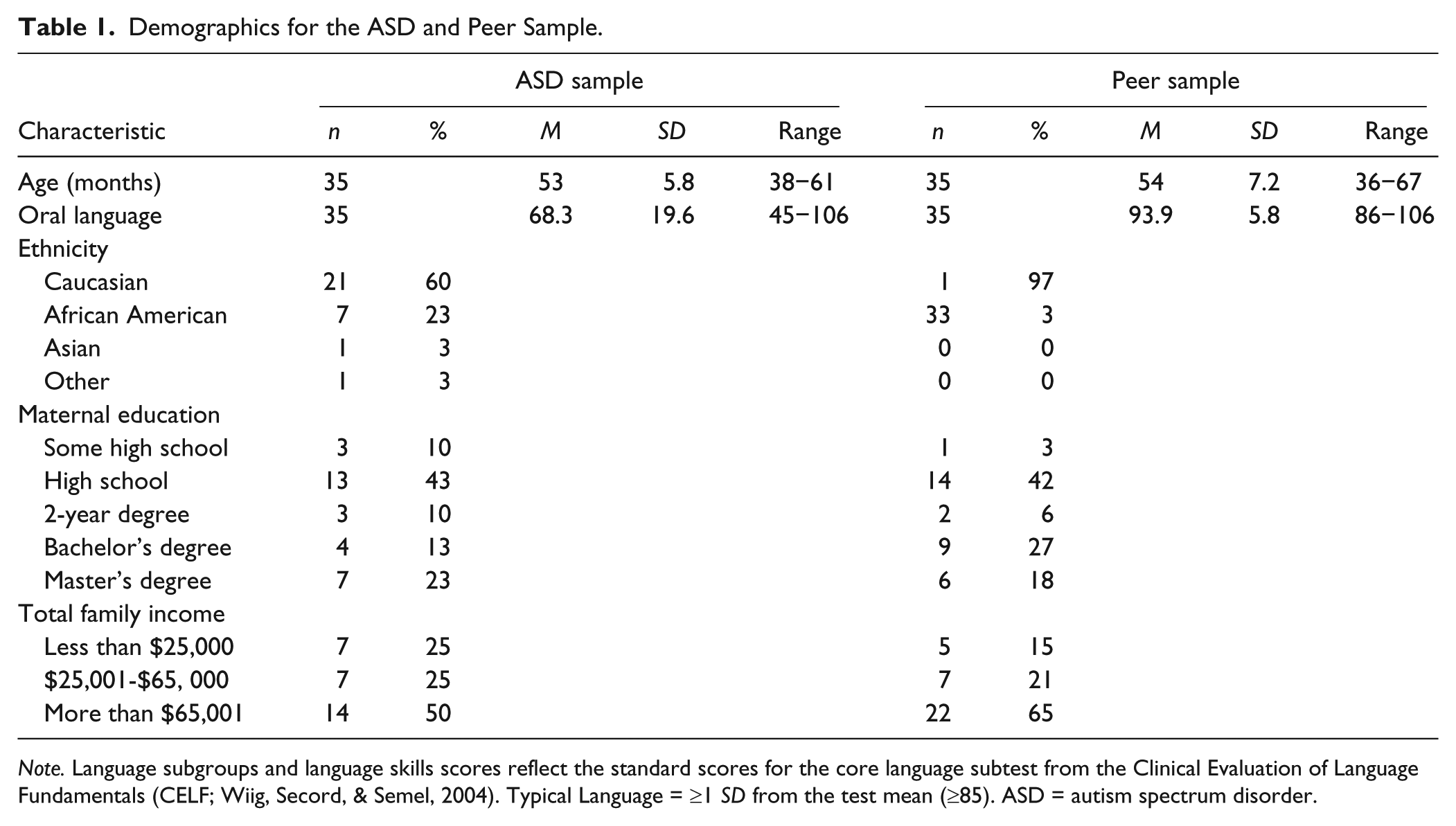
Note. Language subgroups and language skills scores reflect the standard scores for the core language subtest from the Clinical Evaluation of Language Fundamentals (CELF; Wiig, Secord, & Semel, 2004). Typical Language = ≥1 SD from the test mean (≥85). ASD = autism spectrum disorder.
The oral language ability of the children with ASD and their peers can be found in Table 1. As expected, children with ASD had lower oral language skills (M = 68.3, SD = 19.6) than their matched peers (Laushey & Heflin, 2000). Moreover, the large standard deviation and range indicated that this sample of children with ASD had language abilities that varied from severely delayed to average.
Measures
Measures used in the present study included direct assessments of children’s emergent literacy, including measures of alphabet knowledge, print-concept knowledge, definitional vocabulary, and phonological awareness, and assessments of children’s home-literacy environment via caregiver questionnaire. The direct assessments were administered to children in the fall of their preschool year by trained research staff working one-on-one with children. Caregivers also completed the home-literacy questionnaire in the fall of the children’s preschool year. See Justice et al. (in press) for a complete description of assessment procedures.
Alphabet knowledge
Alphabet knowledge was measured using a sum of children’s uppercase letter identification and lowercase letter identification on the Phonological Awareness Literacy Screening (PALS; Invernizzi, Sullivan, Meier, & Swank, 2004). On this assessment, children are presented with a white sheet of paper with the uppercase or lowercase letters printed on it in random order. The assessor pointed to each letter and the child received a point for each letter correctly named for a total of 52 points.
Print-concept knowledge
The raw score (out of 18) on the Preschool Word and Print Awareness (PWPA; Justice, Bowles, & Skibbe, 2006) was used to assess print-concept knowledge. The PWPA measures children’s knowledge of print concepts using the commercially available storybook Nine Ducks Nine (Hayes, 1990). While the assessor is reading the story with the child, she or he asks questions about word and print awareness (e.g., where do I begin to read?). A correct answer receives a score of either one or two. For items with a possibility of two points, a score of one can be given for partially correct answers. An incorrect answer receives a score of zero. Internal consistency of .71 using Cronbach’s alpha has been found for this measure (Cabell, Justice, Konold, & McGinty, 2011).
Definitional vocabulary
Definitional vocabulary is a subtest from the Test of Preschool Emergent Literacy (TOPEL; Lonigan, Wagner, Torgesen, & Rashotte, 2007). The TOPEL measured abilities related to early literacy. The definitional vocabulary subtest assesses children’s knowledge of common word labels and their corresponding definitions. Children label pictures of objects and then answer a follow-up question that pertains to the object’s function or definition. For reliability, Cronbach’s alpha was .82 for definitional vocabulary. For validity, the TOPEL definitional vocabulary was correlated with the One-Word Picture Vocabulary Test (r = .71).
Phonological awareness
Phonological awareness was assessed using a subtest of the TOPEL (Lonigan et al., 2007). The phonological awareness subtest consists of 27 items measuring elision and blending abilities. The first 12 items require a child to say a word, then to say what is left after dropping out specific sounds (elision). For the remaining 15 items, the child is asked to listen to separate sounds and combine them to form a word (blending). For reliability, Cronbach’s alpha was .86 for the phonological awareness subtest. For validity, the TOPEL phonological awareness was correlated with the Comprehensive Test of Phonological Processing (CTOPP) elision and blending (r = .59 and r = .65 respectively).
Print interest
Print interest was taken from the Stony Brook Family Reading Survey (Whitehurst, 1992) and has been used previously to describe children’s interest in print (Sawyer et al., 2014). Print interest is comprised of two items that aim to gauge children’s interest in their name and other words. Cronbach’s alpha for this scale was .56. Items were z scored and summed for final analyses.
Home-literacy environment
Three scales were used to measure children’s home-literacy environment: (a) frequency of storybook reading, (b) literacy teaching, and (c) caregiver beliefs about literacy. The frequency of storybook reading and literacy teaching scales are adapted from Stony Brook Family Reading Survey (Whitehurst, 1992) and have been validated in previous literature (Sawyer et al., 2014). The caregiver beliefs about literacy scale is adapted from the Parental Reading Beliefs Inventory (Whitehurst et al., 1988). See Table 3 for items included in each scale. For the current sample, Cronbach’s alpha for the scales were .71, .90, and .92, respectively. Items from the scale were z scored and then summed.
Results
As shown in Table 2, when examining the descriptive data, children with ASD generally had better alphabet knowledge than their peers did. However, children with ASD had lower print-concept knowledge, definitional vocabulary, and phonological awareness skills than their peers. Despite these differences, the large standard deviations for alphabet knowledge and definitional vocabulary indicated that there was a high level of variability in children with ASD’s emergent-literacy skills. A large standard deviation was also found for the peers’ alphabet knowledge. Moreover, caregivers reported children with ASD had lower print interest than their peers.
Emergent-Literacy Scores for the Children With ASD and Peers.
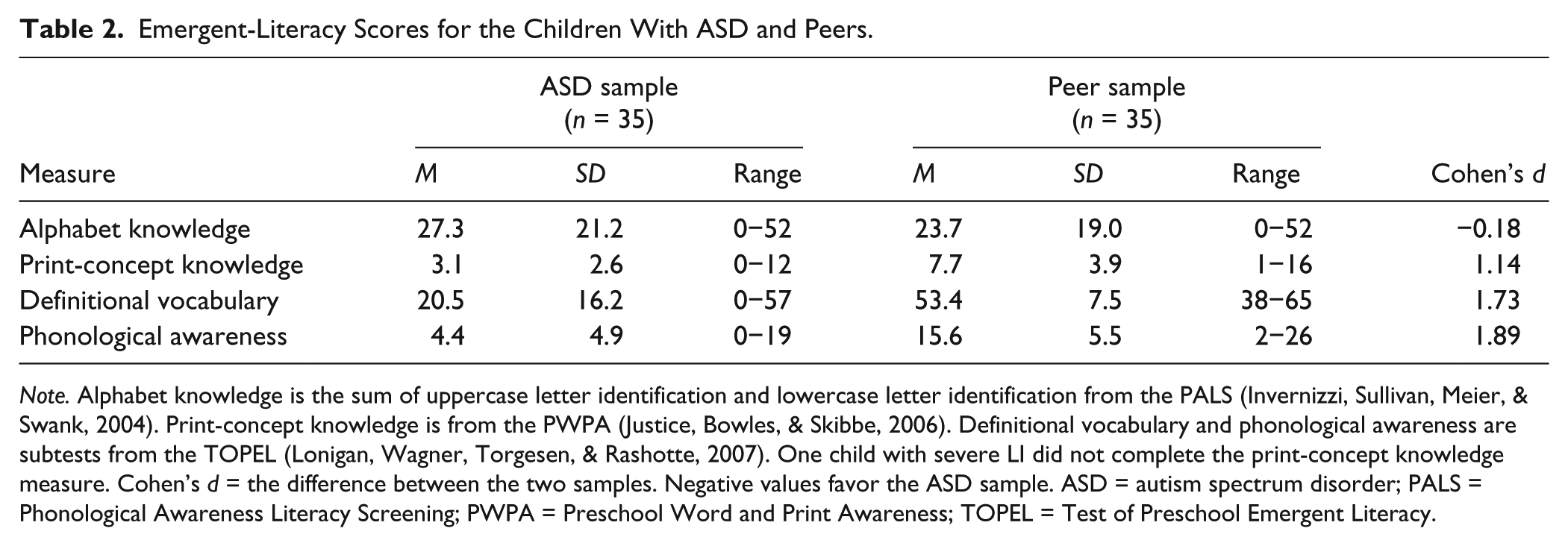
Note. Alphabet knowledge is the sum of uppercase letter identification and lowercase letter identification from the PALS (Invernizzi, Sullivan, Meier, & Swank, 2004). Print-concept knowledge is from the PWPA (Justice, Bowles, & Skibbe, 2006). Definitional vocabulary and phonological awareness are subtests from the TOPEL (Lonigan, Wagner, Torgesen, & Rashotte, 2007). One child with severe LI did not complete the print-concept knowledge measure. Cohen’s d = the difference between the two samples. Negative values favor the ASD sample. ASD = autism spectrum disorder; PALS = Phonological Awareness Literacy Screening; PWPA = Preschool Word and Print Awareness; TOPEL = Test of Preschool Emergent Literacy.
When examining the descriptive data for the home-literacy environment, interesting patterns emerged (see Table 3). More specifically, for frequency of storybook reading and caregiver beliefs, similar results emerged across groups: (a) children with ASD had slightly lower results in the frequency of storybook readings and (b) caregivers of both groups reported believing that reading with their child is fun and helps teach the skills of reading as well as language. With respect to literacy teaching, caregivers of children with ASD indicated that they taught their child about letters and words in books more frequently than the caregivers of children with typical language did.
Caregiver-Reported Print Interest and Home-Literacy Environment for the Children With ASD and Peers.
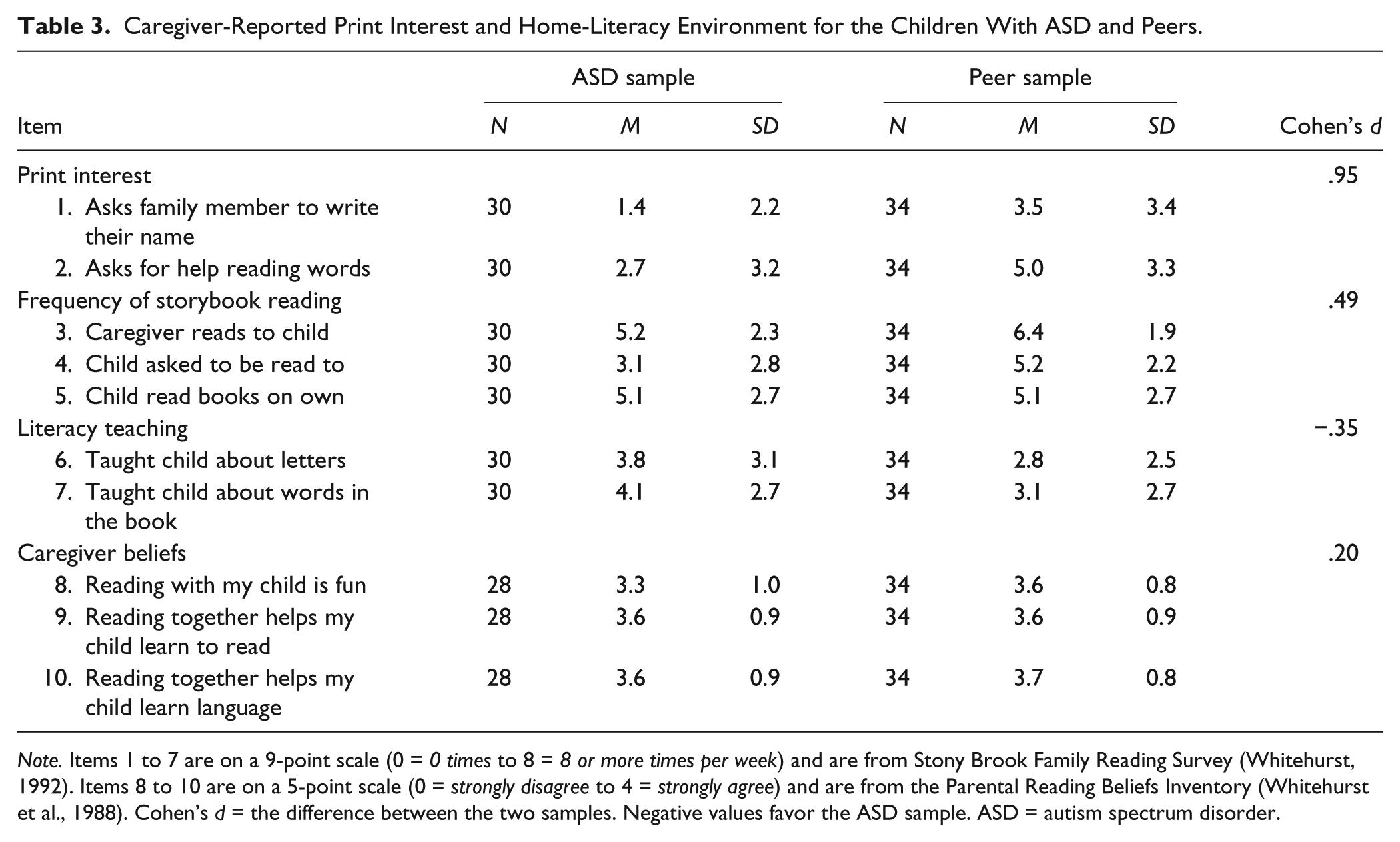
Note. Items 1 to 7 are on a 9-point scale (0 = 0 times to 8 = 8 or more times per week) and are from Stony Brook Family Reading Survey (Whitehurst, 1992). Items 8 to 10 are on a 5-point scale (0 = strongly disagree to 4 = strongly agree) and are from the Parental Reading Beliefs Inventory (Whitehurst et al., 1988). Cohen’s d = the difference between the two samples. Negative values favor the ASD sample. ASD = autism spectrum disorder.
Correlations between the emergent-literacy skills, print interest, and the home-literacy environment subscales were also examined (see Table 4). Significant and positive correlations were found between alphabet knowledge and frequency of shared book reading (r = .32, p = .01), print-concept knowledge and frequency of shared book reading (r = .27, p = .03), and definitional vocabulary and print interest (r = .27, p = .03). These results indicated a positive association between frequency of book reading in the home and children’s alphabet knowledge and print-concept knowledge.
Correlations Between Children’s Emergent-Literacy Skills, Print Interest, and Home-Literacy Environment Subscales.

Note. Alphabet knowledge is the sum of uppercase letter identification and lowercase letter identification from the PALS (Invernizzi, Sullivan, Meier, & Swank, 2004). Print-concept knowledge is from the PWPA (Justice, Bowles, & Skibbe, 2006). Definitional vocabulary and phonological awareness are subtests from the TOPEL (Lonigan, Wagner, Torgesen, & Rashotte, 2007). If the interaction was not significant, the coefficient reported represents the main effect for the model not including the interaction. SBR = storybook reading; PALS = Phonological Awareness Literacy Screening; PWPA = Preschool Word and Print Awareness; TOPEL = Test of Preschool Emergent Literacy.
p < .05. **p < .01.
Differences in Emergent Literacy
To examine the differences in children’s emergent-literacy skills, a regression model was examined for each of the emergent-literacy outcomes (alphabet knowledge, print-concept knowledge, definitional vocabulary, phonological awareness) and autism status. Results indicated that there were significant differences between children with ASD and their peer’s emergent literacy for print-concept knowledge (β = −4.66, p = .01, d = 1.14), definitional vocabulary (β = −24.07, p = .01, d = 1.73), and phonological awareness (β = −6.60, p = .01, d = 1.89), with results indicating that children with ASD had significantly lower emergent-literacy skills than their peers did. There were nonsignificant differences for alphabet knowledge (β = 3.63, p = .45, d = −.18). The effect sizes for print-concept knowledge, definitional vocabulary, and phonological awareness are considered large, whereas the effect size for alphabet knowledge is small.
Second, regression models were fit with the predictors of language, autism status, and language × autism status for the outcomes. The interaction term was not significant for any of the models. Thus, the reported results are for the models with only language and autism status as the predictors. Child language level was a significant predictor for all four emergent-literacy outcomes: alphabet knowledge, print-concept knowledge, definitional vocabulary, and phonological awareness. As shown in Table 5, ASD status was a significant predictor of alphabet knowledge and print-concept knowledge when controlling for language skills but was not a significant predictor of definitional vocabulary and phonological awareness. In fact, results indicated that children with ASD have significantly higher alphabet knowledge than their typical language peers when controlling for language skills and significantly lower print-concept knowledge when controlling for language skills.
Differences in Emergent-Literacy Skills, Print Interest, and Home-Literacy Environment for Children With ASD and Their Peers.
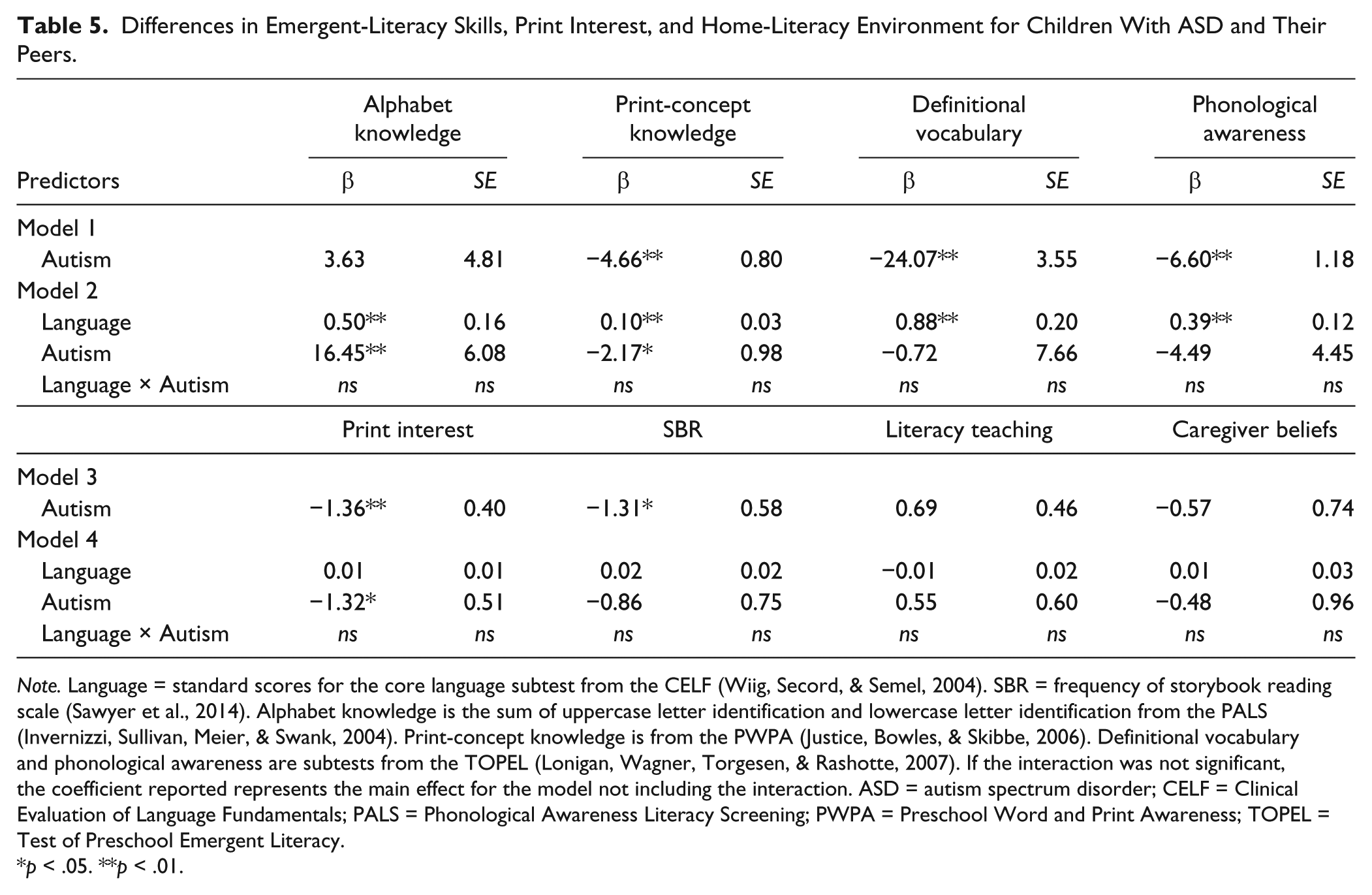
Note. Language = standard scores for the core language subtest from the CELF (Wiig, Secord, & Semel, 2004). SBR = frequency of storybook reading scale (Sawyer et al., 2014). Alphabet knowledge is the sum of uppercase letter identification and lowercase letter identification from the PALS (Invernizzi, Sullivan, Meier, & Swank, 2004). Print-concept knowledge is from the PWPA (Justice, Bowles, & Skibbe, 2006). Definitional vocabulary and phonological awareness are subtests from the TOPEL (Lonigan, Wagner, Torgesen, & Rashotte, 2007). If the interaction was not significant, the coefficient reported represents the main effect for the model not including the interaction. ASD = autism spectrum disorder; CELF = Clinical Evaluation of Language Fundamentals; PALS = Phonological Awareness Literacy Screening; PWPA = Preschool Word and Print Awareness; TOPEL = Test of Preschool Emergent Literacy.
p < .05. **p < .01.
Differences in Print Interest and Home-Literacy Environment
To examine differences in children’s print interest and home-literacy environment, a regression model was examined for print interest and each of the home-literacy environment subscales (frequency of shared book reading, literacy teaching, caregiver beliefs) and autism status. Results indicated that there were significant differences between children with ASD and their peers for print interest (β = −1.36, p = .01, d = .95) and frequency of shared book reading (β = −1.31, p = .03, d = .49), with results indicating that children with ASD have lower print interest and participate less frequently in shared book reading. There were no significant differences for children with ASD and their peer’s home-literacy environment for literacy teaching (β = 0.69, p = .14, d = −.35) and caregiver beliefs (β = −0.57, p = .45, d = .20).
Second, regression models were fit with the predictors of language, autism status, and language × autism status for the outcomes of print interest, frequency of shared book reading, literacy teaching, and caregiver beliefs. The interaction term was found to be nonsignificant for all of the models. Thus, the reported results are for the models with only language and autism status as the predictors. Child language level was not a significant predictor for print interest or any of the home-literacy environment subscales (frequency of shared book reading, literacy teaching, caregiver beliefs). As shown in Table 5, ASD status was only a significant predictor of children’s print interest (β = −1.32, p = .01). Results indicated that children with ASD have significantly lower print interest than their typical language peers when controlling for language skills.
Associations With Print Interest and the Home-Literacy Environment
To examine the association between print interest and the home-literacy environment and children’s emergent literacy, regression models were examined. First, regression models including the predictors of language, autism status, print interest, and print interest × autism status were fit for each of the four emergent-literacy outcomes (alphabet knowledge, print-concept knowledge, definitional vocabulary, phonological awareness). The interaction was not significant for any of the models. Thus, the reported results are for the models with only language, autism status, and print interest as predictors. Results indicated that when controlling for autism status and print interest, child language level was still a significant predictor for all four emergent-literacy outcomes. Autism status was only a significant predictor for alphabet knowledge and print-concept knowledge indicating that children with ASD had significantly higher alphabet knowledge and significantly lower print-concept knowledge than their peers when controlling for language skills and print interest. Print interest was significantly related to children’s alphabet knowledge when controlling for children’s language and autism status (see Table 6). Given that language ability, autism status, and print interest are all significant predictors of children’s alphabet knowledge, children with ASD who also have high language ability and print interest seem to have the highest alphabet knowledge.
Association Between Emergent Literacy, Print Interest, and Home-Literacy Environment.
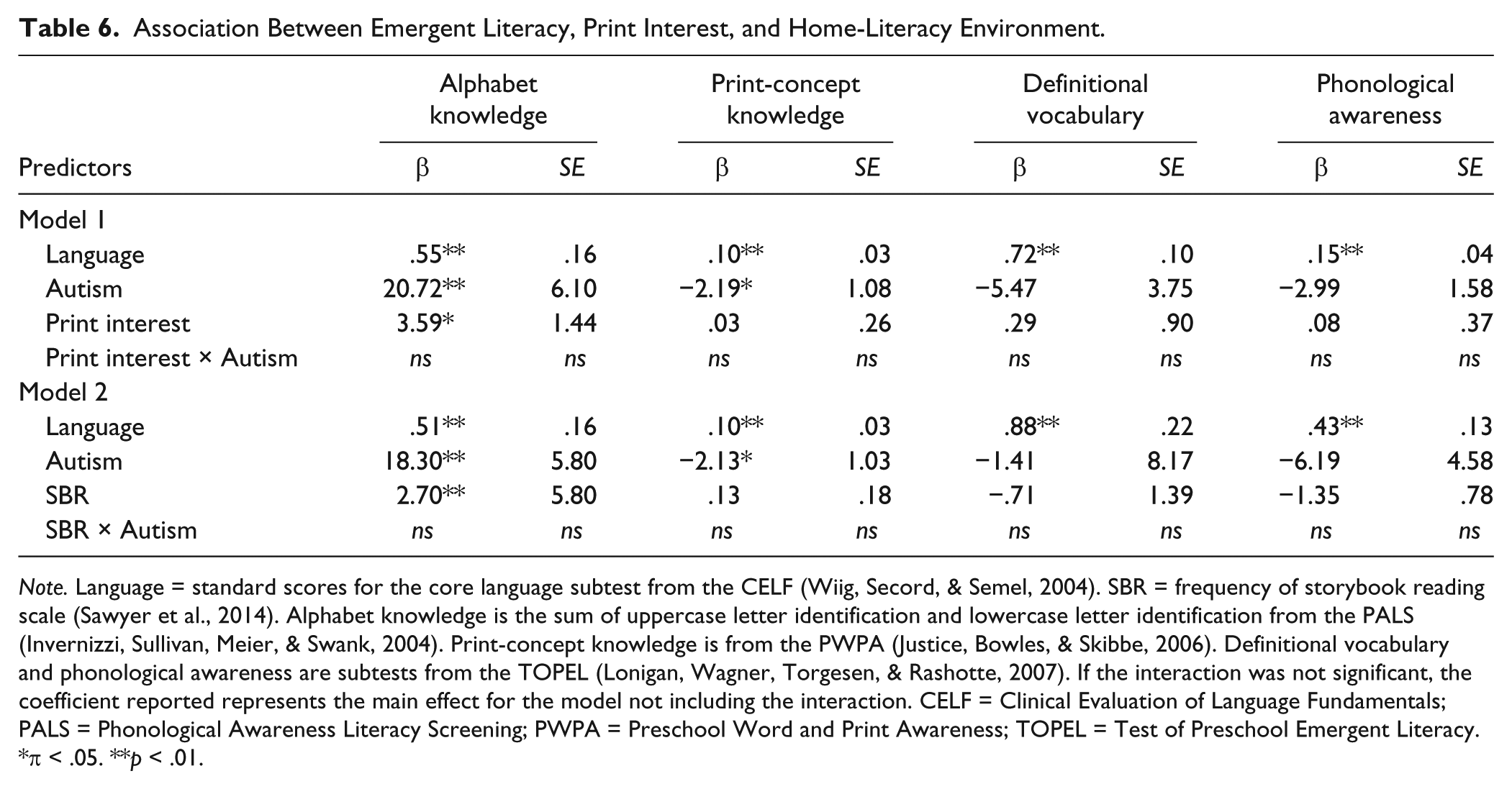
Note. Language = standard scores for the core language subtest from the CELF (Wiig, Secord, & Semel, 2004). SBR = frequency of storybook reading scale (Sawyer et al., 2014). Alphabet knowledge is the sum of uppercase letter identification and lowercase letter identification from the PALS (Invernizzi, Sullivan, Meier, & Swank, 2004). Print-concept knowledge is from the PWPA (Justice, Bowles, & Skibbe, 2006). Definitional vocabulary and phonological awareness are subtests from the TOPEL (Lonigan, Wagner, Torgesen, & Rashotte, 2007). If the interaction was not significant, the coefficient reported represents the main effect for the model not including the interaction. CELF = Clinical Evaluation of Language Fundamentals; PALS = Phonological Awareness Literacy Screening; PWPA = Preschool Word and Print Awareness; TOPEL = Test of Preschool Emergent Literacy.
π < .05. **p < .01.
Second, regression models including the predictors of language, autism status, frequency of shared book reading, and frequency of shared book reading × autism status were fit for each of the four emergent-literacy outcomes (alphabet knowledge, print-concept knowledge, definitional vocabulary, phonological awareness). The interaction was not significant for any of the models, so it was removed from the final analyses. Similar results were found for frequency of storybook reading: When controlling for autism status and frequency of shared book reading, child language level was still a significant predictor for all of the emergent-literacy outcomes. Autism status was also still significant related to higher alphabet knowledge and lower print-concept knowledge when controlling for language skills and frequency of storybook reading. Moreover, frequency of storybook reading was a significant predictor of children’s alphabet knowledge when controlling for children’s language and autism status. Similarly, the significant results for language ability, autism status, and frequency of shared book reading in predicting children’s alphabet knowledge indicated that children with ASD with high language ability that also frequently engaged in shared book reading seemed to know the most letter names.
Discussion
The current study sought to extend the literature on the emergent-literacy skills and home-literacy environment of children with ASD by comparing children with ASD with children with typical language levels. Three main results were found: (a) children with ASD scored significantly higher on measures of alphabet knowledge and significantly lower on measures of print-concept knowledge when controlling for language skills, (b) different patterns emerged for print interest and the home-literacy environment for both children with ASD and their peers, and (c) print interest and frequency of shared book reading were significantly related to children’s alphabet knowledge scores. Each of these findings will be discussed in turn.
Differences in Emergent-Literacy Skills
Given that research has shown that language ability is an important predictor of emergent-literacy skills for all children, and that children with ASD tend to have lower oral language skills than their peers (Laushey & Heflin, 2000), we examined the differences in children with ASD and their peers emergent-literacy skills when controlling for language ability. These results indicated that similar to other researchers (Lanter et al., 2012), children with ASD exhibited a characteristic profile of high alphabet knowledge and low print-concept knowledge. When controlling for language, there were no significant differences between children with ASD and their peer’s definitional vocabulary and phonological awareness.
The significant findings for measures of print-concept knowledge are in line with previous studies of children with developmental disabilities which have found children possess less print-concept knowledge than their typically developing peers (Boudreau & Hedberg, 1999; Cabell, Justice, Zucker, & McGinty, 2009; Gillam & Johnston, 1992; Justice et al., 2006; Koppenhaver & Erickson, 2003). For instance, Koppenhaver and Erickson (2003) found that preschool children with ASD had little conventional letter, word, logo, or environmental print knowledge.
The characteristic weaknesses children with ASD possess with respect to print-concept knowledge are important in light of the research on the importance of this emergent-literacy skill. Print-concept knowledge is considered one of the more consistent predictors of children’s later reading achievement (Hammill, 2004; NELP, 2008) and as it may be a weakness for children with ASD, educators and clinicians may want to implement interventions that include explicit teaching on aspects of print-concept knowledge including book and print organization. Also in line with other researchers, a high level of variability existed across all emergent-literacy domains (Jones et al., 2009; Lanter et al., 2012; Nation et al., 2006). This high variability might not be a surprise given that ASD is a spectrum disorder and that the abilities of children with ASD fall along a wide spectrum of abilities.
Oral language ability was also related to all the emergent-literacy outcomes (alphabet knowledge, print-concept knowledge, definitional vocabulary, phonological awareness). This finding is of little surprise, given that other studies on children with ASD have also reported a strong association between child oral language and emergent-literacy skills (Jacobs & Richdale, 2013; Lanter et al., 2012). Knowing that oral language skills are so closely related to literacy outcomes highlights the importance of concurrently focusing on oral language skills in any intervention for children with ASD.
Patterns in Print Interest and Home-Literacy Environment
Several interesting patterns were observed with respect to print interest, frequency of storybook reading, literacy teaching, and caregiver beliefs regarding literacy teaching. With respect to print interest, somewhat surprisingly, children with ASD were found to possess significantly lower print interest than their peers. Moreover, this finding continued to remain significant even when controlling for children’s language abilities. Given that children with ASD are noted to excel with letter naming, this finding is different from what we hypothesized. We expected to replicate the findings of prior researchers who reported high print interest in children with ASD (Lanter et al., 2012; Nation et al., 2006). Our divergent finding might reflect the complexity of the print interest construct. First, the items used in the print interest scale (e.g., how frequently the children ask a family member to help them write their name or read a few words) may not adequately measure children’s interest in the individual letters of the alphabet. Prior researchers have used items such as enjoyment during shared book reading and these differences may very well lead to the seemingly contradictory findings. In addition, the construct of print interest might highlight a more complex skill than letter interest and children with ASD may exhibit less sophistication with this more advanced skill. Understanding this discrepant finding will be an important area for future research.
For frequency of storybook reading, caregivers of children with ASD were found to engage in significantly less shared book reading in the home than their peers. This finding is similar to previous research that has shown that children with developmental disabilities participate in a fairly small amount of shared book reading (Fitzgerald, Roberts, Schuele, & Coleman, 1991; Marvin, 1994; Marvin & Mirenda, 1993). For instance, Marvin (1994) surveyed parents of children with either single or multiple developmental delays and found that less than half of the children in either group were read to daily. When controlling for language ability, there is not a significant difference for reading in the home for children with ASD and their peers. Therefore, based on this finding and the research suggesting the benefits of daily storybook reading for children’s oral language skills (Bus, van IJzendoorn, & Pellegrini, 1995; Scarborough & Dobrich, 1994), daily storybook reading may have a similar influence on children with ASD’s oral language abilities.
Regarding literacy teaching, caregivers of children with ASD were not significantly different in the amount that they taught their children about letters and words in comparison with caregivers of the peers. However, it is unknown exactly how this influence transpires and given the intervention implications surrounding how caregivers introduce their children with ASD to literacy at an early age, future researchers should explore this. The amount of literacy teaching may also be related to caregivers’ beliefs about literacy, as the current study found that caregivers seemed to have very positive views about their ability to teach their children during book reading.
Finally, regarding caregiver beliefs about literacy, caregivers of children with ASD reported similar beliefs about literacy as the caregivers of peers. For both groups, caregivers indicated that reading with their child was enjoyable and that joint reading could instill important reading and language skills. This finding suggests that caregivers of children with ASD value emergent-literacy teaching just as much as caregivers of children who are typically developing do. This positive finding is in line with a study examining only the emergent-literacy beliefs of caregivers of children with ASD (Lanter et al., 2012), but contrasts from group comparison studies suggesting caregivers of children with developmental disabilities prioritize literacy teaching less (Light & Smith, 1993; Marvin, 1994; Marvin & Mirenda, 1993). Future studies should further investigate the group differences of caregiver beliefs regarding emergent literacy.
An interaction term for language and autism was originally included in the regression models, but the term was removed because it was not significantly related to any of the emergent literacy and home-literacy environment outcomes. The nonsignificant result indicated that the association between language ability, emergent-literacy skills, and home-literacy outcomes are no more or less important for children with ASD than those without. As this is the first study aimed to examine the association between the home-literacy environment and children with ASD’s emergent-literacy skills, it is important to note that children with ASD’s home-literacy environment may be just as important to their development of alphabet knowledge as it is for their peers. However, as power estimates suggest the current study could only detect an effect that was large (d = .7), the results of the current study may have been attenuated and further exploration of this association may be necessary.
Association Between Emergent Literacy and the Home-Literacy Environment
Significant associations were found for print interest and frequency of shared book reading with children’s alphabet knowledge. The association between frequency of storybook reading and children’s emergent-literacy skills has been well supported in the literature (Bus et al., 1995; Frijters et al., 2000). However, research on the association with children’s alphabet knowledge has resulted in mixed findings (Roberts, Jurgens, & Burchinal, 2005; Sénéchal & LeFevre, 2001). Much of the prior research examining the frequency of storybook reading contributions to children’s emergent-literacy skills has focused on children who are typically developing. In a study of children with language impairments examining the frequency of storybook reading and children’s emergent-literacy skills, Sawyer and colleagues (2014) found findings similar to the current study, which included significant associations with children’s print knowledge (specifically a composite of alphabet knowledge and print-concept knowledge). The results of the current study begin to provide support for the importance of caregiver−child storybook reading for children with ASD. The benefits of caregiver−child storybook reading has been thoroughly established through previous research focusing on children who are typically developing; however, this is the first study that shows a possible link between the frequency of caregiver−child storybook reading and emergent-literacy skills for children with ASD.
Limitations and Future Research
The current study expands the literature on the emergent-literacy skills, print interest, and home-literacy environments of children with ASD. There are two limitations to this work. First, the design of this study is correlational, therefore causal relations cannot be inferred. Randomized controlled trial (RCT) or longitudinal designs would be necessary to further examine the impact of the home-literacy environment on children with ASD’s emergent-literacy skills. Second, the scales used to measure aspects of the home-literacy environment may not be specific enough to fully capture children with ASD’s print interest or how caregivers of children with ASD provide literacy teaching. In future studies, the scales used in this study could be expanded to include more specific items and direct observations of children with ASD’s home-literacy environment.
Future research may also include a more in-depth look at caregiver storybook reading with children with ASD. A few studies have examined caregiver storybook reading with children with other developmental disabilities. For example, Skotko, Koppenhaver, and Erickson (2004) videotaped four mothers reading to their daughters with Rett syndrome and results showed that girls with Rett syndrome could learn to communicate in meaningful ways through storybooks. Furthermore, Ezell, Justice, and Parsons (2000) aimed to enhance the emergent-literacy skills of four preschoolers with language delays. The mother–child dyads participated in caregiver training sessions and guided practice to learn a reading style that focuses on print. Results on standard measures of print-concept knowledge showed that the children made rapid gains in a short time period. Therefore, this preliminary research on shared book reading with children with development disabilities shows that shared book reading can be an important context for transferring emergent-literacy skills and this is an important area for future research for children with ASD.
To summarize, this study is one of the very first to suggest that young children with ASD and children who are typically developing possess significant differences with respect to their emergent-literacy skills (alphabet knowledge, print-concept knowledge) and print interest. For emergent literacy, these differences include significantly higher alphabet knowledge and significantly lower print-concept knowledge for the children with ASD when controlling for language ability. Children with ASD also seem to have lower print interest when controlling for language ability. Interestingly, for both groups, language ability was related to emergent-literacy skills and print interest and frequency of storybook reading were related to children’s alphabet knowledge. Although this study provides critical new information regarding the emergent literacy and home-literacy environments of young children with ASD, it is important to recognize that we still have ways to go. A great deal of work must still be carried out with respect to addressing gaps in the reading literature for young children with ASD. In particular, it will be critical for future researchers and clinicians to build on our study to characterize the early reading profiles of young children with ASD and design effective ASD reading programs.
Footnotes
Declaration of Conflicting Interests
The author(s) declared no potential conflicts of interest with respect to the research, authorship, and/or publication of this article.
Funding
The author(s) disclosed receipt of the following financial support for the research, authorship, and/or publication of this article: The research has been supported by U.S. Department of Education, Institute of Education Sciences Grant R324A080037.