




Abstract
Although considerable progress has been achieved regarding the research and laws supporting preschool inclusion, access to inclusive preschool environments remains intangible for many children with disabilities in the United States. The purpose of this article is to discuss current challenges and solutions to high-quality preschool inclusion. We use the conceptual framework identified in the Division for Early Childhood (DEC)/National Association for the Education of Young Children (NAEYC) inclusion position statement to promote solutions to support high-quality inclusion and the success of all children. We provide conceptual and empirical support for preschool inclusion and outline recommendations to the field.
For more than 35 years, the Individuals With Disabilities Education Act (IDEA; 2004) and federal early childhood (EC) programs (e.g., Head Start) have encouraged educational services for preschool children with disabilities to be delivered in general education classrooms with typically developing peers. In fact, IDEA has a strong preference for the placement of young children with disabilities in settings with typically developing children (Musgrove, 2012). The exact wording of IDEA asserts that school districts must ensure that all children with disabilities are educated with children without disabilities to the maximum extent appropriate (34 Code of Federal Regulations [CFR] §300.114). Indeed, IDEA states that the “removal” of children from the regular education setting can be done only if the regular education placement is not satisfactory even with the provision of supplementary aids and services (34 CFR §300.114) and training and technical assistance for administrators and teachers (34 CFR §300.119).
Over the same time period, research support for preschool inclusion has grown. Perhaps the most robust and consistent finding from the EC research is the importance and effectiveness of high-quality, early intervention (EI) for young children with disabilities (Boyd, Odom, Humphreys, & Sam, 2010). In particular, high-quality inclusive environments are correlated with positive outcomes for all young children, including children with disabilities (Camilli, Vargas, Ryan, & Barnett, 2010; Guralnick, 2001; Pianta, Barnett, Burchinal, & Thornburg, 2009; Strain & Bovey, 2011). High-quality inclusive classrooms with higher ratios of more competent peers, in particular, are related to positive outcomes for children with disabilities (Justice, Logan, Lin, & Kaderavek, 2014; Strain & Bovey, 2011).
However, according to U.S. Department of Education (USDOE) Office of Special Education Programs (OSEP), in 2012, across all states, fewer than half (i.e., 42.5%) of children with disabilities, aged 3 to 5 years, received their special education and the related services in a regular EC classroom (USDOE, 2012). During 1984 through 1985, using the best comparison numbers available from the USDOE (1987), 36.8% of children with disabilities, aged 3 to 5 years, received their special education and the related services in a regular EC classroom. Comparing the 1985 data with the 2012 data, the practice of providing special education to children with disabilities, aged 3 to 5 years, in regular EC settings appears to have increased by only 5.7%. Although the definitions of settings and reporting methods by states have changed slightly over time, these numbers indicate that collective efforts to support and promote high-quality inclusion have been marginally successful at best. Others have supported these findings. For example, Odom, Buysse, and Soukakou (2011) compared data from 2002 to 2012 and found that although data trends were similar across the years, inclusion was occurring less often over time. They concluded that field has made insubstantial progress regarding inclusive placements.
The purpose of this article is to discuss challenges and solutions to high-quality preschool inclusion. We briefly describe information gathered from a recent online survey to identify current challenges and solutions to preschool inclusion. We then use the conceptual framework identified in the inclusion position statement developed in collaboration by the Division for Early Childhood (DEC) of the Council for Exceptional Children (CEC) and the National Association for the Education of Young Children (NAEYC) to promote solutions to support high-quality inclusion and the success of all children. Each section will discuss a framework component, review and summarize the extant research associated with each component, and describe the solutions identified through the survey. Finally, we present several recommendations to the field.
Perceived Challenges to Preschool Inclusion
In an effort to explain this lack of progress in preschool inclusion, the authors conducted an online survey. The survey instrument was developed to gain descriptive information from a national sample of administrators to identify current challenges to preschool inclusion and solutions or strategies to address those challenges. The survey asked respondents to identify and describe challenges to preschool inclusion in their program, community, or state, and to suggest solutions. Survey items were based on a similar survey conducted more than 20 years prior (Smith & Rose, 1993; Smith, Salisbury, & Rose, 1992).
Two hundred thirty-eight people responded to the survey. Survey results included representation from 32 states and 1 territory and a variety of roles (i.e., school district special education preschool coordinator, child find coordinators, district special education directors, and state IDEA/619 coordinators). Two hundred twenty-seven survey respondents indicated policies were challenges to inclusion and almost 100 of these respondents suggested solutions. The challenges they described included their perceptions of policies related to program quality, personnel, funding or contracting, transportation, approval of private/nonpublic school programs, conflicting policies between schools and nonschool districts or programs, and differing curricula or methods between school district and nondistrict programs. These respondents indicated these policy and procedural challenges mostly existed at the local or state level. Table 1 provides a summary of these results.
Comparison of Challenges to Preschool Inclusion From 1993 to 2014.
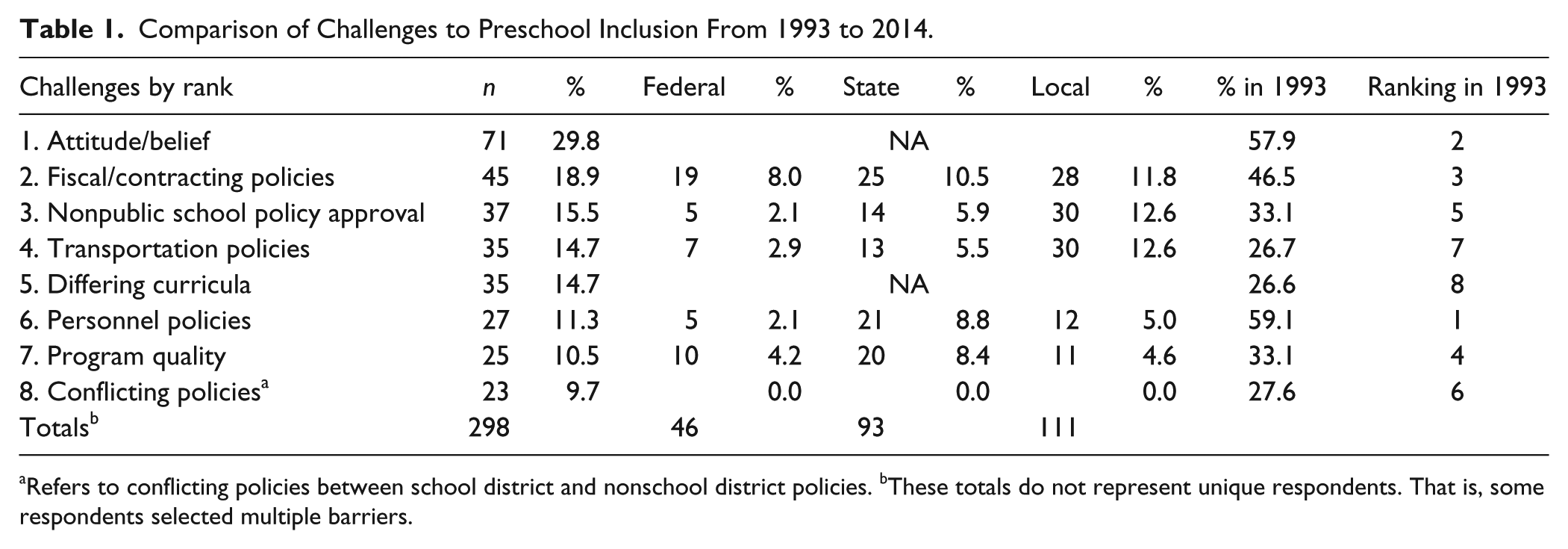
Refers to conflicting policies between school district and nonschool district policies. bThese totals do not represent unique respondents. That is, some respondents selected multiple barriers.
In addition, 71 respondents indicated attitudes and beliefs were serving as challenges to inclusion. For example, respondents identified concerns with the lack of collaboration between general education settings and special education settings and their associated personnel. Respondents also identified concerns someone will lose out (n = 50, 20.9%) because children with disabilities would not get the services they need or children without disabilities would not get the attention they need. Other attitude and belief challenges included concerns about teacher preparedness (n = 44, 18.3%), lack of awareness of the benefits of inclusion (n = 39, 16.3%), turf (e.g., “the private preschool teacher just kicks out kids with special needs, says they are our kids, not theirs”; n = 36, 15.1%), or lack of respect (n = 29, 12.2%).
Comparison Across Years
We compared the current survey results with the previous survey conducted more than 20 years ago (Rose & Smith, 1993; Smith & Rose, 1993; Smith et al., 1992) to understand how challenges to preschool inclusion might have changed. Overall, the challenges and solutions changed very little between the two surveys. The major change was that the attitude and belief challenges moved from being the second most frequently cited category in 1993 to the most frequently cited category of challenge in 2014 (see Table 1). Furthermore, personnel policies were the most frequently cited category of challenge in 1993, but moved to sixth place in the 2014 survey. This suggested perhaps the field has made progress in the area of personnel policies that support inclusion. For example, respondents to the current survey indicated that their states have developed communities of practice for itinerant teachers and community providers to establish strong working relationships and discuss solutions to common problems. Several survey respondents also described statewide professional development activities related to preschool inclusion to ensure all districts have access to the same information (e.g., special education, specialized instruction, accommodations and modifications, blended instruction). In fact, some respondents suggested these professional development activities were blended into the state EC career ladder. The subsequent section uses the conceptual framework identified in the DEC/NAEYC joint inclusion position statement to discuss and promote solutions to support high-quality preschool inclusion.
Advancing Preschool Inclusion
DEC/NAEYC Inclusion Position Statement
In 2009, two prominent EC organizations DEC and NAEYC developed and published a joint position statement on preschool inclusion (DEC & NAEYC, 2009). The collaboration between DEC and NAEYC provided new opportunities at the state and local levels to engage in meaningful dialogue around critical issues for children with disabilities within the broader EC systems (Woods & Snyder, 2009). This is especially important given the fragmented nature of EC (e.g., child care, Head Start, community preschools, Early Childhood Special Education [ECSE]) and the need to ensure quality inclusion for young children with disabilities (Odom et al., 2011).
In the 5 years since the statement was published, the impact of the statement is unknown. The statement included six recommendations for how to use the statement and accompanying definition. The first three recommendations were related to what local or individual program could do to achieve high-quality inclusion. The final three recommendations could be interpreted as broader, state- or national-level actions. These were (a) “revise program and professional standards,” (b) “achieve an integrated professional development system,” and (c) “influence federal and state accountability systems” (DEC & NAEYC, 2009, p. 4). The field has made some progress toward these last three recommendations, but more work is needed.
First, a work group representing DEC and NAEYC revised the initial personnel standards and created new advanced personnel standards for EI/ECSE (Cochrane et al., 2012). Furthermore, these standards are currently being cross aligned with the NAEYC personnel standards (Chandler et al., 2012) to support inclusive and interdisciplinary services in EC and to guide both in-service and preservice professional development (Stayton, 2015). However, many preservice training programs are not aligned with national standards and more work is needed to promote the use of these standards and the alignments across EC and ECSE preservice training programs (Bruder, Mogro-Wilson, Stayton, & Dietrich, 2009; Stayton, Smith, Dietrich, & Bruder, 2012). However, the current survey results suggesting personnel policies are no longer a primary challenge to preschool inclusion might be, at least in part, a result of this ongoing work to align personnel standards (Stayton, 2015).
Second, national professional development technical assistance centers have considered the inclusion of DEC/NAEYC standards. The Center to Mobilize Early Childhood Knowledge (CONNECT; http://connect.fpg.unc.edu) aligned their modules with both the DEC and NAEYC personnel standards. The Center on the Social Emotional Foundations for Early Learning (CSEFEL; http://csefel.vanderbilt.edu/) created a crosswalk between the NAEYC and DEC standards and the CSEFEL Inventory of Practices (Smith, 2008). The Early Childhood Technical Assistance Center (ECTA) and the Early Childhood Personnel Center (ECPC) produced a collaborative systems framework for state personnel systems that recommends aligning state professional standards with the DEC and NAEYC standards. However, there remains significant disparity across states in the path to EC and ECSE licensure (Stayton et al., 2009); a recent review of state licensure across all 50 states identified only 7 (14%) states with blended EC/ECSE licensure. Furthermore, few universities have dual EC/ECSE licensure preservice training programs (Piper, 2007). Although more research is needed, the research on integrated EC/ECSE preservice training is promising and should be used to guide discussions of EC/ECSE preservice professional development (Mellin & Winton, 2003; Stayton, 2015).
Third, the impact on federal and state accountability systems is unknown. However, one recent, promising development across states is the use of Quality Rating and Improvement Systems (QRIS). QRIS are designed to recognize and improve the quality of EC programs. For example, several states are using QRIS to develop procedures for parents to use to identify high-quality, inclusive EC programs (Horowitz & Squires, 2014). However, more work is needed to align QRIS with quality inclusive programming; only 29 of 42 states with QRIS incorporated standards related to the inclusion of children with special needs into their QRIS.
The DEC/NAEYC inclusion statement defines preschool inclusion by access, participation, and supports. Appropriate access, participation, and supports ensure all children are participating members of both their physical and social environments. The following sections describe each of these components and provide conceptual and empirical support for each.
Access
Access refers to providing a sufficient frequency and intensity of contextually relevant learning opportunities across settings for every child by identifying and eradicating structural barriers and improving physical environments. The concept of access promotes the use of universal design principles to support child learning. The principles of universal design are multiple means of (a) representation, (b) expression, and (c) engagement (Center for Applied Special Technology, 2006). McGuire, Scott, and Shaw (2006) also proposed several principles of universal design for instruction, which include equitable use, flexibility, simplicity, perceptibility, tolerance for error, low physical effort, appropriate physical space, sense of community, and climate that supports learning. Universal design principles can be used to ensure all children have access to both the physical and the instructional environments. One critical component of universal design to learning and instruction is a focus on starting with accessible physical and instructional environments, rather than creating a curriculum and then adapting it. In EC settings, this means that teachers intentionally plan for and provide equitable access to learning opportunities, multiple options for expression, diverse ways of participating, and a variety of means of demonstrating competence (Conn-Powers, Cross, Traub, & Hutter-Pishgahi, 2006). In sum, programs need to be ready to support all children; children with disabilities do not need to be ready to be included (Strain, Schwartz, & Barton, 2011).
Access to inclusion supports learning
High-quality inclusive environments benefit children with and without disabilities. For example, Justice and colleagues (2014) recently examined the peer effects of inclusive preschool classrooms. They found that the average language skills of peers at the start of the school year significantly predicted individual child language skills by the end of the school year. Children with disabilities in classrooms with the lowest average language scores at the start of the year had the lowest language scores themselves by the end of the year. The authors concluded that peers do matter—Children’s growth and learning are related to their peers’ skills and the effects are most pronounced for children with disabilities. Similarly, Rafferty, Piscitelli, and Boettcher (2003) found that children with severe disabilities in inclusive settings had higher scores on language assessments than children in segregated settings. Preschoolers with less severe disabilities made similar gains across inclusive and segregated settings. Likewise, Buysse, Goldman, and Skinner (2002) found that when children with disabilities had access to multiple playmates they had more opportunities to develop social and play skills. Child care teachers in their study reported that young children with disabilities in inclusive settings had friends who were typically developing. Holahan and Costenbader (2000) found that children with disabilities with higher social-emotional skills performed better in inclusive settings than segregated ones. Children with disabilities with lower social-emotional development performed equally well in segregated or inclusive settings. Collectively, the research on preschool inclusion suggests a relation between inclusive settings and positive outcomes for children with disabilities. However, additional research is needed examining the short- and long-term causal impact of inclusive programming.
Inclusive options
School districts make placement and setting decisions for children with disabilities who are eligible for special education. The inclusion options for school districts include (a) within public school systems or (b) outside of public schools in community-based EC programs. Within public school systems, this can be accomplished by providing access and placement for preschool-age children with disabilities in classrooms with their typically developing peers. States and districts need to understand and promote creative ways to include children with disabilities in programs with their typically developing peers, which will involve developing relationships among EI, preschool, and kindergarten programs. Inclusive opportunities outside public schools include collaborating with community-based programs such as child care, Head Start grantees, and private preschool programs. Importantly, attitudes and beliefs were primary reasons for a failure to provide inclusive preschool services as reported by our survey respondents. For example, respondents frequently reported that decision makers failed to create inclusive environments because they did not understand federal law or the research. Furthermore, many of the challenges that were described as policy were actually related to procedures, inaccurate beliefs, lack of resources, or inaccurate interpretations of policies. Several survey respondents indicated that clarification regarding the federal law and state policies is needed. This should involve understanding and demonstrating what IDEA requires regarding preschool inclusion. For example, a review and analysis of the recent Dear Colleague Letter in reference to preschool inclusion and Least Restrictive Environments (LREs) might be beneficial for understanding the federal law in relation to preschool inclusion options (Musgrove, 2012).
Participation
The concept of participation focuses on ensuring all children are active, independent participants in their families, classrooms, and communities. Participation means adults promote learning and engagement by using a range of instructional practices and individualized accommodations, modifications, and adaptations to promote active participation and a sense of belonging for all children. Participation is closely aligned with access. That is, adults ensure all children have access and opportunities to participate across contexts, activities, and routines, and some children might need individual adaptations to participate. Adults design the environments (e.g., physical, instructional) to create a sense of belonging for all children. For example, inclusive environments should support naturalistic and embedded instruction as well as more direct or explicit instructional practices to ensure all children are participating and learning.
Participation supports friendships
Decades of research have shown that high-quality early services in inclusive settings are beneficial for all young children, their families, and our communities (Guralnick, 2001; Odom et al., 2011). For example, inclusion provides children with and without disabilities opportunities to establish friendships. Hollingsworth and Buysse (2009) noted that friendships between children with and without disabilities in inclusive settings were voluntary, harmonious, and related to mutual enjoyment and positive affect. They also noted teachers within inclusive preschool classrooms used more active strategies to successfully support friendships between children with and without disabilities (Buysse, Goldman, & Skinner, 2003; Hollingsworth & Buysse, 2009). These early friendships might be critical for learning how to maintain positive social relationships into adulthood.
Effective instruction
A variety of specialized instructional practices related to a range of skills can be embedded into inclusive preschool classrooms (DEC, 2014; Grisham-Brown, Pretti-Frontczak, Hawkins, & Winchell, 2009). For example, specialized instruction has been embedded into inclusive preschool classrooms to teach children with disabilities academic skills (Daugherty, Grisham-Brown, & Hemmeter, 2001; Horn, Lieber, Li, Sandall, & Schwartz, 2000), language skills (Grisham-Brown, Schuster, Hemmeter, & Collins, 2000), and social skills (Venn et al., 1993). The three OSEP outcomes for children with disabilities, namely: (a) acquiring and using knowledge and skills; (b) having positive social-emotional skills, including social relationships; and (c) using appropriate behavior to meet their needs (Hebbeler, Kasprzak, & Kahn, 2014) can be effectively addressed in high-quality, inclusive preschool classrooms.
The survey respondents reported that school districts and regular EC programs do not know how to ensure that appropriate practices and services are provided within the public schools (e.g., state pre-K) or outside of the public schools (e.g., child care, Head Start). Challenges included lack of specialized training, lack of communication and collaboration, beliefs about typical settings, and approaches to instruction and curriculum. The prevailing solution to these challenges was for school district special education personnel, personnel in district typical EC programs, and personnel in community programs to develop regular communication and collaboration. Examples included having a community preschool inclusion team, providing joint professional development opportunities, and ensuring school district ECSE personnel provide itinerate services and coaching to regular EC programs.
Supports
Supports refers to having an adequate infrastructure and systems to support high-quality preschool inclusion. Supports means all adults involved have access to quality professional development including ongoing coaching and support for collaborative teaming. Supports include policies to promote and incentivize preschool inclusion. Many of the challenges to preschool inclusion and likely causes of the lack of progress nationwide involve the lack of knowledge and skills and the confidence to serve young children with disabilities effectively. These challenges are remedied by ensuring the system and infrastructure support inclusion and the practices that promote inclusion (Odom, 2009). School district procedures or policies might include guidance for delivering professional development or writing memoranda of agreement with a local child care center to serve as an inclusive placement for a child with a disability.
Providing fiscal support and resources
Inclusion is not more expensive than segregated programming. Odom and colleagues (2001) evaluated nine inclusive programs and found that six of these nine were less expensive than self-contained special education placements. Results from our survey indicated that many states and districts have reported being “creative” with their funding mechanisms and contract negotiations to support high-quality inclusive preschool programs. For example, districts can braid their funding from multiple sources to support high-quality inclusive classrooms and programs. This might involve creating Memorandums of Understanding (MOUs) between programs for sharing paraprofessionals, creating tuition-based programs for typically developing children, blended with programs for at-risk preschoolers (e.g., Head Start, community preschools), and offering paid transportation for typically developing peers or reimbursing parents for bringing their children with disabilities to community programs. Also, states should allow funding to follow each child with a disability into the general or regular education setting and pull together stakeholder groups to discuss the challenges and solutions.
Families support inclusion
Families of children with and without disabilities generally have positive views of inclusion. Kasari, Freeman, Bauminger, and Alkin (1999) surveyed parents of children with disabilities and found that parents of children with Down syndrome were more likely to endorse inclusive settings than segregated settings, whereas parents of children with autism were more likely to endorse at least part-time inclusion with peers than full inclusion or separate settings. However, parents who currently had children in inclusive settings regardless of their disabilities were more likely to have positive views of inclusion than parents whose children were not in inclusive settings. Likewise, Rafferty and Griffin (2005) surveyed parents of children with and without disabilities and teachers from an inclusive EC program. They found that parents of children with and without disabilities and their teachers viewed inclusion favorably and considered it to be beneficial for children with and without disabilities.
Inclusion supports quality
Results from our survey suggest that states have developed model preschool programs that are high quality, receive high ratings on the QRIS, and include children with disabilities. In fact, many states have linked ratings on the QRIS to inclusion. This allows these states to intentionally promote inclusion and link programs to professional development related to inclusion. For example, through our survey we found that many states have used the DEC/NAEYC position statement to define inclusion and help districts and programs plan, design, implement, and evaluate inclusion programs. Furthermore, research shows that the quality of inclusive preschool programs is as good as or better than programs without children with disabilities. For example, Buysse, Wesley, Bryant, and Gardner (1999) examined multiple factors that affected program quality in EC settings. They found that programs with at least one child with a disability scored significantly higher on measures of program quality than programs that did not include children with disabilities. The authors provided multiple explanations for this finding, including (a) parents of children with disabilities might seek higher quality programs for their children with unique learning needs, (b) programs for children with disabilities might attract or seek better resources, and (c) programs for children with disabilities might seek more qualified staff.
As described previously, attitudes and beliefs were the most frequently reported challenge to preschool inclusion on our survey. For example, these respondents indicated concerns someone will lose out and lack of communication or collaboration as major challenges. Most respondents provided descriptive comments to these items. The analysis of these comments revealed that most of the challenges, even those identified as policy challenges, were in fact related to attitudes or beliefs or lack of resources. The attitude and beliefs comments often fell into one of two categories: collaboration and building awareness and support. For example, a respondent indicated, “private programs are not always open to having itinerate teachers coming in.” This is not a policy challenge, but is related to attitudes or beliefs around collaboration. Another example was as follows: “Training alone doesn’t always change practice.” Thus, clarification regarding policies and legislation supporting preschool inclusion and LRE is needed. This should involve understanding and demonstrating what IDEA requires regarding preschool inclusion.
Enacting High-Quality Inclusion: Recommendations to the Field
The sluggish growth rate of preschool inclusion highlighted in the research (Odom et al., 2011) and supported by our survey suggests that school districts need more support to change these attitudes and beliefs and implement high-quality preschool inclusion. Despite these challenges, respondents to our survey identified a plethora of feasible, legal, and evidence-based strategies and solutions (see Table 2). The next section provides several recommendations for leveraging these solutions and enacting preschool inclusion.
Solutions to Preschool Inclusion by Category of Challenge.
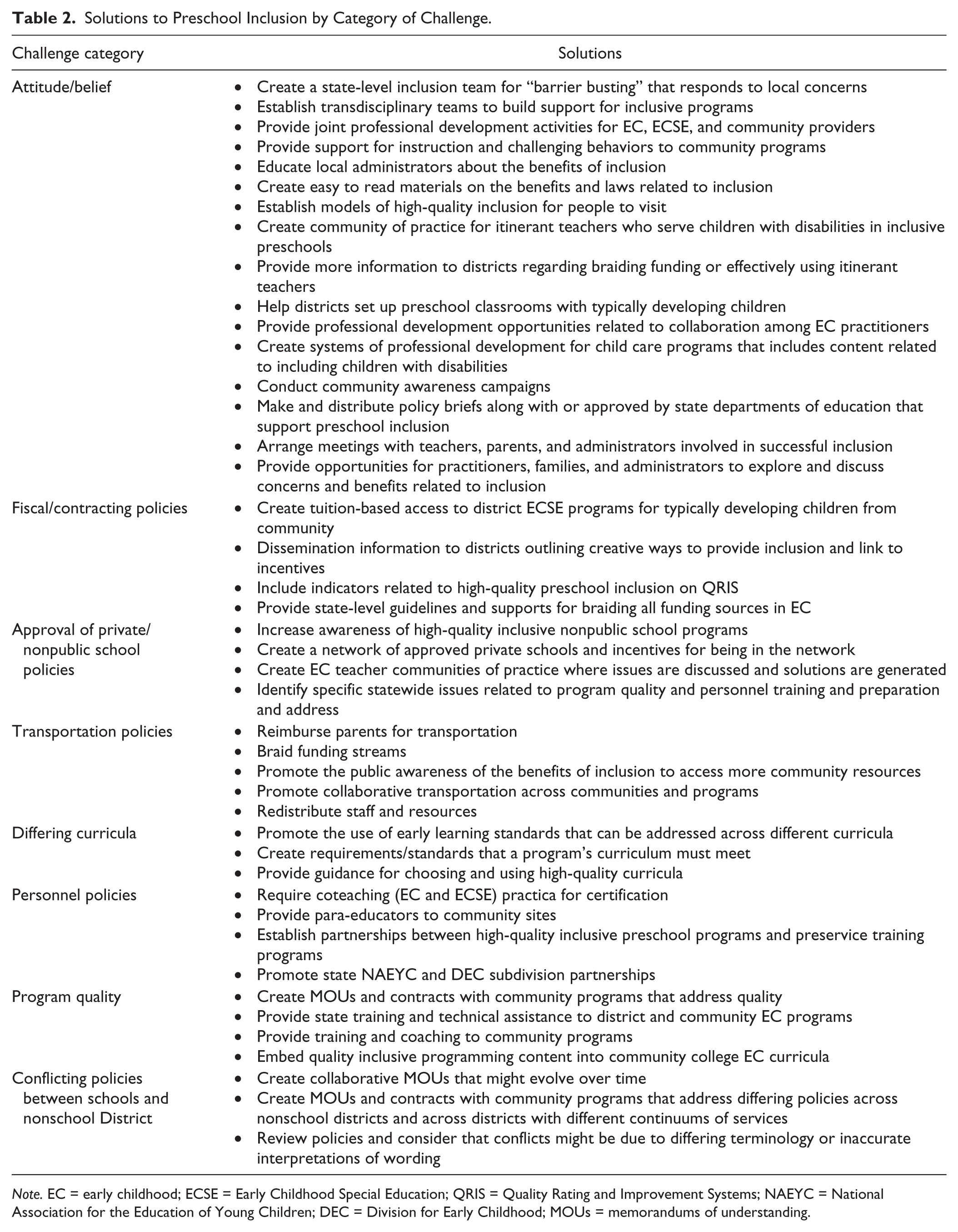
Note. EC = early childhood; ECSE = Early Childhood Special Education; QRIS = Quality Rating and Improvement Systems; NAEYC = National Association for the Education of Young Children; DEC = Division for Early Childhood; MOUs = memorandums of understanding.
Recommendation 1: Identify and Leverage Current Resources
In the first chapter of Guralnick’s (2001) text, Early Childhood Inclusion: A Focus on Change, he described how changes to the law were often the catalyst for changing and improving the education of children with disabilities. Although considerable progress has been achieved through these changes, change is hard and inclusive preschool environments remain elusive for many children. A critical avenue for initiating and sustaining change is to identify current strengths and resources. There are many relevant and useful resources that should be leveraged to support preschool inclusion. First and foremost, the DEC and NAEYC (2009) position statement on inclusion offered a useful framework for defining high-quality inclusion. Second, the ECTA (http://ectacenter.org) is a critically important resource regarding information to support preschool inclusion. Their website includes multiple exemplars of high-quality inclusion across states, fact sheets, and additional resources on general inclusive practices federal laws, financing strategies, and research. Finally, the revised DEC (2014) recommended practices can and should be used to support preschool inclusion and are related to improved outcomes for young children with disabilities.
Recommendation 2: Support Ongoing Research
A primary endeavor in the education sciences has been to use science to identify evidence-based practices related to improved student outcomes. The research on preschool inclusion is clear—High-quality inclusive settings are beneficial (Strain & Bovey, 2011), with positive outcomes likely to accrue for children with and without disabilities. However, researchers should continue to examine the impact of preschool inclusion, perhaps specifically focused on ecological and sociological outcomes. More research is needed related to effective inclusive practices and successful dissemination and implementation of these practices. For example, additional research is needed examining the causal impact of inclusive programming on young children’s development and learning. This will be important for understanding effective characteristics, critical components, and ideal compositions of preschool inclusion.
Furthermore, a documented and significant gap remains between research and practice in EI/ECSE (Hebbeler, Spiker, & Kahn, 2012; Odom, 2009), which is true for preschool inclusion. The next generation of research should focus on identifying evidence-based intervention practices related to improving outcomes for young children with disabilities and identifying evidence-based implementation practices that support intervention agents (e.g., teachers, caregivers) in the use of these practices. Likewise, additional research is needed regarding effective interdisciplinary preservice and in-service personnel preparation. A well-prepared and supported interdisciplinary workforce is perhaps the most critical factor for creating high-quality, inclusion early learning environments (Stayton, 2015).
Recommendation 3: Use an Implementation Science Framework
Fixsen, Blase, Horner, and Sugai (2009) have promoted implementation science as the mechanism for minimizing the research-to-practice gap. While previous efforts have focused on the “what” (i.e., preschool inclusion practices and policies), implementation science explores the “how” (i.e., the practices needed to implement the “what”). Implementation science suggests that there are particular leadership and organization supports that promote the sustained implementation of effective practices. For example, administrators might create work groups to focus on identifying local policy barriers to inclusion, community stakeholders might initiate a public awareness campaign focused on addressing attitude and belief challenges to inclusion, and state special education directors might establish short- and long-term goals related to inclusion. In fact, Purcell, Horn, and Palmer (2007) identified having and utilizing key personnel and a shared vision as critical factors in initiating preschool inclusion. Organizational supports also are needed to foster an environment that supports quality preschool inclusion and allow administrators to focus on identifying challenges to preschool inclusion within their programs and supporting solutions. For example, coaching and supervision should focus on supporting practitioner use of Recommended Practices (DEC, 2014), universal design, collaboration among colleagues, and data-based decision making. Furthermore, the EC professional development research supports ongoing coaching with feedback as critical for sustaining implementation of intervention practices (Snyder, Hemmeter, & McLaughlin, 2011; Snyder et al., 2012).
Leadership and organizational practices should be coherently integrated and focused on practices and attitudes that support quality preschool inclusion to maximize their impact. For example, NAEYC and DEC are currently working to align their respective personnel standards. The intent of these alignments is to support inclusive and interdisciplinary services in EC (Stayton, 2015). They will be available to guide the content of both preservice and in-service professional development. Clearly, past efforts in policy, research, dissemination, technical assistance, and personnel preparation have not resulted in large increases in preschool inclusion. The implementation science framework promotes activities that provide practitioners with effective professional development, administrators with tools to guide the development and use of data systems and create facilitative policies, and organizations the means to change the attitudes, beliefs, and overall culture to support preschool inclusion.
Conclusion
IDEA, the federal law governing special education and related services for young children with disabilities, has a clear preference for inclusive service delivery. The national EC professional associations, DEC and NAEYC (2009), have established a clear inclusion goal and vision for the field and are working toward aligning their personnel standards to support their goal and vision. The field has substantial and convincing research evidence that preschool inclusion, when conducted in a high-quality manner as defined in the research studies, is beneficial for children with and without disabilities. Strain, McGee, and Kohler (2001) outlined the myths associated with inclusion for young children with autism, which apply to all children with disabilities. The myth that is perhaps most detrimental is that inclusion is easy. Implementing high-quality preschool inclusion is not easy. Preschool inclusion requires broadscale efforts and changes across multiple facets of an already complicated EC landscape. Diane Bricker’s (1995) words from two decades ago are relevant here today: “Considerable thought and planning are required to ensure that integration efforts are successful for children, parents, teachers, and the larger community” (pp. 180–181). However, today, in 2015, we have more resources, research, policies, and professional support for preschool inclusion than ever before. It is time to collaborate across systems, districts, and states to enact preschool inclusion and promote the success of all children.
Footnotes
Declaration of Conflicting Interests
The author(s) declared the following potential conflicts of interest with respect to the research, authorship, and/or publication of this article: The authors receive royalties for a book on the same topic.
Funding
The author(s) received no financial support for the research, authorship, and/or publication of this article.