




Abstract
Children with autism spectrum disorder (ASD) are often delayed in acquiring social initiation skills utilized during common early childhood activities. A multiple probe design was utilized to assess the efficacy of a shared book reading intervention to increase the independent commenting of three young children with ASD. The intervention resulted in participant’s acquisition of social commenting in the form of independent pointing and verbal commenting to gain social attention from an adult. The results suggest that young children with ASD can independently initiate social interactions during shared book reading when these behaviors are systematically taught and reinforced. Implications for practice and directions for future research aimed toward generalization and improving the implementation of shared book reading interventions are discussed.
Autism spectrum disorder (ASD) affects one in 59 children in the United States and is characterized by core deficits in social communication, restricted interests, and repetitive behaviors (American Psychiatric Association, 2013; Baio et al., 2018). Young children with ASD demonstrate delays in early social skills, such as responding to and initiating interactions with others (Freeden & Koegel, 2006). Over time, these delays can create a negative cycle whereby children with ASD experience reduced levels of social interactions with others, therefore, limiting opportunities to learn social interaction, which further impacts their social deficits (Tsatsanis & Powell, 2014).
Social interaction behaviors enable children to share in a joint experience in both verbal and nonverbal ways (e.g., commenting and gesturing). Yet, social interaction skills are complex and especially difficult for children with ASD as many display inadequacies in most behaviors required for social interaction, including verbal commenting and pointing (Freeden & Koegel, 2006) and a tendency to only use speech or gestures to make requests (Schreibman, 2005). To address core social deficits associated with ASD, children must be explicitly taught to engage in reciprocal social interactions.
Social communicative interventions for young children with ASD have recently emphasized naturalistic approaches that employ developmental and behavioral principles to support instruction in the context of natural routines involving interactive and meaningful exchanges with a partner (Schreibman et al., 2015). Embedding instruction into activities that are socially engaging for the child can facilitate learning and generalization of skills. In addition, these naturalistic developmental behavioral approaches share many similarities with early childhood educational strategies such as balanced turns, which might increase their feasibility for use in early childhood settings.
Shared book reading is a well-known evidence-based practice for young children with and without disabilities (National Early Literacy Panel [NELP], 2009). The following improvements have been well documented when young children are exposed to shared book reading: language development and comprehension, print concepts, vocabulary, and varied talk about books (Cunningham & Sebulsky, 2011; Pentimonti & Justice, 2010). As language skills (e.g., oral language) are predictors of future reading comprehension for children with and without ASD (NELP, 2009; Nation, Clarke, Wright, & Williams, 2006), shared reading is a practice encouraged for all young children to improve literacy skills (Zucker, Cabell, Justice, Pentimonti, & Kaderavek, 2013). In addition, when young children are interested and engaged in shared book reading through high quality adult interaction strategies, their literacy skill development is positively affected (Hutton et al., 2017; Whitehurst & Lonigan, 1998).
During shared book reading, children experience interactive exchanges with a partner while learning early literacy skills. A goal of early shared book reading is to generate a balanced exchange between the adult and child where the adult is not primarily directing the child but the child is participating equally in the interaction to increase engagement and interest (Kaderavek & Rabidoux, 2004). As such, shared reading creates opportunities for children to respond to and initiate social interactions with others while providing extensive reading experiences. For children with ASD who experience difficulty sharing experiences with others, specific supports to encourage engagement and social interaction during shared book reading are needed.
Although shared book reading has received relatively little attention in ASD intervention research, some investigators have found success in teaching social interaction during the context of book reading (Fleury & Schwartz, 2017; Mucchetti, 2013; Whalon, Martinez, Shannon, Butcher, & Hanline, 2015). For example, Mucchetti (2013) used modifications and visual supports to teach children with ASD and significant intellectual disabilities to respond to comprehension questions. Researchers modified both the text and appearance of the book by adding three-dimensional objects from the story to the physical pages, and found that children could respond to instructor questions, both verbally and nonverbally, following the intervention. The results showed that children with ASD and significant intellectual disabilities could engage in shared book reading and experience social interaction. However, researchers only measured social responding and not initiating.
Whalon et al. (2015) expanded Mucchetti’s (2013) study by examining the effects of an adapted dialogic reading approach on children’s initiations and responses to questions during shared book reading. Researchers incorporated prompts and visual supports in an attempt to increase spontaneous responding to comprehension questions. Three of the four participants displayed a gradual increase in spontaneous responses to comprehension questions, which was the primary target of instructional procedures. However, only two of the participants demonstrated a clear increase in initiations.
In a recent study, extending previous dialogic reading intervention research, Fleury and Schwartz (2017) measured the levels of verbal participation and vocabulary growth in nine young children with ASD. The dependent measures of interest included responses to adult questions and independent verbal initiations in which the child asked their own question or made a comment related to the book. Researchers reported improved frequency of responses to questions during shared book reading along with increased vocabulary knowledge after repeated readings. However, independent verbal initiations in the form of comments or questions by children did not increase.
Although shared book reading shows promise as an effective practice to teach children with ASD to socially interact under natural contexts, previous research has emphasized responding to initiations of others as opposed to initiating interactions with others (Fleury & Schwartz, 2017; Mucchetti, 2013; Whalon et al., 2015). Mucchetti taught children to respond to questions only but did not measure initiations. Whalon and colleagues measured initiations, but only provided an opportunity for the child to initiate on three occasions while reading a book, wherein the researcher paused and looked expectantly at the child for 3 to 5 s. They did not incorporate procedures to systematically teach initiations, which might explain the variability in initiations across participants. A similar issue may explain the absence of initiations among participants in the Fleury and Schwartz investigation. Because initiations that are purely social in nature (i.e., do not involve obtaining preferred items) are a characteristic deficit of ASD, it is particularly important to identify methods that occasion social initiations during naturalistic interventions (Freeden & Koegel, 2006).
Shared book reading is a developmentally appropriate and evidence-based practice used in early childhood settings. As a result, many children with ASD who access early childhood environments may be exposed to shared book reading experiences. Shared book reading has potential to create social interaction opportunities for children with ASD, though there is limited research examining optimal methods for occasioning social interaction, particularly initiations, during shared book reading with children with ASD. To increase rates of gestural and verbal initiations of young children with ASD during shared book experiences, interventions that teach children to comment on or ask questions about the book are needed.
The present research study sought to extend the literature on shared book reading with young children with ASD by focusing on teaching verbal initiations with a pointing gesture centered on a shared book. Specifically, this research aimed to (a) assess efficacy of teaching independent verbal initiations in the form of a comment along with a pointing gesture using behavior modification techniques in the context of shared book experiences, (b) assess the generalization effects of training to novel books, (c) track participant’s verbal responses to researcher initiations, and (d) determine the social validity of teaching independent initiations during shared book experiences to young children with ASD.
Method
Participants and Settings
Three children who attended an early intensive behavior intervention (EIBI) program housed within a child development laboratory preschool at a Midwestern University were recruited based on the following criteria: (a) diagnosis of ASD, (b) interest in books per teacher report, (c) ability to engage in an activity with an adult for at least 10 min with reinforcement, and (d) ability to use two to three words to communicate. The participants were admitted to the EIBI program based on an outside diagnosis of ASD made at age 3 years by an independent psychologist using the Autism Diagnostic Observation Schedule (ADOS; Lord et al., 2000). All participants had received 3 to 6 months of in home applied behavior analysis (ABA) therapy prior to entering the EIBI classroom. According to results of the Verbal Behavior Milestone Assessment and Placement Program (VB-MAPP; Sundberg, 2008), all three participants with ASD demonstrated generalized imitation, could imitate vocal speech, and answer simple questions.
Participants spent approximately 4.5 hr per day in an intensive ABA classroom, and 3 hr in an inclusive preschool classroom with typically developing 4-year-old children. All participants’ baseline probes, intervention, mastery probes, and generalization probes were conducted in a research room next door to the child’s EIBI classroom. The room contained a couch, a large chair, and a child size wooden table with two chairs. Children were asked where they wanted to sit to read at the beginning of each session.
Steven was 4 years old at the time of the study. He regularly chose to look at books in his free time, was interested in letters, and could read some environmental print and sight words. As evidenced by his VB-MAPP, he did not engage in reciprocal social language with peers and was dependent on prompts to interact with adults. Steven spoke in a soft voice and had limited functional language. Steven communicated with others primarily by requesting when prompted, or in the form of echolalia (e.g., scripts from shows and movies) and memorized labels of objects and images. During play or unstructured activities, Steven was not observed to engage in any unprompted verbal social communication directed toward adults or peers.
Liam was 4 years old at the time of the study. He did not choose books as a free time activity and prereading skills consisted of manipulating a book functionally. Liam could not label letters or letter sounds receptively or expressively. Liam’s VB-MAPP provided evidence that Liam depended on adult prompting to speak. He showed interest in adult attention and was able to make verbal requests for desired items using up to three-word phrases (e.g., I want play-doh). During play or unstructured activities, Liam did not engage in unprompted verbal social communication with adults or peers.
Elwin was 5 years old at the time of the study. He enjoyed books and could read some simple sight words he had memorized from flash cards. Elwin’s VB-MAPP data indicated prompt dependence and a barrier to generalize skills. Elwin engaged in high levels of motor and vocal stereotypy, which interfered with engagement in therapeutic and educational activities. Elwin sometimes engaged in inappropriate verbal stereotypy, which hindered verbal participation in therapist-led activities, and he was rarely observed to engage in any unprompted verbal or nonverbal social communication toward adults and peers.
Materials
Books from a well-known, developmentally appropriate children’s series for preschoolers were utilized for baseline, intervention, and mastery probes (see Table 1). Criteria for the books were adapted from Whalon and colleagues (2015) and included the following: (a) pictures that illustrated story content and depicted more than one object in each picture, (b) books that were similar in length (all books were 12 pages), and (c) books that were age-appropriate. Light yellow Post-it™ notes were used (one per page) to cover an image during intervention. The use of visuals to prompt interactions was also based on previous shared reading interventions for young children with ASD (Mucchetti, 2013; Whalon et al., 2015). All sessions were filmed using a GoPro HERO4™.
Book Titles by Participant and Condition.
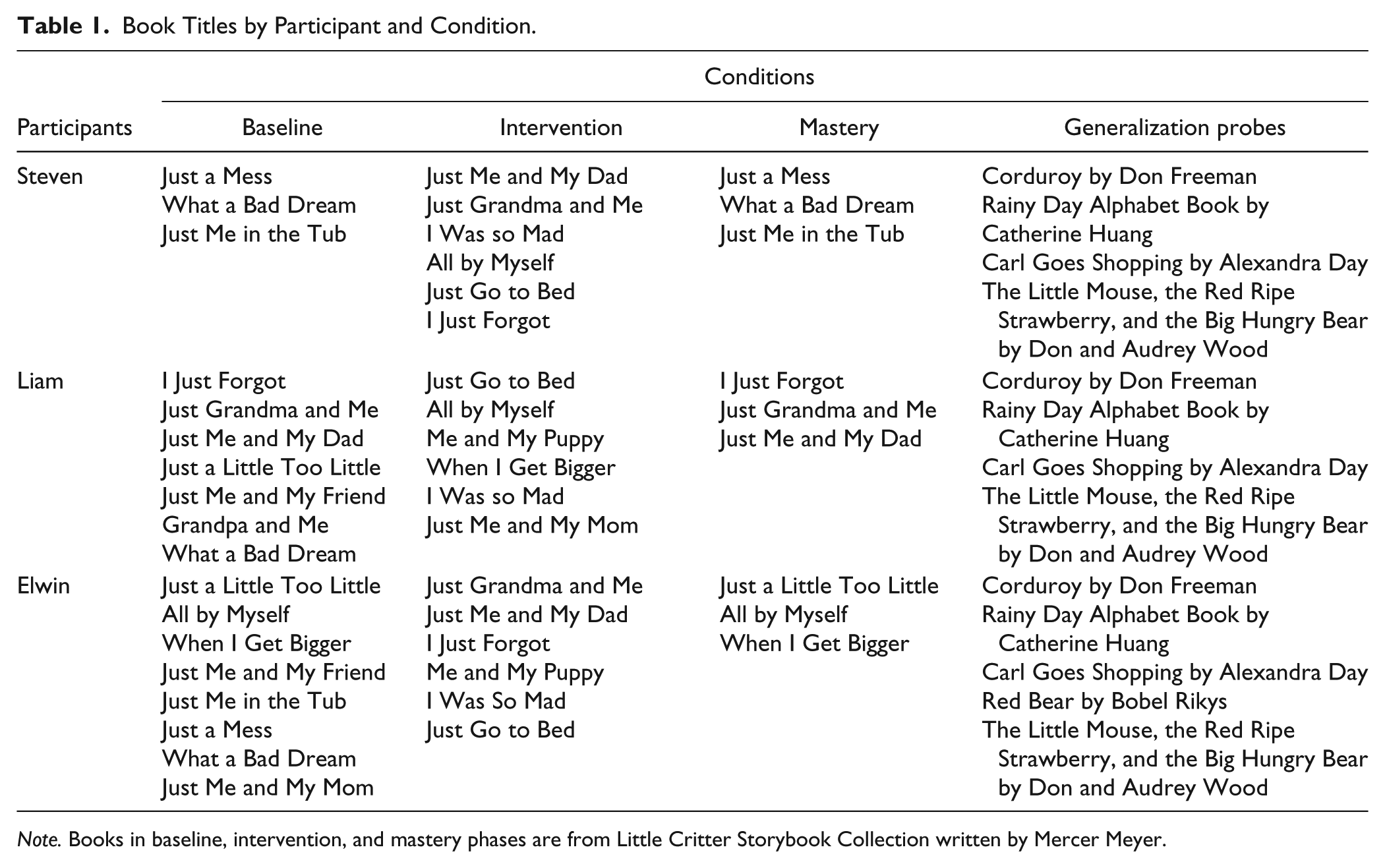
Note. Books in baseline, intervention, and mastery phases are from Little Critter Storybook Collection written by Mercer Meyer.
Token boards were used with all children during the intervention phase only. Token boards made from a strip of paper divided into 10 equal blocks with Velcro™ squares and accompanying plastic gold coins. Each child also chose a reinforcer (i.e., edible or tangible) to exchange for tokens. Reinforcers were chosen from the EIBI classroom from the individual child’s cart, which held reinforcing items and other materials determined to be preferred through ongoing preference assessment. The token board system was a reinforcement strategy all of the participants had been exposed to before intervention.
Experimental Design
A multiple probe across participants design (Horner & Baer, 1978) was used to assess the effects of teaching children to initiate and respond during shared book reading with a social partner. During a multiple probe design across participants, the researcher conducts consecutive and intermittent probes of the dependent variable in the baseline phase (Gast & Ledford, 2014). This design allows for demonstration of experimental control without the need to collect continuous baseline data as is true for a multiple baseline across participants design.
In the present investigation, the researcher staggered implementation of initiation training during shared book reading across participants. The study consisted of three phases: (a) baseline probes, (b) intervention, and (c) mastery probes. Baseline probes were conducted for all three participants. Once participants demonstrated stability in trend and level for the dependent variable, the independent variable was introduced to the first participant. During this time, the remaining children were assessed under baseline probe conditions. When the first participant demonstrated an increasing trend of initiations, the experimenter administered a baseline probe to the second participant to confirm stable responding, and then introduced the independent variable. This was repeated for the third participant. Mastery probes were conducted using the same three initial books from baseline probes for each child and occurred at the conclusion of each participant’s intervention phase. A generalization probe was conducted for each participant once during baseline probes, twice during intervention and once during mastery probes.
Dependent Measures
The primary dependent variable was social initiations in the form of commenting about the book. Independently initiated comments were defined as the child using a protodeclarative point accompanied by a contextually appropriate comment about the picture (e.g., “Wearing a helmet.”)—approximations were accepted (e.g., “Airing emet.”). Contextually appropriate comments included labeling character actions (e.g., “Fell down!”), labeling character feelings (e.g., “He’s scared.”), or describing the character (e.g., “He’s all wet!”). Independent commenting was scored if the comment occurred along with a point. Specifically, independent comments consisted of the child lifting the Post-it™, pointing to the image, and commenting. Independent comments were not scored if the vocalization was (a) not paired with a point, (b) not contextually appropriate (i.e., comment had nothing to do with the book image pointed to), (c) was a single-word object label (e.g., “Firetruck!”), or (d) was preceded by a prompt to lift the Post-it™.
The secondary dependent variable was verbal responses to social initiations. These were defined as the child looking in the direction of the researcher and making an appropriate verbalization (e.g., “It’s a mess” or “Lots of stars”), when the researcher pointed to an image in the book and made a directive statement (e.g., “Look” or “Wow”). A response was recorded as correct if the child made a contextually appropriate comment. Appropriate responses were defined similar to initiated comments, except that they occurred in response to the instructor’s point and directive statement (e.g., “Look” or “Wow”). Responses were not recorded if they were (a) not contextually appropriate (i.e., comment had nothing to do with the book image pointed to), (b) were followed by a prompt (e.g., the child was provided a verbal model to comment), or (c) were a single-word object label (e.g., “Star!”).
Each session was videotaped and uploaded to a secure network the same day. The first author coded 100% of the videos. All observers used the open-source video coding software Datavyu (see www.datavyu.com) to view and create records of the specific time behavior was observed and the specific behavior observed. The data were exported into excel (Microsoft®Excel for Mac, Version 16.10) to graph the occurrence of initiated comments and responses to initiations during each session.
Interobserver agreement (IOA)
A second observer coded 33% of all sessions, randomly selected and evenly distributed across participants and conditions to assess IOA. The second observer was a graduate student with prior training on behavioral data collection. The first author provided the second observer with training specific to coding dependent measures in the present investigation until the observer demonstrated 90% agreement with the first author on training videos.
IOA was calculated using a point-by-point agreement formula for number of initiated comments and responses. An event was scored as an agreement if both observers coded the same response within a 1- to 3-s period. An event was scored as a disagreement if there was no agreement on either the time behavior occurred or the type of behavior. IOA was calculated by dividing the total agreement by the sum of agreements and disagreements and multiplying by 100 to convert the result into a percentage. For Steven, IOA across phases was 99% (range = 92%–100%) for independent commenting and 98% (range = 92%–100%) for independent responses. IOA for Elwin’s frequency of independent commenting was 98% (range = 92%–100%) and 99% (range = 92%–100%) for independent responses across phases. For Liam, IOA for independent commenting was 98% (range = 83%–100%) and 96% (range = 83%–100%) for independent responses across phases.
Procedure
The researcher contrived 12 trials to initiate comments and 12 trials to respond to comments, one of each for each page of the book. The presentation of Post-it™ notes on each page provided a clear antecedent for child-initiated commenting and adult initiations served as the antecedent for child responding. Consequences for the target behavior included social attention and token reinforcers.
Baseline probes
Books were randomly assigned from the series and each participant was assigned a different book for each baseline probe (see Table 1). During baseline probes, the researcher sat next to the child, held the book in front of the child, read the title of the book, and opened to the first page in the book. Each page in the book contained either an opportunity for the child to comment or to respond. One page of a book was defined as all of the images on the right and left side of the spine in an open book. A commenting trial began when the researcher turned to a new page and looked at the child expectantly for 5 s. The trial ended when the child commented or following the 5-s delay. If the child initiated by pointing to an image and vocally describing it, the researcher praised the child by providing specific feedback. A social response trial followed the initiation trial and began when the researcher pointed at a picture in the book and said, “Look!” or “Wow!” then looked to the child expectantly for 5 s. If the child independently responded within 5 s, verbal praise was provided in the form of specific feedback. After both trials were presented, the researcher read the text then turned the page. A total of 12 commenting trials and 12 response trials were presented during each session. No other instructional procedures (i.e., prompting), visuals, or tangible or edible reinforcement were used during baseline probes.
Intervention
During intervention, children were randomly assigned six books of the same series in a random number order, which did not include any of the same books as read in baseline probes (see Table 1). One Post-it™ note was used to cover an image on each page of the book, which totaled 12. The researcher followed the procedures for baseline probes by sitting next to the child, placing the book in front of the child, reading the title, opening to the first page, reading the text on the page, and looking expectantly at the child.
Two main forms of prompting were used during intervention, which included least to most prompting hierarchy for lifting Post-it™ notes and for pointing to the picture, and a verbal model for commenting. When books were repeated during intervention conditions, the same verbal prompts were given across children. If the child gave a different but related contextually appropriate comment before or after an adult prompt, the child’s comment was scored as correct if the vocalization occurred before the prompt and scored as prompted correct following an adult prompt.
For initiating comments, a least to most prompting hierarchy was used for lifting Post-it™ notes and for pointing to the picture. If the child did not independently lift the note after 3 s of having turned the page, the researcher first pointed to the note. If no response occurred, the researcher tapped the child’s elbow. If still no response, the researcher moved to a hand over hand prompt. The same least to most prompting hierarchy was used for pointing to the image. For commenting, the child was given 5 s to respond independently. All independent correct initiations during each of the 12 trials were reinforced with verbal praise, researcher elaboration (e.g., “You’re right, he is making a mess! That is funny!”), and a token. If the child did not respond during the 5 s, the researcher modeled a correct response to the child. Immediately following the model, the researcher closed the flap and opened again to allow the child to repeat the vocalizations with the point. Verbal praise was delivered following all prompted correct initiations.
Following each response trial, the researcher pointed to a separate image on the opposite page not covered by a Post-it™ note and used an attention getting word or phrase (e.g., “Look,” “Wow,” “Oh no”) then looked to the child expectantly. All independent responses occurring within 5 s of the researcher’s initiation were reinforced with verbal praise, researcher elaboration, and a token. If the child gave no verbal response after 5 s, the adult modeled a correct response by commenting on the image. Verbal praise was delivered if the child repeated the researchers’ vocal model. The researcher then read the text and turned the page to start subsequent commenting and response trials. This process continued until the child observed all pages in the book and received all 24 trials of initiated commenting and responding. The criteria for mastery during intervention was one instance of 12 out of 12 trials of independent commenting to ensure that the child consistently performed the behavior.
A differential reinforcement of a lower rate of vocal or motor stereotypy (DRL) procedure was added to the intervention for Elwin to address high rates of vocal and motor stereotypy. The procedure had been used throughout his entire therapy day by his behavioral technician prior to beginning the study, and we administered the DRL beginning with the eighth intervention session. Upon introduction of the DRL, at the beginning of the book reading session, the researcher presented Elwin with two rules to follow during the reading session: “work fast” and “talk like a big boy.” A timer was then set for 10 min. The researcher marked an “X” on a piece of paper if Elwin engaged in vocal or motor stereotypy at any time during the session. If Elwin received fewer than three “X” marks, he could access preferred items following the session. If he engaged in three or more instances of stereotypy, he completed a work task following the shared book reading session.
Generalization probes
Generalization probes were conducted during each phase of the study. One generalization probe occurred after the third session of baseline probes for each child. At least two generalization probes were administered to each child during intervention, and a final generalization probe occurred after the third and final mastery probe. Each generalization book was a novel book outside of the series used for baseline probes, intervention, and mastery probes (see Table 1). The classroom teacher and researcher believed the book to be new to the child. Generalization probes mimicked baseline probe procedures (i.e., no Post-it™ notes or tangible reinforcer). Generalization probe book titles were the same for each child at the same point in each phase and each included 12 commenting and response opportunities.
Mastery probes
Mastery probes were identical to baseline probes. Mastery probes used the same initial three books read during the baseline probes, which were never used during intervention. Each book varied per child due to random assignment (see Table 1).
Procedural Fidelity
The same independent observer who collected IOA also scored procedural fidelity by viewing session videos using a procedural reliability checklist created by the first author. The independent observer was trained to 90% reliability with the first author. The independent observer scored 33% of randomly selected videos from each condition across all participants.
For baseline probes, generalization probes and mastery probes, the checklist consisted of the following steps initiated by the researcher: (a) read the title of the book to the child, (b) opened to the first page and waited 5 s while looking expectantly at the child, (c) acknowledged that the child initiated by pointing to an image and vocally described it by saying “Yes, it is broken” (d) used an attention getting word or phrase (e.g., “Look,” “Oh no,” “Wow,” “Uh oh”) while pointing to an image on the open page, (e) waited 5 s while looking expectantly at the child, (f) praised the child by providing specific feedback if child vocally responded with an accurate comment regarding the image pointed to, or moved to Step g if incorrect or no response, (g) read the text and turned page, and (h) repeated Steps b through g for the remaining pages in the book.
For intervention sessions, the checklist consisted of the following steps initiated by the researcher: (a) read the title of the book to the child, (b) opened to the first page and waited 5 s while looking expectantly at the child, (c) praised the child by providing specific feedback and delivered a token if the child initiated by lifting the flap and pointing to an image while vocally describing it, (d) provided a gestural prompt with a verbal model if the child did not lift the flap or comment, (e) used an attention getting word or phrase (e.g., “Look,” “Wow,” “Uh oh”) while pointing to an image on the open page, (f) waited 5 s while looking expectantly at the child, (g) praised the child by providing specific feedback and delivered a token if child vocally responded with an accurate vocalization regarding the image pointed to, or if no response or incorrect response, moved on to Step h, (h) read the text and turned page, and (i) repeated Steps b through h for the remaining pages in the book.
The percentage of correct implementation was calculated by dividing the total number of steps performed correctly by total checklist steps and multiplying by 100. The mean percentage of steps implemented correctly was 100% during baseline probes and 86% (range = 83%–100%) during intervention. Low scores for intervention implementation were due to consistent errors in wait time by the researcher, which varied between 1 and 3 s below or above the 5 s procedure for wait time. For generalization probes, mean procedural fidelity was 100%, and 100% for mastery probes.
Social Validity
The researchers sent an online survey to preschool general education teachers and early childhood special education teachers employed by public schools or by a state funded grant that services 4-year-old children and their families within local districts. The online survey included videos of the shared reading intervention and questions about the intervention. Respondents observed one video montage with clips labeled from each phase (i.e., before intervention, during intervention, and after intervention). After viewing the clip, educators responded to nine questions using a 7-point Likert-type scale with seven indicating a rating of strong agreement and one a rating of strong disagreement.
The nine statements were as follows: (a) “In my opinion, the child seems to enjoy this form of learning to initiate and respond to joint attention bids during shared book experiences,” (b) “I believe this child is experiencing discomfort with this teaching procedure,” (c) “I believe this teaching procedure is likely to result in permanent improvement for this child,” (d) “This seems like a good use of this child’s time,” (e) “I believe teaching this child to initiate and respond during shared book reading is helpful to them,” (f) “The child is engaging in developmentally appropriate joint attention behaviors,” (g) “This type of teaching would fit well in my classroom,” (h) “I am likely to use this teaching approach with a child who does not engage in initiation behaviors during shared book reading,” and (i) “I believe I could teach an assistant in my classroom to implement this intervention.”
Results
Initiated Comments
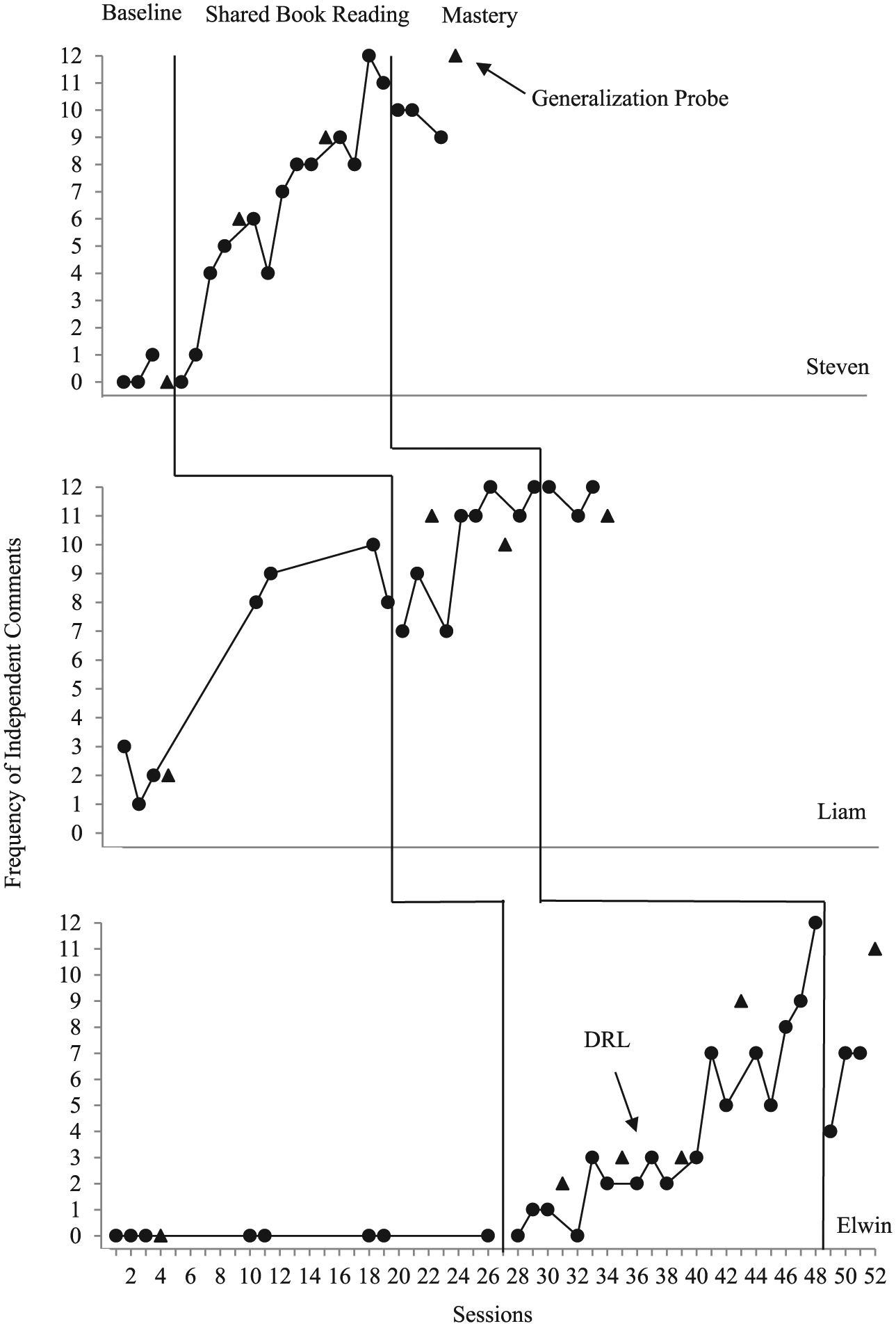
Figure 1 depicts the frequency of initiated comments by Steven, Liam, and Elwin during baseline, intervention, mastery conditions, and generalization probes. A functional relation was observed between shared book reading and frequency of initiated commenting for all participants. That is, when the shared book reading intervention was introduced, frequency of commenting increased for all participants and commenting maintained when the intervention was removed. All participants also demonstrated generalization of commenting to novel books.

Number of independent comments during baseline, intervention, mastery, and generalization probes across participants.
Steven did not demonstrate commenting during baseline probes. During intervention, the frequency of initiated comments follows an increasing trend from baseline. Change in level of commenting is evident from baseline to intervention; Steven met mastery criteria (i.e., 100% once) on the 13th intervention session. In addition, there was only one overlapping data point between intervention and baseline. When the independent variable was removed, frequency of commenting maintained at higher rates than baseline (i.e., 8, 10, and 7 from 0 at baseline). Steven also demonstrated generalization of commenting to novel books where nine comments were observed posttraining compared with one comment during the baseline generalization probe. Visual analysis of generalization probe data also shows an increasing trend from baseline to intervention to mastery.
Liam demonstrated variability in responding during baseline (range = 0–6) with two consecutive ascending points followed by two consecutive descending points. During intervention, an increasing trend in initiated comments is observed from baseline. Change in level of commenting is also evident from baseline to intervention; Liam met mastery criteria on the eighth intervention session with no overlap between intervention and baseline probes. During mastery probes, frequency of commenting maintained at higher rates from baseline (i.e., 11, 11, 12 from an average of 2.6 at baseline). Generalization to novel books is also demonstrated from baseline to intervention to mastery where independent commenting increased from zero during baseline to 12 comments posttraining.
Elwin did not demonstrate commenting during baseline probes. During intervention, visual analysis of data demonstrates a delayed effect of the shared book reading intervention where commenting remained at low levels for seven sessions (range = 0–2), a total of five overlapping points from baseline. During intervention, Elwin was observed to engage in high frequency of vocal stereotypic behavior that was hypothesized to interfere with treatment. Therefore, a DRL procedure was applied on the eighth intervention session and was followed by a rapid increase in frequency of commenting. He met mastery criteria on the 17th session of intervention. Change in level of commenting is also evident from baseline to intervention. During mastery probes, Elwin’s frequency of commenting maintained at higher rates from baseline (i.e., 8, 7, 9 from 0 at baseline). Generalization to novel books is also demonstrated from baseline to intervention where frequency of commenting increased from zero during baseline to seven comments posttraining. Commenting generalized and maintained when the DRL was not used.
Responses to Social Initiations
Figure 2 depicts independent verbal responses to adult initiations during baseline probes, intervention, mastery, and generalization probes. A functional relation was not observed between shared book reading and verbal responses to adult initiated social interaction. Steven and Elwin demonstrated an overall increase in verbal responses from baseline probes to intervention and generalization to novel books.
Number of independent responses during baseline, intervention, mastery, and generalization probes across participants.
Steven’s independent verbal responses during baseline were low (i.e., 0, 0, 1). During intervention, visual analysis shows an increasing trend from baseline, and frequency of verbal responses increased to 11 and 12 on the 12th and 13th session, respectively. Upon removal of the independent variable, verbal responses maintained at a frequency of 10, 10, and 9. Verbal responding during generalization probes also demonstrates an increase from zero responses during baseline to six and nine responses during intervention, and 12 verbal responses during the final generalization probe.
Liam’s independent verbal responses during baseline show an increasing trend, which decreases confidence in the presence of a functional relationship between shared book reading and verbal responses. This trend continued into intervention, and mastery criteria was met on the sixth session. Mastery probes indicate a high frequency of verbal responses. Generalization probes for verbal responses increased from two during baseline probes to 11 and 10 responses during intervention, and 11 independent verbal responses during the final generalization probe session.
Elwin demonstrated no verbal responses during baseline probes and a delayed effect in verbal responses during intervention (i.e., three verbal responses or below). Upon introduction of the DRL, an increasing pattern is observed for verbal responses, where verbal responses increased to 12 after 17 sessions though they did not maintain at this frequency during mastery probes (i.e., 4, 7, 7). Generalization probes for verbal responses demonstrate an increasing trend with zero responses during baseline probes to two, three, and nine independent responses during intervention, and 11 independent responses during the final generalization probe.
Social Validity Results
Ten teachers anonymously responded to the questionnaire. Teachers reported that the child seemed to enjoy this form of learning (M = 6.7) and did not believe the child was experiencing discomfort (M = 1.9). Teachers believed that the teaching procedure is likely to result in permanent improvement (M = 6.3) and agreed that this was a good use of the child’s time (M = 6.2). They believed that teaching the child to initiate and respond during shared book reading was helpful to them (M = 6.8). Teachers agreed that the child was engaging in developmentally appropriate social interaction behaviors (M = 6.3). The teachers reported that this type of teaching fit well in their classroom (M = 6.2) and reported they were likely to use this teaching approach (M = 6.2). In addition, teachers strongly agreed (M = 6.2) that they could teach an assistant in their classroom to implement the intervention.
Discussion
The purpose of the current study was to assess the efficacy of teaching social initiations, specifically commenting in the context of shared book reading. We also assessed generalization in the presence of novel books. The findings suggest that the young children with ASD who participated in the present investigation can be taught to initiate comments during shared book reading. However, only two children acquired independent responding as a result of the shared book reading intervention. The current study extends existing literature on the benefits of shared book reading by documenting a procedure that leads to independent commenting as well as responding.
This study contributes to the field of naturalistic developmental behavioral approaches (Schreibman et al., 2015) for children with ASD by introducing a procedure to enhance shared reading practices to increase the child’s independent social initiations in the form of commenting. Specifically, the present investigation extends the work of Whalon and colleagues (2015) and Fleury and Schwartz (2017), who taught social responding during shared book reading and also measured initiations. Conversely, the present study explicitly taught children to initiate comments, which might be why our participants acquired initiations when participants in other studies only acquired responses.
The present study suggests shared book reading can be enhanced for children with ASD by incorporating tactics that occasion and teach commenting, such as creating curiosity by covering pictures, combining gestural and vocal behaviors, and modeling the target response. The current investigation was informed by and expands prior research that modified books to occasion responding during adapted shared reading (Mucchetti, 2013). Instead of adding small tactile objects to the book as used in Mucchetti’s study, Post-it™ notes were utilized to increase child engagement during shared reading. Participants in the present study all touched and lifted the flaps covering images, which might have helped direct their attention to relevant stimuli. It is also possible that covering images increased participants’ motivation to see what was behind the flap and thereby increase overall participation in the activity. Adaptations to books give children with ASD, who demonstrate atypical attention skills, the opportunity to participate and interact during the shared reading experience by providing a visual cue to gain or direct their attention (Patten & Watson, 2011).
It is noteworthy that two participants reliably demonstrated social responses during the shared book reading intervention. All three participants’ average number of responses increased throughout the intervention phase, generalization probes, and remained at higher than baseline levels during mastery-probe sessions. Yet, it cannot be determined that changes in responses were a result of participating in the intervention alone due to one participant demonstrating an increase in responses during baseline. Nonetheless, these findings align with other shared book reading studies where children responded to social partners at higher rates before they independently initiated (e.g., Fleury & Schwartz, 2017; Whalon et al., 2015). If these outcomes can be replicated, the procedure offers an efficient approach to teaching multiple social behaviors in the context of shared book reading.
All three participants demonstrated generalization of commenting and responding to books not used during training throughout each phase of the study. This is important as none of the materials used during training (i.e., Post-it™ notes, token boards, edible or tangible reinforcement) were present during generalization probes. Furthermore, during mastery-probe sessions, participants engaged in commenting and responding independently when the same books were presented in the same manner as the initial three baseline probes. This further demonstrates that commenting behaviors generalized and were present at high levels in books where zero independent comments occurred per participant prior to the intervention. This result was promising as children with ASD tend to become dependent on adult prompting (Clark & Green, 2014) and experience challenges making independent social initiations like commenting (Freeden & Koegel, 2006).
One important component of how independent commenting was measured in the present investigation was the requirement to point along with a vocalization upon seeing stimuli in the book. Although Whalon et al. (2015) counted initiations when children either pointed toward a picture or vocalized, they did not require both components. The procedures for teaching coordinated pointing and commenting in the present investigation increase the likelihood that children’s social initiation behavior may be reinforced and maintained by others, providing the potential for long-term benefits outside of book reading (Schreibman et al., 2015). Teaching children to point and verbalize supports joint attention and complex social interaction skills, which are often absent or delayed among individuals with ASD (e.g., Leekam, López, & Moore, 2000; Sigman, Mundy, Sherman, & Ungerer, 1986). In addition, little research has focused on increasing meaningful gestures with a verbal comment in children with ASD. Some recent interventions have shown success in teaching the use of gestures with results suggesting an effect on the development of other social-communication behaviors like verbal comments (e.g., Whalen, Schreibman, & Ingersoll, 2006; Whalen & Schreibman, 2003), yet the current study uniquely adds to the field of naturalistic behavioral approaches by teaching a meaningful gesture with a verbal comment to children with ASD.
Limitations
Although all participants made gains, there are a few important limitations to the present study. First, Liam displayed an increasing trend in baseline, which can signal potential threats to internal validity. Repeated exposure to the researcher pointing and verbalizing to assess social responses may have influenced this pattern of independent commenting and may have been sufficient for Liam to acquire independent commenting.
Furthermore, the experimenter may have inadvertently modeled the target behavior (e.g., pointing and commenting) for Liam. Although not assessed, Liam may have possessed prerequisite skills associated with an observational learning repertoire, such as joint attention and imitation (MacDonald & Ahearn, 2015; Taylor & DeQuinzio, 2012). In addition, Liam’s Behavior Analyst reported a rapid increase in expressive language at approximately the same time the study began. Although treatment outside the book reading intervention might explain the increase in responses during baseline probes, initiations increased even further upon Liam entering the intervention phase.
Second, Elwin engaged in vocal stereotypy across activities and settings, we utilized a DRL to decrease vocal stereotypy. The use of additional intervention components in some intervention sessions affects the internal validity of the study and the demonstration of experimental control. Elwin demonstrated a slower rate of acquisition of independent commenting compared with Steven and Elwin. Although we cannot say why this occurred, we observed a high level of stereotypic behavior during Elwin’s baseline probes and early intervention sessions, which directly interfered with performing targeted comments and responses. The addition of DRL decreased vocal stereotypy and allowed Elwin to participate in the shared reading experience as a social partner. The implementation of the DRL corresponded with the use of the procedure across all activities as programmed by his Board Certified Behavior Analyst.
Finally, sessions were conducted one to one in a setting outside of the children’s classroom. The likelihood of generalization to different settings may increase if intervention occurred across locations within the children’s natural environment. Also, the same researcher conducted all sessions, which limits opportunities for generalization across implementers. Although participants demonstrated independent commenting when presented with novel books and without the use of prompts and tangible reinforcement, follow-up data were not obtained to evaluate the extent to which the mastered skill was performed with other people and in other settings.
Implications for Practice
The current study has several important implications for practice. First, shared book reading is a developmentally appropriate activity often used in educational settings. With minor additions or adjustments to procedures, educators can create many opportunities for social interaction among children with ASD, which is a critical component of effective treatment for this population. Also, social behaviors can be taught during shared book reading in a relatively short amount of time while utilizing affordable and accessible materials that are likely to be available in numerous settings where young children with ASD receive services (i.e., school, child care, clinics, homes). In addition, early childhood teachers currently working with young children with disabilities found the procedures to be acceptable and feasible. Respondents reported interest in the procedure and noticed clear, positive change regarding the initiation of comments and responses during shared book reading.
Teaching a young child with ASD to initiate with gestures and vocalizations in the context of a book could increase the quality of engagement in social and literacy instructional settings. Children are often read to daily in the settings in which they are cared for. Early care providers, educators, and parents can embed the current study’s procedures into practice, enhancing shared reading experiences and child participation. This can move the activity from adult directed to a partnership where both the adult and child are highly engaged in a naturally occurring shared activity.
Directions for Future Research
Results indicate that young children with ASD can be taught to independently initiate using verbal commenting with a point in the context of shared book reading. The current intervention combines the developmental appropriateness of shared book reading as a natural context to embed behavioral strategies to teach initiation skills to young children with ASD. Combining the current study’s procedures with dialogic reading-based procedures that have been shown to effectively increase responses to questions and vocabulary knowledge (Fleury & Schwartz, 2017; Whalon et al., 2015) have the potential to yield a powerful intervention package for young children with ASD. Future research is needed to test the effectiveness of such a package.
In addition, it is imperative that social interaction skills during shared reading are generalized to the natural environment across various materials, settings, and people. Future research should include training and coaching of educators and parents to implement the intervention across natural settings. Also, future research using a larger sample of children with varying language levels will provide additional information regarding for whom this intervention is most likely to be effective.
Overall, the data suggest that young children with ASD can independently initiate comments with a pointing gesture in the context of shared book reading. Responding and initiation rates were high posttreatment compared with baseline probes, which reveals increased social reciprocity during shared book reading. The current study’s procedures offer a simple approach to administer social and early literacy instruction to children with ASD in a natural context.
Footnotes
Declaration of Conflicting Interests
The author(s) declared no potential conflicts of interest with respect to the research, authorship, and/or publication of this article.
Funding
The author(s) received no financial support for the research, authorship, and/or publication of this article.