



Abstract
While caregiver coaching approaches in early intervention have a comprehensive literature base, the field continues to experience a research-to-practice gap in the implementation of capacity-building coaching approaches. We examined the caregiver coaching divide and identified strategies for researchers and Part C programs to bridge the gap so that all families benefit from a capacity-building approach during this critical developmental period of the child’s life. Using available evidence and implementation science frameworks, we suggest five actionable strategies for research and practice teams.
Despite an increased focus on caregiver coaching in early intervention (EI) research, the field continues to face a significant research-to-practice gap in the implementation of coaching and family capacity-building practices in Part C service delivery (Marturana & Woods, 2012; Odom, 2009; Sawyer & Campbell, 2017). The past 10 years of research in early childhood intervention has demonstrated a consistent, positive relation between caregiver-implemented interventions and child outcomes, particularly for communication and language (Akamoglu & Meadan, 2018; Heidlage et al., 2019). The quantity and quality of early interactions drive neurological organization during the earliest years of a child’s life, and these interactions have a lasting influence on a child’s academic, language, and social outcomes (Romeo et al., 2018).
Both recommended practices and policies in EI align with research to support dyadic interactions in infants and toddlers with disabilities through caregiver coaching. The Division for Early Childhood (DEC, 2014) Recommended Practices include a clear emphasis on supporting caregiver–child interactions in a child’s everyday routines and activities in a family-capacity-building approach. Allied professional organizations like the American Speech-Language-Hearing Association (ASHA, 2016) and American Occupational Therapy Association ([AOTA] “Guidelines for Occupational Therapy,” 2017) have guidelines for EI that support coaching caregivers as an important service delivery model. While challenges abound, the benefits of implementing a caregiver coaching approach are growing and pay dividends in the developmental trajectories of children across the United States. In 2017, 388,694 children and families were served in Part C programs, and both the raw number of children served and the overall percentage of families enrolled in Part C have increased year upon year since 2000 (U.S. Department of Education, 2018). Given the critical nature of early interactions and the growing number of children entering Part C programs, there is a strong imperative to improve service delivery to decrease the research-to-practice gap.
Why Is Caregiver Coaching so Hard to Implement?
Capacity-building caregiver coaching approaches are complex and multifaceted (Friedman et al., 2012; Kemp & Turnbull, 2014), and they require early interventionists (EIs) to have mastery of several complex and interdependent skill sets (DEC, 2014). Given the wide range of training needs required for coaching models and the variability in professional development (PD) opportunities in the field and in preservice training programs (Douglas et al., 2019), it is no surprise that EI faces a sizable research-to-practice gap (Sawyer & Campbell, 2017). Early intervention providers (EIs) who use a coaching approach need child-oriented skills such as observing child behavior, child assessment, and a deep knowledge of child development. EIs should be fluent in evidence-based interventions that address multiple developmental domains. Critically, EIs need adult-oriented coaching skills that guide interactions with family members and other colleagues (Friedman et al., 2012). These skills allow EIs to help families identify their own priorities, identify strategies to use and when to use them, practice using the strategies, measure progress, and problem solve to make adaptations when strategies do not work as planned (Kemp & Turnbull, 2014; Woods et al., 2011).
EIs also need to understand and explain the importance of family routines as contexts for child learning and development, and they need to help families identify those meaningful routines as contexts for embedding intervention (Woods et al., 2011). Other requisite coaching skills include being able to describe how and why to use an intervention strategy, the ability to demonstrate how to do it and to use guided practice to help families implement it (Friedman et al., 2012; Windsor et al., 2019). EIs should also be equipped with culturally responsive skills to ensure that the intervention matches the family’s culture and value system (DEC, 2014). These skill sets are critical to ensure that services and supports are individualized to the family and that the intervention enhances caregiver–child interactions throughout the day. Weaknesses in either child-oriented skills or capacity-building skills limits the ability of the EI to support the child and family. We suggest that high-quality EI occurs at the intersection of these important skill sets.
The Caregiver Coaching Implementation Gap
Available research indicates that EIs spend small amounts of time actively coaching families during their sessions (Peterson et al., 2007; Sawyer & Campbell, 2017). While the field lacks consensus on what amount of specific coaching strategies like guided practice, caregiver practice, demonstration, observation, problem solving, and reflection are needed to support families during a home visit (see Friedman et al., 2012 for definitions), there is general agreement that each coaching strategy serves an important purpose for adult caregivers (Biel et al., 2019). Peterson and colleagues (2007) found that Part C providers spent 0.49% of the time modeling or demonstrating for families and 0.36% of the time coaching caregiver–child interactions during home visits. In a 2017 study of 163 home-based EI sessions, 52.2% of intervals coded were scored as “working with the child without explanation” (Sawyer & Campbell, 2017). More than half of the recorded home-visiting EI sessions were focused on direct interactions with the child rather than coaching the caregiver–child dyad. Similar to Peterson and colleagues’ (2007) findings, the visits were characterized by low levels of guided practice, caregiver practice, demonstration with narration, and problem-oriented reflection, which are strategies known to support caregiver capacity and strategy use (Sawyer & Campbell, 2017).
Investigations of EI perceptions about coaching indicate that, while EIs might not implement coaching approaches widely, they do value caregiver coaching (Douglas et al., 2019). Douglas and colleagues used interviews, questionnaires, and coaching logs to document EI perceptions about coaching. Their findings align with Sawyer and Campbell (2017)’s observational data in that EIs reported lower levels of observation, “action” or coaching strategies, and reflection upon what worked to support the child.
The disjuncture between coaching approaches that are used in research and those that are used in real-world implementation in EI presents us with important questions about how well researchers are designing and testing coaching approaches for use in community settings, and how well community programs are supporting the uptake of those approaches. In our view, the responsibility of bridging this gap does not fall solely on the research community or upon Part C programs alone. Rather, the research-to-practice gap should be bridged by bringing the two together bidirectionally. Across fields of study, researchers are giving focused attention to implementation science, the study of “methods to promote the adoption and integration of evidence-based practices and interventions” into real-world settings (National Institutes of Health [NIH], n.d.). The research-to-practice gap is not unique to EI, as it also affects health care, education, social welfare systems, and other areas of policy and practice. The NIH and the Institute of Education Sciences (IES) prioritize implementation research as an area of inquiry to uncover factors that both support and hinder translation of evidence-based practices into community-based settings (Fixsen et al., 2013). To this end, we also explore ways that programs can support the use of evidence-based coaching approaches by using tools of research to support children and families within Part C programs.
The Research-to-Practice Divide
In this section, we explore how caregiver-implemented research and Part C practice diverge. Throughout the article, we refer to settings alternately as “community settings” and “real-world” programs outside of research. After we present each difference, we suggest future directions in research and in Part C programs to bridge this divide. Table 1 provides a summary of the research-to-practice gap and strategies to bridge the two contexts.
Strategies to Bridge the Research-to-Practice Caregiver Coaching Gap.
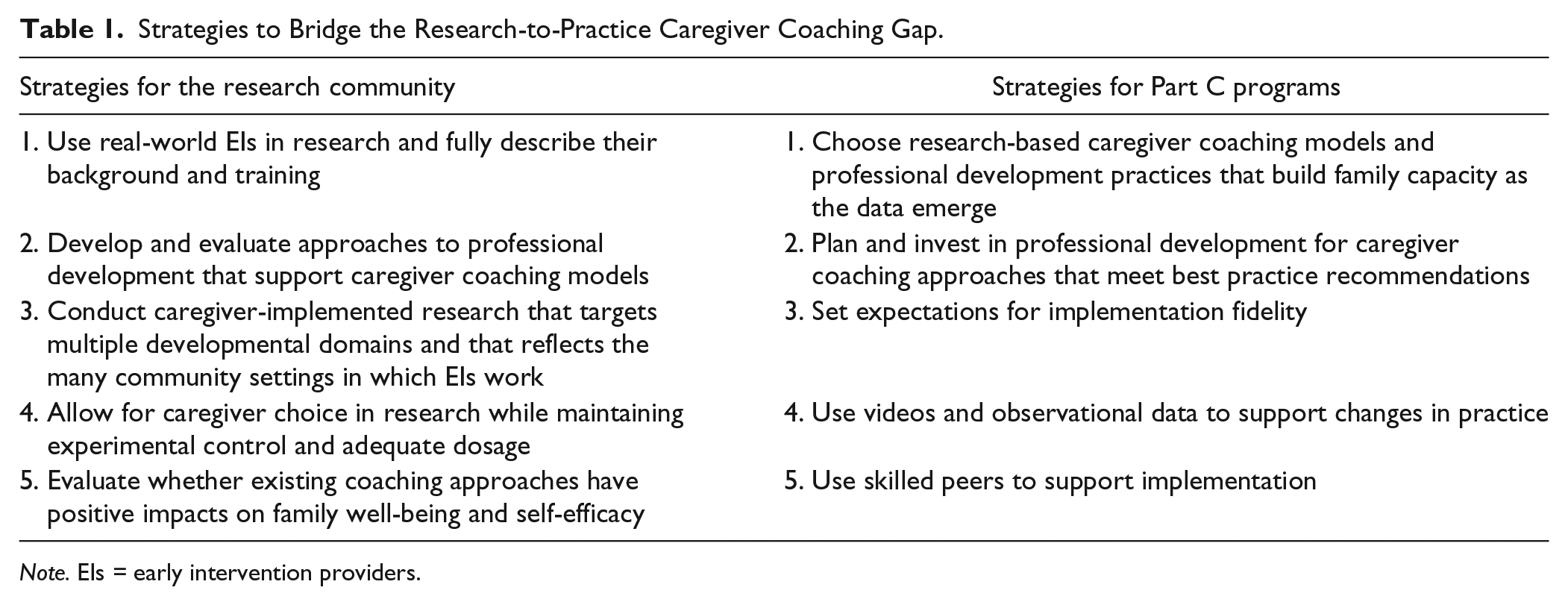
Note. EIs = early intervention providers.
Divide 1. Lack of Early Intervention Providers Participating in Research
Although the research base on caregiver-implemented interventions is substantial, many studies rely on either research staff or graduate students to complete their research (Kemp & Turnbull, 2014). We analyzed the studies in a recent review of caregiver-implemented communication interventions (Akamoglu & Meadan, 2018) to determine who implemented the coaching approaches in the current research base. Akamoglu and Meadan (2018) found that most researchers across the identified studies in their review reported the disciplinary backgrounds of the interventionist and their credentials; however, few made clear whether the interventionists were part of a research team or if they were “indigenous implementers,” the type of person who would use the model in a real-world setting. Akamoglu and Meadan (2018) found that no researchers across the 21 identified studies explicitly stated that the coaches were employed by Part C programs. In their review of caregiver coaching in EI, Kemp and Turnbull (2014) noted that researchers in one study (Salisbury & Copeland, 2013) reported using providers who worked for a Part C program. Other reviews of early childhood coaching studies have reported similar findings (Artman-Meeker et al., 2015).
Hired research interventionists and EIs in community programs may have similar preservice training backgrounds, but there are notable differences in their responsibilities that could impact implementation. Students and research staff have different caseloads and levels of support than real-world EIs who may also split time between EI, Part B preschool programs and school-age settings. These are important demographic distinctions to make in the research. Of course, it is logical to test interventions using graduate student-researchers and hired research staff, and it is an important first step in evaluating the effectiveness of an intervention. However, if the end goal is to test interventions to uncover what works, for whom, and under what conditions that are ultimately intended for community-based settings, researchers must be willing to test interventions with real-world EIs and families. Doing so supports the development of translational materials and approaches that help EIs in the field use evidence-based coaching practices with fidelity, which can then be shared and scaled with Part C programs.
Bridge Building Strategy 1. Use Real-World Early Intervention Providers in Research and Fully Describe Their Background and Training
A shift to using EIs who work for Part C programs in research is critical to ensuring the feasibility, acceptability, and social validity of coaching approaches that researchers hope will be used by EIs in the field. At present, the state of caregiver-implemented research seems to indicate that it works under more ideal conditions, but we have far less data on the effectiveness of real-world EIs serving in this role. Research teams should make purposeful use of community-based EIs, and they should be specific in their reporting of who implemented the model. Although there will be challenges in recruiting and training real-world EIs, technology offers a wide range of supports to engage them. PD studies using distance technology like Skype and FaceTime (Marturana & Woods, 2012), video feedback (Bishop et al., 2015), email feedback (Barton et al., 2018), and bug-in-ear coaching (Ottley et al., 2019) all offer potential for training EIs to use caregiver-implemented models. As EIs become a larger focus of research, it is also critical to detail how they were trained on coaching practices, and what resources and supports were used.
Inclusion of community-based EIs will bring an element of “messiness” that reflects the reality of real-world settings and programs (Siller et al., 2014) into research. For instance, EIs are likely to be guided by an intervention schedule that is set forth by the child’s Individualized Family Service Plan (IFSP), so approaches that employ frequent home visits (e.g., more than once per week) may need to either work with programs to make modifications, or work within the current practices of the program. Some Part C programs conduct joint visits with multiple providers per home visit, while others are moving to a primary service provider approach (Shelden & Rush, 2013). Researchers should expect this variability when engaging in EI research within community settings. Whether in single-case or group research, researchers should plan for how to account for and report on this variability. Will sessions be excluded a priori from a single-case design if multiple providers are present? Will sessions be counted in a data set if it includes an otherwise-unknown caregiver? Or, will these changes simply be noted on the single-case graphs or in group design data sets? These considerations should be weighed before conducting each study, and the decisions to these questions might depend on the research questions. While implementation research with “indigenous implementers” is rare, a few groups are using community-based providers within single-case designs or large-scale randomized controlled trials. For example, Wetherby and colleagues (2018) are using community-based providers to support caregivers of toddlers with autism spectrum disorder (ASD) within Part C programs. The IES has also funded projects that use EIs in caregiver-implemented models (see Salisbury et al., 2018; Windsor et al., 2019; see https://epicintervention.com/). These are positive signs that research teams are moving toward including community-based partners in research. Researchers are also investigating perceptions of EIs who are making a shift to coaching approaches or who are participating in PD to uncover factors that facilitate or hinder the uptake of the model (Salisbury et al., 2018).
Divide 2. Scarcity of Studies on Training Early Intervention Providers to Use Caregiver Coaching Approaches
As the use of EIs in research is relatively rare (Snyder et al., 2012), studies that investigate how to support EIs to adopt coaching models are also uncommon (Krick Oborn & Johnson, 2015). Reporting of how coaches were trained in caregiver-implemented research is a notable area of weakness in the caregiver-implemented literature (Artman-Meeker et al., 2015; Barton & Fettig, 2013), and without it, Part C programs will be challenged to replicate coaching approaches in practice without a blueprint for how to conduct PD related to coaching. A few studies in the literature investigate how to help EIs adopt caregiver coaching approaches. Campbell and Sawyer (2009) tested a PD approach for EIs that used face-to-face trainings in combination with a self-study packet that encouraged the application of and reflection on participation-based practices in a pre–post design. Although this study did not test for experimental effects, it offers preliminary data on the use of direct content instruction on participatory practices and self-reflection as a means to support PD in EI. Marturana and Woods (2012) used a distance mentoring model to help EIs in a state program implement Family Guided Routines Based Intervention (FGRBI). Marturana and Woods documented the dosage and type of coaching received to help EIs increase their use of coaching strategies with families. Similarly, Krick Oborn and Johnson (2015) used a multiple baseline design to experimentally test the impact of face-to-research to training and performance-based feedback on EIs’ use of specific coaching strategies. In both studies, feedback and reflection showed promise as a means to support EIs’ use of caregiver coaching strategies.
Bridge Building Strategy 2: Develop and Evaluate Approaches to Professional Development That Support Caregiver Coaching Models
The field needs more experimental investigations of how to train preservice and inservice providers to use capacity-building coaching approaches. Studies from preschool and elementary education settings offer important information about what does and does not work to create sustained changes in professionals’ practice. It is well known that one-time workshops do little to move the needle to help professionals adopt new practices (Desimone, 2009; Joyce & Showers, 2002) and multiple features are thought to support implementation in early childhood settings (Dunst, 2015; Snyder et al., 2012). These features, like having focused content, opportunities for job-embedded practice, and reflection will be discussed later in this article. As EIs have a unique service delivery setting in which EIs are not centralized in a school, it is critical that researchers investigate how to best support PD in home-visiting models in which providers are distributed across communities. These investigations could include a focus on coaching EIs using peers or more experienced partners to create systems change (Krick Oborn & Johnson, 2015) and using video-based technology platforms to support EIs’ reflection on their practice while receiving feedback (Marturana & Woods, 2012). Careful reporting on the type, content, and dosage of PD supports is critical to developing a research base on PD in EI (Elek & Page, 2019). PD research should also compare types and formats so that stakeholders have data upon which to choose PD systems that fit their programs. Experimental PD research in EI should feature explicit outcome data on EIs’ changes in their use of well-defined caregiver coaching strategies, either using defined strategies in the field (i.e., Biel et al., 2019; Friedman et al., 2012) or operationalized and manualized fidelity measures (see Figure 1) so that the effectiveness of the PD can be put into context. PD studies should aim to include caregiver and child level data when possible.

FGRBI and SS-OO-PP-RR key indicators fidelity measure.
Divide 3. Interdisciplinary Service Delivery in Community-Based Settings
In most of the caregiver-implemented research, research teams test strategies in one developmental domain of interest. Research syntheses have paid particular attention to communication (Akamoglu & Meadan, 2018), social-communication skills (Hong et al., 2018), and behavioral supports (Dunlap & Fox, 2012). However, community-based EIs work across developmental domains, particularly in systems using a primary service provider approach (Shelden & Rush, 2013). The intensity of focus on a single domain and a single set of strategies is likely to be different in community settings, which in turn impacts the dosage delivered to families and focus of intervention more broadly.
In Part C programs, EIs often balance multiple targets and outcomes during a single session and across a family’s participation in Part C, especially for children with significant delays and disabilities. Although a few studies have investigated caregiver-implemented interventions that test strategies’ impact on multiple developmental outcomes (i.e., Windsor et al., 2019), there is little experimental research on how to successfully target multiple goals like communication, social-emotional skills, motor, and adaptive skills concurrently using evidence-based strategies within a coaching model. As such, EIs have scant guidance on how to address a family and child’s multiple and varying needs within a coaching approach.
EIs also work across settings in a child’s natural environments (DEC, 2014). While most intervention studies that include EIs as the implementers are conducted in home-based settings (Krick Oborn & Johnson, 2015; Marturana & Woods, 2012), providers increasingly serve children in early care and education settings (Early Childhood Technical Assistance Center [ECTA], n.d.). Data from ECTA in 2018 indicate that 7.5% of services are provided in child care, although this number and percentage could vary by location due to the uneven availability of child care nationwide (Andersen & Mikesell, 2019). A handful of studies have used a coach in the role of an EI in Early Head Start classrooms (Friedman & Woods, 2015; Romano & Woods, 2018), but additional research regarding strategies for supporting EIs to coach early care and education providers are needed.
Bridge Building Strategy 3: Conduct Caregiver-Implemented Research That Targets Multiple Developmental Domains and That Reflects the Many Community Settings in Which EIs Work
DEC Recommended Practices are built on the understanding that children develop concurrently across domains and across time, and Part C services are designed to reflect that premise. Professional associations like ASHA also acknowledge that specialists in a particular domain need knowledge and expertise in other developmental areas as well (ASHA, 2016), and research in translatable models should reflect the interdisciplinary nature of service delivery in Part C. If the caregiver-implemented research base is to more closely resemble real-world practice and vice versa, additional research is needed to investigate coaching approaches that are flexible enough to accommodate child targets in multiple developmental domains, especially for children with significant disabilities. This could challenge researchers for several reasons. First, most research teams are specialized around a particular domain. Faculty conducting this research are expected to have coherent research agendas which typically include a developmental area of expertise. Yet much like providers need to expand beyond one developmental domain in their work with families, so too must research teams who investigate coaching approaches for caregiver-implemented interventions. By conducting research across disciplines, the field will have a clearer picture of the types of child outcomes that can be achieved when working across child targets, as EIs do. In addition, research using EIs should expand to child care to coach professionals who support children enrolled in Part C in their early care and education settings. Coaching in child care shares some commonalities with coaching families, but it is a distinct setting with its own characteristics (Romano & Woods, 2018). Coaching in child care is also different from coaching in preschool settings. In EI–child care coaching relationships, the coaching inherently occurs between two professionals, unlike family–professional partnerships in home-based service delivery. While there are some data on peer coaching in preschool settings approaches, many studies use an external source of PD like state or research teams (Snyder et al., 2012). In center-based coaching in EI, there is an additional need to collaborate with families even if the primary coaching takes place in the early care and education setting between a child care provider and an EI. Much like other EI research, helping EIs coach child care providers represents a paradigm shift from child-directed models.
Divide 4: The Role of the Family in Research
EIs who align their practice with DEC (2014) Recommended Practices are tasked with reflecting family priorities in the targets and outcomes they address, in the strategies they use, and the contexts in which they intervene. This approach requires responding to the family during each visit, and aligning to a family’s changing needs while remaining consistent with the family’s IFSP. By contrast, caregiver-implemented research often tests packages of strategies or curricula (Akamoglu & Meadan, 2018), and fewer studies allow for responsiveness to family priorities session-by-session because the primary focus is to evaluate whether the identified strategies are linked to caregiver and child change.
For instance, a caregiver-implemented study might define and examine a set of language facilitation strategies. Coaches support families to use the core strategies with fidelity in a set curriculum. A strong research team would develop and describe implementation and intervention fidelity tools, they would measure fidelity consistently, and they would report the implementation of it in the written report. In a setting outside of research, it is far more difficult to adhere to a structured fidelity protocol around a single set of strategies. A family may express to an EI provider that, while they still want to work on language development with their child because it remains their long-term goal, they are more immediately focused on a child’s challenging behavior that has developed in the last week that is impacting the family’s functioning. Although the research team might share resources to support the family, they may not be able to shift focus for the session to behavioral supports because the fidelity measure used is specific to the language intervention. The community-based EI, by contrast, would need to adjust the intervention session to the family’s concerns.
This difference between research and practice is by no means a critique of the literature on caregiver-implemented interventions. Testing intervention strategies with a high level of experimental control is a critical step in building a foundation for evidence-based practice, and adhering to the fidelity protocol is central to testing an intervention’s effect. It is a tremendous challenge for researchers to build measurement systems that are flexible enough to handle session-by-session variability while also maintaining requisite experimental control and sufficient dosage in EI to show evidence of family and child change. However, if coaching models in caregiver-implemented interventions are not flexible enough to handle shifts in family priorities, then they may not be translatable to community-based, capacity-building models built on the premise that families’ needs and priorities should be the focus of intervention. As it stands, EI providers might receive mixed messages about using evidence-based practices (which were often established by testing the set of strategies/curriculum in a sequential fashion) while also being urged by their programs to individualize and respond to family priorities.
Bridge Building Strategy 4: Allow for Caregiver Choice in Research While Maintaining Experimental Control and Adequate Dosage
To make research reflective of family priorities in a manner consistent with recommended practices in Part C, it is important to include elements of caregiver decision making as a means to build family capacity. Choices could include setting specific targets for the intervention (Brown & Woods, 2015; Windsor et al., 2019), choices of routines (Kashinath et al., 2006), and choices of strategies (see Romano & Woods, 2018). Not only is building in opportunities for family choice-making consistent with DEC (2014) Recommended Practices, it is also consistent with adult learning research. Research and theory indicate that when adults have choices about what they learn and how they learn it, they are more actively engaged and more likely to learn the content of the intervention (Dunst & Trivette, 2009; Knowles et al., 2005).
If research teams adopt this approach, they will need to develop measurement systems that can accommodate caregiver decision making within their outcome measures and their implementation fidelity measures. For instance, if families choose outcomes at the beginning of the intervention, these could be maintained until the child achieves it, at which point the target can shift and the caregiver could choose again between developmentally appropriate options. Other researchers might use coding systems that can handle variation. For example, Windsor and colleagues (2019) used a coding approach called the Embedded Instruction Observation System—Early Intervention (Snyder et al., 2015) that used the session’s family-identified target. The research team then calculated complete learning trials, or how many opportunities the caregiver created for the child to practice a skill and how often the child used the skill in a meaningful context.
Approaches like this offer flexibility to the research team, but they also require detailed context when described in a written report of the research (Harn et al., 2013). Sessions in which families choose to target infant vocalizations during diaper changing might have a higher frequency of opportunities, for instance, than a target of pulling to stand while playing, and this should be noted for interpretation. If families in research choose routines as contexts for intervention, these routines need to be fairly consistent, or consistent within broad-categories like play, literacy, caregiving, and community routines (see Brown & Woods, 2015; Kashinath et al., 2006). Careful inclusion of caregiver choice and decision making both in the intervention as a whole and at a session level is a critical, though certainly not exhaustive, means to build caregiver capacity. Other elements, like including problem solving and reflection as coaching components, can also offer caregivers opportunities to gain confidence and competence (Friedman et al., 2012; Lorio et al., 2020). With planning and the use of tools that are able to “flex” with the child and family, research teams can incorporate program capacity-building practices into their approaches. Testing models that include these components will offer data on the degree to which child and family outcomes compare to models that use a more prescriptive and sequential curriculum.
Divide 5: Outcome Measurement in Research and in Community-Based Programs
In much of the caregiver-implemented research, caregiver coaching approaches are defined by their ability to affect changes in caregiver behavior (Heidlage et al., 2019). Measurement often includes observational coding of the degree to which caregivers use a strategy that they are coached to do, commonly using rate or frequency as a metric. Measuring discrete changes in caregiver behavior is a fundamental way to measure the impact of the intervention in the context of theories of change in caregiver-implemented models. Of course, one key purpose of caregiver coaching is to support caregivers’ abilities to use strategies in everyday routines to support their child (Friedman et al., 2012).
Research on family systems indicates that multiple factors influence the quality of caregiver–child interactions (Dempsey & Keen, 2008; Dunst & Trivette, 2009; Trivette et al., 2010), and Part C programs under the Individuals with Disabilities Education Improvement Act [IDEA] are built on the premise that families’ well-being is intertwined with their child’s development. Meta-analytical structural equation models indicate that caregiver well-being directly impacts caregiver–child interactions in children with disabilities (Trivette et al., 2010). In addition, a caregiver’s feelings of self-efficacy indirectly influence interactions with the child through its impact on family well-being (Trivette et al., 2010). If a family feels confident that they know how to support their child, it positively influences their overall well-being, which in turn impacts the nature of caregiver–child interactions. Not only are these constructs linked to caregiver–child interactions, they are malleable and can be supported through capacity-building practices (Trivette et al., 2010).
Descriptive research also documents the inverse relation between family stress and child outcomes. High levels of stress decrease family well-being and negatively impact child developmental outcomes (de Cock et al., 2017). Caregivers of children with disabilities face elevated levels of parenting stress (Frantz et al., 2018). Feelings of self-efficacy, the caregiver’s belief that he or she can positively influence the child’s development, are also related to global child outcomes and in subdomains like social-emotional development and cognition (Albanese et al., 2019). EIs should influence pathways of self-efficacy through capacity-building approaches that build on a family’s strengths.
While many coaching approaches in the research base have illustrated an ability to change caregiver behavior, we have less data about whether those approaches facilitate changes in family well-being and in feelings of self-efficacy (Frantz et al., 2018). Some coaching approaches used in the literature include reports of social validity (Meadan et al., 2016; Salisbury & Copeland, 2013; Woods et al., 2004), which is an important step in determining the degree to which coaching changes how families feel they can support their child. Akamoglu and Meadan (2018) found that 8 of the 21 identified studies reported social validity data that explored the impact on a family’s satisfaction with the intervention or feelings of confidence and competence in their ability to support their child. These reports of social validity are valuable evidence, but additional research is needed to determine which coaching approaches fundamentally build a caregiver’s capacity to help their child learn and grow by influencing a family’s feelings of self-efficacy and well-being. Simply put, caregiver strategy use is a critical but not fully sufficient outcome measure in Part C research. Caregiver-implemented studies should also include investigations of broader impacts of coaching on family self-efficacy and well-being using tools of both quantitative and qualitative research.
Bridge Building Strategy 5: Evaluate Whether Existing Coaching Approaches Have Positive Impacts on Family Well-Being and Self-Efficacy
While research-based caregiver-implemented interventions have reported social validity data, particularly in single-case experimental designs, these variables have not been widely tested in experimental designs. Some caregiver-implemented group design studies used measures that examine changes in family stress between experimental conditions. In a 2015 randomized control trial of a caregiver-implemented language intervention, Roberts and Kaiser (2015) measured differences between a treatment and control group on levels of caregiver stress. While the direction of group differences was promising in the 2015 study (the intervention group reported lower stress than the control), the differences did not reach statistical significance.
At first glance, family well-being and feelings of self-efficacy appear difficult to measure when compared to discreet and observable behaviors, but there are a number of validated tools that can be used for these purposes. Tools like the Parenting Stress Index Short Form (Abidin, 1990) and the Center for Epidemiological Studies Depression Scale (CES-D; Radloff, 1977) can be used to measure these constructs. Measures like the Parenting Sense of Competence Scale (Johnston & Mash, 1989) and the Berkeley Parenting Self Efficacy Scale (Holloway et al., 2019) measure caregiver feelings of self-efficacy. In early childhood special education, the Early Intervention Parenting Self Efficacy Scale has been used for these purposes (Guimond et al., 2008), and measurement tools for family quality of life frameworks have long been used for families of children with disabilities (Bhopti et al., 2016). While measurement tools for family stress, well-being, and self-efficacy have been applied in caregiver-implemented research specific to children with ASD (Frantz et al., 2018), they are less commonly used in other EI populations (Bhopti et al., 2016). Qualitative investigations about how families feel that coaching models supported their family also offer important perspectives from the most important stakeholders in EI, the family itself. While these measures should not supplant measurement of caregiver strategy use, they should play a larger role in determining which coaching approaches have a lasting impact on the family as a system.
Bringing Research Tools to the Real World
The previous sections documented ways in which research can align with Part C practice to help translate evidence-based coaching practices to EIs nationwide. In the following sections, we detail how Part C programs can support the uptake of evidence-based practices. The need for systematic, comprehensive PD in Part C intervention is well-established (ECTA, n.d.) and it is built into the legislative mandate of IDEA Part C (IDEA, 2004). As states move to develop these systems, there are multiple elements of coaching models used in research that should be incorporated in these efforts to create sustained practice changes in EIs. In this section, we use the term “program” to refer to state agencies, local programs, or other community-based agencies that influence policy and practice of Part C services.
Choose Research-Based Caregiver Coaching Models and Professional Development Practices That Build Family Capacity as the Data Emerge
As the research community continues to investigate which coaching approaches have meaningful and lasting impacts on child and family outcomes, programs should use that data to inform their choices of caregiver coaching approaches to adopt for use in Part C. When considering which coaching approaches and PD models to install, programs should consider the following: Which coaching approaches demonstrate an ability to change child and family outcomes and build family capacity? Which approaches best align with the DEC Recommended Practices? Which PD approaches show the greatest potential to create change in EI providers’ use of those coaching practices? How will PD align with states’ systemic improvement plans? While we note that these data are limited at present, PD research is likely to grow in the coming years, equipping programs with evidence to inform their choice of approaches.
To help EIs across a system adopt and sustain selected coaching models, programs should use implementation science frameworks to guide the process. The National Implementation Research Network offers materials through its Active Implementation (AI) Hub that explains how to choose, install, and bring interventions to scale in community-based programs (https://nirn.fpg.unc.edu). One of the first steps identified in the AI Hub is to identify a “useable innovation,” an approach that can be well-defined and operationalized. Given the range of caregiver coaching approaches in the literature, an important first step for programs is to choose well-defined and manualized coaching approaches that EIs can observe, measure, and use with families on their caseloads and that has evidence for supporting caregiver and child outcomes. Given the varying definitions and theoretical perspectives in the research (Friedman et al., 2012; Kemp & Turnbull, 2014) this is not always an easy task. Given the time and investment necessary for installation of the caregiver coaching models, the choice of approaches to use is worthy of careful consideration by Part C programs. In selecting a cohesive coaching approach that has emerging evidence, programs can begin to create a shared vocabulary and knowledge base for their EI providers.
Plan and Invest in PD for Coaching Approaches That Meets Best Practice Recommendations
To build and sustain EIs’ use of family-capacity-building coaching practices, programs should build PD systems that include the features outlined in the literature. Work by Dunst (2015) synthesizes PD in educational research (Desimone, 2009; Joyce & Showers, 2002) and lists seven major features for PD in early childhood intervention. First, PD should include explicit content instruction about the practices that will be taught. In its translation to caregiver coaching approaches, content would include sharing what specific coaching practices are, how to use them with diverse families, and it should cover the evidence supporting the coaching strategies’ use. Next, EIs need job-embedded opportunities to practice and apply what they learned about coaching with families on their caseload (Krick Oborn & Johnson, 2015). Third, EIs need multiple opportunities and formats for reflecting on their own practice. This could include group discussions in team meetings (Romano et al., 2019), individual reflections, and it could include the use of technology (see section “Increase the Use of Videos and Observational Data to Support Changes in Practice”). When reflecting on one’s practice, it is important to help EIs focus specifically on the coaching practices that they learned (Dunst, 2015). Fourth, EIs need sustained and ongoing coaching to support their use of caregiver coaching practices. Coaching from a more experienced EI in their program or from an external source of support offers opportunities for receiving feedback specific to the coaching practices, opportunities for reflection, and the chance to set professional goals. Fifth, EIs will need follow-up support to continue the use of these practices. Sixth, the PD planned should be of sufficient length and intensity to precipitate changes in practice. Finally, the more of the above components that can be programmed in to systems, the more likely it is to create lasting change (Dunst, 2015).
Programs developing PD systems should consider cost when planning how to reach EIs and meet the intensity of the recommendations described above. Given that programs have limited resources, leaders must decide whether to start intensively and deeply in a small number of locations, or if they should begin with a range of agencies across a program and perhaps fewer participants. Those early decisions will impact use of resources and plans for scale up past the initial rounds of EIs trained. No matter the plan for rolling out the PD, it is widely agreed that systems change will take time to implement (Fixsen et al., 2013; National Implementation Research Network, n.d.)
Set Expectations for Fidelity of Implementation
Researchers are becoming more thorough in their use of both implementation fidelity tools and intervention fidelity in caregiver-implemented interventions (Barton & Fettig, 2013; Biel et al., 2019), and this emphasis on fidelity measurement should be carried into community settings. After using evidence to select caregiver coaching models, programs should focus on ensuring that their EIs reach levels of fidelity of implementation that are known to create positive outcomes for children and families. In an EI context, fidelity tools need to detail the specific coaching practices that should be used in each session along with operational definitions of practices to ensure that each is discreet, observable, and measurable. See Figure 1 for an example of a coaching fidelity measure called SS-OO-PP-RR that has been used in research in home and child care settings in early intervention (Brown & Woods, 2015; Romano & Woods, 2018). This manualized fidelity measure describes and operationalizes each component and sets clear expectations for each practice. Manualized approaches also offer shared language for providers as they learn to use the model. Tools that specify and quantify coaching practices can be used to both measure fidelity and support EIs during sessions to ensure the use of key coaching behaviors (Biel et al., 2019).
PD should include a thorough discussion of what implementation fidelity is, why it matters, and why EI providers should measure it in their practice with families. Just as research teams operate under the assumption that sessions will be delivered with fidelity to a protocol, so too should EIs understand that they are expected to adhere to observable coaching practices in their daily work with families. Implementation fidelity is a means to ensure that families are receiving supports as intended and with enough consistency to create positive outcomes for children and families (Fixsen et al., 2013; National Implementation Research Network, n.d.). Setting expectations for fidelity measurement and emphasizing that programs use fidelity data to inform PD is vital. In implementation science frameworks, using data as a part of improvement cycles to continually make progress toward full implementation of the model is critical to sustaining the approach (Fixsen et al., 2013).
Increase the Use of Videos and Observational Data to Support Changes in Practice
Making a change to caregiver coaching models from a child-directed model requires a considerable paradigm shift for EIs who have been previously trained to work directly with children (Krick Oborn & Johnson, 2015; Marturana & Woods, 2012), and it necessitates a wide expansion of skill sets as described earlier in this article. Data on PD indicates that opportunities to practice, receive feedback, and reflect on one’s use of core skills is key to creating sustained change (Dunst, 2015), and these supports can be delivered through the use of technology (Krick Oborn & Johnson, 2015; Marturana & Woods, 2012).
Video reflection is widely used to facilitate feedback and reflection in educational research, and these tools can be readily applied in community-based settings in Part C. Watching one’s practice, reflecting on it, and receiving feedback on the video from a coach has been identified as a means to support teacher practices in multiple fields as wide ranging as literacy instruction, math, and science education (Singer et al., 2011), medicine, social work, and psychology (Fukkink et al., 2011). Platforms like TORSH and GoReact, and others like it, allow EIs to upload videos, watch the videos in playback, and comment on their practice. Meta-analyses of studies that use video-based feedback indicate that it is the most effective when paired with structured observation forms (i.e., an implementation fidelity measure; Fukkink et al., 2011). Given the nature of service delivery in Part C, the use of video is a powerful tool to support change in provider practice when live observations are not possible or desirable (Marturana & Woods, 2012). Families are often willing to accept video recordings when they understand that they are to support the EIs growth and development, but it is essential that they fully consent and understand the purpose of the recording. The use of videos also enables the fidelity measurement.
Use Skilled Peers to Support Implementation in an Implementation Science Framework
As programs build PD systems that support caregiver coaching approaches, it is useful to consider how to build teams of EIs to support one another as they learn a new service delivery approach (Fixsen et al., 2013; Knowles et al., 2005). In agencies, some EIs will be eager and willing early adopters, and these providers can help bring other team members into the fold. In an implementation science framework, implementation teams are used to determine the needs of the program, communicate about the model and about implementation science to others, and help develop internal supports to aid others in their own implementation (Fixsen et al., 2013).
Peers can also be used to support one another systematically through peer coaching and feedback. Peer coaching is a promising practice in early childhood education (Johnson et al., 2017; Tschantz & Vail, 2000). Peer coaches who have learned to implement a model and who are trained to support others through an evidence-based peer coaching approach can be used to create changes in provider behavior (Krick Oborn & Johnson, 2015) while avoiding a supervision approach in which EIs’ job performance is evaluated by an administrator. Peer coaching approaches can be designed to include evidence-based practices like performance feedback and video reflection to support provider change (Johnson et al., 2017).
Communities of practice (CoP) can also be used to bridge the gap between research and practice because participants from across settings are able to co-construct knowledge as they discuss and reflect upon effective coaching practices (Buysse et al., 2003). Using a CoP framework forces the consideration of the social and cultural context as participants share and learn information about caregiver coaching as well as provide opportunities for reflection about changing to a triadic approach (Buysse et al., 2003; Odom, 2009). Members of the CoP recognize that they are part of a larger system and that they are a subgroup that has a common focus. These characteristics of a CoP provide peer-to-peer support within the context of experience and knowledge to support implementation of evidence-based practices. While CoPs alone may not precipitate changes in practice, they may serve a role in deepening and sustaining practice changes among its participants.
Conclusion
While the caregiver coaching research-to-practice implementation gap in EI is a challenge to overcome, researchers and programs can systematically bridge the divide in two ways—by making research more translatable and by ensuring that Part C programs are using tools of research—to strengthen caregiver coaching practices in the field. Although the strategies presented here are not exhaustive, they represent potential next steps in bridging the caregiver coaching implementation gap. Part C programs nationwide are growing year upon year, and the potential for making a difference in the lives of children and families has never been greater. With investment in research that can be used in community-based programs and by investing in PD to support evidence-based coaching models in practice, research and Part C can partner to strengthen outcomes for children and families for many years to come.
Footnotes
Disclaimer
The thoughts and opinions expressed are those of the authors and do not represent the views of the Iowa Department of Education.
Declaration of Conflicting Interests
The author(s) declared no potential conflicts of interest with respect to the research, authorship, and/or publication of this article.
Funding
The author(s) received no financial support for the research, authorship, and/or publication of this article.
