



Abstract
Parent-mediated intervention can enhance parents’ competence in supporting parent–child social interactions. Research and current policy have highlighted the importance of building family capacity in supporting parents to help children with autism develop social communication abilities. Parents who experienced parent-mediated interventions have reported reduced parenting stress; however, few studies have examined parents’ learning outcomes from such interventions for children with autism. We assessed parents’ learning outcomes from participation in the Joint Attention Mediated Learning (JAML) intervention and explored differences in parents’ application of mediated learning principles between intervention and control groups. We used parent–child interaction videos to analyze parents’ application of mediated learning principles with their toddlers in home settings and found significant group differences in parents’ application of the principles at postintervention. Parents in the intervention group showed significant improvements in their competence in mediating child learning in unstructured parent–child interactions, but there were no significant gains for parents in the control group.
Toddlers with autism show difficulties with social communication and repetitive behaviors as early as 18 months (American Psychiatric Association, 2013). Compared to parents of children with other developmental delays, those who have children with autism face unique challenges (Carter et al., 2009). A set of recommendations from the Division for Early Childhood of the Council for Exceptional Children (DEC; Division for Early Childhood, 2014) and Part C of the Individuals with Disabilities Education Improvement Act (IDEA, 2004) highlight the importance of interventions that empower parents to support their child’s learning. Involving parents in interventions can support these parents in responding to their children’s social communication needs (Carter et al., 2011; Estes et al., 2014; Kasari et al., 2010; Mahoney & Wiggers, 2007; Schertz, Odom, et al., 2018; Siller et al., 2014). However, we know little about parents’ learning outcomes from programs promoting parent-mediated interventions, despite research suggesting that parents’ learning outcomes and parenting strategies contribute to the quality of family life and children’s social learning (Zaidman-Zait et al., 2014). In a meta-analysis of parent-implemented interventions for children with autism, only 36% of studies reported parent outcome measures, and the results provided limited information on parent learning supports and their competence in applying interventions in daily routines (Heidlage et al., 2020). There is a pressing need to evaluate parents’ outcomes from interventions designed to help them provide natural social learning opportunities for their children with autism (Beaudoin et al., 2014; Koegel et al., 1996).
Parents’ Roles in Parent-Implemented Intervention Approaches
Among reported parent-mediated interventions, parents’ roles have varied from implementing preplanned activities to being active participants in different approaches or models of interventions (Woods & Brown, 2011). Within naturalistic developmental behavioral intervention (NDBI; Schreibman et al., 2015) approaches, parents were taught to apply modeling, reinforcement, and behavioral intervention strategies to teach their child with autism. For example, Pivotal Response Treatment (PRT) and Family Implemented TEACCH for Toddlers (FITT) interventions taught parents preplanned strategies that interventionists modeled with the child (Bradshaw et al., 2017; Turner-Brown et al., 2019). As a developmental approach, the Joint Attention Mediated Learning (JAML) intervention used mediated learning principles to actively engage parents in the intervention, with parents generating their own ideas for activities that could be integrated into daily interactions (Schertz, Odom, et al., 2018).
Parent outcome measures in parent-implemented interventions have been operationalized as: (a) correct use of specific strategies (Brian et al., 2016; Turner-Brown et al., 2019); (b) parent responsiveness (Carter et al., 2011); and (c) intervention fidelity (Kasari et al., 2015; Rogers et al., 2012, 2019; Shire et al., 2016). A growing body of studies indicates that parents learned to use predetermined intervention strategies from a clinician or a therapist, but few demonstrated how an active learner role for parents was promoted, and whether their competence to apply intervention concepts in daily contexts improved over the intervention period (Akamoglu & Meadan, 2018; Heidlage et al., 2020).
Importance of Supporting Parents’ Outcomes in Parent-Mediated Interventions
The challenges of autism can undermine parents’ confidence in establishing social interactions with their children, so supporting their confidence might enhance their competence in creating supportive learning environments for their children (Estes et al., 2013; Zaidman-Zait et al., 2014). Didactic instruction or highly specified and preplanned parent education programs may not be effective to build parent capacity because they do not engage parents’ sharing and reflection in the learning process (Vismara & Rogers, 2018). Although family-capacity building approaches are at the center of a broad range of parent-implemented interventions, an important issue is the extent to which parents’ learning goes beyond preplanned activities so they can make adaptions to different contexts (Schertz et al., 2011). Caregivers’ empowerment in the intervention may also improve long-term outcomes for children with autism and increase the sustainability of parent-mediated intervention (Wainer et al., 2017). The existing literature includes few studies in which parents’ application of intervention strategies to everyday interactions are reported (Beaudoin et al., 2014; Heidlage et al., 2020).
A focus on parents’ empowerment does not diminish the importance of children’s outcomes. A review of parent-implemented interventions studies found that children’s social communication outcomes from parent-mediated interventions were mixed (Heidlage et al., 2020; Roberts & Kaiser, 2011). These reviews identified several factors that might impact children’s outcomes, including the quality of parents’ intervention and the support parents received. Measuring parents’ outcomes could help researchers to identify whether children’s outcomes are due to parents’ competencies or to other factors, such as parents’ education backgrounds and socio-economic situation (Breitenstein et al., 2010).
Limitations of Existing Parent Outcome Measures
While parents’ learning outcomes are important in parent-mediated interventions, relatively few studies have examined them as intervention outcomes (Freuler et al., 2014; Schertz et al., 2011). In a broader review of the literature, McConachie et al. (2015) found that 18% of parent-implemented intervention studies reported parents’ fidelity as the only measure of parents’ outcome, and these measures were often limited to how many hours parents spent employing the strategies each week. Thus, little is known about parents’ outcomes and how their needs are addressed in intervention programs.
Parents’ application of intervention principles can be expected to mediate the relation between the intervention and the expected child learning outcomes. Examining parents’ ability to apply an intervention’s principles in real-world contexts is crucial to their competencies to help their children to maintain and generalize acquired social communication abilities. Barton and Fettig (2013) analyzed parent fidelity measures in parent-implemented interventions for children with disabilities. The findings suggested that only 33% of studies measured generalization of parents’ application of intervention concepts across daily activities and settings (Barton & Fettig, 2013). Likewise, Moore and colleagues (2020) found that only 36% of parent-implemented interventions studies used parent outcome measures to monitor parents’ support for their child’s communication development in the intervention (Moore et al., 2020). There is a pressing need to examine how parents’ competence is built through the intervention and whether parents can generalize their learning outcomes across contexts.
The Need for Investigating Parents’ Outcomes From the JAML Intervention
The JAML intervention is designed to support parents’ active engagement in the intervention, provide systematic support for parent learning related to joint attention outcomes and mediated learning principles, build parents’ capacity over time, and emphasize social engagement in parent–child interaction (Schertz, Odom, et al., 2018). Parents promote five mediated learning principles in parent–child interaction: “focusing on the interaction (FO), organizing and planning (OP), giving meaning to currently targeted interactional elements (GM), encouraging self-reliance (EN), and expanding (EP).” Parents are supported to build their competency to integrate mediated learning principles into daily interactional activities to support their child’s development of joint attention and other preverbal social communication competencies. Children with autism display more difficulties in initiating joint attention (IJA) and responding to joint attention (RJA) than for requesting acts (Mundy et al., 1994). The fundamental difference between IJA and requesting behavior is that IJA is motivated by a child’s social interests in sharing attention about an object with parent, while requesting behavior solely serves the child’s own interests. RJA is also motivated by the child’s desire to share socially by following the parent’s gaze to the object. To set the stage for joint attention, interventionists provide conceptual support and guide parents’ reflection on how they apply intervention concepts to build social engagement with their child. The details of the intervention procedure are provided under the Method section. A randomized control trial (RCT) of JAML found positive effects for four levels of children’s preverbal communication development: visual synchrony to faces, reciprocal turn-taking, responding to partner joint attention overtures, and IJA (Schertz et al., 2013; Schertz, Odom, et al., 2018).
Study Purpose
We extended the research on JAML by examining parents’ application of mediated learning principles in their interactions with their children with autism. The following research questions guided our study: Do parents in the JAML and control groups differ in their levels of competency in applying mediated learning principles at preintervention and postintervention assessment and in their improvement over time?
Method
Participants
As secondary data analysis, this study included 60 participants from a larger RCT of the JAML intervention (Schertz, Odom, et al., 2018). The JAML study was approved by the Institutional Review Board at Indiana University Bloomington, and participants signed consent forms based on the human participants’ protection procedures. Parent–child dyads who met the inclusion criteria were recruited from the U.S. states of Indiana, Kansas/Missouri, and North Carolina. Children’s and parents’ demographic information is presented in Table 1.
Participant Demographic Information for Parent–Child Dyads.
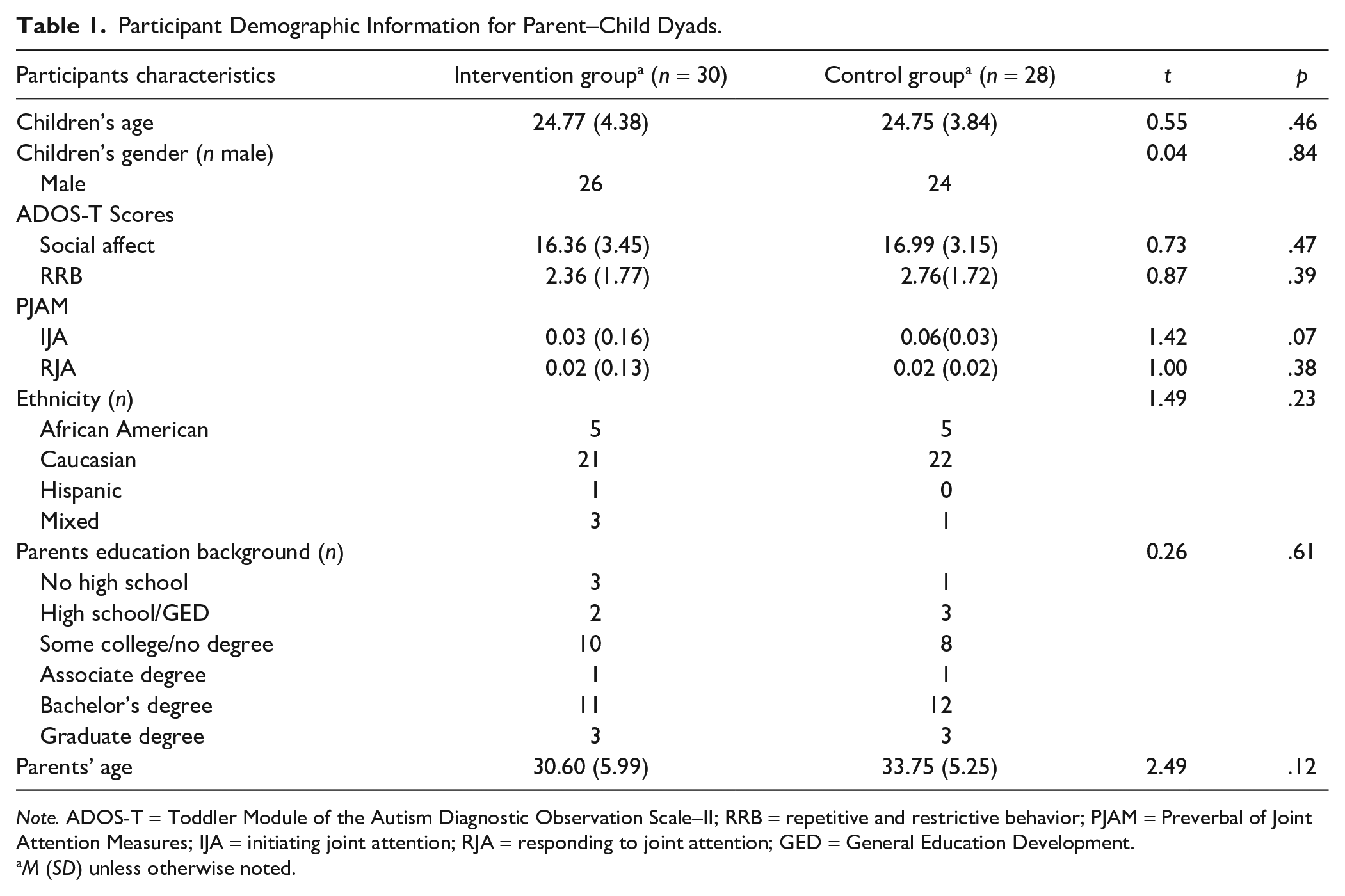
Note. ADOS-T = Toddler Module of the Autism Diagnostic Observation Scale–II; RRB = repetitive and restrictive behavior; PJAM = Preverbal of Joint Attention Measures; IJA = initiating joint attention; RJA = responding to joint attention; GED = General Education Development.
M (SD) unless otherwise noted.
The inclusion criteria specified parent–child dyads in which the child (a) had a confirmed diagnosis according to the Toddler Module of the Autism Diagnostic Observation Scale-II (ADOS-T; Lord et al., 2012), (b) was 30 months of age or younger at the study entry, (c) exhibited no more than three instances of joint attention during a 10-minute parent–child interaction, and (d) did not have a reported confounding condition (e.g., Down syndrome).
Design
In the larger RCT, participants were randomized into JAML and control groups with 73 randomized into the JAML intervention group and 71 allocated to the control group. For this study, the first 20 parent–child dyads who entered the study from each of the three JAML study sites were included. For each of the 60 dyads, parent–child interactions were video-recorded at preintervention and postintervention home visits (i.e., two 10-minute videos per dyad) for a total of 120 videos. However, two participants in the control group were lost to the study. Thus, 118 preassessment and postassessment videos of parent–child interactions were included in the analysis.
Intervention and Control Group Procedures
Intervention coordinators (ICs) at each site facilitated parents’ learning of mediated learning principles in weekly 1-hour home-based sessions for 32 weeks. Parents were encouraged to flexibly generate their own ideas on activities to mediate their child’s learning based on child and family preferences and interests. The ICs’ role was to actively engage parents in the learning process and to support their conceptual understanding of mediated learning principles and how to use them to address their child’s social challenges. An important aspect of conceptual learning was to help parents distinguish social versus nonsocial acts. For example, parents learned to differentiate their child’s social initiations from behavioral requests and to build social interactions rather than to promote direction-following.
At each home-based intervention session, parents began by reviewing their engagement with their child during the prior week. ICs then recorded a 10-minute video of parent–child interaction and replayed the video while guiding the parent’s reflection on what worked well in promoting the child’s engagement. The video reflection process helped parents to recognize their own competencies to support their child’s social communication development and to engage their own thinking rather than to rely on a professional assessment. After the video reflection, ICs introduced new conceptual material through verbal, print, and video examples of other parents using mediated learning principles with their children at similar learning stages and to guide activity planning for the coming week. Parents were encouraged to plan or create activities that best fit their child’s interests or learning needs, ICs followed parents’ lead in developing these activities, and helped parents to identify activity ideas aligned with highlighted mediated learning principles. Examples of parent-generated activity ideas included nursery rhymes (e.g., “This Little Piggy,” “Fishy in the Water”), family routines (e.g., chasing games, up and down games), and turn-taking games (e.g., clapping games, sound imitation games). These examples demonstrated parents’ creativity and competencies in applying mediated learning principles to promote their child’s targeted outcomes across contexts which, since they were created by parents, reflected their own cultural preferences. Another example of parents’ competencies in applying mediated learning principles were their variations of the “Peekaboo” game. For example, one parent hid in the closet and waited for the child to find her, and another used a basket to cover their face while waiting for the child to pull off the blanket. Parents were encouraged to spend 30 minutes a day in planned interactions and to mediated child learning within routine activities as well. The emphasis through all of these activities was to engage parents actively in both learning and doing. Prior studies have shown positive effects of the JAML intervention on child’s preverbal social communication outcomes (Schertz et al., 2013; Schertz & Odom, 2007; Schertz, Odom, et al., 2018).
Participants in the control group were not exposed to the JAML intervention during the study period but participated in Part C and other services available in their communities. After the intervention period ended, control group participants received the JAML intervention materials with guidance on how to use them independently.
Assessment Procedures and Measures
Eligibility assessment
Eligibility assessment was conducted by trained research assistants before enrolling participants in the study. All assessments were conducted at participants’ homes. Eligibility assessments were the ADOS-T Model (Lord et al., 2012), and Preverbal of Joint Attention Measures (PJAM; Schertz, 2013). Before group assignment, a research assistant, who was trained to reliability, administered the ADOS-T to determine criteria for autism were met.
Second, the PJAM was administrated to code instances of joint attention. The PJAM is a partial interval observation coding system that assesses preverbal social communication. At home visits, assessors recorded a 100-minute video of parent–child interaction, and videos were then coded for variables that included joint attention. The 10-minute videos were split into 10-second intervals for a total of 60 intervals for coding. The operational definition for IJA is an exchange of looks between the parents’ face and an object for the social purpose of drawing the parent’s attention to the object. If the exchange of looks was determined to be for the purpose of requesting, it was excluded as IJA. RJA was defined as following the parent’s gaze or pointing to an object and exchanging looks between the parents faces and the object with evidence of social interest (i.e., not for the purpose of direction-following). Three graduate students were trained to an 85% agreement criterion of reliability. Coders were blind to group assignment and the coding was conducted independently. Twenty-five percent of videos were selected to test interobserver agreement, and the mean Cohen’s kappa was 0.78 (0.40–1) for IJA, 0.74 (0.38–1) for RJA.
Parents’ outcomes measures
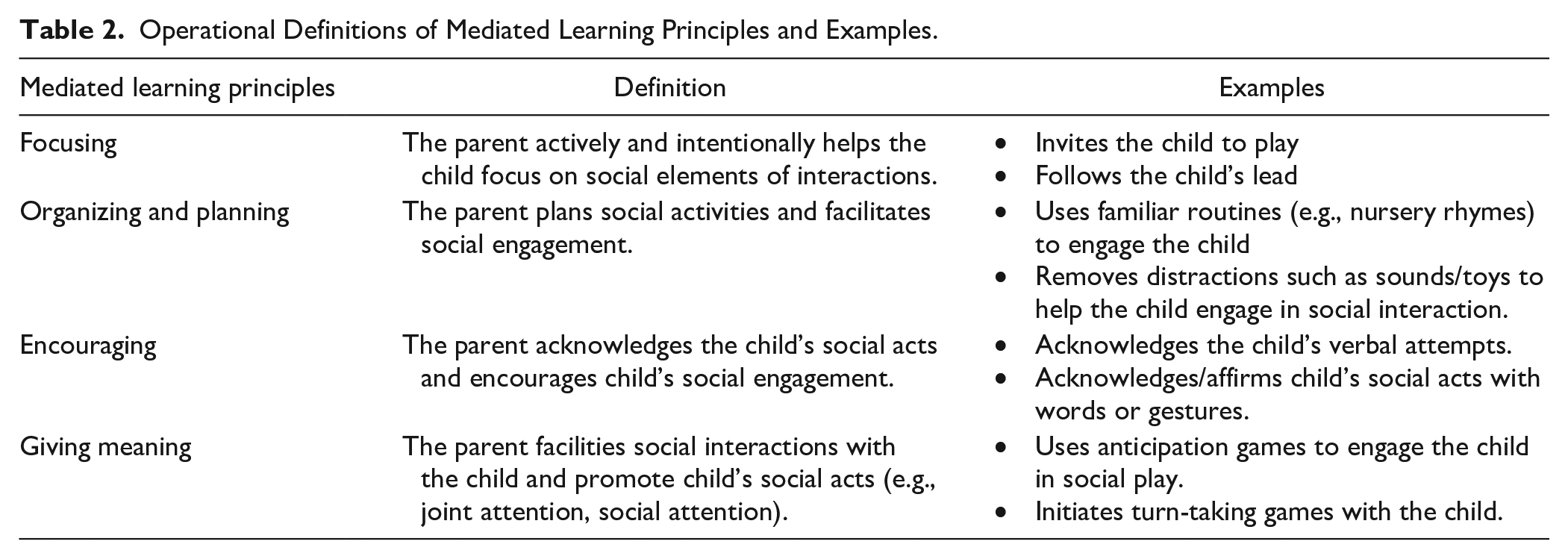
As noted, video recordings of parent–child interaction were made preintervention and postintervention and used to code parents’ application of mediated learning principles. All videos were recorded at participants’ homes. The Mediation of Social and Transactional Engagement Measure (MOSTE; Schertz, Horn, & Liu 2018) is a partial interval observational coding system that assesses parents’ application of the mediated learning principles FO, OP, GM, and EN. Expanding (EP) was not analyzed in the MOSTE because it occurred mostly outside the 10-minute parent–child interactions videos. As parents were often out of view at the beginning of recording as the recording was being set up, the video was cut down to 5 minutes as coders were unable to code parents’ application of meditated learning principles if parents were out of the frame. For each 5-minute video, videos were split into 15-second intervals for use in a partial interval coding system; thus, there were total of 20 codable intervals for MOSTE coding. Parents’ application of each mediated learning principle was coded once per interval as the presence of targeted actions, regardless of how many times they occurred in an interval. The metric of this measure is the total number of intervals containing one or more instances in which parents applied mediated learning principles. Operational definitions of mediated learning principles are presented in Table 2. The two coders, graduate assistants, were trained to 85% agreement for reliability. Coders were blind to group conditions. Interrater reliability was calculated by Cohen’s Kappa based on a double coding of a random selection of 25% of videos across all participants. The mean kappa for FO is 0.85 (0.75–0.92), 0.79 (0.64–0.95) for OP, 0.88 (0.84–0.92) for GM, and 0.80 (0.72–0.86) for EN.
Operational Definitions of Mediated Learning Principles and Examples.
Data Analysis
First, we analyzed descriptive statistics (see Table 3) and ensured the assumptions were met for multivariate analysis of variance (MANOVA), which we used to examine mean differences between intervention and control groups in parents’ application of mediated learning principles before and after the intervention. Bonferroni correction was used when examining the analysis of variance (ANOVA) results. Statistical analyses were performed in SPSS 25.
Descriptive Statistics of Dependent Variables.
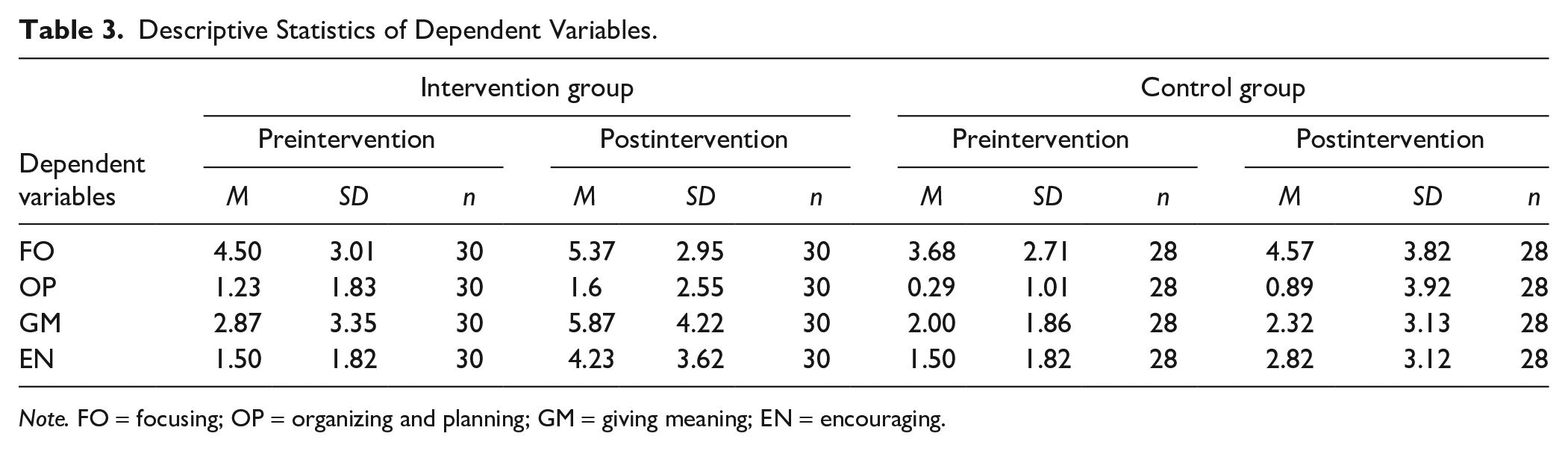
Note. FO = focusing; OP = organizing and planning; GM = giving meaning; EN = encouraging.
Results
A total of 58 parent–child dyads were included in the MANOVA analysis. Two families in the control group (n = 28) did not complete the postassessment, resulting in unequal sizes of the two groups, but the largest cell size (n = 30) was not more than 1.5 times larger than the smallest cell size (n = 28), so the assumptions of MANOVA test were not violated. Table 3 shows the descriptive statistics for the coded variables. Preintervention differences between groups in parent and child characteristics were not detected (see Table 1).
Group Differences on Parents Application of Mediated Learning Principles
There were no significant differences between the intervention and control groups’ application of mediated learning principles in the preintervention assessment (see Table 4), Wilk’s
Group Differences at Preintervention and Postintervention.
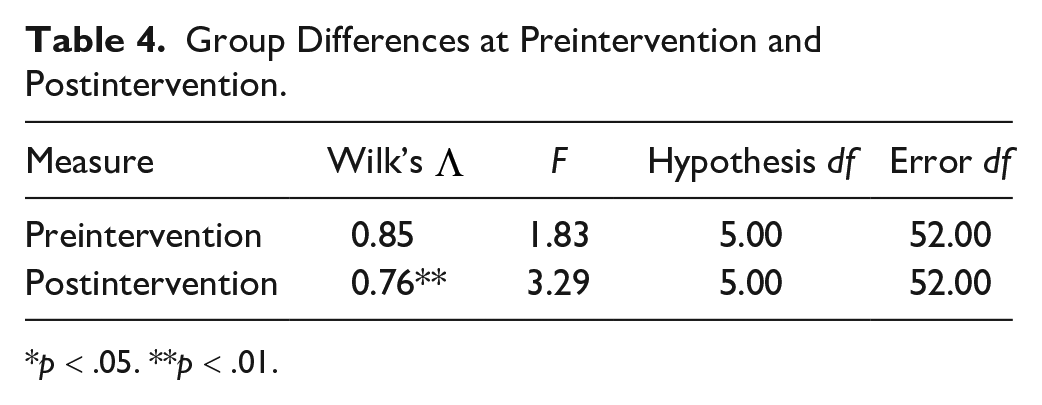
p < .05. **p < .01.
Effects on Parents’ Outcome at Postintervention
For the intervention group, significant gains were detected in parents’ application of mediated learning principles at postintervention (see Table 5), Wilk’s
Multivariate Effects on Predifferences and Postdifferences.

p < .05. **p < .01.
As we found significant differences between the preassessment and postassessment for the intervention group, we examined the univariates ANOVA results (see Table 6 and Figure 1). The intervention group had made significant gains in GM and EN between preintervention and postintervention assessments, F(1, 58) = 9.29,
Univariate Effects on Preassessment and Postassessment.

Note. FO = focusing; OP = organizing and planning; GM = giving meaning; EN = encouraging.
p < .05. **p < .01.
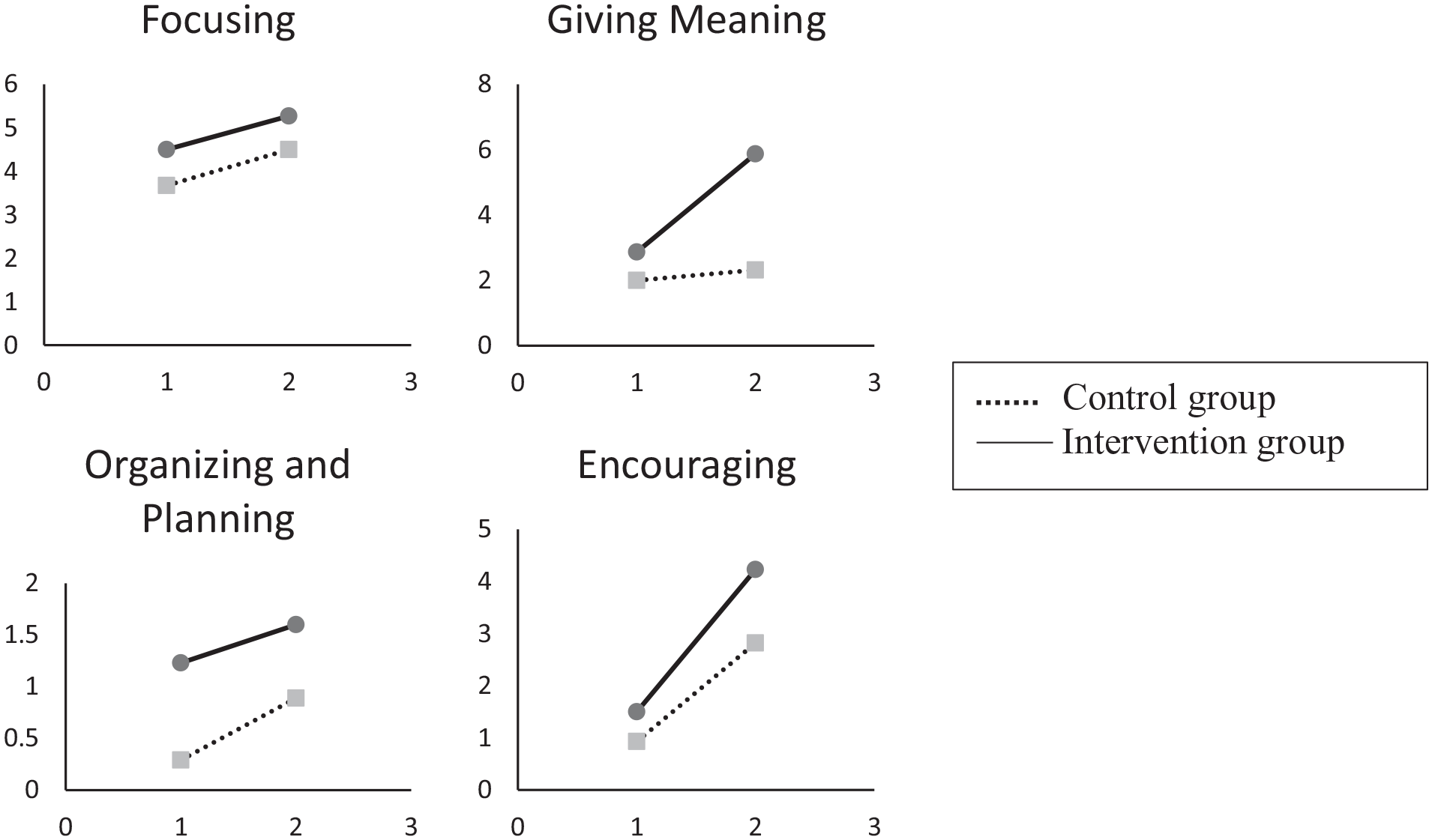
Group differences on parents’ application of mediated learning principles.
Discussion
As hypothesized, parents in the intervention and control groups were not significantly different in their use of mediated learning principles at the beginning of this study. The results of the postassessment indicate that parents in the intervention group made significant gains in application of mediated learning principles and developed the competency to apply them in parent–child interactions, whereas the control group parents did not. These findings extend findings of previous parent-mediated intervention studies (Ingersoll et al., 2016; Rogers et al., 2019; Shire et al., 2016) in which parents who received targeted support maintain high fidelity to general intervention principles and develop their capacity to create intervention activities consistent with those principles by interacting with their children in ways that support learning.
Earlier studies have demonstrated that the JAML intervention has positive effects on children’s preverbal social communication development (Schertz et al., 2013; Schertz, Odom, et al., 2018). This study found that parents’ application of mediated learning principles varied systematically by treatment condition at postintervention assessment. Supporting parents’ use of mediated learning principles, rather than using preplanned scripted activities to teach their children to follow directions, was intended to help parents build their capacity to establish reciprocal social interactions with their toddlers across widely varying conditions. Also, parents learned to differentiate social initiations from behavioral requests and to meet their children’s varying levels of social communication needs. In this respect, it addresses the core social challenges for children with autism as they are defined by Mundy and Crowson (1997).
Mediated learning principles emphasize social learning to promote children’s preverbal social communication development (Schertz, Call-Cummings, et al., 2018). Parents use the intervention principles to guide playful social interactions with their children, which support joint attention development through natural interactions. Mediated learning principles provide flexibility for cultural adaptations and encourage parents to integrate child learning into family routines and daily interactions. During the JAML intervention, parents were encouraged to recognize their own competence in adapting mediated learning principles to their own home settings.
As research has found that parents of children with autism often experience difficulties in establishing social interactions with their children, supporting parents’ generalization is essential in parent-mediated interventions (Wainer et al., 2017). This study demonstrated that parents who received the JAML intervention improved in applying mediated learning principles as they creatively integrated intervention content in everyday parent–child interactions. Parents gained knowledge that strengthened their ability to provide social learning opportunities across contexts and to help their children with autism generalize their learning. During the early childhood period, parents provide primary interactions during daily routines, and how parents use these as natural learning opportunities directly affects children’s language and social communication development (Siller & Sigman, 2008). Parents who have difficulties establishing early transactional interactions with their children may be especially challenged to provide the social-emotional learning opportunities their children need, an effect that may be magnified for children with autism. If the ultimate goal of parent-mediated intervention is to build parents’ capacity to facilitate child’s social communication, it is necessary to evaluate these competencies. When parents remain competent in the use of mediated learning principles in interacting with their children across settings, they are likely to support the children’s social communication development in the long run. Longitudinal studies are needed to investigate parents’ ability to maintain these competencies over time. Future research is also needed to determine whether parents’ competencies mediate children’s intervention outcomes.
While mounting evidence now supports the importance of involving parents in such interventions, there is no consensus on how to best support parents’ outcomes and maintain their capacities (Kemp & Turnbull, 2014). In early intervention studies, parents’ outcomes have received less attention than children’s outcomes, and the literature lacks clear demonstrations of how parents’ learning is promoted during interventions (Beaudoin et al., 2014). This study focused on parents’ learning outcomes and found that parents’ competencies in applying mediated learning principles may develop when they become active learners in facilitating parent–child interactions and use their own judgment in adapting daily family interactions to promote child learning. Assessing parents’ learning outcomes provides one indication of whether such development has occurred. It is unclear to what extent parents’ growth in this study related to factors such as self-efficacy. Future studies are needed to investigate which components of the intervention are most likely to bolster parents’ competencies and self-efficacy as well as whether and how parents’ self-efficacy directly or indirectly influences children’s intervention outcomes.
The current literature has limited information regarding how well interventionists support parents’ learning (Beaudoin et al., 2014; Wainer & Ingersoll, 2013) as most are trained to work directly with children rather than to directly help parents to support child learning. These findings suggest that, rather than providing preplanned activities, interventionists can use mediated learning principles to promote parents’ competency.
Limitations and Future Directions
A limitation of this study is the small sample size. Future replications with larger samples are needed to further validate the effects of JAML intervention on parents’ outcomes. In addition, the current findings cannot be broadly applied to all parent-mediated interventions because JAML is unique in its specific focus on parents’ generalized use of mediated learning principles. One additional limitation is that the majority of the participants were white, which limits generalizability across race and ethnicity. Future research should examine the degree to which cultural background or other demographic variables might affect intervention outcomes.
Conclusion
These findings contribute to the empirical evidence of the positive effects of the JAML parent-mediated intervention on both parents’ and children’s outcomes and provides further support for bolstering parents’ active leadership in the intervention to enhance their competency in generalizing its principles within natural settings. The current study demonstrates that parents’ roles can go beyond following preplanned strategy recommendations and suggests the potential benefits of integrating parents’ conceptual learning using family-capacity building approaches. Investigating how parents apply intervention principles in daily contexts furthers our understanding of possible facilitators or barriers to parent learning in natural settings (Breitenstein et al., 2010; Wainer & Ingersoll, 2013).
Future studies are needed to examine the association between parents’ competencies and children’s outcomes, and whether other factors contribute to parent outcomes, such as self-efficacy. Moreover, investigations of the relationship between parents’ competencies and child outcomes across social economic and educational backgrounds are needed. Such research should identify the variables that mediate or moderate the intervention outcomes for both parents and children.
Footnotes
Declaration of Conflicting Interests
The author(s) declared no potential conflicts of interest with respect to the research, authorship, and/or publication of this article.
Funding
This study received funding from the Indiana University Social Sciences Research Funding Program, Office of the Vice Provost for Research (grant no. 2241754/FRSP).
