



Abstract
Young children with and without disabilities who are bilingual or in the process of learning multiple languages have many strengths; however, educational policies and bias related to bilingualism for children from linguistically minoritized groups have typically included deficit-based views. The purpose of this systematic review was to identify how researchers describe these children and their caregivers. Thirty research studies were included in the review. Each study was published in Infants and Young Children, Journal of Early Intervention, or Topics in Early Childhood Special Education between 1988 and 2020. Studies were coded to determine participant characteristics and whether deficit- or strength-based descriptions of participants were used. Although researchers’ descriptions of participants’ linguistic backgrounds varied, most were English-centric, and deficit-based descriptions of bilingualism were more prevalent than strength-based descriptions. Preliminary recommendations are provided for describing children and families from linguistically minoritized communities and including strength-based language in research and practice.
The number of children in the United States growing up in a bilingual context has grown exponentially in the 21st century (U.S. Census Bureau QuickFacts: United States, 2010). Twenty-eight percent of children enrolled in Head Start come from homes in which the primary language is one other than English (Office of head start-service snapshot, 2016–2017) and 33% of children in public primary and secondary schools are considered to be bilingual (Turner et al., 2016). As more bilingual or dual language learning (DLL) children enter school, it is crucial for early childhood practitioners to know how to best support their academic and linguistic growth (Zepeda et al., 2011). Fortunately, the number of research studies including children who speak languages other than (or in addition to) English has also grown in the last decade (e.g., Hur et al., 2020; Lund et al., 2017).
Recent research has identified many important characteristics of bilingual learning. Children learning English and another language (or languages) (a) can learn more than one language simultaneously without causing confusion or developmental delay (Guiberson, 2013); (b) benefit from bilingual instruction that supports their home language when they speak a language other than English at home (López & Greenfield, 2004); (c) benefit from bilingual instruction as compared with instruction in English only (Farver et al., 2009); and (d) have cognitive, academic, and social advantages compared with their monolingual peers (e.g., Bialystok & Martin, 2004). Despite the growing empirical evidence in favor of bilingualism, sociopolitical ideologies have shaped American society—often centering policy around English speakers and placing English (as spoken by White middle-class and upper class Americans) as superior to other languages, particularly when those languages are spoken by people who are not White (Flores & Rosa, 2015). These racialized views of language have adversely affected individuals’ perceptions of bilingualism and education policies related to bilinguals in the United States (Nieto, 2009), and thus are likely to have had an impact on early childhood special education research. In this article, we examine how early childhood researchers are describing children and caregivers who are bilingual or learning two or more languages, and determine whether researchers are using strength- or deficit-based language related to bilingualism.
Historical and Contemporary Perceptions and Policies Related to Bilingualism
Critical race theory (CRT) provides a grounding framework for understanding the historical and contemporary sociopolitical ideologies that have shaped people’s perception and educational policies surrounding bilingualism in the United States (Flores & Rosa, 2015; Rosa & Flores, 2017). According to CRT, racial categorizations are not biological, but rather a social construct created to maintain the power of Whites within economic and legal institutions (Crenshaw et al., 1995). Raciolinguistics is a subcategory within CRT focusing on the examination of how the construct of race is associated with individuals’ language use (Rosa & Flores, 2017). Historically, when White Europeans colonized the Americas, they deemed the languages spoken by Indigenous people as “less complex and thus subhuman” (Rosa & Flores, 2017). These ideologies created language hierarchies, in which the languages spoken by White Europeans were perceived as superior to the languages spoken by Indigenous people who were not White. In our contemporary American society, the English spoken by Whites (excluding Spanish-speaking people who identify as Latinx and White) continues to be the language of power and prestige, and the metric used to measure linguistic aptitude (Rosa & Flores, 2015). Consequently, the English spoken by Whites is considered the default, and other languages and language varieties (e.g., African American English) are considered deviant from the “norm.” This false idea that the English spoken by Whites is superior to the language(s) or language varieties spoken by people who are not White (despite the lack of biological differences among groups of people) is an example of how language is connected to race in the United States (Flores & Chaparro, 2018). The racialization of language is a persisting artifact of the systemic and linguistic racism that continues to undergird the United States today.
Systemic racism refers to the policies, resources, and power that benefit the dominant group (i.e., people who are White in the United States) and exclude groups of people (i.e., people who are Black, Latinx, Asian, American Indian, etc.) who have historically been oppressed (Iruka et al., 2020). Linguistic racism, then, refers to power differentials between people who speak the language(s) of power (i.e., standardized American English, in the United States) and racialized people who are linguistically minoritized (see Dovchin, 2020). We operationalized the term “linguistically minoritized” to refer to racialized individuals who identify with racial and/or ethnic groups (e.g., Latinx, Black, Asian, etc.) other than White and also speak languages or language varieties other than the standardized American English most valued by Whites from middle to high socioeconomic statuses (SESs; Charity Hudley & Mallinson, 2013). We consciously apply the suffix “-ized,” in the terms “minoritized” and “racialized” rather than using the terms “minority” or “racial” to indicate the systemic oppression of people who are not White and who have historically experienced less access to positions of power and equitable opportunities in the United States. We recognize that there are contexts in which individuals who speak languages other than English (or language varieties other than standardized English) are indeed the majority (Rosa & Flores, 2017). We also acknowledge that some White, monolingual, individuals might be perceived negatively for speaking nonstandardized variations of English, such as Southern American English (Kinzler & DeJesus, 2013). The present article, however, focuses on researchers’ descriptions of young children and caregivers from linguistically minoritized groups who speak a language(s) other than, or in addition to, English.
Perceptions of bilingualism
Ideologies rooted in the idea that the language spoken by Whites is superior to other languages spoken by people who are not White in the United States continue to influence individuals’ and researchers’ contemporary perceptions of bilingualism (Nieto, 2009). Despite the benefits of bilingualism (e.g., Bialystok & Martin, 2004) and that bilingualism is the norm throughout the world (Grosjean, 2010), in the United States, many people continue to have deficit-based views of bilingualism when referring to the languages spoken by people who are not White (Charity Hudley & Mallinson, 2013). To illustrate, when listeners hear and see a bilingual person with an advanced degree who is not White speak a variation of English with influence from another language (e.g., Arabic-influenced English), they often perceive the person as being less intelligent or competent than a White, English-speaking monolingual with the same qualifications (Flores & Rosa, 2015). Furthermore, White parents from higher SES backgrounds are lauded for providing their children with opportunities to learn a second language, whereas parents who are not White are frequently discouraged from maintaining their children’s home language (i.e., the language other than English spoken at home; Flores & Chaparro, 2018). In addition, children and caregivers who are not White and speak a language other than English, or English in addition to another language, are often considered “at-risk” for academic failure, despite the benefits of bilingualism (Yosso, 2005). This deficit-based view of bilingualism stems from measuring the success of children who have been linguistically minoritized with metrics designed for White English-speaking children from higher SES backgrounds (Fránquiz et al., 2011; Liggett, 2014; Yosso, 2005).
Garcia and colleagues (2014) postulated that deficit-based views of bilingualism are rooted in linguistically racist, monoglossic ideologies derived from the desire to only speak English in the United States to form a cohesive national identity. When applying monoglossic ideologies, the goal is for children and their caregivers to speak English proficiently. Terms commonly used to refer to children who are learning English such as “English Learners,” “English Language Learners,” and “English Language Proficient” reflect monoglossic ideologies. These terms center on the standardized English spoken by White monolinguals as the point of reference, inherently applying deficit-based views to people with other linguistic backgrounds (Charity Hudley & Mallinson, 2013). Conversely, heteroglossic ideologies focus on the value of multilinguism as a salient component of individuals’ cultural identity (Garcia et al., 2014). Terms such as “Multilingual,” “Dual Language Learner,” and “Emergent Bilingual” are reflective of heteroglossic ideologies. These heteroglossic terms are centered on the experiences of people who are bilingual. Throughout the history of the United States, educational policies have been influenced by shifting monoglossic and heteroglossic sociopolitical ideologies (Flores et al., 2020).
Educational policies focusing on bilingualism
The influence of English-centric, monoglossic ideologies was seen as early as the 19th century when the U.S. government enforced regulations requiring immigrants and American Indians to assimilate to English-speaking European American culture (Nieto, 2009). It was not until the 1960s when the Civil Rights era sparked a shift in American ideology, creating the impetus for policies in support of bilingualism. For example, the Bilingual Education Act (BEA), passed in 1968, was the first official federal recognition of children who spoke languages other than English at home (Nieto, 2009). With this legislation, school administrators were encouraged to explore new educational approaches to support the needs of children who were considered to be ethnic and linguistic minorities in the United States; however, in the 1980s, President Ronald Reagan signed legislation that limited the funding for bilingual education under the BEA (Miguel, 2004). As fiscal restrictions were augmented, sociopolitical shifts favored English fluency over support for bilingualism until 1994 when President Bill Clinton reauthorized the BEA and funded bilingual programs to support children’s bilingual development. However, in 2001, the BEA was discontinued with the passage of the No Child Left Behind Act, and the focus turned to evaluating children’s performance on high-stakes, standardized, English-only assessments. In 2015, the federal passing of the Every Student Succeeds Act (ESSA) reinstituted that children be assessed in the languages they speak most fluently rather than only in English (Broughton et al., 2019). Most recently, in California, the passing of the Multilingual Education Act in 2016 (Proposition 58) repealed the English-only restrictions established under Proposition 227 in 1998, once again providing children with access to bilingual education.
The contentious history of bilingual education and policies in the United States demonstrates the impact of the racialization of language on the education of children from linguistically minoritized communities. Instead of consistently providing children from linguistically minoritized groups with opportunities to develop bilingually, educational policies have typically focused solely on English-only acquisition—whereas White children from English-speaking families fill the majority of spaces in bilingual schooling options to “better their future” by being bilingual (Flores & García, 2017). This dichotomy, and focus on English-only acquisition for linguistically minoritized children is driven by the linguistically racist idea that to succeed in the United States, one should assimilate to the customs and norms established by Whites from the middle to upper class (Yosso, 2005).
The impact of English-centric, monoglossic ideologies on young children and their caregivers
Measuring success for this linguistically and ethnically diverse group of young children against an English-only, and predominantly White, “standard” is problematic because it upholds racist assumptions that children who are White, English-speaking monolinguals are superior (Fránquiz et al., 2011). Use of an English-only metric results in deficit-based views that erase the linguistic and cultural strengths that children with diverse linguistic backgrounds bring to their school and community (Yosso, 2005). Furthermore, deficit-based views suggest that some children are “at-risk” for delays simply because they do not speak English at home. This notion also applies to the misconception that parents who speak languages other than English lack the skills to engage their children in rich language interactions, when in fact, even monolingual input in a language other than English can lead to growth in English language acquisition (e.g., Ijalba, 2015).
The impact of English-centric, monoglossic ideologies on early childhood special education research
Using English-centric, deficit-based language when referring to individuals who have been linguistically minoritized can have long-lasting, negative consequences, including children’s loss of their home language, reduced self-esteem, and a disconnection between children and their cultural heritage (Aalberse & Hulk, 2018). Applying deficit-based language may also result in the propagation of commonly held myths that learning two or more languages causes confusion and inherent risk for academic failure. Trusted educators and health care professionals often disseminate these myths by discouraging parents from speaking to their children in their home language(s) and may be even more likely to do so when children have disabilities (Wilkinson & Morford, 2020). Conversely, bilingual children who are developing typically may be misdiagnosed as needing special education services (Bedore & Peña, 2008). Given the potential life-changing impact of using English-centric, deficit-based language, it is critical to examine how researchers are describing children and families from linguistically minoritized groups.
Recommendations for Describing Children’s and Caregivers’ Linguistic Backgrounds
One potential antidote to English-centric, deficit-based views of bilingualism and linguistic racism is to actively, and continuously, become anti-racist (Boutte et al., 2011). Anti-racist individuals are invested in applying practices and policies that promote equity for children, who in this case, come from minoritized linguistic backgrounds (Kailin, 2002). Applying anti-racist principles to research moves beyond supporting multiculturalism, diversity, and inclusion, by going against the status quo that defaults to deficit-based views when describing children and caregivers who have historically been oppressed (Gillborn, 2006). Professionals, policymakers, and others involved in early childhood special education can continue to address the use of deficit-based language by critically examining how children and their caregivers are described in research and practice. Scrutinizing participant descriptions and comments related to participants’ linguistic backgrounds may be one of the first steps in becoming anti-racist researchers and educators. Recent guidelines for reducing bias in scientific writing (American Psychological Association [APA], 2020) paired with existing research to promote equity when referring to individuals who speak multiple languages or languages other than English (Rosa & Flores, 2017; Yosso, 2005) provide a useful framework for reducing bias and promoting anti-racism in early intervention and special education.
Purpose
The purpose of this systematic review is to examine peer-reviewed papers in early childhood special education-focused journals to determine how researchers are describing children with delays and disabilities who are also from linguistically minoritized groups. The aim is that this article will allow for an initial conversation about recommendations for reducing linguistic bias and promoting anti-racism when describing children and adults who are linguistically minoritized. The following research questions are addressed:
Method
Search Strategy
This review was based on guidelines from Preferred Reporting Items for Systematic Reviews (PRISMA; Moher et al., 2009). The literature search included peer-reviewed articles published in three journals focused on early childhood special education research: Topics in Early Childhood Special Education (TECSE), Journal of Early Intervention (JEI), and Infants and Young Children (IYC) from the first year all three journals were in existence in 1988 to April, 2020. We first identified articles by searching the following keywords individually in the PsycINFO database for each journal: “Dual Language Learners”; “English learners”; “bilingual”; “non-English”; “multilingual”; “minority”; and “diversity.” We also conducted hand-searches of every journal by accessing individual article titles on each journal’s website.
Inclusionary Criteria
We included articles where authors reported using experimental (group and single-case studies), quasi-experimental, correlational, or qualitative research designs. We included studies in which authors reported that a portion (or all) of the participants (i.e., children, caregivers) spoke a language other than English. Systematic reviews and conceptual papers were excluded, as were studies in which only participants’ racialization/ethnicity (not linguistic background) was mentioned (e.g., Hispanic).
Study Selection Process
The titles and abstracts of all articles were screened to determine whether the article met the inclusion criteria as listed above. If all inclusion criteria could not be determined through title and abstract review alone, we reviewed the full text of the article. Articles that did not meet the inclusion criteria were omitted. Given the purpose of this review to focus on three specific journals, no snowball searching was completed on the included articles (i.e., we did not review included article reference lists or other articles which cited an included article).
Coding and Analysis
To address the first research question, we examined the title, abstract, participants, and demographic tables to determine how researchers described participants. First, we determined whether researchers specified the language(s) spoken by participants (e.g., Arabic–English speakers). Next, we determined whether other terms were used to describe participants considered to speak a language other than English (i.e., minority, person of color, underrepresented, low income), as well as terms to describe monolingual English speakers (i.e., monolinguals and majority). We also identified whether participants’ ethnic/racialized groups were described for all participants (i.e., Hispanic or Latino, Black or African American, Asian, White, Native Americans and Alaskan Natives, Native Hawaiians/Other Pacific Islanders, two or more races, or other terms such as “Latinx”). Finally, we examined the title, abstract, introduction, and participants section of each article to determine whether the researchers described participants with linguistically minoritized backgrounds as being “at-risk,” and how risk status was described.
For the second research question, we identified labels researchers used to describe participants’ linguistic backgrounds, and determined whether these terms were in line with monoglossic ideology centering English speakers as the norm (e.g., English Language Learners (ELLs), English Learners (EL)), heteroglossic ideology (e.g., bilingual, DLL), or a mix of the two (i.e., when researchers used both DLL and ELL in the paper). We then examined whether researchers’ use of these terms has changed across time by comparing the number and percentage of articles using each set of terms by year the articles were published.
The third research question was addressed by identifying strength- and deficit-based statements throughout the articles. Strength-based language was operationalized as a statement in which authors described the potential benefits of bilingualism (e.g., children who speak their home language and English experience academic and social advantages), whereas deficit-based language was defined as a statement in which authors mention negative connotations associated with bilingualism (e.g., bilinguals are likely to enter kindergarten with reduced school readiness skills). Descriptions about bilingual participants that were neither strength- nor deficit-based were coded as neutral (e.g., because hundreds of languages are spoken in India, Indian children vary in the language they speak at home.). We also determined whether the use of strength- versus deficit-based language changed over time.
To answer the research questions, the first and second authors trained the remaining authors on article coding procedures until 85% accuracy was reached on an initial set of six practice articles. Each article included in the review was then coded by at least two authors. Intercoder reliability was calculated by adding the number of agreements across all studies (n = 453), dividing by the total number of possible agreements (n = 491), and then multiplying by 100. Overall reliability was judged to be adequate at 92%. Disagreements were addressed by the original coders coming to consensus with the first two authors.
Codes were entered on Microsoft Excel. Quantitative data were calculated (e.g., number of studies that used the label “dual language learner”). Descriptive information was analyzed by the first two authors to identify common themes (e.g., how risk was described when referring to participants who spoke a language other than English at home; examples of strength- vs. deficit-based language).
Results
Figure 1 shows the article selection process which resulted in 30 articles meeting inclusion criteria for the review (15 from JEI, 10 from TECSE, and five from IYC). The design of the studies reviewed was distributed as follows: 15 correlational, five descriptive, three single-subject design, three qualitative, three randomized group design, and one mixed method. Table 1 provides additional detailed descriptions of the study purpose, and a summary of participant descriptions.

Overview of article selection process.
Guidelines When Describing Children and Caregivers From Linguistically Minoritized Groups.
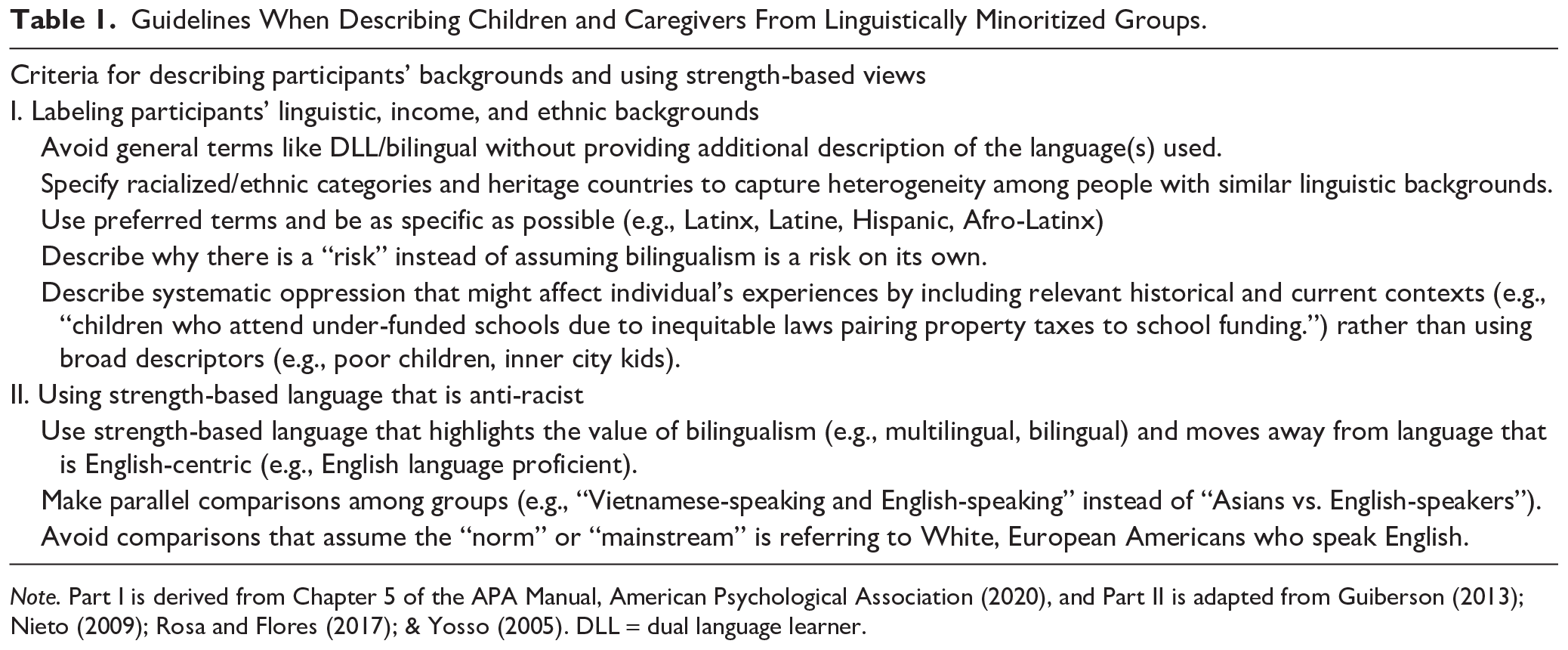
Note. Part I is derived from Chapter 5 of the APA Manual, American Psychological Association (2020), and Part II is adapted from Guiberson (2013); Nieto (2009); Rosa and Flores (2017); & Yosso (2005). DLL = dual language learner.
Participant Descriptions
To address the first research question, we coded authors’ descriptions of participants in terms of their linguistic background, racial/ethnic background, SES, and conceptualization of “risk.” Authors from most studies (83%) specified that the participants spoke Spanish. The other languages specified were Mixtec, Cantonese, Arabic, Vietnamese, Tagalog, American Sign Language, Russian, and French Creole. Only four studies (13%) included specific terms to refer to the monolingual English-speaking participants, such as “non-English learners” and “English-speakers” (i.e., Greenwood et al., 2010; Guarino et al., 2010; Jackson & Callender, 2014; Peredo et al., 2020). Authors in 25 studies (83%) included racial/ethnic backgrounds (e.g., Carta et al., 2014; Olmsted et al., 2010). Authors in 10 of these 25 articles also specified participants’ country of origin (i.e., Mexican, Puerto Rican, Filipino, Haliwa-Siponi, Chinese, Russian) (e.g., Guo et al., 2013; Hough & Kaczmarek, 2011). Other terms used to describe participants who spoke languages other than English included labels such as “minority,” “racial/ethnic minority,” and “linguistic minorities” (n = 13, 43%), whereas more general terms such as “diverse cultures” or “diverse backgrounds” (i.e., Ciupe & Salisbury, 2020; Spencer & Slocum, 2010; Williams et al., 2013) were used in three studies (10%). McHatton and Correa (2005) were the only ones to include the term “participants of color,” while Bruder et al. (1991) described participants as being from the “inner city.” Authors in four studies (13%) labeled participants using the terms such as “vulnerable” or “underserved” (i.e., Bruder et al., 1991; Diamond & Baroody, 2013; Missall et al., 2006; San Antonio et al., 2014). Authors in two studies (6%) described participants as “migrants” or “immigrants” (i.e., Gonzalez & Uhing, 2008; Shapiro & Derrington, 2004).
Authors in most studies (n = 24, 80%) also described participants in terms of their SES. For example, authors in 16 articles (53%) referred to participants as “low income” or as having a “low socioeconomic status,” four (13%) described participants as “economically disadvantaged,” and two (7%) stated that participants lived in poverty (i.e., Greenwood et al., 2010; Missall et al., 2006). Authors from another two studies noted that participants were eligible for public assistance or free/reduced school lunch programs (i.e., Cambray and Salisbury, 2010; Jackson & Callender, 2014).
In regard to whether authors described “risk” for the children who spoke a language other than English at home, 18 (60%) studies included specifications of why participants were considered at-risk for academic difficulty (e.g., Bruder et al., 1991; Greenwood et al., 2011; Harris et al., 2016; McHatton & Correa, 2005). For example, McHatton and Correa (2005) stated, They [Latinx Spanish-speakers] are more likely to live in poverty and face disproportionate health risk factors, including lack of access to care and higher rates of asthma and diabetes, and are at high risk for behavioral and developmental disorders resulting in early placement in special education. (p. 131)
Authors of seven studies (23%) mentioned that participants were simply at-risk for being DLLs (e.g., Hanson et al., 2011; Johnson & Walker, 1991; Missall et al., 2006; Odom et al., 2019). Authors in the remaining five (17%) studies did not mention risk (e.g., Ciupe & Salisbury, 2020; Greenwood et al., 2010; Loomis & Mogro-Wilson, 2019).
Use of Monoglossic Versus Heteroglossic Terminology
Coding related to participants’ linguistic characteristics showed that more than half of the studies (62%) used monoglossic terminology to describe participants’ linguistic background. For example, authors in 11 studies (36%) described participants as “not speaking English” or “speakers of languages other than English.” Authors from another eight studies (26%) used the terms “English Language Learners” or “English Learners.” The terms “English as a Second Language” and “Limited English Proficient” were used less frequently, 10% and 3%, respectively. In contrast, other authors used heteroglossic terms to describe participants, such as “bilingual” (n = 10, 33%) and “Dual Language Learner” (n = 6, 20%).
Figure 2 provides a visual representation of the use of monoglossic and heteroglossic terminology across time. No studies from the 1990s used solely monoglossic terms; however, 37% of the studies published in the 2000s relied on monoglossic terms. Although no studies published since 2016 exclusively used monoglossic terminology, at least one study in each year used a mix of monoglossic and heteroglossic terms.

Early childhood researchers’ use of labels to describe children’s and caregivers’ linguistic backgrounds in studies published from 1900 to 2020. Monoglossic labels refer to English-centric terms including “English Language Learners” and “English Language Proficient.” Heteroglossic labels refer to terms centering multilingualism including “Dual Language Learners,” “bilinguals,” and “multilinguals.”
Strength- Versus Deficit-Based Language When Referring to Bilingualism
Of the 30 articles reviewed, authors from only two articles (7%) included strength-based language when discussing bilingualism (i.e., Odom et al., 2019; Loomis & Mogro-Wilson, 2019). For example, Loomis and Mogro-Wilson (2019) described benefits of bilingualism by stating that bilingualism is, “. . . a protective factor that is positively associated with socioemotional development in Hispanic preschoolers who are economically disadvantaged” (p. 118). Authors from two studies (7%) included both strength- and deficit-based language (i.e., Hanson et al., 1997; Spencer et al., 2019). The majority of authors, however, (n = 21, 70%) only used deficit-based language. The five remaining sets of authors (17%) used neutral language when describing participants’ linguistic backgrounds (i.e., Greenwood et al., 2010; Harris & Norton, 2016; Jackson & Callender, 2014; Johnson & Walker, 1991; Marshall et al., 2020). When examining whether researchers’ use of strength- versus deficit-based language has changed across the last three decades (see Figure 3), we did not see any clear patterns indicating researchers increasing their use of strength-based language over time or within the years associated with particular bilingual education policies. Although the authors from two studies (Loomis & Mogro-Wilson, 2019; Odom et al., 2019) published in 2019 were the only ones to exclusively use strength-based language when discussing bilingualism, two studies that have been published more recently (2020) described bilingualism in terms of deficit-based language only.
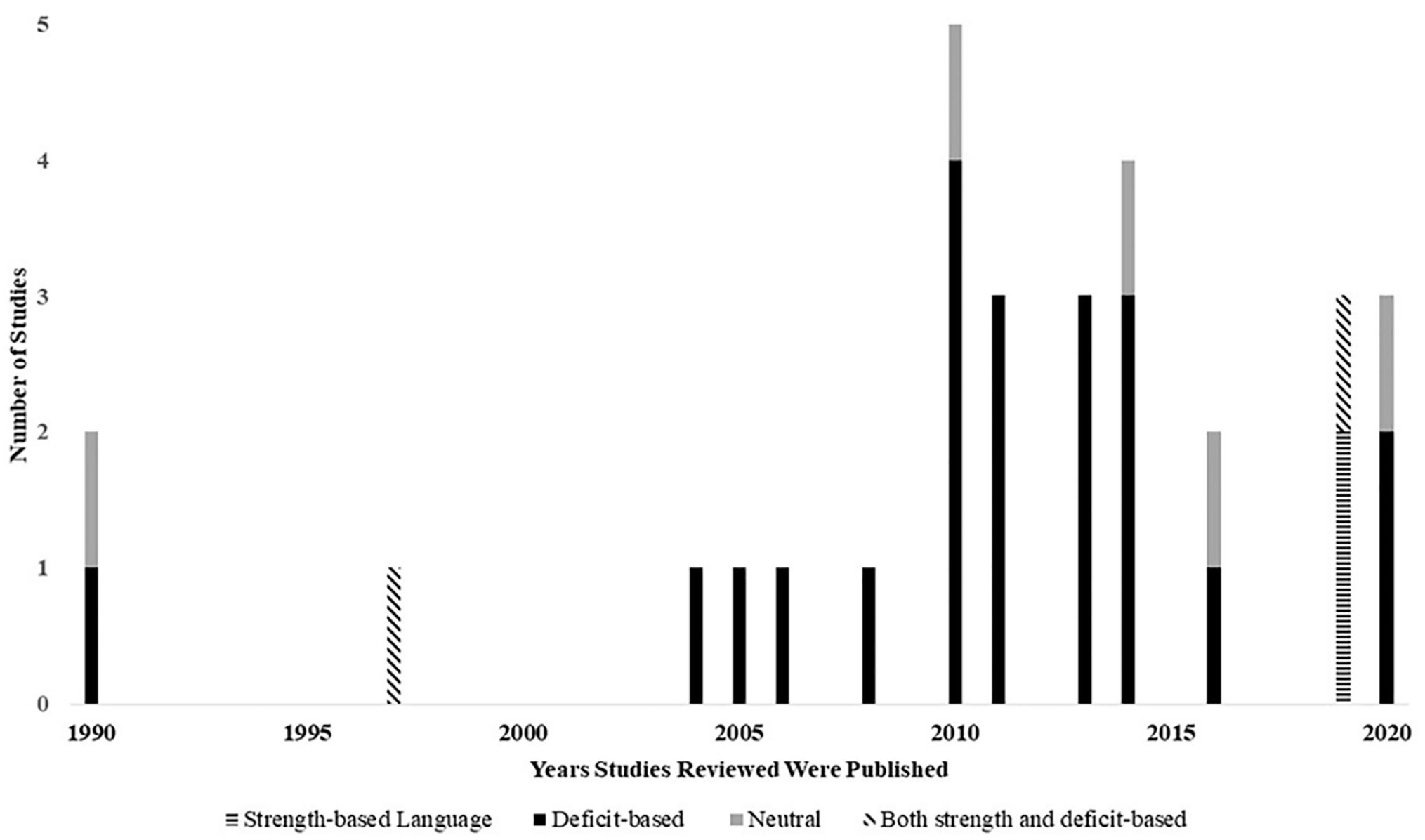
Early childhood use of strength- versus deficit-based views from 1900 to 2020. Studies with strength-based views discussed the benefits and value of bilingualism. Studies with deficit-based views supported the idea that being bilingual placed individuals at a disadvantage. Studies with neutral language did not specifically mention the impact of bilingualism.
Authors’ strength-based descriptions of participants who were linguistically minoritized focused on three themes: (a) the importance of fostering bilingual children’s home language to promote their academic success (e.g., “For children’s whose first language is Spanish, there is growing evidence to suggest dual language instructional approaches can lead to greater academic achievement and proficiency in their second language,” Spencer et al., 2019, p. 204); (b) the value of linguistically diverse classrooms (e.g., “The diversity in educational programs today reflects the richness of unique characteristics found in the larger society,” Hanson et al., 1997; p. 309); and (c) the role of bilingualism in reducing children’s adversities (e.g., “Bilingualism had also been found to be a protective factor that is positively associated with socioemotional development in Hispanic preschoolers . . .,” Loomis & Mogro-Wilson, 2019, p. 118).
The themes that emerged from analyzing authors’ deficit-based descriptions of participants included (a) the negative educational and social-emotional outcomes of not speaking English fluently (e.g., “. . . linkages regarding DLL’s English language proficiency and its negative relation to both internalizing and externalizing problem behaviors,” Hagan-Burke et al., 2016, p. 93); (b) the impact of not speaking English on children’s and caregivers’ access to educational services (e.g., Guarino et al., 2010); (c) the negative impact of not being “acculturated” to European American culture (e.g., “Acculturation in the United States, particularly in the educational system, is associated with parents’ deliberate attention to develop young children’s school readiness,” Manz et al., 2014, p. 187); and (d) parents’ limited English skills and SES when coming to the United States—thought to negatively affect children’s academic success (e.g., Bruder et al., 1991).
Discussion
The purpose of this systematic review was to identify and discuss how researchers in early childhood special education have described children and caregivers from linguistically minoritized backgrounds, and to consider whether these descriptions have been influenced by sociopolitical ideologies regarding bilingualism. The findings from this review revealed that although there was variability in the labels early childhood researchers used to describe children’s and caregivers’ linguistic backgrounds (and no obvious changes in patterns of use across time), most researchers applied English-centric, monoglossic, deficit-based views.
When examining how researchers have described children’s and caregivers’ linguistic backgrounds, a major finding was that although most researchers provided general information about participants’ racialized and ethnic groups, few included specific information about the participants’ ethnicities, countries of origin, or the specific languages spoken. A limitation of simply using the generalized term “Dual Language Learners” is that it assumes that members from linguistically minoritized groups are homogeneous, when in reality, even DLLs who speak the same languages can vary in their country of origin, dialect, experience with both languages, and racialized grouping. To illustrate, many people from Latin America speak Spanish, yet self-identify as a variety of ethnic and racialized groups (e.g., Afro-Latinx, Indigenous, White, Latinx/Latino, and so on). Although all Spanish speakers living in the United States might be from a minoritized linguistic group, their self-identification might vary. Providing specific details to describe participants can result in more accurate interpretations of research findings.
Another striking finding was that only 60% of researchers whose studies were reviewed provided specific details on why children who are from linguistically minoritized communities were considered at-risk for academic failure. Almost half of the authors of studies included in the review stated that participants were “at-risk” because they spoke a language other than English. This problematic assertion supports the erroneous assumption that speaking multiple languages puts individuals at-risk for academic failure (Guiberson, 2013). Once again, the notion that children from linguistically minoritized groups are “at-risk” solely because they speak (or are learning) two or more languages reflects linguistically racist perspectives placing the standardized English spoken by Whites as the metric of success in the United States (Rosa & Flores, 2017). Simply stating that participants are at-risk for academic failure for speaking multiple languages fails to acknowledge how children from linguistically minoritized groups often experience linguistic racism, and English-only policies unsupportive of their instructional needs (e.g., Castro et al., 2011).
One of the most notable findings related to the second research question was that more than half of the researchers used labels reinforcing monoglossic, English-centric ideologies (Garcia et al., 2017). These labels included “English Leaners,” “English Language Learners,” and “Non- Speakers of English.” Terms that center around English reinforce the linguistically racist idea the standardized English (primarily spoken by Whites) is the language of primary value (Flores & Rosa, 2015). Using English as the point of reference assumes that English is the “norm,” and that an individual’s goal should focus on only speaking English, rather than on being bilingual. Using English-centric descriptions can have a negative impact on educators’ and clinicians’ perceptions of children’s home language (Nieto, 2009) which may lead to children’s reduced self-esteem, and eventually, language loss affecting children and parents’ communication (Aalberse & Hulk, 2018). Terms associated with heteroglossic ideologies (e.g., “bilingual,” “multilingual,” “Vietnamese-speaking”) center on the experiences of children who are linguistically minoritized, rather than on the experiences of White, English-speaking monolinguals (Garcia et al., 2017). When examining whether the use of monoglossic versus heteroglossic terms has changed over time, although there appears that researchers have not used solely monoglossic terms in recent years, it is difficult to draw conclusions, given the limited sample and not knowing whether the years the studies were published corresponded directly with when the studies were conducted. The third research question addressed the extent to which researchers used strength-based versus deficit-based language when referring to participants’ linguistic characteristics. Notably, only 17% of the authors whose studies we reviewed mentioned the potential benefits of bilingualism. Most authors applied deficit-based language when referring to participants from linguistically minoritized groups. These descriptions centered primarily on the negative academic and social impact of not speaking English, and the adverse effects of not “acculturating” to middle-class to upper class cultural norms or speaking standardized English. For example, when describing Puerto Rican parents’ access to an early intervention program, Bruder and colleagues (1991) stated that part of the reason why children had poorer educational outcomes was because their parents were having their children at a very young age per U.S. standards, rather than acknowledging the systematic barriers that some Puerto Ricans might experience such as not having access to Spanish–English bilingual early interventionists, or coming from an island with significant economic turmoil. This example highlights how linguistically minoritized groups are often compared with the culture of prestige in the United States, often defaulting them as deficit (Yosso, 2005).
Furthermore, researchers’ use of deficit-based language has not changed distinctly over time, and deficit-based views of bilingualism appear to persist, regardless of the educational policies that are in place, or recency of the published articles. These findings are important as they highlight that simply adapting new terminology does not necessarily equate to changes in ideological perspectives and anti-racist actions (Flores & Schissel, 2014).
Implications
Children and caregivers who are linguistically minoritized are likely to benefit greatly from ideological shifts that center them as unique communicators with inherent linguistic value and experiences (López, 2008). Early childhood special education researchers and educators can lead the broader field of education by critically examining the perspectives they are applying when describing and working with children and caregivers from linguistically minoritized groups. One promising way of achieving this is to first acknowledge the impact of colonization and linguistic racism on peoples’ perspectives and educational policies surrounding bilingualism. Then, it is vital to examine whether the labels (e.g., “Dual Language Learners,” “English Language Learners”), descriptors (e.g., “risk”), and intended educational outcomes (e.g., becoming bilingual vs. only English proficient) we espouse are in line with either deficit-based views that apply English-centric, monoglossic ideologies, or strength-based views that apply heteroglossic ideologies. One primary recommendation is to not assume that the “norm” is the standardized English spoken by Whites from higher SES backgrounds, and instead, describe the impact of systemic and linguistic racism on children’s educational outcomes and create research studies and educational programming that affirm and value the languages and identities of children and caregivers from linguistically minoritized groups.
Call to Action and Future Directions
As researchers, we can apply an anti-racist framework that focuses on (a) self-reflection of our assumptions and socialization around bilingualism (e.g., Kailin, 2002); (b) acknowledgment of how children and caregivers from linguistically minoritized groups are affected by linguistic and systemic racism (e.g., Escayg, 2019); (c) changes to the scientific peer review process to include a more rigorous examination of how researchers are discussing “risk” (e.g., APA, 2020); (d) collaborations with multidisciplinary researchers in fields (e.g., sociology, public health) that study topics affecting the education of children and caregivers from linguistically minoritized groups; and (e) incorporation of heteroglossic, strength-based perspectives that celebrate children’s and caregivers’ enriching linguistic identities (e.g., Otheguy et al., 2019). As early childhood researchers, we could benefit from ongoing professional development focusing on anti-racism, the history of language and race in the United States, and heteroglossic ideologies supporting bilingualism.
Table 1 offers initial guidelines for evaluating and conducting research involving children and caregivers from linguistically minoritized backgrounds. These guidelines are divided into two categories. The first category contains recommendations for describing children and caregivers from linguistically minoritized groups. The second category includes recommendations for using strength-based language that acknowledges the systemic oppression, as well as the benefits of bilingualism. The main theme connecting these two categories is to be as specific as possible when describing individuals from linguistically minoritized groups. These guidelines are a first attempt at providing recommendations for reducing bias and promoting anti-racism when describing linguistic characteristics of children and caregivers. They are not meant to be static. Future studies could expand these guidelines when describing children and caregivers who speak different varieties of English, and for descriptions of other characteristics, such as gender or disability.
Conclusion
As we become more conscious of how our descriptions and perceptions of children and caregivers from linguistically minoritized groups can contribute to linguistic racism, it is critical we question the status quo and dynamically change how we frame our work to reflect our current understanding. Many researchers and educators working within the United States (regardless of their racialized and linguistic background) were socialized to assume the language of prestige and power is the standardized English spoken by Whites from higher SES backgrounds. Not one of us is unscathed by this socialization. Becoming anti-racist researchers is an ongoing process, and it is acceptable to evolve our research and practice as our understanding progresses.
Supplemental Material
sj-pdf-1-tec-10.1177_0271121421991222 – Supplemental material for Who is Centered? A Systematic Review of Early Childhood Researchers’ Descriptions of Children and Caregivers From Linguistically Minoritized Communities
Supplemental material, sj-pdf-1-tec-10.1177_0271121421991222 for Who is Centered? A Systematic Review of Early Childhood Researchers’ Descriptions of Children and Caregivers From Linguistically Minoritized Communities by Xigrid T. Soto-Boykin, Anne L. Larson, Arnold Olszewski, Veena Velury and Anna Feldberg in Topics in Early Childhood Special Education
Footnotes
Declaration of Conflicting Interests
The author(s) declared no potential conflicts of interest with respect to the research, authorship, and/or publication of this article.
Funding
The author(s) disclosed receipt of the following financial support for the research, authorship, and/or publication of this article: This work was supported by Grant R324B180004 from the Institute of Education Sciences, U.S. Department of Education, awarded to the University of Kansas.

Supplemental Material
Supplemental material for this article is available online.
References
Supplementary Material
Please find the following supplemental material available below.
For Open Access articles published under a Creative Commons License, all supplemental material carries the same license as the article it is associated with.
For non-Open Access articles published, all supplemental material carries a non-exclusive license, and permission requests for re-use of supplemental material or any part of supplemental material shall be sent directly to the copyright owner as specified in the copyright notice associated with the article.
