



Abstract
Parents are encouraged to read to their children as early as possible. Multiple studies of parent–child shared book reading with children ages 3 years and older have shown positive outcomes on parent use of language-based strategies and child language development. However, few studies have included children under the age of 3; thus, little is known about interventions for parent–child shared book reading practices with infants and toddlers. In this systematic review, we examined 12 studies of interventions that included practice opportunities to support parent–child shared book reading practices with infants and toddlers between the ages of birth and 3 years. Across the studies, parents were taught to use interactive shared book reading strategies through a variety of teaching functions; however, only six studies included direct measurement of parent strategy use and child behaviors during shared book reading interactions. Directions for future research and the implications of this review are discussed.
Keywords
Interactive shared book reading (ISBR) includes strategies to support adult–child interactions and conversations regarding children’s books (U.S. Department of Education, Institute of Education Sciences, What Works Clearinghouse, Early Childhood Education, 2015). This style of book reading provides multiple, enhanced opportunities for building language and literacy skills in young children, which contributes to later school readiness (Mol et al., 2009). Studies of ISBR have revealed positive outcomes for typically developing children, English learners, children with disabilities, and children at risk for disabilities (Fitton et al., 2018; Towson & Gallagher, 2014; U.S. Department of Education, Institute of Education Sciences, What Works Clearinghouse, Early Childhood Education, 2015; U.S. Department of Education, Institute of Education Sciences, What Works Clearinghouse, Early Childhood Education Interventions for Children With Disabilities, 2010); ISBR may decrease the risk for later developmental delays or disabilities in children who experience poverty (National Early Literacy Panel, 2008).
ISBR intervention studies have focused on teaching caregivers strategies to use before, during, and after shared book reading experiences (Dowdall et al., 2020; Walsh & Hodge, 2018). Strategies used before reading include teaching targeted vocabulary and making predictions about what the book might be about (Lorio & Woods, 2020; Read et al., 2019). During shared book reading, caregivers ask questions, define new vocabulary, expand or extend child utterances to provide more advanced language models, and link concepts from the story to the child’s life experiences (Rezzonico et al., 2015; Wasik & Bond, 2001). ISBR supports an understanding of print concepts, an emergent literacy skill, as caregivers allow children to turn pages in the book and identify components of books, such as the front and back covers, and title, and follow the text from left to right (Lovelace & Stewart, 2007; Treiman et al., 2016). When the book is finished, the caregiver summarizes the story and encourages the child to recall main details, favorite parts, or lessons learned from the text (Akamoglu & Meadan, 2019).
These ISBR strategies have been taught to a variety of caregivers, including parents, guardians, teachers, and day care providers. However, most studies included children between the ages of 3 and 5 years, and little is known about ISBR with parents and their children under the age of 3 despite the fact that ISBR is developmentally appropriate and recommended for these young ages (Mol et al., 2008). Parents are the primary stakeholders in executing ISBR at home with infants and toddlers. A variety of professional organizations (e.g., Read Aloud 15 MINUTES, American Speech-Language-Hearing Association, and Zero to Three) encourage parents to make shared book reading an everyday activity and to start reading to their child as early as possible. The U.S. Department of Education, Office of Intergovernmental Affairs, Education Partnerships and Family Involvement Unit (2003) recommends daily shared book reading beginning at 6 months of age, stating this experience is one of the most effective methods in helping young children learn. The period prior to 3 years is critical for language development, and ISBR may be one way for parents to support their child’s early emerging language (Kuhl, 2011).
ISBR With Infants and Toddlers
Examining ISBR interventions for children under 3 and understanding how shared book reading with infants and toddlers impacts early language and literacy development are important for providing evidence-based recommendations to parents. Unfortunately, the research on parent–child shared book reading with infants and toddlers is limited. Observational studies of parent and child behaviors during shared book reading have linked those behaviors to later child language and literacy outcomes. For example, shared book reading onset that occurred during the first year of life was found to be a strong predictor of children’s later expressive and receptive language (Karrass & Braungart-Rieker, 2005; Payne et al., 1994). In another study of 41 toddlers and their mothers, the average age of shared book reading onset was 7 to 8 months. Earlier shared book reading was related to stronger receptive vocabulary skills at age 2 (DeBaryshe, 1993).
The connection between shared book reading onset and child language development may be tied to how parents interact with their infants and toddlers during shared book reading compared with other daily routines and activities (Hoff-Ginsberg, 1991; Yont et al., 2003). For example, Gros-Louis and colleagues (2016) found that mothers were more responsive to their infant’s consonant-vowel vocalizations during shared book reading than during puppet and toy play. Mothers were noted to respond to these vocalizations with expansions and labeling of items in the book (Gros-Louis et al., 2016). Sosa (2016) also found a difference in parent–child interaction when comparing play with electronic toys, play with traditional toys, and shared book reading. Parents exposed their 10- to 16-month-old children to a higher number of content-specific words and total words during shared book reading, suggesting shared book reading resulted in increased quality and quantity of vocabulary exposure. Other observational studies found that parents adjust their interaction style and strategy use based on their child’s developmental level. When parents read to infants, they simplify the text and use strategies to recruit the infant’s attention. With toddlers, they tend to use more questions and provide more feedback regarding the child’s responses to questions (Martin, 1998; Sénéchal et al., 1995). Parents can use a variety of language-facilitating strategies during shared book reading interactions, exposing their infants and toddlers to new vocabulary, concrete referents for that vocabulary, and opportunities for the child to initiate conversations, ask and answer questions, and imitate language models.
Teaching Parents ISBR Strategies
Several programs exist to inform parents of the benefits of reading to their infants and toddlers, and to support them in implementing ISBR strategies to enhance language and literacy development (e.g., Books for Babies®, Too Small to Fail, Talk With Me Baby). As one example, the Reach Out and Read (ROR, 2014) program introduces parents to ISBR during well-child visits at local hospitals or clinics with free books for families. While multiple studies on ROR have indicated increased incidences of parents reading to their children at home based on parent self-report, these studies lack direct observations (e.g., Sharif et al., 2002). ROR provides parents with suggestions, but no documented opportunities for them to practice and receive feedback, making it unclear whether parents could adequately use these strategies at home without support. Research has consistently shown that adults learn when there are multiple opportunities to practice new skills and receive feedback on their practices rather than didactic lectures (Joyce & Showers, 2002). Opportunities to reflect on one’s practice and use feedback are critical to the learning process (Trivette et al., 2009). Not all parents may be aware of or know how to effectively use ISBR strategies, and there is variability in how they read to their infants and toddlers (Abraham et al., 2013). Furthermore, families from different cultural backgrounds have varying approaches to narratives and shared book reading interactions, and research supports early literacy activities in the family’s preferred language (Melzi & Caspe, 2005). Thus, the family’s linguistic and cultural background should be taken into account while supporting parent learning. Parents may benefit from collaboration with an instructor or coach to learn, practice, problem solve, and reflect upon newly learned ISBR strategies and how to implement them to support their child’s language and literacy development (Biel et al., 2020; Friedman et al., 2012).
Purpose of the Review
Knowledge of the behavioral and language-based features of parent–child shared book reading interactions with infants and toddlers is lacking. Specific information on the instructional practices used to coach parents in ISBR strategies is also unclear. To learn more about ISBR practices with culturally and linguistically diverse infants and toddlers, we conducted a systematic review of parent–child shared book reading interventions for children under the age of 3. Using what is known about ISBR with children age 3 to 5 years, we sought to identify the strategies and procedures used to train parents in ISBR. To align with best practices for adult learning, we focused our systemic review on interventions that included opportunities for parents to practice ISBR strategies with their children (Bransford et al., 2000; Trivette et al., 2009). The following research questions were addressed:
Method
Literature Search Strategy
The literature search, article screening/inclusion, article coding, and synthesis of the coding results for this review were based on guidelines from the Preferred Reporting Items for Systematic reviews and Meta-Analyses (PRISMA; Moher et al., 2009). Multiple searches of peer-reviewed, empirically based literature published up to December 2019 were conducted across a total of four databases (PubMed, ComDisDome, PsycINFO, and ERIC). The following search terms were used in each database: parent OR caregiver, infant OR toddler, preschool, book reading, intervention, and train* OR coach*. The search was limited to articles published in English. The initial search resulted in a total of 1,436 articles. A hand search of related articles and journals was used to identify additional articles, increasing the final article count to 1,443. After duplicates, books, theses, and dissertations were eliminated (n = 20), a total of 1,423 articles remained. Article titles and abstracts were screened in Abstrackr (Wallace et al., 2012) to identify articles related to shared book reading and children age 3 years and younger. If the title or abstract included text related to shared book reading, it was automatically included; however, if there was evidence of other adults (e.g., teachers, day care providers) conducting the book reading sessions or children older than age 3 (e.g., kindergarteners) in the abstract text, the article was excluded. After screening the 1,423 articles, 216 articles remained.
Eligibility Criteria
All 216 full-text articles were evaluated by the first author and a graduate student for inclusion in the review based on the following criteria: (a) at least one child between 0 and 36 months, (b) at least one parent involved for each child, (c) intervention specifically related to parent–child shared book reading with opportunities for parent practice of shared book reading strategies with feedback, (d) intervention and parent education procedures were adequately described, and (e) the study occurred in the United States. Articles were excluded if they were non-empirical, did not specifically target parent–child shared book reading, had no description of the intervention, or did not include opportunities for parents to practice learned strategies during the context of shared book reading and receive feedback from a trainer or coach. The practice could be conducted with or without the child, including role-play or practice with other adults. Because the review focused on programs and interventions meant to support parent–child shared book reading, observational studies of shared book reading also were eliminated. Based on these criteria, nine articles were included. An ancestral search was conducted on all nine articles by hand searching each reference list. A forward search was conducted using the “cited by” feature in Google Scholar (Greenhalgh & Peacock, 2005). A total of 11 additional articles were identified through these search methods. Following full-text review, three met the inclusionary criteria.
Article Coding
Research questions were addressed using a comprehensive coding manual. Each article was coded for the following: (a) study design and location, (b) family demographics, (c) type of ISBR intervention, (d) frequency of shared book reading interactions, (e) ISBR strategies targeted, (f) teaching and/or coaching strategies used to support parents, (g) implementation and intervention fidelity, (h) parent and child outcomes, (i) effect size, and (j) overall study quality. ISBR strategy codes were developed by identifying common strategies used to support language development and social interaction during parent–child shared book reading (see online supplemental materials Table A). Codes for teaching and coaching strategies were obtained from Biel et al. (2020) and Friedman et al. (2012). Biel and colleagues (2020) developed the Implementation Fidelity Framework, which outlines teaching functions (sharing information, modeling, prompting/guiding/scaffolding, and feedback) and the specific teaching procedures that fall into each function. All studies were coded with the Implementation Fidelity Framework. If the study specifically mentioned coaching, it was further coded for general and specific coaching strategies as outlined by Friedman and colleagues (2012). The first author and a graduate student acted as primary coders for this section of the coding manual, conducting all coding in Qualtrics®.
The second section of the coding manual focused on study quality. The quality of each study was evaluated by the authors using a framework originally developed by Goldstein and colleagues (2014), which included ratings across four categories: (a) study design and internal validity, (b) measurement features, (c) results, and (d) external validity. Quality indicators in each category were rated using a 4-point scale: 1 = unacceptable, 2 = minimal, 3 = acceptable, and 4 = exemplary. This framework was most recently used by Soto and colleagues (2019) as part of a systematic review of phonological awareness interventions for Latino children.
Coder training and reliability
Coders prepared for article coding by reviewing the manual and conducting side-by-side coding of two articles that were found ineligible for the review. All disagreements were discussed until consensus was achieved. Coder training continued with independent coding of four additional training articles, reaching 80% agreement on the last two articles coded. Each article in the review was independently double coded, resulting in 81% agreement (range = 72%–100%) for the first section of the coding manual and an average intraclass correlation coefficient .83 (range = .06–.91) for the second section of the coding manual. During the coding process, coders met weekly to discuss the articles, and all disagreements were recoded through consensus coding.
Synthesis of Coding Results
The extracted data from the coding procedures were charted into tables to summarize the findings. The tables were reviewed by the second and third authors, who have expertise in child development, literacy practices, and parent-implemented interventions. Any final coding disagreements were reviewed by returning to the original article and discussing the codes as a team until final agreement was met.
Results
A total of 12 articles met inclusionary criteria and were included in the current review (see Figure 1; Moher et al., 2009). The results of article coding and analysis are presented below.
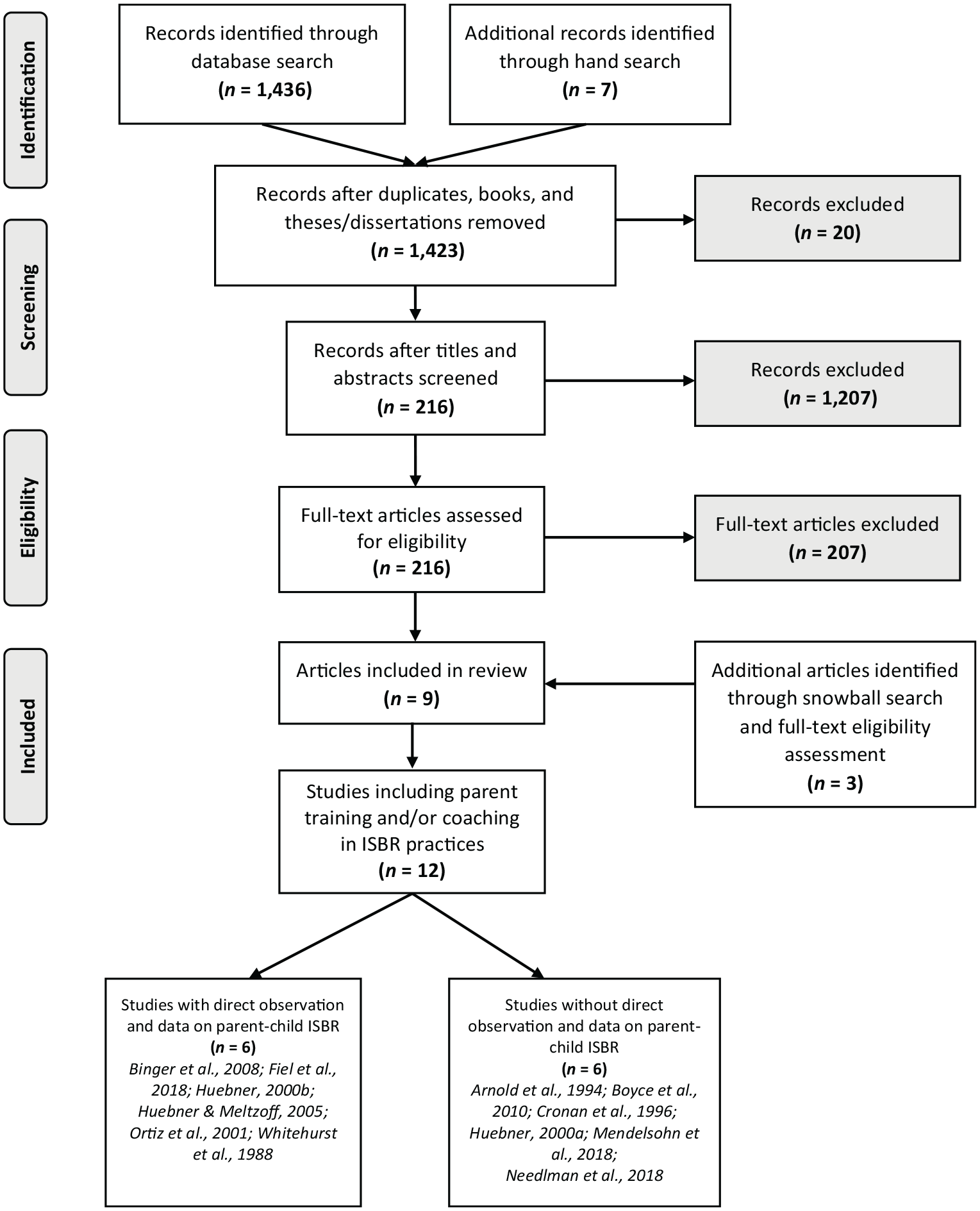
PRISMA flow diagram of article extractions.
Study Design and Participant Demographics
Of the 12 studies reviewed, study designs included randomized control trials (n = 9), single-case design (n = 1), and quasi-experimental designs (n = 2) (see Table 1). Studies were conducted in research labs (n = 2), family homes (n = 3), during well-child visits (n = 2), in a combination of home and community settings (n = 3), or a combination of research lab and home settings (n = 1). The specific location of one study was not mentioned (Binger et al., 2008). A total of 1,205 parents (M age = 30.8 years, males = 13, females = 1,162) and 1,216 children (M age = 28.8 months, range = 0–60 months, males = 607, females = 609) participated in the studies. Child participants included those with typical development (n = 337), speech/language disorders (n = 8), physical/learning disabilities (n = 4), and developmental risk factors, including premature birth and poverty (n = 867). All but three studies reported race or ethnicity characteristics for participants (Arnold et al., 1994; Needlman et al., 2018; Whitehurst et al., 1988). Across seven studies, parent participants identified themselves as the following races/ethnicities: Asian/Pacific Islander = 4, Black/African American = 49, Latinx/Hispanic = 405, White = 243, and Other = 28. Race or ethnicity for child participants was reported in five studies, including Asian/Pacific Islander = 7, Black/African American = 30, Latinx/Hispanic = 284, White = 135, and Other = 131. Majority of families involved in the studies fell at or below the federal poverty guideline.
Characteristics of the Study and ISBR Intervention.

Note. ISBR = interactive shared book reading; SBR = shared book reading; * = no direct observation and measures of parent–child shared book reading interaction; RCT = randomized control trial; min = minutes; Codes for ISBR Strategies Taught to Parents: C/M = commenting/modeling; E/E = expansions/extensions; P = praise; Q/P = questions/prompting; RS = responsiveness; DR = dialogic reading; SCD = single-case design; NR = not reported; WT = wait time; SHELLS = Storytelling for the Home Enrichment of Language and Literacy Skills; ePALS = internet-based Play and Learning Strategies program; QE = quasi-experimental; VIP = Video Interaction Project; ROR = Reach Out and Read; PC = print concepts; RP = repetition.
English and Spanish were the primary languages spoken across families, with three studies including only English speakers, one study including only Spanish speakers, four studies including a combination of English and Spanish speakers, and one study including speakers of English, Spanish, and other languages. Of the six studies including families that spoke languages other than English, four mentioned providing interventions in the family’s preferred language or used bilingual facilitators to train parents (Boyce et al., 2010; Cronan et al., 1996; Feil et al., 2020; Mendelsohn et al., 2018). Although Huebner (2000a) and Huebner and Meltzoff (2005) included families that spoke Spanish in their studies, there was no mention of using the families’ preferred language during assessments or interventions. Huebner and Meltzoff (2005) specifically mentioned two child participants were bilingual Spanish/English speakers, and two shared book reading videos were excluded from the analyses because they occurred in Spanish. See online supplemental materials Table B for participant demographic data across individual studies.
ISBR Interventions
Researchers in all 12 studies included training or coaching for parents in ISBR strategies; however, only six studies included direct observation and measurement of parent–child shared book reading following the training program (see Table 2). Specific ISBR interventions evaluated in studies included Storytelling for the Home Enrichment of Language and Literacy Skills (SHELLS; Boyce et al., 2010), the internet-based Play and Learning Strategies program (ePALS; Feil et al., 2020); dialogic reading (DR; Arnold et al., 1994; Cronan et al., 1996; Huebner, 2000a, 2000b; Huebner & Meltzoff, 2005; Whitehurst et al., 1988), Video Interaction Project (VIP; Mendelsohn et al., 2018), and ROR (Needlman et al., 2018) (see Table 1). Across the 12 studies, intervention sessions with families ranged from 1 to 11 total sessions for 10 to 60 min per session (see Table 1). Common ISBR strategies taught to parents across studies included the use of questions/prompting (n = 11), responsiveness (n = 9), expansions/extensions (n = 8), praise (n = 8), and commenting/modeling (n = 7). Researchers in only one study evaluated parents’ use of the following strategies: print concepts (Ortiz et al., 2001), repetition (Whitehurst et al., 1988), and wait time (Binger et al., 2008) (see Table 2). No researchers taught or examined parents’ use of distancing, redirection, correction for incorrect child language use, or strategies to support child vocabulary learning during shared book reading. Fidelity of parents’ use of ISBR strategies was collected in three studies (Binger et al., 2008; Huebner, 2000b; Huebner & Meltzoff, 2005).
Outcomes Measured During Parent–Child ISBR Practice.

Note. ISBR = interactive shared book reading; RP = repetition; * = no direct observation and measures of parent–child shared book reading interaction; NR = not reported; RAA = Read, Ask, Answer; MSM = multi-symbol messages; AAC = augmentative and alternative communication; LPCIS = Landry Parent–Child Interaction Scales; BST = book sharing techniques; IB = intrusive behavior; PB = positive behavior; A/E = affect/enthusiasm; EL = expressive language; RL = receptive language; E/E = expansions/extensions; D = directives; L = labeling; P = praise; Q/P = questions/prompting; RP = repetition; 1WU = one-word utterances; MLU = mean length of utterance; MWU = multi-word utterances; VOC = vocalizations; BC = book choice; IM = imitations; RQ = requests; IN = interest in shared book reading; C = corrections; R = reading text.
Parent Teaching and Coaching Methods
Based on the Implementation Fidelity Framework (Biel et al., 2020), teaching functions used to educate parents in ISBR strategies were sharing information (n = 12), modeling (n = 10), prompting/guiding/scaffolding (n = 3), and feedback (n = 10) (see online supplemental materials Table C). Meetings, workshops, and print materials were frequently used to share information with parents. In one study, parents were provided with information through an online course, which included one-on-one online coaching sessions (Feil et al., 2020). Huebner and Meltzoff (2005) included an intervention group that received coaching and support through phone calls. Modeling of ISBR strategies was performed through video recordings or live models, and feedback was provided orally after live and recorded practice opportunities. Opportunities for self-reflection, a procedure falling under the feedback teaching function, were included in two studies (Feil et al., 2020; Mendelsohn et al., 2018). Prompting/guiding/scaffolding were only included in three studies, which means only three studies provided parents with support during practice opportunities (Arnold et al., 1994; Binger et al., 2008; Boyce et al., 2010). Feil and colleagues (2020) and Huebner and Meltzoff (2005) used coaching to support parents in using ISBR strategies with their infants and toddlers, including direct teaching, demonstration/modeling, practice, feedback, and reflection as strategies in their coaching procedures (Friedman et al., 2012). Feil et al. (2020) did not conduct practice opportunities with the coach. Instead, parent practice was video recorded and later reviewed with the coach to provide feedback. Fidelity of parent education and coaching procedures was measured by researchers in two studies (Binger et al., 2008; Boyce et al., 2010).
Parent and Child Outcomes
In six studies, researchers measured parent and child behaviors during shared book reading interactions (see Table 2). The parent ISBR outcomes measured primarily revolved around supporting interaction and language learning opportunities. Binger and colleagues (2008) supported parents in modeling augmentative and alternative communication (AAC) system use during shared book reading interactions. Outcomes were related to accuracy of strategy use, including RAA RAA RAA! (Read, Ask, Answer) and modeling of two-symbol messages using the child’s AAC system. Feil et al. (2020) used the Landry Parent–Child Interaction Scales (Landry et al., 1998) to evaluate parent–child shared book reading, rating positive parenting behaviors, book sharing techniques, and use of intrusive behaviors that can hinder parent–child interaction. Huebner (2000b) examined the frequency of questions, repetition, labeling, imitative directives, praise, and expansions, as well as the frequency of parent behaviors that minimized child verbalizations. Huebner and Meltzoff (2005) examined these same parent outcomes as a DR Ratio, which was calculated by taking the frequency of supportive reading behaviors (e.g., questions, labeling, imitations, expansions, praise) divided by the frequency of behaviors that minimized child participation in shared book reading. Ortiz et al. (2001) coded videos for the rate of parent questions/prompts, proportion of books the parent allowed the child to choose, average parent enthusiasm based on a 7-point scale, and the rate of parent praise directed toward the child. Whitehurst et al. (1988) coded audiotapes for the frequency of parent shared book reading behaviors, including directives, labeling, reading the text, questions, praise, repetition, expansions, and corrections.
Child outcomes measured during shared book reading included frequency of vocal, verbal, and gestural communication and complexity of language use (Binger et al., 2008; Huebner, 2000b; Huebner & Meltzoff, 2005; Whitehurst et al., 1988). Feil et al. (2020) collected ratings of child positive behavior, expressive/receptive language, and affect using the Landry Parent–Child Interaction Scales. Ortiz et al. (2001) rated child interest in shared book reading using a 7-point scale; child interest was based on alertness, physical orientation toward the book and parent, frequency of verbalizations, and proportion of verbalizations related to the book. Only Binger and colleagues (2008) specifically included measurement of child gesture use during shared book reading, but final child outcomes related specifically to multi-symbol aided AAC messages. The effect sizes related to measurements collected during parent–child shared book reading interactions were collected in two studies, noting medium to large effects on parent strategy use and/or child outcomes (Binger et al., 2008; Feil et al., 2020). Effect sizes were listed in other studies, but these measurements were not directly related to observed parent–child shared book reading interactions. Effect size estimates are included in online supplemental materials Table D.
Study Quality
Results of the evaluation of study quality (Soto et al., 2019) revealed that the average rating across the 12 studies was 2.81, with ratings ranging from 2.00 to 3.69. The lowest quality indicators were maintenance/generalization (M = 2.00), implementation fidelity (M = 2.08), and consumer satisfaction (M = 2.08). Other quality indicators with lower ratings included attrition (M = 2.45) and statistical treatment (M = 2.50). Indicators with higher ratings included descriptions of study rationale (M = 3.75), group equivalence (M = 3.45), participant selection (M = 3.33), and measurement schemes/definitions (M = 3.33). Supplemental Table E includes ratings for each quality indicator across the 12 studies.
Discussion
This systematic review examined 12 studies of interventions with opportunities for parents to learn and practice shared book reading strategies with their infants and toddlers. Following our search, we identified multiple studies that evaluated ISBR programs for infants and toddlers. However, few studies included opportunities for parents to practice or receive feedback on their ISBR practices, both of which were inclusionary criteria for our review due to their impact on adult learning and maintenance of strategy use (Trivette et al., 2009). Despite the small number of studies in this review, results suggested parent training and coaching in ISBR can support effective parent strategy use and infant/toddler language outcomes were reported in two studies. In the following paragraphs, we discuss the implications of the limited ISBR research base that includes parent coaching for this population and make suggestions for future research.
Family Cultural and Linguistic Diversity and ISBR
English and Spanish were the primary languages represented across identified. Researchers in six studies included families who spoke languages other than English; however, only four of those studies implemented assessments and interventions in the families’ preferred language. Research consistently demonstrates bilingualism is a strength and children learn best when their parents speak in their home language (Bialystok, 2018; Goodrich et al., 2013). Furthermore, when developing models of ISBR for use with children under 3 years, researchers should consider cultural factors that may affect shared book reading (e.g., diverse styles of storytelling, communication) as this was not discussed by researchers in the identified studies and may affect parents’ maintenance of strategy use.
ISBR Strategies for Infants and Toddlers
The scheme used to code ISBR strategies in the reviewed intervention studies was based on observational studies of parent–child shared book reading with infants and toddlers, and intervention studies with preschoolers. Many of the strategies used with preschoolers during shared book reading also were used by parents with infants and toddlers (e.g., questions, modeling, and expansions/extensions). We expect there was variability in how these strategies were used by parents in the reviewed studies, but this was not easily discernable. For example, 11 studies included questions/prompting as an ISBR strategy, but most studies did not provide information to delineate the types of questions asked or depth of response required from children. Comparing how parents of preschoolers differ from parents of infants/toddlers in ISBR strategy use may help identify strategies that are more beneficial for each age group.
Notably, vocabulary instruction was not included as a strategy in any of the studies, yet it is often included in studies with preschool-age children (Rezzonico et al., 2015). Analysis of vocabulary instruction for infants/toddlers during shared book reading is warranted. In a meta-analysis of ISBR, Mol and colleagues (2008) noted improved expressive vocabulary outcomes for children between the ages of 2 and 3 years compared with those who were 4 to 5 years old. Vocabulary development is important for later language and literacy development (Suggate et al., 2018). Shared book reading provides rich opportunities for vocabulary learning (Sosa, 2016). As such, vocabulary instruction should be a component of ISBR interventions for infants and toddler, and future research can determine how vocabulary instruction can be modified (i.e., concrete words, short descriptions) and implemented with this age group.
Teaching Parents ISBR Strategy Use
Research consistently suggests adults learn better when they are actively involved in the learning process, with opportunities to use or practice their new knowledge in practical settings (Trivette et al., 2009). We expect this is also true when teaching parents to use ISBR strategies. Parents need to learn and evaluate their use of strategies with opportunities to practice using the strategies in everyday routines with support from coaches or interventionists. Providing multiple practice opportunities across an extended period might allow parents to implement the intervention with higher intensity, which has the potential to increase children’s language outcomes (Dowdall et al., 2020). Providing support (e.g., prompting, guidance, scaffolding, feedback) during practice allows parents to make changes to their strategy use in the moment and increases their confidence in using the strategy when the interventionist is not there (Friedman et al., 2012). Research on performance-based feedback indicates that when adult learners are given immediate feedback, they are more likely to use that feedback to build their skills (Ottley et al., 2016). Only three studies included support for parents in their use of ISBR strategies during practice opportunities (Arnold et al., 1994; Binger et al., 2008; Boyce et al., 2010). Almost all studies included feedback, but it was provided after the practice opportunity, preventing parents from making changes and immediately improving their strategy use.
It is also critical that researchers systematically document the fidelity with which interventions are delivered. Both implementation and intervention fidelity are important for evaluating the effectiveness and feasibility of an intervention, as well as assisting researchers in identifying an intervention’s active ingredient(s) (Dunst et al., 2013). Three studies reported parent intervention fidelity, finding parents increased their use of ISBR strategies (Binger et al., 2008; Huebner, 2000b; Huebner & Meltzoff, 2005). However, researchers in only two studies (Binger et al., 2008; Boyce et al., 2010) measured implementation fidelity to evaluate the instructor’s adherence to the predetermined protocol for teaching parents to use ISBR strategies. Implementation fidelity received a lower rating in the study quality evaluation. With the limited information available about fidelity measures during shared book reading interventions with infants and toddlers, it is difficult to identify the best approaches for teaching parents to use ISBR strategies and the best strategies to include in the intervention.
Implications and Suggestions for Future Research
Future research should address the gaps identified in this review, and we suggest two lines of research for increasing understanding of the ISBR practices of parents with infants and toddlers. First, the field must identify how child communication and parent practices during shared book reading change over time as children age from infancy through toddlerhood and how these practices vary across cultures. Shared book reading interactions likely present differently across different ages of young children due to significant differences in child language development from birth through age 3 (Capone & McGregor, 2004; National Institute on Deafness and Other Communication Disorders, 2017). A starting point may be to further investigate what “typical” shared book reading looks like throughout infant and toddler development and across diverse linguistic and cultural backgrounds so researchers may identify the ISBR strategies parents are already using and those that are related to developmental outcomes at different developmental levels. Understanding how shared book reading interactions differ over time and across cultures, and the long-term outcomes of ISBR with infants and toddlers may help the field elucidate potential mechanisms linking shared book reading with language development, literacy outcomes, and school readiness. This research would culminate in the identification of evidence-based and culturally relevant ISBR strategies practitioners can recommend to parents of infants and toddlers.
The second line of research relates to the teaching and coaching procedures used to support parents in implementing ISBR strategies with their infants and toddlers. Additional experimental studies that include opportunities for parents to practice ISBR strategies and receive feedback, with effect sizes reported, are needed to better understand the active ingredients that support parents’ learning and success. The results of this review provide insight into the teaching and coaching methods that may be useful for supporting parents in learning and using ISBR strategies; however, understanding the intensity of support parents need to learn these strategies during shared book reading is lacking. Given the rapid developmental changes in children between the ages of birth and 3 years, we expect parents will need regular opportunities for support to adjust their ISBR practices to fit their child’s developmental level and learning needs over time. Changes in the intensity of parent support needed can be evaluated through measures of implementation and intervention fidelity. However, based on our study quality ratings, fidelity measurements were often not collected by researchers in the studies included in the current review. Measurement of maintenance and generalization of parent ISBR practices and parent satisfaction with the intervention and coaching procedures were additional areas that were rarely measured or reported. The limited information on fidelity, maintenance, generalization, and satisfaction limits interpretations of the results and overall treatment effects. Future research should include evaluations of these factors to assist researchers and clinicians in providing approved training and coaching practices that support parents in using ISBR strategies across different contexts (e.g., well-child visits, home).
Strengths and Limitations of the Review
The findings from this systematic review offer a summary of the state of research on interventions for parent–child ISBR with infants and toddlers. While this body of work is limited, evidence points to the potential of early interactive book sharing interventions to increase child outcomes in the earliest stages of language development. The review includes two notable limitations: (a) Only studies published in the United States and in English were reviewed and (b) the ISBR strategy coding scheme was primarily based on observation studies and intervention studies with preschool-age children. As such, the results of this review may not be generalizable to other populations and the individual outcomes of each study should be interpreted with caution. With attention to the gaps in the literature exposed by this review, researchers can begin to learn more about the types of coaching and supports needed to increase parent use of ISBR strategies with infants and toddlers, and how these strategies relate to later child language outcomes across time and family cultural backgrounds.
Supplemental Material
sj-pdf-1-tec-10.1177_0271121421998793 – Supplemental material for A Systematic Review of Parent–Child Shared Book Reading Interventions for Infants and Toddlers
Supplemental material, sj-pdf-1-tec-10.1177_0271121421998793 for A Systematic Review of Parent–Child Shared Book Reading Interventions for Infants and Toddlers by Ciera M. Lorio, Abigail D. Delehanty and Mollie K. Romano in Topics in Early Childhood Special Education
Footnotes
Acknowledgements
A special thanks to Anna Yates for her assistance with the database searches and article coding.
Authors’ Note
This paper was presented at the 2020 biannual Conference on Research Innovations in Early Intervention (CRIEI) in San Diego, CA, USA.
Declaration of Conflicting Interests
The author(s) declared no potential conflicts of interest with respect to the research, authorship, and/or publication of this article.
Funding
The author(s) received no financial support for the research, authorship, and/or publication of this article.

Supplemental Material
Supplemental material for this article is available on the Topics in Early Childhood Special Education website along with the online version of this article.
References
Supplementary Material
Please find the following supplemental material available below.
For Open Access articles published under a Creative Commons License, all supplemental material carries the same license as the article it is associated with.
For non-Open Access articles published, all supplemental material carries a non-exclusive license, and permission requests for re-use of supplemental material or any part of supplemental material shall be sent directly to the copyright owner as specified in the copyright notice associated with the article.
