



Abstract
Several types of professionals support families of young children with disabilities as they navigate the early intervention and early childhood special education systems (EI/ECSE). Medical professionals are often the first to discuss service provision with families, while EI/ECSE providers are responsible for evaluating, determining eligibility, and providing services. The alignment between these two groups can directly influence child and family outcomes. We explored the experiences of medical professionals and EI/ECSE providers working in one large Northeastern U.S. city to understand how each group views their respective roles within the system and to gauge the degree to which they collaborate. Our findings revealed that both groups are committed to the families they serve but are often frustrated by conflicting recommendations for EI/ECSE service delivery. We provide suggestions to improve opportunities to communicate and collaborate to increase the effectiveness of support for children and their families.
Standards of pediatric care include having medical professionals screening young children for developmental delays and, if a delay is detected, refer those children for further evaluation (Graungaard & Skov, 2006; Guevara et al., 2013; Lipkin et al. 2020; Sices et al., 2009). Early intervention (EI) or early childhood special education (ECSE) professionals then evaluate those children to deternine if they are eligible for EI/ECSE services (de Sam Lazaro, 2017) and work with the families to determine appropriate services and interventions for children who are eligible (Noyes-Grosser et al., 2013). Parents consistently report that receiving accurate information (Galil et al., 2006; Graungaard & Skov, 2006; Sansosti et al., 2012) and establishing regular communication opportunities are necessary for effective collaboration with professionals and providers at each stage of the process (Galil et al., 2006).
Similarly, leading professional associations and organizations set standards for interprofessional collaboration in the field of medicine (Bridges et al., 2011) and interdisciplinary (Sisti & Robledo, 2021) and transdisciplinary (DEC, 2014) collaboration in special education. In fact, collaboration is identified as critical to effective care and education. Requisite collaboration components in these fields are dedicated to communication and bridging differences in professional cultures and nomenclature (Manor-Binyamini, 2007). In training programs, interprofessional education—or cross-disciplinary teaching, learning, and supervision—is a model that affords early carreer professionals from different disciplines the opportunity to learn about, from, and with one another. This type of training is increasingly seen as key to effective integrated care (Miller et al., 2018; World Health Organization, 2010). Numerous researchers have called for increased collaboration between medical professionals and special education providers (O’Neil et al., 2008; Sheppard & Vitalone-Raccaro, 2016; Sices et al., 2009). Although interprofessional education is being utilized at the training level, limited research examines how medical professionals and special education providers within the same EI/ECSE system view their respective roles and collaborate in real-time. We assert that such information is critical to systems change efforts, specifically in a collaborative culture and professional development. Such changes stand to increase the effectiveness of support for children and their families.
The Role of the Medical Professional
Medical professionals include, but are not limited to, pediatricians, developmental pediatricians, nurse practitioners, psychologists, social workers, and child life specialists in clinical settings. These individuals play a critical role in interventions when identifying, treating, and supporting young children with disabilities delays: “Due to federal guidelines for health screening and immunizations before school entry, children in the United States attend approximately 13 to 15 pediatric primary care visits from birth to age 4 years (Mendelsohn et al., 2020, p. 70). Medical professionals also perform regular developmental screening at these visits (Lipkin et al., 2020). Parents typically discuss any concerns about their child’s development (Hyman et al., 2020; Sansosti et al., 2012; Sices et al., 2009).
Standards of pediatric care recommend developmental assessments at every well-child visit, ranging from every other month (for infants) to every year (for children ages three years and up). Consequently, medical professionals are often the first to discuss special education services with parents and may make referrals to either EI for children ages 0 to 3 or ECSE for children ages 3 to 5 (Hastings et al., 2014). These individuals play a critical role in assisting parents as they pursue services for their children (Sansosti et al., 2012; Sheppard & Vitalone-Raccaro, 2016; Sices et al., 2009). Clinicians also prescribe therapeutic services for children with disabilities (Committee on Children with Disabilities, 2001).
The Role of Special Education Providers
Upon the referral for EI or ECSE services by a medical professional, parent, or early care provider, the EI/ECSE special education team assumes the responsibility for determining if the child is eligible for services and, if so, works with the family to develop and implement an Individualized Family Service Plan (IFSP) for a child ages birth to 3, or an Individualized Education Program (IEP) for a child ages 3 to 5. The Individuals with Disabilities Education Improvement Act (IDEA, 2004) mandates that the special education team members include, at a minimum, a parent or guardian of the child with a disability/delay, an administrator, special and general education professionals, and necessary therapists. We refer to the administrators, special education teachers, and therapists who develop and implement the IFSPs/IEPs and monitor the child’s progress in IFSP/IEP developmental and learning goals, typically in the home or childcare/preschool settings, as “special education providers.”
Collaboration Between Medical Professionals and Special Education Providers
In 2001, the American Academy of Pediatrics (AAP), in association with the Council for Exceptional Children (CEC), called for medical professionals to work with special education providers as a part of an interdisciplinary team to support children with disabilities. More recently, leading professional groups have named collaboration an essential standard for practice in the field of EI/ECSE (DEC, 2014, 2020). A growing body of research examines how special education teams (e.g., Dinnebeil et al., 2001; Sisti & Robledo, 2021) and medical professionals (Davis et al., 2016) collaborate with other medical or therapeutic service providers to support children with disabilities/delays and their families. However, there is limited scholarly literature describing collaboration between these two groups. Although limited, studies on this topic show that medical professionals often welcome the opportunity to collaborate despite barriers to effective collaboration (e.g., time, parent resources or knowledge of the special education system, and willingness by the child’s school to collaborate) (Sheppard & Vitalone-Raccaro, 2016).
Jimenez et al. (2012) reported that EI providers had difficulty contacting pediatricians when trying to follow up on referrals due to time or Health Insurance Portability and Accountability Act (HIPPA) concerns. Although not specific to students with disabilities, Lemkin et al. (2019) interviewed educators in an urban district serving primarily low-income students about their experiences collaborating with pediatricians. The teachers cited barriers to communication and collaboration that included the inability to contact physicians, parent resistance to sharing information and HIPPA concerns, and teachers’ having negative perceptions of doctors based on personal experiences. Similarly, Manor-Binyamini (2007) studied the language used by special education teachers and psychiatrists who work with children with disabilities. She found that members of these two groups used different professional language; moreover, she noted that it seemed as though “psychiatrists perceive[d] their treatment strategy as a transition from sickness to health via medical care, whereas teachers perceive[d] it as a transition from lack of knowledge to knowledge by means of learned behavior” (p. 41).
Researchers from both fields have highlighted best practices for effective collaboration such as the need for clearly defined roles, frequent communication, providing time for collaboration, and having shared goals (Sisti & Robledo, 2021). Additionally, team members need to build trust. Disclosure and transparency help professionals in various disciplines trust one another’s professional abilities (Coufal & Woods, 2018). Recommendations for medical professionals include providing referrals to EI, working with the team to develop an IFSP/IEP, monitoring developmental progress, and “providing continuity of health care including prescribing specific rehabilitative therapies as appropriate and periodically reviewing the need to continue such services” (Committee on Children with Disabilities, 2001, p. 1156).
Service Provision in Urban Areas
We know that the timely provision of educational and therapeutic services for children at-risk for or with disabilities is critical for children’s development (Clark et al., 2018). However, professionals working in urban areas face unique challenges when supporting young children and their families (Guevara et al., 2013, 2016). Urban EI/ECSE systems are charged with providing services to large numbers of children, many of whom come from diverse racial, cultural, and linguistic backgrounds and whose parents may or may not have economic resources. When families do not have access to resources, personal and material, to support their children’s development, the environmental risk becomes a factor (Guralnick, 2011). Poverty places young children at significant risk for poorer physical, cognitive, and social-emotional developmental outcomes (Chaudry & Wimer, 2016).
Research also indicates that racial, cultural, and linguistic diversity impacts how families view disability. Race and culture have been shown to affect parent perceptions of typical child’s behavior (Harvey et al., 2013; Nowell et al., 2015). Linguistic diversity can make early identification challenging as children learn multiple languages and families lack access to the literature documenting typical growth in their home language (Peredo, 2016). Children in linguistically diverse communities whose parents’ immigration status may be precarious are at an increased risk for a host of challenges, including poverty, housing instability, social isolation, and adverse social, emotional, and psychological outcomes (Yoshikawa et al., 2013). For these children and their families, timely and individualized service provision is necessary, and it is best supported by effective interprofessional collaboration.
We sought insight into how medical professionals and special education providers viewed their respective roles within a large, urban EI/ECSE system and the degree to which they collaborated to support families of children with disabilities/delays. The following research questions guided our study: (a) How do medical professionals and special education providers who support young children and their families view their role in the city’s EI/ECSE system? (b) How do they describe their experiences collaborating?
Method
Study Design
We collected data as a part of a larger study to capture insights from four distinct stakeholder groups on the issue of EI/ECSE functions in one Northeastern U.S. city. The larger study examined the city’s EI/ECSE system as a phenomenon. We utilized the input from four stakeholder groups to assess system trends (Moran & Sheppard, 2022). After preliminary analysis, we determined that several stakeholder group experiences warranted further analysis. The first of these was the role of early care providers as a part of the EI/ECSE team (Sheppard & Moran, 2021). The second is the interaction between the special education providers and medical professionals because of the unique complexities that were found to hinder collaboration. After Institutional Review Board approval was granted by our Institution, we conducted semistructured life-world interviews, the purpose of which is to capture humans’ lived experiences (Kvale, 1983), with medical professionals and special education providers who support young children and their families in the EI/ECSE system.
We used a qualitative research methodology because it is appropriate for exploring and understanding the complex experiences of individuals working within a unique system (Yilmaz, 2013). Maxwell (2010) described qualitative research as relying “much more on a local analysis of particular individuals, events, or settings than on establishing general conclusions and addresses ‘how’ and ‘why’ questions, rather than simply ‘whether’ and ‘to what extent’” (p. 477). Further, qualitative research provides us with “the ability to help people appreciate the viewpoints and constructions of others [and] is indicative of educative authenticity” (Tobin & Begley, 2004, p. 392). We also used phenomenology to guide our methodology, and we conducted a thematic analysis to determine the “experiences, meanings and the reality of participants” (Braun & Clarke, 2006, p. 81).
Participants
We interviewed 10 medical professionals and 11 special education providers (see table in online supplemental materials). We worked to ensure that we captured the experiences of professionals in different roles within each stakeholder group (e.g., teachers and administrators, pediatricians and child psychologists) to represent the diverse body of professionals working to support families navigating the system. All interviewees had knowledge of the EI/ECSE systems in the city and worked directly with families of children receiving EI/ECSE services. We sought the perspectives of medical professionals who worked in city-based medical centers or hospital clinics and whose patient base included children residing in the city. We also sought the perspective of special education providers who worked for the two contracted entities, one in charge of EI and the other in charge of ECSE and those representing the local School District and community-based sites like Early Head Start/Head Start. Participants reported serving a racially and ethnically diverse group of children and families, including those receiving publicly funded medical insurance and families identified as eligible for subsidized and free early care.
We utilized purposive sampling to ensure that we reached participants who had direct, and in many cases, extensive experience and who were working directly with families of children who received EI/ECSE services in the city (Palinkas et al., 2015). Utilizing maximum variation sampling (Patton, 2002), we targeted different regions in the area to ensure that participants served a pool that reflected the city’s diverse population. We also asked participants to describe the demographics of children and families they supported during initial contact. To reach eligible participants, we called or emailed over 50 medical professionals and over 50 special education providers using the publicly available contact information or professional contacts. Over half of our participants were recruited in this manner, and the rest were recruited using a snowball method (Palinkas et al., 2015), with referrals from other participants. The demographics of individual professionals was not ascertained. Prospective interviewees who did not participate did so primarily due to scheduling constraints. We did not have any participants drop out of the study.
Data Collection
We conducted individual in-depth interview sessions with each participant. Interviews lasted between 45 and 90 minutes and took place either via phone or in-person. Before beginning each interview, we introduced the study by explaining its purpose and we asked participants if they had any questions or concerns. We responded to questions or concerns with transparency. We asked participants to sign a consent form before the interview. When possible, we conducted interviews together. We audio-recorded all sessions, and we took detailed notes. We conducted interviews until reading saturation and data collection no longer supported new themes (Guest et al., 2006). We did not conduct any repeat interviews.
We developed an interview protocol guided by extant literature and publicly available documents related to the city’s EI/ECSE system (see Appendix A in the online supplemental materials). We asked participants about their training and the children they served in addition to open-ended questions related to experiences with and perspectives on EI/ECSE. We asked primary and follow-up questions throughout the sessions to allow for the exploration of emergent themes.
Data Analysis
We transcribed all interview recordings in full. Researcher notes and transcriptions were then uploaded to the Dedoose data management system for coding. We completed three rounds of coding. Data collection and analysis took approximately 15 months to complete.
Step 1
During the first round of deductive coding, we independently examined the same four transcripts. We used the research questions as a guide to identifying the trends in the interview transcripts and our notes (Roberts et al., 2019). We worked together to refine 48 preliminary codes by discussing each code individually, agreeing upon code names, and generating definitions for all codes. An example of a preliminary code was role and responsibilities. We ultimately agreed upon 36 refined codes, which we then used to analyze a second set of transcripts independently.
Step 2
During the second round of coding, we eliminated redundant codes, refined code names and definitions, and regrouped codes that described very small or very large quantities of data. We separately used an inductive approach to determine four themes (both expected and unexpected) and develop a codebook with 17 final codes (Roberts et al., 2019) (Table 1). When discrepancies or differences arose, we reached a consensus through discussion (J. L. Campbell et al., 2013). An example of an expected theme was opportunities to increase effective collaboration, and an unexpected theme was limited collaboration fuels service gaps/systemic tensions. We then coded all transcripts using the final codebook. We confirmed no outliers existed.
Themes and Associated Codes From a Qualitative Examination of the Perspectives of Medical Professionals and Special Education Providers on Roles and Collaboration.
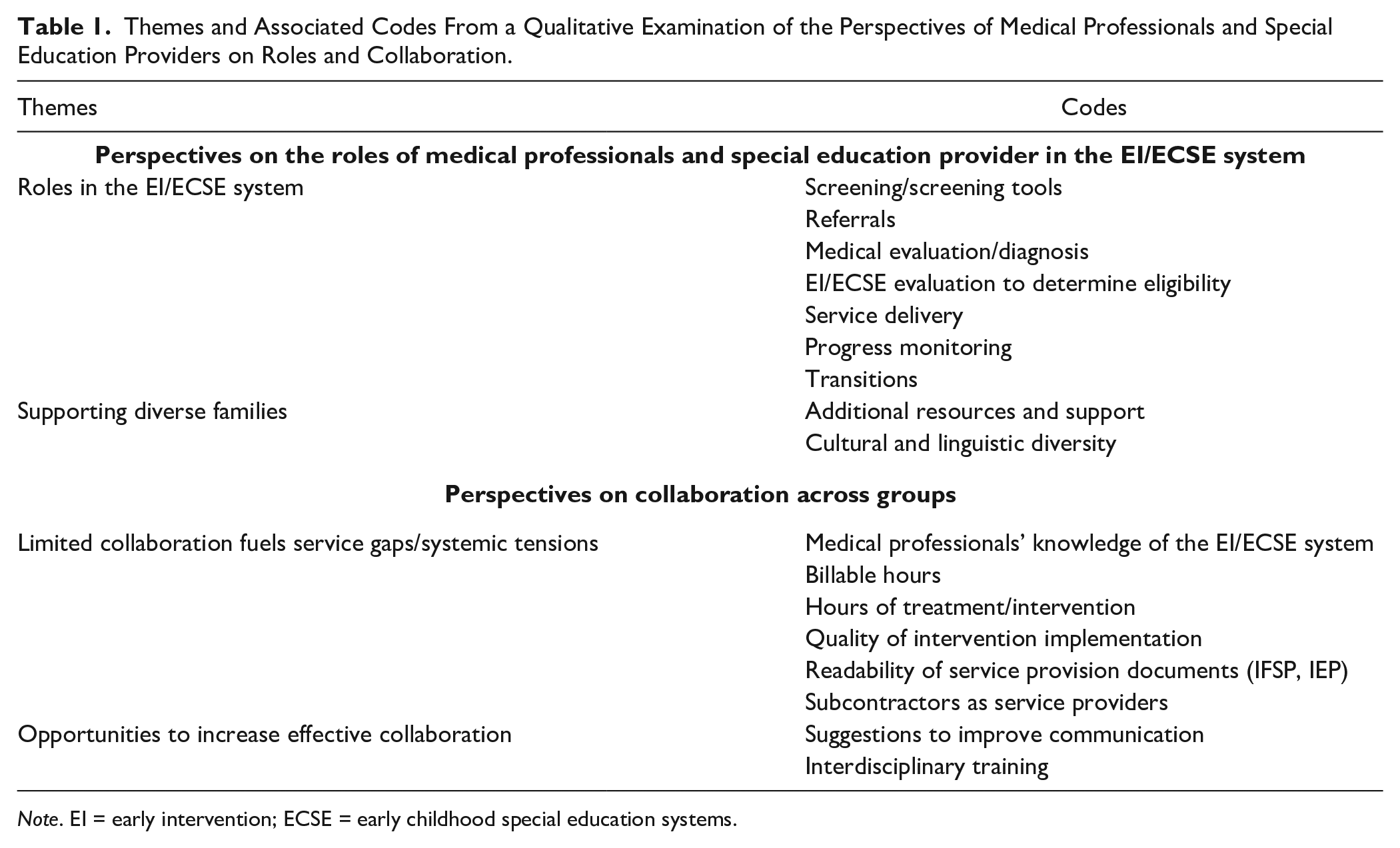
Note. EI = early intervention; ECSE = early childhood special education systems.
Validation Strategies
We utilized Creswell and Miller’s (2000) framework to ensure validity. To that end, we provided rich descriptions of the data, examined researcher reflexivity, conducted multiple rounds of coding, and used member checking. We also adhered to the concept of trustworthiness, which is demonstrated through credibility, transferability, dependability, and confirmability (Lincoln & Guba, 1985).
During data collection, we each took detailed notes and wrote memos to capture rich descriptions of the data and to examine researcher reflexivity. During data analysis, we independently reviewed each transcript, as well as interview notes, to establish accuracy and interrater reliability (Creswell & Poth, 2016). During every round of coding, we maintained a detailed log of codes and code definitions. We shared individual transcripts and preliminary themes with every participant for comments, corrections, and validation as part of the member checking process. In qualitative research, member checking is regarded as the gold standard for validity checks (Madill & Sullivan, 2018).
Results
Medical professionals and EI/ECSE service delivery providers provided rich insight into the EI/ECSE system. Table 1 outlines the themes that emerged. The following sections describe each theme and give consideration to sub-themes.
Perspectives on Roles
Medical professionals screen children and make referrals
Pediatricians stated that their primary role in the EI/ECSE system is to screen children during well visits using parent questionnaires, the Modified Checklist for Autism in Toddlers (MCHAT), and other screening tools. When concerns arose, pediatricians explained the referral and evaluation process to caregivers and completed a referral for services to the contracting entity in charge of EI or ECSE. A pediatrician described the process, stating, If I’m worried about autism, I will refer someone for a formal autism-specific evaluation. … If I think someone has a significant developmental delay, I’ll try to get them to a developmental pediatrician. … If it’s not a severe delay, like if they’re just maybe a few months behind and I think they’re going to catch up with EI. … then I don’t refer to developmental. …I just make the referral to EI.
The child life specialist described her role as supporting pediatricians throughout this process and serving as the point of contact to coordinate outreach to families. Professionals referred families to developmental pediatricians and child psychologists if they determined that the child needed or would benefit from a second medical evaluation. According to a developmental-behavioral pediatrician, “We will review our findings and pull what we think is going on in terms of a diagnosis. . . we’ll discuss recommendations we print out and [write] a summary that has a list of recommendations for them to go home with.”
Special education providers determine eligibility and service provision
Special education providers detailed their role in the EI/ECSE system, starting with receiving referrals from medical professionals, childcare providers, family members, and community members. Participants described their involvement in this process as a series of steps, beginning with the referral and ending with children’s transition out of their service provision (usually the transition to kindergarten).
Special education providers from the contracting entity for EI or ECSE contacted the family to schedule a child’s evaluation upon receipt of a referral. If eligible, providers from each entity (a) identified a service coordinator, lead IFSP/IEP development; (b) contracted with therapists, special instructors, and special education teachers to deliver services (either in the home, childcare, or preschool setting); (c) oversaw progress monitoring; and (d) prepared the family for one of two transitions, either to the 3 to 5 contracted entity or to the local district once the child reached school age. Students ages 3 to 5 receive service coordinator services in this district, which is not always the case elsewhere.
Participants support families in a large urban system
The EI/ECSE system in this urban area served a large, diverse population of children. Participants consistently noted that the city also has one of the highest poverty rates in the country, putting a significant number of children at risk for disabilities or delays. Participants representing medical professionals and special education providers described the lengths they frequently went to in order to provide families with additional resources and support. One medical clinician stated, “When parents have other priorities and insecure housing, and insecure food, and [little] stability . . . following through on early intervention is not the number one priority.” Participants stated the importance of securing families’ basic needs before addressing developmental concerns. All participants described instances of working with families experiencing hardships, many of them severe.
Importantly, medical professionals connected parents to social workers, support groups, and parent advocates. As one pediatrician described, We do put them in contact with parent advocates that are connected to their school district so that they know kind of who they can go to with questions, and how to help them kind of to advocate, and then social work stays in contact with them, and if they’re going to have barriers, they can try to see what other community resources we can connect them to.
Special education providers had similar safety nets in place for families. Both contracted entities had their teams of “parent advisors” or “parent advocates.” A provider for the ECSE-contracted entity described the role of their parent advisors, stating, “They are a part of our leadership team that meets every week. No hidden agenda, no dirty language we have to hide, they know what is going on, they bring back other perceptions of the community.” EI and ECSE facilitated outreach and offered additional support to meet families’ needs through community-entity liaisons.
With 52 spoken languages recognized across the city, special education providers also highlighted efforts to increase access to translators and translation services to help meet the needs of linguistically diverse families. Despite these efforts, participants recognized that more is needed for families with fewer economic resources and those from culturally and linguistically diverse backgrounds. They identified children from these populations as those most likely to get “lost” in the system.
Limited Collaboration Among Professionals and Providers Creates Service Gaps
Participants described collaboration between medical professionals and special education providers as limited, with the “gap” in collaboration attributable to several factors. Medical professionals expressed a strong desire to be more involved in the EI/ECSE system to support families more effectively. However, they faced two primary constraints, including lacking a comprehensive understanding of the system and not using billable hours for EI/ECSE work. Speaking about clinicians understanding of the system, a pediatrician stated, When residents come through, and they see patients, you know. … I feel like 20% of the questions [parents] have are about medical issues, and about 80% are about the things you don’t learn in the curriculum. … So how do you help parents advocate for the services that they need? I think [this] is something we really need to think about.
Medical professionals also highlighted how billable time excluded conversations with children’s EI/ECSE service coordinators, therapists, special education teachers, and others, although such conversations would potentially expand their understanding of the system. According to one clinician, “If we did have those conversations, we would learn better ways to help the child. I feel that part of the reason why we don’t . . . is because that time the doctor spent on the phone is not billable time.” As a result, medical professionals did not participate in this type of work and instead relied on the family to be “a go-between,” which multiple clinicians called “problematic.”
Interestingly, when we asked special education providers if they collaborated with medical professionals, most indicated they did not and shared that they were not actively entertaining the possibility. However, some described partnership involvement in the past. Special education providers almost exclusively discussed communicating with the medical professionals about children’s health, not their disabilities/delays. Several described the point of contact for such communication as being the school nurse, but only in the context of school-based programs for students with disabilities/delays. When asked about working with medical professionals, one special education provider stated, “For the pediatrician, it’s not much. If there is a direct health need, we have a health coordinator who will reach out to the pediatrician sometimes.” Once the topic of collaboration between groups arose, however, special education providers eagerly posited ideas and identified avenues for future growth.
Systemic Tensions Between Medical and EI/ECSE Service Delivery Models Persist
Participants discussed their roles in the EI/ECSE system and collaboration among multiple stakeholder groups (i.e., families and early care providers). According to medical professionals and special education providers, systemic tensions continued to underlie the medical and EI/ECSE service delivery models for EI/ECSE. More specifically, these groups did not agree on the role of pediatricians (general or developmental) in prescribing hours of intervention. Medical professionals also found the quality-of-service provision, as described by the families of children in their care, to be problematic.
Tensions around determining hours of service
From the medical perspective, the role of developmental-behavioral pediatricians was to make diagnoses and prescribe treatment for children with disabilities/delays. Participants argued that for children this young, prescriptions could include hours of intervention to be filled by EI/ECSE providers. Participants stated that special education providers push back on prescribed hours of intervention because they have difficulty delivering. As one developmental-behavioral pediatrician discussed, I spend a lot of time thinking about how I explain things to some families to minimize the potential for conflict, but I think Early Intervention still is upset with us about including the number of hours of intervention that the evidence suggests is necessary.
Participants who were not developmental-behavioral pediatricians also recognized this tension and its impact on families.
From the special education provider perspective, medical professionals overemphasized the weight of treatment plans and prescription hours in their conversations about EI/ECSE with families. According to an EI provider, I think there’s been a huge gap where a parent may say, “My doctor says I need speech weekly.” Whereas the early intervention model is more a family participation-based approach where you look at who is the most appropriate early interventionist to address the child’s needs. So, there may be different lenses to decide what type of services are needed for early intervention between a pediatrician and an early intervention team.
Special education providers repeatedly echoed that medical professionals did not fully understand their model’s structure and purpose. One participant called the relationship “contentious,” while another referred to medical professionals’ recommendations for hours of service and specific interventions (e.g., discrete trial vs. naturalistic teaching) as “outdated.”
It’s like the 40 hours a week of ABA, which is just challenging to wade through and a little dated because, I hypothesize, or at least it seemed when we had close relationships, that they were referring to discrete trial teaching. The research is veering away from that into more naturalistic teaching procedures or a combination.
Participants perceived that families were subsequently impacted and often left confused while determining which “lens” most appropriately met their children’s needs.
Tensions around the quality of services provided
Medical professionals in all roles expressed concern that families were not being taught or encouraged to implement therapies and interventions at home by EI/ECSE therapists. “I’m struck by the degree to which families don’t describe being taught to implement the interventions that they tell me EI is working on,” stated one participant. This issue bred confusion and frustration because families were tasked with updating medical professionals on children’s progress, and in many cases, they could not. When families could not share a thorough picture of therapies and interventions, medical professionals reported having a limited understanding of the impact of such services on children’s development.
The second area of concern for medical professionals was the availability and readability of service provision documents and their need to rely on families to coordinate information sharing. Medical professionals indicated that documentation from special education providers had to be explicitly requested, or it was otherwise unavailable. Referring to EI/ECSE reports, one pediatrician stated, “I never see them, and we’re dying to see them . . . I think once or twice, I called them to request it, which is kind of funny because the referral includes consent for the reports to be released to us.” Medical professionals also highlighted the readability of IFSPs and IEPs, particularly for families from diverse backgrounds, as troubling. Noting that these documents were often lengthy and included technical jargon, a clinician remarked, “The reading level of the families in the community that I care for is very variable, and often parents haven’t read the full IEP and might not be able to explain to me exactly what it says.”
Special education providers did not shy away from addressing tensions over the quality-of-service provision. However, from the participants’ perspective, the contracted entities’ lack of oversight given the system’s heavy reliance on contracted provider agencies and subcontracted therapists was the issue. According to an ECSE administrator, To be frank, we work with a tremendous amount of agencies and providers, and issues with providers, I would say is, is a biggie. So, [we see] concerns with the quality of specific providers or the level of communication they’re getting from certain providers.
While there was no immediate solution for this specific issue, providers highlighted the efforts EI/ECSE professionals were making city-wide to improve the effectiveness of the system. The contracted entity for children 3 to 5, for example, was restructuring to embed evaluative services and service provision within communities. This effort was a marked change from families having to travel to a central location for evaluations and providers covering a wide range of zip codes to deliver services.
Suggestions to Increase Effective Collaboration
Although descriptions of collaboration were limited, participants were quick to share ideas to improve collaboration and engage with fellow stakeholders. Medical professionals highlighted the importance of communication. “You don’t always get the full picture; there isn’t always great communication with the parents to then relate it to us,” stated one medical professional. Another commented, “We’re at the mercy of a family [when trying to gather and share information].” Both groups indicated that opening lines of communication and streamlining communication were necessary steps to take so that families did not constantly have to act as intermediaries.
One suggestion was to have a designated point of contact: “I think having a point of contact with early intervention and a dialog back and forth is really important for understanding their perspective, and you know, how things work on their end to be able to help families better.” Another pediatrician offered, I would definitely love to have a forum that we work on. So, for example, if I want to learn more about social communication, ask a few questions on a forum and then give it to the family to give to them [early care providers] . . . If we did have a release to be able to talk to them—if we can send a two-way communication . . . well, that hasn’t happened yet.
Participants on the medical side wanted to establish a way to exchange information, however, their ideas for solutions were largely hypothetical (i.e., “a forum,” “a registry”).
Participants, particularly special education providers, expressed interested in interdisciplinary training. A special education provider offered, “We do need to do a better job of capitalizing on partnerships I think with healthcare providers and developmental peds like we have in the past. . . Provide some of that education.” While these types of educational efforts had been made before, they had not been revisited in some time. According to a provider, We used to have some really great connections, oh and I’m blanking on names, with various healthcare providers throughout the city and their developmental pediatricians used to do observations on site, and we would do EI information sessions with them. Through the many transitions this city goes through, that kind of fell off, but that’s becoming something that we’re increasingly interested in as we move forward and embrace regionalization and as we’re getting into individual communities.
Special education providers viewed co-constructed professional learning opportunities as a promising way to alleviate the tension between models and ease the burden on families caught in the middle.
Discussion
We explored the perspectives of medical professionals and special education providers of the EI/ECSE system in one large Northeastern U.S. city. We aimed to understand each group’s perceptions of their role in this system and their experiences collaborating. Our findings showed that both stakeholder groups are instrumental in supporting young children with disabilities/delays and their families. However, the collaboration between groups was limited, and collaborative efforts were constrained by ongoing tensions underlying the medical and EI/ECSE service delivery models. In the face of these challenges, participants expressed a desire to increase communication and collaboration to support the populations they serve more effectively.
A System in Conflict
United States federal law recommends accessible, community-based, coordinated, multidisciplinary, and family-centered programs (IDEA, Part C, 2004). Further, organizations like the World Health Organization (WHO) (2010) endorse collaborative practice as best practice. Despite such endoresements, however, neither the medical professionals nor the special education providers that we interviewed reported that the medical and service provision models operated well together in the EI/ECSE system. Both groups readily acknowledged that the underlying tensions caused a degree of conflict, which adversely impacted families. Families needed to negotiate relationships with each set of providers and served as the locus for information exchange between groups.
According to recommended practice, EI/ECSE providers should strive for transdisciplinary collaboration, defined as individuals working together to share information and move toward a common goal (DEC, 2014). Medical professionals and special education providers did not describe this system as one where interdisciplinary and transdisciplinary collaboration occurred. However, individuals from both groups described potential ways to improve both communication and collaboration. A potential barrier for such collaboration was that medical professionals wanted to increase their participation in IFSP/IEP development and progress monitoring. At the same time, special education providers seemed to view the medical professionals’ role as limited to health issues.
Researchers recognize challenges related to collaboration within EI/ECSE systems, and attribute them to several underlying differences (Suter et al., 2009). Various stakeholder groups, including families, frequently operate using different definitions and have divergent perceptions of service provision (e.g., Dinnebeil et al., 1999; Jimenez et al., 2012). Practically speaking, the discrepancy between the hours of intervention prescribed by professionals and the capacity of the special education service providers to meet those hours was problematic and a widely recognized point of frustration. This finding is consistent with the ongoing debate regarding the effects of direct and indirect (consultative) service provision between the medical and special education fields (Coufal & Woods, 2018). Special education providers reject the idea that more service always equals better outcomes (Reed & Osborne, 2012). Interestingly, medical professionals in particular voiced concerns about both the limited number of direct service hours and a lack of indirect/consultative practices. Regardless, the conflicting views put undue strain on families.
While medical professionals and special education providers clearly articulated their perspectives on their roles in the system, they were less clear about the role and responsibilities of the other group. A key prerequisite to effective collaboration is recognizing the value of other professionals and providers (Orchard et al., 2005). Absent this clarity, roles likely become blurred, leading to conflict (Hall, 2005), as evidenced by our findings. The findings also highlight the limitations that special education providers put on the roles of medical professionals. Although participants did not directly voice a reluctance to collaborate, we see similarities in the conclusions of Sheppard and Vitalone-Raccaro (2016), who reported that physicians found school personnel was sometimes unwilling to collaborate because of differing opinions regarding responsibilities. When roles and responsibilities are unclear, collaborative efforts cannot move forward because there is no mutual understanding, and the cultivation of meaningful communication and relationships can be difficult to develop (Hall, 2005).
Finally, medical professionals’ knowledge of special education law and services and limited time were additional factors impeding collaboration. Professional knowledge of special education law and services has a significant impact on young children and families (F. K. Campbell, 2009). The impact is so crucial that the American Academy of Pediatrics recommends that physicians understand at least the basic elements of the special education law to adequately support families navigating service provision systems (Lipkin et al., 2015). Our participants’ experiences showed that understanding remains limited (Shah et al., 2013). Medical professionals did not feel knowledgeable about the system, nor did they have the time to learn through collaboration with fellow stakeholders like EI/ECSE coordinators, therapists, and classroom teachers due to insurance requirements and billing constraints.
The Impact on Families
The relationship between professionals and families is crucial to outcomes for children with disabilities/delays (Dunst & Dempsey, 2007). The difficulties faced by this population make them particularly vulnerable to the impact of a challenging home environment. Professionals are encouraged to identify and prioritize the needs of parents and caregivers (Seligman & Darling, 2017). In urban areas, contextual factors such as poverty/extreme poverty, racial, cultural, and linguistic diversity, and parental immigration status can further compound extant difficulties, making prioritizing family needs even more critical. Although the participants we interviewed tried to do just that with additional resources and support, their efforts were undercut by the heavy demands on families navigating the system. Medical professionals and special education providers acknowledged that their efforts to build strong relationships with families, many of whom had limited financial resources and were experiencing hardships, were overshadowed by irregularities, contradictions, and conflicts that arose as families negotiated complex relationships with different stakeholder groups, which is consistent with the extant literature (Ryan & Quinlan, 2018).
Participants were especially concerned with parents and caregivers acting as a constant conduit for information and updates, which they felt contributed to an overload of parent work (McManus et al., 2011). Medical professionals, in particular, acknowledged how frustrating it was for families to have to wade through lengthy documents with technical jargon in an attempt to bring their children’s clinicians up to speed (Hammond et al., 2008). Both groups also recognized that advocating for children while acting as the point person for all inter-group communication was highly taxing and a major source of stress for families (Ryan & Quinlan, 2018). However, families assumed that role because when information was not transferred between professionals, children with disabilities/delays received a lower quality of care and are at risk for adverse outcomes (Kripalani et al., 2007).
Recommendations for Research and Practice
Our results shed light on several areas of opportunity for improved effectiveness. We have identified and categorized these opportunities as stemming from (a) structural or systemic challenges, such as rigid procedures and policies and the nature of large, urban systems, or (b) relational or interpersonal challenges, such as confusion over roles and responsibilities and disagreement around best practices. Although specific to this large urban area, we believe the recommendations offered could be adopted, as applicable, by any EI/ECSE system. When systems improve professional collaborative practices they increase the support children with disabilities, and their families receive.
Opportunities to address structural and systemic challenges
Similar to many other systems, the large urban EI/ECSE system participants worked in was described as paperwork intensive, with a reliance upon phone calls, paper copies, electronic copies, and at times, fax machines. As a result, the policies and procedures to protect young children created challenges for those supporting them, siloing the flow of communication across groups. One suggestion from participants was to create a platform or forum to ease the flow of communication across relevant providers, including those in medical, EI/ECSE service delivery, and early care. If the role were expanded, service coordinators could be the primary liaison between systems. Such a system would require signed permissions and releases to protect the integrity HIPPA; however, multi-way communication could prove beneficial to parents and guardians who would no longer have to serve as the sole intermediary among their children’s support personnel.
An added layer of complexity is that many forms should be translated into the 52 spoken languages recognized across the EI/ECSE system. If information and paperwork related to any child were centralized, families would no longer have to be the sole conduit for information exchange. If that system was online and either mobile-friendly or stored in a secure app, families could access their children’s information and complete paperwork promptly using any number of electronic devices. Such an effort could be successful if providers offered training and support, such as computers or iPads for this purpose at pediatric offices, special education provider sites, community childcare centers, and other locations.
Opportunities to address relational and interpersonal challenges
Medical professionals and special education providers would benefit from an inter-group coalition or workgroup to remedy conflict and strengthen collaboration. Such a coalition could include representation from other stakeholder groups and could be structured across interprofessional, interdisciplinary, and transdisciplinary collaboration models used in both fields. This type of effort would help increase medical professionals’ knowledge of the EI/ECSE system and could serve as an opportunity to clarify roles and responsibilities, establish norms, and exchange information. Using evidenced-based models fosters a greater understanding of and appreciation for one another’s professional disciplines and could help build a shared frame of reference for planning, implementing, and evaluating integrated services. Bruder et al. (2019) further recommended that professional organizations align their competencies around supporting young children with disabilities/delays and their families. We recommend that pediatricians be included in discussions on alignment. An effective working group or coalition would take up and resolve issues, address the various challenges of the system locally in a collaborative way, and discuss and establish commonality on best practices.
Interdisciplinary coursework, training, and ongoing professional learning, beyond traditional preparation programs (e.g., medical school, applied behavior analysis/special education certification programs, and interprofessional education) could also address this well-established need (Ioerger et al., 2019). Preparation programs should continue to develop more hands-on programming, enabling professionals to work directly with young children and families as well as professionals from other stakeholder groups providing care. Practicing professionals should participate in ongoing interdisciplinary training or programming that counts toward maintaining board certification, licensure, or ongoing credit hours. Districts might also seek grant funding from the state to encourage this type of collaborative work and address billable hours more comprehensively across practices, clinics, and hospital systems.
Limitations
The study has several limitations. First, participants were interviewed only once about a system with many complexities. As such, single interviews do not provide sufficient time for reflection. Second, medical professionals and special education providers are generalized terms that include professionals in varying roles. The perspectives put forth by each of the participants are not necessarily reflective of all professionals in those fields, nor does it reflect the experiences of all other professionals who serve in similar roles. Third, most of the medical professionals were affiliated with large health systems and, as such, had greater access to specialized supports (such as developmental pediatricians, child life specialists, and social workers). Their experiences may not represent the experiences of professionals in smaller practices. Finally, we did not explicitly ask participants to define the roles of other stakeholders. Nevertheless, our evidence suggests that this line of inquiry may reveal other potential conflicts to collaboration and is worthy of investigation.
Conclusions
Medical professionals and special education providers serve in key roles, supporting young children with disabilities/delays and their families as they enter and navigate EI/ECSE systems. Both stakeholder groups frequently connect families to additional resources, which are critical in the context of large urban settings. These professionals desire to support this population more effectively; however, they face barriers, and collaborative opportunities remain limited. The study highlights potential avenues to increase communication and collaboration across these integral stakeholder groups. We believe that efforts to facilitate and streamline professional collaboration impact children with disabilities/delays and their families directly and positively.
Supplemental Material
sj-docx-1-tec-10.1177_02711214221115655 – Supplemental material for Finding Common Ground: Medical Professionals and Special Education Providers Supporting Young Children and Families
Supplemental material, sj-docx-1-tec-10.1177_02711214221115655 for Finding Common Ground: Medical Professionals and Special Education Providers Supporting Young Children and Families by Kaitlin K. Moran and Mary E. Sheppard in Topics in Early Childhood Special Education
Supplemental Material
sj-docx-2-tec-10.1177_02711214221115655 – Supplemental material for Finding Common Ground: Medical Professionals and Special Education Providers Supporting Young Children and Families
Supplemental material, sj-docx-2-tec-10.1177_02711214221115655 for Finding Common Ground: Medical Professionals and Special Education Providers Supporting Young Children and Families by Kaitlin K. Moran and Mary E. Sheppard in Topics in Early Childhood Special Education
Footnotes
Declaration of Conflicting Interests
The author(s) declared no potential conflicts of interest with respect to the research, authorship, and/or publication of this article.
Funding
The author(s) received no financial support for the research, authorship, and/or publication of this article.

Supplemental Material
Supplementary material for this article is available on the Topics in Early Childhood Special Education website at with the online version of this article.
References
Supplementary Material
Please find the following supplemental material available below.
For Open Access articles published under a Creative Commons License, all supplemental material carries the same license as the article it is associated with.
For non-Open Access articles published, all supplemental material carries a non-exclusive license, and permission requests for re-use of supplemental material or any part of supplemental material shall be sent directly to the copyright owner as specified in the copyright notice associated with the article.
