




Abstract
The purpose of this systematic literature review was to understand trends in field experiences that were part of early childhood special education (ECSE) teacher preparation activities in the United States. Thirteen studies that included an analysis of ECSE teacher candidates (TCs) completing at least one field experience, including coursework-based practicums or student teaching internships, were published between 2013 and 2022 and reviewed. Specifically, we examined the demographics of TCs and student participants to understand who was included in this research. Field experience parameters including setting, duration, instructional approach, and instructional focus were reviewed to draw comparisons between the various approaches to structuring TCs’ early teaching opportunities. Finally, specific learning activities and feedback opportunities within field experiences, as well as TC and student outcomes of the studies, were explored to determine current trends and findings. Implications for research and practice are discussed.
Early childhood is an essential period for children’s brain development and learning (Karch, 2013). However, not all children meet developmental milestones as anticipated and instead need support at a young age through early intervention (EI) and early childhood special education (ECSE) services. Through support during EI/ECSE young children can gain access to specialized services to support their language development, motor skills, and any developmental areas for which they may require support. For young children who are at risk of or identified as having a disability, EI/ECSE can be life-changing in terms of positively impacting learning and development (The National Early Childhood Technical Assistance Center, 2011).
Given the importance of these early educational experiences, young children with disabilities need profession-ready ECSE teachers. Profession-ready teachers are fully prepared to work with young children with disabilities, who require specialized, developmentally appropriate instruction to meet their individualized needs. Such teachers are critical to sustaining high quality educational experiences for our young students with disabilities and yet early ECSE teaching positions are challenging to staff. According to the U.S. Department of Education Office of Postsecondary Education (2017), states frequently report ECSE teacher shortages. As a result, vacancies are filled by underprepared teachers who do not possess licensure in ECSE and, therefore, may not have the unique skills required to work with this population. Thus, establishing high-quality preparation programs for ECSE teachers is one important way to help address the teacher shortage and to ensure that teachers are effectively prepared to enter the field with the necessary knowledge and skills, to ultimately improve outcomes for young children with disabilities.
To prepare profession-ready ECSE teachers, it is widely agreed by researchers and teacher educators that practice-based learning opportunities, such as field experiences, in PK-12 school settings are a critical part of teacher preparation, as TCs need opportunities to practice and apply skills in authentic settings with students and to receive feedback on their instruction (Brownell et al., 2019; Nagro & deBettencourt, 2017). Nagro and deBettencourt (2017) defined field experiences as “any teacher preparation activities within authentic school-based settings that integrate course work and require TCs to work directly with students” (p. 8). As discussed by McDonald et al. (2014), learning how to teach requires practice in teaching. As special education TCs have opportunities to apply knowledge and skills in school settings, they start to integrate their knowledge in more flexible, strategic ways, thereby moving from novice to expert (Brownell et al., 2019). Researchers have found that practice-based learning opportunities are particularly impactful on TCs’ learning when they have effective models, receive feedback, self-reflect on their performance, and use more than two skills simultaneously during instruction (Brownell et al., 2019). Importantly, field experiences can increase TCs’ content knowledge, their knowledge of how to enact content in practice, and their use of effective practices (Leko et al., 2012). Thus, providing TCs with meaningful, high-quality field experiences may be key to creating profession ready ECSE teachers.
Additionally, accrediting bodies emphasize the importance of applying theory to practice to provide candidates with authentic learning opportunities that can closely mirror the realities of such a complex role. Specifically, field experiences are highlighted within teacher preparation standards, indicating that accrediting bodies (Council for the Accreditation of Educator Preparation, 2022; Council for Exceptional Children [CEC], 2020) acknowledge that field experiences are paramount to teacher preparation. For example, the CEC 2020 EI/ECSE Standard 8 requires TCs be supervised in “a series of planned and developmentally sequenced field experiences” that span the age ranges, abilities, and variety of settings that are “appropriate to their license and roles.” Therefore, it is not surprising that a recent review of state licensure requirements indicated that over half of states require a specific field experience for ECSE licensure programs (Chen & Mickelson, 2015).
Despite the importance of field experiences in special education teacher preparation, we are aware of only two literature reviews that examined field experiences in special education teacher preparation, both of which included early childhood and school-age students. First, in their literature review, Nagro and deBettencourt (2017) identified 36 peer reviewed studies from 2000 to 2014 of field experiences including special education TCs, and they reviewed findings in terms of program reviews (n = 17), student teaching internships (n = 13), and field experience practicums (n = 6). Overall, Nagro and deBettencourt (2017) found that (a) most researchers concluded that positive outcomes in field experiences were attributed to being able to apply skills in authentic classroom settings; (b) most publications were descriptive in nature, with few measuring changes in TCs’ practices; and (c) the effects of field experiences on TC outcomes could not be analyzed as intended by the authors due to the largely descriptive nature of the extant literature. To update the review conducted by Nagro and deBettencourt, O’Brien et al. (2023) examined peer-reviewed publications of field experiences including PK-12 special education TCs from 2013 to 2020. O’Brien et al. (2023) excluded program descriptions due to their focus on empirical studies, and analyzed 41 field experiences (21 coursework-based practicum; 20 student teaching) across 43 studies. Key findings from their review included (a) variety in reporting and terminology across studies; (b) the emergence of residency models as a unique type of field experience; (c) field experience settings covering a range of grade levels; (d) overall frequent opportunities for TCs to engage in learning opportunities around their instruction and receive feedback through field experiences, with some differences noted across field experience types and TC level (i.e., undergraduate or graduate); and (e) an increase in quantitative methodology compared to Nagro and deBettencourt’s (2017) review (O’Brien et al., 2023). Though these reviews provide an important synthesis of field experiences in special education teacher preparation, neither examined findings specific to ECSE TCs, indicating a need to further investigate field experiences specific to ECSE preparation.
The Distinct Field of Early Childhood Special Education
The term early childhood special education may be used to refer to different groups of children. For instance, although the Division for Early Childhood broadly defines the age range for ECSE as birth through age eight (CEC, 2020b), some states define ECSE teacher licensure as covering birth through age five, whereas others focus exclusively on preK through third grade (Chen & Mickelson, 2015). Given the complexity inherent in licensure across the United States, and EI’s focus on home and community settings, this present literature review will focus on ECSE teacher candidates’ field experiences in school (e.g., preK through third grade) settings. Although birth-three settings are an integral part of EI, the focus on primary service provider models, family coaching, and home and community based settings would not allow for comparison across studies in the present review on classroom and educator-specific variables. Therefore, only school-based early childhood settings will be included. Furthermore, although both K-12 special educators and ECSE teachers may serve some of the same students with disabilities from 5 to 8 years old, there are unique skills required in ECSE specific to the age of the children served. These unique skills are highlighted in the most recently updated CEC standards, which for the first time separated out standards specific to EI/ECSE preparation (CEC, 2020b) from K-12 special educator (CEC, 2020a) preparation. For example, the EI/ECSE standard 6.5 states that teacher “candidates identify and create multiple opportunities for young children to develop and learn play skills and engage in meaningful play experiences independently and with others across contexts (CEC, 2020b),” whereas the K-12 standards do not mention play at all. Additionally, the EI/ECSE standards have an entire standard focused on partnering with families whereas for K-12 special educators, family partnerships do not have their own standard. Thus, programs preparing ECSE TCs should have different emphases when it comes to field experiences, for example, including play-based, naturalistic instruction.
Given the distinct needs of ECSE preparation, it is imperative to examine extant research specific to ECSE field experiences. Although other reviews have been conducted on field experiences in special education teacher preparation (e.g., Nagro & deBettencourt, 2017; O’Brien et al., 2023), they focused broadly on PK-12 settings. Due to the unique skillset required to teach the youngest learners with disabilities and no systematic review to date, we therefore aim to investigate how ECSE teachers are being prepared during their field experiences.
Purpose Statement and Research Questions
The purpose of this study is to systematically review the relevant literature regarding ECSE teacher preparation field experiences in school-based settings. We use Nagro and deBettencourt’s (2017) review of PK-12 field experiences involving special education teacher candidates as a conceptual framework for our review. Specifically, we use their conceptualization of field experiences and findings from their review to guide our definition and types of field experiences, research questions (e.g., parameters investigated and activities coded), and methodology (e.g., search terms, inclusion and exclusion criteria). This framework allows us to continue a coordinated line of inquiry around special education field experiences within teacher preparation, while also targeting our study to focus specifically on ECSE teacher candidates. Specifically, we aim to answer the following questions in the current study: Across studies of field experiences that include ECSE TCs.
Method
We conducted a systematic literature review to explore trends in the study of ECSE TC field experiences. Throughout each phase of the search, we screened identified articles to determine if they met the following inclusion criteria: (a) published between 2013 and 2022; (b) written in English; (c) from a peer-reviewed journal; (d) described or measured any type of field experience, practicum, student teaching, clinical experience, field-based experience, clinical field experience, service learning, or apprentice teaching; and (e) involved ECSE TCs.
Search Procedure
The current review was conducted as part of a larger project that resulted in multiple datasets to examine extant literature on field experiences in special education teacher preparation. This review focuses on empirical investigations of ECSE TCs’ field experiences, while the larger project also included K-12 field experience settings. Since Nagro and deBettencourt’s (2017) review included articles through August 2014, we expanded our search to 2013 to ensure that we fully captured any possible articles published during this time that may not have been identified in their review (e.g., online first publications). This particular systematic review was expanded to identify recent articles that had been published from 2013 on, bringing this systematic review current through December 2022. The original search procedures used to identify studies for inclusion are described in detail by O’Brien et al. (2023). We first screened the 43 field experience articles that included both ECSE and K-12 special education TCs identified by O’Brien et al. (2023) using the inclusion criteria of the current review, resulting in nine articles that included ECSE TCs. Next, we replicated and extended the search procedures followed by O’Brien et al. (2023). Specifically, we (a) updated the database search through December 2022, (b) updated the hand search and extended it to ECSE specific journals, and (c) conducted an ancestral search of new articles identified. See Figure 1 for the Preferred Reporting Items for Systematic Reviews and Meta-Analysis (PRISMA) flow chart of literature identification procedures for this review.
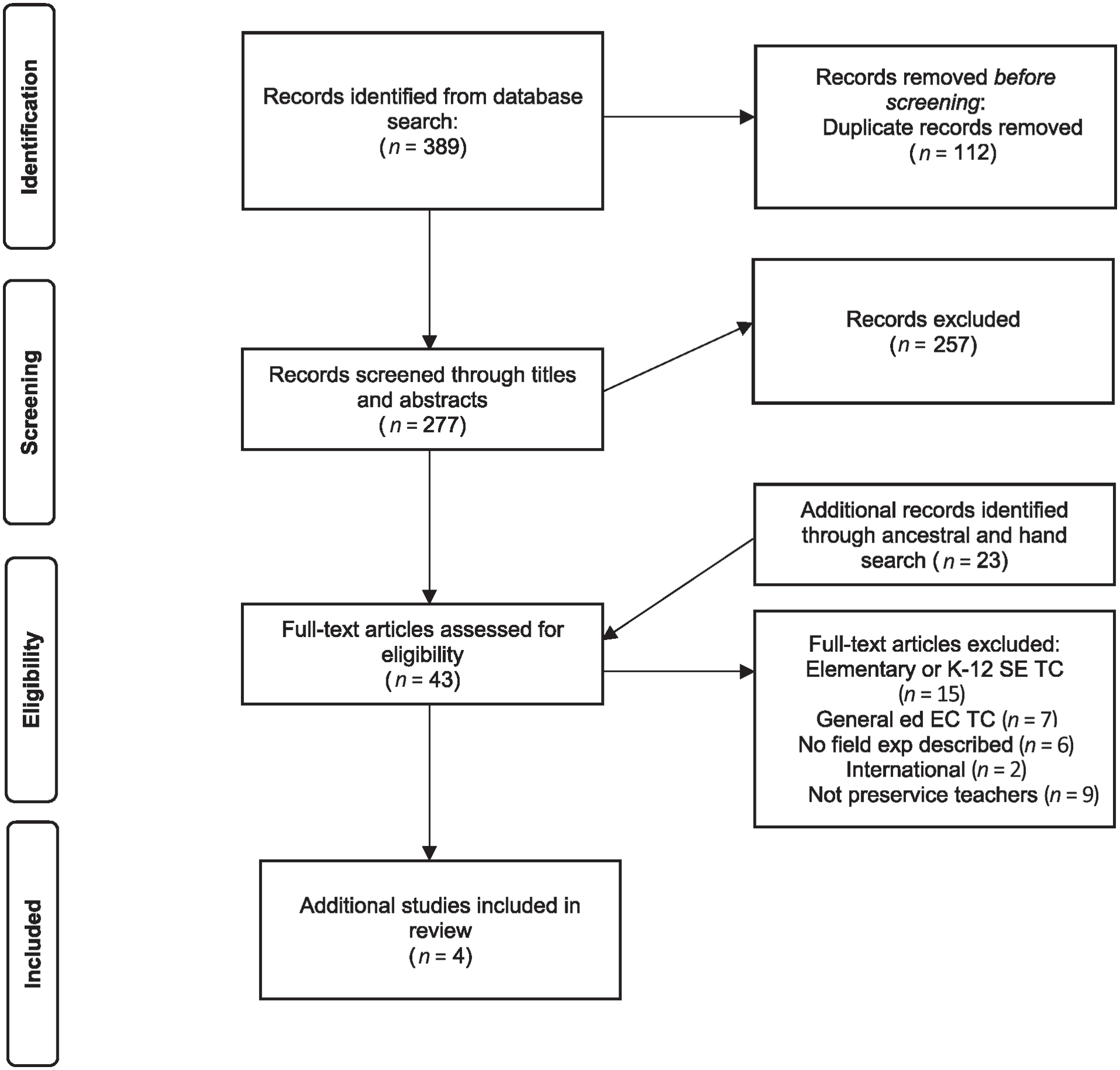
Preferred reporting items for systematic reviews and meta-analyses (PRISMA). Flow diagram of search procedures.
Database Search
To update the dataset, we replicated the same database search procedures outlined by O’Brien et al. (2023) for articles published from October 2020 (the last date included by O’Brien et al., 2023) through December 2022. First, we conducted a database search of: Education Research Complete, Academic Search Complete, ERIC, and Teacher Reference Center. Search terms were the same as those used by O’Brien et al. (2023): field* OR clinical OR practicum OR applied OR experience OR student teach* [AND] “special ed*” OR disabilit* [AND] “student teach*” OR “teacher candidate*” OR preservice OR pre-service OR trainee OR intern* [AND] “teacher preparation” OR “teacher education.” We then filtered results to those (a) written in English, (b) published between October 2020 and December 2022, and (c) published in peer-reviewed, academic journals.
The updated database search resulted in 389 articles. After removing duplicates, two researchers completed title and abstract screening of the 277 new articles to determine if articles met eligibility criteria for this review. With greater than 90% reliability, 257 articles were excluded due to taking place outside of the U.S. or irrelevant subject matter (e.g., physical education and secondary education), leaving 20 articles for full review. During this full article review, two articles met inclusion criteria (IRR = 90%; 18/20 agreement). Any discrepancies in coding were discussed among the research team until consensus was reached. In all, 11 articles were included from the original (n = 9) and expanded (n = 2) database searches (see Figure 1).
Hand Search
Subsequently, we conducted hand searches of relevant journals to identify additional literature for this systematic review. First, two researchers hand searched all issues of Teacher Education and Special Education (TESE) and the Journal of Teacher Education (JTE) from October 2020 to December 2022 to update the hand search conducted by O’Brien et al. (2023). Two articles met initial criteria, but neither met inclusion criteria during a full article review, so no additional articles from TESE or JTE were added. Next, we conducted an additional hand search in journals focused on early childhood education. Two researchers independently screened titles of articles in the Journal of Early Intervention (JEI), the Journal of Early Childhood Teacher Education (JECTE), and Topics in Early Childhood Special Education (TECSE) published between 2013 and December 2022. Two articles from JECTE (IRR = 96%, 168/174 agreement) and 10 articles from JEI (IRR = 95%, 179/187 agreement) met initial inclusion criteria, however upon full article review none focused on ECSE TCs, thus no articles were added. For TECSE, the title screen resulted in 14 articles that met initial inclusion criteria (IRR = 98.6%; 146/148 agreement), including three duplicates. With the remaining 11 articles, the two coders then screened for inclusion by reading the article abstracts. Six met inclusion criteria at this stage (IRR = 100%; 6/6 agreement) and went on for full article review. During the full article review, two articles met all criteria for inclusion in this review (IRR = 83%; 5/6 agreement).
Ancestral Search
Finally, we completed an ancestral search by screening the reference lists of the three articles identified in the updated database search (Hilaski et al., 2021; Nagro, Regan, et al., 2022; O’Brien et al., 2021). Thirteen articles were included at the title screen, nine were duplicates and four did not focus on ECSE teacher candidates. Thus, the ancestral search yielded no additional results. Overall, from all search procedures that we conducted, we identified four new articles for analysis in addition to the nine articles from the original study for a total of 13 studies.
Results
Of the 13 studies included in our review, two reported results from the same field experience and participant sample (Coogle et al., 2015; Storie et al., 2017). Additionally, one study (Nagro, Regan, et al., 2022) was an analysis of data from two other included articles (Coogle et al., 2020; O’Brien et al., 2021). Therefore, we report the results from 11 field experiences instead of 13 studies to avoid over-representation of these field experiences for the Research Questions 1 to 3. Additionally, while analyzing our findings, we examined field experiences in two categories as described by Nagro and deBettencourt (2017): (a) coursework-based practicum experiences (i.e., experiences shorter in duration than student teaching and which typically occur prior to more comprehensive field experiences) and (b) student teaching experiences (i.e., internships that occur at the end of a TC’s program and provide a comprehensive field experience in which the TC assumes the role of classroom teacher under the supervision of a mentor teacher).
Research Question 1: Participant Demographics
First, we examined the demographic information of ECSE TCs included as participants in field experience studies (see Table 1). Out of the 62 total TCs included in this review, most were undergraduate TCs (81%; n = 50), while only 19% (n = 12) were studying at the graduate level. Most participants were in coursework-based practicums (77.4%; n = 48), and of the participants who were in student teaching experiences, all were at the undergraduate level. Furthermore, 50% of all TCs (n = 31) were pursuing joint EC/ECSE licensure, while the other half were seeking only ECSE licensure. The majority (95%, n = 59) were enrolled in traditional teacher preparation programs and were not teachers of record during the study, except for two participants in McLeod’s (2020) field experience and one in O’Brien et al.’s (2021) field experience.
Participant Demographics for Studies Included in Review.
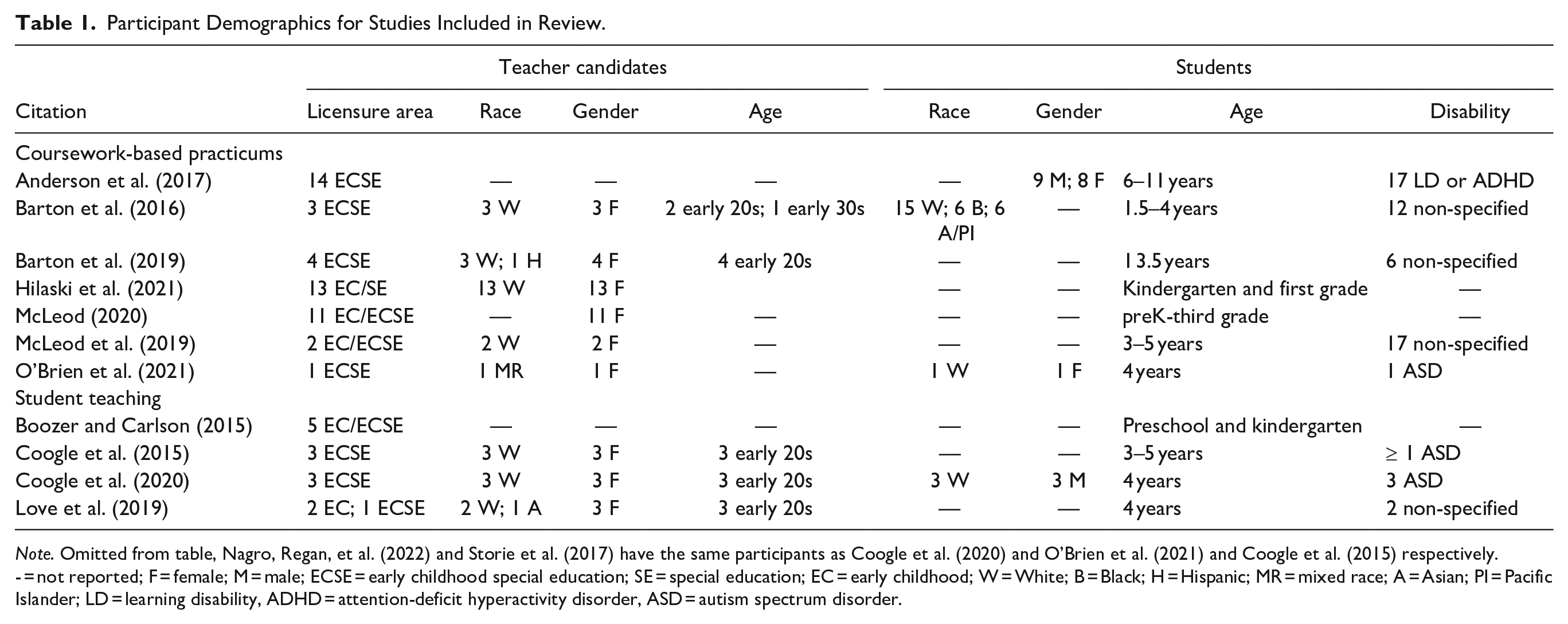
Note. Omitted from table, Nagro, Regan, et al. (2022) and Storie et al. (2017) have the same participants as Coogle et al. (2020) and O’Brien et al. (2021) and Coogle et al. (2015) respectively. - = not reported; F = female; M = male; ECSE = early childhood special education; SE = special education; EC = early childhood; W = White; B = Black; H = Hispanic; MR = mixed race; A = Asian; PI = Pacific Islander; LD = learning disability, ADHD = attention-deficit hyperactivity disorder, ASD = autism spectrum disorder.
Researchers reported gender of the TCs in most (n = 9) field experiences, accounting for 69% of TC participants. All of the participants in field experiences where gender was reported were female (n = 43). TC race was reported less frequently, in seven of the 11 included field experiences, which represented a little over half (51%; n = 32) of all TCs. Of TCs for whom race was reported, 91% (n = 29) identified as White or Caucasian. Of the remaining TCs, one identified as White and Hispanic (Barton et al., 2019), one as Korean (Love et al., 2019), and one as Caucasian and Native American (O’Brien et al., 2021). Thus, across field experiences, ECSE TCs were primarily pre-service undergraduates in traditional teacher preparation programs, who were mostly White/Caucasian and female.
To further examine who was being studied in ECSE field experiences, we also investigated the demographics of student participants (see Table 1). Researchers in all field experiences reported student age, although how age was reported varied. Specifically, seven field experiences (64%) focused exclusively on children before they entered Kindergarten, two field experiences (18%) focused exclusively on children in elementary school, and the remaining two field experiences (18%) included participants from both preschool and elementary school (see Table 1). In addition to reporting age, students were generally identified as having a disability (n = 57), as seven field experiences (63.6% of field experiences) reported student disability status. Yet, their specific characteristics or eligibility were not always described. For example, four stated that the students had an “identified disability” (n = 37) without specifying the disability. Three field experiences, however, indicated specific disability categories. Specifically, one field experience mentioned that students had either a learning disability or ADHD (n = 15; Anderson et al., 2017). For the field experience in Coogle et al. (2015) and Storie et al. (2017) and the one in Coogle et al. (2020), students in the study had a diagnosis of Autism Spectrum Disorder with a need for communication support. Student gender was reported less frequently in only three field experiences (27% of field experiences), with slightly more males (n = 12) than females (n = 9). Additionally, only three field experiences (27% of field experiences) reported student race, representing African American (n = 6), Asian/Pacific Islander (n = 6), Turkish/Czech (n = 1), and White (n = 18) students. Thus, across field experiences, researchers reported student age consistently, with most student participants in grades Pre-K through first. Student race, gender, and disability were less consistently reported with researchers in only two field experiences reporting on all characteristics (Coogle et al., 2020; O’Brien et al., 2021).
Research Question 2: Field Experience Parameters
To answer research question 2 regarding the parameters of ECSE TC field experiences, we examined the duration, setting, instructional approach, and instructional focus of each field experience (see Table 2). We describe results for each of these parameters below.
Field Experience Participants, Duration, Setting, and Instruction.

Note. Omitted from table, Nagro, Regan, et al. (2022) and Storie et al. (2017) have the same participants as Coogle et al. (2020), O’Brien et al. (2021), and Coogle et al. (2015) respectively. UG = undergraduate; GA = graduate; ALT = alternate route; SWD = students with disabilities; GE = general education; PK = pre-kindergarten; HS = head start.
Setting and Duration
A little over half of the field experiences (55%, n = 6) took place in preschool settings that included students with disabilities. Of the remaining field experiences, two took place in elementary school settings, and two included a variety of grade levels from preschool through third grade. Only one field experience took place in a self-contained special education setting. Field experiences ranged in duration from two weeks (McLeod, 2020) to two semesters (Boozer & Carlson, 2015). However, some researchers reported duration in hours (e.g., Anderson et al., 2017) making it difficult to compare across field experiences. Although all of the student teaching field experiences lasted for at least one semester, some coursework-based practicums were also reported as one semester in length, and others were described in further detail. For example, several researchers who utilized single case design reported duration in number of data collection sessions instead of number of field experience weeks (e.g., Barton et al., 2019; McLeod et al., 2019).
Instructional Approach
To determine the instructional approach used in the field experience, we examined the groupings of students that the TCs worked with (e.g., one-on-one and small group) and any other information provided on the instructional approach. Altogether, 64% (n = 7) of the sample occurred during teacher-led classroom instruction (i.e., the activities are selected by the teacher). Specifically, just under half of the field experiences (45%, n = 5) focused exclusively on one-on-one or small group teacher-led instruction, while an additional two focused on teacher-led classroom instruction but did not specify group size. Of the remaining field experiences, three focused on free play or center time (Barton et al., 2016, 2019; Coogle et al., 2020), indicating child-led activities (i.e., children have complete choice in selecting the activity), and one study did not report the instructional approach (Love et al., 2019).
In our examination of instructional approach, we identified some differences based on TC level (i.e., undergraduate or graduate) and field experience type. Specifically, all three undergraduate coursework-based practicums focused on one-on-one instruction or tutoring. As shown in Table 2, graduate practicums and undergraduate student teaching incorporated other instructional approaches, such as free play, small group, and whole class instruction. Thus, graduate students and undergraduates completing student teaching experiences had the opportunity to plan for more complex environments involving multiple students, indicating an increasing assumption of teacher responsibilities as they reached this level in their program.
Instructional Focus
We examined the instructional focus of the field experience to better understand what TCs were being asked to do during their field experiences. We found that overall descriptions of the field experiences focused more on the researchers’ specific area of investigation (e.g., constant time delay) rather than a holistic focus on the field experience. Thus, it is possible that Table 2 and the related results represent only a portion of the skills actually practiced within the field experience. Of the information reported regarding instructional focus, just over half of field experiences (55%, n = 6) focused on instructional skills the TCs were learning and applying, and did not tend to be content area specific (e.g., reading, math). For example, the TCs in McLeod’s (2020) field experience learned how to implement constant time delay across a variety of early childhood content areas. Similarly, TCs in Boozer and Carlson’s (2015) article focused on backwards instructional design skills. Even though five field experiences (45%) focused on communication (three of which also focused on social-emotional development), the majority of field experiences had an instructional focus on TCs’ implementation of specific teaching practices across content areas instead of a particular content area such as literacy or math.
Research Question 3: Field Experience Activities
We examined the activities included in the field experiences, including (a) the learning activities in which TCs engaged during the field experience and (b) opportunities TCs had to receive feedback (see Table 3). Specifically, we coded field experience learning activities for lesson planning, data collection, reflection, and video-based activities, which were common field experience components identified by Nagro and deBettencourt (2017). We also coded feedback opportunities including receiving coaching, being observed, and technology-based coaching.
Field Experience Activities.
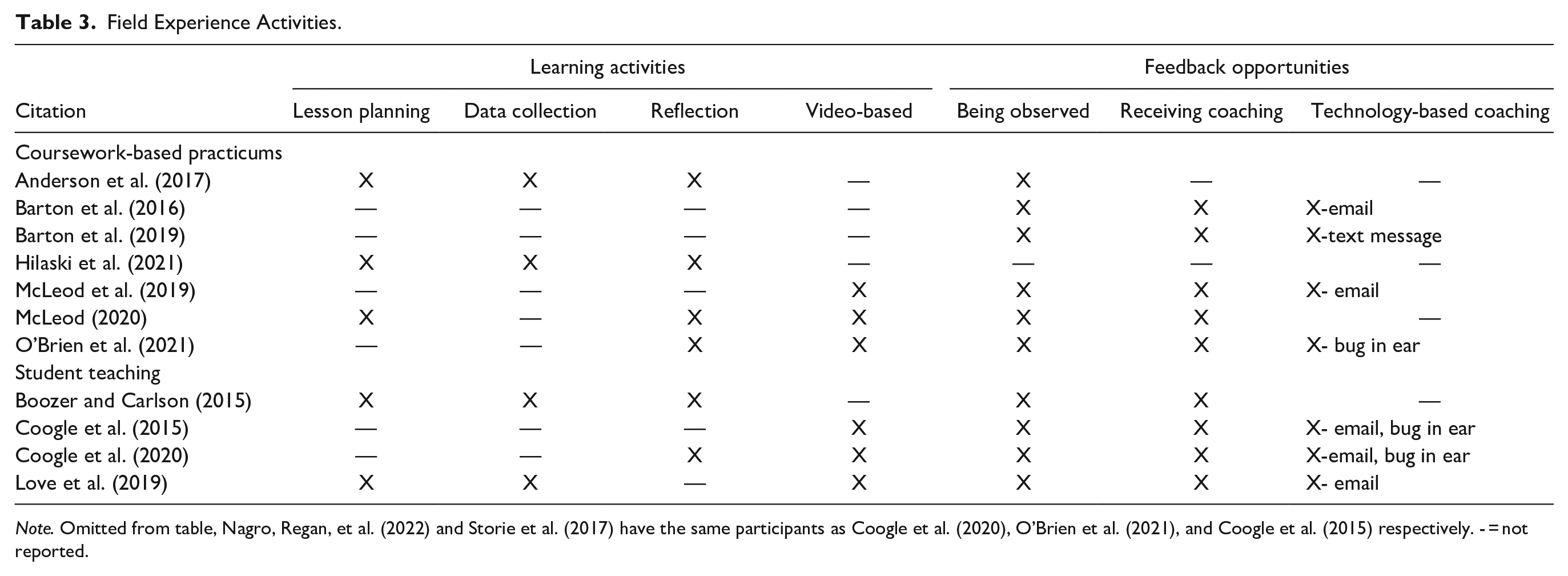
Note. Omitted from table, Nagro, Regan, et al. (2022) and Storie et al. (2017) have the same participants as Coogle et al. (2020), O’Brien et al. (2021), and Coogle et al. (2015) respectively. - = not reported.
Lesson Planning Activities
Just under half (45%, n = 5) of field experiences had lesson planning as a required component of the field experience. In three coursework-based practicum experiences, lesson plans focused on planning for a single lesson in a specific content area (e.g., literacy and technology integration in math). In one student teaching experience (Boozer & Carlson, 2015), TCs wrote a two- to four-week unit plan for a content area. In another, a TC described using the data collection rubric to inform her lesson planning (Love et al., 2019), but the lesson plan requirements were not described. Thus, overall, lesson planning during coursework-based practicums tended to be for a single lesson at a time while lesson planning during student teachings was more varied.
Data Collection Activities
Additionally, researchers in four field experiences (36%) mentioned data collection as a TC learning activity. In three field experiences, TCs assessed student progress for the purposes of instructional planning (Anderson et al., 2017; Hilaski et al., 2021; Love et al., 2019). One field experience had TCs collect data on their own teaching practice (Boozer & Carlson, 2015). Overall, data collection tended to be connected to lesson planning and instructional practice.
Reflection Activities
Another learning activity was reflection, which was incorporated in six field experiences (55%). Specifically, TCs from three field experiences wrote open-ended reflections (Anderson et al., 2017; Boozer & Carlson, 2015; Hilaski et al., 2021). Of this group, one also incorporated a Socratic seminar influenced group reflection (Hilaski et al., 2021). Two field experiences incorporated guiding questions to support students’ written reflections (Coogle et al., 2020; McLeod, 2020). Finally, one field experience (O’Brien et al., 2021) used a structured reflection matrix which asked TCs to describe a teaching practice, analyze decision making, judge its effectiveness, and apply insights to plans for future field experiences. Thus, across the six field experiences that asked TCs to write reflections on their practice, half (n = 3) used supports such as guiding questions or reflection matrices to facilitate student reflective practice.
Video-Based Learning Activities
Overall, six field experiences (55%) mentioned video-based learning activities of various types. Video-based communication for synchronous coaching was used in three field experiences (Coogle et al., 2015, 2020; O’Brien et al., 2021; Storie et al., 2017). In these studies, researchers utilized bug-in-ear technology to coach TCs during a synchronous teaching session. Additionally, video-based learning activities were also used to support TC reflection on their practice in two studies (McLeod, 2020; O’Brien et al., 2021). Video-based activities were used differently in two additional field experiences. In one field experience, video recording was used as a method of self-modeling desired instructional practices (McLeod et al., 2019) and in another pre-recorded videos of children in a classroom were used for TCs to practice data collection (Love et al., 2019). Thus, although video recording was used in multiple ways to support learning, it was a common feature of the field experiences and used to support TC practice.
Learning Activities Overall
Overall, eight of the eleven (73%) field experiences included at least one learning activity, and most included three or four. Interestingly, as shown in Table 3, in three field experiences, researchers reported no learning activities (Barton et al., 2016, 2019; McLeod et al., 2019). In these three field experiences, the focus was on TCs’ feedback opportunities. All five field experiences that reported few to no learning activities incorporated all feedback opportunities (coaching, observation, and technology-based coaching).
Field Experience Feedback Opportunities
Across all studies, we looked at feedback opportunities in terms of observations, coaching, and technology-based coaching (see Table 3). Of the 11 field experiences, almost all (91%; n = 10) included observations as part of the field experience. Of the 10 that included observations, 90% (n = 9) used observations to coach TCs. In another, (Anderson et al., 2017) TCs were observed by researchers for the purpose of data collection, but not coached on their practice related to these observations.
Coaching, where a TC is observed and given feedback on their practice, was included in 82% of field experiences (n = 9). Of the nine field experiences that included coaching, most (78%; n = 7) used technology (e.g., email, text message, and bug in ear) to facilitate this process. Of these seven field experiences, 4 (57%) used exclusively delayed written feedback via email or text message (Barton et al., 2016, 2019; Love et al., 2019; McLeod et al., 2019). Three also incorporated bug in ear technology for immediate feedback on a specific instructional practice (Coogle et al., 2015, 2020; O’Brien et al., 2021; Storie et al., 2017). Two field experiences, on the other hand, did not use technology as a means to communicate with TCs about their practice. Specifically, TCs in McLeod’s (2020) study received in-person group feedback opportunities. Boozer and Carlson (2015) mentioned that TCs received coaching from both mentor teachers and teacher educators during lesson planning, but did not specify the methods of this process. Overall, feedback opportunities were frequent, with 91% of field experiences (n = 10) reporting at least one feedback opportunity and most (64%, n = 7) including all three feedback opportunities. Thus, receiving feedback was a core component of ECSE field experiences.
Research Question 4: Participant Outcomes
In this section, we report trends in the outcomes measured in ECSE field experience research, including: (a) TC behavioral outcomes, (b) TC perceptions of instructional practices, and (c) student outcomes. Additionally, we present results from all 13 studies, instead of 11 field experiences, as different outcomes were examined within the same field experience (i.e., Coogle et al., 2015, 2020; O’Brien et al., 2021; Nagro, Regan, et al., 2022; Storie et al., 2017). Across those 13 studies, 9 (69%) were single case design, while the others were qualitative (Anderson et al., 2017; Hilaski et al., 2021) and mixed methods (Boozer & Carlson, 2015; McLeod, 2019).
Teacher Candidate Behavioral Outcomes
Overall, 10 studies (77%) examined outcomes based on changes in TC behavior. Most of these studies (n = 8, 80%) used single case design and direct behavioral observation on use of a specific teaching strategy (e.g., choice making). Interestingly, all eight of these single case design studies examined the impact of coaching during field experiences on TC outcomes. These studies demonstrate that coaching during field experiences has a positive effect on use of evidence-based teaching strategies (e.g., Barton et al., 2016, 2019; Coogle et al., 2015, 2020). Specifically, Barton et al. (2016, 2019), Coogle et al. (2020), and McLeod et al. (2019) found that teachers increased their rate of target instructional behaviors (e.g., descriptive praise and offering choices) when coached using delayed technological feedback (i.e., text message or email) during a field experience. Similarly, Love et al. (2019) determined that TCs increased data collection quality when provided an intervention package including a data collection template, an instructional session on data collection, and then individualized feedback through email coaching. Coogle et al. (2015, 2020) and O’Brien et al. (2021) found that real-time (e.g., bug in ear) coaching increased TCs use of embedded opportunities to elicit communication from preschoolers. Finally, Nagro et al. (2022) analyzed single-case reflection data from two separate field experiences (Coogle et al., 2020; O’Brien et al., 2021) and found that TCs improved their reflective ability after participating in reflection activities and real-time coaching.
Although the majority of coaching studies were single case design and incorporated technology, two additional studies measured TC behavioral change when connected with a coaching component unrelated to technology. Using a mixed methods design, Boozer and Carlson (2015) found that between first and final unit plan submission, TCs made positive changes when writing their lesson plans. Specifically, through a document analysis, the researchers determined that TCs included clear lesson objectives and got rid of less relevant standards after receiving feedback. Additionally, McLeod (2020) used behavioral observations during a case study and found that TCs used constant time delay practices with fidelity, however given the nature of the research, they could not distinguish what aspects of the intervention (e.g., instructional, peer feedback, and video self-reflection) supported this change. Thus, the majority of studies that examined ECSE TC behavioral changes during a field experience used single-case design, collected observational data, incorporated some type of coaching, and found positive outcomes
Interestingly, of the two studies examining TC behavioral outcomes that did not integrate coaching (Anderson et al., 2017; Hilaski et al., 2021), the researchers still reported perceived increases in TC behavior gathered by TC self-report through interviews. Thus, although these two studies collected data on behavioral outcomes, it was measured indirectly through participant perceptions. For example, Anderson et al. (2017) found that TCs reported integrating technology apps into lessons during their field experience, and Hilaski et al. (2021) found that TCs reported learning to use assessment to drive instruction. As these were not single case or experimental designs, this data was collected through participant interviews.
Teacher Candidate Perceptions of Instructional Practices
Less commonly reported outcomes were TC perceptions of instructional practices utilized during field experiences. A variety of perceptions were reported in four separate studies (31%). Specifically, TCs from two field experiences reported that they intended to continue using the target skill learned in the field experience (Coogle et al., 2015; O’Brien et al., 2021). TCs in two field experiences also felt that the skill they practiced during the field experience was effective (Coogle et al., 2015; Boozer & Carlson, 2015). One study (Hilaski et al., 2021) reported that TCs increased their confidence in instructional approach and moved from a teacher-centered to student-centered practice. Overall, TCs reported positive feelings about their learning during field experiences. This is consistent with the behavioral changes found in other studies that demonstrated that TCs increased their use of targeted instructional practices.
Student Outcomes
Since the ultimate goal of teacher preparation programs is to train profession-ready teachers who can best support students, it is encouraging that four studies (31%) directly measured student outcomes in conjunction with ECSE field experiences. Specifically, Coogle et al. (2020) found that students marginally increased their expressive communication when TCs used the targeted teaching strategies, and that this increase was larger when provided bug in ear coaching. Storie et al. (2017) also found that students increased functional communication skills when TCs used naturalistic strategies. In a similar manner, O’Brien et al. (2021) determined that a focus student responded to the TC’s teaching strategy (choice making) by responding almost twice as frequently during the intervention condition than baseline. However, one study (Barton et al., 2019) found that the percentage of student engagement using time sampling did not change based on intervention conditions. Overall, it is noteworthy that three of four studies that examined student outcomes connected TC instruction during field experiences to increases in student desired behaviors.
Discussion
The purpose of this literature review was to describe the research on ECSE field experiences by examining: (a) student and TC demographics, (b) field experience setting type and duration, (c) TC learning activities, and (d) TC and student outcomes. Altogether, field experience parameters, activities, and embedded learning opportunities are preparation practices with the potential to support TCs becoming profession-ready. In the following section, we discuss findings within the context of ECSE in the US.
Participant Demographics
When examining TC and student demographics in studies of ECSE teacher preparation field experiences, we found that TC participants were primarily White/Caucasian females. Given that ECSE teachers are predominantly female, with less than 3% identifying as male (U.S. Bureau of Labor Statistics, Department of Labor, 2018), and that the majority of special educators working in school-based settings are White (84%; U.S. Bureau of Labor Statistics, Department of Labor, 2018), this sample is reflective of ECSE teacher demographics in the United States. However, given the lack of diversity of the current sample and the inconsistent reporting of participant demographics, it is difficult to draw conclusions for some ECSE TCs (e.g., male ECSE teachers and teachers of color). This is also true for reporting on ECSE student participants, as we found limited demographic information on the students ECSE TCs worked with in field experiences. Specifically, researchers primarily reported students’ age but did not consistently report on other characteristics (e.g., gender, race, and disability). Importantly, knowing students’ disabilities would provide some information on the types of students for which ECSE TCs are prepared to work. Although children with the same disability may have differing strengths and needs, even this basic level of information is not reported. Without student demographics, it is difficult to know whether TCs are being prepared to educate the full range of students’ needs covered under their licensure. Given the limited reporting found in the current review, we suggest that future research more fully describe the students and TCs they are studying to ensure a comprehensive and accurate portrayal of the field.
Field Experience Parameters
To better understand ECSE field experiences, it is important to examine field experience parameters, such as duration, setting, and instructional focus. A detailed description of field experience parameters would enhance researchers’ ability to draw conclusions about field experiences based on the conditions under which ECSE TCs received practice opportunities, emphasizing the need for clear reporting on all field experience parameters. For example, an inclusive preschool classroom may require different instructional skills than a self-contained second grade classroom. If researchers do not include information about the field experience setting, conclusions drawn from a study about the field experience context and TC practice opportunities maybe constrained. Similar to the findings on TC and student demographic information, we found that field experience parameters were inconsistently reported across the literature, making it difficult to compare field experiences across studies. Although limited reporting within the included studies may create some challenges for identifying trends across studies, below we discuss key findings that we identified in our review.
One key component of learning to be an ECSE teacher is spending time in the classroom with opportunities to practice in authentic school settings. In the studies included in our review, all of the student teaching experiences lasted for at least one semester, highlighting a key commonality. Duration for the coursework-based practicums, however, was less consistent, ranging from two weeks to an entire semester. Although comparison across studies was limited by variation in researcher reported duration, in general, undergraduate coursework-based practicums tended to be shorter than graduate ones. Since undergraduate and graduate TCs are all seeking ECSE teacher licensure, it is important for researchers and teacher educators to examine the needs of TCs and to continue to find the dosage needed for hands-on practice.
Another key finding of our literature review is that studies on field experiences took place almost exclusively in inclusive, general education environments, specifically in preschool classrooms. In the 2018 to 2019 school year, more than 70% of children with disabilities age 3 to 5 years attended inclusive early childhood programs (Office of Special Education Programs, 2020). Our findings indicate that ECSE TCs commonly receive opportunities to practice within these settings as part of field experiences. Additionally, we found that the majority of field experiences were with preschoolers, with fewer field experiences with lower-elementary students. Given that the ages covered under early childhood special education teacher licensure varies across the United States (Chen & Mickelson, 2015), as researchers continue to examine ECSE field experiences, it is important to describe the intended licensure path to better determine if the literature gives a comprehensive understanding of age levels covered by ECSE licensure, including elementary and birth through age three settings.
Finally, our findings indicate that instructional opportunities within ECSE field experiences were more commonly reported in small group or individualized instruction as opposed to whole group instruction, which generally reflects the nature of ECSE instructional settings. Additionally, we found that one fourth of field experiences incorporated child-centered instruction, called naturalistic instruction or embedded learning opportunities. Although small groups and intentional evidence-based practices are utilized in special education, child-centered, play-based instruction is also encouraged in ECSE settings (CEC, 2020b). Thus, our findings highlight that ECSE field experiences may need to incorporate child-centered instruction in addition to the teacher-led instruction of small or individual groups.
Field Experience Activities
Our review highlights that coaching and being observed are commonly used feedback opportunities in ECSE field experiences. This key finding highlights the importance of providing ECSE TCs with opportunities to not only teach in authentic school settings but to receive coaching. Further, there was an emphasis on technology-based coaching across studies, and given that almost all of these studies were published before 2020, this was a trend prior to the pandemic pivot to virtual instruction. Receiving feedback, no matter the form, can support TC learning and development (Cornelius & Nagro, 2014). It is, therefore, encouraging that a commonality across field experiences was the opportunity for ECSE TCs to receive feedback and coaching on their instruction.
It is interesting to note that researchers more often described TCs’ feedback opportunities within field experiences (e.g., coaching) than their learning activities (e.g., lesson planning). Approximately half of the field experiences included reflection, video-based activities, and lesson planning, while around one-third included data collection as learning activities, despite the importance of these skills in preparing ECSE teachers. It is possible that researchers were more focused on the feedback TCs received in field experiences than the actual activities in which they were engaging as part of the field experience. It is also possible that researchers described coaching and feedback more often because that was the focus of their research aims in their study. When field experience artifacts (e.g., lesson plans and written reflections) are also data collected for research studies, it can be challenging to disentangle research activities from field experience activities. This is further complicated by the fact that some researchers were also serving as teacher educators of the TCs (e.g., O’Brien et al., 2021). Thus, in assuming multiple roles during the field experience (i.e., researcher, teacher educator), the distinction between what was done for educational purposes versus research becomes further muddled.
Field Experience Outcomes
Though we did not set out to examine specific components that made differences during field experiences, our literature review suggests that both TC behavior and student outcomes tended to improve following field experiences. It is noteworthy that most studies on ECSE field experiences looked directly at changes in TC instructional behavior and beyond social validity or self-reported data, as TCs may not always be accurate when self-reporting their abilities (Nagro, Raines, et al., 2022). It is encouraging that some studies looked at TC behavioral outcomes. It should be noted that there was a high prevalence of single-case design studies focused on coaching among studies that reported student or TC outcomes. This is consistent with the foci of single case designs, as they measure observable behaviors in response to stimuli (e.g., coaching). Moving forward, we recommend that more studies use this as an outcome metric (as appropriate) to substantiate ties between field experiences and positive student outcomes. Overall, this systematic literature review supports the notion that field experiences are important and impactful on ECSE TC learning. Although we do not yet know the exact components of field experiences that make a difference, the results from this study indicate that coaching, and specifically technology-based coaching, is a promising practice during ECSE teacher preparation field experiences.
Limitations
As the first study to review extant research on ECSE field experiences in special education teacher preparation, this study offers important insight for teacher educators and researchers. Yet, there are limitations to our study that are important to acknowledge. First, although we attempted to conduct a thorough review with multiple search methods, it is possible that we may have inadvertently excluded other studies (e.g., gray literature was excluded from our search). Similarly, our search terms may not have fully captured all possible studies. Second, given that our study focused on a subset of a broader literature search (O’Brien et al., 2023) which replicated a previous review (Nagro & deBettencourt, 2017), we included studies from 2013 through 2022, thereby excluding articles prior to 2013. Third, although we gathered information from what was reported in the included articles during our coding process, it is possible that we interpreted a field experience activity or feature in a way that was unintended by the authors. Fourth, by excluding non-school based settings, our review may have missed field experiences in other settings and serving students who are younger than three years old. This is an essential area of research for future studies on EI/ECSE. Thus, while this study is the first to examine ECSE field experiences in school-based settings (preK-3), it will be critical for future research to also examine field experiences in birth-three settings to obtain a more comprehensive view of EI/ECSE teacher preparation. Finally, as a first review of ECSE field experiences, our research questions focused on demographic information, logistical parameters, field experience components, and outcomes, without examining quality indicators. Thus, we cannot draw conclusions about the overall effectiveness of the field experiences or the quality of the evidence base.
Implications
The findings of our review highlight important implications for future research. First, it is imperative that researchers continue to investigate field experiences in ECSE teacher preparation programs, particularly for graduate students in student teaching. More research is needed to fully understand not only which field experiences are used to prepare both graduate and undergraduate ECSE TCs but also which components of field experiences are critical for improving TC and early childhood student outcomes. Further, given the variety of ways in which researchers reported features of field experiences and participants, it will be critical for future replication studies and literature syntheses that researchers fully describe the field experience, research methodology, and participants. Additionally, researchers used different terminology to describe field experiences (e.g., practicum, internship, and student teaching), emphasizing the need for a shared language or, at minimum, clear definitions of the field experience itself.
In addition to research, our findings indicate important implications for teacher educators. First, observation and coaching were the most common features of ECSE field experiences, and most often technology was used to facilitate the coaching. Teacher educators might explore their use of observations combined with coaching within their programs and collect data on TC and student outcomes. Similarly, teacher educators can explore how technology may be leveraged to provide coaching to TCs. Additionally, a common learning activity within field experiences was reflection, highlighting that field experiences may need to provide TCs with opportunities to reflect on their and others’ teaching.
In conclusion, this systematic literature review described the participant demographics, parameters, learning and feedback opportunities, and outcomes of ECSE field experiences. Encouragingly, field experiences suggest positive behavioral outcomes for both TCs and young students with disabilities. As researchers continue to investigate ECSE field experiences, reporting on TC and student demographics as well as field experience parameters, activities, and outcomes will support improved understanding of the key factors influencing TC growth and student performance. This will lead to an improved understanding of best practices that can support TCs to be profession ready.
Footnotes
Declaration of Conflicting Interests
The author(s) declared no potential conflicts of interest with respect to the research, authorship, and/or publication of this article.
Funding
The author(s) received no financial support for the research, authorship, and/or publication of this article.
