



Abstract
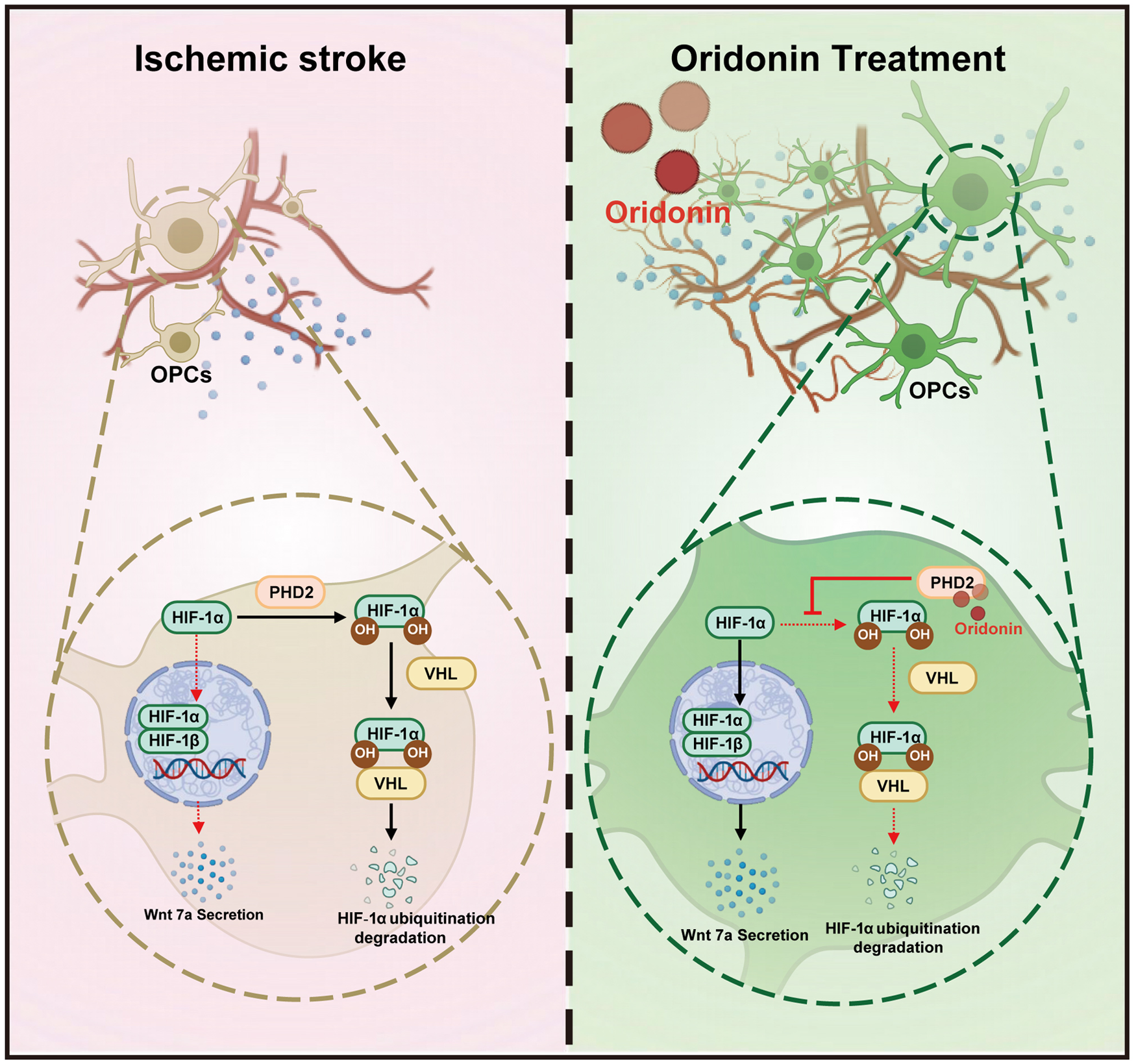
Angiogenesis during post-stroke neurovascular recovery is linked to oligodendrocyte precursor cells (OPCs) phenotypic shifts. Oridonin, a natural diterpenoid, has the potential to regulate post-stroke angiogenesis, but its specific mechanism remains unclear. Intraperitoneal injection of oridonin significantly promoted angiogenesis in the ischemic penumbra of stroke model mice. However, endothelial cell proliferation, sprouting, and tube formation assays demonstrated that oridonin exerted no direct regulatory effect on endothelial cell-triggered angiogenesis in vitro. Unexpectedly, oridonin notably promoted perivascular OPCs proliferation in the ischemic penumbra and enhanced the secretion of the pro-angiogenic factor Wnt7a by immunofluorescence staining and enzyme-linked immunosorbent assay (ELISA) analysis. Meanwhile, the conditioned medium from oridonin-treated OPCs enhanced the angiogenic effect of endothelial cells, which was reversed by inhibition of the Wnt7a/β-catenin pathway. Mechanistically, drug affinity responsive target stability (DARTS) and microscale thermophoresis (MST) assays confirmed that oridonin directly bound to α-ketoglutarate-dependent prolyl hydroxylase 2 (PHD2), thereby inhibiting the ubiquitination and degradation of hypoxia-inducible factor 1-alpha (HIF-1α) in OPCs and regulating their proliferation and pro-angiogenic effects. Collectively, oridonin targets PHD2 to inhibit HIF-1α ubiquitination and degradation in OPCs, thereby facilitating OPC proliferation and activating the Wnt7a/β-catenin pathway to promote endothelial angiogenesis after stroke.
Get full access to this article
View all access options for this article.
References
Supplementary Material
Please find the following supplemental material available below.
For Open Access articles published under a Creative Commons License, all supplemental material carries the same license as the article it is associated with.
For non-Open Access articles published, all supplemental material carries a non-exclusive license, and permission requests for re-use of supplemental material or any part of supplemental material shall be sent directly to the copyright owner as specified in the copyright notice associated with the article.
