




Abstract
This study examined the relationship between the executive control process of inhibition and self-reported dispositional mindfulness, controlling for gender, grade, and cortisol levels in 99 (43% female) fourth- and fifth-graders (
Mindfulness is a self-regulatory skill that involves observing one’s own thoughts and feelings without judgment (Brown & Ryan, 2003). Practices of mindfulness originate from Eastern contemplative traditions and have recently emerged as a new way to reduce stress and to promote mental well-being in both children and adults (e.g., Baer, 2003; Greeson, 2009). Mindful attention and awareness is conceptually based on models of self-regulation theory (Brown & Ryan, 2003; MacKillop & Anderson, 2007); it is a state of consciousness that is characterized by self-awareness and focused attention to the present moment in an open and accepting state (Bishop et al., 2004). An increasing number of studies have reported a link between mindfulness-based practices and benefits for health and well-being (Moore & Malinowski, 2009). Specifically in the context of promoting health, well-being, and success in schools, practicing mindfulness has been identified as a promising approach for improving types of attention that are significant for the development of inhibition and self-regulation in adolescents (Zylowska et al., 2008). However, the underlying mechanisms are not yet well understood, and further research needs to be conducted to shed light on the factors involved in mindful attention awareness (Brown, Ryan, & Creswell, 2007).
In this article, we report the findings of a study in which we investigated dispositional mindful attention awareness in relation to executive function (EF) among early adolescents, taking into account the role of grade, gender, and neuroendocrine regulation (as assessed via salivary cortisol). Mindfulness is related to attention, self-regulation, and brain functions (Bishop et al., 2004; Segal, Williams, & Teasdale, 2002; Tang et al., 2007), and can be trained, fostered, and promoted in early adolescence (Semple, Lee, Rosa, & Miller, 2009). EFs are related to intellectual abilities and problem-solving skills and are considered crucial in healthy and positive development in life (Zelazo, Müller, Frye, & Marcovitch, 2003). Cortisol is a biological indicator of neuroendocrine regulation that is related to stress responses, executive control skills, and self-regulation of behavior (Giovagnoli, 2001; Lipska, Aultman, Verma, Weinberger, & Moghaddam, 2002), and should therefore be considered as a control variable when investigating the relationship between mindfulness and EFs. Our study contributes to research on mindfulness, self-regulation, and executive control processes. Furthermore, it informs research on interventions, positive youth development, and resilience, given that mindfulness and executive control skills can be considered protective factors that can be trained and fostered, contributing to healthy and positive adolescent development.
A Multiple-Levels-of-Analysis Perspective on Early Adolescent Development
Early adolescence, roughly between the ages 10 and 14, is a highly transient time, characterized as a period of both opportunity and risk in development (Eccles & Roeser, 2009; Steinberg et al., 2008). During early adolescence, the transition from elementary to secondary school occurs, accompanied by tremendous developmental changes and challenges in the cognitive, biological, and social domains, thereby marking early adolescence as a critical and significant period for further development (Dahl & Gunnar, 2009; Eccles, 1999; Eccles & Roeser, 2009). Understanding the complex developmental changes and their interplay is key for identifying and creating intervention strategies to promote and foster early adolescents’ positive development.
In order to identify mechanisms and skills that (a) can be fostered and strengthened through preventive interventions and initiatives, and (b) positively affect several domains of development, there is a need to move away from investigating single mechanisms of development toward adopting a multiple-levels-of-analysis approach (Cicchetti & Blender, 2006; Curtis & Cicchetti, 2003; DelCarmen-Wiggins, 2008). Taking a multiple-levels-of-analysis approach is critical in the field of prevention science because it not only provides a way to identify a variety of biological processes that may lead children away from risk and toward positive mental health and well-being but also can provide critical information for the design and implementation of effective preventive interventions (Greenberg, 2006). Greenberg stresses that a primary goal of prevention science is to change behavior that is defined broadly as action, emotion, or cognition, and states, “A central task for the next decade is to understand in much greater detail the relations between the multiple levels of the biological substrate and these resilience processes involved in cognitive processes and emotional regulation” (p. 142). Included in the array of critical mechanisms and processes that have been identified as contributing to resilience and positive development during childhood and adolescence are self-regulation and problem-solving skills—processes in which EFs and the actions of the prefrontal lobe play a fundamental role. Moreover, self-regulation in particular can serve as protective factor and is considered to be one of the critical assets for healthy development (Luthar, 2006; Masten, 2007; Masten & Motti-Stefanidi, 2009).
In the current study, we bring together three core domains of early adolescent development: cognitive functioning, self-regulation, and neuroendocrine regulation. The concurrent examination of the ways in which various dimensions of functioning are interrelated is a crucial first step in the design of effective intervention and preventive programs to improve educational practice and foster the well-being of early adolescents.
The Benefits of Mindfulness on Well-Being
Although almost everyone has the capacity for mindful awareness and attention, there are varied interindividual and intraindividual differences in people’s willingness and ability to focus attention on the present moment (Brown & Ryan, 2003). Research on mindfulness indicates that individuals with naturally higher levels of mindfulness report feeling less stressed, anxious, and depressed, and more content, vital, and satisfied with life in comparison with individuals who score lower on mindfulness measures (see Greeson, 2009). Furthermore, greater mindfulness has been associated with higher abilities to self-regulate inner emotional experiences in the present moment (Brown et al., 2007), which has been considered to positively affect long-term health outcomes (Greeson, 2009). In the past few years, there has been an increase in the utilization of mindfulness-based interventions in mental health settings, with the Mindfulness-Based-Stress-Reduction program (MBSR; Kabat-Zinn, 1984) being among the most popular programs in implementations and research evaluations (Moore & Malinowski, 2009). In addition, various other mindfulness applications have become more popular and supported by research evidence (see Baer, 2003 for a review), with recent research indicating the effectiveness of such approaches for adolescents (e.g., Biegel, Brown, Shapiro, & Schubert, 2009; Broderick & Metz, 2009). Nonetheless, despite evidence that the enhancement of mindfulness through training is associated with greater well-being in other domains (e.g., Chiesa & Serretti, 2009; Kabat-Zinn, 1990; McCown & Reibel, 2010), the underlying mechanisms of how it contributes to physical and psychological well-being are not yet well understood (Brown et al., 2007).
Recent research with adults has shown that increased mindful attention awareness can be taught and that mindfulness training can increase cognitive capacities for attention, memory, and learning (e.g., Heeren, Van Broeck, & Philippot, 2009; Langer, 2000; Moore & Malinowski, 2009). Mindfulness is said to increase attention by enabling the mind to focus and sustain attention on one’s thoughts and by inhibiting distractions or unwanted thoughts (Moore & Malinowski, 2009). A study by Heeren and colleagues (2009) investigated the effects of mindfulness meditation training on cognitive inhibition and cognitive flexibility in adults with no prior mindfulness meditation practice. Results revealed that participants who had received the mindfulness meditation training made significantly fewer errors on cognitive inhibition and flexibility tasks than the participants in the control group. Similarly, Jha, Krompinger, and Baime (2007) have shown that adults with no previous mindfulness or meditation practice showed significantly higher voluntary attention control after a mindfulness intervention. In fact, Wenk-Sormaz (2005) found improved cognitive flexibility and attentional control among adults who had received as little as three 20-minute sessions of mindfulness training. Furthermore, a group of adults and adolescents with attention deficit and hyperactivity disorder (ADHD) who had completed a mindfulness-based intervention showed improvement in self-reported ADHD symptoms and on a computerized attention and inhibitory control task (Zylowska et al., 2008).
These findings are important because they link mindful attention awareness with attentional control. At present, however, evidence is limited in that most of the research on mindfulness’ trainability and effectiveness on cognitive inhibition and attention comes from adult populations. Less is known about the association between mindfulness and attentional control among children and early adolescents (Thompson & Gauntlett-Gilbert, 2008). Therefore, there is great potential in applying mindfulness techniques in educational settings with younger people, given that it can be a used as a tool to teach and improve both self-awareness and impulse-control while decreasing emotional reactivity (Thompson & Gauntlett-Gilbert, 2008). Langer (2000) advocates that the increased awareness, creativity, and cognitive flexibility fostered by mindful practices can improve children’s learning and performance by reducing stress and increasing students’ engagement in the lessons being taught. This rationale has led to a small number of rigorously evaluated mindfulness-based school programs for children from kindergarten to high school, showing that mindfulness practices can be of enormous benefit for children’s social and emotional development (see, for example, Burke, 2010, for a review; see also Napoli, 2004; Napoli, Krech, & Holley, 2005; Ritchart & Perkins, 2000; Schonert-Reichl & Lawlor, 2010).
A recent study on mindfulness-based cognitive therapy with 9- to 12-year-olds indicated not only that children learned mindfulness techniques from training but also that mindfulness reduced attention and behavior problems and decreased anxiety (Semple et al., 2009). Similarly, Napoli (2004) found that elementary school students who practiced mindful breathing with their teachers reported being better able to relax and focus, reduce their anxiety before a test, make better decisions in heated moments such as conflicts, and were more able to regain their focus after their attention had been diverted. Furthermore, in a nonclinical sample of adolescents, receiving a mindfulness curriculum was associated with decreased negative affect and increased self-acceptance and emotional regulation abilities (Broderick & Metz, 2009). Moreover, the authors found that adolescents reported a high degree of acceptance of and satisfaction with the program, supporting the vision of mindfulness-based interventions as promising techniques for promoting health and well-being in early adolescence.
With the growing popularity of mindfulness in psychology, health sciences, social work, and neuroscience, researchers are calling for a thorough investigation of methods and contents of exploration when researching mindfulness (Garland & Gaylord, 2009). Garland and Gaylord emphasize the need for a performance-based, cognitive-behavioral measure of mindfulness, mixed-method approaches including a wide spectrum of instruments assessing mindfulness, and in particular the use of so-called “hard” scientific methods (e.g., neuro-cognitive measures) in addition to self-report measures.
EF Skills: Core Mechanisms of Cognitive Development in Early Adolescence
Executive control processes are high-level functions that organize, sequence, and regulate behavior, playing a crucial role in everyday activities and functioning such as planning, holding, and managing multiple open goals, and maintaining cognitive flexibility (Reimers & Maylor, 2005). The three key components of EFs that characterize mature cognition are the ability to (a) hold information in the mind, mentally manipulate this information, and act on the basis of it (working memory), (b) exercise self-control by resisting inappropriate behaviors and responding appropriately (inhibition), and (c) quickly and flexibly adapt behavior to changing situations (cognitive flexibility; Davidson, Amso, Cruess Anderson, & Diamond, 2006; Zelazo et al., 2003). EF skills are age-related, with improved performance being found on tasks assessing executive control from childhood and adolescence (e.g., Davidson et al., 2006; Zelazo & Müller, 2002), reaching a peak in early adulthood (e.g., Diamond, 2002; DeLuca et al., 2003).
During the onset of early adolescence, activity in the prefrontal regions of the brain increases, indicating maturation (Rubia et al., 2006; Steinberg, 2005), whereas activity in irrelevant brain regions decreases (Durston et al., 2006), reflecting an overall linear pattern of improved cognitive control and emotion regulation as the prefrontal cortex matures from late childhood to early adulthood (Casey, Jones, & Hare, 2008). Neural development in the prefrontal cortex during the adolescent years has been found to be associated with improved executive control processes such as selective attention (Anderson, Anderson, Northam, Jacobs, & Catroppa, 2001) and the voluntary inhibition of impulses (León-Carrión, García-Orza, & Pérez-Santamaría, 2004). Yet, conversely, impulsivity and risk-taking behavior increase from childhood to adolescence (Steinberg, 2008)—a notion that researchers have explained with the increase of subcortical activation in the accumbens and amygdala which are known to be involved in making risky choices and processing social and emotional information (Ernst et al., 2005; Montague & Berns, 2002). Identifying ways to improve emotional regulation and to decrease behavioral impulsivity that are associated with risky behaviors can be promising for the design of intervention programs for early adolescents, promoting a positive path in development.
Relationships of EF Skills to Social and Emotional Competence and Positive Development
EF skills in childhood, in particular inhibitory control, are closely related to social and emotional functioning, which in turn play a significant role in positive school adjustment and academic achievement (Bierman, Nix, Greenberg, Blair, & Domitrovich, 2008; Rhoades, Greenberg, & Domitrovich, 2009). It is believed that inhibiting a behavior requires mediation by associated neuroanatomical areas in the prefrontal cortex in order to control impulsive thoughts and actions (Riggs, Greenberg, Kusché, & Pentz, 2006). In an evaluation of the effectiveness of an intervention program designed to promote social and emotional skills in elementary school children, Riggs et al. (2006) found that the program was effective in both promoting children’s social and emotional competence and enhancing inhibitory control. These findings are in accord with theoretical considerations and empirical evidence suggesting that EFs, in particular inhibitory control, facilitate the regulation of emotions and behaviors and are related to social and emotional competence in childhood (Kochanska, Coy, & Murray, 2001; Rhoades et al., 2009).
Connecting EFs and Processes of Self-Regulation
EFs, in particular inhibitory control skills, involve cognitive and emotional self-regulation abilities which have been characterized as the balance or interaction between processes of emotional-motivational arousal and cognitive control processes (Gray, 2004). Self-regulation plays a key role in the socialization of a child because it contributes to competent functioning over the life span (Bronson, 2000; Posner & Rothbart, 2000). It has been theorized that one of the main mechanisms of mindfulness practices that affects positive change is improved self-regulation (Shapiro, Carlson, Astin, & Freedman, 2006). Bishop and colleagues (2004) propose that mindful attention awareness is linked to EF skills because it requires self-regulating the focus of attention while inhibiting the urge to elaborate on thoughts and feelings that naturally arise in consciousness. On a physiological level, self-regulation has been studied through the activation and activity of the stress-response system, with a particular emphasis on the activity of the hypothalamic-pituitary-adrenal (HPA) axis (Blair, 2010; Diamond & Aspinwall, 2003).
Neuroendocrine regulation is frequently assessed via HPA-axis activity, a homeostatic system that follows a circadian rhythm and is activated in response to cognitive (e.g., fear, excitement) or noncognitive (e.g., infections) stressors (Jessop & Turner-Cobb, 2007). Cortisol levels found in saliva or blood can be used as an indicator for HPA-axis activity. Considering HPA activity when examining inhibitory skills and mindfulness is important because past research has found significant relationships between cortisol and EFs as well as cortisol and mindful attention awareness (Blair, Granger, & Razza, 2005; Tang et al., 2007).
The interconnectedness among EFs, HPA functioning, and emotional and behavioral self-regulation has been established in a number of studies with animal models (e.g., Goldstein, Rasmusson, Bunney, & Roth, 1996; Holmes & Wellman, 2009) as well as humans (Blair et al., 2005). Findings from studies with humans have revealed a significant relationship between different domains of self-regulation, such as EFs; social, emotional, and cognitive competence; and physiological measures of stress reactivity and HPA activity (see Blair, 2010, for a review; see also Diamond & Aspinwall, 2003). In his review article, Blair stresses the interrelatedness among the different aspects of self-regulation, in particular during child development. Indeed, recent years have witnessed a burgeoning research in this area due, in part, to increased recognition of the significance of self-regulation and stress reactivity in determining healthy cognitive, social, and emotional development in childhood.
Research on HPA activity, a form of physical self-regulation, has mostly been conducted with adults, showing that chronically high or low levels of cortisol in response to stress are associated with difficulties in cognitive and behavioral regulation (Blair et al., 2005). For example, highly elevated cortisol levels have been associated with deficits in cognitive functioning (Monk & Nelson, 2002). In addition, Blair et al. (2005) found that although lower baseline cortisol was related to better inhibitory control, lower cortisol reactivity in response to a stressor was related to decreases in EF in low-income preschool children. However, it should be noted that these results cannot be generalized to other age-groups or to children from different socioeconomic backgrounds. To our knowledge, no research to date has been conducted on the relationship between inhibitory control and baseline cortisol during the early adolescent years.
Research with adult samples evaluating interventions based on mindful attention and awareness practices has suggested a link between mindfulness and physiological systems related to stress (e.g., Davidson et al., 2003; Tang et al., 2007). For example, Tang et al. (2007) found participation in meditation training was associated with decreased cortisol responses following stress exposure. Given that theoretical as well as empirical research indicates an interrelation between different forms of self-regulation, such as EFs and HPA activity (Blair, 2010; Blair et al., 2005), and mindful attention, awareness, and HPA activity (Tang et al., 2007), we believe that it is important to consider the influence of cortisol when investigating the relationship between mindfulness and inhibitory control processes.
Summary and Hypotheses
Mindfulness, EFs, and neuroendocrine regulation are interrelated mechanisms that are significant in early adolescents’ health, well-being, and positive development and adjustment. Investigating these three areas reflects a multilevel approach, combining self-report measures with cognitive performance data and biological regulation processes. Taking this approach into an educational setting and investigating it in a sample of early adolescents addresses a current gap in the research and has the potential to benefit multiple areas of both research and application, such as education, intervention, clinical, and health research. This is the first study to our knowledge to investigate mindfulness in relation to inhibitory control, taking into consideration neuroendocrine functioning in early adolescents. Specifically, we hypothesized that after controlling for grade level, gender, and morning cortisol level, mindfulness would be a significant predictor for early adolescents’ performance on high-demand inhibitory control trials in a computerized EF task.
Method
Participants
Participants were 56 male and 43 female early adolescents in four 4th- and 5th-grade classrooms who were part of a larger study examining the effects of a school-based social and emotional competence program in public elementary schools. Schools were located in middle-class neighborhoods in a large city in Western Canada. Data for the current study were drawn from measures administered prior to the intervention (i.e., pretest data). Forty students were in fourth grade and 59 students were in fifth grade. Students’ ages ranged from 9.00 to 11.16 years (
Measures
Demographic information
A demographic questionnaire was administered to each student to gather information about his or her gender, age, grade, first language learned, and family composition.
Mindfulness
The original Mindful Attention Awareness Scale (MAAS) was developed by Brown and Ryan (2003) to assess individual differences in the frequency of mindful states over time. In developing their measure, Brown and Ryan proposed that “statements reflecting mindlessness are likely more accessible to most individuals, given that mindless states are much more common than mindful states” (p. 826). Hence, items on the MAAS reflect mindless states (e.g., “I could be experiencing some emotion and not be conscious until sometime later,” “I do jobs or tasks automatically without being aware of what I am doing,” “I snack without being aware of what I am eating”). The MAAS (Brown & Ryan, 2003) is a 15-item scale with a response format that ranges from 1 = almost always, 2 = very frequently, 3 = somewhat frequently, 4 = somewhat infrequently, 5 = very infrequently, and 6 = almost never, with higher scores indicating higher levels of mindfulness. Items are distributed across cognitive, emotional, physical, interpersonal, and general domains. Benn (2004) later modified the MAAS to use with younger populations by (a) altering language to be age appropriate and (b) changing the 6-point Likert-type scale to read in a more child-friendly format, ranging from 1 = almost never, 2 = not very often at all, 3 = not very often, 4 = somewhat often, 5 = very often, and 6 = almost always.
Upon analysis, items were reverse-scored and averaged, with higher scores indicating higher mindfulness. Brown and Ryan report the MAAS to be a reliable and valid instrument with a reported internal consistency of .85. The modified MAAS has been reported to have an internal consistency of .84 as assessed via Cronbach’s alpha (Lawlor, Schonert-Reichl, & Zumbo, 2009). For the present investigation, Cronbach’s alpha was good (α = .84).
Cortisol
HPA-axis activity was assessed by measuring free cortisol in saliva at 9 a.m. in the classroom setting. The salivary cortisol collection was facilitated by research assistants who visited the classrooms to assist participating students throughout the collection. Participants were instructed to avoid food intake and high physical activity prior to the saliva collection. When collecting the saliva samples, research assistants directed children to put a dental cotton roll in their mouths for 1 minute and saturate it in saliva (Salimetrics Oral Swab, Canada). Samples were shipped to Clemens Kirschbaum’s laboratory at the Dresden University of Technology in Germany for analyses of salivary cortisol. Cortisol concentrations were then determined using a commercial chemiluminescence immunoassay (CLIA; IBL-Hamburg, Germany). This assay has a sensitivity of 0.16 ng/ml and intra- and interassay coefficients of variation less than 12%. All data were log-transformed for further analyses.
EFs
To assess inhibition control, we used a computerized Dots task (also see Davidson et al., 2006) in which the central stimuli—a heart or a flower—appeared on the right or left side of the computer screen, requiring participants to press the key either on the same or opposite side of the stimulus (see Figure 1). The two stimuli were equated for visual characteristics, such as size, color, and luminance. The inhibition task consisted of 33 trials in which either hearts or flowers appeared on the screen in an unpredictable order. Participants were instructed to always press the button on the same side (congruent trials), when the stimulus on the screen was a heart, and to press the button on the opposite side (incongruent trials), when the stimulus was a flower. Participants therefore had to remember both rules and apply them flexibly. Considering our interest in inhibitory control, the trials of interest in our study were those that require highest inhibitory skills. On those switch trials, participants had to switch from applying the congruent rule to applying the incongruent rule. Switching from congruent (easier rule) to incongruent trials (harder rule) in the mixed condition requires a particularly great amount of inhibitory control (Davidson et al., 2006).
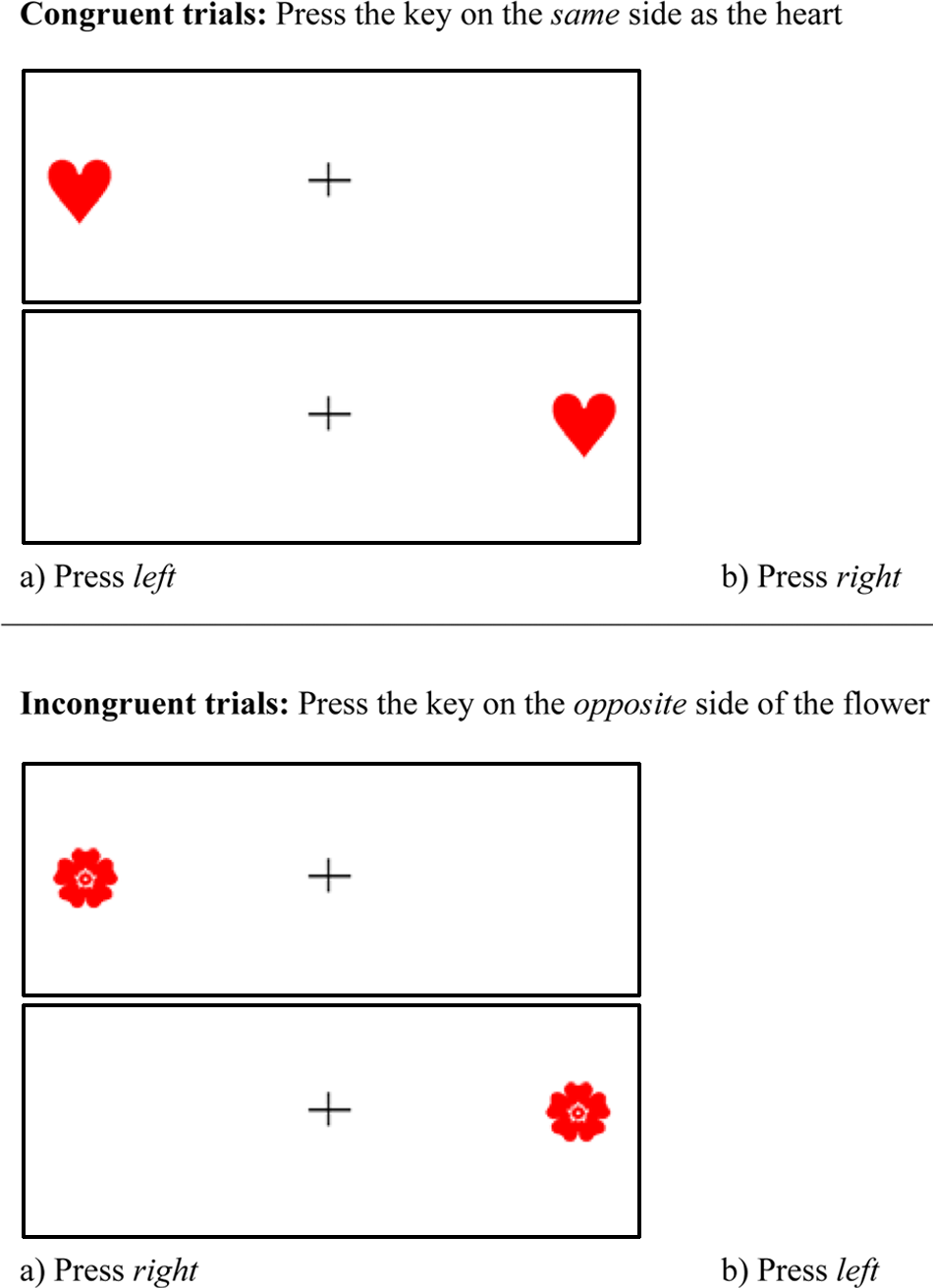
Stimuli and conditions in the Dots task
Procedure
All self-report data were assessed in form of a survey, administered to students in their classroom during a regular 45-minute-class period in the early spring of the school year. Each item on the questionnaire was read aloud by trained research assistants while students completed the measures. Cortisol was collected in the beginning of the school day with an oral cotton swab. Together in the classroom, participants took their own saliva sample according to instructions and supervision of the research assistants. Teachers had been advised to cancel the morning gym session on this day to avoid an artificial incline of cortisol levels due to exercise. The EF task assessment took place outside of the classroom in a quiet room with no distractions. Early adolescents were told that they were going to play a computer game for the next 10 minutes in which hearts and flowers appear on the screen and they had to press one of the two marked buttons on the left or right side of the keyboard depending on which rule they were instructed to apply. The task was presented on a laptop using the Presentation program by Neurobehavioral Systems to present stimuli and record responses. Responses were collected via two input keys on the keyboard. Participants were positioned approximately 50 cm from the screen. The task consisted of three different conditions. Each condition began with condition-specific instructions and a short block of four practice trials. The practice trials consisted of all relevant trials types included in the task condition. If necessary, the practice trials were repeated, to ensure that the participant had understood the task and the condition-specific requirements. Stimulus presentation time was 750 ms, and the interstimulus time interval was 500 ms.
Results
Data Analytic Procedure
The outcome measure of interest was children’s performance on high-demand inhibitory control switch trials within the mixed condition. The predictor variables were gender, grade level, morning cortisol level, and MAAS score. Performance on inhibitory control trials was operationalized as the percentage of correct responses (PC). PC was calculated by dividing the number of correct responses by the sum of correct and incorrect responses. Anticipatory responses, that is, responses that were faster than 200 ms, were considered too fast to be a response to the stimulus (Davidson et al., 2006) and were thus excluded from the analyses. A response was considered correct if the participant correctly applied the condition-specific rule by pressing the appropriate button on the keyboard, and if this occurred no faster than 200 ms after the trial stimulus had appeared and before the trial stimulus had disappeared. Practice trials as well as the first trial following the practice trials of each block were excluded from analyses.
The MAAS score was the average composite of responses on all items after the answers had been reverse-scored (after reversing, higher scores indicated higher levels of mindfulness).
Preliminary Analyses
Preliminary analyses were conducted to ensure that the data did not violate any of the assumptions for hierarchical regression analysis. Normality, linearity, multicollinearity, homoscedasticity, normality of error distribution, and independence of errors assumption were not violated. A correlation analysis for all variables included in the regression models (see Table 1) revealed a positive significant correlation between inhibitory control trial performance and grade level.
Intercorrelations of All Variables
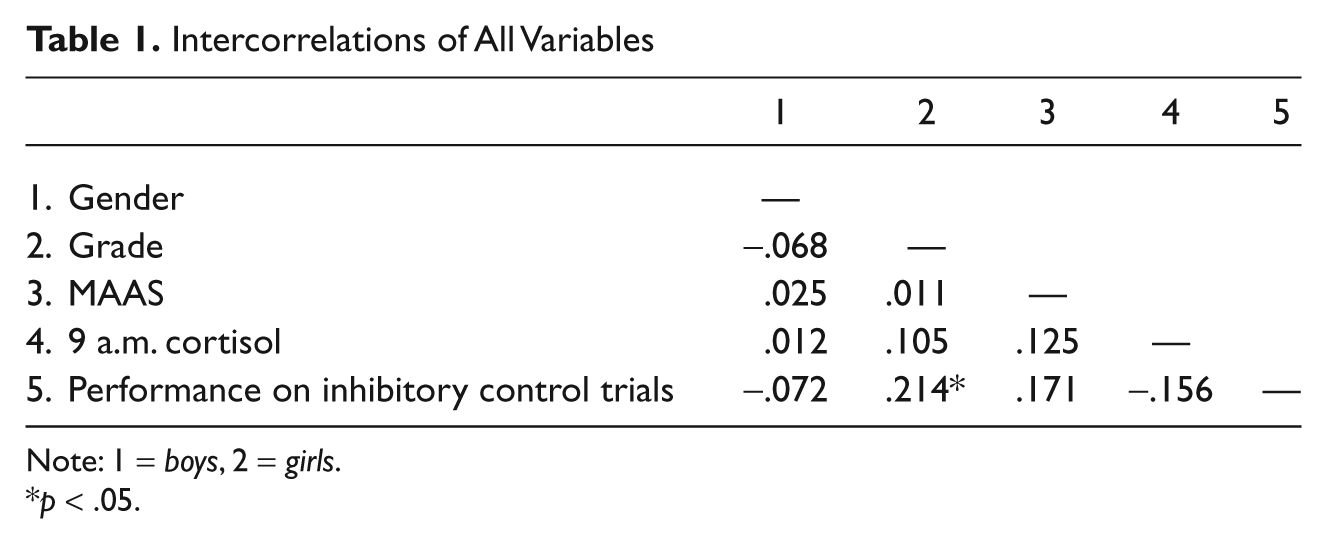
Note: 1 = boys, 2 = girls.
p < .05.
Overall, performance on inhibitory control trials ranged from 25% to 100% accuracy with a mean of 83% and a standard deviation of 16.51. MAAS scores ranged from 2.53 to 5.87 (
Regression Analyses for Performance on Inhibitory Control Trials
We used a hierarchical linear regression analysis to investigate whether—after controlling for gender, grade, and cortisol in Model 1—mindfulness significantly predicted performance on highly demanding inhibitory control trials in Model 2 (see Table 2). When we entered ESL-status as a control variable in the model, it was neither a significant predictor nor did it alter the overall results. We therefore did not include ESL-status in our analyses in order to increase statistical power. Model 1, in which gender, grade level, and cortisol were predictors and performance on inhibitory control trials was an outcome variable, was not statistically significant and explained only 4.9% of the variance in performance, adjusted R2 = .029, F(2, 96) = 2.47, ns. As can be seen in Table 2, for Model 1, only grade level emerged as a positive and significant predictor in the model, whereas cortisol was marginally significant. As predicted, after entering mindfulness in the next block, Model 2 explained 11.8% of the variance in performance on inhibitory control trials, adjusted R2 = .081, F(4, 94) = 3.15, p = .018. The addition of mindfulness to the model was significant, as evidenced by the positive and significant change in R2, R2 change = .069, F(2, 94) = 3.69, p = .029. More specifically, in Model 2, MAAS score was a positive and significant predictor of inhibitory control after taking into account gender, grade, and cortisol. Cortisol was a significant negative predictor in Model 2. 1 This finding indicates that after controlling for morning cortisol levels, mindfulness significantly predicts inhibitory control in early adolescence when assessed with a cognitive performance task that taxes high levels of inhibition.
Hierarchical Regression Analysis of Performance on Inhibitory Control Trials
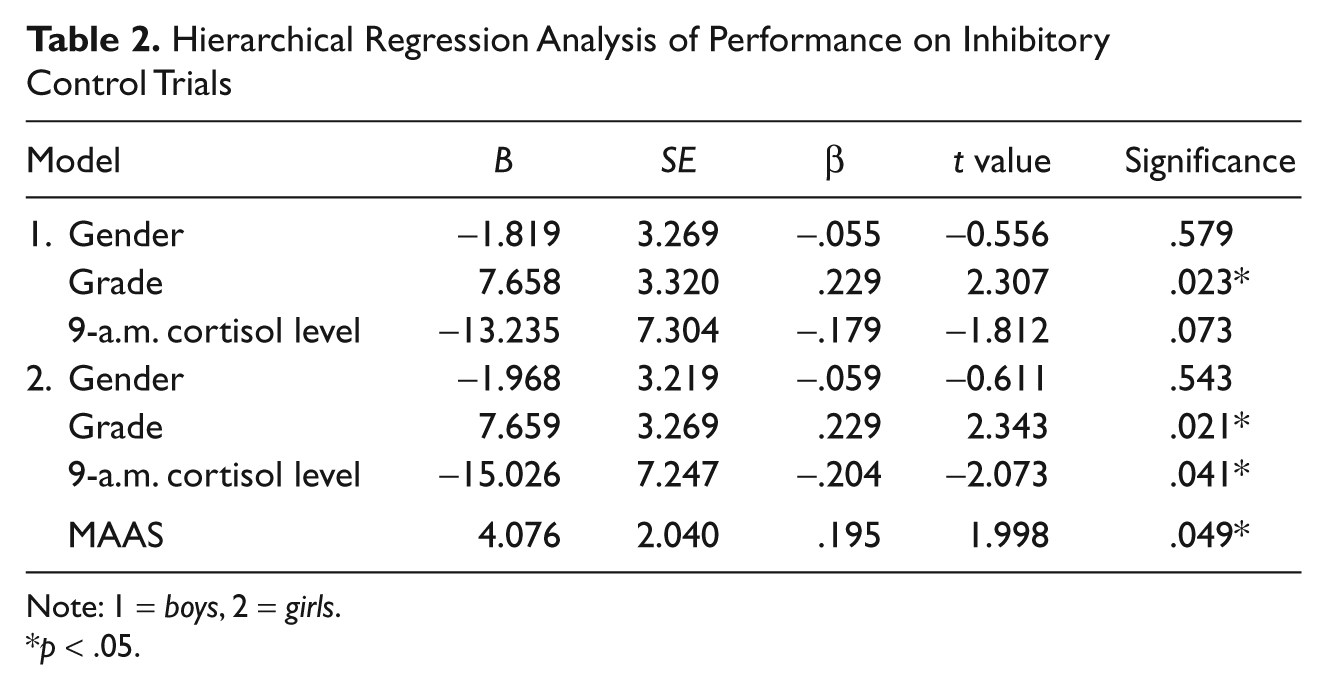
Note: 1 = boys, 2 = girls.
p < .05.
Discussion
The main finding in this study was that, as assumed, self-reported mindfulness significantly and positively predicted inhibitory control in a sample of early adolescents, after controlling for grade level, gender, and cortisol level. Higher self-reported mindful attention awareness predicted more correct responses on high-demand inhibitory control trials. We believe that this finding is an important contribution to the literature on mindfulness and EF, in particular in regard to the developmental period of early adolescence. To our knowledge, no research study has yet investigated the relationship between mindfulness and inhibitory control during this developmental period when no intervention is given. The practical significance of this finding lies in its applicability for the design of intervention programs to foster cognitive functioning, enhance self-regulation, and promote positive development in youth. Furthermore, we also found that the control variable cortisol was a significant negative predictor of inhibitory control in our full model. This section will conclude with a discussion of the limitations of the study and outlook for future research.
The impact of mindfulness on EF skills has been demonstrated in particular in intervention studies with adult samples, indicating that training in mindfulness techniques can enhance executive control skills (Baer, 2003; Heeren et al., 2009; Moore & Malinowski, 2009). However, to our knowledge, research on mindfulness thus far has not investigated whether scores on a mindful attention and awareness measure are significantly related to scores on a measure of inhibitory control, without participants having received mindfulness training. A strength of the current study was the use of valid measures that were able to assess children’s mindfulness and inhibitory control. One explanation for this finding could be the nature of the inhibition and the mindfulness measures we used. The ability to inhibit is a mechanism of voluntary control, related to self-regulatory processes and required for attentional selection (Posner & Rothbart, 2000; Rueda, Posner, & Rothbart, 2005). The MAAS, a measure of dispositional mindfulness, is conceptually based in models of self-regulation (Brown & Ryan, 2003). Mindfulness, as measured by the MAAS, is defined as enhanced attention to awareness that facilitates conscious self-regulatory processes (Brown & Ryan, 2003). Similarly, inhibitory control as measured by the EF task in our study requires attention and conscious self-regulation in order to apply the correct rule to the stimulus occurring in the present moment. Therefore, the relationship between mindfulness and inhibitory control is not surprising, given that the ability to self-regulate is at the core of both of these skills. Another strength of this research study can be found in the three domains of investigation included, namely, the cognitive, biological, and self-regulatory domains. Such an approach aligns with the current push for more interdisciplinary and multilevel perspective research in development in order to understand developmental mechanisms and phenomena at different levels of occurrence (Cicchetti & Blender, 2006; Greenberg, 2006) combining self-report (MAAS), performance-based (EF task), and biological (cortisol) data.
Practically speaking, research on mindfulness is particularly significant because mindful attention can be fostered and trained and function as a tool to enhance EF skills and promote health (Heeren et al., 2009; Moore & Malinowski, 2009). To date, the vast majority of such studies have been conducted with adults and clinical samples. Whereas a small number of studies with children and adolescents have recently emerged with promising results on the effectiveness of mindfulness approaches in classroom settings (see Burke, 2010, for a review), only few of the study designs allow for causal interpretation of the results. One randomized control trial study conducted by Napoli and colleagues (2005) suggests that mindfulness approaches can be an inexpensive tool to promoting self-regulatory skills in the classroom setting. However, in this emerging field of study, there is still a lack of rigorous research studies offering firm conclusions about the relationship between EFs and mindfulness throughout the adolescent years. Although much more needs to be learned about the relationship between mindfulness and self-regulation in early adolescence, the extant research in this area supports the contention that this area of research may provide fertile ground for discovering the tools that can foster self-regulation and inhibitory control and enhance the well-being and positive development of early adolescents (Burke, 2010).
A secondary finding in our analyses was that morning cortisol significantly and negatively predicted inhibitory control. Although this relationship was not our primary interest in the current study, it is interesting to note that this finding is in accord with that of Blair and colleagues (2005) in a study examining the relationship between EFs and cortisol in preschoolers living in poverty. Specifically, Blair et al. found that low baseline diurnal cortisol (in contrast to cortisol in response to a stressor) was related to better inhibitory control. Nonetheless, it is important to note that the findings of Blair et al. may not generalize to the general population because it may be specific for children living in poverty or other stressful circumstances. Furthermore, research needs to be conducted to gain understanding about normative diurnal cortisol patterns and their correlates of cognitive functioning in early adolescence. Puberty is a time in development characterized by unique neuroendocrine regulation (see Jessop & Turner-Cobb, 2007) as well as developmentally specific cognitive functioning (Steinberg, 2008).
A limitation of the current study is that our findings are limited to the particular measures used to assess mindfulness and inhibitory control. Therefore, further studies are needed that use test batteries with multiple measures in order to investigate the impact of the method of assessment on these findings. Future research also needs to further investigate the relationship between mindfulness and other executive control skills. It is important to study the potential role of inhibitory control as a predictor for mindful attention and awareness, considering the possibility that one needs inhibitory control abilities in order to be mindful. Furthermore, given that the findings in this study are bound to the developmental period of early adolescence, they need to be replicated in other age groups with the aim to investigate the predictive power of mindfulness for inhibitory control across childhood and adolescence.
In conclusion, the present study provides new insights into the role of psychological and biological processes related to young adolescents’ self-regulatory capacities. Our results indicate that mindfulness is associated with at least one important dimension of EF skills—that of inhibitory control. This supports previous research findings linking mindfulness with attentional control in adult populations (Heeren et al., 2009; Jha et al., 2007) and extends these previous findings to an early adolescent sample. Collectively, these findings indicate that we must continue to explore how the mechanisms of early adolescents’ self-regulatory functioning is affected by and affects developmental outcomes. Continued examination of early adolescents’ EFs and their relationship to well-being; further clarification of the effects of gender, socioeconomic status, and race/ethnicity on self-regulation; and utilization of experimental and longitudinal designs would extend our findings in interesting and important directions.
Footnotes
Declaration of Conflicting Interests
The authors declared no potential conflicts of interest with respect to the research, authorship, and/or publication of this article.
Funding
The authors disclosed receipt of the following financial support for the research, authorship, and/or publication of this article: Funding was generously provided by the Human Early Learning Partnership at the University of British Columbia, the Mind and Life Institute, and the Hawn Foundation.