



Abstract
This study investigated individual differences in sixth-grade students (N = 181; 47% girls, ethnically diverse) use of friends as a coping resource when dealing with a social stressor with another peer at school. Confirmatory factor analysis supported the hypothesized three factor structure of coping with friends: mastery, avoidance, and nonchalance. Controlling for levels of social self-efficacy, social goal orientations were linked to different types of coping. Specifically, a social development goal was positively associated with mastery coping. A social demonstration-avoid goal was positively associated with avoidance coping. A social demonstration-approach goal was positively associated with nonchalance coping. In turn, individual differences in coping were associated with subsequent social adjustment (measured 3 months later). Specifically, mastery coping was associated with best friendship quality, avoidance coping was associated with anxious solitude, and nonchalance coping was associated with overt aggression.
During early adolescence, when students make the transition to middle school, social stress is common (Juvonen, Le, Kaganoff, Augustine, & Constant, 2004). Adolescents’ peer networks are disrupted when they move to a new school so they need to forge new relationships and/or maintain friendships in a larger and different setting (Berndt, 2004; Eccles, 2004). These changes come at a time when adolescents increasingly rely on friends for companionship, intimacy, and support (Berndt, 2004). Also during this stage, attention to social reputation and popularity increases (LaFontana & Cillessen, 2002). In tandem, social manipulation and aggression are more common experiences (Espelage & Swearer, 2004). In general, students report that mean behavior amongst students is prevalent in middle school (Juvonen et al., 2004), and the majority report being the target of some bullying behavior during their first year in middle school (Espelage & Swearer, 2004).
While it is common for young adolescents to experience some social stress in middle school, there is variability in the extent to which adolescents are affected by these negative peer encounters (Hoover, Oliver, & Hazler, 1992). Individual difference in how students cope with social stress is one factor that seems important in understanding the extent to which peer problems impact psychological adjustment over time (Kochenderfer-Ladd, 2004; Kochenderfer-Ladd & Skinner, 2002). Having a friendship has also been found to buffer students from the negative consequences of peer problems and victimization (Erath, Flanagan, Bierman, & Tu, 2010; Hodges, Boivin, Vitaro, & Bukowski, 1999; Hodges, Malone, & Perry, 1997). Interestingly, individual differences in coping within friendships have not been examined. The goal of the present research is to better understand coping within the context of friendship in reaction to social stress in middle school. Specifically, we develop a new, multifaceted measure of individual differences in young adolescents’ use of friends as a coping resource when dealing with a social stressor with another peer at school. Guided by theory and research on social goals (Erdley, Cain, Loomis, Dumas-Hines, & Dweck, 1997; Ryan & Shim, 2008) and coping (Kochenderfer-Ladd & Skinner, 2002), we hypothesized that different social goals would be associated with distinct forms of coping with friends which, in turn, would be associated with subsequent social adjustment in middle school.
Social Goals
Social goals have provided insight into the social behaviors and social adjustment of children and adolescents (Ojanen, Grönroos, & Salmivalli, 2005; Rose & Asher, 1999; Wentzel, 2001). Scholars using an achievement goal theoretical framework of motivation have distinguished goals that focus on developing versus demonstrating competence (Dweck, 1986; Elliot & McGregor, 2001). In the social domain a social development goal involves improving social relationships and social skills (e.g., gaining insights into friends or learning how to get along with others); a social demonstration-approach goal involves garnering positive feedback from others and gaining social prestige (e.g., being seen as “cool” or “popular”); and a social demonstration-avoid goal involves avoiding negative judgments from others (e.g., not being seen as a “loser”; Ryan & Shim, 2008).
Prior theory and research indicates that these goals set in motion different processes, encompassing whether and how individuals approach, engage, function, and evaluate themselves in the social domain (Elliot, Gable, & Mapes, 2006; Erdley et al., 1997; Horst, Finney, & Barron, 2007; Kuroda & Sakurai, 2011; Mouratidis & Sideridis, 2009; Ryan & Shim, 2008). Most relevant to the present investigation, social achievement goals are associated with young adolescents’ social adjustment in middle school (Ryan & Shim, 2008). A social development goal is associated with prosocial behavior and positive friendship qualities (e.g., intimacy & trust). A social demonstration-approach goal is associated with perceived popularity as well as maladaptive behaviors like aggression. A social demonstration-avoid goal is negatively associated with perceived popularity and positively associated with social worry and anxious solitude. We anticipate that social goals will be related to how young adolescents cope when they experience a social problem at middle school (Dweck & Leggett, 1988). This proposal is in line with findings of Erdley et al. (1997) that social achievement goals predicted the coping responses of children in an experimental situation.
Coping with Friends
There are a myriad of specific coping strategies, and classifications are also numerous (Compas, Connor-Smith, Saltzman, Thomsen, & Wadsworth, 2001). In the present research, we distinguish between mastery and avoidance forms of coping. This distinction has precedence in the academic and social domains, especially in relation to goals (Dweck & Leggett, 1988; Erdley et al., 1997; Gazelle & Rudolph, 2004; Grant & Dweck, 2003). Mastery coping refers to an adaptive response to stress or failure involving efforts to change the situation. Mastery coping leads to efforts to figure out the problem and change the situation, and thus, is more likely to diminish problems and fosters. Avoidance coping refers to a maladaptive response to stress or failure involving disengagement and efforts to escape the problem. Avoidance coping leads to giving up which is unlikely to remedy problems, and thus, undermine adjustment (Dweck, 1986; Erdley et al., 1997; Grant & Dweck, 2003).
A novel feature of the present study is that we examine mastery and avoidance coping with friends. Measures of coping distinguish mastery and avoidance coping from social support seeking (e.g., Carver, Scheier, & Weintraub, 1989; Causey & Dubow, 1992; Grant & Dweck, 2003; Kochenderfer-Ladd & Skinner, 2002). That is, mastery and avoidance coping are conceptualized and measured as how an individual responds to a stressor. A typical item for mastery coping in response to a stressful event would be “I concentrate my efforts on doing something about it.” A typical item for a avoidance response to stress would be “I give up the attempt to get what I want” (see Carver et al., 1989). Thus, mastery and avoidance responses are typically conceptualized as a solitary experience, distinct from social support seeking.
Research on seeking social support is quite mixed with inconsistent findings regarding whether it is beneficial for adjustment (Altermatt, 2007; Causey & Dubow, 1992; Klima & Repetti, 2008; Kochenderfer-Ladd & Skinner, 2002). The work to date with children on coping via seeking social support has used omnibus measures with items such as “I tell a friend or family member what happened” (Causey & Dubow, 1992). In response to inconsistent findings with such measures, researchers have suggested greater specificity be used to understand the nature and consequences of coping (Altermatt, 2012; Causey & Dubow 1992; Compas et al., 2001; Wadsworth & Compas, 2002). We heed this call for greater specificity by examining mastery and avoidance forms of coping with friends in response to a social stressor with another peer at school. As theory and research on social goals suggests, students may have quite different motives and strategies when seeking support from friends. We propose that coping with friends is multifaceted just as individual coping is multifaceted. We hypothesize that further specification of the types of coping with friends will reveal different implications for adjustment.
Our focus on coping with friends is consistent with theories of why friends are so beneficial for adjustment (Vitaro, Boivin, & Bukowski, 2009) and research showing that having friends protects students from negative consequences of peer harassment (e.g., Hodges et al., 1999). Our conceptualization of coping will provide some new insights into the processes within friendships that are important to adjustment. We hypothesize that making further distinctions in the types of coping that students do with friends will reconcile the conflicting findings that having friends is a buffer to negative effects of peer victimization (e.g., Erath et al., 2010; Hodges et al., 1997; Hodges et al., 1999) but that seeking support from peers in response to problems is unimportant to adjustment (Causey & Dubow, 1992; Klima & Repetti, 2008; Kochenderfer-Ladd & Skinner, 2002).
Social Goals and Coping with Friends
We examine our proposal that coping is a multifaceted, socially motivated behavior that often takes place amongst friends in a sample of early adolescent students during their first year in middle school when social stress is a fairly common experience. We examine coping with friends in relation to problems caused by problems with a peer outside the friendship (e.g., being called a name by a kid at school). In line with the three distinct social achievement goals (development, demonstration-avoid, demonstration-approach), we propose three types of coping responses with friends: mastery, avoidance, and nonchalance.
We expect that different social goals will be associated with different coping responses (Erdley et al., 1997). With a social development goal, a problem with another peer is likely to be viewed as a situation that can be remedied. In the context of friends, a social development goal is likely to lead to discussion to gain advice on how to improve the situation. Given that a social development goal is associated with positive perceptions of social competence (Ryan & Shim, 2008), it is likely to be related to using friends as resources for help to achieve a desirable social outcome. Thus, a social development goal will be associated with mastery coping with friends.
With a social demonstration-avoid goal, a problem with another peer is likely to be viewed as having the potential to incur negative judgments from one’s friends. The problem would be avoided as a topic for discussion because it is safer than bringing up the problem and risking a negative evaluation from friends. Thus, a social demonstration-avoid goal will be associated with avoidance coping with friends.
With a social demonstration-approach goal, a problem with another peer is likely to be viewed as also having the potential to incur negative judgments from one’s friends and diminish their coveted popular reputation. However, a social demonstration-approach goal is associated with high perceived social competence. In combination with a concern for self-presentation, such confidence would lead to nonchalant posturing or actively portraying oneself as not bothered by the problem. Thus, a social demonstration-approach goal will be associated with nonchalance coping with friends. Nonchalance coping is distinct from mastery coping in that it discounts the problem to friends rather than trying to solve it, and it is distinct from avoidance coping in that the problem is not hidden but reframed as not a real threat.
Mastery, avoidance, and nonchalance coping with friends are congruent with the forms of solitary coping strategies identified by prior work on children and adolescents’ response to peer problems, peer conflict, or peer harassment (Causey and Dubow, 1992; Kochenderfer-Ladd & Skinner, 2002; Salmivalli, Karhunen, & Lagerspetz, 1996; Wilton, Craig, & Pepler, 2000). Research using observations and peer reports of other children’s behaviors has identified mastery, avoidance, and nonchalance coping responses in children who are chronic victims of harassment by peers (Salmivalli et al., 1996; Wilton et al., 2000). In regards to self-report measures, avoidance and mastery coping with friends are congruent with distancing and problem-solving solitary coping, respectively (Causey & Dubow, 1992; Kochenderfer-Ladd & Skinner, 2002). Mastery coping with friends bears some resemblance to instrumental support seeking (i.e., talk to someone to address a problem rather than emotional support seeking which focuses on relief from negative emotions). Instrumental support seeking has been found to be adaptive for adjustment in adults (see Carver, 2000). Mastery coping with friends is distinct from co-rumination (i.e., extensive discussing and revisiting of problems with friends) in that co-rumination lacks a focus on solutions and contains a focus on negative feelings (see Rose, 2002).
Coping with Friends: Associations with Subsequent Social Adjustment
We anticipate that different types of social coping with friends will have different implications for social adjustment. We examine three aspects of social adjustment that capture different types of social behavior and have been the focus of much social development research: best friendship quality, anxious solitude, and overt aggression (Rubin, Bukowski, & Parker, 2006). Mastery coping with friends is expected to be positively related to social adjustment. Seeking advice from friends may yield helpful solutions to alleviate social challenges. Further, getting assistance from friends provides an opportunity to deepen the friendship as it involves intimacy and trust. Thus, social mastery coping is expected to be associated with subsequent heightened best friendship quality and diminished anxious solitude and overt aggression. In contrast, avoidance coping with friends is expected to be related negatively to social adjustment. Avoidance denies a young adolescent not only the chance to think of strategies to improve the situation but also any emotional support or comradery over a problem. Avoidance coping is thus expected to be marginalizing and associated with heightened anxious solitude and diminished best friendship quality. Nonchalance coping with friends is also expected to be negatively associated with social adjustment albeit differently than avoidance coping. Actively portraying oneself as not bothered by a problem also denies attention to potential solutions but reframes the issue rather than just hiding it. While this nonchalance may buffer an adolescent from low peer regard in the short run, it does not serve to solve the problem. Playing it cool could easily manifest itself as defending one’s dominant position in the peer system. While such behavior could have benefits, a potential cost of such bravado behavior is that it could undermine trust and intimacy with friends over time. As a response to a persistent social challenge, it is likely that nonchalance coping could lead to overt aggression to defend one’s position as cool and be associated with diminished best friendship quality.
Social Self-Efficacy
We include social self-efficacy (i.e., confidence in one’s social skills) in our model for several reasons. First, although all students are likely to experience some social stress and peer problems in their first year in middle school, some will experience more problems than others. By including a measure of social self-efficacy, we control for some of the variation in peer problems as well as social competence because a key source of self-efficacy is level of success (Bandura, 1986). Based on prior research indicating a facilitative role for social self-efficacy and social behaviors (Harter, 1982; Wheeler & Ladd, 1982), we expect that social self-efficacy will be positively related to mastery coping and negatively related to avoidance and nonchalance coping. Further, we expect social self-efficacy to be positively related to best friendship quality and negatively related to anxious solitude and overt aggression. By including social self-efficacy in the model, we can examine the unique effects of social goals on coping and coping on social adjustment.
Gender
We also include gender in our model. Previous research indicates that girls and boys might differ in their social goals, coping with friends, and social adjustment. Girls tend to be more oriented towards communal goals whereas boys tend to be more oriented toward dominance goals (Rose & Rudolph, 2006). Girls’ friendships tend to be characterized by higher levels of intimacy and self-disclosure than boys (e.g., Buhrmester & Furman, 1986; Camarena, Sarigiani, & Petersen, 1990; Parker & Asher, 1993). Girls tend to be more prosocial (Holmgren, Eisenberg, & Fabes, 1998) whereas boys tend to use more overt aggression (Galen & Underwood, 1997). Thus, we examine potential gender differences in our constructs as well as control for gender when examining relations among social goals, coping with friends, and social adjustment.
Overview of the Present Research
In sum, this study examines relationships among social goals, coping with friends, and social adjustment in a sample of early adolescents during their first year in middle school. We develop a new measure of coping with friends that distinguishes between mastery, avoidance, and nonchalance coping and assess it with confirmatory factor analysis. Structural equation modeling is used to examine the hypothesized relationships between social goals, coping with friends, and social adjustment. We hypothesize these relations will be found controlling for social self-efficacy. Gender differences are examined. We examine direct effects of social goals on social adjustment as well as indirect effects of social goals on social adjustment through coping with friends.
Method
Participants
The participants were sixth-grade students from two public middle schools. Sixth grade is the first year of middle school in both schools. Letters describing the project were sent home, and 84% of the students returned a slip with their parents’ written consent for them to participate yielding a sample of 217 at Wave 1. The sample was 47% girls and ethnically diverse (39% Black, 35% White, 11% Asian American, 5% Asian Indian, 4% Hispanic, and 6% Other). Of the 217 students who had Wave 1 data, 181 had Wave 2 data. We analyzed missing data and there were no significant differences between students who remained in the study and those who were lost at Wave 2 in student characteristics or study variables at Wave 1.
Procedure
The data were collected as part of the University of Illinois Social Goals and Adjustment to Middle School project (Primary Investigator: Allison M. Ryan). Surveys were administered to students in their classrooms by trained researchers. Social achievement goals and coping were measured at Wave 1 (December), and social adjustment indices were measured about 3 months later at Wave 2 (March). Instructions and items were read aloud while students read along and responded. Students were told that the survey was not a test and that there were not right or wrong answers and that the purpose of the survey was to find out students’ beliefs and behaviors at school. Students were assured the information would be kept confidential. In addition, students were told that filling out the survey was voluntary and that if, at any point they wanted to stop, they could do so.
Measures
Coping with friends
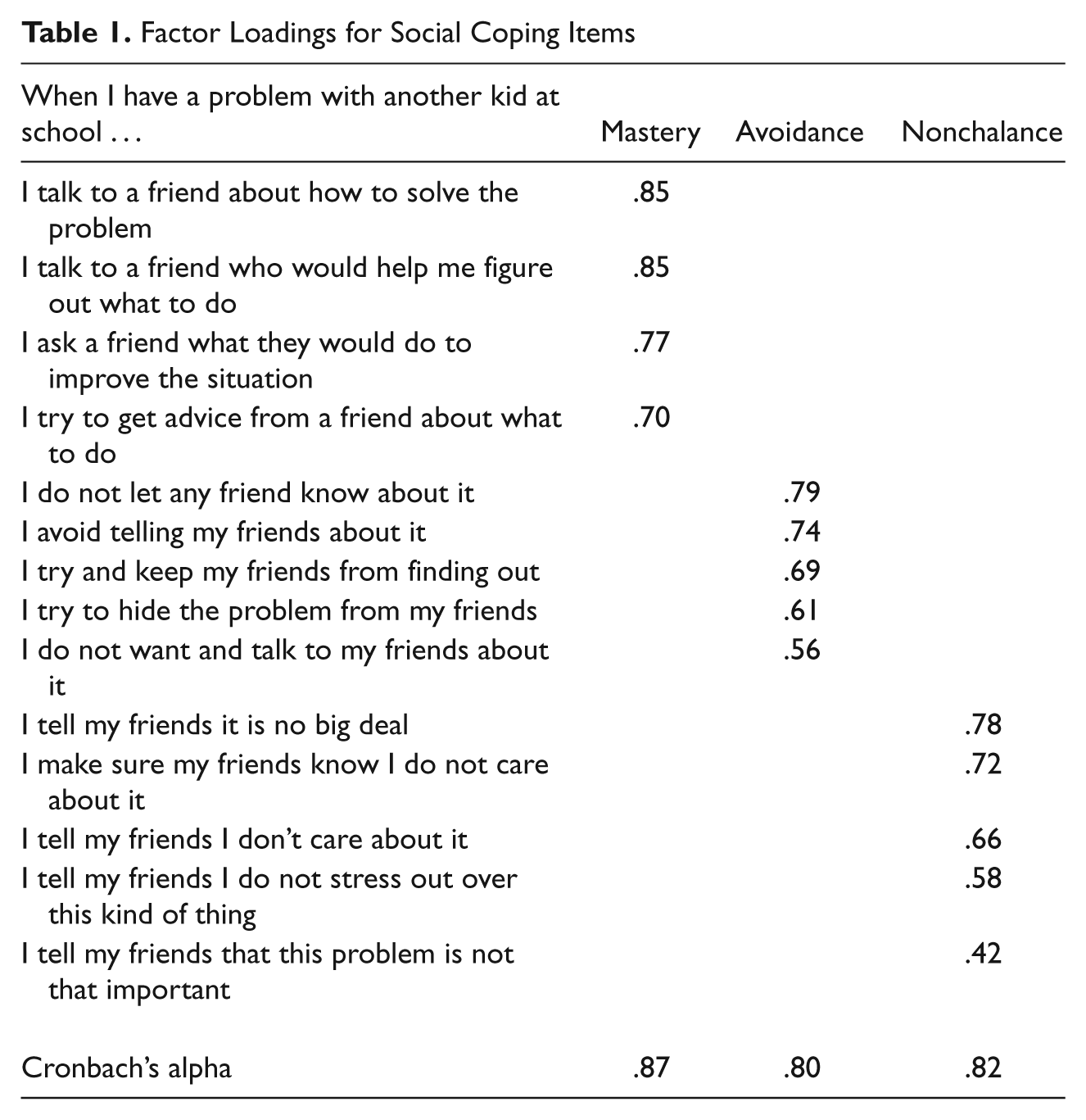
We developed a measure of the different types of coping with friends (mastery, avoidance, and nonchalance). The directions for the social coping portion of the survey (adapted from Causey & Dubow, 1992) were “When you have a problem with another kid at school (not a friend), what do you usually do?” For example, someone was mean to you or spreading a rumor about you. You didn’t like it and wanted it to stop. What do you usually do? Below these directions were 14 items reflecting the various types of coping with friends (see Table 1). All items were rated on a scale that ranged from 1 (never) to 5 (always). The items were developed for this study. Factor and reliability analysis for the new measure is presented in the Results section.
Factor Loadings for Social Coping Items
Social achievement goals
The three social achievement goals were measured with Ryan and Shim’s scale for young adolescents (Ryan & Shim, 2008). The six social development goal items concern a focus on developing social competence (e.g., “I feel successful when I learn something new about how to get along with other kids”). The six social demonstration-avoid goal items concern a focus on demonstrating that one is not socially undesirable and avoiding negative judgments from others (e.g., “One of my main goals is to make sure other kids don’t say anything bad about me”). The six social demonstration-approach goal items concern a focus on demonstrating social desirability and gaining positive judgments from others (e.g., “It is important to me that other kids think I am popular”). All items were rated on a scale that ranged from 1 (not at all true of me) to 5 (very true of me). The measure was reliable in the present sample (Cronbach’s α = .83, .84, and .79 for social development, social demonstration-approach, and social demonstration-avoid goal, respectively).
Social self-efficacy
We used a four-item measure of social self-efficacy with peers to measure the students’ confidence when interacting with their classmates. This scale has been found to be reliable and valid in previous studies (e.g., Ryan & Patrick, 2001). A sample item is “I can get along with most of the students in my class.” All items were rated on a scale that ranged from 1 (not at all true of me) to 5 (very true of me). The measure was reliable in the present sample (Cronbach’s α = .82).
Best friendship quality
We used Rose’s (2002) adapted version of Parker and Asher’s (1993) Friendship Quality Questionnaire to measure students’ perceptions of their positive relationship qualities with their best friend at school. To facilitate a focus on best friendship, we instructed students to write down the name of one of their best friends at school and think of that best friend as they completed items about support (e.g., “Gives advice with figuring things out,” three items), validation (e.g., “Makes me feel good about my ideas,” two items), intimacy (e.g., “We can talk about whatever happens to us,” three items), and conflict resolution (e.g., “We can talk about how to get over being mad at each other,” two items). All items were rated on a scale that ranged from 1 (never) to 5 (always). These 10 items formed one factor in a factor analysis and thus were averaged to form one scale. The measure was reliable in the present sample (Cronbach’s α = .89).
Anxious solitude
A self-report version of Gazelle’s measure of anxious solitude was used (Gazelle & Ladd, 2003; Gazelle & Rudolph, 2004) and consisted of six items: “worries,” “anxious,” “self-conscious,” “shy and timid,” “withdrawn from peers,” and “prefers to be alone.” Students were instructed to “circle a number to indicate how often you are like this” on a scale that ranged from 1 (never) to 5 (always) for all items. The measure was reliable in the present sample (Cronbach’s α = .72).
Overt aggression
To assess the overt aggression, we used the student-report version of the Aggression subscale of the Interpersonal Competence Scale (Cairns, Leung, Gest, & Cairns, 1995) which consisted of three items: “fights with others,” “argues with others,” and “gets in trouble.” Students were instructed to “circle a number to indicate how often you are like this” on a scale that ranged from 1 (never) to 5 (always) for all items. The measure was reliable in the present sample (Cronbach’s α = .73).
Results
Confirmatory Factor Analysis of Social Coping
We conducted a confirmatory factor analysis (CFA; using AMOS 17.0) on the 14 coping items to see if our hypothesized model was a good fit to the data and a better fit to the data than two other plausible alternative models. This program uses the full information maximum likelihood (FIML) method of estimation. FIML neither deletes cases that are missing from one or two time points of data collection (pairwise deletion), nor does it delete a case if the case is missing a variable within a time point of data collection (listwise deletion), thus reducing bias in parameter estimates (Enders, 2001). The CFA tested the hypothesized three factor model by designating the items for each coping load on their respective latent variables and evaluated three nested models: (a) the three factor model, (b) an adaptive-maladaptive model in which latent correlations between avoidance and nonchalance coping were fixed to 1.0, and (c) an approach-avoid model in which latent correlations between mastery coping and nonchalance coping were fixed to 1.0. The hypothesized three-factor model fit the data well, χ2(74, N = 217) = 145.789, p < .00, comparative fit index (CFI) = .94, χ2/df ratio = 1.97, root mean square error of approximation (RMSEA) = .06 and better than the fit of the adaptive-maladaptive model,
Descriptive Statistics
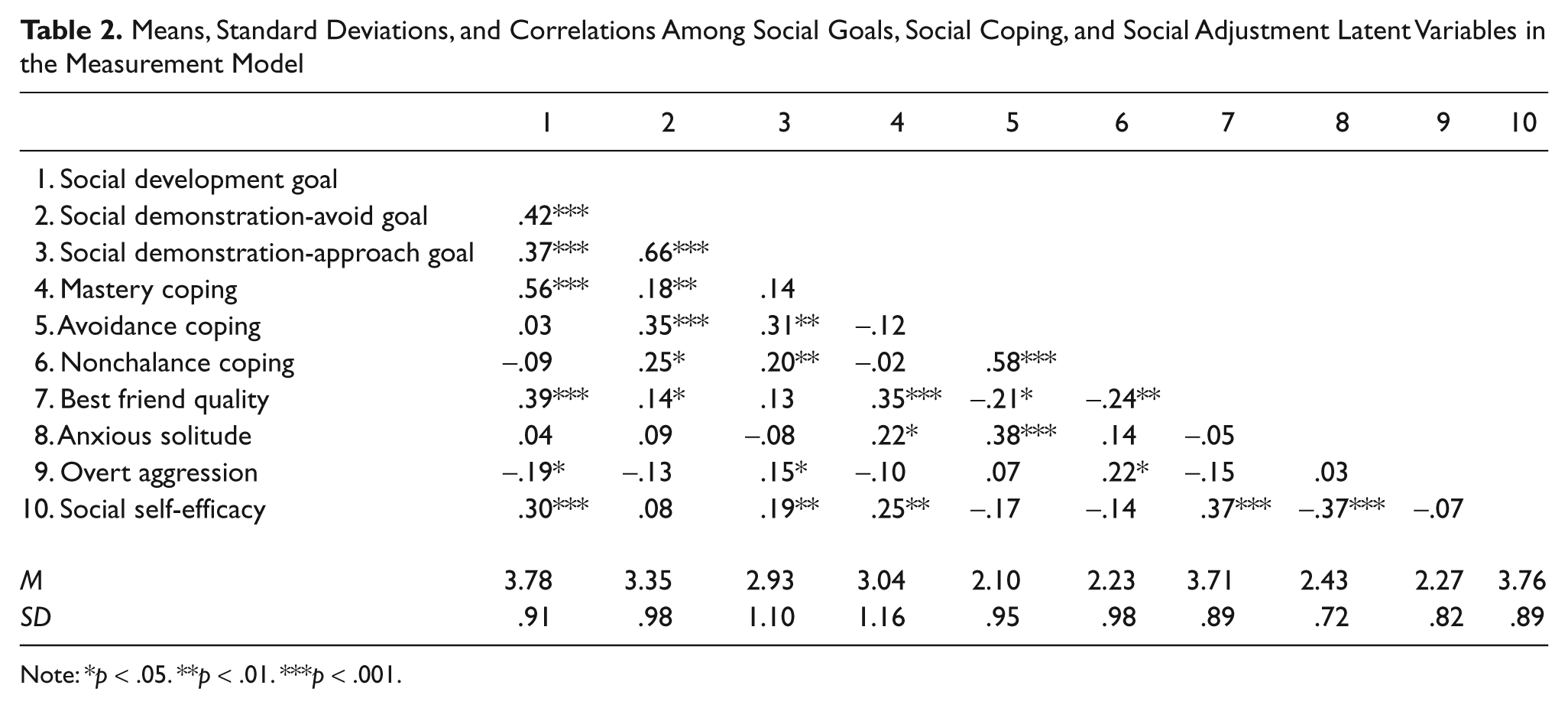
Table 2 presents the means and standard deviations and bivariate correlations for social goals, social coping, social self-efficacy, and social adjustment. In general, the correlations were consistent with expectations. Of note was that our new measure of coping showed key expected correlations: mastery coping was correlated with a social development goal and best friend quality, avoidance coping was correlated with a social demonstration-avoid goal and anxious solitude, and nonchalance coping was correlated with a social demonstration-approach goal an overt aggression. We examined mean level gender differences in all constructs and two were found: girls reported higher social development goals (t = 2.25, p < .05) and best friendship quality (t = 4.88, p < .001) than did boys.
Means, Standard Deviations, and Correlations Among Social Goals, Social Coping, and Social Adjustment Latent Variables in the Measurement Model
Note: *p < .05. **p < .01. ***p < .001.
Relations Between Social Goals, Social Coping, and Social Adjustment
In our model, social goals, social self-efficacy, social coping, and social adjustment were represented by latent variables composed of three or four indicators. Latent constructs that had six or more items (i.e., social goals, best friend quality, and anxious solitude) were based on three to four parcels of two items each, determined conceptually for best friend quality (e.g., validation items together) and randomly for the others. The use of parcels allowed us to build a more parsimonious model (see Little, Cunningham, Shahar, & Widaman, 2002). Social goals were expected to be associated so covariance among them was allowed. All of the indicators loaded significantly on their respective latent factors (see Figure 1).
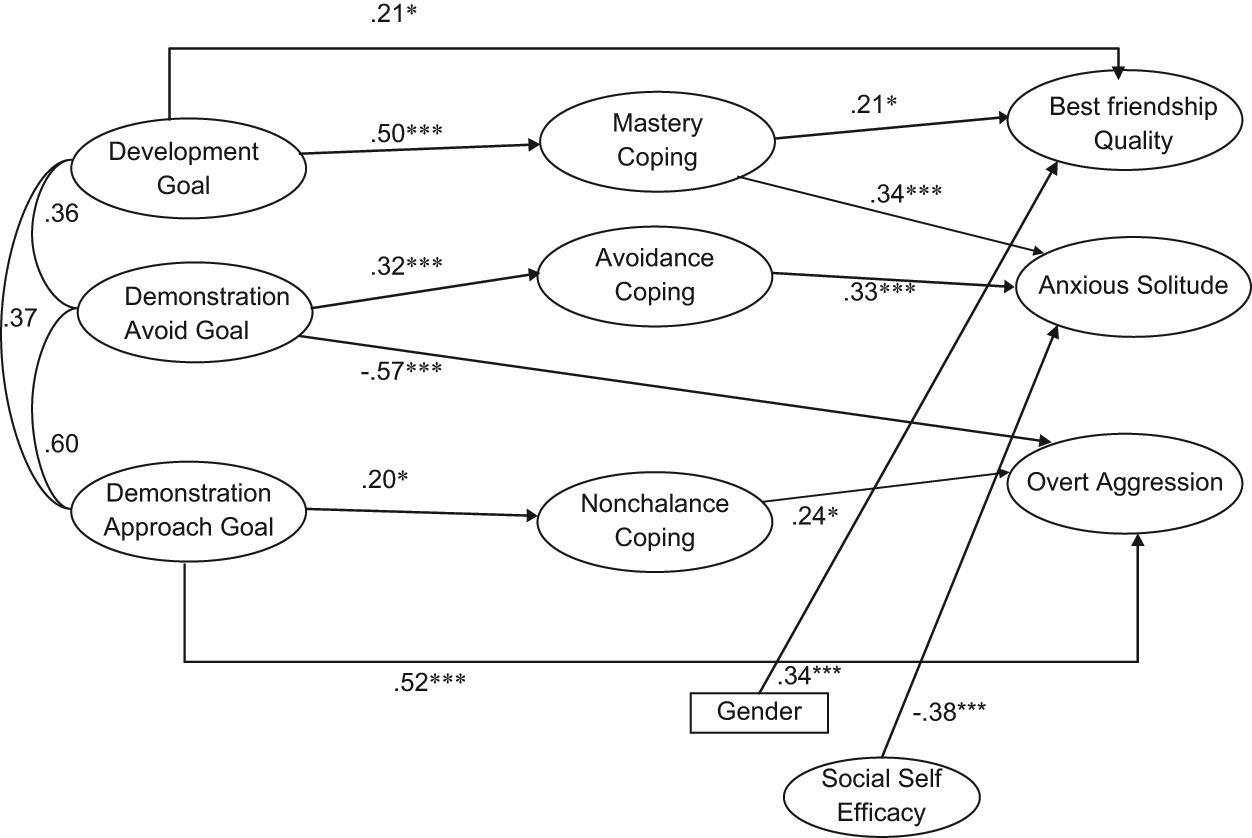
Structural equation model of social goals, social coping with friends and social adjustment
The first step of our model building process was to examine a model with all the hypothesized paths (as specified in the Introduction). The paths from a development goal to avoidance coping and nonchalance coping, a demonstration-avoid goal to mastery coping and nonchalance coping and a demonstration-approach goal to mastery and avoidance coping were not significant so we did not include these paths in the final model. The paths from mastery coping to overt aggression, avoidance coping to best friendship quality, and nonchalance coping to best friendship quality were not significant so we did not include these paths in the final model. The paths from social self-efficacy to the three types of coping, social self-efficacy to best friend quality and social self-efficacy to overt aggression were also not significant and removed. There was also no direct path from a social demonstration-avoid goal to anxious solitude, so this was removed. Next, to evaluate whether gender moderated any path of the model, we performed an omnibus test of equality of the latent variances and covariance for two groups (boys and girls). The model was equivalent for boys and girls,
The final model (see Figure 1) provided a good fit to the data, χ2(641, N = 217) =963.138, p < .00, CFI = .90, χ2/df ratio = 1.50, RMSEA = .045. A social development goal was associated with mastery coping (β =.50, p < .001). A social demonstration-avoid goal was associated with avoidance coping (β = .32, p < .001). A social demonstration-approach goal was associated with nonchalance coping (β = .20, p < .05). In turn, mastery coping was positively associated with subsequent best friendship quality (β = .21, p < .05) and anxious solitude (β = .34, p < .001). Avoidance coping was positively associated with subsequent anxious solitude (β = .33, p < .001). Nonchalance coping was positively associated with subsequent overt aggression (β = .24, p < .05). There were also significant direct paths from social goals to social adjustment: a social development goal was positively associated with best friendship quality (β = .21, p < .05), a social demonstration-avoid goal was negatively associated with overt aggression (β =–.57, p < .001) and a social demonstration-approach goal was positively associated with overt aggression (β = .52, p < .001). These relationships among social goals, social coping, and social adjustment were found controlling for social self-efficacy and gender. In the final model social self-efficacy was negatively related to anxious solitude (β = –.38, p < .001). Gender was positively related to best friend quality (β = .34, p < .001). 1
There also were indirect effects of social goals through coping with friends on social adjustment. A social development goal was indirectly linked with best friendship quality through the association with mastery coping (β = .11). A social demonstration avoid goal was indirectly linked with anxious solitude through avoidance coping (β= .10). A social demonstration approach goal was indirectly linked with overt aggression through nonchalance coping (β = .05). To test for partial (vs. full) mediation of the social goals on social adjustment via coping, the final model was compared to a reduced model in which the path between a social development goal and best friendship quality was deleted. The result was a significant decrement in model fit (
Discussion
Early adolescence and the transition to middle school bring new social challenges such as navigating a new and larger peer system, adapting to changing criteria for popularity, and dealing with bullying issues. Simultaneously, this stage of life is characterized by increased companionship and intimacy with friends. Our investigation highlights one way different types of peer experiences might be interrelated and matter for social adjustment. We identified different ways that young adolescents might cope with friends with a social problem at school (e.g., name calling, rumors instigated by someone that is not a friend). We found support for our hypothesized three factor structure of coping with friends: mastery, avoidance, and nonchalance. Individual differences in reports of coping were related to the broader social goals students endorsed and were associated with subsequent social behavior.
As expected, a social demonstration-avoid goal was associated with avoidance coping with friends and avoidance coping was associated with subsequent anxious solitude. When students are concerned with avoiding embarrassment they retreat when they experience a social problem at school. This is consistent with other research linking social demonstration-avoid goals to avoidant behavior but extends it to the realm of friends. Young adolescents with a social demonstration-avoid goal are concerned about how they look even when they are with friends. This may be due to the fact that students were in their first year in middle school and even friendships may be new or being renegotiated in a new setting. The findings may also reflect the early adolescent stage of life, which is characterized by increased self-consciousness.
In contrast, a social demonstration-approach goal was associated with nonchalance coping with friends, which in turn was associated with subsequent overt aggression. This is consistent with prior work showing that popularity is often associated with aggression (e.g., Rodkin, Farmer, Pearl, & Van Acker, 2000). Our distinction in types of coping provides some insight into how the desire to impress others plays out in times of stress. When it is important to students to maintain a positive image in front of others they are more likely to downplay the problem and portray that they are not bothered and ultimately this can lead to an aggressive response, perhaps because the problem never gets addressed in a constructive manner with friends.
Little work to date has examined nonchalance coping. It is likely that nonchalance coping could also have some benefits. For example, it is likely to be prudent to not let a bully know they can easily manipulate your feelings. School is a social place and it might not always be possible to have honest conversations with friends that remain private. Adults often caution children from overreacting to teasing. Thus, nonchalance may, at times, be appropriate. Future work that examines nonchalance coping in public and private settings with a wider array of correlates could provide some insights. Examining if individuals tend to cope similarly with different people (friends, acquaintances, parents) in regards to different problems could be informative about the stability of coping tendencies across situations.
A social development goal was associated with mastery coping with friends, which, in turn, was associated with subsequent best friendship quality. However, when controlling for all other variables mastery coping with friends was also associated with subsequent anxious solitude. This was unexpected since theory and research indicate a social development goal is adaptive for social adjustment. However, once social goals and other forms of social coping were controlled for, there is a remaining element of mastery coping with friends that heightens concern about social problems and is associated with higher levels of social anxiety over time. This is reminiscent of work on co-rumination that shows excessive discussion of problems between friends has trade-offs: heightened intimacy with friends over time but also heightened depression (Rose, 2002).
However, there are important differences between co-rumination and mastery coping with friends. Co-rumination refers to discussing problems repeatedly, speculating about causes and focusing on negative feelings (Rose, 2002). Mastery coping with friends is more adaptive in that it refers to solution-focused discussions. Feelings and frequency of discussions are not specified in the construct of mastery coping with friends. Given the adaptive focus, it seems mastery coping with friends would not involve getting mired down in negative feelings or excessive discussion that is not constructive. This is implied in the items in the Mastery Coping With Friends Scale but future work could improve the measure by specifying these elements which might eliminate the unexpected associations with anxious solitude. These differences in the constructs might also explain why no gender differences were found in our measure of social coping with friends but have been found with co-rumination (Rose, 2002).
Due to theory and prior research, we controlled for social self-efficacy and gender in our model but few relations were found. Regarding social self-efficacy, many of the expected associations could be seen in the zero-order correlations but not in the full model. Thus, nonsignificant paths in the full model are likely due, in part, to shared variance such that controlling for social goals renders social self-efficacy not significant. Regarding gender, there were few mean level differences. While girls did show the expected pattern of being higher in social development goals and best friend quality than boys, the expected differences in demonstration goals and overt aggression were not found. This could be due to the fact that gender differences are often small and not consistently found across samples (Rose & Rudolph, 2006). It also may be related to our diverse sample. Most research concerning gender has been on White samples. Gender differences vary by ethnicity (see Ryan, Shim, UThandi, Kiefer, & Thompson, 2009). The present sample was not large enough to investigate such ethnicity by gender interactions, but it could partially explain why no differences were found.
The construct of social goals has a long history in developmental psychology and has provided many insights into children and adolescents’ motivations and behaviors (see Crick & Dodge, 1994). Much attention has investigated social content goals which examine the implications of different outcomes or end-states that individuals desire, for example, affiliation, companionship, responsibility, nurturance, intimacy, fun, revenge, and domination or control over others (see Anderman, 1999; Chung & Asher, 1996; Ford, 1992; Jarvinan & Nicholls, 1996; McAdams, 1987; Rose & Asher, 1999; Sanderson, Rahm, & Beigbeder, 2005; Wentzel, 2001). In response to such numerous categories, researchers have called for a broader view on social goals, one that explicates an overarching framework that provides parsimony and key distinctions. An achievement-goal approach is in line with such calls in that it transcends various outcome goals and considers fundamental orientations to competence (Elliot et al., 2006; Kuroda & Sakurai, 2011; Ryan & Shim, 2008). There are other major distinctions in the social domain (e.g., agency vs. communion motives) that have proven fruitful in understanding social adjustment (Ojanen et al., 2005). An important task for future work is to consider the relation of these different social goals and if they have unique implications for social behaviors including coping.
Limitations and Future Research
Although our work provided some new insights into coping during early adolescence, there are several limitations that need to be noted and possibly addressed in future research. First, we relied on students’ self-reports. Shared method variance may account for some of the association among constructs. Future research using friend or peer nomination techniques could provide a different perspective on social adjustment and behaviors observed by peers. It would be interesting to see, for example, if individual differences in students’ coping among friends related to students’ social status in the larger peer ecology (e.g., nominations as popular). Further, the present research is correlational and cannot make conclusions about causality. Given we were examining a new measure it seemed prudent to start with a smaller time frame and prospective longitudinal associations. Future work with a longer time frame could provide important information, especially in regards to development. We only examined children during their first year in middle school. It would be interesting to follow children over time and see if the level of social goals and coping, as well as the implications of different types of coping, change as students develop and move through middle school and into high school.
Another limitation of our study was that we only had a measure of overt aggression. Relational aggression seems relevant as well. Relational aggression refers to harming others through purposeful manipulation and damage of their peer relationships (Crick & Grotpeter, 1995). Nonchalance coping with friends, or “playing it cool” is a form of manipulation as it actively tries to persuade friends that an issue is not a problem. We found that a social demonstration-approach goal was associated with nonchalance coping with friends, which in turn was associated with subsequent overt aggression. It is likely that nonchalance coping would also lead to relational aggression stemming from students’ desire to look cool.
Conclusion
Overall, the results are informative about individual differences in young adolescents’ social goals, coping with friends, and social adjustment during early adolescence. This line of research is important because we know social issues can be a source of great stress for children in middle school (e.g., Juvonen et al., 2004). Knowledge about the different types of coping that young adolescents use, the motivation underlying those different forms of coping and the implications for their social adjustment puts us in a better position to tell children how to deal with social stress during this time. While there is much work being done to alleviate bullying and make schools a safer place, it is likely social stress will always be around. An additional way to help children navigate the social waters of early adolescence might be to suggest they focus on adaptive goals and coping strategies.
Footnotes
Declaration of Conflicting Interests
The authors declared no potential conflicts of interest with respect to the research, authorship, and/or publication of this article.
Funding
The authors received no financial support for the research, authorship, and/or publication of this article.