



Abstract
The current study examined how racial and sociobehavioral similarities were associated with friendship stability and friendship quality. Cross-race friends were not significantly similar to each other in peer-nominated shyness/withdrawal, victimization, exclusion, and popularity/sociability. Relative to same-race friends, cross-race friends were significantly less similar in peer-nominated popularity/sociability, exclusion, and victimization. Although same-race friendships were more prevalent than cross-race friendships, only similarity in friends’ aggressive behavior (but not racial homophily) was related to friendship stability. Neither racial nor sociobehavioral similarity predicted friendship quality beyond adolescents’ individual sociobehavioral characteristics. Taken together, findings suggest that although racial similarity may affect initial friendship formation, racial similarity may not impact friendship stability or friendship quality when also accounting for friends’ similarity in sociobehavioral characteristics.
Homophily is a particularly strong predictor of initial peer attraction and the formation of friendships (Aboud & Mendelson, 1998; Haselager, Hartup, van Lieshout, & Riksen-Walraven, 1998; Kandel, 1978; Mouw & Entwisle, 2006; Rubin, Lynch, Coplan, Rose-Krasnor, & Booth, 1994). As such, most adolescent friendships involve same-race peers (e.g., Aboud, Mendelson, & Purdy, 2003; Graham & Cohen, 1997; Graham, Cohen, Zbikowski, & Secrist, 1998; Joyner & Kao, 2000). Although racial homophily often characterizes friendships, scholars have proposed that increases in racial diversity within a community can lead to increases in social integration and improved intergroup attitudes (Aboud & Levy, 2000; Allport, 1954; McGlothlin & Killen, 2005; Pettigrew & Tropp, 2000; 2005). Thus it has been proposed that with increased diversity, the prevalence of cross-race friendships will also increase (Blau, 1977; Quillian & Campbell, 2003). However, there is mixed evidence that diversity actually increases the prevalence of cross-race friendships, with some studies finding increased cross-race friendship prevalence only for particular groups (e.g., majority children) and others finding that the effect of diversity is dependent on other contextual features, such as the amount of segregation in extracurricular activities and academic tracks (Hallinan & Teixeira, 1987; Hamm, Brown, & Heck, 2005; Moody, 2001; Quillian & Campbell, 2003; Rodkin, Wilson, & Ahn, 2007).
Beyond prevalence, there is relatively little research about the friendship stability and friendship quality of cross-race friendships (for an exception see Aboud et al., 2003). As friendship theorists note, friendship stability and friendship quality are also important features of friendship (Bukowski, Newcomb, Hartup, 1996; Hartup, 1996; Rubin, Bukowski, & Parker, 2006) and have significant impact on adolescent adjustment (Berndt & Keefe, 1995; Keefe & Berndt, 1996; Rubin, Fredstrom, & Wojslawowicz Bowker, 2008; Wojslawowicz Bowker, Rubin, Burgess, Booth-LaForce, & Rose-Krasnor, 2006). Therefore, an understanding of cross-race friendships is incomplete when the focus is solely on prevalence. There is reason to believe that diverse school environments may foster more positive attitudes toward out-group members (Pettigrew & Tropp, 2000, 2006); thus, if friendships are established in these contexts they may be just as likely as same-race friendships to be stable and of high quality. In the current study, we explored friendship stability and friendship quality in diverse schools in order to better understand whether, and how, racial homophily is related to these features of friendships.
The current study also considers whether, and how, similarity in behavior and peer experiences are related to friendship features. Many researchers have reported that behavioral similarity may elicit friendship formation (e.g., Haselager et al., 1998; Kandel, 1978; Rubin et al., 1994). Friends are more similar than nonfriends in such behaviors as aggression, shyness/withdrawal, and prosociality (e.g., Cillessen, Jiang, West, & Laszkowski, 2005; Haselager et al., 1998; Rubin, Wojslawowicz, Rose-Krasnor, Booth-LaForce, & Burgess, 2006). Additionally, young adolescents and their friends are similar in how they are viewed and treated by peers. For instance, friends are similar in the extent to which they are accepted and victimized by their peers (Bowker, Fredstrom, et al., 2010; Haselager et al., 1998). However, very little is known about the degree to which adolescents involved in cross-race friendships are similar to each other in behavior and peer experiences. Furthermore, although it is accepted that both behavioral and racial homophily may affect friendship formation, the extent to which both forms of similarity may be related to friendship stability and friendship quality has yet to be established. In the current study, we explored this question by comparing whether, and how, racial homophily and friends’ similarity in behavior (i.e., aggression, prosocial behavior, leadership) and peer experiences (i.e., being excluded or victimized by peers) predict friendship stability and friendship quality.
Homophily and Friendship Stability
Although there is much evidence to suggest that homophily may elicit friendship formation, there is less evidence about the extent to which friends’ similarity is associated with friendship stability. Initial research indicates that cross-race friendships may be less stable than same-race friendships (Aboud et al., 2003; Hallinan & Williams, 1987) and that demographically dissimilar individuals’ relationships are more likely to dissolve over time (McPherson, Smith-Lovin, & Cook, 2001). Together this evidence presents a bleak picture for the potential stability of cross-race friendships. Given the importance of behavioral similarity for friendship formation, we suggest that similarities in behavior and peer experiences may play a more significant role than racial similarity in keeping adolescents together as friends. For example, Ellis and Zarbatany (2007) found that friends’ who were similarly aggressive had friendships that were more stable over a short time period. Additionally, adolescents in stable friendships are more similar than those in unstable friendships on their choices of activities, delinquent behaviors, and such internal attributes as self-esteem and achievement motivation (Hafen, Laursen, Burk, Kerr, & Stattin, 2011; Urberg, Degirmencioglu, & Tolson, 1998). The current study expands on this literature by examining whether friendship stability is related to friends’ behavioral similarity (i.e., aggressive, prosocial, withdrawn, and sociable behaviors) as well as similarity in how friends are victimized and excluded by peers (hereafter referred to as sociobehavioral similarities). Thus we suggest that sociobehavioral similarity may be a stronger predictor of friendship stability than racial homophily, especially within diverse schools that may foster cross-race friendships once they are established. In the present study, we investigated this possibility.
Homophily and Friendship Quality
Just as it is important to consider how different types of similarity might contribute to the prevalence and stability of young adolescent’s friendships, it is also important to consider how similarity contributes to the quality of these relationships. High-quality friendships are typically characterized by validation, care, help, guidance, companionship, and recreation (e.g., Parker & Asher, 1993; Rubin, Bukowski, et al., 2006). Positive friendship qualities have been associated concurrently and predictively with indices of positive psychosocial adjustment during late childhood and early adolescence, likely because high-quality, positive friendships satisfy social needs and offer significant emotional and social support (e.g., Bukowksi, Hoza, & Boivin, 1994; Parker & Asher, 1993; Rubin, Bukowski, et al., 2006).
The dual roles of racial and sociobehavioral homophily in friendship quality have been relatively unexplored (Aboud & Mendelson, 1998). Although initial investigations of cross-race friendships find that they are of similar quality as same-race friendships (Aboud et al., 2003), little is known about how sociobehavioral homophily contributes to friendship quality. Also, nothing is known about the unique and joint contributions of racial and sociobehavioral homophily in the prediction of friendship quality among young adolescents in racially diverse contexts. Instead, researchers have focused on individual friends’ sociobehavioral characteristics and their relations with friendship quality. For instance, young adolescents characterized as socially withdrawn tend to have lower quality best friendships (Rubin, Wojslawowicz, et al., 2006). Researchers also find that friends’ aggressive behavior is negatively related to positive features of friendship quality (e.g., Cillessen et al., 2005; Poulin & Boivin, 1999), whereas prosocial behaviors are positively related to friendship quality (e.g., McDonald, Wang, Menzer, Rubin, & Booth-LaForce, 2012). Given the evidence presented in the aforementioned studies, we suggest that it is important to simultaneously consider whether, and how, each dyad member’s racial and sociobehavioral characteristics predict friendship quality. Given the extant evidence pertaining to the relations between behaviors, social experiences, and perceptions of friendship quality, we suggest that racial homophily may not be associated with friendship quality above and beyond friends’ sociobehavioral characteristics and their similarity on these characteristics.
Overview of the Present Study
Given the known significance of racial and sociobehavioral homophily in friendships (Berndt, Hawkins, & Hoyle, 1986; Haselager et al., 1998; Poulin & Boivin, 2000; Urberg et al., 1998) and the limited knowledge about the features of cross-race friendships in diverse contexts, in the present study we (a) explored the prevalence of same-race and cross-race friendships; (b) examined the extent to which young adolescents in same-race and cross-race friendships were similar in their sociobehavioral characteristics; (c) examined the manner in which racial and sociobehavioral homophily differentially predicted friendship stability over a school year, and (d) investigated whether, and how, racial and sociobehavioral homophily predicted reports of friendship quality after controlling for both dyad members’ sociobehavioral characteristics. Again, the current study is novel in that much of the literature on the composition of friendship dyads has typically focused on either racial or behavioral homophily; few studies of friendship prevalence, stability, and quality exist within which similarity in race and sociobehavioral characteristics have been examined simultaneously.
Method
Participants
Participants were drawn from a larger sample of 1,397 young adolescents who completed gradewide peer nomination and friendship measures in the fall of sixth grade. All participants had parental consent (84% of all possible participants) and were drawn from three public, racially diverse middle schools in a large East coast metropolitan area. Available countywide demographic information from the U.S. Census indicated that the majority of families in this school district were middle to upper-middle class (see U.S. Census, 2012). An examination of NCES data revealed that all of the participating schools had high levels of racial diversity, with diversity index scores (Simpson, 1949) of the three schools between .58 and .74. These scores indicate the amount of diversity within a community and range from 0 to 1, with scores closer to 1 indicating greater diversity (Simpson, 1949).
The present study focused on 490 sixth-grade students (245 dyads; 105 male dyads), each of whom was involved in a reciprocal best friendship during the fall semester (Time 1) and for whom race/ethnicity information was available. The average age of these students was 11.39 years (SD = .52). The study sample was also racially and ethnically diverse, with 48.40% being identified as European American, 13.10% Latino/a, 11.60% African American, 18.60% Asian American, and 8.0% multiracial. Friendship (in)stability could be determined for 203 of the 245 friendship dyads; this information was not available for 42 dyads because one or both members did not complete friendship nominations at Time 2 (spring semester of the sixth-grade academic year). However, attrition analysis indicated that dyads that were not considered in the friendship stability analyses were equally likely to be cross-race (52.4%) or same-race (47.6%), χ2(1) = 1.42, p = .23. Finally, of the 203 dyads, 139 pairs of students came to the university and completed an additional battery of questionnaires, including a measure of friendship quality. Five dyads that visited the lab did not have complete data and these dyads were excluded from the analyses. The dyads that were eliminated from analyses because of incomplete data were equally likely to be cross-race as those that remained in the data set (n = 134), χ2(1) = .73, p = .39.
Procedure
In the Fall (Time 1) and Spring (Time 2) of the first year of middle school (sixth grade), graduate research assistants administered two questionnaires in group-format in classrooms or larger school rooms (e.g., library, auditorium). Each session lasted approximately 1 hour. The first questionnaire involved friendship nominations and the second questionnaire was a peer nomination measure assessing sociobehavioral characteristics. Only adolescents with parental consent completed the questionnaires.
After collecting in-school data and identifying mutually recognized friendships, a subsample of dyads was recruited to participate in the laboratory portion of the study. As the larger study was about friendship and social behavior, dyads were recruited based on ECP nominations of aggression and withdrawal. Dyads with one member being either high on withdrawn behavior (top 33% on withdrawal and bottom 50% on aggression), high on aggressive behavior (top 33% on aggression and bottom 50% on withdrawal), or low on both behaviors (bottom 50% on withdrawal and aggression) were specifically targeted for recruitment. Although participants were recruited in order to have one member of the dyad meet these criteria, analyses indicated that adolescents who participated in the laboratory portion of the study did not differ from those who did not participate in the laboratory portion on aggressive behavior, t(1, 404) = .01, p = .99, withdrawn behavior, t(1, 404) = .32, p = .75, victimization, t(1, 404) = 1.18, p = .24, exclusion, t(1, 404) = .78, p = .43, or on popular/sociable behaviors, t(1, 404) = .73, p = .47. However, adolescents who did participate were rated more highly on leadership/prosocial behaviors by peers compared to those who did not participate in the laboratory portion, t(1, 404) = 2.75, p = .01. Dyads who participated in the laboratory portion were equally likely to be cross-race (40%) as those who did not participate (47.1%), χ2(1) = 1.85, p = .17.
During the laboratory visit, a research assistant administered instructions and questionnaires individually to each adolescent and parent. The laboratory visit typically occurred between 2 and 3 months after the Time 1 school administration. Additional follow-up telephone interviews were conducted to gather race information after the Time 2 school assessment from participants who did not visit the laboratory. Prior to any contact with participants, institutional human subjects review board approval from the (University of Maryland) was obtained.
School Measures
Friendship nominations
Participants were asked to write the names of their two same-sex “very best friends” in their grade and school (Bukowski, Hoza, & Boivin, 1994). Only mutual (reciprocated) friendships were subsequently considered. The identification of a best friendship was similar to procedures used in other studies focused on best friendships (e.g., Parker & Asher, 1993). At Time 1, 57.72% of the larger school sample had at least one mutual best friendship. A small minority of participants had more than one mutual best friendship; for these participants, one best friend was randomly chosen to be included in study analyses. These procedures yielded 245 best friendship dyads with nonoverlapping dyad members; 203 of the 245 could be classified as stable or unstable at Time 2. Of the 203 mutual best friendships at Time 1, 62.56 % were mutual at Time 2. These friendships were classified as “stable.” The other friendships were considered “unstable” (37.44%).
Sociobehavioral characteristics
Following the completion of the friendship nomination questionnaire, participants completed the Extended Class Play (ECP; Wojslawowicz Bowker et al., 2006), an extended version of the Revised Class Play (Masten, Morison, & Pellegrini, 1985). Young adolescents were instructed to pretend to be the directors of an imaginary class play and to nominate their grade-mates for various positive and negative roles. All item scores were standardized within sex and within school in order to adjust for the number of nominations received and the number of nominators. As reported elsewhere (Wojslawowicz Bowker et al., 2006), exploratory principal components factor analysis with Varimax rotation and confirmatory factor analyses supported a five-factor orthogonal model: Aggression, Shyness/Withdrawal, Victimization/Exclusion, Prosocial Behaviors, and Popularity/Sociability. Cronbach alphas for the factors at Time 1 were Aggression (seven items; e.g., someone who picks on others): .93; Shyness/Withdrawal (four items; e.g., someone who rarely starts conversation): .85; Victimization (three items; e.g., someone who gets picked on): .89; Exclusion (three items; e.g., someone who is often left out): .89; Prosocial Behaviors (six items; someone who helps others): .88, and Popularity/Sociability (five items; e.g., someone who makes new friends easily): .95. Participants completed this measure at Times 1 and 2, but only Time 1 peer nominations were of interest in the present study.
Laboratory Measures
Racial identification
Racial information was obtained from all participants via questionnaires that were sent home, completed in the laboratory, or during phone interviews. A forced-choice procedure was employed (options included White, Black, Asian, Latino/Hispanic, Native American, East Asian, Southeast Asian, Mixed race, and an “other” category for which parents could report a different racial category).
Friendship Quality Questionnaire-Revised (FQQ)
The FQQ was used to assess the adolescent’s self-perceived quality of friendship with his or her best friend (Parker & Asher, 1993). The 40-item FQQ yields six subscales in the areas of companionship/recreation, validation/caring, help/guidance, intimate disclosure, conflict resolution, and conflict/betrayal. A total positive friendship quality score was computed for each adolescent by adding the mean scores of the subscales (with the exception of the conflict and betrayal scale, which was reverse scored) and was used in the present analyses (α = .86).
Data Analytic Strategies
To test whether same-race or cross-race friendships were more common at Time 1, a 2 (sex) × 2 (friendship group: same-race, cross-race) chi-square analysis was performed. Next, a series of intraclass correlations (ICCs) was computed using Time 1 peer nomination data to examine the extent to which mutual friends were similar in sociobehavioral characteristics in same-race and cross-race friendships. Fisher’s r-to-z transformations were used to test for significant differences in the magnitude of the similarities for cross-race and same-race friends.
Following these analyses, a series of logistic regression analyses was conducted to test the significance of racial and sociobehavioral homophily in the prediction of friendship stability. For each logistic regression, the dyad’s sex was entered in the first step. Sex was included as a covariate to control for expected differences in the friendship stability and quality of boys and girls (Rose & Rudolph, 2006). The racial composition of the dyad was entered in the second step and the distance score for each sociobehavioral characteristic was entered in the second step to predict friendship stability over the school year (1 = stable, 0 = unstable). Kenny, Kashy, and Cook (2006) suggest using distance scores as a measure of dissimilarity in analyses examining dyads. For the current study, we were specifically interested in the dissimilarity of friends in their sociobehavioral characteristics, of which we had one score per individual. Thus distance scores for each sociobehavioral characteristic amounted to taking the absolute value of the difference score between friends (for recent example, see Spencer, Bowker, Rubin, Booth-LaForce, & Laursen, in press). Separate logistic regressions were run for each sociobehavioral characteristic, including aggression, social withdrawal, victimization, exclusion, prosocial/leadership, and popularity/ sociability. To assure that dyad level stability was only represented once in the analyses, analyses were conducted at the dyad level (n = 203).
Lastly, dyadic data analysis techniques guided by the Actor–Partner Interdependence Model (APIM; Kenny et al., 2006) were used to examine the extent to which sex, each dyad member’s sociobehavioral characteristics, racial homophily, and sociobehavioral difference scores predicted each dyad member’s perceptions of friendship quality. Recently, researchers have agreed that analyses of dyadic relationships include characteristics and perceptions of both individuals in the dyad (Kenny et al., 2006) instead of relying on only one dyad member’s perceptions or characteristics or dyad-level composites (e.g., means or sums of members’ characteristics). Dyadic data analyses allow for the examination of the associations between both dyad-level characteristics (racial and sociobehavioral homophily) and dyad members’ sociobehavioral characteristics (actor and partner) with friendship quality scores. For this analysis, distance scores of dyads’ sociobehavioral characteristics were again used as a measure of sociobehavioral dissimilarity (Kenny et al., 2006; Spencer et al., in press). Data were analyzed with linear mixed effects modeling in SPSS using the Compound Symmetry, Correlation Metric function within the MIXED command. Dyad members were considered indistinguishable, meaning that there was not a variable that could differentiate between partners, and thus we allowed for a correlation between the error terms of the actors and the partners (for more detail, see Kenny et al., 2006). Separate analyses were run for each of the six sociobehavioral characteristics as focal predictors.
Results
Examining the Prevalence of Same-Race and Cross-Race Friendships
Of the sample of 245 nonoverlapping best friendship dyads at Time 1, 138 were same-race (85 White, 17 Latino/a, 13 African American, and 22 Asian American dyads) and 107 were cross-race. Friendships were more likely to comprise same-race than cross-race peers, χ2(16) = 276.14, p < .001. Exploratory chi-square analyses revealed that girls (41.20%) and boys (47.70%) were equally likely to have cross-race friendships, χ2(1) = 1.05, p = .31 and that same-race friendships (65.0%) and cross-race (59.3%) friendships were equally stable across the school year, χ2(1) = 0.68, p = .41.
Examining Homophily in Same-Race and Cross-Race Friendships
Results from the ICC analyses are presented in Table 1. Of note, it was found that adolescents in both same-race and cross-race friendships were highly similar to each other on aggressive behavior and prosocial behavior (Table 1). Same-race friends were also similar on all other sociobehavioral characteristics. However, cross-race friends were not significantly similar in their levels of shyness/withdrawal, victimization, exclusion, and popular/sociability. We also examined if the ICCs for same-race and cross-race friends were significantly different from one another. Fisher’s r-to-z tests revealed that same-race friends were significantly more similar than cross-race friends on peer victimization, exclusion, and popular/sociable behaviors.
Intraclass Correlations Among Best Friends’ Sociobehavioral Characteristics in Fall of Sixth Grade and Z Values From Fisher r-to-z Transformations.
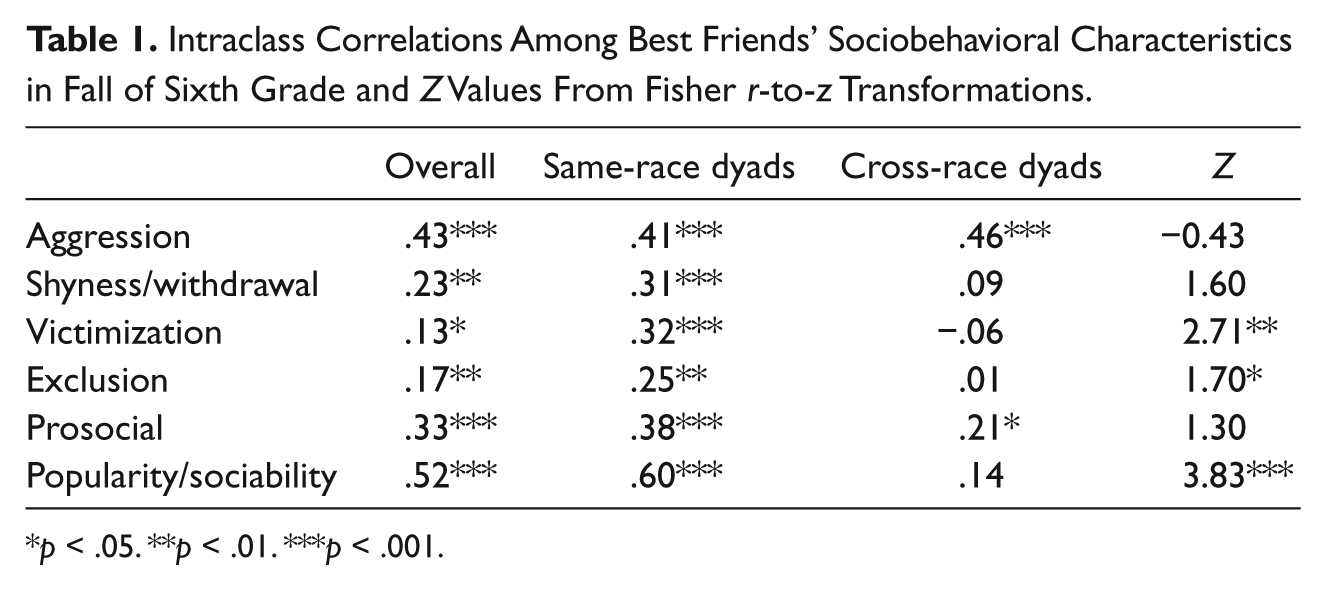
p < .05. **p < .01. ***p < .001.
Predicting Friendship Stability From Racial and Sociobehavioral Homophily
To examine whether racial and sociobehavioral homophily predicted friendship stability, hierarchical logistic regression analyses were conducted. As seen in Table 2, neither sex nor racial homophily were significant predictors of friendship stability. However, there was a significant and positive main effect for the distance score for aggression in the prediction of friendship stability. Results indicate that dissimilarity in aggressive behavior predicted friendship instability across the school year, regardless of same-race or cross-race friendships. There were no other significant main effects for sociobehavioral dissimilarity.
Parameter Estimates and Odds Ratios From Hierarchical Logistic Regressions Predicting Friendship Stability From Gender, Racial Composition, and the Sociobehavioral Distance Score.

p < .01.
Predicting Friendship Quality From Racial and Sociobehavioral Homophily
Friendship quality data were available from both partners for 134 dyads (54 cross-race dyads). For these 134 dyads, the intraclass correlation for friendship quality was relatively high (ICC = .51, p = .001); Fisher’s r-to-z tests revealed that the intraclass correlations for friendship quality for same-race (ICC = .57, p < .001) and cross-race friendship dyads (ICC = .42, p = .001) did not differ significantly, z = 1.11, p = .13.
Separate APIM analyses were conducted for each sociobehavioral characteristic. Results from the APIM analyses are presented in Table 3. Across all analyses, racial homophily and sociobehavioral distance scores were not significant predictors of friendship quality. Additionally, young adolescents’ sociobehavioral characteristics were not significantly related to their own perceptions of friendship quality. However, examinations of friends’ characteristics (partner effects) did reveal a number of significant associations with young adolescents’ perceptions of friendship quality. Specifically, the amount that an adolescent’s friend was victimized was negatively related to the adolescent’s perceptions of friendship quality. Also, friends’ prosocial behaviors were positively related to adolescents’ perceptions of friendship quality. Finally, friends’ popularity/ sociability was positively related to young adolescents’ perceptions of friendship quality.
Parameter Estimates From Linear Mixed Effects Models Examining Individual Sociobehavioral Characteristics, Dyad-Level Sociobehavioral Distance Scores, and Racial Composition Predicting Positive Friendship Quality.
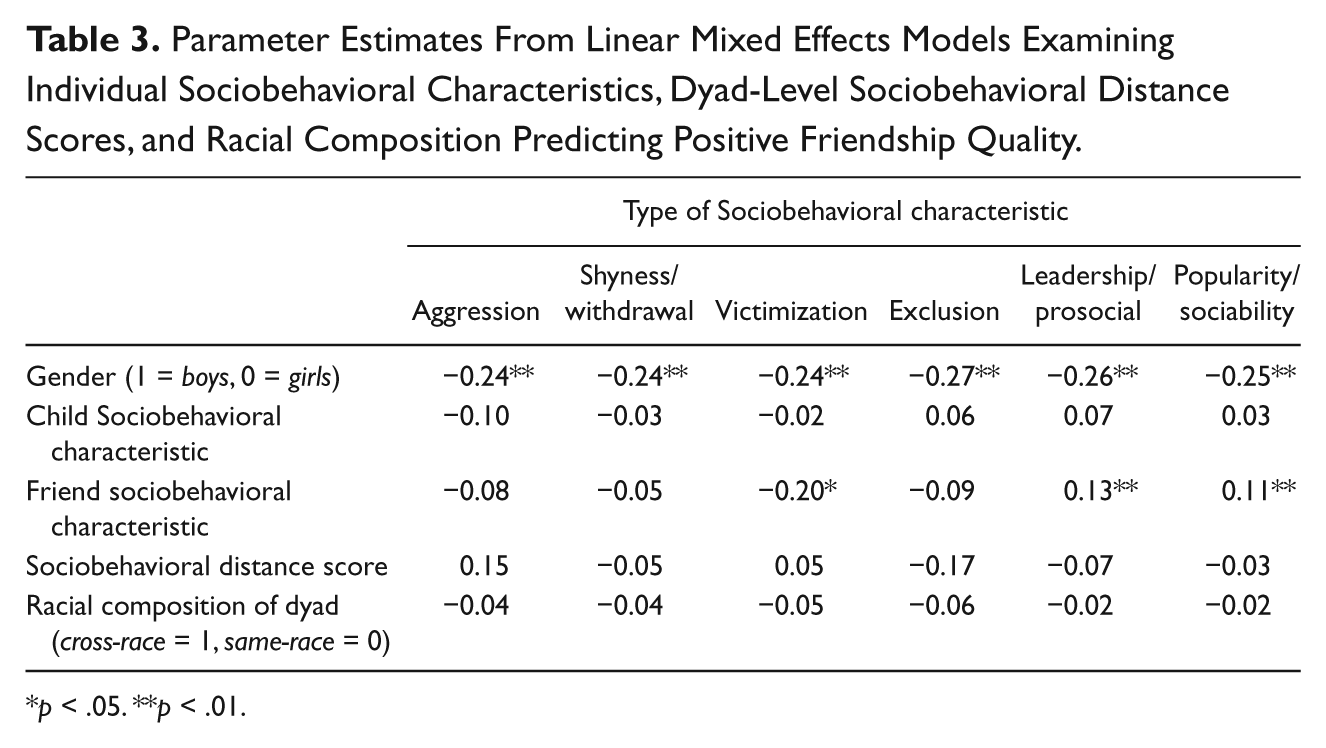
p < .05. **p < .01.
Discussion
The findings of the present study provide new information regarding young adolescents’ same-race and cross-race friendships. First, same-race friendships were more common than cross-race friendships, supporting extant literature on racial selection bias and friendship formation (e.g., Moody, 2001). Second, analyses revealed that same-race friends were similar to one another on all markers of sociobehavioral characteristics including shyness/withdrawal, aggression, victimization, exclusion, prosocial behavior, and popular/sociability. Cross-race friends were similar to each other on aggressiveness and prosocial behavior; however, they were not similar to one another on any other peer-reported sociobehavioral characteristics. Additionally, cross-race friends were significantly less similar than same-race friends on dimensions of peer-nominated popularity/sociability, exclusion, and victimization. It is currently unclear if this dissimilarity is a byproduct of peer perceptions (e.g., how other adolescents view peers of different races as being dissimilar; see Wilson & Rodkin, 2011) or if some groups victimize and exclude in-group members who associate with out-group members. It is also possible that friendships with out-group members lead to decreases in victimization for members of some groups (see Kawabata & Crick, 2011). According to Abrams, Rutland, Cameron, and Marques (2003), children and young adolescents who deviate from group norms become rejected by their own in-group. It is also possible that young adolescents who are seen as shy/withdrawn by peers are better able to form friendships with members of other racial groups wherein shy/withdrawn behavior is less stigmatized. Recent research indicates that socially withdrawn behavior is more normative for some racial groups (e.g., East Asian American youth) than for others (Menzer, Oh, McDonald, Rubin, & Dashiell-Aje, 2010; also see Bellmore, Nishina, & Graham, 2011). Despite the above evidence, more research is necessary to explore how cultural norms, perceived behavioral homophily, and racial group membership contribute to friendship formation over time, and within specific ethnic groups.
Our results revealed that dissimilarity in aggression predicted friendship instability. That is, friends who were more dissimilar in aggressive behavior were less likely to maintain their friendships across the sixth-grade year. Importantly, these findings suggest that the level of similarity in aggressive behavior was more predictive of friendship stability over a school year than the racial composition of the dyad. Friends who are similar on aggressive behavior are more likely to enjoy one another’s company and approach social situations similarly, thus increasing the likelihood that the friendship will remain stable over time (Rubin, Bukowski, et al., 2006). However, the incongruence in a friendship between aggressive and nonaggressive adolescents may make it dissolve sooner, perhaps due to increased levels of conflict in the friendship and incompatible behavioral styles. It is also plausible that friendships between aggressive and nonaggressive young adolescents involve bullying (by the aggressive adolescent) and victimization.
Significantly, neither form of homophily predicted friendship quality in our study. In conjunction with the finding that racial homophily was not a predictor of friendship stability, our results suggest that although race may be one factor that contributes to the formation of cross-race friendships, race does not negatively affect either the maintenance of friendships (once formed) or friendship quality. These findings are promising because they suggest that future efforts could focus on fostering the formation of friendships among children and young adolescents of different races and that these friendships may be as long lasting and as high quality as same-race friendships.
Although we did not find that homophily was related to friendship quality, we did find a number of significant friend (partner) effects when predicting friendship quality. These results could be explained by the extant literature on peer relations and friendship. For instance, we found that adolescents’ perceptions of friendship quality were related to how much their friend was victimized by peers. More specifically, the more an adolescent’s friend was victimized by his or her peers, the less positively the adolescent viewed their friendship. Researchers have shown that friends can protect children and young adolescents from the negative internalizing and externalizing costs of peer victimization (Criss, Pettit, Bates, Dodge, & Lapp, 2002; Hodges & Perry, 1999). However, our results are the first, to our knowledge, to suggest that nonvictimized young adolescents may not enjoy their friendships with victimized peers as much as their friendships with nonvictimized peers. This may occur if victimized adolescents are not able to provide support and opportunities for fun and companionship to their nonvictimized friends because of the turmoil they experience on a daily basis.
Additionally, the more that adolescents’ friends were judged by peers to be prosocial, popular, and sociable, the better young adolescents’ perceived the quality of their friendship with these friends. These findings support previous findings linking prosocial behavior to ratings of positive friendship quality, using the APIM statistical method. For example, while examining the predictors of dyadic friendship quality among adolescents, Cillessen and colleagues (2005) and McDonald and colleagues (2012) found that ratings of prosocial behaviors were associated with self and friends’ perceptions of positive friendship qualities. Individuals who are rated as more prosocial are often empathic, helpful, and supportive and these qualities have been associated with less conflict and better quality relationships (see Cillessen et al., 2005). Additionally, popularity/sociability provides opportunities for young adolescents to form friendships (Aboud & Mendelson, 1998; Bukowski, Pizzamiglio, Newcomb, & Hoza, 1996). Likewise, friendships of popular/sociable individuals are associated with companionship, intimacy, and satisfaction (Burhmester, 1990).
Limitations and Future Directions
It is important to note the limitations of the present study. First, the present study neglected to explicitly examine the role of classroom factors in the formation and maintenance of diverse friendships. Given that differences emerged between same-race and cross-race friendship when evaluating friendship prevalence, exploring the individual contribution of school racial climate would be of importance. Moreover, it may be that the stability and friendship quality of cross-race friendships depends on the specific racial identities of the young adolescents. Although our sample was racially diverse, we did not have enough students to confidently make inferences about differences that were attributed to the racial composition of each dyad (e.g., White/Black versus White/Asian, etc.) Additionally, our sample lacked the variability in school diversity necessary to begin to explore how diversity might influence friendship formation, stability, and quality among young adolescents. Therefore, it would be important to examine the effects of racial group membership on intergroup contact (Allport, 1954; Blau, 1977), school climate, and grades to determine whether racial identity impacts same-race and cross-race friendship stability and friendship quality.
Another limitation pertained to the peer nomination process. The present study limited friendship nominations to same-sex, same-grade, and same-school peers. Although much of the literature extant has focused on these types of relationships (Berndt & McCandless, 2009), there is growing evidence that friendships with those of the opposite sex or friendships outside of one’s school may play a significant role in young adolescents’ development (Bowker & Spencer, 2010; Chan & Poulin 2009; Poulin & Pedersen, 2007). Likewise, there is evidence that children and adolescents may have an in-group bias toward their own race (i.e., they may perceive adolescents of the same race as more socially competent than those of a different race) and may allow these biases to influence their nominations (see Chen & Tse, 2008). Given the importance of this topic, it would be beneficial for researchers to examine the impact of racial and sociobehavioral homophily on the friendships of adolescents across sex, grade, and school among same-race and cross-race friends.
Despite its limitations, the present study was unique in its exploration of the significance of racial homophily and sociobehavioral homophily in the formation, maintenance, and qualities of young adolescent’s friendships within a middle-class, diverse suburban sample. The present study supports past research that finds that adolescents prefer same-race peers over cross-race peers, even in diverse contexts. However, this study adds to the literature by showing that friends’ peer reputations and their similarity in the extent to which they are aggressive may be more important predictors of friendship stability and perceptions of friendship quality than whether friends are of the same race. Additionally, this study suggests that even though racial differences might be a barrier to friendship formation, they do not seem to be impediments for friendship maintenance or quality.
Footnotes
Acknowledgements
The authors would like to thank the children, parents, and teachers who participated in the study as well as Allison Buskirk-Cohen, Kathleen Dwyer, Erin Galloway, Jon Goldner, Sue Hartman, Amy Kennedy, Angel Kim, Sarrit Kovacs, Alison Levitch, Abby Moorman, Andre Peri, Margro Purple, Joshua Rubin, and Erin Shockey who assisted in data collection and input.
Declaration of Conflicting Interests
The author(s) declared no potential conflicts of interest with respect to the research, authorship, and/or publication of this article.
Funding
The author(s) disclosed receipt of the following financial support for the research, authorship, and/or publication of this article: The research reported in this article was supported by National Institute of Mental Health grant 1R01MH58116 to Kenneth H. Rubin.