




Abstract
This study had three goals: (a) assessing the predictive association of externalizing and internalizing behaviors during childhood with sexual onset during early adolescence; (b) examining the interactive link of externalizing and internalizing behaviors with early sexual onset; and (c) investigating the moderating effect of gender in this context. A sample of 343 French-Canadian participants (140 girls) was followed annually from kindergarten until age 15. Externalizing and internalizing behaviors during childhood were reported by teachers, whereas early sexual onset was self-reported from age 13 to 15. Controlling for sociofamily risk, pubertal status, social preference and sexual abuse, results showed a significant interactive link between externalizing and internalizing behaviors with early sexual onset, albeit only among boys. Specifically, boys high on externalizing and low on internalizing problems in childhood were at increased risk of early sexual onset in early adolescence, whereas externalizing boys with high levels of internalizing problems were not. Externalizing and internalizing problems did not predict early sexual onset for girls. The developmental and clinical implications of these findings are discussed.
Keywords
Most heterosexual youth will start showing interest in other-sex mates at some point during their adolescent years. About half of adolescents will have their first sexual experience of intercourse before the age of 17 (Maticka-Tyndale, 2001), whereas 60% to 70% report being sexually active by age 18 (Grunbaum et al., 2004). Although a developing awareness of sexuality and a participation in some forms of sexual behavior are normative during adolescence (Boislard & Zimmer-Gembeck, 2012; Tolman & McClelland, 2011), the fact that some youth engage in early sexual activity raises concerns among parents, researchers, policy makers, and clinicians. Young adolescents are less likely to be equipped with accurate knowledge concerning sexuality and contraception (Frappier et al., 2008; Meier, 2007) and more likely to be lacking self-confidence and proper preparation to negotiate condom use (Abel & Fitzgerald, 2006). Younger teens may also have more difficulties obtaining contraceptives because early sexual activity is considered inappropriate by most adults (Jessor, Costa, Jessor, & Donovan, 1983). In addition, early starters accumulate more opportunities for having sex over time, more sexual encounters and more sexual partners, and use condoms less consistently (Capaldi, Stoolmiller, Clark, & Owen, 2002; Miller, Christopherson, & King, 1993; Roterman, 2005). Considering these facts, it is not surprising that early sexual intercourse is prospectively associated with unintended pregnancies as well as increased rates of sexually transmitted infections (STIs), including HIV (Boyce, 2004; Brener, Kann, Lowry, Wechsler, & Romero, 2006; Rotermann, 2005). Indeed, among all sexually active persons in Canada, teenagers currently have the highest incidence of STIs, such as Gonorrhea and Chlamydia (Government of Canada, 2005). Clearly, sexual activity in early adolescence is a serious public health issue and identifying antecedent risk factors that may explain early sexual onset is thus of crucial importance.
Externalizing Behaviors and Early Sexual Onset
Previous longitudinal research has consistently linked externalizing problems, notably antisocial behavior, to early sexual onset (Ary et al., 1999; Capaldi et al., 2002; Siebenbruner, Zimmer-Gembeck, & Egeland, 2007). When the direction of this relationship is considered, recent literature reports that antisocial behavior often precedes early and risky sexual behavior (Boislard & Poulin, 2011; Boislard, Poulin, Kiesner, & Dishion, 2009). Scholars have argued that a deviant syndrome underlies co-occurring risky behaviors (Costa, Jessor, Donovan, & Fortenberry, 1995; Jessor et al., 2003). According to this Deviant Syndrome Theory, problematic behaviors in adolescence represent diverse manifestations of a tendency to adopt unconventional and deviant behaviors and attitudes (Jessor et al., 2003; Jessor & Jessor, 1977). Behaviors such as delinquency, drug use, or early sexual activity are thus assumed to share common etiological factors, notably antisocial behavior during childhood (French & Dishion, 2003).
Youth engaging in antisocial behaviors are likely to be attracted to sexuality and to have more opportunities for unsupervised and unstructured situations with other-sex mates favorable to sexual encounters. Some scholars have raised the possibility that externalizing behaviors may attract other-sex mates who are alike in attitudes and behaviors. Especially for adolescent boys, externalizing behaviors may actually increase popularity and attractiveness among other-sex peers (Bukowski, Sippola, & Hoza, 2000; Rodkin, Farmer, Pearl, & Van Hacker, 2000). For some youth, externalizing behaviors may thus serve to heighten visibility and facilitate access to potential sexual interactions (Dishion, Poulin, & Skaggs, 1999).
Internalizing Behaviors and Early Sexual Onset
In addition to a possible predictive link between externalizing behaviors and early sex, it has been proposed that some adolescents may engage in early sexual activity to alleviate a general feeling of hopelessness (Whitbeck, Conger, & Kao, 1993) and generate a sense of belonging (Burke, 1987). In line with this notion, several longitudinal studies have reported a moderate positive relationship between internalizing behaviors and early sexual intercourse (Grello, Welsh, Harper, & Dickson, 2003; Monahan & Lee, 2008). However, when examined in multivariate predictive models, the longitudinal relationship between internalizing problems and early sex sometimes attenuates (Caminis, Henrich, Ruchkin, Schwab-Stone, & Martin, 2007) or even disappears (Boislard & Poulin, 2011). Thus McLeod and Knight (2010) showed that only externalizing behaviors retained significance when both types of problems were included in the final model. Another study found that associations between sexual debut and subsequent depressive symptoms were limited to female adolescents who debuted prior to age 16 (Meier, 2007).
Yet another perspective proposed by some scholars is that internalizing behaviors may delay rather than foster sexual intercourse (Capaldi, Crosby, & Stoolmiller, 1996). This notion is supported by research on sexual delay, which shows that children high on internalizing symptoms and low on externalizing behaviors have the highest probabilities to be virgins at age 21 (Boislard, Poulin, & Zimmer-Gembeck, 2011). The underlying mechanism for such association resides in the symptoms of internalizing behaviors, such as low self-esteem, low motivation, high isolation and social deficits, all of which are likely to diminish attractiveness to peers (Rudolph, 1994) and, ultimately, opportunities to engage in sexual behavior. Internalizing symptoms may immobilize youth and restrain them from engaging in other-sex encounters that usually precede sexual intimacy. Moreover, people with internalizing problems may have a low propensity to risk-taking and be more likely to avoid situations like sexual activity because of a variety of fears regarding STIs, unwanted pregnancies, or being caught by parents (Blinn-Pike, Berger, Hewitt, & Olseon, 2004). In summary, findings regarding the predictive effects of internalizing problems are not only inconsistent but also contradictory, as some studies suggest a positive link with early sexual onset and others a negative link.
Possibility of an Interactive Link Between Internalizing and Externalizing Behaviors in Predicting Early Sexual Onset
One possible reason for the equivocal effects of internalizing problems may be that internalizing behaviors have not so much of a main effect but instead play a moderating role in the link between externalizing problems and early sexual onset. Specifically, concomitant internalizing problems may act like an inhibitor of later delinquent behaviors for individuals high on externalizing behavior (Tremblay, Pihl, Vitaro, & Dobkin, 1994). This is consistent with Cloninger’s proposition that individuals high on impulsivity and low on social withdrawal and anxiety are the most at risk for antisocial personality (Cloninger, 1986). In line with this notion, anxiety and shyness have been identified as mitigating factors of the association between externalizing behavior and future delinquency (Kerr, Tremblay, Pagani, & Vitaro, 1997; Vitaro & Brendgen, 2011). As mentioned previously, early sexual onset may be part of the same general deviant syndrome as delinquency and the two may share common antecedent factors (Ary et al., 1999). It is thus conceivable that externalizing and internalizing problems have a similar synergetic or interactive effect on sexual initiation as on delinquent behavior. Specifically, low levels of internalizing behaviors may exacerbate the impact of externalizing behaviors on early sexual onset, whereas high levels may attenuate this effect. Aggressive youth with concomitant internalizing problems may be more sensitive to punishment and the negative consequences of their actions and may thus be less likely to engage in risk-taking behaviors, including early sexual intercourse. Indeed, research has shown that especially in early adolescence, dating and sexual activity are unfamiliar situations that are likely to raise concerns and increase anxiety (La Greca & Mackey, 2007) and that fear and uncertainty are among the main reasons for abstaining from sexual activity (Blinn-Pike et al., 2004).
A second mechanism whereby internalizing behaviors might decrease the likelihood of engaging in later problem behaviors among externalizing youth is by interfering with exposure to deviant peers. Affiliation with deviant peers is a well-documented risk factor for early intercourse (Cavanagh, 2004) and risky sexual behaviors (Boislard et al., 2009). Empirical evidence suggests that behavioral inhibition might impede friendship formation with deviant peers (Boivin & Vitaro, 1995; Dishion & Patterson, 1991). Futhermore, aggressive youth high on internalizing behaviors often display reactively aggressive behavior, which puts them at increased risk of being rejected and perhaps even victimized by their peers (for a review, see Vitaro & Brendgen, 2011). In contrast, aggressive youth who are low on concomitant internalizing problems mostly display proactive aggression and often occupy a central role in the peer group (Vitaro & Brendgen, 2011). As a result, the social prominence of aggressive youth who are low on internalizing behavior may provide them with ample chances to encounter prospective sexual partners. In contrast, access to sexual partners is likely limited for aggressive youth who are socially withdrawn, anxious, and depressed, as they are less likely to be exposed to social situations such as parties where opportunities for potential sexual activity can occur. To our knowledge, however, no previous study has examined the potential interaction effect of externalizing and internalizing behaviors on early sexual onset.
Gender Differences
In a recent review, Zimmer-Gembeck and Helfand (2008) identified multiple gender differences in the predictors of sexual intercourse onset, including gender differences in the associations of values, mental health, parenting practices, and peer relationships with the timing of first sexual intercourse. Gender differences may also be evident specifically with regard to the predictive associations of externalizing and internalizing problems with early sexual onset. Some scholars have suggested that externalizing behaviors can have a functional utility especially for boys by making them more visible, popular, and attractive to females in adolescence (Bukowski et al., 2000; Rodkin et al., 2000). In support of this notion, Zimmer-Gembeck and Helfand (2008) reported that greater alcohol use and externalizing behaviors were the two behaviors that had the most consistent associations with earlier onset of intercourse among boys, but not among girls. Concomitant internalizing behaviors may also be more predictive of the age at sexual onset in aggressive boys than in aggressive girls. Internalizing behavior is generally more accepted among girls than boys (Perry-Parrish & Zeman, 2009), and low anxiety has been linked to greater peer acceptance among boys only (Oberle, Schonert-Reichl, & Thompson, 2010), whereas sadness has been associated with low peer acceptance for boys, but not for girls (Perry-Parrish & Zeman, 2009). These findings indicate that high internalizing symptoms may reduce opportunities for sexual encounters for aggressive boys, but not necessarily for aggressive girls. Together, these results suggest that gender must be considered as a possible moderator when examining the (potentially interactive) links of externalizing and internalizing behaviors on early sexual onset of young adolescents.
The Current Study
The goal of this study was to examine the potential interactive link of externalizing and internalizing behaviors during childhood with early sexual onset. As outlined previously, we expected that youth with high externalizing behaviors and low internalizing behaviors would be at high risk of early sexual onset, whereas externalizing youth with high levels of internalizing behaviors should not engage more often in early sex than youth without externalizing problems. This interaction was expected to be moderated by gender, however. Specifically, as suggested by the literature regarding gender differences reviewed above, the interactive link of externalizing and internalizing problems on early sexual onset should be more apparent among boys.
To test these predictions, we employed a longitudinal design where externalizing and internalizing behaviors were examined annually during childhood, from kindergarten to the end of elementary school. Most longitudinal studies on early sexual intercourse did not assess predictor variables prior to early adolescence. However, research shows that externalizing and internalizing behaviors can already be present in early childhood and tend to be rather stable in some youth (Broidy et al., 2003; Côté et al., 2009). If adolescent deviant behavior (including early sex) is indeed partly driven by an underlying preexisting tendency for antisocial behavior, coupled with a lack of anxiety and inhibition, this tendency should already be observable at a relatively young age. Considering the early onset and the stability of these behaviors, we therefore examined their initial levels in kindergarten as well as their potential change over time to fully understand their contribution to early sexual activity.
Our hypotheses were tested while controlling for the effects of pubertal status, sociofamily risk, social preference, and sexual abuse on early sexual onset. Early pubertal timing has been consistently linked to earlier sexual onset across studies (Zimmer-Gembeck & Helfand, 2008) as well as to increases in problem behavior and accelerated developmental trajectories (Magnusson, Stattin, & Allen, 1985). In addition, rejection by the peer group is among the most frequently evoked social antecedents of problem behavior (McDougall, Hymel, Vaillancourt, & Mercer, 2001), and some evidence suggests that peer rejection is also a risk factor for early onset of sexual intercourse (Greenberg, Magder, & Aral, 1992). Peer rejection could, however, also be negatively instead of positively related to early sex. Ladd (2006) has proposed that attaining acceptance in the peer group is a critical social task for developing certain skills in order to adequately interact with others. Missing such opportunities in younger years seems to impair the transition to more complex interactions such as the mixed peer groups of early and middle adolescence, and the romantic and sexual relationships that usually appear during that time. These findings are in line with those of Zimmer-Gembeck and Collins (2008) who found that early childhood sociability was predictive of more lifetime sexual partners at age 26. As such, although no clear prediction could be made regarding the nature of the association, we controlled for the link between peer rejection and early sexual onset. Family-related risk factors such as low SES, parents’ low education levels, and intact versus nonintact family structure have also been associated with early sexual activity, especially in girls (Zimmer-Gembeck & Helfand, 2008), and these indicators of family risk were therefore included as an additional control. Finally, we also controlled for the documented link between sexual abuse and early sexual intercourse (Wilson & Widom, 2008).
Method
Participants
Participants were part of a longitudinal study on psychosocial development. The original sample was comprised of 399 French-speaking Whites (44% females) from a small town in the province of Quebec, Canada. The first assessment (T1) was made during kindergarten (mean age = 6.01 years, SD = .28), in 1984. All kindergarten children in the community were targeted for participation, and 95% of the solicited children participated in the study. Children’s average socioeconomic status (SES) was very similar to the provincial average. Children attended elementary school until Grade 6 (T7), which was followed immediately by the transition to junior high school (T8 and up). All participants attended the same high school, which is the only high school in the community. The sample was followed each year until age 15 (T10). Our outcome variable of interest (i.e. early sexual onset) was assessed at three time points (i.e., age 13, 14, and 15; final n = 343). There were 11.89% missing data points, and Little’s MCAR test (Little, 1988) suggested that the pattern of missingness was inconsistent with the Missing Completely At Random assumption, χ2(46) = 82.43, p < .001. Participants with complete data had fewer externalizing problems at T1 than those with missing data (Mean = 3.78, SE = .29, versus Mean = 5.23, SE = .61, t(375) = 2.31, p < .05). However, participants with complete data did not significantly differ from participants with incomplete data in regard to internalizing problems at T1 (Mean = 1.71, SE = .12, versus Mean = 2.18, SE = 2.24, t(375) = 1.93, p = .06) or sociofamily risk at T1 (Mean = 0.32, SE = 0.02, versus Mean = 0.36, SE = 0.03, t(350) = 1.13, p = .26).
Procedure
After approbation from the School Board, teachers and parents of the target classrooms were contacted by mail and invited to participate in the study. Teachers provided materials and consent forms to the children of their classrooms to pass on to their parents. Written consent from all parents and teachers was required for the data collection in the classroom. The verbal consent of all participating children was also required. Participants were informed that their answers would be kept strictly confidential and that they could stop their participation at any time during the study.
Measures
Externalizing behaviors
Each year, from kindergarten to Grade 6 (T1 to T7), externalizing behaviors were assessed for each participant using teacher-ratings of the Social Behavior Questionnaire (SBQ; Tremblay, Desmarais-Gervais, Gagnon, & Charlebois, 1987), with a new teacher assessing their behaviors each year. Teachers have been reported to be reliable raters of children’s social behavior (Walker, 2004), and research shows that early externalizing behavior is a good predictor of later antisocial behavior (Hollenstein, Granic, Stoolmiller, & Snyder, 1994). The scale comprised 11 items (i.e., “fights,” “destroys others properties,” “irritable,” “inconsiderate,” “blames others,” “not liked,” “disobedient,” “tells lies,” “bullies,” “doesn’t share,” “restless”), which covers a wide range of externalizing behaviors. Ratings for each item ranged from 0 (does not apply) to 2 (applies often). Separately for each assessment time, the mean was computed to create a scale score of externalizing behavior. Cronbach’s alphas in the present study ranged from .90 to .93 from one wave to another. Test-retest reliability over a 1-year period ranged from .37 to .59. To represent interindividual differences in the level and change in children’s externalizing behavior over the course of primary school, latent growth curve analyses (Willet & Sayer, 1994) were conducted separately using the Mplus 6.1 Software package (Muthen & Muthen, 1998-2010). No assumptions regarding independence and homoscedasticity of the measurement errors were imposed. Missing data were included using Full Information Maximum Likelihood estimation and a robust chi-square estimator was utilized to accommodate nonnormality of the data. For externalizing problems, the results revealed that a model including a linear trend fit the data rather well (CFI = .95, TLI = .95, RMSEA = .07), with significant variances in both the intercept and the linear slope. Inclusion of a quadratic slope term did not yield a better fit (CFI = .95, TLI = .95, RMSEA = .07) and neither the mean nor the variance of the latent quadratic term were statistically significant. Individual intercept (Mean = 3.86, SD = 3.37) and linear slope (Mean = −.28, SD = .24) factor scores from the linear growth model were thus saved and used as predictors in subsequent analyses.
Internalizing behaviors
As for externalizing behaviors, each year, from kindergarten to Grade 6 (T1 to T7), internalizing behaviors were assessed for each participant using teacher-ratings of the Social Behavior Questionnaire (SBQ; Tremblay et al., 1987). This scale comprises 5 items (i.e., “worried,” “alone,” “distressed,” “fearful,” “cries”), and ratings for each item ranged from 0 (does not apply) to 2 (applies often). Separately for each assessment time, the mean was computed to create a scale score of internalizing behavior. Cronbach’s alphas in the present study ranged from .72 to .76. Test-retest reliability over a 1-year period ranged from .26 to .44. Latent growth curve analyses were again performed to represent interindividual differences in the level and change in children’s internalizing behavior over the course of primary school. The linear growth model did not fit the data well (CFI = .89, TLI = .90, RMSEA = .07). However, although model fit improved considerably after inclusion of the quadratic term (CFI = .96, TLI = .95, RMSEA = .05), inspection of the latent growth parameters revealed a significant variance only in the intercept but not in the linear or quadratic growth of internalizing problems. Individual intercept factor scores were thus saved and used as a predictor in subsequent analyses (Mean = 2.13, SD = .98).
Social preference
Children’s level of social preference or rejection from kindergarten (T1) through Grade 6 (T7) was assessed using peer nominations (Coie, Dodge, & Coppotelli, 1982). Specifically, each year, booklets of names (or photographs if they were not yet able to read) of all children of a given classroom (of about 25 children each) were handed out to the participants. The participants were then asked to circle the photos (or names) of the three classmates they liked to play with most (positive nominations), and of the three classmates they liked to play with least (negative nominations). The criteria outlined by Coie et al. (1982) were used to compute the social preference score for each participant each year. Specifically, the total number of received positive nominations was calculated for each participant and z standardized within the classroom to create a total Liked-Most-score (LM). The same procedure was used for the negative nominations and for the creation of a Liked-Least-score (LL). Afterwards, the LL-score was subtracted from the LM-score to create a social preference score, which was again z standardized within the classroom. A positive score indicates social preference, whereas a negative score reflects peer rejection. Test-retest reliability over a 1-year period ranged from .48 to .57 (Mean r =.52). To increase representativeness, reliability, and validity, an average score of social preference was computed across the seven consecutive waves (T1 to T7).
Early sexual onset
From T8 to T10, participants were asked whether they have had complete sexual intercourse (with penetration) and, if so, how old they were at their first sexual intercourse. The participants were asked to indicate their age in years. In line with previous studies, sexual onset was considered early if it happened before the age of 14 (Brendgen, Wanner, & Vitaro, 2007; Martin et al., 2005). Coding for this variable was 1 “Early sex,” 0 “No early sex” (or no sexual intercourse at all). Instead of excluding participants with discrepant data, as has been done in some longitudinal studies on the age at sexual onset (Cavanagh, 2004), discrepant responses were managed using systematic rules, based on the work of French and Dishion (2003) with two-wave data and on a previous study (Boislard & Poulin, 2011). Five participants reporting intercourse before age 10 and 1 participant reporting ages differing by more than 2 years were excluded from the analyses. At the end of the data collection, 18% of the participants were considered having had early sexual onset (23 boys, 39 girls).
Pubertal status
In Grade 7 (T8), participants completed a validated French version of the Pubertal Developmental Scale (PDS; Petersen, Crockett, Richards, & Boxer, 1988; Verlaan, Cantin, & Boivin, 2001). The PDS is a 5-item gendered measure where participants self-report their level of sexual development on a 4-point scale (1 = no development, 2 = development has barely begun, 3 = development is definitely underway, 4 = development is complete). The sexual characteristics include menarche and breast development for girls, changes in voice and growth of body hair for boys, and changes in growth spurt, pubic hair, and skin for both genders. Using Tanners’ classification (1962), participants were categorized into one of five groups, from 1 (early starter) to 5 (late starter). Pubertal status was computed separately by gender, with α’s ranging from .68 to .83 (Mean pubertal status = 3.25, average SD = .81).
Sexual abuse
From T8 to T10 (Junior high school), participants were asked whether they had been sexually abused in the last 12 months. Those who reported yes at least once were given a score of 1. At the end of the data collection, 8% of the participants (5 boys, 24 girls) indicated that they had been sexually abused.
Sociofamily Risk was assessed via mother reports on (a) family structure (two parents or single), (b) educational level of both parents (or of the parent with whom the child was living), (c) occupational status of both parents (or of the parent with whom the child was living) based on the Blishen, Carroll, and Moore (1987) occupational prestige scale, and (d) mother’s and father’s age at the birth of the first child, respectively. A score of 0 was attributed to family structure if the child was living with both natural parents and a score of 1 was attributed to all other cases. Parental educational level, parental occupational status, and mother’s or father’s age at the birth of the first child were scored 1 when the individual scores were in the lower quartile of the respective variable distribution. A score of 0 was given to scores above the first quartile of the distributions. A total sociofamily risk index was then computed, separately for each year, by averaging the individual variable scores. As such, a high value in this newly created variable indicated exposure to a high level of sociofamily risk (Mean = .33, average SD = .26). Similar sociofamily risk factors have been associated with early sexual activity in previous research, especially among girls (Langille, Hugues, Murphy, & Rigby, 2005; Zimmer-Gembeck & Helfand, 2008).
Results
Preliminary Analyses
In Table 1, bivariate correlations, means, and standard deviations of all variables are presented. To account for cases with missing data, both the preliminary and the subsequent main analyses (i.e., logistic regression analyses predicting early sexual onset) were performed using multiple imputations with 20 imputed data sets using the MI procedure available in SPSS 20. As can be seen, early sexual onset was significantly and positively correlated with sociofamily risk (r =.18, p < .01) and pubertal status (r =.25, p < .01). Early sexual onset was also significantly and negatively correlated with the slope of externalizing problems (r = −.15, p < .05), but not with initial levels of either externalizing or internalizing problems, nor with social preference. Sociofamily risk was positively correlated with initial levels of both externalizing (r =.16, p < .01) and internalizing (r =.20, p < .01) problems, but was negatively correlated with the slope of externalizing problems (r = −.13, p < .05). Initial levels of externalizing and internalizing problems were positively correlated with each other (r =.26, p < .01). However, initial levels of both externalizing and internalizing problems were negatively correlated with the slope of externalizing problems (r = −.80, p < .01, and r = −.19, p < .01, respectively). Social preference was not correlated with any of the study variables. In terms of gender differences, girls experienced more sexual abuse during childhood than boys (r =.22, p < .01), had a more advanced pubertal status (r =.63, p < .01), and showed lower initial levels (r = −.26, p < .01) but a higher slope (r =.18, p < .01) of externalizing problems. Moreover, girls reported earlier sexual onset (r =.15, p < .05).
Bivariate Associations, Means, and Standard Deviations a .

For categorical variables (early sex, gender, and sexual abuse) the Phi coefficient is reported. 0=male. 1=female.
p < .05. **p < .01.
Main Analyses
Hierarchical logistic regression analysis was conducted to assess the predictive additive and interactive links of externalizing and internalizing behaviors with early sexual onset, while controlling for gender, sociofamily risk, sexual abuse, pubertal status, and the level of social preference among peers. Results are presented in Table 2. Main effects of the predictor variables (i.e., gender, sociofamily risk, pubertal status, social preference, sexual abuse, initial level and slope of externalizing problems, as well as well as initial level of internalizing behaviors) were assessed on the first step. On the second step, the following interaction terms were included: “initial level of externalizing problems × initial level of internalizing problems,” “initial level of externalizing problems × gender,” “initial level of internalizing problems × gender,” and a three-way interaction “initial level of externalizing problems × initial level of internalizing problems × gender”). Finally, on the third step, two two-way interactions (“slope of externalizing problems × initial level of internalizing problems” and “slope of externalizing problems × gender”) and a three-way interaction (“slope of externalizing problems × initial level of internalizing problems × gender”) were added. To avoid multicollinearity, continuous variables were centered before creating the interaction terms (Jaccard, 2001).
Logistic Regression of Early Sexual Onset (Whole Sample).
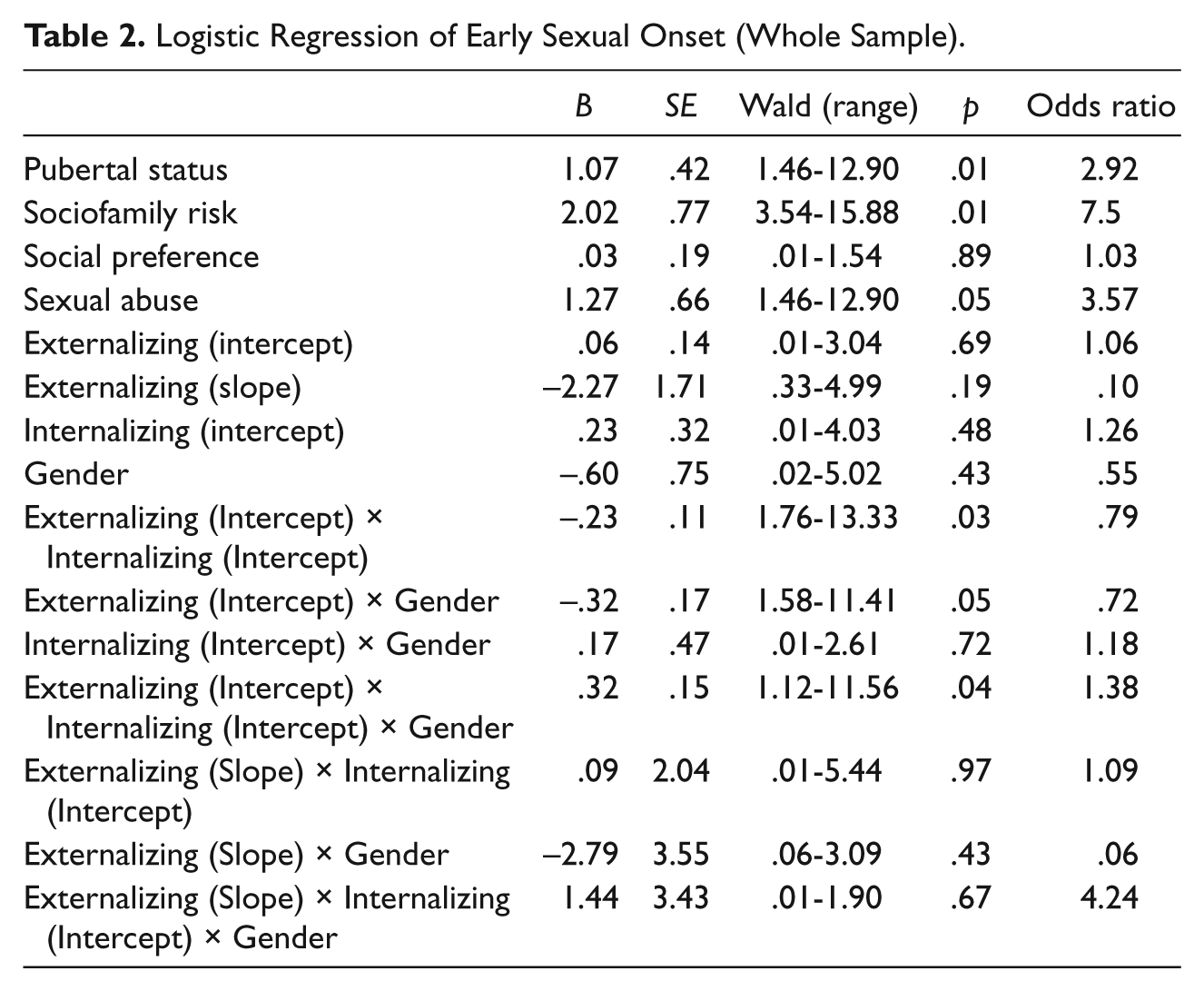
As can be seen in Table 2, results from the first step showed that early pubertal status increased the odds of early sexual onset, odds ratio = 2.92, p = .01. The probability of early sexual onset was also higher in youth experiencing high sociofamily risk (odds ratio = 7.5, p = .01) or sexual abuse (odds ratio = 3.57, p = .05). There were no significant main effects of social preference, gender, initial levels of externalizing or internalizing problems or of the slope of externalizing problems on early sexual onset. However, results from the second step revealed a significant interaction effect between initial levels of externalizing and internalizing problems (odds ratio = .79, p < .05), a significant interaction effect between initial levels of externalizing problems and gender (odds ratio .72, p = .05) as well as a significant triple interaction between initial levels of externalizing and internalizing problems and gender (odds ratio = 1.38, p < .05). Similar interaction effects involving the slope of externalizing problems, which were tested on the third step, did not reach statistical significance.
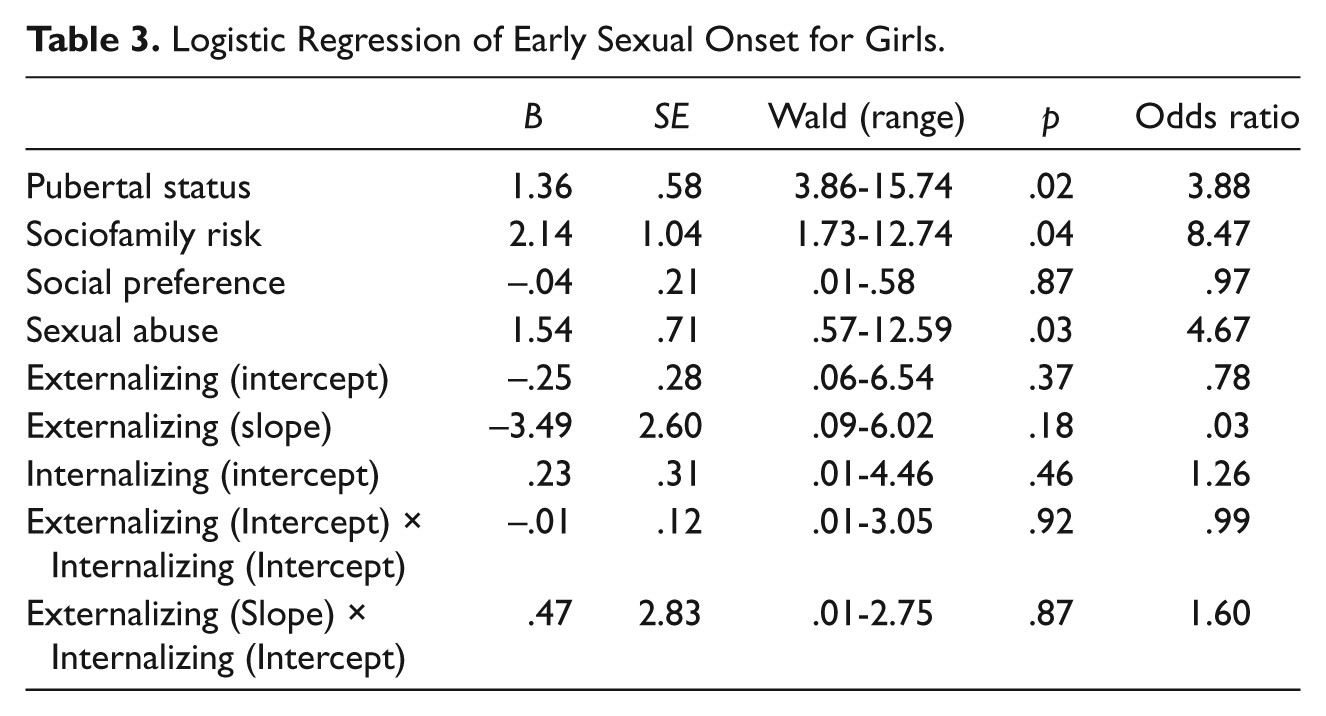
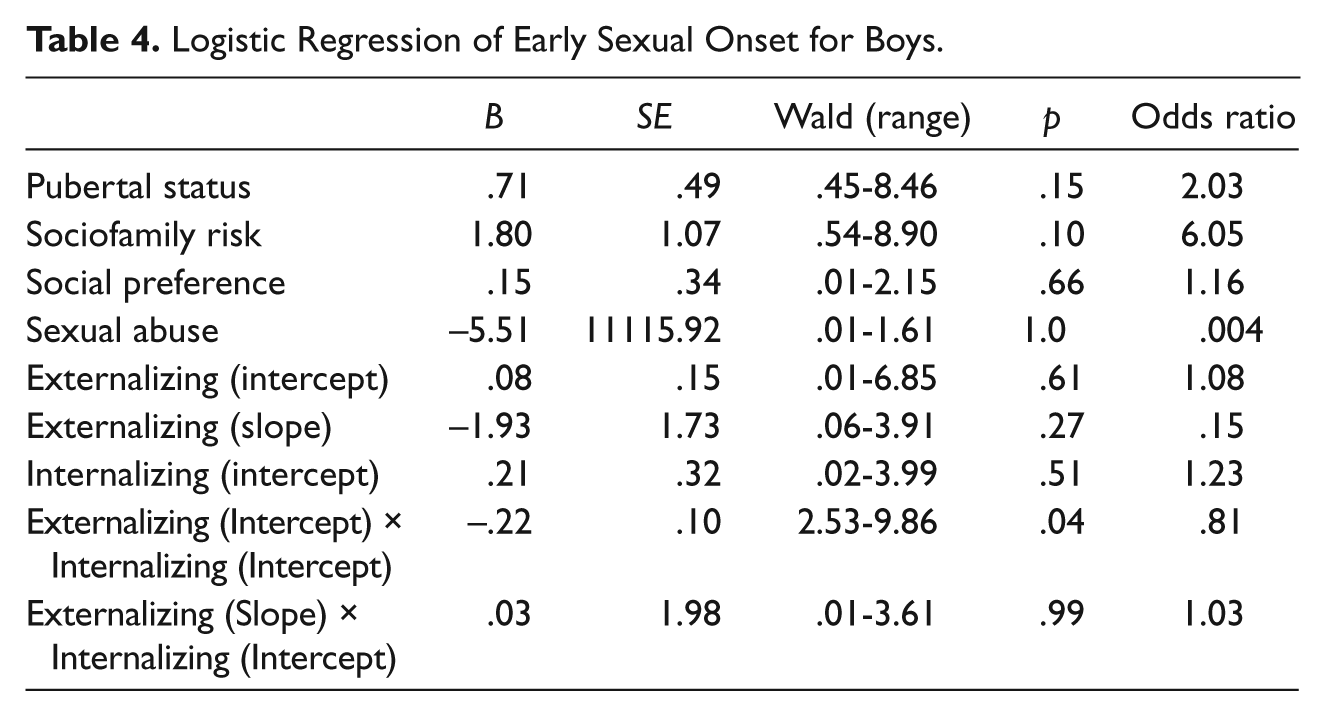
As can be seen in Tables 3 and 4, further inspection of the significant triple interaction between initial levels of externalizing and internalizing problems and gender revealed that the two-way interaction between initial levels of externalizing and internalizing problems was significant for boys (odds ratio = .81, p < .05), but not for girls (odds ratio = .99, ns). The significant two-way interaction for boys was probed by examining the association between initial levels of externalizing problems and early sexual onset at different high (+1 SD and + 2 SDs) and low (−1 SD and −2 SDs) initial levels of internalizing problems (Jaccard, 2001). The results showed that a high initial level of externalizing behavior was related to increased odds of early sexual initiation in boys with concomitantly low levels of internalizing behaviors (i.e., odds ratio = 1.65, p < .05, when initial internalizing problems were 2 SDs below the mean; and odds ratio = 1.33, p = .10, when initial internalizing problems were 1 SD below the mean). In contrast, the initial level of externalizing behavior was unrelated to the odds of early sexual onset in boys with concomitantly high levels of internalizing behaviors (i.e., odds ratio = .71, p = .18. when initial internalizing problems were 2 SDs above the mean; odds ratio = .87, p = .46, when initial internalizing problems were 1 SD above the mean).
Logistic Regression of Early Sexual Onset for Girls.
Logistic Regression of Early Sexual Onset for Boys.
Discussion
The goal of this study was to examine the main and combined associations between externalizing and internalizing behaviors during childhood and early sexual onset. Controlling for the effects of of pubertal status, sociofamily risk, social preference and sexual abuse, results showed no main effect of either externalizing or internalizing behaviors on early sexual onset. However, as expected, there was a significant interactive effect between externalizing and internalizing behaviors on early sexual onset, albeit only among boys.
According to Deviant Syndrome Theory, problematic behaviors in adolescence share common etiological factors and may represent diverse manifestations of a common tendency to adopt unconventional and deviant behaviors and attitudes (Jessor et al., 2003). Although these problem behaviors have indeed been found to share common predictors in many studies, empirical support for the theory is equivocal. For example, in a study by Udell, Sandfort, Reitz, Bos and Dekovic (2010) early sexual onset was not clustered with externalizing behaviors in a sample of Dutch adolescents. Our study adds to this research by showing that externalizing behaviors are indeed not always associated with early sexual onset. One reason for the failure to replicate the main effect of externalizing behaviors on early sex found in previous research may be because externalizing behaviors were assessed over the whole childhood period in the present study (i.e., starting in kindergarten), rather than in early adolescence like in previous studies (Boislard & Poulin, 2011; Siebenbruner et al., 2007). Our study also shows, however, that interaction effects can sometimes be more informative than main effects. In this case, and for boys only, the interaction between externalizing and internalizing behaviors contributed to explaining early sexual onset, whereas externalizing behaviors only did not.
Our results show that boys high on externalizing behaviors and low in internalizing behaviors are at increased risk of having early sex, whereas those high on externalizing behaviors and high on internalizing behaviors were not more at risk than those without such problems. Especially noteworthy in this context is the finding that it was the initial levels of high externalizing and low internalizing behaviour that predicted early sex, rather than changes in these behaviors over middle childhood above and beyond the initial levels. This result concords with the notion that children with early observable, stable externalizing dispositions (and no concomitant internalizing problems) are most at risk for later deviant behavior, including early sex. It is possible that these boys do not worry about the negative consequences of their actions and, consequently, may be more prone to risk-taking and risky behaviors in new and unfamiliar situations such as sexual encounters. In contrast, externalizing boys with concomitant internalizing problems may refrain from early sexual activity because they are too anxious to initiate sexual contacts. It is also possible that aggression combined with anxiety reduces attractiveness of adolescent males among females. Indeed, boys who are high on aggression and internalizing problems may resemble the reactively aggressive youth who are often the most unpopular ones and who have no or only few friends, whereas proactively aggressive youth—who usually do not have internalizing problems—are often more accepted by their peers (Vitaro & Brendgen, 2011). It is also conceivable that anxiety raises negative expectations about the potential outcomes of having sex (e.g., unwanted pregnancies, performance anxiety, etc.) among aggressive boys who just recently achieved puberty and lack sexual experience.
This moderating effect of internalizing behaviors on the link between externalizing behaviors and early sexual onset was not significant among girls, which may be explained by the fact that internalizing behaviors do not have the same connotation for girls and for boys (Caspi, Elder, & Bem, 1988). Among boys, internalizing behaviors are socially undesirable and could restrain them in both finding sexual partners and initiating sexual contacts. Boys with internalizing problems are frequently rejected by their peers and are likely to be supplanted by more outgoing and hence more popular boys (Bukowski et al., 2000; Rodkin et al., 2000). In contrast, girls may be sexually solicited regardless of whether they have internalizing or externalizing problems. Results from the present study are thus a further confirmation of gender differences regarding the impact of internalizing behaviors on early sexual onset.
The interaction effect of externalizing and internalizing problems on early sex was observed while controlling for several potential confounding variables, notably pubertal status, sociofamily risk, social preference and sexual abuse. In line with findings from other studies (Cavanagh, 2004; Zimmer-Gembeck & Helfand, 2008), more advanced pubertal maturation increased the odds of early sexual onset, albeit only among girls. This result is surprising, because one could expect that advanced pubertal maturation would predict early sex for both genders. However, most studies have assessed the association between pubertal maturation and early sex among girls only (Magnusson et al., 1985), leading to a misunderstanding of the processes involved among boys. Future research should elucidate the gendered impact of puberty on sexual timing. In contrast, social preference was not significantly associated with early sex among girls or boys, thus adding to the previous equivocal findings on the effect of social preference on early sexual onset (McDougall et al., 2001; Zimmer-Gembeck & Collins, 2008). More research is needed to shed more light on the role of social preference among peers in explaining early sexual onset.
Strengths, Limitations, and Conclusions
This study contributes to the literature on early sexual onset by examining childhood predictors of early adolescent sexual activity, using a longitudinal 10-wave, multi-informant and multimethod design, with a sample of boys and girls. Our results suggest that it is the combination of high externalizing and low internalizing behaviors that increases the probabilities of early sex. Of note, most studies that did find main effects of externalizing and internalizing problems on sexual onset used the same sources (i.e. mostly participants’ self-reports) for the assessment of both the behavioral characteristics and sexual behavior (Costa et al., 1995), which may have increased associations due to shared method variance. The use of different reporting sources in the present study, that is, teacher-reports for internalizing and externalizing behaviors, peer nominations for peer status, and self-reports for age at first intercourse, avoided such potential bias. Furthermore, the main predictors were assessed starting at school entry and examined longitudinally throughout childhood in this study, whereas most longitudinal studies on early sexual intercourse measured predictors only in late childhood or early adolescence.
Despite these strengths, there are also several limitations to this study that need to be acknowledged. First, this study should be replicated with samples other than French–Canadian Whites, because since ethnocultural differences in sexual development have been reported in previous studies (Zimmer-Gembeck & Helfand, 2008). Future studies need to clarify ethnocultural differences with regard to early sexual onset and its correlates. Second, our measure of internalizing behaviors assessed a broadband construct that reflected social withdrawal, anxious and depressive symptoms, as well as behavioral inhibition, which may have grouped some elements that might have had a main effect if considered independently. For example, previous research has shown that social withdrawal is more predictive of a lack of sexual opportunities than are depressive symptoms (Boislard et al., 2011). Future research should examine the unique contribution of each of these dimensions on early sexual onset. Third, peer acceptance also varied across measurements because peer environment changed from one year to the next (i.e., the classroom composition did not remain stable). Additionally, the stability of both internalizing and externalizing behaviors was quite low, possibly reflecting the diverse opinions of different teachers over time. Fourth, our sexual abuse measure was only assessed “in the last 12 months” for 3 years, thus neglecting the impact of earlier childhood sexual abuse on early sexual onset. Furthermore, only 18% of our sample have had early sexual intercourse (e.g., at age 13 or younger), which, although higher than national rates (Garriquet, 2005), still only represents 62 adolescents. Thus results should be interpreted carefully.
Another limitation is the fact that parents’ and peers’ influences were not considered in this study, despite the ample evidence of their contribution to youth’s transition to sexual activity. For example, parental monitoring, control, warmth, support, limit setting, values, and communication about sex have been linked to the timing of sexual onset (Boislard et al., 2009; Zimmer-Gembeck & Helfand, 2008). Furthermore, friends’ deviance, perceived sexual activity, and peer norms have also been shown to accelerate sexual onset (Zimmer-Gembeck & Helfand, 2008). These variables need special attention in future research aiming at understanding the emergence of early sexual onset, especially among girls.
These limitations notwithstanding, the present study contributes to our understanding of the role of externalizing and internalizing behavior problems in explaining early sexual onset. By the same token, the present findings may help reconcile at least in part some of the equivocal results of past studies. In line with previous research on delinquency (Kerr et al., 1997), our study revealed that adolescent males who were high on externalizing behaviors and low on internalizing behaviors during childhood had high probabilities of engaging in early sexual intercourse. These results emphasize the importance of reaching out to children with externalizing problems—especially to those who are low on inhibitory behaviors—as early as possible because they are the most at risk of engaging in problem behaviors later on, including in early sex. The findings from this study are nevertheless encouraging by showing that predictors of precocious sexual behaviors can be identified as early as age 5. Early interventions may thus help prevent early sexual activity as well as the development of a deviant lifecourse trajectory.
Footnotes
Declaration of Conflicting Interests
The author(s) declared no potential conflicts of interest with respect to the research, authorship, and/or publication of this article.
Funding
The author(s) disclosed receipt of the following financial support for the research, authorship, and/or publication of this article: This research was made possible by grants from the Social Sciences and Humanities Research Council of Canada and the Fonds Concerté pour l’Aide à la Recherche from the Quebec Government. We wish to thank the directors of the school board as well as the participating teachers and children. Bernadette Simoneau deserves our thanks for her assistance in data management and preparation. We also wish to thank Mahault Albarracin and Julie Whissell for their precious help with the revisions, as well as the anonymous reviewers who helped improving the manuscript considerably.