



Abstract
The present study investigates developmental patterns of fear in adolescence. It is based on longitudinal data collected as a part of the European Longitudinal Study of Pregnancy and Childhood (ELSPAC) project. A total of 186 Czech adolescents (43% girls) were assessed repeatedly at the age of 11, 13, and 15 years. The free-response method was used to examine individual-specific fears. Fear occurrence, content, and intensity changes in 19 general fear categories in the age groups studied were investigated. The findings reveal that the most common fears of 11- and 13-year-old adolescents were related to school. However, at the age of 15, the most common fear category was the fear of losing someone, or the fear of something happening to somebody. Furthermore, we found that developmental trajectories of fear categories are characterized by a transition from the specific and concrete fears of childhood to the more general and abstract fears of adolescents.
Introduction
Fear is one of the basic emotions which humans experience, express, and recognize in others since early infancy (Ekman, Sorenson, & Friesen, 1969). The current study focuses on common fears which are defined as unpleasant feelings emerging as normal responses to realistic or imaginary danger. These emotions are considered to be an important and adaptive aspect of development (Gullone, 2000; Marks, 1987). The content of children’s common fears changes over developmental time and is entwined with their cognitive, perceptual, emotional, and social development (Owen, 1998). Across development, the fear content changes from fears connected to concrete stimuli which occur in the immediate environment (e.g., noise) in infants and young children through the realistic fears of school-aged children (e.g., school achievement) to more abstract fears (e.g., future) in adolescence. This predictable pattern of development of normal child fears is known as “ontogenetic parade” (Marks, 1987).
Due to many biological, psychological, and social changes, adolescence is characterized by a number of insecurities and ambivalences, which aid the development of age-specific contents of fear (e.g., social evaluation fears; Bokhorst, Westenberg, Oosterlaan, & Heyne, 2008; Westenberg, Drewes, Goedhart, Siebelink, & Treffers, 2004). This leads to an increase in particular types of fear during adolescence despite the fact that overall fearfulness has been repeatedly described as decreasing with age (Gullone & King, 1993; King et al., 1989; Ollendick, King, & Frary, 1989).
A wide variety of assessment methods ranging from direct observation, measuring of physiological correlates, parent/teacher reports to self-report, has been used over the past hundred years with the purpose to map and understand the development of children’s fears (Gullone, 2000). As previous studies have shown, the prevalence of common fears in childhood and adolescence depends critically on the research method employed (e.g., Lane & Gullone, 1999; Muris et al., 2002). For the purpose of the current study, comparison of two research methods was required: (a) the self-report fear survey schedule, and (b) the free-response method. The survey method is the most commonly used way of assessing common fears in childhood and adolescence. This method requires children to assess a broad range of potential fear-provoking stimuli and situations. The most commonly used self-report surveys are the Fear Survey Schedule for Children-Revised (FSSC-R; Ollendick, 1983) and the Fear Survey Schedule for Children-II (FSSC-II; a revised version of the FSSC-R; Gullone & King, 1992). In contrast, to the self-report fear survey schedule, the free-response method allows participants to generate fears on their own, without being limited by a preprepared list. Some authors consider free-response methods as cognitively and verbally demanding (see Gullone, 1999) and some studies specifically examined the differences between these two methods (e.g., Lane & Gullone, 1999; Muris, Merckelbach, Meesters, & Van Lier, 1997). Whereas survey schedules indicated that fears of danger and death have the highest prevalence (e.g., “Someone in my family dying,” “Not being able to breathe”), the free-response method also detected, apart from serious and dangerous situations (e.g., death, death of family member, illness), fears which are not directly related to death or danger (e.g., spiders, losing friends, bad marks). Assessment based on the surveys indicates that children may endorse their affective response to the image of the stimulus rather than their actual fear responses, whereas free-response methods capture the contents of fears typical of every participant in the context of their everyday lives (King et al., 1989; McCathie & Spence, 1991; Szabó, 2009).] Due to this fact, the combination of survey schedule with free-response offers the possibility to grasp the accurate picture of adolescents’ fears (Lane & Gullone, 1999; Muris, Merckelbach, & Collaris, 1997).
The purpose of the present study was to examine longitudinally self-reported fears in the period of 11 to 15 years of age. While studies of normal childhood fears development have predominantly relied on surveys and cross-sectional design (Mellon, Koliadis, & Paraskevopoulos, 2004; Ollendick, Matson, & Helsel, 1985; Westenberg et al., 2004), the current study has benefited from free-response method and longitudinal design that enables us to study developmental change in the same individuals. The current study was primarily set up to identify the most common fears in early and middle adolescence. Furthermore, we investigated the developmental patterns and changes of fear contents over developmental time. In line with the developmental pattern described in the literature (e.g., the “ontogenetic parade”; Marks, 1987), we expected an increase in general or abstract fears from the age of 11 to the age of 15.
Method
Sample
The participants were 186 Czech adolescents (43% girls). Each participant was followed longitudinally and assessed at three time points: at the age of 11, 13, and 15. Our longitudinally followed sample was drawn from a larger sample of which size was affected by attrition from 676 at the age of 11 to 524 at the age of 13, to 536 at the age of 15. In following analysis, only participants who provided data at all three time points were included (N = 186). A missing data analysis did not show any systematic patterns in attrition affecting our data. Participants were recruited from the typical population. None of them reported that they had received psychological counseling for elevated levels of fear.
The sample of the current study consists of participants followed in the psychological part of the European Longitudinal Study of Pregnancy and Childhood (ELSPAC, e.g., Golding, 1989). ELSPAC is an international longitudinal epidemiological study (for more details about the Czech branch of ELSPAC see Ježek, Lacinová, Širůček, & Michalčáková, 2008; Sejrková, 1999; Smékal, Lacinová, & Kukla, 2004; Smékal & Macek, 2002).
Measure and Procedure
Content and intensity of fear was measured using a free-response method called “The Cake of Fear.” Choice of the method in this study was inspired by a research project of Šimčáková (1999), who used a method based on naming contents of fears in a sample of early adolescents aged 11 years to 14 years.
The participants obtained written as well as oral instruction from an examiner to draw a circle on a blank sheet of paper (European A4 format) that would represent “the whole” of their fear. Then they were asked to allocate sectors dividing the Cake of Fear into a number of subjectively experienced fears and named each sector with the name of their particular fear. Participants were given the instruction that the size of each sector should directly relate to the experienced intensity of their specific fears. No additional instructions were given. The participant was subsequently required to work independently and on his or her own. This procedure was used to increase the validity of the results by securing the privacy of each participant in order that they would feel comfortable enough to report even very negative events in their drawings (Figure 1).
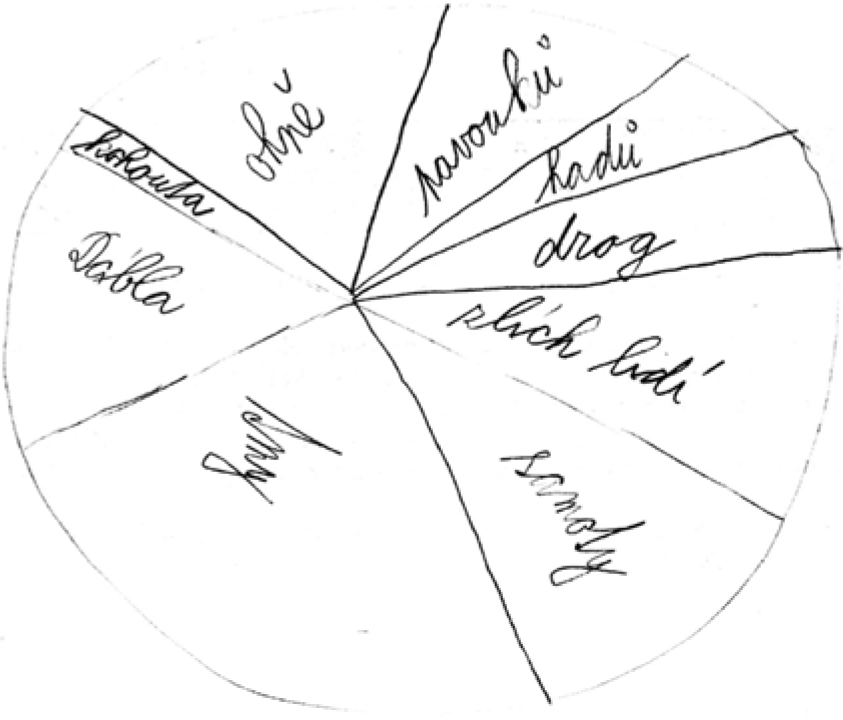
An example of the Cake of Fears method—from the biggest sector clockwise (darkness, devil, cock, fire, spiders, snakes, drugs, bad people, loneliness).
To obtain empirical evidence of congruent validity, Michalčáková (2007) examined the association between Cake of Fears and Fear Survey Schedule for Children-II. In the 13-year-olds (N = 170), correlation (ρ = .38; p < .001) was found between occurrence of fears measured by both methods. In other study, Michalčáková and Lacinová (2005) investigated sample of 13-year-olds from ELSPAC (N = 528) and found weak linear relationship (ρ = .24; p < .001) between the free reported number of fears and the level of depressed mood measured by Czech version of Short Mood and Feelings Questionnaire (Masopustová, Michalčáková, Lacinová, & Ježek, 2008).
The method employed was part of a larger battery of tests comprising a questionnaire section and a semistructured interview with adolescents (for more details see Ježek & Lacinová, 2008). The Cake of Fears technique was administered during the second half of the examination session, after establishing a secure atmosphere and rapport with the participant.
Coding of the Cake of Fear
The overall fear occurrence in each participant was obtained by adding up sectors reflecting specific fear contents. The data obtained were categorized by the authors of the study in a way comparable to procedures used in other research studies focused on children’s fears (e.g., Kirmanen & Lahikainen, 1997). First, the reports were categorized according to their contents. The aim of the categorization was to get rid of formal differences in expressions of the same fear contents. Next, the categories that included fears with very tangible content (e.g., the fear of tarantulas, the fear of zombies) were grouped in categories of higher order comprising groups of similarly motivated fears—for instance, the fear of spiders on this level already included the fear of spiders in general, but also the fear of tarantulas, garden spiders, trapdoor spiders, and so forth. By merging those categories, we created 19 general categories of the highest level.
For each participant the occurrence of each of 19 categories was converted to a dichotomic variable (0 = participant did not mention any fear from this category, 1 = participant mentioned one or more fears from this category). To evaluate intensity of fear, angle of each sector was measured (0 = fear was not mentioned; 360 = the fear sector size covers the whole of the Cake of Fear).
Statistical Data Analysis
Frequency analysis was used to describe the distribution of 19 general categories. Changes of fear contents were analyzed across all age groups using Cochran’s test for linear trends. Due to multiple repeated calculations, level of significance was corrected using the Bonferroni correction—the level of significance used was p < .0026 (.05/19). A repeated measures analysis of variance (ANOVA) was used to evaluate the change of intensity in 19 general fear categories over development.
Results
Descriptive Statistics
Overall, the participants reported 2,972 fears across all ages. At the age of 11, overall, the participants reported 895 fears. Reported fears in this age ranged from 1 to 14 (Mdn = 4). At the age of 13, overall, the participants reported 1,067 fears. Reported fears in this age ranged from 1 to 17 (Mdn = 6). At the age of 15, overall, the participants reported 1,010 fears. Reported fears in this age ranged from 1 to 18 (Mdn = 5). Overall, intensity of fears regardless of their content ranged from 7.25 to 360 (M = 54.74, SD = 42.52) at the age of 11, from 7.27 to 180 (M = 59.12, SD = 33.93) at the age of 13 and from 10.00 to 340 (M = 67.15, SD = 30.07) at the age of 15.
Description of General Categories
We identified 19 general fear categories as follows:
School-related fears—the category includes child fears relating to school (e.g., marks, tests, essays, teachers, subjects).
Fear of animals—the category includes fears of animals in general, listing of individual species, possibly fears of being attacked by an animal.
Fears of social and natural threats—the category includes fears of dangerous situations that, by their nature, not only threaten the child as such, but also have global impact (e.g., terrorism, war, floods, and earthquakes).
Fears of losing someone, fear for somebody/something—the category includes fears of losing somebody/something that children have a positive relationship with; it includes fears for persons from their immediate social environment (family, friends)—fears of losing them, separating from them, and/or fears for their safety; the category also includes fear of death too.
Fears of being endangered by others—the category includes fears of various persons and their actions (e.g., burglars, violent people, and murderers).
Fears related to specific places, ways of living— group of fears related to specific places (e.g., cemetery, loft) and their characteristics (e.g., height, depth) that children evaluate as unpleasant and threatening (e.g., to be in the dark, alone).
Fears for health and body, fears of unpleasant bodily sensations—the category includes fears for one’s own health, and so-called “medical fears”—these are fears associated with unpleasant bodily sensations relating to illnesses, injuries, and their medical treatment (e.g., doctors, injections); the category also includes fears of various diseases or handicaps.
Generalized fears—the category includes fears reported in most general terms; it also includes fears of development and future (e.g., responsibility, nihility, occupation, adulthood).
Imaginary fears—the category includes fears of nonexistent, supernatural beings, and phenomena that are subjectively threatening (e.g., specters, ghosts, curses).
Fears mediated by media—a category of fears resulting from pictures of reality or fiction performed by media (e.g., horror, films, books).
Fears of one’s own inadequacy—category of fears resulting from feelings of one’s own incompetence, lack of self-confidence and coping with insecurity, and fear of results that might be brought about by own behavior (e.g., fear that “I may not cope with something,” “may be awkward,” “may bring about something wrong,” “may not be good enough”).
Traffic-related fears—fears related to means of transport, traffic, and transportation technologies (e.g., fear of cars, crashes).
Fears of punishment—the category includes fears related to punishment and bans imposed on the child (e.g., spanking, PC games ban).
Fears of objects, substances or their attributes—the category includes fears of subjectively dangerous objects (e.g., sharp objects), substances (e.g., drugs), or their attributes (e.g., toxicity).
Sleep fears—fears related to sleep and dreams (e.g., nightmares).
Fears of new situations—fears related to new situation, activities and environments that a child has not encountered before (e.g., new things, situation that “I don’t know.”).
Fears of sports—group of fears related to sports and sporting activities (e.g., skiing).
Fears of losing one’s way, of getting lost—the category includes fear of the potentially dangerous situation of getting lost and straying in both familiar and unfamiliar environments.
Fear of wishes not getting fulfilled—fears related to concerns that desirable projections and wishes would not be fulfilled (e.g., “I will not get a present.”).
The content of fears not fitting in any of these categories was vague and unclear (e.g., fear that snails would return to the aquarium, common town elements) and these responses were not used in further analysis (11 % of all responses).
In order to establish interrater reliability on formed categories, 15 % of randomly chosen responses were coded independently by two trained additional raters (a woman and a man). These raters were blind to the goal of the study. The overall kappa coefficients for the agreement between primary coding of the authors of the study and two additional independent raters were similar, ranging from .90 to .93.
Prevalence of General Fear Categories
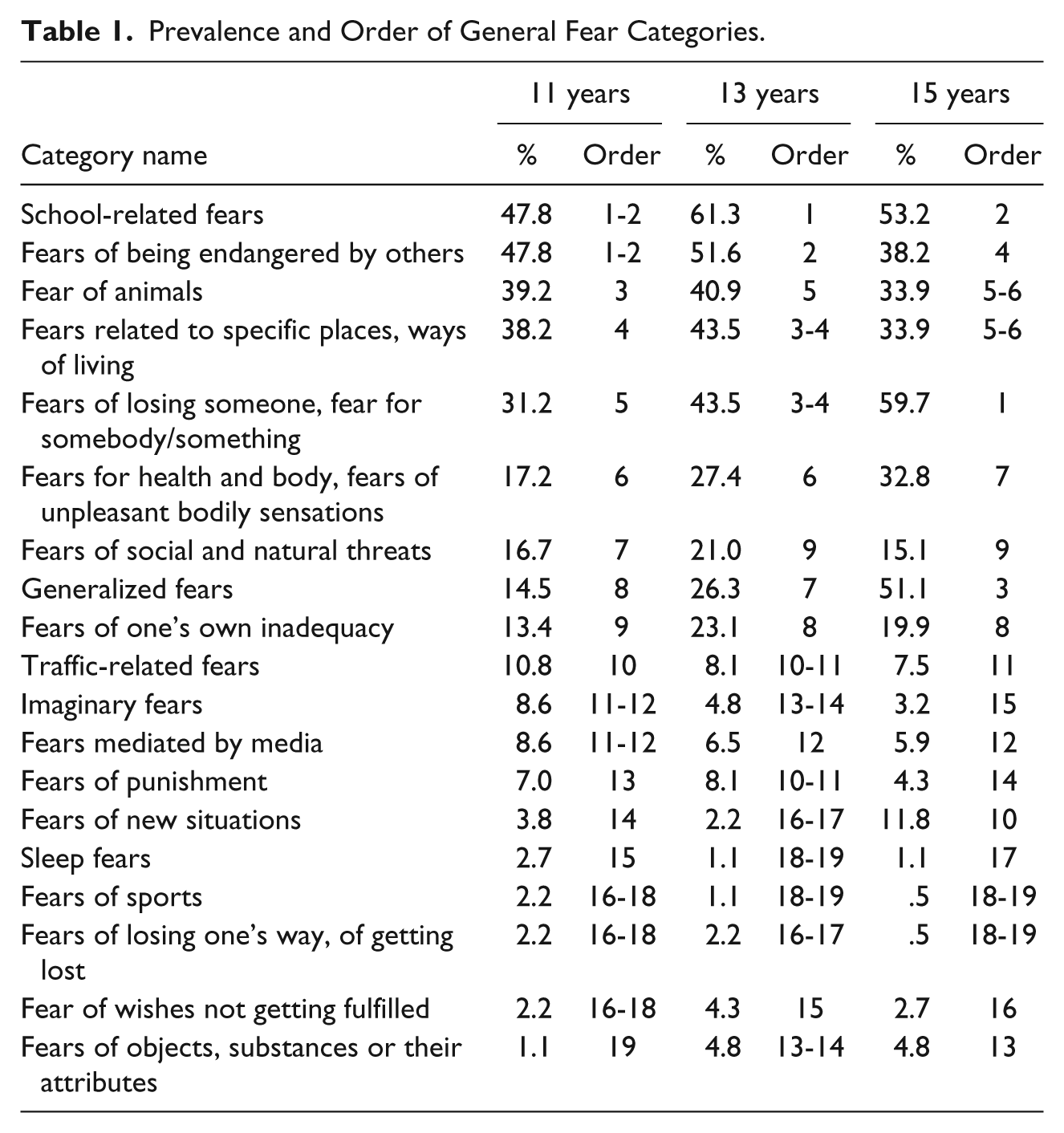
Table 1 shows the frequency of all general fear categories by age groups. At the age of 11 and 13, the most frequent fears were school-related fears and fears of being endangered by others. Almost 40% of the 11-year-olds mentioned fears of animals and almost 44% of the 13-year-olds referred to fear of losing someone, fear for somebody/something. At the age of 15, the most common fears were related to losing someone, fear for somebody/something, and also fear of a school situation. Next, more than 50% 15-year-olds reported generalized fear.
Prevalence and Order of General Fear Categories.
Intensity of General Fear Categories
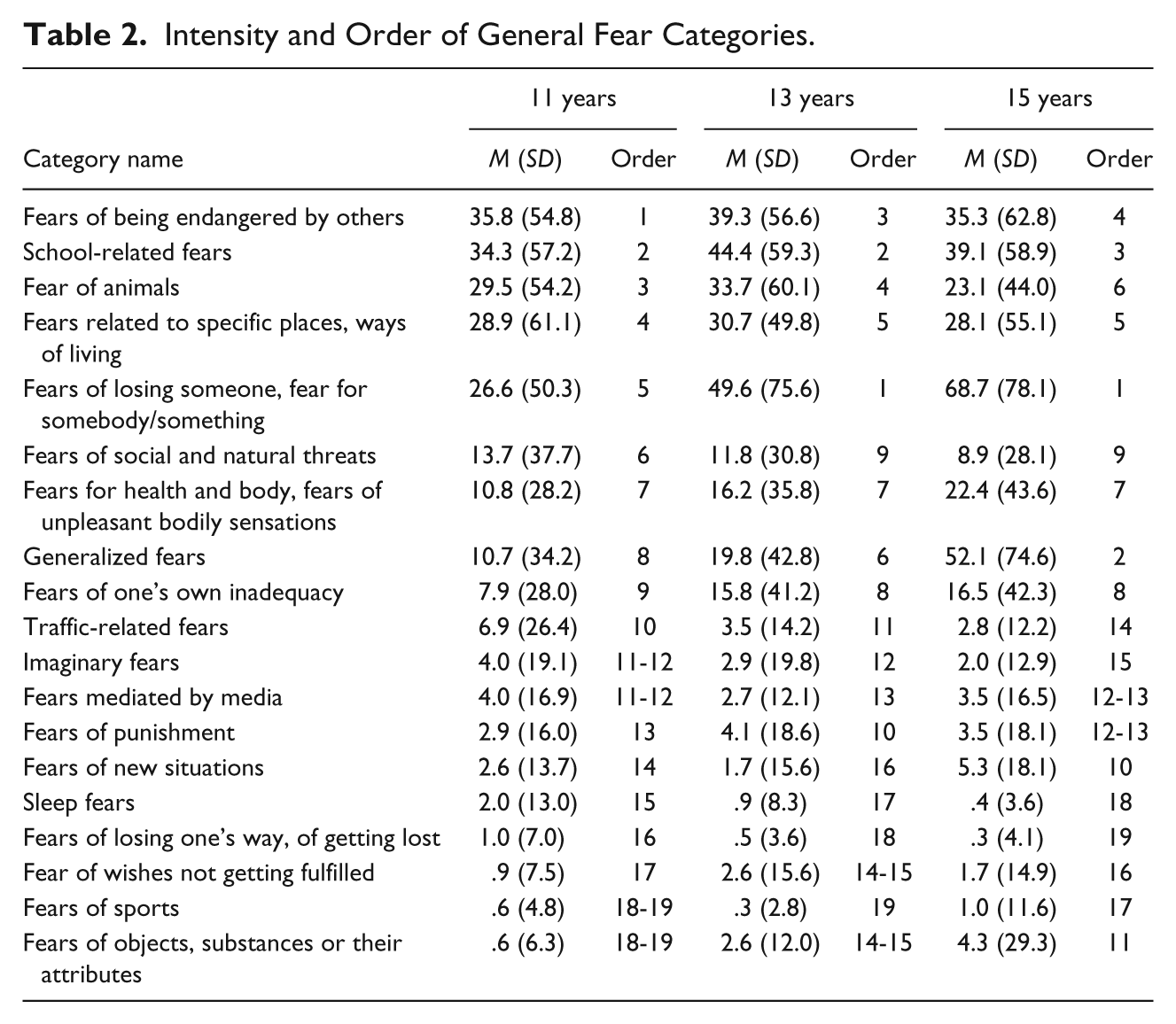
As Table 2 illustrates, the most intensive fear at the age of 11 was a fear of being endangered by others. At the age of 13 and 15 the most intensive were fears of losing someone, fear for somebody/something.
Intensity and Order of General Fear Categories.
Changes in General Fear Categories Over Time
Statistically significant changes in occurrence and intensity of six fear categories across the ages groups were found: (a) Fears of losing someone, fear for somebody/something (occurrence: Cochran’s Q = 36.85; p < .001; intensity: Wilk’s λ = .78, F(2, 179) = 25.05, p < .001); (b) Generalized fears (occurrence: Cochran’s Q = 68.15; p < .001; intensity: Wilk’s λ= .75, F(2, 173) = 28.66, p < .001); (c) Fears for health and body, fears of unpleasant bodily sensations (occurrence: Cochran’s Q = 16.7; p < .001; intensity: Wilk’s λ = .94, F(2, 177) = 5.39, p = .005); (d) Fears of new situations (occurrence: Cochran’s Q = 19.24; p < .001); (e) Fears of animals (intensity: Wilk’s λ = .96, F(2, 179) = 3.54, p = .03); (f) Fears of one’s own inadequacy (intensity: Wilk’s λ = .95, F(2, 173) = 4.81, p = .009). Apart from the category of animal fears, which decreased in intensity over time, all fear categories increased in intensity over time.
Discussion
The present study examined the occurrence and development of common fears in adolescents aged from 11 to 15 years. Across all ages studied one of the most prevalent and intensive fears were found to be related to the school environment. Frequent concerns about school in childhood and early adolescence reported in this study are consistent with previous findings (García-Fernández, Sánchez, Amorós, & Carrillo, 2010; Silverman, La Greca, & Wasserstein, 1995). From the age of 6 to the age of 14, school-related fears were found to become more prominent (Gullone, 2000). This developmental change can be captured especially when free-response method is used. For example, using qualitative free-response approach, Burnham (2009) found school related fear to be the one of the spontaneously reported fears, which may be underestimated by surveys with preprepared items.
As was illustrated with school-related fear, the free-response method reveals less aversive but more likely occurring events to be top of the list of most common fears together with death and danger fears. This enriches findings gathered via surveys with preprepared items which mainly detect death and danger fears as the most prevalent (Lane & Gullone, 1999; Mellon, Koliadis, & Paraskevopoulos, 2004; Muris, du Plessis, & Loxton, 2008; Shore & Rapport, 1998). Also, in the present study, adolescents frequently reported high intensive fears related to death and danger (categories: Fears of losing someone, fear for somebody/something; Fears of being endangered by others). Not only are these fears typical for adolescents, but they accompany individuals through all ongoing developmental stages as well (Galt & Hayslip, 1998; Gullone, 2000; Mikulincer & Florian, 1995).
The third most frequent and intensive fear at the age of 11 in the present study was fear of animals. This is in line with results reported by Muris, Merckelbach, and Collaris (1997) and Muris, Merckelbach, Meesters et al. (1997). In free-response to the question “What do you fear the most?” school-aged children put spiders on the top position and snakes among the first 10 of the most common fears. On the contrary, when a survey with preprepared items (FSSC-R) was used in the same sample, school-aged children reported fears of danger and death the most often.
The third most frequently reported fear category at the age of 15 in the present study was the group of generalized fears with the second highest intensity. This category is characterized by abstract and general worries and fears, which typically arise in the period of adolescence.
Longitudinal changes in fear occurrence and intensity were also examined in the present study. Six of 19 identified categories were found to change across ages. The increase in both occurrence and intensity of fear was reported in following categories: (a) Fears of losing someone, fear for somebody/something; (b) Generalized fears; (c) Fears for health and body, fears of unpleasant bodily sensations; (d) Fears of new situations (increase in occurrence only). Furthermore, intensity of (e) fears of animals was found to decrease across ages while intensity of (f) fears of one’s own inadequacy was found to increase across ages. Except the Fears for health and body and Fears of animals, all categories consist of rather abstract stimuli and their increase over developmental time is in line with our predictions.
Firstly, fears of losing someone, fear for somebody/something, sometimes called altruistic fear, is common in adults compared with children (Warr, 1992; Warr & Ellison, 2000). In the present study, age-related increase detected in this category presents transformation from child to adult content of fears. This transformation is underlined by changes in cognitive abilities from concrete to abstract operations (Piaget, 1970). The adolescents’ thinking becomes more abstract and tends to be more differentiated over time. Therefore, the developed adolescents’ psychological functions allow them to better understand and anticipate potential danger and threat. The increasing reflection of one’s own and significant others’ vulnerability or mortality might be based on developmentally acquired ability of hypothetical thinking about potential threat. Similarly to current results, Lane and Gullone (1999) detected frequent fear of death or family member death reported by 11 years to 18-year-olds. Fears related to death and danger occupy the top positions cross-culturally (Erol & Sahin, 1995; Mellon, Koliadis, & Paraskevopoulos, 2004; Muris et al., 2008; Valiente, Sandín, Chorot, & Tabar, 2003; Warr, 1992) and used to be mentioned often by children with learning disabilities and mild mental retardation (Li & Morris, 2007).
Secondly, the increase detected in generalized fears category across studied ages follows the basic pattern of normative fears development (see Marks, 1987). Similarly to current findings, Schroeder and Gordon (2002) and Gullone (2000) provide evidence of the generalization process in adolescents’ fear development. These fears develop in context of typical adolescent changes. For instance, adolescence is characterized by the emergence of general concerns with political, social, and moral issues (Macek, 2003), by first attempts in the field of political orientation and active engagement (Šerek & Macek, 2010), and orientation toward a future (Greene, 1986; Nurmi, 1991; Steinberg et al., 2009). Furthermore, growing adolescents’ cognitive capacity is related to the development of generalized worries and fears with less concrete stimuli such as lack of freedom, unhappiness, misery, destiny, and so forth.
Thirdly, the category which was found as increasing with age is group of fears for health and body and fears of unpleasant bodily sensations. This finding is consistent with many previous studies (e.g., Aho & Erickson, 1985; Brewer, Gleditsch, Syblik, Tietjens, & Vacik, 2006; Gullone & King, 1997; Quiles, Ortigosa, Méndez, & Pedroche, 2000). As a result of sociocognitive development, adolescents are more conscious of the risks of medical intervention (Quiles et al., 2000). Moreover, adolescents also operate on a higher level of conceptualization which enables them to evaluate the impact of illness on quality of life (Bibace & Walsh, 1981). Furthermore, they may view medical procedures as a potential threat to their self-esteem if they fear that they will not be able to respond in an expected manner (Rudolph, Dennig, & Weisz, 1995). Present findings may also reflect developmental concerns related to one’s own body (e.g., integrity, physical disfigurement, and loss of physical attractiveness). These concerns may accompany some central issues in adolescence—development of body image and self-acceptance (Schechter, Berde, & Yaster, 2003).
Fourthly, current results show that with increasing age, adolescents reported more fears related to new situations (e.g., meeting new people, attending new school, and visiting new places). This can be explained by the normative development of autonomy and the separation process in adolescence. Individuals begin to separate themselves from their parents, engage in more independent decision making, and attempt to manage everyday life problems without regular and direct support from parents (Noom, Deković, & Meeus, 1999, 2001). These developmental tasks bring a higher occurrence of new and unknown situations, which can result in a higher number of fears. “The unknown” is often judged as one of the basic aspects triggering fear response in human individuals (O’Keefe & Nadel, 1978; Plaford, 2009). Bronson (1968, pp. 424-425) describes the development of fear of novelty in infancy: “Increasingly throughout the juvenile period, the fear of novel situations is mastered without direct reference to the mother. This growing independence has been reported in various primate species.” It can be hypothesized that “renaissance” of fears related to new situations and activities in adolescence might be connected with the interaction between increased adolescents’ desire for independence or autonomy and lack of experience to deal with new situations on their own.
Fifthly, the occurrence of animal fears is characteristic of the period of childhood and adolescence (Gullone, 2000; Muris & Merckelbach, 2001) and some authors point out its gradual decrease with age (Gullone & King, 1993, 1997). In the present study, occurence of animal fear did not change over developmental time. However, an age-related decrease was detected in fear intensity. Developmental stability of animal fear experience is consistent with Bennett-Levy’s and Marteau’s (1984) assumption of the biological significance of certain fear-evoking perceptual animal properties, but animal fear intensity can be reduced with respect to cognitive capacity development and social desirability. The decreasing trend detected in this category can be understood either as a real animal fear decline or as a developmentally appropriate growth in socially desirable behavior and self-representation patterns in adolescence.
Sixthly, the final category which was found as increasing in intensity is a category of fears resulting from feelings of one’s own incompetence, lack of self-confidence and coping with insecurity, and fear of outcomes that might be brought about by his/her behavior (e.g., fear that “I may not cope with something,” “may be awkward,” “may bring about something wrong,” “may not be good enough”). The adolescence period during which two important tasks are solved, that is, searching for one’s own identity and developing relationships with the outside world, brings along insecurities and concerns related to oneself, feelings of one’s own incompetence, fears of failure, and social rejection. The intensification of fears motivated in this way is typical in adolescence and is confirmed by a series of research studies (e.g., Gullone & King, 1997; Lane & Gullone, 1999). A specific role in these processes is fulfilled by adolescent egocentrism and in particular the phenomenon of the so-called “imaginary audience” (Elkind, 1967). The impression that the young person is constantly under a careful inspection of others who are evaluating him/her can to a great degree coaffect the arousal of specific fears pertaining to the lack of attractiveness or one’s own imperfection.
The present study has some limitations. Given that the current research is part of a longitudinal study which began even before our participants were born, the problem of attrition should be considered. Furthermore, ELSPAC participants were selected from an urban population only. The major strength of this study is the combination of longitudinal design and use of the free-response method. We are not aware of any study over the past 50 years that has examined the development of fears in early adolescence longitudinally at three time points using the free-response method. This method enables participants to express their fears (without constraints) based on their actual and real experiences in everyday life situations. The advantages include the specificity and accuracy of obtained responses and the elimination of the priming effect of preprepared items (Scherer, 2005). Our study lends strong support to the trends reported in studies based on analyses of cross-sectional data obtained through questionnaire methods.
Current results offer several possible implications. It is important to point out that school represents a significant source of distress even in adolescence, which could be seen as a target of school counselors’ intervention. Furthermore, increasing occurrence of generalized fears in adolescents’ development could be taken into account when prevention and intervention is planned. The information about growth of medical fears in adolescence should present an inseparable part of health professionals’ knowledge base.
Additional research to provide more detailed analysis of rich data which can be gathered by “Cake of Fear” needs to be conducted, for example, the growth-curve analysis that could give us more specific information about the predictors of trajectories of fear development. Furthermore, future research could examine the relationships between fear contents and cultural background using the free-response method. For this purpose, the detailed and specific categorization created in this study could serve as a starting point for comparisons with another cultural environment. In this way, a realistic picture that captures the fears of contemporary adolescent populations across different cultural contexts can be acquired.
Despite the fact that the main purpose of this study was not to describe culturally specific fears, current findings could shed some light on fears experienced by Czech adolescents at the beginning of the 21st century.
Footnotes
Declaration of Conflicting Interests
The author(s) declared no potential conflicts of interest with respect to the research, authorship, and/or publication of this article.
Funding
The author(s) disclosed receipt of the following financial support for the research, authorship, and/or publication of this article: This study was supported by a grant from the Ministry of Education, Youth and Sports of the Czech Republic, MSM0021622406.