



Abstract
The goal of this study was to examine links between observed social participation in the schoolyard and indices of socio-emotional functioning in early adolescence. Participants were children (N = 290) aged 9 to 12 years. Social participation (e.g., solitary play, dyadic interaction, group interaction) was assessed in the schoolyard during recess and lunch using behavioral observations. Measures of perceptions of peer difficulties (e.g., perceived peer relations, loneliness) and internalizing problems (e.g., social anxiety, depression) were provided via maternal ratings and child self-reports. Results from cluster analyses revealed several subgroups of children characterized by distinct patterns of social participation. The groups also differed in terms of their socio-emotional functioning. For example, nonsocial children (who displayed the most frequent solitary activities) reported the highest levels of internalizing problems and more peer difficulties. Results are discussed in terms of the utility of observed social participation behaviors as marker variables for socio-emotional difficulties in early adolescence.
From early childhood through adolescence, the peer group provides an important and unique context for the acquisition and implementation of a wide range of social, emotional, cognitive, and educational skills (Rubin, Bukowski, & Parker, 2006). In particular, the experience of peer relations difficulties at school is directly linked with school adjustment outcomes over time (Ladd, 2006). During early adolescence, the peer group takes on increased importance, with peers becoming even more significant sources of support and agents of socialization (e.g., Berndt & Keefe, 1995; Hirsch & DuBois, 1992). Moreover, adolescents who withdraw from opportunities for peer interaction are at increased risk of a host of negative socio-emotional and school adjustment difficulties (Bowker, Rubin, & Coplan, 2012). Interestingly, adolescents may also begin to demonstrate an understanding and appreciation of the potentially positive aspects of solitude (Larson, 1997).
A frequent context for peer interaction in early adolescence is the schoolyard. Social exchanges in the schoolyard during recess provide unique opportunities for children to acquire and consolidate new social skills (Blatchford, 1998; Sluckin, 1981). Moreover, it has been argued that children’s peer experiences in the schoolyard are reflective of—and directly impact upon—their education and school adjustment (Pellegrini & Smith, 1993). Accordingly, naturalistic observations of adolescents’ social interactions in the schoolyard represent an important and unique methodological tool for identifying socially vulnerable children. For example, as compared with rating scales and other assessments, behavioral observations (a) provide more objective and detailed measurements of a wide range of behaviors, (b) are less prone to biases, (c) have higher external (ecological) validity, and (d) offer more information about the functions of behaviors (e.g., by evaluating antecedent and consequent events; Nock & Kurtz, 2005).
In early childhood, naturalistic observations have been frequently used to assess individual differences in social participation (e.g., solitary behaviors, group play) during unstructured free play at school (e.g., Coplan, Arbeau, & Armer, 2008; Coplan, Gavinski-Molina, Lagacé-Séguin, & Wichmann, 2001; Rubin, 1982). However, to date there have been only a few observational studies of children’s social participation behaviors at school in middle childhood (e.g., Gazelle, 2008; Serbin, Lyons, Marchessault, Schwartzman, & Ledingham, 1987; Spangler & Gazelle, 2009). Moreover, there appear to be even fewer observational studies of older children in the schoolyard, with these focusing primarily on aggression and bullying (e.g., Boulton, 1999; Craig, Pepler, & Atlas, 2000; Pepler, Craig, & Roberts, 1998). Indeed, to our knowledge, there have been no previous observational studies with a specific focus on social participation in the schoolyard among early adolescents.
Given the importance of peer interaction in early adolescence, observations of early adolescents’ social participation (or lack thereof) in the schoolyard may provide a unique “window” into their socio-emotional functioning at school. Accordingly, the goal of this study was to examine the utility of employing schoolyard social participation behaviors as marker variables for socio-emotional functioning at school in early adolescence. We employed naturalistic observations of schoolyard behaviors to identify subgroups of children characterized by different patterns of peer group social participation and then compared these groups on indices of peer relations and internalizing problems.
Social Participation in Childhood
Parten (1932) was among the first to develop an observational taxonomy to characterize individual differences in young children’s social participation (e.g., solitary, parallel, cooperative) during free play at preschool. The correlates and outcomes of individual differences in observed socially interactive and non-social behaviors at school have since been well documented, particularly in early childhood (see Coplan & Ooi, 2014, for a recent review).
Socially Interactive Behaviors
In early childhood, free play in peer contexts is most often characterized by solitary and parallel (i.e., next to but not with) activities (Rubin, Fein, & Vandenberg, 1983). Peer interactions gradually increase during childhood, peaking in late childhood/early adolescence, while also changing forms in later adolescence when interactions shift from game-play to socializing (Baines & Blatchford, 2009; Cairns, Xie, & Leung, 1998; Gifford-Smith & Brownell, 2003). Thus, we expected social play (e.g., social exchanges, group activities, games, conversations with peers) to be “the norm” during recess among early adolescents (Blatchford, Baines, & Pellegrini, 2003).
Increased social participation at school has also generally been regarded as a marker of both socio-emotional and academic competence in childhood (e.g., Berk, Mann, & Ogan, 2006; Elias & Berk, 2002; Fisher, 1992; Howes, 1992; Levy, Wolfgang, & Koorland, 1992; Rubin, Chen, McDougall, Bowker, & McKinnon, 1995; Rubin, Hymel, & Mills, 1989; Schwebel, Rosen, & Singer, 1999; Singer & Lythcott, 2002). Accordingly, children who most frequently displayed social play behaviors were expected to demonstrate the lowest levels of internalizing problems and peer difficulties.
Peer relation researchers further distinguish between dyadic (i.e., one-on-one) and larger groups interactions (Rubin, Bukowski, & Parker, 2006). For example, whereas group interactions may foster the development of skills such as teamwork and leadership, one-on-one play with a peer allows more opportunities for friendship, self-disclosure, and intimacy during early adolescence (Van Lieshout, Cillessen, & Haselager, 1999; Zarbatany, McDougall, & Hymel, 2000). Indeed, there is a wealth of empirical literature emphasizing the importance of mutual friendships in many aspects of children’s development (Bukowski, Newcomb, & Hartup, 1996).
However, in contrast to children’s reciprocal and intimate relationships (i.e., friendships), there are at least some reasons to speculate that observed dyadic interactions in the schoolyard may not necessarily be reflective of positive school adjustment outcomes in early adolescence. To begin with, children may play with only one other child at recess because they have a limited social group to choose from. For example, Ladd (1983) reported that children experiencing peer relation difficulties were more likely to interact in smaller social networks when observed during recess. Similarly, Bagwell, Coie, Terry, and Lochman (2000) reported that the social networks of peer-rejected children were smaller than their more well-accepted counterparts, and were also more likely to be comprised of other low-status peers.
Children may also play with only one other child because they are shy and socially withdrawn. Despite being just as likely to have a mutual best friend as their more sociable peers (Rubin, Wojslawowicz, Rose-Krasnor, Booth-LaForce, & Burgess, 2006; Schneider, 1999), socially withdrawn children tend to have difficulty forming a large number of friendships (Pedersen, Vitaro, Barker, & Borge, 2007). Moreover, Rubin, Wojslawowicz, and colleagues (2006) reported that socially withdrawn fifth graders were more likely to have (similarly) socially withdrawn best friends. Thus, in the present study, we speculated that children displaying the highest frequencies of dyadic interactions at recess may also demonstrate increased socio-emotional difficulties as compared with their more “group play–oriented” counterparts.
Nonsocial Behaviors
There is a large body of research demonstrating concurrent and predictive links between social withdrawal (i.e., the consistent display of solitary behaviors in peer group contexts) and indices of socio-emotional maladjustment (see Rubin, Coplan, & Bowker, 2009, for a review). In early and middle childhood, there appear to be important differences in the meaning and implication of different subtypes of observed nonsocial behaviors (Coplan & Ooi, 2014). For example, whereas reticent behavior (i.e., watching other children play but not joining in, remaining unoccupied) appears to be a marker variable for shyness and anxiety (e.g., Coplan et al., 2008; Coplan, Prakash, O’Neil, & Armer, 2004; Henderson, Marshall, Fox, & Rubin, 2004), solitary-active play (i.e., repetitive sensorimotor actions, solitary dramatizing) appears to reflect social immaturity, impulsivity, and externalizing difficulties (Coplan et al., 2001; Coplan, Rubin, Fox, Calkins, & Stewart, 1994; Choo, Xu, & Haron, 2012; Evans, Nelson, & Porter, 2012; Rubin & Mills, 1988). In contrast, solitary-passive play (i.e., quiescent constructive and exploratory activities while playing alone) appears to be a comparatively benign form of nonsocial behaviors, and it has generally not been associated with indices of socio-emotional difficulties in early and middle childhood (Bar-Haim & Bart, 2006; Coplan, 2000; Coplan et al., 1994; Doctoroff, Greer, & Arnold, 2006; Lloyd & Howe, 2003; Nelson, Hart, & Evans, 2008; Rubin, 1982).
However, the implications of nonsocial play appear to change with age. It has been posited that all forms on nonsocial play may become increasingly associated with peer problems and maladjustment in later childhood and early adolescence, as solitary activities progressively violate rising age-related expectations regarding social interactions (Rubin & Asendorpf, 1993). In support of this notion, Gazelle (2008) reported that both observed reticent behavior and solitary-passive play among children in Grade 3 demonstrated a similar pattern of associations with indices of socio-emotional difficulties (almost no solitary-active play is observed among older children during free play). Most recently, as part of a larger study of the implications of social withdrawal in later childhood and adolescence, Coplan et al. (2013) reported that an aggregate variable consisting of (a) self-reported solitary activities outside of school and (b) observed reticent/solitary play at recess at school was associated with indices of negative peer relations. Accordingly, in the present study, we speculated that children who displayed the most frequent nonsocial activities would be at the highest risk of internalizing problems and peer difficulties.
The Current Study
The goal of this study was to explore links between observed social participation behaviors in the schoolyard during recess and early adolescents’ socio-emotional functioning. Overall, we expected (a) social (group) play to be the predominant observed behavior and that this form of social participation would be negatively associated with socio-emotional difficulties at school, (b) children displaying the highest frequencies of dyadic interaction would evidence more difficulties than their more group-oriented counterparts, and (c) children observed to engage in the highest frequencies of nonsocial activities would demonstrate the highest levels of maladjustment (e.g., social anxiety, depression, loneliness, negative perceptions of peer relations).
Finally, although not the primary focus of this study, some gender differences were also expected. In terms of main effects, boys were expected to demonstrate more frequent group interactions and girls more dyadic interactions (e.g., Baines & Blatchford, 2009; Blatchford et al., 2003; Zarbatany et al., 2000). Interestingly, social withdrawal appears to impart a greater risk of negative peer experiences for boys as compared with girls (Coplan et al., 2004; Coplan & Weeks, 2010; Stevenson-Hinde & Glover, 1996). It has been suggested that this is because shy and socially withdrawn behaviors are less socially acceptable for boys than girls because these behaviors violate gender norms and expectations of male assertion and dominance (see Doey, Coplan, & Kingsbury, 2013, for a recent review). Thus, we speculated that boys who engaged in the highest frequencies of nonsocial behaviors might be particularly at risk of socio-emotional difficulties.
Method
Participants
The participants in this study were children (N = 290; 137 boys, 153 girls) aged 9 to 12 years (
The sample was approximately 80% Caucasian, with a variety of other ethnicities also represented (e.g., 9% Hispanic, 5% Asian, 4% Black). The public school board from which the sample was drawn did not permit the collection of information regarding parental employment status and income. However, approximately 4% of mothers and 5% of fathers had not attended high school, 22% of mothers and 23% of fathers had completed high school, 58% of mothers and 57% of fathers had a college/university degree, and 15% of mothers and 15% of fathers had a graduate-level degree. Thus, participants appeared to be of varied socio-economic status.
Procedure
Multi-source assessments were employed, including behavioral observations, child self-reports, and maternal ratings. Participant recruitment occurred in January. In the spring (April/May), children were observed in the schoolyard during recess (mid-morning, approximately 30-40 minutes of outdoor free time) and lunch (early afternoon, approximately 30-40 minutes of outdoor free time). 1 Near the end of the school year (May/June), children (during a group testing session) and parents (maternal reports) provided assessments of children’s socio-emotional functioning.
Measures
Observations
Children’s social participation behaviors in the schoolyard during recess and lunch were observed using the Play Observation Scale (POS; Rubin, 2001), adapted for use in this context (Coplan et al., 2013). Trained observers employed a time-sampling protocol whereby children’s social participation behaviors were recorded using a series of 30-second time-samples. Children were observed on three to four separate days over a 4-week period. During each visit, observers located target children in the schoolyard and coded each child’s activity for a series of 10 time-samples. Observers rotated their attention through the target children (in a random order) on each visit until between 30 and 40 time-samples were completed per child. Visits continued until 120 time-samples (i.e., 60 minutes) were completed for every child.
Social participation categories coded included (a) reticent behavior (child is unoccupied or displaying onlooking behavior; see Coplan et al., 1994), (b) solitary play (child is playing alone, typically at a distance of more than 3 feet from other children, and paying little or no attention to the group), (c) parallel play (child is playing next to, but not with other children, typically within 3 feet of other children), (d) dyadic interaction (child is talking to or playing with another child), (e) group interaction (child is talking to, or playing with, two or more children), and (f) teacher interaction (child is talking to a teacher or group of teachers). Following the established protocol, these codes were mutually exclusive, with the predominant (i.e., most frequent) behavioral code assigned for each time sample. Raw frequencies for each code were proportionalized by dividing them by the total number of scans for each child. Of note, parallel play and teacher interaction were observed to occur less than 0.5% of the time. Indeed, only a handful of children were observed to display any of these behaviors across all scans. Accordingly, these variables were not included in subsequent analyses.
Research assistants completed several weeks of extensive training (e.g., theoretical background readings, detailed review of the coding manual, multiple practice observation sessions with an experienced coder) and collected inter-observer reliability data prior to the start of the study. Inter-observer reliability between pairs of observers was computed using Cohen’s kappa (based on 500 time-samples) and ranged between .84 and .88. Observers met regularly during data collection to discuss any issues arising and to reduce rater drift.
Child self-reports
Children’s
Maternal reports
Finally, mothers of a sub-sample of participants (n = 111) completed the Strengths and Difficulties Questionnaire (Goodman, 2001) to assess children’s emotional symptoms (five items, for example, “many worries, often seems worried,” α = .70) and peer problems (five items, for example, “picked on or bullied by other children,” α = .73). Of note, no significant differences between those children whose parents completed the Strengths and Difficulties Questionnaire and those who did not were found for any study variables.
Results
Preliminary Analyses
Descriptive statistics for all study variables are displayed in Table 1. Of note, among the observations of social participation, three variables contained outlier scores (i.e., greater than 3 SDs above the mean): reticent behavior (seven cases), solitary play (six cases), and dyadic interaction (three cases). This issue is discussed further in the forthcoming section pertaining to cluster analysis.
Descriptive Statistics for All Study Variables.
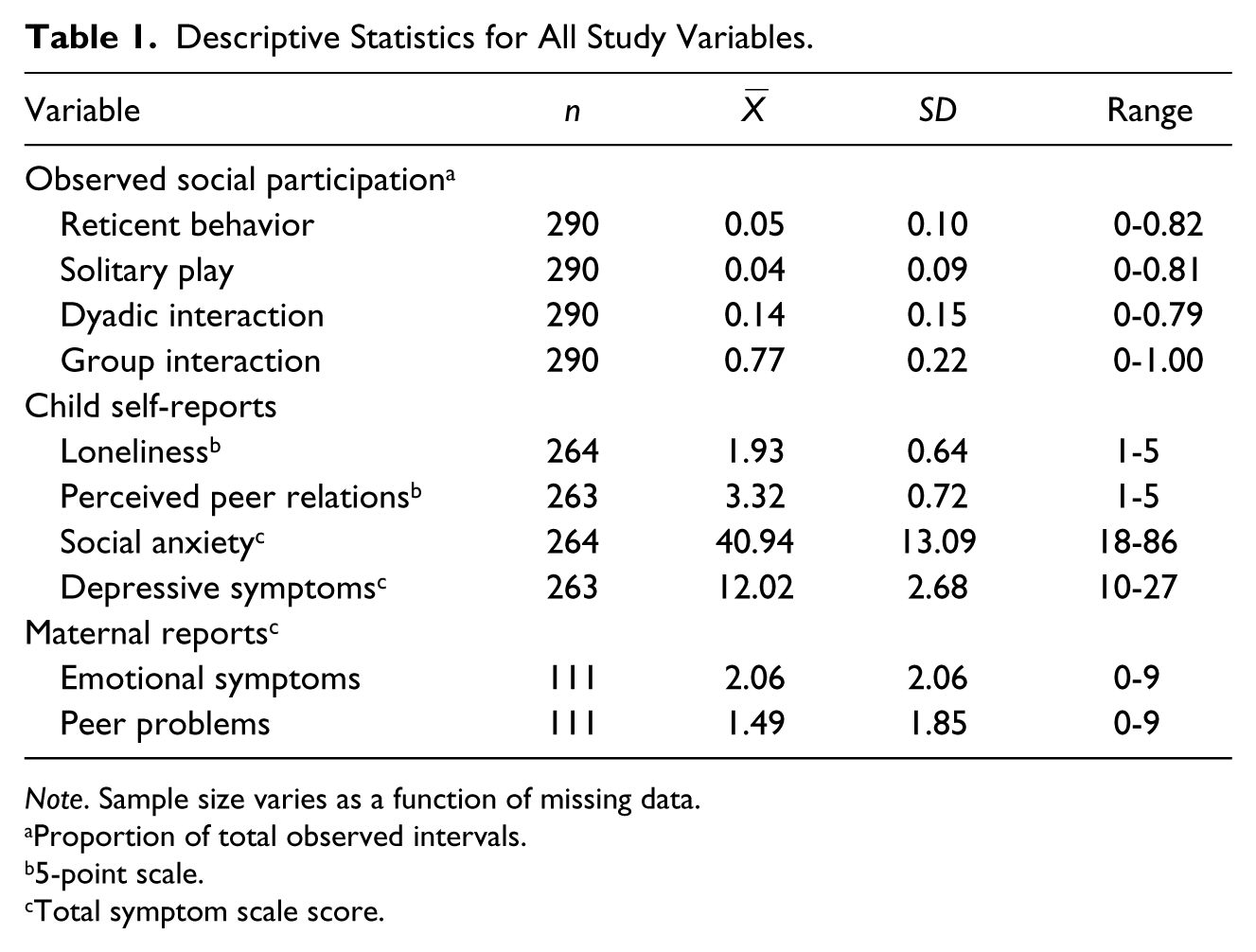
Note. Sample size varies as a function of missing data.
Proportion of total observed intervals.
5-point scale.
Total symptom scale score.
As expected, group interaction was the predominant observed behavior, comprising slightly more than three quarters of all observations. Results from a MANOVA indicated a significant effect of child gender, F(4, 285) = 9.72, p < .001, η2 = .120, for observations of social participation. Results from follow-up univariate analyses indicated no significant gender difference for reticent behavior (
Results from correlational analyses indicated no significant associations between social participation and demographic variables (i.e., maternal education, paternal education, child age). Accordingly, these demographic variables were not controlled for in subsequent analyses.
Cluster Analysis
In order to identify distinct subgroups of children, a cluster analysis was performed based on observed schoolyard play behavior frequencies. The four types of observed play behaviors (i.e., reticent, solitary, dyadic, and group) were entered into a hierarchical clustering analysis using Ward’s method (Ward, 1963) with squared Euclidian distance. This method maximized differences between clusters while minimizing the variance within a cluster. Analysis of the dendrogram, the changes in the error sum of squares at each stage, and the meaningfulness of each additional cluster in providing distinct patterns of play behavior (Bartko & Eccles, 2003) revealed that a four-cluster solution provided the best fit for the data. A k-means clustering analysis was then conducted by forcing each case into one of four clusters. One-way ANOVAs among the four clusters revealed significant group differences for all four variables.
Since groups were developed based on patterns of play behavior across four variables, cluster analysis was more resistant to extreme scores on a single variable. Although 16 cases were identified as univariate outliers, comparable four-cluster solutions were identified when the outliers were brought in within 3 SDs or dropped. Additionally, retaining the outliers yielded slightly larger groups in the smaller clusters and slightly better group differences. As a result, outliers were not altered or excluded in further analyses.
Descriptive statistics for the four social participation clusters are displayed in Table 2. The first cluster was labeled average (n = 129; 57 boys, 72 girls) and included the largest subset of children in the sample. The average cluster displayed what appeared to be “age-normative” levels of schoolyard social participation behaviors, with mean scores comparable to the overall sample means for all four social participation variables. The second cluster was named group-social (n = 89; 60 boys, 29 girls), and comprised children with the highest frequency of group interactions. Indeed, group-social children engaged almost exclusively in group interaction and were characterized by the lowest frequencies of reticent behavior, solitary play, and dyadic interaction as compared with all other clusters. The third cluster was labeled dyadic (n = 48; 10 boys, 38 girls) and consisted of children with the highest frequency of dyadic interactions. Children in the dyadic cluster also displayed less group interaction than both the average and group-social clusters. Finally, the fourth cluster was named nonsocial (n = 24; 10 boys, 14 girls), and comprised children with the highest frequencies of reticent behavior and solitary play and lowest frequency of group interaction.
Means (SDs) of Observed Schoolyard Behaviors for Social Participation Clusters.

Note. Means in the same row with different subscripts differ significantly at the .05 level.
The gender distribution of the social participation clusters varied significantly from expected values, χ2(3) = 28.75, p < .001. This gender effect was evident in the group-social cluster, with significantly more boys and fewer girls than expected (z = 4.6, p < .001), and in the dyadic cluster, with significantly more girls and fewer boys than expected (z = −4.0, p < .001).
Social Participation Clusters and Indices of Socio-Emotional Functioning
The primary analyses compared the four social participation clusters in terms of indices of socio-emotional functioning.
Children’s self-reports of socio-emotional functioning
To begin with, a 4 × 2 MANOVA was conducted, with social participation cluster (group-social, average, dyadic, nonsocial) and child gender (boy, girl) serving as independent variables, and self-reported indices of socio-emotional functioning (social anxiety, depressive symptoms, loneliness, perceptions of peer relations) as dependent variables.
There was a significant multivariate effect (Wilks’ λ) of social participation cluster, F(12, 648.50) = 2.11, p < .05, η2 = .033, and child gender, F(4, 245) = 4.29, p < .05, η2 = .066, but no significant Cluster × Gender interaction, F(12, 648.50) < 1, ns, η2 = .016.
Results from follow-up univariate analyses indicated a significant effect of gender for loneliness, with boys (
Significant univariate effects for cluster were found for all indices of socio-emotional functioning: social anxiety, F(3, 260) = 4.50, p < .01, η2 = .049; depressive symptoms, F(3, 259) = 4.90, p < .01, η2 = .054; loneliness, F(3, 260) = 5.29, p < .001, η2 = .057; and perceptions of peer relations, F(3, 259) = 5.13, p < .01, η2 = .055. Relevant means for the effects of social participation cluster and results from post hoc tests (Tukey’s HSD [Honest Significant Difference]) are displayed in Table 3.
Means (SDs) for Indices of Socio-Emotional Functioning of Social Participation Clusters.

Note. Means in the same row with different subscripts differ significantly at the .05 level.
The group-social and average clusters did not differ significantly from each other for any of the self-reported indices of socio-emotional functioning. The nonsocial cluster reported significantly higher levels of social anxiety and depression than all other groups. The nonsocial cluster also reported significantly greater loneliness and lower perceived peer relations than the average and group-social clusters. Interestingly, the dyadic cluster reported significantly lower perceived peer relations than both the average and group-social clusters.
Parental reports of socio-emotional functioning
The final set of analyses examined cluster differences for the subset of the sample (n = 111) for which parental reports of child socio-emotional problems was available. For emotional symptoms, results indicated only a significant effect of cluster, F(3, 103) = 2.97, p < .05, η2 = .080. As displayed in Table 3, children in the nonsocial cluster were rated by mothers as having significantly more emotional symptoms than the average and group-social clusters. For peer problems, results also indicated only a significant effect of cluster, F(3, 103) = 2.77, p < .05, η2 = .075. In this case, the nonsocial cluster was rated by mothers as having significantly more peer problems than the group-social cluster.
Discussion
The goal of this study was to examine the utility of employing schoolyard social participation behaviors as marker variables for socio-emotional functioning at school in early adolescence. Overall, the majority of children were observed to spend most of their time engaged in social interactions with peers (i.e., group play, peer conversation). However, results from cluster analyses also revealed additional subgroups of children characterized by different patterns of social participation. Moreover, these clusters also differed in their socio-emotional functioning. For example, nonsocial children, who were observed to engage in the most frequent solitary activities, evidenced the highest levels internalizing problems and peer difficulties (as assessed by both self-reports and maternal ratings). Our findings suggest that individual differences in social participation remain important concomitants of socio-emotional functioning in early adolescence. Accordingly, these results have direct implications for school personnel, who are frequently in a position to directly observe children’s social behaviors in the schoolyard.
Social Interaction as the Norm
Our results certainly supported the notion that peer interaction is “the norm” among early adolescents during recess in the schoolyard. Across the entire sample, children were observed to engage in social play (in groups of three or more peers) over 75% of the time, with an additional 14% spent in dyadic interactions. Moreover, among the four subgroups identified by our cluster analyses, the two largest clusters (which together included about 75% of the sample) were characterized by their almost exclusive engagement in peer activities during recess. Indeed, the group-social cluster was observed to engage in group activities 97% of the time, with the average cluster similarly engaged 80% of the time. Given the normative nature of social participation during this age period, our findings further highlight the critical importance of social skills and socio-communicative competence for early adolescents (Rubin, Bukowski, & Parker, 2006)—who are clearly expected to be able to initiate and maintain group interactions.
Previous research has indicated that successful social participation is associated with positive socio-emotional functioning (e.g., Berk et al., 2006; Blatchford et al., 2003; Rubin et al., 1995). Our findings extend this research into early adolescence. Children in the group-social and average clusters, who were observed to participate in the most social interactions, also reported the lowest levels of anxiety, depressive symptoms, and loneliness, as well as the most positive perceptions of their peer relations. Mothers also rated these children as having the fewest emotional symptoms and peer problems. Of note, despite the observed difference in larger peer group interaction, children in the average and group-social clusters did not differ significantly from one another in terms of indices of socio-emotional functioning. These results suggest that both of these clusters of children may be surpassing the minimum social interaction “threshold,” which may serve as a protective factor against school difficulties. However, it remains to be seen if the heightened levels of larger group interaction evident in the subgroup of extremely social children might have other “benefits” (e.g., popularity).
Some gender differences in social participation were also noted. Overall, consistent with the previous research (Baines & Blatchford, 2009; Blatchford et al., 2003), girls were observed to display significantly more dyadic interaction and significantly less group interaction than boys (with similar gender differences noted in the composition of the subsequently identified groups characterized by the highest levels of these two corresponding levels of social participation). These findings are also in keeping with the commonly forwarded notion that boys tend to play in larger social networks, whereas girls more often prefer to engage in smaller, more exclusive, and intimate pairs (Belle, 1989; Benenson, Apostoleris, & Parnass, 1998; Waldrop & Halverson, 1975).
Being Alone in the Schoolyard
Across the entire sample, nonsocial behaviors (i.e., reticent, solitary) were observed to occur quite infrequently. However, a small subgroup of children was observed to be alone in the schoolyard almost half of the time. These nonsocial children, who comprised about 8% of the sample, evidenced the most pervasive socio-emotional difficulties. Children in the nonsocial cluster reported the highest levels of social anxiety, depression, and loneliness, and were rated by mothers as having more emotional and peer problems as compared with their more socially interactive counterparts. These findings are in keeping with previous research demonstrating the negative implications of social isolation in adolescence (see Bowker et al., 2012, for a recent review). It seems clear that frequently “being alone” in the schoolyard represents a potential marker variable for socio-emotional difficulties. Accordingly, teachers may be able to use their own observations of children’s schoolyard social behaviors as a “quick screen” of children’s social adjustment.
However, it is important to note that this cluster of children most frequently engaged in solitary activities is likely also a heterogeneous group. That is, children in the nonsocial cluster may be alone at school for different reasons. For example, Coplan and colleagues (2013) found that solitary behavior in the schoolyard was related to both shyness and a (non-fearful) preference for solitude. Children also may be alone at school because they are rejected, isolated, and ostracized by their peers (e.g., Nesdale et al., 2007). Thus, ameliorative interventions addressing different domains may be best suited for different nonsocial children (e.g., shyness/anxiety vs. exclusion/victimization), whereas some nonsocial children (i.e., unsociable/prefer to play alone) may not necessarily require intervention.
Contrary to our speculations, we did not find a gender difference in the links between nonsocial behaviors and socio-emotional functioning. Both nonsocial boys and girls were equally likely to experience difficulties. It may be that nonsocial children in this age period violate social norms to such an extreme degree that gender no longer plays a role (Stevenson-Hinde & Glover, 1996). It is also worth noting that the negative costs of behavioral solitude may vary across developmental periods. For example, Larson (1990) suggested that older adolescents come to demonstrate an increased appreciation and acceptance of solitude. In support of this notion, Wang, Rubin, Laursen, Booth-LaForce, and Rose-Krasnor (2013) recently reported that adolescents’ preference for solitude was associated with indices of internalizing problems in Grade 8 but not in Grade 12.
Implications of Frequent Dyadic Interactions
Dyadic interactions are thought to foster self-disclosure and intimacy among friendship pairs in early adolescence (e.g., Zarbatany et al., 2000). However, the schoolyard may not represent the most appropriate venue for intensive dyadic exchanges. Across the entire sample, this form of social participation was only observed to occur about 14% of the time, on average. Moreover, as with solitary activities, a relatively small subgroup of children was observed to engage in a high frequency of dyadic behavior, and these children appeared to experience at least some evidence of socio-emotional difficulties.
Our hypotheses for dyadic interactions were partially supported. A subgroup of about 17% of the sample was characterized by comparatively high levels of observed dyadic interactions. This dyadic cluster appeared to be less maladjusted than nonsocial children (e.g., less internalizing problems). However, children in the dyadic cluster reported more negative perceptions of their peer relations than those in the average and group-social clusters. Thus, there was some preliminary evidence to suggest that frequent dyadic interactions in the schoolyard may represent an additional behavioral marker for maladjustment in the domain of peer relations. Notwithstanding, it is important to note potentially different underlying mechanisms that may lead to heightened dyadic interactions in the schoolyard. For example, some children may play with only one other child in the schoolyard because of their limited social network (e.g., Bagwell et al., 2000), perhaps as a result of poorer social skills or social wariness (Pedersen et al., 2007). Moreover, socially isolated adolescents are more likely to befriend similarly withdrawn peers, potentially putting both at risk of greater peer victimization and exclusion (Gropeter & Crick, 1996; Rubin, Wojslawowicz, et al., 2006).
As noted earlier, the dyadic cluster had a gender distribution that included a greater percentage of girls than expected by chance. Although girls tend to report greater intimacy in their friendships than boys at this age (Parker & Asher, 1993), girls also tend to report greater negativity within their relationships, which may exacerbate the risk for negative peer outcomes (Greco & Morris, 2005). This may partially account for the poorer social adjustment of this particular group of children. It should also be noted that the gender composition of dyadic interactions was not recorded in the present study. Although the majority of children’s friendships occur with same-sex partners at this age (e.g., Bukowski, Gauze, Hoza, & Newcomb, 1993), children who primarily associate with members of the opposite sex have been reported to be less well-liked and to have poorer social skills (Kovacs, Parker, & Hoffman, 1996; Zimmer-Gembeck, 1999). As well, up to 25% of children at age 12 are involved in dating (Carver, Joyner, & Udry, 2003), and having a boyfriend/girlfriend in early adolescence has been related to poorer emotional adjustment for those who are unpopular among their same-sex peers (Brendgen, Vitaro, Doyle, Markiewicz, & Bukowski, 2002).
Caveats and Future Directions
The results from this study suggest that observations of early adolescents’ social participation in the schoolyard can provide a useful “snapshot” of their social and emotional functioning. Children who displayed behavioral profiles that deviated substantively from the socially interactive group norm evidenced the highest levels of internalizing problems and peer relation difficulties—with a similar pattern of results observed across both child self-reports and maternal ratings. Teachers are present in the schoolyard every day at recess and lunch and routinely observe children in this context. Even from a distance and in a crowded schoolyard, teachers may be able to note individual children who are frequently “off by themselves.” Our findings suggest that teachers and other school officials may be able to utilize such observations as an initial screening tool to detect potential opportunities for further assessment and intervention.
Our study was limited by a correlational design that included only a single time point for assessments, and thus cannot differentiate possible bidirectional effects between adjustment and social participation. Longitudinal studies that also explore a wider range of school adjustment variables (e.g., externalizing problems, academic achievement) are warranted, as well as studies that include more fine-grained observational assessments (e.g., categorizing type of group and dyadic activities; identity of social partners). Small sample sizes in some of the identified clusters also limited our ability to detect interaction effects involving gender.
A limitation of the observational protocol was that we were not able to consider the “content” of observed dyadic and group interactions. For example, in some cases it is possible that the target child was coded as engaging in dyadic interaction while in the process of arguing with a peer. This may help to shed some light on our novel findings regarding dyadic interaction. Indeed, future studies should seek to further explore the characteristics of the children in these dyadic exchanges and the quality of their relationships with each other. As well, our observations were specific to the context of the schoolyard during periods of unstructured outdoor activities. It would be of interest to assess the implications of social participation in other school settings (e.g., in the halls, classroom, or lunch room). Notwithstanding, our results provide some of the first evidence that observed social participation continues to be a marker variable for socio-emotional adjustment in the early adolescent years.
Footnotes
Acknowledgements
The authors wish to thank Amanda Bullock, Laura Doey, Erica Dutschek, Allison Graham, Kate Hill, Christopher Hnain, Adam Kingsbury, Mila Kingsbury, Kim Rowan, Claire Rowsell, Kelsey Sheehan, MalieTeng, and Murray Weeks for their help in the collection and coding of data.
Declaration of Conflicting Interests
The author(s) declared no potential conflicts of interest with respect to the research, authorship, and/or publication of this article.
Funding
The author(s) disclosed receipt of the following financial support for the research, authorship, and/or publication of this article: This research was supported by a Social Science and Humanities Research Council of Canada Insight Grant to authors Coplan and Rose-Krasnor.