




Abstract
While both outsiders and defenders have antibullying attitudes, only defenders have the reputation to defend victims. However, outsiders—despite their reputation of avoiding involvement in bullying—do receive some defender nominations and thus defend victims at least occasionally. This study investigated the relationship between these behavioral reputations and social-cognitive antecedents of students’ provictim intervention decision: Is provictim intervention related to a cost-reward analysis or to an analysis based on the presence and reactions of others? A sample of 489 Dutch early adolescents (
Bullying in schools involves the repeated exposure of one individual (the victim) to aggressive acts of one or more classmates (the bullies; Olweus, 2010; Salmivalli, 2010). Victims are powerless during these unprovoked, but intentionally damaging acts. Moreover, bullying is a coercive strategy that helps individuals reach the highest ranks within their social groups (Olthof, Goossens, Vermande, Aleva, & Van der Meulen, 2011; Reijntjes et al., 2013).
Within the school setting, students who are witness to bullying can take on different behavioral roles (Salmivalli, Lagerspetz, Björkqvist, Österman, & Kaukiainen, 1996). As the peer group and peer relations become increasingly important during the transition into adolescence (Berndt, 2002; Dishion & Tipsord, 2011; Steinberg & Morris, 2001)—and because early adolescents spend a lot of time interacting with their classmates—the peer group context is an important focal point for bullying research during adolescence. Some students actively help the bully (assistants), while others encourage the bullying to continue by playing the role of audience or instigator (reinforcers). However, there are also students who try to alleviate the negative consequences of victimization on the victim (defenders). Nevertheless, by far the largest within-classroom subgroup consists of those who try to avoid involvement in bullying situations (outsiders). In the present study, the focus is on the behaviors of those witnesses to bullying who have the reputation to be outsiders or defenders with their classmates. While defenders’ behavior clearly reflects provictim intervention behavior, outsiders’ behavior can reflect active avoidant behavior, nonintervention behavior, or the combination of both types of behavior. This study aims at investigating differential social-cognitive antecedents of the decision to perform provictim interventions for students who show outsider and defender behavior.
Three arguments support a focus on these behavioral reputations (Pronk, Goossens, Olthof, De Mey, & Willemen, 2013). First, peers are almost always present during victimization and, when performed, provictim interventions are effective most of the time (Hawkins, Pepler, & Craig, 2001; O’Connell, Pepler, & Craig, 1999). Second, both outsiders and defenders have prosocial tendencies and antibullying attitudes (Olthof & Goossens, 2008; Pozzoli & Gini, 2010; Pronk et al., 2013; Salmivalli & Voeten, 2004). Where defenders also behave according to their prosocial and antibullying attitudes, outsiders rarely do. Third, if outsiders can be motivated to start acting in accordance with their prosocial and antibullying attitudes, a new within-classroom defender subgroup constituting more than half of the classroom could emerge (Olthof et al., 2011; Salmivalli, Lappalainen, & Lagerspetz, 1998). Several authors have suggested that genuine reductions in victimization can only result when students with a mismatch between antibullying attitude and behavior are activated to stand up for their views (Pozzoli & Gini, 2010, 2013; Pronk et al., 2013; Salmivalli, 2010). A recent meta-analysis suggests bullying programs with this focus are indeed effective (Polanin, Espelage, & Pigott, 2012).
As defending becomes less frequent during the transition into adolescence while outsider behavior becomes more frequent (Goossens, Olthof, & Dekker, 2006; Pozzoli & Gini, 2013; Pozzoli, Gini, & Vieno, 2012), it is important for research to focus on activating outsiders’ defender potential during this developmental period. Strangely enough, only a few studies have taken this approach and sought to identify factors that could activate outsiders’ defender potential. Outsiders have been found less competent and self-efficacious than defenders in social situations (Gini, Albiero, Benelli, & Altoè, 2008; Pozzoli & Gini, 2010), as well as in victimization situations and intervening in them specifically (Pronk et al., 2013). Moreover, outsiders were found to think they are less able to cope with the consequences of being bullied themselves (Pronk et al., 2013). Thus, so far, we know that outsiders’ defender potential is not activated because they lack the skills that are needed to help victims and because they are afraid of retaliation by the bully.
However, outsiders and defenders have also been found to be quite similar. Both are highly empathic (Gini et al., 2008) and even outsiders defend victims at least occasionally (Goossens et al., 2006; Salmivalli & Voeten, 2004). Moreover, both outsiders and defenders are morally sensitive about the consequences of bullying on victims and unlikely to show moral disengagement in bullying situations (Thornberg & Jungert, 2013). Finally, outsiders are sometimes willing to intervene on behalf of victims, like defenders, but prefer more indirect intervention strategies (e.g., consoling victims, warning teachers; Pronk et al., 2013).
Whether or not to intervene in victimization situations is likely to be influenced by social and situational factors (Pronk, Olthof, & Goossens, 2014; Salmivalli et al., 1998). Two social-psychological theories are prominent in this regard (Fischer et al., 2011; Penner, Dovidio, Piliavin, & Schroeder, 2005), the Situational Decision Model of Bystander Intervention (Latané & Darley, 1970; Latané & Nida, 1981) and the Cost-Reward Model of Helping Behavior (Piliavin, Dovidio, Gaertner, & Clark, 1981). Both models claim provictim intervention is more likely when those who are witness to an emergency situation have distress awareness, that is, when they are aware of the distress the situation implies for the victim. However, the Situational Decision Model suggests that distress awareness triggers a situational analysis based on the presence of others and how the witnesses think these others present want them to react. Two bottleneck processes are of interest here. The first one is diffusion of responsibility, that is, witnesses’ tendency to subjectively divide their personal responsibility to help someone in distress by the number of others present. For example, if there are many others present, someone else must surely be able to help the victim. The second one is pluralistic ignorance, that is, witnesses’ tendency to rely on the overt reactions of others in making the decision to help someone in distress. For example, if others present do not help the victim, then witnesses may get the impression that nothing serious is going on.
The Cost-Reward Model on the other hand suggests that distress awareness triggers an evaluation of the costs and rewards of (non)intervention. However, this evaluation is dependent on witnesses’ threshold level of arousal, that is, the situation needs to emotionally arouse the witness above a certain threshold level. According to the Cost-Reward model, people seek to maximize personal gains and to minimize personal losses, that is, someone will intervene when either intervention costs are low, or when the rewards for intervention or the costs for nonintervention are high. While different factors precede the decision to intervene on behalf of victims in both models, the final outcome is the same: intervention or nonintervention. In the present study, we investigate whether behaving as outsiders or defenders after witnessing victimization can be predicted by different social cognitions about the antecedents of their provictim intervention decision, as suggested by the Situational Decision Model and the Cost-Reward Model.
Both models are based on studies in which the decision-making process behind adult witnesses’ intervention behavior was experimentally manipulated in dangerous emergency situations involving unfamiliar others (as victims, perpetrators, and/or witnesses; Fischer et al., 2011). It is therefore unclear to what extent these models are helpful in explaining the decision-making process behind early adolescents’ intervention behavior in victimization situations involving familiar others. Pozzoli and Gini (2013) recently applied the Situational Decision Model to the domain of bullying. Their findings, in accordance with the Situational Decision Model, suggest that provictim intervention is more likely when students with antibullying attitudes feel responsible for the victim’s fate, but not when they are inclined to deal with victimization in a distancing way (avoiding problems). A question remaining is: “Which social cognitions are associated with this tendency to either approach or avoid involvement in victimization situations?”
In a recent qualitative study, Forsberg, Thornberg, and Samuelsson (2014) interviewed witnesses to victimization about these antecedents. Despite viewing bullying as something wrong as it harms victims, witnesses claimed to only act in line with this view through moral agency, that is, when they were confident they could do so competently. Two moral processes were found to impede witnesses’ moral agency. The first one was moral distress, that is, the experienced psychological distress as extrinsic situational factors overrule enactment according to moral standards (Forsberg et al., 2014). For example, a witness knows the victim should be helped, but feels unable to do so because of the bullies’ perceived powerbase or because of a perceived lack in skills to do so adequately. The second one was moral disengagement or the psychological justification as intrinsic motivational factors overrule enactment according to moral standards (Bandura, 1999). For example, the witness knows the victim should be helped, but justifies nonintervention because the situation can be reframed as a relatively harmless one. Unfortunately, Forsberg et al. did not differentiate different types of witnesses, and therefore it is unclear how outsiders and defenders fit into the proposed model. For example, outsiders, defined as those who actively avoid involvement in bullying, were found to be low in moral disengagement like defenders in other studies (Obermann, 2011; Thornberg & Jungert, 2013).
Besides the victim’s own contribution to being bullied and the witnesses’ relationships with others present in the situation, Forsberg et al. (2014) suggested three nonhierarchical social and situational conditions that underlie the decision to intervene in victimization situations. The first one was situational seriousness, the equivalent of distress awareness in the Situational Decision Model and the Cost-Reward Model. The second one was experienced emotional distress, the equivalent of the assumption of a threshold level of emotional arousal in the Cost-Reward Model. The third one was experienced intervention responsibility or responsibility transference. This is a condition combining diffusion of responsibility and pluralistic ignorance of the Situational Decision Model, suggesting that the provictim intervention decision is influenced by the (lack of) expectation that others who are present could and should help the victim.
In the present study, the focus is on the social-cognitive antecedents of students’ provictim intervention decision and how these antecedents relate to being perceived by peers as showing outsider and defender behavior. According to the Situational Decision Model we expect that students who show defender behavior will intervene on behalf of victims because they (a) feel personally responsible for intervention because there are no other classmates present to whom responsibility can be transferred (transference of intervention responsibility; Forsberg et al., 2014; Latané & Darley, 1970; Latané & Nida, 1981), and (b) assume that their classmates will support and assist them in executing provictim interventions (support dependency of intervention behavior; Latané & Darley, 1970; Latané & Nida, 1981). Based on the Cost-Reward Model, we expect that students who show defender behavior will intervene on behalf of victims because they (a) do not fear retaliation by the bullies (low intervention costs; Penner et al., 2005; Piliavin et al., 1981), (b) believe helping victims will result in positive outcomes for themselves (high intervention rewards; Penner et al., 2005; Piliavin et al., 1981), and (c) not helping victims would induce negative feelings (high nonintervention costs; Forsberg et al., 2014; Penner et al., 2005; Piliavin et al., 1981). As it is pivotal to provictim intervention in both models, we expect that students who show defender behavior will be aware of victim’s distress caused by victimization.
Outsider behavior can reflect either active avoidance or nonintervention behavior, and as such outsider behavior could relate to the social-cognitive antecedents in two different ways. If outsider behavior is reflective of students’ active avoidant behavior in witnessed victimization, outsider behavior will not be uniquely related to the social-cognitive antecedents of provictim intervention. If, on the other end, outsider behavior is predominantly reflective of their lack of defender behavior (i.e., nonintervention behavior), outsider behavior will be related to the social-cognitive antecedents in opposite ways to defender behavior. First of all, as it is pivotal to provictim intervention in both models, we could then expect that students who show outsider behavior will not be aware of victim’s distress caused by victimization. Second, based on the Situational Decision Model, we could then expect that students who show outsider behavior will not perform provictim interventions because they can transfer their personal intervention responsibility and because their intervention behavior is support dependent. And third, based on the Cost-Reward Model, we could then expect that students who show outsider behavior will not perform provictim interventions, because they anticipate high intervention costs, low intervention rewards, and low nonintervention costs.
In sum, the present study aims at investigating the link between students’ social cognitions about social and situational factors functioning as antecedents to their provictim intervention decision and their behavioral reputation with classmates as outsider or defender according to peer nominations. Students were presented a scenario in which they were to imagine being witness to victimization. A counterfactual thinking item procedure enabled the investigation of students’ social cognitions about possible antecedents of their provictim intervention decision. Students’ counterfactual thinking was manipulated by having them imagine being nonintervening witnesses to victimization and questioning them about how their nonintervention could be overruled.
Method
Participants
The data were collected in the fifth- and sixth-grade classrooms of 19 primary schools in the Netherlands (N = 515) after having obtained cooperation of the schools and classroom teachers. In the Netherlands, school-wide antibullying protocols are mandatory and checked by the Dutch National School Inspectorate. In these protocols, general ground rules are set for the detection, prevention, and treatment of within-classroom and within-school bullying problems. As a result, all participating schools enforced a similar antibullying policy. No other interventions or programs were implemented in any of the participating classrooms during the time of testing. In accordance with a procedure preferred by schools and endorsed by the ethical committee of the faculty, parents were provided a letter about the aims and procedures of the study. Parents could object to their child’s participation in the study by returning a preprinted objection note. The parents of 5.1% of the potential participants (n = 26) objected to their child’s participation in the study. Before the testing session started, the participants themselves were informed that they could cease participation whenever they wanted to, but none did. The final sample consisted of 489 early adolescents (49.9% boys;
Procedure
The questionnaires measuring involvement in bullying and the cognitions related to provictim intervention were administered on Internet-linked computers. Participants received login names and passwords to enter a questionnaire website, ensuring anonymous, confidential, and correct response recording. Participants were tested in small groups in quiet rooms in their schools. Seating arrangements made it impossible to communicate with or to see the responses of others. Test sessions started with informing participants about the confidentiality and anonymity of their given responses. Consistent and correct questionnaire administration was assured by the presence of at least two trained research assistants who followed a written research protocol and who were unfamiliar with the participants. The total procedure took 30 minutes.
Materials
Involvement in bullying
An Internet version of Olthof et al.’s (2011) Bullying Role Nomination Procedure (BRNP)—an adaptation of the Participant Role Scales (Salmivalli et al., 1996)—was used to measure involvement in bullying. The BRNP enables participants to nominate classmates on their bullying-related behavioral reputation. These nominations are collected and compiled and as such assure each participants’ behavioral reputation is assessed reliably (Olweus, 2010; Pellegrini, 2002). In the present study, the nominations of interest were those pertaining to outsider and defender behavior. With regard to the validity of the outsider and defender constructs, a general finding of peer nomination procedures is that girls are more likely to get both types of nominations than boys (Goossens et al., 2006; Salmivalli et al., 1996). Olthof et al. confirmed this finding with the BRNP and demonstrated that BRNP-reported defenders had a stronger dominance position and popularity status than BRNP-reported outsiders. Finally, Pronk et al. (2013) demonstrated that BRNP-reported outsiders have a lower competence in bullying situations and that BRNP-reported defenders are more willing to intervene on behalf of victims.
The BRNP starts with a general definition of bullying (definition: repetition, intention, and power imbalance). Subsequently, participants could nominate classmates on Outsider Behavior (“Some classmates do not want to have anything to do with the bullying. They stay away from the bullying, pretend not to see what is going on, or do not take sides with either the bullies or the victim”) and on Defender Behavior (“Some classmates try to help the victim. They tell them not to feel bad about the bullying, try to console them, are nice to them during recess, or inform the teacher about the bullying”). Participants could also decide not to nominate classmates, if they felt no classmates fulfilled the behavioral description or if they felt uncomfortable to do so. In theory, an unlimited number of classmates could be nominated by indicating their names in drop-down lists including all classmates’ names (self-nominations were impossible).
To correct for unequal numbers of students across classrooms, proportion scores were calculated for both nominations by dividing the number of received nominations by the number of within-classroom nominators (minus the nominee). The proportion scores could range from 0 (no nominations) to 1 (nominated by all classmates) and were comparable with those found in previous studies (Olthof et al., 2011; Pronk et al., 2013): the Outsider Behavior mean score was .09 (SD = .09) and the Defender Behavior mean score was .10 (SD = .10). Both proportion scores were within-classroom normalized with SPSSs Rankit procedure. 1
Social cognitions influencing provictim intervention
Participants were presented an imagined victimization scenario. The procedure started with general information about bullying (definition: repetition, intention, and power imbalance), victimization situations (presence and behaviors of others), types of victimization (physical, material, verbal, or relational), and types of interventions (confronting the bullies alone or with a friend, consoling or being nice to the victim, warning the teacher). The subsequent scenario was similar to those used by Pronk et al. (2013), that is, participants had to imagine witnessing a classmate being victimized. However, in the present study, participants were to imagine they did not intervene on behalf of the victim, that is, they remained nonintervening witnesses. In the appendix, the general information and the scenario presented to the participants can be found.
Subsequently, participants’ social cognitions about social and situational conditions underlying their decision to perform provictim interventions were measured by presenting them 12 items in a counterfactual thinking format: “I would have helped the victim, if I had been aware that the classmate was really being bullied.” See Table 1 for all items used in this study. Participants indicated how likely each condition would have overruled their nonintervention on a 4-point answering scale ranging from 1 (very unlikely) to 4 (very likely). Six items were derived from Burn (2009) to cover Situational Decision Model conditions: Distress Awareness, Responsibility Transference, and Support Dependency. These items were adjusted to the context of victimization by bullying, and their contents were made appropriate for early adolescents, as Burn (2009) used these items in sexual assault situations with adults. Six extra (similar) items were created in addition to the Distress Awareness items to measure the conditions relevant to the Cost-Reward Model, that is, Intervention Costs, Intervention Rewards, and Nonintervention Costs.
Items Measuring Social Cognitive Antecedents of Provictim Intervention (N = 489).
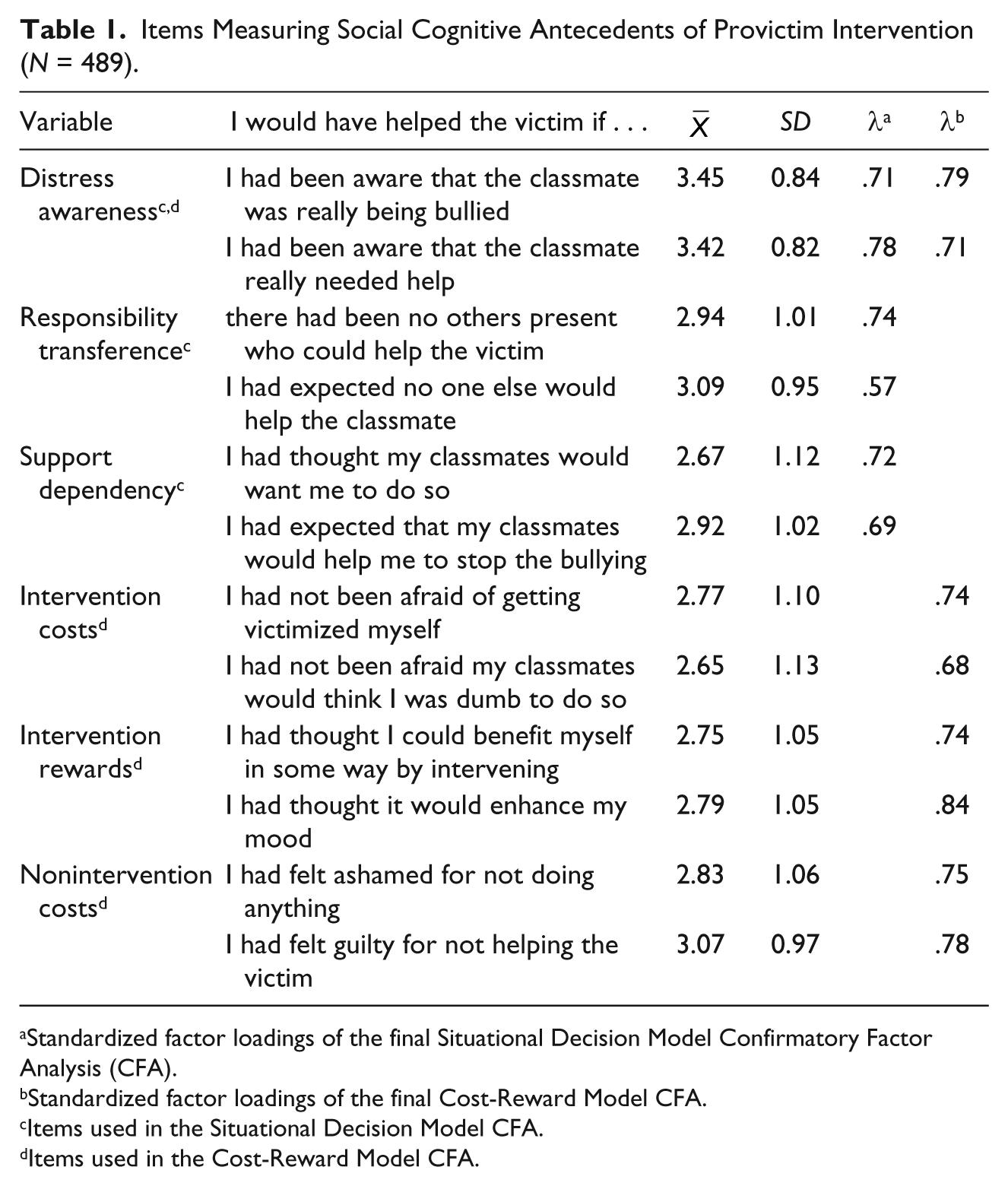
Standardized factor loadings of the final Situational Decision Model Confirmatory Factor Analysis (CFA).
Standardized factor loadings of the final Cost-Reward Model CFA.
Items used in the Situational Decision Model CFA.
Items used in the Cost-Reward Model CFA.
Situational decision model variables
Confirmatory Factor Analyses (CFAs) were executed in LISREL 8.80 to examine the Situational Decision Model factor structure in the data (see Table 1 for the six items used in these analyses). First, the data were fitted to a baseline model of one general factor. Second, the data were fitted to an intermediate two-factor model conforming to the two phases of the Situational Decision Model (Phase 1: Distress Awareness; Phase 2: Situational Analysis). And third, the data were fitted to the final three-factor model (i.e., the Situational Decision Model) consisting of Distress Awareness, Responsibility Transference, and Support Dependency. The chi-square difference tests between the models and the goodness of model fit indices indicated that the final three-factor Situational Decision Model best fitted the data (see Table 2). The standardized loadings of all items with their latent factor in the final model can be found in Table 1. Based on these results, the following variables were created (all: average of two items): (a) Distress Awareness (Spearman-Brown coefficient = .72;
Confirmatory Factor Analyses for the Situational Decision Model and the Cost-Reward Model (N = 489).
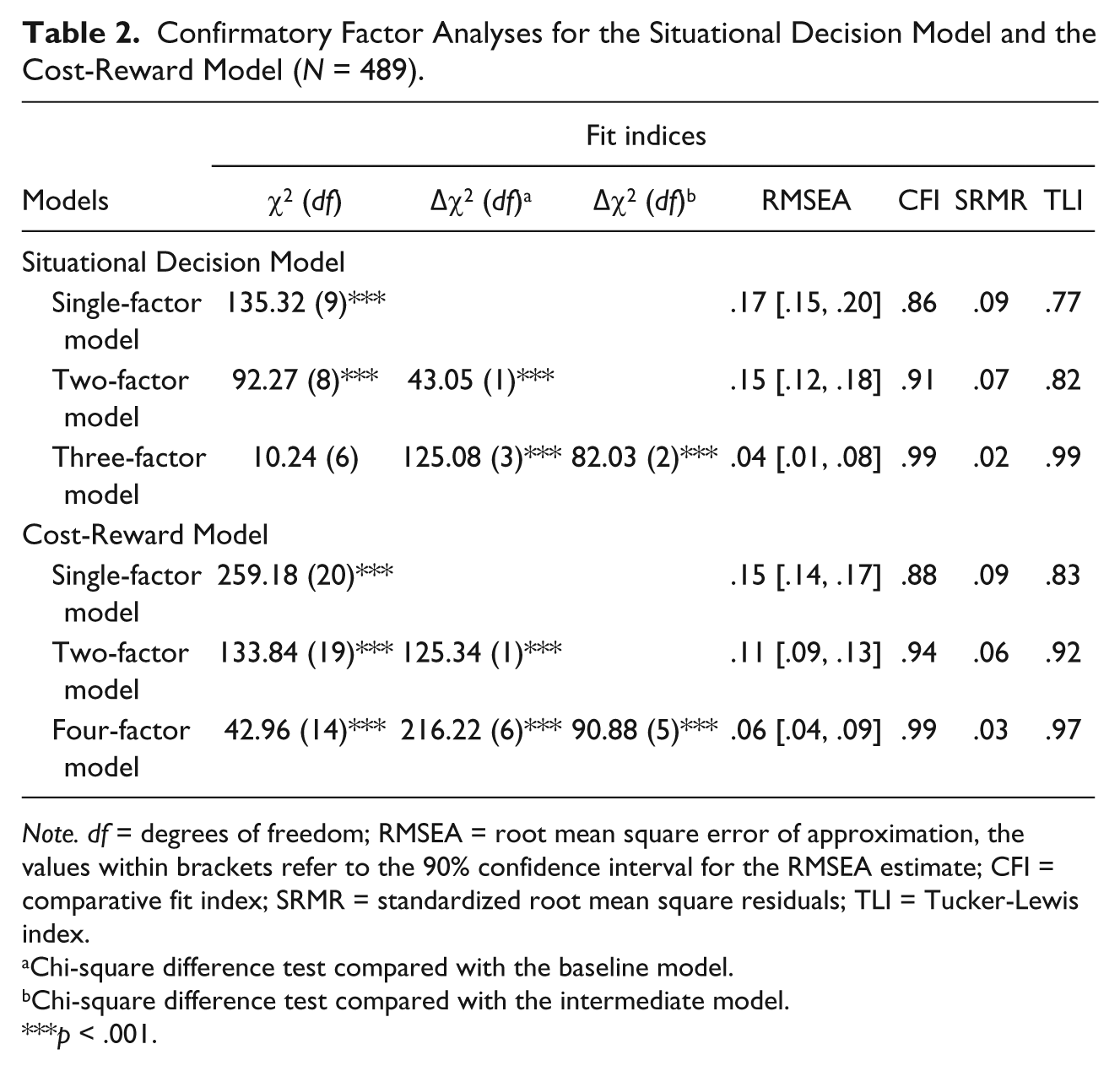
Note. df = degrees of freedom; RMSEA = root mean square error of approximation, the values within brackets refer to the 90% confidence interval for the RMSEA estimate; CFI = comparative fit index; SRMR = standardized root mean square residuals; TLI = Tucker-Lewis index.
Chi-square difference test compared with the baseline model.
Chi-square difference test compared with the intermediate model.
p < .001.
Cost-reward model variables
CFAs were also executed in LISREL 8.80 to examine the factor structure of the Cost-Reward Model in the data (see Table 1 for the eight items used in these analyses). First, the data were fitted to a baseline model of one general factor. Second, the data were fitted to an intermediate two-factor model conforming to the two phases of the Cost-Reward Model (Phase 1: Distress Awareness [same items as in the Situational Decision Model CFAs]; Phase 2: Cost-Reward Analysis). And third, the data were fitted to the final four-factor model (i.e., the Cost-Reward Model) consisting of Distress Awareness, Intervention Costs, Intervention Rewards, and Nonintervention Costs. The chi-square difference tests between the models and the goodness of model fit indices indicated that the final four-factor Cost-Reward Model best fitted the data (see Table 2). The standardized factor loadings for all items to their latent factor in the final model can be found in Table 1. Based on these results, the following variables were created in addition to Distress Awareness (all: average of two items): (a) Intervention Costs (Spearman-Brown coefficient = .67;
Statistical Analyses
Both dependent variables (i.e., outsider and defender behavior) were within-classroom transformed into normal scores with the Rankit procedure (see Footnote 1), which is a standard procedure in bullying-related peer nomination research (e.g., Olthof et al., 2011; Salmivalli et al., 1998). This procedure is necessitated because bullying-related behavioral proportion scores based on peer nominations are positively skewed due to many participants not receiving any nominations. Moreover, variance at the classroom and school levels for peer report measures does not only consist of nominee-related variance (i.e., nonindependence of individual responses), but nominator-related variance as well (e.g., classroom differences in willingness to nominate classmates). Thus, as the within-classroom normalization procedure also corrected the dependent variables for independence violations of students’ individual responses, the classroom- and school-related variances should have effectively been reduced to 0. To statistically evidence this assumption, intraclass correlations (ICCs) and design effects (DEs) were calculated (Peugh, 2010). The ICCs suggested that the between-level variance in both models that was due to classroom and school-level variability was negligible (all ICCs < 1%). The DEs suggested that the classroom- and school-level influences on the models’ standard error estimates were also negligible (all DEs < 1.10). Therefore, hierarchical multiple regression was appropriate for further data analyses.
Results
General First Steps
The intercorrelations between all study variables can be found in Table 3. Separate hierarchical regression models were run with Outsider and Defender Behavior as dependent variables. Outsider and Defender Behavior were corrected in a first step for the influence of Gender (0 = girl; 1 = boy) and Other Witnessing Behavior (Defender or Outsider), as previous studies indicated that both behaviors are more visible in girls than in boys and that outsiders sometimes show defender behavior (and vice versa; Goossens et al., 2006; Salmivalli et al., 1996; Sutton & Smith, 1999). As it is a precondition for conducting a situational analysis according to the Situational Decision Model and for starting the cost-reward analysis in the Cost-Reward Model, the predictor Distress Awareness was entered into the models separate from the other predictors at the second step. The results are summarized in the top panel of Table 4: First, girls received more outsider and defender nominations than boys. Second, outsider and defender behavior were positively related. Third, defender behavior was positively related to awareness of victim’s distress. Fourth, outsider behavior was not significantly related to distress awareness.
Correlation Matrix for All Study Variables (N = 489).

Note. Gender was coded as 0 (girls) and 1 (boys). All italicized correlations indicate cross-model correlations. All correlations equal to or greater than .09 have a per test significance level of p < .05.
Hierarchical Regression Models Predicting Outsider and Defender Behavior (N = 489).
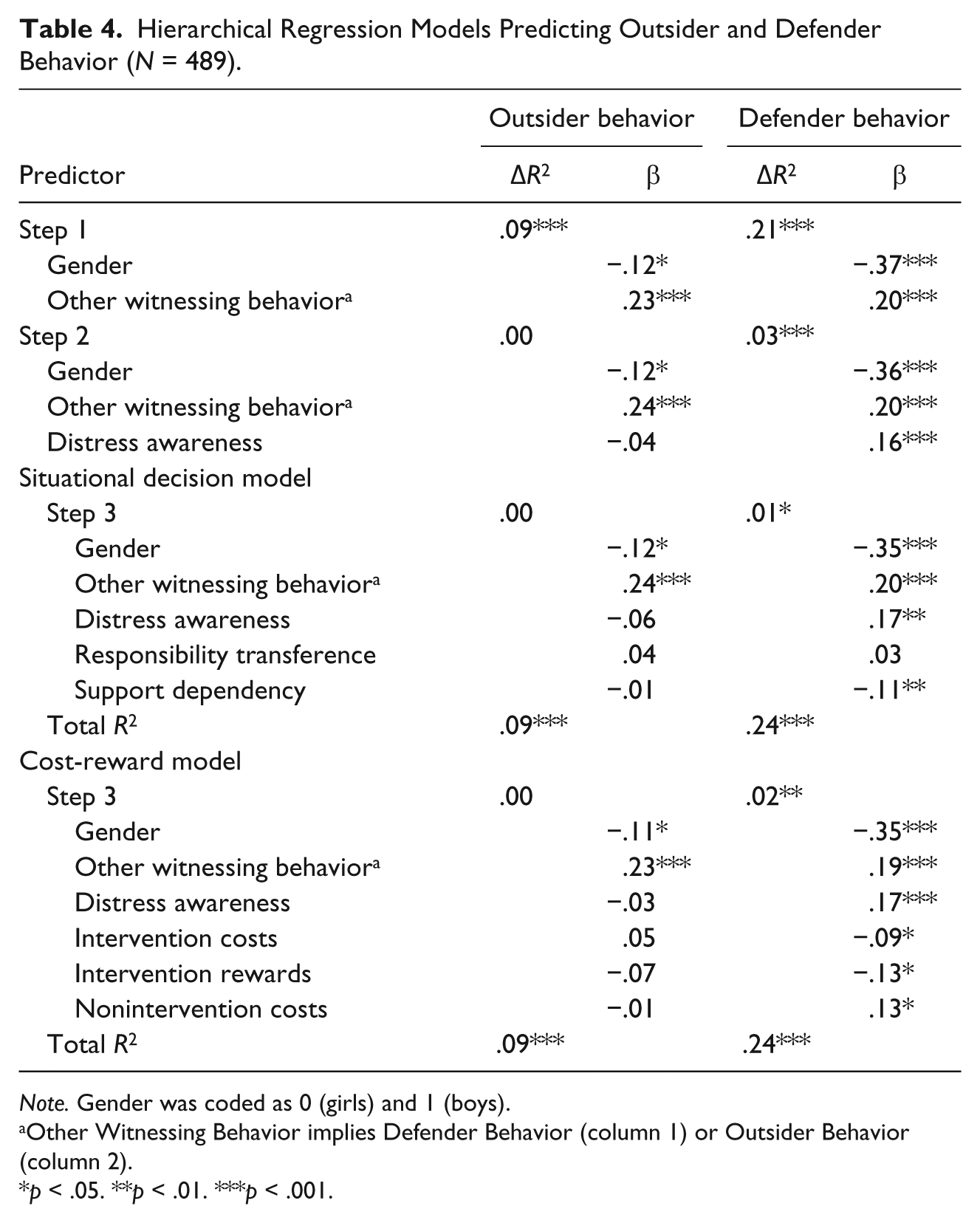
Note. Gender was coded as 0 (girls) and 1 (boys).
Other Witnessing Behavior implies Defender Behavior (column 1) or Outsider Behavior (column 2).
p < .05. **p < .01. ***p < .001.
Situational Decision Model
In the Situational Decision Model analyses, the predictors Responsibility Transference and Support Dependency were added into the models at the third step. At the fourth step, the interaction of one of the Situational Decision Model predictors with Gender was added into the models, that is, Distress Awareness × Gender, Responsibility Transference × Gender, and Support Dependency × Gender. The gender interactions were created by multiplying the zero-centered Situational Decision Model predictors with Gender. For both dependent variables, three different four-step models were run, that is, one model for every Gender interaction. None of the interactions with gender contributed significantly to explaining Outsider or Defender Behavior (all: p > .05). Therefore, the fourth step will not be reported. The results are summarized in the middle panel of Table 4: First, defender behavior was not related to the perception that one’s personal responsibility for helping the victim could be transferred to others present. Second, defender behavior was negatively related to the perception that helping the victim was dependent on the support or assistance from classmates. Third, outsider behavior was not significantly related to either Responsibility Transfer or Support Dependency.
Cost-Reward Model
In the Cost-Reward Model analyses, the predictors Intervention Costs, Intervention Rewards, and Nonintervention Costs were added into the models at the third step. At the fourth step, the interaction of one of the Cost-Reward Model predictors with Gender was added into the models, that is, Distress Awareness × Gender, Intervention Costs × Gender, Intervention Rewards × Gender, and Nonintervention Costs × Gender. The gender interactions were created as described above for the Situational Decision Model. For both dependent variables four different four-step models were run, that is, one model for every Gender interaction. None of the interactions with gender contributed significantly to explaining Outsider or Defender Behavior (all: p > .05). Therefore, the fourth step will not be reported. The results are summarized in the bottom panel of Table 4: First, defender behavior was negatively related to reporting that the anticipation of low costs and high rewards would have led one to help the victim. Second, defender behavior was positively related to reporting that the anticipation of high costs for not helping the victim (i.e., feelings of guilt and shame) would have led one to help the victim. Third, outsider behavior was not significantly related to Intervention Costs, Rewards, or Nonintervention Costs.
Discussion
The main goal of this study was to examine whether students’ tendency to show defender or outsider behavior could be explained by differences in their social cognitions about provictim intervention. First of all, as expected, awareness of the distress caused to the victim was positively linked to defender behavior. Second, while students’ tendency to take or transfer their personal intervention responsibility was not related to defender behavior, students’ tendency to let their intervention behavior depend on support or assistance from classmates in these endeavors was negatively related to defender behavior. Third, reporting that the anticipation of high nonintervention costs would have been an incentive to intervene was positively related to defender behavior. However, reporting that the anticipation of low intervention costs or high intervention rewards would have been an incentive to intervene was negatively related to defender behavior.
The positive relationship between identifying distress awareness as a factor that would promote provictim intervention behavior and students’ actual defender behavior supports the basic principle of both the Situational Decision Model and the Cost-Reward Model. Distress awareness was found to be pivotal to deciding to intervene in emergency situations (Fischer et al., 2011; Latané & Darley, 1970; Latané & Nida, 1981; Penner et al., 2005; Piliavin et al., 1981) and in victimization situations (Forsberg et al., 2014). The present findings suggest that students who show defender behavior help victims because they are aware of the distress the victim experiences.
The findings for defender behavior are inconsistent with the Situational Decision Model in two ways. First, students who showed defender behavior denied that their intervention efforts depended on the expectance of support or assistance from classmates. Previous studies suggest that students who perceive normative peer pressure to perform provictim interventions are more likely to report that they will intervene on behalf of victims (Pozzoli & Gini, 2010, 2013; Rigby & Johnson, 2006). However, in the latter studies, both participants’ behavior and cognitions were measured through self-reports. Therefore, shared method variance may have contributed to these findings. The present findings suggest that students who are reported to show defender behavior do not think that their provictim interventions are dependent on support or assistance from classmates, that is, on situational intervention pressure.
Second, defender behavior was unrelated to students’ tendency to transfer or anchor their personal intervention responsibility. Recently, witnesses to victimization were found to report that their provictim interventions would be overruled if they had the possibility to transfer their moral responsibility for intervention to others (Forsberg et al., 2014). The present findings suggest that this does not obtain for witnesses with the reputation to show defender behavior. As it was also not related to outsider behavior, it may be that different antecedents influence the intervention decision for different types of witnesses. Based on Forsberg et al. (2014), it may be that responsibility transfer only influences nonintervention behavior through moral disengagement. As both outsiders and defenders were found to be low in moral disengagement (Obermann, 2011; Thornberg & Jungert, 2013), their (non)intervention decision may only be influenced by, respectively, moral distress (e.g., a fear of retaliation by the bullies; Pronk et al., 2013) and moral agency (e.g., confidence in victimization situations; Pronk et al., 2013). Moreover, previous studies suggest that students who report feeling responsible for the victim’s fate are more likely to report that they will perform provictim interventions (Pozzoli & Gini, 2010, 2013). Responsibility transference may therefore be the moral disengagement strategy that only influences the nonintervention behavior of probullying witnesses (e.g., reinforcers). The present findings suggest that students with a defender reputation do not attribute their helping of victims to (non)transference of their personal intervention responsibility.
The findings for defender behavior are more consistent with the Cost-Reward Model in that high nonintervention costs were found to promote helping behavior (Penner et al., 2005; Piliavin et al., 1981). Students who showed defender behavior reported that feeling guilty and ashamed would have overruled their nonintervention behavior. At the same time, students who showed defender behavior were less likely to identify a lack of fear of becoming bullied themselves (i.e., low intervention costs) and expecting personal benefits for doing so (i.e., high intervention rewards) as reasons to intervene. While the latter are not in agreement with the Cost-Reward Model, the findings together suggest that those who show defender behavior may decide to perform provictim interventions predominantly on the basis of their own moral compass. Previous studies already suggested that guilt is an empathy-based response serving the inhibition of antisocial behavior and facilitation of prosocial behavior (Menesini & Camodeca, 2008; Olthof, 2012). However, feeling ashamed has only been found to serve the inhibition of antisocial behavior (Olthof, 2012). In the present study, the combination of these moral emotions was related to prosocial defender behavior. This suggests that anticipated guilt and shame may work together as a moral compass that guides decision making in the prosocial and antisocial world. Of course, only experienced anticipated shame in the context of a social environment consisting of familiar people was investigated in the present study. In such contexts, the effect of shame may be amplified (Olthof, 2012).
With regard to outsider behavior, no unique relations were found with any of the measured social-cognitive antecedents of provictim intervention. The findings did confirm that girls are more likely to show outsider and defender behavior than boys and that both behaviors are positively related (Goossens et al., 2006; Salmivalli et al., 1996; Sutton & Smith, 1999). It may be that students who show outsider behavior base their intervention decision on other cognitions or feelings, like their friendship connection to the others present in the situation. Several studies suggest that friendship selectivity influences the provictim intervention behavior of students in general (Forsberg et al., 2014; Oh & Hazler, 2009; Rigby & Johnson, 2006) and of outsiders specifically (Pronk et al., 2013). It is also possible that the imagined victimization scenario used in the present study caused students who show outsider behavior to focus on their insecurities, anxieties, or the potential harm they may face, should they intervene. Such feelings may have overwhelmed them or pushed aside their prosocial tendencies (Olthof & Goossens, 2008; Gini et al., 2008; Pozzoli & Gini, 2010; Pronk et al., 2013). The positive relation between outsider and defender behavior found in the present study indicates once again that these behaviors are not mutually exclusive and suggests that outsiders may defend victims in situations that are less stressful and auspicious. In agreement with this, despite differences in intervention preferences, outsiders were recently found willing and ready to undertake defensive activities like defenders (Pronk et al., 2013). While only defenders were prepared and felt self-efficacious to confront bullies directly, outsiders were equally self-efficacious and prepared to perform indirect provictim interventions (e.g., consoling victims, warning the teacher).
Taken together, it seems as if students’ tendency to show outsider or defender behavior cannot be explained unequivocally by either the Situational Decision Model or by the Cost-Reward Model. Besides distress awareness, the situational antecedents were not (responsibility transference) or negatively (support dependency) related to defender behavior. Also, while the Cost-Reward Model suggests that low costs and high rewards for intervention would positively relate to defender behavior, negative relationships were found. It was the thought of not helping victims that induced the moral emotions of guilt and shame in students who show defender behavior. Based on a meta-analysis, Fischer et al. (2011) concluded that witnesses’ response to general emergency situations was more likely the result of distress awareness and a cost-reward type of analysis than of a situational-based decision process. In light of this, while both outsider and defender behaviors were recently found to be characterized by agreeableness (e.g., empathic responsiveness, prosocial behavioral tendencies), only outsider behavior was also characterized by punishment sensitivity (e.g., behavioral inhibition) and impulse control (Pronk et al., 2014). These latter personality characteristics of outsiders may hinder them in executing a morality-based cost-reward analysis in response to witnessed victimization.
It must be noted that the Situational Decision Model and the Cost-Reward Model have mainly been investigated by exposing adults to emergency situations involving unknown others, while in the present study early adolescents were asked to imagine a stressful situation involving familiar others. The differences between the present findings and previous studies testing both models may thus be influenced by a familiarity effect, that is, the participants were familiar with the others witnessing the event because they are classmates. Forsberg et al. (2014) similarly suggested that familiarity with other witnesses present in the situation, either as victim, bullies, and/or witnesses, will cause someone to respond in ways that are based on affect or prior knowledge. However, the present findings may also be different from those generally found in experimental studies involving the Situational Decision Model and the Cost-Reward Model, as in this study participants’ cognitions were assessed and related to their naturally occurring behavior rather than inferring them directly from experimentally induced behavior.
When putting the present findings into a developmental context, the finding that the moral emotions of guilt and shame for nonintervention fostered defender behavior, may have important implications. The transition into adolescence coincides with a shift from a parent or adult influenced environment to a peer-influenced environment (Dishion & Tipsord, 2011; Steinberg & Morris, 2001). At the same time, helping victims becomes less visible during this period as compared with avoiding involvement in witnessed victimization situations (Goossens et al., 2006; Pozzoli & Gini, 2013; Pozzoli et al., 2012). Antibullying interventions that aim at promoting prosocial behavior may therefore need to start increasing awareness of bullying and its consequences by using parents and teachers during middle childhood, when these adults still are their main role models. By the time children reach adolescence—and their peers start becoming their main role models—a strong moral sense that bullying is wrong and that victims should be helped, should have already been installed, preferably in all classroom students.
A strength of this study was focusing on early adolescents’ peer reputation of helping victims versus avoiding involvement in bullying (defender vs. outsider behavior) in connection with self-reported cognitions about potential antecedents of their provictim intervention decision. Peer nominations represent the collective view of all members of a classroom or grade, and as such are based on a multitude of observations. Moreover, it is possible to distinguish various subtypes of witnesses such as outsiders and defenders, and we can thus find more meaningful relations than when using a general category such as witnesses. Finally, the peer nomination procedure used in the present study was computerized, which has several extra advantages (Olweus, 2010; Van den Berg & Cillessen, 2013). They enable more anonymous data collection and storage (Mayeux, Underwood, & Risser, 2007; Van den Berg & Cillessen, 2013). Moreover, they decrease social desirability in responding to items. As participants feel more anonymous, they will perceive more confidentiality about responding to items and will feel more comfortable and willing to nominate classmates. Moreover, the procedure used in the present study also enabled participants to not nominate any classmates if they did not know anyone to nominate. As a result, the present study limited the ethical concerns about using peer nominations to measure bullying-related behaviors and limited socially desirable responding to the BRNP (as well as to the social-cognitive antecedent items). A third strength of this study was using proportion scores of participants’ behavioral reputation rather than classifying them in bullying roles by using seemingly arbitrary cutoff points. As a result, all available variance in participants’ behavioral reputations was used. This means that the data of all participants could be analyzed, rather than only the data of a subgroup of participants based on role classifications that suffer from the confounding influences of other bullying-related behaviors.
A limitation of this study was its cross-sectional design. The social-cognitive antecedent items were formulated as indicative of conditions promoting provictim intervention, but causal conclusions cannot be drawn. Also, despite clear factorial CFA structures, only two items were used to measure the social-cognitive antecedents and some reliability coefficients were relatively low. Moreover, it is unclear to what extent conditions in imagined situations carry over to real-life behavior. Future studies using more items to measure the social-cognitive antecedents and with an experimental study design are therefore needed to strengthen the present results. For example, participants could be presented short movie clips of enacted victimization in which the different situational conditions are carefully manipulated to provide more insight into the antecedents of students’ provictim intervention decision. Similarly, future studies investigating students’ real-life behavior and the link with claimed behavior are necessary. Another limitation was defining bullying only generally before presenting participants the imagined scenario and using only one scenario to investigate students’ social cognitions. Also, participants were presented a relatively large volume of information before they were to imagine a victimization situation in which they were nonintervening witnesses (see the appendix). However, they were left free to imagine a victimization situation that was vivid in their own minds and therefore the items could be answered based on a strong mental picture of victimization without keeping all the presented information in mind. Still, students were not restricted with regards to their imagined victimization situation when they answered the items. Individual differences in beliefs about conditions preceding provictim intervention in different types of victimization events may exist. Future studies with hypothetical or imagined scenarios that refer to different types of victimization and with more clearly scripted scenarios are needed to strengthen the present findings. Finally, students’ defender behavior was based on their tendency to help victims indirectly (e.g., consoling and being nice to them, warning the teacher) and not so much on their tendency to help victims directly (actively protecting them). Also, the present study focused on individual differences in students’ social cognitions about provictim intervention. However, the potential influence of classroom contextual and school climate factors on students’ decision making could not be investigated. Future studies that specifically investigate the influence of classroom contextual and school climate factors on students’ social cognitions about provictim intervention are necessary to strengthen the present findings, as both were found to contribute to explaining differences between outsiders and defenders in bullying situations (Pozzoli et al., 2012).
Notwithstanding these limitations, the present findings have implications for interventions aiming at promoting defender behavior during a developmental period in which defending victims becomes less frequent. The findings indicate that having awareness of victims’ distress and anticipating moral feelings (i.e., guilt and shame) for not helping victims seem to increase the likelihood defensive acts will be executed. Antibullying programs may need to put more focus on teaching youth about the negative impact of victimization on victims. Equally important is increasing awareness of their own role in resolving victimization. Youth needs to know that they themselves contribute to the (dis)continuance of victimization and its adverse consequences on victims. Outsiders need to become aware that their own avoidant behavior can positively reinforce bullying behaviors.
Footnotes
Appendix
Declaration of Conflicting Interests
The author(s) declared no potential conflicts of interest with respect to the research, authorship, and/or publication of this article.
Funding
The author(s) disclosed receipt of the following financial support for the research, authorship, and/or publication of this article: This research was funded by a grant (431-09-032) from The Netherlands Organization for Scientific Research (NWO) awarded to F. A. Goossens and M. M. Vermande.