



Abstract
Identifying factors that influence adolescents’ decisions to start smoking is necessary to improve interventions for reducing tobacco use. The current longitudinal study was designed to determine the direction of influence between feelings of invulnerability to harm and cigarette smoking, and to test whether the perceived risks and benefits of smoking mediate the relationship between invulnerability and smoking. Participants were 228 adolescents (57% female;
Cigarette smoking is associated with approximately 480,000 deaths per year, making it the leading preventable cause of death in the United States (U.S. Department of Health and Human Services [USDHHS], 2014). Smoking has been shown to cause heart disease, cancer, stroke, and chronic lower respiratory disease (USDHHS, 2010). Although many of the health consequences of smoking are not experienced until adulthood, epidemiological data indicate that approximately 86.9% of adults who have ever smoked daily started smoking before 18 years of age (USDHHS, 2014). By preventing smoking initiation or progression to regular smoking among adolescents, we may achieve significant reductions in the morbidity and mortality associated with cigarette smoking, especially given the fact that current smoking cessation treatments for adolescents are typically ineffective or are not supported by sufficient empirical evidence (Stanton & Grimshaw, 2013). Identifying factors that influence adolescents’ decisions to start smoking, as well as determining what underlying mechanisms and individual characteristics explain how these factors operate, will provide critical information necessary to improve interventions aimed at reducing tobacco use.
Theories of adolescent development state that adolescents engage in risk behavior in part because they feel invulnerable to harm (Elkind, 1967; Lapsley, 2003; Lapsley & Murphy, 1985). This invulnerability is often conceptualized as a core developmental feature of early and later adolescence, although its precise nature and mechanisms of action differ among theories. In Elkind’s (1967) account, invulnerability is the result of adolescent egocentrism that attends the transition to formal operations. Invulnerability has also been operationalized as an optimistic bias in risk appraisal (Jacobs-Quadrel, Fischoff, & Davis, 1993; Millstein & Halpern-Felsher, 2002b). According to the optimistic bias account, individuals believe that good outcomes are more likely to happen to themselves than to others, and that bad outcomes are more likely to happen to others than to themselves. Others characterize invulnerability in terms of individual differences in perceptions of personal risk (see Millstein & Halpern-Felsher, 2002a). In contrast, Lapsley (2003) has conceptualized invulnerability as a developmental construct that plays a role in adolescent personality (ego) development through separation-individuation processes. It allows an adolescent to cope adaptively with normative developmental challenges (e.g., with individuation), while disposing the adolescent to engage in risky behavior by inducing him or her to feel impervious to injury, harm, or danger. Subjective invulnerability presents, then, with “two faces,” one that points toward adaptation and the other toward risk behavior.
Research has provided evidence to support the existence of a subjective sense of invulnerability among adolescents and emerging adults (Hill, Duggan, & Lapsley, 2011; Lapsley & Hill, 2010). Two types of subjective invulnerability have been identified: danger invulnerability, or “a sense of indestructibility and propensity to take physical risks” (i.e., invulnerability to physical harm), and psychological invulnerability, or “one’s felt invulnerability to personal or psychological distress” (Lapsley & Hill, 2010). Studies of subjective invulnerability show that a greater sense of invulnerability is associated with more risk behavior and better psychological outcomes, which is consistent with the idea that invulnerability can have both positive and negative implications for development (Hill et al., 2011; Lapsley & Hill, 2010). Specifically, a greater sense of both psychological and danger invulnerability is associated with increased risk-taking behavior, including delinquency and substance use. Danger invulnerability is also associated with more interpersonal problems. In contrast, a greater sense of psychological invulnerability is associated with better self-esteem and fewer depressive and interpersonal problems among both adolescents and emerging adults. While informative, these findings leave important issues unaddressed, such as what is the link between subjective invulnerability and more specific risk behaviors. In particular, it is unknown whether invulnerability is associated with smoking behavior. If such a relationship exists, longitudinal studies are needed to determine the direction of the relationship and to identify potential mechanisms of action. Such knowledge is likely to have valuable implications for developing interventions to reduce adolescents’ engagement in such behaviors.
Several theories postulate (e.g., the Theory of Planned Behavior, the Health Belief Model, and Social Cognitive Theory; Ajzen, 1991; Bandura, 1977; Rosenstock, Strecher, & Becker, 1988) and empirical evidence supports the notion that engaging in risk behaviors such as smoking is also predicted by a sense of invulnerability, defined as lower perceptions of risk and higher perceptions of benefits. Results of both cross-sectional and longitudinal studies of adolescent smoking behavior have confirmed that adolescents who smoke perceive less smoking-related risk and more smoking-related benefits than non-smokers (Aryal, Petzold, & Krettek, 2013; Halpern-Felsher, Biehl, Kropp, & Rubinstein, 2004; Halpern-Felsher, Ramos, & Cornell, 2007; Krosnick, Chang, Sherman, Chassin, & Presson, 2006; Rodriguez, Romer, & Audrain-McGovern, 2007; Romer & Jamieson, 2001; Song et al., 2009). Similarly, the literature on negative and positive smoking outcome expectancies, which can be considered analogous to perceived risks and benefits of smoking, also indicates that expectancies predict smoking behavior in adolescence (e.g., Anderson, Pollak, & Wetter, 2002; Hine, Tilleczek, Lewko, MacKenzie-Richer, & Perrault, 2005).
While we know that perceptions of smoking-related risks and benefits are associated with smoking behavior among adolescents, we know little about what factors drive these perceptions of smoking, including whether a more general sense of invulnerability is related to more specific perceptions. Such information is likely to have valuable implications for identifying which adolescents are most at risk to start smoking and what interventions may best target these youth. The few studies that have examined possible predictors of specific smoking-related perceptions or expectancies among adolescents highlight the importance of personal experimentation with smoking, social exposure to smoking (e.g., friend smoking), and ethnicity as potential determinants of adolescents’ perceptions of smoking-related risks and benefits (Chung, White, Hipwell, Stepp, & Loeber, 2010; Morrell, Song, & Halpern-Felsher, 2010; Racicot, McGrath, & O’Loughlin, 2011). However, these studies did not examine the influence of more developmental characteristics such as subjective invulnerability.
As it is currently measured, invulnerability is a developmental characteristic that motivates adolescents’ decisions to engage in a variety of risky behaviors (e.g., Lapsley & Hill, 2010). It is conceivable that invulnerability affects behavior through its influence on perceptions of the risks and benefits associated with that particular risk behavior, such as smoking. Research and theory suggest that perceptions are more specific and proximal to the behavior, while invulnerability may be more general and distal. Thus, it is reasonable to hypothesize that perceptions will act as a mediator of the relationship between subjective invulnerability and behavior. For example, perceptions of benefits may be more salient to adolescents who believe they are more invulnerable to harm, and these same adolescents may also hold lower perceptions of risk. There are no studies to date that have examined invulnerability as a predictor of adolescents’ perceptions of the risks and benefits of smoking.
The aim of the current study is to address current gaps in the literature by using prospective longitudinal data from an adolescent sample, beginning in early adolescence, to determine (a) the direction of influence between invulnerability and smoking behavior, (b) whether danger and psychological invulnerability differentially influence adolescent smoking, and (c) whether smoking-related perceptions mediate the relationship between invulnerability and smoking behavior. As a plausible alternative hypothesis, we also tested whether invulnerability mediated the relationship between smoking-related perceptions and behavior. Furthermore, we evaluated whether mediation existed only for certain types of invulnerability (danger vs. psychological invulnerability) or certain types of perceptions (short-term risk vs. long-term risk vs. benefits).
We hypothesized that (a) adolescents’ subjective invulnerability, as more of a developmental characteristic, would predict smoking behavior, but that smoking behavior would not influence invulnerability; (b) danger invulnerability, but not psychological invulnerability, would predict cigarette smoking because cigarette smoking is typically viewed as posing more physical than psychological risks; and (c) perceptions of both the risks and benefits of smoking, as more proximal predictors of behavior, would mediate the relationship between the more distal construct of subjective invulnerability and smoking behavior, but that invulnerability would not mediate the relationship between smoking-related perceptions and smoking behavior. We tested these hypotheses after controlling for several potentially confounding variables: gender, previous smoking experience, prior levels of invulnerability, previous perceptions of smoking, and peer smoking. Previous research suggests that males and females may experience different levels of invulnerability (Lapsley & Hill, 2010), and that previous smoking experience predicts perceptions of the risks and benefits of smoking (Morrell et al., 2010). In addition, within-subject levels of invulnerability and perceptions of smoking are likely to be correlated over time, which means it will be important to control for prior levels of these variables. Finally, research has consistently shown peer smoking to be a strong predictor of adolescent smoking (see Simons-Morton & Farhat, 2010, for a review of peer influences on smoking).
Method
Participants
Two hundred twenty-eight adolescents (57% female) with a mean age of 14 years (SD = 0.4 years) were recruited from 9th grade classrooms in one public high school in Northern California. The sample was 62.6% White (non-Hispanic), 14% multi-racial/ethnic, 9.3% Asian/Pacific Islander, 7.9% Hispanic or Latino, 5.1% Other, and 0.9% African American. Because there were only two African American participants, they were combined with the Other category for the main analyses. At baseline, 59 (25.9%) adolescents reported that they had tried cigarette smoking at least once.
Procedure
The current study represents a secondary analysis of data from a 2-year longitudinal study in which the survey was designed to measure potential predictors of adolescent smoking behavior, including invulnerability and the perceived risks and benefits of smoking. Researchers visited classrooms and explained the study, invited students to participate, and provided students with study information and a parental consent form. Students who signed an adolescent assent form and whose parents signed the parental consent form were eligible to participate in the study. Consent forms were distributed to 302 students, of whom 237 (78.5%) returned completed consent forms and 228 (75.5% total response rate; 96.2% of those who completed consent forms) completed the baseline survey. Eligible participants completed surveys twice per school year from the beginning of 9th grade to the end of 10th grade. Of the 228 students who completed the baseline survey, 211 (92.5%) completed the survey again at Time 2, 205 (89.9%) completed the survey at Time 3, and 200 (87.7%) completed the survey at Time 4. The survey comprised questions about beliefs, attitudes, and behaviors associated with tobacco use. Researchers provided instructions and were available to answer questions during survey administration. Participants were given a movie gift certificate in compensation for their participation. All procedures were reviewed and approved by the university’s Institutional Review Board. Additional study details have been published elsewhere (Halpern-Felsher et al., 2004).
Materials
Demographic characteristics
Participants reported their age, sex, and race/ethnicity on the baseline survey (survey Time 1).
Subjective invulnerability
The Adolescent Invulnerability Scale (Duggan, Lapsley, & Norman, 2000; Lapsley, 2003; Lapsley & Duggan, 2001; Lapsley & Hill, 2010) was used to measure adolescents’ sense of personal subjective invulnerability. This measure was only administered at survey Time points 2 and 3. This self-report scale comprises 20 statements about invulnerability, such as “I’m unlikely to be injured in an accident” and “What people say about me has no effect on me at all (reverse-scored).” Participants rate the extent to which each of these statements describe them on a 5-point Likert-type scale (1 = strongly disagree to 5 = strongly agree); several items are reverse-scored. Factor analyses from previous studies using both adolescent and young adult samples have suggested the presence of two subscales: Danger Invulnerability (12 items) and Psychological Invulnerability (8 items; Duggan et al., 2000; Lapsley & Hill, 2010). Item scores are summed within each subscale to obtain a total subscale score. These subscales demonstrate acceptable to good reliability (α = .76-.81 for Danger Invulnerability and α = .73-.78 for Psychological Invulnerability; Hill et al., 2011; Lapsley & Hill, 2010). In the present study, both subscales demonstrated acceptable to good reliability at the two survey time points in which they were measured: α = .75 and .82 at Times 2 and 3 for the Danger Invulnerability subscale, and α = .81 and .83 at Times 2 and 3 for the Psychological Invulnerability subscale.
Perceptions of smoking-related risks and benefits
Participants estimated their likelihood of experiencing 15 possible smoking-related outcomes by completing a series of conditional risk assessments at all four survey time points (see Halpern-Felsher et al., 2001; Ronis, 1992; van der Velde, Hooykaas, & van der Pligt, 1996). Results from previous research have shown that these 15 outcomes fall into three categories, which remained stable across time: short-term risks (get into trouble, smell like an ashtray, get a bad cough, have trouble catching breath, get colds, and have bad breath), long-term risks (lung cancer, cough, trouble catching breath, heart attack, and wrinkles), and benefits (look cool, feel relaxed, be more popular, and look more grown up; Morrell et al., 2010; Song et al., 2009). We created separate scores for perceptions of short-term risks, long-term risks, and benefits by averaging item scores within each category. Across all 4 survey time points, internal consistency reliability ranged from .80 to .90 for short-term risks, from .88 to .92 for long-term risks, and from .71 to .73 for benefits.
For the conditional risk assessments, participants imagined two different smoking scenarios, one in which they just began smoking two to three cigarettes per day and one in which they continued to smoke two to three cigarettes per day for the rest of their lives. The former scenario was used to evaluate participants’ perceptions of the benefits and short-term risks of smoking, while the latter was used to evaluate their perceptions of the long-term risks of smoking. After reading the scenarios, participants indicated the likelihood that each outcome would occur by filling in the blank with any number between 0% and 100%.
Smoking behavior
At all four survey time points, participants reported how many times they had “ever tried smoking a cigarette, even one puff” (1 = none, 2 = 1 time, 3 = 2-5 times, 4 = 6-10 times, and 5 = more than 10 times). Given the ordinal nature of the scale and the fact that the number of students in Categories 2 to 5 was small, this item could not be used as a continuous variable for analysis nor could the original five categories be preserved. Therefore, responses to this item were dichotomized prior to analysis (0 = has not tried smoking, 1 = has tried smoking).
Peer smoking
Peer smoking (hereafter referred to as having at least one friend who did or did not smoke, or as peer smoking) was measured as a dichotomous variable, where 0 = the participant reported having no friends who smoked at least one cigarette per day and 1 = the participant reported having at least one friend who smoked at least one cigarette per day.
Statistical Analysis
Preliminary correlations, t tests, one-way between-subjects ANOVAs, mixed factorial ANOVAs, and two-way chi-square tests were used to examine simple relationships among the variables of interest prior to conducting the main analyses. After confirming that there were no violations of statistical assumptions, linear and logistic regression analyses were used to address the three study aims. No violations of assumptions were detected for the reported analyses.
To address our first and second aims, we used logistic regression to test whether danger or psychological invulnerability measured at Time 2 predicted smoking behavior at Time 3, and we used linear regression to test whether smoking behavior at Time 2 predicted danger or psychological invulnerability at Time 3. To address our third aim, we conducted two sets of multiple mediation analyses (described below). The first set tested our primary hypothesis that perceptions would mediate the relationship between subjective invulnerability and smoking behavior (Figure 1). The second set tested our alternative hypothesis that invulnerability would mediate the relationship between smoking-related perceptions and smoking behavior (Figure 2).
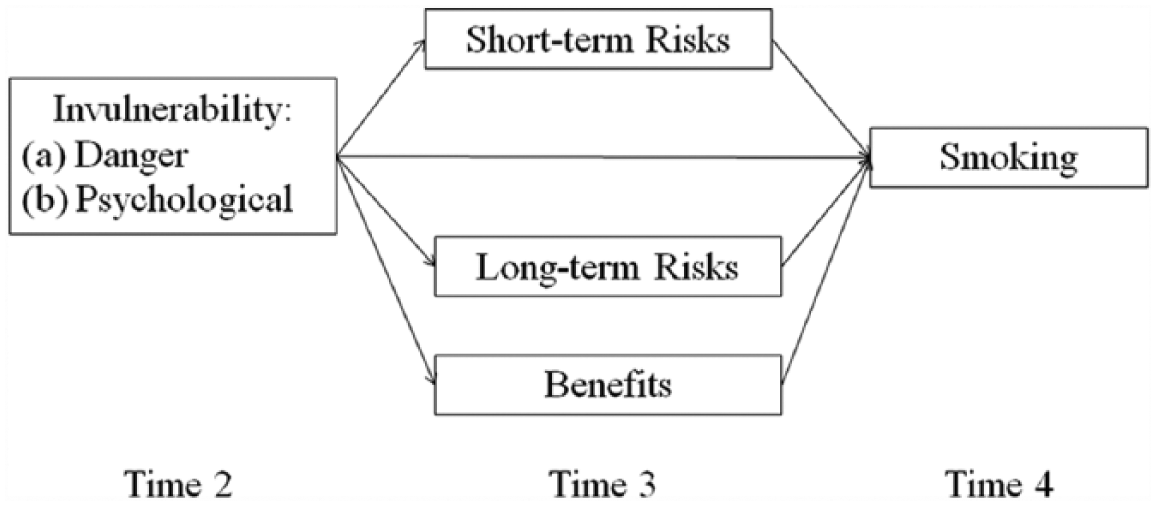
Path diagram of analyses testing perceptions of the risks and benefits as mediators of the relationship between invulnerability and smoking behavior, after controlling for participant sex and prior smoking experience. This model was tested twice: (a) once to test perceptions as mediators of the relationship between danger invulnerability and smoking behavior, and (b) once to test perceptions as mediators of the relationship between psychological invulnerability and smoking behavior.

Path diagram of analyses testing danger and psychological invulnerability as mediators of the relationship between perceptions of the risks and benefits of smoking and smoking behavior, after controlling for participant sex and prior smoking experience. Analyses were replicated across two sets of Time points: 1 and 2. This model was tested 3 times for each set of time points: (a) once with short-term risks predicting invulnerability, (b) once with long-term risks perceptions predicting invulnerability, and (c) once with benefits predicting invulnerability.
Two of the most common approaches to testing for mediation are the causal steps strategy described by Baron and Kenny (1986) and the product-of-coefficients approach, such as the Sobel test (Sobel, 1982). However, the causal steps approach has unacceptably low power to detect a significant mediation effect in all but very large samples, and the Sobel test assumes that the sampling distribution of the mediated (indirect) effect is normal, an assumption that is frequently violated (Hayes, 2009). Instead, experts recommend using bootstrapping methods to test the significance of the indirect effect (Hayes, 2009). This procedure involves drawing a sample of n cases with replacement from the original sample, estimating the indirect effect, and then repeating this process k times. Confidence intervals (CIs) are then calculated based on the estimates from the bootstrapping procedure and used to evaluate the significance of the indirect effect. These CIs typically produce more accurate estimates, have fewer problems with Type I error and statistical power than traditional CIs, and can be adjusted for bias.
In the current study, we evaluated three possible mediators of the relationship between invulnerability and smoking (perceptions of the short-term risks, long-term risks, and benefits of smoking) and two possible mediators of the relationship between perceptions and smoking (danger and psychological invulnerability). When several mediators are postulated, multiple mediation is most appropriate (Preacher & Hayes, 2008a). Multiple mediation involves testing the effects of several mediators simultaneously, and can be conducted using a bootstrapping approach. It is superior to conducting a separate mediation analysis for each mediator because it allows one to determine both the total indirect effect of the entire set of mediators and the specific indirect effect of each mediator separately, limits the likelihood of parameter bias resulting from omitted variables, and allows one to estimate the relative strengths of the effects of the different mediators in comparison with each other (Preacher & Hayes, 2008a).
For the present study, tests of multiple mediation using bootstrapping were conducted in SPSS 19 using the multiple mediation macro called “Indirect” (Preacher & Hayes, 2008a). This macro automatically accounts for the fact that our outcome variable (smoking behavior) is binary, which can cause problems in a mediation analysis if not properly addressed (MacKinnon & Dwyer, 1993). Estimates of effects, standard errors, and 95% CIs were calculated based on 5,000 randomly drawn bootstrap samples. The total indirect effect, the separate indirect effects for each mediator (denoted ab), and all pairwise comparisons among the specific indirect effects were evaluated for significance according to their bootstrap CIs. If the bootstrap 95% CI for a selected effect excluded 0, then that effect was deemed to be statistically significant at α = .05. We report and interpret our results with respect to bias-corrected (BC) bootstrap CIs, because they are generally considered to be most accurate (Briggs, 2006; Preacher & Hayes, 2008a; Williams & MacKinnon, 2008).
Traditionally, researchers have argued that the total effect of the predictor variable on the dependent variable must be statistically significant for mediation to occur. However, experts in the field now contend that this does not have to be true, especially for multiple mediation models due to suppression effects (Preacher & Hayes, 2008a; Shrout & Bolger, 2002). In other words, it is possible for the indirect effects of two different mediators to have opposite signs and therefore cancel each other out. As a result, the direct effect appears non-significant in either a statistical or practical sense, but there is a significant and theoretically or practically meaningful set of indirect effects. Therefore, we test mediation effects in the present analyses whether the effect of the predictor variable on the dependent variable is statistically significant.
While true causality cannot be inferred from the results of a non-experimental study such as the current one, testing variables in a clear temporal sequence by using longitudinal data may increase confidence in analytic outcomes (Preacher & Hayes, 2008b). Thus, we constructed our analyses such that every predictor variable preceded every mediator or dependent variable in time, and every mediator variable preceded every dependent variable in time. We also controlled for the effects of sex (0 = female, 1 = male), previous smoking experience (0 = no, 1 = yes), prior levels of invulnerability, and peer smoking where possible.
Results
Descriptive statistics are presented in Table 1 and correlations are presented in Table 2. As expected, perceptions of the short- and long-term risks of cigarette smoking were negatively associated with invulnerability, and perceptions of the benefits of smoking were positively associated with invulnerability. Perceptions were typically associated with danger invulnerability instead of psychological invulnerability, with a few exceptions: Short-term risk perceptions at Time 1 were significantly, negatively correlated with psychological invulnerability at Times 2 and 3, and both short- and long-term risk perceptions at Time 2 were significantly, negatively correlated with psychological invulnerability at Time 2. Short-term risk perceptions were significantly negatively correlated with danger invulnerability at all survey time points. Long-term risk perceptions at Times 3 and 4 were significantly negatively correlated with danger invulnerability at Times 2 and 3. Perceptions of benefits were significantly, positively correlated with danger invulnerability at all time points, except for benefits at Time 2 and danger invulnerability at Time 3.
Mean (SD) Subjective Invulnerability and Tobacco-Related Perceptions, and Frequency of Teen and Peer Smoking Behavior at Each Survey Time Point.

Note. Frequencies (percent) are reported for smoking behavior. Cells are empty at time points where data were not collected on variables of interest.
Bivariate Correlations Between Invulnerability and Tobacco-Related Perceptions Across All Survey Time Points.

p < .05. **p < .01. ***p < .001.
Results from mixed factorial ANOVAs (Sex × Time) showed that males reported higher levels of danger and psychological invulnerability than females, F(1, 172) = 32.29, p < .001, and F(1, 180) = 34.04, p < .001, respectively. For example, males’ average danger and psychological invulnerability scores were both 3.4 points higher than females’ average danger and psychological invulnerability scores at Time 2 (
A series of one-way, between-subjects ANOVAs were conducted to test for group differences in invulnerability and risk perceptions according to race or ethnicity at each survey time point. There were no differences by race or ethnicity in invulnerability, risk perceptions, or perceptions of benefits at any time point, with one exception: perceptions of benefits at Time 3 differed significantly by race or ethnicity. Post hoc pairwise comparisons indicated that Hispanic participants reported significantly higher perceptions of benefits (
At Times 1, 2, and 3, 12.7%, 23.6%, and 21% of participants reported having at least one friend who smoked, respectively. Results from chi-square analyses indicated that there were no sex or racial or ethnic differences at any time point in whether participants had friends who smoked, ps > .05. Mean danger and psychological invulnerability scores did not differ depending on peer smoking, with one exception: At Time 3, the mean danger invulnerability score was higher for participants who had at least one friend who smoked (
Aims 1 and 2: Relationship Between Invulnerability and Smoking Behavior
We first tested whether danger or psychological invulnerability predicted later smoking behavior. We were unable to control for previous smoking experience as a covariate in these analyses because doing so produced highly unstable parameter estimates, most likely due to the small number of smokers at each time point leading to an inadequate ratio of cases to variables. 1 After controlling for participant sex, results from logistic regression analyses indicated that a one-point increase in danger invulnerability at Time 2 was associated with a 9% increase in the odds of smoking at Time 3 (odds ratio [OR] = 1.09, p < .05). Given that the standard deviation of the Danger Invulnerability subscale was 5.70 at Time 2, this finding translates into a 51.3% increase in the odds of smoking for every one SD increase in danger invulnerability. We further tested whether this finding would be replicated across another pair of time points for which we had available invulnerability data, and found a similar pattern of results: A greater sense of danger invulnerability at Time 3 was associated with a 5% increase in the odds of smoking at Time 4 (OR = 1.05, p < .05). Given that the standard deviation of the Danger Invulnerability subscale was 6.56 at Time 3, this finding translates into a 32.8% increase in the odds of smoking for every one SD increase in danger invulnerability. Psychological invulnerability did not predict smoking behavior across either pair of time points (p > .6 from Time 2 to Time 3, and p > .9 from Time 3 to Time 4).
We conducted a second set of analyses testing danger and psychological invulnerability as predictors of smoking behavior across both pairs of time points that included peer smoking as a covariate in addition to sex. When peer smoking was included as a covariate in the regression model, the effect of danger invulnerability on smoking became non-significant, ps > .05. The effect of psychological invulnerability remained non-significant. Peer smoking was the only significant predictor of smoking across these two models. Having at least one friend who smoked was associated with a 134% to 213% increase in the odds of smoking, compared with not having any friends who smoked (OR = 2.34, p < .05 and OR = 3.13, p < .01, respectively).
Next, we tested whether smoking behavior predicted later danger or psychological invulnerability. Results from linear regression analyses showed that, after controlling for sex, previous levels of invulnerability, and peer smoking at Time 2, having smoked at Time 2 did not predict changes in danger or psychological invulnerability at Time 3 (p > .7 and p > .1, respectively). 2 Consistent with our preliminary analyses, gender was a significant covariate: On average, males exhibited danger and psychological invulnerability scores that were 2.95 and 1.87 points higher than those of females (ps < .001). As expected, previous vulnerability scores were significantly associated with later vulnerability, ps < .01. Peer smoking was not a significant predictor of danger or psychological invulnerability (p > .08 and p > .1, respectively).
Aim 3: Mediation
In testing both sets of mediation models associated with Aim 3 (described below), a second set of analyses was conducted, in which peer smoking was added as a covariate in addition to sex and prior smoking experience. Peer smoking was not a significant covariate in any of the analyses. We also controlled for levels of mediators at earlier survey time points, but none was statistically significant, nor did they produce significant improvements in the models. Therefore, in the interest of parsimony and according to standard practice, peer smoking and levels of mediators at previous time points were not included in the final mediation models. Results of all final mediation models are presented in Table 3.
Results of Multiple Mediation Analyses Predicting Adolescent Smoking Behavior After Controlling for Sex and Previous Smoking Experience.

Note. ab = indirect effect; BC 95% CI = 95% bias-corrected bootstrap confidence interval; Initial = analyses performed across first set of survey time points (Time 1, Time 2, and Time 3); Replication = analyses performed across second set of survey time points (Time 2, Time 3, and Time 4). Significant effects are highlighted in bold.
Perceptions as mediators between invulnerability and behavior
Results from multiple mediation analyses testing perceptions of the risks and benefits of smoking at Time 3 as mediators of the relationship between invulnerability at Time 2 and smoking behavior at Time 4 indicated that, after controlling for sex (all ps > .05) and prior smoking experience (ORs = 6.06 and 5.85, ps < .001), only the perceived benefits of smoking significantly mediated the relationship between danger invulnerability and smoking behavior (ab = .03, BC 95% CI = [.004, .078]). Specifically, a one-point increase in danger invulnerability was associated with a 4% increase in the odds of smoking (OR = 1.04, p < .05) through the effect of perceived benefits of smoking and after controlling for covariates. Given that the standard deviation of the Danger Invulnerability subscale was 5.70 at Time 2, this finding translates into a 22.8% increase in the odds of smoking for every one SD increase in danger invulnerability, through the effect of perceived benefits of smoking and after controlling for covariates. Perceptions did not mediate the relationship between psychological invulnerability and smoking behavior. Pairwise comparisons of the specific indirect effects confirmed that perceptions of benefits was a significantly stronger mediator than perceptions of short-term risks (ab = −0.03, BC 95% CI = [−.085, −.001]), but not long-term risks and (ab = −0.03, BC 95% CI = [−.077, .012]).
Invulnerability as a mediator between perceptions and behavior
Results from multiple mediation analyses that tested danger and psychological invulnerability as mediators of the relationship between smoking-related perceptions and smoking behavior after controlling for sex (all ps > .05) and prior smoking experience (ORs ranged from 3.06 to 4.43, all ps < .001) indicated that neither danger nor psychological vulnerability at Time 2 mediated the relationship between perceptions of risks or benefits at Time 1 and smoking behavior at Time 3. These results were replicated in a mediation analysis evaluating invulnerability at Time 3 as a mediator of the relationship between perceptions at Time 2 and smoking behavior at Time 4.
Discussion
This is the first study to our knowledge that has evaluated prospective associations among adolescents’ subjective sense of invulnerability (danger and psychological), their perceptions of the risks and benefits of cigarette smoking, and their subsequent smoking behavior. Our first aim was to determine whether subjective invulnerability influenced smoking behavior, or vice versa. Findings showed that, as hypothesized, a greater sense of danger invulnerability was associated with greater odds of smoking 6 months later, a result that was replicated across two pairs of survey time points. Also, consistent with our hypotheses, smoking behavior was not associated with a significant change in invulnerability after controlling for sex and previously reported levels of invulnerability. These findings support the idea that invulnerability as measured in the current study may be more of a developmental construct that influences, but is not influenced by, behavior.
Our second aim was to ascertain whether danger and psychological invulnerability were differentially related to smoking behavior. Consistent with our hypothesis, only danger invulnerability predicted smoking behavior 6 months later and was a significant predictor variable in our mediation analyses. One plausible explanation for this finding is that cigarette smoking is generally considered in terms of its physiological rather than psychological risks, and danger invulnerability is specifically associated with a “propensity to take physical risks” (Lapsley & Hill, 2010). Smoking is primarily presented by the media and in educational settings as a hazard to physical health, and smoking cessation is often regarded as the responsibility of health care professionals such as physicians.
With respect to Aims 1 and 2, it is important to note that danger invulnerability was no longer significantly associated with having ever tried smoking once friend smoking was controlled for, and that friend smoking was strongly associated with participant smoking behavior. Peer smoking was not significantly correlated with danger invulnerability at any time point in our sample (all ps were non-significant after applying a Bonferroni correction for multiple comparisons and all r values were below the recommended minimum effect size of .2; Ferguson, 2009), which suggests that shared variance between invulnerability and peer smoking is not responsible for the fact that invulnerability was no longer a predictor of smoking after including peer smoking in the regression model. These findings are consistent with a large body of research showing that peer smoking is one of the strongest predictors of adolescent smoking (Simons-Morton & Farhat, 2010), and suggests that friends’ influence may be an even more powerful determinant of teen smoking than at least one developmental factor, invulnerability.
Our third aim was to test whether smoking-related perceptions would mediate the relationship between invulnerability and smoking behavior or, alternatively, whether invulnerability would mediate the relationship between perceptions and behavior. These results provided evidence to support our hypothesis that perceptions would act as mediators of the relationship between invulnerability and smoking behavior, but that invulnerability would not serve as a mediator between perceptions and smoking behavior.
It is noteworthy that perceptions of the benefits of smoking, but not perceptions of the risks, mediated the relationship between invulnerability and smoking behavior. Adolescents who felt less vulnerable to physical (but not psychological) harm perceived the benefits of smoking to be greater, and these greater perceived benefits were associated with greater odds of smoking. It is conceivable that the benefits of smoking are more salient than the risks to adolescents who feel less vulnerable to harm. The lack of a relationship with short- and long-term risk perceptions was not likely due to low statistical power, as our sample size was large and we used a type of statistical mediation analysis that does not rely on exceptionally large samples. Thus, these results add to a growing body of literature suggesting that perceptions of benefits are as important as perceptions of risk in determining adolescent smoking behavior (Halpern-Felsher et al., 2001; Song et al., 2009). These findings emphasize the importance of identifying, acknowledging, and challenging adolescents’ perceptions of the benefits of smoking as part of smoking prevention programs for youth, which currently focus almost exclusively on increasing perceptions of tobacco-related harm.
Peer smoking was not a significant predictor in the multiple mediation models, which was unexpected given the established importance of peer smoking to adolescent smoking behavior. One possible explanation is that shared variance among the independent variables may have obscured the unique contributions of individual predictors; however, bivariate correlations among all predictors indicated that none of them were consistently or strongly associated with each other. A more plausible explanation may be found in the formal interpretation of the results of the mediation models. Given that the models are estimated with all predictors entered simultaneously, the effect of peer smoking on adolescent smoking is not significant when holding all other predictors constant, including invulnerability, perceptions, sex, and prior smoking experience. In other words, peer smoking is no longer an important predictor when other variables of interest are included in the model. A similar phenomenon was observed when levels of all mediators at previous survey time points (invulnerability or perceptions of the risks and benefits of smoking, depending on the model) were included as covariates in the models: The effects of previous levels of the mediators on adolescent smoking were not significant when holding all other predictors constant.
Our findings have implications for how invulnerability fits into models of adolescent decision making, at least as applied to cigarette smoking. If future research shows that the observed relationship among invulnerability, perceived benefits, and behavior holds for other types of risk behavior, such as risky driving or sexual activity, then it may be useful to include invulnerability in decision-making theories more broadly. The results of the present study also corroborate the assertion in models of health behavior that perceptions are the most proximal predictors of smoking behavior. However, it remains important to determine whether the distinction between invulnerability and perceptions holds for other forms of risk behavior, or for different populations (e.g., among adults or highly religious people). In addition, our findings confirm the importance of friend smoking as a predictor of teen smoking, and provide evidence to suggest that in some circumstances friend smoking may be more strongly associated with adolescent smoking than developmental characteristics such as invulnerability.
Our results also have implications for our understanding of optimistic bias, which occurs when individuals believe that good outcomes are more likely to happen to themselves than to others, and that bad outcomes are more likely to happen to others than to themselves. Optimistic bias, measured in terms of perceived risk, is often assumed to be a measure of the same underlying construct as invulnerability (Jacobs-Quadrel et al., 1993; Millstein & Halpern-Felsher, 2002b). However, the current study indicates that perceived risk and invulnerability are distinct constructs, which calls into question the assumption that optimistic bias and invulnerability represent the same construct. Specifically, invulnerability was not consistently correlated with the perceived risks of smoking in the current study (the single significant correlation was low enough [r = −.20] to imply the existence of distinct but related constructs).
Limitations
The results of the current study must be interpreted in the context of several limitations. The sample included adolescents from one public high school in Northern California, which may limit generalizability. While our data were longitudinal, invulnerability was only measured at two survey time points, which prohibits an examination of long-term trajectories of invulnerability, perceptions, and smoking. Furthermore, the results of our tests of whether invulnerability predicts smoking or smoking predicts invulnerability may not be directly comparable. We were not able to control for previous smoking in the first set of analyses, but we were able to control for prior levels of invulnerability in the second set of analyses. As a result, we were predicting absolute levels of smoking as a function of invulnerability, versus changes in invulnerability as a function of smoking. Therefore, we cannot say whether invulnerability is associated with a change in smoking behavior, which is fundamentally different from having ever tried smoking. It would be useful to investigate this relationship in future studies, as it is possible that invulnerability may predict changes in smoking behavior and that this relationship may change as adolescents develop.
Although perceptions of the benefits of smoking mediated the relationship between danger invulnerability and smoking behavior, danger invulnerability was associated with a relatively small increase in perceptions of the benefits of smoking (an increase of 0.82 percentage points for every one-point increase in invulnerability). These findings indicate that, while invulnerability may prove useful as a predictor of benefits perceptions at a population level, there are other factors that are likely to be stronger predictors. One study has already demonstrated that previous experimentation with smoking is a strong predictor of smoking-related perceptions (Morrell et al., 2010), but future research should examine what factors predict pre-experimentation perceptions, as well as which additional factors may predict post-experimentation perceptions and thus progression to regular or daily smoking. Identifying these factors and their mechanisms of action will be critical to reducing cigarette smoking among youth. Plausible candidates for exploration include adolescents’ exposure to tobacco use in the media, tobacco industry marketing, and smoking within the family, which have been shown to influence adolescent smoking behavior (Dalton et al., 2009; Mays et al., 2014; Pierce et al., 1991).
The finding that the relationship between invulnerability and adolescent smoking disappeared after controlling for peer smoking raises the question of how important invulnerability is to teen smoking. However, context is key to interpreting these results. Peer smoking was only more important than invulnerability when perceptions of the risks and benefits were not included in the statistical model (i.e., Aim 1). However, peer smoking was no longer a significant predictor of teen smoking when included in the mediation models, thus providing evidence to support the importance of invulnerability when perceptions are considered.
Finally, it is possible that not controlling for previous levels of all mediators in the final mediation models may limit the strength of our prospective design. However, given that previous levels of mediators were not significant covariates, nor did they improve the overall models, any adverse impact is likely to be minimal.
Conclusion
Taken together, the results of the present study suggest that invulnerability may influence adolescent smoking behavior by increasing the perceived benefits of smoking. This has important theoretical and practical implications. At least for adolescent smoking, we may wish to consider revising decision-making models to include perceived benefits as mediators between invulnerability and smoking behavior, instead of as merely exogenous predictors of smoking. On a practical level, our findings suggest that tobacco prevention efforts, which currently focus almost exclusively on increasing perceptions of tobacco-related harm, should also focus on decreasing perceptions of tobacco-related benefits.
Footnotes
Declaration of Conflicting Interests
The author(s) declared no potential conflicts of interest with respect to the research, authorship, and/or publication of this article.
Funding
The author(s) disclosed receipt of the following financial support for the research, authorship, and/or publication of this article: This work was supported by the Tobacco-Related Disease Research Program (14RT-0010H and 9Kt-0072); the Raschen-Tiedenann Fund of the Research Evaluation and Allocation Committee, School of Medicine, University of California, San Francisco; the U.S. Department of Health and Human Services, National Institutes of Health, National Cancer Institute (1F32CA141933-02); and the University of California, San Francisco Academic Senate Committee on Research.