




Abstract
There is little consensus on how to conceptualize coping after perceived failure and less is known about the contextual resources that may support or undermine the use of specific coping strategies. This study examined parenting in relation to coping using the framework of self-determination theory and examined the motivational processes through which parenting, specifically parental structure, autonomy support, and involvement, may be associated with coping. Findings showed that the relations between parental structure and parental autonomy support and defensive coping were mediated by perceived control; however, there were also direct effects of structure and autonomy support, unmediated by this motivational resource. Findings also suggest that parent involvement directly predicts mastery coping.
There is no doubt that classrooms are rife with academic challenges, such as difficult tasks, group work, and test taking, that affect children’s cognitions and behaviors. Thus, in order to be successful, students must bring to bear coping strategies so as not to be disrupted when they encounter stressful academic situations. Much of the work on coping with academic challenges has focused on how students regulate the emotions that arise during challenging assignments, such as test taking (Hodapp & Benson, 1997; Sarason & Sarason, 1990). Less research has examined coping strategies that students employ following perceived negative or failure feedback, where students can use the information they receive to enhance their progress or be disrupted by it. These academic coping strategies may be particularly relevant for late elementary age students (e.g., sixth grade) because at this age, children experience increased competition, standardized testing, and comparative judgments about their own academic competencies relative to others (Stipek & Mac Iver, 1989) that may make coping with failure experiences particularly threatening. Furthermore, urban youth have been shown to be at heightened academic risk (Rumberger & Thomas, 2000). Thus, identifying resilience factors, such as academic coping, is particularly critical for this group.
Although there is a substantial body of literature on coping in general, there have been few studies that have systematically examined individual differences in students’ experiences of failure feedback or the strategies they use to cope with their corresponding internal experiences, with even fewer studies including a diverse, urban sample. This study addresses this gap by examining coping strategies utilized when students confront inevitable academic failure experiences at school among a group of diverse, urban, sixth-grade students.
What is even less understood are the contexts that support or undermine academic coping. Given that social contexts can influence the stressors to which a child is exposed, how those stressors are experienced, and how the child responds or copes with the stressors, it is critical to view coping not only as an individual resource, but also as a social process (Compas, Champion, & Reeslund, 2005; Eisenberg, Fabes, & Guthrie, 1997). Much of the work on contexts for academic coping and success has focused on classroom factors (e.g., Hamre & Pianta, 2001; Jang, Kim, & Reeve, 2012; Jang, Reeve, & Deci, 2010; Zimmer-Gembeck & Locke, 2007), with little attention devoted to the home environment and the mechanisms through which the home might exert its effects on academic coping behaviors. This project thus fills this gap by examining specific dimensions of parenting in relation to coping using the framework of self-determination theory (SDT; Deci & Ryan, 1985). Furthermore, the study examines the motivational processes through which parenting may be related to coping, building on the more general model that self-related affects and cognitions mediate relations between contexts and school achievement (Connell & Wellborn, 1991).
Coping Strategies in the Academic Domain
There is abundant literature focusing on individual differences in children’s use of coping strategies. Most frameworks distinguish between coping responses that involve children taking an active approach to dealing with the stress and trying to solve the problem and those involving more defensive or self-focused responses. In particular, Carver, Scheier, and Weintraub (1989) distinguished between problem-focused and emotion-focused strategies. On the active side, problem-focused coping includes strategies that individuals employ to manage the demands of the task (Lazarus & Folkman, 1984) and broadly reflects an outward approach aimed at mastering the environment and ameliorating the situational stress. Such responses are evident in others’ categories of problem-focused coping (Carver et al., 1989), problem solving (Causey & Dubow, 1992), direct problem solving and positive coping (Tero & Connell, 1984). Newman (2000) has focused on another active problem-focused coping strategy, which he termed adaptive help-seeking, in which students monitor their academic performance, show awareness of difficulty that cannot be overcome independently, and remedy that difficulty by requesting assistance from others. In addition, a related but distinct coping strategy includes students’ attempts to engage in social transactions in the service of receiving emotional reassurance or support. This category of coping, coined “support for feeling,” involves seeking out others to listen to feelings or providing some understanding, so the failure experience is less emotionally upsetting (Ayers, Sandler, West, & Roosa, 1996). These three coping strategies—problem solving, adaptive help-seeking, and support for feeling—while distinct, all reflect an active approach aimed at ameliorating the effects of failure and henceforth are referred to as mastery strategies.
The second cluster of coping, emotion-focused strategies (Carver et al., 1989; Schutz, Hong, Cross, & Osbon, 2006), reflects defensive responses that shift students’ concentration away from the task and onto their own feelings in the service of restoring internal experiences threatened by failure. Students who use emotion-focused strategies may rely on attentional deployment, whereby they pay attention to certain aspects of the stressful situation (e.g., Gross & Thompson, 2007), but do so by perseverating on aspects of the task that are outside of their control (e.g., that a teacher is being unfair in grading an assignment). Thus, these students may respond to failure by confronting others, becoming aggressive, engaging in externalizing behaviors, showing some physical release of emotions, venting, or blaming others (Causey & Dubow, 1992; Skinner & Wellborn, 1997; Spirito, Stark, Grace, & Stamoulis, 1991). Theorists have also described emotion-focused strategies in which individuals deliberately attempt to conceal their emotional reactions and disengage from the task (Schutz et al., 2006). These students may deny the significance of the failure (Tero & Connell, 1984) or defensively engage in cognitive avoidance as a way of protecting or maintaining their esteem. In addition to utilizing cognitive avoidance, students may engage in what Gross and colleagues (e.g., Gross & Thompson, 2007) call cognitive change strategies, in which they change the meaning of their experience to be more inwardly focused, with self-denigration or rumination or by blaming themselves for the challenges they have faced. Given that many approaches suggest that rumination is a manifestation of experiential avoidance (Mellings & Alden, 2000), these strategies may also serve to avoid contact with the failure. While these three coping strategies—cognitive avoidance, rumination, and blame—differ in fundamental ways, they all attempt to restore or protect the self and are heretofore referred to as defensive coping.
Given the myriad ways that students could cope in the context of academic failure, it is important to identify when and why students may utilize specific coping clusters. In this study, we employ a theoretical view, SDT (Deci & Ryan, 1985), that delineates key motivational and contextual factors that may explain why some students respond to failure through mastery efforts whereas others respond with defensive attempts to protect their esteem.
Self-Determination Theory—Conceptual Framework
SDT asserts that people have universal and basic psychological needs (Deci & Ryan, 1985) and coping, according to this standpoint, is best understood in relation to these needs (Skinner & Wellborn, 1994). This theoretical perspective suggests that individuals have a need to feel related or connected to, loved, and valued by others (Baumeister & Leary, 1995; Leary, 2010). In addition, people have a need for autonomy or to feel volitional regarding their actions (Deci & Ryan, 1985). Lastly, people have a need to feel competent or effective in their interactions with the environment (Ryan & Deci, 2000; Skinner, Wellborn, & Connell, 1990). Academic challenges, setbacks, and difficulties may especially impinge upon children’s experience of competence.
In school, there are many challenges and all children, even students who do well, face difficulties, do badly, or even fail, at some point. Situations that potentially threaten a person’s experience of competence are objectively stressful (Skinner & Wellborn, 1994). However, Skinner and Wellborn (1994) proposed a SDT-based theory that suggests that academic failure can be experienced as either a challenge to competence, in which failure is viewed as a source of information on how to build competencies, or a threat, in which the message is incompetence.
What might influence children’s experience of stressful situations as threats or challenges to their competence? Two motivational resources around competence may be particularly important. First, a large body of research on learned helplessness (Abramson, Seligman, & Teasdale, 1978; Kay, Sullivan, & Landau, 2015) suggests that a sense of perceived control, which refers to a person’s knowledge about how outcomes are attained (Connell, 1985; Muldoon, Lowry, Prentice, & Trew, 2005), may predict children’s experience of difficult situations. Individuals with low perceived control who do not expect that they can produce or prevent outcomes may be more vulnerable to experiencing such events as threatening to their needs. For example, there is evidence that when individuals believe that they cannot control an unpleasant event, they will experience that event as more stressful (Peterson, Maier, & Seligman, 1993) and there is evidence to suggest that a sense of perceived control can impact a person’s affective experiences of challenging academic tasks (Pekrun, 2000).
Second, children’s perceived competence (Harter, 1982) or sense of their capacity to master outcomes may contribute to the experience of events as challenges or threats (Skinner & Wellborn, 1994). Children who are convinced of their own efficacy may interpret failure as an opportunity to learn from obstacles. Children who doubt their capacities, on the other hand, may experience setbacks as compromising their need to feel competent.
These motivational resources may make a difference in terms of how children cope. For example, if students have these motivational resources around competence, they can focus their attention away from the self and seek to understand how contingencies in the context are operating by actively problem solving and seeking information to understand and complete the task at hand. Rather than directing attention inward in an attempt to restore their self-views, these students can channel their efforts into mastering the environment (Skinner, Edge, Altman, & Sherwood, 2003; Skinner, Pitzer, & Steele, 2013). Therefore, these students are more likely to demonstrate mastery coping response patterns (Dweck, 1999) by utilizing problem solving, adaptive help-seeking, and support for feeling.
By contrast, if children do not have these resources, they may react less effectively. Their responses will be less focused on understanding material, tackling issues, or learning. Instead, they will be focused on the self with efforts to restore internal experiences of competence, specifically by avoiding the failure or by blaming others or themselves (Rhodewalt & Vohs, 2005; Skinner et al., 2003). Research on self-regulation has found some support for these relations. Doran, Stephan, Maiano, and Le Scanff (2011) found, for instance, that students who endorsed high levels of amotivation, reflecting an experience of passivity or helplessness, were less likely to utilize mastery strategies and more likely to use defensive strategies. To date, despite relevant theory, no empirical research has examined the joint and unique contributions of perceived competence and perceived control to coping strategy use.
Parenting Context
In addition, SDT identifies three contextual dimensions that facilitate experiences of perceived control and competence and ultimately academic coping. Of particular relevance, the theory proposes that structure, whereby environments provide clear and consistent expectations, predictable responses, and specific feedback, meets individuals’ needs for competence (Farkas & Grolnick, 2010). Given that the key environment for the development of motivation is homes (Grolnick & Ryan, 1989), the theory suggests that homes that provide high-quality structure give children an understanding of how their behavior is connected with outcomes and a sense that they are able to affect them. By contrast, when expectations, consequences, and feedback are not clearly delineated, it is not clear to children how their behavior affects outcomes in their environment, thus they are likely to feel incompetent and have maladaptive control beliefs—beliefs that luck or unknown sources control outcomes. Thus, according to SDT, parental structure should be associated with experiences of perceived control and perceived competence.
A number of empirical studies have found that parental structure is in fact associated with children’s perceived competence and perceived control. Grolnick and Ryan (1989) found that higher parental structure was associated with children’s reports of greater academic perceived control. Farkas and Grolnick (2010) showed that parental provision of academic structure was positively associated with both general perceived control and children’s perceived academic competence, and was negatively associated with children’s maladaptive control beliefs. These two studies suggest that when parents provide structure in the home, children feel more competent and are more likely to see relations between actions and outcomes, both of which have been found to enable students to cope with academic challenges in more effective ways.
SDT also identifies two other need-supportive contextual dimensions: autonomy support and involvement. Parents support their child’s need for autonomy by encouraging children’s initiations and autonomous problem solving and taking their perspectives. Controlling practices, in which adults pressure children toward specific outcomes, deny them the opportunity to solve problems themselves, and ignore their perspectives, hinder children’s sense of autonomy, and leave children feeling coerced and externally regulated (Grolnick & Ryan, 1989). Some authors (e.g., Pomerantz & Eaton, 2000) have argued that parental control indicates to children that their worth is contingent on meeting targeted outcomes and, if they fail to meet outcomes, it is because they are incompetent. Consistent with this argument, Grolnick, Ryan, and Deci (1991) found positive correlations between parental autonomy support and children’s perceived competence and perceived control. In a related line of research, Friedel, Cortina, Turner, and Midgley (2007) showed that when parents pressured students toward specific outcomes by emphasizing school grades and peer comparison, students were more likely to adopt performance goals, and in turn respond to failure feedback with maladaptive coping or non-coping. In contrast, when parents supported students’ autonomous initiations and acquisition of new skills, students endorsed more mastery goals, felt more self-efficacious, and subsequently responded to academic challenges by remaining emotionally and behaviorally engaged with the task. The results of these studies indicate that parental autonomy support is an important contextual resource for developing students’ perceived competence and control.
Lastly, SDT proposes a third contextual dimension, parent involvement, which generally refers to the degree to which parents are interested in, have knowledge about, and actively participate in their child’s life (Grolnick & Slowiaczek, 1994). Grolnick and Slowiaczek (1994) proposed that parent involvement facilitates children’s sense of competence that would enable them to put forth effort in academic tasks. In support of this model, parental academic involvement has been linked to tenth-grade students’ academic self-efficacy in a diverse sample (Hong & Ho, 2005), effortful control (i.e., students’ active attempts to shift attention, inhibit responses, and initiate behavior on difficult tasks; Wong, 2008), and both ego resilience (i.e., the ability to adjust to change and cope with stress) and engagement coping (self-regulation of emotions and solution-seeking; Swanson, Valiente, Lemery-Chalfant, & O’Brien, 2011).
In sum, research has shown that parental structure, autonomy support, and involvement are associated with students’ perceptions of control and competence. Yet to be examined are the relations between these parenting dimensions and coping, both direct associations and relations mediated through perceived competence and control.
Current Project
The goals of the current study were twofold. A first was to examine specific dimensions of parenting in relation to coping, using the framework of SDT (Deci & Ryan, 1985). A second was to examine the motivational processes through which parenting may be related to coping. In doing so, the study addressed the following questions: (a) How are parenting variables associated with mastery and defensive coping? (b) Is there evidence that perceived control and perceived competence mediate the effects of parental structure, autonomy support, and involvement on children’s coping? (c) Are there direct effects of these three parenting dimensions on children’s coping?
Based on SDT and studies demonstrating the positive effects of parental autonomy support, involvement, and structure on child outcomes, it was hypothesized that these three parenting dimensions would be positively associated with mastery coping strategies and negatively associated with defensive strategies. We also predicted that perceived control and perceived competence would mediate these relations (see Figure 1). However, given that others have proposed direct effects of parenting on coping (Power, 2004), we also tested a competing direct effects model in which parental autonomy support, involvement, and structure show both direct and indirect effects on children’s academic coping.
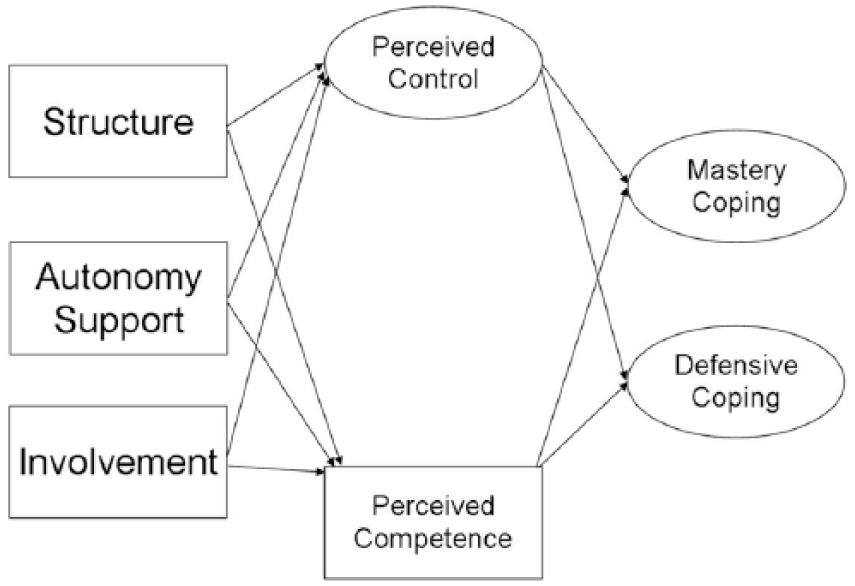
Hypothesized indirect effects model with structure, autonomy support, and involvement affecting inward- and outward-focused coping through perceived control and perceived competence.
Method
Participants
The sample included 201 sixth-grade children (97 boys, 104 girls,
Procedure
Students were informed about the project in their classrooms and received a letter (in either English or Spanish) describing the study to take home and return to school. The letter asked parents to indicate if they were interested in learning more about the study. Spanish letters and questionnaires were translated and then back translated by another native Spanish speaker. Approximately 510 letters were sent home to families. Fifty-nine percent of parents returned the forms. Of families returning letters, 67% indicated interest. This response rate is comparable with those of other studies involving in-person parent participation (e.g., Laursen, DeLay, & Adams, 2010). Interested families were called and visits scheduled either at the family’s home or at the university. After parents provided written consent and children provided written assent, parents and children completed questionnaires. Families were given US$60 for their participation. All study procedures were approved by the university Institutional Review Board and by the Research and Accountability Office of the participating school district.
Measures
Coping
Based on a broad review of the coping literature, coping subscales from three questionnaires were included to measure a variety of responses that children have to academic failure or setbacks.
Children’s Academic Coping Inventory
This questionnaire assesses children’s affective, behavioral, and cognitive responses to academic failure (Tero & Connell, 1984). Four items from the Positive Coping subscale measure the child’s active attempts to remedy the cause of the perceived failure (e.g., “When I do badly on an important test, I try to find out what I did wrong, so that it won’t happen again”). Four items from the Anxiety Amplification subscale measure worry and self-denegation (“When I do badly on an important test, I worry whether it will happen again”). Four items from the Denial subscale assess children’s attempts to deny the significance of the failure (e.g., “If I do badly on an important test, I try to forget about it”). Children respond on 4-point Likert-type scales from not at all true to very true.
Children’s coping in the academic domain
This questionnaire measures a variety of ways children can cope with stress in the academic domain (Skinner & Wellborn, 1997). Four items from the Support-Seeking (help-seeking) subscale measure seeking guidance and problem-focused support (e.g., “If I do badly on an important test, I ask for some help with understanding the material”). Four items from the Opposition (projection) subscale measure blaming others to cope with the failure (e.g., “When I do badly on an important test, I blame the teacher”). Children respond on 4-point Likert-type scales (very true to not true at all).
How I Cope Under Pressure Scale
Children’s attempts to seek out others for emotional reassurance and social support were measured with two items from the How I Cope Under Pressure Scale’s (HICUPS) Support for Feeling subscale (e.g., “I talk about my feelings with someone who really understands”). Items were adapted so children reported on their responses following academic failure as opposed to a general stressor. Children responded on 4-point Likert-type scales (very true to not true at all). Coping items from both subscales were subjected to a confirmatory factor analysis using structural equation modeling (SEM) using Amos 19.0. The findings from this analysis are presented in detail in the “Results” section (Ayers et al., 1996).
Parenting
Parent structure
The 12-item Parental Structure Self-Report Questionnaire assesses children’s perceptions of their parents’ provision of structure around school. This measure of parental structure was chosen given that it has been shown to relate to children’s perceptions of competence and control (Grolnick & Wellborn, 1988). Sample items include “My parents make it clear what they expect of me in school” and “When I don’t do my best in school, I never know how my parents will act” (reverse coded). Children respond on 4-point Likert-type scales (very true to not true at all). In the present study, one item “In my home, the kids are expected to do homework and schoolwork a certain way” was dropped to improve subscale reliability (Cronbach’s α = .71). The remaining items were averaged to compute a single parental structure measure, with higher scores designating more provision of structure.
Parent autonomy support
Children’s perceptions of their parents’ autonomy support versus control were measured with the Parenting Context Questionnaire (PCQ; Grolnick & Wellborn, 1988; for example, “When it comes to school, my parents are always telling me what to do”; reverse coded). Children respond on 4-point Likert-type scales (very true to not true at all). In this study, items were adapted so children reported on their perceptions of both parents (or one parent in the case of a single parent home) in relation to school. Because only five items measured parental autonomy support around school, two additional autonomy support items were written for this study that are related theoretically to other existing measures of perceived parental autonomy support (e.g., Grolnick & Wellborn, 1988). In this study, the seven-item questionnaire evidenced an alpha of .72.
Parental involvement
Children’s perceptions of their parents’ involvement were measured with Grolnick, Benjet, Kurowski, and Apostoleris’s (1997) personal involvement questionnaire (e.g., “My parents know when it’s time for my report card to be out”). Grolnick et al. (1997) have found the scale to be associated with several outcome measures, including perceived competence, self-worth, and grades (e.g., Grolnick, Kurowski, Dunlap, & Hevey, 2000). Children indicate on 4-point Likert-type scales how true they think statements about their parents are. One item, “My parents know the names of the other kids of my class,” was dropped to improve subscale reliability (Cronbach’s α = .72).
Motivational resources
Perceived control
The Student Perceptions of Control Questionnaire (Skinner, Zimmer-Gembeck, & Connell, 1998) assesses children’s perceptions of who or what controls their successes and failures. In this study, only the academic items were administered. One 6-item scale assesses children’s overall control perceptions (e.g., “If I decide to learn something hard, I can”). Two scales, each with four items, assess children’s beliefs about strategies for success, including luck (e.g., “To do well in school, I have to be lucky”) and unknown (e.g., “If I get a good grade on a test, I usually don’t know why”). Children respond on 4-point Likert-type scales from not at all true to very true. The Luck and Unknown subscales were highly correlated, r = .65, p < .01. Others (e.g., Skinner et al., 1998) have averaged these two subscales to create a “Maladaptive Strategy Belief scale.” To test whether these two subscales could be combined, items (N = 8) were submitted to a principal components factor analysis using varimax rotation. Findings confirmed a single maladaptive strategy belief factor (eigenvalue = 3.89, accounting for 48.63% of the variance) and thus items from both subscales were averaged to create a Maladaptive Strategy Belief scale with higher scores indicative of greater endorsement of maladaptive beliefs about what controls their success and failures. In this study, alphas were .62 for overall control and .84 for maladaptive strategy beliefs.
Perceived competence
The Self-Perception Profile for Children (Harter, 1982) assesses children’s perceived competence in several domains and their general self-worth. Children’s perceptions of their academic competence were assessed with the four-item academic subscale. Children identify which of two opposing statements are most like them and report if that statement is really true for them or sort of true for them (e.g., “Some kids often forget what they learn BUT other kids can remember things easily”). An academic perceived competence composite was calculated by averaging the scores on the four items. Grolnick et al. (1991) have found relations with autonomous motivation and academic outcomes. In this study, Cronbach’s α was .79.
Results
Data Analytic Plan
Given that our missing data were less than 1% for all variables and were missing at random, mean substitution was used (Tabachnick & Fidell, 2012) . First, we used confirmatory factor analysis to examine the complex higher order model of coping theoretically proposed. Next, means, standard deviations, and possible ranges of all variables were examined (see Table 1). Correlations between parenting, motivational resources, and coping were then conducted. Maternal education and child gender were included in these analyses to determine if they should be included as covariates in subsequent analyses.
Means, Standard Deviations, and Ranges for All Variables.

Finally, SEM using IBM SPSS Amos 19 (Arbuckle, 2010) was used for model testing as it allows for estimation of error variance and thus is a more precise statistical analysis, as compared with path analysis (Meyers, Gamst, & Guarino, 2009). A full-information maximum likelihood procedure was employed in estimating the parameters. The proposed mediational model examined the extent to which parenting dimensions of autonomy support, structure, and involvement affect mastery and defensive coping, through their effects on students’ perceived competence and perceptions of control. A direct effects model was tested, examining whether the inclusion of all direct paths from parenting to coping variables fit the data. Maternal education and child gender were included as covariates, by allowing paths to all variables.
Preliminary analysis of the coping measure
The 20 coping items were subjected to a confirmatory factor analysis with SEM using Amos 19.0. Full-information maximum likelihood estimation was used. A higher order model was tested in which items loaded on six first-order factors (problem solving, help-seeking, support for feeling, avoidance, rumination, blame) which loaded on two general coping categories (mastery, defensive). Figure 2 depicts the tested model. This model showed adequate fit, χ2(165) = 254.80, χ2/df = 1.54, incremental fit index (IFI) = .93, comparative fit index (CFI) = .93, root mean square error of approximation (RMSEA) = .052, 90% confidence interval (CI) = [0.039, 0.064], and all of the indicators loaded onto their respective factors, p < .001 level. The results suggest that six latent factors reflect two higher order dimensions, with problem solving (Cronbach’s α = .82), help-seeking (Cronbach’s α = .74), and support for feeling (two items highly correlated, r = .65, p < .01) loading on “mastery” coping, and avoidance (Cronbach’s α = .69), rumination (Cronbach’s α = .71), and blame (Cronbach’s α = .80) loading on “defensive” coping. The six coping indicators were computed by calculating an average of their respective indicator variables and were used to create higher order latent factors, “mastery” and “defensive” coping in subsequent structural equation models.
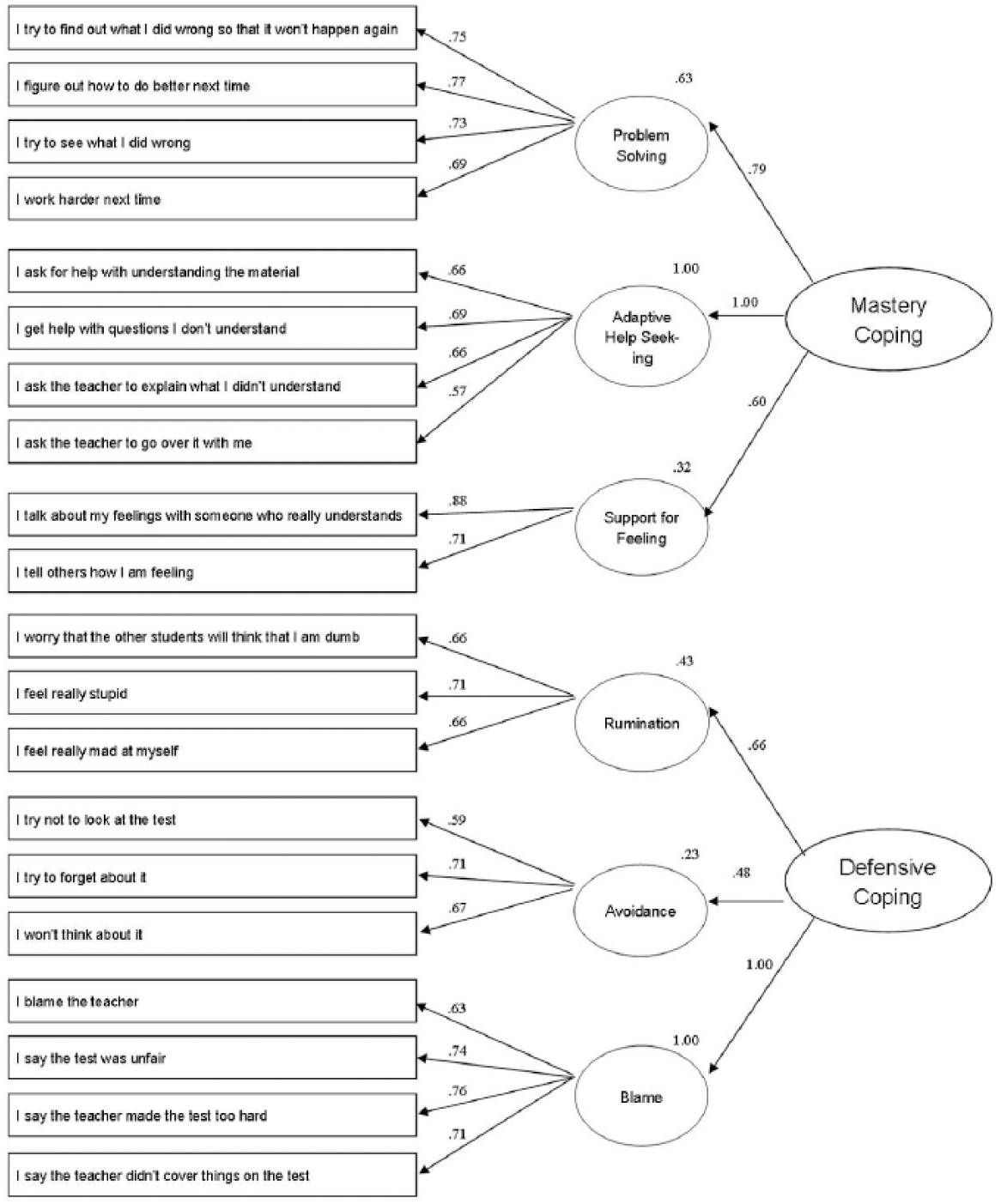
Standardized coefficients of higher order coping model.
Descriptive Results
The means for structure, autonomy support, and involvement (Table 1) indicate that children perceived their parents as above the midpoint on all parenting dimensions. The sample reported coping with academic failure most by using problem solving and least with blame. However, there was adequate variability and the full range of possible ratings for all subscales. Relations among all study variables are displayed in Table 2. There were significant correlations between parenting and perceived competence and control and evidence that parenting and motivational resources were positively related to mastery coping (and negatively related to defensive coping). Specifically, the three parenting dimensions were positively associated with help-seeking, avoidance, and blame. Both parental structure and involvement were related to help-seeking. Notably, only parent involvement was associated with support for feeling and parental structure was the only parenting correlate of avoidance.
Correlations Among Main Study Variables.
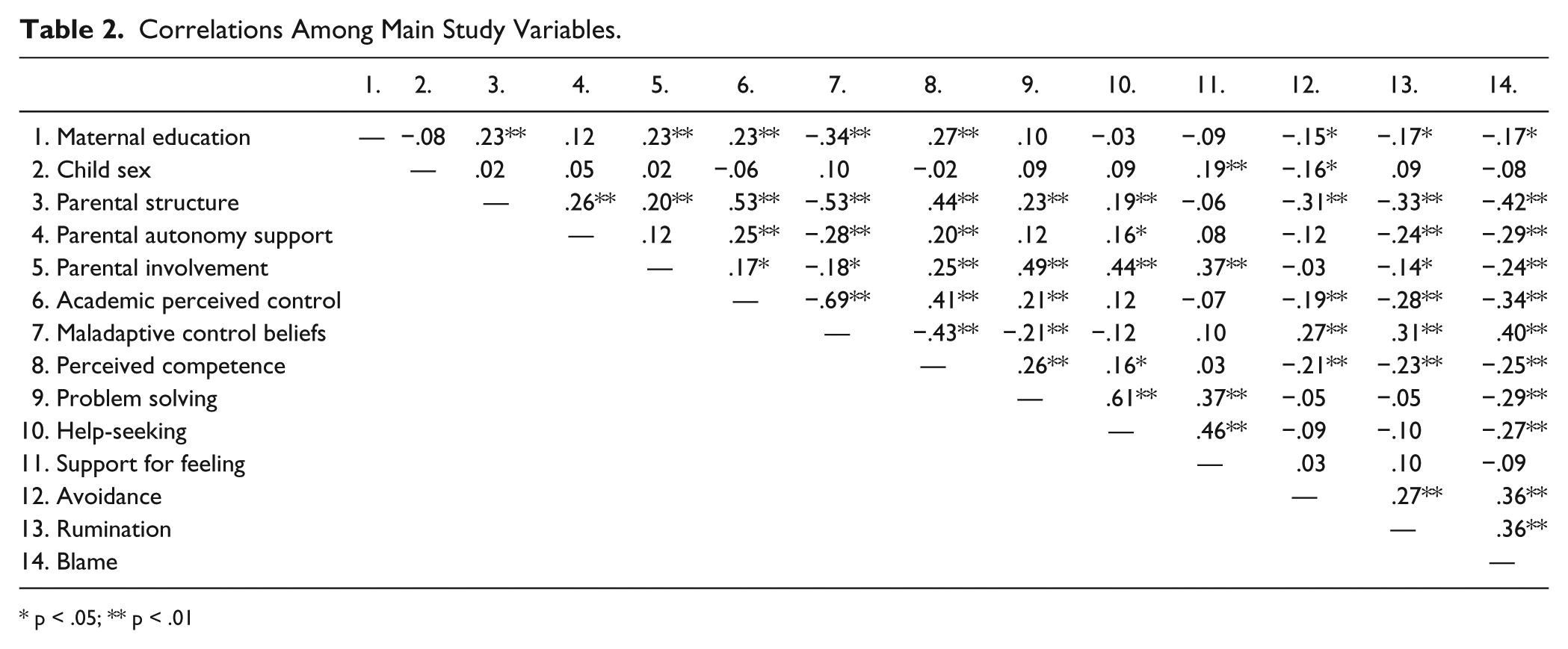
* p < .05; ** p < .01
Because maternal education was associated with several of the parenting, motivational resource, and coping variables and gender was correlated with several coping subscales, both were included as covariates in subsequent analysis. Of note, we did not find evidence that gender moderated the effects of parenting on motivational resources, the effects of motivational resources on coping, or the effects of parenting on coping.
Perceived Control and Competence Mediating Relations Between Parenting and Coping
The first goal was to examine whether relations between parenting and children’s coping strategies would be mediated by two motivational resources, perceived control and perceived competence. The model (Figure 1) proposed indirect effects of parental structure, autonomy support, and involvement on two latent coping variables (mastery and defensive coping). The latent variable, perceived control, was measured with two indicators: perceived control and maladaptive strategy beliefs. The two latent coping variables were measured with three indicator variables. Indicators of mastery coping were problem solving, adaptive help-seeking, and support for feeling. Indicators of defensive coping were rumination, avoidance, and blame. It was predicted that parental autonomy support, involvement, and structure would affect mastery and defensive coping indirectly through perceived control and perceived competence. The error terms for the latent mastery and defensive coping variables were allowed to correlate because they were expected to covary (see Bauer & Curran, 2012). All three parenting variables were also allowed to covary. Direct paths from parenting variables (autonomy support, involvement, and structure) to the latent coping variables (mastery and defensive coping) were included in the model.
The results (see Figure 3) suggested that this model was an acceptable fit, with χ2(54, N = 201) = 87.78, p < .01, and goodness-of-fit index (GFI), IFI, and CFI of .94, .95, and .95, respectively. The RMSEA was .06 with a 90% CI of [0.03, 0.08]. A bootstrapping procedure was used to test all indirect effects in the model. The indirect paths from structure, involvement, and autonomy support to mastery coping were nonsignificant as was the indirect path from involvement to defensive coping. The indirect paths from structure to defensive coping and autonomy support to defensive coping were significant (p < .01 and p < .05, respectively).
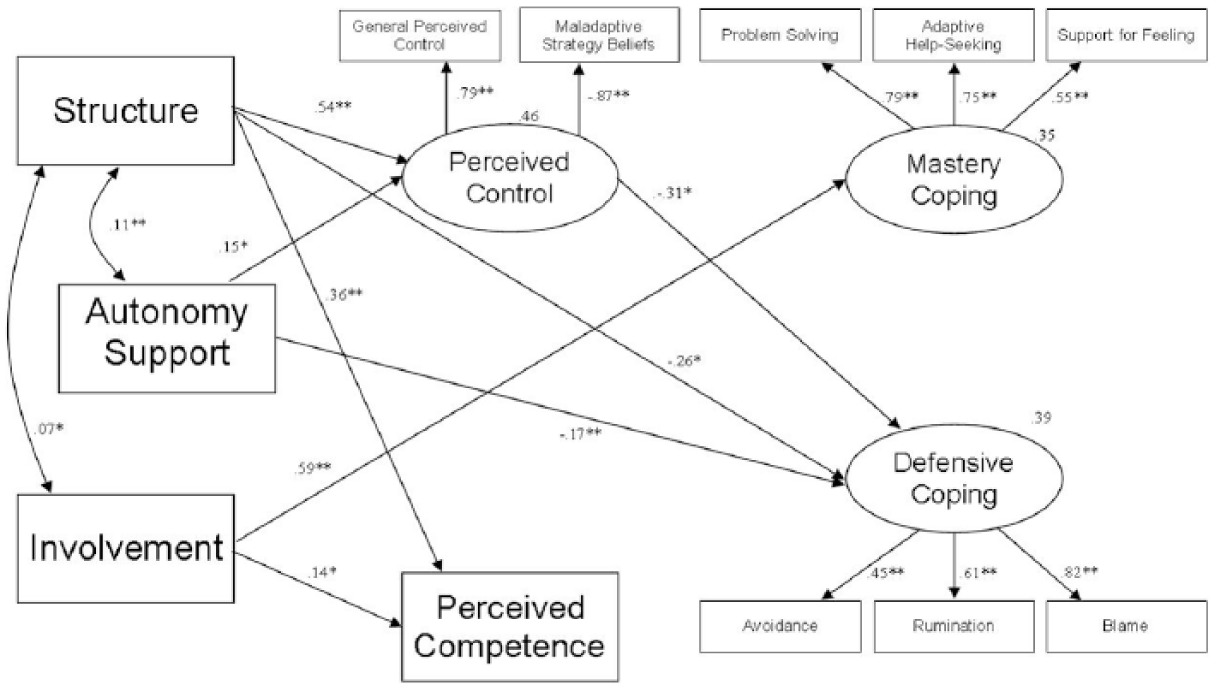
Standardized coefficients of “direct effects” structural equation model.
Results revealed that both structure and autonomy support evidenced both direct effects on defensive coping and indirect effects, through perceived control, but did not predict mastery coping. While involvement was not associated with defensive coping, it directly predicted use of mastery coping strategies. Interestingly, although structure and involvement predicted perceived competence, perceived competence was unrelated to coping.
Discussion
This project filled a gap in the literature by examining contextual (i.e., parental structure, autonomy support, and involvement) and motivational resources (i.e., perceived control and perceived competence) in relation to coping with perceived failure. In particular, the study addressed whether perceived control and perceived competence mediated the effects of parental structure, autonomy support, and involvement on children’s coping or whether these parenting resources showed direct effects on children’s coping.
Researchers have highlighted the importance of parenting in socializing children’s response to stress (Skinner & Pitzer, 2012; Skinner & Wellborn, 1994) and have shown that global parenting measures predict coping behavior (Zimmer-Gembeck & Locke, 2007). In the current study, tests of the meditational models indicated that the relations between parenting and children’s coping are more complicated than simply a direct effect or one perfectly mediated by perceived competence and perceived control. Rather, the data suggested that structure and autonomy support relate to children’s coping by both these routes. Specifically, the relations between structure and autonomy support and defensive coping were mediated by perceived control; however, there were also direct effects of structure and autonomy support, unmediated by this motivational resource. This suggests that one way that parental structure and autonomy support may have an effect on children’s coping is by preventing children from believing that academic success and failure depend on luck or some unknown cause and by facilitating a sense that they can control outcomes.
In understanding the direct effects, it is possible that when parents provide structure, they are modeling or teaching their children strategies to deal with failure and these may translate directly to adaptive coping behaviors. The lack of research on this parenting dimension (Grolnick et al., 2014) and that our results show significant associations with problem solving, help-seeking, avoidance, blame, and rumination suggest that it needs further attention.
Similarly, when parents support their children’s autonomous problem solving, children may feel empowered to take responsibility for their behavior and thus may be less likely to respond to failure in reactive ways. This is consistent with Assor and Tal’s (2012) work showing that mothers who used psychological control had children who were more likely to respond to failure with self-devaluation and shame and with Knee and Zuckerman’s (1998) study showing that individuals high in autonomy engage in fewer defensive coping strategies. In considering why there was mediation for defensive coping and not for mastery coping, one possibility is that mastery coping includes skills-based strategies. Thus, parents, through their provision of structure, autonomy support, and involvement, are not impacting coping behavior by enhancing personal resources, but by teaching skills. In contrast, defensive coping strategies are not rooted in planned, skillful action, but instead are reactive and thus the impact that context has is through the motivational propensities that are enhanced.
Results suggest that although involvement directly predicted coping strategies aimed at mastering the environment and ameliorating the situational stress (e.g., problem solving, help-seeking, and support for feeling), this association was not mediated by motivational resources of perceived control or perceived competence. In understanding this pattern of findings, one possibility is that there may be other pathways by which involvement impacts mastery coping, perhaps by facilitating children’s sense of self-worth and security with themselves and in their relationships (Gonzalez-DeHass, Willems, & Doan Holbein, 2005). Although this remains an issue for future investigation, such an interpretation would be consistent with our findings highlighting parental involvement as particularly a salient correlate of the coping strategy, support for feeling.
There are a number of limitations of this study. First, the correlational nature of this study makes the direction of effects unclear. Parenting may impact coping behavior; however, coping could impact parenting. This seems less likely for parental structure as one might expect that helpless responding may actually evoke greater provision of structure as parents more clearly articulate rules, expectations, and consequences to a less competent child to better assure that he or she will do well in the future. However, it is easy to imagine how well-intentioned parents may feel compelled to solve problems for a child and not support his or her autonomy when the child is reacting to failure in helpless ways. This could be tested empirically with longitudinal work and it is particularly important to do so, given the significant limitations of testing mediation with a cross-sectional design (Maxwell & Cole, 2007). A second limitation relates to our use of only child report measures. Our study did not measure parents’ reports of structure or other parenting dimensions. However, children’s perceptions of their contexts are most relevant as SDT proposes that it is children’s experiences that are most predictive of motivation and behavior. Though child report measures were most relevant for this study, future studies could use parent reports of structure, autonomy support, and involvement to generalize our findings. Third, our sample size did not allow testing of gender differences with multi-group analysis (Bauer & Curran, 2012) in which the full model is examined separately for boys versus girls. Some studies (e.g., Ptacek, Smith, & Dodge, 1994) have found that female students engage in more emotion-focused coping compared to male students. Furthermore, some researchers have shown that men engage in more problem-focused coping (e.g., Ptacek et al., 1994), while others (e.g., Eschenbeck, Kohlmann, & Lohaus, 2007) have found that females engage in more problem-focused coping. Given these inconsistencies in the literature, future research is needed to address potential process differences by gender. Fourth, though diverse, our sample was from an economically disadvantaged school district. Levels of parent resources and relations with motivational and coping constructs may differ in other populations. It is also important to note that our recruitment procedure required some minimal level of parental involvement (e.g., returning letters, scheduling meetings), which may further impact the generalizability of our findings. Lastly, some subscales evidenced only moderate scale reliability (e.g., perceived control) and thus the results should be replicated utilizing other measures. Nonetheless, the use of SEM is a notable strength, especially given this limitation because the use of latent variables allows us to account for measurement error.
In future studies, it would be important to examine students’ appraisal of failure experiences in addition to coping. In particular, it would be interesting to explore whether students who feel that they can control academic outcomes will appraise a failure experience as a challenge to competence, whereas students low in such resources will appraise the same failure as a threat to competence. In addition, in this study parents were examined as contextual resources for students confronting failure. However, the home is only one context that may support or undermine academic coping and the school, specifically teachers, may also be an important contextual resource. Future work should explore how teachers’ provision of autonomy support, structure, and involvement may relate to children’s response to academic setbacks.
In conclusion, this study makes a substantial contribution to the area of academic coping by exploring how context may relate to academic coping responses. The study highlights the direct effects of parent structure and parental autonomy support on defensive coping, and offers some support that these two parenting dimensions may also relate to defensive coping strategies by facilitating children’s perceived control. The findings also suggest that involvement directly predicts mastery coping, though future work is needed to assess possible alternative mediators. Results of this study point to the need for interventions aimed at helping parents provide structure, autonomy support, and involvement, given their key role in facilitating children’s academic coping behavior.
Footnotes
Declaration of Conflicting Interests
The author(s) declared no potential conflicts of interest with respect to the research, authorship, and/or publication of this article.
Funding
The author(s) disclosed receipt of the following financial support for the research, authorship, and/or publication of this article: This research was funded by a grant from the William T. Grant Foundation to Wendy S. Grolnick and Esteban V. Cardemil.