




Abstract
The crisis of public spaces implies a closure to the private sphere and, as a consequence, the inanity of the education processes. Space privatization involves the supremacy of the “οίκος” (house) on the “αγορα” (public space), so that the house assumes the role of an enclosed community. The effect of this closure is a weakening of the spatial identification and socialization of preadolescents and the exclusion of differences and relationships with their peers. This break prevents and reduces the autonomous exploration of the space as a place of free expression, the communicative acting, the conflict. This article analyzes the efficacy of the educative role of the quarter and its incidence on the preadolescent development from a sheltered to an open space both through a deep relationship with the environment and an aptitude to explore the external world. The validity of these hypotheses has been proved through a study carried out in three cities.
Introduction
Although the relationship between public space and the educational process is easily understood from direct observation, developing discussion about it is a highly complex exercise. As education is the process by which the subject is led outside the protected condition and is given a start in public life, it follows that public space and education are intimately connected. The objective here is to understand the educational role played by public space in the psychological, social, and civil growth of the subject in transition, highlighting above all the ways in which the widespread crisis of public spaces weakens spatial identification and socialization in the preadolescent and excludes difference and relationship with the Other, as well as depleting their educational function.
The Developmental Tasks of Preadolescents and the Role of Space
The preadolescent is a subject who on the one hand finds her/himself in a psycho-social and spatial condition that is in transition, and on the other is an individual whose action is situated within a context. More specifically, the concepts of transition, migration, and of situated action represent the particular theoretical gaze through which the condition of the preadolescent is analyzed.
The emergence of the model of development, understood as action in context (Jones & Deutsch, 2013; Witherspoon & Hughes, 2014, p. 867), has contributed to a change of perspective, as the vision of a preadolescent as an abstract product of childhood and pubertal maturation contrasted with the “preadolescents” who, in highly differentiated and personal ways, address their development tasks in the different cultural contexts in which they live. These interpretative keys make it possible to see preadolescence as an autonomous evolutionary stage that is the bearer of needs and demands, and also makes it possible to avoid constructing generic, generalized types of the preadolescent in contemporary society. Preadolescence begins first of all from an expansion of the adolescent period and the delay of puberty, a phase of interconnection between two physical, psychological, social, and spatial worlds: childhood and adolescence. It is precisely this specific status of being a markedly and naturally ambiguous age of transition that allows it to be considered as the preeminent and characteristic feature of this developmental stage (Steinberg, 2010). In these passages, the preadolescent faces developmental challenges, defined here as developmental tasks (Coleman & Hendry, 1999). These tasks are multiple, based on the relationship between the individual, her/his social belonging, and the environment in which she/he lives, and are dealt with by individuals in transition one at a time rather than globally. This nexus between the developmental tasks and the socio-economic and cultural characteristics of the environment is a structural fact that manifests itself as a developmental path that follows the transformations of the body (from infancy to adulthood), the process of subjectivization in relation to the social networks of childhood, and the transition from protected space to open space. The idea investigated here is that it is possible to gain insight into the specificity of the preadolescent not only when they are dealing with some of the developmental tasks, such as those related to physical and sexual growth, but above all in the presence of a particular migration that involves the preadolescent in deploying capabilities and resources to explore and experiment with external spaces. Their relationship with external space (the settings of everyday life) for educational and also developmental purposes represents a structural transition that the preadolescent undergoes, and determines a developmental imprinting that is fundamentally important for the success of subsequent developmental tasks that they are called upon to face in adolescence. The intention here is not to argue that this second aspect is preeminent over the other developmental tasks, but it is certainly worth remembering that their success in carrying out the developmental tasks, as well as the nature of these tasks, are closely connected with the social quality of the external environment; above all because the subject’s action is located in the social space. In line with this perspective, it is easy to identify other theoretical approaches in which space is of fundamental importance, and in which the action of the subject is understood in active terms as collecting information, encouraging action, imbuing the space with meaning, and modifying it. At this point we must briefly mention the contributions made by the psycho-pedagogical and social approaches, particularly Dewey’s (1916) concept of transition according to which human action is always an active participant within a social and physical environment, and the work of Lewin (1951) who highlights the relationship between the person and the context.
Public Space as Co-Educator
For the preadolescent, the transition from the protected sphere of the family to the public sphere is a “second birth” (Arendt, 1958) inasmuch as it brings with it the great opportunity to enter the world, and to do so with the wonder of discovery. Each new arrival must live through this experience of opening in the best way possible, and must be entitled to characterise it with their own originality (Parri, 2006 p.39).
In this interpretation, the constituting value of public space cannot be other than educational and, through a practical wisdom situated in the public context, reserves for itself the task of testing exchange with the Other and the relationship with the world, while preserving in each participant their own original presence. The educational potential that public space can express by bringing out exploration, experimentation, innovation, curiosity, and amazement is the basis for the formation of the Homo Civicus as founder and custodian of the public good. Instead, what matters is to enhance appreciation of an educational practice that is based on individual and community experience, making public space a co-educator that intervenes and, alongside other agencies of socialization (family, school, informal places), participates in the difficult process of the growth of the preadolescent. The public space is important for “to play independently and to discover the world is crucial to their development and happiness” (Beunderman, Hannon, & Bradwell, 2007, p. 25).
From this viewpoint, the developmental tasks that the preadolescent has to face, via the cognitive process of exploration, are closely interdependent not only with the classic and traditional agencies of socialization and acculturation but also the places that make up the community (Witherspoon & Hughes, 2014). In this sense, it is only if the neighborhood or the community retain their specific character as public actors, and above all only if they permit the experiential use of space, that they can make possible the construction of open, political citizens who possess a sense of solidarity. Thinking about these issues necessarily requires us to first define two aspects: public space in relation to the educational process, and the crisis of public space in relation to the development phase of the preadolescent.
It is far from easy to arrive at an unequivocal definition of public space. The preference here is not so much for providing a specific definition so much as for giving a general background that makes it possible to focus on the educational aspect of public space. Arendt (1958) and Habermas (2015) developed a concept of public space—the public sphere—which went on to have significant resonance across various disciplines. For Arendt, the public realm is the common world in which as a plurality of subjects we make ourselves visible and act by confronting one another: a relational space (infra, for Arendt) that plays a part in constituting the community, since it brings together the world of intangible reality with the physical and spatial world (tangible artefacts; Arendt, 1958). For Habermas, public space is based on accessibility for all, and is generated by the communicative action of private individuals who through dialogue and conversation act in the sense of upholding the public good. From this point of view, public space represents a third space with respect to the market and the institutions, located on the side of the private. By bringing out the weakening of public space in modern society, these two authors highlight the crisis in the process of education for citizenship, and in that sense we can certainly understand the relationship between public space and the educational dimension, as public space becomes the place in which interrelating is the starting point for personal enhancement in relation to the community and to the Other. The educational dimension becomes a democratic resource in that it generates action and critical communication through discourse between a plurality of subjects, in a process that above all in Arendt is located within a complex reality (tangible and intangible) in which subjects learn and bring to fruition their way of inhabiting the world through communicative and relational practice. In line with these considerations, it is necessary to recall some fundamental sociological contributions in which public space is configured as a space of sociability, of fiduciary relationships and also, therefore, of the educational dimension. Important references can be identified in the works of the sociologists of urban modernity, most recently in Sennett (2002). He is among the leaders who have discussed the role of public space as a function of social life. For Sennett, the public space is the place of anonymity, of impersonality opposed to the intimate reality. Therefore, the only possible reality is the intimate one. But our task here gives special importance to studies that place emphasis on the social properties and the relationships of public space, above all on its capabilities of translating those relationships into life practices. This is a public sphere (public space) which in its conception recalls the model of civic and social virtue. The contributions of Arendt and Habermas can be placed in a first category, whereas a second category could include the work of Jacobs, from which important trajectories of research have derived, such as the sociology of public space and the theory of social capital. Following this perspective, the public spaces “are the most important public spaces of the city and its most vital organ” (Jacobs, 1961 p.27). When they can keep values and social resources, these spaces are able to contribute to the birth of a collective and public sense, to the diffusion of trust and encourage the socialization processes. They are spaces where strangers mix supporting the realization of the phenomenon of street ballet “where streets, for their intrinsic nature, allow strangers to live in peace thanks to good citizenship that protects the dignity and the intimacy of individual life” (Jacobs, 1961 p.67).
In developing the concept of public space as an educational ambit, it should be noted that this background of theoretical reference is not only built around the model of civic virtues and sociability, but also around the model of learning. The public space, as the ambit in which surprise, the unexpected, and the adventure of the unknown are lived, is the place where discoveries are experienced and where one’s mental horizons are expanded. Of all the different inflections that public space expresses, learning and knowledge are of central importance in the formation of the citizen.
The Decline of Public Space
The object of this section is to delineate the multiple approaches developed within the debate inherent to the crisis in public space, identifying which of these are better suited to identifying the condition of preadolescents in respect to the crisis in public space.
Nowadays public space is generally considered in crisis because it no longer has those characteristics that form citizenship, that generate an encounter with others, as well as social heterogeneity, above all as regards freedom of access and participation (Mehta, 2014). In the last years, the analysis of the crisis was associated with the emergence of some urban, social, and technological phenomena that are the foundations of its decline. Many scholars have linked the decay of public space with the computer age, globalization, and new forms of media. Recently, Armitage (2011) and Castells (2010) have reinterpreted the link between the city and new technologies, with a particular focus on the acceleration that new technologies have had on space, subjecting it to a dematerialization process.
Another important field of research pertains to an aspect of the theme of insecurity, and more in general fear, as well as the problematic issue of safety and surveillance. In general, public space is represented not only as the source of insecurity but also as the field in which fear of the other is generated, where aggression, bullying, and theft all occur. It is worth citing the theses of Bauman and Lyon (2013) on the theme of city/fear and the thesis by Virilio (2007) on the city as panic, and that of Beck on the society of risk (Sorensen & Christiansen, 2013). These theses demonstrate the decline of the functions linked to meeting and socialization in the public space. Strictly from an urban planning standpoint, contemporary literature tends to emphasize the presence of a homogenization process in the planning of public space (Carmona, 2010) and a reduction in its design quality in terms of creativity and innovation.
The question of the decline of public space is undoubtedly very complex, but nevertheless it is possible to identify a general tendency that leads back to the privatization process. It represents the key to effectively reading this article because it offers both a comprehensive view of the problem as well as allowing identification of the connections between the different points of view presented.
The privatization process is the product of a group of social, political, and technological factors that have resulted in the dominance of the private sector over the public sector. On the economic front, the most common phenomenon is the marketization and commercialization of space, characterized by a direct divestment by the state of portions of the public domain to private subjects, as well as a gradual replacement of public space with shopping centers or theme parks. This latter phenomenon is defined as disneyfication and implies the transformation of places into semblances, hyper-realities dominated by the logic of consumption and the construction of safety through surveillance (Sorkin, 1992; Springer, 2010). More recently the transformation of public space in common spaces is defined as domestication by cappuccino, constituted of the diffusion of new spaces such as bars, restaurants, and so on characterized by control and exclusion of the citizen who is not a consumer (Atkinson, 2003; Mark & Gill, 2011).
The privatization of public space does not necessarily imply a direct desire for profit, but it does reinforce models of spatial segregation that are evident in the marginalization of the peripheral areas in gated communities. What is interesting to highlight is that the economic and spatial privatization process is also configured on a social plane that assumes the characteristics of a minimal social reality more and more restricted into specific self-referenced affective and relational fields that exclude diversity and heterogeneity. According to this vision, Sennett (2002) sustains that the withdrawal of the individual into a more intimate lifestyle generates the crisis of the public man, impoverishing and emptying public space of its social and civil vitality.
Preadolescents and Public Space
Of late there has been excessive discussion about the emphasis placed on the privatization process of spaces, claiming that the emergence of new forms of space is not the only result, but diverse modes of new and creative participation and appropriation are also consolidated through this process (Leorke, 2015; Sassen, 2011). This process exclusively pertains to some categories of subjects, including young adults and tourists, and not to children, preadolescents, and the elderly, who are systematically expelled from public space causing, above all for children and preadolescents, deprivation from opportunities to use the city, a decrease in autonomy, and an increase in fear, hindering the inclination for exploration and participation in public life with the increase in surveillance (Blečić, Cecchini, & Talu, 2013). More specifically, for these categories, the crisis of public space leads to closure within the private sphere and consequently to a depletion of the educational effectiveness of public space.
The privatization of space leads to the supremacy of the οίκος (house) over the αγορα (public space) and transfers the role of community to the home, where differences are shut out, there are no relationships with the Other, and above all where the autonomous exploration of space as a place of free expression and of the conflict in which social identity is formed is impeded. The weakening of public space, and consequently the exclusion preadolescents from it, is manifested in the loss of some functions that are fundamental for the development of the preadolescent and the future citizen. The functions lost are of various kinds, but in terms of education and development, the most problematic and significant are those that tie spatial experience to the development of cognitive maps on the one hand and, on the other, the functions that connect the formation of Homo Civicus to the exploratory quality of the spatially lived life. More specifically, the relational weakening of public space implies a crisis of reference for the future citizen, not only with the significant adult (and then with the community) but also with the need for recognition that can only be obtained by encountering the Other, the person who is not like oneself. The emptying-out of meaning from spaces and their transformation into anonymous places or into places given over to private consumption put the sense of belonging into crisis; in other words, by inhabiting such spaces the future citizen is encouraging the spread of alienation and deracination (Cuervo & Wyn, 2014). Where education is concerned, this brings a significant impact, above all in the preadolescent groups, in relation to their chances of becoming responsible and critical citizens who possess the ability to put democracy into action.
Research Methodology and Hypotheses
On the basis of these considerations, a pilot study has been carried out. In particular, a qualitative and quantitative research has been conducted with preadolescents aged between 11 and 14, enrolled in a middle school in one of the neighborhood of Benevento, Bari (Southern Italy), and Rome. In each of the three realities, by using a non-probabilistic sampling, a middle school has been identified. The first phase of the research has been characterized by the use of the technique of the focus groups in each school selected in order to deeply investigate the relationship between the preadolescents and the contexts of life in general and in particular the perception, the assessment, and the social practices developed with the public space. The use of this not standard technique has been helpful in the exploratory and preliminary phase of the research because it has allowed the study of a new and complex phenomenon and because it has been the theoretical and methodological basis for the construction and development of the research.
In this phase, more specifically, the purpose of the use of focus groups has been twofold: the emergence of the research hypotheses to be verified empirically in the subsequent quantitative survey and the preparation of the questionnaire built by using the language, the categories, the views, the concepts, and practices close to the experiences of life of preadolescents with respect to the object of study (Krueger & Casey, 2009). The 15 members of each focus group have been selected with the help of an assistant moderator (the teachers of the schools) from the lists of the respective schools by considering the criteria of age, sex, and residence in the neighbor (Hill, Thompson, & Williams, 1997). The author of the article has acted as moderator. Parent consent and preadolescent assent have been obtained.
The list of the questions to direct the discussion in the focus groups has followed two general principles: the principle according to which we moved from the general to the specific questions and the order of importance in relation to the purpose of the research. The topics covered by the questions asked in the three focus groups can be schematically summarized as follows: the definition of the community, the sense of belonging, the scale of the most important values, the degree of tolerance for diversity, the relationship with the places of the neighborhood, the definition of the square, the level of security and insecurity of the neighborhood and the public space, the autonomy moving in the neighborhood, the informal meeting places, the relationships with the neighbors, the relationship with the social networks and the public spaces, the social and familiar networks. As already mentioned, the answers obtained by the focus groups have been used to develop a set of hypotheses and a questionnaire valid for all the three samples. The questionnaire is composed by the scale of the community (Prezza, Costantini, Chiarolanza, & di Marco, 1999) and other questions on the themes, language, and concepts that emerged from the individual focus groups. In particular, the assumptions made have concerned the following hypotheses:
The Italian Scale of a Sense of Community
A sense of community is born as a theoretical construction with research developed in the field of psychology of the community (Sarason, 1974). The most complete theorization was that of McMillan and Chavis (1986), who defined the four dimensions: membership, influence, integration and fulfillment of needs, and shared emotional connection. Numerous studies have analyzed the concept of a sense of community, investigating the diverse characteristics and specific details, in particular in the United States, and in more recent years in Italy. This work uses the Italian scale of a sense of community by Prezza et al. (1999), based on the works of Davidson and Cotter (1986) and of McMillan and Chavis (1986), because it was validated in the context of the specificities in Italy. This allowed consideration of social, cultural, and territorial aspects of Italian communities and cities, for which the specificities are represented by a historic center with a high-density residential population and a relevant sense of belonging, as well as in the case of the few larger cities, administratively organized in areas or circumscriptions configured into territorial sections. Here the preference was given to the Prezza scale because of its use in numerous research projects in Italy that involved adolescents (Cicognani, Zani, & Albanesi, 2012; Prezza & Pacilli, 2007).
The Quantitative Research
In the second phase of the research the questionnaire has been administered to a sample of preadolescents by randomly selecting a section from each school. A total of 101 questionnaires have been administered in Benevento, 63 and 47 in Bari and Rome respectively. The different sample sizes do not affect the results as comparative analyses have been carried out only for exploratory and not inferential scopes. The questionnaire has demonstrated good reliability with a Cronbach’s alpha of .88.
The Analytic Approach
Several analytic techniques have been applied to address the study hypotheses, mostly explorative univariate and multivariate techniques. In the questionnaire, participants had to select a response ranging from (1) “strongly agree” to (4) “strongly disagree,” for this reason in many cases Multiple Correspondence Analysis (MCA) has been applied.
The Territorial Contexts
The three realities studied are different, but interesting to compare because almost all of the preadolescents interviewed live in the neighborhoods since they were born (80.20% in Benevento, 89.36% in Rome, and 82.61% in Bari). In particular, the comparison aims to verify whether the process of transformation of the public space and its role in education is a phenomenon present in large (Rome) as in middle (Bari) and small (Benevento) urban realities. The issues of privatization and transformation of space into a place without meaning is a phenomenon which also involves the small towns that have been affected over time by processes of social disorganization and cultural space. The interest here is to analyze the condition of the preadolescent in relation to public space and its role in the neighborhoods in order to capture not only the common elements or any differences but also the processes of identity in closed social microcosmos preventing the formation of the citizen and of the civic culture.
The territorial area in which school of Benevento is located is the hinterland. In it there is a progressive process of social desertification of the territory which resulted in the weakening of the social structure of the neighborhood. In Bari, the school is located in the sixth district that, despite being a central city space, the suburban characteristics are preserved. For Rome, the survey has been carried out in a school located in the San Lorenzo quarter in which a widespread process of gentrification is undermining the identity of the community. San Lorenzo survives economically, thanks to the university business but gradually the community loses its true identity of neighborhood as the working class is gradually replaced by the upper-middle class because of the process of economic regeneration of the space and the consequent increase in the cost of housing and life.
The Solitude of Preadolescents in the Public Space and the Withdrawal of Significant Adults
The importance of peer groups, and above all of friendly relationships, is by now a consolidated fact that plays a central role in the analysis of the world of preadolescents (Killen & Coplan, 2011). In most of the literature, this drive toward socialization is represented as the process of the preadolescent’s migration from the family toward the peer group, or from the family toward the school. Without wishing to underestimate the centrality of the family, or to make residual the role of the peer group or even of the school, the intention here is to thematize public space as an educational operator. This also means highlighting the resources, the hardships and limitations that preadolescents encounter along their pathway to becoming public subjects. In this section we analyze not only the meaning that public space assumes in the culture of preadolescents, but also its explanatory capacities in taking notice of their vision of the world and in understanding whether that vision is capable of opening outwards or will become embedded within self-referential norms. The aim is to understand if the community still plays a role in the formation of the preadolescents in their growth as citizens or if, on the contrary, the adult generation has abdicated from the public space in favor of the private, intimate life.
In the questionnaire, the scale of the community (Prezza et al., 1999; consisting of 20 items), revisited in terms of the analysis of public space, was given to the respondents and then analyzed using MCA. Using item projection related to the modes of response “strongly agree,” “agree,” “disagree,” “strongly disagree,” it was possible to group the items that expressed the same semantic area (see Figure 1). In detail, the items were grouped as follows: those concerned with “friendship, belonging, and generational participation” (Items 6, 14, 19); those that refer to experience as sharing and to the potential for forming friendly relationships in the neighborhood (Items 7 and 8); those that express the public realm (Lofland, 1998; Items 12 and 20), and finally those that have a negative meaning at the scale of the community (Items 5, 9, and 18) because they express the difficulty of moving around within one’s own community, solitude, and the desire to get away from one’s own town—although in relation to this the respondents in the three places were all in disagreement, thus indirectly confirming the meaning of community space in relational terms and as a place of belonging. 1
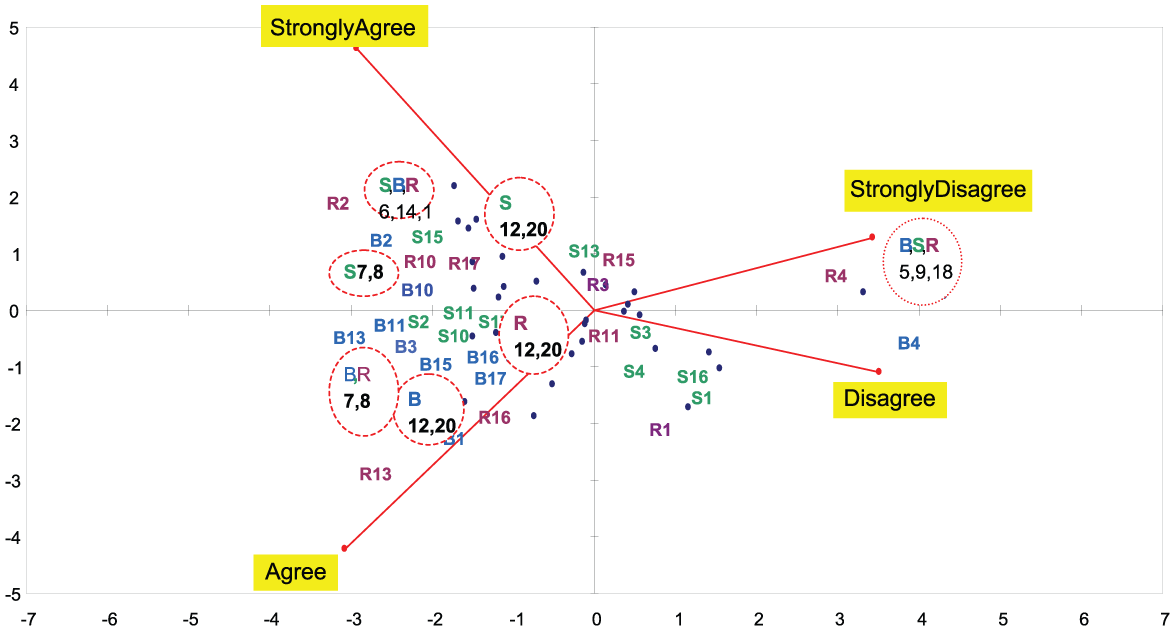
MCA applied to the scale of community of B, R, S.
By these means, two types of public space are configured. The first is the space of primary relationships and consists of restricted networks within groups of peers; it becomes their only reference for intervening in the situation with a view to modifying it. This is a public space that Lofland (1998) defines as parochial because it is built around a domestic nucleus (the home, the family . . . ) and which in this instance takes on a more fragmented dimension as it consists of self-referential ecological niches, separate worlds that do not communicate with one another. The second type of public space is intergenerational, and nurtures an enlarged sense of trust as the foundational basis of civil society. Thanks to the presence of adults, in this type of public space the preadolescents can express their double need to be part of it while also differentiating themselves, thus bringing about an increase in the relational complexity that generates community and places value on individuality. But all the same, analysis of the data also delineates a relational space from which the adult community is absent. In all three of the local settings investigated, the vision of the world as it is configured in the preadolescent who expresses distrust in the generation of the adults as guide and reference is characterized by the first type of space. There is thus no system of relational bridges between different generations and subjects; this is a fundamental aspect of public space as a democratic αγορα in which an educational practice develops aimed at the formation of the active citizen. The relational space that clearly emerges is the οίκος, in which the home is the fulcrum around which the restricted community is constructed.
Based on these results, it can be said that the loss of educational functions in public space associated with the crisis in the social generative process (generational and social transmission; Hypothesis 6) is widely confirmed by the quantitative data of the research. On one hand, the public space is empty, meaningless, a place of formal and deceptive meetings, since the generative and educational relations are missing and on the other hand house, family, and primary sociality, without a relational context that supports the encounter with the other and enhances memberships and participation, turn into privatism (socio-cultural enclave). The above corresponds with the indications that emerged from focus groups about the role that the privatization process in public space (Hypothesis 2) plays in the definition of the social reality of preadolescents in private and self-referenced terms. Family becomes the place (if not the only one) to escape from a worthless external world: the house as a fortress, the only community opposed to society. On one hand it emerges that family represents the reference space for the development of identity and on the other hand, it represents the place where close social relations are built, unable of prosocial and collective actions. It is evident that young people not only build restricted exclusionary relationships, but parents themselves express a markedly subsidiary and non-social parenting. This case also confirms how the weakening of public space influences the harmonious accomplishment of developmental skills and the preadolescent (Hypothesis 3), above all causing private closure and inhibition of the autonomous and responsible growth of the subject. No doubt that, for a person who lives in a developmental stage for the conquest of autonomy, is essential the relationship with the environment that, through a path of subsequent identification, the individual re-establishes and re-sets (Cops, 2013). Instead, in the preadolescent culture, the closure in private involves the formation of a self-referenced and hyper-individual identity, a moral development based on expressive and intimate values and a communication process centered on the interaction register of.
The Preadolescents and the Social World: The Consumption Space Versus the Public Space
The results of the research show not only a trend that consists in a process of reversal of the relationship between public space and consumption (private) space in favor of the latter, but also a process of approval of the behavior and lifestyles of preadolescents along standardized paths, consumerist and private that exclude the indeterminacy, the participation, the universality of access, principal aspects of the public space, and fundamental basis for the construction of identity. The re-dimensioning process of public space in favor of private space and consumption is confirmed, becoming a hypothesis (Hypothesis 5) in the qualitative research phase, resulting in restriction of its civic and social functions. More specifically examining Figure 2, where on the axes there is the definition of the relationship preadolescents-social sites, it is possible to note, in all the three settings considered, a common phenomenology in the perception and meaning of the space.

The meaning of the places in the three settings (S, B, R).
The space is divided into two social worlds, separate and relatively autonomous. Looking at the second and third quadrant to the left of the factorial plan it is easy to see that places such as house, sport centers, shops, bars, and shopping centers have been defined by all the interviewed preadolescents sites with which they have intense and funny relationships, full of positive connotations in terms of enjoyment and meaning. In the first and fourth quadrant, a second area comes out where a crisis emerges in the relationship between both preadolescents and institutions, such as the town hall, the church (defined as boring or indifferent), than respect to public spaces, above all the street and the square (with the exception of preadolescents from Benevento who attribute to the square a positive meaning). From the comparative analysis it comes out a general picture of the preadolescent world in which there seems to be a block of action (since they appear stationary in the sense of little spatial mobility) and when they move they seem headed straight into well-defined circuits which are articulated along the axis home/family and the spaces of consumption. The αγορα then disappears, where public and private spheres meet; the streets, the walls are no longer spaces of social relations but motorized traffic channels, producing an expulsion of children and preadolescents from the public space and private spaces, ghettoized in private spaces or consumption spaces. These results appear in line with the idea that the public space crisis results in a weakening of the spatial socialization process and the connected cognitive process (Hypothesis 4), reducing the knowledge and relative fundamental routines for the development of the preadolescent upon insertion into the “world.” In particular (for the preadolescents), the public space, in the practice of everyday life and not so much in the ideal perception of what it should be, takes on the contours of a fragmented place where there is only restricted sociability and bonding rather than bridging links. This encourages the formation of new tribal communities that consist in exclusionary cohesions, social expression of cohesions of family or of friendship, but not social.
The withdrawal of preadolescents from participation to the construction of social and civil space entails not only a process of desertification, a transformation of the subject from citizen to consumer, but it also has an impact on the identity formation (Cops, 2013). In this context, the public space is the arena where young people construct their social and civil identity. The absence of this process subtracts the new generation the chance to experience, to explore the public space, to live events both painful and disquieting but important because they force to deal with the otherness and encourage people to go beyond their defined boundaries of the self (Sennett, 2002).
Public Space and Difference
This section analyses the relationship between the educational process and public space, beginning from two theoretical assumptions. The first of these makes reference to the concept of education and learning as a situated, dynamic, and largely tacit process linked to the context and to the specific ways in which it takes place. The second theoretical assumption makes reference to an idea of public space delineated as a socio-spatial setting in which the learning process is situated and takes shape.
On the basis of these assumptions, the intention of investigating the three places was to explore the educational dimension of public space in the formation of relational complexity, as the process of recognition of the Other in her/his concrete humanity and thus her/his complexity, avoiding both the danger of idealization (which implies non-contact) and that of stigmatization (which implies closure). Beginning from the results set out in Figure 1, attention was focused on a concept of public space as a participatory environment, statistically the most significant for identifying the educational processes that are characterized by the civic dimension. In order to study public space as an environment in which the preadolescent is educated to deal with Difference, the following variables were taken into consideration: “Given the opportunity, we too would be able to organize something in our village/neighborhood” (Item d19 2 in Figure 3); “I think the people around here have the potential to change” (Item d20 2 in Figure 3); “How would you define your relationship with the public square—intense, fun, ugly, boring, or you don’t care one way or the other 3 ?”; “What does a public square mean to you: a place in which to play, a place for dialogue, a space for adults only, an empty place, a space used for parking, or a poorly lit, dangerous place 4 ?”; “Would you be willing to accept the following types of people as members of your village/neighborhood—Muslims, Jews, the disabled, Africans, Chinese, immigrants from other European countries, people who think differently from you, Albanians 5 ?” Using MCA, these variables were analyzed together. Univariate analysis of the variable for the relationship with difference, which for the sake of brevity is not given in the text, showed that in the neighborhood in Bari there is an open and tolerant attitude with respect to all the categories considered, while in the neighborhoods in Rome and in Benevento, closed and highly selective attitudes emerge. So taking the approach that focuses on space as a formative medium the educational processes configured require a more polyhedric interpretation of the world of the preadolescent.

MCA for Benevento.
For the Benevento sample (Figure 3), taking the case in which the public square is seen as a place devoid of meaning because it is believed to be an empty space used as a car park, dangerous and only accessible to adults, a complete absence of participation is registered along with the highest degree of intolerance (Quadrant II, QII). But when the public square is considered as the place for play and chatting, associated with a moderate degree of participation, a type of relationship with those who are “different” is configured that seems to refer to a process of encounter based on reciprocal responsibility (QIII). The maximum opening-up to others is not supported either by the presence of public space as a place of participation nor as a space in which there is a lived experience of relating (QI).
This latter situation occurs again in the analysis of the community in Bari (Figure 4, QII), in which perception of the public square as a dangerous place, and the lack of any sense of link to it, brings out a maximum degree of openness of behavior toward difference. But when the public square takes on a meaning that recalls playfulness and the dialogue between generations, associated with an intense and enjoyable bond, a type of behavior emerges that seeks difference and accepts it but is also conditioned by the relational complexity of difference (the Other is neither idealized nor condemned, QIII). If the link between preadolescents and the public square is indifferent or boring to them, they do not participate in it and show little confidence in their own and others’ capacities; this determines the highest degree of closure (QI and QIV).
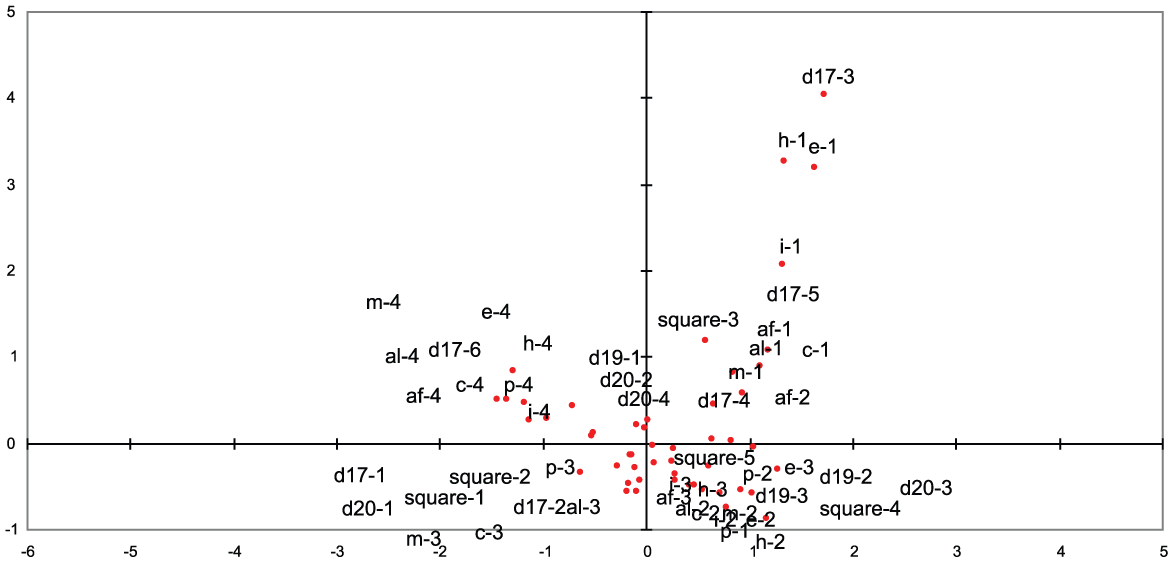
MCA for Bari.
Interpretation of MCA results for Rome (Figure 5) brings out particular characteristics as compared with the other two places. In this diagram, in fact, reading by quadrants does not help us to understand the explanatory role of public space (represented by the perception of the public square, by the relationship with it, and by the level of participation in it). The explicative capacity of public space delineates a central area (shown inside the circle) in which a moderate confidence on the part of both preadolescents and adults, in the scope they have for intervention, corresponds to the attribution to the public square, of an intense, enjoyable meaning. In this case too, the public square generates a relationship with difference that tends to integrate it but is also aware of how demanding difference can be, in both personal and community terms. The more extreme attitudes lie outside the circle: maximum openness toward others, isolated from the other explanatory variables, and maximum closure, in which the public square is considered ugly and where distrust in one’s own possibilities and in those of others is at a maximum.
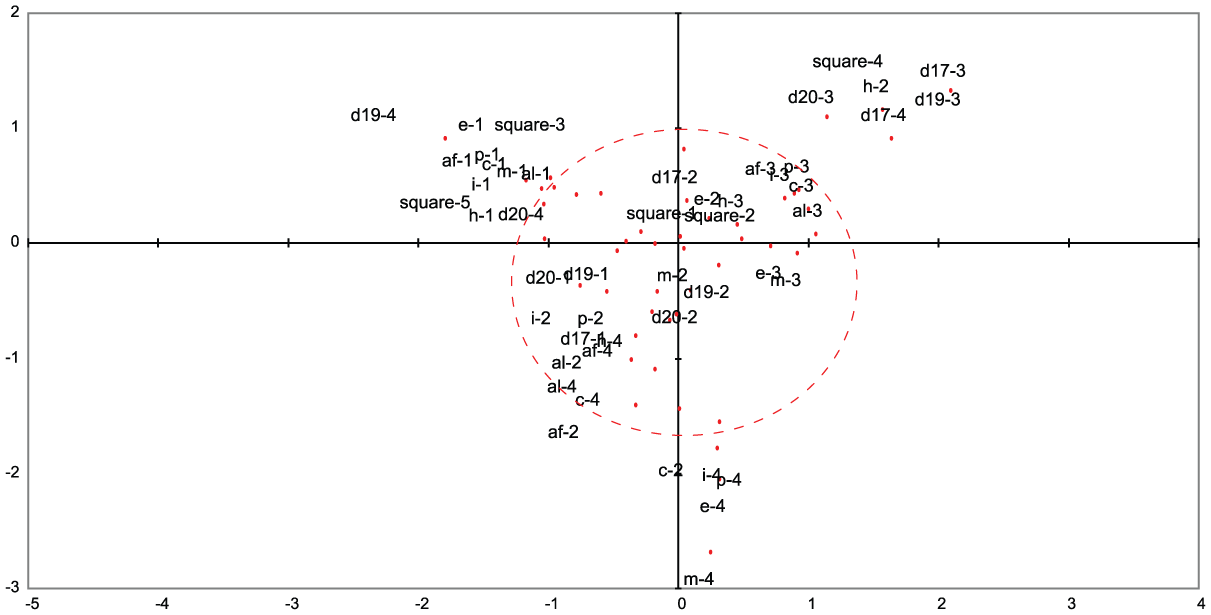
MCA for Rome.
Comparative analysis clearly shows the role of public space as an explanatory variable of the relational practices of preadolescents, and the possibility of identifying patterns of behavior. In the three areas considered, a model of coexistence or of “education for coexistence” is foreshadowed, one that is more thought about than acted upon, and a model in which behavior is tried out within an historically and socially structured context. A type of education for coexistence is outlined that is not taught in formalized places nor using codified types of knowledge but is lived, with all the contradictions and the ambiguities that a situated educational process brings. Compared with non-experienced coexistence, experienced coexistence appears complex because it is lived within public space, which is par excellence the place of difference and diversity.
In the case of Bari a cosmopolitan culture emerges that is associated with the fear of public space, that is, of society: a paradox that would require deeper investigation. Fear of public space, in fact, represents a loss because it leads in turn to a loss of resources within the community and because it highlights the criticality of the relationship between the school and the knowledge it produces: the family and the community.
For the communities in Rome and Benevento, in the unexperienced model of coexistence there lurks a doubt: the danger inherent in a process of limited or non-responsibilisation vis-à-vis the concrete life. A relationship with public space seems to emerge that is based more on “formally residing” in the community than on “living” in it and that would entail a probable depletion of civic resources. In relation to the model tested in all the three areas studied, a more cautious attitude toward difference is brought out in which the public square represents the arena within which to experience the needs associated with inhabiting the world and of modifying it through the dialogue.
Finally, the model of closure in Bari and Benevento is associated with the negative perception of space and of the bond with space that is developed, while in Rome a feeling of mistrust is also associated with closure, both inside oneself and in grown-ups. Based on these analyses, public space, in line with the results of the qualitative analyses, is confirmed as a place that symbolizes diversity and encountering others, while where it is in crisis a weakening of behavioral skills emerges, related to meeting and dialogue . The importance that preadolescents have attributed in the qualitative analysis for some functions that public space must fulfill in the growth and education of citizens is also significant. This pertains to the social quality of public space and the issue of generativity (Hypotheses 1 and 6), intended as the prosocial process based on participation by adults in the civic life of the community.
Conclusions
In the field of socio-psychological research, it is an accepted idea that in modern society there is an occurring strong process of privatization of social life. This phenomenon does not lead to the physical disappearance of the preadolescents from the public space as their presence is visible, proved in the public places of the city, rather to the transformation of their presence that more and more often seems unable to take possession of the space, to identify it as a place of education and relationships. Research data show a strong contradiction between “must be” and “ to be” compared with the perception and meaning that preadolescents give to the public space. The preadolescents of this research (50% in Benevento, 51.06% in Rome, and 56.52% in Bari) imagine the square as a place of dialogue, but when they stop there, the dialogue becomes the relation with their peers, within the restricted circles of friendship and family, excluding the other and everything that does not conform to their worldview. It follows a process of civil regression that leads to the transformation of the αγορά to an emotional and relational “microfeud” with consequences on the process of the growth of the citizen. The research shows how the crisis of public space and its disneyfying (Leorke, 2015) has produced the encapsulation of young people into new microfeud spaces which are strongly legitimated by the action of the adults, marked by processes of social generativity rather than social. At the base of the evolutive block of the subjects in transition within intimate and consumerist microfeud, it is easy to see the process of cultural pseudo-speciation (Erikson, 1984) that involves the tendency to circumscribe their identity within a specific group and to feel different compared with the neighbor, considered different and inferior. This results into a narcissistic and individualistic culture and to the development of a pseudospecies mentality as the process of cognitive closure that allows the strengthening of the uniqueness and superiority of their own group. This is particularly acute because it reveals the transformation of the public space in a place without social and symbolic significance and relationship, and where the weakening of its features occurs making it open-minded. In these contexts, without an adequate social and civic support, it is more and more precarious the chance of generating an educational place where to experience the routine of the encounter and the dialogue with the other. Here hides the fundamental problem of the development of tribal identity based on a process of identification with specific subgroups rather than the formation of identity, defined by Erikson (1984) “species-wide,” based on the universal ethos. It is obvious that the pseudospecies mentality can be moved on by realizing the identification with the other, different from itself, thanks to the presence of a particular context that, both for its spatial organization and social vocation, allows the participation, the encounter, the conflict, and the negotiation. The research shows that it is not enough to have equipped public spaces in a community, but it is necessary to invest in social processes, moral responsibility, and generativity, and it should also spread an educational process that recognizes place as a key space for the growth and development of individual.
Footnotes
Declaration of Conflicting Interests
The author(s) declared no potential conflicts of interest with respect to the research, authorship, and/or publication of this article.
Funding
The author(s) received no financial support for the research, authorship, and/or publication of this article.