



Abstract
This study investigated the social status (i.e., popularity, likeability, and friendships) of adolescents with an early onset of externalizing behavior (i.e., alcohol use, tobacco use, and antisocial behavior). Building on Moffitt’s dual-taxonomy model, it was hypothesized that early onset adolescents were more popular, but not necessarily more liked or with more friends. Hypotheses were tested using data from the Social Network Analysis of Risk Behaviors in Early Adolescence (SNARE) study (N = 1,100, 50% boys,
During adolescence, there is an increase in externalizing behaviors, such as alcohol use, tobacco use, and antisocial behavior (e.g., Currie et al., 2012; Jennings & Reingle, 2012). According to the dual-taxonomy model (Moffitt, 1993), the “maturity gap” is important for understanding this adolescent onset of externalizing behavior. Adolescents experience this gap when they feel biologically mature, although they do not yet have the same rights and responsibilities in society as adults. Externalizing behavior thus gives them an opportunity to be seen as mature, autonomous, and adult-like in their peer group. Those adolescents who engage in externalizing behavior at an early age (i.e., having an early onset) gain high status among their peers as they show how to deal successfully with the maturity gap. Consequently, these early adolescents are expected to become important role models to their peers, evoking the imitation and mimicry of their externalizing behaviors (Moffitt, 1993, 2007; Moffitt & Caspi, 2001). This idea is a crucial part of the dual-taxonomy model of Moffitt (1993), as it explains the spread of externalizing behaviors among adolescents, namely, from those with an early onset to their peers.
Surprisingly, only a few studies explicitly tested an important part of this hypothesis, whether an early onset of externalizing behavior is related to a high status in the peer group. Two studies investigated the social status of adolescents with a profile of life course–persistent, and likely an early onset of, externalizing behaviors such as delinquency (Rulison, Kreager, & Osgood, 2014) or aggression (Young, 2013), using the number of friendships as an indicator for social status. Both studies showed that adolescents with a stable delinquency or aggression level had fewer friends than their peers.
These findings seemingly contradict the idea that an early onset of externalizing behavior is associated with high status among peers. However, whereas these two previous studies focused on number of friends as indicator of social status, popularity, sometimes referred to as perceived popularity, is a different conceptualization of social status (Cillessen & Rose, 2005; Gifford-Smith & Brownell, 2003; LaFontana & Cillessen, 1998; Mayeux, Houser, & Dyches, 2011; Parkhurst & Hopmeyer, 1998). Whereas being well liked or having many friends is mainly associated with prosocial characteristics such as being kind and trustworthy (Parkhurst & Hopmeyer, 1998), popularity has been linked to different forms of externalizing behaviors such as aggression, alcohol use, tobacco use, and norm-breaking behavior (e.g., Dijkstra, Lindenberg, Verhulst, Ormel, & Veenstra, 2009; Hawke & Rieger, 2013; Mayeux, Sandstrom, & Cillessen, 2008). Thus, although popularity is generally associated with externalizing behavior, acceptance is not (see also, Agan et al., 2014; Cillessen & Rose, 2005; Mayeux et al., 2011). Moreover, popular adolescents are considered attractive for affiliation (Dijkstra, Cillessen, & Borch, 2013), dominant, powerful, and influential (Lease, Kennedy, & Axelrod, 2002). In this respect, popularity seems to better reflect the idea of role models as formulated by Moffitt (1993) than the number of friends.
We extend research on the association between externalizing behavior and social status in two ways. First, to date, studies investigating social status and externalizing behavior mainly focused on middle adolescence without differentiating between adolescents with an early onset of externalizing behaviors and their peers with an adolescent onset of externalizing behaviors. Although Cillessen and Mayeux (2004) examined popularity during late childhood and early adolescence, they only focused on relational and physical aggression, which only represents a small part of adolescents’ externalizing behaviors. Hence, examining an early onset of a broader range of externalizing behaviors might provide a more detailed picture of its link with popularity.
Second, originally Moffitt (1993) did not explicitly differentiate in the conceptualization of social status between being liked, having many friends, and being popular. However, the characterization of the status of adolescents with an early onset of externalizing behavior seems to reflect popularity, rather than having many friends or being well liked, as adolescents with an early onset of externalizing behavior are argued to obtain an influential position in the peer system. Indeed, later Moffitt (2007) called for studies to investigate the popularity of adolescents with an early onset of externalizing behavior. Moreover, Moffitt (1993) explicitly mentioned that liking is not needed to successfully copy behavior: “What is contended is that adolescents-limited youths should regard life-course persistent youths as models, and life-course persistent teens should regard themselves as magnets for other teens. Neither perception need involve reciprocal liking between individuals” (p. 688).
This study aimed to investigate the hypothesis of Moffitt (1993) that adolescents with an early onset of externalizing behavior are considered popular in early adolescence. In so doing, we focused on three types of social status: popularity, likeability, and friendships. This allowed comparing current findings with aforementioned studies. Second, we identified externalizing behavior among adolescents who just left elementary school when they entered a new and larger social network at secondary school in the Netherlands (when they are around 12.5 years old). Entering secondary school exposes adolescents to a larger peer group with less adult supervision as well as older peers, thus increasing the likelihood for adolescents to experience the maturity gap. Therefore, the entry to secondary school and the ages between 11 and 13 are important for starting adolescent onset externalizing behavior (Moffitt, 1993). Hence, identifying externalizing behavior at the very start of secondary school allows studying early adolescents with an early onset of externalizing behavior. Moreover, it allows studying whether early adolescents who become interested in externalizing behavior perceive their more experienced peers as being more popular; presumably, these more experienced peers become role models. To this end, several types of externalizing behavior were taken into consideration, that is, alcohol use, tobacco use, and antisocial behavior. Having an onset of multiple behaviors might signal being more experienced in externalizing behavior and thus increases the chance of being popular during early adolescence. Specifically, the following hypotheses will be tested: Adolescents with an early onset of externalizing behavior will be more popular, but not necessarily (Hypothesis 1) more liked (Hypothesis 2) or with more friends (Hypothesis 3). These effects were expected to be especially strong for adolescents who have an early onset of several externalizing behaviors. In addition, we investigated possible gender differences to assess if, in line with the expectations of Moffitt and Caspi (2001), findings will be similar for boys and girls.
Method
Participants and Procedure
Data were derived from the SNARE (Social Network Analysis of Risk Behaviors in Early Adolescence) study. SNARE is an ongoing prospective cohort study involving two schools in two regions of the Netherlands (see also Dijkstra et al., 2015; Franken et al., 2016). Participants were recruited in their first or second grade of school (i.e., similar to seventh-eighth grades in the United States) in Year 1. In Year 2, a second cohort was added, including students in first grade at the same schools. A passive consent procedure was used; students or their parents were asked to send a reply card or email within 2 weeks, if they wished to refrain from participation. In total, 1,826 students were approached for this study, of which 40 students (2.2%) refused to participate. A total of 1,786 students participated in SNARE (
For the current study, only participants form the first grade were included in order to assess a valid indication of early onset externalizing behavior at the beginning of secondary school. Participants who attended the pre-assessment and the first wave of data collection were included, resulting in a sample of 1,100 first-grade students in secondary school (50% boys), aged 11.1 to 15.6 years (
Measures
Self-reported externalizing behaviors (pre-assessment, Time 1)
At the pre-assessment and Time 1, participants reported their engagement in three forms of externalizing behavior: alcohol use, tobacco use, and antisocial behavior. At pre-assessment, participants were asked if they ever engaged in these behaviors, at Time 1, participants were asked if they engaged in these behaviors since the pre-assessment. For alcohol use, participants used a 13-point scale (ranging from 0 to over 40 times) to report on how many occasions they consumed at least a glass of alcohol (Light, Greenan, Rusby, Nies, & Snijders, 2013; Wallace et al., 2002). For tobacco use, participants used a 7-point scale (ranging from never to more than 20) to indicate how many cigarettes they smoked (e.g., Monshouwer et al., 2011). Antisocial behavior was measured with 17 items by asking participants how often (between 0 to 12 or more times) they had been involved in 17 types of antisocial behavior; including stealing, vandalism, burglary, violence, weapon carrying, threatening to use a weapon, truancy, contact with the police, and fare evasion in public transport (e.g., Nijhof, Scholte, Overbeek, & Engels, 2010; Van der Laan, Veenstra, Bogaerts, Verhulst, & Ormel, 2010).
To obtain an “onset score” at Time 1, the scores of the pre-assessment and Time 1 were combined per behavior. Furthermore, based on recommendations of Farrington and Loeber (2000) and because data using continuous measures of externalizing behavior frequency were highly skewed (see Table 1), all externalizing behavior data were recoded as binary, indicating no onset at all (0) or any onset of alcohol use, tobacco use, or antisocial behavior (1). As externalizing behaviors are known to cluster together during early adolescence (e.g., Monshouwer et al., 2012), an exploratory factor analysis (using maximum likelihood estimations and oblique rotation) tested if the externalizing behaviors loaded on a single factor. The variables loaded on one factor, explaining 55.3% of the variance, with an eigenvalue greater than 1. Therefore (see Tabachnick & Fidell, 2007), a composite variable, representing the number of different externalizing behaviors participants engaged in (i.e., alcohol, tobacco use, antisocial behavior), was computed; resulting in scores between 0 (no onset of externalizing behaviors) and 3 (an onset of all externalizing behaviors). The binary variables on antisocial behavior, alcohol use, and tobacco use were added, and participants could thus have a score between 0 (no onset of externalizing behavior) and 3 (an onset of all externalizing behaviors).
Frequency Onset of Externalizing Behavior.

Social status (Time 1)
At Time 1, popularity was assessed by asking “who are most popular,” likeability was assessed by asking “who do you like most,” and number of friends by asking “which of your classmates are your best friends.” Received scores were summed and divided by the total number of possible nominators (i.e., classmates), to obtain a proportional score which allowed comparing social status between classrooms of different sizes. Therefore, participants could obtain a score between 0 (no nominations) and 1 (nominated by all classmates). Afterward, these scores were z standardized.
Analysis Strategy
To get an overview of the variables, descriptive statistics were calculated. First, the mean, standard deviation, and the bivariate correlations between the main study variables were calculated. Second, to test our hypotheses, externalizing behavior was entered as a dummy-coded contrast in order to assess if there is an additional impact of having an onset of multiple externalizing behaviors compared with having an onset of less of these behaviors. The first dummy-coded variable was coded 0 when participants had no onset of externalizing behavior and 1 if they had an onset of at least 1 externalizing behavior. The second variable was coded 0 if participants had an onset of at most 1 type of externalizing behavior and 1 if participants had an onset of at least two externalizing behaviors. The last variable was coded 0 if participants had an onset maximum of two externalizing behaviors and 1 if they had an onset of all three externalizing behaviors. Using this method, each group is compared with the previous group. Hence, regression coefficients are additive. For example, the last effect of having an onset of three externalizing behaviors can be calculated by combining this effect with the effects of having at an onset of at least one and at least two externalizing behaviors (see also, Dijkstra, Cillessen, Lindenberg, & Veenstra, 2010; Kalmijn, 1999). Multiple linear regression analyses were run to analyze the association between the onset of externalizing behaviors (alcohol use, tobacco use, and antisocial behavior) and social status (popularity, likeability, friendships), while controlling for gender (girls were coded as 0, boys as 1) and the other status types. Therefore, it was possible to disentangle the different status types. For example, controlling for likeability and friendship in the prediction of popularity assured that the possible association between externalizing behavior and popularity was not explained by an association between externalizing behaviors and being liked or having friends. Rather than identifying a group with a profile of early onset of externalizing behavior, adolescents who had an onset of at least one, at least two, or three externalizing behaviors were compared.
Three analyses were run, one per item of social status (popularity, likeability, and friendships) as the dependent variable. Analyses were run in two steps. First, the main effects of the externalizing behaviors were assessed, while controlling for gender and other types of social status. In the second step, interaction effects between an early onset of externalizing behavior and gender were added.
Results
Descriptive Statistics
First, the mean scores and bivariate correlations between the main study variables were calculated (Table 2). The different social status types correlated positively and moderately (between .32 and .53). Furthermore, whereas popularity and the number of friends were positively correlated with externalizing behaviors, likeability was negatively correlated with these behaviors.
Means (SD) of, and Correlations Between, the Main Study Variables.
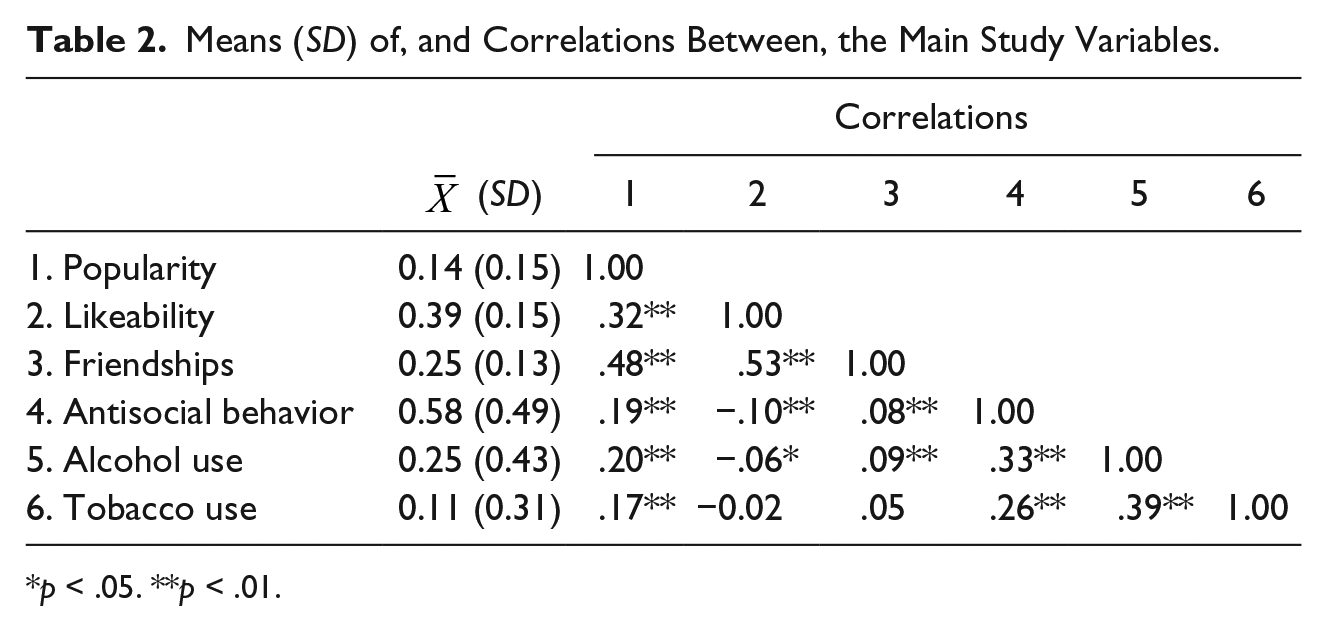
p < .05. **p < .01.
Externalizing Behavior and Social Status
The association between externalizing behavior and social status was examined for each of the three social status types: popularity, likeability, and the number of friends (see Table 3). In the first step of the analyses, social status was predicted by the amount of externalizing behavior (engagement in more than one, more than two, or three externalizing behaviors), while controlling for gender and the other types of social status. Having an early onset of at least one externalizing behavior was significantly and positively associated with popularity (B = 0.09, t = 2.97, p ≤ .01), negatively associated with likeability (B = −0.07, t = −10.66, p = .02), and not associated with friendships (B = 0.03, t = 1.27, p = .20). Furthermore, there was an additive effect of having an onset of multiple externalizing behaviors for popularity and likeability. Participants who had an onset of at least two externalizing behaviors were more popular (B = 0.07, t = 2.25, p = .03) than their peers with an onset of less externalizing behaviors, and those with an onset of three externalizing behaviors were in turn even more popular (B = 0.12, t = 3.90, p < .01). Furthermore, participants who had an onset at least two externalizing behaviors were less liked than their peers with an onset of at least one or no externalizing behaviors (B = −0.08, t = 2.50, p = .01).
Results From Multiple Linear Regressions Predicting Popularity, Likeability, and Friendship From Externalizing Behaviors.
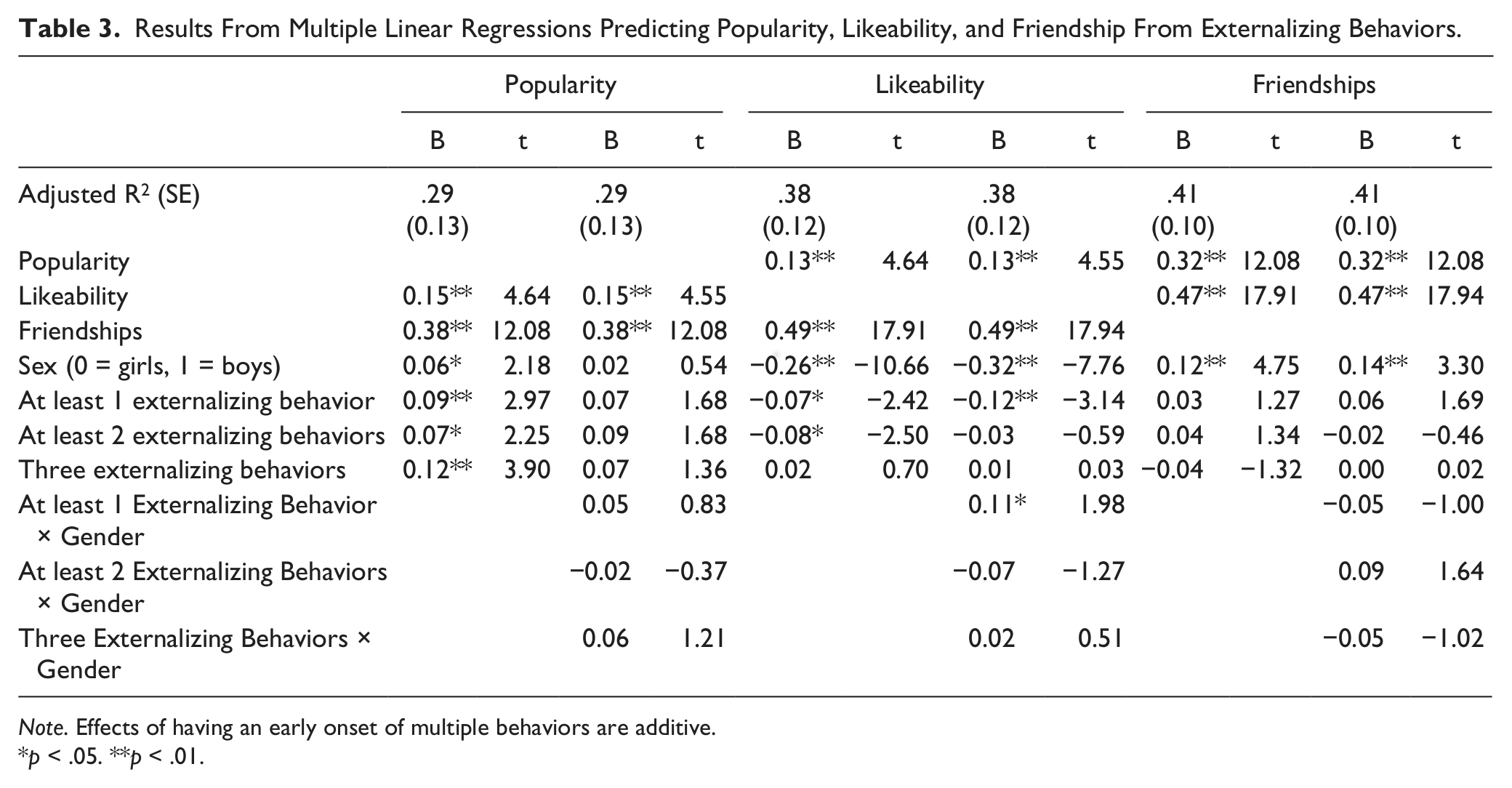
Note. Effects of having an early onset of multiple behaviors are additive.
p < .05. **p < .01.
The analyses investigating possible gender differences showed that the only differences between boys and girls were in the association between likeability and externalizing behavior. The interaction between externalizing behavior and gender (B = 0.037, SE = 0.017, p < .048) indicated that the negative association between having an onset of at least one externalizing behavior and likeability was stronger for girls than for boys (see Figure 1). Simple slope analyses indicated that for girls, the level of engagement in externalizing behavior was negatively associated with being liked (B = −0.24; p ≤ .01), whereas for boys, this was not the case (B = −0.02; p = .49). Specifically, girls who had no experience with externalizing behavior were liked more than girls who had any experience in externalizing behavior.
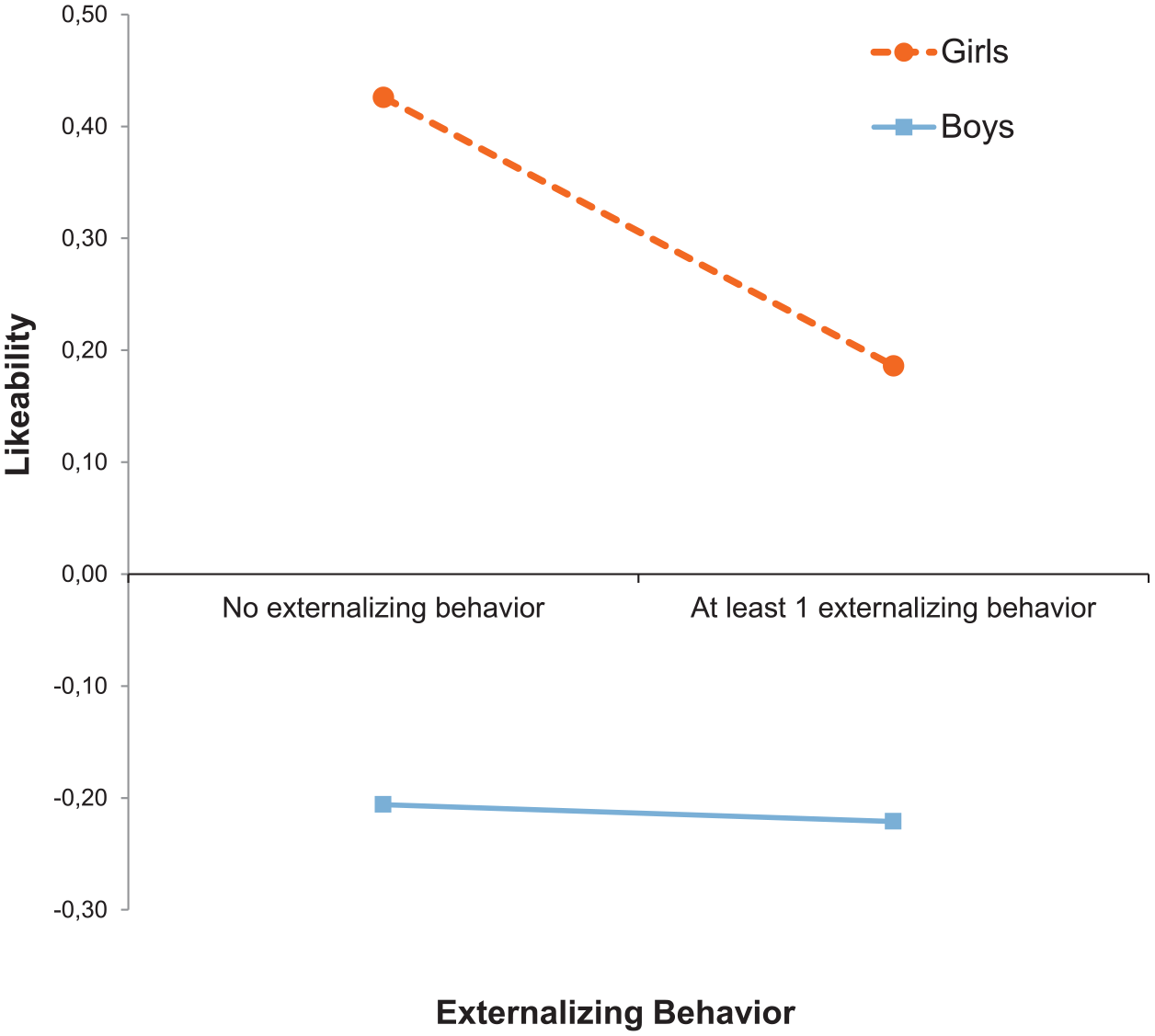
The interaction between gender (girls = 0, boys = 1) and externalizing behavior (no onset of externalizing behavior vs. an onset of at least one externalizing behavior).
Discussion
The main aim of this study was to investigate the social status of adolescents with an early onset of externalizing behavior. In contrast to earlier studies focusing on the adolescents’ number of friends (Rulison et al., 2014; Young, 2013), this study focused on different status types. The findings showed that compared with their peers, adolescents with an early onset of externalizing behavior are (a) more popular, (b) less liked, (c) have a similar number of friends, and that these findings are stronger for adolescents with an early onset of multiple externalizing behaviors for popularity and likeability. Therefore, we found strong support that adolescents with an early onset of externalizing behavior are perceived as popular by their peers. In general, the association between externalizing behavior and status was similar for boys and girls. However, girls who engage in externalizing behavior were less liked compared with their peers who did not engage in this behavior, for boys such difference did not exist.
Current findings show the importance of assessing multiple social status types when looking at the social status of adolescents with an early onset of externalizing behavior; as externalizing behavior was differently associated with popularity, likeability, and friendship. Moreover, although Moffitt (1993) focused on antisocial behavior, the findings suggest that adolescents who engage in multiple adult-like behaviors such as alcohol and tobacco use, might be perceived as more adult-like and therefore popular. These more experienced adolescents who have an early onset of multiple externalizing behaviors might also more likely be characterized by a profile of early onset externalizing behavior.
We found no differences in the number of friends between adolescents with an early onset of externalizing behavior and their peers. This finding is in contrast with earlier studies, showing that adolescents with a stable engagement in aggression or delinquency, which might be seen as indicative for an early onset of externalizing behavior, had fewer friends than their peers (Rulison et al., 2014; Young, 2013). Both previous studies investigated friendships in networks where participants already knew one another for a longer period of time, possibly differences in the number of friends of adolescents with an early onset of externalizing behavior and their peers only exist after their peers know them better; as we assessed status in a new social network when entering secondary school. Alternatively, it might be that especially delinquency and aggression are associated with having fewer friends, rather than smoking and alcohol use; as smoking and alcohol use are more social behaviors.
Looking at gender differences, the association between social status and externalizing behavior only differed between boys and girls for likeability. While for girls the level of externalizing behavior negatively affected their likeability, for boys, externalizing behavior did not alter their likeability. One possible explanation might be that externalizing behaviors are perceived to be more normative for boys than for girls; especially, substance use may be appreciated differently by male and female peers (Mayeux, 2011). This lack of gender differences in popularity or adolescents’ number of friends is in line with the expectations of Moffitt and Caspi (2001) who expected that the mechanisms underlying the spread of externalizing behavior are similar for boys and girls. Thus, it seems that for girls, more than for boys, externalizing behavior also comes with disadvantages such as being less liked, next to the advantages such as being popular.
Strengths and Limitations
The current study has several strengths. The main strength is that we managed to show how the status of adolescents with an early onset of externalizing behavior is perceived by their peers; using peer nominations of age-mates in the same classes at school. Furthermore, popularity, likeability, and friendships were assessed; thus, comparing these three types of social status was possible. Moreover, assessing an early onset of externalizing behavior among participants who just left elementary education allowed identifying them before their peers experienced an adolescent onset of such behaviors. Also, additive effects of having an onset of multiple externalizing behaviors using dummy-coded contrast variables were investigated, based on three types of externalizing behavior (alcohol use, tobacco use, and antisocial behavior). Assessing the additive effects of having an onset of multiple externalizing behaviors allowed studying the additional effect of having more experience in externalizing behavior. Finally, we used self-reported indicators for externalizing behavior and peer reported indicators for social status, therefore, preventing rater bias, which occurs when participants identify both their friends and the externalizing behavior of those friends (see Meldrum, Young, & Weerman, 2009).
This study also has some limitations. First, the study design did not allow participants to be followed from childhood until adulthood. This would be ideal to identify those adolescents with an early onset, or even life-course persistent profile, of externalizing behavior. However, we asked participants about their lifetime engagement in externalizing behavior just after leaving primary school. Thus, we feel fairly confident that the analyses in this study can be seen as an adequate test of the hypothesis of Moffitt about the social status of adolescents with an early onset of externalizing behavior. Second, as our design was cross-sectional, we could not investigate changes over time. Therefore, we do not know to what extent the image of adolescents with an early onset of externalizing behavior is specific for the age studied or will change over time; in particular, whether the popular image of this group will decline after adolescence. Moreover, we do not know how early externalizing behavior becomes associated with popularity. According to Moffitt (1993), adolescents with an early onset of externalizing behavior become popular as their peers become interested in this behavior. However, popular adolescents might also befriend peers with an early onset of externalizing behavior which in turn might increase the popularity of adolescents with an early onset of externalizing behavior through contagion processes (see Dijkstra et al., 2013; Marks, Cillessen, & Crick, 2012). In addition, future studies should investigate whether these adolescents with an early onset of externalizing behavior become influential in the spread of externalizing behavior. Finally, longitudinal studies would allow for making the distinction between the adolescent onset group and non-involved adolescents (i.e., abstainers). This would allow testing whether it is the adolescent onset group that is most sensitive to the early onset adolescents and is most likely to assign them with a popular status. Future longitudinal studies should fill this gap.
Conclusion
Current findings indicate that adolescents with an early onset of externalizing behavior are perceived as popular by their peers, while they are less liked. Thus, these findings support the claim of Moffitt (1993) that adolescents with an early onset of externalizing behavior may become popular among their peers. Furthermore, findings expand on recent studies which investigated friendship as an indicator of social status (Rulison et al., 2014; Young, 2013) by comparing friendships with popularity and likeability and showing the importance of comparing these types of social status. Future research should investigate whether adolescents with an early onset of externalizing behavior do indeed influence the development of externalizing behavior among their peers and, thus, could be seen as key agents in the spread of such behavior at this age. Especially, peer-led interventions such as the ASSIST (A Stop Smoking in Schools Trial) program (Starkey, Audrey, Holliday, Moore, & Campbell, 2009), where the most influential adolescents are trained in verbal communication skills and selected to spread smoke-free and health-promoting messages among their peers, should consider that some of the selected adolescent role models might have an early onset of other types of externalizing behavior such as alcohol use or antisocial behavior and might currently engage in several externalizing behaviors. Teaching such adolescents verbal communication skills, without helping them change their externalizing behavior, might actually make them more influential in the spread of their externalizing behavior among their peers. Also, for these intervention programs, it could be beneficial to investigate both the externalizing behavior and the popularity, likeability, and number of friends adolescents have—to find the most influential adolescents to spread their message to prevent adolescent externalizing behavior.
Footnotes
Declaration of Conflicting Interests
The author(s) declared no potential conflicts of interest with respect to the research, authorship, and/or publication of this article.
Funding
The author(s) received no financial support for the research, authorship, and/or publication of this article.
Author Biographies
 .
.