




Abstract
Framed from an integrative approach, the current article examined the associations between ethnic identity exploration (EIE), ethnic identity commitment (EIC), and acculturative stress by investigating the mediating role of ethnic attitudes (i.e., in-group favoritism and out-group derogation) in these relationships. Additionally, the moderating role of age was analyzed. A multiple-group path analysis was performed on data collected from 256 Tunisians in early and 248 in middle adolescence living in Italy, which is an interesting and understudied immigrant group characterized by similarities and differences with the host population. In younger adolescents, EIE and EIC were indirectly and positively related to acculturative stress via the mediating role of in-group favoritism and out-group derogation. In older adolescents, EIE was related to higher levels of EIC, which, in turn, was predictive of acculturative stress. The findings are discussed in light of the theoretical framework, research context and limitations, and implications for practice are presented.
Keywords
Introduction
Italy is increasingly becoming more ethnically and culturally diverse. In the last few years, the foreign-born population in the country has significantly grown. According to the Caritas Italiana e Fondazione Migrantes (2013), the total number of legal immigrants that are permanent residents in Italy has increased from about 1,000,000 in 2001 to about 5,000,000 in 2013. Such an increase is related to a greater frequency of migration flows toward Italy, directed especially to its southern regions like Sicily. Currently, a large number of immigrants come from Africa due to its geographical closeness, via countries such as Libya or Tunisia. Hence, Italy and Sicily have become interesting contexts for the study of intercultural relations because of their peculiar patchwork of religions, cultures, and people in search of a new pattern of intercultural coexistence.
Tunisians are one of the most interesting and understudied immigrant groups living in Italy, and especially in Sicily. They are the 10th largest non-EU immigrant group in Italy (3.2% of the total immigrant population), with a prevalence of men (about 65%) and young people (55% are under 40 years old), in addition to a very high number of minors (about 31%) compared with other immigrant groups (Centro Studi e Ricerche IDOS, 2015; Hannachi, 2015; Ministero del Lavoro e delle Politiche Sociali, 2012). As far as their presence in Sicily is concerned, Tunisians are the second largest immigrant group (about 18,000 persons) and have a long history of exchanges with this region that began in the 1960s (Caritas Italiana e Fondazione Migrantes, 2013; Hannachi, 2015).
Tunisian and Sicilian groups are characterized by some similarities and differences. On one hand, Tunisia and Sicily are geographically close and are marked out by sociocultural interactions that have often resulted in similar habits, for instance, with regard to food (couscous, kebab), architecture, family culture, or values. On the other hand, there are differences between the two groups, particularly related to spoken languages, practiced religions, and the legal status of immigrants for Tunisians that may pose some real barriers to their effective integration. Thus, although Tunisians have generally established good relationships with Sicilian people and are mostly integrated, in some occasions, they still encounter stressors such as language barriers, limited social resources, or discrimination that can serve as risk factors that negatively impact their well-being (Musso, Inguglia, & Lo Coco, 2015).
In this process, it is important to evaluate what factors affect immigrants’ perceptions of acculturative stress, namely the psychosocial hassles encountered as consequences of settlement in the host country (Hovey & King, 1996; Kunst & Sam, 2013; Schwartz, Unger, Zamboanga, & Szapocznik, 2010). Previous studies analyzed the impact of demographic, psychological, cultural, and social factors on immigrants’ acculturative stress (Lueck & Wilson, 2011). Among the psychological factors, one important variable that can exert both direct and indirect effects on acculturative stress is ethnic identity (Quintana, 2010). However, to date, only a few studies have specifically analyzed the association between ethnic identity and acculturative stress, as well as the role of possible mediating variables in this relationship (Kunst & Sam, 2013; Lee, Steinberg, & Piquero, 2010). Moreover, to our knowledge, there are no studies that have investigated these relationships in Tunisian adolescents.
The present study attempts to fill this gap by investigating the relationship between ethnic identity and acculturative stress in a sample of Tunisian adolescents and by examining whether this association is mediated by ethnic attitudes given that the combination of in-group favoritism and out-group derogation may lead immigrants from ethnic identity to stress (Kunst & Sam, 2013). Additionally, we analyzed the moderating role of age in these processes with respect to two different groups (early vs. middle adolescence). In order to address these issues, we used a bidimensional model of ethnic identity (Gaines, Bunce, Robertson, & Wright, 2010).
Ethnic Identity as a Multidimensional Construct
Ethnic identity is a multidimensional construct that includes different components, such as exploration and commitment (Ashmore, Deaux, & McLaughlin-Volpe, 2004; Phinney & Ong, 2007; Schwartz, Zamboanga, Weisskirch, & Rodriguez, 2009; Syed et al., 2013). Ethnic identity exploration (EIE) consists of current or past efforts to learn about the history, practices, and beliefs of one’s ethnic group, whereas ethnic identity commitment (EIC) refers to awareness, attachment, and belonging to the same group (Phinney & Ong, 2007). From a developmental perspective, ethnic identity seems to emerge from the exploration of alternative directions, values, and beliefs, and ideally results in a commitment to one’s own choices, even though some research proposes, inversely, consider commitment to be predictive of exploration (Meeus, Iedema, & Maassen, 2002).
Phinney’s (1989) model of ethnic identity suggested that EIE and EIC undergo several changes from childhood to adolescence. Theoretically, these dimensions are thought of as being separated at early stages of development, becoming more and more intertwined across adolescence, with high rates of exploration that are usually translated into a strong sense of commitment that, in turn, promotes intensive exploration behaviors (Crocetti, Rubini, & Meeus, 2008; Whitehead, Ainsworth, Wittig, & Gadino, 2009). Moreover, both EIE and EIC are expected to increase from early to middle adolescence due to advances in development (French, Seidman, Allen, & Aber, 2006; Pahl & Way, 2006; Phinney & Kohatsu, 1997; Syed & Azmitia, 2009). Some longitudinal studies (French et al., 2006; Pahl & Way, 2006) have shown that early adolescence is characterized by thorough exploratory behaviors (i.e., reading books and talking with people) to learn something about their own heritage, as well as by the development of a beginning sense of EIC (French et al., 2006). At later stages, EIE is expected to peak during middle adolescence and then decrease in later adolescence, a period characterized by more self-confidence in terms of personal and social identities, whereas EIC is expected to increase both in middle and in later adolescence (Pahl & Way, 2006). However, throughout adolescence, the association between EIE and EIC seems to get stronger.
A developmental explanation for these age-related changes includes lower levels of cognitive and social maturity in younger adolescents compared with older ones. In this sense, those in early adolescence are not able to think abstractly about their ethnicity and thus cannot assign a deeper meaning to the information and experiences acquired when talking with people or participating in events. Accordingly, their exploratory behaviors are not strictly linked to a sense of commitment that might otherwise result from more concrete identification with parents or other significant persons (Phinney & Ong, 2007). Then, during middle adolescence, exploratory behaviors progressively become more functional and the individuals reach a clearer understanding of the meaning of the youth’s ethnicity; as a result, the association between EIE and EIC is strengthened (French et al., 2006; Phinney, 1990).
Additionally to these considerations, ethnic identity has a particular meaning for immigrant youth because it is part of the acculturation process (Berry, Phinney, Sam, & Vedder, 2006; Phinney, Horenczyk, Liebkind, & Vedder, 2001). In particular, ethnic identity pertains to the preference for maintaining one’s own ethnic culture. This is one of two key intercultural dimensions in Berry’s (2005) model of acculturation. Several studies have shown that a positive attitude toward the heritage culture is often associated with high levels of ethnic identity, whereas a negative attitude can hinder ethnic identity formation in immigrant adolescents (Dimitrova, Chasiotis, Bender, & van de Vijver, 2013; Inguglia & Musso, 2015; Schwartz, Zamboanga, & Jarvis, 2007).
Ethnic Identity and Acculturative Stress
Some studies have shown that ethnic identity is associated with immigrant adolescents’ acculturative stress concerning the level of psychosocial strain experienced by immigrants and their descendants in response to immigration-related challenges (stressors) encountered as they adapt to life in a new country (Hovey & King, 1996; Kunst & Sam, 2013; Lueck & Wilson, 2011; Petersen, Dünnbier, & Morgenroth, 2012; Schwartz et al., 2010; Smith & Silva, 2011; Wang, Schwartz, & Zamboanga, 2010). These psychological or social stressors are due to an incongruence of beliefs, values, and other cultural norms between their country of origin and the host country (Sanchez, Dillon, Ruffin, & De La Rosa, 2015). In addition, these stressors are usually linked to factors such as a different legal status, the existence of language barriers, and the perception of being discriminated against by dominant group members (Berry, 2005; Musso et al., 2015). Such elements are particularly relevant for immigrant adolescents who have to learn to face tasks related to their acculturation in various developmental contexts, such as at school, with family, in the peer group, and in the neighborhood.
Traditionally, acculturative stress was studied among first-generation immigrants (Birman & Trickett, 2001; Rogers-Sirin, Ryce, & Sirin, 2014; Sirin, Ryce, Gupta, & Rogers-Sirin, 2013). However, research has shown that second- and even third-generation immigrants are not free from acculturative stress (Córdova & Cervantes, 2010; Dawson & Panchanadeswaran, 2010; Pottie, Dahal, Georgiades, Premji, & Hassan, 2014). Although second- and later generation immigrants usually do not face the stressors linked to language barriers, they often have to deal with the stress associated with discrepancies in values and norms between their heritage and the host country, and furthermore, they still often deal with episodes of discrimination.
Among the predictors of acculturative stress, scholars have identified factors such as the nature of the host society, as well as the immigrants’ ethnicity, socioeconomic status, gender, age, acculturation strategies, and ethnic identity. In particular, EIC was positively related to acculturative stress (Petersen et al., 2012; Smith & Silva, 2011; Verkuyten & Brug, 2002; Wang et al., 2010). This finding can be explained by at least two reasons. First, as ethnic identity is associated with the acculturation process and high levels of EIC seem to be linked with high degrees of heritage culture retention (Schwartz et al., 2013), there can be a strong perception of incongruence of beliefs, values, and other cultural norms between the immigrants’ country of origin and the host country. Second, the attachment to one’s own ethnic group can enhance the perception of being discriminated against by the host society. This is particularly valid for adolescents who are very sensitive to social comparisons. Immigrant adolescents with strong ethnic identities are more likely to experience stress and to report episodes of discrimination by majority group members who may perceive them as not sufficiently oriented toward the receiving culture (Lee et al., 2010; Quintana, 2010; Rivas-Drake et al., 2014; Verkuyten & Brug, 2002; Yip, Gee, & Takeuchi, 2008). For instance, Quintana (2010) argued that youth with a strong EIC are more likely to use ethnicity as an explanation for unfair treatment. However, some studies (Greene, Way, & Pahl, 2006; Toomey, Umaña-Taylor, Updegraff, & Jahromi, 2013) showed that a strong ethnic identity is protective against stress linked to experiences of discrimination among minority adolescents. For instance, Greene et al. (2006) found that higher scores of ethnic affirmation and belonging buffered youth from the negative effects of peer discrimination on self-esteem. Taken together, these findings highlight the importance of having a better understanding of the relationships between EIC and acculturative stress during adolescence.
The Mediating Role of Ethnic Attitudes
The association between ethnic identity and acculturative stress has already been analyzed by some studies, and the findings were not always univocal. In some cases, scholars found a positive association, such as the one described above, and in other cases, they reported different results (Roysircar-Sodowsky & Maestas, 2000; Schwartz et al., 2007). To explain this heterogeneity, it can be supposed that there are other variables that occur in this relationship. Considering that ethnic identity is a collective identity (Ashmore et al., 2004; Tajfel, 1981) and that acculturative stress relates to immigrants’ orientations toward both their ethnic culture and the host society, it could be important to investigate the mediating role of ethnic attitudes.
Generally, scholars tend to demonstrate two distinct ethnic attitudes: in-group favoritism, which is a person’s tendency to display a systematic preference for members of their own ethnic group, and out-group derogation, which is a person’s tendency to show negative attitudes toward people who belong to other ethnic groups (Inguglia & Musso, 2013; Verkuyten, 2005). Several studies, mainly rooted in Social Identity Theory (SIT; Tajfel, 1981) and Social Identity Development Theory (SIDT; Nesdale, 2004), have focused on the relationships between ethnic identity and ethnic attitudes, finding a positive association between ethnic identity and in-group favoritism (Bennett et al., 2004; Inguglia & Musso, 2013; Juang, Nguyen, & Lin, 2006; Molina, Wittig, & Giang, 2004; Phinney & Flores, 2002; Whitehead et al., 2009). Moreover, some of these studies have also shown that high levels of ethnic identity are positively associated with out-group derogation (Masson & Verkuyten, 1993; Pfeifer et al., 2007), although contradictory findings are found in the literature (Phinney, Ferguson, & Tate, 1997; Phinney, Jacoby, & Silva, 2007; Whitehead et al., 2009). For example, Whitehead et al. (2009) analyzed the separate contributions of EIE and EIC on immigrant adolescents’ ethnic attitudes in middle adolescence by finding evidence for a model in which EIE precedes EIC, which, in turn, predicts a positive attitude toward the in-group. Moreover, the authors noted that out-group derogation was negatively and indirectly influenced by ethnic identity components through mediation of the in-group attitude.
Overall, there is a general consensus in affirming that both EIE and EIC are positively associated with in-group favoritism. The relationship between EIE, EIC, and out-group derogation is more controversial, although there are studies confirming that high levels of ethnic identity are related to a negative attitude toward other ethnic groups. This is in line with SIT’s previsions (Tajfel, 1981), proposing that the positive distinctiveness, which is ascribed to the in-group over the out-group, is used as a source of positive self-esteem (see also Barrett & Oppenheimer, 2011). However, it is noteworthy that EIE seems to also be indirectly linked to ethnic attitudes through its association with EIC, as shown by Whitehead et al. (2009).
As far as the relationships between ethnic attitudes and acculturative stress are concerned, studies framed from an acculturation perspective (e.g., Kunst & Sam, 2013; Schwartz et al., 2013) seem to suggest that a positive attitude toward the ethnic in-group is often associated with the perception of high levels of acculturative stress. Favoring members of one’s own ethnic group, as well as being committed to it, can contribute to heightened incongruence between the individual’s heritage and the host country’s culture. Moreover, a negative attitude toward the dominant group can enhance the perceived distance between the immigrants and host society members, leading to high levels of acculturative stress. Similar considerations can be derived, taking into account Berry’s (2005) model of acculturation, in which the combination of a positive attitude toward the ethnic in-group and a negative attitude toward the dominant group results in separated strategies that can lead to conflicts and stress (Kunst & Sam, 2013).
The existing findings seem unsatisfactory in explaining how ethnic attitudes mediate the relationships between EIE, EIC, and acculturative stress. Therefore, it is beneficial to shed more light on this topic. In taking on this task, we assumed that it is also valid to consider gender differences, especially in association with ethnic identity since we are already introducing age-related variations.
Ethnic Identity and Gender Differences
Research has shown the existence of gender-related differences in the development of EIE and EIC during adolescence. Some scholars argue that females show more exploratory behaviors and stronger ties to their ethnic heritage than do males (Bowman & Howard, 1985; Phinney, 1990; Wade, 1994). Along this vein, Phinney and Tarver (1988) found that African American females are more likely to explore their ethnic backgrounds compared with their male counterparts. Conversely, Pahl and Way (2006) demonstrated that EIE is not affected by gender. Moreover, females were shown to report higher levels of EIC than were males because they are traditionally the bearers of culture and undergo a more thorough enculturation into their ethnic groups’ heritages (Pahl & Way, 2006; Phinney, 1990).
The Current Study
In light of the limited body of research, the current study sought to contribute to a more detailed knowledge of the associations between EIE, EIC, ethnic attitudes, and acculturative stress among Tunisian adolescents in Italy. The conceptual framework is based on the integration of the bidimensional developmental model of ethnic identity (Phinney & Ong, 2007), SIT and SIDT (Nesdale, 2004; Tajfel, 1981), and the acculturation approach (Berry, 2005; Kunst & Sam, 2013). In particular, the study was aimed at simultaneously examining (a) the relationships between EIE, EIC, and acculturative stress during adolescence, including gender, (b) the mediating role of ethnic attitudes in these relationships, and (c) the moderating role of age in these processes with regard to two different groups (early vs. middle adolescence). In order to achieve these aims, we tested a theoretical model summarized in Figure 1.
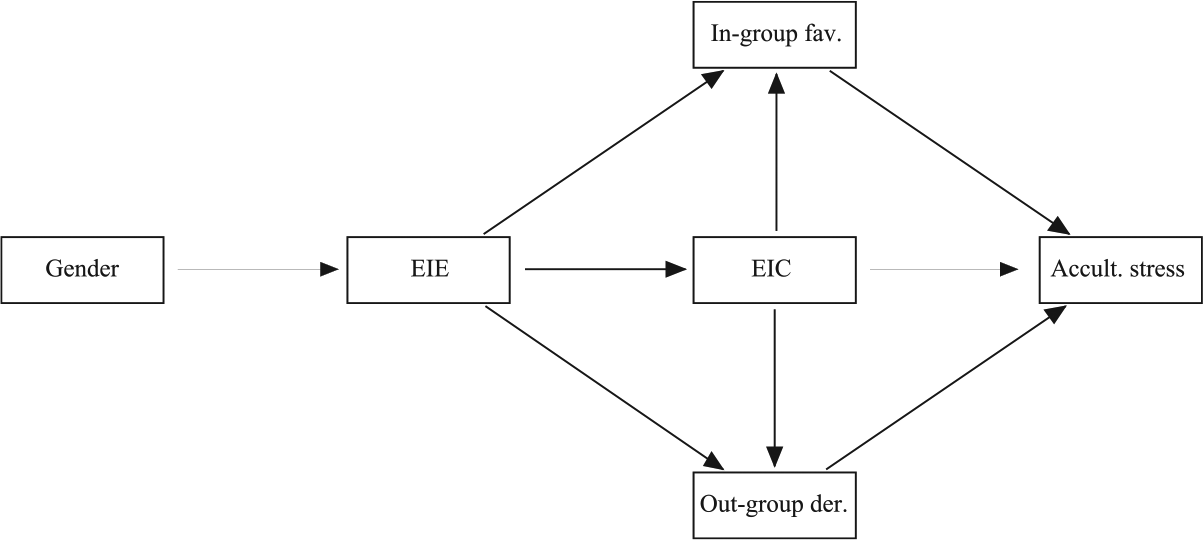
Hypothesized relationships between the study variables.
With regard to the first goal, we hypothesized that EIE would be positively related to EIC, which, in turn, would be positively associated with acculturative stress. This prediction is based on Phinney’s (1990) model of ethnic identity, stating that exploratory behaviors are more likely to lead immigrant youth toward developing higher levels of ethnic awareness, attachment, and belonging (French et al., 2006; Phinney & Ong, 2007). This is especially true in contexts in which there is a large ethnic community maintaining the habits and the traditions of the heritage culture, such as Tunisians living in Sicily. Furthermore, a strong sense of commitment can be associated with the perceptions that acculturation is particularly demanding, especially with regard to the stressors linked to feelings of being discriminated against by dominant group members (Quintana, 2010). Additionally, in line with Phinney and Tarver (1988), we expected that gender would be associated with EIE, with females showing more exploratory behaviors compared to males.
With regard to the second objective, we were interested in analyzing the mediating role of the ethnic attitudes in these relationships. Based on previous research rooted in SIT (Inguglia & Musso, 2013; Masson & Verkuyten, 1993; Pfeifer et al., 2007), we expected that both EIE and EIC would be positively related to in-group favoritism and out-group derogation. Moreover, we hypothesized that both in-group favoritism and out-group derogation, in turn, would be positively associated with acculturative stress, by acting as mediating variable in the relationship between ethnic identity and stress. In our opinion, prominent ethnic attitudes can contribute to leading immigrant youth from a sense of ethnic commitment to a state of withdrawal from the host society’s culture, a factor that is often associated with stress (Berry, 2005; Kunst & Sam, 2013).
With regard to the third aim, we hypothesized some age-related differences. In particular, in referring to the developmental models of ethnic identity (French et al., 2006; Pahl & Way, 2006; Phinney, 1990), we expected that the relationship between EIE and EIC would be more positive in middle than in early adolescence. Regarding the other relationships, we cautiously had a more exploratory intent, although we knew that differences might exist in light of the connection between some theoretical references and the specific research context.
Method
Participants
Participants in this study included 256 individuals in early (132 girls) and 248 individuals in middle (126 girls) adolescence. The participants were of Tunisian origin and were living in western Sicily (Italy) in towns with more than 50,000 inhabitants. The early adolescence group included sixth through eighth graders attending Italian first grade secondary schools. The participants’ age ranged from 11 to 13 years (
The middle adolescence group included ninth through 11th graders that attended Italian second-grade secondary schools. The participants’ age ranged from 14 to 16 years (
A comparison of the two age groups showed that they did not differ significantly in terms of gender (0 = male, 1 = female), χ2(1) = 0.03, p = .87; state of birth (0 = Italy, 1 = Tunisia), χ2(1) = 0.73, p = .39; spoken languages (0 = Arabic and Italian, 1 = only Italian), χ2(1) = 2.38, p = .12; number of parents (0 = two parents, 1 = one or no parents), χ2(1) = 3.50, p = .06; and SES (0 = low, 1 = medium, 2 = high), χ2(2) = 3.53, p = .17. Instead, a significant difference was found for age of arrival in Italy, t(502) = 108.53, p < .001, with the middle adolescence group arriving at an older age than did members of the younger group (the age of arrival for the Italy-born adolescents was 0).
Procedure
The local psychology department’s ethics committee approved this study and all procedures were performed in accordance with the Italian Association of Psychology’s ethical principles for psychological research (2015). Five hundred twenty three participants were contacted in schools located in neighborhoods where a high proportion of Tunisian adolescents live. After receiving permission from the respective principals, the participants’ parents were informed, through specific parent meetings, about the purpose of the research, the voluntary nature of participation, and the anonymity of responses. During the meetings, parents provided informed consent for their son or daughter’s participation. Fewer than 5% of the parents did not allow their son or daughter to participate. In addition, adolescent participants (N = 504) provided signed assent agreeing to take part in the study. Italian research assistants and young graduate trainees collected the data. Participants had 40 min to complete the survey.
Measures
The measures used in this study were developed in the Italian language (i.e., ethnic attitudes) or were translated from English into Italian (i.e., SES, ethnic identity, and acculturative stress), following the recommendations of the International Test Commission (2005). In the latter case, an independent English native language teacher, fluent in Italian, did a back translation. Discrepancies were resolved following the guidelines outlined by Knight, Roosa, and Umaña-Taylor (2009).
Sociodemographics
Respondents were asked to indicate their age, gender, state of birth, age of arrival in Italy, and spoken languages. Family characteristics, number of parents, paternal and/or maternal level of school completed, and the parents’ occupation were assessed using BSMSS (Barratt, 2012).
Ethnic identity
Ethnic identity was assessed using the Exploration (three items) and Commitment (three items) subscales of the Multigroup Ethnic Identity Measure–Revised (MEIM-R; Phinney & Ong, 2007). Example items include, “I have spent time trying to find out more about my ethnic group, such as its history, traditions, and customs” (Exploration) and “I understand pretty well what my ethnic group membership means to me” (Commitment). Items were rated on a 5-point Likert-type scale, ranging from strongly disagree (1) to strongly agree (5). The score was calculated as the mean of items in each subscale, with higher scores indicating higher levels of the constructs.
To examine the internal structure of the MEIM-R, confirmatory factor analyses were conducted for the entire group, as well as the early and middle adolescence groups. Fit indices (see the “Analytic Plan” section for model fit criteria) of the two-factor model are shown in Table 1. The fits were generally good in each group. Factor loadings for each of the estimated models ranged from acceptable to satisfactory, with values between .74 and .83 (entire group), .71 and .83 (early group), and .67 and .84 (middle group). Across these groups, Cronbach’s alphas ranged from between .80 and .84 for Exploration and .71 and .82 for Commitment.
Fit Indices of the Two-Factor Model, Distinguishing Between Ethnic Identity Exploration and Commitment.
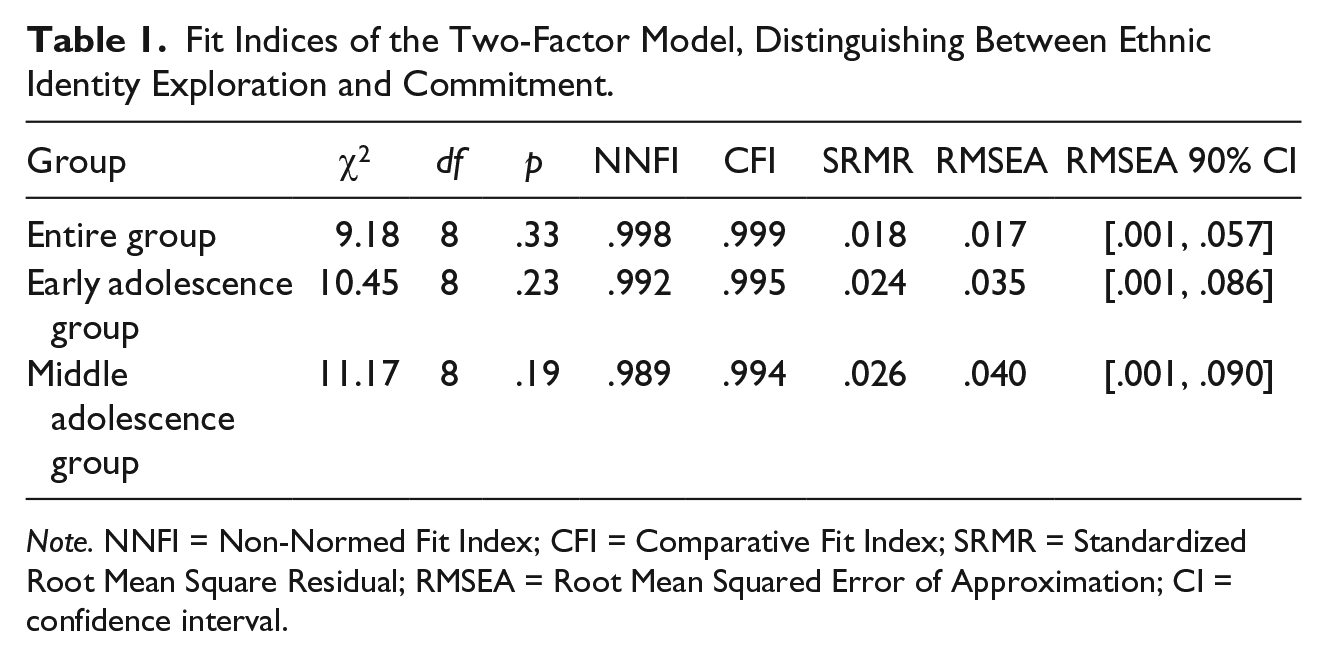
Note. NNFI = Non-Normed Fit Index; CFI = Comparative Fit Index; SRMR = Standardized Root Mean Square Residual; RMSEA = Root Mean Squared Error of Approximation; CI = confidence interval.
Ethnic attitudes
Ethnic attitudes were assessed based on studies from Inguglia (2007; Inguglia & Lo Coco, 2009). The eight-item in-group favoritism measure assessed traits of, and affects toward, the respondents’ own group. Example items are as follows: “People belonging to the Tunisian group are friendly” or “I like to play with Tunisian people.” The eight-item out-group derogation measure assesses traits of, and affects toward, the dominant group, namely Italians. Example items are as follows: “Italian people are aggressive” or “I don’t like to talk with Italian people.” Items were rated on a 5-point Likert-type scale, ranging from strongly disagree (1) to strongly agree (5). In-group favoritism scores were calculated as the mean of the items after reversing the negative ones, with higher scores indicating higher levels of in-group favoritism. Out-group derogation scores were calculated as the mean of the items after reversing the positive ones, with higher scores indicating higher levels of out-group derogation. Across entire, early and middle adolescence groups, Cronbach’s alphas varied between .74 and .77 for in-group favoritism and .74 and .79 for out-group derogation.
Acculturative stress
Acculturative stress was assessed using the 24-item short version of the Societal, Attitudinal, Familial, and Environmental Acculturative Stress Scale (SAFE; Padilla, Wagatsuma, & Lindholm, 1985; see also Hovey & King, 1996; Mena, Padilla, & Maldonado, 1987). This scale measures acculturative stress in social, attitudinal, familial, and environmental contexts, in addition to perceived discrimination or majority group stereotypes toward immigrants. Example items are as follows: “It bothers me that I have an accent” or “I feel uncomfortable when others make jokes about or put down people of my ethnic background.” Items were rated on a 5-point Likert-type scale, ranging from not stressful (1) to extremely stressful (5). The total score was calculated as the mean of items, with higher scores indicating higher levels of stress. The SAFE scale has been found to have adequate internal consistency reliability (.89; Mena et al., 1987) for adolescents. In the present study, Cronbach’s alphas varied between .77 and .81 across the entire group, as well as the early and middle adolescence groups.
Analytic Plan
The data analysis proceeded in two main steps. A multiple-group path analysis was first performed using structural equation modeling (SEM) with age group as the grouping variable. All indirect effects were tested using a Bootstrap sample of 5,000. According to Bollen and Long (1993) and Faraci and Musso (2013), to evaluate model fit, different indices were inspected (adopted cut-offs in parentheses): Chi-square test with the associated p value (p > .05), Non-Normed Fit Index (NNFI ≥ .95), Comparative Fit Index (CFI ≥ .95), Standardized Root Mean Square Residual (SRMR ≤ .05), and Root Mean Squared Error of Approximation (RMSEA ≤ .05, RMSEA 90% CI ≤ .10). Initially, an unconstrained (less restrictive) model in which the path coefficients were allowed to vary between the two age groups was tested. Next, a constrained (more restrictive) model where all key path coefficients were set equal across age groups was tested and compared with the unconstrained model using the chi-square difference (Δχ2). In addition, to confirm the adequacy of the Δχ2 test, two fit statistics were also evaluated, comparing the more restrictive and the less restrictive models: the difference in CFI values (ΔCFI) and the difference in RMSEA values (ΔRMSEA). If Δχ2 had been smaller than the chi-square critical value at the difference in degrees of freedom of the two models, ΔCFI > −.010 and ΔRMSEA < .015 (Chen, 2007; Cheung & Rensvold, 2002), the more restrictive model would have been preferred; otherwise, the less restrictive model would have provided a better fit to the data. In the latter case, in a parsimonious perspective, a partially constrained model where only some specific path coefficients were set equal across age groups would have been tested and compared with the unconstrained model. In the second step, the model fit was compared with the fit of an alternative theoretically plausible model in order to gather information about its appropriateness.
Results
Preliminary Analyses
A multivariate analysis of variance (MANOVA) was conducted to examine whether participants’ scores for EIE, EIC, ethnic attitudes, and acculturative stress differed based on age group. Significant age group differences were found, Wilks’ λ = .82, F(5, 498) = 22.55, p < .001, η2 = .18. The univariate analyses of variance (ANOVAs) revealed significant age group effects for EIE, F(1, 502) = 9.32, p < .01, η2 = .02; EIC, F(1, 502) = 71.49, p < .001, η2 = .12; and out-group derogation, F(1, 502) = 4.58, p < .01, η2 = .01. The middle adolescence group reported significantly higher levels of EIE and EIC and lower levels of out-group derogation, than did the early adolescence group (see Table 2).
Means and Standard Deviations for Key Study Variables, by Age Group.
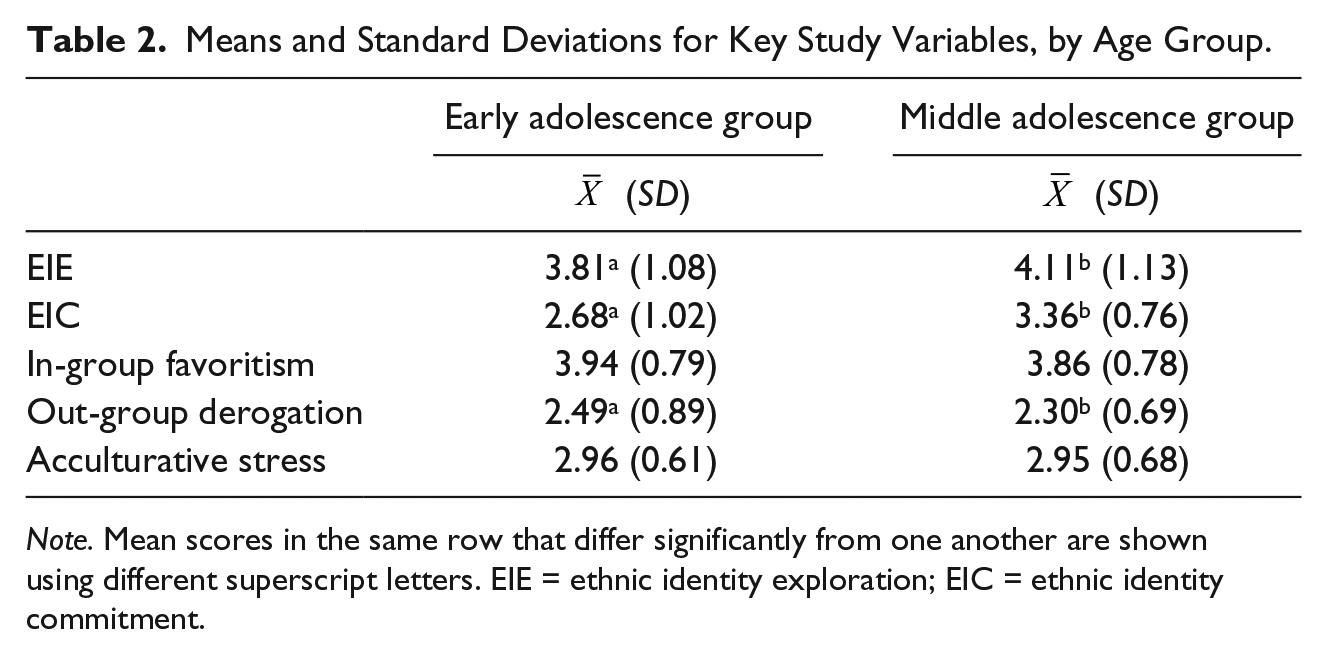
Note. Mean scores in the same row that differ significantly from one another are shown using different superscript letters. EIE = ethnic identity exploration; EIC = ethnic identity commitment.
In addition, MANOVAs were performed to evaluate whether early and middle adolescence scores on the key study variables differed based on state of birth, spoken languages, number of parents, and family SES (dummy coded: 0 = low stratum; 1 = medium-high stratum). Within the early adolescence group, significant multivariate effect of state of birth, Wilks’ λ = .91, F(5, 250) = 4.66, p < .001, η2 = .09, and family SES, Wilks’ λ = .95, F(5, 250) = 2.65, p = .02, η2 = .05, were found. Univariate ANOVAs showed that state of birth had a significant effect on EIE, F(1, 254) = 5.83, p = .02, η2 = .02; out-group derogation, F(1, 254) = 9.71, p < .01, η2 = .04; and acculturative stress, F(1, 254) = 8.45, p < .01, η2 = .03, but not on EIC and in-group favoritism. Family SES had a significant effect on EIE, F(1, 254) = 4.76, p = .04, η2 = .02, and acculturative stress, F(1, 254) = 1.41, p = .05, η2 = .02, but not on EIC and ethnic attitudes. Members of the early adolescence group who were born in Tunisia scored higher on EIE and acculturative stress, and lower on out-group derogation, than did those who were born in Italy, while members of the early adolescence group with a medium-high SES stratum scored higher on EIE and acculturative stress than did those with a low SES stratum. No significant multivariate effects were observed for spoken languages, Wilks’ λ = .99, F(5, 250) = 0.75, p = .58, η2 = .01, and number of parents, Wilks’ λ = .98, F(5, 250) = 1.22, p = .30, η2 = .02. Within the middle adolescence group, no significant multivariate effects of state of birth, Wilks’ λ = .98, F(5, 242) = 1.06, p = .38, η2 = .02; spoken languages, Wilks’ λ = .98, F(5, 242) = 0.78, p = .57, η2 = .02; number of parents, Wilks’ λ = .98, F(5, 242) = 0.87, p = .50, η2 = .02; and family SES, Wilks’ λ = .98, F(5, 242) = 1.03, p = .40, η2 = .02, were observed. Furthermore, age of arrival in Italy was positively related only to EIE (r = .14, p = .03) and acculturative stress (r = .13, p = .04) within the early adolescence group. No significant correlations were found within the middle adolescence group.
Multiple-Group Path Analysis
Correlations between the key study variables are displayed in Table 3. Based on the preliminary analyses, state of birth, family SES, and age of arrival in Italy were controlled by allowing them to predict all of the variables considered in the theoretical model except for gender (see Figure 1), and to covariate with each other and with gender. As shown in Table 4, the initial unconstrained model had good fit. The constrained version of the model had poor fit and a significantly worse fit compared with the unconstrained model, Δχ2(9) = 59.18, p < .001, ΔCFI = −.042, ΔRMSEA = .078. Inspection of modification indices suggested releasing the constraints, except for direct effects of EIE on in-group favoritism, EIC on out-group derogation, and in-group favoritism on acculturative stress. The partially constrained model had excellent fit and did not have a significantly different fit compared with unconstrained model, Δχ2(3) = 3.24, p > .05, ΔCFI = .000, ΔRMSEA = .002. Standardized coefficients of this more parsimonious and preferable model are shown in Figure 2. Together, the findings indicate that the hypothesized model was partially different in the two age groups.
Correlations for Key Study Variables, by Age Group.
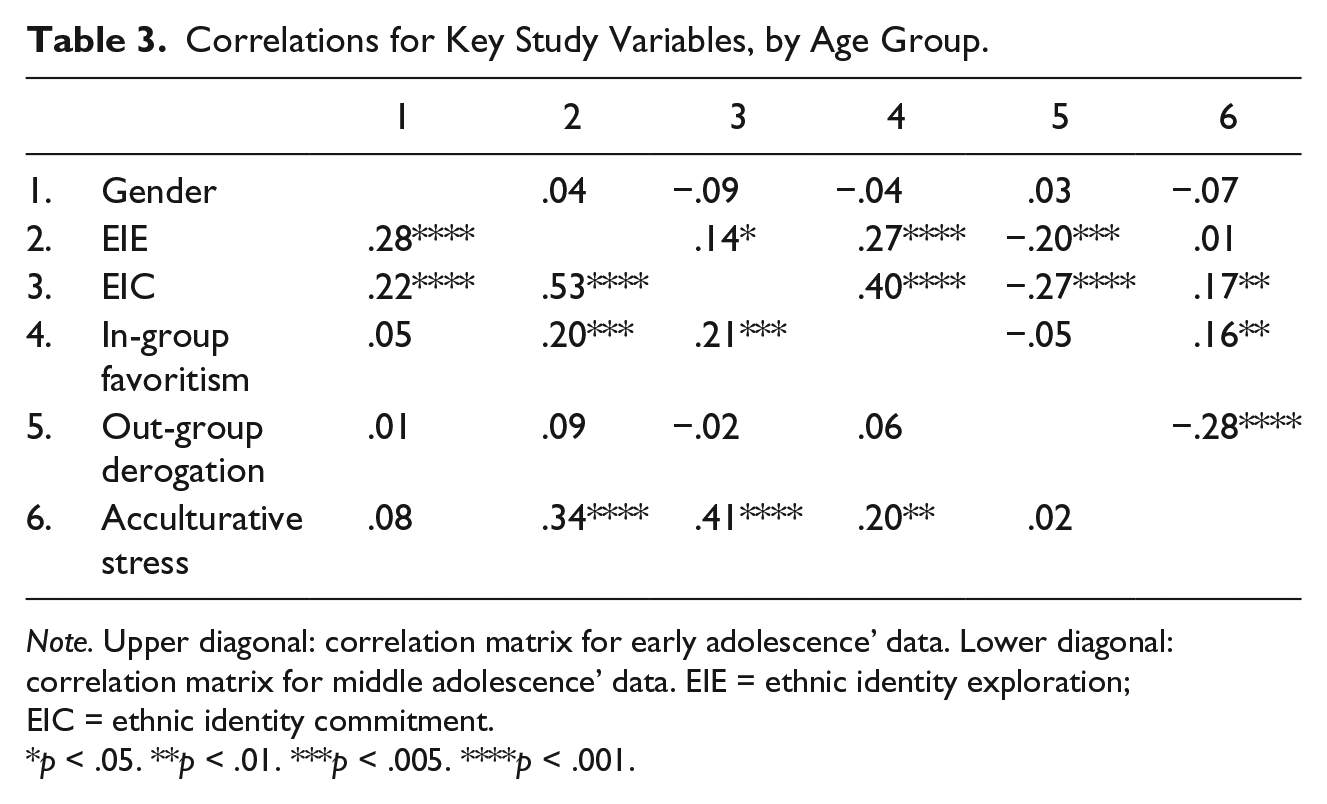
Note. Upper diagonal: correlation matrix for early adolescence’ data. Lower diagonal: correlation matrix for middle adolescence’ data. EIE = ethnic identity exploration; EIC = ethnic identity commitment.
p < .05. **p < .01. ***p < .005. ****p < .001.
Fit Indices for Structural Equation Models Across the Two Age Groups.
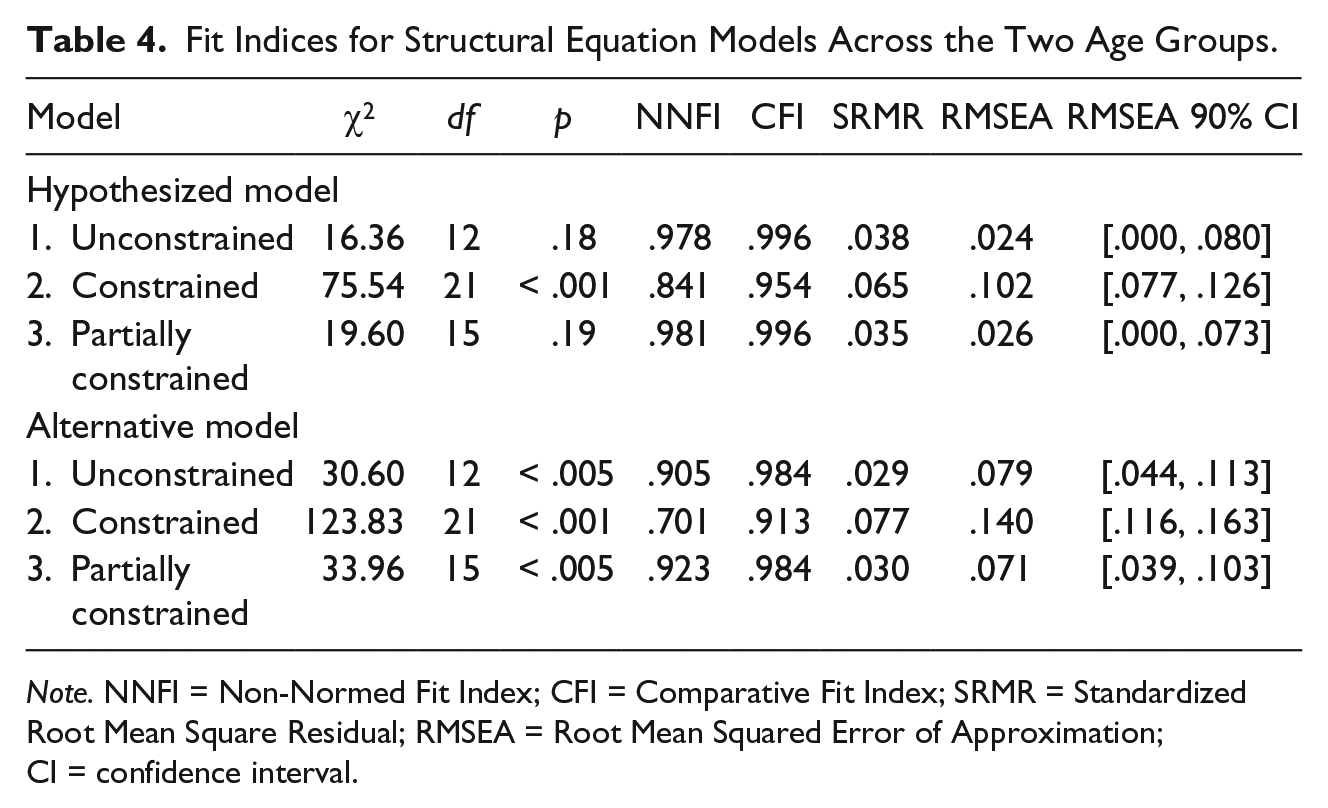
Note. NNFI = Non-Normed Fit Index; CFI = Comparative Fit Index; SRMR = Standardized Root Mean Square Residual; RMSEA = Root Mean Squared Error of Approximation; CI = confidence interval.
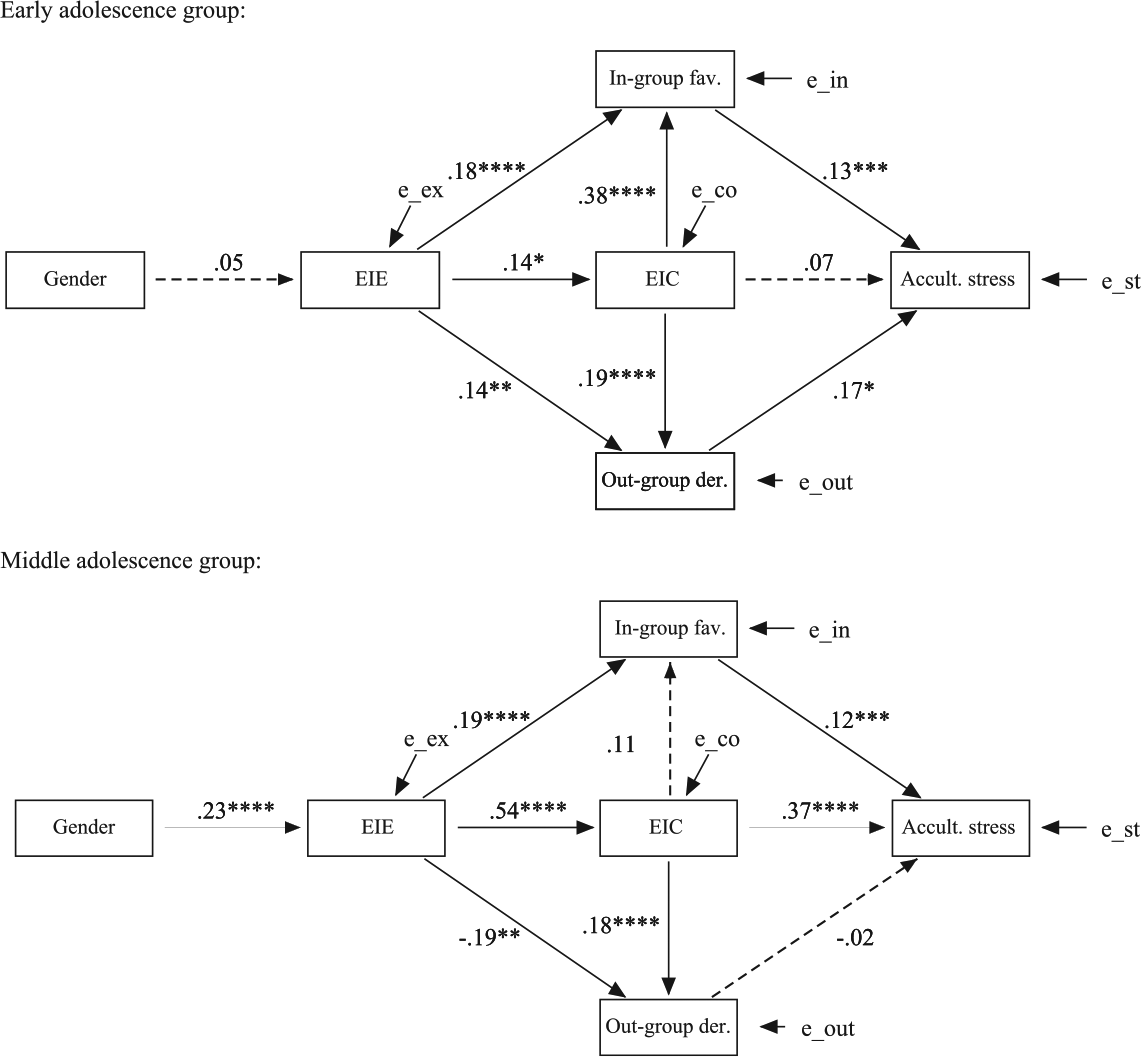
Final multiple-group path model for the relationships between the study variables, moderated by age group.
Within the early adolescence group, direct effects showed that EIE significantly predicted increases in EIC, in-group favoritism, and out-group derogation. EIC significantly predicted increases in both in-group favoritism and out-group derogation, but not in acculturative stress. In-group favoritism and out-group derogation significantly predicted increases in acculturative stress. These results revealed that there was no direct effect of EIE or EIC on acculturative stress, whereas there was evidence of mediating effects of in-group favoritism and out-group derogation. Accordingly, the analysis of indirect effects showed that EIE and EIC were indirectly and positively related to acculturative stress via the mediating role of in-group favoritism (respectively, β = .02, p < .05 and β = .05, p < .01) and out-group derogation (respectively, β = .02, p < .05 and β = .03, p < .05).
Within the middle adolescence group, analyses revealed both some similar and some different results. Similar to the early adolescence group, EIE significantly predicted increases in in-group favoritism that, in turn, was positively predictive of acculturative stress; also, EIC significantly predicted increases in out-group derogation. Conversely, EIC significantly predicted increases in acculturative stress, and EIE significantly predicted decreases in out-group derogation, while no significant effects of EIC on in-group favoritism and out-group derogation on acculturative stress were found. Furthermore, EIE significantly predicted increases in EIC, but this occurred more closely compared to with the early adolescence group. Still, a significant effect of gender on EIE was obtained, with girls scoring higher compared with the boys. These findings showed a predominant pattern in which EIE was related to higher levels of EIC, which, in turn, was predictive of acculturative stress, whereas there was no evidence of mediating effects of in-group favoritism (relative to the association between EIC and acculturative stress) and out-group derogation. Accordingly, the analysis of indirect effects revealed that EIE was indirectly and positively related to acculturative stress via the mediating roles of EIC (β = .20, p < .01) and in-group favoritism (β = .02, p < .05). Moreover, gender was indirectly related to EIC (β = .12, p < .01), in-group favoritism (β = .04, p < .05), and out-group derogation (β = −.04, p < .05) via the mediating role of EIE, with girls scoring higher compared with boys on EIC and in-group favoritism and scoring lower on out-group derogation.
Estimation of an Alternative Model
A model was specified in which the relationship between EIE and EIC was reversed (i.e., EIC predicted EIE), as suggested by some literature (Meeus et al., 2002). A multi-group path analysis was then performed according to the steps followed for the hypothesized model. All tested models had poorer fits (see Table 4). Because the hypothesized and alternative models were not nested, they were compared using the Akaike Information Criterion (AIC; Akaike, 1974, 1987), where lower values indicate a better fitting model. This comparison indicated that the hypothesized model provided a better fit to the data than did the alternative model (ΔAIC = −13.69, −48.77, and −13.63 for unconstrained, constrained, and partially constrained models, respectively). Accordingly, the model positing an alternative inverse relationship between EIE and EIC was rejected, and the hypothesized model was retained.
Discussion
The purpose of the study was to investigate how EIE and EIC, ethnic attitudes, and acculturative stress were related among Tunisian adolescents living in Italy. In doing so, we simultaneously examined the relationships between EIE, EIC, and acculturative stress, including gender, as well as the mediating mechanisms of ethnic attitudes and the moderating role of age in these relationships. Except for some findings, a number of our hypotheses were supported.
EIE, EIC, and Acculturative Stress
As expected, EIE was positively related to EIC both in early and in middle adolescence, although to a different extent. Our study, therefore, indicates that exploratory behaviors are one of the main means through which Tunisian youngsters examine in depth the culture of their own group and then move toward EIC. In a context such as Sicily for Tunisians, where adolescents have different opportunities to have contact with both their heritage and the mainstream culture, exploratory behaviors are allowed by the family and the larger society, becoming the resources through which Tunisian youth learn about the history, traditions, and customs of their group in order to reach a clear understanding of the meaning of their ethnicity in terms of commitment. In this perspective, as many scholars noted, EIE is a kind of prerequisite for perceiving a sense of belonging to an ethnic group during adolescence (Chakawa, Butler, & Shapiro, 2015; Phinney & Ong, 2007; Syed & Azmitia, 2010). This is well known by authors involved in ego identity research who have stressed the importance of the exploration process for the development of personal identity, and, consequently, for an individual’s well-being (Crocetti et al., 2008; Luyckx, Goossens, & Soenens, 2006).
The hypotheses that EIC would be positively related to acculturative stress while gender would be associated with EIE were confirmed only for the middle adolescence group. These results will be discussed later, in the section regarding the moderator role of age. Nonetheless, our study showed partial evidence for the association between gender, ethnic identity, and susceptibility to stress, in line with Yip et al. (2008) and Yoo and Lee (2008).
The Mediating Role of Ethnic Attitudes
The mediating role of ethnic attitudes in the relationship between ethnic identity (EIE and EIC) and acculturative stress was partially confirmed depending on the age group. We found EIE related to in-group favoritism in each group, in accordance with previous studies (Inguglia & Musso, 2013; Phinney, Cantu, & Kurtz, 1997; Roberts et al., 1999). Phinney (1989) suggested that learning about one’s ethnic group leads to the rejection of its negative views based on stereotypes and promotes positive in-group attitudes. In line with the work of Whitehead et al. (2009), EIC was also positively linked to in-group favoritism, although only for the early adolescence group. As discussed later, younger adolescents who are attached to the Tunisian group are more likely to express a positive orientation toward their own group members compared with the level of positive orientation in the older adolescents. In addition, high levels of EIC are significantly associated with out-group derogation both in early and middle adolescence (Duckitt, Callaghan, & Wagner, 2005; Verkuyten, 2005). This finding is in line with SIT (Tajfel, 1981), positing that people generally tend to increase the in-group and out-group distinctiveness to derive self-esteem, attributing value to the group they belong to over the other groups (Barrett & Oppenheimer, 2011), including the host dominant one. Consequently, it is reasonable that among members of minorities, ethnic identity is associated with ethnic attitudes. The finding concerning the positive association between EIE and out-group derogation in early adolescence can be interpreted along the same line, although it is not the case for those in the middle adolescence group, provided that they show a negative connection. In the former, having more in-depth knowledge of one’s ethnic origins increases prejudice toward the dominant group, whereas in the latter, it leads to a decrease. Advances in cognitive development are possibly involved in these age group differences, as discussed later.
Furthermore, we found that a positive attitude toward the ethnic in-group is connected with high levels of acculturative stress in both age groups, although the association is small in nature. Tunisian adolescents who express a more positive evaluation of their own ethnic in-group are inclined to experience more acculturative stress. This is in line with our predictions based on studies framed from an acculturation perspective (e.g., Kunst & Sam, 2013; Schwartz et al., 2013), showing that in-group favoritism, as well as commitment to one’s ethnic group, is often associated with the perception of high levels of acculturative stress. Additionally, the finding can be better understood taking into account the features of the research context. On the one hand, preference for one’s ethnic group could lead Tunisian youth to a sort of withdrawal from the mainstream group, which is likely to enhance the perception of differences between their culture of origin and the dominant culture, thus causing high levels of acculturative stress. On the other hand, the similarities between Tunisians and Sicilians that are described in the introduction can contribute to softening this association. A similar mechanism of withdrawal contributing to a higher level of stress and softened by contextual factors can adequately explain the positive association between out-group derogation and acculturative stress in Tunisian individuals in early adolescence, whereas there is no significant link in older adolescents. Again, this age group effect can be accounted for in consideration of cognitive growth (see next section).
Age as a Moderator
Our prediction that the relationship between EIE and EIC would be more positive among individuals in middle, rather than early, adolescence was evidently supported. This finding is in line with studies on the development of ethnic identity reported in the introduction (French et al., 2006; Phinney & Ong, 2007; Syed & Azmitia, 2009). The two components of ethnic identity were more interrelated in the middle adolescence group, albeit this association is also significant for early adolescence at a lower level. Probably, in the older group, EIC is consequence of a personal choice determined quite strictly via active exploration, whereas, in younger Tunisians, commitment could be affected mostly by the internalization of family values, such as in Marcia’s (1966) foreclosure status.
Age also has a moderating effect on some other important relationships included in our model. In the middle adolescence group, there is no significant association between EIC and in-group favoritism compared with the younger group. This finding could be explained considering the progress in cognitive development during middle adolescence that enable youngsters to understand that their social group can be characterized, at the same time, by both positive and negative attributes (Inguglia & Musso, 2013). Such cognitive advances allow Tunisians living in Sicily to understand that some physical and cultural features of their own group are similar to Sicilians and that the two groups are very close, although there are social barriers, such as different legal statuses, that are sources of acculturative stress. The same reasons are valid to explain age differences between EIE and out-group derogation, as well as between out-group derogation and acculturative stress. In both cases, the increased perception of similarity between Tunisians and Sicilians may facilitate the possibility that the older youth could be more integrated compared with the younger adolescents, and with a more developed bicultural identity, thus producing lower negative views of the dominant group, lower out-group derogation scores, and the loss of the significant path between out-group derogation and acculturative stress. Taken together, these findings are in line with research suggesting that there are benefits to being bicultural in terms of lower levels of stress and higher levels of adaptation (Berry et al., 2006). However, in our sample, it is noted specifically in middle adolescence in spite of all the participants could to some extent be considered bicultural, since in each age group over half the immigrant youth was born in Sicily, while the rest arrived at a very young age. As mentioned, this may be because middle adolescents have more resources that make more salient their bicultural condition. Nevertheless, studies have found that being bicultural may also produce some drawbacks because the process of dealing with two cultures places a burden on the individual and can lead to stress, isolation, and identity confusion (Nguyen & Benet-Martinez, 2013; Romero, Martinez, & Carvajal, 2007). This process is also evident in our findings, given that both early and middle adolescents showed average levels of stress scores.
Other fundamental age differences are connected to the relationships between EIE, EIC, and acculturative stress. The findings give support to a direct association of EIC, and indirect associations of EIE via EIC and in-group favoritism, with acculturative stress in the middle adolescence group. Conversely, in the earlier group, EIC was only indirectly associated with acculturative stress via the mediating role of ethnic attitudes. These findings suggest that, among younger Tunisian adolescents, both exploratory behaviors and sense of commitment lead to showing a certain degree of ethnic attitudes that, in turn, are related to perceived acculturative stress. Hence, for younger Tunisians, exploring and being committed to their own ethnic culture is not a determinant of stress per se. Rather, they are key elements in a path of multiple relationships that, altogether, lead to acculturative stress. This result is in line with our prediction based on acculturation theories (Berry, 2005; Kunst & Sam, 2013), stating that the combination of a positive attitude toward the ethnic in-group and a negative attitude toward the dominant group can lead to higher levels of acculturative stress in immigrant youth. Instead, data about middle adolescence prevalently supported the prediction of a direct moderately sized association between EIC and acculturative stress, as asserted by a number of other authors (Lee et al., 2010; Quintana, 2010). In this sense, Tunisian individuals in the middle adolescence group who are more committed to their ethnic group are more likely to perceive the changes related to the acculturation process as being stressful, compared with those in early adolescence. Possibly, tough ties to one’s own ethnic culture can act as a “barrier” in the settlement process, especially if not accompanied by a positive attitude toward the host country’s culture. Consequently, this situation can lead Tunisian immigrants to develop negative feelings toward those behavioral and cultural changes that are related to acculturation (Schwartz et al., 2010). This does not mean that a strong sense of commitment must necessarily provoke psychological ill-being, rather that it is likely to lead adolescents to high levels of acculturative stress that, if badly managed, could, in turn, affect the development of negative outcomes. In summary, in our sample, the findings suggest that in early adolescence acculturative stress seems likely to pertain to a social dimension related to the quality of ethnic attitudes, whereas in middle adolescence it pertains more to the attachment to the ethnic group.
Moreover, there are age-related differences with regard to the direct and indirect effects of gender on some study variables. First, in line with Phinney and Tarver (1988), gender was significantly associated with EIE, but only in the older group, indicating that Tunisian girls in middle adolescence tend to be involved in exploratory behaviors more often than are boys. Second, there are indirect effects of gender on EIC, in-group favoritism, and out-group derogation, with older girls more likely to be committed to and show a higher attitude toward their own ethnic and dominant group than are boys by means of EIE. One suitable explanation of these findings may depend on the particular features of the Tunisian group in the research context. Tunisians living in western Sicily are a relatively well-integrated group that has preserved its own cultural traditions, seeking to promote them in youngsters (Inguglia & Musso, 2015). From middle adolescence onward, gender-related differences in cultural transmission practices are more likely due to the fact that Tunisian girls are often requested to behave in a more conservative and traditional way than are their male counterparts. As a result, girls are expected to spend more time exploring their own ethnic culture whereas their male peers are usually left more autonomous to move outside their family and ethnic community. These exploratory behaviors are likely to affect, in turn, the commitment to, as well as a positive attitude toward, the ethnic group. Still, at the same time, they paradoxically seem to facilitate the process of comparison with the Sicilian people and culture, producing a decrease in the derogation of the dominant group in view of the similarities that can be observed.
Limitations and Level of Significance of the Study
The present study should be considered in light of some weaknesses. First, the cross-sectional nature of the study design precludes us from clearly concluding the direction of the associations among the study variables. Thus, it would be important to conduct future longitudinal studies following the same participants during adolescence in order to draw clearer conclusions about the direction of associations between these variables and about the developmental processes involved.
Second, there is a debate about the measures employed to assess exploratory behaviors. In this study, we used the MEIM-R (Phinney & Ong, 2007). However, Syed et al. (2013) noted that MEIM-R’s exploration items refer to behaviors that signal ongoing attempts to conceptually understand and learn more about one’s own ethnic background (i.e., thinking about one’s ethnicity), rather than to behaviors indicating concrete and active participation in events or experiences that taught respondents something about their ethnicity. Otherwise, the latter behaviors are assessed using the Ethnic Identity Scale (EIS; Umaña-Taylor, Yazedjian, & Bámaca-Gómez, 2004). We, therefore, encourage future studies to simultaneously use both MEIM-R and EIS in order to analyze the impact of different exploratory behaviors on individuals.
Third, our study was limited to the investigation of the effects of ethnic identity and attitudes on acculturative stress. Actually, there are also other variables that may be interesting to take into account. For example, further studies could consider how the identification with the dominant group affects relationships between ethnic identity and acculturative stress (Berry et al., 2006). Also, the analysis of the role of a more general perceived bicultural identity is critical in understanding how acculturative stress is experienced by immigrant youth. During this discussion, we mentioned this issue and referred to our study participants as bicultural using the state of birth and the age of arrival in Sicily as indicators. However, a direct measurement of the perceived bicultural identity is desirable for next investigations.
Despite these limitations, our study contributes meaningfully to the literature because it extends the understanding of the relationships between ethnic identity, as a bidimensional construct, and acculturative stress during early and middle adolescence. Moreover, our examination of ethnic attitudes as mediating variables advances the literature by allowing us to identify and explicate mechanisms or processes that underlie the observed relationships between ethnic identity and acculturative stress. Additionally, we were able to reveal some gender-related and age-related differences in these processes. Together, these findings enhance the knowledge of factors that can contribute to the adjustment of Tunisian adolescents living in Italy through a theoretical perspective that integrates contributions from the bidimensional developmental model of ethnic identity (Phinney & Ong, 2007), SIT and SIDT (Nesdale, 2004; Tajfel, 1981), and the acculturation approach (Berry, 2005; Kunst & Sam, 2013). However, these conclusions are likely to be generalized to other immigrant adolescents who live in contexts characterized simultaneously by strong ties with the heritage culture, quite high levels of integration, and good relationships with the host society members.
Finally, these findings also provide implications for practice, suggesting some guidelines for designing educational programs aimed at preventing the potential negative effects of acculturative stress among Tunisian adolescents living in Sicily. First, especially during early adolescence, such programs should have the intention of diminishing levels of in-group favoritism and out-group derogation as a function of the need for in-group and out-group distinctiveness (Tajfel, 1981), for instance, by providing youth with opportunities of intercultural contact in a collaborative environment (Lemmer & Wagner, 2015). Moreover, during middle adolescence, intervention programs should mainly promote bicultural identities rather than ethnically based identities (Schwartz et al., 2015), by proposing actions that enhance the active involvement of Tunisian adolescents in the Sicilian culture (i.e., learning language, habits, and history of Sicily). Both objectives fit with the goals of a multicultural policy that addresses the promotion of biculturalism among youth living in plural societies in order to safeguard their psychosocial well-being (Berry, 2013). However, in this process, the immigrant adolescents’ families may also play a critical role. Hence, studies that address this issue are encouraged in order to provide researchers with a more comprehensive perspective, while practitioners in the field should work to find effective strategies for dynamically involving immigrant families in their educational programs.
Footnotes
Declaration of Conflicting Interests
The author(s) declared no potential conflicts of interest with respect to the research, authorship, and/or publication of this article.
Funding
The author(s) received no financial support for the research, authorship, and/or publication of this article.