



Abstract
There is abundant evidence to suggest that students’ achievement goals (AGs) predict their motivation and performance. While it has been proposed that psychological need satisfaction (PNS) may affect AG, empirical support remains limited during the transition to secondary school. This prospective study addresses this gap by examining the link between students’ PNS and AGs through their academic and social adaptation during this transition. A large stratified sample of 626 students completed a series of measures before and after the transition to secondary school. The results revealed that satisfaction of students’ needs for autonomy and competence predicted the adoption of mastery goals through their academic adaptation. The satisfaction of needs for autonomy and relatedness also predicted lower adoption of performance-avoidance goals via their social adaptation. These findings highlight the importance of PNS in shaping adaptation and AG during the transition to secondary school. Practical implications for parents and teachers are discussed.
Keywords
Achievement motivation has long been considered as a central element of personality, exploratory behavior, perseverance, and learning (Atkinson, 1957; McClelland, Atkinson, Clark, & Lowell, 1953; Murray, 1938). Some studies on achievement goal theory (AGT) state that this motivation is rooted in the goals that individuals want to achieve according to their interpretation of the competence and the value they attribute to stimuli in the environment (Elliot, 2008; Elliot & Dweck, 2005; Vansteenkiste, Lens, Elliot, Soenens, & Mouratidis, 2014). To date, two types of goals have been particularly important for understanding students’ adaptation when their competence is required: mastery and performance-avoidance goals. Mastery goals promote cognitive and behavioral engagement, well-being, perseverance, and task performance. By contrast, performance-avoidance goals are associated with decreased school functioning and adverse psychological well-being (E. M. Anderman & Patrick, 2012; Elliot, 2005).
Many empirical studies have addressed students’ achievement goals between the end of elementary school and the beginning of secondary school. A general consensus has emerged of a gradual decline in the adoption of mastery goals (L. H. Anderman & Anderman, 1999; E. M. Anderman & Midgley, 1997; Bong, 2009; Duchesne, Ratelle, & Feng, 2014; Midgley, Anderman, & Hicks, 1995; Paulick, Watermann, & Nückles, 2013; Shim, Ryan, & Anderson, 2008). In addition, it has been suggested that a substantial proportion of students pursue performance-avoidance goals to a consistently higher degree of intensity than their peers (Duchesne et al., 2014). Several researchers have argued that unsatisfied basic psychological needs play a major role in the decrease in motivation at the beginning of adolescence (e.g., Eccles et al., 1993; Eccles & Roeser, 2011; Paulick et al., 2013; Wang & Eccles, 2012). According to self-determination theory (SDT; Deci & Ryan, 1985, 2000), the satisfaction of three psychological needs is critical in the initiation and guidance of motivated behaviors: the needs for competence, autonomy, and relatedness. These needs, however, have been little studied during the transition to secondary school (Gillison, Standage, & Skevington, 2008; Ratelle & Duchesne, 2014). Furthermore, no studies have specifically examined their unique contribution to the adoption of achievement goals.
The main objective of this prospective study was to examine the contribution of psychological need satisfaction to mastery and performance-avoidance goal orientations at the beginning of secondary school. In doing so, we explored two mechanisms through which psychological need satisfaction could be related to these goals, that is, the ability to adapt to academic and social demands in school. The transition to secondary school is usually accompanied by an increase in academic demands (Eccles & Roeser, 2011) and in the importance given to developing new social ties with peers (Brown, Bakken, Ameringer, & Mahon, 2008). We hypothesized that the links between students’ psychological need satisfaction and achievement goals will be mediated by their adaptation to these changes.
Achievement Goals
In the AGT literature, goals are generally seen as perceptual-cognitive representations involved in the activation and regulation of behavior directed toward achieving or avoiding an object/state in an achievement situation (DeShon & Gillespie, 2005; Elliot & Murayama, 2008; Hulleman, Schrager, Bodmann, & Harackiewicz, 2010). These goals are organized primarily around approach and avoidance motivations, competency interpretation, and evaluation of the valence of contextual stimuli (E. M. Anderman & Patrick, 2012; Elliot, 1999, 2008; Elliot & Dweck, 2005; Elliot & Murayama, 2008). While approach motivation focuses on achieving competence and orients behavior toward positive/desirable stimuli, avoidance motivation is directed toward avoiding incompetence and guides behavior so as to avoid negative/undesirable stimuli (Elliot, 2008). In this sense, approach-regulated behavior would allow individuals to prosper and develop to their full potential by approaching a stimulus that is evaluated positively, while avoidance-regulated behavior would be associated with survival by allowing individuals to stay away from a negatively evaluated stimulus (Elliot, 2008; Roskes, Elliot, & De Dreu, 2014).
These concepts of approach-avoidance, competence, and valence comprise the conceptual core of the trichotomous (Elliot & Church, 1997; Elliot & Harackiewicz, 1996) and 2 × 2 models of achievement goals (Elliot, 1999; Elliot & McGregor, 1999; Pintrich, 2000). The trichotomous goal framework consists of mastery, performance-approach, and performance-avoidance goals. Mastery goals focus on competence acquisition and mastery. These goals are positively valenced (possibility of success), and competence is defined according to an intrapersonal standard. Performance-approach goals are focused on the importance of surpassing others and demonstrating competence. These goals are also positively valenced, but competence is defined according to a normative/social standard. Finally, performance-avoidance goals focus on the importance of not appearing incompetent. Competence is negatively valenced (possibility of failing/being judged negatively) and is defined according to a normative/social standard. The 2 × 2 model applies the approach-avoidance distinction to mastery goals, with the addition of mastery-avoidance goals (striving away from incompetence). When endorsing these goals, competence is negatively valenced (fearing the possibility of losing acquired skills and competencies) and is defined based on an intrapersonal standard. Researchers, however, have questioned the relevance of mastery-avoidance goals (DeShon & Gillespie, 2005; see also Hulleman et al., 2010; Maehr & Zusho, 2009), as well as noting that participants had difficulty accurately representing them (Van Yperen, Elliot, & Anseel, 2009). Finally, it seems that these goals would be more common for certain types of individuals (e.g., elderly, experts, athletes) who may fear seeing their skills diminish or being unable to perform to the same level as in the past (e.g., Elliot, 2005).
The present study focuses on mastery and performance-avoidance goals. This choice was guided by two considerations. First, the scientific literature clearly points to the importance of promoting mastery goals and discouraging performance-avoidance goals, while questions remain as to the merits of adopting performance-approach goals (Maehr & Zusho, 2009). Some research has linked mastery goals (positive relationship) and performance-avoidance goals (negative relationship) to intrinsic motivation (Elliot & Church, 1997; Poulin, Duchesne, & Ratelle, 2010) and school grades or performance (Elliot & Church, 1997; Paulick et al., 2013). As for performance-approach goals, their contribution to school functioning has been reported as inconsistent (positive, negative, and null), which could indicate ambiguity in its operationalization (see Senko, Hulleman, & Harackiewicz, 2011). In short, it is unclear what the real benefits of performance-approach goals are and whether it is appropriate to promote them in elementary school and at the beginning of secondary school (see Maehr & Zusho, 2009; Middleton & Midgley, 1997).
Second, recent studies that used self-report measures of achievement goals with young adolescents have reported correlations ranging from .66 to .84 between performance-approach and performance-avoidance goals (e.g., Maltais, Duchesne, Ratelle, & Feng, 2015; Poulin et al., 2010; Vassiou, Mouratidis, Andreou, & Kafetsios, 2016). The strength of these correlations may reflect a semantic overlap between the items (demonstrating competence vs. avoiding the demonstration of incompetence) or the participants’ difficulty in clearly detecting the subtleties (see Murayama, Elliot, & Yamagata, 2011; Urdan & Mestas, 2006). Although it is recommended to include two strongly correlated constructs as a second-order factor (e.g., Kline, 2011), it might be difficult to interpret the meaning because this factor would combine an approach goal and an avoidance goal (Linnenbrink-Garcia et al., 2012).
Basic Psychological Needs as Antecedents of Achievement Goals
Studying the determinants of achievement goals has generated a critical mass of research that has mainly clustered around implicit theories of intelligence (see Dweck & Master, 2009), perceived competence (Cury, Elliot, Da Fonseca, & Moller, 2006), temperament and motives (see Elliot & Niesta, 2009; Michou, Vansteenkiste, Mouratidis, & Lens, 2014), behavioral and emotional dispositions (Duchesne et al., 2014), the parent-child relationship (Duchesne & Ratelle, 2010; Maltais et al., 2015), and the learning environment (Wolters, 2004). Basic psychological need has also been proposed to be theoretically associated with achievement goals (Deci & Ryan, 2000; Kaplan & Maehr, 2007). Few empirical studies, however, have examined these needs as predictors of achievement goals, and none have investigated these relationships in the context of the elementary-secondary transition. Extending the study of the determinants of achievement goals to the basic psychological needs could help to enrich our understanding of the goals adopted by students at a time in their schooling when academic motivation and emotional school engagement follow downward trends (see Eccles & Roeser, 2011; Li & Lerner, 2011).
SDT (Deci & Ryan, 1985, 2000) argues that all human beings naturally tend toward self-actualization and the development of their full potential by seeking to fulfill three basic psychological needs: autonomy, competence, and relatedness. Satisfying these needs provides much of the meaning and intentions that underlie a person’s engagement in an activity or behavior directed toward a goal (Deci & Ryan, 2000; Ryan & Deci, 2002). The need for autonomy refers to the need for volitional action and exercising control over events. In the school environment, this need can be met when a teacher offers students an activity in which they can freely make choices and organize their actions. The need for competence is characterized by the need to effectively interact with the environment and use one’s skills. This need can be met when students have the opportunity to engage in a task suited to their abilities and in which they can improve their skills. Finally, the need for relatedness is defined as the need to be significantly related to others and to have warm relationships with people who are considered important. This need can be met when students feel they have harmonious relationships with other students.
A literature review identified two studies that examined basic psychological need satisfaction as determinants of achievement goals in the school context. In the first study, Ciani, Sheldon, Hilpert, and Easter (2011) used a sample of 184 undergraduate preservice teachers surveyed 3 times during a single semester. Correlation analysis confirmed the existence of positive relationships between the satisfaction of the three psychological needs (autonomy, competence, relatedness) and the adoption of mastery goals, but no association was found with performance-avoidance goals. A subsequent path analysis including autonomous motivation as a mediator revealed that only the satisfaction of psychological needs for autonomy and relatedness were positively associated with autonomous motivation, which in turn predicted mastery goals. More recently, Diseth, Danielsen, and Samdal (2012) verified the relationship between students’ perception of teachers’ support for psychological needs and two achievement goals (mastery and performance-approach) with a sample of 240 students (Grades 8 and 10) surveyed once during the school year. The correlations showed positive associations between the satisfaction of the three psychological needs and mastery goals. When analyzed via path analysis, the needs for competence and relatedness directly predicted mastery goals, while the need for autonomy indirectly predicted these same goals through self-efficacy. No direct link was found between psychological need satisfaction and performance-approach goals.
Overall, these two studies support the proposed relationship between psychological need satisfaction and achievement goals, mainly mastery goals. It is, however, necessary to explore other avenues to understand the links between these constructs. First, the relationship between basic needs satisfaction and achievement goals has only been tested in a transversal manner (Diseth et al., 2012) or over a period of a few weeks (Ciani et al., 2011). Thus, we do not know the predictive value of psychological need satisfaction over a longer period of time. This information is crucial to clarify the direction of relationships and to identify predictors of achievement goals for possible interventions. Second, only one study considered performance-avoidance goals (Ciani et al., 2011). Furthermore, the links between psychological need satisfaction and performance-avoidance goals were examined in a sample of university students, which might not allow generalization to much younger students. Third, no studies specifically covered the transition to secondary school. This period is characterized, in particular, by a decline in mastery goals (e.g., L. H. Anderman & Anderman, 1999; E. M. Anderman & Midgley, 1997; Duchesne et al., 2014) and a strong tendency, among many students, to adopt performance-avoidance goals (Duchesne et al., 2014). From the perspective of preventing motivational problems at the beginning of secondary school, it is important to identify, before the transition to secondary school, which psychological needs best predict achievement goals across the transition as well as whether the same goal is explained by one or more needs. Finally, it follows from the above that it is pertinent to control for variations that were observed concerning achievement goals in order to isolate the variance attributable to goals adopted by students before entering secondary school and, thus, better appreciate the contribution of basic needs satisfaction to the goals adopted in secondary school.
Adaptation to the Transition as a Mediating Process
There is a general consensus in the scientific community that the transition to secondary school is an event likely to cause youth’s concerns of an academic and social nature (Akos & Galassi, 2004; Duchesne, Ratelle, Poitras, & Drouin, 2009; Duchesne, Ratelle, & Roy, 2012; Goldstein, Boxer, & Rudolph, 2015; Waters, Lester, Wenden, & Cross, 2012). These concerns appear legitimate considering that entering secondary school includes at least two major adaptation challenges: dealing with new expectations and grading practices (Feldlaufer, Midgley, & Eccles, 1988; Lane, Parks, Kalberg, & Carter, 2007; Randall & Engelhard, 2009) and being accepted by new peers (Juvonen, 2007; Kingery, Erdley, & Marshall, 2011; Rubin, Bukowski, & Laursen, 2009). The accumulated evidence to date suggests that the ability to meet these challenges would have a strong impact on several aspects of students’ school functioning, including their motivational orientation (e.g., Eccles, Lord, & Buchanan, 1996; Goldstein et al., 2015; Juvonen, 2007; Lord, Eccles, & McCarthy, 1994; Wigfield, Eccles, Schiefele, Roeser, & Davis-Kean, 2006).
In this study, we examined the possibility that the satisfaction of students’ basic needs at the end of elementary school predicts their achievement goals in the first year of secondary school through their perceptions of being well adapted academically and socially to the transition. Theory and research supports the relevance of targeting these two dimensions of adaptation as mediators of this relationship. Theoretically, it has been proposed that psychological need satisfaction would lead individuals to consider stressful events as an opportunity to grow and excel and not as a threat to their ego (Ntoumanis, Edmunds, & Duda, 2009; Skinner & Edge, 2002). Thus, students who feel autonomous, competent, and connected to others would consider the transition to secondary school as a pleasant event—a challenge—that is likely to make their adaptation easier and to focus their attention on achieving competence rather than avoiding incompetence. Empirically, there is evidence that perceived academic competence (Maltais et al., 2015), competence feedback (Senko & Harackiewicz, 2005), and peer relationships (Nelson & DeBacker, 2008; Shin & Ryan, 2014; Urdan, 1997) are important components of students’ achievement goals. Taken together, these elements lead us to propose that students whose psychological needs have been met in elementary school would perceive themselves as having the personal resources (being autonomous, competent, and connected to others) to deal with the transition and to adapt to it (do the work required and build a network of friends). This positive appraisal of their resources and their adaptation could lead them to focus on developing competence rather than on concealing incompetence.
The Current Study
The aim of this prospective study was to examine psychological need satisfaction in Grade 6 as predictors of mastery and performance-avoidance goals in Grade 7 (first year of secondary school) by exploring perceptions related to academic and social adaptation during the transition to secondary school as indirect mechanisms. Two hypotheses were formulated for this objective.
Students whose psychological needs have been met before entering secondary school should feel confident about taking on the academic and social challenges of their new school environment and, consequently, perceive themselves as capable of effectively facing them. Successful adaptation could in turn contribute to students’ orientation toward competence and skills development.
Unsatisfied psychological needs would hinder adaptation to the transition to secondary school, giving rise to a fear of failure or concerns about social evaluation.
When testing our hypotheses, students’ gender and achievement goals adopted in Grade 6 (mastery and performance goals) were selected as control variables. Gender differences have been reported regarding achievement goals such that, compared with girls, boys are less focused on mastery goals but more on performance-avoidance goals (e.g., Duchesne et al., 2014). It has also been demonstrated that mastery goals are correlated during the pre-post transition to secondary school, just like performance-avoidance goals (e.g., Duchesne et al., 2014; Maltais et al., 2015; Paulick et al., 2013).
Method
Sample and Procedures
The sample for this study consisted of 626 White students (284 boys, 336 girls, six unspecified) who took part in a study to better understand socio-educational adaptation in the context of the transition to secondary school. The average age of students was 11.82 years (SD = 0.48 years) at Time 1 (T1; Grade 6). They were recruited in collaboration with the Quebec Ministry of Education, Leisure, and Sport (MELS), from a random sample of all Grade 6 students attending French-speaking public schools in the province of Quebec (Canada) in September 2005. The sample was stratified by student gender, family socioeconomic status, and geographical location (urban vs. rural). MELS, after approval by its committee responsible for access to information, produced a list of names and phone numbers for a sample of students selected on the basis of stratification factors. Participation in the study required the written consent of students and one of their parents. The vast majority of students were originally from the province of Quebec (93%), spoke French at home (98%), and lived in an intact family (73%). The median family income, as reported by mothers, was between Can$50,000 and Can$59,999, which was similar to the average middle-class household income at T1 (Statistics Canada, 2009). In primary school, students were divided among 353 schools (average number of students in these schools = 347). In secondary school, the information available for 577 of 629 students (92%) indicates that they were divided among 357 schools (average number of students in these schools = 1,190) and 19% attended a private school.
Participants completed a questionnaire twice, once in the spring of Grade 6 (T1) and once in the first year of secondary school (Time 2 [T2]). Compensation in the form of a movie ticket or a gift card to purchase a book or music online was sent to them following receipt of the completed questionnaire.
Attrition
Complete data were available at T2 for 376 of the 626 students who returned the questionnaire at T1 (60%). To determine whether this subsample was representative of the original sample, analyses were conducted by gender, family structure, language spoken at home, psychological needs satisfaction, and achievement goals at T1. Results indicated that participants in the subsample for whom data were complete were not different from participants for whom data were not available at T2 with respect to gender, χ2 = 0.04, df = 1, p = .84; language spoken at home, χ2 = 1.25, df = 1, p = .26; psychological need satisfaction and achievement goals, Wilks’ λ (5, 626) = 1.31, p = .26. A difference, however, was detected regarding family structure, χ2 = 11.69, df = 1, p < .01. The proportion of students from intact families was higher among students who provided complete data (78%) than for those whose data were incomplete (65%). The importance of this relationship was nonetheless negligible, as revealed by Cramer’s V contingency coefficient (.14).
Measures
Psychological need satisfaction at Time 1
Three scales were used to measure students’ perceived psychological need satisfaction at school. Satisfaction of the need for autonomy was assessed with the Academic subscale of the Perceived Self-Determination in Life Domains Scale (Blais & Vallerand, 1991). Satisfaction of the need for competence was measured with the Perceptions of academic competence subscale of the Perceived Competence in Life Domains Scale (Losier, Vallerand, & Blais, 1993). Satisfaction of the need for relatedness was assessed with the Intimacy subscale of the Need for Relatedness Scale (Richer & Vallerand, 1998). Each subscale was composed of three items answered using a 7-point Likert-type scale ranging from 1 (do not agree at all) to 7 (strongly agree). Sample items include “I go to school out of personal choice” (autonomy); “At school, I’ve generally developed very good competence as a student” (competence); and “In my relationships with my classmates, I feel close to them” (relatedness). Higher scores indicated that students perceived that their need was satisfied. Previous research (Losier et al., 1993; Richer & Vallerand, 1998; Vallerand, 1997) supported the psychometric qualities of these subscales. In the current study, Cronbach’s alphas were .62 for autonomy, .67 for competence, and .83 for relatedness.
Adaptation to the transition to secondary school at Time 2
Students’ perceptions about their ability to adapt to the elementary-secondary transition were measured using six items adapted from a scale for evaluating students’ concerns about the transition to secondary school (Duchesne et al., 2009; Duchesne et al., 2012). In the original scale, some of these concerns were focused on academic demands. In this study, the wording of these items was slightly modified to estimate the extent to which students felt able to meet school demands in secondary school (four items; for example, “I find that the work given in secondary school is too difficult”—reverse coded) and to make friends (two items; “I find it hard to make new friends in secondary school”—reverse coded). Students indicated the extent to which each item reflected their feelings on a 5-point scale (1 = does not correspond at all to what I think, 5 = corresponds exactly to what I think). The higher the score, the more students perceived themselves as being well adapted.
An exploratory factor analysis with oblimin rotation was conducted to examine the factorial validity of the six items for adaptation to the transition (see Gerbing & Hamilton, 1996). The results of this analysis indicated two distinct dimensions according to the Guttman-Kaiser criterion for eigenvalues greater than 1 (Guttman, 1954). The variance explained by the first dimension (academic adaptation; eigenvalue = 1.86) was 30.91%. Factor loadings for the four items in this dimension were between .52 and .88. Cronbach’s alpha coefficient was .79. The second dimension (social adaptation; eigenvalue = 1.46) explained 24.36% of the total variance. Factor loadings for the two items in this dimension were, respectively, .52 and .99, while the bivariate correlation between these items was .53 (p < .001).
Achievement Goals (Grade 6 and First Year of Secondary School)
Mastery and avoidance goals
Achievement goals were measured twice, in Grade 6 during elementary school (as control variables) and toward the end of the first year of secondary school (as criteria variables), using items from the Mastery Goals and Performance-Avoidance Goals dimensions of the Patterns of Adaptive Learning Scales (PALS; Midgley et al., 2000). The Mastery Goals dimension (five items) assessed the extent to which students focus on task-based and intrapersonal standards of competence (e.g., “It is important to me that I improve my skills”). The Performance-Avoidance Goals dimension (four items) measured the extent to which students are trying to not appear less competent than their peers (e.g., “It’s important to me that my teacher doesn’t think that I know less than others in class”). Students were asked to indicate the degree to which each statement corresponded to their goals on a 5-point Likert-type scale ranging from 1 (very little or not at all) to 5 (very much). Midgley et al. (2000) reported internal consistency coefficients above .70 (.85 for mastery goals and .74 for performance-avoidance goals). In this study, Cronbach’s alphas in Grade 6 were .78 for mastery goals and .75 for performance-avoidance goals. At the end of the first year of secondary school, they were, respectively, .85 and .79 for mastery and performance-avoidance goals.
Statistical Analyses
Structural equation modeling was used to test our hypotheses using Mplus (version 7.0; Muthén & Muthén, 1998-2012). The analysis was performed with the maximum likelihood (ML) estimator. Latent factors for psychological needs (three items per construct) and social adaptation (two items) were estimated using individual items. Item parcels were used to estimate the other factors (i.e., mastery goals, performance-avoidance goals, and academic adaptation) by grouping two or three items per factor. When there are several items to measure a construct, this procedure is considered preferable to the use of individual items because it yields more parsimonious models and minimizes the impact of different sources of sampling errors while being less likely to violate the normal distribution assumption (T. D. Little, Cunningham, Shahar, & Widaman, 2002; Marsh & Yeung, 1997). The goodness of fit of the model was assessed with four indices: the chi-square degree of freedom ratio (χ2/df), the comparative fit index (CFI), the Tucker-Lewis index (TLI), and the root mean square error of approximation (RMSEA). A model with a good fit has a χ2/df ratio < 3, a CFI and TLI close to .95, and an RMSEA less than .08 (Byrne, 2012; Hu & Bentler, 1999). Although the chi-square index (χ2) was reported, it was not used to assess the suitability of the model due to its high sensitivity to the sample size (Byrne, 2012).
In this study, the bootstrap resampling method was used to evaluate the indirect effects (Bauer, Preacher, & Gil, 2006; Marcoulides & Schumacker, 2013; Preacher & Hayes, 2008). This non-parametric analysis method, which has the advantage of being robust to violations of data normality conditions (Hayes, 2012), takes a series of random samples (in the present case, 1,000 resamples) from the initial sample. For each of these samples, the analysis produces bias-corrected 95% confidence intervals (CIs) around the product of the non-standardized path coefficient of the estimated indirect effect. When this CI does not include zero, the indirect effect of the independent variable on the dependent variable through the intermediate variable is statistically significant (Hayes, 2012; Krieger, Altenstein, Baettig, Doerig, & Holtforth, 2013). Unlike mediation analysis (see Baron & Kenny, 1986), the analysis of indirect effects does not require the presence of a statistically significant direct effect between two variables to explore the possibility that this association transits through a third variable (Cecil, Barker, Jaffee, & Viding, 2012).
Treatment of Missing Data
Little’s test (R. J. Little, 1988) was performed on all the variables to test whether the pattern of missing data was missing completely at random (MCAR). The result of this test was statistically non-significant, χ2(81) = 91.84, p = .19, which confirms the completely random nature of the missing data. To minimize the loss of information and increase the statistical power of the model to be tested, the missing values were imputed with the full information ML estimation method (Graham, 2003; Muthén & Muthén, 1998-2012). This method is considered the most effective to estimate models with missing data (Allison, 2003; Enders, 2010).
Results
Preliminary Analyses
A descriptive analysis was conducted to assess the normality of the study variables. The results of this analysis indicated that all variables were normally distributed with no significant skewness or kurtosis (i.e., coefficients < |3|). Means, standard deviations, and zero-order correlations between these variables are presented in Table 1. Consistent with our hypotheses, most relationships were statistically significant and in the expected direction.
Means, Standard Deviations, and Zero-Order Correlations for All Variables (N = 626).

Note. Correlations greater than or equal to .10 are significant at p < .05 or less.
Scored on a 7-point scale.
Scored on a 5-point scale.
Main Analysis
Model tested
The indirect effects model was tested, controlling for gender and T1 achievement goals. The model was a good fit to the data, χ2(174) = 334.13, p < .001; χ2/df = 1.92; CFI = .96; TLI = .94; RMSEA = .04. Factor loadings for the indicators were between .40 and .91, suggesting that none of the items showed a weak association with its hypothetical construct. The significant standardized path coefficients are presented in Figure 1. To avoid cluttering the figure, the statistically non-significant associations and those involving the control variables, which are described later, are not shown. The proportion of variance explained by all the model’s exogenous variables (i.e., control, independent, and intermediate) is the same for mastery and performance-avoidance goals, that is, 29%.
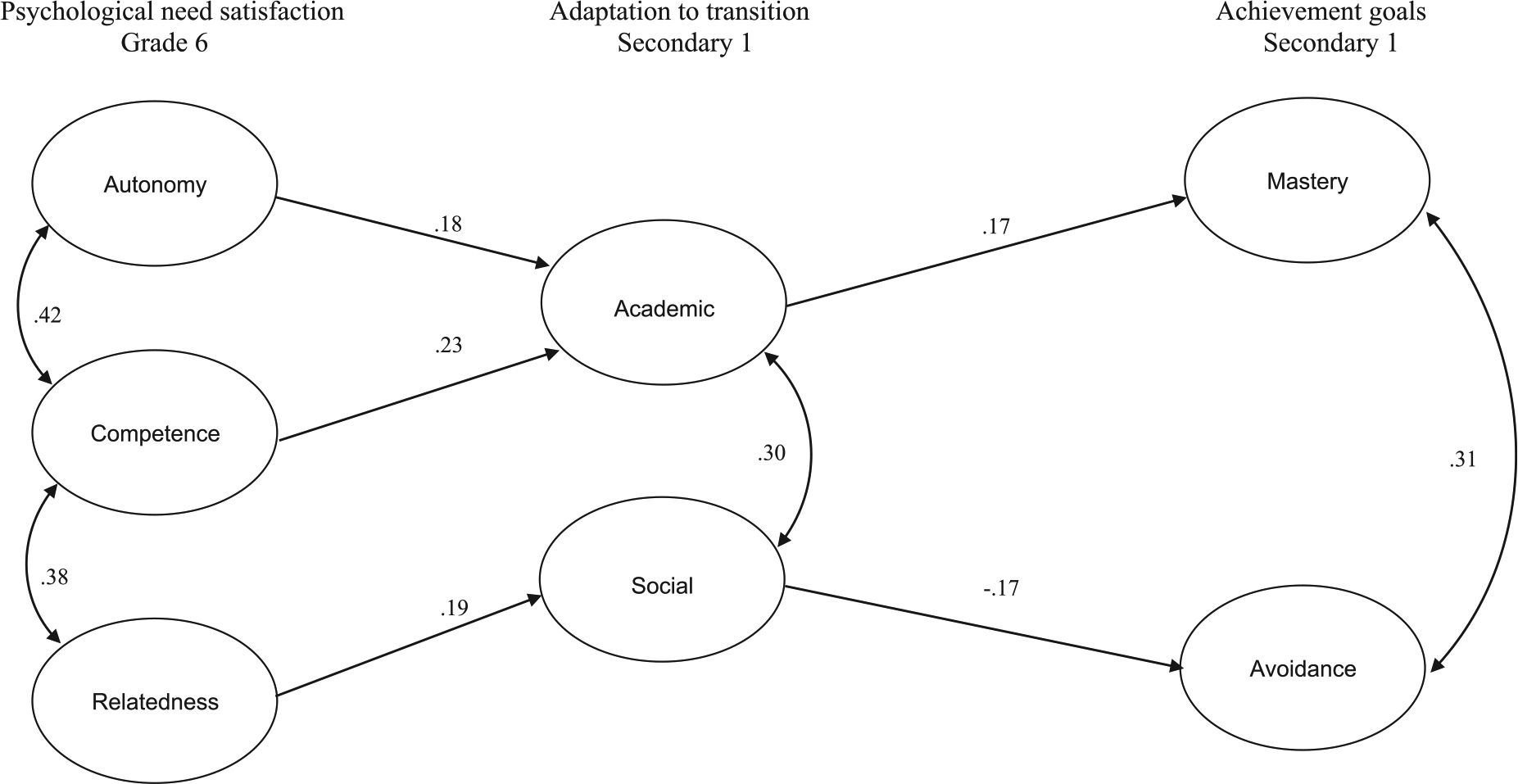
Predictive relationship between basic psychological need satisfaction, adaptation to secondary school transition, and achievement goals.
Indirect effects
Results based on 95% CIs estimated by the bootstrap procedure revealed the existence of four indirect effects. Two of these effects highlight the following sequences: competence satisfaction → academic adaptation → mastery goals (95% CI = [.007, .13]) and autonomy satisfaction → academic adaptation → mastery goals ( 95% CI = [.004, .09]). These relational patterns indicate that the satisfaction of the needs for competence and autonomy in Grade 6 predicted increases in students’ ability to adapt to the academic demands in the first year of secondary school. In turn, students’ academic adjustment predicted the adoption of mastery goals. The other two indirect effects involved social adaptation as the mediating mechanism for the link between need satisfaction and goals: autonomy satisfaction → social adaptation → performance-avoidance goals (95% CI = [−.14, −.006]) and relatedness satisfaction → social adaptation → performance-avoidance goals (95% CI = [−.088, −.004]). These effects show that the satisfaction of the needs for autonomy and relatedness in Grade 6 predicted students’ ability to make friends during the transition to secondary school. Students’ social adjustment, in turn, predicted a decrease in performance-avoidance goals adopted in the classroom.
Direct effects
The path coefficients indicated that the satisfaction of needs for competence and autonomy positively predicted academic adaptation in the first year of secondary school (β = .23, SE = .08, p = .01 and β = .18, SE = .09, p = .04, respectively). In addition, the results showed that relatedness satisfaction positively predicted social adaptation during the transition to secondary school (β = .19, SE = .08, p = .03). It is also noteworthy that satisfaction of the need for autonomy positively predicted social adaptation, although this trend did not meet statistical significance (β = .18, SE = .10, p = .07). Finally, academic adaptation at the beginning of secondary school was positively associated with the adoption of mastery goals (β = .18, SE = .07, p = .02), while social adaptation was negatively related to performance-avoidance goals (β = −.19, SE = .08, p = .02).
Other results also emerged from the tested model. Positive relationships were found between the satisfaction of needs for competence and autonomy (β = .42, SE = .07, p < .001), the satisfaction of needs for competence and relatedness (β = .38, SE = .05, p < .001), academic and social adaptation (β = .30, SE = .06, p < .001), and achievement goals in Grade 7 (β = .31, SE = .07, p < .001). Moreover, being a boy was positively associated with performance-avoidance goals in Grade 7 (β = .17, SE = .05, p < .001) but negatively associated with mastery goals in Grade 6 (β = −.13, SE = .05, p < .01) and the satisfaction of three psychological needs (competence: β = −.14, SE = .05, p < .01; autonomy: β = −.29, SE = .05, p < .001; relatedness: β = −.09, SE = .04, p = .04). Mastery goals in Grade 6 were positively related to mastery goals in Grade 7 (β = .45, SE = .07, p < .001) and to the satisfaction of needs for competence (β = .43, SE = .06, p < .001), autonomy (β = .34, SE = .06, p < .001), and relatedness (β = .21, SE = .06, p < .001). They were also positively related to performance-avoidance goals in Grade 6 (β = .34, SE = .05, p < .001). Finally, performance-avoidance goals in Grade 6 were positively related to their counterparts in Grade 7 (β = .41, SE = .07, p < .001) and negatively related to the satisfaction of the need for autonomy (β = −.18, SE = .07, p < .01).
Discussion
This study examined whether psychological need satisfaction at the end of elementary school could predict achievement goals in the first year of secondary school. As expected, the satisfaction of students’ psychological needs predicted the adoption of mastery goals and the reduction of performance-avoidance goals. We also found that, in line with our hypotheses, these links were explained by students’ adaption to the transition to secondary school. Two relational patterns emerged from the results: The satisfaction of needs for autonomy and competence predicted mastery goals through academic adaptation, while the satisfaction of needs for autonomy and relatedness was associated with performance-avoidance via social adaptation. These results provide the first evidence of the importance of psychological need satisfaction for predicting achievement goal orientation in the context of the transition to secondary school. Below, we discuss these findings and their theoretical and practical implications.
Psychological Need Satisfaction and Mastery Goals
Our findings contribute to the literature linking psychological need satisfaction and mastery goals in several ways. First, they replicate previous studies that found that psychological need satisfaction contributes to the adoption of these goals in samples of older students (Ciani et al., 2011; Diseth et al., 2012). Second, they extend these findings by showing how they apply to younger students and that they can be generalized to a specific context, namely, the transition to secondary school. To the best of our knowledge, this study is the first to show the buffering effect of pre-transition psychological need satisfaction on students’ mastery goal orientation in secondary school. Specifically, when their needs for autonomy and competence were satisfied, students transitioned to secondary school perceiving themselves as better able to adapt to the academic demands of the new school, and consequently developed a mastery orientation. Third, this is the only study to have identified students’ academic adaptation as one of the psychological mechanisms responsible for the positive contribution of psychological need satisfaction to a mastery goal orientation.
In line with theoretical works that linked psychological needs and adaptation (Ntoumanis et al., 2009; Skinner & Edge, 2002), we believe that students’ cognitive evaluation processes could partly explain the relationships found in our analysis. Students whose needs for autonomy and competence were satisfied in elementary school might be more inclined to make a positive appraisal of certain personal resources necessary to adapt to a new school environment (e.g., ability to make choices and to freely organize actions regarding school life; feeling competent in what they have learned). A positive appraisal of these resources could be accompanied by a feeling of control and pleasant emotions leading students to consider the transition to secondary school as a challenge to take on rather than a threatening event for the ego (Ntoumanis et al., 2009). Once in secondary school, this positive mind-set could be reinforced by feedback on their competence indicating to students that their schoolwork is well done, and that they are progressing and succeeding in their new environment. Students may thus feel that they are academically well adapted, which would boost confidence in their abilities and help orient students toward an internalized focus to learn.
The association between academic adaptation during the transition to secondary school and the adoption of mastery goals is consistent with previous studies showing that mastery goals were positively predicted by perceived academic competence (Maltais et al., 2015) and that negative competence feedback (e.g., doing poorly on an exam) predicted a significant decrease in the adoption of these goals (Senko & Harackiewicz, 2005). According to the present results, the satisfaction of needs for autonomy and competence before entering secondary school appears to be a prerequisite for the establishment of this relationship.
Psychological Need Satisfaction and Performance-Avoidance Goals
According to SDT (Deci & Ryan, 2000), people have universal basic psychological needs that must be met to function optimally and to be at ease socially. Our results supported SDT’s postulate by showing that the satisfaction of needs for autonomy and relatedness at the end of elementary school is associated with the ability to make friends and be accepted by peers during the transition to secondary school. Social adaptation, in turn, is associated with a decreased endorsement of academic goals focused on avoiding incompetence or negative social comparisons in the classroom.
Our findings suggest that elementary school students whose psychological needs have been met consider the transition to secondary school as an event offering new socialization opportunities and the opportunity to learn and master new skills and knowledge. These students, who would have internalized the importance of going to school and would be confident of being accepted by others, might be more inclined to approach peers and develop close ties with those who share similar goals. These friendships could lead to behaviors of mutual help and support in learning situations, reducing the focus on social comparison, competition, avoidance of incompetence, and the fear of looking stupid. Although this hypothesis needs to be tested empirically, it seems to make sense with studies that have reported that secondary school students who adopt performance-avoidance goals have friends who devalue academic effort and achievement (Urdan, 1997) or have fewer friends in the classroom (Shin & Ryan, 2014).
Instability of Achievement Goals
Although the goal of our study was not focused on assessing the stability of achievement goals during the transition to secondary school, an examination of the correlations showed that mastery and performance-avoidance goals were moderately stable over an interval of 12 months. These results mirror other studies that cover the same period (e.g., L. H. Anderman & Anderman, 1999; E. M. Anderman & Midgley, 1997; Duchesne et al., 2014; Paulick et al., 2013) and indicate that the intensity of the goals adopted by students varies (e.g., decline of mastery goals), with individual differences being particularly pronounced. Although a significant portion of this instability can be attributed to students’ school environment (E. M. Anderman & Patrick, 2012; Elliot & Dweck, 2005) and family environment (Duchesne & Ratelle, 2010; Maltais et al., 2015), our results suggest that the contributions from their basic psychological needs satisfaction in elementary school and their academic and social adaptation at the beginning of secondary school should not be neglected.
Practical Implications
The results of this study raise two implications for preparing and supporting students transitioning to secondary school. The first implication relates to the importance of supporting the satisfaction of students’ basic psychological needs. To this end, SDT (Ryan & Deci, 2000) holds that an autonomy-supportive environment is one of the main factors for satisfying innate basic psychological needs. In such an environment, a significant person (e.g., parent, teacher) considers the perspective of the child/adolescent, explains and justifies the reasons for engaging in a behavior or activity, encourages initiatives, offers opportunities for choice making and problem solving, promotes self-regulation strategies, provides informal feedback, and minimizes the use of external reinforcers (rewards, punishments) to control behavior (Reeve, 2002; Ryan & Deci, 2000, 2006). Several studies have shown that autonomy support at home and in the classroom was associated with many educational benefits for students, such as the satisfaction of psychological needs, competence, autonomous motivation, curiosity, a preference for challenges, mastery efforts, school adjustment, and psychological well-being (Chirkov & Ryan, 2001; Deci, Schwartz, Sheinman, & Ryan, 1981; Duchesne, Ratelle, Larose, & Guay, 2007; Niemiec et al., 2006; Ratelle, Simard, & Guay, 2013; Sheldon & Krieger, 2007). We think that parents and elementary school teachers could benefit greatly from seminars (at school or at parent and teacher association conferences), development workshops (at school), and factual information (e.g., on the school website or in the school newspaper) promoting and facilitating the adoption of autonomy-supportive behaviors by teachers and parents.
The second implication arising from the results of this study relates to students’ achievement goals. These goals are considered malleable and, like psychological need, can be influenced by social contexts (Elliot & Dweck, 2005). Research has clearly shown that students exposed to a classroom environment that promotes competence/mastery were more willing to take on the same kind of goals (for a review, see E. M. Anderman & Patrick 2012; Maehr & Zusho, 2009). Such an environment is notably structured around meaningful activities, support of students’ autonomy, and recognition of effort, progress, risk taking, and creativity (Givens Rolland, 2012; Kaplan & Maehr, 2007). Aside from the classroom environment, studies have shown that a parent can encourage his or her child’s mastery goals when the child perceives the parent as being involved (Duchesne & Ratelle, 2010), available, comforting, and open to communication (Maltais et al., 2015). Parents whose children are about to make the transition to secondary school could be informed about the importance of maintaining their involvement in the academic monitoring of their children. Strategies such as showing interest in what their children do in school, paying attention to their concerns, recognizing their achievements and efforts, and supporting them through their difficulties and disappointments need to be encouraged so that children feel that their parents are involved. Again, we believe that this information—based on empirical data—should be communicated to families and schools in the same ways proposed above.
Limitations and Directions for Future Research
SDT proposes that the satisfaction of basic psychological needs has implications for achievement goals (Deci & Ryan, 2000), but only a very limited number of studies have so far examined this association in a school context and none have focused on the transition to secondary school. This study adds to the motivational literature by showing that the satisfaction of students’ basic psychological needs in Grade 6 predicts achievement goals in secondary school through mechanisms of academic and social adaptation. These associations were obtained while controlling for the contribution of students’ gender and the achievement goals adopted in Grade 6. Although this study has many methodological strengths (large-scale stratified sample, two data waves collected at 12-month intervals, imputation of missing values, inclusion of potential confounding variables), the limitations should also be stated.
First, the correlational design of this study prevents us from inferring causal relationships between the study variables. For example, although it is theoretically plausible to postulate that adapting to a new educational environment could affect students’ achievement goal orientations, the opposite seems equally plausible. Future replication studies could assess adaptation and achievement goals at different times. Another research avenue could be to verify the bidirectional and recursive longitudinal relationships between these variables using an autoregressive cross-lagged panel model approach (for an overview of this modeling technique, see Bollen & Curran, 2004).
Second, the data used in this study were collected using self-reported instruments, which are subject to social desirability bias (Miller et al., 2015). For example, it is possible that some students were reluctant to admit that they were struggling to meet school demands, to make new friends, or that they were focused on the fear of being incompetent. Future research could seek to overcome this problem by incorporating into the design a social desirability scale, which could be used as a control variable, or external sources of information on the student such as teachers (to assess school adaptation) and classmates (to assess social adaptation). Adding these information sources would also help to reduce common variance bias.
Third, we used a sample of White students who were mostly from intact, middle-class families. Future research could attempt to confirm and extend the results of this study, with particular care in the selection of participants to reflect more cultural, social, and family diversity.
Finally, certain family and school factors that were found to contribute to the variables in our model were not considered. Studies have shown that parenting behaviors (e.g., autonomy support, involvement) are significant predictors of both students’ basic psychological needs satisfaction (see Joussemet, Landry, & Koestner, 2008) and achievement goal orientation (e.g., Duchesne & Ratelle, 2010). Past research also suggested that the school context can contribute to students’ psychological needs satisfaction, goal orientation, and academic performance through social climate, teacher beliefs, curricular tracking, and pedagogical practices (Eccles & Roeser, 2011; Federici, Skaalvik, & Tangen, 2015; Hattie, 2009; Lüftenegger, van de Schoot, Schober, Finsterwald, & Spiel, 2014; Wolters, 2004). Further studies are needed to explore the potential moderating effect of family and school factors in the relations from psychological need satisfaction to achievement goals.
Conclusion
Two key questions were at the heart of this prospective study: Are students’ basic psychological needs satisfaction at the end of elementary school associated with the adoption of mastery and performance-avoidance goals at the end of the first year of secondary school? Do mechanisms of academic and social adaptation during the transition to secondary school mediate this relationship? In light of the results obtained, it appears possible to answer these questions in the affirmative. Our results indicated that the satisfaction of needs for autonomy and competence contributes to a mastery goal orientation and that this link can be explained by students’ perception of being academically well adapted. It was also shown that the satisfaction of needs for autonomy and relatedness fostered social adaptation, which would prevent students from adopting a performance-avoidance goal orientation. All these associations have been adjusted for student gender and achievement goals adopted before the transition to secondary school. Overall, these results highlight the role of certain malleable factors on which parents and teachers can intervene to promote students’ motivation, engagement, and success at a critical time in their schooling.
Footnotes
Declaration of Conflicting Interests
The author(s) declared no potential conflicts of interest with respect to the research, authorship, and/or publication of this article.
Funding
The author(s) disclosed receipt of the following financial support for the research, authorship, and/or publication of this article: This study was supported by the Social Sciences and Humanities Research Council of Canada (SSHRCC) and the Fonds de Recherche du Québec–Société et Culture (FRQSC).