




Abstract
This study examined multiple risk behaviors (violence, delinquency, and substance use) among 240 African American and 262 Hispanic preadolescent boys from urban schools in the Midwest United States. Latent transition analysis allowed patterns of multivariate risk to emerge uniquely within and across these ethnic groups, highlighting patterns for subgroups that are overlooked by common aggregate statistics. Results revealed four risk classes for each ethnic group, with nuanced probabilities of endorsement and transition across classes and ethnic groups. Involvement with police and more severe use of substances were distinguishing factors of higher risk classes. African American boys showed a tendency to transition between risk classes over time, while Hispanic boys tended to exhibit stability. Personal involvement in school and community action among parents were highlighted as protective factors. Suggestions for prevention programming based on results include early timing, addressing criminal justice involvement, providing academic enrichment programs, and promoting community action among parents.
In 2014, President Barack Obama’s “My Brother’s Keeper” (MBK) initiative challenged cities, towns, counties, and tribes across the United States to address gaps in opportunity and risk faced by young men of color, with the goal of “keeping kids on track and giving them second chances” in order that they reach full potential. The program emphasizes completing school, entering a productive career, and avoiding violence and involvement in the criminal justice system and explicitly focuses on boys and young men of African American, Hispanic American, and Native American backgrounds, with a “particular focus on issues important to young men under the age of 15” (The White House, 2014, 2016). The memorandum for the program explains a recognized uniqueness of the challenges, risks, and gaps in opportunity faced by boys of these groups, apart from those faced by girls and youth more generally, and the importance of the childhood and early adolescent developmental periods.
African American and Hispanic youth have long been suggested to be at greater risk for behaviors that disrupt trajectories toward success and well-being (Farrington, Loeber, & Stouthamer-Loeber, 2003; Piquero, West, Fagan, & Holland, 2006), and boys have been highlighted as being particularly at risk, given findings of higher levels for many risky behaviors including physical aggression (e.g., Stoltz, 2005; Xie, Drabick, & Chen, 2011); and use of alcohol and marijuana (Substance Abuse and Mental Health Services Administration [SAMHSA], 2014). For example, while trajectories for progression in severity of violence, delinquency, and substance use tend to follow the same temporal order for boys and girls, rates of these risk behaviors have been shown to be higher for boys at all ages (see Jennings, Maldonado-Molina, & Komro, 2010 and Loeber & Hay, 1997 for violence and delinquency; see Ehlers et al., 2010 and Schuckit, Daeppen, Tipp, Hesselbrock, & Bucholz, 1998 for substance use). Several studies have, additionally, shown greater tendency for violence and delinquency among boys in these ethnic groups relative to boys of other backgrounds (e.g., Chauhan, Reppucci, & Turkheimer, 2009; Farrington et al., 2003; Maldonado-Molina, Jennings, & Komro, 2010; McNulty & Bellair, 2003; Williams et al., 2007)—though studies have, in fact, not suggested earlier substance use (Horton, 2007; Malone, Northrup, Masyn, Lamis, & Lamont, 2012; SAMHSA, 2014; Williams et al., 2007).
Most studies and public health initiatives on youth risk behavior have focused on single domains of risk (e.g., substance use only, violence only)—but this limits information on patterns of risk behavior that exist across behavioral domains. Yet studying risk behaviors in conjunction is intuitive as risk behaviors are thought to share common causes in the self and the environment (Jessor & Jessor, 1977), and because cognitive, affective, and social developmental factors such as abilities for decision making and control, as well as personal values, cut across multiple domains of behavior (Geier & Luna, 2009; Harden & Tucker-Drob, 2011; Steinberg, 2008).
Social action theory emphasizes the embeddedness of the individual and his or her cognitions, actions, and interactions in an environmental structure that either constrains or enhances these self-regulatory mechanisms of change (Ewart, 1991). In applying social action theory to the study of risk behaviors among African American and Hispanic boys, the actions that parents, communities, schools, and boys themselves may take can be considered within the social context of racial and economic barriers uniquely faced by boys and young men of color. In this study, we examine multiple risk behaviors in relation to background and contextual factors, as well as select actions and interactions of boys, parents, and communities in schools and neighborhoods, among African American and Hispanic boys in an urban environment. This comprehensive examination of multiple risk behaviors, as they co-occur and are influenced by social risk and protective factors, is likely to reveal greater information on the best points of intervention for each group, relative to examining each risk behavior in isolation, wherein common causes in actors or the environment may be overlooked.
We apply a social action theory approach to the study of multiple risk behaviors, as they occur in context, using mixture modeling. The type of mixture model we use, latent transition analysis (LTA), summarizes patterns of responses across many items (referred to as “indicators”) by placing persons responding to these items into a small number of groups (“latent classes”), each with its own pattern of risk, which is studied over time (Collins et al., 1994). The mixture model acknowledges that risk is not a uniform phenomenon, but rather may take on various forms for distinct subpopulations, and allows these forms to “emerge” from the data. This approach is sensitive to the potentially distinct patterns of risk that may exist for African American and Hispanic boys in comparison with each other, as well as to diversity in levels of risk within these ethnic groups (i.e., both across- and within-culturally; Azibo, 1988; Graham, 1992). By allowing patterns to emerge from data from multiple risk domains, we address apparent discrepancies in the literature—for instance, that boys in these ethnic groups may not be at particular risk for early substance use, on average, yet for certain subgroups it may be a major concern. Ultimately, the aim of this study is to uncover patterns of multivariate risk that inform and improve prevention programming for African American and Hispanic boys, a current national concern.
Multivariate Risk Among African American and Hispanic Boys
Youth risk behavior is formally defined as behavior that can have adverse effects on development and well-being, or that may prevent future successes and development (de Guzman & Bosch, 2007). Preadolescence is a critical developmental period for youth risk behavior as this is when many risk behaviors are likely to be initiated (e.g., for substance use, Johnston, O’Malley, Miech, Bachman, & Schulenberg, 2015; for violence and delinquency, Loeber & Farrington, 2001). 1 It is also a time when the physical and social effects of these behaviors are likely to be greater—for instance, with greater potential for addiction (National Institute on Drug Abuse [NIDA], 2014; U.S. Department of Health and Human Services [HHS], 2012) or for displacement from a normative schooling trajectory, among violent and delinquent youth (Children’s Defense Fund, 2014).
African American and Hispanic youth have generally been suggested to be at greater risk for these behaviors because of residence in neighborhoods with weaker economic conditions, increased opportunity for drug use, and greater exposure to violence, and in households with greater instability, one-parent structure, or younger maternal age, on average (Farrington et al., 2003; Piquero et al., 2006). As for the study of youth risk behavior more generally, studies among these ethnic groups have generally focused on domains of risk in isolation, or have examined links between risk behaviors only in limited ways. For instance, Maldonado-Molina and colleagues (2010) predicted membership in latent groups for aggressiveness among Black and Hispanic middle school students, pooled with youth of other backgrounds, from substance-related variables—but this does not allow risk subpopulations to emerge across the domains of substance use and delinquency, but only for the latter, nor does it allow risk subpopulations to emerge for each ethnic group separately. This exemplifies how research has not adequately explored within- and across-group diversity in risk among boys of color.
A more grounded and complete approach may help reconcile apparent discrepancies in the literature on risk among African American and Hispanic boys. For instance, studies have suggested higher levels of violence and delinquency among boys in these ethnic groups (e.g., Farrington et al., 2003; Maldonado-Molina et al., 2010; McNulty & Bellair, 2003; Williams et al., 2007), but lower risk for early alcohol use initiation, relative to White youth, on average (Malone et al., 2012; SAMSHA, 2014). These findings seem in discord with theory suggesting that African American and Hispanic boys should, in general, be at greater risk for both sets of risk behaviors. However, group or aggregate rates, for singular behavioral domains, can overlook critical information. For instance, subgroups of African American and Hispanic boys may engage in very early use of alcohol and other drugs, even if this is not normative for their ethnic group (i.e., there may be important within-group variation). Thus, prevention programming may not be as helpful as it could be in targeting the behaviors at greatest need of attention among these boys, even if this implies a focus on subgroups rather than entire populations (Rose, 1992).
In addition to the uniqueness of the neighborhoods and homes in which these boys live (Farrington et al., 2003; Piquero et al., 2006), African American and Hispanic boys may generally experience events, such as interactions with teachers or police, differently than a White peer would; they may also experience these events differently than each other. Thus, while African American and Hispanic boys have been highlighted as warranting unique attention (The White House, 2014), comparing simple rates of risk behaviors with those for other ethnic groups may not be valid—for example, if boys of color more frequently face suspension, expulsion, or juvenile justice system consequences for the same risk behavior (Rodriguez & Eells, 2013). For example, research has shown that cultural differences in expression and movement can also be misinterpreted by teachers as defiance or a behavioral disorder, and the majority of this research has focused on African American boys (Neal, McCray, & Webb-Johnson, 2001). Likewise, African American and Hispanic boys are overrepresented in the juvenile court system, with bias shown in front-end court processes, as well as in juvenile court outcomes (Rodriguez & Eells, 2013); and overrepresentation is greatest for African American boys (Campaign for Youth Justice, 2012; Children’s Defense Fund, 2014). Among Hispanic boys, acculturation may be an important risk or protective factor (and may be relevant in some locales for Black youth). Specifically, as reflected in proxy measures such as years lived in the United States, acculturation may be associated with higher rates of risk behaviors, as has been shown for substance use, delinquency, and conduct disorder more generally (Bird, Canino, et al., 2006; Bird, Davies, et al., 2006; Maldonado-Molina et al., 2009; Smokowski, Rose, & Bacallao, 2009).
These considerations highlight the need for examinations of risk behaviors among African American and Hispanic boys that are conducted uniquely for these ethnic groups, not necessarily compared with rates among White or youth overall, and additionally sensitive to potential variation within these ethnic groups. The current study represents an example of this type of analysis, accomplished by combining a social action theoretical approach with mixture modeling.
The Current Study
We focus our analysis on preadolescence in order to examine early engagement, which is critical to understanding developmental trajectories for risk, as acknowledged by the MBK initiative and theory more generally. We focus on violence, delinquency, and substance use as three primary youth risk behaviors. While this analysis does not include all risk behaviors, nor all subpopulations of African American and Hispanic youth in the United States, it serves as an example of the type of analysis that has been lacking in addressing this important national goal and may be extended to additional risk outcomes and social-contextual environments, accordingly.
Given the potential for multiple patterns of risk to emerge for each group of boys, we advanced research questions in lieu of hypotheses, focusing on three spheres of influence on risk: (a) background factors, including the home environment; (b) schools; and (c) neighborhoods. Background factors represent factors that may not be manipulated, but inform on potential differences in risk associated with characteristics that vary within ethnic group. Within the school and neighborhood spheres, we focus on potential actions that boys, parents, and communities can take within these social contexts, in light of the barriers within them, in line with social action theory. We explored a number of covariates within these spheres that literature has associated with risk: age, socioeconomic status (SES; free/reduced lunch), household structure (two-parent or other), and acculturation among the background factors; school performance (good test/project scores), personal involvement (studying), and parental involvement (parent asks about school) among the school-related factors; and neighborhood problems and community action among the neighborhood factors. We also considered interactions between parental and community actions in the schooling and neighborhood domains and barriers in those domains (parental involvement in school with school performance and community action with neighborhood problems) to examine whether actions may moderate the impact of barriers on risk.
Method
Data Source
We utilized data from Project Northland Chicago (PNC), a longitudinal alcohol use preventive intervention trial with its middle school data collected in fall 2002 (beginning of Grade 6), spring 2003 (end of Grade 6), spring 2004 (end of Grade 7), and spring 2005 (end of Grade 8). While dated, other longitudinal data sources on risk behaviors among youth at this age remain limited. PNC is also rich in item-level detail on risk behaviors across multiple domains, with student surveys including multiple items on self-reported alcohol, cigarette, and marijuana use; engagement in violence and delinquency; and other risk variables at each time of measurement. Parent surveys measure reports of neighborhood problems, attitudes and behaviors regarding alcohol, and parenting strategies. Students were from 61 Chicago Public Schools (CPS) selected from all CPS that included Grades 5 through 8, had low mobility rates (< 25%), and were larger in size (30+ students per grade; Komro et al., 2004; Komro et al., 2006). PNC is thus not representative of all CPS, yet these criteria ensured efficiency in data collection and analysis. As schools were selected purposely, and all Grade 6 students selected (response rates of 91% to 95% at the four measurements), no sampling weights were applied. Assignment to intervention was at the neighborhood level (groups of schools), and interventions lasted all three years. We focus on the baseline (fall 2002) and last follow-up (spring 2005) time points.
Sample
Filters and treatment of missingness
First, we limited our sample to students in the control condition, assigned at baseline (N = 2,341), to avoid potential treatment effects, and removed students who moved from control to intervention schools (n = 15, reduced N = 2,326). Second, we limited our sample to boys who were African American or Hispanic (reduced N = 776), the two ethnic groups with greatest representation in PNC and in CPS more generally. (Sample sizes were not large enough for other groups to permit separate analysis.) Finally, we reduced the sample to boys with valid risk behavior data at both time points, which enabled us to examine risk transition without overreliance on missing data techniques for our main outcome variables (final analytic N = 502; 240 African American boys, 262 Hispanic boys). Mplus’ default Full Information Maximum Likelihood (FIML) was utilized for select item-level missingness for these individual outcome variables. To maintain a consistent sample in conditional models, we utilized multiple imputation for predictor variables (to be described). Chi-square analysis showed that case-wise missingness at follow-up was (positively) associated with being African American (p < .001) and with eligibility for free/reduced lunch at baseline (p < .05). Logistic regression showed that case-wise missingness at follow-up was also positively related to age at baseline (p < .001).
Final sample characteristics
Both African American and Hispanic boys were 11.8 years old on average at baseline (SD = .48 and SD = .51, respectively). At follow-up, boys were 14.3 years old on average (SD = .48 for African American boys; SD = .54 for Hispanic boys).
Among African American boys at baseline, 40% reported living in a two-parent home, 81% were eligible for free/reduced lunch, and 97% reported living in the United States their entire life. Sample size was N = 170 for parents of African American boys, and missingness of parent data was not significantly related to eligibility for free/reduced lunch at baseline (p = .40).
Among Hispanic boys at baseline, 72% reported living in a two-parent home and 83% were eligible for free/reduced lunch. Eighty percent reported living in the United States their entire life, 9% for 7 to 9 years, 7% for 4 to 6 years, 3% for 1 to 3 years, and 1% for less than 1 year, highlighting some potential variation in acculturation for this group. As a second proxy measure for acculturation, language spoken most often in the home for this group at baseline was 34% “mostly English,” 64% “mostly Spanish,” and 2% “Other,” again highlighting some potential variation in acculturation. However, PNC questionnaires did not permit students to mark speaking English and Spanish about equally in the home, a limitation in the measures; hence, we do not incorporate this second measure further into our analyses. Sample size was N = 172 for parents of Hispanic boys. Missingness of parent data for this group was positively related to eligibility for free/reduced lunch (p < .05), but not with boys’ years in the United States (p = .14), as measured at baseline.
PNC questionnaires did not permit students to indicate more specific ethnic or cultural self-identification beyond “Black or African American” and “Latino, Hispanic, or Mexican American.” Thus, we did not incorporate further detail on ethnic self-identification into our analyses beyond the more general self-identifications indicated here. In CPS schools more generally, the majority of Hispanic students at Grade 6 in the 2002-2003 school year were Mexican American (80%), with smaller percentages of Puerto Rican, Cuban, or Other Hispanic heritage (Chicago Public Schools, 2016). CPS did not record further detail beyond these ethnic group identifications for either group in this calendar year.
Measures
Risk behaviors
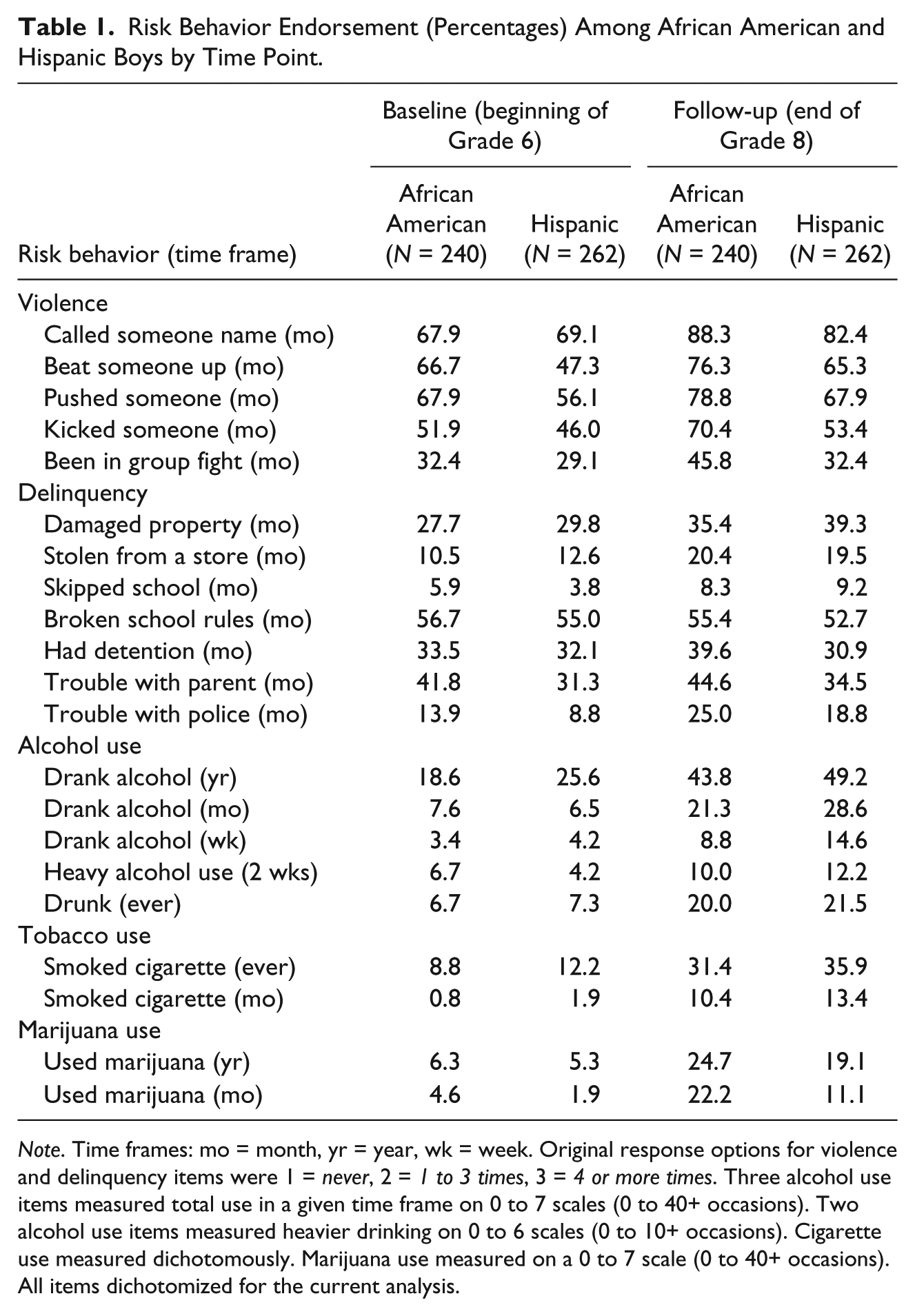
We utilized boys’ responses to items measuring 21 distinct risk behaviors at each time point, including violence (five items), delinquency (seven items), alcohol use (five items), cigarette use (two items), and marijuana use (two items; see Table 1 for items and noted response options). Violence and delinquency items were distinguished in prior factor analysis (Yarnell, Pasch, Brown, Perry, & Komro, 2014). We dichotomized items that did not have 0/1 responses for consistency of interpretation across items, and so responses could be interpreted as conditional probabilities of endorsement between 0 and 1.00 in our LTA models. Given use of items rather than scales, item intercorrelations are not relevant.
Risk Behavior Endorsement (Percentages) Among African American and Hispanic Boys by Time Point.
Note. Time frames: mo = month, yr = year, wk = week. Original response options for violence and delinquency items were 1 = never, 2 = 1 to 3 times, 3 = 4 or more times. Three alcohol use items measured total use in a given time frame on 0 to 7 scales (0 to 40+ occasions). Two alcohol use items measured heavier drinking on 0 to 6 scales (0 to 10+ occasions). Cigarette use measured dichotomously. Marijuana use measured on a 0 to 7 scale (0 to 40+ occasions). All items dichotomized for the current analysis.
Risk and protective factors and covariates
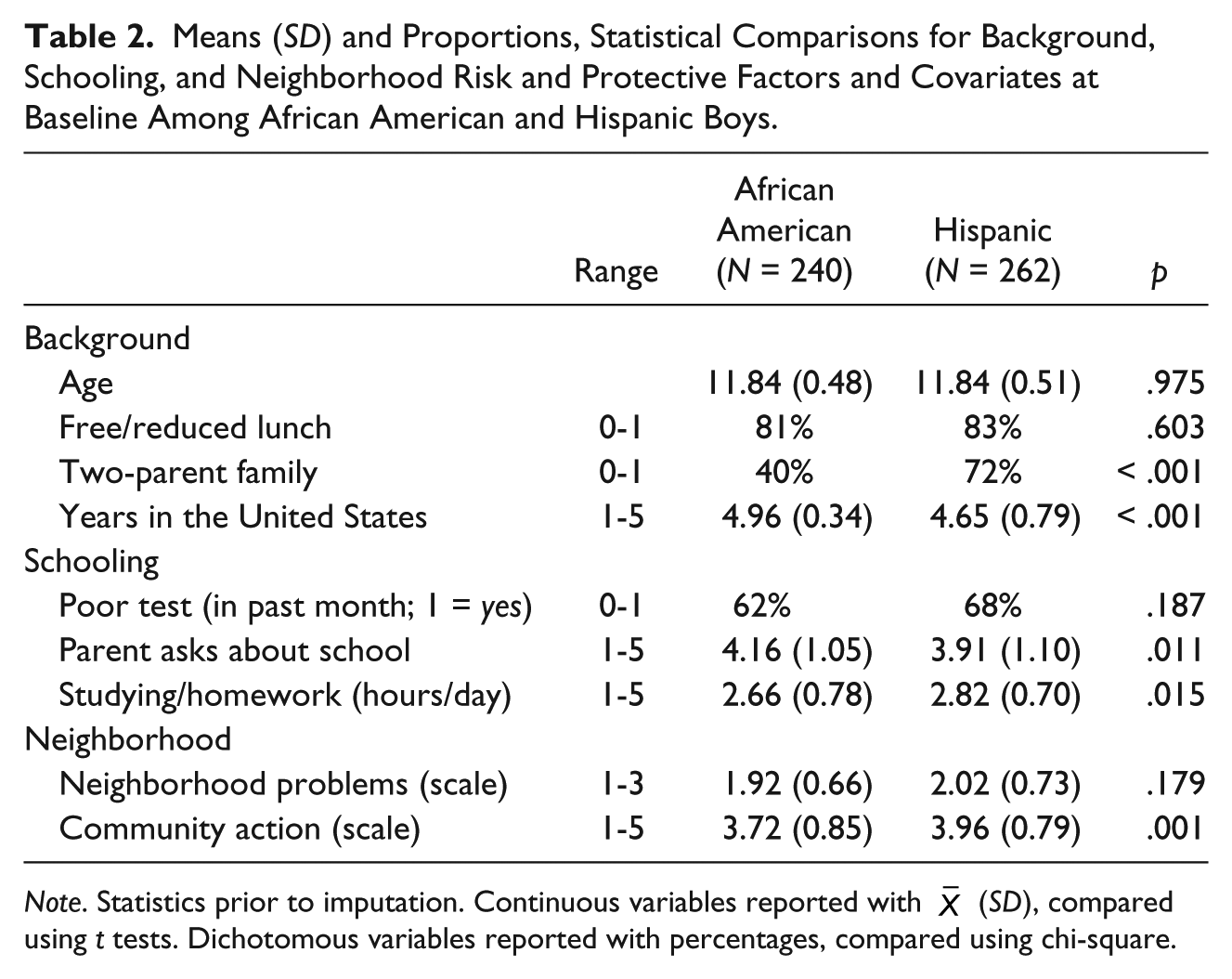
These variables were used to predict risk status at baseline and at follow-up conditional on baseline status. Predictors were grouped into blocks (Background, Schooling, and Neighborhood), and were based on baseline responses. Table 2 displays variables in each block, along with means and proportions for these variables.
Means (SD) and Proportions, Statistical Comparisons for Background, Schooling, and Neighborhood Risk and Protective Factors and Covariates at Baseline Among African American and Hispanic Boys.
Note. Statistics prior to imputation. Continuous variables reported with
Background variables
Background variables were based on self-report: ethnic group membership (multiethnic boys were coded as “Other” in the original PNC data and are not included here), age (coded as years and partial years based on self-reported birthdate), receipt of free/reduced lunches (1 = yes, 0 = no), primary residence (1 = two-parent family, 0 = other arrangement), and years lived in the United States (1 = all of life, 2 = 7-9 years, 3 = 4-6 years, 4 = 1-3 years, and 5 = <1 year; reverse-scored for all analyses). Other residence arrangements included living mostly with mother; mostly with father; with mother and father, in separate homes; mostly with grandparent; mostly with other relative; mostly with foster parents; or “other.” Two-parent families (mother and father together) were the most common in each ethnic group, followed by mostly with mother (38% of African American boys, 22% of Hispanic boys).
Schooling variables
Schooling variables, also based on student self-report, included having done poorly on a test or important school project in the past month (Poor Test; 0 = no, 1 = yes), frequency of parent/guardian asking about school (Parent Asks about School; 1 = never, 2 = hardly ever, 3 = sometimes, 4 = a lot, 5 = all the time), and time spent studying/on homework per day (Studying/Homework; 1 = 0 hours, 2 = 1-2 hours, 3 = 3-5 hours, 4 = 6-10 hours, 5 = 11+ hours).
Neighborhood variables
Neighborhood variables included two scales based on parents’ reports. First, Neighborhood Problems was an average of parents’ responses to seven items measuring how much various issues are a problem “on the block where you live” (drug dealing, unsupervised youth, people drinking alcohol on the street, too many stores that sell alcohol, lack of supervised activities for youth, too many alcohol advertisements, poor police response). Response options were 1 = not a problem, 2 = minor problem, and 3 = serious problem. Reliability was α = .90 for parents of African American boys, and α = .94 for parents of Hispanic boys. Second, Community Action was an average four items measuring actions “you or one of your neighbors” would take in the presence of various neighborhood problems. Response options ranged from 1 = would not do something about it to 5 = definitely would do something about it. Reliabilities were α = .76 for parents of African American boys, and α = .69 for parents of Hispanic boys.
Analyses
Analyses were conducted separately by ethnic group to examine potentially unique risk classes and transitions for each group. First, we determined rates of endorsement by time point using Stata 12. Second, we analyzed the confluence of risk behaviors in risk classes, and transition between classes over time, using LTA models run in Mplus 7, using standard setup for a two-time point autoregressive structural model with the dichotomous risk behaviors as indicators in the measurement model (Collins & Wugalter, 1992; Muthén & Muthén, 1998-2012; see also Reboussin, Green, Milam, Furr-Holden, & Ialongo, 2014 for a recent example). We constrained the risk class solution (indicator thresholds) to have measurement invariance over time for consistent interpretation of the risk classes across time points, and classified boys according to their “most likely class” (Clogg, 1995). Boys were permitted to transition freely between risk statuses across the time points. We did not nest students into schools in order to concentrate on individual risk patterns and transitions, as two-level mixture models are computationally demanding (Muthén & Muthén, 1998-2012) and thus require a simpler model at the individual level, which was not desired here—given the goal of maximizing information on risk behaviors of individual boys, rather than a focus on school-level effects. The school selection criteria additionally control for several school factors by design (e.g., urban public schools in Chicago, which had a majority ethnic minority, low-SES student population).
Finally, we predicted risk class at baseline and follow-up from each block of risk and protective factors and covariates (Background, Schooling, and Neighborhood). Here we employed Stata’s mi chained for multivariate imputation of predictors with missing data to maintain a consistent sample across these models, using 20 generated imputation data sets (Stata Press, Release 12). Rate of missingness was as reported above for parent-response Neighborhood variables and was highest for free/reduced lunch among the student-response variables (12.5% among African American boys, 15.3% among Hispanic boys), with 3% or less missingness for all other student-response variables in each ethnic group. Stata’s mi estimate was used to run multinomial logistic regression models across these 20 data sets, predicting status at baseline and conditional status at follow-up (as exported from Mplus) from these blocks of predictors. Two final models included centered versions of the main effects comprising the interactions within the school and neighborhood domains, along with the interaction terms in sequence, as previously mentioned.
Results
Means and Proportions for Indicators and Predictors of Risk
Table 1 shows risk behavior endorsement rates by time point and ethnicity. Rates tended to differ by severity of the behavior or outcome (e.g., lower for trouble with police than for trouble with parents), or by frequency (e.g., lower for use in the past month than for use in the past year).
Table 2 shows means and proportions for the blocks of Background, Schooling, and Neighborhood variables used in subsequent modeling, as measured at baseline, compared across ethnic groups using α = .01 to control Type I error. The groups did not differ in age or eligibility for free/reduced lunch, but differed significantly on residence in a two-parent family (Hispanic students more likely to live in a two-parent family, p < .001) and years in the United States (higher for African American boys, p < .001). The groups did not differ in reports of poor performance in school in the past month (62% of African American boys, 68% of Hispanic boys), how often parents asked about school (both groups reporting that their parents ask “a lot” about school, on average), or time spent studying/doing homework (1-3 hours daily, on average). Parents of boys in each ethnic group did not differ in reports of neighborhood problems (both reporting minor levels, on average). However, parents of Hispanic boys reported higher levels of community action (p = .001).
LTA Model Selection
Our online appendix table shows statistics associated with our selection of the appropriate LTA model for African American and Hispanic boys, based on relative fit statistics (Akaike information criterion [AIC] and Bayesian information criterion [BIC]), proportions of cases per class, and entropy (see Lubke & Muthén, 2007). 2 In subsequent steps, we examine the interpretability and distinctiveness of the endorsement and transition probabilities for each class, for the selected solution. For both ethnic groups, model fit improved dramatically between the two- and three-class models, and moderately between three- and four-class models, shown in decreasing AIC and BIC values. BIC, which penalizes more severely for model complexity (Kenny, 2015), increased (rather than decreased) for both ethnic groups when a fifth class was added, suggesting that this addition was not worth the cost to parsimony of the model. Entropy statistics were high (above .85) for all models. 3
In addition, the four-class solution produced proportions in line with the idea that a small subgroup of boys engage in very high risk behaviors at the beginning of middle school (4% of African American boys and 6% of Hispanic boys at baseline), with this class appearing to become more common across these years, as seen in increased proportions for the smallest class at follow-up, in line with theory (e.g., Loeber & Farrington, 2001; Loeber & Hay, 1997). In contrast, the three-class model did not contain a class for either ethnic group that was as rare at baseline. Given this alignment with theory on initiation and progression of risk behavior, and the fit statistics, we tentatively chose the four-class solution.
Finally, we examined the assumption of measurement invariance across time by comparing two nested models for each ethnic group: an unconstrained model (risk indicators freely loading) and a constrained model (risk indicators equated across time). The constrained model fit significantly worse than the unconstrained model for both ethnic groups (Wald = 2,821.6 for African American boys; Wald = 2,821.6 for Hispanic boys; 84 df, p < .001 for both), but this may be expected for a joint test of parameter equalities given a larger measurement model (21 indicators). Hence, as an alternative, we estimated separate latent class analysis (LCA) models for baseline and follow-up for each ethnic group, and examined entropy and class proportions for the four-class solution at each time point. Results showed good entropy and class proportions in line with those in the overall LTA, for each time point and ethnic group, 4 suggesting that at both time points, for both ethnic groups, the four-class solution showed good distinguishability between classes, and contained classes approximately equivalent in proportion to classes seen in the overall model, for that time point.
Class Prevalence and Endorsement Probabilities by Race/Ethnicity
Lower risk classes
As shown in Table 3, at baseline, large proportions of boys (36% of African American boys, 44% of Hispanic boys) were members of a class marked by low probability of endorsing the indicators of violence, delinquency, and substance use, relative to other classes (class Low Risk). However, boys in this class were somewhat likely to report engagement in some forms of violence and delinquency, such as calling someone a name, breaking school rules, or getting in trouble with a parent (between 14% and 40% conditional probability for these indicators). One distinction was that the conditional probability to report drinking alcohol in the past year was virtually zero among African American boys (1%), but was slightly higher among Hispanic boys (7%). This suggests that “low risk” may be interpreted slightly differently between the ethnic groups, with alcohol experimentation not as rare among “low risk” Hispanic boys. These levels and types of risk behaviors are shown visually in our online appendix figures.
Risk Class Prevalence and Risk Behavior Endorsement Probabilities for Four-Latent Class Solution by Race/Ethnicity.

Note. Time frame for engagement in risk behaviors is indicated in parentheses. yr = year; mo = month; wk = week.
Other large proportions of boys (44% of African American boys, 45% of Hispanic boys at baseline) belonged to a class that on the whole exhibited much higher probabilities for endorsing the indicators of violence than the Low Risk class (between 25% and 95% conditional probability across the violence indicators) and moderately higher probabilities for endorsing indicators of delinquency (between 5% and 65% conditional probability across the delinquency indicators). Boys in this class showed higher conditional probabilities for drinking alcohol in the past year than boys in the Low Risk class for each ethnic group (25% and 28% for African American and Hispanic boys, respectively), but other forms of substance use remained rarer or uncommon (range from < 1% to 15% across other substance use indicators). Boys in this class thus seemed to exhibit experimentation with substances (past year use of alcohol and ever use of cigarettes)—or to have decreased from heavier use, though this may be a more appropriate interpretation at follow-up and marks experimental use nonetheless, given the age of the sample (i.e., extended history of use is not possible). We thus named this class according to these distinguishing features (Medium Risk).
Higher risk classes
Two classes marked by higher conditional probabilities for reported engagement in violence, delinquency, and substance use (relative to the lower risk classes) were less common, but generally increased in prevalence over time (see class prevalence statistics in Table 3). The overarching pattern for these classes was that one showed relatively high conditional probabilities for engagement in two risk behaviors (Dual Risk) and the other for all three (Multiple Risk). However, the two behaviors coupled together among Dual Risk boys differed by ethnicity. Among Dual Risk African American boys, heavier substance use was uncommon (2% to 16% conditional probability across the substance use indicators other than past year use of alcohol), but high probabilities were seen for many indicators of violence and delinquency, including involvement with police (57%). Among Dual Risk Hispanic boys, substance use was much more common (14% to 65% conditional probability across the same indicators), including recent use and use of cigarettes. However, Dual Risk Hispanic boys showed relatively low probabilities for delinquency compared with African American boys in this class, and zero probability to report involvement with police. The Dual Risk class remained relatively constant in prevalence for African American boys (though this does not mean it contains the same individuals at each time), but it increased in prevalence among Hispanic boys over time.
Among Multiple Risk Hispanic boys, reports of engagement in delinquency and involvement with police were much more common relative to Dual Risk Hispanic boys (68% conditional probability for police involvement; range of 36%-94% conditional probability for the other delinquency indicators), as was reported recent use of substances including cigarettes among Multiple Risk African American boys, relative to Dual Risk African American boys (see conditional probabilities in Table 3). Multiple Risk boys of both ethnic groups were also much likely to report use of marijuana, relative to their Dual Risk peers (86% conditional probability for Multiple Risk African American boys, 68% conditional probability for Multiple Risk Hispanic boys). The Multiple Risk class increased in prevalence over time for both ethnic groups.
Transition Probabilities by Class and Race/Ethnicity
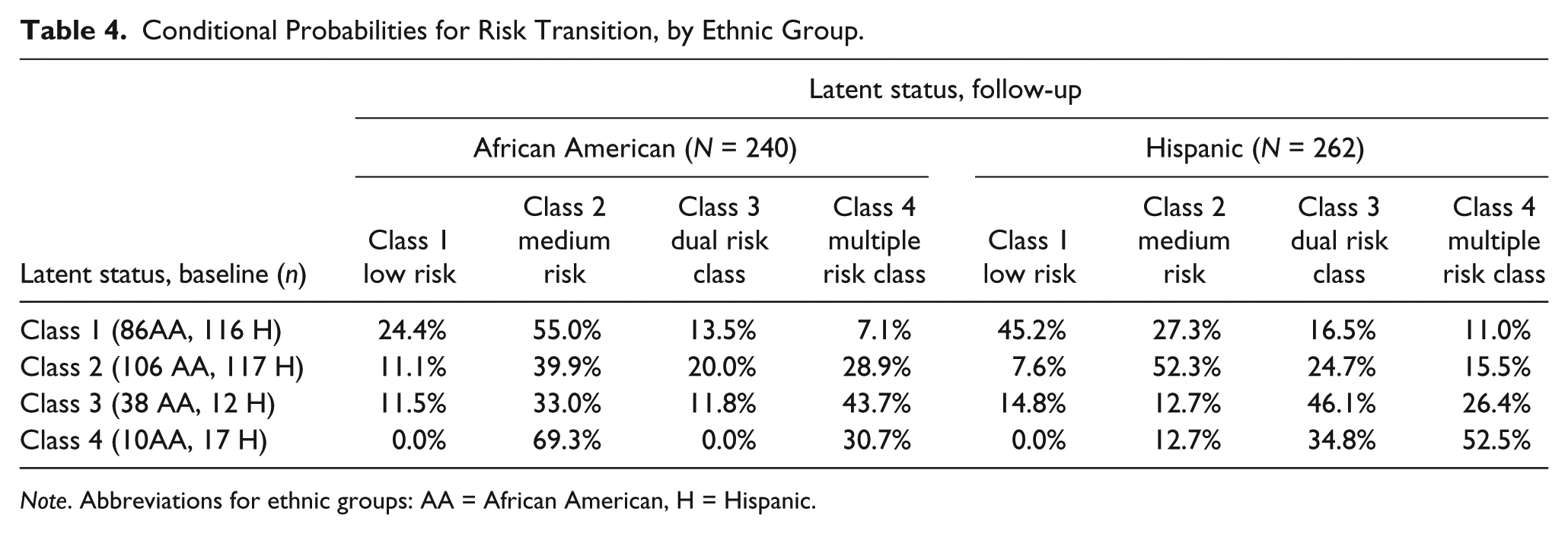
Table 4 shows probabilities for transition, conditional on baseline status, for each risk class and ethnic group. Hispanic boys showed high probabilities to remain constant in their risk class over time. This is seen in the large percentages in their transition matrix being the downward diagonal elements, which represent stability. That the four diagonal elements were the highest for each baseline class suggests that stability in risk behaviors over time was common among lower risk and higher risk Hispanic boys alike.
Conditional Probabilities for Risk Transition, by Ethnic Group.
Note. Abbreviations for ethnic groups: AA = African American, H = Hispanic.
In contrast, African American boys were likely to transition, with the higher probabilities in their matrix being the elements above the diagonal (representing increase in risk behaviors) and those below the diagonal (representing decrease in risk behaviors). Two particularly common patterns of increase in risk were seen: transition from low risk into experimentation with substances, violence, and mild delinquency (Low Risk to Medium Risk); and transition from high violence and delinquency only into high violence and delinquency coupled with heavier use of substances including cigarettes and marijuana (Dual Risk to Multiple Risk). In addition, African American boys who began middle school in one of the higher risk classes were likely to transition into milder forms and levels of delinquency and substance use (Dual/Multiple Risk to Medium Risk), though these were rarer trends overall as higher risk classes were less prevalent at baseline.
Effects of Risk and Protective Factors on Status at Baseline and Follow-Up
Tables 5 to 7 show the results of multinomial logistic regression models predicting risk class membership at baseline, and risk class membership at follow-up, accounting for baseline status (see tables for p values). These models explored the effects of predictors on probability to be in the Medium Risk, Dual Risk, or Multiple Risk class at these time points, relative to being in the reference class, Low Risk. We omitted Years in the United States in models estimated among African American boys given limited variance for this variable, as discerned in initial models.
Unstandardized Coefficients (Odds Ratios) for Multinomial Logistic Regression Models Predicting Risk Class Membership at Baseline (Grade 6) From Background, Schooling, and Neighborhood Factors, African American Boys.

Note. N = 240. All predictors’ measures at baseline. Years in the United States was not included as a Background variable for African American boys. F statistic and numerator (model) df noted once for each multinomial logistic regression model. Denominator df reflect multiple imputation, and are hence omitted. Reference class is Low Risk. Problems × Action is the interaction between Neighborhood Problems and Community Action variables. SEs for unstandardized regression coefficients available from the first author. Odds ratios for constants are omitted. F/R = free/reduced; Y = yes; Neighbor = neighborhood.
p < .10. *p < .05. **p < .01. ***p < .001.
Unstandardized Coefficients (Odds Ratios) for Multinomial Logistic Regression Models Predicting Risk Class Membership at Baseline (Grade 6) From Background, Schooling, and Neighborhood Factors, Hispanic Boys.

Note. N = 262. All predictors’ measures at baseline. F statistic and numerator (model) df noted once for each multinomial logistic regression model. Denominator df reflect multiple imputation, hence omitted. Reference class is Low Risk. Problems × Action is the interaction between Neighborhood Problems and Community Action. SEs for regression coefficients available from first author. Odds ratios for constants are omitted. F/R = free/reduced; Y = yes; Neighbor = neighborhood.
p < .10. *p < .05. **p < .01. ***p < .001.
Unstandardized Coefficients (Odds Ratios) for Multinomial Logistic Regression Models Predicting Risk Class Status at Follow-Up (Grade 8) From Baseline Risk Class Status and Background, Schooling, and Neighborhood Factors, by Race/Ethnicity.

Note. All predictors’ measures at baseline. Blocks of predictors are as shown in Tables 5 and 6, with baseline risk class added to the Background block. Interaction terms not statistically significant in predicting follow-up risk class status (not shown here). Years in the United States was not included as a Background variable for African American boys. F statistic and numerator (model) df noted once for each model. Denominator df reflect multiple imputation, hence omitted. Reference class for the dependent variable (follow-up status) is Low Risk. SEs for regression coefficients available from first author. Odds ratios for constants are omitted. Class 1 = low risk; Class 2 = medium risk; Y = yes; F/R = free/reduced; Neighbor = neighborhood.
p < .10. *p < .05. **p < .01. ***p < .001.
In predicting baseline status from Background factors, we found that for both ethnic groups, older age was associated with increased probability to be in one of the higher-risk categories, though this impact was strongest for Dual Risk African American boys (Table 5), and for Multiple Risk Hispanic boys (Table 6; see tables for p values). Contrary to theory, receipt of a free/reduced lunch and years in the U.S. (among Hispanic boys) were not related to probability to be in these classes.
In predicting from Schooling factors, we found poor performance on a test or project to be associated with increased probability to be in the Dual or Multiple Risk classes among African American boys at baseline (Table 5), but it was associated with increased probability to be Medium Risk among Hispanic boys at this time point (Table 6). There were protective effects of spending more time on studying and homework—specifically, lowered probability for African American boys to be Dual Risk at baseline (Table 5), and lowered probability for Hispanic boys to be Multiple Risk at baseline (Table 6). Associations of parental involvement in schooling were not significant.
In predicting baseline status from Neighborhood factors, we found no main effects from the Neighborhood Problems or Community Action variables, nor any interaction between them, for African American boys (Table 5); but we found a protective effect of Community Action on Hispanic boys’ probability to be Dual Risk, as well as an interaction between Community Action and Neighborhood Problems on probability to be in this class. The interaction between Parent Asks and Poor Test was not significant (omitted from tables).
To examine the nature of the significant interaction, we ran three follow-up models among Hispanic boys containing the Background and Neighborhood variables, but omitting Community Action, which served as a stratifying characteristic (trichotomized into scores of < 3.75, between 3.75 and 4.5, and 4.5 or above—each reflecting about one third of the data for the variable for this group of parents at baseline). Results showed that among boys whose parents reported lowest levels of Community Action, the direction of the association of Neighborhood Problems with probability to be Dual Risk class at baseline was positive, b = 2.62 (1.71), p = .13; but among boys whose parents reported highest levels of Community Action, the direction of the association was negative, b = −.82 (.80), p = .30. While low subsample sizes may have deflated power to detect statistical significance for these effects, this suggests a shift in the impact of Neighborhood Problems on Hispanic boys’ probability to be in the Dual Risk class at baseline, according to parents’ levels of Community Action. Specifically, the harmful effect of neighborhood problems on risk appears to be mitigated when parents of Hispanic boys exercise community action.
Finally, Table 7 shows effects of the predictors on risk class status at follow-up, controlling for baseline status. 5 Results showed that African American boys belonging to two-parent families had lower conditional probability to be in the Dual Risk class at follow-up, relative to African American boys from other types of households. Among Hispanic boys, poor test performance remained a risk factor for conditional probability to be in any of the comparison risk classes, relative to being Low Risk. In addition, for both ethnic groups, being Low Risk at baseline was protective against being in one of the higher risk classes at follow-up (for both Dual and Multiple Risk classes among Hispanic boys, and for Multiple Risk only among African American boys), which is in accord with results in Table 3, which note that the transition from Low Risk to one of the higher risk classes was uncommon for both ethnic groups.
Discussion
This study applied a social action theoretical approach to the study of risk behavior among urban African American and Hispanic boys, in response to national initiatives emphasizing a need to address the unique gaps in risk and opportunity faced by boys in these ethnic groups. By examining actions that boys, parents, and communities can take within the contexts of schools and neighborhoods, and by incorporating the study of multiple risk behaviors in a mixture modeling framework, we provide an example of the type of comprehensive analysis that is needed to maximize information on the types of risk and best potential interventions for these ethnic groups. Our analysis suggested important distinctions in the types of risks that exist for these boys, both within and across ethnic groups, as well as insight on several potential points of intervention.
Lower Risk Behavioral Patterns, Transitions, and Prevention Strategies
Eight out of 10 African American boys and nine out of 10 Hispanic boys in our data belonged to a “lower risk” class at the beginning of middle school. This is a positive finding in that the risk behaviors in the examined domains that may have more severe and extended effects are relatively uncommon for these boys as they enter middle school. Boys in these risk classes may engage in some acts of violence (though group or “gang” fights were rare in our data) and in experimental use of substances (probabilities for recent or heavy use, or use of marijuana, were quite low). Most delinquency in these classes seems to involve getting in trouble with parents or at school rather than acts suggesting legal consequences—though we found delinquency to be somewhat more common among Hispanic boys who experimented with substances. Thus, these lower risk classes were similar between the two ethnic groups, but not completely so.
In line with the differing nature of the lower risk classes across these ethnic groups, we found the proportion of boys experimenting with substances—coupled with engagement in violence—to increase over time among African American boys, but to decrease among Hispanic boys. Transition patterns suggested this is because of the common trend for African American boys to shift from being low in risk into this medium risk class (conditional probability of 55%), while those who began middle school in the medium risk class were likely to remain in that class (40%). Thus, it is intuitive for the size of this class to increase. While Hispanic boys who began middle school in the medium risk class were also most likely to remain in this class (52%), a shift into this class was less probable. In fact, African American boys tended to exhibit transitions in risk class more generally, while Hispanic boys tended to exhibit constancy. Yet none of our predictors showed an association with African American boys’ membership in (or transition into) the medium risk class at follow-up, relative to being low risk. Among Hispanic boys, status in this class was positively related to poor performance on a test or school project in the past month.
These findings point to the importance of early interventions, as even experimental use of substances at this age is harmful, with early initiation associated with increased probability for problems later in life, including addiction (e.g., for alcohol, Chassin, Pitts, & Prost, 2002; Hingson, Heeren, & Winter, 2006; Warner & White, 2003; for cigarettes, HHS, 2012; for marijuana, NIDA, 2014). Likewise, while aggressive behavior may be somewhat normative for boys (Loeber & Hay, 1997; Stoltz, 2005), parents, administrators, and boys themselves must be aware that aggressive behavior (and even nonaggressive behavior) among African American and Hispanic boys is more likely to be interpreted harshly (Muhammad, 2003; Neal et al., 2001), so even boys with lower risk behaviors may be subject to severe consequences such as being suspended, expelled, or referred to the juvenile or adult justice system (Children’s Defense Fund, 2014; Rodriguez & Eells, 2013). Hence, both ethnic groups may benefit from programs on resolving conflicts using skills other than physical violence, and on the importance of refraining from use of alcohol and cigarettes.
Additionally, promoting achievement in school through in-school or after-school enrichment or tutoring programs may be beneficial in preventing violence and experimental substance use, at least among Hispanic boys. However, this may be beneficial for other outcomes for both ethnic groups—for instance, for improving grades in school, even if risk behaviors are not directly affected. Yet, an academically focused intervention should protect against higher levels of risk typified by more severe delinquency and substance use for both ethnic groups, as discussed next. These enrichment and tutoring programs may harness the higher levels of aggression seen here and for early adolescent boys more generally (Loeber & Hay, 1997) by relying on a structure of competing teams, whereby boys may also learn critical interpersonal skills in working with teammates to achieve a common goal.
Higher Risk Behavioral Patterns, Transitions, and Prevention Strategies
Our findings also suggest the existence of higher risk subgroups of African American and Hispanic boys who exhibit levels of risk behaviors that are not captured by aggregate statistics on risk in these ethnic groups. For instance, aggregate rates of heavy alcohol use in the past 2 weeks were low for both ethnic groups at the beginning of middle school (7% among African American boys, 4% among Hispanic boys). However, based on latent class membership, rates for the highest risk class were much higher (41% and 49%, respectively). While the latter are probabilistic rates (given membership in this unobserved subpopulation), these higher probabilities are a call for concern, while the needs of boys in these ethnic groups may be overlooked when only aggregate statistics are considered. Although research has generally suggested that African American and Hispanic boys are not at particular risk for early substance use relative to White peers (Malone et al., 2012; SAMSHA, 2014), our results suggest that such a generalization may be misguided.
Our data also suggest that the nature of higher risk classes differs according to ethnicity. In our data, the two higher risk classes were distinct in behavioral patterns exhibited, and transitions over time. Importantly, among the “dual risk” classes, violence appeared to couple with delinquency for African American boys, though only for a brief period—as boys in this class were likely to transition either upward or downward from this level and type of risk. In contrast, violence coupled more readily with heavier and more frequent substance use among Hispanic boys in this class. Moreover, this coupling was likely to be stable over time, rather than transitory in nature. Additionally, each ethnic group contained a small class of boys who showed high probabilities for all three sets of risk behaviors; these were more similar between the ethnic groups in levels and types of behaviors, though African American boys continued to exhibit greater probability to transition relative to Hispanic boys.
Rates of endorsement for particular risk behaviors among these classes were revealing, but raise several questions. First, African American boys were likely to report getting in trouble with police given membership in either of these classes (greater than 50% conditional probability for each), while only Hispanic boys in the uppermost, “multiple risk” class were likely to do so (68%). In fact, Hispanic boys who did not engage in extremely high levels of delinquency (but only mild and moderate levels) had zero probability to report trouble with police; thus, trouble with police is a clear distinguishing factor between the upper risk classes among Hispanic boys. This may be interpreted in two ways. It may be that certain delinquent behaviors (e.g., property damage) are more likely to result in getting in trouble with the police among boys at this age—and “dual risk” African American boys happen to engage in those behaviors more frequently—while greater substance use, with more frequent engagement among “dual risk” Hispanic boys, is not. Or, it may be that African American boys are likely to get in trouble with the police more generally, regardless of level and type of problematic behavior, which may be due to institutionalized racism, as highlighted by the MBK program’s statements on disproportionate representation in the criminal justice system (The White House, 2014). Class proportions in our results suggested that one out five African American boys is likely to report trouble with police at the beginning of Grade 6, rising to two out of five by the end of Grade 8, which marks a very young age for involvement with legal authority. The MBK initiative has stated a focus on “issues arising from school disciplinary action, access to mentoring services and support networks, and interactions with the criminal justice system and violent crime,” and our results suggest that this is a worthy focal point for the program, particularly for African American boys.
Second, levels and frequency of substance use among Hispanic boys in the upper risk classes were very concerning. While these classes were rare for Hispanic boys at the beginning of Grade 6, prevalence rose to nearly 40% by the end of Grade 8, suggesting that a sizable portion of Hispanic boys in middle school have access to alcohol, cigarettes, and marijuana according to our data. Consideration should be given as to whether substances are obtained among boys in this ethnic group in the home or neighborhood, or through peers at school. The shift in the association of neighborhood problems with Hispanic boys’ probability to be in the “dual risk” class, according the level of community action reported by parents, suggests that neighborhood problems such as drug dealing and lack of supervision may contribute to these higher levels if proactive steps are not taken by parents and communities. Programs encouraging Hispanic parents to increase levels of community action may be a helpful strategy—and one toward which Hispanic parents may be receptive, given the higher rates of community action among these parents in our data. From a social action theory perspective, the relationship between persons and environmental contexts is dynamic and reciprocal, as families are helped or hindered by the resources and risks in their neighborhoods, but may also help create an environment that meets their goals (Ewart, 1991).
Note, however, that parental involvement in schooling, another arena in which parents may exert influence, was not associated with risk class for either ethnic group. Rather, other schooling factors—boys’ performance on tests and time spent studying—showed stronger relationships with risk class membership. Hence, promoting achievement among boys themselves, rather than indirectly through parents, may be a more effective way to prevent more extreme patterns of risk for boys in these ethnic groups. This does not imply that parental involvement is not important for boys’ achievement and avoidance of risk behaviors, but it may suggest that the measure used here (asking about school) is not the mechanism by which parents can most strongly exert change. Rather, in accord with social action theory, parents may help craft settings that support studying and achievement, such as aiding in the structuring the physical environment (a library, community center, or quiet place in the home) and boys’ use of time (Ewart, 1991). After-school enrichment and tutoring programs may be a particularly successful strategy because these control the social environment in which risk behaviors may be feasibly be practiced (Jessor & Jessor, 1977)—for example, by limiting access to substances more readily available in risky neighborhoods and by increasing the monitoring of boys’ behavior, which may otherwise be less carefully supervised. Hence, achievement programs may additionally buffer the impact of problem neighborhoods on risk seen among Hispanic boys.
Last, age was associated with membership in these higher risk classes for both ethnic groups at Grade 6, but bore no relationship at Grade 8. Hence, boys who are older at the beginning of middle school may benefit the most from these interventions. This may suggest that higher levels of risk are more common among boys who are older for their grade due to being academically delayed, so they may also benefit strongly for achievement outcomes via an academics-focused risk prevention strategy. Additionally, results showed that belonging to a two-parent family was associated with lowered probability for African American boys to be in the “dual risk” class at Grade 8 (indicating higher risk for violence and delinquency, though not higher risk for substance use), while this family structure was not associated with lowered risk to be in the “multiple risk” class (which was characterized by greater substance use as well). This finding is challenging to interpret but implies that two-parent family structure does not protect against use of substances, among highest risk African American boys.
Limitations and Future Directions
This study had several limitations. First, data were self-reported, such that prevalence of risk behaviors may be higher than reported here. However, parent and teacher informants may also deflate estimates if they are unaware of actual engagement, or bias them in either direction. Additionally, the PNC measures have been documented as reliable and valid (Komro et al., 2004). Second, our sample was drawn from a primarily low-SES, urban school setting, so results may not generalize to other contexts. The methods used here should be replicated among other samples, including African American and Hispanic boys in other locales of the United States, as well as among Native American boys. In fact, the select nature of schools in our sample may be one reason for the lack of association between free/reduced lunch and risk class membership, in light of strong associations between SES and risk behavior in the literature (Piquero et al., 2006). In a more heterogeneous sample, SES may be a critical predictor. Likewise, it would be valuable to obtain more information on the ethnic identity and level of acculturation of boys in these ethnic groups. Also, while the breadth of our indicators of risk was a strength, some predictors were limited in scope—for example, based on a single item (e.g., parental involvement) or on a scale that may require greater examination (e.g., community action, which reflected hypothetical rather than actual behaviors). Also, while our models incorporated many nuanced indicators of risk and allowed for multiple subpopulations to emerge, they cannot reveal the direction of causal effects, which is important for intervention design. Last, efforts should be made to obtain more recent item-level, longitudinal data on multiple risk behaviors among youth at this age.
Conclusion
This study provided an example of the type of comprehensive analysis that is needed to discern the greatest information on types of risk behaviors among African American and Hispanic boys in the United States and the best potential interventions for promoting well-being and achievement among boys in these ethnic groups. By blending social action theory with mixture modeling, we have demonstrated the importance of looking at the diversity in risk behaviors both within and across ethnic groups, and that unique actions taken in specific social spheres of boys’ lives may be fruitful ways for boys, parents, and communities to participate in meeting this national goal. Our hope is that this research is utilized and extended in efforts to protect our youth and ensure that youth in all groups reach full potential.
Footnotes
Declaration of Conflicting Interests
The author(s) declared no potential conflicts of interest with respect to the research, authorship, and/or publication of this article.
Funding
The author(s) disclosed receipt of the following financial support for the research, authorship, and/or publication of this article: NIH grants supplied in the online submission portal, which supported this research. These were the National Institute on Alcohol Abuse and Alcoholism and Grant R01 AA013458, and National Center on Minority Health and Health Disparities under Grant R01 AA016549. Both were awarded to the author, Kelli A. Komro, PhD.
Notes
Supplemental Material
Supplementary material is available for this article online.
Author Biographies
References
Supplementary Material
Please find the following supplemental material available below.
For Open Access articles published under a Creative Commons License, all supplemental material carries the same license as the article it is associated with.
For non-Open Access articles published, all supplemental material carries a non-exclusive license, and permission requests for re-use of supplemental material or any part of supplemental material shall be sent directly to the copyright owner as specified in the copyright notice associated with the article.
