



Abstract
Despite evidence that youth gain weight disproportionately over the summer months, few studies examine contributing obesogenic behaviors. Utilizing a mixed-methods approach, this study examined associations between summertime dietary intake patterns and executive function among 79 low-income urban minority early adolescent girls (ages 9-13 years). Participants were interviewed via the multiple-pass 24-hour dietary recall method and completed individually administered executive function tasks. A subsample of 14 parents completed interviews to gather qualitative information about summertime eating patterns. Results suggested that participants consumed 25% to 35% more daily calories than recommended, and inhibition difficulties were associated with higher calorie and sugar-sweetened soft drink intake. In addition, over one third of participants were classified as nighttime eaters, and these participants had more difficulty with inhibition, even when accounting for sleep influences, and consumed more soft drinks than daytime eaters. Qualitative interviews consistently indicated that summertime changes food consumption as well as the timing and structure of the meals.
Introduction
Child obesity rates have tripled over the past 40 years, and low-income minority girls are disproportionately affected (Ogden, Carroll, Kit, & Flegal, 2012). Rates of weight gain among youth are 2 to 3 times greater during the summer months than the rest of the year (Moreno et al., 2015; von Hippel & Workman, 2016) and may be particularly problematic among minority youth and youth who are already overweight (von Hippel, Powell, Downey, & Rowland, 2007). During the summer, when most children are not in a structured school setting, researchers have speculated that youth may engage in more obesity-related health behaviors, such as low levels of physical activity (McCue, Marlatt, Sirard, & Dengel, 2013), short sleep (Bates et al., 2016; Nixon et al., 2008), and high caloric intake (Baranowski et al., 2013). Although dietary intake has been proposed as a potential mechanism for weight gain over the summer months, few studies have tested this hypothesis empirically. Of the two studies that have examined summertime patterns of dietary intake in comparison with the school year, one found a modest increase in calorie consumption during the summer in Greek children ages 3 to 18 years (Yannakoulia, Drichoutis, Kontogianni, & Magkanari, 2010), and the other found no difference in calorie consumption in U.S. children ages 9 to 11 years (McCue et al., 2013). A third study examined summertime dietary intake in second and third grade U.S. children participating in organized summer activity versus those who did not participate in organized activity and found that those who were involved in organized activity were more likely to eat breakfast and less likely to have meals in front of the television (Tovar et al., 2010). These eating patterns may be particularly pronounced for low-income youth, who are less likely than higher income children to be involved in organized activity during the summer (Chin & Phillips, 2004).
In addition to dietary intake, the changes in structured activity that occur during the summertime may also be concerning for other reasons. In general, the summertime is characterized by later sleep onset and wake times (Nixon et al., 2008), which may be associated with increased hours of daylight (Bénéfice, Garnier, & Ndiaye, 2004). In a previous examination of sleep among urban minority youth, Bates and colleagues (2016) found that average time of sleep onset during unstructured summertime was around midnight and average wake time was around 9:00 a.m. Given that the average school start time (and thus average wake time) for an adolescent is typically before 9:00 a.m. (Wolfson, Spaulding, Dandrow, & Baroni, 2007), this change in sleep alone represents a significant shift in scheduling when transitioning to summertime. These schedule changes may then shift the timing of food consumption to later in the day (Miller, Lumeng, & LeBourgeois, 2015), which is problematic given that increased calorie consumption at night has been associated with obesity (Gallant, Lundgren, & Drapeau, 2012). However, no studies to our knowledge have examined summertime dietary intake while taking into consideration timing of meals. In addition, there is a lack of research examining the likelihood that some children may be more vulnerable to shifts in summertime schedules due to individual differences, such as difficulty with inhibition and cognitive flexibility (i.e., executive function [EF]).
EF represents cognitive processes involved in effortful and goal-directed behavior (Best, 2010), which have important connections to self-regulation, academic achievement, and successful functioning across activities of daily life (Li, Dai, Jackson, & Zhang, 2008; Mischel et al., 2011). Evidence consistently supports links between EF and sleep, such that children who are poor sleepers have more difficulty with impulsivity, working memory, and attention (Sadeh, Gruber, & Raviv, 2002). In addition, even temporary sleep deprivation has been linked to impairments in EF in children (Sadeh, Gruber, & Raviv, 2003). Relations may also exist between EF and dietary intake. For example, inhibition, the ability to suppress a dominant response, is linked to higher consumption of both energy dense, nutrient poor foods and sugar-sweetened beverages (Ames et al., 2014; Nederkoorn, Dassen, Franken, Resch, & Houben, 2015). Cognitive flexibility, the ability to respond to changing instructions and to shift behavioral goals (Ravizza & Carter, 2008), may also play a role. Prior studies have shown that, like inhibition, poor cognitive flexibility is related to a number of problematic eating behaviors, such as binge eating (Ames et al., 2014; Mobbs, Iglesias, Golay, & Van der Linden, 2011). In addition, Khan, Raine, Drollette, Scudder, and Hillman (2015) found that problems with cognitive flexibility in 7- to 10-year-olds were related to increased saturated fat and dietary cholesterol intake.
Although there are known links between EF and both dietary intake and sleep, little research has been done to examine associations between EF and mealtimes more broadly. Likewise, no studies to date have examined the interplay between later sleep onset, dietary intake, and EF. Utilizing a mixed-methods approach, the current study sought to evaluate the association between EFs and dietary intake in the summertime, taking into consideration the role of sleep and meal timing, among a sample of low-income minority females during early adolescence. Building on past research, we hypothesized that girls with more problems with EF would consume more calories and have higher sugar consumption. We expected that girls who stayed up later at night would also have impaired EF, especially in the domain of inhibition. Given the lack of literature on associations between individual differences in EF and schedule changes, we conducted exploratory analyses to investigate a possible relation.
Method
Participants and Procedure
This study included 79 girls ranging in age from 9 to 13 years (mean (m) = 11.89, SD = 1.07 years). The majority of participants were African American (58%) or Latina (30%). Of participants who reported income, approximately 89% qualified for free or reduced lunch based on household income-to-needs ratio. Data for the current study were originally collected for a larger investigation evaluating the effectiveness of a 4-week community-based summer program focused on promoting wellness and physical activity. Data were collected during the first weeks of the summer vacation period, prior to the start of a community-based program. Both programmatic and informed parental consent were obtained, and children provided verbal assent to participate in the study. Across all three summers of data collection, there were 97 unique participants. Fifteen participants did not complete full dietary intake recalls, and three participants were removed because they were outliers, reporting overall calorie consumption greater than 5,000 kcal (approximately 2 SDs above the mean), bringing the total to 79.
In addition to the early adolescents, a subset of 14 parents of participants, all mothers, also participated by completing a semi-structured qualitative interview about summertime eating patterns. All parents of participating girls were offered the opportunity to participate in qualitative interviews, and the 14 described here represent those who agreed.
Measures
Anthropometrics
Weight (measured using a digital scale to the nearest 0.1 kg) and height (measured using a SECA stadiometer to the nearest 0.1 cm with head held in the Frankfort plane) were used to calculate body mass index (BMI; kg/m2). BMI z scores were then calculated using age- and gender-specific Centers for Disease Control and Prevention (CDC; 2015) growth charts.
Twenty-four-hour dietary recall
The triple-pass 24-hour dietary recall method was used to assess dietary intake, a process that aided participants in recalling everything they ate and drank within the preceding 24 hours. Recall information was entered into the University of Minnesota Nutrition Data System (NDS), and composite scores were calculated. For the purposes of the current study, total kilocalories, total grams of saturated fat, and total servings of fruit, vegetables, and sugar-sweetened beverages (SSBs) were used for all dietary intake analyses. Time of food intake was also analyzed by taking an average of calories consumed by all participants within each hour. Following previous research, participants were classified as night eaters if they consumed more than 25% of their daily calories after 8:00 p.m. (Allison et al., 2010).
Delis-Kaplan Executive Function System (D-KEFS)
The D-KEFS Color-Word Interference Test (CWIT; Delis, Kaplan, & Kramer, 2001) was utilized to measure inhibition and cognitive flexibility. Two of the four task conditions were used for the current study, in which the participant must (a) inhibit automatic responses by naming the color of words’ ink rather than reading the words (inhibition score), and (b) switch between naming ink color and reading words (cognitive flexibility score). For the purposes of the current study, the amount of time in seconds that it took a participant to complete the inhibition and the inhibition/switching conditions was recorded with more time on each indicating worse performance. These raw scores were used in all analyses. The CWIT evidences strong psychometric properties with internal consistency coefficients ranging from 0.62 to 0.77 for children 10 to 14 years of age, and test-retest reliability ranging from 0.77 to 0.90 across conditions (Delis et al., 2001; Delis, Kramer, Kaplan, & Holdnack, 2004)
Behavior Rating Inventory of Executive Function–Self-Report (BRIEF)
The BRIEF (Guy, Isquith, & Gioia, 2004), a 55-item questionnaire measure of daily EF, was also utilized to measure participants’ own perceptions of their EF abilities. Raw scores from the Inhibit and Shift subtests of the BRIEF were used to measure self-reported problems with inhibition and cognitive flexibility in daily life, with higher scores indicating more problems. Previous examination of the psychometric properties of the BRIEF subscales has demonstrated good internal consistency (α = .72-.96; Guy et al., 2004). Cronbach’s alpha in the current study was .81.
Semi-structured interviews
A subset of parents completed a semi-structured interview regarding family eating patterns. Parents responded to the following question: “How do your family’s eating patterns and mealtimes look different in the summer months as compared with the school year?” followed up with additional questions including, “When and where does your child tend to eat?” and “What does your child tend to eat?” Twelve interviews were conducted in English and two interviews were conducted in Spanish with fluent research assistants (RAs). Interviews were audio recorded and then transcribed and translated if necessary. A coding team (C.B., D.M.) read interview responses from all participants and extracted repeated themes (i.e., codes). Once all codes were determined, two RAs coded the same interview independently, and a Kappa value of .67 was computed. Following this coding, the RAs met together with the fourth author (D.M.) to discuss any discrepancies in coding and to clarify coding categories. Next, two additional interviews were coded, at which point the RAs reached 100% reliability (κ = 1.0). Finally, the remaining 11 interviews were divided between the two RAs and coded. Once coding was complete, counts were taken for the number of times that each theme was mentioned across all interviews.
Sleep
Sleep patterns were measured via a waist-worn accelerometer (Actigraph GT3X; Pensacola, FL) positioned just behind the right hip, worn by participants for 1 week. For data processing, 60-second epochs of motion were used. Sleep variables were derived using algorithms created by Tudor-Locke, Barreira, Schuna, Mire, and Katzmarzyk (2013), which are adapted from the Sadeh algorithm (Sadeh, Sharkey, & Carskadon, 1994), to better differentiate periods of sleep from periods of sedentary and nonwear time using waist-worn accelerometers (Barreira et al., 2015). For the current study, participants were required to have at least three nights of captured sleep to be included in analyses. Using data from all available nights, the current study examines sleep onset time, or the first minute of sleep at night, and nightly sleep duration, or the number of minutes scored as sleep between sleep onset time and wake time.
Statistical Analysis
All data were analyzed using IBM SPSS software, Version 22. Descriptive statistics were used to characterize participant dietary intake (i.e., average daily kilocalories, grams of saturated fat, servings of SSBs, fruit, and vegetables). Hierarchical linear regression models were used to assess for associations between EF and each of the five dietary intake variables. Both the D-KEFS and the BRIEF were entered as the independent variables into all models using forward regression to determine which measure of EF was most strongly associated with reported dietary intake. Exploratory independent-samples t tests and logistic regression models were then used to assess for differences in dietary intake and EF between participants who ate late at night and those who did not. A separate logistic regression model was used to assess for associations between EF and timing of meals using sleep as a covariate. Due to its correlation with scores on the BRIEF and D-KEFS, participant age was entered as a covariate in all regression analyses. However, because zBMI was not significantly correlated with any of the other variables, it was not included in further analyses.
Results
Means and correlations are presented in Table 1. Average zBMI fell within the healthy weight range (m = 1.04, SD = 1.01; Kuczmarski et al., 2000). Specifically, 1% (n = 1) of participants were underweight, 41% (n = 32) were healthy weight, 25% (n = 20) were overweight, and 33% (n = 26) were obese (CDC, 2015).
Intercorrelations and Descriptive Statistics of Measured Variables.
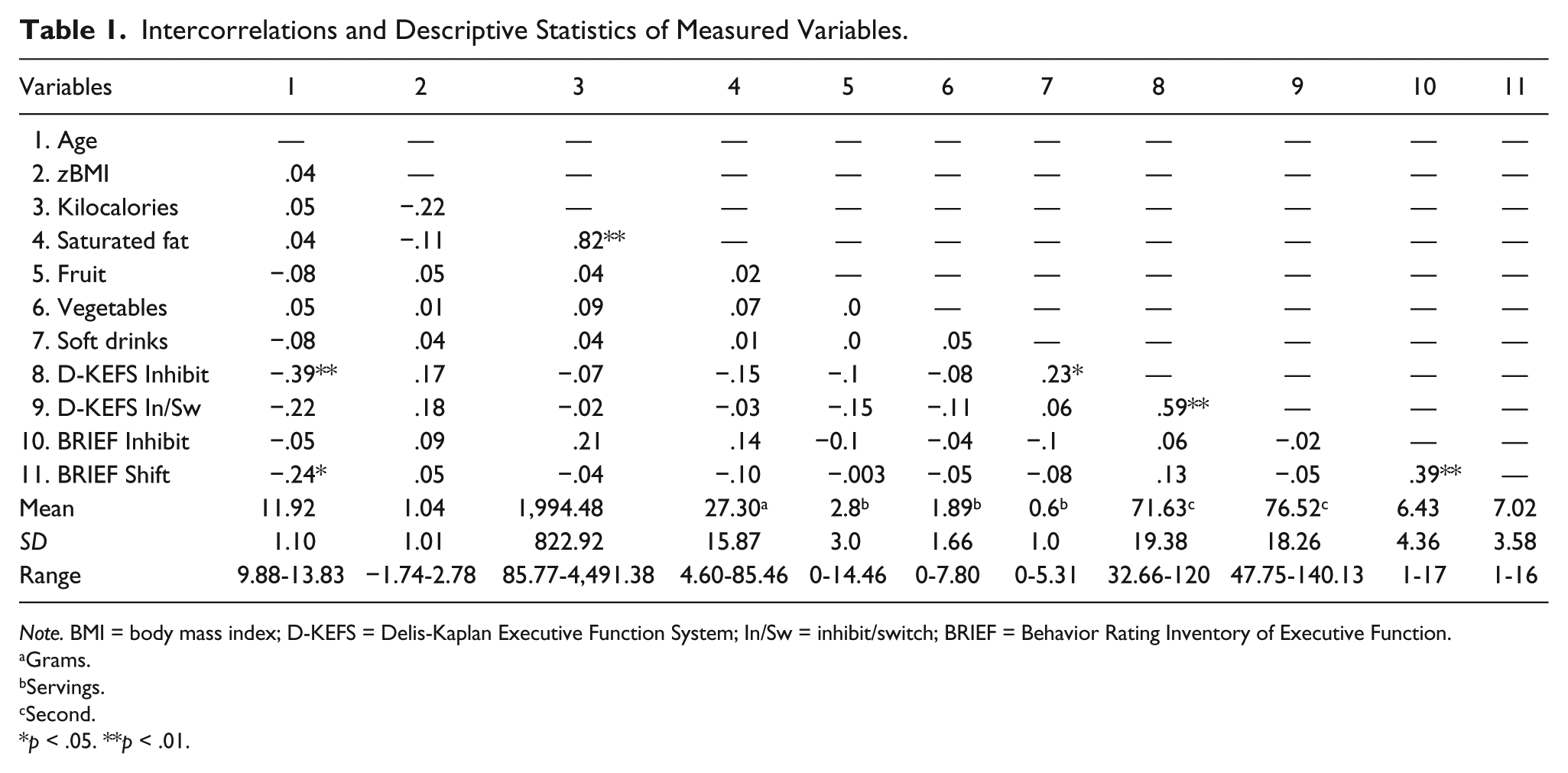
Note. BMI = body mass index; D-KEFS = Delis-Kaplan Executive Function System; In/Sw = inhibit/switch; BRIEF = Behavior Rating Inventory of Executive Function.
Grams.
Servings.
Second.
p < .05. **p < .01.
Dietary recall data revealed that participants reported consuming between 25% and 35% more daily calories than the U.S. Department of Health and Human Services (USDA) & U.S. Department of Agriculture (2015) recommended intake for a 9- to 13-year-old girl engaging in light physical activity. In addition, participants reported consuming less than the USDA & U.S. Department of Agriculture (2000) recommended servings of vegetables per day (two vs. three), and more than the recommended servings of fruit (three vs. two). Furthermore, participants endorsed consumption of a SSB each day, on average.
EF and Dietary Intake
Hierarchical linear regression analysis examining the relation between EF and dietary intake revealed that BRIEF Inhibit scores were significantly associated with total reported kilocalorie consumption, F(1, 69) = 5.39, p = .02, β = .27, R2 = .07, such that more reported problems with inhibition were related to higher calorie consumption. Similarly, accounting for age, D-KEFS inhibition time was also significantly associated with dietary intake, such that children who had more difficulty with inhibition (as evidenced by spending more time on the CWIT) also reported consuming larger amounts of sugar-sweetened soft drinks, F(1, 67) = 6.25, p = .02, β = .33, R2 = .09. However, there were no associations between cognitive flexibility measures and dietary intake.
Meal Timing
Meal timing was also evaluated. Participants consumed most of their calories between noon and 7:00 p.m. The largest number of calories consumed occurred during the 12:00 p.m. hour (m = 593 kcal) and during the 7:00 p.m. hour (m = 531 kcal). An average of 552 kcal were consumed after 8:00 p.m. and before 6:00 a.m. (i.e., night eating). More than one third of participants (38%) consumed more than 25% of calories after 8:00 p.m. and were classified as night eaters. Chi-square analyses revealed no demographic differences between night eaters and daytime eaters. Independent-samples t tests examining differences between night eaters and daytime eaters revealed dietary differences between the two groups, such that night eaters reported consuming more sugar-sweetened soft drinks (m = 0.99 servings, SD = 1.29) than daytime eaters (m = 0.35 servings, SD = 0.61), t(75)= −2.49, p = .02. However, there were no other differences in reported consumption or BMI between night eaters and daytime eaters. T tests also revealed that inhibition was more impaired in night eaters, who had greater total inhibition time on the D-KEFS (m = 78.72 seconds, SD = 21.00) than daytime eaters (m = 67.30 seconds, SD = 17.12), t(77) = −2.63, p = .01. However, there were no other differences in EF between daytime eaters and night eaters.
Given the impairments in inhibition found in night eaters, logistic regression analyses were conducted to examine whether this relation would remain significant when accounting for the influence of sleep patterns. Analyses revealed that, after accounting for both sleep onset and duration, poor inhibition was positively associated with late night eating, χ2(4) = 12.16, p = .016.
Qualitative Descriptions of Schedule Changes
As can be seen in Table 2, qualitative data revealed that parents/guardians also noted changes in the timing of meals during the summer months. For example, 85.7% of parents indicated that their daughter ate different foods during the summer, with 71.4% of parents specifically indicating that their daughter ate more fruit. On the contrary, 21.4% of parents indicated that their daughter ate more food in general over the summer months (e.g., “When they are home, they watch TV, they eat, they eat, eat, eat.”). Meanwhile, timing of meals also seemed to be different during the summer: 50% of the parents indicated that their daughter ate at different times (e.g., “She wakes up later, like at 12, so she isn’t hungry . . .”). Parents also indicated that the flexibility of summertime increased the number of family meals, and 35.7% of parents indicated that the family ate dinner together more frequently. Although 28.6% of the parents indicated that the family cooked at home more, 21.4% indicated that the family cooked at home less during the summer when compared with the school year, citing the rise in temperatures (e.g., “. . . 90 degrees outside, I don’t want to get the kitchen all hot . . .”).
Qualitative Coding Themes and Counts of Summertime Family Eating Patterns.

Discussion
The current study assessed summertime dietary intake patterns in a sample of low-income minority girls, in the context of EF, meal timing, and sleep. Results from this study suggest that overeating during the summertime may be problematic, with the average number of calories consumed in this population falling between 25% and 35% higher than USDA recommended daily values for girls engaging in light physical activity. In addition, this study also revealed that individual factors, such as EF (specifically, difficulty with inhibition), may be associated with poor dietary intake. Contextual factors, such as meal timing, were also relevant. Over one third of participants consumed 25% or more calories between 8:00 p.m. and 6:00 a.m. These participants had more difficulty with inhibition than those who did not eat late at night, even after accounting for sleep. They also reported consuming larger amounts of sugar-sweetened soft drinks.
This study is the first to our knowledge to demonstrate a link between late night eating and inhibition. Although prior studies have descriptively examined night eating in adolescents (e.g., Striegel-Moore et al., 2004), few studies have evaluated psychological correlates that are associated with late night eating in a nonclinical population. Furthermore, the current findings suggest that the inhibitory problems seen in late night eaters exist above and beyond what is explained by sleep schedules. Bates and colleagues (2016), drawing from a subsample of participants in the current study, demonstrated that minority girls had an average sleep onset time of 12:10 a.m. when not in structured programming. However, our findings suggest that staying up late may not be the sole, or most important, factor relating to eating late. Instead, difficulty with inhibition also appears to be a key correlate of late night eating.
Although late night eating is not specific to summertime, the summer months may represent a time of schedule shifting, where staying up late is more likely. Furthermore, individual factors, such as poor inhibition, may explain why some children are particularly susceptible to engaging in less healthy dietary habits during the summer. In conjunction with the dietary recall data, qualitative data indicated the potential role of contextual factors (i.e., going to sleep late, watching more TV) that may explain summertime dietary habits. Research has shown that fewer household routines are associated with greater risk for child obesity (Anderson & Whitaker, 2010; Bates et al., 2018). Future work should consider summertime’s influence on family structure and routine as a potential mechanism influencing eating patterns and weight gain during this time.
The results of this study also demonstrate that only certain aspects of EF, specifically inhibition, are associated with problematic eating behaviors. This may help to explain why children may have the knowledge of which foods are healthy and which foods are not, but still choose unhealthy foods (Heard, Harris, Liu, Schwartz, & Li, 2016). The findings of the current study contrast with those of Khan and colleagues (2015), who found that cognitive flexibility was significantly associated with saturated fat intake. However, Khan and colleagues (2015) used different tasks to assess cognitive flexibility and a younger sample of children (ages 7-10 years), both of which may partially account for these differences.
Limitations and Future Directions
This study is not without limitations, including that dietary intake was only assessed during the summer months, specifically during the first weeks of summer, without school-year comparisons. Future studies should compare dietary intake in the summer to that of the school year to determine whether there are significant changes that may help to explain summertime weight gain. Likewise, sample size was also limited in this study, especially for parent interview data. Because only a small percentage of parents agreed to be interviewed, selection bias may have influenced qualitative results for a few reasons. First, the parents who we interviewed were all interested in having their daughter participate in a health and wellness summer camp, and second, only a small proportion of eligible parents actually participated in the interviews. This may have affected our findings. Although these interviews allowed us to collect important data about the ways in which summertime scheduling differed from that of the school year, information about the role that parents played in children’s schedules and dietary intake was not collected. This study used 24-hour recalls as the primary method of collecting information about dietary intake. Although short-term 24-hour recalls are generally considered to be less error prone than food frequency questionnaires, limitations of self-report data still apply (Kipnis, Carroll, Freedman, & Li, 1999). In addition, as previously stated, the unique characteristics of this sample may limit generalizability of these findings. All of the participants in this study had signed up for a 4-week community-based summer program focused on promoting physical activity and wellness. Given their selection, it is likely that the participants in this study value health and may engage in healthier eating patterns. Finally, given the cross-sectional nature of this study, it is impossible to determine the directionality of the relation between EF and dietary intake.
Future studies should examine inhibition and diet from a longitudinal perspective to determine whether poor inhibition leads to late night eating and poor dietary intake, eating patterns impact inhibition, or the relation is reciprocal in nature. These studies should examine dietary intake both during the summertime and during the school year to determine whether there are differences in scheduling, EF, and mealtimes across the year. Likewise, more research should be conducted on whether there are differences in inhibition between children who wake up in the middle of the night to eat and those who simply stay up late eating. In addition, it is possible that in addition to EF, motivation and drive for food may also play a role in dietary intake. Future studies should assess both EF and drive to elucidate whether the two may work together to influence intake or, alternatively, whether EF or drive plays a stronger role in influencing diet. Finally, given that EF only explained a small percentage of the variance in dietary intake, future research should continue to examine other factors that may also be associated with summertime food consumption.
Conclusion
This mixed-methods study augments the current literature by being the first to examine summertime dietary intake from a contextual perspective, finding an association between mealtimes and inhibition by utilizing rigorous, objective dietary recall methodology alongside qualitative interviews. It also supports a growing literature that EF problems are related to unhealthy dietary intake in youth. Understanding the factors that may lead to obesity, especially in ethnic minority populations, is important for creating effective interventions to prevent weight gain before it becomes a more intractable problem in adulthood.
Footnotes
Declaration of Conflicting Interests
The author(s) declared no potential conflicts of interest with respect to the research, authorship, and/or publication of this article.
Funding
The author(s) disclosed receipt of the following financial support for the research, authorship, and/or publication of this article: This work was supported by a Provost Summer Research grant from Loyola University Chicago. Amy Heard Egbert is also supported by the National Science Foundation Graduate Research Fellowship Program. Any opinons, findings, and conculsions or recommendations expressed in this material are those of the authors and do not necessarily reflect the views of the National Science Foundation. We would like to thank the leaders and staff at the Girls in the Game program, and the research assistants in the Activity Matters Lab for their help with data collection. We especially would like to acknowledge and thank the adolescents and their families who participated in the project, and took the time to share their perspectives with us.
