




Abstract
Victimization in early adolescence can have severe negative consequences later in life. Friendships are especially important in this time period. The present study investigated friendship selection and influence (contagion) processes with regard to victimization, as well as prosocial and aggressive characteristics of victims’ friends. Using social network analyses (RSiena), we longitudinally analyzed data of five fourth-grade classrooms, including 185 students (56.8% girls;
Victimization is a pervasive experience among early adolescents. A systematic meta-analysis on the prevalence of victimization across several countries (mostly within the United States and Europe) showed an average of 23.7% of students who experienced victimization (Cook, Williams, Guerra, & Kim, 2010), with varying prevalence rates across countries (Bjereld, Daneback, & Petzold, 2015; Cook et al., 2010; Craig et al., 2009; Elgar et al., 2015; Elgar et al., 2013). Studies agree on the negative effects of victimization, both cross-sectionally as well as longitudinally, on emotional problems such as anxiety and depression (Schwartz, Lansford, Dodge, Pettit, & Bates, 2014; Zwierzynska, Wolke, & Lereya, 2013), social problems such as social alienation and deviant peer affiliations (Rudolph et al., 2014), a sense of loneliness (Zimmer-Gembeck, Trevaskis, Nesdale, & Downey, 2014), physical health problems (Due et al., 2005), academic performance (Wang et al., 2014), and eventually extreme consequences such as suicidal ideation and attempt (Geoffroy et al., 2016). The accumulated evidence depicts a consistent risky and negative scenario for students who experience victimization regarding their developmental outcomes, both during their school years and later in life.
Early adolescents spend more time with peers than in other periods of their life (Allen, Weissberg, & Hawkins, 1989; Witkow & Fuligni, 2011). During the transition from childhood to adolescence, gaining a position within the peer group constitutes a crucial challenge for students. In this context, peer victimization is especially damaging as it posits the victim at a low, less valued, and vulnerable position (Andrews, Hanish, Updegraff, Martin, & Santos, 2016; Cillessen, 2011; Kollerová & Smolík, 2016). Students who are victimized are, therefore, clearly disadvantaged by means of being socially isolated, being marginalized from their peer groups, and having fewer friends (Berger & Rodkin, 2009; Pouwels, Lansu, & Cillessen, 2016; Scholte et al., 2009). The social disadvantage of early adolescents who experience victimization stands out when considering the central role that friends play for their social adaptation and well-being. Friends can offer support when needed, and help adolescents to build and confirm their identity (Bagwell & Schmidt, 2011; Bukowski & Sippola, 2005). The aim of the present study was to longitudinally examine the associations between peer victimization and friendships, with a particular focus on the characteristics of victims’ friends that might drive their friendship selection processes.
The Protective Role of Friendships
Friends play a central role in victimization (Gini, Carli, & Pozzoli, 2009; Salmivalli, Voeten, & Poskiparta, 2011; Thornberg, 2015). Considering that victimization has become pervasive within school contexts (Rodkin & Hodges, 2003), friendships may especially play a specific role for early adolescents who experience victimization. In fact, the literature systematically reports that early adolescents’ friends might be potential defenders against victimization, but also against the negative outcomes of being victimized (Cuadros & Berger, 2016; Hodges & Perry, 1999). If this is the case, the decision regarding whom to look for as friends is extremely relevant and purposeful for early adolescents who experience victimization. For instance, they may befriend peers who are also victimized to share their experiences, as they are exposed to the same peer rejection and loneliness (Holt & Espelage, 2007). In fact, Schacter and Juvonen (2018a) found that the effect of victimization on several adolescents’ adjustment indicators was attenuated when their friends also experienced victimization by peers. Recently, it was found that within the larger friendship network, adolescents tended to choose classmates as friends with similar levels of victimization (Lodder, Scholte, Cillessen, & Giletta, 2016). Moreover, Scholte and colleagues (2009) reported that victims’ friends had a social adjustment profile characterized by less acceptance, more victimization, and less friendships outside their classroom, suggesting that friendships might be reciprocated between adolescents who experience victimization. This process has been described as default selection (Sijtsema, Rambaran, & Ojanen, 2013), indicating that even though adolescents might want to befriend popular peers, they settle with peers who also experience victimization in order to gain affection and companionship. However, sharing their victimization status would, in turn, limit the potential protective role of these friends.
Students may also base their friendship selection on the potential protective role of specific peers (Hunter, Boyle, & Warden, 2004). A specific line of research has focused on the protective role of friends for peer victimization and social exclusion. These studies showed that having friends leads to lower victimization levels and acts as a buffer against the negative consequences of victimization (Cuadros & Berger, 2016; Hodges, Malone, & Perry, 1997; Hodges & Perry, 1999). Following this idea, recent studies have addressed specific features of friendships regarding victimization, such as structural features of friendship networks, intimacy, support, and conflict between friends, confirming the positive and protective effects of friends for students who experience victimization (Cuadros & Berger, 2016; López & Rodríguez-Cárdenas, 2014; Vargas & Saavedra, 2012).
The protective role of friends against victimization is twofold. On the one hand, it implies social support and positive relationships that might help buffering the effects of victimization. On the other hand, it can imply active defending behaviors against peers who victimize others. The defending role of peers has been widely described since the emergence of the participant role approach proposed by Salmivalli, Lagerspetz, Bjorkqvist, Osterman, and Kaukiainen (1996). Salmivalli and colleagues identified defenders in peer victimization situations, who stand up for the victim and provide comfort. Defenders are often well-liked, have many friends (Caravita, Di Blasio, & Salmivalli, 2009), display high self-efficacy and social status (Pöyhönen, Juvonen, & Salmivalli, 2010; van der Ploeg, Kretschmer, Salmivalli, & Veenstra, 2017), show prosocial behavior (Crapanzano, Frick, Childs, & Terranova, 2011; Pouwels et al., 2016), and social dominance (Olthof, Goossens, Vermande, Aleva, & van der Meulen, 2011). Pouwels and colleagues (2016) suggest that in order to successfully defend a peer, adolescents need a relatively high level of peer acceptance in order to feel safe and avoid becoming victimized. Consequently, it is reasonable to propose that early adolescents who experience victimization by peers will look for friends who may fulfill this defending role. Recent research featuring elementary students shows, for instance, that children who are victimized by peers are more likely to be defended by peers who either perceived them as friends, or whom they nominated as friends (Oldenburg, Van Duijn, & Veenstra, 2018). Even though the literature has described the role and characteristics of defenders, its overlap with friendships relations is still unclear. In particular, the present study focuses on the characteristics of the peers whom victimized adolescents select as friends adopting an inclusive perspective on this protective role, testing whether these peers display prosocial behaviors that might posit them as defenders. As suggested by Scholte and colleagues (2009), adolescents who experience victimization tend to be selective in their friendship choices by preferring peers who are generally well-liked and who display high levels of prosocial behavior.
By contrast, peers might also be viewed as potential assets for protection by means of their aggression. Several studies departing from an evolutionary perspective have shown that aggression can have an adaptive function, by means of its association with popularity (Cillessen & Mayeux, 2004; Puckett, Aikins, & Cillessen, 2008) and social dominance (Hawley, Little, & Card, 2007), and as a way to deal with interpersonal conflicts (Xie, Swift, Cairns, & Cairns, 2002). The association between relational aggression and popularity, for instance, becomes heightened when adolescents also display positive social behaviors (Gangel, Keane, Calkins, Shanahan, & O’Brien, 2017). Aggressive peers, thus, might be viewed as socially dominant, powerful, and having them as friends could represent a safety mechanism for victimized adolescents. Consequently, the present study also tests whether adolescents who experience peer victimization might select aggressive peers as friends, who could eventually protect them against harassment by means of their social dominance and status.
The Risks of Being a Victim’s Friend
From the friends’ perspective, being a victim’s friend may also jeopardize one’s standing in the peer group and can be a risk factor for becoming victimized as well. For instance, victims tend to reciprocate defending nominations during middle to late childhood (Sainio, Veenstra, Huitsing, & Salmivalli, 2011), and specifically when they hold a similar position in their classroom, such as being victimized by the same peer (Huitsing & Monks, 2018; Huitsing, Snijders, Van Duijn, & Veenstra, 2014; Huitsing & Veenstra, 2012). Interestingly, children who were victimized by the same peer also tend to defend each other (Huitsing et al., 2014; Huitsing & Veenstra, 2012), possibly because they are part of the same peer group. This suggests that being a victim’s friend can carry social risks. Studies have found support for the “retaliation hypothesis,” showing that defending a victim implies the risk of becoming victimized by the same bully that harasses the defended victim (Huitsing et al., 2014), although this influence effect only seems to hold for boys (Lodder et al., 2016). Seemingly, recent studies suggest that students who experience victimization are avoided as friends by most of their peers (Turanovic & Young, 2016). As a consequence, early adolescents may restrain themselves of defending their victimized peers because of the fear of becoming victimized themselves (Thornberg et al., 2012).
The Present Study
Considering the negative consequences of peer victimization and the role that friends might play to both avoid being victimized and to counteract the negative effects, the present study addresses the interplay between friendship relationships and peer victimization among early adolescents. Using a longitudinal design, we focus on the characteristics of peers that early adolescents select as friends (i.e., victimized, aggressive, or prosocial peers) and the effect of friends on early adolescents’ victimization status.
We address similarity between friends in their victimization levels. Two social processes have been proposed to explain this similarity, that is, selection and influence. A comprehensive review of the literature concludes that both processes seem to operate together in explaining similarity (Veenstra, Dijkstra, & Kraeger, 2018). Selection refers to the nomination of specific peers as friends, which is often related to the tendency to befriend peers with similar characteristics. Influence refers to a peer socialization process in which individuals tend to assimilate to their friends’ characteristics or behaviors over time. However, adolescents do not actively choose to exert or change whether they are victimized, so the influence effect should be interpreted as a “contagion effect” (see Sentse, Dijkstra, Salmivalli, & Cillessen, 2013). Accordingly, we test both selection and influence processes as explanations for friends’ similarity in their victimization status. Our first hypothesis (Hypothesis 1; H1) proposes that early adolescents select peers as friends with similar levels of peer victimization.
Above similarity, the main research question of this study refers to the potential protective role of friends of early adolescents who experience victimization, which would foster an active selection of friends based on their expected defense against victimization because of their prosociality or aggressiveness. Accordingly, we propose two selection hypotheses. H2a: Early adolescents who experience victimization befriend peers who are prosocial (prosocial selection hypothesis); and H2b: Early adolescents who experience victimization befriend peers with aggressive behaviors (aggression selection hypothesis).
In light of the evidence showing the potential risk of becoming victimized when defending a peer who experiences peer victimization, we also test an influence or peer contagion hypothesis (H3): Early adolescents whose friends are victimized by their peers will over time resemble their friends’ victimization status (influence hypothesis).
Method
Participants and Procedure
Participants were part of a larger longitudinal study on peer relationships that followed over 3 years fourth, fifth, and sixth graders from four schools in Santiago, Chile. In the present study, we focused on fourth grade classrooms (participation rates were too low for the other cohorts to conduct social network analysis). Participants were assessed yearly until sixth grade. In total, 82.4% of parents granted consent to participate. The final sample for the present study included 185 fourth graders from five classrooms in three schools.
All participating schools corresponded to a middle-level socioeconomic status, and were private schools with a public subsidy (which represents 54.6% of schools in Chile; Chile, Ministerio de Educación, 2015). No information about ethnicity was gathered, considering that the Chilean society is mostly homogeneous, with roughly 95% of the population self-identifying as White (or Mixed Race with European ascendancy; Chile, Ministerio de Planificación, 2005). In the Chilean educational system, students remain with the same classmates over their whole elementary education (Grades 1 to 8); therefore, classrooms constitute highly stable social contexts.
Principals were approached and informed about the study and asked for their authorization. Active parental consent for participation in the study was gathered for all participants. Participants were assured that their answers would be kept confidential and that they could stop participating at any time. All instruments and procedures were approved by the Institutional Review Board of the local university. Surveys were completed during regular class hours, taking approximately 45 minutes per classroom. During the survey, participants answered the questionnaire individually, while trained administrators assisted participants when needed.
In our study, we focused on all fourth grade classrooms (seven classrooms within four schools, with a total of 272 participants, 52.5% female, age range 9-10 years old). Considering the assumptions of social network analyses (i.e., the possibility for all participants to nominate each other within their network), we selected classrooms with the lowest missing data (missing data higher of .20 are considered excessive as simulations may become unstable; see Ripley, Snijders, Boda, Vörös, & Preciado, 2017), resulting in a final sample of five classrooms with 185 students (missing fraction average .166, 56.8% girls). Compared with the excluded classrooms, the selected classrooms presented higher levels of victimization t(189)t1 = 2.63; pt1 = .009; t(197)t2 = 3.41, pt2 < .001, aggression t(248)t1 = 3.44; pt1 < .001; t(269)t2 = 4.85; pt2 < .001, a higher proportion of girls t(270) = 2.20; p = .028, as well as lower levels of prosocial behavior in the first wave t(248)t1 = −2.60; pt1 = .009. Among these classrooms, after the first assessment, 21 new students joined the different classrooms, and only two students left the study between assessments, Nt1 = 164; Nt2 = 185; Nt3 = 183. For the network analyses, we included these students who were not present during a specific assessment using a network composition change approach, as discussed by Huisman and Snijders (2003). Participants who were present in all three assessments were more aggressive, t(184) = 2.90, p = .004; no differences were found for victimization or prosocial behavior.
Measures
Participants completed self-reports and were asked to nominate their best friends and their classmates who best fit several items assessing aggression and prosocial behavior. They also reported on their victimization experiences.
Friendships
Participants checked the name of their best friends on a roster with all their classmates’ names. Unlimited nominations were allowed. Based on these nominations, we constructed an adjacency matrix for each classroom at all assessment times containing all friendship nominations, with 0 and 1 representing absence and presence of a nomination between actors i and j, respectively.
Victimization
We used the Victimization subscale of the Illinois Bullying and Fighting Scale (Espelage & Holt, 2001). This is a self-reported questionnaire with 18 items and answers on a 4-point Likert-type scale. The Victimization subscale included four items: during the last month “other students picked on me,” “other students made fun of me,” “other students called me names,” and “I got hit or pushed by other students.” Reliability indices (Cronbach’s alpha) ranged from .83 to .87 across the three assessments. The average scores over the four items were calculated for each assessment and subsequently transformed into four categories following RSiena requirements, based on .25 percentile cutoffs.
Aggression
Participants were asked to check the name of their classmates on a roster with all their classmates’ names who best fit four statements on physical and relational aggression: these are my classmates who “start fights,” “make fun of others,” “ignore others,” and “get in trouble.” Unlimited nominations were allowed. Scores on each item were converted into proportion scores, representing the percentage of nominations received over the maximum potential nominations, thus, scores ranged from 0 to 1. For each assessment time, an average score over the four items was calculated. This aggregated score on aggression showed high internal consistency across assessments (α = .92, α = 94, and α = .90, respectively). As scores were calculated using proportion scores, they were transformed into four categories based on .25 percentile cutoffs to ease interpretation (see Logis, Rodkin, Gest, & Ahn, 2013).
Prosocial behavior
Following the same peer nominations procedure, participants reported on their classmates’ prosocial behavior based on two statements: These are my classmates who “are kind to others” and “cooperate.” Across assessments, correlations between the two items were high (r’s = .89, .85, and .86, respectively). Scores were then transformed into four categories based on .25 percentile cutoffs.
Analytical Strategy
We used a specific type of longitudinal social network analyses called stochastic actor-oriented models (SAOM) implemented in RSiena (Simulation Investigation for Empirical Network Analysis software package in R). These models allow testing the co-evolution of both students’ friendship networks and their behaviors (Ripley et al., 2017; Snijders, van de Bunt, & Steglich, 2010). In this approach, actors (e.g., students) are assumed, based on their individual preferences, to modify continuously both their relationships (e.g., friendship) and behaviors (e.g., victimization) between assessments. For example, friendships may change (i.e., creating a new friendship or ending an existing one) as well as behaviors (i.e., by going one or more steps up or down in victimization) in response to the current network structure and the “behavior” of other students in the network. Thus, the model, reflecting a dynamic process, controls for changes in friendships and behaviors as well as structural (e.g., dyadic, triadic) and individual effects (e.g., actors attributes) on changes in friendships and victimization. Unlike traditional statistical techniques, stochastic actor-oriented models control for structural tendencies (e.g., transitivity) allowing a more precise calculation of selection effects of any attribute (e.g., victimization; Steglich, Snijders, & Pearson, 2010). For example, when friendship selection between two victimized adolescents occurs because they share a common friend (transitivity), leaving out an estimate for transitivity would result in this friendship selection being incorrectly attributed to their level of victimization.
RSiena models contain two sets of parameters: network dynamics, referring to structural features of the network and changes in the structure (selection) based on individual attributes, and behavioral dynamics referring to individual changes in specific attributes due to interpersonal relationships.
The network dynamics part includes structural characteristics of the network that need to be controlled for in the estimations: Density (representing the tendency of participants to nominate others) is expected to be strongly negative, reflecting the fact that densities are much lower than 0.5 in most social networks; reciprocity (the degree to which friendship nominations are reciprocated) is typically strongly positive; transitivity (representing a closure effect: friends of friends become friends) is commonly positive; the interaction between transitivity and reciprocity (representing the tendency toward reciprocation within triadic in comparison with non-triadic contexts) is usually negative (Block, 2015).
Also, effects of victimization on friendship relationships were included, assessing whether early adolescents who experience victimization were more likely to give (represented by the victim ego effect) and receive (victim alter effect) friendship nominations. We also included the similarity effect (ego × alter) for victimization, aggression, and prosocial behaviors, indicating whether friendship nominations are more likely to occur between participants with similar levels on these behaviors. We controlled for students’ gender by including the ego, alter, and similarity effects. Finally, interaction effects were included to test our hypotheses regarding victims’ friendship selection based on their peers’ aggression (victim ego × aggression alter) and their prosocial behaviors (victim ego × prosocial alter).
Regarding the behavioral dynamics, we included linear and quadratic shapes for victimization, testing for longitudinal trends. We also examined whether students whose friends were victimized by their peers became victimized at similar rates as their friends (average alter). Finally, we tested the direct effects of individual students’ aggression, prosocial behaviors, and gender on their own changes in victimization over time.
Meta-analytic procedure
The results of each of the five classrooms were summarized using a meta-analytic procedure with the metafor package in R (Viechtbauer, 2010). This approach estimates and tests the mean as well as the standard deviation, using an iterated weighted least squares method without making the assumption of normal distribution (for more details, see Snijders & Baerveldt, 2003). In this approach, all networks are supposed to follow similar dynamics (the same model specification but with potentially different parameters), and to come from the same population of networks.
Results
Descriptive Statistics
Correlations
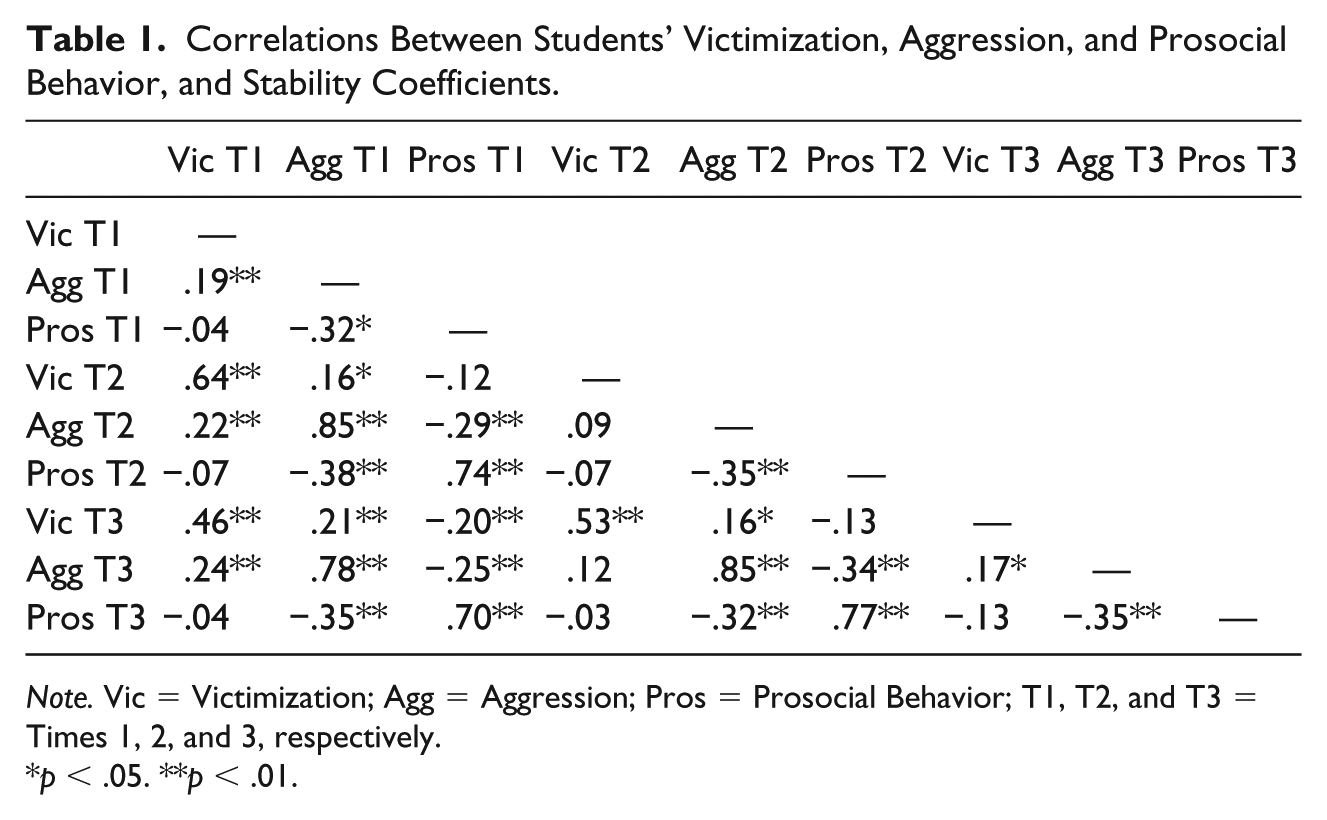
As displayed in Table 1, victimization was positively associated with aggression cross-sectionally (except at Time 2), and victimization was also positively associated with later aggression, and aggression was associated with later victimization. Prosocial behavior and aggression were negatively associated at each time point, and also over time. Interestingly, victimization and prosocial behavior were not significantly associated. Finally, Table 1 shows that victimization, aggression, and prosocial behavior were stable over time, with positive associations between the three assessments of the same variable, ranging from r = .46 to r = .85 (all p’s < .01).
Correlations Between Students’ Victimization, Aggression, and Prosocial Behavior, and Stability Coefficients.
Note. Vic = Victimization; Agg = Aggression; Pros = Prosocial Behavior; T1, T2, and T3 = Times 1, 2, and 3, respectively.
p < .05. **p < .01.
Network descriptive statistics
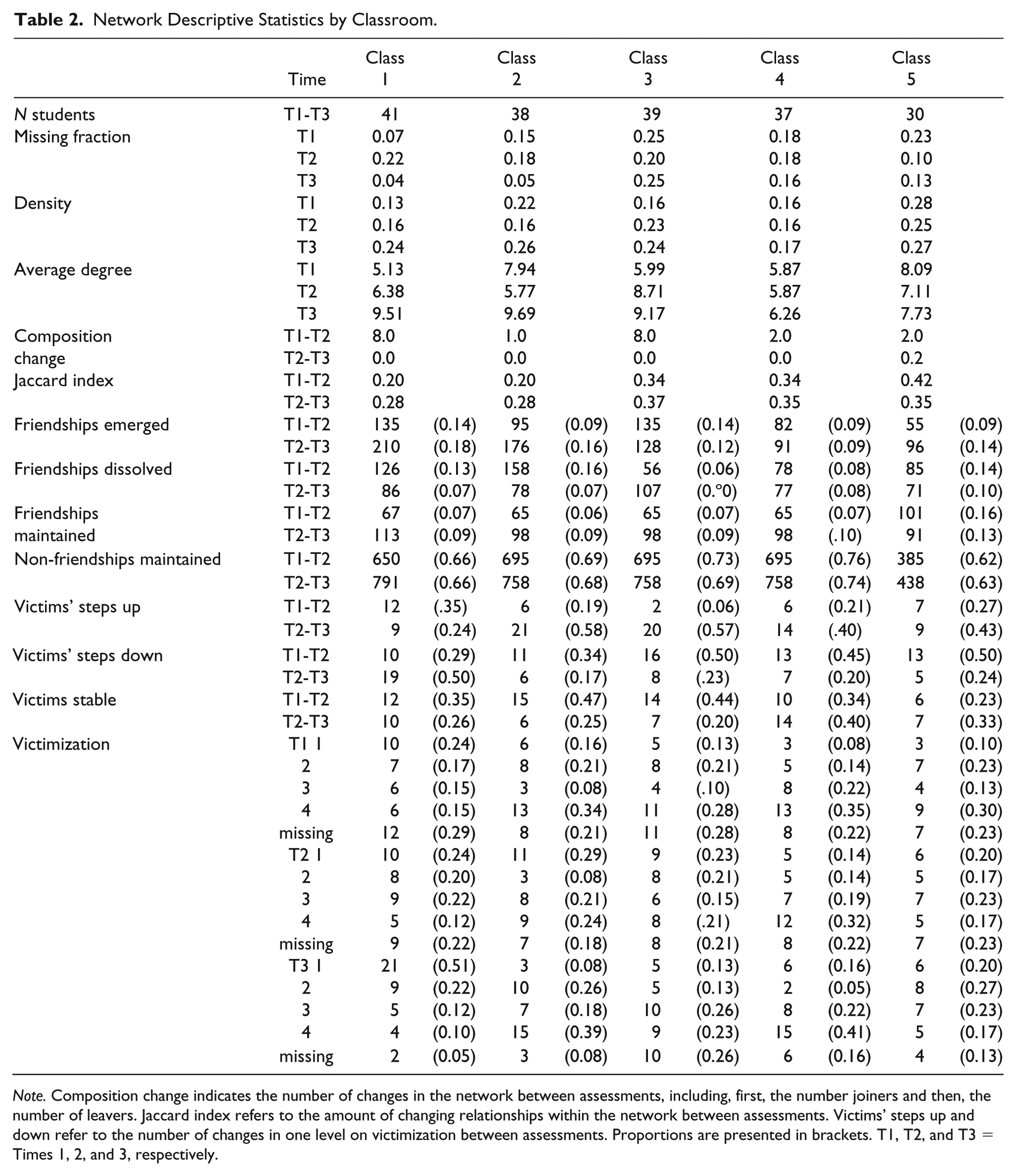
For each classroom, descriptive statistics of the networks and changes in friendships and victimization are presented in Table 2. The average number of friendship nominations given ranged between 5.13 and 9.69 over classrooms, with a higher number of nominations in the third year of assessment (sixth grade). The Jaccard index, an indicator of stability in friendship nominations, ranged between .20 and .42 across school years and classrooms. More specifically, many friendships were maintained during the three school years, but there were also sufficient emerging and dissolving friendships to conduct social network analysis.
Network Descriptive Statistics by Classroom.
Note. Composition change indicates the number of changes in the network between assessments, including, first, the number joiners and then, the number of leavers. Jaccard index refers to the amount of changing relationships within the network between assessments. Victims’ steps up and down refer to the number of changes in one level on victimization between assessments. Proportions are presented in brackets. T1, T2, and T3 = Times 1, 2, and 3, respectively.
Social Network Analysis
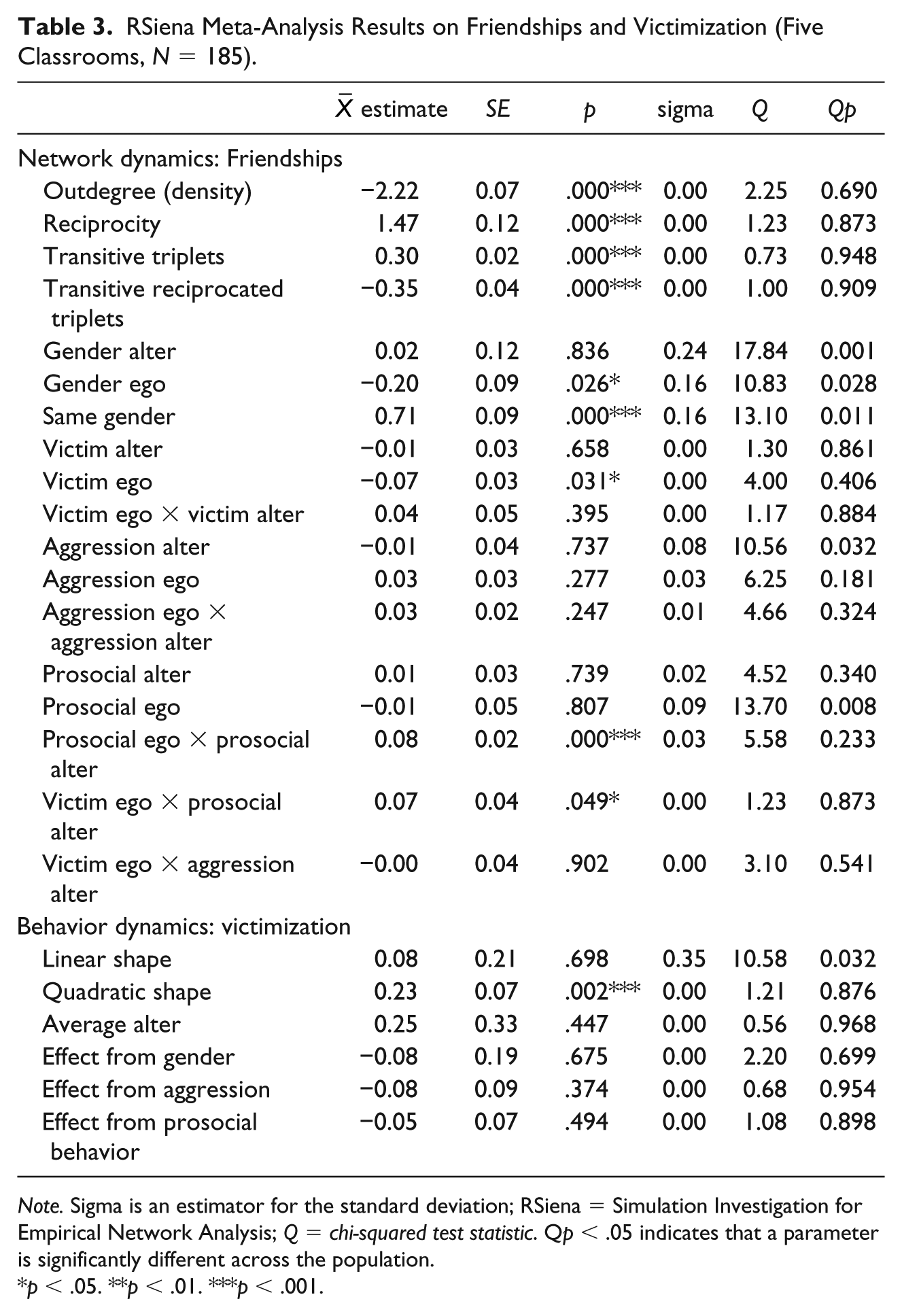
Table 3 shows the results of the RSiena analysis concerning students’ friendships and their levels of victimization from fourth to sixth grade. The table includes the mean estimate and standard error for each effect and the estimates focusing on a relationship to exist (network dynamics) or for a behavior to change (behavior dynamics; Ripley et al., 2017).
RSiena Meta-Analysis Results on Friendships and Victimization (Five Classrooms, N = 185).
Note. Sigma is an estimator for the standard deviation; RSiena = Simulation Investigation for Empirical Network Analysis; Q = chi-squared test statistic. Qp < .05 indicates that a parameter is significantly different across the population.
p < .05. **p < .01. ***p < .001.
The outdegree (density) effect was negative, as expected, as it indicates that participants, on average, selected few peers in their classroom as friends (a positive outdegree parameter would indicate that participants nominate half of their classmates randomly as friends). Also, friendships were reciprocal, transitive (i.e., friends of students’ friends become their friends), and mostly same gender. Moreover, the positive effect of the transitive triplets and the negative effect of the transitive reciprocated triplets are consistent with the idea that unreciprocated friendships are more likely to exist within social groups (e.g., triadic structures), compared with asymmetric friendships outside of social groups (Block, 2015).
Regarding the effect of victimization on friendships, adolescents who were victimized were less likely to give friendship nominations (victim ego effect). We did not find support for the similarity hypothesis; early adolescents with similar victimization and aggression levels did not select each other as friends (victim ego × victim alter effect, and aggression ego × aggression alter, respectively). By contrast, and supporting earlier studies, prosocial students were more likely to select peers as friends with similar levels on these behaviors, as shown by the similarity effects (prosocial ego × prosocial alter).
Moreover, results showed that early adolescents who experience victimization were more likely to select prosocial peers as friends (victim ego × prosocial alter effect), supporting the prosocial selection hypothesis (H2a). Results did not support the aggression selection hypothesis (H2b): Aggression did not influence the likelihood of being nominated as friend by victimized adolescents (non-significant victim ego × aggression alter effect).
We also controlled for ego and alter effects for gender, prosocial behavior, and aggression, finding that girls were more likely to give friendships nominations.
Regarding the behavior dynamics part, the significant and positive quadratic shape parameter suggests a positive feedback, so that changes in victimization are self-reinforcing. Furthermore, befriended early adolescents did not become more similar to each other in their levels of victimization (non-significant average alter effect), showing no support for the contagion hypothesis (H3). Finally, individual students’ aggressive behaviors, prosocial behaviors, and gender did not influence their levels of victimization.
Discussion and Implications
Particularly during early adolescence, due to developmental shifts including an increasing orientation toward peers, friends become important for individuals’ social experiences. Establishing intimate bonds with peers and finding a place within the peer ecology are developmental goals for adolescents (Witkow & Fuligni, 2011). Considering that peer victimization directly hinders the achievement of these goals, positive peer relations become key assets. The present study aimed to examine friendship dynamics of early adolescents who experience peer victimization, adopting a longitudinal social network approach to assess both selection and influence (“contagion”) processes. We were particularly interested in the characteristics of peers (i.e., being victimized, prosocial, or aggressive) that could be perceived as potential assets for protection, and, therefore, could drive friendship selection of early adolescents who experience victimization. Our results show that early adolescents who are victimized were not likely to select peers with similar levels of victimization as friends. However, they were likely to select prosocial peers as friends. Even though prosocial peers might be chosen by many students as friends by default (i.e., prosociality is highly liked), our results highlight that adolescents who experience victimization are particularly likely to select prosocial friends, as compared with a default prosocial selection (non-significant prosocial alter effect). By contrast, they were not likely to select aggressive peers as friends, which might be due to the fact that bullies are often aggressive, which lessens the chance of selecting aggressive peers as friends and defenders against victimization.
The literature on peer victimization gives special attention to the protective role of peers, both by creating a safe context for potentially victimized adolescents, but also by directly intervening and defending them (Hodges & Perry, 1999; Hunter et al., 2004). Specific behaviors and attributes are needed to accomplish this role (Lambe, Della Cioppa, Hong, & Craig, 2019). On the one hand, prosocial behaviors allow accompanying and supporting peers who experience victimization, and create a positive environment in which they feel included and accepted. On the other hand, aggressive behaviors may be viewed as a direct way to deal with others’ aggression and as a way to defend victims. Our results show that prosocial peers appear to be attractive as friends for early adolescents who are victimized, whereas aggression does not play a role in friendship selection. These results highlight the role of positive peer relations and a positive school climate against peer victimization, and suggest that aggression as a mean for dealing with interpersonal conflicts is not naturalized and accepted within the adolescent culture, and particularly among early adolescents who experience peer victimization.
We found no support for the influence hypothesis; friends did not become more similar in their victimization levels over time. Earlier evidence suggested that adolescents avoid befriending victimized peers because of the fear of becoming victimized themselves (Boulton, 2013). Even though the present study might overlook this situation because it did not tap on intentions to befriend and motives to not befriend victimized early adolescents, our results show that being a victim’s friend does not necessarily imply becoming victimized as well. Probably, as victims’ friends have a specific profile characterized by prosocial behaviors, they are socially preferred, which lowers their risk of becoming victimized over time (Pouwels et al., 2016).
Our results are encouraging by showing that aggression does not seem to be valued as a coping strategy against victimization (by means of selecting aggressive peers as friends), and, by contrast, prosocial behavior seems to be valued as a friends’ attribute by adolescents who experience victimization. However, it should also be noted that prosocial adolescents should not exclusively fulfill the potential defending role of peers. Interventions should foster a classroom climate that implements wide protective strategies to reduce victimization in the first place, and to promote defending—or more broadly, caring for peers—in all students, no matter their prosocial character or social standing (Troop-Gordon & Unhjem, 2018). This is in line with the idea of peer victimization as a group process, with all peer group members being involved and having their own role (e.g., defender, assistant, witness; Salmivalli, 2010).
Limitations and Future Research
Some limitations apply to the study. First, the sample size was small, as we were only able to analyze five classrooms. However, the models converged well, and earlier studies adopting a social network approach have featured similar samples. Second, the time frame between assessments was a year; shorter intervals between assessments across the school year would have provided more insights into the ongoing friendship relationships and victimization. Third, it would be interesting to differentiate types of victimization, as differences have been found between physical and relational victimization (Sentse et al., 2013; Sijtsema et al., 2013). In this line, identifying aggressive victims, a specific population that has been associated with very negative outcomes (Holt & Espelage, 2007), could also contribute to a better understanding of the interplay between peer victimization and friendships. Moreover, more insights can be gained in the mechanisms that play a role in friendship dynamics regarding victimization. Different types of defending behaviors by peers can be disentangled, such as general protective support from friends and more active (almost enforcer) support. Finally, even though we assessed aggression through four peer ratings, calculating an aggregated score with high internal consistency over time, it might be arguable whether all these items correctly address aggression. For instance, some studies have focused on relational or physical aggression, and have used more direct items to tackle aggressive behaviors, such as assessing active exclusion instead of ignoring others (Bass et al., 2018; Kraft & Mayeux, 2018). Seemingly, only two peer-rated items were used to assess prosocial behavior. These constructs could be further developed (differentiating forms of aggression, altruism, defending, helping behaviors), and stronger and more complete measures could be included in future studies. Additionally, other constructs could be considered, such as students’ social status.
Future studies should aim at gaining a better understanding of specific features of early adolescents’ interpersonal relationships, such as the direction of friendships, the amount of time that students spend together, and the quality of friendships. For instance, earlier studies have shown that adolescents who have high quality friendships experience less interpersonal conflict and a more positive self-concept than adolescents with low quality friendships (Casullo & Solano, 2000). Through interpersonal support and acceptance, friends may protect against risk behaviors, such as peer aggression (Cuadros & Berger, 2016; Oyanedel, Alfaro, & Mella, 2015). Furthermore, specific characteristics of friendship quality such as disclosure and support have been shown to buffer the effects of victimization by increasing students’ well-being (Cuadros & Berger, 2016). In the same line, future studies can examine classroom norms, for example, whether aggressive peers are popular in the classroom and whether students really act against victimization and defend each other in these situations. For instance, a recent study found that both prosocial school norms and having friends buffer against the negative effects of victimization (Schacter & Juvonen, 2018b). Finally, as girls often focus more on prosocial behaviors and boys behave more aggressively than girls, future studies might include interaction effects between students’ gender and friendships selection and influence processes. Closson and Watanabe (2018), for example, found that within high popularity cliques, showing prosocial behavior to a friend is protective against relational victimization for girls, but constitutes a risk factor for boys.
In sum, this study provides relevant information regarding the role of friends for adolescents who are victimized by their peers, highlighting their potential protective role by means of their prosocial behavior. Moreover, results show that being a friend of a peer who experiences victimization does not necessarily imply becoming victimized. Therefore, it highlights the need to foster peer support and positive relationships among adolescents to counteract the negative consequences of victimization, but also to prevent it from happening in the first place. Building peer networks based on cooperation, care for others, and support seems the perfect seed for fostering respectful and caring societies.
Footnotes
Declaration of Conflicting Interests
The author(s) declared no potential conflicts of interest with respect to the research, authorship, and/or publication of this article.
Funding
The author(s) disclosed receipt of the following financial support for the research, authorship, and/or publication of this article: This study was funded by the Fondo Nacional de Desarrollo Científico y Tecnológico de Chile, FONDECYT grant #1150201.
