



Abstract
Mathematics anxiety negatively impacts cognitive processing, performance, expectations, motivation, and future choices. However, research has not examined patterns in students’ mathematics anxiety levels over time. The current study addresses this gap by exploring group-based trajectories in mathematics anxiety during the transition to junior high school. Five trajectories are described: consistently low anxiety, consistently high anxiety, steady decline, summer decrease, and summer increase. Predictors of trajectory membership, including student demographics and motivational variables like self-concept, are explored. Trajectory membership predicts longitudinal differences in expectations and values after high school. Implications for research on students’ mathematics anxiety over time and especially during transition are discussed.
Keywords
Mathematics anxiety affects at least 20% of adults (Ashcraft & Ridley, 2005), and according to the Programme for International Student Assessment (PISA) 2012 international survey, an average of 30% of 15-year-old students worldwide (23% of students in the United States) say that they feel helpless when working on mathematics problems (Organisation for Economic Co-operation and Development [OECD], 2013). Those with mathematics anxiety suffer from intense feelings of fear and worry during mathematics situations. It negatively impacts cognitive processing, performance expectations, and future choices (Ashcraft & Moore, 2009; Meece, Wigfield, & Eccles, 1990). Those with mathematics anxiety become disheartened and ultimately avoid mathematics (Ashcraft & Moore, 2009; Hembree, 1990). Multiple meta-analyses and literature reviews have drawn attention to its detrimental effect on student performance and motivation (Hembree, 1990; Ma, 1999; Maloney & Beilock, 2012). In order to alleviate mathematics anxiety in students, researchers must better understand the factors that influence changes in mathematics anxiety. In particular, the developmental trajectories of mathematics anxiety need to be studied as evidence suggests that mathematics anxiety likely develops as early as elementary school (Maloney, Ramirez, Gunderson, Levine, & Beilock, 2015; Ramirez, Chang, Maloney, Levine, & Beilock, 2016; Wu, Barth, Amin, Malcarne, & Menon, 2012). Given the serious consequences and prevalence of mathematics anxiety, improving mathematics education and student performance must include addressing anxiety. Understanding when and how mathematics anxiety changes over time is the first step toward targeted interventions.
Previous research suggests that motivational factors including expectations and task values (e.g., Frenzel, Pekrun, & Goetz, 2007a; Meece et al., 1990), academic control (e.g., Niculescu, Tempelaar, Dailey-Hebert, Segers, & Gijselaers, 2016), and achievement goal orientations (e.g., Daniels et al., 2008; Zusho, Pintrich, & Cortina, 2005), as well as elements of the classroom environment such as perceived competition among students and excessive lesson demands (e.g., Frenzel, Pekrun, & Goetz, 2007b; Goetz, Ludtke, Nett, Keller, & Lipnevich, 2013), can predict variation in mathematics anxiety. The majority of these studies examined mathematics anxiety at one time point; few studies have looked at trajectories of students’ mathematics anxiety over time. One study that has examined trajectories in mathematics anxiety during the transition to junior high school showed variability in mathematics anxiety for certain subgroups (Madjar, Zalsman, Weizman, Lev-Ran, & Shoval, 2018). However, this work was done with a growth curve analysis, which assumes one population trajectory and examines how some covariates explain deviation from this overall pattern. Another short-term study, which used an experience sampling method (Goetz et al., 2013), suggests that intraindividual variation in mathematics anxiety exists and that there could be many distinct patterns of change within a population. The current study addresses this gap in longitudinal studies by exploring group-based trajectories in mathematics anxiety during the transition from elementary to junior high school.
Literature Review
Mathematics anxiety is commonly defined as an adverse emotional reaction characterized by fear or dread (Hembree, 1990). It is a negative affective reaction to encountering mathematics, or even just numbers (Richardson & Suinn, 1972). People with mathematics anxiety experience intense physiological and psychological reactions in situations involving mathematics.
Changes in Mathematics Anxiety Over Time
There is a paucity of research examining levels of mathematics anxiety over time. Some longitudinal work has examined how changes in mathematics anxiety are related to changes in motivational variables. For example, with a sample of seventh grade students and using a cross-lagged model with three time points, Ahmed, Minnaert, Kuyper, and van der Werf (2012) found a reciprocal relationship with lower mathematics self-concept leading to higher mathematics anxiety, and in turn, higher mathematics anxiety leading to subsequent lower mathematics self-concept. In work with two time points and a sample of first-year university students, changes in academic control from before midterms to before finals were related to concurrent changes in mathematics anxiety (Niculescu et al., 2016).
Two studies have examined mathematics anxiety in the Longitudinal Study of American Youth dataset, which includes data following students from Grades 7 through 12. Growth-curve analyses indicated that students’ mathematics anxiety increases across middle and high school grades at the same time that their attitudes toward and utility of mathematics is declining (Ma & Cartwright, 2003). Gender differences in that analysis showed higher mathematics anxiety for females at the initial time point in Grade 7 and their anxiety increased at a faster rate than that of males. A cross-lagged model examining Grades 7 through 12 showed that prior low mathematics achievement leads to higher mathematics anxiety in subsequent grades (Ma & Xu, 2004). In contrast, results indicated that prior high mathematics anxiety had less impact on later mathematics achievement. Interestingly, this model also suggested that mathematics achievement is stable whereas mathematics anxiety was less consistent. Finally, their analysis included an examination of gender differences that found males’ prior achievement impacts subsequent mathematics anxiety each year; however, for females, their prior achievement only impacts subsequent mathematics anxiety during key transition points from elementary to junior high and from junior high to high school.
One study has specifically examined mathematics anxiety during the transition to junior high school. Madjar et al. (2018) followed 226 Israeli students as they transitioned and 187 students who did not transition. Data collection included two time points in sixth grade, the year prior to transition, and two time points in seventh grade, the year after transition. Hierarchical linear modeling indicated that gender, school transition, and grade point average (GPA) were all significant predictors of change in mathematics anxiety. Further analysis suggested that those who transition show a spike in their anxiety immediately before the transition which then declines in the following school year, whereas their nontransition counterparts had relatively stable anxiety. Similarly, females and those with high GPAs also had these quadratic slopes, with increases before the transition followed by declines during the school year. In contrast, males and those with low GPAs had relatively consistent levels of anxiety. These results point to the transition between elementary and junior high school as a key time point to study for potential changes in mathematics anxiety.
Transition to Junior High School as Critical Time
The transition from elementary to junior high or middle school is a time of change as students shift from a general classroom to subject-specific ones and many aspects of their motivation shift during this time (Eccles et al., 1993). For example, the transition to junior high school is marked by an initial drop in self-esteem and self-concept in mathematics (Wigfield, Eccles, MacIver, Reuman, & Midgley, 1991). The drop is seen at the beginning of the school year following transition but has been shown to rebound for self-esteem, social self-concept, sports self-concept, liking of English, and liking of social activities. Mathematics self-concept and liking of mathematics did not rebound after the initial drop. Similarly, importance of and interest in mathematics declined over the summer before junior high school and then continued to decline over the school year, suggesting lasting effects of the transition (Wigfield & Eccles, 1994). These and other studies suggest that environmental changes during the transition to junior high greatly impact students’ motivation (Eccles et al., 1993). It stands to reason, then, that the transition to junior high may cause changes in mathematics anxiety similar to those seen in other motivational constructs, especially given that the environment has been identified as a significant predictor of anxiety (e.g., Frenzel et al., 2007b; Goetz et al., 2013).
Expectancy-Value Theory, Control-Value Theory, and Mathematics Anxiety
Much of the literature examining the transition period between elementary and junior high or middle school is grounded in expectancy-value theory (Wigfield & Eccles, 1994). Previous work has shown that mathematics anxiety is related to expectations (i.e., beliefs about potential performance) and value (i.e., the reasons for attempting to perform), and is predictive of later choices and performance (Meece et al., 1990). Expectancy-value theory places affective reactions like mathematics anxiety in between students’ background—including beliefs, behaviors, and prior experiences—and their expectations and values (Wigfield & Eccles, 2000). Building on the work of expectancy-value theory, control-value theory also associates affective reactions with expectations and values; however, the order of association depends on the emotion being studied (Pekrun, 2006). In the case of anxiety, appraisals of control and value precede the emotional response because anxiety is a prospective emotion (Pekrun, 2006).
Expectations
Expectations are beliefs about performance in terms of tasks or outcomes. The expectations for success depend on an individual’s confidence in his or her ability in relation to anticipated difficulty of the achievement activity in question and may be conceptualized as a person’s sense of efficacy for the given domain (Eccles & Wigfield, 2002). Perceptions of control depend on the subjective likelihood of obtaining an outcome combined with the controllability of actions or outcomes (Pekrun & Perry, 2014). This expectancy and sense of control is related to affective reactions, including anxiety (Pekrun, 2006; Wigfield & Eccles, 2000). For example, in cross-sectional studies, mathematics self-efficacy predicts mathematics anxiety (Jain & Dowson, 2009; Pajares, 1996; Pajares & Kranzler, 1995), as does mathematics self-concept (Ferla, Valcke, & Cai, 2009; Radisic, Videnovic, & Baucal, 2015). Furthermore, in a regression analysis that included task values, increases in competence beliefs significantly predicted decreases in mathematics anxiety (Frenzel et al., 2007a).
Values
Perceptions of task value include the degree of importance or goal relevance of an action or outcome and the “direction” of the value, whether it is specific to either attaining a goal or impeding attainment of a goal (Pekrun & Perry, 2014). This value and importance is related to emotions, such as anxiety (Pekrun, 2006; Wigfield & Eccles, 2000). Task value has been examined in conjunction with mathematics anxiety by Meece and colleagues. For example, Meece et al. (1990) investigated potential predictors of mathematics anxiety, the relationship to expectations and value, and the impact of these constructs on performance and course enrollment plans. Their analysis found that mathematics anxiety is recursively related to expectations and value. Other work has also shown the impact of task value on mathematics anxiety. In a model including competence beliefs, Frenzel et al. (2007a) found task values of mathematics and achievement both predict mathematics anxiety. When examining the predictive power and potential interaction between expectations and values, Lauermann, Eccles, and Pekrun (2017) found that students with higher levels of self-concept were less likely to worry in mathematics and those with higher levels of utility and intrinsic values were more likely to worry. Moreover, their moderation results suggest that the impact of values is stronger for students with low to moderate levels of self-concept.
Environmental influences
More broadly, expectancy-value and control-value theory posit that an individual’s expectancies and values are influenced by their perceptions of others’ expectations for them. Early work in the expectancy-value framework examined students’ perceptions of their teacher regard (i.e., does your teacher view you as a good student) along with students’ competence and value as predictors of emotional functioning (Roeser, Eccles, & Sameroff, 1998). These researchers found that even controlling for prior-year emotional functioning, both competence and perceptions of teacher predicted emotional functioning for adolescents. Control-value theory researchers have found mathematics anxiety is related to perceived classroom environment variables including teacher support and lesson demands, which included the teacher’s expectations (Goetz et al., 2013).
Overall, the expectancy-value framework of our secondary data source and the more recent control-value theory suggest predictors of mathematics anxiety include expectancies and value of mathematics as well as perceptions of teacher expectations (Pekrun, 2006; Wigfield & Eccles, 2000). They also suggest that patterns of mathematics anxiety may predict later choices related to mathematics and beliefs regarding mathematics ability (Wigfield & Eccles, 2000).
Purpose of This Study
There is a growing body of work on mathematics anxiety. Many studies feature the connection of mathematics anxiety with motivational variables including expectations, values, and the influence of the teacher. Although much of the work has been with only one time point for mathematics anxiety, existing longitudinal studies suggest that there is variation in mathematics anxiety across time. A key transition time to examine mathematics anxiety in adolescents is the move from elementary to junior high school. One longitudinal study has examined mathematics anxiety during this period, finding that mathematics anxiety was stable for students who did not transition between schools and mathematics anxiety increased during the transition for those students who changed schools (Madjar et al., 2018). In their study, Madjar and colleagues (2018) relied on a growth curve model to examine change which does not allow for multiple distinctive patterns to emerge from the data. Rather, the analysis assumes that there is one developmental pattern in the population and then predictors model how individuals deviate from this pattern. However, there is evidence to suggest intraindividual variation in mathematics anxiety; using an experience sampling method over a 10-day period, Goetz and colleagues (2013) found significant within-person variance in mathematics anxiety. Therefore, an exploratory, person-centered approach could reveal a variety of patterns in students’ mathematics anxiety. The purpose of the current study is to examine patterns of mathematics anxiety within adolescents as they transition to junior high school. Should distinctive patterns emerge, it seems likely that student expectations and value for mathematics, as well as their perceptions of the classroom environment, will be related to the patterns in mathematics anxiety.
Method
Data Source
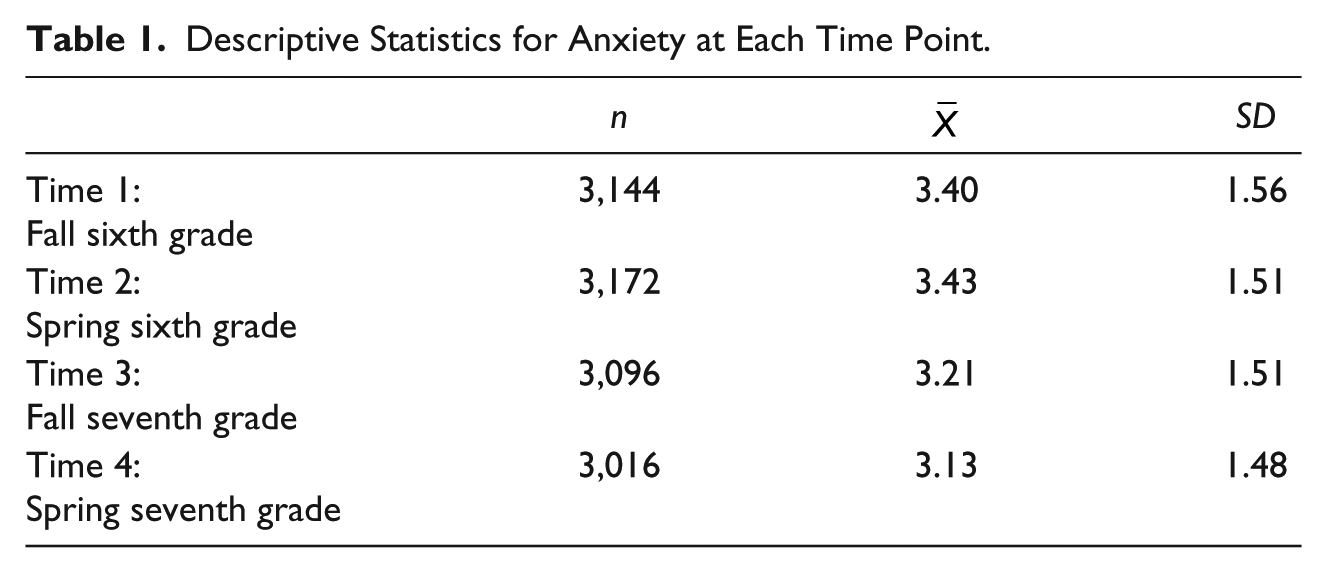
The Michigan Study of Adolescent Life Transitions (MSALT) data collected by Eccles and colleagues (Eccles, 2010; Eccles et al., 1993) were drawn from 12 public school districts in southeastern Michigan, including primarily working and middle-income families. Mathematics anxiety in the MSALT data was measured at four time points: Time 1, fall of sixth grade; Time 2, spring of sixth grade; Time 3, fall of seventh grade; and Time 4, spring of seventh grade. These time points capture the transition to junior high between sixth and seventh grade. Mathematics anxiety scores were available for 2,378 students (53.3% female; 89.4% White) in all four time points and 3,741 (52.7% female; 86.1% White) for at least one time point (see Table 1 for descriptive statistics of anxiety at each time point). Follow-up data were collected 7 years later with data available for 1,393 students at this time point.
Descriptive Statistics for Anxiety at Each Time Point.
Measures
Mathematics anxiety
The MSALT dataset includes six questions that are averaged together to measure mathematics anxiety at each time point, measured on a 7-point scale. Items include “Before you take a test in math, how nervous do you get? (1 = I’m not at all nervous; 7 = I’m very nervous)” and “When the teacher says she is going to ask you some questions to find out how much you know in math, how much do you worry that you will do poorly? (1 = not at all; 7 = very much).” Reliability was above .85 for all four time points: Time 1 = .87; Time 2 = .86; Time 3 = .86; and Time 4 = .88.
Self-concept
Ability beliefs for mathematics at Time 1 were calculated as the average of seven items on a 7-point scale. Items include “How well do you think you will do in math this year?” (1 = not at all; 7 = very well) and “Compared to most of your other school subjects, how good are you at math?” (1 = much worse; 7 = much better). Reliability was .89 for this time point.
Importance
Students’ value for mathematics, including importance and utility, at Time 1 was calculated as the average of five items on a 7-point scale. Items include “In general, how useful is what you learn in math?” (1 = not at all; 7 = very useful) and “For me, being good at math is . . .” (1 = not at all important; 7 = very important). Reliability was .79 for this time point.
Performance
Baseline performance was assessed with first semester math grades (concurrent with the first time point). Course grades in the MSALT database were standardized to a single scale using a +/– grading system (1 = F; 16 = A+).
Perception of teacher beliefs
Students’ perception of their sixth grade teacher’s belief that some students cannot do well in math class was assessed during Time 2 using a single item: “The teacher thinks that some of the students in this class can’t do very good math work” on a 4-point scale (1 = not very often; 4 = very often).
Follow-up expectations and choices
In a follow-up study collected 12 years after 12th grade, 7 years after transition, expectations were assessed using a single item: “Compared to others, how good are you at doing advanced math” (1 = a lot worse; 7 = a lot better). For the same time point, future choice was assessed with the single item: “Are there any careers that you have ruled out because you do not like the math, physics, or chemistry classes that you would have to take?”
Data Analysis
Group-based trajectory modeling assumes that there are multiple groups of developmental trajectories that differ from each other. In short, it is a “person-centered” approach that focuses on the distinctive characteristics of individuals (Nagin, 2009; Nagin & Odgers, 2010). This is in contrast to hierarchical modeling and latent curve analysis, which both assume a single population distribution and attempt to model how individuals vary around the average population growth curve (Nagin, 2009). Group-based trajectory modeling is a way to model multiple distinctive patterns of growth for phenomena that are unlikely to contain a common growth process (Nagin, 2009; Nagin & Odgers, 2010). It lends itself to questions like the one in this study that are focused on the shape of the distribution for different groups. In other words, it reveals patterns that exist for a given phenomenon over time (Nagin, 2009). Both group-based trajectory modeling and more general growth mixture modeling consider that interindividual differences lead to heterogeneity (i.e., different possible groups) within a larger population and allow the modeling of these different growth trajectories. These latent groups are created from the modeling of continuous variables; in the case of the present study, it is the patterns in mathematics anxiety measures over time that create the latent group trajectories.
Group-based trajectory models is a special case of growth mixture modeling that assumes that all individual growth trajectories within a group are homogeneous. In both approaches, individuals are placed into latent classes based on similarities in patterns of data; however, these two approaches differ in what values are allowed to vary within and between latent classes. In group-based trajectories, the variance of the latent group’s intercept and slope is fixed within the group and only allowed to vary between the groups. Thus, in a group-based trajectory model, the assumption is that all individuals within the group are identical. In contrast, a more general mixture model allows the latent intercept and slope to vary both within and between the groups, allowing individual differences in trajectory within a group. Both types of growth-based trajectory models were tested in the current study. We use the group-based trajectory approach to help determine how many trajectories to use and then move to growth mixture models, allowing variation with the created latent groups (Jung & Wickrama, 2008).
It is logical to assume that mathematics anxiety is such a phenomenon that contains multiple patterns over time. Students display varying levels of mathematics anxiety and there are certainly students who trend upward in levels and even those who decrease in anxiety under certain circumstances. In an effort to explore the accuracy of these assumptions and determine the appropriateness of a group-based trajectory analysis, five spaghetti plots were run with roughly 25 randomly selected individuals in each. All five plots looked very similar and showed that there were multiple distinct patterns. For example, some students showed decreases during school years and an increase during summer. Still others had one direction of growth from Time 1 all the way through Time 4. These variations suggested multiple patterns of growth rather than one common pattern with individual variation around the average. Group-based trajectory modeling was completed in SAS 9 with PROC TRAJ (Jones, Nagin, & Roeder, 2001) and the models were confirmed using Mplus 8 (Muthén & Muthén, 1998-2017). Mplus analyses were conducted using robust full information maximum likelihood estimation. This approach adjusts standard errors accounting for any nonnormal distribution of data and makes use of all available data points (Little, Jorgensen, Lang, & Moore, 2014).
To examine how these longitudinal groups might differ from one another, we conducted some supplemental analyses. We first attempted to predict trajectory membership using baseline (Time 1) variables with a multinomial logistic regression in order to explain what types of characteristics were associated with trajectory membership. Next, we conducted analyses with a subsample of data collected 2 years after high school graduation (7 years after the initial anxiety measures) using two approaches to explore how the categorical variable created from trajectory membership related to motivational and demographic variables. We used one-way ANOVA and chi-square analyses to examine trajectory membership differences in expectations and choices 2 years after high school graduation.
Results
The first component of group-based trajectory modeling is deciding on the number of latent trajectories. Following the procedures laid out by Nagin (2009) and Nagin and Odgers (2010), we tested a range of three to nine groups. One indicator of group selection can be based on the Bayesian information criterion (BIC), a fit indicator that should plateau at the optimal number of trajectories. However, when we tested the recommended range of three to nine groups, the BIC continued to increase. Researcher analysis was used to determine the optimal number of groups following the guidelines laid out by Nagin (2009), emphasizing the relative size of groups and the uniqueness of the various trajectories. Based on these criteria, we tested many models ranging from three to nine trajectories and determined that five group-based trajectories is the best approximation of the data with the most parsimonious solution that still captures as much variation as possible. If more than five groups are included, the additional trajectories mimic the shapes of already included trajectories but at different levels. In other words, additional groups beyond five do not reveal any useful or important distinctions in trajectories. Furthermore, the size of additional groups becomes quite small. Next, we allowed the intercepts and slopes of the latent groups to vary, testing a true mixture model. Because the number of group trajectories identified can vary between group-based and growth mixture models, we again tested a range of models. Allowing random slope and intercepts resulted in convergence issues and Heywood cases with all models tested. Attempts to address these issues included increasing iterations for estimation, changing start values, and constraining variances to positive values (Jung & Wickrama, 2008); however, we were not able to identify a model with adequate fit when intercept and slope constraints were relaxed and thus we present the group-based trajectories with homogeneous groups.
Mathematics Anxiety Trajectories
The five trajectory solution can be found in Figure 1 and Table 2. Important considerations when viewing trajectories include the percentage of group membership—groups should not be too small and large groups indicate prevalent trajectories; the statistical significance of cubic growth—four time points allow for consideration of cubic, quadratic, or linear growth; and the patterns in the figure itself—increases and decreases are shown visually. We also examined the model entropy which is marginal at .63. Entropy measures the accuracy of classification with values closer to 1.0 being most desired. Furthermore, acceptable posterior probabilities ranged from .66 to .84. Two trajectories are flat: Trajectory 1 includes the consistently low anxiety students and Trajectory 5 includes the students who are consistently high in anxiety. Three trajectories display statistically significant cubic patterns. Trajectory 2 has slightly increasing but almost stagnant change during the school years accompanied by a decrease over the summer. In Trajectory 3, there is no change in anxiety during the school year but increases in anxiety during the summer. Finally, Trajectory 4 is marked by an overall decrease in anxiety. The largest drop occurs over summer, but decreases are still clear over the two school years.

Graph of mathematics anxiety trajectories for four time points with percentage of sample in each trajectory group.
Trajectory Parameter Estimates for Intercept and Shape.
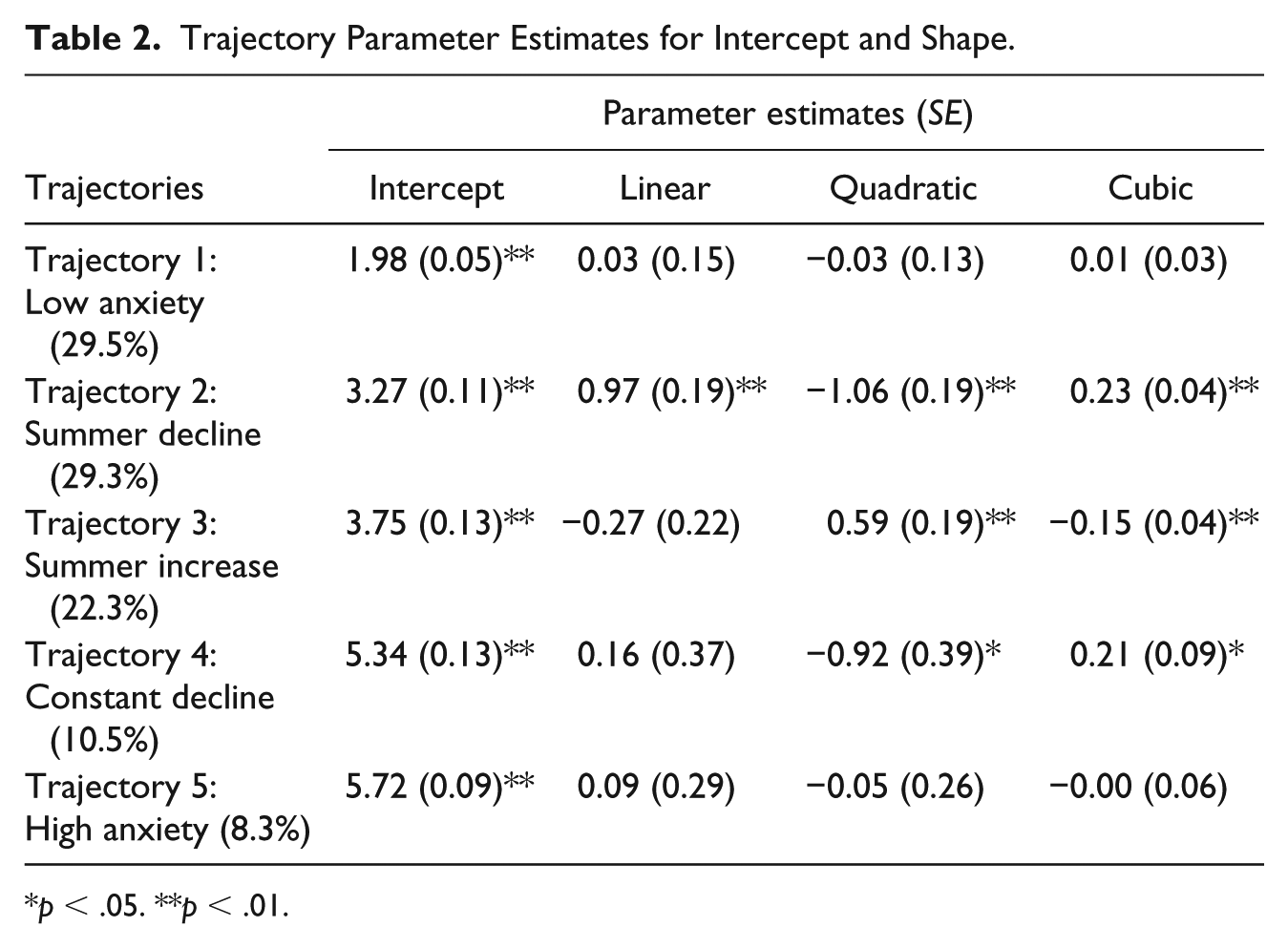
p < .05. **p < .01.
We then examined patterns in the relationship between trajectory membership and gender, χ2(4) = 93.01, p < .01. Trajectory 1, the low anxiety group, included a much higher proportion of boys (56.6%) than the original sample. This is in contrast to Trajectory 5, the high anxiety group, that had a very high proportion of females (72.3%). Trajectory 2, the summer decrease group, had a similar quantity of females (52.9%) to the original sample. Conversely, Trajectory 3, the summer increase group, included more females (55.4%). Interestingly, the group with decreasing anxiety, Trajectory 4, had the highest proportion of females (59.4%).
Predictors of Trajectory Membership
Next, we examined gender as well as motivational variables (i.e., self-concept and importance) and a perception of teacher beliefs from the first wave of data as predictors of trajectory group membership, controlling for first semester grades. Use of these variables reduces total sample size from 3,471 to 2,062, as not all students had achievement data; however, relative trajectory membership group sizes remained consistent.
The multinomial logistic regression method focused first on the low anxiety (Trajectory 1) as the referent group because this group is considered desirable by most and thus we compared less desirable patterns with this. However, we also examined all other possible comparisons (Table 3). All four trajectory patterns differed from the low anxiety group on self-concept. Students with higher levels of self-concept were about half as likely to be in the summer decreasing anxiety (Trajectory 2; odds ratio [OR] = 0.56) and the summer increasing anxiety (Trajectory 3; OR = 0.54) groups as compared with the low anxiety trajectory group. Comparatively, the ORs for the decreasing anxiety group (Trajectory 4) and the high anxiety group (Trajectory 5) were 0.46 and 0.42, respectively, indicating that as self-concept increases the likelihood of being in either of these groups is lower. Similar results regarding self-concept were found in the other comparisons. Self-concept distinguishes among the groups with the exception of comparisons between the summer change groups and comparisons between the high anxiety and constant decrease groups.
Odds Ratios From Logistic Regressions Predicting Trajectory Membership.
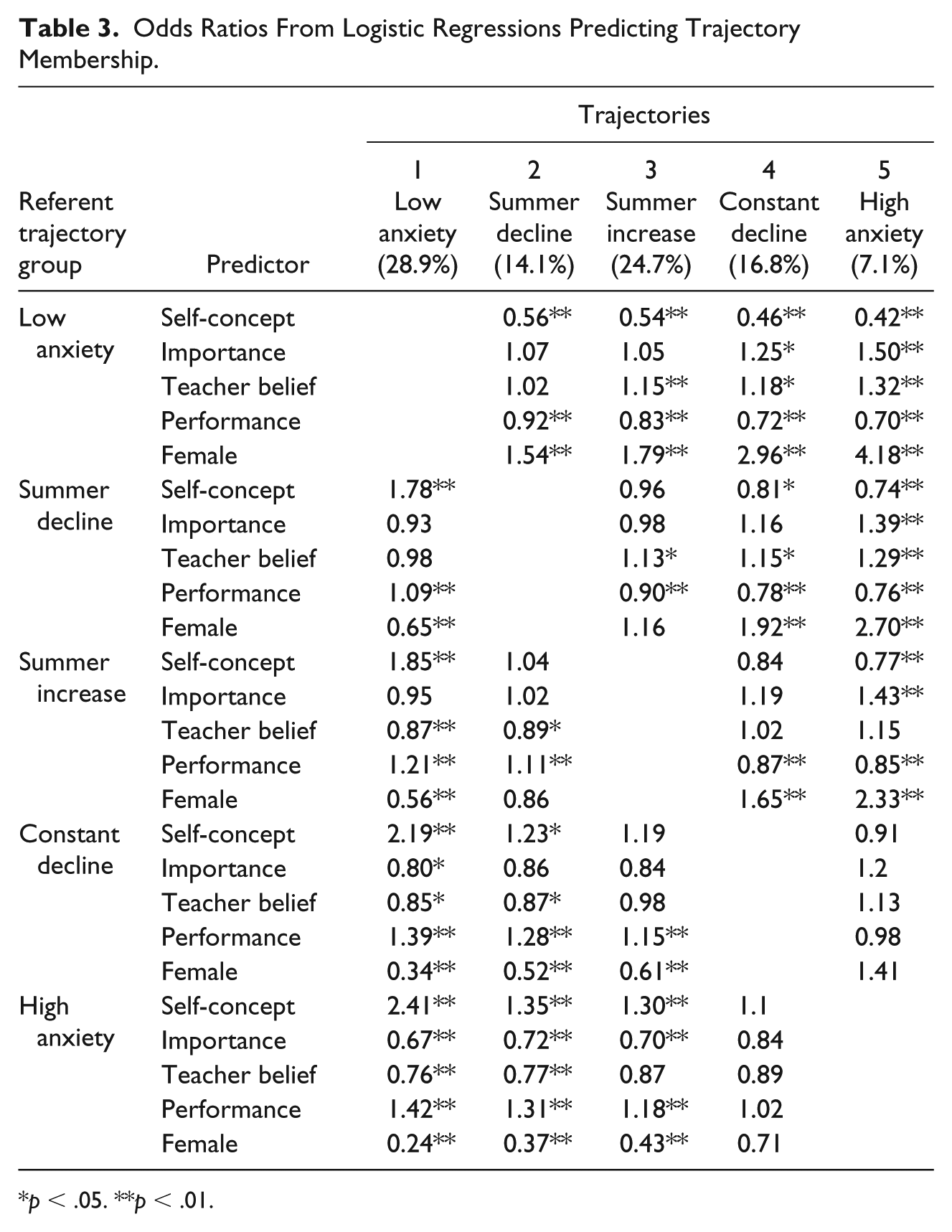
p < .05. **p < .01.
Importance significantly predicted membership in the high anxiety group (Trajectory 5; OR = 1.50) and the decreasing anxiety group (Trajectory 4; OR = 1.25). As importance increases, students were more than 1.5 times as likely to be in the high anxiety group and 1.25 times as likely to be in the overall decrease group. In the other comparisons, importance was a significant predictor of the summer groups and the low anxiety group when compared with the high anxiety group. It was also significant when comparing constant decrease group with the low anxiety group.
Gender was a significant predictor for all four trajectories with girls being more likely to be in any of the anxiety trajectories as compared with the consistently low anxiety group. Particularly striking is the OR for girls in the consistently high anxiety group (Trajectory 5, OR = 4.18) indicating they are 4 times more likely to be in the consistently high group as compared with the consistently low group. Moreover, gender was a significant predictor in almost all of the comparisons run. The only comparisons in which gender was not a significant predictor were between the high anxiety and constant decrease groups and between the summer change groups.
Students’ perceptions of their teachers’ beliefs that some students cannot do well in math class also differentiated trajectory membership. For students who endorsed this item, there was a greater likelihood of being in the summer increasing anxiety group (Trajectory 3; OR = 1.16), the overall decrease group (Trajectory 4; OR = 1.18), or the consistently high anxiety group (Trajectory 5; OR = 1.32) as compared with the consistently low anxiety group. When examining the other comparison results, it becomes clear that perceptions of teacher beliefs are key to understanding differences between the summer increase group, the constant decrease group, and the high anxiety group.
Long-Term Expectations and Career Choices
Finally, we examined follow-up items for a portion of the sample used to determine the trajectory patterns. Data were collected again 2 years after these students graduated from high school from 1,393 students (37.23% of the original sample used to formulate the trajectories), which is 7 years after the elementary to junior high transition data from Grades 6 and 7. Remaining in the sample were 94 students (31.76% of original group) in the high anxiety group (Trajectory 5), 102 students (33.12% of original group) in the decreasing anxiety group (Trajectory 4), 296 students (33.91% of original group) in summer increasing group (Trajectory 3), 446 students (39.23% of original group) in the summer decreasing group (Trajectory 2), and 455 students (40.37% of original group) in the consistently low anxiety group (Trajectory 1).
This follow-up sample is much smaller than the original sample used to create the trajectories as only slightly more than one third of the original sample responded to the follow-up survey. We examined several key demographic and motivational variables to determine how this sample compares with the original sample. Chi-square tests indicated that there were more girls in the follow-up sample (62%) than the original, χ2(1) = 49.34, p < .01, and there were more White students (92%) than in the original, χ2(1) = 66.46, p < .01. T tests indicated that those in the follow-up sample had significantly higher baseline self-concept (
A one-way ANOVA indicated significant differences in future expectations for mathematics between trajectory groups, F(4, 1388) = 29.40, p < .01, χ2 = 0.08. Group differences were examined using Games-Howell post hoc tests. In particular, the low anxiety group (Trajectory 1;

Group differences in response to “Compared to others, how good are you at each of the following: Doing advanced math?” (1 = a lot worse; 7 = a lot better).
Similarly, students were also asked whether there were any careers that they had ruled out because they do not like math, physics, or chemistry classes that they would have to take. More students from the high anxiety group (Trajectory 5) said yes, whereas more students in the low anxiety group (Trajectory 1) said “no.” Remaining students in Trajectories 2, 3, and 4 were approximately evenly divided between “no” and “yes” (Figure 3). It should be noted that only 738 students answered this question, which is 19.73% of the original sample; however, the chi-square analysis was significant, χ2(4) = 13.02, p = .01.
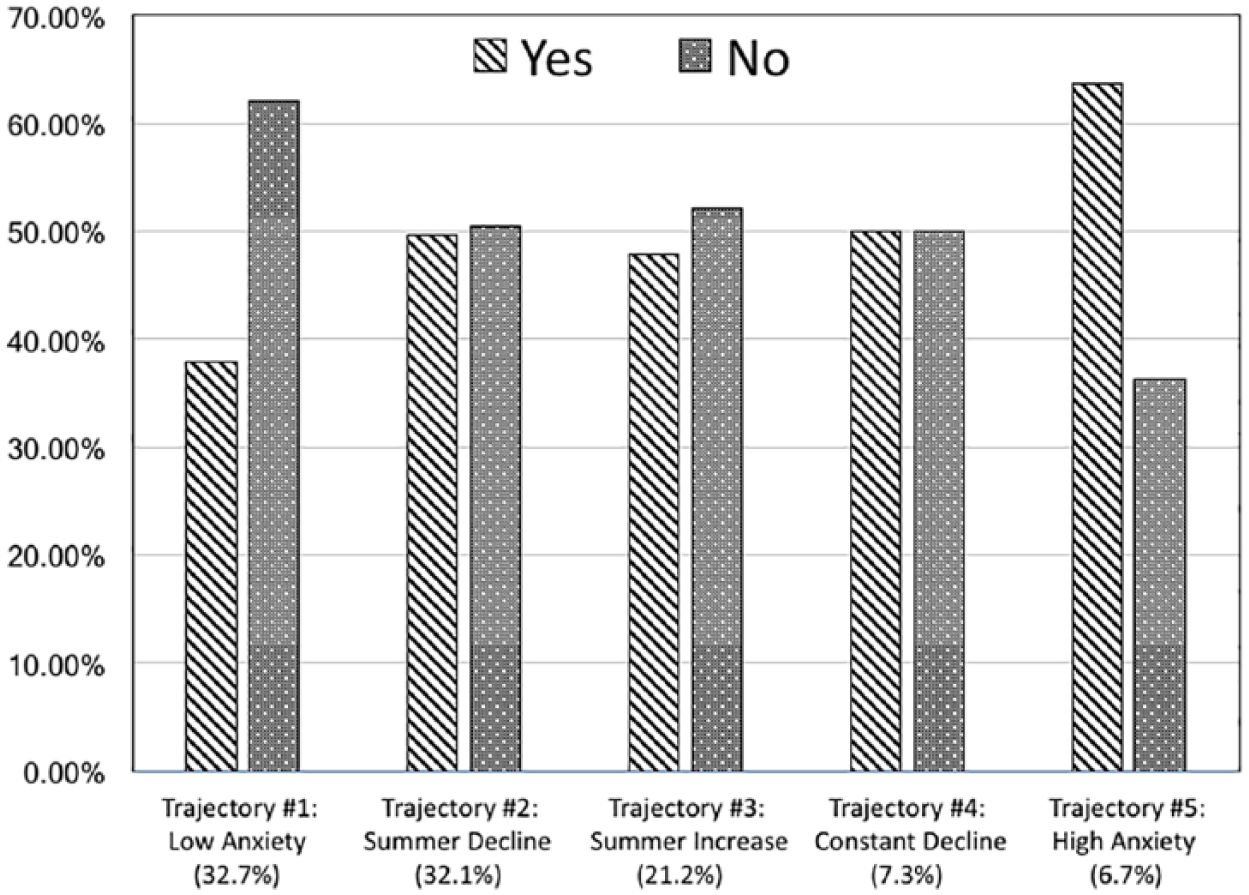
Percentage of responses by group to “Are there any careers that you have ruled out because you do not like the math, physics, or chemistry classes that you would have to take?”.
Discussion
This study examined patterns of mathematics anxiety at a critical time in adolescent development, the transition from Grade 6 to Grade 7, when students are moving from a general classroom to subject-specific classrooms. Research suggests that this time period is especially important to study because of the changes in students’ motivation and self-beliefs (e.g., expectations and values) as they transition (e.g., Eccles et al., 1993; Wigfield & Eccles, 1994; Wigfield et al., 1991), which are related to mathematics anxiety (e.g., Frenzel et al., 2007a; Meece et al., 1990; Pekrun, 2006).
We found five distinct patterns in mathematics anxiety that demonstrate that more than one pattern of change exists for this adolescent population. There is not a “one size fits all” pattern that can be assumed for students. Our findings suggest both increases and decreases in mathematics anxiety as well as summer changes in mathematics anxiety. Previous longitudinal research studies of mathematics anxiety have attempted to fit single growth models and found either no growth or slightly increasing anxiety (e.g., Ma & Cartwright, 2003; Madjar et al., 2018). Our results provide a possible explanation for these conflicting findings because our solution suggests multiple patterns of mathematics anxiety. In traditional growth curve analyses, opposing patterns would be canceled out when averaged together, whereas these differing patterns are distinct using a group-based trajectory approach. Furthermore, each of the previous studies did find differences in trajectories when splitting their samples by either gender (Ma & Cartwright, 2003; Madjar et al., 2018) or school transitions (Madjar et al., 2018). Our methodological approach allows us to first uncover the multiple patterns and then examine how other variables such as demographics may predict membership in different trajectory patterns. We also found that there were differences in the number of males and females in various trajectories, confirming previous findings regarding gender differences in mathematics anxiety. All of our participants experienced a school change between Grades 6 and 7, which was similar to the school transition findings of Madjar and colleagues (2018).
These trajectories suggest important findings regarding students’ levels of mathematics anxiety and the distribution of students within these levels. There is a large percentage of students in the low anxiety trajectory (29.5%) and a relatively smaller percentage of students in the high anxiety trajectory (8.3%). Although the high anxiety group is much smaller than the low anxiety group, this is still a significant number of students and deserves attention. This number represents a realistic proportion of students who experience consistently high mathematics anxiety. Prior research has suggested that 25% to 30% of students struggle with math anxiety (Beilock & Willingham, 2014; Dowker, Sarkar, & Yen Looi, 2016) and PISA results have indicated that 23% of American students feel helpless when encountering mathematics (OECD, 2013). In our study, we found two trajectories, high anxiety (Trajectory 5) and summer increase (Trajectory 3), are consistently above the mean level of anxiety at all time points. These two groups make up 30.6% of the sample, which is consistent with these previous research findings.
Two of the trajectories feature change during the summer accompanied by little to no change during school years. The summer increasing group (Trajectory 3) is consistent with research in the transition literature examining other motivational characteristics (i.e., achievement, values, and self-esteem) over the summer vacation (Eccles et al., 1993; Wigfield & Eccles, 1994; Wigfield et al., 1991). In Trajectory 3, mathematics anxiety increases, whereas other studies have found that achievement and self-esteem decrease; the explanation for these patterns is likely the same in that during the transition, students experience a change that challenges their self-conceptions resulting in decreases of desirable constructs and increases in less desirable outcomes such as mathematics anxiety. Interestingly, the other summer change pattern, the summer decreasing group (Trajectory 2), is not consistent with these findings or explanation. It is possible that this is an artifact of the data collection occurring a few weeks into the new school year. They may be realizing that mathematics and the new school environment are not so bad. Or, conversely, it may be that the lack of exposure to mathematics over the summer caused a decrease. Future research could collect data during the summer to better clarify the distinctions between these two groups.
Finally, the final pattern found is a constant decline trajectory initially appeared promising because it could indicate students whose mathematics anxiety reduced over time. However, when examined in relationship to other motivational variables (i.e., lower math self-concept, lower importance of mathematics), the decreases seen in anxiety in this group may not be as positive as initially hoped. This is reinforced by the lack of significant differences between this group and the high anxiety group on any of the motivational variables in the logistic regression. Furthermore, the lower self-concept and lower importance of mathematics suggest that this group may be difficult to reach and perhaps have disengaged from mathematics. Expectancy-value theory and control-value theory suggest that low expectations and low value will result in anxiety or other negative emotions (Pekrun, 2006; Wigfield & Eccles, 2000). More research into this group would help clarify whether they are withdrawing.
Gender differences in the groups are consistent with other research on mathematics anxiety with more girls experiencing mathematics anxiety (e.g., Hembree, 1990; Hyde, Fennema, Ryan, Frost, & Hopp, 1990; Lee, 2009; Meece et al., 1990). As other researchers have pointed out, this is an important issue of which classroom teachers should be aware. The high anxiety group has a higher proportion of females (72.3%) than the original sample and the low anxiety group shows the opposite pattern with the presence of fewer girls than expected (43.4%). Furthermore, in the logistic regression, gender was a significant predictor of trajectory membership with females 4 times more likely to be in the high anxiety group than the low anxiety group.
Trajectory membership is not only predicted by gender, but more importantly by students’ personal motivation and perceptions of their teachers’ belief about learning mathematics. Students’ personal characteristics (i.e., self-concept and importance) as well as their perceptions of the learning environment (i.e., perception of their teacher’s belief regarding learning mathematics) were related to cluster membership. Students with higher self-concept were much less likely to be in the decreasing anxiety and high anxiety groups, and somewhat less likely to be in either summer change group, as compared with the low anxiety group. Interestingly, higher importance was related to membership in the decreasing anxiety and high anxiety groups. This suggests that how students see the importance of mathematics may pressure students, leading to higher levels of anxiety that either remain at high levels or slowly decrease due to some other intervening variable. Further investigation in these patterns is needed.
Moreover, when asked about their perceptions of their mathematics teachers, students who endorsed the item indicating their teachers believed some students cannot do well in math were more likely to be in the increasing anxiety group or the high anxiety group. This indicates that when a teacher communicates that math is difficult and/or that not everyone is capable of being successful in mathematics, this leads to higher student anxiety. Such a result is consistent with recent research showing that teachers with mathematics anxiety relate to their female students’ belief that not everyone is capable of doing well in mathematics (Beilock, Gunderson, Ramirez, & Levine, 2010). Understanding exactly why students believe their teachers hold these beliefs, or how this belief is transferred to students, is key to disentangling the impact of this perceived belief on student anxiety. The impact of environment on expectations, values, and anxiety is consistent with expectancy-value theory and control-value theory.
Finally, consistent with theory, examination of follow-up data indicated that these anxiety patterns are also related to outcomes after high school. Trajectories differed significantly in terms of students’ beliefs that they are good at advanced math. High mathematics anxiety and increases in mathematics anxiety over the summer were related to lower beliefs regarding ability in mathematics years after high school graduation. Students in the high anxiety group were also likely to rule out careers because they required mathematics, whereas students in the low anxiety group did not. However, the longitudinal follow-up dataset consists of only about one third of the original sample and more research is needed to verify the long-term outcomes of students experiencing mathematics anxiety.
Implications
Understanding more about how students’ motivation and perceptions of the learning environment impact mathematics anxiety is important, especially when considering the potential for long-term effects on beliefs about mathematics ability and career intentions many years after adolescence. The current study demonstrates that there are multiple patterns in how mathematics anxiety changes over time and future research could validate these trajectories, especially if future data fit with growth mixture modeling. Our findings align with the theoretical predictions that students with low self-concept and low importance will display higher anxiety; however, more research is needed into what specific predictors are tied to each trajectory. For example, future research should examine the declining anxiety group with the incorporation of additional measures to verify what is occurring with these students. Similarly, more research with data collection during the summer could shed light on whether the changes seen during the summer transition occur because of anticipation or because of a reaction when the school year starts. Finally, researchers need to examine more closely the classroom dynamic between student and teacher, collecting additional measures of perceptions of teacher beliefs, especially during critical transition periods in adolescence.
The findings of this research have important classroom implications. Gender differences in mathematics anxiety exist at this key developmental time for adolescents. Girls should be encouraged in mathematics and teachers should endorse the value and importance of mathematics for both genders. Perhaps even more important, however, are the motivational variables and classroom perceptions variable that are related to these trajectories. Teachers should focus on bolstering students’ self-concept and helping them see the importance of mathematics. Other research supports the importance of focusing on the payoff of effort and not attributing failure to ability (see Dweck & Leggett, 1988, for a review of such research); this communication is perhaps even more important in mathematics where many students struggle. Reaching students early, especially during transition, will hopefully keep them from being in the high anxiety group that was less likely to see themselves as good at mathematics and more likely to rule out careers requiring mathematics. Furthermore, teachers need to be aware that how they communicate their own beliefs about learning mathematics impacts the emotions of their students (Beilock et al., 2010; Beilock & Maloney, 2015). Teachers who communicate that math is difficult and that not every student can be successful can lead to elevated levels of students’ mathematics anxiety, which undermines students’ classroom behaviors and achievement outcomes.
Conclusion
This study contributes to the literature on mathematics anxiety by uncovering the multiple trajectory patterns in mathematics anxiety for adolescents during a critical transition period. The trends found in mathematics anxiety are not the same for all students. Some students remain consistently high or low, but even more students experience some sort of change during the transition. Awareness of these varying patterns and more research about what influences these patterns will eventually lead to more effective interventions for mathematics anxiety. The current study finds that there are malleable factors including students’ valuing of mathematics and students’ expectations that can influence how students’ mathematics anxiety changes over time. Furthermore, this research demonstrates that teachers convey their own beliefs about who can learn mathematics to their students and the perceptions students have of their teacher are influential to students’ levels of mathematics anxiety. Hence, mathematics anxiety is not only a characteristic that a student brings into a classroom but can also be learned or diminished by interactions with teachers. Knowing under what circumstances and at what times anxiety changes will allow researchers to develop targeted interventions at critical points (e.g., the transition to junior high school) and focus on key influences (e.g., expectations and values).
Footnotes
Declaration of Conflicting Interests
The author(s) declared no potential conflicts of interest with respect to the research, authorship, and/or publication of this article.
Funding
The author(s) received no financial support for the research, authorship, and/or publication of this article.