




Abstract
Research shows that sibling victimization may be as detrimental to adolescent outcomes as peer victimization. However, many questions remain unanswered with regard to protective parenting factors and consequences of sibling victimization among adolescents. This study tested a mediation model in which sibling victimization, predicted by parental monitoring, is associated with parent and peer-adolescent attachment as mediated through adolescent self-perceptions of social competence and self-worth. A three path mediation from parental monitoring → sibling victimization → adolescent self-perceptions → peer-/parent-adolescent attachment was tested. Structural equation modeling results revealed that parental monitoring was negatively associated with sibling victimization for girls. For boys and girls, sibling victimization had negative direct and indirect effects on parent- and peer-adolescent attachment via adolescent self-perceptions of social competence and self-worth. Findings suggest that parental monitoring may be important in the prevention of sibling victimization and self-perceptions may be an important point of intervention for adolescents experiencing sibling victimization.
Keywords
Sibling victimization has been called the “most common and least researched form of family violence in the United States” (Krienert & Walsh, 2011, p. 331) and has been related to a number of detrimental outcomes in childhood including poor mental health (Tucker, Finkelhor, Turner, & Shattuck, 2013). Furthermore, research shows experience of sibling victimization may have long-term consequences that last into adulthood, such as substance use, aggression, depression, low self-esteem, and low sense of wellbeing (Morrill-Richards & Leierer, 2010; Wiehe & Herring, 1991). Although awareness and literature on sibling victimization has been growing steadily, many questions still remain unanswered. The primary goal of the current study was to address some of these questions with regard to the role of parenting practices, such as parental monitoring, and possible pathways by which parental monitoring and sibling victimization may be related to adolescent attachment with parents and peers. Specifically, we examined lack of parental monitoring as a predictor of sibling victimization, and parental monitoring and sibling victimization as predictors of peer- and parent-adolescent attachment. In addition, given prior evidence that experience of maltreatment has effects on self-perceptions that are in turn related to maladjustment (e.g., Boulton, Smith, & Cowie, 2010; Kim & Cicchetti, 2004), we examined adolescent self-perceptions of social competence and self-worth as possible pathways through which sibling victimization may be related to parent and peer attachment. An extended mediation model is proposed examining a three path mediation from parental monitoring to parent and peer attachment via sibling victimization and adolescence self-perceptions. Finally, given research evidence for gender differences in parental monitoring (Fagan, Van Horn, Antaramian, & Hawkins, 2011) and sibling victimization (Krienert & Walsh, 2011), potential gender differences were also examined.
In the following sections, we offer research support and evidence for our hypothesized pathways. By using an extended mediation model, our goal was to expand understanding of sibling victimization in the context of parental monitoring as well as connections of monitoring and sibling victimization to relationship attachment in adolescents.
Sibling Conflict Versus Sibling Victimization
Sibling victimization remains overlooked in many families as parents often label it as mere conflict or rivalry (Kiselica & Morrill-Richards, 2007). Parents also commonly believe that sibling aggression is both normative and benign (Dirks et al., 2018). This attitude has caused a great deal of difficulty in attempting to define the difference between normative sibling conflict and sibling victimization. Making the distinction is vitally important however, as empirical evidence supports fundamental differences in outcomes among siblings who experience conflict versus victimization (Kiselica & Morrill-Richards, 2007). Some degree of conflict may be considered a normal part of any relationship, as research suggests that relationship conflict is not always detrimental and may even have beneficial effects. Morrill-Richards and Leierer (2010) defined conflict as “mutual disagreement over resources in the family” (p. 18). Under certain circumstances, conflict among siblings can provide opportunities for growth and learning conflict resolution skills that can aid in developing peer relationships (Herrera & Dunn, 1997). Indeed, Volling (2003) reported that siblings who experience a moderate amount of conflict in their sibling relationships report greater warmth and affection for each other. This conflict, however, must be void of aggression to be either benign or beneficial to development. Interactions characterized by aggression, and imbalance of power, specifically one sibling exercising aggression to dominate another, distinguishes victimization from normative, non-harmful conflict (Wolke, Tippett, & Dantchev, 2015). Dirks and colleagues (2018) further quantified this distinction by using item-response theory to measure frequency cut-off points that distinguish between typical (or normative) sibling aggression from atypical sibling aggression in preschoolers. Their work indicates that it is not only the type or intensity of the aggressive behavior that defines to victimization, but also the frequency. They concluded that sibling directed aggression was only atypical when it occurred more days than not where as typical sibling aggression occurred only occasionally.
A further consideration for clarity in this distinction is the terminology used in research. Wolke et al. (2015) argued that lack of consistency in terminology has hindered clarity of definitions and thus research in this area as a whole. Although abuse and victimization may be considered synonyms, they suggested using the term bullying which “is a form of aggression between siblings that involves direct or indirect intentional and persistent behaviors with an imbalance of power” (p. 918). For the current study, we have chosen to use the term “victimization” because sibling victimization in our sample was measured using the Juvenile Victimization Questionnaire (JVQ; Finkelhor, Hamby, Ormrod, & Turner, 2005), a comprehensive survey on youth victimization.
Like peer victimization, sibling victimization may be psychological or physical in nature (Morrill-Richards & Leierer, 2010) and is related to a variety of detrimental outcomes including internalizing and externalizing behaviors (Buist, Dekovic, & Prinzie, 2013; Garcia, Shaw, Winslow, & Yaggi, 2000). Sibling victimization may even be related to risk for peer victimization (Tucker, Finkelhor, Turner, & Shattuck, 2014b; Yabko, Hokoda, & Ulloa, 2008). Thus, extant literature provides clear evidence indicating that sibling conflict and sibling victimization are distinct in both characterization and consequence.
Predictors of Sibling Victimization
Kramer (2010) proposed that parenting plays a major role in the development of positive sibling relationships. Specifically, parents can model appropriate social behaviors, prompt and coach complex behaviors like emotion regulation and behavioral control, as well as reinforce positive behaviors and interactions. Research supports this supposition showing that parenting factors, such as paternal and maternal warmth, are related to sibling warmth and attachment (East, 2009; Stocker & McHale, 1992). Parental warmth and involvement are also related to lower levels of sibling relational aggression (Updegraff, Thayer, Whiteman, Denning, & McHale, 2005). In contrast, parental negativity is highly associated with concurrent sibling negativity (Kim, Hetherington, & Reiss, 1999) and negative parenting practices—such as overt favoritism, severe physical punishment, neglect, low warmth, and lack of supervision—are strongly correlated with high levels of both sibling conflict and victimization (Hoffman & Edwards, 2004; Tucker, Finkelhor, Turner, & Shattuck, 2014a; van Berkel, Tucker, & Finkelhor, 2018).
Furthermore, research on the effects of parent intervention on sibling relationships indicate that parental intervention in sibling conflict was particularly beneficial for younger sibling dyads compared with older sibling dyads (Kramer, Perozynski, & Chung, 1999). However, McHale, Updegraff, Tucker, and Crouter (2000) found that while direct parental intervention was not related to more positive sibling relationships, time spent by parents with the siblings together was associated with more positive sibling relationships. They concluded that positive sibling relationships are influenced by everyday involvement with the sibling dyad rather than direct intervention in sibling conflict. In particular, the authors suggested that “the presence of a parent—as a companion, model, or supervisor—may turn siblings’ attention away from bickering and teasing” (p. 757). In the case of sibling victimization, it is possible that monitoring prevents aggression from rising to levels of victimization through promoting warmth or simply because children may behave differently if they know their parents are consistently paying attention. Thus, parental monitoring of adolescents may serve as a protective factor for the development of positive sibling relationships. Parental monitoring, in particular, has been linked to the prevention of problem behavior such as substance use and antisocial behavior as well as a number of positive outcomes including self-esteem and academic achievement (Farley & Kim-Spoon, 2017; Laird, Pettit, Dodge, & Bates, 2003). In relation to siblings, low maternal monitoring has been shown to lead to imbalance of status and power in sibling dyads (East & Khoo, 2005) and sibling conflict in general is connected with low parental monitoring (Furman & Giberson, 1995; Tucker, Finkelhor, Turner, & Shattuck, 2014a). Thus, we propose to further the literature in this area by examining whether low parental monitoring of adolescents may be predictive of higher occurrence of sibling victimization.
Sibling Victimization and Parent and Peer Attachment
It has been proposed that the quality and nature of sibling relationships plays an important role in the development of other relationships, thus predicting the quality of future relationships (Herrera & Dunn, 1997; Volling, 2003). Extant research testing this idea focuses on dating relationships, suggesting experience of sibling victimization in childhood and adolescence is related to greater likelihood of both receiving and perpetrating violence (whether physical, emotional, or sexual) within a dating relationship (Noland, Liller, McDermott, Coulter, & Seraphine, 2004; Simonelli, Mullis, Elliott, & Pierce, 2002). Although little is known regarding the effects of sibling victimization on the quality of other types of relationships, such as parent and peer relationships, available research indicates that experience of sibling and peer victimization are often comorbid. Tucker and colleagues (2014b) found that it was more common for children and adolescents to experience victimization in both sibling and peer relationships than in only one domain. Furthermore, experience of sibling victimization increases the odds of peer victimization (Tippett & Wolke, 2015; Tucker et al., 2014b). Similarly, sibling conflict predicted later difficulties with peer relationships and antisocial behavior in adolescent boys. Given that research has found support for the social learning theory perspective that sibling relationships may act as training grounds for peer relationships (Patterson, Dishion, & Bank, 1984; see also Brody, 1998 for a review), it is plausible that experience of sibling victimization would be related to difficulty forming positive attachments in peer relationships.
Continuing with the logic that sibling victimization is related to quality of other relationships, we suggest that it might be an important predictor of parent-child relationships as well. Research has connected parental behaviors to occurrence of sibling victimization (Tucker et al., 2014a) and parent-child relationship quality has been connected to sibling aggression (Updegraff et al., 2005), however, to date, research on the connection of parent-child relationships and sibling victimization has been unidirectional. We propose that the relationship may be reversed such that sibling victimization may be predictive of low attachment in the parent-child relationship. Our reasoning is that while peer relationships may be influenced by sibling victimization through social learning, parent-child relationships may be influenced through lack of trust or feelings of not being valued by the parent. Tucker and colleagues (2014a) noted that siblings often have different experiences with the parent-child relationship and that some of these differences may be due to sibling victimization. For example, given that parents often view sibling victimization as normative and benign, a child may perceive this as lack of support from parents, and may even see parents’ dismissive attitudes toward victimization as favoritism toward the other sibling. This may well lead to low attachment and poor relationship quality with parents. It should be noted that we are not suggesting that the parent-child relationship is not predictive of sibling victimization, but that there may be bidirectional or cyclical effects. Although our model does not explicitly test for a bidirectional connection, the current study proposes to break ground on this idea by examining if sibling victimization is indeed predictive parent attachment. In sum, we expect that occurrence of sibling victimization may be predictive of low peer and parent attachment. In the next section, we further explore this rationale by examining specific mechanisms by which sibling victimization may be related to peer and parent attachment.
Sibling Victimization and Self-Perceptions
Extant child maltreatment and peer victimization literature indicates that these factors have significant negative effects on children and adolescent’s self-perceptions which are in turn related to negative outcomes. For example, in a longitudinal study of maltreated and non-maltreated school-aged children, Kim and Cicchetti (2004) found that maltreatment had significant negative effects on children’s social competence, which in turn was negatively related to both internalizing and externalizing symptomatology. Research on peer victimization demonstrates that it also has significant negative effects on self-perceptions. Specifically, Grills and Ollendick (2002) found peer victimization to be negatively related to perception of self-worth in middle school children. Similarly, Boulton and colleagues (2010) reported that experience of peer victimization in 9- to 10-year-old children predicted negative changes in perceptions of social competence and self-worth 5 months later. Despite the connections in literature relating certain types of victimization to changes in self-perception, there is a dearth of research that systematically examines sibling victimization in relation to self-perception in adolescents. Previous research has established that sibling bullying is related to lower self-esteem, as well as feelings of helplessness and shyness (Duncan, 1999). More recent work has confirmed the connection of sibling bullying to lower self-esteem and also demonstrated that sibling bullying is related to lower sense of competence, including general mastery and efficacy to navigate challenges among young adults (Plamondon, Bouchard, & Lachance-Grzela, 2018). The current study further extends this research by examining whether sibling victimization is related to low perceptions of self-worth and social competence and further investigating whether these self-perceptions may be pathways by which sibling victimization is associated with peer- and parent-adolescent attachment. Murray, Holmes, and Griffin (2000) found that low self-esteem was related to satisfying attachment in dating couples in adult samples. Although this research was not done with adolescents, it provides precedence for examining a similar relationship during this developmental stage. As an example, sibling victimization may lower adolescents’ perceptions of their own social competence and self-worth, which in turn may lead to difficulty forming quality attachments. Thus, in the current study, we examined whether self-perceptions of social competence and self-worth might be pathways by which sibling victimization may be related to peer- and parent-adolescent attachment.
Gender Differences
Extant research suggests that there may be gender differences with regard to the effects of negative interpersonal relationships on self-perceptions and adjustment outcomes. For example, peer victimization predicted changes in self-perceptions of social acceptance and self-worth for both boys and girls but predicted changes in perceptions of physical appearance and behavioral conduct only for girls (Boulton et al., 2010). Peer victimization was negatively related to perception of self-worth for both boys and girls but that perception of self-worth mediated the association between peer victimization and anxiety only for girls (Grills & Ollendick, 2002). These findings suggest that the relationship of victimization and self-perceptions may not function in the same way for both boys and girls. Furthermore, Kim et al. (1999) found that although negative/hostile sibling relationships had direct effects on externalizing behavior for both boys and girls, only for girls they also had an indirect effect on externalizing behavior through increased probability of involvement with deviant peers. The authors suggested that girls may be more reactive to conflict in sibling relationships. Given evidence for gender differences in the extant literature, we explored whether the associations among the variables in our mediation model may differ between boys and girls.
The Present Study
The purpose of the current study was to examine a mediational model of predictors and consequences of sibling victimization. We examined whether parental monitoring would predict occurrence of sibling victimization and whether sibling victimization is associated with peer- and parent-adolescent attachment as mediated by adolescent self-perceptions of social competence and self-worth. We hypothesized that (a) low parental monitoring would be related to high occurrence of sibling victimization, (b) high occurrence of sibling victimization would be related to low peer- and parent-adolescent attachment, and (c) the relationship of sibling victimization and peer- and parent-adolescent attachment would be mediated by self-perceptions of social competence and self-worth. We also hypothesized that a possible three path mediation of parental monitoring → sibling victimization → social competence and self-worth → peer- and parent-adolescent attachment might explain associations among these variables. Finally, the examination of gender differences was largely exploratory, yet given that extant research suggests that girls may be more likely to be vulnerable to sibling victimization, and that girls may be more at risk for negative outcomes in victimization, we expected that the proposed pathways may be stronger for girls than for boys.
Method
Participants
Participants were part of a study conducting research on youth’s healthy development and included 355 adolescents (165 girls) between the ages of 10 and 15 years (
Procedures
Participants were recruited from areas in a southeastern state via letters using address lists purchased from contact companies, email announcements, flyers, notices placed on the Internet, or word-of-mouth. Adolescents and their parents were interviewed privately and simultaneously, and both received monetary compensation. Interviews were conducted by graduate students and research assistants in conference rooms in the university’s psychology building. Interviews lasted on average 2 hours, and participants were given several breaks throughout. The procedures of the current study were approved by the university’s Internal Review Board.
Measures
Demographic variables
Demographic information of age, race (0 = White, 1 = Ethnic/Racial minority), parent’s marital status (answers range from never married, divorced, separated, and married), and the annual household income (1 = None, 15 = US$200,000+) was gathered from parents.
Parental monitoring
Parents and adolescents were asked about parental monitoring habits using the 13-item Parental Knowledge subscale of the Child Monitoring Scale (CMS; Hetherington & Clingempeel, 1992). This scale asks how much the parent knows about his or her adolescent’s decisions about various aspects of the adolescent’s life, such as performance in school, where the adolescent is when not at home, and dating behaviors. Answers on this scale range from “1 = Never knows” to “5 = Always knows.” In the current sample, reliability coefficients (α) were .91 for adolescents’ reports of mother’s monitoring, .93 for adolescents’ reports of father’s monitoring, and .91 for parent’s report of monitoring. Two adolescent participants reported on father’s monitoring but not on mother’s monitoring, whereas 22 adolescents reported on mother’s monitoring but not on father’s monitoring. A latent factor of parental monitoring was constructed based on adolescent reports of maternal and paternal monitoring and parent report of monitoring, described in Results below.
Sibling victimization
Adolescents were asked to report on the Peer and Sibling Victimization module (six items) of the JVQ (Finkelhor et al., 2005), which assesses victimization that has occurred in the past 12 months such as being hit, kicked/hit in the genitalia, picked on, and teased. A dichotomous “sibling victimization” variable was created such that “1” indicated the adolescent endorsed that a sibling had done any of these actions to them, whereas “0” indicated otherwise. We also created a dichotomous “other victimization” variable with “1” indicating victimization experiences by someone other than siblings and was used as a control variable for the occurrence of other possible forms of victimization in the adolescent’s life. Previous research indicates that the JVQ is a reliable and valid measure of sibling and other victimization (Finkelhor et al., 2005).
Adolescent self-perceptions
Adolescents were asked to respond to the 36-item Harter’s Self-Perception Profile for children or adolescents (SPP: Harter, 1979). This questionnaire asks adolescents to choose one of two statements that is more like them (i.e., some kids are often unhappy with themselves but other kids are pretty pleased with themselves) and then endorse that statement as either “sort of true for them” or “really true for them.” Answers are coded with values from one to four with higher values indicating better self-perceptions. The means of the social competence (six items) and global self-worth (six items) subscales were utilized in the present study because of their theoretical relationship to our outcomes of interest. In the current sample, reliability coefficients (α) for the social competence and global self-worth subscales for adolescents were .71 and .80, respectively.
Parent and peer attachment
Adolescents were asked to report on a shortened form of the Inventory of Parent and Peer Attachment (IPPA; Armsden & Greenberg, 1987; Raja, McGee, & Stanton, 1992). These questionnaires asked about the level of perceived support from parents (12 items) and peers (12 items) separately. Answers for both scales ranges from “1 = Almost never or never true” to “5 = Almost always or always true” with higher values indicating higher levels of support. The mean of each scale was used in the present study. In the current sample, reliability coefficients (α) were .85 and .82 for the parent and peer scales, respectively.
Results
Data Analysis Strategy
We conducted structural equation modeling (SEM) analyses using Mplus statistical software package (Muthén & Muthén, 2010). The significance of mediation effects were tested using product-of-coefficients tests using the Delta method standard errors for two-path (single mediator) and three-path (two mediators in series) mediated effects (Taylor, MacKinnon, & Tein, 2008). The two-path tests determined whether self-perception of social competence and self-worth were significant mediators in the relationship between sibling victimization and peer- and parent-adolescent attachment. The three-path mediation tests determined the significance of the relationship of parental monitoring to peer- and parent-adolescent attachment through sibling victimization and adolescent self-perception of social competence acceptance and self-worth. We examined how parental monitoring was related to sibling victimization and adolescent self-perception (both social competence and self-worth) as well as peer- and parent-adolescent attachment. We tested whether results differed for boys and girls using a two-group SEM with nested model testing where path coefficients were freed to vary or constrained to be equal for boys and girls. The significance of model fit differences was determined by Wald’s Chi-square test.
Preliminary Analyses
Table 1 presents bivariate correlations among study variables as well as descriptive statistics. Multivariate general linear modeling (GLM) analysis of testing effects of demographic characteristics (including adolescent age, gender, race, and family income) revealed that adolescent age and family income had significant effects on parent attachment and peer attachment, respectively. Thus, adolescent age and family income were included as covariates in the main analyses. In addition, victimization by individuals other than siblings was added as a covariate to examine the effects of sibling victimization over and above victimization by other individuals. Data were screened for outliers and multivariate non-normality using Mahalanobis’s distance values. Eleven cases were shown to have a Mahalanobis’s distance score greater than the critical value, χ2(7) = 24.322, p < .001. We compared models that included and excluded these cases and found highly similar model fit and path coefficients; thus, we included the cases in the main analyses. Skewness and kurtosis were also examined and fell within acceptable ranges (skewness less than 3 and kurtosis less than 10; Kline, 1998) with the exception of adolescent report of mother monitoring and parent report of monitoring. These variables were log transformed prior to main analyses.
Bivariate Correlations and Descriptive Statistics.
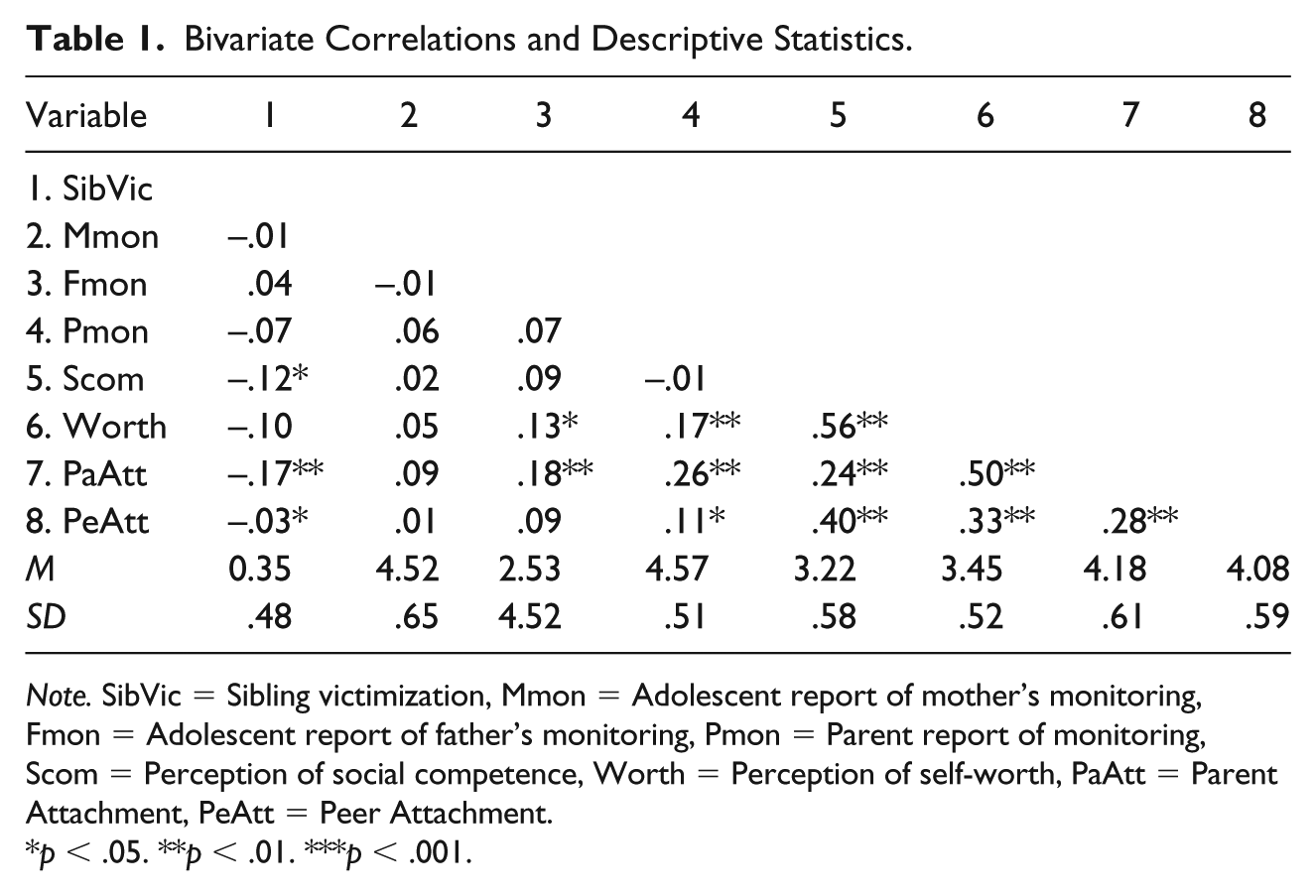
Note. SibVic = Sibling victimization, Mmon = Adolescent report of mother’s monitoring, Fmon = Adolescent report of father’s monitoring, Pmon = Parent report of monitoring, Scom = Perception of social competence, Worth = Perception of self-worth, PaAtt = Parent Attachment, PeAtt = Peer Attachment.
p < .05. **p < .01. ***p < .001.
Data Analysis
We first conducted a confirmatory factor analysis to the test measurement structure of the latent factor of parental monitoring. The measurement model for the latent factor was a saturated model, χ2 = .00, df = 0, p = .00; comparative fit index (CFI) = 1.00; root mean square error approximation (RMSEA) = .00. All factor loadings were significant and ranged from r = .30 to .87. The main model (see Figure 1) examined effects of parental monitoring on peer- and parent-adolescent attachment as mediated through sibling victimization and adolescent self-perception of social competence and self-worth. Model fit was acceptable (χ2 = 47.458, df = 14, p < .001; CFI = .93; RMSEA = .08). Parental monitoring was not significantly related to sibling victimization (b = −1.917, SE = 1.496, p = .20). However, parental monitoring was positively related to perception of social competence (b = 1.181, SE = .609, p = .049), perception of self-worth (b = 3.721, SE = .529, p < .000), parent-adolescent attachment (b = 6.798, SE = .628, p < .000), and peer-adolescent attachment (b = 1.456, SE = .620, p = .019).

Summarized model fitting results of the associations among parental monitoring, sibling victimization, self-perceptions, and parent and peer attachment.
Sibling victimization was related to both perception of lower social competence (b = −.118, SE = .044, p = .008) and perception of lower self-worth (b = −.070, SE = .035, p = .048). Sibling victimization was also significantly related to both parent–adolescent attachment (b = −.182, SE = .031, p = .009) as well as peer-adolescent attachment (b = −.090, SE = .039, p = .019). Adolescent perception of social competence was related to higher peer (b = .300, SE = .050, p < .000) but not parent-adolescent (b = −.028, SE = .049, p = .560) attachment. In contrast, adolescent perception of self-worth was related to higher parent (b = .291, SE = .043, p < .000) but not peer-adolescent (b = .057, SE = .061, p = .355) attachment.
Mediation analyses revealed adolescent perception of social competence to significantly mediate the relationship between sibling victimization and peer–adolescent attachment, b* = −.060, SE = .024, p = .013, 95% confidence interval (CI): [–.308-.135]. Adolescent perception of self-worth significantly mediated the relationship between sibling victimization and parent-adolescent attachment (b* = −.033, SE = .017, p = .046, 95% CI: [–.164-.109]). The three-path mediation effects involving parental monitoring → sibling victimization → social competence and self-worth → peer and parent-adolescent attachment were not significant (b* = .006, SE = .001, p = .600, 95% CI: [–.007, .019]; b* = .003, SE = .003, p = .250, 95% CI: [–.004, .011]).
Results of testing two-group models for gender differences revealed that model fit was significantly worse when paths between parental monitoring and sibling victimization were constrained to be equal between boys and girls (Wald test χ2 = 7.014, df = 1, p =.008). Further examination showed that parental monitoring was significantly related to sibling victimization for females (b* = −.326, SE = .114, p = .004) but not for males (b* = .087, SE = .102, p = .393). However, there were no gender differences for the associations between sibling victimization and parent and peer attachment (Wald test χ2 = 1.220, df = 2, p = .543), for the pathway involving sibling victimization → self-worth → parent attachment (Wald test χ2 = .908, df = 2, p = .635), and the pathway involving sibling victimization → social competence → peer attachment (Wald test χ2 = .2.543, df = 2, p = .280).
Given that parental monitoring was only significantly related to sibling victimization for girls and not boys, we tested the three path mediation hypotheses (parental monitoring → sibling victimization → social competence and self-worth → peer- and parent-adolescent attachment) using only girls. The three-path mediation involving parental monitoring → sibling victimization → self-worth → parent-adolescent attachment approached statistical significance (b* = .015, SE = .008, p = .058, 95% CI: [–.005, .035]). Specific path coefficients for girls are as follows: parental monitoring to sibling victimization (b* = −.326, SE = .114, p = .004), sibling victimization to self-worth (b* = −.179, SE = .074, SE = .114, p = .016), and self-worth to parent-adolescent attachment (b* = .232, SE = .062, p < .001). The three-path mediation involving parental monitoring → sibling victimization → social competence peer-adolescent attachment, however, was not significant (b* = .015, SE = .013, p = .242, 95% CI: [–.018, .049]).
Discussion
The purpose of the current study was to examine parental monitoring as a possible predictor of sibling victimization, and to examine whether sibling victimization is related to parent and peer attachment as mediated by self-perceptions of social competence and self-worth. In addition, a potential three path mediation from parental monitoring, to parent and peer attachment through sibling victimization and adolescent self-perceptions was examined. The hypothesis that parental monitoring would be related to sibling victimization was supported, but only for girls. The hypothesis that the relationship between sibling victimization and parent and peer attachment would be mediated by adolescent self-perceptions was also partially supported. Specifically, perception of social competence mediated the relationship between sibling victimization and peer-adolescent attachment and perception of self-worth mediated the relationship between sibling victimization and parent-adolescent attachment. Sibling victimization was also directly and negatively related to both parent- and peer-adolescent attachment. The hypothesized three path mediations relating parental monitoring and parent-adolescent and peer-adolescent attachment via sibling victimization and adolescent self-perceptions were not significant for the overall group, however, examination of gender differences hints that further research on this model may be warranted.
Parental Monitoring and Sibling Victimization
Parental monitoring was inversely related to occurrence of sibling victimization, but only for girls. This finding may in part be explained by previous findings that parents are more likely to monitor girls than boys (Fagan et al., 2011; Svensson, 2003). In fact, our data suggested that parents of adolescent girls reported higher levels of monitoring than parents of adolescent boys (t = −2.073, p = .039). However, there were no gender differences with respect to adolescents’ reports of maternal monitoring (t = −.502, p = .616) or paternal monitoring (t = −.692, p = .489). Although it may be that the relationship of parental monitoring to sibling victimization is stronger for girls because boys do not receive as much monitoring as girls, our finding also suggests that gender differences in the amount of parental monitoring may depend on the informant. However, it is also possible that parental monitoring is a more salient protective factor against sibling victimization for girls than boys because parents monitor different aspects of children’s lives between daughters and sons. A direction for future research, then, would be to examine if this is indeed the case and why girls may benefit more from parental monitoring than boys. The present study contributes to literature on sibling victimization by demonstrating that adolescent girls whose parents are aware of and actively monitor their children’s activities appear be less likely to experience victimization by a sibling; however, the question remains as to what parental factors may be protective of boys with regard to sibling victimization. The results of the present study also add to extant literature concerning parental monitoring by showing it to be an important factor related to higher adolescent self-perceptions of social competence and self-worth as well as greater parent and peer attachment.
Sibling Victimization, Attachment, and Mediation of Self-Perception
Our results revealed that sibling victimization was related to parent–adolescent attachment both directly and indirectly through self-perception of self-worth. Similarly, sibling victimization was related to peer-adolescent attachment both directly and indirectly through self-perception of social competence. These findings are consistent with previous research on the relationship of maltreatment and peer victimization to perceptions of social competence (e.g., Boulton et al., 2010; Grills & Ollendick, 2002), and our results further establish that sibling victimization may also have a similar relationship with adolescent perceptions of their own social competence. Such findings address gaps in the literature by elucidating the correlations of sibling victimization with other relationships as well as highlighting self-perception as a mediating process. Extant literature on sibling relationships underscores that sibling interactions are important training tools for future peer interactions (e.g., Brody, 1998; Herrera & Dunn, 1997; Kramer & Conger, 2009; Tucker et al., 2014a; Volling, 2003). It follows that if sibling interactions are a training ground for social interactions and sibling interaction involves victimization experience, then formation of quality peer relationships may be difficult as the child or adolescent has negative previous experience as a reference. The current findings indicate that while sibling relationships may be able to teach positive aspects of peer interaction, abusive sibling interactions may be related to deficits in quality relationships with peers via perceptions of their own social competence.
Similarly, our findings provided evidence for self-perception of self-worth as a pathway between sibling victimization and parent-adolescent attachment. These findings are consistent with previous research (e.g., Boulton et al., 2010; Grills & Ollendick, 2002) that showed peer victimization to be negatively related to perception of self-worth and extend these findings by illustrating that sibling victimization is related to perceptions of self-worth in a similar manner to peer victimization. These findings may also help explain other research that suggests experience of sibling victimization is predictive of peer victimization (Tippett & Wolke, 2015; Tucker et al., 2014a). For example, research shows that adolescent self-perceptions are reciprocally related to peer victimization (Boulton et al., 2010); therefore, a direction for future research might be to examine whether sibling victimization increases risk for peer victimization via adolescent self-perceptions.
Overall, our finding of the positive association between sibling victimization and poor quality parent-adolescent relationship demonstrates how family subsystems (e.g., parent-child relationship, sibling relationship) may be interrelated. Furthermore, the current findings suggest that the link between sibling victimization and poor quality parent-adolescent relationship can be, in part, due to the detrimental relationship between sibling victimization and adolescent perception of self-worth. Extant research on perceptions of self-worth and attachment suggests that having good relationships is related to high levels of self-worth and self-esteem (e.g., Kenny & Sirin, 2011).
No gender differences were found among the mediated relationship of sibling victimization → social competence and self-worth → parent-adolescent and peer attachment, which was surprising given previous research. For example, Grills and Ollendick (2002) noted that the associations between peer victimization and perceptions of self-worth were stronger for girls than for boys. The authors suggested that because girls are more likely to have greater emotional investment in relationships they may be more likely to internalize negative feedback. Similarly, Kim and colleagues (1999) suggested that girls may be more reactive to hostility/negativity within the sibling relationship than are boys. Girls, then, may be more likely than boys to internalize negative feedback from siblings than boys. Thus, extant research suggests that sibling victimization may put girls at greater risk than boys for negative outcomes; however, the current study found no such tendency. The discrepancy between the findings of these prior studies and the current study’s findings may be in part due to the difference in the outcomes. It is possible that gender differences exist particularly for the associations between abusive relationships and adjustment problems, such as internalizing and externalizing symptomatology. Future research on sibling victimization should continue to explore possible gender differences, specifically whether boys exhibit greater resilience in the face of sibling victimization.
Parental Monitoring, Attachment, and Mediation of Sibling Victimization and Self-Worth
We begin this section with due caution in interpreting near significant results; however, we do believe the results merit discussion as they may inform important directions for future research. Results may provide evidence that, for girls, the relationship between parental monitoring and parent-adolescent attachment is mediated via sibling victimization and perception of self-worth. Specifically, lower parental monitoring was related to occurrence of sibling victimization, which was related to lower perception of self-worth, which in turn was related to lower parent-adolescent attachment. This finding provides preliminary evidence to literature on parental monitoring by suggesting pathways through which parental monitoring may be related to female adolescents having quality relationships with their parents. It appears that the gender differences in this relationship were driven by parental monitoring being related to sibling victimization only for girls. Such findings highlight that further research is warranted regarding gender differences in protective and risk factors for sibling victimization. Furthermore, it is possible that the marginal significance for the mediation effect may be in part due to low rates of sibling victimization in our sample. Thus, we strongly encourage future researchers to replicate the findings before making strong inferences about the pathways through which parental monitoring may be related to adolescent-parent relationships.
Implications for Interventions
So far we have noted that the results of the current study may provide helpful information to the development of interventions, such as parental monitoring as a protective factor against sibling victimization for girls. In cases where sibling victimization is not prevented, and targeting perceptions of social competence among adolescents who have experienced sibling victimization may be especially important in helping adolescents develop positive peer attachment. Similarly, perceptions of self-worth seem to be specifically related to positive parent attachment, therefore interventions may focus on improving parent-adolescent relationships through helping parents build their children’s perception of self-worth. Perhaps one of the most major implications of current study for future interventions is to seriously consider that parenting interventions may be necessarily different for boys and girls. Kramer (2010) made a number of research based suggestions for parenting behaviors that can foster positive sibling relationships, however, further research may be necessary to determine if, like with parental monitoring, other protective factors against sibling victimization may be differentially efficacious for boys and girls.
Limitations and Conclusion
There are some methodological strengths of this study as well as well as some limitations that suggest directions for future research. A strength of the current study is that we used a latent variable of parental monitoring based on data from multiple informants. Adolescents reported on their mothers’ and fathers’ monitoring behavior and the primary caregiver reported on their own monitoring behavior. Another strength of the study is that we were able to look at the effects of sibling victimization over and above the effects of victimization by other individuals. Despite these strengths, some methodological limitations should be noted. First, our findings were based on cross-sectional, correlational data and do not establish causality in relations among the study variables. The mediated effects found in this study warrant further replications using longitudinal, multiple-wave data. A second limitation is that all our data are based on self-report. In addition, except for parental monitoring, sibling victimization, self-perception, and attachment variances relied on single informant using adolescents’ self-report. Future research would benefit from the use of multiple methods/informants of data collection to reduce possible biases due to shared method variances. Finally, no information on sibling age, birth order, or gender was collected. Thus, it is unknown how such variables may or may not influence the findings of the current study. Extant research does show sibling victimization tends to be higher among brother-brother pairs, and for siblings of similar age (Tucker, Finkelhor, Shattuck et al., 2013). Thus, sibling age and gender should be an important consideration for any future research.
In conclusion, the current study contributes to literature on sibling victimization by illuminating familial and social relationship correlates of sibling victimization including parental monitoring and adolescent attachment with parents and peers. These findings provide evidence that sibling victimization is not a benign experience as many parents believe but rather has significant correlations with mental health outcomes. For both boys and girls, sibling victimization was related to poor parent- and peer-adolescent attachment and these associations were explained by poor adolescent self-perceptions of social competence and self-worth predicted by sibling victimization. Our findings present preliminary evidence for pathways that involve adolescent self-perceptions through which sibling victimization may predict the ability to form quality relationships over and above the effects of other types of victimization. Results imply that parental monitoring may be important in the prevention of sibling victimization, at least for girls, and adolescent self-perceptions may be an important point.
Footnotes
Declaration of Conflicting Interests
The author(s) declared no potential conflicts of interest with respect to the research, authorship, and/or publication of this article.
Funding
The author(s) disclosed receipt of the following financial support for the research, authorship, and/or publication of this article: This research was supported by grants awarded to Jungmeen Kim-Spoon, Ph.D. from the National Institute of Child Health and Human Development (HD057386) and the National Institute of Drug Abuse (DA036017). We thank Laurel Marburg, Eirini Papafratzeskakou, Diana Riser, Gregory Longo, and Julee Farley for their help with data collection. We are grateful to our study participants.
