




Abstract
In this study, we explored the longitudinal linkages among Chinese early adolescents’ unsociability, peer rejection, and loneliness. Participants were N = 445 primary school students in Shanghai, P.R. China followed over 3 years from Grades 6 and 7 to Grades 8 and 9. Measures of adolescents’ unsociability, peer rejection, and loneliness were obtained each year from a combination of self-reports and peer nominations. Among the results, (1) compared with the unidirectional and bidirectional models, the cross-lagged model was deemed the best fit for the data; (2) adolescent unsociability contributed to later increases in loneliness via a pathway through peer rejection; and (3) loneliness directly contributed to later increases in unsociability. Results are discussed in terms of the implications of unsociability for Chinese adolescents’ experience of peer rejection and subsequent loneliness.
Socially withdrawn children often remove themselves from opportunities for peer interactions and tend to display solitary behaviors in social contexts (Rubin, Coplan, & Bowker, 2009). Contemporary theory and research have identified different subtypes of social withdrawal, including shyness and unsociability, each of which is attributed to different underlying motivations and emotions and has different implications for children’s adjustment (Asendorpf, 1990; Coplan, Ooi, & Nocita, 2015). For example, there has been considerable previous research on the development and implications of shyness, a temperamental trait that may result in social withdrawal because of heightened wariness and self-consciousness in social situations (Coplan, Prakash, O’Neil, & Armer, 2004). Shyness is characterized by a social approach—social avoidance conflict, whereby the desire to interact socially (high social approach motivation) is inhibited by feelings of fear and anxiety of perceived social evaluation (high social avoidance motivation; Coplan et al., 2004). Moreover, shyness is associated with negative adjustment outcomes such as peer difficulties (e.g., peer victimization, rejection) and internalizing problems (e.g., depression, social anxiety; for a recent review, see Rubin, Bowker, Barstead, & Coplan, 2018).
In contrast, comparatively less is known about unsociability, which refers to a non-fearful preference for solitary activities, and is characterized by a low social approach and low social avoidance motivations (Asendorpf, 1990; Coplan et al., 2004; Coplan et al., 2013). The implications of unsociability appear to be relatively benign as the evidence suggests that unsociability is not concurrently related to socioemotional outcomes in older children (for a recent review, see Coplan, Ooi, & Baldwin, 2019).
Moreover, Chen, French, and Schneider (2006) have argued that cultural values play an important role in determining the meanings and implications of different types of social withdrawal. For example, in contrast to findings from Western societies (Coplan et al., 2019), unsociable Chinese children experience adjustment difficulties (e.g., Liu et al., 2015; Zhang & Eggum-Wilkens, 2018a, 2018b). Despite this contention, little is known about the developmental pathways linking unsociability and adjustment in Chinese adolescents. It is particularly important to study the relations between these constructs during adolescents because time spent with peers tends to increase steadily from childhood through to adolescence (Jarus, Anaby, Bart, Engel-Yeger, & Law, 2010; Lam, McHale, & Crouter, 2014). As well, from developmental and interactional perspectives, withdrawing from opportunities for social interaction may be viewed as particularly problematic during early adolescence because it is incongruent with the norms and expectations for social interaction during this period (Coplan et al., 2019). Accordingly, the goal of this study was to examine the longitudinal associations over 3 years among unsociability, peer rejection, and loneliness in the cultural context of contemporary urban China.
Unsociability and Loneliness: A Contextual-Developmental Perspective
Unsociable children usually do not have the motivation to interact with peers, but they also do not appear to experience anxiety during social interactions (Coplan & Armer, 2007). As such, this non-fearful preference for solitude is considered conceptually similar to other constructs such as affinity for aloneness (Goossens, 2014), preference for solitude (Burger, 1995), social disinterest (Coplan et al., 2004), and solitropic orientation (Leary, Herbst, & McCrary, 2003). In Western cultures, unsociability appears to be a benign form of social withdrawal and has been found to be unrelated to child adjustment difficulties (Coplan et al., 2019). For example, Sette, Zava, Baumgartner, Baiocco, and Coplan (2017) demonstrated that unsociability among young children was not related to internalizing problems. Similarly, Coplan, Liu, Cao, Chen, and Li (2017) found that unsociable children do not experience peer problems and do not feel socially anxious or depressed. Taken together, researchers have argued that this non-fearful preference for spending time alone can be perceived as a personal choice in Western culture, which might not be related to indices of maladjustment (Burger, 1995; Chen, 2010; Leary et al., 2003).
According to the contextual-developmental perspective, individual behaviors in a culture need to be understood from a developmental point of view, and the development of behaviors needs to be understood in the social context (Chen, 2019). As mentioned before, cultural values affect the meanings and implications of different types of social withdrawal (Chen et al., 2006). Chinese culture is collectivist in nature with unique social norms, including the maintenance of group harmony, which is viewed as a central concern for individuals (Chen, 2010). Thus, in this cultural context, intentionally removing oneself from the peer group is perceived by peers and adults as anti-collective, selfish, and abnormal. As such, unsociability has been found to be a salient predictor of child internalizing problems, including loneliness throughout development in Chinese culture (e.g., Coplan & Weeks, 2010; Liu et al., 2015; Liu, Chen, et al., 2017; Zhang & Eggum-Wilkens, 2018a, 2018b). For example, Liu et al. (2014) found that unsociability was associated with loneliness across the school year among Chinese children. Moreover, Liu et al. (2015) demonstrated that compared to Canadian unsociable children, unsociability was more strongly related to loneliness among Chinese children. Furthermore, it has been suggested that unsociability might become related to development difficulties with increasing age (Coplan et al., 2019; Olweus, 1993). However, most of the extant studies have been conducted using cross-sectional designs, which has limited our ability to understanding the links and the direction of effects between unsociability and loneliness.
Unsociability and Loneliness: Mediating Role of Peer Rejection
We further speculated that unsociability influences internalizing problems indirectly, through the development of peer relations. Previous studies have documented that unsociability among Chinese adolescents tends to elicit negative responses from peers, which in turn, is related to peer difficulties, including more peer rejection (Coplan et al., 2016; Ding, Weeks, Liu, Sang, & Zhou, 2015; Liu et al., 2015; Sang et al., 2018). For example, Liu et al. (2014) demonstrated that after controlling for the effect of shyness, unsociability was associated with less peer preference among older children and adolescents. It also has been shown that peer problems serve as a probable cause of child loneliness (Boivin, Hymel, & Bukowski, 1995; Shin, 2007; Sletta, Valås, Skaalvik, & Søbstad, 1996). For example, compared to popular children, children who are rejected by peers are more likely to experience feelings of loneliness (J. Cassidy & Asher, 1992; Shin, 2007; Sletta et al., 1996). Moreover, compared to aggressive-rejected children, withdrawn-rejected children consistently report greater loneliness (Boivin & Hymel, 1997; Ladd, Kochenderfer, & Coleman, 1997). Thus, unsociability may lead to peer rejection, which would, in turn, exacerbate loneliness.
Moreover, although past studies have not explored bidirectional effects among these constructs, we surmised that there might also be bidirectional associations among loneliness, peer rejection, and unsociability. That is, children who experience loneliness may behave in ways that leads to peer rejection and increase their preference for spending time alone subsequently. In support of this notion, research has shown that loneliness increases the prevalence of negative emotions and is associated with poor social skills (Jones, Hobbs, & Hockenbury, 1982) which are all related to negative peer interactions (K. W. Cassidy, Werner, Rourke, Zubernis, & Balaraman, 2003). Indeed, previous studies assessing the relations between loneliness and peer relations have found that loneliness was associated with more peer victimization and less prosocial behavior (Woodhouse, Dykas, & Cassidy, 2012). Moreover, because lonely children experience feelings of sadness, boredom, and alienation (Bullock, 1993), they often feel excluded, which can be damaging to their self-esteem and self-worth. This in turn, could lead to a low social approach motivation and a tendency to behave in a less prosocial manner to others.
Gender Difference
Furthermore, we examined potential gender differences in the relations among these constructs, given that girls have been found to score lower on unsociability and experience less peer rejection and less loneliness (Liu et al., 2015). In addition, unsociability is predictive of peer problems and subsequent emotional difficulties for Chinese boys, but not for girls (Liu et al., 2014).
The Present Study
The impact of unsociability on Chinese adolescents’ adjustment and the mechanism explaining the relations between unsociability and loneliness are less understood. Specifically, many researchers have only focused on the direct relations between unsociability and adjustment outcomes, neglecting potential indirect or cross-dimensional effects. Accordingly, we examined a cross-lagged model linking unsociability, peer rejection, and loneliness over a 3-year period (starting in Grades 6 and 7) in a sample of middle-school children from urban Mainland China. A cross-lagged model examines cross-domain influences (Calkins & Bell, 2010) and bidirectional associations among variables, which offers an opportunity to understand the complex associations among unsociability, peer rejection, and loneliness.
Drawing upon the conceptual and empirical evidence, we postulated that unsociability would be associated with peer rejection, which in turn would predict subsequent loneliness. More specifically, we hypothesized that unsociability would be positively associated with loneliness over multiple time points and that this association would be mediated by peer rejection. On a more speculative basis, we anticipated bidirectional effects in that loneliness would predict subsequent peer rejection as well as subsequent unsociability. Furthermore, we expected that as compared to girls, boys would score higher on unsociability. As well, unsociable behavior was anticipated to be associated with more peer problems and loneliness for boys than girls.
Method
Participants
The initial sample at Time 1 comprised N = 445 sixth- and seventh-grade children (Mage = 12.96 years, SD = 1.28 year) in four elementary schools in Shanghai, P.R. China. The schools were randomly selected from among public schools in the city. There were 12 classes, with approximately 35 students in each class. There were n = 198 sixth-grade students (103 boys, 94 girls; Mage = 11.38 years, SD = 0.79 year) and n = 247 seventh-grade students (120 boys, 127 girls; Mage = 12.48 years, SD = 0.68 year).
The children were mostly from families of low to middle socioeconomic status. Approximately 54% of fathers and mothers had a high school or lower education, and 34% of fathers and 28% of mothers had a college or higher education. Participants were primarily only-children (92%) from intact families (92%). Almost all participants were of Han nationality, the dominant nationality (over 90% of the population) in China. Average annual family income was ¥84,000–¥120,000 (range: <¥24,000 to >¥960,000); 62.4% of the sample reporting family income below ¥120,000, and very few (4.3%) reporting income above ¥300,000. The demographic data for the sample were similar to those reported by the China State Statistics Bureau concerning the urban population in China.
Follow-up data were collected 1 year later (Time 2) and again a year after that (Time 3) in the same schools. Data were collected in December at each time point. Overall, sample attrition was quite low from Time 1 to Time 2, but sample attrition was quite high from Time 2 to Time 3, with only 65% of the original sample participating in the follow-up assessments (attrition analyses is presented in the “Results” section). For all the variables, missing data rates ranged from 4.8% to 5.0% for each study variable at Time 1. Missing data rates at Time 2 rose slightly, from 8.0% to 11.3% for each study variable. Finally, at Time 3, missing data rates ranged from 30.2% to 46.7% for each study variable (reflecting the higher participant attrition). Little’s (1988) missing completely at random (MCAR) test was not significant, χ2(124) = 140.81, p = .144, suggesting that the pattern of missingness was not systematic. Moreover, only loneliness at Time 1 was significantly different between dropped youth and not dropped (t = 2.53, p = .012; Mdropped = 1.97, SD = 0.77, Mnot-dropped = 1.77, SD = 0.87). Accordingly, Full Information Maximum Likelihood (FIML; Muthén & Muthén, 2007) was used to estimate missing data for participants who did not complete assessments in all three time points of data collection.
Procedure
Upon obtaining ethical approval and institutional permissions, written consent was obtained from all children, mothers, and teachers through the schools. The consent rate in this study was 96%. At each of the three time points, graduate research assistants group administered the self-report measure (unsociability and loneliness) for children. Graduate research assistants also group administered the peer nominations to assess peer rejection.
Measures
Unsociability
Participants’ unsociability was assessed using a translated (and back translated) version of the Child Social Preference Questionnaire (CSPQ; Coplan et al., 2013). This measure consists of seven items (rated on a 5-point scale) pertaining to a preference for spending time alone (e.g., “if given a choice, I prefer to play alone than with other kids”). As with the original English version, in the present sample at Time 1, all items loaded on a single factor (eigenvalue 3.83, factor loadings from 0.64 to 0.86), which accounted for 54.63% of the variance. At Time 2, all items loaded on a single factor (eigenvalue 4.004, factor loadings from 0.57 to 0.84), which accounted for 57.20% of the variance. At Time 3, all items also loaded on a single factor (eigenvalue 4.205, factor loadings from 0.65 to 0.85), which accounted for 60.07% of the variance. In the present sample, this measure also demonstrated high internal reliability (α = .86–.89) at each time point. This measure has been used with Chinese children in previous studies and has demonstrated evidence of reliability and validity (e.g., Chen, Wang, & Cao, 2011).
Peer nominations
Students were also asked to nominate up to three classmates with whom they least liked to be (i.e., negative nominations). Nominations received from all classmates were totaled and standardized within each class. The negative classmates nominations received from peers provided an index of peer rejection at each time point. The procedure has been used and demonstrated to be valid with Chinese children (e.g., Liu, chen, et al., 2017).
Loneliness
Children’s loneliness was assessed by a self-report measure adapted from Asher, Hymel, and Renshaw (1984). This measure consists of 16 items (e.g., “I have nobody to talk to,” “I feel lonely,” “I don’t have anybody to play with at school”) using a 5-point scale ranging from 1 (not at all true) to 5 (always true). Total scores were calculated, with higher scores indicating greater loneliness. This measure has been used with Chinese children in previous studies and has demonstrated evidence of reliability and validity (e.g., Liu et al., 2018). In the present sample, this measure also demonstrated high internal reliability (α = .85–.89) at each time point.
Data Analyses Plan
Data were screened for potential errors in data entry. Subsequently, examination of the data for univariate and multivariate outliers was conducted, followed by testing of assumptions, multicollinearity, and normality. Next, a series of mixed repeated measures multivariate analyses of variance (MANOVAs) was conducted to examine overall effects of Gender, Time, and their interactions for each variable. Overall, boys scored higher on loneliness, F(1, 235) = 6.33, p < .013. Loneliness increased from Time 1 to Time 2 and decreased from Time 2 to Time 3 significantly with age, F(2, 485) = 10.42, p < .001. No significant main effects of time for the other variables were found and there were no significant Time × Gender interactions. Moreover, two grades (e.g., Grades 6 and 7) were regarded as one wave for each wave in the current study. Thus, a series of independent sample t-tests was conducted to examine the overall effects of grade at each time point. The results showed that there were no significant differences between two grades at each time point. Thus, we did not control any variable in further analysis.
We first examined the measurement invariance across time using the procedure recommended by Little (2013). We fitted less constrained models first and then proceeded to the next more constrained model if the changes in model fit were modest (e.g., Δ comparative fit index [CFI] < 0.01; Cheung & Rensvold, 2002). In order to examine the cross-lagged model linking unsociability, peer rejection, and loneliness, we tested and compared four models in order. Specifically, a base-line stability model was tested first to estimate stability coefficients. Next, we tested the unidirectional model, which added the paths from unsociability at an early time point to later peer rejection, as well as from peer rejection at an early time point to later loneliness. Following this, we tested the bidirectional model, which included the paths from loneliness at an early time point to later peer rejection, as well as from peer rejection at an early time point to later unsociability. Finally, the cross-lagged model was tested, which added diagonal paths between constructs at adjacent time points (e.g., unsociability at Time 1 to loneliness at Time 2). This model explored the potential relations among variables both concurrently and longitudinally between adjacent time points. The best fitting model was identified as the final model and then follow-up analyses were performed. Moreover, classroom and school intraclass correlations were < .01 for all the variables, indicating there were no cluster effects for the classroom and school.
To test the four models, we used path analysis with maximum likelihood-robust (MLR) estimation in Mplus version 6.12 (Muthén & Muthén, 2007). Data were screened for normality. Most of the variables were non-normally distributed (unsociability at T3, loneliness at T1 and T3, peer rejection from T1 to T3). Moreover, the results from omnibus test of multivariate normality showed that the data were not normally distributed (p < .0001). Thus, MLR was chosen because it accounts for potential issues of non-normal data. To evaluate the absolute model fit, we used the following fit indices: CFI, Tucker-Lewis index (TLI), root mean square error of approximation (RMSEA), standardized root mean square residual (SRMR), and Akaike information criterion (AIC), and χ2 test of significance (Hu & Bentler, 1999; Kline, 2005). Close fit is indicated by CFI and TLI values >0.95 (Hu & Bentler, 1999). In addition, a close fit is indicated by RMSEA values <0.06, whereas adequate fit is indicated by values between 0.06 and 0.08. SRMR values <0.08 indicate a good fit. A better fitting model is indicated by a lower AIC value. Because the χ2 test of significance is sensitive to sample size (Kline, 2005), it is reported, but not used as a measure of absolute model fit. Nested models were compared using the Satorra-Bentler scaled χ2 difference test because of the use of MLR estimation. Finally, to test gender difference, a multi-group analysis was conducted where an unconstrained model (i.e., all parameters in the full model were allowed to vary across gender) was compared to a constrained model (cross-lagged paths were constrained equal across gender).
Results
Preliminary Analyses
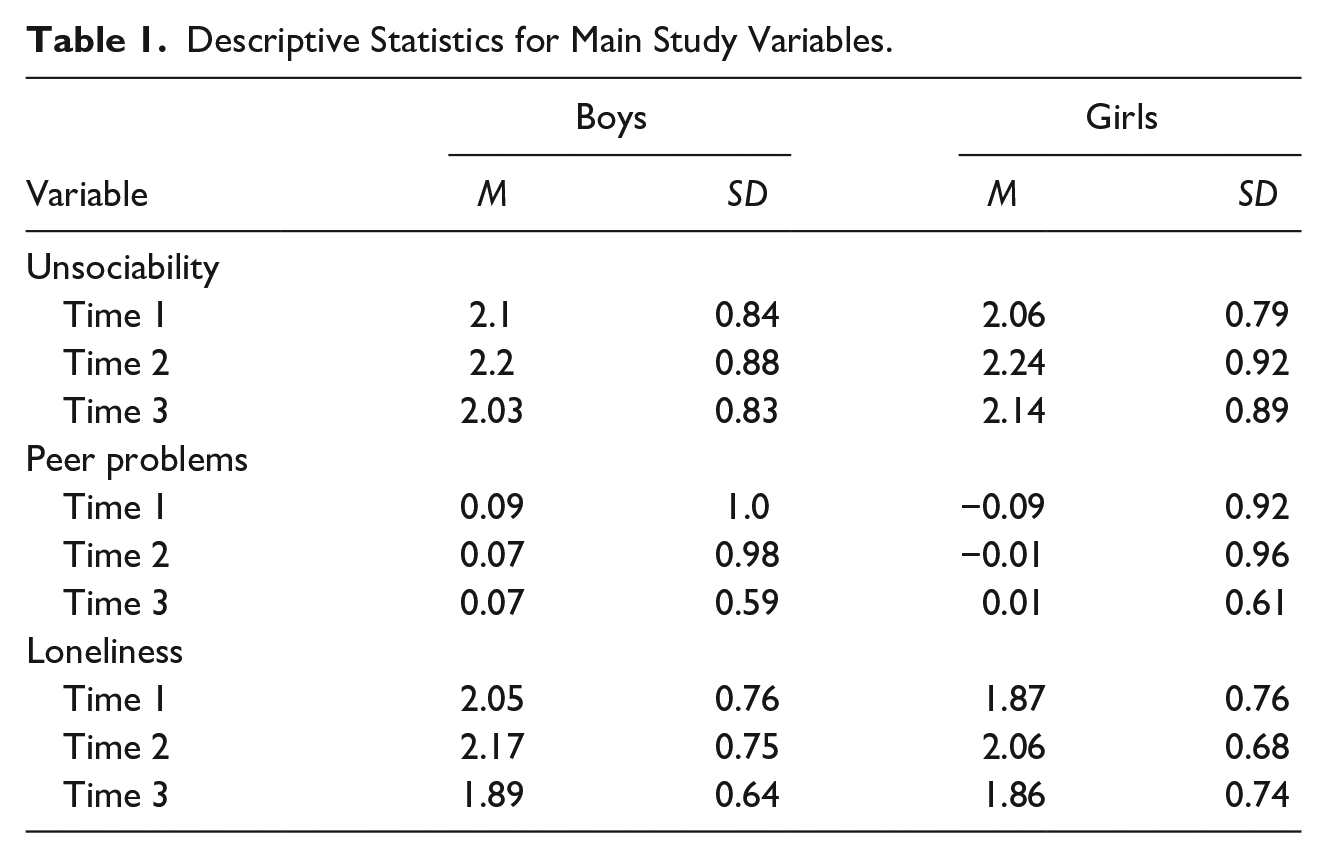
Means and standard deviations for all the variables at each time point are presented in Table 1. The time invariance of psychometric measurement was tested for unsociability and loneliness, but not for peer rejection because it comprised only one item. The patterns for the loadings and intercepts were found to be consistent in all the models for unsociability and loneliness. The fully constrained models, which had equal loadings and intercepts across time, had adequate levels of fit, CFIs = 0.90–0.98, TLIs = 0.90–0.94, ∆CFIs = −0.007 to −0.009. Therefore, these results indicated that the measurements of these constructs were invariant across time in our study.
Descriptive Statistics for Main Study Variables.
Inter-correlations among all study variables are presented in Table 2. Among the results, all study variables displayed considerable stability across the 3 years. In addition, at each time point, unsociability was significantly and positively associated with loneliness, whereas peer rejection was significantly and positively associated with loneliness.
Intercorrelations Among Study Variables.
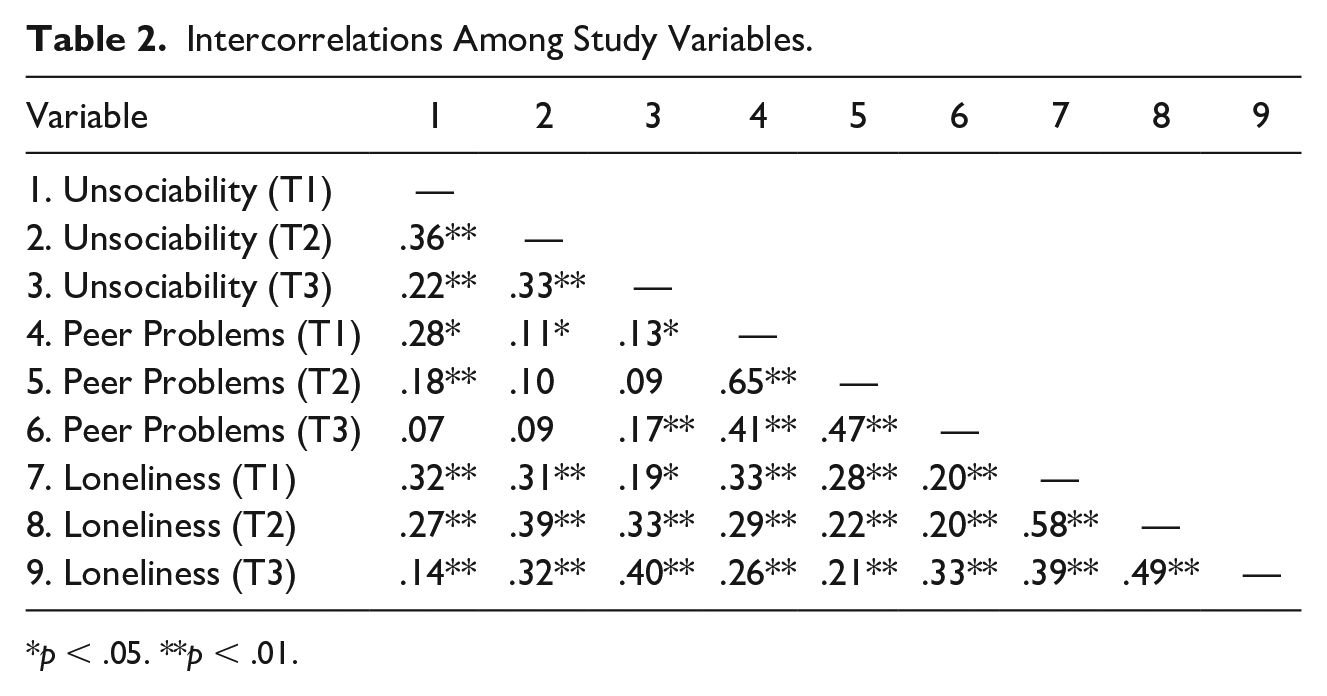
p < .05. **p < .01.
Modeling Relations Among Unsociability, Peer Rejection, and Loneliness
Absolute fit indices and model comparison tests are presented in Table 3. The full model, which included all cross-lagged paths, fit the data better than other models, which suggested that the full model represents the best fit for the data. This model is shown in Figure 1. Overall, unsociability at Time 1 predicted peer rejection at Time 2 (positive association), and peer rejection at Time 2 predicted students’ loneliness at Time 3 (positive association). Moreover, loneliness at Time 2 predicted peer rejection at Time 3 (positive association), but this effect was not significant from Time 1 to Time 2.
Summary of Model Fit Statistics.
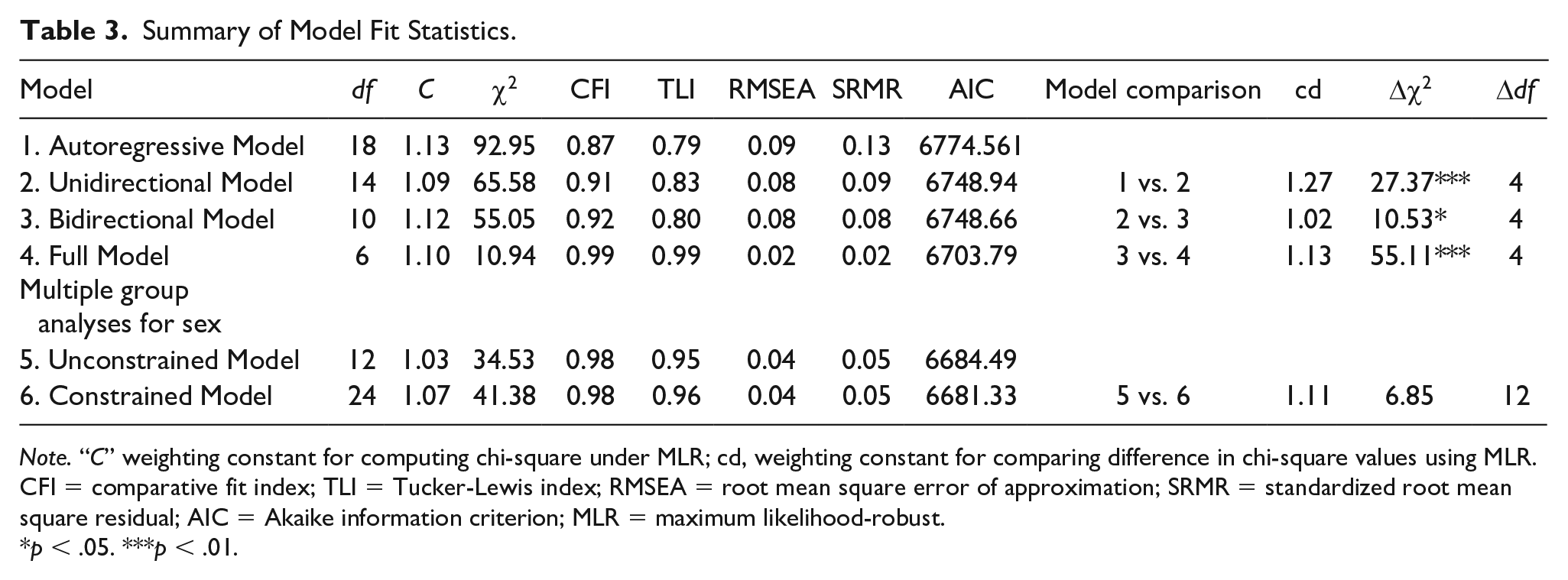
Note. “C” weighting constant for computing chi-square under MLR; cd, weighting constant for comparing difference in chi-square values using MLR. CFI = comparative fit index; TLI = Tucker-Lewis index; RMSEA = root mean square error of approximation; SRMR = standardized root mean square residual; AIC = Akaike information criterion; MLR = maximum likelihood-robust.
p < .05. ***p < .01.
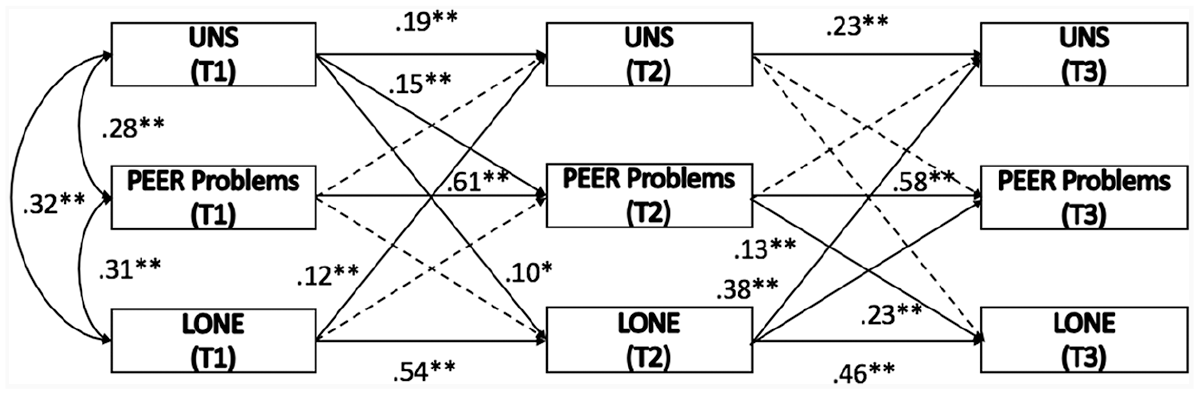
Cross-lagged model of unsociability, peer rejection, and loneliness in Time 1, Time 2, and Time 3.
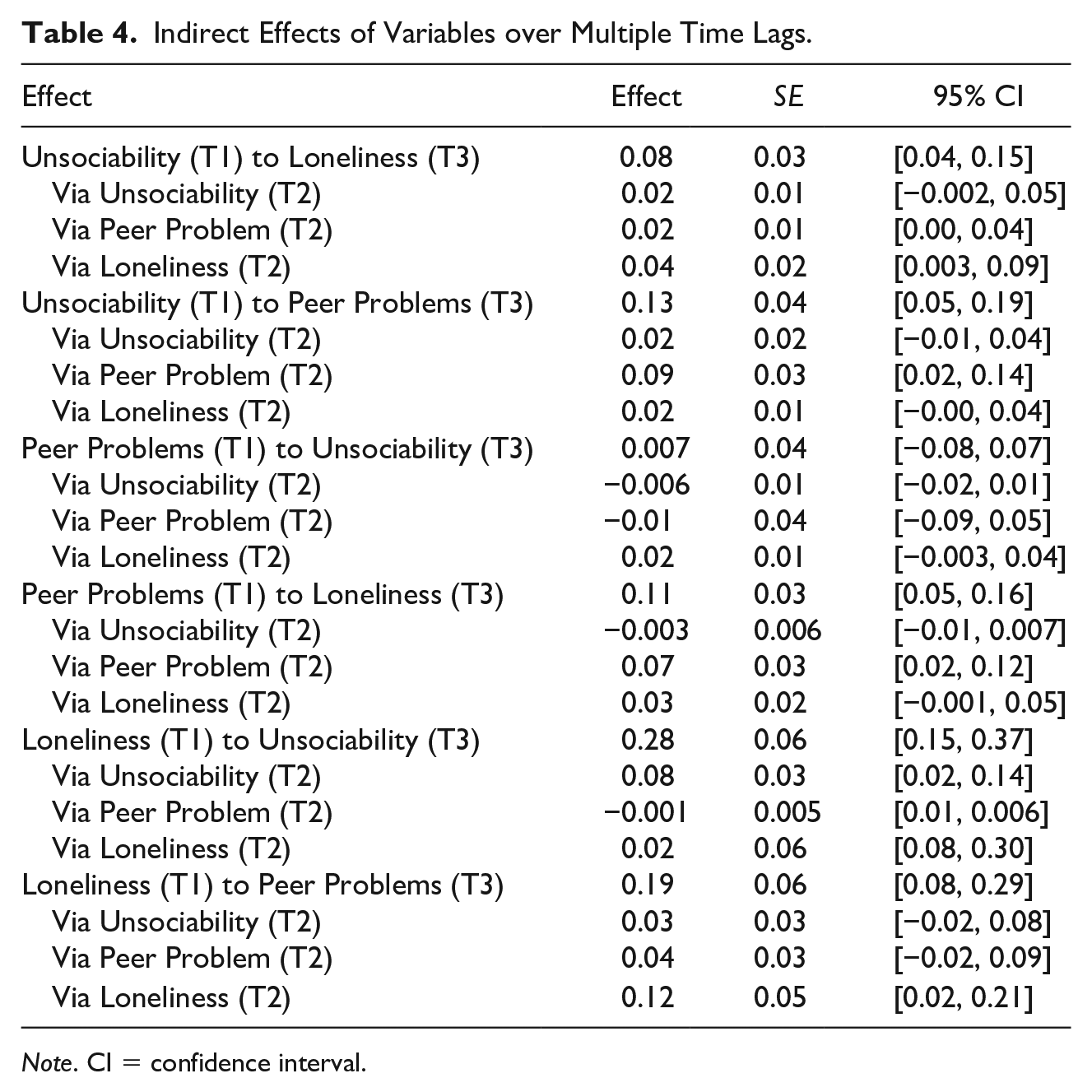
Next, we examined indirect effects of unsociability, peer rejection, and loneliness over multiple lags (i.e., over 2 years) based on the full model presented in Figure 1. The longer lag indirect effects, calculated automatically using Mplus, included the sums of multiplicative products of regression coefficients representing intermediate cross-lagged effects and stability effects of the related variables. All tests involving the mediation process were conducted with both direct and indirect effects in the same model. The longer lag indirect effects are presented in Table 4.
Indirect Effects of Variables over Multiple Time Lags.
Note. CI = confidence interval.
Overall, the results indicated that unsociability at Time 1 displayed a significantly longer lag effect on peer rejection at Time 3, specifically, unsociability at Time 1 predicted peer rejection at Time 3 via a pathway through both peer rejection and loneliness at Time 2. Unsociability at Time 1 predicted loneliness at Time 3 via a pathway through peer rejection and loneliness at Time 2. Loneliness at Time 1 also displayed significant longer lag indirect effects on both unsociability (via a pathway through both unsociability and loneliness at Time 2) and peer rejection at Time 3 (via a pathway through loneliness at Time 2).
Finally, gender differences in cross-lagged paths were tested in accordance with the procedures outlined by van Lier et al. (2012). The results showed that there was no significant change in model fit, Δχ2(12) = 6.85, p = .27, indicating that the cross-lagged paths did not vary significantly across gender.
Discussion
Contrary to findings in the West (Coplan et al., 2019), unsociability has been found to be a risk factor for increases in peer relation difficulties and internalizing problems in Mainland China (Liu et al., 2017; Liu et al., 2014; Zhang & Eggum-Wilkens, 2018a, 2018b). Growing evidence about unsociability among early adolescents in China has revealed that unsociability is associated with a host of social and psychological issues, including peer rejection and loneliness (Coplan et al., 2016; Liu et al., 2015; Liu et al., 2014; Liu et al., 2017). The present study compared a series of nested models to explore the association between unsociability and loneliness, as well as investigate the mediating role of peer rejection. As expected, unsociability at Time 1 (Grades 6 and 7) positively predicted loneliness at Time 3 (Grades 8 and 9), via a mediated pathway through peer rejection at Time 2 (Grades 7 and 8). The observed cross-lagged paths appeared consistent for boys and girls. There was also evidence of bidirectionality as loneliness contributed to further increases in unsociability and peer rejection at various time points. Taken together, these results provide support for a cross-lagged model.
The results from correlations and autoregressive models indicated that early adolescents’ unsociability and peer rejection were highly stable and the mean level was consistent over three years. The high stability of unsociability is consistent with previous research (Liu et al., 2015; Liu et al., 2017; Liu et al., 2014). Moreover, the results from the present study also suggested that the determinants of unsociability might be quite complex, with loneliness playing an important underlying role. In terms of peer rejection, these findings are consistent with previous research. For example, Dumas, Neese, Prinz, and Blechman (1996) reported high stability for peer rejection during middle childhood.
Loneliness was also found to be highly stable over 3 years; however, the mean level changed over the three time points. Specifically, the mean level of loneliness was higher at Time 2, but was lower at both Time 1 and Time 3. Indeed, some researchers have suggested that the trajectories in loneliness are not stable because loneliness tends to rise in childhood, peak during adolescence, and then drops in young adulthood (e.g., Heinrich & Gullone, 2006; Ladd & Ettekal, 2013). Moreover, loneliness is affected by many factors such as children’s social skill, their own personality, and other demographic characteristics (e.g., Heinrich & Gullone, 2006; Schinka, van Dulmen, Mata, Bossarte, & Swahn, 2013). Thus, our results indicated that child unsociability and peer problems might affect the mean level change of loneliness.
Links Among Unsociability, Peer Rejection, and Loneliness
In the present study, we found evidence to support the cross-lagged model. After controlling for the stability of variables over time, unsociability was negatively associated with subsequent loneliness, via a mediated pathway through peer rejection. Specifically, Chinese early adolescents’ unsociability in Grades 6 and 7 predicted peer rejection 1 year later (Grades 7 and 8), which in turn predicted loneliness 1 year after that (Grades 8 and 9). In other words, it can be argued that unsociability contributed to increases in peer rejection, which then led to increases in subsequent loneliness. These results are consistent with previous studies indicating that unsociability in Chinese culture is concurrently and predictively associated with a wide range of negative adjustment outcomes, including peer difficulties (e.g., victimization and rejection) and internalizing problems (e.g., depressive symptoms, loneliness; Coplan et al., 2016; Liu et al., 2015; Liu et al., 2017; Liu et al., 2014). However, to our knowledge, this is the first study to demonstrate these effects transactionally and over time.
To understand the complexities of these relations, it is necessary to consider the cultural context and developmental timing. As mentioned previously, the Chinese culture is collectivist in nature with a strong emphasis on interdependence and maintaining group harmony (Chen et al., 2009). As such, when unsociable adolescents choose to remove themselves from the peer group, they are behaving in ways that are disruptive to the social norms and values (Chen, 2010). As such, unsociable adolescents are more likely to be perceived by their peers as selfish and deviant (Chen et al., 2011), which might elicit negative peer responses such as rejection. Moreover, early adolescence is a developmental period that is characterized by an increase in time spent with peers (e.g., Jarus et al., 2010; Lam et al., 2014). As such, peers may reject adolescents who prefer to spend time in solitude because their behavior is incongruent with the norms and expectations around social interaction during this developmental period (e.g., Coplan et al., 2019). Moreover, when unsociable adolescents experience peer rejection, it subsequently evokes feelings of loneliness. Poor peer relations have been found to be a predictor of long-term negative effects and could be a precursor to loneliness (Boivin et al., 1995). Indeed, evidence indicates that compared to children who are accepted by their peers, those who are disliked or rejected experienced more feelings of loneliness (J. Cassidy & Asher, 1992; Shin, 2007; Sletta et al., 1996). Our findings highlight that peer rejection functions as the mechanism that explains how unsociability is linked to future loneliness.
In addition to the longitudinal mediation pathway linking unsociability to loneliness via peer rejection, we found evidence of bidirectional effects. Specifically, loneliness was predictive of later unsociability as well as later peer rejection. These findings make a novel contribution to the extant literature because to our knowledge, there are no published empirical studies which have demonstrated such bidirectional effects. Moreover, because of this, we can only speculate to the explanation of these findings. In terms of the bidirectional relation between unsociability and loneliness, this might be further evidence that unsociability is characterized by internal social approach and social avoidance motivations as well as emotional substrates such as loneliness (e.g., Coplan et al., 2004; Coplan et al., 2013). In other words, some adolescents might choose to spend time in solitude because of low approach and low avoidance motivations, which could result in feelings of loneliness, whereas others who feel lonely might withdraw from opportunities for social interactions due to other internalizing problems related to loneliness such as low self-esteem (Bullock, 1993). As for the bidirectional relation between loneliness and peer rejection, it could be that adolescents who are lonely act in ways that elicit rejection from their peers (K. W. Cassidy et al., 2003), while adolescents who face peer rejection subsequently experience loneliness (e.g., Shin, 2007).
Limitations and Future Directions
The results from the present study add to the field of research aiming to understand the developmental implications of unsociability among Chinese early adolescents. This appears to be the first study to explore the cross-dimensional effects among unsociability, peer rejection, and psychological maladjustment. Despite the contribution of this study to the literature, there are some limitations that should be noted when interpreting the findings.
First, from a methodological perspective, our assessments relied primarily on adolescent self-reports (unsociability, loneliness), although peer rejection was assessed via peer nominations. Self-reports may be prone to specific biases (Mangelsdorf & Shoppe, 2000). Thus, the use of additional informants (i.e., parents, teachers) should be used in the future. Moreover, our study only assessed unsociability, but not other different subtypes of social withdrawal. For example, in recent years, shyness in contemporary China has also been found to be associated with negative adjustment outcomes such as peer difficulties, internalizing problems (e.g., loneliness, social anxiety), negative self-perception, and academic difficulties (Coplan et al., 2016; Ding et al., 2014; Liu et al., 2015). In addition, we only measured peer rejection in the present study therefore; future study could assess broader aspects of peer relations, such as peer acceptance, peer victimization, or peer popularity.
Second, the present study focused only on peer rejection and loneliness. However, unsociability has also found to be associated with other adjustment difficulties such as less school-related social competence and more learning problems (Chen et al., 2011), depressive symptoms (Liu et al., 2015), and low self-worth (Liu et al., 2014). Thus, future studies could explore the long-term effects of unsociability on other adjustment difficulties.
Furthermore, it is also important to look at the earlier etiology of unsociability. Researchers have suggested that unsociability might be influenced by both genetics and the environment. As well, unsociability has been thought to be benign in early childhood but become increasingly maladaptive in later childhood and adolescence (Olweus, 1993; Silberg et al., 2005). Therefore, it would be helpful that future studies investigate the etiology and developmental trajectory of unsociability in childhood.
Finally, our sample comprised early adolescents from urban regions of China. There appears to be some differences in these findings as a function of geographical location in China. For example, families in rural areas in China endorse more traditional collectivistic values, which can be seen in the more negative outcomes related to children’s unsociability (Chen et al., 2011). Therefore, the results cannot be generalized to other regions of China. In addition, it is unclear the degree to which our findings are generalizable to other countries. Future study could consider cross-cultural studies (i.e., China and a Western country) given that cultural values play an important role in determining the meanings and developmental outcomes of unsociability.
Despite these limitations, the results of the present study constitute a significant contribution to our understanding of relations among unsociability, internalizing problems, and the role of peer relations in today’s urban Chinese early adolescents. The results could be informative to both parents and teachers to learn about the negative effects of unsociability and to encourage more attention to unsociable adolescents. As well, future interventions could try to promote peer relationships for unsociable adolescents, which in turn may help reduce their internalizing problems.
Footnotes
Authors’ Note
Junsheng Liu is also affiliated with East China Normal University, Shanghai, China.
Declaration of Conflicting Interests
The author(s) declared no potential conflicts of interest with respect to the research, authorship, and/or publication of this article.
Funding
The author(s) disclosed receipt of the following financial support for the research, authorship, and/or publication of this article: The research was supported by grants from the National Natural Science Foundation of China (31971001), the Ministry of Education of Humanities and Social Science Project (18YJA190009), and the China Postdoctoral Science Foundation Funded Project (2018M632053).
