



Abstract
Students who repeat a grade are at a higher risk of dropping out of high school. Previous research has examined this in a methodologically aggregated way (e.g., repeated any grade versus never repeated) or only specific grades/grade ranges (e.g., Kindergarten or elementary) leaving questions about which grades are more detrimental to repeat with respect to school dropout. This study uses data from the National Center for Education Statistics (N = 9,309) to comparatively examine which grades, when repeated, show the strongest associations with dropping out. Overall, those who repeated sixth or seventh had the highest odds of dropping out of high school with unique patterns by gender and race/ethnicity. These grades are typically when youth transition into middle school. When examined through a developmental lens, these results highlight the important impact that grade retention while youth experience other normative physical, cognitive, and social changes.
Approximately 1.2 million youth drop out of high school each year (Miller, 2015). High school dropout is associated with a host of long-term difficulties, including unemployment, arrest and incarceration, economic hardship and public assistance, substance abuse, and poor health—all of which negatively impact families and communities (Lansford, Dodge, Pettit, & Bates, 2016). Each individual that drops out of high school is estimated to cost the U.S. economy at least $292,000 over their lifespan due to reliance on welfare and Medicaid, criminal activity, lost taxes, and poor health (National Center for Education Statistics [NCES], 2015). Students who are retained a grade have been shown to be at statistically higher risk of dropping out of high school compared to continuously promoted students (Bornsheuer, Polonyi, Andrews, Fore, & Onwuegbuzie, 2011; Warren, Hoffman, & Andrew, 2014). The relationship between grade retention and school dropout has been well documented, showing consistent links beyond other confounding variables such as socioeconomic status, social skills, and other school-based policy variables (Grissom, & Shepard, 1989; Hughes, Cao, West, Smith, & Cerda, 2017; Jimerson et al., 2006; Warren & Saliba, 2012).
Recent estimates show retention rates to be between 1.9% and 2.7% annually or about 2.4 million students a year (NCES, 2019b). Grade retention is designed to give children who appear to be falling behind a chance to catch up and meet the requirements for their grade level (Lorence, 2006). Although a popular strategy and appearing to be a viable solution to improve academic success (Wu, West, & Hughes, 2008), it is also controversial with studies showing no increase in academic success for grade retention and associations with negative outcomes, including high school dropout (Andrew, 2014). Moreover, the additional years of schooling associated with retention comes with a 13-billion-dollar cost (Anderson, Whipple, & Jimerson, 2002). Nevertheless, should grade retention be selected for students, it is important to understand which grades, when repeated, amplify (or mitigate) the risk of dropping out.
The expectancy–value theory provides a theoretical framework to understand how grade retention may influence dropout risk. It proposes that adult (in this study, teachers) expectancy-related beliefs shape their behavior in promoting child and adolescent engagement in any particular domain (Eccles & Wang, 2012). This, in turn, influences children and adolescents’ self-concepts and task values (e.g., motivational beliefs) which influences youth subsequent behaviors. For example, Williams et al. (2020) found that student behaviors typically co-occurring with grade retention (e.g., low academic achievement, antisocial behaviors; Lorence, 2006; Rodney, Crafter, Rodney, & Mupier, 2010) were significantly linked with teachers’ expectations that students would graduate from high school. In this study, the students’ gender and race/ethnicity were important moderators of teacher expectations and may be important considerations in understanding grade retention and dropout risk (Williams et al., 2020). Furthermore, perceived criticism from trusted adults plays a major role in adolescents’ self-perceptions, which shapes their psychosocial, behavioral, and achievement outcomes (Cohen & Frydenberg, 1996; Cross, 1997). As confidence and support from adults during early adolescence is a key ingredient for healthy psychosocial development, Mathys, Véronneau, and Lecocq (2019) believe that grade retention during the transition to secondary school may be the most detrimental to long-term academic success.
Although research has established grade retention to be strongly associated with school dropout, there are some limitations in the present literature. Specifically, studies examining grade retention and high school dropout have done so in a methodologically aggregated way (i.e., if a student has ever repeated a grade versus not), without much regard for the specific grade level retained. The extent of investigating specific grades has been limited to Kindergarten repeats or elementary grouping variables (i.e., repeats in kindergarten or from first through sixth combined; see Jimerson, 2001 for examples). Within these investigations, researchers have identified the initial effect of kindergarten retention to be about two times as negative as initial effects of early retention in other elementary grades combined (Fruehwirth, Navarro, & Takahashi, 2016). Furthermore, this body of research on grade retention is not comparative in nature, thus leaving questions about which grades are more detrimental to repeat than others, particularly with respect to school dropout. Finally, the literature examining the timing of grade retention rarely uses large nationally representative samples, instead relying on state- or school-specific data (Jacob & Lefgren, 2009; McCoy & Reynolds, 1999; Ou & Reynolds, 2010). Investigating which grades, when repeated, are most strongly associated with dropping out of high school, using generalizable student data, would benefit future research on grade retention and provide important guidance for teachers, parents, and administrators when making “best practice” decisions about students repeating grade levels. This also provides critical information for future academic intervention and policy development.
Kindergarten Repeats
Of the individual grades investigated with respect to grade retention, Kindergarten is the most extensively studied. Children who repeat Kindergarten, on average, continue to perform below their peers when measuring literacy skills years later (Burkam, LoGerfo, Ready, & Lee, 2007). Burkam and others posit that most children appear to receive little or no cognitive benefit from repeating Kindergarten, suggesting that these children will continue to struggle throughout their schooling experience (Lincove & Painter, 2006). Reasons for repeating Kindergarten may vary, as parents may choose to repeat (or delay the entrance of) Kindergarten for their child to be older compared to their peers when schooling starts. A study comparing the effects of Kindergarten retention with students who delayed entry into Kindergarten (both groups would be older by first grade), found that the students who repeated were at greater risk for poor school adjustment and had lower scores in high school mathematics and language compared to those that delayed entry into kindergarten (Raffaele-Mendez, Kim, Ferron, & Woods, 2015). Thus, there are factors specific to repeating, as opposed to simply being older, that affects student achievement and adjustment.
Elementary and Middle School Repeats
Similar to Kindergarten-grade retention, studies investigating the longitudinal sequelae of elementary and middle school retention paint a negative picture of students who are retained a grade such that both elementary and middle school retention were associated with lower achievement scores. Grades were grouped in these studies, such that grades 1 to 3 or 4 to 7 were grouped together in one study (McCoy & Reynolds, 1999) and grades 1 to 2 grouped in another (Hwang & Cappella, 2018). In a study concerning test-based retention, researchers found evidence that students retained in third grade have a substantially reduced probability of retention in later grades, but were ineffectual at preventing later dropout (Schwerdt, West, & Winters, 2017). Using dropout as an outcome, Hughes and colleagues (2017) found that, after controlling for 65 covariates, students retained in an elementary grade were 68% more likely to drop out of high school by age 16 compared to continuously promoted students. When restricting the sample to only those who had dropped out, those retained in elementary school were over 10 times more likely to drop out before 10th grade, compared to students who dropped out but were never retained. They posit that being retained in the later stages of elementary school may detrimentally affect psychosocial adjustment in youth, and thus, may amplify other maladaptive behaviors that manifest through the later grades and into high school.
Also investigating the link between grade retention and developmental psychosocial adjustment, Mathys et al. (2019) found that students retained at the transition into secondary school (e.g., sixth or seventh grades) experienced decreases in self-esteem as well as lower levels of intrinsic and extrinsic motivation. Students who were retained also had higher levels of delinquent and aggressive behaviors compared to continuously promoted students. Although their study did not measure subsequent dropout rates, they posit that maladaptive psychosocial behaviors as a result of being retained near a transition grade (particularly one intersecting with puberty) may subsequently continue to pose substantial issues throughout high school. Students retained in grade, they theorize, may feel implicit biases (such as feelings of inadequacy) from teachers and parents as a result of the retention. This also aligns with Balfanz, Herzog, and Mac Iver (2007) who posit that maladaptive behaviors that manifest around the sixth grade may not be able to self-correct as easily as in the earlier formative years of school.
Gender and Race/Ethnicity
Research examining grade retention and dropping out of school show that both are higher for boys than girls, and for Black and Hispanic youth (Hughes et al., 2017). Data using the 2010 Current Population Survey, show grade-retention rates are higher for boys than girls, 2.6% and 2.2%, respectively (Warren et al., 2014). In addition, grade-retention rates for Black youth were 3.8%, Hispanic youth were 2.8%, and White youth were 2.0%. According to the U.S. Department of Education, in 2017, the dropout rate for boys was 6.4% and girls 4.4% (McFarland et al., 2019). Black and Hispanic youth had dropout rates of 6.5% and 8.2%, respectively, with only 4.3% for White youth. Grade retention was a risk factor for dropping out for Black and Hispanic students (compared to White students), and a significant risk factor for Black and White girls (Hughes et al., 2017).
Current Study
Using longitudinal, nationally representative data from the NCES, this study had three research questions. First, is the relative likelihood of dropping out of high school higher compared to youth who never repeated a grade? First, we hypothesize that grade retention increases a student’s chances of dropout. Second, among youth who repeated a grade, are certain grades, when repeated, statistically linked to dropout more than others? We hypothesize that retention in the later grades leading up to high school will have stronger associations to dropout compared to retention in earlier grades.
Third, given the possible gender and racial/ethnic disparities in grade retention and high school dropout (McCoy & Reynolds, 1999; Tingle, Schoeneberger, & Algozzine, 2012; Winsler et al., 2012), are there ethnic/racial and gender differences in the association between grade retention and dropout? Although research has shown that racial/ethnic minorities and males have increased odds for both grade retention and high school dropout, the association of race/ethnicity and gender with grade retention and dropout has not been fully explored. As such, we approach this research question as exploratory and without a priori hypotheses.
Methods
Sample
Data came from the NCES High School Longitudinal Study of 2009 (HSLS:09; NCES, 2019a). This nationally representative, longitudinal data set contains more than 25,206 nineth graders from 944 schools surveyed in 2009. The data set spans from a baseline year of 2009 to 2016, with two follow-ups taken at years 2012 and 2016. Students, their parents, math and science teachers, school administrators, and school counselors were all surveyed to aid in the compilation of the data set. It is worth noting that the data set does contain information regarding grade retention in ninth through 11th grades; however, these data have significant attrition rates and missingness, and if included in the final sample, would decrease the power of the analysis significantly due to eliminating any cases with missing repeat data. Of the full sample, 9,457 youth had complete grade-retention information in the data set. As multiple repeated grades would logically contribute to an increased risk of dropout (see sensitivity analysis), and because this study investigates the effect of repeating only a single grade (or no grade at all) comparatively, students were removed from analysis if they repeated multiple grades (n = 148), resulting in a final sample of 9,309.
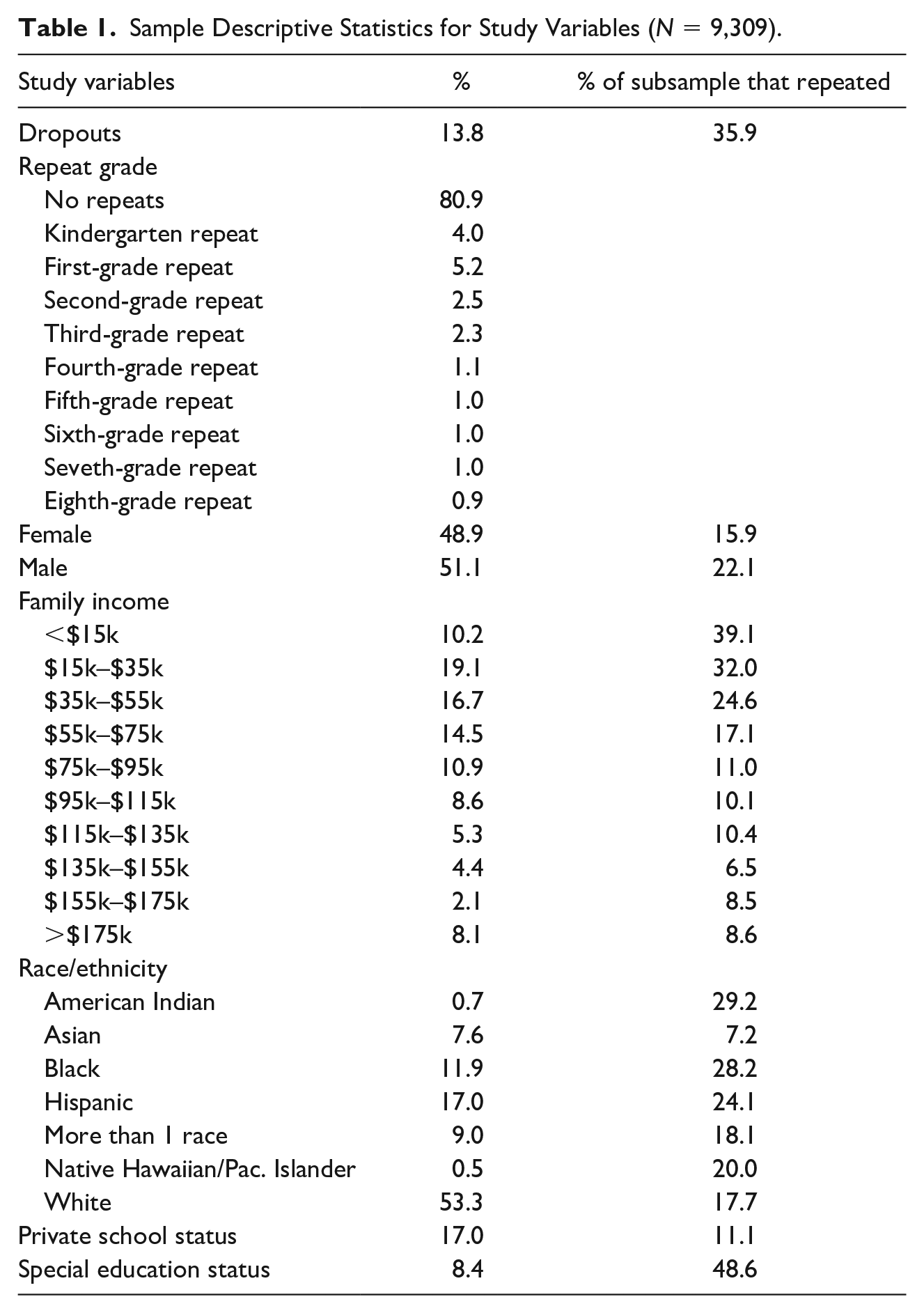
Table 1 shows the descriptive statistics of the sample population. The sample was 50% male and predominately White (53.3%), with other races/ethnicities of Hispanic (17.0%), Black (11.9%), more than one race (9.0%), Asian (7.6%), American Indian (.7%), and Native Hawaiian/Pacific Islander (.5%). Approximately 30% of the students came from families earning under $35,000, 50% came from families earning between $35,000 and $95,000, and the remaining students (20%) came from families with household income above $95,000. Around 18% of the sample attended private schools, while 8% were enrolled in special education programs.
Sample Descriptive Statistics for Study Variables (N = 9,309).
Although the NCES gives sampling weights, the weighting schemata invariably have a design effect on the data. Weighting the data is generally accepted for descriptive statistics of the sample (Kish & Frankel, 1974), yet meritorious arguments have been published against the viability of using weights when stratifying the sample, using statistical models (e.g., multivariate regression), or both (Gelman, 2007; Kott, 2007). As our analyses both stratify the sample and uses regression modeling, the data were left unweighted.
Measures
Grade retention
When each student was in ninth grade, their parent was asked, “Since starting kindergarten, has [your 9th-grader] repeated any grades?” with a follow-up question of “What grade(s) did [he or she] repeat?” Parent reports are commonly used in research surrounding retention and are often used to help classify retention rates, dropout rates, and academic outcomes (Reynolds, 1992; Warren & Saliba, 2012; Willson & Hughes, 2006). Data were then combined from each time point to create both a continuous frequency repeat variable as well as nine binary variables; one for each grade with answers of “yes” (repeated) or “no” (did not repeat). Cases were then selected for analysis if the repeat frequency value was “0” (never repeated a grade) or “1” (repeated one grade). This process yielded 9,309 cases for analysis.
Dropout
Dropout was assessed by a precalculated variable given by the NCES (“X3EVERDROP”). Administrative data were provided by the school via enrollment statistics. Students were coded as “dropped out” if they were not currently enrolled in school, had not transferred, and had not earned a high school diploma or alternative credential (e.g., General Educational Development [GED]). These data were collected each year until 2013, where the final dropout variable was calculated by combining 2009 through 2013 data into a dichotomous variable (“1” for at least one dropout episode, and “0” for no dropout). The variable has been used in other published studies investigating dropout (Obinna & Ohanian, 2020).
Gender
Gender was self-reported by students as male or female at the base year (2009).
Race/ethnicity
Race/ethnicity was asked at the base year with response options of White, Black, Hispanic, Asian, American Indian/Native Alaskan, Native Hawaiian/Pacific Islander, or more than one race. All race/ethnicity categories were used in the overall model; however, due to sample size constraints, the three largest racial/ethnic groups of White, Black, and Hispanic were used for split-sample regressions.
Control variables
Family income was assessed at the base year and answered by the parent of the student. A list of income bracket options was given, with categories ranging from “less than $15,000” to “over $175,000,” measured in $20,000 increments. Private school status was determined by the data collection team at the time of the survey, coded as “0” for public and “1” for private. Special education status was determined based on parent response to the question, “Is your child enrolled in a special education program with an IEP?” Responses were coded “0” for no and “1” for yes.
Analytic Strategy
First, descriptive statistics were explored among study variables. To test the first research question, logistic regression was used with grade retention as the independent variable, dummy coded as Kindergarten through eighth (“never retained” as the reference group), and dropping out of high school as the dependent variable. The full model was adjusted for gender, family income, race/ethnicity, private school status, and special education status. Although logistic regression will yield coefficients, odds ratios, and significance values for all variables, it does not give statistical significance between any two given independent variables (e.g., it would not test differences between two significant independent variables). As the second research question was to compare retention grades in predicting dropout likelihood, Cumming’s (2009) postestimation test of coefficients was used in which the 95% confidence intervals of two coefficients were compared (confidence intervals estimated via bias corrected bootstrap, as suggested by Wichmann & Hill, 2001; 5,000 resamples per regression). In the event that the confidence intervals overlap by less than half the length of one confidence interval arm, then the p value between the confidence intervals is at least below the level of significance (i.e., less than .05). Addressing the third research question, we first conducted an interaction analysis via moderation. We tested interactions of retention (grade) with gender and race/ethnicity on dropout.
Sensitivity Analysis
We previously posited that it is logical to assume that youth who were retained in grade at multiple time points had an increased likelihood of dropping out compared to youth who only repeated a single grade. This, of course, is a testable assumption, given the nature of the data. To test this, we conducted a logistic regression using only two groups of students: those with only a single repeated grade (reference group) versus those who had multiple repeats (N = 148), using dropout as an outcome. The model was significant (χ2 = 32.666, p < .001) and showed that those with multiple repeats were more than twice as likely to dropout compared to those with only a single repeat (odds ratio = 2.233, p < .001). Thus, as our original assumption was indeed correct, we excluded those with multiple repeated grades.
Furthermore, as an additional post hoc test, split-sample regressions were conducted by gender and the three largest racial/ethnic groups (Black, White, Hispanic), while adjusting for all other control variables and using the same postestimation test of coefficients. Particularly in the context of smaller sample sizes (e.g., a small number of repeaters by gender or race/ethnicity may not pass the threshold for a significant interaction resulting in a type 2 error), split sample regressions by sample is helpful in highlighting the nuanced differences (James, White, & Kraemer, 2005) particularly among subgroups (in this case, gender and race/ethnicity). This mirrors other published studies which have used split-samples regressions to detect subtle yet salient differences between samples (Cardoso, Padilla, & Sampson, 2010; Jewell & Kambhampati, 2015; Wright & Palmer, 1999).
Regarding this method, there is an increased likelihood of a type 1 error due to two separate regressions being conducted. To limit this, we have taken two approaches. First, we have bootstrapped the sample using 5,000 samples, as research has shown that bootstrapping provides more accurate parameter estimates, thereby reducing the chance of type 1 errors (Sinha, 2020). Next, M. L. Anderson and Magruder (2017) suggest using a Bonferroni correction to adjust for potential false discovery rates, particularly when using split-sample regression. As such, p value significance thresholds were adjusted to a level of .025 in the gender split-sample regressions, and .01 for the race/ethnicity regressions.
Results
Of the final sample, 19.1% were held back one time (not shown in tables) and 13.8% of the final sample had dropped out of high school. Table 1 presents the specific retention percentages stratified by demographic variables. Approximately 22.1% of males and 15.9% of females were retained in grade. As income increased, being retained generally decreased, with the highest percentage of repeats from those with the lowest income of less than $15,000 (39.1% retained). American Indian and Black students had the highest retention rates (29.1% and 28.2%, respectively), while Asian students had the lowest (7.2%). Those in private schools had lowest retention rates (11.1%), while those having special education status had higher rates (48.6%). Of the students who dropped out, 35.9% of them were retained in grade.
Table 2 presents the regression results for the full sample. With regards to the first research question, the odds of dropping out of high school were significantly higher for children who had repeated any given grade with the exception of fifth grade (p = .09). More specifically, the odds of high school dropout were more than two times higher for youth repeating kindergarten (OR = 2.02, p < .001), third grade (OR = 2.00, p < .001), and fourth grade (OR = 2.73, p < .001), compared to youth who were never retained. Repeating sixth grade made students over seven times more likely to dropout when retained (OR = 7.08, p < .001). Dropout odds increased over four times when repeating seventh grade (OR = 4.55, p < .001) and nearly four times when youth were retained in eighth grade (OR = 3.56, p < .001). Significant postestimation tests revealed that repeating sixth and seventh grades were statistically associated with dropout compared to all other grades below them (all at the p < .05 level). Repeating eighth grade was significantly different than repeating kindergarten, first, and second grades (p < .05; see Table 2).
Logistic Regression Analysis of H.S. Dropout by Grade Retention.
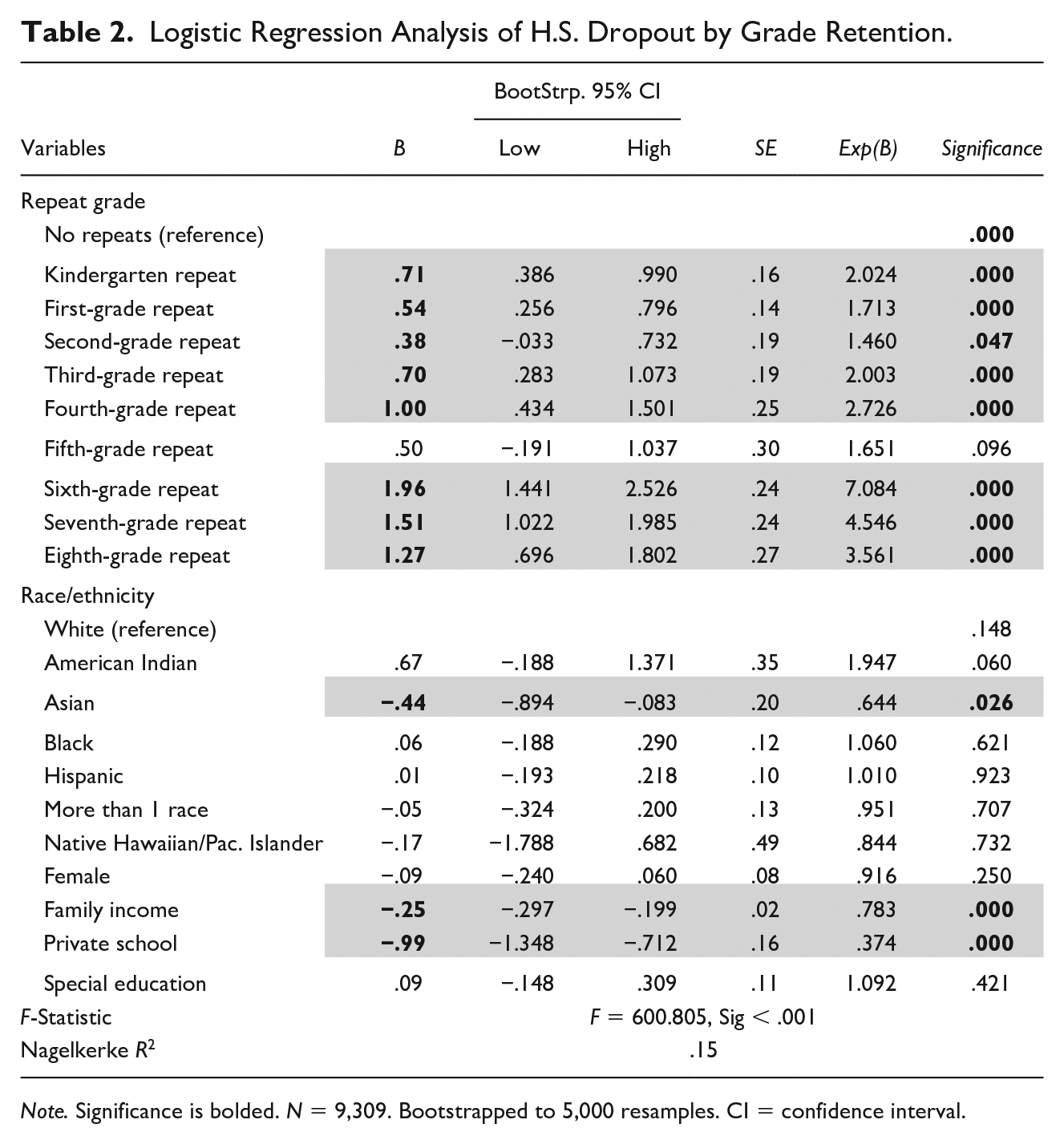
Note. Significance is bolded. N = 9,309. Bootstrapped to 5,000 resamples. CI = confidence interval.
Interactions were tested between gender and grade retention, and race/ethnicity and grade retention (both with an outcome of dropping out). Results of the interaction analysis did not reveal any significant results (all p values were above the .05 level). Split file results by gender are presented in Table 3. It should be noted that differences by gender and race/ethnicity are purely descriptive and that these similarities and differences are not statistically tested because the interactions were not significant.
Logistic Regression Analysis of H.S. Dropout by Grade Retention and Gender.

Note. Significance is bolded at the .025 level. N = 4,798 for males, 4,509 for females. Bootstrapped to 5,000 resamples. CI = confidence interval.
Sensitivity Analysis by Gender and Race/Ethnicity
Several trends were observed for both boys and girls. For example, repeating kindergarten, sixth, seventh, and eighth grades were significantly associated with dropout in both males and females. Mirroring the full sample, sixth-grade retention appeared to be the most detrimental in terms of graduating high school, as it increased the odds of dropout 6.4 times for boys and 8.2 times for girls. For both males and females, repeating second and fifth grades were not associated with dropping out.
Several unique patterns were apparent based on grade of retention. First, boys repeated a grade at a rate of 22%, and girls repeated at a rate of 16%. With respect to being retained, repeating the first grade (OR = 2.40, p < .001) or fourth grade (OR = 4.04, p < .001) only increased the risk of dropping out of high school for girls. Being retained in third grade doubled the odds of dropping out for boys (OR = 2.18, p < .001). The risk of dropout was over seven times greater for girls repeating seventh grade (OR = 7.12, p < .001). Boys repeating seventh grade were three times likely to drop out (OR = 3.35, p < .001), compared to their peers who were never retained.
Postestimation tests for girls indicated that repeating sixth or seventh grade had a stronger link with high school dropout than kindergarten or first-grade retention. For boys, repeating sixth grade was statistically associated with dropout compared to kindergarten or third-grade repeats (all at the p < .05 level for both males and females, respectively).
Black and Hispanic youth repeated a grade at a rate of 28% and 24% and had dropout rates of 19% and 16%, respectively. White youth had an 18% retention rate and a dropout rate of 12%; not shown in table). Table 4 presents logistic regression results split by White, Black, and Hispanic race/ethnicity. Interestingly, being retained in sixth grade increased the odds of dropping out 10-fold for White and Black students (p < .001). The same association was nonsignificant among Hispanic youth (p = .285). The only grade linked with dropping out for Hispanic students was seventh grade (OR = 5.66, p < .001). All three groups had a five-fold greater likelihood of high school dropout when repeating the seventh grade (p < .01). When White students were retained in any grade, their odds of dropping out increased (all nine grades below the p < .01 level). For Black youth, only repeating sixth and seventh grades were linked with dropping out (OR = 10.62, p < .001 and OR = 5.46, p < .001, respectively). Postestimation tests showed that for White students, repeating sixth grade was significantly more impactful than repeating kindergarten through third grades (p < .05 for all).
Logistic Regression Analysis of H.S. Dropout by Grade Retention and Race/Ethnicity.
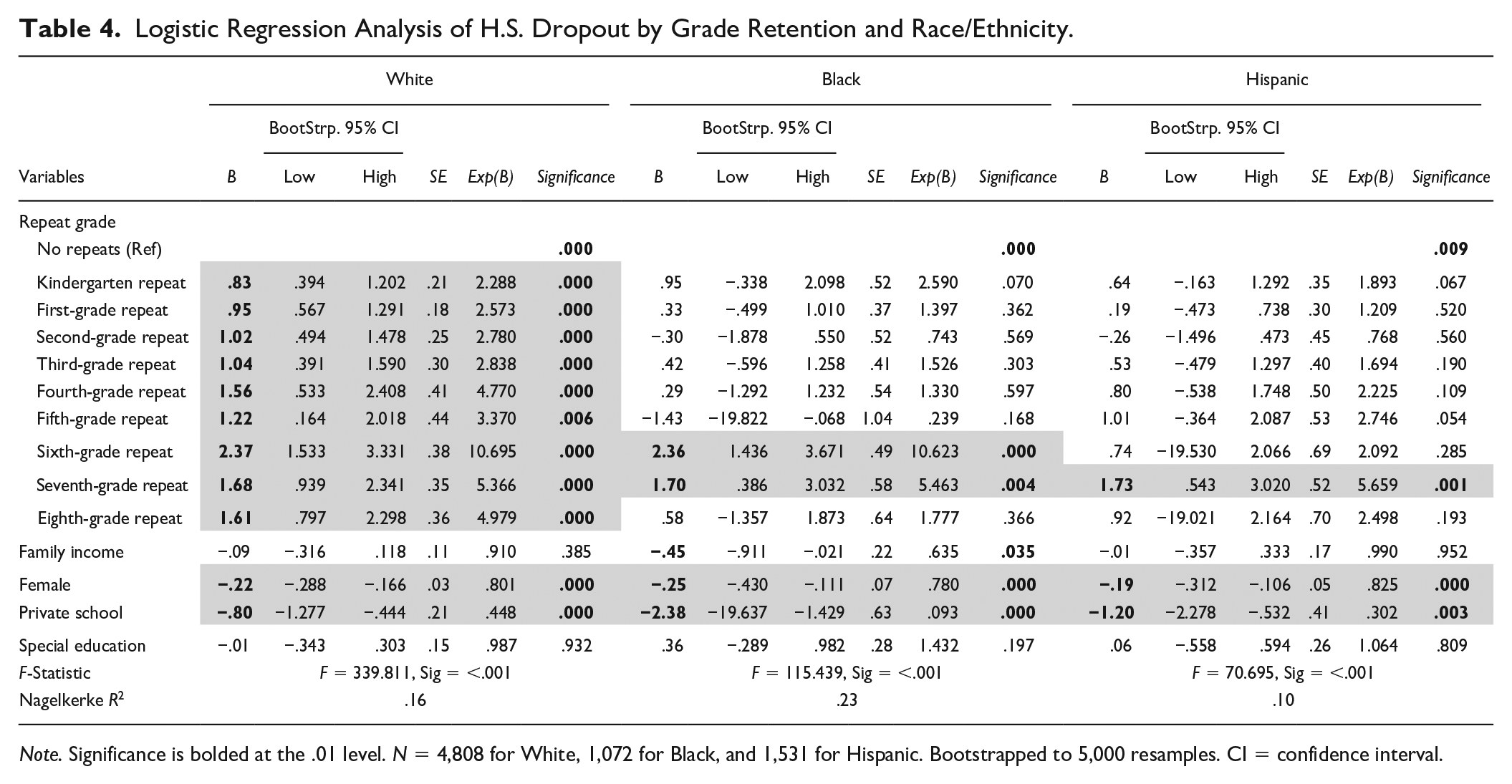
Note. Significance is bolded at the .01 level. N = 4,808 for White, 1,072 for Black, and 1,531 for Hispanic. Bootstrapped to 5,000 resamples. CI = confidence interval.
Discussion
This study examined the likelihood of dropping out of high school based on grade retention between Kindergarten and eighth grade. No known studies have comparatively investigated which specific grades of retention increase the likelihood of dropping out of high school compared to other retention grades and compared to youth who never repeated a grade; particularly with generalizable longitudinal data. Broadly, results showed that students who repeated a grade in early middle school/junior high had the greatest risk for dropping out in high school, compared to youth who were never retained with unique patterns of relationships between retention and dropout by gender and race/ethnicity. The rational for grade retention is that repeating a grade gives students the opportunity for skill mastery in areas necessary to be competent in the following grade (Brophy, 2006). However, when juxtaposed through a developmental lens, theses grades also coincide with biological (i.e., puberty), cognitive (i.e., greatest advances of systematic and logical thought), social (i.e., peer and romantic relationships), and structural (i.e., school transitions) changes and may magnify potential barriers to healthy development.
While being retained in kindergarten or first grade increased the odds of high school dropout, youth who were retained during the transition into or out of middle school were up to eight times more likely to drop out during high school. The transitions from elementary to middle school and middle to high school can be particularly difficult with increased demands on academic performance and the need to navigate more complex educational and social environments (Barber & Olson, 2004). Transitions include youth moving to larger schools and classrooms, changing classes during the day, and increasing workloads (Schiller, 1999). Psychologically, results align well with research showing elementary school students look forward to and anticipate the transition to middle school; particularly as it relates to celebrating milestones of elementary graduation with peers (Akos, 2002). Repeating sixth grade, then, would attenuate these feelings of anticipatory excitement, disrupt current peer relationships, and symbolically indicate a “failed” transition.
Indeed, studies that investigated prediction models of high school dropout have stressed the importance of the “transition years” of middle school. For example, one longitudinal study that followed approximately 13,000 students found that poor attendance, misbehavior, and course failures in sixth grade can be used to identify 60% of the students who will dropout out of high school (Balfanz et al., 2007). They theorize that maladaptive behaviors that manifest around the sixth grade may not be able to self-correct as easily as in the earlier formative years of school. Their study, however, did not focus on grade retention. Nevertheless, Eccles and Roeser’s (2011) work bridges our results with the findings of Balfanz and colleagues. Eccles and Roeser contextualize middle school through a developmental lens; that is, more than viewing middle school through administrative benchmarks such as grade points average (GPA) and attendance. They posit that early adolescents’ social-emotional development is directly tied to their intellectual development and that disruptions in social-emotional development during early adolescence (such as having to repeat a grade which, for example; Peixoto et al., 2016) may catalyze poor academic outcomes that are more deleterious than in younger years. These poor academic outcomes then, as Balfanz and colleagues (2007) note, do not self-correct in high school, leading to an increase in dropout.
Moreover, previous research has indicated that middle school teachers have the highest rates of turnover (Clotfelter, Ladd, & Vigdor, 2007; Marinell & Coca, 2013), which coincides with a critical structural transition for adolescents. Middle school teachers have been found to be less trusting of students, function more as disciplinarians, perceive students as having fixed mindsets and abilities, and tend to lack confidence in their teaching, relative to elementary school teachers (Eccles & Roeser, 2009; Midgley, Berman, & Hicks, 1995; Pharris-Ciurej & Hirschman, 2012). This illustrates a mismatch of what youth need during school transitions and what teachers are equipped or prepared to provide. When this mismatch is paired with a student who is already struggling academically and is being retained in grade, normative physical, cognitive, and social developmental changes can pivot that student down a deleterious pathway (Elder, 1998).
Grade Retention by Gender
When examined by gender, the importance of retention during these transitional periods was further highlighted. Specifically, boys were six times more likely while girls were eight times more likely to drop out of high school if retained in sixth grade. Postestimation tests further emphasize the importance of retention in these grades as the odds of dropping out were significantly higher relative to retention in lower grades. This again points to the challenges of the transition from elementary to middle school that coincides with major biological development. Stability during pubertal changes is essential to normative development (Ganiban, Saudino, Ulbricht, Neiderhiser, & Reiss, 2008) and, since pubertal timing averages 2 to 3 years earlier for females than males (Roenneberg et al., 2004), retention in sixth grade may coincide more dramatically with pubertal development for girls. It is also possible that girls may be more susceptible to social stress caused by retention, though more research is needed regarding this (Jimerson et al., 2006). This may also indicate that later adolescent grade retention would coincide more dramatically for boys (e.g., ninth or 10th grades), but more research is needed in this area.
Grade Retention by Race/Ethnicity
Being retained at virtually any grade appeared to be a dropout risk for White youth. In contrast, there appears to be unique patterns in which grade, when repeated, greatly influences high school dropout among Black and Hispanic youth—specifically, for Black youth retained during sixth and seventh, and Hispanic youth in seventh grade. For racial/ethnic minority youth, there might be other factors that have a larger impact on dropout or make certain periods more vulnerable when coupled with retention. Black youth routinely experience lower expectations from teachers that can significantly hinder their success and promotion (Kozol, 2005; Rothstein, 2004; van den Bergh, Denessen, Hornstra, Voeten, & Holland, 2010). It is possible that due to these differential expectations, and associated academic deficits, the modeling of minority youth dropout becomes a self-fulfilling prophecy. Indeed, high school dropout rates are disproportionately higher for Black and Hispanic youth, relative to White youth (Snyder et al., 2019), and this is likely to due to factors within and outside of the school setting.
When Hispanic youth reach middle school age, given a cultural emphasis on familia, they may begin taking on some degree of adult-like work or caregiver roles. Although studies have shown that parentification is not necessarily deleterious for Hispanic youth because of close family ties and heightened feelings of self-efficacy (Shin & Hecht, 2013), it may still serve as a dropout risk (and potentially even a retention risk) for youth with academic struggles significant enough to have them repeat a grade during middle school. Previous studies have identified challenges within school social and cultural environments that promote feelings of disconnect between Hispanic home and school lives that might be amplified during school transitions (Lys, 2009). Given the importance of socio-cultural factors, and prior research highlighting the importance of cultural identity and belongingness within school settings (Benner & Graham, 2009; Li & Lerner, 2011), future studies aiming to understand academic challenges of minority youth should focus on cultural dynamics within families and communities that may strain students’ academic motivation, engagement, and achievement.
It should be noted that the interaction term for both gender and race/ethnicity was nonsignificant. While this suggests that there may not, in fact, be significant differences by gender or race/ethnicity, our results with regard to gender and race/ethnicity aid in supporting the full sample findings—that is, that sixth and seventh grade retention is a large risk factor for dropping out.
Limitations
Notwithstanding the merits of this research, there are several limitations that warrant consideration. While this study investigated retention in Kindergarten through eighth grades, it is possible that examining ninth through 12th grades would yield additional data points that may provide varying results (this study could not accomplish this due to substantial missing data concerns). It is also possible that some students dropped out prior to high school, and thus, were not captured in our study. In addition, the retention rate was relatively small across all grades, particularly in sixth, seventh, and eighth grades. It is possible that our findings are impacted by smaller sample sizes, particularly when stratified by gender and race/ethnicity. The timing of the dropout was also not specified, and as such, may yield additional data points which would provide a better understanding regarding the relationships between retention and dropping out.
Next, this study excluded students who repeated multiple times. As a result, it may also be the case that a student who repeated in kindergarten through eighth grade also repeated a grade in high school, thus possibly conflating their inclusion in our study (cases in our study only repeated a single grade). There are many reasons for why students are retained in grade (e.g., academically held back, developmentally not mature compared to peers, absent more days than required to move to the next grade, behavioral citations, etc.). Some of these reasons may be more detrimental than others for future academic success. Future research in this area might consider these reasons and subsequently either control for them, or investigate group differences. Future studies may also consider the nature of multiple repeaters by examining variation based on number of retentions, as well as the combinations of grades in which the student were held back.
A final limitation is our split-sample analysis. The interaction terms of gender and race/ethnicity were nonsignificant when entered in the model. More research is needed, particularly with a larger sample size to determine if any potential statistically significant demographic interactions are present.
Nonetheless, these limitations should be taken in consideration with the study’s strengths, including using a nationally representative data set of a large cohort of students. Furthermore, this study is among the first to compare multiple retention grades in terms of unsuccessful academic outcomes (as opposed to investigating a single or set of two grades). This was accomplished using longitudinal retention and dropout data, while accounting for numerous control variables (such as family income and private school status) not available in other targeted studies on grade retention.
As a remediation strategy, retention does not appear to improve school performance (Hughes et al., 2017; Hwang & Cappella, 2018) and can symbolically convey to students that their teachers and school do not consider them capable. In this study, retention at certain critical periods dramatically increased students’ vulnerability to dropping out in high school. Retention may only intensify students’ feelings of frustration and disengagement from school, particularly in middle school. This is likely true for retained youth who only repeat academic content, but do not receive any additional study or life skills instruction or resources or social and emotional help (Stone & Engel, 2007). However, should a student need to repeat a grade, study results suggest identifying and retaining students earlier in their academic path would minimize the potential harmful consequences of leaving school altogether (e.g., fifth-grade retention had a nonsignificant finding, while sixth-grade retention increased dropout risk seven-fold). Previous work indicates that older students, relative to their same-grade peers, experience more suicidal thoughts and more fighting (Gunter & Bakken, 2010). This confluence of adolescent maturation, exposure to new social environments, and more demanding and impersonal schools, as well as being retained during a pivotal developmental period (Elder, 1998) can put struggling early adolescent youth on a pathway toward academic failure. For those who are further ahead or behind in development relative to their peers, grade retention during a transition may further exacerbate any potential problems and contribute to high school dropout, relative to on-time and promoted peers.
Conclusions
This study revealed that being retained increased the likelihood of dropping out compared to those who have never repeated a grade. In addition, repeating in the sixth and seventh grades showed the strongest links with dropping out in high school. In terms of gender, both boys and girls repeating sixth grade were more likely to dropout. Similarly, repeating seventh grade also increased the likelihood of dropping out for all racial/ethnic groups. In addition, being retained at sixth grade increased the likelihood of dropping out for White and Black students 10-fold, while Latino students repeating seventh grade increased the likelihood of dropping out by over five times. Results lend overall support for examining alternative ways to increase student achievement without holding students back altogether as being retained perceived as punitive by students (Goos et al., 2012; Roderick, 1994). This is particularly important due to the deleterious effects across the life course that are concomitant to dropping out, including living on government assistance, substance use, and poor physical and mental health (Lansford et al., 2016).
Footnotes
Declaration of Conflicting Interests
The author(s) declared no potential conflicts of interest with respect to the research, authorship, and/or publication of this article.
Funding
The author(s) received no financial support for the research, authorship, and/or publication of this article.
