



Abstract
The goal of this study was to test nonverbal intelligence and neighborhood social capital as protective factors against future delinquency in early adolescent youth placed at risk by virtue of their involvement in childhood conduct problems. Analyzing longitudinal data from 3,028 youth (1,565 boys, 1,463 girls) in one cohort of the Longitudinal Study of Australian Children (LSAC) and 3,682 youth (1,896 boys, 1,786 girls) in a second cohort of the LSAC, nonverbal intelligence, as measured by the Matrix Reasoning subscale of the WISC-IV, displayed a consistent moderating effect on the conduct problems–future delinquency relationship. According to these results, conduct problems were slightly but significantly less likely to lead to delinquency when nonverbal intelligence was high than when it was low or moderate. By shielding at-risk children from future delinquency, protective factors like high nonverbal intelligence may provide a means by which delinquency can be prevented or reduced.
Not everyone who is at high risk for delinquency will end up becoming delinquent. That is because certain individual and social-environmental influences will moderate the effect of risk on outcome. This pattern, commonly referred to as resilience, is a consequence of an interaction between risk and protective factors. A risk factor can be defined as a variable that increases the odds of a negative outcome like delinquency. A protective factor, by contrast, reduces the odds of a negative outcome by interacting with a risk factor and interfering with the risk factor’s ability to achieve a negative outcome (Farrington, Ttofi, & Piquero, 2016). A history of criminal victimization, for instance, may place youth at increased risk for subsequent delinquency (Jennings, Piquero, & Reingle, 2012), yet when paired with high levels of family support and parental monitoring (O’Connell, Boat, & Warner, 2009), criminal victimization has a lower likelihood of being followed by delinquency than if family support and parental monitoring are lacking. The purpose of the current investigation was to determine whether variables believed to protect a child against delinquency by interacting with salient risk factors for offending may serve a preventive function in children displaying signs of antisocial behavior.
Risk Factors and Delinquency
Traditionally, risk factors have been defined as variables that correlate with or predict an increased risk or propensity for disease or infection. The concept has been expanded beyond its medical origins to cover a wide variety of behaviors and conditions. One of these behaviors is delinquency. When considering risk factors for delinquency, the factor can be something as simple as weak parental discipline and the outcome of interest some manner of offending behavior. The opposite pole of a risk factor (e.g., strong parental discipline) is sometimes referred to as a protective factor, although it would be more accurate to call it a promotive factor (Farrington et al., 2016). Before a variable can be considered a protective factor, it must reduce the outcome, in this case delinquency, by interacting with and diminishing the risk factor’s effect on the outcome. If a strong parent–child bond was found to moderate the relationship between weak parental discipline and delinquency, we might well classify it as a reasonable candidate for the role of protective factor. The purpose of the current investigation was to explore the moderating effect of two putative protective factors (nonverbal intelligence and neighborhood social capital) on the well-established risk relationship between childhood conduct problems and early adolescent delinquency.
A large body of research has accumulated on childhood and adolescent risk factors for delinquency. Chief among the risk factors that have been identified are the individual risk factors of impulsivity, low intelligence (although it has been argued that the relationship between intelligence and delinquency is curvilinear, with delinquency being highest in the mid-range of IQ: Mears & Cochran, 2013), and truncated educational attainment, along with the social-environmental risk factors of lack of parental warmth, negative peer associations, and neighborhood disorder (Murray & Farrington, 2010). Perhaps, the most important risk factor of all, however, is a history of antisocial behavior (Kofler-Westergren, Klopf, & Mitterauer, 2010). From early externalizing behavior to conduct disorder, and from conduct disorder to delinquency, and finally from delinquency to adult criminality, antisocial behavior has demonstrated moderate to high levels of continuity over time (Schaeffer, Petras, Ialongo, Poduska, & Kellam, 2003; Walters, 2016). In the present study, a history of parent- and teacher-reported conduct problems was treated as a risk factor for subsequent self-reported delinquency in youth transitioning from late childhood to early adolescence.
Protective Factors and Delinquency
An individual protective factor like nonverbal intelligence may reduce delinquency by neutralizing or mitigating the effect of prior conduct problems on future delinquency (Farrington et al., 2016). As previously mentioned, low intelligence is a verified risk factor for delinquency (Murray & Farrington, 2010), although there are those who would argue that the relationship is curvilinear (Mears & Cochran, 2013; Silver, 2019). It stands to reason, then, that high intelligence may serve an opposite or promotive function, or that it may even interact with conduct problems to produce a protective effect. Delinquency has been found to correlate negatively with general intelligence (Hirschi & Hindelang, 1977; McGloin, Pratt, & Maahs, 2004), although the direction of this relationship has been and continues to be a matter of debate (Ward & Tittle, 1994). Also, there is less of a gap between delinquents and nondelinquents with nonverbal or performance tasks than there is with verbal IQ (Isen, 2010). In addition, because a good portion of the IQ-delinquency relationship is the result of school failure and nonverbal measures of intelligence tend to correlate less with school failure than do verbal measures (McGloin et al., 2004), the current study employed nonverbal intelligence as a putative protective factor.
Like low intelligence, neighborhood disorder has been classified as a risk factor for delinquency (Murray & Farrington, 2010). Unlike low intelligence, which is an individual risk factor, neighborhood disorder is a social-environmental risk factor. It has been demonstrated that socially cohesive neighborhoods marked by high levels of informal social control and collective efficacy reduce crime by preventing youth who live in the neighborhood from acting out and strengthening local parenting through social support (Jain & Cohen, 2013; Vieno, Nation, Perkins, Pastore, & Santinello, 2010). As has been reported in previous research, youth are most likely to commit crimes in the neighborhoods where they live (Damm & Dustmann, 2014). If the streets of the neighborhood are safe to play in and neighbors support one another, then youth may respond with decreased levels of criminal involvement. Accordingly, a second putative protective factor examined in this study was neighborhood social capital, a construct that some researchers consider the antithesis of neighborhood disorder (Sampson, Morenoff, & Gannon-Rowley, 2002).
Nonverbal Intelligence and Neighborhood Social Capital as Protective Factors
The next question that needs to be answered is how exactly might intelligence and neighborhood social capital protect an early adolescent from engaging in future delinquency by way of its interaction with a risk factor like childhood conduct problems? Wechsler (1958) defined intelligence as “the global capacity of a person to act purposefully, to think rationally, and to deal effectively with [the] environment” (p. 7). We can assume from this definition that Wechsler viewed intelligence as a global ability rather than a series of isolated skills and that a non-verbal test like matrix reasoning is just as likely to assess this global capacity as a verbal test like vocabulary, although it should also be noted that offenders tend to perform better on non-verbal tests than verbal ones. This definition of intelligence also reflects the belief that cognition (rational) and behavior (purposeful) are linked in the service of solving problems. Finally, dealing effectively with the environment means being able to adapt to a constantly changing environment. According to Wechsler’s definition, intelligence may have the most to offer rational choice and deterrence theories of crime (Cornish & Clarke, 1986; Paternoster, 2010), in that it may allow the individual to come up with better options, which they then more thoroughly evaluate and more effectively implement.
Research on neighborhoods and crime has its foundation in the Chicago school. When neighborhood disorder theories were first proposed there was a great deal of emphasis on physical deterioration as a cause of social disorder and a precursor to crime. This is similar, in many ways, to the more recent emphasis on physical disarray in broken windows theory (Kelling & Wilson, 1982). Broken windows theory notwithstanding, there has been a subtle shift in emphasis away from deteriorating physical conditions in favor of the psychological sequela of these deteriorating conditions. This would include such factors as moral cynicism, increased incentive and opportunity for crime, and fear of crime. The impact of these conditions can be mitigated by social ties (Ross & Jang, 2000), collective efficacy (Sampson et al., 2002), and social capital (Coleman, 1988). These cognitive-social variables may act as buffers against neighborhood disorder by providing opportunities for surveillance, supervision, and support that not only assist and protect neighborhood adults, but youth as well (Morenoff, Sampson, & Raudenbush, 2001). Like matrix reasoning, neighborhood social capital—defined as a network of social relationships that provide support and shared meaning—may serve to protect individuals from crime, particularly those in the community who are most vulnerable.
The Present Study
There is an abundance of research on risk factors, much less on protective factors, and virtually nothing on the ability of nonverbal intelligence and neighborhood social capital to moderate the effect of childhood conduct problems on early adolescent delinquency. Given the significant role conduct problems play in early delinquency development, it is vital that we comprehend the process by which these influences can potentially be mollified through certain personal characteristics like nonverbal intelligence and select social-psychological processes like social capital. The purpose of the current investigation, then, was to determine whether a risk factor—prior conduct problems—interacted with two putative protective factors—nonverbal intelligence and neighborhood social capital—to moderate the prospective relationship that has long been known to exist between conduct problems and future delinquency.
Because research indicates that male youth are more vulnerable to risk factors than female youth, whereas female youth are more resilient and responsive to protective factors than male youth (Newsome, Vaske, Gehring, & Boisvert, 2016), a preliminary analysis was conducted to determine whether sex moderated any of the risk x protective factor interactions examined as part of this study. If any of the three-way interactions involving sex turned out to be significant, then the plan was to perform separate analyses for male and female participants. It was hypothesized that the two putative protective factors (nonverbal intelligence and neighborhood social capital) would moderate the relationship between conduct problems at age 10-11 and delinquency at age 12-13 in two separate cohorts of Australian youth, irrespective of their ability to directly reduce future delinquency by way of a promotive effect.
Method
Participants
The current study incorporated two cohorts from the Longitudinal Study of Australian Children (LSAC; Australian Institute of Family Studies, 2018), a large representative sample of Australian youth followed from birth (B cohort) or from kindergarten (K cohort). At present, each cohort consists of seven waves of data. The B cohort began in infancy, with re-interviews taking place every 2 years up through age 12-13. The K cohort began when a child entered kindergarten, with re-interviews occurring every two years up through age 16-17. Cohort B served as the initiation sample in the current study and comprised 3,028 youth (1,565 boys, 1,463 girls) and had a racial/ethnic breakdown of 96.4% non-indigenous, 3.1% aboriginal, and 0.5% Torres Strait Islander. Cohort K served as the cross-validation sample and contained 3,682 youth (1,896 boys, 1,786 girls) and had a racial/ethnic breakdown of 96.7% non-indigenous, 3.0% aboriginal, and 0.3% Torres Strait Islander.
Weighting
Participants were assigned both cross-sectional and longitudinal sample weights as part of the standard LSAC procedure. These weights served two purposes: (a) accounting for the child’s probability of being included in the study and (b) adjusting for non-response. Because the current study was conducted over a 2-year period (ages 10-11 to 12-13), longitudinal sample weights from Wave 12-13 were employed. Some participants had data on one or more variables included in the present study, even though they had not been assigned a Wave 12-13 longitudinal sample weight. Accordingly, a supplemental analysis was performed on all participants with non-missing data on at least one of the eight variables from this study, but without any weighting of cases.
Research Design
A two-wave longitudinal research design was implemented. The first wave, which took place when participants were 10-11 years of age, contained all of the control and predictor variables used in this study. The second wave, which occurred 2 years later when participants were 12-13 years of age, was marked by administration of the dependent or outcome measure. The wave during which participants were 12-13 years of age was selected as the dependent variable because it was the first time this variable (self-reported delinquency) was assessed in the K cohort and it was the only time it was assessed in the B cohort. Participants in both cohorts were originally selected using a two-stage cluster probability sampling approach created from the Australian Medicare enrollment database. Sample weights were then used to maximize representativeness and adjust for missing data.
Data Analytic Plan
A one-equation regression analysis was conducted with all control, independent, and moderator variables measured at age 10-11 and the dependent variable assessed at age 12-13 in both the initiation (Cohort B) and cross-validation (Cohort K) samples. Two models were tested: a direct or unmodulated model with no interaction terms (Model 1) and a moderated model with two interaction terms (Model 2). The estimator used in the regression analyses was a maximum likelihood with standard errors that were robust to non-normality and the non-independence of observations (MLR). Supplemental analyses were performed for the purposes of evaluating the sensitivity and robustness of the main results. In the first supplemental analysis, all participants from the LSAC with data on at least one of the eight study variables were analyzed without weights. In the second supplemental analysis, extreme outliers were winsorized to the next lowest value (1, lowest outlier). The descriptive and correlational analyses were performed with SPSS Version 26 (IBM, 2019), whereas the regression analyses were conducted with Mplus 8.3 (Muthén, & Muthén, 1998-2017).
Measures
Conduct problems
The risk/independent variable for this study was conduct problems, as assessed with the Conduct Problems scale of the LSAC’s Strengths and Difficulties Questionnaire (SDQ). Each item on the Conduct Problems scale (“often loses temper”; “often fights with other children or bullies them”; “often lies or cheats”; “steals from home, school, or elsewhere”; “generally well-behaved, obeys adult requests”) is rated on a 3-point scale (0 = not true, 1 = sometimes true, 2 = certainly true, except for the “generally well-behaved, obeys adult requests” item, which was reverse-coded) and the results summed to produce a score that could range from 0 to 10. The Conduct Problems scale was completed by the child’s mother, father, and teacher, and the results averaged. Internal consistency estimates (Cronbach’s α) for the five-item scale ranged from .61 to .75 (M = .67) in the sample from Cohort B and from .62 to .77 (M = .67) in the sample from Cohort K. Average absolute agreement (ICC) between raters (parents and teachers) was .68 in the sample from Cohort B and .67 in the sample from Cohort K.
Nonverbal intelligence
The Matrix Reasoning subtest of the Wechsler Intelligence Scale for Children–Fourth Edition (WISC-IV: Wechsler, 2003) served as a measure of nonverbal intelligence, the first of two protective-moderator variables included in the current study. Matrix Reasoning presents the child with colored matrices or visual patterns in which part of the matrix or pattern is missing. The child is instructed to select the option, out of five, that best completes the matrix or pattern. There are 35 matrices on the Matrix Reasoning subtest and a participant’s score is based on the number of matrices successfully solved. Like other matrix tasks, Matrix Reasoning assesses abstract problem solving and spatial reasoning skills and is considered one of the best measures of fluid intelligence (gf) available (Canivez, Watkins, & McGill, 2019; Žebec, Demetriou, & Kotrla-Topíc, 2015).
Neighborhood social capital
The only neighborhood collective efficacy-social control measure available in both cohorts of the LSAC was a two-item measure of neighborhood social capital. The two items (“it is safe to play outside in the neighborhood”; “people help neighbors”) that form the neighborhood social capital scale were each rated on a 4-point Likert-type scale (1 = strongly disagree, 2 = disagree, 3 = agree, 4 = strongly agree). These two items were completed by the parent most familiar with the child’s behavior, usually the mother, identified as Parent #1 in the LSAC. The internal consistency of this two-item scale was moderate in Cohort B (r = .33) and moderately high in Cohort K (r = .44), whereas inter-rater reliability between mothers and fathers (when data were available for both parents) was moderate in Cohort B (absolute agreement ICC = .57) and low-moderate in Cohort K (absolute agreement ICC = .51).
Self-reported delinquency
Whereas the risk, protective, and control factors were all assessed when participants were 10-11 years of age, the outcome measure, self-reported delinquency, was assessed 2 years later, when participants were 12-13 years of age. Children were asked to indicate how often they engaged in the following 17 behaviors (“got into physical fights in public”; “skipped school for a whole day”; “stole something from a shop”; “drew graffiti in public places”; “carried a weapon like a knife, gun or piece of wood”; “took a vehicle [e.g., car] for a ride without permission”; “stole money or other things from another person”; “ran away from home and stayed away overnight or longer”; “purposely damaged or destroyed others” property”; “damaged a parked car [e.g., slashed tires, scratched paint]”; “went around with a group of three or more kids damaging or fighting”; “suspended or expelled from school”; “broke into a house, flat or vehicle”; “stole something out of a parked car”; “started a fire in a place where you should not burn”; “used force or threats to get money or things from someone”; “caught by police for something you did”) in the past year. Participants used a 6-point frequency scale (0 = not at all, 1 = once, 2 = twice, 3 = three times, 4 = four times, 5 = five or more times) to rate each item. Scores were then summed to yield a scale that could range from 0 to 85. The internal consistency of the delinquency scale was good in both the B (α = .82) and K (α = .88) cohorts of the LSAC.
Control variables
Three control variables were included in this study: age (in years) at the time the risk and protective factors were collected, sex (1 = male, 2 = female), and indigenous status (1 = non-indigenous, 2 = indigenous). In a preliminary analysis, sex was entered into a three-way interaction with the risk × protective interactive effects to determine whether sex moderated any of these relationships.
Missing Data
Participants were selected for this study if they had been assigned a longitudinal sample weight at age 12-13. The vast majority of youth with longitudinal sample weights had complete data on all seven variables. Of the 3,028 participants in the initiation (Cohort B) sample, 90.7% had complete data on all seven study variables, 7.5% were missing data on one variable, 0.8% were missing data on two variables, and 1.0% were missing data on three or four variables. Of the 3,682 participants in the cross-validation (Cohort K) sample, 95.8% had complete data on all seven study variables, 3.5% were missing data on one variable, and 0.8% were missing data on two or three variables. The only variable with more than 5% missing data was delinquency (5.6%) in Cohort B. Missing data were handled with full information maximum likelihood (FIML), a procedure that estimates population parameters and standard errors by examining known relationships between non-missing data. FIML has been found to be more accurate and less biased than more traditional missing values procedures like simple imputation and listwise deletion and assumes all data are missing at random (Allison, 2002).
Results
Initiation Sample
Descriptive statistics and inter-correlations for the seven study variables in the initiation sample (Cohort B) are listed in Appendix A. Of particular note, the conduct problems variable was responsible for over half of the significant Bonferroni-corrected correlations identified in the analysis. There was no evidence of multicollinearity when the predictor variables were regressed onto the delinquency outcome: tolerance = 0.965-0.995 and variance inflation factor (VIF) = 1.009-1.036. The outcome measure, delinquency, was both highly skewed and leptokurtoic (skew = 8.81, kurtosis = 143.76). Because sex failed to moderate either of the risk × protective variable interactions, all analyses were performed on the full sample of participants (male + female).
The left half side of Table 1 summarizes results for the unmoderated model (Model 1), whereas the right half side of Table 1 summarizes results for the moderated model (Model 2). Model 1 displays a modest inverse effect for gender and a moderate direct (risk) effect for conduct problems. The model’s overall effect, however, was small (R2 = .046, p < .001). Model 2 displayed significant main effects for sex and conduct problems and a modest negative interaction between conduct problems and matrix reasoning (β = −0.08). There was also a small but significant overall effect (R2 = .054, p < .001) for Model 2. Testing for the possibility of a curvilinear relationship between matrix reasoning and delinquency by adding a squared matrix reasoning term to Model 1, failed to show evidence of a curvilinear effect (Z = 0.30, p = .78).
Results of Robust Maximum Likelihood Regression Analyses Predicting Delinquency at Age 12-13 in the Initiation Sample (Cohort B).
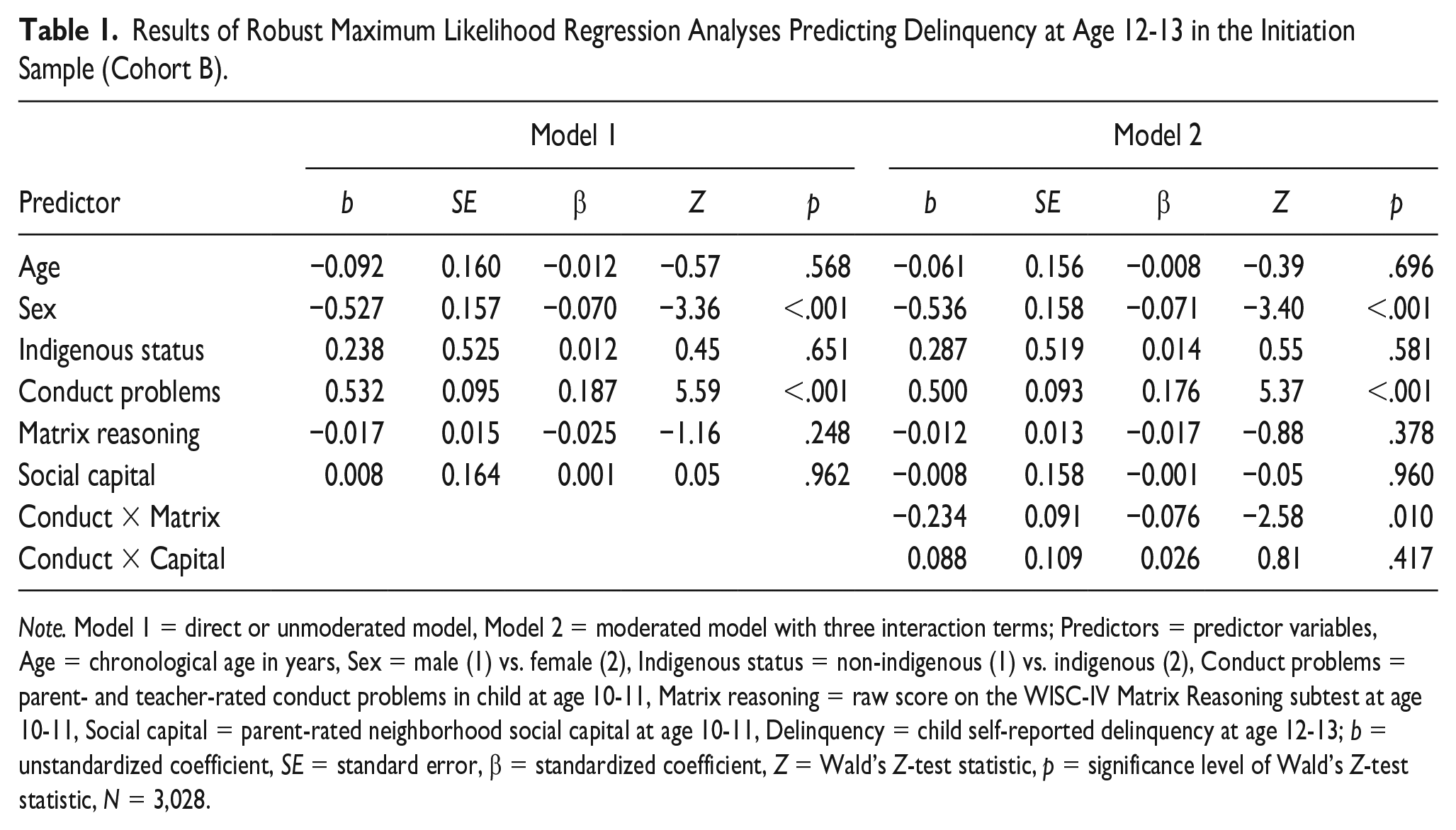
Note. Model 1 = direct or unmoderated model, Model 2 = moderated model with three interaction terms; Predictors = predictor variables, Age = chronological age in years, Sex = male (1) vs. female (2), Indigenous status = non-indigenous (1) vs. indigenous (2), Conduct problems = parent- and teacher-rated conduct problems in child at age 10-11, Matrix reasoning = raw score on the WISC-IV Matrix Reasoning subtest at age 10-11, Social capital = parent-rated neighborhood social capital at age 10-11, Delinquency = child self-reported delinquency at age 12-13; b = unstandardized coefficient, SE = standard error, β = standardized coefficient, Z = Wald’s Z-test statistic, p = significance level of Wald’s Z-test statistic, N = 3,028.
Table 2 summarizes the conditional effects of the focal predictor, conduct problems, on delinquency at three levels of matrix reasoning—low (1.5 standard deviations below the mean), medium (mean), and high (1.5 standard deviations above the mean). As these results indicate, conduct problems predicted delinquency when matrix reasoning was low and medium but not when it was high. Figure 1 also illustrates the significant reduction in the ability of conduct problems to predict delinquency at higher levels of matrix reasoning, as represented by the fact that the high matrix reasoning line is less steep than the low matrix reasoning line.
Conditional Effects of the Focal Predictor (Conduct Problems) at Different Levels of the Moderator Variable (Matrix Reasoning) in the Initiation Sample (Cohort B).
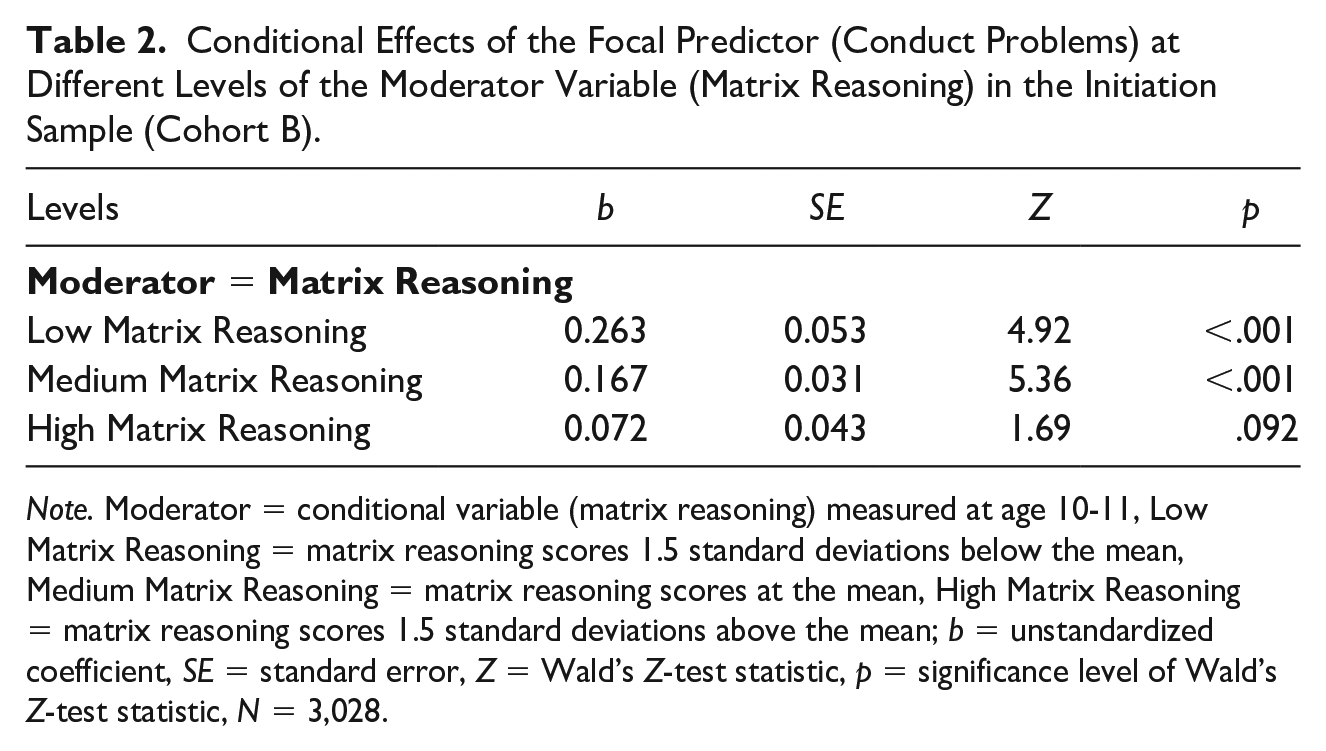
Note. Moderator = conditional variable (matrix reasoning) measured at age 10-11, Low Matrix Reasoning = matrix reasoning scores 1.5 standard deviations below the mean, Medium Matrix Reasoning = matrix reasoning scores at the mean, High Matrix Reasoning = matrix reasoning scores 1.5 standard deviations above the mean; b = unstandardized coefficient, SE = standard error, Z = Wald’s Z-test statistic, p = significance level of Wald’s Z-test statistic, N = 3,028.
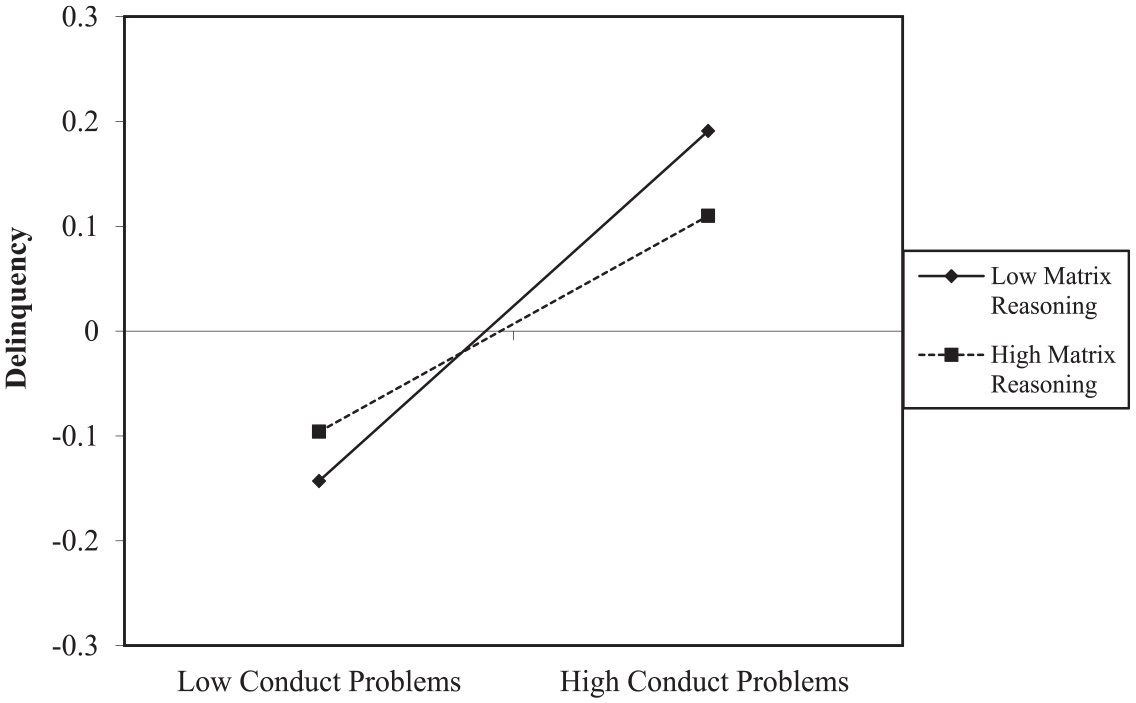
Interaction between conduct problems and matrix reasoning at age 10-11 as a predictor of delinquency at age 12-13 in the initiation sample (Cohort B).
The first supplemental analysis revealed that the results did not change when 3,764 Cohort B participants with complete data on at least one of the eight variables included in this study were analyzed without weights (conduct × matrix interaction: Z = 2.41, p < .05; β = −0.07). The second supplemental analysis indicated that the sex and conduct problems main effects were significant, as was the conduct x matrix interaction (Z = 2.24, p < .05; β = −0.08) when six outlying scores (>25) identified with SPSS Explore were winsorized to the next lowest value (i.e., 24).
Cross-Validation Sample
Descriptive statistics and inter-correlations for the seven variables in the cross-validation sample (Cohort K) are listed in Appendix B. The number of significant Bonferroni-corrected correlations in the cross-validation sample was nearly double that of the initiation sample. As with the initiation sample, there was no evidence of multicollinearity: tolerance = 0.933-0.994 and VIF = 1.006-1.071. Like in the initiation sample, the conduct problems variable had a non-normal distribution (skew = 6.62, kurtosis = 73.86). Sex once again failed to moderate any of the risk × protective variable interactions and so all analyses were performed on the full sample of participants (male + female).
Table 3 provides a breakdown of results for Models 1 (unmoderated model) and 2 (moderated model) in the cross-validation sample (K cohort). There were twice as many significant Model 1 effects in the K cohort as there were in the B cohort. A moderate direct (risk) effect and modest inverse effect were once again obtained for conduct problems and sex, respectively. In addition, there was a modest direct effect for indigenous status and a modest inverse effect for matrix reasoning (β = −0.08), as well as a moderate overall effect (R2 = .077, p < .001). Model 2 displays these same four main effect and a significant inverse correlation between the conduct × matrix interaction and subsequent delinquency. The overall effect was of moderate magnitude (R2 = .084, p < .001). There was no evidence of a curvilinear relationship between matrix reasoning and delinquency when matrix reasoning was squared and added to Model 1 (Z = 1.00, p = .316).
Results of Robust Maximum Likelihood Regression Analyses Predicting Delinquency at Age 12-13 in the Cross-Validation Sample (Cohort K).
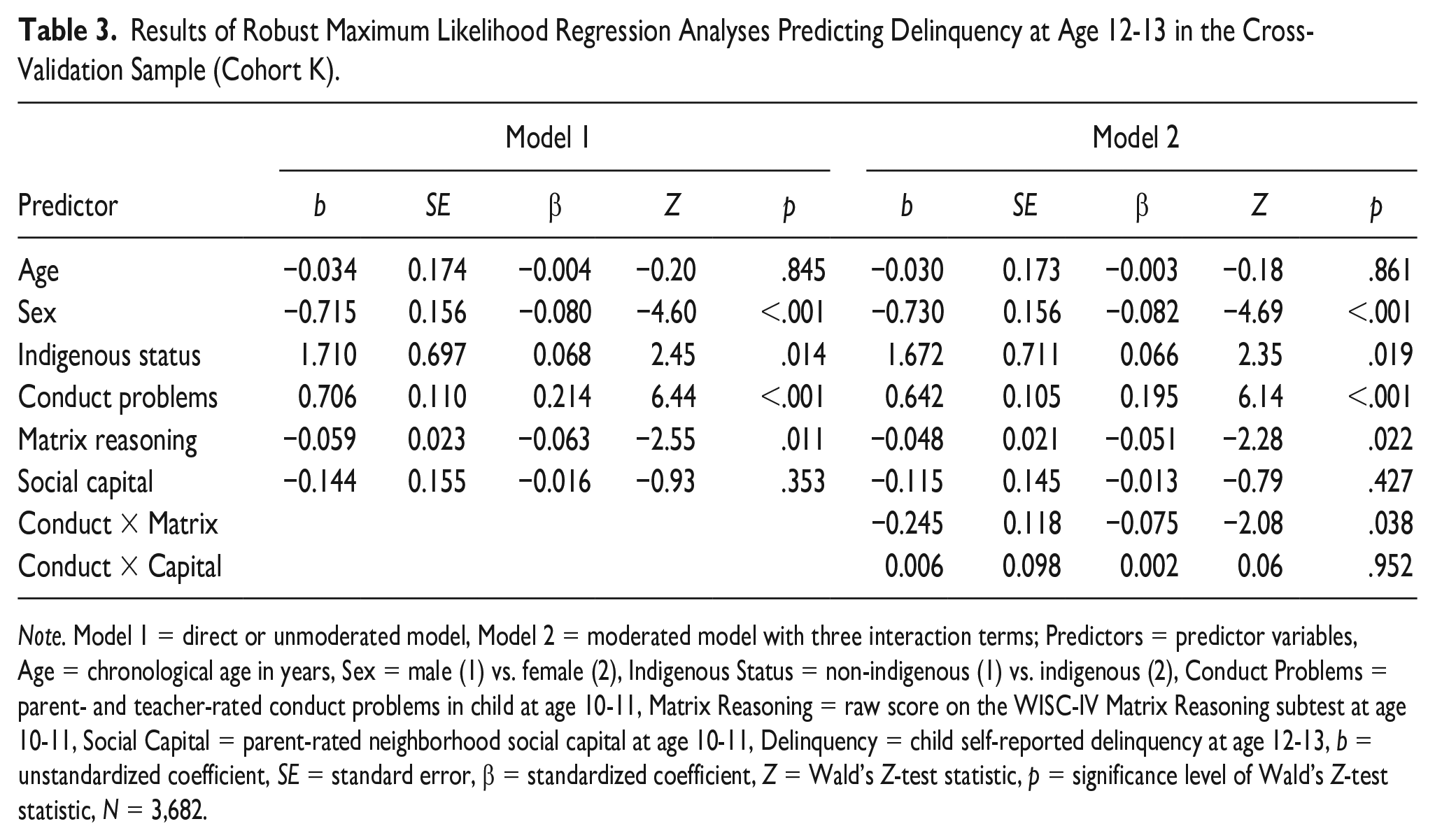
Note. Model 1 = direct or unmoderated model, Model 2 = moderated model with three interaction terms; Predictors = predictor variables, Age = chronological age in years, Sex = male (1) vs. female (2), Indigenous Status = non-indigenous (1) vs. indigenous (2), Conduct Problems = parent- and teacher-rated conduct problems in child at age 10-11, Matrix Reasoning = raw score on the WISC-IV Matrix Reasoning subtest at age 10-11, Social Capital = parent-rated neighborhood social capital at age 10-11, Delinquency = child self-reported delinquency at age 12-13, b = unstandardized coefficient, SE = standard error, β = standardized coefficient, Z = Wald’s Z-test statistic, p = significance level of Wald’s Z-test statistic, N = 3,682.
The conditional effects for the K cohort, like those for the B cohort, were in the predicted direction, with the conduct problems-delinquency relationship being significant when matrix reasoning was low or medium but then falling just short of significance when matrix reasoning was high. The problem behavior × matrix reasoning interaction is depicted in Figure 2 and illustrates that the conduct problems-delinquency relationship was significantly weaker when matrix reasoning was high. This is once again represented by a high matrix reasoning line with less slope relative to the low matrix reasoning line.
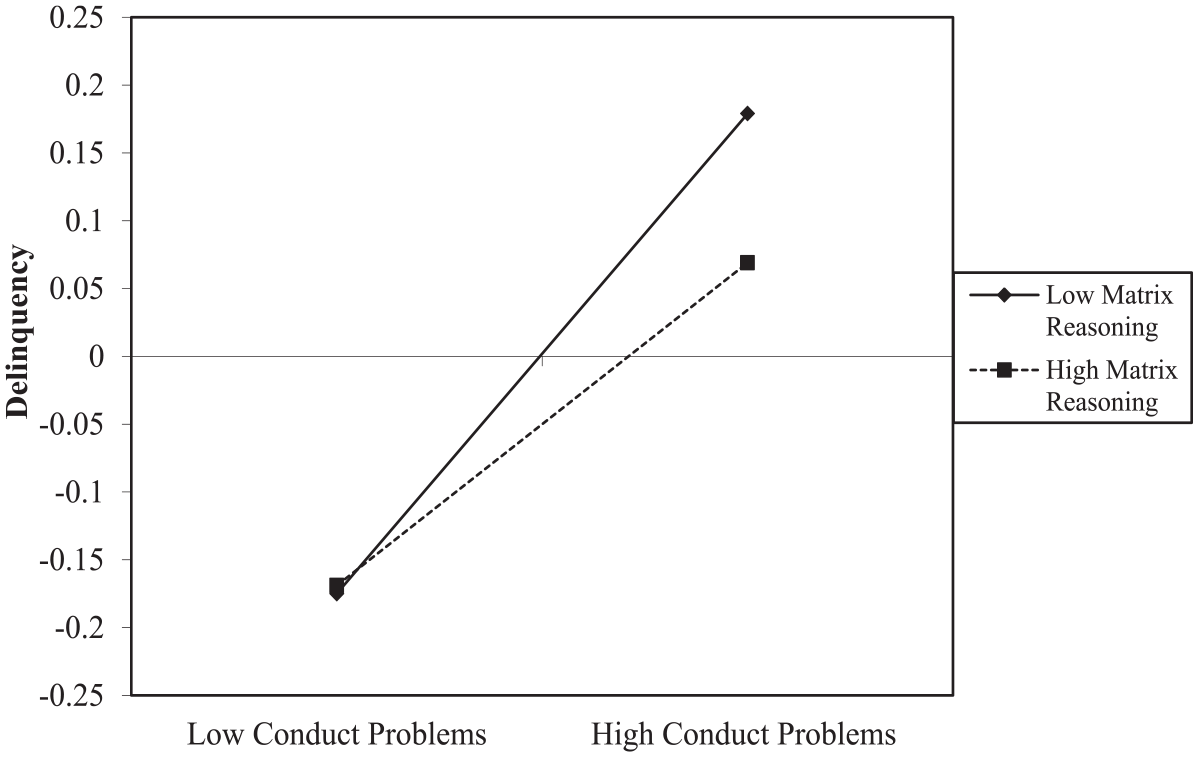
Interaction between conduct problems and matrix reasoning at age 10-11 as a predictor of delinquency at age 12-13 in the cross-validation sample (Cohort K).
The conduct × matrix interaction was significance in the first supplemental test when all 4,169 participants from the cross-validation sample with at least one complete data point were evaluated without benefit of weighting (Z = −2.33, p < .05; β = −0.08). The conduct × matrix interaction remained significant when five outliers identified through SPSS Explore (score > 46) were winsorized to the next lowest value (i.e., 45) and the analysis re-computed (Z = −1.97, p < .05; β = −0.07).
Discussion
According to the results of this study, certain factors may be helpful in managing delinquency during the early stages of its development. In the direct or unmoderated models for both cohorts, there was strong support for childhood conduct problems as a risk factor for delinquency. Matrix reasoning, on the other hand, produced a protective (interaction) effect in the initiation and cross-validation samples. It also served as a promotive factor (main effect) in the cross-validation sample. Conditional effects (Tables 2 and 4) and visual inspection of the conduct × matrix interactions (Figures 1 and 2) denote that conduct problems were a strong predictor of early delinquency only when matrix reasoning was low or medium in magnitude, the hallmark sign of a protective effect. Use of matrix reasoning instead of a verbal scale like vocabulary to measure intelligence was particularly helpful in ruling out schooling as an alternative explanation for the current results given that nonverbal scales like matrix reasoning have long been known to be less influenced by schooling than verbal scales (Cahan & Cohen, 1989). Moreover, the use of a longitudinal design helped establish the temporal order of the predictor and outcome variables employed in this study.
Conditional Effects of Focal Predictor (Conduct Problems) at Different Levels of the Moderator (Matrix Reasoning) in the Cross-Validation Sample (Cohort K).
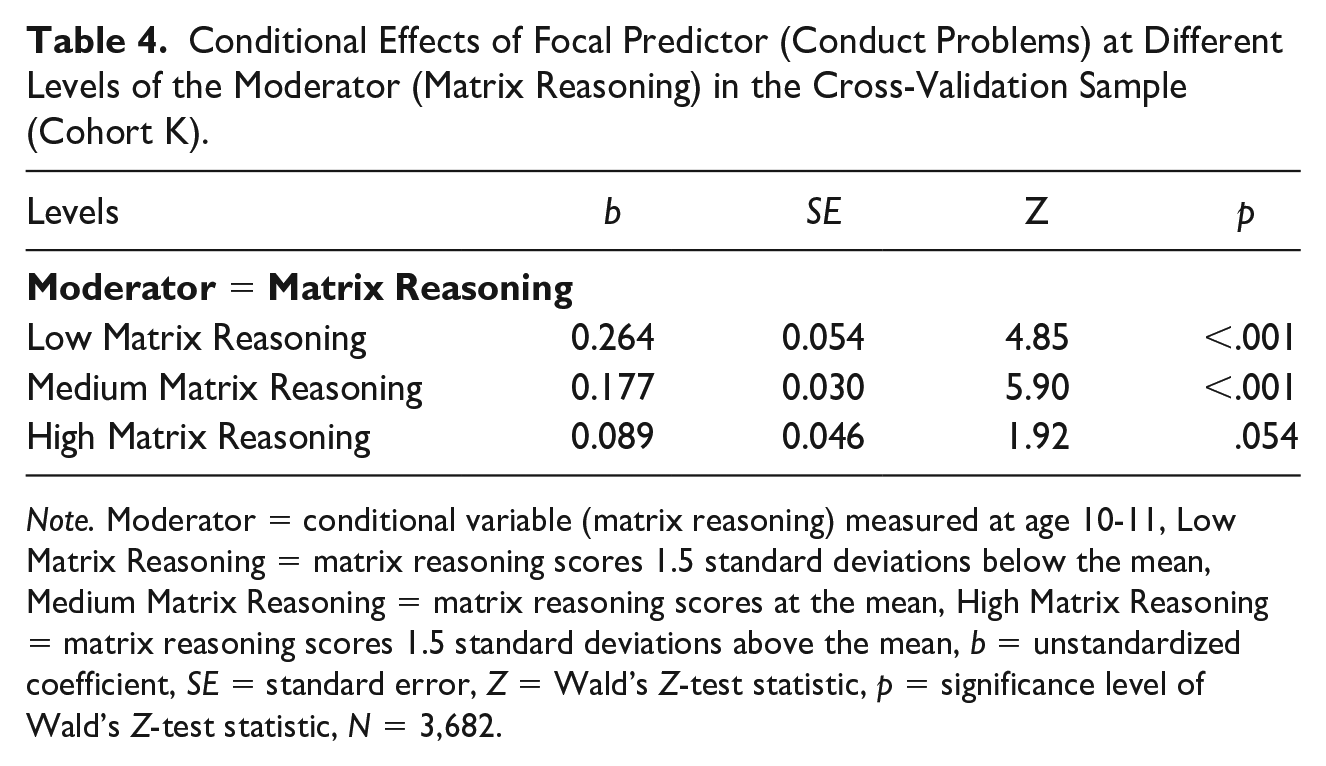
Note. Moderator = conditional variable (matrix reasoning) measured at age 10-11, Low Matrix Reasoning = matrix reasoning scores 1.5 standard deviations below the mean, Medium Matrix Reasoning = matrix reasoning scores at the mean, High Matrix Reasoning = matrix reasoning scores 1.5 standard deviations above the mean, b = unstandardized coefficient, SE = standard error, Z = Wald’s Z-test statistic, p = significance level of Wald’s Z-test statistic, N = 3,682.
Neighborhood social capital, unlike nonverbal intelligence, failed to achieve a promotive or protective effect in the initial (Cohort B) or cross-validation (Cohort K) samples. In the current study at least, neighborhood social capital was ineffective in buffering against a particularly potent risk factor in childhood conduct problems. This does rule out the possibility, however, that neighborhood social capital may serve as a protective factor for another risk factor. Unlike risk factors, which code for general risk, protective factors are specific to a particular class, category, or type of risk. Thus, while neighborhood social capital may be ineffective in moderating the risk of conduct problems on early delinquency, it may be effective in moderating the risk of specific social, environmental, and structural conditions; neighborhood disorder (Sampson et al., 2002), criminal victimization (Jennings et al., 2012), and poverty (Dong, Egger, & Guo, 2020) being but three examples. What this suggests is that the term protective factor may be a misnomer and that a more risk-relevant term like protective effect may be more descriptive. It should also be pointed out that the neighborhood social capital measure was restricted to two items because these were the only social capital-relevant items available in Cohort K. A more comprehensive measure of neighborhood social capital/collective efficacy may have produced different results and should be considered in future research on this topic.
One of the more consistent findings from this study was that the abstract reasoning and nonverbal problem-solving skills assessed by the Matrix Reasoning scale of the WISC-IV acted as a consistent but modest moderator of the longitudinal conduct problems–delinquency relationship. From this, it could be surmised that nonverbal intelligence may offer modest protection against delinquency in early adolescent youth placed at risk for future delinquency by prior conduct problems. Similar results were obtained in a study on child abuse and later criminality in adults who elevated the Matrix Reasoning scale of the Wechsler Adult Intelligence Scale-III. Those adults who scored high on this scale were significantly less likely to have an arrest for violent criminality than adults with comparable histories of childhood abuse who scored low on the matrix reasoning scale (Nikulina & Widom, 2019). The results of the current study combined with those from Nikulina and Widom (2019) indicate that nonverbal intelligence may exert a protective effect on two different risk factors—conduct problems and childhood abuse, respectively. Nikulina and Widom (2019), however, never obtained a significant interaction between childhood abuse and nonverbal intelligence, and so intelligence’s role in reducing the effect of childhood abuse on future adult offending requires further corroboration. The current results suggest that higher levels of intelligence may protect some youth placed at high risk for early delinquency by a history of childhood conduct problems, but the effects were small (β = −0.075 to −0.076). They were so small, in fact, that their practical significance is brought into question.
Although the practical value of the current findings may be limited, the theoretical implications appear to be more substantial. It was previously argued that intelligence, whether verbal or nonverbal, is capable of assisting people in making decisions as described by rational choice theory and the deterrence doctrine. Just because an individual possesses above average intelligence, however, does not mean that they will necessarily make good decisions. Intelligence may promote better decision-making, but it needs to be evaluated in light of other relevant person factors, such as impulsivity, empathy, and lack of insight. A child with good intelligence could still make a bad decision by allowing their impulsivity or self-centeredness to interfere with the decision-making process. Situational and environmental factors also impact on the decisions we make, sometimes in indirect and highly circuitous ways. One study, for instance, disclosed that tobacco use during pregnancy had a deleterious effect on an unborn child’s future ability to use perceptual and abstract reasoning skills to solve complex problems (Ramsay et al., 2016). We may study variables in isolation, one or two at a time, but if our goal is to fully understand a process as complicated as delinquent decision-making, we will need to study a range of variables and how they interface with one another, whether it be through interaction, mediation, or some other process.
The current study presents with both strengths and weaknesses. One notable strength is the availability of two large samples, which, in turn, allowed for cross-validation of initial findings. Second, because the data were longitudinal, the present study allowed for proper temporal ordering of predictor and outcome variables. Another strength of this study is that three different types of measures were employed. Research in the social and behavioral sciences is often criticized for its reliance on a single data source—most often, self-report (Shadish, Cook, & Campbell, 2002). Yet, in the present study there were three sources of data: reports from others (parent and teacher ratings of prior conduct problems), a performance measure (WISC-IV Matrix Reasoning), and a self-report measure (subsequent delinquency). One criticism that could be leveled against the present study is that the moderating effects were small in magnitude. Interactive effects, it should be noted, are nearly always small, particularly when one or both main effects are significant (Aguinis, Beaty, Boik, & Pierce, 2005; McClelland & Judd, 1993). A further limitation of this study is that one of the putative protective factors (neighborhood social capital) was composed of just two items, another variable achieved only modest reliability (conduct problems), and an important demographic control variable (socioeconomic status) could not be included in the current study because it was not measured in the LSAC.
The current results produced consistent support for nonverbal intelligence as a protective factor against the delinquency-promoting effects of childhood conduct problems. One reason why neighborhood social capital failed to produce either a promotive or protective effect in the direct or moderated analyses of either cohort was that scores on the instrument used to measure neighborhood social capital were concentrated at the upper end of the scale (91%–95% of the parents rated their neighborhood as 2.5 or higher on a scale from 1 to 4). Moreover, neighborhood social capital may be less relevant to the actions of individual neighborhood youth than it is to the neighborhood as a whole (De Coster, Heimer, & Wittrock, 2006). Besides clarifying the mechanisms responsible for the reasonably consistent protective effect observed for nonverbal intelligence in mitigating the risk presented by childhood conduct problems, it is imperative that the number and variety of possible protective factors be expanded to include such potentially important protective factors as self-efficacy at the individual level and school involvement at the social-environmental level. Given the situational specificity of protective effects, they may contribute to our understanding of youth resilience (Zolkoski & Bullock, 2012); but only by expanding the base of protective factors and clarifying how these protective factors moderate risk by interacting with specific risk factors will researchers be in a position to understand the complex nature of resilience as a means of managing, controlling, and reducing future delinquency.
Footnotes
Appendix
Descriptive Statistics and Correlations for the Eight Variables Included in the Cross-Validation Sample (Cohort K).

| Variable | n | M | SD | Range | 2 | 3 | 4 | 5 | 6 | 7 |
|---|---|---|---|---|---|---|---|---|---|---|
| 1. Age | 3,682 | 10.33 | 0.47 | 10-11 | −.00 | .01 | .01 | .07 † | .02 | −.00 |
| 2. Sex | 3,682 | 1.49 | — | 1-2 | .02 | −.16 † | .04 | −.03 | −.12 † | |
| 3. Indigenous status | 3,680 | 1.03 | — | 1-2 | .11 † | −.11 † | −.02 | .10 † | ||
| 4. Conduct problems | 3,676 | 1.14 | 1.26 | 0-9 | −.19 † | −.11 † | .23 † | |||
| 5. Matrix reasoning | 3,632 | 23.03 | 4.56 | 6-35 | .03 | −.11 † | ||||
| 6. Social capital | 3,658 | 3.16 | 0.49 | 1-4 | .04 | |||||
| 7. Delinquency | 3,582 | 1.38 | 4.25 | 0-85 |
Note. Variable = variable name, n = number of participants with complete data, M = mean, SD = standard deviation, Range = range of scores in the current sample, Age = chronological age in years, Sex = male (1) vs. female (2), Indigenous Status = non-indigenous (1) vs. indigenous (2), Conduct Problems = parent- and teacher-rated conduct problems in child at age 10-11, Matrix Reasoning = raw score on the WISC-IV Matrix Reasoning subtest at age 10-11, Social Capital = parent-rated neighborhood social capital at age 10-11, Delinquency = child self-reported delinquency at age 12-13.
p < .0024 Bonferroni-corrected alpha .05/21 correlations).
Declaration of Conflicting Interests
The author(s) declared no potential conflicts of interest with respect to the research, authorship, and/or publication of this article.
Funding
The author(s) received no financial support for the research, authorship, and/or publication of this article.
